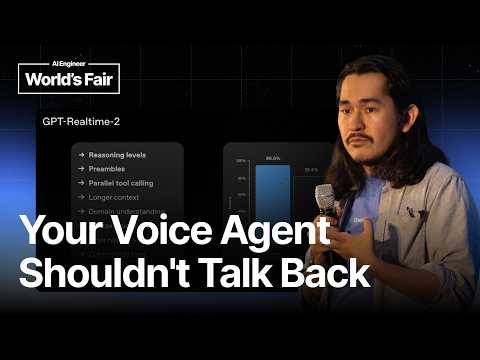
Voice Agents Can Just Do Things — Charlie Guo, OpenAI
Talk by Charlie Guo (OpenAI developer experience) on voice agents and the assumption that they must respond in speech. Covers the three long-standing modes of voice interaction (speech-to-speech, speech-to-action, event-to-speech), argues speech-to-action is the most neglected ("voice the next capability overhang"), shows how existing app endpoints and handlers can be converted into tools a voice model can call, and discusses hands-free contexts and accessibility, ending with the question of what role voice should play at all.
# Video Identity Observations: "Voice Agents Can Just Do Things — Charlie Guo, OpenAI"
## Speaker Self-Description (Explicit Claims)
- **Speaker identity and role**: Charlie Guo states, > "my name is Charlie uh and I work on the developer experience team at OpenAI. And part of my job is talking to developers to understand and see... how they're building with our models."
- **Employer affiliation**: OpenAI is stated directly and reinforced by the title and the closing, > "I'll be at the OpenAI booth, for any Q&A after."
- **Presentation context**: The talk is framed as a conference keynote-style session ("if you take away from this presentation," "next year's keynote," "many of the talks today"), with multiple references to other speakers' talks ("if you saw Quinn's talk," "as we just saw in the last talk").
## Intended Audience
- **Developers building with AI models**: The speaker repeatedly addresses builders directly:
> "if you're a developer today... what does that mean for building your own software"
> "every developer has an endless amount of notifications"
- **Audience assumed to be technical**: References assume familiarity with concepts like **API endpoints**, **React hooks**, **tool calling**, **streaming audio**, and **benchmarks** without basic explanation.
- **Audience of practitioners at an AI-focused event**: The framing "what would it mean to take your existing software and just talk to it" targets people with existing products.
## Claimed Scope of Content
- **Core thesis**: > "speech is not the only way that a voice model has to respond" — challenging the misconception that "voice agents have to talk back."
- **Three-part framework presented**:
1. **Speech to speech** (e.g., language learning, support, live translation)
2. **Speech to action** (form filling, creative tools, computer use) — described as > "one of the most underexplored areas"
3. **Event to speech** (hands-free experiences, proactive outreach) — called > "still very very exploratory"
- **Cross-cutting themes**: remixability of modes ("they're not meant to be mutually exclusive") and **accessibility**, supported by a personal anecdote about developers who lost hand mobility.
## Product/Company Promotion (Explicit)
- **GPT Realtime 2 pitch**: The speaker flags it himself: > "this is going to be the one part of the talk where I make my shameless plug." Claims include reasoning over audio, parallel tool calls, "preambles," longer context, wake words, and strong benchmarks ("TL;DR, is a pretty good model").
- **Technical positioning**: OpenAI's real-time model family is described as trained on native audio tokens rather than a transcription chain, contrasted with the "chained approach" of earlier voice modes.
## Closing Positioning Claim
- **Channel-scope ambition**: The talk ends with a design philosophy claim: > "start with the question of what is the role of voice and audio in this interaction" and a forward-looking statement, > "I do believe that AGI will be spoken, not typed."
## Demonstrated Presentation Patterns (Observable, Not Claimed)
- **Educational, framework-driven style**: Organizes content into taxonomies (three modes, use-case categories, question lists) with concrete examples.
- **Candid, informal tone**: Self-aware humor ("shameless plug," "cheekily calling concierge experiences... customer support plus") and verbal fillers consistent with a live, unscripted conference talk.
- **Evidence types used**: Personal anecdotes, historical analogies (movie phone hotline, car GPS), and latency comparisons — no third-party data cited beyond internal product comparisons.
- **Call to action**: Direct exhortation to the audience to experiment: > "I hope everybody in here can start to build some much richer experiences with voice."
## Notes on Limits
- This is a **single conference talk**; it demonstrates OpenAI developer-relations presentation style but does not alone establish channel-wide content patterns.
- No curated metadata was supplied; identity evidence comes solely from title and transcript.
- Claims about the model's capabilities (benchmarks, latency, features) are **creator/product claims**, not independently verified within the material.
# Delivery Observations — Charlie Guo, "Voice Agents Can Just Do Things"
## Tone & Overall Style
- **Conversational, low-key casual**: The talk reads like spoken dialogue rather than scripted presentation, marked by heavy filler language throughout: *"you know,"* *"um,"* *"like,"* *"right?"* — e.g., *"And I think, you know, the other thing I would mention here is that um they're they're remixable, right?"*
- **Self-aware humor**: He flags his own joke: *"what I am sort of cheekily calling concierge experiences which I think is just another way to say customer support"* and calls the model section his *"shameless plug."*
- **Colloquial vocabulary**: *"vibe create, vibe compose, vibe paint"*; *"cludily trying to iterate"*; *"a significant GDP of the internet."*
## Recurring Phrases & Verbal Habits
- **"I think" as a constant hedge/framing device** — appears dozens of times: *"I think there are a few examples," "I think this is one of the most underexplored areas."*
- **"right?" as a discourse tag** to re-engage the audience: *"right uh speech to speech speech to action and event to speech"*; *"start with the question of like what is the role of voice and audio in this interaction? Um and then how do I move forward from there, right? Right?"*
- **"you know" repetition** — nearly every paragraph contains at least one instance.
- **"Um" and "uh" fillers** appear continuously, consistent with unscripted or loosely scripted delivery.
## Teaching / Structural Habits
- **Explicit thesis statement up front**: *"if there's one thing that you take away from this presentation, I would like it to be the idea that speech is not the only way that a voice model has to respond."*
- **Numbered taxonomy**: He organizes the talk around *"three kind of modes... speech to speech speech to action and event to speech,"* then walks through each in sequence.
- **Signposting transitions**: *"The second category is speech to action"*; *"And then the last bucket here is event to speech"*; *"And that brings me to GPT realtime 2."*
- **Concrete everyday analogies**: movie phone hotline, GPS navigation, phone trees, a recipe app while cooking, a human travel agent saying *"Hey, like I'm going to go check flight prices."*
- **Callback structure**: He returns to the opening misconception: *"Um and to go back to that misconception, right?"* and closes with a reframed question for builders.
- **References to other talks at the event**: *"as we've seen from from previous talks, even just today"*; *"if you saw Quinn's talk."*
## Audience & Context Awareness
- **Addresses a developer audience directly**: *"if you're a developer today, um, what does that mean for building your own software?"*; mentions API endpoints and React hooks.
- **Cites event logistics**: *"I'll be at the OpenAI booth, uh, for any Q&A after."*
- **A moment of live recovery**: a slip at *"But if you're a developer today, right? Whoops."* — observable, though we can't confirm what the "whoops" referred to (likely a slide/remote issue).
## Uncertainty Notes
- Timing, pacing, and audience reaction are not observable from the transcript alone; filler density suggests an informal spoken style, but vocal tone cannot be verified.
- The **[snorts]** marker indicates a light moment mid-talk, but its cause is not stated.
# Observation Document: "Voice Agents Can Just Do Things" — Charlie Guo, OpenAI
## Speaker
- **Charlie Guo**, developer experience team, OpenAI. Identifies himself at the talk's start.
## Central Thesis
- A **misconception/misunderstanding** exists that voice agents "have to talk back."
- Key takeaway he wants the audience to retain: **speech is not the only way a voice model has to respond**. Models are becoming intelligent enough to open new design modes.
## Three Emerging Modes
Guo names three categories, with two framing points:
- **Not new**: Long history of such systems. Examples he cites:
- Movie-phone hotline for showtimes as an early speech-to-speech system ("if you squint").
- Car GPS navigation as an early event-to-speech system.
- **Remixable / not mutually exclusive**: The best products combine all three modes.
### 1. Speech to Speech
- User talks, model talks back. Examples:
- **Live practice/coaching**, especially language learning — hearing emphasis/emotion and giving feedback.
- **"Concierge experiences"** — his "cheeky" term for "customer support plus." Notes the first voice tutorial most builders attempt is a customer support chatbot. Expresses hope that agents can soon feel more enjoyable to talk to than "arguably the median human support agent."
- **Live translation** — models now fast enough to translate dynamically with little latency. Speculative claim: "It wouldn't shock me" if next year's keynote were live-dubbed in real time across languages.
### 2. Speech to Action
- User talks; model uses tools. Guo calls this **"one of the most underexplored areas"** — he nearly titled the talk "voice is the next capability overhang."
- Three interesting categories:
- **Form filling**: Much of the internet is forms. He'd prefer talking five minutes to fill a government document with 90% completion plus a quick human check, versus typing everything manually. Calls it "boring" but significant "GDP of the internet."
- **Creative tools**: He can articulate software requests to Codex but lacks vocabulary/skill for music or painting — "my taste exceeds my capability." Looks forward to voice-enabled "vibe create, vibe compose, vibe paint."
- **Computer use** (generalizable category): If models can do everything a human can on a computer, "why am I talking to an app?... Why am I not just talking to the entire computer?"
- **Developer guidance**: Modern web apps already expose actions as "nouns and verbs" (API endpoints, React hooks) that can be converted into tools exposed to a model, letting users drive existing software by voice. Qualification: guardrails and safety checks are still needed.
### 3. Event to Speech
- Model receives an event and talks to the user. Counterpoint to speech-to-action; **still very exploratory**. "We haven't quite seen what AI native really looks like in this vein yet."
- Two through lines:
- **Hands-free / screen-free experiences**: e.g., a recipe app used while cooking, when attention is diverted.
- **Proactive outreach**: No developer would display or speak *all* logs, but voice can be the top of an escalatory attention path: animate → pop-up → speak to the user.
## Cross-Cutting Theme: Accessibility
- Knows multiple developers who lost hand mobility/finger dexterity and thought their programming careers were effectively over; with LLMs, coding agents, and voice agents, they now produce "orders of magnitude more code" than before.
## Mixing Modes
- **In-car assistants**: All pieces exist (CarPlay, Spotify control, Google Maps traffic rerouting alerts) but nothing combines them into one seamless voice agent across modes.
- **Games**: Experimentation with in-game characters — talk to mine information, execute actions, and react to world events via speech instead of simple notifications.
## Why Now: Model Architecture Context
- Traditional voice agents use a **chained approach**: talk → transcribe → LLM → tool calls → text → audio → playback.
- OpenAI's **real-time model family** differs: no behind-the-scenes transcription; trained on native audio as tokens — audio in, audio out. Industry is trending this way, including dropping the turn-based abstraction for continuous streaming.
- What transcription loses: tone, cadence, emotional impact, interruption cues, background noise.
- Quantitative reason: the first two ChatGPT voice modes (chained) had significantly higher latency than the native approach with advanced voice mode.
## GPT Realtime 2 (his "shameless plug")
- Latest model in the real-time family, released "a couple of months ago" (as of the talk).
- Features claimed:
- **Reasoning in the audio medium** — "it can now think before it speaks"; users can give it more reasoning budget.
- **Parallel tool calling** alongside thinking (adds latency, he acknowledges).
- **Preambles** — model can tell the user it's thinking or calling tools, e.g., a travel agent saying "I'm going to go check flight prices... give me a couple seconds."
- Longer context, better domain understanding, more natural voices, greater steerability.
- **Wake words** — can give the model a name (e.g., "hey, Marin") and prompt it to respond.
- Performs well on "the latest audio benchmarks."
## Closing Advice
- Do **not** start with "what kind of voice agent am I trying to build?"
- Start with: **"What is the role of voice and audio in this interaction?"**
- Follow-on questions: What can the model perceive? What context does it have? What tools are available, and which should it execute safely? Should it communicate now or wait? Visual notification or audio?
- Final claim: **"AGI will be spoken, not typed."**
## Preserved Qualifications
- The three modes "are not new."
- Speech-to-action is "underexplored"; event-to-speech is "very, very exploratory."
- Tool calling "adds latency" — an acknowledged trade-off.
- Guardrails and safety checks remain necessary.
- Claims about realtime transcription statistics (55%/38%/7% body language/tone/words) are quoted as an "old saying," not sourced data.
- The live-dubbed keynote prediction is explicitly speculative ("It wouldn't shock me if...").
# Speaker Attribution & Provenance Record
## Video
- **Title:** Voice Agents Can Just Do Things — Charlie Guo, OpenAI
- **Video ID:** `01a15ca7-6426-7950-bd24-668f52177802`
## Speakers & Roles
| Speaker | Role | Evidence |
|---|---|---|
| **Charlie Guo** | **Primary speaker / presenter**; identifies himself as a member of the **developer experience team at OpenAI** | *"my name is Charlie... I work on the developer experience team at OpenAI"* |
- No other speakers appear in the transcript; the presentation is a single-speaker talk.
- A `>>` marker appears near the start and end (with `[music]`), but no additional speaker content is attributable to it.
- No narrator, guest, host, or audience Q&A content is present.
## Referenced Third Parties & Prior Talks (Unquoted/External)
- **Quinn's talk** — referenced regarding event-to-speech explorations (*"if you saw Quinn's talk"*).
- **A prior talk on live translation** — referenced (*"as we just saw... the last talk"*).
- No full names, dates, or titles were provided for these referenced talks.
## Products, Tools & Claims Cited by the Speaker
- **OpenAI Real-Time model family** — described as trained on **native audio as tokens** (no transcription step).
- **GPT Realtime 2** — described as released *"a couple of months ago"* (relative to talk date), with reasoning in audio, tool calling (including parallel tool calls), "preambles" (transcript spelling; likely "preambles"), longer context, wake words, and benchmark performance claims.
- **Advanced Voice Mode in ChatGPT** — latency comparison against the first two chained voice modes.
- **Codex / Codex app** — referenced as a coding tool and for its "ghost cursor" computer-use animation.
- **Third-party products mentioned as examples:** Spotify, Google Maps, CarPlay, Photoshop, Ableton, GPS navigation, movie phone hotlines.
- **"55/38/7" communication statistic** — attributed by the speaker to an *"old saying"* about body language, tone, and words; **no named source provided**.
## Promotional Segments
- **Flagged: GPT Realtime 2 segment.** The speaker explicitly labels it: *"this is going to be the one part of the talk where you know I make my shameless plug."* This portion promotes OpenAI's Realtime 2 model and its features.
- The speaker also closes by inviting attendees to the **OpenAI booth for Q&A**, an OpenAI-affiliated promotional/availability note.
## Availability & Uncertainty
- **Comment availability:** Not stated in the source material.
- **Curated metadata:** None supplied beyond the title.
- **Relative dates only:** "a couple of months ago," "recent months/years" — no absolute dates.
- The speaker frames some content as personal opinion/aspiration (e.g., *"It wouldn't shock me if..."*), not verified fact.
- Some claims (benchmark results, latency comparisons) are speaker assertions without cited external sources.
So, my name is Charlie uh and I work on the developer experience team at OpenAI. And part of my job is talking to developers to understand and see, you
know, what and how they're building with our models. um whether that's text, image or audio. And lately I've been thinking about a misconception that I have seen or maybe it's just a misunderstanding and it's the idea that voice agents have to talk back. \>\> And to some of you that might sound, you know, absurd. It's a voice agent. What do you mean it's not supposed to talk? Uh, but I think if there's one thing that you take away from this presentation, I would like it to be the idea that speech is not the only way that a voice model has to respond. And I think models are getting intelligent enough and capable enough that they're starting to open up some uh new modes of design. I mean there's actually three kind of modes that that you know I kind of see emerging these days right uh speech to speech speech to action and event to speech and there's a couple of things I think worth pointing out about um these three categories. The first is that they're not new, right? I think as we've seen from from previous talks, even just today, um there's a long history of building these types of systems in and around voice. Um if you squint, you could make the argument that the movie phone hotline where you called in to get showtimes was an example of a speech-to-pech system. Uh and I think you could pretty reasonably make the argument that you know GPS navigation in your car which has existed since I was a
kid is an example of an event to speech system. So, it's not that they are brand new, but I think it is that we are able to do some some much more interesting things with them uh now that uh we're in
this era, right? And I think, you know, the other thing I would mention here is that um they're they're remixable, right? They're not meant to be mutually exclusive. Um and I think as we'll see in a little bit, the best products uh exist in a way that combines all of these modes. So, speechto um everybody knows it. Hopefully, everybody loves it. the user talks uh and then the model talks back and I think there are a few examples that that I can give um for this type of use case right you've got things like live practice and coaching especially around language learning right I think the ability to um hear a
lot of emphasis or emotion and give people that feedback is really powerful um I think you can have you know what I am sort of cheekily calling concierge experiences which I think is just another way to say customer support
plus+ Um the first voice tutorial that most people you know try to build when they have access to this technology is some sort of customer support chatbot for very good reasons. But I think with you know when we add a richness and a depth to the voice models as has been happening in recent months in recent years um we can build something that is like much more enjoyable to use than like talking your way through a phone tree. Um, and so, you know, I have the hope that like soon, if not like, you know, now, we're capable of building support experiences with agents that actually feel much more enjoyable to talk to than like arguably like the median human support agent. Um, and as we just saw if you hear the last talk, uh, live translation, right? The models have gotten good enough and fast enough that we can just dynamically translate content on the fly, um, with like little to no latency. It wouldn't shock me if at next year's keynote um you know they live streamed it from the main stage but also uh dubbed it in real time across multiple languages. The second category is speech to action. Uh these are talks and the model uses tools and I think this is one of the most underexplored areas that we have. Um I actually almost titled this talk uh voice is the next capability overhang because I think there is just a vast vast amount of stuff um that we could be doing in this category that we are not currently doing. Uh for example um there's a broad spectrum I don't have you know there's way too many examples even fit on this slide but three
categories that that I find particularly interesting. Uh first is form filling right um so much of the internet is just filling out forms. Um, and there is, you know, today no reason why you shouldn't
be able to just talk. You know, I would love it if instead of spending an hour filling out a government document, I could just talk for five minutes and it would get 90% of it for me and I would do a quick check, you know, just to make sure that everything looked good, right? That is a vastly superior experience than like having to type in every single name and address that I've lived in the last 5 years and, you know, all of my previous identities. Um and so I think I think that one is though it may seem boring you know affects a a significant GDP of the internet right the next category is creative tools uh where I am privileged enough that I can speak the language of software and so I can tell codeex you know here's exactly what I want you to build and I can articulate it in a way that um I get much more leverage than sort of just like cludily trying to iterate one thing at a time but I can't do that when it comes to you know using making music or painting um and so if I don't have the ability to articulate um the exact aesthetic that I'm looking for. Um and if I don't know how to use Photoshop or Ableton, I'm left in this state where, you know, my my taste exceeds my capability. Um and so I'm really looking forward to integrating voice into creative tools so that I can just sort of cludgy go along and, you know, vibe create, vibe compose, vibe paint, um and make something that that's really beautiful to me. And I think the generalizable um category here, right, then just starts to become computer use. And we've already seen some companies start to do this. Um, you know, it raises the question of like, look, if the models are just getting good enough to do everything on a computer that a human can do, like why am I talking to an app? Why am I talking to a terminal? Why am I not just talking to the entire computer? Uh, and so I think that's sort of a really interesting uh way to start exploring. But if you're a developer today, right? Whoops. If you're a developer today, um, what does that mean for building your own software, right? And I think it is like much easier than you think to start adding audio as an intelligence layer to the intelligence layer to the apps that you already have. Um, if you're building a modern web application, you already expose so much of it as like action as nouns and verbs, right? And if you think about all the verbs that you have, you have uh API endpoints, you have, you know, React hooks. Each of those things can like pretty relatively easily be converted into a tool that you expose to a model and then you can give the user the
ability to just drive your existing software um with their voice, right? And yes, you still need guardrails, you still need safety checks. Like many of the talks today are going to talk about securing and you know productizing this,
but um for this I just want you to think about you know what would it mean to take your existing software and just talk to it. Um and to go back to that misconception, right? I think there are a lot of um you know like if you're talking to the software maybe it can talk back but we've been developing other ways of communicating with the user for decades right we know these things we know we can show notifications and popups we can change state like the color of a button or a drop shadow we can highlight text um if you've used computer use in the codeex app you know there's this amazing like little ghost cursor animation that goes around and clicks things for you so we don't have to use words to actually tell the user what is happening on screen with their software Uh and then the last bucket here is event to speech, right? Um the model
receives an event and talks to the user. Um and sort of the counterpoint from speech to action. I think this one is still very very exploratory, right? Um you know, if you saw Quinn's talk, I think there's a lot of uh space here of
like things we can do. Um and to me, we haven't quite seen what AI native really looks like in this vein yet. But um of the things that I've seen, I think there's a couple of through lines that I tend to notice, right? The first is hands-free or screen-free experiences. There might be times where uh I need to interact with software, interact with objects and I can't use my hands or more importantly my attention is diverted elsewhere. Um that might be something you know like uh a recipe app. Maybe I'm cooking and I need to just say like what's going on and and have something else have something happen. Um the other category is proactive outreach, right? Where you the model needs to be able to tell you something or get your attention in a way um that you might not be looking at, right? I think every developer um has uh an endless amount of notifications and events happening in their software. But um no developer in their right mind would sort of say I should show all of these logs. Nor you know would they say I should speak all of these logs. But we can start to conceive of voice as this like upper level in this escalatory path of like okay maybe you animate something and then maybe you pop something up and then if that doesn't work maybe you talk to the user to get their attention. And underlying both of these categories and I think this this you know this whole presentation is this broader theme of accessibility. Um on a personal personal note, I know like multiple developers who um over the course of their careers lost mobility in their hands, lost dexterity in their fingers and for many of them, they thought their career as a programmer was more or less over. Um and then came large language models, right? Then came coding agents
and voice agents and now they generate orders of magnitude more code than they like previously did um you know on a given given day or month. Um, and so I think there's there's a lot that we can unlock here uh for the broader world as
well. Um, to go back to like I said, you know, I think like when it comes to these three modalities, you can mix and match them and we already have some, you know, rudimentary ways that we're seeing this. I think there's things like, you know, all of these pieces for in-car assistants exist, though nothing has quite like combined them into this seamless way. You can talk to like the CarPlay dashboard. Um, you can tell it, "Hey, go play some Spotify music for me." Um, and then it can come back and tell you, Google Maps can come back and tell you, hey, like, you know, there's traffic on this route. We're going to reroute you. But like we can now start to think about what does it mean to combine that into like a single voice agent across multiple modes. \[snorts\] Um, similarly, you know, there's a lot of experimentation in the game space with multimodality. Um, you can think about a real life character where you're talking to it to, you know, mine information about the game, about the world. um you can talk to it to execute actions on your behalf and then it can react to like world events right that are happening and then give that information to you rather than just like a simple notification um and I think the question you know behind the question here right is like I mentioned we've had all these things for a while people have been prototyping them for a while why focus on them now why think about building with them now um and I think that brings me to uh a little bit of context here right as as I'm hopefully most of you know traditionally voice agents are built in this chain Ed model, right? You uh talk, you transcribe, you send that to a language model. It calls tools. Hopefully, it doesn't take too long to respond. Um it then generates text output. You make that into audio and then you play that back to the user. And some time ago, um OpenAI, you know, decided on a different approach, right? The real-time model family does not do any transcription behind the scenes. It is trained on native audio as tokens. So, you send audio in and you get audio back out. And the industry I think in general has been, you know, trending more in this direction. Um, and not just making it native audio, but even just letting go of the turnbased abstraction that we've had, right? Um, and so making it that it's just continuous streaming audio in and out. And the reason that opening I did this was, you know, turns out there's a lot of stuff that you lose when you transcribe speech and when you transcribe audio, right? Um there's the old saying that when humans communicate face to face, 55% of the information is in body language, another 38% is in your tone of voice and the last like 7% is the actual words you are saying. Um and so when you transcribe, you lose tone and cadence and emotional uh you know impact, you lose like whether they're trying to interrupt you, you lose background noise, all of this stuff which is really important context for the model to understand. Um a much more quantitative reason to do it is that you know the first two uh voice modes in chat GBT were built with this chained approach. Um and as you can see had you know significantly higher latency than using uh the native approach with advanced voice mode. And that brings me to GPT realtime 2. Um and this is going to be the one part of the talk where you know I make my shameless plug. Um real time 2 is the the latest model in the real time family. We released it a couple of months ago. Um, and the the really cool thing about this model is that it brings
reasoning to the audio medium. Um, and so much like our text models, it can now think before it speaks. Um, I'm sure many of us have seen some demos of voice models saying things that are a little
bit less than intelligent. Um, and so you can now, you know, try to ensure that you give it more reasoning budget uh to come up with a good answer. Part of why that's also useful is that we introduced tool calling a little while ago. And so the model in addition to thinking it can also delegate parallel tool calls. Um you can start to bring these together. Um though of course that adds latency, right? And you know that's why we also added preamles. Um preamles are a way that you can prompt the model to uh give the user a heads up if it's going to be thinking or if it's going to be calling tools. Um you know if you think about the scenario of a travel agent, right? If I called the travel agent on the phone, uh you would want the travel agent to say to say, "Hey, like I'm going to go check flight prices, right? give me a couple seconds to do that. Um, and now with an AI travel agent, um, and preamles, you can actually have it communicate that to the user while it's performing actions in the background. Uh, there's a few other things here, right? It's got longer context, better domain understanding, um, more natural voices, and it's much more steerable. Um, there's some really cool features, uh, that it can do when it comes to like wake words and just waiting for you to to tell it. You you can give it a name. Uh, you can say like, you know, hey, Marin, do you want to say hi to the room? Um, and if you've like prompted that into the model, then it'll, you know, go ahead and and respond to you, right? Uh, and of course, you know, uh, obligatory benchmark slide, uh, it does pretty well on the the latest audio benchmarks, too. So, TLDDR, uh, is a pretty good model. Um,
but I think the the kind of final thing that you know I want to leave you with here is um when building voice agents uh not to start with the question of like what
kind of voice agent am I trying to build, right? I think the thing I want to leave you with is start with the question of like what is the role of voice and audio in this interaction? Um and then how do I move forward from there, right? Right? And often when I ask that question, it leads to a bunch more questions after that. Things like what can the model perceive? What context does it have? Right? Um what tools are available to it and which of those tools should it be, you know, uh executing safely and correctly? Um should it communicate now? Should it wait? Uh you know, how should it communicate? Should it be sending visual notifications or using audio? Um, and so taken together, yeah, I hope everybody in here can can start to build some much richer experiences with voice. Um, because like others have said, uh, I do believe that AGI will be spoken, not typed. Thank you very much. I'll be at the OpenAI booth, uh, for any Q&A after. Um, yeah, have a good event. \>\> \[music\]