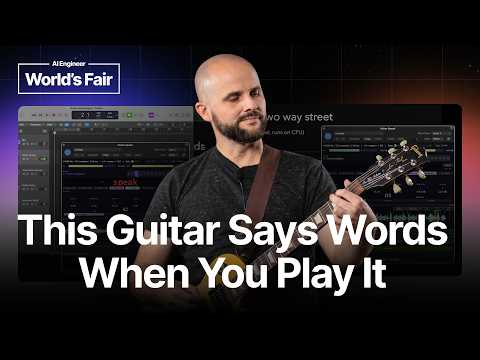
While my guitar gently speaks — Todd Fisher, Philo Ventures
Todd Fisher (Philo Ventures) traces his project to make a guitar speak: from pickup, amplifier, stomp boxes, and the talk box (Peter Frampton-style), to a JUCE plugin in a DAW. He covers speech segmentation challenges (energy gap segmentation vs. sonority peak syllabification), pitch detection with the YIN algorithm, synthesis with envelope shaping and a vocoder, and the final build routing a microphone through speech recognition into a local model so the guitar can answer questions aloud. Singing approximation uses pre-rendered pitch-shifted samples from an open singing dataset.
# Channel Presentation Observations: "While my guitar gently speaks — Todd Fisher, Philo Ventures"
## Creator Identity
- **Self-identified creator**: Todd Fisher, who introduces himself directly: *"So, I am Todd Fischer. I love the guitar. That's one of my passions in life."*
- **Channel/series attribution**: The title references "Philo Ventures," suggesting this is a talk within a larger event or channel series, though the transcript contains no further self-description of the channel itself.
## Intended Audience
- **Developers and engineers**: The talk assumes a technical audience:
- *"all the projects that we have as engineers over the years"*
- Explains DAWs in developer terms: *"your DAW is effectively your IDE but for musicians"*
- References familiar tools and concepts (Logic Pro, plugins, local LLMs, Whisper, text-to-speech).
- **Live conference/session audience**: Interactive elements show an in-person crowd — *"Anyone have a question you want to ask my guitar?"*, *"Start clapping. Everyone start clapping"*, and audience laughter responses.
## Claimed Scope and Purpose
- **Explicit stated goal — inspiration**: *"part of my goal today is to inspire you guys to find whatever project you're passionate about, go start building it because it's super easy now with AI."*
- **Project-focused scope**: The talk documents one passion project ("making my guitar speak") from concept through iterations, framed as a personal journey: *"today I want to share kind of my journey in this process and where kind of I'm at today."*
## Demonstrated Presentation Patterns
- **Live demo-heavy format**: Multiple on-stage demonstrations with a guitar, Logic Pro, and a custom plugin, including handling technical failures transparently (*"Live demos always the best"*, *"Technical difficulties"*).
- **Educational, explainer style**: Defines concepts for less specialized viewers — energy gap segmentation, sonority peak syllabification, the YIN pitch algorithm, ADSR synthesis, talk boxes, vocoders.
- **Tool recommendations to audience**: *"For anyone building audio software, look into Juice"*; invites collaboration: *"if anyone has any other ideas of how to make the guitar sing feel free to come up to me after."*
- **Personal anecdote framing**: Opens with concert memories (Slipknot, *Stranger Things: The First Shadow* on Broadway) and Halloween guitar-playing traditions to motivate the technical content.
- **Humor and pop-culture references**: The "Developers, developers, developers" bit, Eddie Munson costume, and Stranger Things alphabet wall demo.
- **Closing charge to audience**: *"Go and build awesome things because nowadays with AI, we could build so many really cool things"* — reinforcing the inspirational framing.
## Self-Description vs. Demonstration
- **Explicit creator claims**: Passion for guitar; goal to inspire audience to build projects; the project's evolution narrative.
- **Observable but unstated**: Todd demonstrates competence in audio DSP, plugin development, and AI integration (Whisper, Piper, local LLMs, the World vocoder project) — shown through the work presented, not claimed as credentials.
# Delivery Observations — Todd Fisher, "While my guitar gently speaks"
## Overall Tone
- **Enthusiastic, casual, and conversational.** Frequent intensifiers like "pretty awesome," "really awesome," "so fun," "mind-blowing," and "super easy" recur throughout.
- **Self-deprecating and forgiving of imperfection.** He repeatedly frames partial successes positively:
- > "Not quite as good as I want to. So, long story short, uh I settled on..."
- > "We have a choppy version, but but it is working. So, so that's a win, right?"
- > "Kind of fun. Kind of weird, but overall it's working."
## Recurring Vocabulary & Phrases
- **"Pretty awesome"** appears many times: "Pretty awesome, right?", "That's pretty awesome," "It was pretty awesome," "I think it's pretty awesome."
- **"So, with that said"** is a stable transition phrase used to move between sections: "So, with that said, I want to take you back several years ago," "So with that said, let's go ahead and jam out," "So, with that said, made it kind of work."
- **Evolution framing:** he repeatedly describes the project as steps or evolutions — "the next kind of evolution," "in the spirit of evolving the thought, evolving the project," "what is the next evolution of this project?"
## Teaching Habits
- **Analogy to familiar concepts.** For non-musicians/developers: "your DAW is effectively your IDE but for musicians and music producers."
- **Signposting audience benefit.** He states an explicit goal early: "part of, uh, my goal today is to inspire you guys to find whatever project you're passionate about, go start building it."
- **Caveats about demo reliability** delivered humorously: "Live demos always the best." (This appears once; the broader pattern of technical difficulties interrupting is directly observable — "Technical difficulties. Wait a minute." and "All right, technical difficulties again. So, sorry for that.")
- **Crediting tools/techniques by name** so the audience can follow up: JUCE (transcribed as "Juice"), Piper, Whisper, the YIN pitch algorithm, WORLD, VocalSet, ADSR, "look it up."
## Audience Interaction
- Direct audience questions and polls:
- > "Anyone have a list of projects that maybe they'll get to? Yeah."
- > "Anyone know Eddie Mson?" (transcript rendering of Eddie Munson)
- > "Anyone have a question you want to ask my guitar?"
- He incorporates audience input live ("What is reality?") and reacts to responses: "So, yeah, very existential. I like that."
## Filler & Disfluency Patterns
- Heavy use of **"uh" and "um"** and repeated words ("the the," "but but"), suggesting an unscripted, informal delivery.
- Frequent sentence-final **"right?"** as a check-in with the audience: "That's pretty awesome, right?", "It gets a little bit challenging to where it's not 100% foolproof, right?"
## Closing Pattern
- **Bookends the talk** by returning to the inspirational charge from the opening: "going back to the the charge to go in and build some awesome... side project... Go and build awesome things because nowadays with AI, we could build so many really cool things."
## Uncertainty Notes
- Filler-word frequency is directly observable in the transcript but may be exaggerated by transcription; the exact count should not be treated as precise.
- Audience laughter and applause are only occasionally marked in the transcript, so the full extent of audience engagement cannot be verified from this source alone.
# Position Extraction: "While my guitar gently speaks" — Todd Fisher, Philo Ventures
## Speaker
- **Todd Fisher** (self-identified), engineer and guitar hobbyist, presenting a personal project.
## Framing Positions
### Live performances as inspiration
- Recalls a **Slipknot concert** (high school, Bay Area) where the drummer's kit rotated upside down — memorable, "mind-blowing."
- Recalls **Stranger Things: The First Shadow on Broadway** (~a year ago in New York), praising a live slow-motion falling scene that looked like post-production — evidence of creativity leveraging technology in live settings.
### Call to action (core thesis)
- Engineers accumulate a "big giant list" of project ideas; with **AI in the last ~6 months**, these projects are far more achievable.
- Goal of talk: **inspire audience to build their passion projects** because "it's super easy now with AI."
- Qualification he states himself: "I know sometimes there's caveats."
## Evolution-of-guitar narrative
- Acoustic guitar → **pickup/amplification** (rock and roll) → **stomp boxes/effects pedals** → **Peter Frampton's talk box** (guitar sound through a physical hose into the mouth to form words) → **software emulation** (Pro Tools, Logic, Fruity Loops).
- Notes a "hot take" argument: perhaps physical effects pedals are no longer needed — presented as an open question, not his settled position.
- Asks: what is the **next evolution of the guitar with AI**?
## Project Origin
- Played guitar while passing out Halloween candy for ~10 years; three years ago dressed as **Eddie Munson** (Stranger Things).
- Built an app painting the **Stranger Things alphabet lights on his garage door**, triggered by guitar notes, with custom messages.
- This led to the question: "How hard would it be to make my guitar speak?"
## Technical Journey (stated positions and qualifications)
### Stage 1 — Text-to-speech playback
- Tools: **JUCE framework** (recommended for audio software), plugin formats for DAWs ("your IDE but for musicians"), **Piper** and built-in Apple TTS.
- Demo: playing a TTS audio clip on guitar trigger ("Developers…" — Ballmer homage).
- Acknowledged limitation: single audio file doesn't generalize — "there's more than one word."
### Stage 2 — Word slicing
- **Energy gap segmentation**: cut where decibels near zero (silence between words).
- Qualification: **not 100% foolproof** — connected speech often has no silence between words.
- **Sonority peak syllabifier**: vowels typically lead syllables; combined both approaches — "made it kind of work… not quite as good as I want."
- Settled (pragmatically, not ideally) on **manual drag-editing of segments**.
### Stage 3 — Singing via vocoder
- **YIN pitch algorithm** for fundamental frequency detection.
- Synthesized note via **ADSR** envelopes, pushed through voice clip through a **vocoder** — analogous to the talk box.
- Live demo hit "technical difficulties" (recurring); he acknowledged "some bugs to work out" but counted it as saying words over chords. Mixed synthesized note vs. voice with a "clarity lever."
### Stage 4 — Conversational guitar
- Pipeline: mic → **Whisper speech-to-text** → any local LLM → output spoken via guitar.
- Demo with audience question "What is reality?" worked, though "choppy."
- His assessment: "it's not quite singing yet."
### Stage 5 — Pre-baked singing samples
- **VocalSet** open-source singer recordings + **WORLD** project for pitch shifting; pitches mapped to guitar frets.
- Qualification: **very heavy process, cannot run live** — must be pre-baked.
- Started with five vowel sounds; result "kind of fun, kind of weird… not quite your opera singer, but getting closer."
## Open Questions & Contradictions
- **Unresolved tension**: he repeatedly labels results as working-but-imperfect ("kind of work," "not quite singing," "bugs to work out") — success is incremental, not claimed as finished.
- **Invitation**: open to audience suggestions for AI-heavier approaches to make the guitar sing.
- Avoided playing the actual "While My Guitar Gently Weeps" to sidestep copyright in the posted video — played "chords that may or may not sound similar."
## Closing Position
- Reiterates thesis: **build your passion project**; with AI, "time is typically not the big time suck that it once was."
- Sign-off: "Be awesome or be good to each other."
# Speaker Attribution Record
## Video
**Title:** While my guitar gently speaks — Todd Fisher, Philo Ventures
**Video ID:** `01a15ca7-d2a8-77a1-9b2e-7963c043d527`
## Speakers & Roles
- **Todd Fisher** — **Creator / Presenter (sole human speaker)**
- Self-introduced: > "So, I am Todd Fischer."
- Presents a personal project ("making my guitar speak") in a talk/session format before a live audience.
- **Audience members (unidentified)** — **Other (audience)**
- One audience member contributes a spoken suggestion: > "What is reality?"
- Audience reactions (laughter, applause, clapping) are noted in the transcript.
- **AI/computer-generated voice** — **Other (demo output, not a human speaker)**
- Guitar/TTS outputs rendered as speech during live demos (e.g., "Developers," "Look at me. I can speak," LLM responses such as "That's quite a question to start with").
## Provenance & Referenced Sources
- **Named third parties / cultural references** (cited as inspiration or context, no claims evaluated):
- Slipknot concert (Bay Area, high school era) — personal anecdote
- *Stranger Things: The First Shadow* on Broadway — personal anecdote
- Eddie Munson (*Stranger Things* character) — costume reference (transcript spells "Eddie Mson")
- Peter Frampton — credited with popularizing the **talk box**
- **Technologies/tools referenced by the creator:**
- **JUCE** audio framework
- **Piper** (text-to-speech), Apple built-in TTS
- **Logic Pro** (DAW) as demo environment
- **Energy gap segmentation** and **sonority peak syllabifier** for word slicing
- **YIN pitch algorithm** for pitch detection
- **Vocoder**, **ADSR** synthesis
- **Whisper** (speech-to-text), an unspecified **local LLM**
- **VocalSet** (open-source singer recordings)
- **WORLD** project (pitch shifting)
- Named DAW software: Pro Tools, Logic, Fruity Loops (mentioned generally)
## Promotional Segments
- **None identified.** No sponsored content, product promotion, or calls to purchase are present.
## Availability & Uncertainty Notes
- **Comment availability:** Not indicated in supplied source material.
- **Curated metadata:** None supplied beyond title and transcript.
- Speaker surname appears as both "Fischer" (self-introduction) and "Fisher" (video title) — discrepancy noted without resolution.
- The creator explicitly declines to play a specific copyrighted song: > "because it's going to be posted online, I don't want to muddy up the waters with any copyright things."
- No timestamps are present in the transcript; none were invented.
So, I am Todd Fischer. I love the guitar. That's one of my passions in life. Uh, today I want to talk about uh this project I've been working on for a while here, effectively making my guitar
speak. Uh, but of course I want to start out with kind of framing it under this awesome premise. You know, we've all been to live performances where like your mind was just blown. It was awesome. You know, the the first one I remember way back I was in high school. I went to a Slipnot concert, so a little bit heavier music uh here in the Bay Area. And I remember at some point the drummer was drumming a cool drum solo, and his drum set started raising up. And I was like, "Whoa, that's cool." And everyone got kind of excited, right? And then halfway through the solo, his drum set started to go like this and tipping. and his whole drum set was like on the wall while he was upside down playing his drum solo and everyone was just cheering like whoa this is so crazy mind-blowing like whoa it was so so impactful right I still reme remember it today um fast forward probably about a year ago uh I went to New York to see the Stranger Things on Broadway the the first shadow and it was really cool because the whole time I was there I was watching it and it felt like it was actually like a a Netflix episode but in real life and it was just like the effects that they did there was so so amazing. I remember even one time at near the end there was a scene where somebody somebody was falling backwards and it was like a slow motion scene and it probably about a minute long the whole scene but just like the fact that like they they were able to produce that in real life but it looked like it was a post-prouction slow motion scene just just mind-blowing. So it's like well that's cool. So given you everyone here's probably had some experiences with live performances in the past and I think it's really awesome just to like see the creativity uh that people can do with leveraging technology in some creative way. And so you know I'm thinking about all the projects that we have as engineers over the years where it's like hey that's a cool idea. I'm going to write this down. I have like a big giant list. Anyone have a list of projects that maybe they'll get to? Yeah. So it all happens right? Uh, and it's really awesome because the last 6 months or so with AI, uh, being able to, you know, push us forward with some of these projects, it's just really cool to see where we can take all these projects. So, so part of, uh, my goal today is to inspire you guys to find whatever project you're passionate about, go start building it because it's super easy now with AI. I get easier with AI. I know sometimes there's caveats, but but in general, uh, I I want to have you guys leave this session being inspired to go build whatever that cool thing is for you personally. that's gonna, you know, help you to learn stuff or maybe make a difference in the things that you're you're trying to figure out. Uh, so I want to start off with framing
this kind of in the realm of the guitar. So the guitar acoustic guitar has been around for several years, several thousands or hundreds of years, sorry. Um, and at some point somebody said, "Hey, I'm going to put a pickup on a
guitar. I'm going to plug it into a speaker." And now we have rock and roll. We're going to make it super loud. That was pretty awesome. And then of course we have a lot of people getting these stomp boxes, these these effects pedals. We put them all together. We have really awesome sounds. You really famous people have a lot of these. Uh and then at some point Peter Peter Frampton came along and said, "Hey, what if we get the sound of the guitar, put it through an actual hose, like a physical hose, put it in my mouth, and then basically play the guitar sound in my mouth and inform some sort of words. So that's pretty awesome that that's known as the talk box. And then in the last couple decades we have a lot of progress made with software emulation. Uh you think of you know protools you think of logic of uh fruity loops there's a lot of software even to the point where all the effects are in software now there is the argument made hot take that maybe you don't need all those physical effects pedals anymore. So so there's that question right and then of course looking forward it's what is that next evolution of the guitar uh with AI in the picture. So, with that said, I want to take you back several years ago, Halloween time. I was passing out candy, bunch of trick-or-treaters. You know, it got kind of boring. So, I was like, "Hey, what if I go and actually bring my guitar out with my amp and just play?" Uh, so for the past what, 10 or years or so, I've actually been playing guitar on Halloween, passing out candy, and it's kind of fun. Uh, and then fast forward probably three years ago, I decided to dress up as Eddie Mson. Anyone know
Eddie Mson? Stranger Things guitar player guy. So, pretty awesome guy. So, I dressed up as him. I was like, "This is going to be so fun. I can play the music with him." Whatever. And you kind of go the Oh, hold on.
Hold on. Wait a minute. Technical difficulties. All right, there it goes. So, a bunch of little Stranger Things awesomeness, right? Uh, but figured out, hey, what if there was like some more stuff I could put in this whole experience. And so I decided to go and build a little app that would actually paint the Stranger Things alphabet on my garage door just because it's fun, right? Uh, and so let me just show you a quick example of how this worked. So effectively, make sure I have the mic permission. Whenever I play a note, it would go and communicate whatever lights. And I even had it to where I could actually set custom messages such as happy Halloween, all that fun stuff. It was it was overall pretty fun just to kind of mess with that, right? So once again, you know, whatever I type in there, I could actually spell whatever and and very much a cool nod to Stranger Things. But it kind of got me thinking like what is the next evolution of this project? And I settled on this idea of like, hey, how hard would it be to make my guitar speak? It sounds easy. Maybe, maybe not. So, so today I want to share kind of my journey uh in this process and where kind of I'm at today. Uh so looking around the different tools, there's a framework out there called Juice. Really awesome. For anyone building audio software, look into Juice. It's it's pretty good. Um and then of course there's a number of plugins uh sorry plug-in formats out there uh for your your digital audio
workstation. And for for those that are not aware, uh your DAW is effectively your IDE but for musicians and and music producers. And then I I started with some text to speech stuff with Piper and
some built-in Apple stuff and then some other really fun uh digital signal processing. Uh so with that said, my first stab here was I want to get raw text so I could just type in whatever text I want uh push it through the text to speech uh get the audio clip and then whenever I play a note on the guitar I want to go and play that back. So let's go see how that works. So, switching over to my Logic Pro here, and this is the plugin I made. So, it's just like any other plugin in Logic where you just plop it in there. It's just, you know, chaining all the effects together. And so, this is what I came up with. \>\> Developers. \>\> So, it's playing it. \>\> Pretty awesome, right? \>\> Kind of reminds me of something, right? \>\> Start clapping. Everyone start clapping. Developers. Developers. developers, developers, developers. Awesome. Thank you. That's pretty awesome. Uh, you guys are great. Um, so I got it to where it's playing an actual audio file. That's pretty awesome. But it turns out, you know, in English or in any languages for that matter, there's more than one word. So the next kind of evolution, it's a little bit chatty. The next evolution there is let's actually go and slice it per word now. So I got to the point where it's playing now. It's going to slice per word. Look at me. I can speak. Look
\>\> me. I can speak. \>\> So now it's speaking words. And that's pretty awesome, right? Uh but it turns out that uh as we speak, there's a
number of challenges in how we automatically slice words. So I looked into this thing called energy gap segmentation. The general idea here is if you look in any waveform over here, we see that here's a bunch of of words that we're speaking, right? Uh the idea there is there's typically silence in between words. So let's just cut it whenever the decibb are very much close to zero, right? Uh but the issue with that is there's actually sometimes when you know as I'm speaking right now, for example, uh there's actually no silence in between some of my words. So it gets a little bit challenging to where it's not 100% foolproof, right? So beyond that, I looked into this thing called sority peak syllab syllabifier. That's a hard word to say. Effectively identifying the syllables of the audio signal and identifying that there's vowels in here. Vowels typically lead to syllables. That's kind of the idea. So I said, "Okay, let's take the senority peak, add it to the uh the energy gap, and figure out if we could just make that work automatically." So with that said, made it kind of work. So let's just play this one. \>\> Thank you for letting me Nope. Oh, \>\> here it feels so good. \>\> Get out of my target case once in a while. \>\> So, there you go. It's working pretty well. Not quite as good as I want to. So, long story short, uh I settled on just the ability to go and actually I could drag this and manually edit some of these uh uh segments in here. So, worked okay, right? Um but moving on, you know, with the spirit of evolving the thought, evolving the project, right? It's like, okay, we're we're having the AI say stuff. That's great, but what if we could actually make it sing? Let's take it to the next step because this is music. Why not, right? Uh so, looked into pitch detection. And for those that are not aware, uh, as you hear any any noise out there, there's typically multiple frequencies going on at any given time, you know, you think of when you play the the C key on the piano. Uh, there is definitely a fundamental frequency or the the kind of the the one that we identify as the note, but there's a bunch of other frequencies. So, we needed a way to go and figure out like how do we detect that fundamental frequency? So, when I press something on the guitar, how do I translate that into an actual note? Uh, and then I found this uh, yin pitch algorithm. Basically what it does is it detects the pitch. I won't get into all the details, but look it up. It's kind of a fun uh, really cool way of
detecting the pitch. Uh, but effectively what I do is I play the guitar. Uh, I detect the the pitch. I I make what's effectively a pitch saw or aka a
synthesized note. Uh so for those that are not familiar with how audio works on the the computer, you think of all the e electronic music, all that stuff. Uh that is basically uh a synthesized note. We have ADSR which effectively are the levers to figure out how to actually make the note sound in different ways. Uh and then so basically we get the pitch note or the syn synthesized note. Uh we then push it through uh the the voice clip effectively. So think of the talk box. We're kind of filling up the cavity of the talk of the voice that is. and we push it through a vocoder and it
should sing. So that's kind of the idea, right? So with that said, let's go ahead and jam out a little bit because I have a guitar and it's fun. So
get back to Logic here. Uh so I'm going to play some chords. Uh I originally was gonna uh play a song that is very much related to the talk or the the title of my talk, While My Guitar Gently Speaks. But because it's going to be posted online, I don't want to muddy up the waters with any copyright things. So, I will play some chords that may or may not sound similar to a famous song. So, Hey, hey, hey. So that's the backing track. So let's go ahead and have some AI speaking on top of it. \>\> I'm here. \>\> No. Hold on. Technical difficulties. Let's try that again. \>\> Live demos always the best. I'm here at this con friends. \>\> All right, technical difficulties again. So, sorry for that. But let's just run through it and see what happens. \>\> \[music\] \>\> Con friends \[music\] that speak. I'm the guitar that can speak.
So \>\> awesome. So there you go. Some bugs to work out, but overall we are able to to say words on top of this. And for what's worth, I'm trying to mix the uh the the
synthesized note with this clarity lever right here. So balance or mixing the the synthesized note with the actual voice that the AI is giving. Uh so so that worked pretty good. Um but there's also this other question, you know, given that uh when you speak it's typically conversational. What if I could take this to the next level? And what if we actually had this microphone right here where I could speak into the mic? It would then respond on the guitar. So the way that I accomplished this is speaking to the mic used speech to text. a whisper uh put that into raw text, run a local model on my computer. It doesn't really matter what LLM, just any local model. Have a conversation coming and then from that output go and plop it on the guitar. So, let's see how this works. Anyone have a question you want to ask my guitar? \>\> Anybody? What is reality? \>\> Let's do it. \>\> What is reality? \>\> So, it's thinking going through the LLM things and let's see what it says. \>\> That's quite a question to start with. \[laughter\] How does your music help you understand that elusive concept to real be right now? \>\> So, yeah, very existential. I like that. So, thank you for that suggestion there. So, there you go. We have a choppy version, but but it is working. So, so that's a win, right? Uh, awesome. And thanks for the claps, sir. Um, but really like it's not quite singing yet, right? So, moving on in this project, it's like how do I actually make it sing, right? I found a lot of uh open- source options out there as far as uh uh recordings or or samples if you will. There's a thing called vocal set out there. They basically recorded a bunch of singers and I could use those audio files to go and do some fun stuff with them. And effectively, I took those samples. I used a project called World, which helps with things like pitch shifting and some other things. and I'm able to then shift the the pitches of everyone singing on those audio clips and map it to the guitar. Uh, this is a
very heavy process and so I can't really do that live. I have to effectively pre-bake that and then once it's already pre-baked, I could then go and jam out with it. So, with that said, uh, let me
go ahead and show that example here. So, uh, because it takes so long, I actually just started with the vowel sounds. So there's somebody singing all each of the five vowels. And so we'll see how that sounds, right? Kind of fun. Kind of weird, but overall it's working. It's It's closer to singing, right? Uh so let's go ahead and throw that on top of all the chords over here, and let's see if we can make it sound decently well. Oh, so we'll just play these chords again. \>\> \[groaning\] \>\> So, not quite your opera singer, but getting closer and and so I I think there's something awesome there. Uh so effectively once again that is going through the whole synthesize process uh putting a sample shifting the pitch shift of the sample and then effectively mapping each fret or each note on the guitar to one of those samples that are pre-baked effectively right. So with that said you know where do I want to take this next uh very much want to get into more of of the you know AI heavier options if anyone has any other ideas of how to make the guitar sing feel free to come up to me after. I think it's pretty awesome. Uh but more importantly, you know, everyone here going back to the the charge to go in and build some awesome, you know, side project, some passion project of yours, like what is
that for you? Go and build awesome things because nowadays with AI, we could build so many really cool things and time is typically not the the big time suck that that it once was, right? So, with that said, uh be awesome or be good to each other and thank you very much.