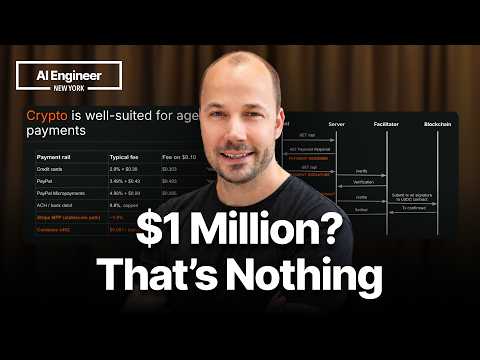
Why AI Agents Still Won't Pay for Anything — Jan Curn, Apify
Jan Curn, founder of Apify, examines why AI agent payment protocols (x402, AP2, ACP, MPP, TAP, UCP) have seen near-zero real transaction volume despite widespread industry adoption. He walks through the agent payment funnel — need, setup, discovery, purchase — to show where it breaks down, covering why API keys remain dominant, why crypto may fit agent payments, the trust problem in service discovery, and how pay-per-use billing with batch settlement works.
# Video Identity Observations
## Source Overview
- **Title:** *Why AI Agents Still Won't Pay for Anything — Jan Curn, Apify*
- The material is a **conference talk transcript** by a named speaker affiliated with a company, not a typical solo creator video.
## Speaker & Organizational Self-Description (Explicit Claims)
The speaker introduces his organization directly:
> "at API we're running a marketplace of uh tools for AI uh we call these tools actors we have about 80,000 of them"
- **Claimed scale:** ~80,000 tools ("actors") covering "extraction of data from social media sites, e-commerce, hospitality, travel, search engines and general like automation."
- **Business model claim:** a two-sided marketplace where "actors are created by a global community of creators," with a striking revenue figure:
> "just last month we paid almost $2 million to the creators uh for their actors"
- **Stated interest in topic:** agentic payments matter to them because "it's just another way how we can sell our actors... to more people and agents."
## Intended Audience
Evidence suggests the audience is **technical practitioners and service providers in the AI/agent ecosystem**:
- Deep dive into specific payment protocols (x402, MPP, AP2, ACP, UCP, etc.) with names, companies, and dates — assumes familiarity with fintech/crypto-adjacent terminology.
- Practical implementation detail (402 errors, facilitators, batch settlement, escrow schemes) aimed at engineers integrating payments.
- Closing call to action targets **businesses selling services**:
> "it's really good time now to uh figure how you can sell your services uh in this new world... if you wait too long maybe uh you will miss the train"
## Claimed Scope / Positioning
- The speaker positions himself as an **early authority**: "last year uh at AI engineer world fair in San Francisco I was the only one who was talking about this topic."
- Offers **skeptical analysis** rather than promotion: cites low adoption figures ("$1 million payment volume and on MPP only like $1.5,000... that's basically nothing") despite his commercial stake in the space.
- Self-disclosed non-alignment with crypto: "I'm not like a crypto person myself I'm not hodling anything."
## Demonstrated (vs. Claimed) Presentation Patterns
- Argument structure is a **funnel analysis** (need → setup → discovery/trust → buy) with friction points at each stage — analytical, framework-driven style.
- Mixes **macro forecasts** (Gartner's $15T by 2028, 80% B2B autonomy) with **first-hand implementation war stories** from Apify's x402 integration.
- Tone is casual and conversational with humor ("except for uh like buying illegal substances and hiding money away from your spouse").
## Caveats
- This is a single conference talk; channel-wide conclusions (upload cadence, recurring series, subscriber expectations) cannot be drawn from this material alone.
- Transcript contains transcription artifacts ("Asians" for "agents," "Asentic" for "agentic"), which are presentation-medium noise, not creator claims.
# Delivery Observations — Jan Curn, "Why AI Agents Still Won't Pay for Anything"
## Tone & Stance
- **Conversational, improvisational delivery.** The transcript shows heavy use of fillers and self-corrections: *"uh why don't uh the agents pay"*, *"I mean that's basically nothing"*, *"Oh, there's more."* The talk reads as spoken extemporaneously rather than read from a script.
- **Skeptical-but-optimistic framing.** He repeatedly undercuts hype with real numbers before restoring optimism: *"that might be a little too much but we'll see"* (on Gartner's $15T prediction), followed by *"I think the unlock is already happening."*
- **Self-deprecating asides** appear at key moments: *"except for uh like buying illegal substances and hiding money away from your spouse"*, and *"I'm not like a crypto person myself I'm not hodling anything."*
## Recurring Phrases & Vocabulary
- **"Big unlock"** is the most distinctive repeated phrase — used at least three times:
- *"big unlocker will come with always on agents"*
- *"big unlock would come if these major agentic payment platforms... integrate crypto payments directly"*
- *"again like a big unlock would be like if these like big agent providers uh enabled like payments out of the box"*
- **"Right?" as a comprehension check** — frequent sentence-ending tag: *"they help you automate uh your uh work on the web"*, *"Everybody can do that, right?"*, *"and you can use it right."*
- **Funnel metaphor** structures the entire argument: *"the best way to do that is to look at the ag payments as a funnel"*, then step-by-step: *"first the need"*, *"second step in a in a in a funnel is setup"*, *"last is to buy."*
- **"Trusted middleman"** recurs in the trust section: *"people started to use like a trusted middleman"*, *"there's a trusted middleman that tells you okay this is a service you can trust."*
- Casual hedges: *"I don't know"* used as a placeholder for examples (*"I don't know $5 for job"*, *"I don't know the perfect weather data"*).
## Teaching Habits
- **Concrete numbers as evidence.** Nearly every claim is anchored: *"about 80,000"* actors, *"almost $2 million"* paid last month, *"$1 million payment volume and on MPP only like $1.5,000"*, *"$14,000 worth of tokens"* on a $100 Claude plan.
- **Chronological cataloguing.** He lists payment protocols in date order (L42 → Mastercard Agent Pay → x402 → ... → APOP), even adding late-remembered items mid-flow: *"Oh, there's more... Oh one more agent pay for machines by Mastercard."*
- **Rhetorical question → answer loop.** Sets up questions then works through candidate explanations: *"So the question is like where is everyone?"*, *"So first maybe there's a low supply of services... Well, I don't think that's the case because..."*
- **Historical analogies for technical concepts.** Trust is explained via barter, recommendations, and town squares: *"if you ask oh um can you recommend me a good barber like uh to your friend."*
- **Step-by-step protocol walkthrough.** The x402 flow is narrated sequentially: *"first like you know you send API request you get like 402 error back... then the server verifies it... then you settle the transaction."*
## Structural Patterns
- **Funnel organization:** need → setup → discovery/trust → buy, each section ending with a "big unlock" forecast.
- **Problem → workarounds → resolution arc** in the pay-per-use section: the "up to" scheme fails (*"which was a bit of a bummer"*), the exact-plus-refund workaround is imperfect, then *"finally the bet settlement payment scheme uh solved this issue."*
- **Closing urgency appeal:** *"if you wait too long maybe uh you will miss the train and that's all. Thank you so much."*
## Stable Patterns vs. Isolated Moments
- **Stable (repeated):** "big unlock" phrasing, funnel framing, concrete dollar figures, rhetorical-question setup, "right?" tags, hedged optimism.
- **Isolated (single occurrence, less certain as habits):**
- The crypto-joke aside about *"illegal substances"* — humor appears only here.
- The personal disclaimer *"I'm not like a crypto person myself"* — a one-time credibility move.
- *"I do not have time to go through the detail"* — likely a time-management moment rather than a teaching style.
## Uncertainty Notes
- Word-level quotations come from an auto-generated transcript with errors (e.g., *"Asentic"*, *"Alipe"*, *"L42"* for likely "L402," *"export to"* for "x402"); quoted spellings reflect the transcript as given, and some intended terms are uncertain.
- Recurrence counts are based on this single talk; whether "big unlock" and the funnel metaphor are durable habits across Jan Curn's talks cannot be confirmed from this source alone.
# Observation Record: "Why AI Agents Still Won't Pay for Anything" — Jan Curn, Apify
## Speaker
- **Jan Curn**, Apify — identification based on video title; transcript uses first-person throughout without contradicting this.
## Context: Apify's Position (Stated by Curn)
- Apify runs a marketplace of ~**80,000 "actors"** (tools for AI) covering data extraction, e-commerce, hospitality, travel, search, and automation.
- Actors are built by a global creator community; Apify paid **"almost $2 million"** to creators last month.
- His stated interest: agentic payments are *"just another way how we can sell our actors"* — hence Apify has rapidly integrated every new payment protocol.
## Claim: Massive Protocol Proliferation, Minimal Adoption
### Protocol landscape (as enumerated by Curn)
- L402 (Lightning Labs), Mastercard Agent Pay (Apr), x402 (Coinbase, May 2025), Kia Pay / Visa (Skyfire), AP2 (Google), ACP (OpenAI/Stripe, Sep), TAP (Visa, Oct), UCP (Google/Shopify, Jan), ACTP (Alipay), MPP (Stripe/Temple), AM (Alipay, Apr), APOP (Union Pay), OKX Agent Payment Protocol, Agent Pay for Machines (Mastercard).
- His characterization: *"a heated battleground for the future of agent e-commerce."*
### Adoption data (cited from x402 scan and MPP scan websites)
- **x402: ~$1M payment volume in 30 days; MPP: ~$1,500.** Curn: *"that's basically nothing... non-existent."*
- Agents **are** spending money — but through **API keys**, not autonomous payment. He notes Apify, Exa, Perplexity, and Firecrawl together make *"far more than a million dollars per month"* from agents via API keys.
## Claim: Crypto Is Well-Suited for Agentic Payments
Curn's stated reasoning (he qualifies: *"I'm not a crypto person myself... I don't have any crypto"*):
- **No single owner/company** controlling the ecosystem.
- **Cheaper than credit cards/PayPal/bank debit** — traditional rails don't make economic sense for microtransactions.
- **No chargebacks** — critical, since *"there's like infinite number of agents"* who would otherwise *"steal all your money effectively"*; crypto has only merchant-optional refunds.
- Supporting evidence he offers: Coinbase's x402 and Stripe's MPP are built on stablecoins/crypto rails.
## Core Argument: The Agentic Payments Funnel
Curn frames adoption as a funnel — **need → setup → discovery → buy** — with friction at every stage.
### 1. Need
- Most builders use pre-registered accounts + API keys; hence *"agentic payments are competing with API keys... not with Visa."*
- Prerequisites for autonomous purchasing, per Curn:
- **Better models** → more trust; he argues money is *safer* than system access: losing $50 is sad, a data leak is a disaster.
- **Always-on agents** (citing OpenAI's offerings) — budgets become necessary for real autonomy.
- **End of token subsidies**: *"On $100/month on Claude you can buy... $14,000 worth of tokens"* — subsidized agents have no incentive to buy services instead of building from scratch.
### 2. Setup
- Crypto remains *"fairly opaque"* with lingo and wallet-setup friction vs. ubiquitous credit cards.
- Expected unlocks: better UX, and **direct crypto integration by Claude/ChatGPT-style platforms** (e.g., "use $50 of your account credits to purchase services") — which he predicts is *"coming sooner than later."*
### 3. Discovery & Trust
- Historical trust mechanisms (personal networks, marketplaces, reviews, consumer protection) **do not yet exist in the agent world**.
- Emerging analogues: Anthropic's verified connector directory, OpenAI app review, Apify's marketplace — *"trusted middleman"* model.
- Big unlock: major agent providers enabling payments **out of the box**.
### 4. Buy
- Fixed-price-per-call is insufficient; real jobs need **pay-per-use/variable pricing**.
## Case Study: x402 Pay-Per-Use (as narrated by Curn)
- Base flow: request → 402 + payment-required header → signature → facilitator (e.g., Coinbase) verification → settlement on blockchain → service delivery. Risk: doing work before settlement means possible loss.
- **"Up to" payment scheme problem**: nothing prevented double-spending before on-chain settlement — *"which was a bit of a bummer"* for pay-per-use.
- Apify's workaround: **exact charge + refund** (charge $10, consume $2, refund $8) — but this shifts trust to the seller and adds fees/blockchain transactions.
- **Batch settlement** (added by x402 in 2026; Apify integrated "last week") reportedly solves this via blockchain escrow enabling later micro-charges.
## Concluding Claims (Curn)
- The funnel *"is really being enabled right now"*; real volumes and the agent economy will start soon.
- Service providers should integrate now — implementation is harder than expected, and waiting risks *"miss[ing] the train."*
## Preserved Qualifications & Tensions
- Gartner's forecast (**$15T economy, 80% of B2B autonomous by 2028**): Curn hedges — *"that might be a little too much but we'll see."*
- Crypto advocacy is qualified by his self-described non-crypto stance.
- He frames the talk as prediction, not settled fact: unlocks are *"coming"* or *"happening"* but not yet realized — the title question (why nobody pays) remains open in his own account.
# Video Attribution & Provenance Record
## Speaker Identification
| Speaker | Role | Evidence |
|---|---|---|
| **Jan Curn** (Apify) | **Presenter / session host**; industry practitioner speaking for his company | Title credits him; opens with "welcome to my session" and gives a first-person company introduction |
- No guests, interviewers, or narrators appear; the entire transcript is one continuous talk.
- The speaker is not a neutral journalist: he represents **Apify**, a marketplace operator with a direct commercial interest in agentic payments. Claims about the market should be read as insider/company-perspective statements.
## Referenced Sources & Third-Party Claims
All attributed to the speaker during the talk; none independently verified:
- **Gartner (rendered "guard")**: prediction that by 2028 agentic payments will be a **$15 trillion economy** and 80% of B2B activity done autonomously by agents. Speaker adds his own hedge ("might be a little too much").
- **x402 scan and MPP scan websites**: cited as data sources for transaction volumes — ~**$1M/30 days on x402**, ~**$1,500/30 days on MPP**.
- **Payment protocols enumerated** (as listed by the speaker, with dates approximate in transcript):
- L402 — Lightning Labs (mid-2024 per transcript)
- Agent Pay — Mastercard (April 2025)
- x402 — Coinbase (May 2025)
- Kaia/"KYA" Pay — Skyfire / Visa (June 2025)
- AP2 — Google
- ACP — OpenAI + Stripe (September 2025)
- TAP (Trusted Agent Protocol) — Visa (October 2025)
- UCP — Google + Shopify (January)
- ACTP — "Alipe" (transcript spelling; likely Alibaba/AliPay)
- MPP — Stripe + Temporal ("Temple" per transcript)
- AMM/"MMP" — "Alipe" (April)
- APOP — UnionPay
- Agent Payment Protocol — OKX
- Agent Pay for Machines — Mastercard
- **Adoption metrics** cited in the talk: Apify ~**80,000 actors**, ~**$2M paid to creators last month**; Agentic payment directories listing Apify, Exa, Perplexity, and "Farcru" (uncertain spelling), jointly >$1M/month from agent usage via API keys.
- **Product claims**: Claude ~$100/month ≈ $14,000 of tokens if maxed ("token subsidies"); Claude's verified connector directory; ChatGPT apps directory; x402 payment scheme evolution (exact → up-to → batch settlement); MPP "sessions."
- **Anecdotal/personal claims**: speaker states he holds no crypto himself; historical framing of trust (barber recommendation, town squares) is illustrative, not sourced.
## Unverified / Uncertain Items
- Dates, protocol names, and attributions (e.g., "KYA pay," "Alipe," "Temple") come from an auto-transcript and may contain transcription errors; flag before quoting.
- Gartner figures and scan-site volumes are speaker-reported only.
- Apify's internal revenue and payout figures are company self-reports.
## Promotional Content
- **Company promotion flagged**: extended introduction of Apify's marketplace, creator payouts, and its agentic payments integrations; closing call to action urging service providers to adopt agentic payments early ("if you wait too long maybe you will miss the train"). The talk functions partly as industry positioning for Apify's commercial interests.
## Comment Availability
- No metadata supplied about comments; **availability unknown**.
## Evidence Channels Unavailable
- Slides/visuals (protocol lists, scan screenshots, diagrams) referenced but not provided in text form.
- Curated metadata beyond title not supplied.
Hello everyone. Uh welcome to my s session and uh today I'm going to talk about agentic payments and uh in particular the pressing question now that we have all the patent payment
protocols. So the big question is like why is uh nobody is using them? Uh why don't why don't uh the agents pay and before I start uh just a quick introduction uh at API we're running a marketplace of uh tools for AI uh we call these tools actors we have about 80,000 of them and they cover use cases like extraction of data from social media sites, e-commerce, hospitality, travel, search engines and general like automation. Basically they help you automate uh your uh work on the web and these actors are created by a global community of creators and uh so they they they build them publish them on our store and we sell them to the users to the customers and uh just last month we paid almost $2 million to the creators uh for their actors right so it's like a driving two-sided marketplace so obviously I think by now you can understand why we take great interest in agic payments because for us it's just another way how we can sell our actors, our tools and our creators to uh to uh more people and agents, right? And uh so obviously uh whenever there was a new new uh uh way how we can integrate our system, our platform, our marketplace uh to let agents agents buy those tools uh we we went fast and added those things. So uh actually uh last year uh at AI engineer world fair in San Francisco I was the only one who was talking about this topic about the topic of Asian payments and uh agent economy in more broadly because back then it wasn't really like you know well known uh not many people talked about it and I think like over the last year and a half uh there's been a great progress right so uh this year uh on AI engineer worlds fair in San Francisco there was a dedicated uh track uh for agentic payments And now you know over the past year think like uh really everyone understands that uh Asians in order to complete ever longer tasks they will actually need uh budget uh because you know at some point uh they will ask you to to approve something and so on and if you want them to to be autonomous and really complete bigger task you might need need to give them money and u there's been a huge progress over the past year and a half uh in this domain so u I think like guard predicts uh that by 2028 uh this will be like a $15 trillion economy and that 80% of B2B activity between uh between uh companies will be done autonomously through agents. I mean that might be a little too much but we'll see. But anyway, a lot a lot of players in the finance uh
and finance uh in fintech uh jumped on this band bedwagon because they understood they understand the size of this opportunity. So we saw a lot of different uh tools and payment standards
uh appear over the past you know year and a half. So it started with L42 by Lightning Labs. Uh it was mid 2020 were super early and last year in April Mastercard agent pay uh then May 2025 X42 by Coinbase. It's probably the most popular agent payment standard currently. Uh in June last year uh KYA pay uh by Skyfire by Visa. uh we have uh Asian payments protocol AP2 by Google then agent e-commerce protocol ACP by openai and stripe in September last year uh in October trusted agents protocol tap by visa uh in January universal commerce universal commerce protocol UCP by Google and Shopify there's more agent commerce agent e-commerce trust protocol ACTP by Alipe uh machine payments protocol MPPP by Stripe and Temple. Uh that's from uh early this year. And uh from April, Asian mobile protocol, MMP, AM by Alipe. And uh last but not least, Asentic Payment Open Protocol, APOP by Union Pay. Oh, there's more. Uh OKX, agent payment protocol by OKX. So you can see this became a heated battleground uh for the future of agent e-commerce because all these like players understand okay agents are going to pay at some point and uh these companies actually want to uh you know have part of the of the of this new future and uh preferably to use their networks and existing infrastructure to do that. Oh one more agent pay for machines by Mastercard. So there's players a lot of these and it's really hard to keep track uh of all the new standards happening right now. Uh and I think like u this whole agent commerce became like a huge uh uh huge uh well big news for for uh crypto people because finally uh there seems to be like a real use case they waiting for for a long time you know for crypto except for uh like buying illegal substances and hiding money away from your spouse and I actually believe that like I'm not like a crypto person myself I'm not hodling anything I don't have any crypto but um I I think like crypto is actually very very well positioned uh to win in this like agentic payments wars because uh crypto like uh if done well is uh it doesn't have like single owner there's like no single company controlling the the ecosystem right and u and uh it has like properties that make it very useful for agentic payments. So if you for example compare uh crypto with like credit cards, PayPal
or PayPal microp payments or you know bank debit um it's much cheaper like you just can't like use uh use these traditional payment
methods for small agent transaction. It just doesn't make economical sense. And also uh uh the traditional payment methods uh they also have chargebacks. Like everybody who's selling online understands that uh you have to count that like some people will just abuse your service and then ask for money back and it's just like you know sort of uh way of life for for for online businesses. But you can't do that in the in the agentic uh world because there's like infinite number of agents and uh they would just like you know steal all your money effectively or you know take your service for free. So uh on crypto uh there is no chargebacks uh only like refunds if but these are optional by by the merchants. So I think really like crypto is well suited for agent payments and uh it is like bright future u for that and actually two oh sorry two biggest players uh uh or two most popular agentic payment standards currently exploring coinbase and stripe uh mpp uh on uh stable coin pass are actually like using crypto right and uh it's not surprising so let's have a look at the adoption of uh these two systems in real world. This is from the X42 scan and MPPP scan websites u which basically monitors uh the transactions on blockchain. And you can see in the last 30 days uh in the last 30 days uh on X42 there was just only like $1 million payment volume and on MPP only like $1.5,000. I mean that's basically nothing. It's uh it's like non-existent. So the question is like where is
everyone? Why is nobody using it? Like uh it's been more than uh like year and a half now uh when agent payments become a thing but like agents are still not using it. So let's try to u find answer
to that question. So first maybe there's a low supply of services. Maybe there's just not not too many things to buy on you know for agents autonomously. Well, I don't think that's the case because if you look u at these like agentic payment directories like there's like plenty of services, you know, and I would say just like our company and Exa and Perplexity and Farcru are all there and u I would say we together make far more you know uh than million dollars per month uh from agent agents using our services right so clearly agents are using these tools pay much more for that uh but uh through API keys not uh through autonomous discovery and payment so it must be the demand right like uh so clearly the agents just are not
interested they are not buying the services so let's try to understand why okay and u I think the best way to do that is to look at the ag payments as a funnel so it starts with like need so
first you as a outer of the system or creator of the agent need to have the need like okay uh because otherwise like you wouldn't allow it or you wouldn't set it up and then you need to like somehow set it up and once it's uh once it's done the agents need some way to discover the services and eventually buy them, right? And I would say at every step of this funnel, we have some friction points that ultimately like uh lead to the fact that like agents are not buying um at the end of the funnel. So let's try to look at it more in more detail. So first the need well most people are building agentic systems now uh and they give them access to services but they they they they do it through fixed uh accounts or like you know accounts with sign up uh they sign
up before and through API keys right so you just like I don't know like you have an agent and if you need to give it access to web data uh you just uh create an account on aify and uh and then like
put the API key into your cloud or you know through use use uh MCP to connect uh to the services and then so and then you pay uh for for the use of the services uh through your credit card, right? It's it's pretty straightforward. Everybody can do that, right? So it's it's really not like that like agentic payments are are competing with with Visa. It's uh they are competing with with API keys because it's just the more convenient way. So what needs to happen for for agents or people to really uh decide okay I want my agent not to use only fix set of services that I you know gave it before but uh uh I want my agent to also discover new services as as it goes uh and buy those on its own right so I think there's uh few prerequisites to that first is better models uh I mean as the models are getting better the agents can complete every longer task autonomously you you trust them more and so on. So this is sort of a natural progression of things and I think over time uh the models like if if if they don't have it already will will deserve a trust also with money and I think like you can start like giving them I don't know $5 for job and then 50 and if you know it works like you can do 500 and I would say people already trust agents with uh access to their systems uh even right access quite often and sometimes uh it leads to disasters or you know leakage of data think with money it's it's safer I mean like if you lose $50 it's it's sad but it's not a disaster like you Unless well somebody leaks your email that's much worse. So I this is already progressing like models are getting better and they will have more trust uh from people to to to do that uh to uh purchase services. But I think big unlocker will come with always on agents now we saw with like uh metamuse you know open eye dot and so on. I think the the personal always on agents are becoming a real thing and uh if you want those agents to actually do something like you will give them budget eventually. So I think we're we're getting to this uh stage as well. And I think what will also help a lot is uh end of the era of token sub subsidies. Now on $100 per month on claude you can buy I don't know like $14,000 worth of tokens if you max it out. Uh this is crazy because then the agents have no incentives whatsoever uh to you know to look for existing services because they can build anything from from scratch because it costs nothing. But I think at some point this will end maybe with open AAI and not entropics IPO and suddenly the agents will be okay maybe it's more economical for me to buy a service rather than build it from scratch or figure out way to to get it done. So I think this is like uh the unlock is already happening and then second u step
in a in a in a in a funnel is setup. Okay, I want to use it now. How how do I do it? I think for a lot of people like crypto is still fairly opaque. you know there's like a lot of different like lingo there's like different words and
you know uh terms and like I would say like most people uh really haven't tried to set up crypto wallet themselves uh maybe they use like Coinbase for trading but really like give their Asian crypto wallet you know it's it's you know it needs like you know some extra work from them and it's it's it's a little more difficult you know than I don't know using a credit card to pay for a service because everybody has credit cards already but I think uh this this this will also like uh soon be solved you either with better better user experience. I think the agentic payment tooling is getting better like every month really and I think big unlock would come if these major agentic payment agentic platforms you know like cloud or or JGPT or you know these uh personal agents if they actually integrate uh crypto payments directly
itself right so basically you would just like use your main account credits from cloth and say like hey you can use $50 to p purchase services I think this would be like big unlock and I think it's coming sooner than later all right
so then the agent has a crypto wallet or or you know agentic payment system set up and it can buy services. So the big question is now where where can it find the services it can trust and trust is important because if you're buying a service from something from someone you need to make sure okay that they will deliver the service they promise they will do they will deliver for the price they they they say they will right and if you don't this trust you wouldn't transact with anyone and like historically how are how are people building this trust you know like first like they did started to transact with people they they they knew right so they like you know exchange services and later with money but it was is someone they knew. So they they knew they can trust and they will sell them good thing or they will trust with someone uh someone else like they knew and trusted like recommended them right. So it's like kind of like if you ask oh um can you recommend me a good barber like uh to your friend uh you'll be like okay uh you can use this one you know and then you can trust that person and then it's all great and over time you know as the world like you know got got bigger uh people started to use like a trusted like middleman uh to to tell you who who is like good seller and who is not right so for example like different marketplaces or town squares where you know if there was some someone like selling in a town you know on the square you could probably trust okay they are you know they are fair and you know we have like different sort of like reviews and uh and you know different agencies uh for consumer protection and so on you know so basically these elements give trust to the to the to the economy that you can buy services you know from strangers because there is like signals you can use but in the aging world there is nothing like that how can you know that like this agent or service on on some random URL that that's claims oh I have API for I don't know the perfect weather data can you trust it well it's kind of hard but I think the same principle will apply you know so either like network network or trust that like oh I know these services uh are good you know so basically this is a pool you can use or uh basically using trusted directories and marketplaces and we can already see is happening for example uh cloth uh has uh has a directory of connectors right it's like sort of like verified connectors that you know that actually like entropic like reviews pretty carefully. It's a it's hard to get there you know uh so they provide already this layer of trust for the directory of these tools and same forg they have apps and uh you know appi is a marketplace as well so basically there's a trusted middleman that tells you okay this is a service you can trust you know and you can you can use it right so I think this is already happening as well and um uh again like a big unlock would be like if these like big agent providers uh enabled like payments out
of the box you know suddenly I think the the the the whole thing would really start and last is to buy right and u traditional these agentic payments systems they only supported this uh
super simple uh use case and it was like fixed price per API call but in this world this is not sufficient you know there's only so so many things you can buy for fixed price maybe like the weather forecast but to complete a real job you actually need like uh payer use I mean like for example to to launch some comput job or some agentic job that uses LLM itself right and uh and uh so you need like variable pricing uh and uh thankfully just just uh uh earlier this year X42 added this option it's called batch settlement and u MPP added sessions uh and the goal of these uh payment schemes is to enable uh agents you know to uh handle also this like paper use billing so let's have a quick look on the how how uh x4 to implements payer use because I think this is sort of a nice illustration what the early adopters have go through you know to to to uh make it work. So just a quick look how X42 works like first like you know you send API request you get like 402 error back uh with some with some payment uh signature sorry payment required header you create a signature repeat request with some money uh then the server uh verifies it with the facilitator which might be Coinbase for example it's all good and then you do work there well we'll see uh then you settle the transaction uh Coinbase the facilitator submits the transaction to to blockchain and transaction is cor confirmed you get like settled response back from the from the from the facilitator and then you know actually the money has been transferred and you can do the job right. So the risk is like if you do the job a little earlier and then uh the money just doesn't arrive like you can lose money. So it depends on your service. Sometimes uh you just want to make sure that that you charge before you actually do the service if there's like non-trivial cost maybe like you know some some compute and so on and then you get payment response. So this is all good uh but this is like really just for the simple simple scenarios but handling payer use was pretty much uh like a little more challenging you know. So first in May uh export to launched exact payment scheme. This was the first scheme for the fix fixed pricing and then they released promise that we will release up to payment scheme basically allowing like this variable cost. They released it earlier this year but unfortunately it didn't really work exactly for our use case. I'll get to that very quickly. And then finally uh they introduced base setments uh in 2026. So the problem with up to payment scheme was that even though like it allowed you to to charge rather variable cost there was not nothing preventing the buyer the agent to spend those money twice you know because the transaction was only like settled on blockchain uh later. So basically up to wasn't really useful for for uh for pay-per- use case which was a bit of a bummer. So we work around that by using exact and refund. So basically we charge like sort of like I don't know like $10 up front and then you know let's say consumed $2 and and once u once the work was done we refunded the rest but then again that means that the agents need to trust uh the seller which again goes back to the original point that it's it's it's difficult sometimes so and it has to blockchain transaction so that means like more fees and so on. So this wasn't really ideal. So finally the bet settlement payment scheme uh
solved this issue. We added it just recently I think last week. Uh I do not have time to go through the detail but uh it uses cryptomagic to kind of like escrow the money on blockchain and then
like you can like charge it like you know uh for microtransactions later and final remarks. Uh so I think the agent payments funnel is really being enabled right now and uh soon uh it will really like start like a real volumes on on the on the and the real start of the agent economy and I think it's really good time now to uh figure how you can sell your services uh in this new world because the implementation might be a little more difficult than you think and if you too long if you wait too long maybe uh you will miss the train and that's all. Thank you so much.