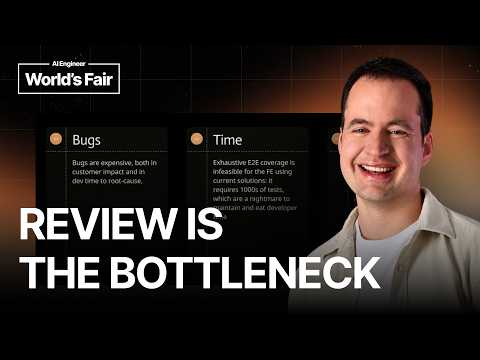
Why AI Didn't Actually Make You Ship Faster — Gabriel…
Gabriel Spencer-Harper, co-founder and CEO of Meticulous, argues that AI-generated code has shifted the bottleneck from writing to verification. The talk covers why assertion-based tests can't keep up with AI-generated code, and demos Meticulous's record-and-replay approach to frontend verification, which records real user flows, replays them on pull requests, and produces visual before/after diffs. Underlying technologies discussed: fully mocked network traffic, a deterministic browser to eliminate flaky tests, and coverage-guided flow selection. Recorded at AI Engineer World's Fair 2026 in San Francisco.
# Video Identity Observations — "Why AI Didn't Actually Make You Ship Faster"
## Speaker & Self-Identification
- The speaker introduces himself explicitly: <blockquote>"my name is Gabe. I'm one of the co-founders and CEO of Meticulus"</blockquote> (transcribed as "Meticulus" throughout, though the title renders it "Meticulous").
- This is a **conference-style talk**, not a typical YouTube upload: he waits for attendees to enter, references a live demo setup, and closes with a booth location — <blockquote>"come to booth LG6 and thank you so much for listening."</blockquote>
## Intended Audience
The talk is aimed squarely at **software engineering professionals**, particularly engineering leaders and developers working on front-end codebases:
- Framing around organizational bottlenecks: <blockquote>"someone somewhere at your organization is spending time verifying code and that is now your new bottleneck"</blockquote>
- Direct address to engineers' workflows: <blockquote>"if an engineer in your organization uh AI generated this pull request, would you feel comfortable hitting the the merge merge and ship button?"</blockquote>
- Technical depth assumes developer familiarity — CI runners, localhost, Cypress, Playwright, `setTimeout`/`setInterval`, pull requests, feature flags.
## Claimed Scope
- **Problem scope:** AI-generated code has outpaced human review capacity, and assertion-based testing cannot exhaustively cover regression space: <blockquote>"the space of possible regressions is too vast to exhaustively cover"</blockquote>
- **Product claim:** <blockquote>"Meticulus gives you exhaustive or near exhaustive verification of your front-end codebase with zero developer effort"</blockquote>
- **Social proof claims:** deployed across engineering organizations including Discord, Dropbox, Notion, 11 Labs, LaunchDarkly — <blockquote>"if an engineer touches front-end code at one of these companies, they use Meticulus every every day"</blockquote>
- **Technical claims made for the tool:** orders-of-magnitude fewer flakes than Cypress/Playwright via browser-level determinism; screenshot-based diffing at "every possible moment"; a code-coverage-maximizing workflow selection algorithm.
## Creator Claims vs. Demonstrated Evidence
| Creator claim | Demonstrated in video |
|---|---|
| Exhaustive front-end verification | Claimed and explained via a demo walkthrough of recording/replay/screenshot-diff workflow |
| Customer adoption at named companies | Stated assertion only; no customer testimony shown (references unspecified "nice things our customers have said") |
| Works with AI agents | Positioned ("or an agent agent does" judgment at review time) but not directly demonstrated |
## Format & Presentation Patterns
- Structured talk outline stated upfront: <blockquote>"one minute introducing meticulous and then one minute giving some background context... and then sort of eight minutes giving a demo and technical technical overview"</blockquote>
- Heavy **live product demonstration** as the centerpiece, with explanation of three "key technologies" (mocking/idempotency, browser determinism, coverage-maximizing replay selection).
- Marketing-oriented framing: problem → status quo critique → three downstream consequences → solution demo → customer validation → booth call-to-action.
## Limits of This Evidence
- This single conference talk demonstrates a **sales/evangelism presentation persona**, not necessarily the channel's broader content patterns.
- Speaker name inconsistencies ("Meticulous" vs. "Meticulus," "Gabe" vs. "Gabriel Spencer-Harper") suggest transcription noise; the title is the more authoritative source for the speaker's full name and company name.
# Delivery Observations: "Why AI Didn't Actually Make You Ship Faster"
## Overview
This is a conference-style product talk by Gabe, co-founder and CEO of Meticulous. The transcript is machine-style with timestamps in brackets, filler words, and some repeated words. The observations below are limited to the transcript text; no curated delivery metadata was supplied.
---
## 1. Verbal Fillers and Hedging
**Feature:** Frequent filler words ("Um," "Uh," "So," "Great," "Cool") appear throughout.
- Opening: "Hello everyone. Hi. **Um**, my name is Gabe."
- Mid-talk: "So **um** the second key technology..." (paraphrase of frequent usage)
- Transition: "Give me **one second** to switch this back."
**Observed frequency:** High. Fillers appear at most section boundaries.
**Uncertainty:** Transcript formatting may over- or under-represent fillers, so frequency is approximate.
---
## 2. Signposting and Structure
**Feature:** The speaker announces structure explicitly and repeatedly.
- "I'll spend one minute introducing meticulous and then one minute giving some background context..."
- "So there are three sort of like downstream consequences of that current state. **The first one is...** The second one is... And then the third..."
- "And then the third technology which is the most **um important one** for grocking like why this works..."
**Observation:** Enumerated structure ("first, second, third") is used for both the three downstream consequences and the three technologies.
---
## 3. Repeated Phrasing
**Feature:** Several words or phrases repeat in close succession, sometimes as stutter-like repetition in the transcript.
- > "And then the third like problem or downstream **downstream** consequence of of the state of the world..."
- > "...we **need** ..." (not present; omitted)
- > "...spend a lot of time **maintaining maintaining maintaining** tests."
- > "...what **meticulous meticulous** will will will flag it."
- > "...how how **meticulous meticulous** works."
- > "...how do you **how do you** get there?"
**Uncertainty:** These may be transcription artifacts rather than deliberate delivery choices. Repetition is observable in the text but its cause cannot be confirmed from the transcript alone.
---
## 4. Rhetorical Questions and Clarifying Framing
**Feature:** The speaker frames key ideas as questions, then answers them.
- > "...a good clarifying question is if an engineer in your organization uh AI generated this pull request, would you feel comfortable hitting the merge merge and ship button?"
- > "So then the question becomes um that sounds great. How do you how do you get exhaustive verification?"
- > "So how do you how do you do that?"
**Observation:** Questions are used as a transition device before explaining a technique.
---
## 5. Analogy and Contrast with Alternatives
**Feature:** The speaker frequently contrasts Meticulous with assertion-based tools (Cypress, Playwright).
- > "...assertionbased testing alone isn't enough."
- > "...typically when you write an assertionbased test, you use your business context and judgment to encapsulate the correct behavior of software up front..."
- > "In meticulous, we just show you what's different and you exercise your judgment at review time..."
- > "...you could write a cypress test or playright test that covers 100% of your codebase but only makes a single assertion..."
**Observation:** Comparison is a recurring teaching pattern, used to define the product's approach.
---
## 6. Emphasis Through Intensifiers and Superlatives
**Feature:** Strong modifiers are used to emphasize claims.
- > "...you get **radically** less or **orders of magnitude** less flakes..."
- > "...we handle all of that randomness and make the browser deterministic or **near** deterministic so that you have **radically radically** less flakes."
- > "...this really **unusual and radical** thing..."
- > "...exhaustive or **near exhaustive** verification..."
- > "...code coverage in our **opinionated** view is a **terrible** metric for every tool in the world..."
**Observation:** Claims are often framed with strong, absolute-leaning language. Whether this reflects deliberate persuasion is not observable.
---
## 7. Concrete Examples and Demo Narration
**Feature:** Abstract claims are grounded with a step-by-step narration of the product workflow.
- > "So someone clicking the login button, clicking the settings panel, clicking the analytics panel."
- > "...it dispatches each event one by one. And as it dispatches those events, so click the login button, click the senses panel, click the analytics panel..."
- > "So here's the name change on light mode. Here's the name change on dark mode."
**Observation:** Demo sections use repeated sentence frames ("click the... click the...", "Here's... Here's...") to narrate sequential actions.
---
## 8. Audience Address and Pacing Markers
**Feature:** The speaker addresses the audience directly and marks pauses or technical delays.
- > "Hello everyone. Hi."
- > "I'll just wait one more minute for people to come in..."
- > "the Wi-Fi is slow, so I'm just going to switch tabs."
- > "Give me one second to set this up." / "Great."
**Observation:** The speaker verbally manages pauses and technical setup during the live demo.
---
## 9. Closing Pattern
**Feature:** The talk ends with a call to action directing the audience to a booth.
- > "If you're interested in finding out more then come to booth LG6 and thank you so much for listening."
---
## Summary of Stable-Looking Patterns
| Pattern | Strength of Evidence |
|---|---|
| Frequent fillers ("um," "uh") | Strong; recurs throughout |
| Explicit enumeration ("first, second, third") | Strong; used in two sections |
| Contrast with assertion-based testing | Strong; recurs across sections |
| Intensifiers ("radically," "orders of magnitude") | Moderate; several instances |
| Repeated words ("maintaining maintaining") | Weak; may be transcription artifacts |
| Rhetorical questions | Moderate; a few clear instances |
**Limitations:** Single transcript, no curated metadata, and transcription artifacts make it hard to separate deliberate delivery from recording noise.
# Video Position Record: "Why AI Didn't Actually Make You Ship Faster"
**Speaker:** Gabe (Gabriel Spencer-Harper), co-founder and CEO of Meticulous — self-identified in the transcript.
**Format:** Product demo/talk. The speaker explicitly notes this is a company presentation (one minute company intro, one minute context, ~eight minutes demo).
---
## Core Thesis
> "If you have exhaustive verification then you can ship code at the speed that your agents write it. If you don't, then someone somewhere at your organization is spending time verifying code and that is now your new bottleneck."
- **Claim:** AI writes code faster than humans can review it; review and verification is "the new bottleneck."
- **Claimed tradeoff:** Without exhaustive verification, organizations must trade velocity against bugs and user experience.
- **Clarifying question posed:** "If an engineer in your organization AI generated this pull request, would you feel comfortable hitting the merge and ship button?" He states that in most organizations the answer is no, because engineers would want to check feature flags, roles, permissions, settings, configurations, and edge cases.
---
## Position on the State of Software Testing
Two stated conditions of the "current state of the world":
1. **AI outpaces review** — AI writes code faster than humans can review it.
2. **Assertion-based testing alone isn't enough** — "no matter how hard a human or an agent tries to define the correct behavior of software a priority upfront in assertions the space of possible regressions is too vast to exhaustively cover."
### Three claimed downstream consequences
- **Bugs/regressions** with business impact.
- **Engineering time spent on test maintenance** — he claims engineering organizations spend "double-digit percentages" of their time on manual validation, review, debugging flakes, and updating/maintaining end-to-end test suites.
- **A lost alternative mode of programming** — with exhaustive verification, teams could "bump all your dependencies," do sweeping refactors, and accept any AI-generated change "with complete confidence."
---
## Product Claims (Meticulous)
- **What it does:** Provides "exhaustive or near exhaustive verification of your front-end codebase with zero developer effort" via one line of JavaScript on non-production environments (localhost, QA, dev, staging).
- **Claimed deployment:** Used across "the entire engineering organization" at Discord, Whiz (as transcribed), Dropbox, Notion, Eleven Labs, LaunchDarkly, "and many, many other great companies."
- **Mechanism as described:**
- Records thousands/tens of thousands of user workflows in the browser.
- On a PR, replays a subset of recorded workflows, taking a screenshot "at every atomic moment," generating before/after screenshot sequences that are diffed.
- Posts a PR comment, typically within a few minutes.
- **Key framing point:** "Meticulus will not tell you whether or not there's a bug." It shows diffs; judgment about expected vs. unexpected is exercised at review time by a human or agent — contrasted with assertion-based tests, where judgment is exercised upfront.
## Three Key Technologies Claimed
1. **Full mocking** — network requests/responses recorded and stubbed at replay, making tests idempotent ("run them a thousand times") and isolated, enabling horizontal parallelization.
2. **Determinism** — claims "orders of magnitude less flakes" than Cypress or Playwright by augmenting the browser "from the scheduling engine layer up," handling randomness sources like CPU clock-dependent animations and setTimeout/setInterval interleaving.
3. **Code-coverage-based workflow selection** — replays each recorded flow against main, maps workflows to lines of code executed, and selects a subset maximizing coverage.
### Notable qualification (preserved as stated)
> "Code coverage in our opinionated view is a terrible metric for every tool in the world apart from meticulous."
His reasoning: a Cypress/Playwright test could cover 100% of code with a single assertion ("code covered is not the same as code tested"), but with Meticulous coverage approximates testing "because we're taking a screenshot at every possible moment throughout a flow" — a single pixel diff on a 4-second flow gets flagged.
### Stated dependency chain
He explicitly frames the technologies as interdependent: exhaustive verification depends on the coverage algorithm; the algorithm only works because of screenshots at every moment; that volume (tens/hundreds of millions of screenshots) would otherwise drown in flakiness, so flakiness must be solved "at the root level" via browser augmentation.
---
## Caveats for the Record
- This is a **vendor talk** — all superiority claims (vs. Cypress/Playwright, "zero developer effort," flake reduction) are the CEO's own claims about his company's product, presented without independent verification in the transcript.
- He references "some nice things that our customers have said about us" but no specific customer quotes appear in the transcript.
- The claim that exhaustive verification enables "any AI generated change with complete confidence" is presented aspirationally ("all of a sudden you can"), not as a demonstrated result.
# Speaker & Provenance Record — "Why AI Didn't Actually Make You Ship Faster"
## Video Identification
- **Video ID:** 01a15ca7-2002-744a-9fa5-d37fa9bb7cc2
- **Title:** *Why AI Didn't Actually Make You Ship Faster — Gabriel Spencer-Harper, Meticulous*
- **Format:** Conference-style demo/talk (speaker states it is a "demo or talk" with a timed structure: intro, context, ~8-minute demo)
## Speakers & Roles
| Speaker | Role | Basis |
|---|---|---|
| **Gabe (Gabriel Spencer-Harper)** | **Co-founder and CEO of Meticulous**; sole speaker and presenter | Explicit self-identification: "my name is Gabe. I'm one of the co-founders and CEO of Meticulus" (title spelling: "Meticulous") |
- No guests, narrators, or additional named speakers appear. One "[music]" cue follows the closing; no attributed speech accompanies it.
## Cited Sources & Referenced Entities
- **Customer organizations claimed as deployments:** Discord, Whiz, Dropbox, Notion, 11 Labs, Launch Darkly, "and many, many other great companies."
- **Comparative tools referenced by name:** Cypress (rendered "cypus") and Playwright (rendered "playright"), cited in flakiness and code-coverage comparisons.
- **Customer testimonials:** Speaker references "some nice things that our customers have said about us" (visual slide content; not transcribed).
- **Call to action:** Audience directed to **booth LG6** for more information — *promotional element within the talk*.
## First-Party Claims (Company Claims, Not Independently Verified)
All substantive claims originate solely from the speaker promoting his own product:
- Meticulous provides "exhaustive or near exhaustive verification" of front-end codebases with zero developer effort.
- AI writes code faster than humans can review; review/verification is the "new bottleneck."
- Assertion-based testing cannot exhaustively cover the space of regressions.
- Three downstream consequences claimed: bugs/regressions, engineering time on test maintenance ("double-digit percentages"), and constrained programming practices.
- Product mechanics: one line of JavaScript injected on non-production environments; recording/replaying workflows; screenshot diffing on pull requests via CI; PR comments posted "typically within a few minutes."
- Three key technologies: full network mocking (idempotency, isolation, horizontal parallelization); browser determinism via augmentation of the scheduling engine layer (reduced flakes); code-coverage-maximizing workflow selection algorithm.
- Notable admission: **Meticulous does not detect bugs directly** — "Meticulus will not tell you whether or not there's a bug"; it presents diffs for human/agent judgment at review time.
- Speaker's own caveat: code coverage "is a terrible metric for every tool in the world apart from meticulous."
## Promotional Segments
- **Entire talk is promotional** for Meticulous, delivered by its CEO, including a live product demo and a closing booth referral ("come to booth LG6").
## Provenance Boundaries & Uncertainty
- No curated metadata beyond the title was supplied; speaker identity rests on the title plus the transcript's self-introduction.
- Company/product name appears inconsistently in the transcript ("Meticulus" vs. title's "Meticulous"); title spelling treated as canonical.
- Customer deployments, competitor comparisons, and technical claims are **speaker assertions only** — no third-party verification available in the source.
- Q&A or audience interaction: none captured in the transcript.
## Comment Availability
- No information about comments or audience feedback channels is present in the transcript or supplied metadata.
Hello everyone. Hi. Um, my name is Gabe. I'm one of the co-founders and CEO of Meticulus. Um, I'll just wait one more minute for people to come in and then we can and then we can get started. Um so
in today's demo or talk I'll talk about verification of code. Um I'll spend one minute introducing meticulous and then one minute giving some background context on the company and then sort of
eight minutes giving a demo and technical technical overview. Um so if you have exhaustive verification then
you can ship code at the speed that your agents write it. If you don't, then someone somewhere at your organization is spending time verifying code and that is now your new bottleneck and you're forced into a position where you're trading off velocity against bugs and user experience.
So I'll give um super quick context on Meticulus. So, Meticulus gives you exhaustive or near exhaustive verification of your front-end codebase with zero developer effort. Um, it's
deployed across the entire engine organization at all of these companies like Discord, Whiz, Dropbox, Notion, 11 Labs, Launch Darkly, and many, many other great companies. So, if an engineer touches front-end code at one of these companies, they use Meticulus every every day. However, before we get into the product and talk more about verification, um, let's just cover the current sort of state of the world. So, AI writes code faster than humans can
review it. And review and verification is now the new bottleneck. The other state of the world is that
assertionbased testing alone isn't enough. So no matter how hard a human or an agent tries to define the correct behavior of software a priority upfront
in assertions the space of possible regressions is too vast to exhaustively cover. And so a good clarifying question is if
an engineer in your organization uh AI generated this pull request, would you feel comfortable hitting the the merge merge and ship button? And in most
organizations, the answer is no. You would want to go and do the hard work of checking out all the different feature flags, all the different roles, permissions, settings, configurations, and the various different edge cases in order to understand the exhaustive impact of this of this change and see if you can spot any issues. So there are three sort of like
downstream consequences of that current state. The first one is bugs or regressions uh which have a a business impact. The second one is engine organizations
will spend doubledigit percentages of their time maintaining end to-end test suites. So across manual validation, review, uh debugging flakes or updating or maintaining the test suite, um all spend a lot of time maintaining maintaining maintaining tests. And then the third like problem or downstream downstream consequence of of the state of the world is that um if you if you can get exhaustive verification then you can program in a new and different way.
So all of a sudden you can bump all your dependencies, you can do sweeping refactors, you can make any AI generated change with complete complete confidence. So then the question becomes
um that sounds great. How do you how do you get exhaustive verification? What does it look like and how do you how do you get there? Um so I'll now give you a demo of how how meticulous meticulous
works. So, we give you uh give me one second to set this up.
Great. Um, so we give you one line of JavaScript to inject onto nonproduction environments. So that's localhost, QA, dev, staging. That JavaScript instruments the web browser and records thousands or tens of thousands of flows or workflows. So someone clicking the login button, clicking the settings panel, clicking the analytics panel. And then when you open a pull request on your CI runner, you spin up your web application on localhost 3000 and Meticulus takes a subset of those recorded workflows and it replays them. So it dispatches each event one by one. And as it dispatches those events, so click the login button, click the senses panel, click the analytics panel, it takes a screenshot at each atomic moment throughout time. And so it generates a sequence of screenshots for every workflow, one before your code change and one after your code change. It then diffs those two sequences together to show you what would be different about your application if you were to merge that code in before before you do. So in this example, there's two changes here. One is someone's changed the name and the second is they've introduced an error to a to a drop down. And so when you open a
pull request, Meticulus posts a comment typically within a few minutes. And when the developer clicks into this comment, the Wi-Fi is slow, so I'm just going to switch tabs. But when a developer clicks
into this comment, Meticulus will not tell you whether or not there's a bug. What it will show you is a set of diffs that show you what's different about the application if you were to merge that code in. And so each diff has a before state and an after state. And so by reviewing the diff, you can determine whether that change is expected or unexpected. So here's the name change on light mode. Here's the name change on dark mode. And then this is a manifestation of that logical logical error. So typically when you write an assertionbased test, you um use your business context and judgment to encapsulate the correct behavior of software up front and and encapsulate that into your assertion based test. In meticulous, we just show you what's different and you exercise your judgment at review time or or or an agent agent does. Um give me one second to switch this back.
Cool. Um, so there are sort of three technologies that are really important for helping build a mental model of the tool and how it works, how it works and why it works. So the first one is that
everything is mocked out. So um at record time we record all the network requests and responses and then at replay time we stub those in and we perform that mocking for two reasons. One is to make the test item potent. So you can run them a thousand times in a row and get the same results each and every time. And the second reason is it means that every test is isolated from every other test which eliminates the risk of race conditions and allows you to paralyze the test horizontally and get get the results in it in a few minutes. The second key technology is that you get radically less or orders of magnitude less flakes with meticulous than any other tool including cypus or playright. And the reason why is we
augment the browser from the scheduling engine layer up to be fully deterministic. So when browsers were first designed determinism was not a design goal. And so there's many
different sources of randomness. For instance, an animation spinner depends upon the clock speed of the CPU of the machine rendering the browser or the interle between set timeout and set interval. And so we handle all of that randomness and uh make the browser deterministic or near deterministic so that you have radically radically less flakes. And then the third technology which is the most um important one for grocking like why this works is if you want this to be exhaustive it has to cover every
feature plan combination every permission every role every config every possible branching through the application. So how do you how do you do that? So one technique that we use is
that for every session or flow that we record, we replay it once against main branch or master branch and we monitor what lines of code get executed and then we build a map or an index that maps each individual workflow to lines lines of code executed and choose a subset of workflows that maximizes code coverage across your application. And typically uh give me one second. Typically I would say that code coverage in our opinionated view is a terrible metric for every tool in the world apart from meticulous and the reason why is you
could write a cypress test or playright test that covers 100% of your codebase but only makes a single assertion and so code covered is not the same as code
tested but with meticulous it actually is approximately the same because we do this really unusual and radical thing which is we're taking a screenshot at every possible moment throughout a flow. So if there's a 412 set flow and there's a single pixel diff, meticulous meticulous will will will flag it. And so you can start to see how all these technologies layer together. Um you only get exhausted verification because of this code coverage algorithm. That algorithm only really works because you take a screenshot at every possible moment. If you take a screenshot every possible moment, you're taking on the order of tens, hundreds of millions of screenshots. And so, traditionally, you would just drown in noise or drown in flakiness. And so, you have to solve flakiness at the root level. Um, which is which is what we what we what we do by by augmenting augmenting the browser. Um, these are some nice things that our customers customers have said about us. Um, and that concludes today's talk. If you're interested in finding out more
then come to booth LG6 and thank you so much for listening. \>\> \[music\]