Why Bigger Context Windows Won't Save Your Agent —…
Talk by Elizabeth Fuentes Leone, developer advocate at AWS, on why bigger context windows do not fix AI agents: models tend to lose information in the middle of long contexts, and tool outputs can overwhelm agents. She presents four strategies (externalize, select, compress, isolate) and demonstrates them with code using the open-source, model-agnostic Strands Agents framework. Topics include sliding-window and summarizing conversation managers, short-term, long-term and graph memory, memory pointers for large tool outputs, sharing pointers across a multi-agent swarm, capping tool calls to prevent endless loops, async handles for slow MCP tools, and anti-patterns to avoid. Recorded at the AI Engineer World's Fair 2026 in San Francisco.
# Channel Presentation Observations: Single Video
## Source Basis
- **Video ID:** `01a15ca6-e390-7b61-8a0c-99d5e5854358`
- **Title:** "Why Bigger Context Windows Won't Save Your Agent — Elizabeth Fuentes Leone, AWS"
- **Available sources:** Title and transcript only. No curated metadata was supplied.
- **Scope note:** These observations cover only this one video. They do not describe the channel as a whole.
---
## 1. Explicit Self-Description (Creator Claims)
The speaker makes a few direct identity statements in the transcript:
- **Name and role:** The speaker introduces herself as Elizabeth.
> "first I have to say I am Elizabeth. I am not Morgan."
- **Affiliation:** The title attributes the talk to AWS. The transcript supports this indirectly through the closing remarks.
> "We have the specialist and I am Elizabeth No Morgan remember."
- **Self-referential humor:** The speaker jokes about stepping in for another presenter, noting that the agenda template stayed the same.
> "the guy for the agenda they never change agenda. So we are almost the same but with different colors hair."
**Attribution note:** These are the speaker's own statements. The transcript does not establish a broader channel identity.
---
## 2. Intended Audience (Observable Evidence)
The transcript points to a **technical audience of developers and architects building agentic applications**.
- **Assumed familiarity with agent concepts:** Terms such as "context window," "agent loop," "tool invocation," "MCP," "vector database," and "graph memory" are used without definition.
- **Framework-specific content:** The talk walks through the Strands framework, including a "conversation manager," "agent state," "invocation state," and a `tool` decorator.
- **Practical orientation:** The speaker presents concrete implementation patterns, such as:
- Setting a summarization ratio of 50% and preserving the last four messages.
- Capping tool invocations (e.g., "you only can invoke that tool three times").
- Using async handles for slow external APIs.
- **Event context:** The closing remarks reference an in-person booth and swag, suggesting a conference setting.
> "if you want to learn more about stringent we have a huge boot there. We have a lot of swag."
---
## 3. Claimed Scope
The speaker frames the talk around a single problem and a set of responses.
### Core Problem
> "right now edge system breaks when tools returns a large amount of data. Context window overflow and the engine start to hallucinate and start the recar is degrad."
### Core Thesis
The speaker argues that larger context windows do not solve the problem.
> "we saw that just add more token that will fix it... today we know that is not true because we have the uh attention you curve."
### Proposed Framework: Four Named Strategies
The speaker organizes the content around:
1. **Externalize:** Move large data to persistent storage and keep a memory pointer in context.
2. **Select:** Retrieve only what is relevant.
3. **Compress:** Summarize or compact information to reduce tokens.
4. **Isolate:** Separate context across agents.
Within the talk, these are described as "context engineering" techniques. The speaker also says the strategies "are a little complicated" and begins with "the easy one."
---
## 4. Observable Presentation Patterns
### Delivery and Format
- **Live, conversational talk:** The transcript contains filler and self-corrections (e.g., "Yes. Yes is because," "I going to be fast").
- **Time awareness:** The speaker references time constraints ("oh my god 9 minutes I going to be fast," "to close this session six minutes").
- **Demonstration-driven:** The speaker describes code and architecture, including tool definitions and agent setup. Some code is described verbally rather than shown in the transcript.
- **Promotion of resources:** The speaker offers to share the slide deck and points to a booth and swag.
> "I going to share the deck at the end."
### Tone
- **Informal and self-deprecating:** Humor about the agenda and identity.
- **Enthusiastic about tools:** Positive language about the framework.
> "And yes, this is amazing."
- **Vendor-adjacent:** The speaker highlights AWS-linked components, such as Amazon Bedrock, which the transcript describes as used "behind the scene" by the framework, and AWS API Gateway timeouts.
---
## 5. Claims vs. Demonstrated Content
| Category | Creator Claim (Stated) | Demonstrated in Transcript |
|---|---|---|
| Framework openness | Strands is "completely open source" and "free" | Stated directly; no license evidence shown |
| Model flexibility | Strands is "completely model" agnostic and can use OpenAI, Gemini, Anthropic ("tropics") | Stated; a one-line import example is described |
| Memory types | Short-term, long-term (vector DB), and graph memory can be combined | Described conceptually; no working example shown |
| Tool-loop safety | Max tool counts prevent endless loops | Described with a three-invocation example |
| Async handling | Async handles prevent blocking on slow external APIs | Described; the speaker says results depended on the case |
**Note:** Several technical claims are presented as the speaker's experience ("I did a lot of test") without shown data.
---
## 6. Limitations of This Evidence
- **Single source:** Only one transcript is available, so no pattern can be generalized beyond it.
- **Transcript quality:** The transcript contains transcription errors (e.g., "messenger" for "messages," "recar" for "recall," "content window" for "context window"). Quotes above are lightly reflected as written, and exact wording should be verified against the original audio.
- **No metadata:** Channel descriptions, playlists, or other curated context were not provided, so the channel identity beyond this talk cannot be assessed.
- **Unverified affiliations:** The AWS affiliation comes from the title and a closing reference. It is not independently confirmed here.
# Delivery Observations: Elizabeth Fuentes Leone, "Why Bigger Context Windows Won't Save Your Agent"
## Source Basis
- **Input:** Title and transcript only. No curated metadata was supplied.
- **Transcript quality:** The transcript appears to be automatically generated. It contains recognition errors such as "content window" for *context window*, "strand" for *Strands*, and "Neo forj" for *Neo4j*. Word-level observations below may partly reflect transcription artifacts rather than the speaker's delivery.
## Tone and Register
### Conversational and self-deprecating opening
The speaker opens with a light joke about the speaker-lineup mix-up:
> "Well, first I have to say I am Elizabeth. I am not Morgan. But the guy for the agenda they never change agenda. So we are almost the same but with different colors hair."
### Informal, spoken-style register
The delivery stays casual throughout, with frequent hedges and filler:
> "Okay. So it's it's going to be similar."
> "Yes. Yes is because right now edge system breaks..."
### Audience engagement
The speaker asks for attention and promises follow-up material:
> "Please pay me attention and because I going to share you all the information that I going to talk share."
> "I going to share the deck at the end."
### Time awareness
The speaker tracks the time budget aloud and adjusts pace:
> "oh my god 9 minutes I going to be fast"
> "to close this session six minutes we have the antipartis"
## Recurring Vocabulary
**Affirmations used as transitions:**
- "yes" appears in multiple roles: an affirmation, a transition, and an emphatic marker.
> "And yes, this is amazing."
> "And yes, this is simple..."
> "Yes, this is going to depend of the case that you are building..."
**Discourse markers:**
- "So" opens many sentences and phrases, including "So let's return to our strategy" and "So what does happen..."
**Framing questions:**
- The speaker repeatedly introduces problems through "what happen" / "what happened" constructions:
> "But what happen when you have a lot of memory..."
> "So what happened with this application..."
> "But what happened is your application is super complicated..."
**Domain terms:** context engineering, context window, memory pointer, externalize, select, compress, isolate, agent loop, sliding window, summarization, invocation state, long-term memory, graph memory.
## Teaching Habits
### 1. Define, then demonstrate
The speaker defines a concept and then shows how it works:
> "So first let's see what is a strand a strand is this so you only need one line of code to create the agent loop..."
### 2. Named-strategy enumeration
Techniques are introduced in ordered lists using ordinal signposting:
> "We have the externalize... And the second one is select... And the last one is isolate..."
> "the third one is relation memory."
**Note:** The transcript lists four techniques (externalize, select, compress, isolate), but "compress" is introduced mid-sentence without its own ordinal signpost. The count is therefore ambiguous in the transcript.
### 3. Concrete numeric example
Configuration is described with specific values:
> "So you have the summary radio that is in this case is 50% and you want to preserve preserve the last four messages."
### 4. Cumulative recap
Each section ends with a compact recap. The closing summary uses a short list of key points:
> "So tool returns large data, logs, database, alert information, externalize, select and use a memory pointer."
> "You can have clearest st... give a clear answer for the tool and limited to counts and a thin handle."
### 5. Explicit section transitions
The speaker marks structural moves with phrases such as:
- "Let's continue with the other one."
- "So let's return to our strategy."
- "and let's start."
### 6. Analogies and figurative language
- Context sharing across agents is compared to garbage:
> "you share the context window between agents is like add garbage to the other agents"
- The attention curve is described in plain terms:
> "the engine is going to forget the meter in the in the in the curve. It's only going to remember the first part and the last part..."
## Patterns Versus Isolated Moments
| Observation | Assessment |
|---|---|
| Frequent "So" and "yes" as discourse markers | **Stable pattern**, recurring across most sections |
| "what happen/happened" problem framing | **Stable pattern**, used at least three times |
| Ordinal signposting ("first," "second," "the last one") | **Stable pattern** in strategy sections |
| Time-remaining comments | **Isolated**, appears twice near the start and end |
| Self-introduction joke | **Isolated**, appears once at the opening |
| Analogies ("like add garbage," attention-curve description) | **Isolated**, one or two instances each |
| Promotional asides ("completely open source," swag, Lego sets) | **Isolated**, appears near the strand introduction and close |
## Uncertainty
- The transcript is machine-generated, so exact wording may be off in places. Quotations are reproduced as they appear in the transcript, including errors.
- Pacing, intonation, and emphasis cannot be assessed from the transcript alone.
- Repetition of discourse markers is observable, but its effect on listeners cannot be determined from text.
# Observation: Context Engineering for Agents
**Source:** *Why Bigger Context Windows Won't Save Your Agent*, presented by **Elizabeth Fuentes Leone (AWS)**
**Speaker attribution:** Elizabeth Fuentes Leone, per the video title and the speaker's self-introduction in the transcript.
**Transcript note:** The transcript is auto-generated and contains recognition errors (for example, "attention you curve," "content window" for "context window," "Strand" for "Strands"). This record paraphrases the speaker's stated positions and avoids quoting garbled passages as exact wording.
---
## 1. Core Thesis
The speaker argues that **larger context windows do not solve agent reliability problems**. Instead, **context engineering**, meaning deliberate control over what enters the context window and when, is presented as the needed architectural approach.
> The speaker states that when tools return large amounts of data, the agent system "breaks," because context window overflow leads to hallucination and degraded recall.
---
## 2. Problem Framing
### 2.1 Failure Modes Claimed
- **Overflow:** Large tool outputs (for example, logs) fill the window.
- **Hallucination:** Stated as a consequence of overflow.
- **Recall degradation:** Stated as a consequence of overflow.
### 2.2 Why the Window Grows
- In a supervisory agent that retrieves application logs, each retrieval adds data to the window.
- Sessions carry prior history forward, so the window "is going to grow every time."
- The speaker describes this as how agents "remember," using the window for that purpose.
### 2.3 Rejected Assumption
- **Earlier view (about one year before the talk):** Adding more tokens, meaning a bigger window, would fix the problem.
- **Speaker's current position:** This is "not true."
- **Stated reasoning:** The **attention curve**. With very large inputs, the model is described as retaining mainly the **beginning and end** of the context while losing the middle. The transcript's wording is garbled here; "middle" is the most plausible reading.
- **Evidentiary basis:** Stated informally. No benchmark or study is cited in the transcript.
---
## 3. Definition of Context Engineering
- The speaker defines it as **giving the model the information it needs, when it needs it.**
- The speaker notes that agents do not always need all information in the window.
- A stated risk is **context poisoning**, where injected or problematic content in the window degrades the model.
- The stated goal is to **optimize context for better outcomes and lower token consumption.**
---
## 4. The Four-Strategy Framework
The speaker organizes techniques into strategies. The transcript names three explicitly (externalize, select, isolate), and then describes compression as the next strategy:
| Strategy | Speaker's Description |
|---|---|
| **Externalize** | Move large data to persistent storage and keep a memory pointer in context |
| **Select** | Retrieve only what is relevant |
| **Compress** | Summarize or compact information to reduce tokens |
| **Isolate** | Separate context across agents |
> **Note:** The transcript lists "compress" as the third strategy, with "isolate" named as the last one. The speaker's wording on this point is inconsistent, so the list above reflects the content rather than an exact ordering.
---
## 5. Specific Techniques and Claims
### 5.1 Conversation Manager (Strands Framework)
The speaker presents this as the "easiest" starting point.
- **Framework:** Strands, described as **open source, free, and model-agnostic.**
- **Three built-in strategies:**
1. **Sliding window:** Keep only the most recent messages.
2. **Summarization:** Summarize older messages into one.
3. **Combined:** Summarize older messages while keeping recent ones.
- **Example configuration:** Summary ratio of 50%, preserving the last four messages.
- **Model support:** Described as using Amazon Bedrock by default, with other providers (for example, OpenAI, Gemini, Anthropic) available by adding a single line.
### 5.2 Memory Types
The speaker describes three layers, to be combined as needed:
- **Short-term memory:** Recent conversation history within a session.
- **Long-term memory:** A vector database with different memory types and prompts, used to retrieve past information in new sessions.
- **Relational / graph memory:** Entity graphs for relationships and traversal. The speaker refers to Neo4j, with a suggestion that viewers consult another presenter for details.
### 5.3 Memory Pointers for Large Tool Output
- A tool returns a large log payload.
- A second tool stores the payload externally and returns an **ID**.
- The ID is held in **agent state** (Strands tool context).
- A retrieval tool can later fetch the full logs when the agent needs them.
- The speaker frames this as something "you can build in your architecture."
### 5.4 Multi-Agent Sharing
- **Position:** Sharing a full context window across agents adds irrelevant material, which the speaker calls "garbage" for agents that do not need it.
- **Proposed approach:** Share only pointers through **invocation state** between agents in a swarm.
### 5.5 Preventing Infinite Loops
- **Problem described:** Agents can repeatedly invoke the same tool, sometimes without a clear response.
- **Proposed controls:**
- Return clear, unambiguous tool responses.
- Set maximum invocation counts per tool.
- **Example:** Each of two tools is capped at three invocations.
### 5.6 Asynchronous Handling of Slow Tools
- **Problem described:** External APIs and MCP tools may respond slowly, and gateways such as AWS API Gateway have maximum response times that can halt the application.
- **Proposed approach:** Asynchronous invocation. The agent starts a job, then checks status later (for example, a "start job" tool and a "check job status" tool).
- **Evidence:** The speaker reports "a lot" of testing, with differences in outcomes, but no metrics are given.
- **Qualification:** The speaker says the approach "is going to depend of the case."
---
## 6. Anti-Patterns Identified
- **Context stuffing:** Including everything in the window. The speaker's position is that the model does not need all information.
- **Lossy native summarization:** Summarization may drop information required to answer later questions. This is stated as a caution.
- **Context pollution:** Passing unneeded information to agents. The speaker says "don't pass everything."
---
## 7. Summary of Recommended Scenarios
**Good fit for these techniques:**
- Tools returning large data (logs, databases, alerts), which should be externalized and referenced by pointer.
- Many agents needing the same large data, which should be shared through invocation state.
- Agent loops or tool calls that risk running indefinitely, which should have clear responses and invocation limits.
- Slow external calls, which should be handled asynchronously.
---
## 8. Qualifications and Open Tensions
- **Summarization trade-off:** The speaker both recommends summarization and warns it can lose needed information. The transcript does not resolve how to balance these.
- **Evidence base:** The attention-curve claim, the performance claims about async handling, and the efficiency gains are presented without quantitative data in the transcript.
- **Context-dependence:** The speaker repeatedly says the right approach depends on the use case (for example, "this is going to depend of the case").
- **Time constraints:** The speaker notes she is moving quickly due to time limits, so some techniques are described briefly.
- **Deferred detail:** Graph memory details are explicitly deferred to another presenter.
# Speaker Attribution and Provenance Record
**Video ID:** `01a15ca6-e390-7b61-8a0c-99d5e5854358`
**Title (as supplied):** *Why Bigger Context Windows Won't Save Your Agent — Elizabeth Fuentes Leone, AWS*
---
## 1. Speaker Inventory
### 1.1 Primary Speaker
- **Name (title metadata):** Elizabeth Fuentes Leone
- **Affiliation (title metadata):** AWS
- **Role:** Sole on-camera presenter; delivers the entire talk
- **Self-identification in transcript:** "Elizabeth"
> "Well, first I have to say I am Elizabeth. I am not Morgan."
### 1.2 Other Named Individuals
- **"Morgan"**
- Referenced by the speaker as the person whose agenda slide was reused, and again at the close.
- Not identified as a speaker in the transcript.
- Role: unknown.
> "But the guy for the agenda they never change agenda."
> "I am Elizabeth No Morgan remember."
### 1.3 Speaker Identity Flag
> ⚠️ **Name discrepancy.** The title names "Elizabeth Fuentes Leone." The speaker states she is "Elizabeth" and not "Morgan." The transcript does not contain the surname, so the surname can't be confirmed from the transcript itself. The speaker's identity rests on the title metadata.
### 1.4 Audience and Other Voices
- No audience questions, panelists, or other on-camera voices appear in the transcript.
- A `[music]` marker appears at the end, with no speaker attribution.
---
## 2. Speaker Role Statements (Self-Described)
- **Presenter/talk giver:** "today I going to talk about..."
- **Event participant with a booth:** the speaker refers to "the booth," "swag," and "the specialist" (see Section 4).
- **Sharer of materials:** "I going to share the deck at the end."
The transcript does not state the speaker's job title. AWS affiliation comes only from the title.
---
## 3. Referenced Sources and Products
These are named in the transcript. The transcript is auto-generated, and several names appear phonetically. The mappings below are interpretive and are marked accordingly.
| Transcript Form | Probable Referent (interpreted) | Speaker's Characterization |
|---|---|---|
| "strand" / "trans" / "stringent" | Strands Agents framework | "a framework... completely open source... free... completely model[-agnostic]" |
| "Amazon better" | Amazon Bedrock | Used "behind the scene" by Strands by default |
| "Lamba," "Gemini," "tropics," "OpenAI" | AWS Lambda, Google Gemini, Anthropic, OpenAI | Other models usable via one added line |
| "neo forj" | Neo4j | Graph database for relational memory; the speaker defers to "the guy" from Neo4j for details |
| "EP gateway" | AWS API Gateway | Has a maximum response time |
| "FastAPI" | FastAPI | Used to build the example MCP server |
| "IMCP" / "NCP" | MCP (Model Context Protocol) | External tool interface |
Other references:
- **"Attention curve"** (the "lost in the middle" pattern). The speaker describes it without a citation.
- **Context engineering**, referenced as a discipline. No source is named.
- **"The deck"**, which the speaker says will be shared at the end. No link or location is given in the transcript.
---
## 4. Promotional Segments
> 📣 **Promotional content identified.**
- **Location:** Closing segment, near the end of the transcript.
- **Content:**
- Promotion of Strands ("if you want to learn more about strands... a huge booth there").
- Mention of swag and "little Legos for Amazon" available at the booth.
- Invitation to "see you there" and to speak with "the specialist."
- **Promotional nature of the product references:** Throughout the body, the speaker describes Strands in favorable terms, including "completely open source," "free," and "simple." These are the speaker's own characterizations of a product she appears to represent. They are not independently sourced.
---
## 5. Provenance Facts
### 5.1 Third-Party Claims Made by the Speaker
- Earlier in the talk, a belief that "just add more token" would fix context problems was common "probably one year ago." The speaker says this is no longer true.
- The attention-curve claim: the model "only going to remember the first part and the last part."
- Some memory and summarization behaviors are attributed to the framework.
No claim in the transcript is cited to a paper, dataset, or study.
### 5.2 Demonstrations and Testing
- The speaker says: "I did a lot of test using this... asynchronous handle," with a reported difference "a lot." No data or results are shown in the transcript.
- A "six minutes" session duration is mentioned without supporting data.
### 5.3 Unverifiable Items
- Deck availability: promised, not confirmed.
- Code examples: described verbally and referenced by screen content ("if you can see there"). The code itself is not in the transcript.
- Timestamps: none are provided in the source.
---
## 6. Comment Availability
- No comment data was supplied with this record.
- Comment availability is **unknown**.
---
## 7. Limitations of This Record
- Transcript is machine-generated, with phonetic substitutions and grammatical noise. Names of products and people may be misspelled.
- Speaker surname and employer rest on title metadata only.
- Slides and on-screen code are not available to verify references the speaker points to visually.
- No timestamps are provided, so the location of specific claims within the video can't be pinpointed.
Hi. Well, first I have to say I am Elizabeth. I am not Morgan. But the guy for the agenda they never change agenda. So we are almost the same but with
different colors hair. Okay. So it's it's going to be similar. So today I going to talk about the infinite content window is a meet. Yes. Yes is because
right now edge system breaks when tools returns a large amount of data. Context window overflow and the engine start to
hallucinate and start the recar is degrad. So right now context engineering help us to uh give us a better architecture for this agent application. So we have some techniques that allows us to improve the context the context window for this agentics application. So
imagine that you have a agent that is responsible to uh supervise some application. So this agent they have to retrieve log logs for that application.
So every time this agent is doing the retrieve for the logs is putting data for the content window and every time this content window is going to grow. It's going to grow every time because when we have a one session and each session is going to retrieve the last session because it's going to remember everything. That's the way that agents remember and they use the content window for that. In the past about probably one year ago before this agentic era we saw
that just add more token that will fix it. Yeah, there's more bigger content window that is going to fix it. And today we know that is not true because
we have the uh attention you curve. What is this? We have a lot of data, but if that data is super super big, the engine
is going to forget the meter in the in the in the curve. It's only going to remember the first part and the last part that we sent to that content window. And I'm talking here about context engineering. But I can move. But content engineer is giving the model the
information it needs when it needed. Sometimes the agent doesn't need all the information inside that content window. Sometimes the content window is poison
the engine because you can have a problem injection inside your content window and the content engineer help us to incorout the context window for optimal outcomes and token consumption. So today I going to show you some techniques that can help you to improve the content window. And these techniques
uh I manage for a strategy. We have we have the externalize because move this that this big data to a persistent storage. You can create a memory pointer
to storage that data. I going to share the deck at the end. So you need to you don't need to have to. Please pay me attention and because I going to share you all the information that I going to talk share. And the second one is select you can retrieve only what is relevant. We have compress that reduce token because you can summarize and you can compact that information. And the last one is isolate because you can separate context across agents. and let's start.
So the starting point conversation manager this strategy yeah we have some strategy that are a little complicated but we are going to start for the easy
one that we can use inside the framework. So here in this strategy we are going to use a strand engine is a framework like we are a we maintain is completely open source yes it's free and is a yeah it's open source free hence it's completely model and so here with strands you can use three different strategy inside the framework so we have sliding window that allows you to keep only the most recent messenger we have summarization inside the framework that allows you to summarize all their messenger and keep present one and the last one is a combination of two we have that you can combine summarize of older messenger with resent one so first let's see what is a strand a strand is this so
you only need one line of code to create the agent loop so this line here create all the agent loop behind the scene. You
need to create the nose, the graph, nothing because the strands can do that for you and you have the system prom and the tools. And yes, this is simple because it's using Amazon better behind the scene. But if you want to use Lamba uh Gemini and tropics, you only need to add one line because you can do that. You import the the library for OpenAI for example and then you add the model line and that's it. So let's return to our strategy. If you want to use
summarization conversation manager that's the only line that you that you can add for this agent loop. So you have the summary radio that is in this case
is 50% and you want to preserve preserve the last four messages. So every time that you invoke this agent in this session, this session is going to manage your content window in this way. So it's going to keep the four last messages and it's going to summarize the other 50%. And yes, this is amazing. But what happen when you have a lot of memory and you don't want to lose you don't want to lose all the memory inside that content window. So you can use well always we
have shortened memory because shortterm memory is when you have the recent conversation history. So you can use this uh application
in the shortterm memory. But what happen when you want to return and uh you for you uh you have a new session for this agent and you don't have short-term memory. You can have long-term memory and you can create a vector database for that long-term memory. You can have different types of memory inside that vector database with different prompts that can understand your conversation and say whatever you want. And the third one is relation memory. You can use entity graph. You can go to the uh to the guy for neo forj that they can explain you more about that. You can use traversal baset or how things connect. So you can understand you can use a combination of three of those. You can have long short-term memory for the me the session that you have. Then you can retrieve the memory that is in the past the long longterm memory and if you have some relation thing that you want to keep in a different way you can add for that a graph memory as well. Let's continue with the other one. So what happened with this application where a lot of logs that I told you you don't want to put that locks inside your content window every time that you invoke the agentic application that agent you can save that inside a memory
pointer. So what how this work? You have the the tools. The tool returns you and a bunch of uh logs. You can use another
tools that is going to capable to took that logs and save that logs in a storage and you are going to retrieve an ID for that storage and for that using a strands you can have that using the agent state. In the agent state you are going to have all the information for the tools. Then you can use another tool that is going to capable to understand that logs and it's going to send um it's going to send to the agent hey the logs okay you don't need the logs to understand that but what happen is you need the logs you can go say hey this is my ID come on retrieve the logs because I needed to know so this is something that you can build in your architecture and it's something like this you can have two different tools that's the way that we create tools inside the trans only with the tool decorator. So we have fetch application logs and if you can see there you have the tool context agent step state. So we retrieve that information and we save that in a memory pointer. We create a memory pointer ID that is going to preserve inside our content window. But what happened is your application is super complicated and the tools is not enough. You can use
ah if I forget that you can use a multi- aenting application. So you can create a a trans swam with multi- aents but you
share the context window between agents is like add garbage to the other agents because no all the agents need the information between them. So you can share the information between the invocation state pointer. So you can create an ID between that swam agent swam and you can share the memory pointer between the the invocation state between that aents and that's the way that we create the swamp in a strand agent and oh my god 9 minutes I going to be fast and the next one is where the next one is what happened when the
engine uh want to stop never in sometimes we have this engine that stay in the loop like forever invoking the same tool the same tool again and it's
never ending so you can stop that with a minimum amount on invocation inside the loop so what is the problem I said the problem to sell more soul may be available so what does happen when you not when you you don't have a clear response when you evolve the tool So you can avoid that with the tool way with the clear response and with amounts of invocation for the tool and you do like this. So you have a limited tool count. So you set max tool counts for this
example is my tools search fly. You can you only can invoke that tool three times and the other tool. Yeah. Three time as well. So the agent never is
going to do to do this uh internal loop. It's only going to invoke that tools three times. And the last one, yes, I almost there. The last one is uh is not something that help you to the context window. is something that you can use to help your content window because sometimes we are invoking IMCP tools or IMCP or we have external API that never answer you at the time that you need it. Sometimes for
example we have EP gateway AWS EP gateway it have a a maximum time that is going to receive the the answer. So if you don't have that time, it's going to
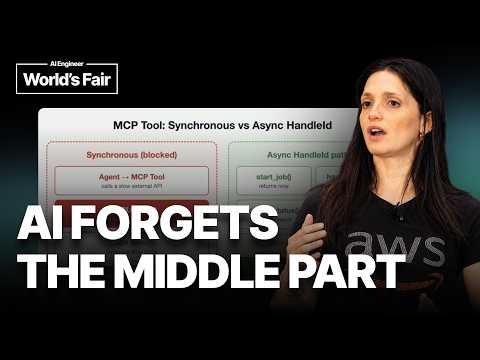
uh like stop your application because the delay. So you can avoid that using a a synchron. So when you use synchronous, your engine is going to wait forever for the answer for your NCP. But if you have an a sync handle, you can invoke your NCP, your external API. So then you can save that and you can retrieve the answer in the next invocation or when you need it. Yes, this is going to depend of the case that you are building and you can do that like this create MCP this is a function that use fast API and with fast API you only need to create the tools. So I going to have two different tools. One is the star lob and another one is check job status and I did a lot of test using this uh a sync handle and the different is a lot. For example, if you have the different um the well the agent never stop to answer me. So because I wait then he can retrieve the information and to close this session six minutes we have the antipartis so why uh you have
to avoid you have to avoid contact stuffing so you need you don't need to include everything and the kitchen you know you don't have to include everything the content window because
the engine doesn't need all the information there you can only share what a need to create the answer that your user or you're asking for. You can have uh native summarization. Sometimes when you do native summarization, the agent uh can uh you can uh forget what you need. If you're doing whatever superization what you may for probably in that summarization, you are not going to have everything that the engine is needed to answer you. and context population. Again, don't pass everything to the agent. The agent doesn't need all that information. And what is a good scene here? So tool returns large data,
logs, database, alert information, externalize, select and use a memory pointer. Many engines need the same large data.
You can share invocation between stage and agent loops or tool hands. You can have clearest st you know give a clear answer for the tool and limited to counts and a thin handle. Thank you. And of course if you want to learn more about stringent we have a huge boot there. We have a lot of swag. We have a little Legos for Amazon that you can have and see you there. We have the specialist and I am Elizabeth No Morgan remember. Thank you so much. \>\> \[music\]