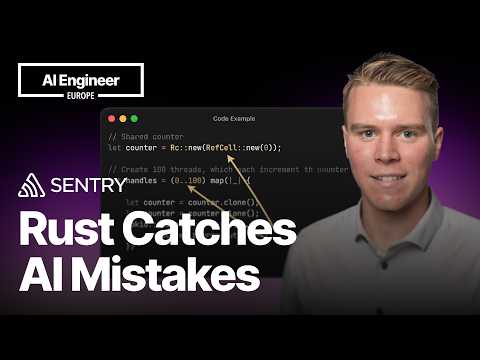
Why Rust is the Ideal Language for Vibe-Coding — Daniel…
A conference talk by Daniel Szoke, Rust SDK maintainer at Sentry, arguing that language choice shapes the quality of AI-assisted ("vibe") coding. It contrasts permissive languages like TypeScript and Python — easy for models to write but prone to intermittent runtime failures such as data races — with Rust, whose strict compiler rejects unsound code, names offending types, and directs agents to fixes. The talk covers why "easy-to-write" languages dominate AI development, the hidden risks of that prioritization, Rust's compiler guarantees (type, null, and concurrency safety), a "fearless concurrency" code demonstration, and why enforced correctness acts as a fast, reliable feedback loop for autonomous AI agents. Timestamped sections span the speaker's background, conventional wisdom on AI-assisted development, failure modes, and Rust safety features.
# Channel Identity Observations — Video: "Why Rust is the Ideal Language for Vibe-Coding — Daniel Szoke, Sentry"
## Explicit Self-Description Evidence
- **Speaker role stated directly**: "My name is Daniel Zook. I'm uh the Rust SDK maintainer at Sentry" — the presenter identifies as a Sentry employee and maintainer of Sentry's Rust SDK.
- **Sponsored content acknowledged**: "this is a sponsored talk and I'm from Sentry, so this is the little marketing slide" — the talk explicitly carries commercial sponsorship from Sentry.
- **Promotional call to action**: "You should try us out if you don't already. This QR code would give you 3 months for free of our business plan. Um we have agent monitoring features. We have a booth downstairs."
## Intended Audience
- **Developers evaluating languages for AI-assisted / agentic coding**: The talk opens by addressing "the conventional wisdom on what language to use for agentic coding or vibe coding," implying an audience already engaged with LLM-based development workflows.
- **Developers with mixed Rust familiarity**: The speaker bridges both groups — "for those of you who don't know anything about Rust or don't know that much about it, some basic background," while also noting "people who haven't encountered it would kind of have the perception that it's very advanced."
- **Practitioners of AI-assisted development specifically**: "I'm sure if you've done any coding with AI, you might have had a situation where you got code that looked really nice… but something might not be right."
## Claimed / Demonstrated Scope
- **Advocacy for Rust in agentic coding**: The core claim is contrarian positioning — "Rust is probably not one of the first things you think of" for vibe coding, followed by the thesis that "the importance of it being easy for the model to write the language is overstated."
- **Technical depth demonstrated**: Concrete coverage of Rust compiler guarantees (type safety, null safety, "fearless concurrency"), a worked concurrency code example, and comparison against Python/TypeScript/JavaScript trade-offs.
- **Breadth beyond pure technology**: References external context — a GitHub article on TypeScript contributor counts, and Yuval Noah Harari's book *Nexus* — showing the talk mixes technical argument with philosophical framing ("alien intelligence," Murphy's Law).
## Observable Presentation Patterns
- **Conference-talk format**: In-person delivery indicators — "We have a booth downstairs. Come by… I'm happy to chat" — and an on-stage slide ("this is the little marketing slide").
- **Opinionated, argumentative structure**: The speaker contrasts conventional wisdom against a personal position ("My argument is that…", "I would even say that in some cases it's a bad thing").
- **Balance of candor and marketing**: The speaker openly labels the promotional segment rather than blending it invisibly into the technical content — a demonstrable presentation choice.
- **Audience-interaction affordance**: Explicit invitation for follow-up questions at the Sentry booth, indicating a live event context rather than a produced studio video.
## Summary of Identity Signals
| Dimension | Evidence |
|---|---|
| **Affiliation** | Sentry (stated: "I'm from Sentry") |
| **Role** | "Rust SDK maintainer at Sentry" |
| **Content type** | Sponsored conference talk, technical argument + product pitch |
| **Audience** | Developers doing or evaluating AI-assisted/agentic coding; mixed Rust experience |
| **Stance** | Contrarian pro-Rust position against the Python/TypeScript consensus |
# Delivery Observation — Daniel Szoke, "Why Rust is the Ideal Language for Vibe-Coding"
## Tone & Overall Delivery Style
- **Conversational, low-key persuasive tone**: The talk reads as an informal conference presentation rather than a rehearsed keynote. Filler words appear frequently throughout the transcript:
- > "Um you know, maybe you think you know, probably chat GPT has a good idea"
- > "Um and so, there's even this article from GitHub"
- **Direct first-person framing** from the opening:
- > "My name is Daniel Zook. I'm uh the Rust SDK maintainer at Sentry and I want to tell you why I think Rust is the ideal language for vibe coding."
## Vocabulary & Framing Choices
- **Repeated informal terminology**: "vibe coding" and "agentic coding" are introduced early and used interchangeably:
- > "what language to use for agentic coding or vibe coding, however you refer to it"
- **Distinguishes "LLM" from "agent" deliberately**, correcting himself once:
- > "makes it easy for the agent or for the LLM, I should say, to write JavaScript"
- > "it's not just LLMs that write code. We put the LLM in an AI agent. It's in a loop."
- **Technical vocabulary clusters** around compiler guarantees: "deterministic guardrails," "invariants," "type safety," "memory safety," "fearless concurrency," "send," "non-deterministic."
## Recurring Rhetorical Habits
- **Question-then-answer structure** to advance the argument:
- > "But why are these languages Python, TypeScript, JavaScript so ideal for vibe coding?"
- > "is that even a good thing?"
- **Concession-then-reversal pattern**: he acknowledges the opposing view before countering it:
- > "Adding typing is a helpful constraint, but that only gets you so far"
- > "This is a huge help, but there are a lot of problems with only relying on having tests"
- > "of course, all these uh constraints come with a trade-off. Rust is harder for LLMs to get right on the first try... But I think this is a good thing."
- **Appeal to external authority** — cites ChatGPT, a GitHub article, and a book:
- > "there's this book called Nexus I recently read and I can highly recommend it to anyone"
- **Trailing "right?" as a checking device** appears repeatedly:
- > "something we want to optimize for, right?"
- > "in a lot of cases... right?"
- > "anything that can go wrong will go wrong eventually at some point, right?"
## Teaching Habits
- **Numbered/listed enumeration** of reasons:
- > "So, first of all, they're common and familiar languages."
- "firstly... And then..." in the tests section
- **Audience-aware scaffolding** — provides background before assuming knowledge:
- > "for those of you who don't know anything about Rust or don't know that much about it, some basic background."
- **Concrete worked example** for the most technical concept:
- > "I just want to give you all a quick example on fearless concurrency because I think it's it's really powerful."
- Walks through a counter with 100 threads and a specific compile error: > "Error: Future cannot be sent between threads safely."
- **Comparative teaching** — contrasts Rust behavior with TypeScript behavior for the same example to make the point memorable.
## Communication Patterns
- **Hedged, experience-based claims** rather than absolutes:
- > "at least in the this sort of conventional wisdom"
- > "in my experience"
- **Self-aware humor / wry comparisons**:
- > "I guarantee you that it's faster than letting an AI agent review your code"
- **Honest disclosure of sponsorship** and open invitation:
- > "of course, this is a sponsored talk and I'm from Sentry, so this is the little marketing slide."
- > "We have a booth downstairs. Come by... I'm happy to chat."
## Stability vs. Isolated Moments
- **Stable patterns** (repeated across the talk): filler-heavy conversational delivery, "right?" tag questions, concession-then-reversal argumentation, enumerated lists, hedging with "I think."
- **Isolated moments**: the *Nexus*/Harari "alien intelligence" digression and the Murphy's Law reference appear once each and do not recur; the QR code/sponsor segment is a single closing moment.
- **Uncertainty note**: timestamps and vocal tone (pace, emphasis, pauses) are not directly observable from this transcript; observations about delivery rhythm rely on textual markers like "um," "you know," and repeated words only.
# Position Record: "Why Rust is the Ideal Language for Vibe-Coding"
**Speaker:** Daniel Szoke, Rust SDK maintainer at Sentry
## Core Thesis
- Rust is the **ideal language for vibe-coding** (agentic coding), contrary to conventional wisdom.
- The importance of a language being *easy for an LLM to write* is **overstated** — in some cases it is a **bad thing**.
## Conventional Wisdom (as characterized by the speaker)
- Asked what language to use for agentic coding, ChatGPT said there's no single number one language, but **Python is probably top**, with **JavaScript/TypeScript as strong number two**.
- Szoke agrees this is "pretty true" from his experience, but **flips the order**: TypeScript has lately emerged as the top choice.
- Cites a GitHub article from late last year claiming AI has pushed TypeScript to **number one language on GitHub by contributor counts**, strongly suspected to be due to AI-assisted development.
### Why these languages are considered ideal (stated conventional reasons)
- **Common and familiar** — typical first languages, easy for humans and seemingly for LLMs.
- **Rich ecosystems** — many frameworks, libraries, and examples; helps humans and agents building from scratch.
- **Fast to scaffold and run** — dynamic/interpreted; easy to run and iterate.
- **Typing support** helps agents avoid type misuse — though the `any` type in TypeScript and typed Python "kind of undermines that a little bit."
## Speaker's Counter-Argument
### The problem with optimizing for LLM writability
- LLMs write these languages well *because* they are dynamic and flexible — but the **same flexibility makes mistakes easy**, both obvious and subtle.
- Typing "only gets you so far" and type safety in TypeScript/Python is **not very strong**.
### LLM fallibility
- LLMs are **by design non-deterministic** and will always be fallible; mistakes may become less frequent but will never disappear entirely.
- Just as we guard against human error, we must guard against **LLM error**.
### Limits of tests and review agents
- Without skillful prompting, agents write **tests after implementation**, testing implementation details instead of behavior.
- Even with TDD, tests **usually can only prove incorrectness when they fail** — impractical to test all input combinations.
- LLM-generated tests and code-review agents **can themselves make mistakes**.
### "Alien intelligence" argument (from Yuval Noah Harari's *Nexus*)
- Harari: LLMs are the first non-human producers of human language; he dislikes "artificial" in AI because it understates how different LLM cognition is, preferring **"alien intelligence."**
- Szoke's inference: **failure modes may be totally unexpected** — e.g., plausible-looking code with sensible names and comments containing subtle bugs or unnecessary heuristics.
### Murphy's Law
- "Anything that can go wrong will go wrong eventually."
- Without **deterministic guardrails**, even with human review, agentic review, and good testing, failures will occur — more often in JavaScript/Python/TypeScript where such guardrails are often lacking.
## The Rust Case
### Background
- Compiled language designed for **safety and performance**; aims to be as fast as C/C++ while being **memory safe and type safe**.
- If it compiles, you can be **reasonably confident** many bug classes are absent (compiler enforces type safety, memory safety, concurrency invariants).
- Beginner-friendly intent; **compiler errors give detailed context on what went wrong and how to fix it** — helpful for AI agents iterating on errors.
### Safety guarantees listed
- **Strict type safety** — no `any` type or unchecked cast bypass.
- **Null safety** — no universal null; emptiness must be explicit `Option`, and the compiler forces checking before access.
- **Fearless concurrency** — compiler verifies that data shared between threads is thread-safe.
- Speaker notes this is "a small list."
### Example: fearless concurrency
- Counter incremented by 100 threads; expected final value 100.
- Types used (`Rc<RefCell<i32>>`) are for single-threaded mutable sharing, not synchronized.
- In TypeScript, this **might compile and run**, failing only intermittently — potentially hard to debug in a larger app.
- In Rust, it **does not compile**: "Future cannot be sent between threads safely"; the extended error identifies the non-`Send` captured counter value, letting the agent immediately switch to a thread-safe type.
### Acknowledged trade-off and rebuttal
- **Trade-off (conceded by speaker):** Rust is harder for LLMs to get right on the first try due to many rules.
- **Rebuttal:** LLMs operate inside agents in autonomous loops — they can compile, read errors, and fix them.
- Every compile error is **potentially a bug avoided in production**.
- On compile-time complaints: "I guarantee you that it's faster than letting an AI agent review your code, and it might not even find all the errors that the Rust compiler is guaranteed to find."
- He still endorses using review agents, but as an *additional* safety element, not a replacement.
## Closing (Sentry promotion)
- Discloses this is a **sponsored talk**; promotes Sentry's agent monitoring features, a QR code for 3 free months of the business plan, and an on-site booth for questions.
# Speaker Attribution Record — Video `01a15ca9-3df9-7ccd-8af3-a156ab424fbc`
## Video
**Title:** Why Rust is the Ideal Language for Vibe-Coding — Daniel Szoke, Sentry
## Speakers
### Daniel Szoke (transcribed as "Daniel Zook")
- **Role:** Creator / presenter — sole speaker in the transcript.
- **Stated affiliation:** Rust SDK maintainer at Sentry.
- Self-introduction: *“My name is Daniel Zook. I'm … the Rust SDK maintainer at Sentry.”*
- Note: Title metadata spells the surname **Szoke**; the transcript audio renders it as **Zook**. Discrepancy is explicit, not resolved.
## Referenced Sources & Third-Party Claims
- **ChatGPT (OpenAI)** — speaker reports asking it for the best agentic coding languages; it named Python first, JavaScript/TypeScript second. **Third-party claim relayed by speaker.**
- **GitHub article ("late last year")** — speaker cites it claiming AI has pushed TypeScript to the number-one language on GitHub by contributor counts, suspected due to AI-assisted development. **Third-party claim; no link or title provided.**
- **Book: *Nexus* by Yuval Noah Harari** — speaker's reading recommendation; relays Harari's framing of "AI" as "alien intelligence." **Third-party characterization.**
- **Murphy's Law** — invoked as a general principle.
## Promotional Segments — FLAGGED
> "this is a sponsored talk and I'm from Sentry, so this is the little marketing slide."
- Speaker explicitly identifies the talk as **sponsored** by Sentry.
- Promotion includes: QR code for **3 months free of the business plan**, mention of **agent monitoring features**, an invitation to Sentry's **booth downstairs** for questions.
## Availability & Limitations
- **Comment availability:** Not stated in transcript; no metadata provided.
- **No timestamps** available in the source; promotional segment occurs near the end of the talk.
- Curated metadata beyond the title was not supplied, so all provenance facts above derive from the transcript alone.
My name is Daniel Zook. I'm uh the Rust SDK maintainer at Sentry and I want to tell you why I think Rust is the ideal language for vibe coding.
So, the conventional wisdom on what language to use for agentic coding or vibe coding, however you refer to it, um
it's Rust is probably not one of the first things you think of. Um You know, maybe you think you know, probably chat GPT has a good idea, what's the best agentic coding
language given that it's also a an agent of some sort. And it would tell you that there's no single number one language, um but that Python is probably the top language, um and as a strong number two, it said JavaScript and TypeScript when I asked it. Um and I think that this is in, at least my experience, pretty true, although I would flip the order because um TypeScript seems to have come out as like the top choice for agentic coding lately. And um so there's even this article from GitHub that came out uh I guess late last year and it says that AI, like they think that AI has pushed TypeScript to the number one um language on GitHub by contributor counts at least. Um so they know it's TypeScript is the number one language and they they strongly suspect that that's because of people using it for AI-assisted development. But why are these languages
Python, TypeScript, JavaScript so ideal for vibe coding. Um at least to in the this sort of conventional wisdom. So, first of all,
they're common and familiar languages. Um So, they're they're they're usually the languages you would learn if you were learning programming from scratch. So, they're easy for humans, and they also seem to be easy for LLMs. There's also a lot of frameworks, libraries, and examples out there. Um so, that that's helpful if you're building something new from scratch, of course, that you can build it on top of something. And you know, it's helpful for humans, it's also helpful for agents. They're fast to scaffold and run. They're dynamic languages. They're interpreted, at least JavaScript and Python are. TypeScript, maybe there's some light compilation down to JavaScript or something, but it's pretty easy just to run it and see what it does, and then you iterate on that. And uh particularly for agents, the typing support is helpful so that the agent doesn't misuse types. Um but uh yeah, there's the any type that it kind of undermines that a little bit in in TypeScript and and typed Python, but you know, overall, these languages, LLMs, the models themselves are pretty good at outputting runnable code in the first try because these languages are simple, um and they impose few constraints. So, I think because of this fact that LLMs just seem to be good at writing them, people jump to these languages. Um but I think something that a lot of people in my experience don't question as much as whether this is even
something we want to optimize for, right? Um the classic vibe coding languages are easy for the models to write, but is
that even a good thing? My argument is that the importance of it being easy for the model to write the language is overstated. In fact, I would even say that in some cases it's a bad thing that these languages are easy for the models to write. Um the dynamic and flexible nature of the languages is what makes it easy for the agent or for the LLM, I should say, to write JavaScript, Python, TypeScript. Um but this same flexibility also makes it very easy to make mistakes. Sometimes even obvious mistakes, sometimes less obvious mistakes. Adding typing is a helpful constraint, but that only gets you so far um because it only gives you the type safety and also it's not a very strong type safety um in TypeScript or Python. And this is of course a problem because LLMs are fallible. They will always be fallible because they're by design non-deterministic systems. So, hopefully in the future they get better at making mistakes less often, but I don't think this is something that would ever disappear entirely. And so, just like the smartest humans make mistakes and we need to guard against human error, we're also going to need to guard against LLM error. One way that folks often would do that, especially also in the conventional uh vibe coding languages, is adding tests. This is a huge help, but there are a lot of problems with only relying on having tests and and code review agents. Um firstly, you know, if you don't prompt the agent skillfully, it'll often write the tests after the implementation and then you just end up testing implementation details without actually testing the behavior properly. Uh even with that test-driven development though, tests usually can only prove incorrectness when they fail because it's impractical call to test every single possible input combination. You can't prove that every input produces the correct output in a lot of cases. And then of course, if LLMs are the ones generating the tests, they may make mistakes when writing those tests and the same thing applies to coding review agents. And then kind of more on a philosophical level, right? We all know AI stands for artificial intelligence, but there's this book called Nexus I
recently read and I can highly recommend it to anyone who hasn't read it yet. It's from an author Yuval Noah Harari. He's a historian and he has kind of a
unique perspective on artificial intelligence. So he's discussing human information networks all the way from Stone Ages to printing press to internet to now with LLMs, right? Um and he thinks LLMs are really unique because it's the first time we have something that's non-human that's able to produce human language. And um a point he makes that really stuck with me is that he doesn't like that the A in AI is artificial because it understates how different um LLMs and other AI technologies are from how humans think and he actually likes to call it alien intelligence instead. Um because the internal workings of how they think at a low level is different from how we think. LLMs predict tokens that come in streams and it's a very powerful mechanism of thinking, but it's not how we think. And my point here is that the failure modes might be totally unexpected to us. And I'm sure if you've done any coding with AI, you might have had a situation where you got code that looked really nice. It might have had sensible variable names, good comments, and whatever. But when you take a look, something might not be right. Like there might be a subtle bug or maybe it's relying on some heuristic when you could check the actual thing and more reliably and more easily in some cases. So, you really need to be careful with this with um LLM and agent tech-based development, right? And then that brings me to Murphy's Law, which basically states that anything that can go wrong will go wrong eventually at some point, right? So, if you are using a language without deterministic guardrails, even if you apply human review, uh agentic review, test a good testing process, if you don't have something that is a absolute deterministic guard against this, eventually you're going to have some failures. And in these languages like JavaScript, Python, TypeScript, where you lack these guardrails a lot of the times, you're going to have failures more often, right? Um and this brings me to Rust, which is a
language with many constraints. Um and so for those of you who don't know anything about Rust or don't know that much about it, some basic background.
It's a compiled language. It's designed with safety and performance in mind. It wants to be as fast as C and C++, but it wants to be memory safe, type safe, um and basically wants to be such like it wants to have such a strict compiler that if the code compiles, you can be reasonably confident that a lot of different types of bugs are not present in your code. Um and that that happens because the compiler is enforcing invariants like type safety, memory safety, concurrency, et cetera. Um and the language tries to be very beginner-friendly. So, Rust itself, I think people who haven't encountered it would kind of have the perception that it's very advanced, but they try to make the language easy to learn. The compiler errors give you a lot of information on what went wrong and how to fix the problem. And so, they provide a lot of context, and of course, this is really helpful when AI agents compile Rust code, hit an error, and then need to fix it. So, as I mentioned, there's a lot of safety guarantees in Rust, right? Um first one worth mentioning is that the
type safety is is strict. You can't bypass it with some any type or an unchecked cast. Null safety is another big one if you've
come from other languages. There's no universal null value. If you want to have an option that or an a type that can be empty, you need to define it explicitly as an option type, and the compiler will force you to always check that the value is there before you access the inner value. And fearless concurrency, which is, I think, really powerful and it basically means that the Rust compiler will check if you have a any multi-threaded code that any data shared between the threads is done that that's all done in a thread-safe way. And this is really just a small list. There's there's so many more things that the Rust compiler enforces, but I just want to give you all a quick example on fearless concurrency because I think it's it's really powerful. So,
here's a little code example. Basically, we have a counter here, which is going to start with a value of zero, and we're going to create 100 threads here. Um
And each time we're going to take the counter and add one to this inner value. So, once all these threads finish, you would expect this to have a value of 100. Now, there's a problem here, which is that um these types here, they're designed for um sharing mutable data, but only within a single thread. They're not synchronized for um multi-threaded safe access. Um so, in a language like TypeScript, something like this might compile, it might run, and then you would only notice the problem when every once in a while you would get a value other than 100 out of this, right? And it might be, especially if this is a small part in a bigger application, it could be very difficult to debug where this data race is occurring. But in Rust, this just doesn't compile. You're going to get a compile error, and it will say, "Error: Future cannot be sent between threads safely. Um this future, so this little async block in here, um is not send. And all send means is safe to be sent between threads, and it's not. So this error isn't that helpful, but if you scroll down in the error message, it'll explain further. And this is what's going to be really helpful to your AI agent because it says, "Oh, the value here, this counter value that was captured, it's not send. It has type RC RefCell i32, and that's not send." And so if your AI agent, when it just compiles your project, it'll get this compiler error, and it can immediately go and change this to a thread-safe type, of which there's there's plenty in in Rust. Um so of course, all these uh constraints come with a trade-off. Rust is harder for LLMs to get right on the first try because there's so many rules they need
to follow. But I think this is a good thing. Um that's because it's not just LLMs that write code. We put the LLM in an AI
agent. It's in a loop. It can do things autonomously. And AI agents are very well suited to be able to compile their code, check any failures, and then go and fix them. And every compile error um is potentially a bug that you avoid in your production code. So um and and with the Rust compiler, like something I hear sometimes people complain that compile times are slow. But I guarantee you that it's faster than letting an AI agent review your code, and it might not even find all the errors that the Rust compiler is guaranteed to find. I still think you should use use it, of course, but it's good to have this um additional element of safety, I guess. And of course, this is a sponsored talk and I'm from Sentry, so this is the
little marketing slide. Um you should try us out if you don't already. This QR code would give you 3 months for free of our business plan. Um we have agent monitoring features. We have a booth downstairs. Come by. Feel free to ask questions about Sentry or if you want to talk to me about the talk, you can also come by and I'm happy to chat. Thank you.