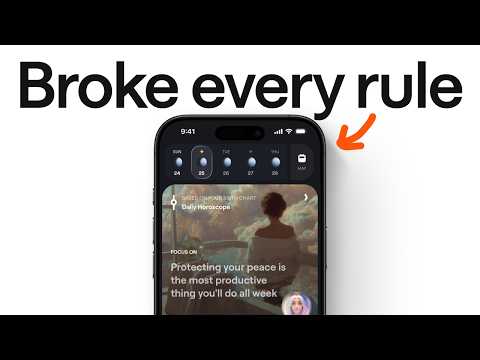
He Spent $1M on A/B Tests. Here's What Won.
Vitaliy Urban, founder of the astrology app Moonly, discusses the A/B testing program behind the app's growth. The video covers experiments on onboarding, paywalls, pricing, free trials, login requirements, add-ons, alternative billing, and attribution/personalization of the first session, including which tests won and which failed. It also covers managing A/B tests at scale and advice for app founders.
# Channel Identity Observations — "He Spent $1M on A/B Tests. Here's What Won."
## Intended Audience
- **App founders, product designers, and growth/product professionals** — the video is saturated with practitioner vocabulary and metrics: *"customers lifetime value doubled," "unit economics," "CAC... now profitable from day zero."*
- The closing pitch makes the target explicit: > "If you're into design data-backed breakdowns on apps and websites that have already been shipped, this channel is for you."
## Claimed Scope
- **Data-backed teardowns of shipped digital products**, especially mobile apps.
- Evidence of recurring format and research depth:
> "In our previous episodes, we studied thousands of onboarding flows, dashboard designs, paywalls to find out what works and what doesn't."
- The channel claims its own comparative dataset: *"On Mobin, only 12% of apps have no sign up or login step," "4% of iOS apps offer a lifetime plan," "59% of iOS paywall screens do not offer a free trial"* — suggesting it runs or owns a design-pattern research product (**Mobin**).
## Format and Presentation Style
- **Founder-interview format** with host narration intercut with guest answers (Moonly's founder), plus host-side commentary on results ("which means their customers are worth twice more than before").
- **Guest interview series**: references to prior guests ("They had a similar finding with our previous guests"), indicating an episodic interview show.
- Recurring structure: myth-vs-evidence framing — *"All the common advice we hear about onboarding, paywall, pricing, and even giving free trials, all of it failed those tests."*
## Self-Description Evidence (Creator's Own Claims)
- Explicit channel positioning statement at the outro (quoted above) — the strongest direct self-description in the material.
- Host frames himself as an analyst of existing products rather than a guru of untested theory: the value proposition is studying *"apps and websites that have already been shipped."*
- Persona positioning around skepticism toward conventional advice: > "It's easy to go on Dribbble. You see same elements in dozens of other apps and assume we need it too."
## Demonstrated (vs. Claimed) Presentation Patterns
- Demonstrates deep sourcing: proprietary metrics from the guest (40% conversion on paid traffic, 41% day-one retention) and cross-references to prior episodes.
- Demonstrates a practical/tactical tone: recommendations ("I recommend to move slowly and cheap"), tool mentions (PostHoc, Coror/Codex, Stripe), and platform-specific guidance.
- Note: all performance figures are creator/guest claims relayed by the host; the video itself does not independently verify them.
# Delivery Observation: "He Spent $1M on A/B Tests. Here's What Won."
## Format Overview
This is an **interview-driven case study** with two observable voices:
- A **host/narrator** who frames each section, cites benchmark data ("On Mobin..."), and asks structured questions.
- A **founder guest** who answers with experiment results and first-person recommendations.
The delivery alternates between these voices in a tight call-and-response rhythm, with the host frequently summarizing the guest's answer before pivoting to the next topic.
---
## Recurring Host Patterns
### 1. Benchmark framing with "On Mobin..."
The host repeatedly anchors claims to his own dataset:
> "On Mobin only 12% of apps have no sign up or login"
> "On Mobin, 4% of iOS apps offer a lifetime plan"
> "On Mobin 59% of iOS paywall screens do not offer a free trial."
### 2. Hard-number openers
The video opens with stacked statistics to hook attention:
> "40% of people who install this app from an ad end up paying for it. This astrology app spent over a million dollars on AB tests and made $20 million"
### 3. Cross-episode self-references
The host connects this episode to prior work:
> "based on what we found in our previous episode, studying over a thousand onboarding flows"
> "They had a similar finding with our previous guests."
> "In our previous episodes, we studied thousands of onboarding flows"
### 4. Closed, results-oriented questions
Host questions are short and force a specific answer:
> "Which pay wall won?"
> "Did this move the needle for you?"
> "Did the users who converted at $8 a week churn harder?"
### 5. Repeat verbal signature: "moved the needle"
> "Did this move the needle for you?"
> "the one that moves the needle was their AI astrologer Luna"
> "out of all the paywall experiments, what moved their numbers the most?"
---
## Recurring Guest Patterns
### 1. Socratic "ask why" teaching habit
The founder models questioning assumptions with a repeated structure:
> "I always recommend to start with question why why do we need this?"
> "So they asked why do they even need login at all?"
> "Was it made to let users keep their data? No... Was it to collect emails? ... Was it for email marketing? ... So why did we need login at all?"
### 2. "We tested / we ran" as the spine of every claim
Nearly every recommendation is backed by a stated experiment:
> "We run hundreds of experiments on every element on the pay wall."
> "Moonly ran 40 pricing experiments."
> "Across all our tests, the soft pay wall won."
### 3. "Earned its place" as a closing motif
> "Every element on the payw wall earned its place."
> "Every element, every icon, every text earned its place by winning a test."
### 4. Direct first-person recommendations
The guest frequently shifts from reporting results to giving advice:
> "I recommend to always add social proof"
> "So I don't recommend to try alternative building"
> "I recommend to move slowly and cheap."
---
## Vocabulary Profile
- **Metric-dense language throughout**: "LTV doubled overnight," "2x uplift," "conversion increased by 12%," "unit economics," "price anchoring," "jobs to be done."
- **Named frameworks**: "contextual pay walls," "soft pay wall," "hard payw wall," "activational insight," "price anchoring," "web funnel."
- **Contrast as a teaching device**: theory vs. result is a repeated structure:
> "In theory, this sounded like a great idea, but every single contextual payw wall failed their AB test."
> "The usual advice is to keep onboarding short, but..."
---
## Structure of Each Segment
A stable section template recurs across the video:
1. Host states common advice ("The usual advice is...", "There are also a lot of advice around free trials").
2. Guest reveals the test result contradicting it.
3. Host quantifies the payoff ("their customers lifetime value doubled," "lifted revenue between day three and day 30 about 15%").
4. Pivot to the next topic, often via a host question.
---
## Uncertainty Notes
- The transcript includes **[music] markers** at many transition points, suggesting edited, produced pacing — but visual/audio delivery style (tone, gestures) cannot be observed from text alone.
- Some transcript artifacts (e.g., "Taro feature taro payw wall bus chart screen chart payw wall") appear to be transcription errors; I've avoided quoting them as evidence of the speaker's actual phrasing.
- The single-instance exclamation "The woman on the sunset. Yeah," is quoted but treated as an isolated moment, not a pattern.
# Video Observation Record: "He Spent $1M on A/B Tests. Here's What Won."
## Speakers
- **Host** — unnamed narrator/interviewer; references "our previous episodes" and the "Mobin" database of app design examples.
- **Moonly founder** — the interviewed guest; identified in the transcript only by context (founder of the astrology app Moonly, which spent over $1M on A/B tests and made $20M "with no investors"). The transcript does not supply his name.
---
## Claim-by-Claim Record
### 1. Onboarding
- **Host (context/framing):** Common advice says keep onboarding short, but prior research on 1,000+ onboarding flows found top-converting apps often have long flows. Moonly's onboarding is **30 screens long**.
- **Founder:** Three major onboarding iterations over six years. Early versions "focused mostly on features, but not the users problem." The latest version targets the **user's job to be done** and offers an **"activational insight"** — bite-sized information (e.g., how lunar cycles affect mood) before showing how a feature solves the user's specific problem.
- **Founder:** With 40 features, they tailor onboarding to the originating ad. They built a **custom attribution engine** connecting ad network → custom App Store product page → custom onboarding flow → specific app experience.
- **Founder:** ~**10 different onboarding flows** in production, each built around a specific user job (e.g., anxiety, ADHD).
- **Host (reported results):** Customizing onboarding **doubled customer lifetime value**; ad spend doubled in one month; CACs "now profitable from day zero" (founder's claim).
- **Founder:** Onboarding collects birth details and personalizes the first session: daily guidance card, moon phase, personalized daily program, and **personal transits** — described as "a perfect hook" because users keep anticipating when a transit will end or the next will start. Quick-access buttons are customized from onboarding answers.
- **Host (reported results):** Day 1 retention **41%**, Day 7 retention **37%** (founder's figures).
### 2. App Store Featuring
- **Founder:** Being featured "worked greatly 15 years ago" but "stopped delivering the same benefits today."
- Brings lots of **irrelevant traffic** → worse conversion rates → App Store algorithms may rank the app lower in search. "It's a problem sometimes actually."
- Qualification: featuring "can still work well for universal generic apps like calculators or flashlights, but it isn't particularly useful for niche apps."
### 3. Removing Login
- **Host (context):** On Mobin, 12% of apps have no sign-up/login step; Moonly has **10 million users and no login screen at all**.
- **Founder:** Recommends starting with "why do we need this?" — it's easy to copy patterns from other apps ("afterpilot" [as transcribed]). SMS logins create "a UX nightmare."
- **Founder, reasoning through each rationale:**
- *Data persistence?* No — data already stored in Apple keychain; instantly restored on a new iPhone.
- *Collecting emails?* Real email entry creates "significant cognitive friction"; users hide emails via Sign in with Apple anyway.
- *Email marketing?* A "huge and complex challenge" — despite years of effort and 1M+ emails sent with strong open rates, they "haven't yet managed to make it work efficiently," and it cost significant money.
- **Conclusion (founder):** "It was better to remove it and reduce the cognitive load on our users."
### 4. Paywalls
- **Contextual paywalls failed:** Founder previously matched paywalls to features (tarot paywall, birth-chart paywall). "In theory, this sounded like a great idea, but **every single contextual paywall failed their AB test**" — users perceived they had to buy each feature separately. They returned to a **single consistent paywall** ("unlocks all features").
- **Soft vs. hard paywalls:**
- Founder: "Across all our tests, **the soft paywall won**." Qualification: the close button only appears after 5 seconds, "but we call it soft paywall anyway."
- Founder (contrasting result): "**Hard paywalls won in the US**" — "in the US, users are much more accepting of aggressive monetization."
- **Images as the biggest lever:** Founder: "I feel like images are the biggest lever." Hundreds of experiments per paywall element; a single winning image delivered a **2x uplift** in a few days — "the winner was not the image that we bet on."
- **Winning image:** A realistic-style **woman at sunset**. The team "fell in love with Disney style" but failed to consider their paying audience is **over 35** and "couldn't recognize themselves in cartoonish 3D characters."
- **Face personalization — a failure:** They personalized ~50 images with the user's own face (complex and expensive). Results were inconsistent, "some of them are simply cringe," people are "sensitive to anything involving their own face," and "thousands of users avoided opening the app" — the feature was completely removed.
- **Copy:** Eight title/subtitle variants tested; words alone increased conversion **12%**. Founder recommends social proof (downloads, reviews, accolades) and notes "no commitment, cancel anytime" subtitles "always seem to bump things up incrementally."
- **Cumulative framing:** "What you see today is the result of small incremental improvements made almost every day." Baseline 2020 paid-traffic conversion: **10%**; today: **40%**.
### 5. Pricing
- **Founder:** "Pricing tests are the most important experiment you can run in a product." ~**40 pricing experiments** in the past year.
- **Price anchoring:** A high-priced lifetime plan increases perceived value and nudges users toward the weekly plan — "you don't mean to sell a lifetime plan." (Host context: on Mobin, 4% of iOS apps offer a lifetime plan, usually priced ~2x the annual plan.)
- **Changing units, not numbers:** "People usually don't compare prices to value, they compare prices to each other." $8/month → **$8/week**; $30/year → **$30/month**.
- **Trade-off (preserved):** Host asked if $8/week converters churn harder. Founder: "**Yes**, but the final revenue is bigger as you have more rebills before the subscriber will die" [transcript garbled: "rebuilds before the scoreboard will die"]. Weekly payments also speed ad-spend recovery and shorten the acquisition feedback loop.
### 6. Free Trials — Removed
- **Founder:** Trials worked for a year, but "most of the time the unit economics were much stronger without them." Common pattern: users purchase and cancel within seconds.
- **Reasoning:** The birth chart — one of the most valuable features — was given to trial users for free; afterward they felt they'd "already received 90% of value" and weren't interested in paying. Free trial was **completely removed**. (Host context: 59% of iOS paywall screens on Mobin offer no free trial.)
- **Replacement — one-time offer:** Delivered ~day 3. "If price is the blocker, we don't lose this user." Lifted revenue between day 3 and day 30 by **~15%**.
### 7. What Worked Well
- **One-tap sharing:** "People don't share features, they share insights about themselves." Screenshot triggers a ready-made share flow. **23% of users share** something; millions of free views.
- **AI astrologer "Luna":** ~**1 million conversations** in 6 months post-launch, growing exponentially. Cartoon/Disney-style and faceless designs failed; "when people receive meaningful personal guidance, they need the entity to feel trustworthy. **So realism works better here.**"
- **Add-ons:** ~10 in-depth astrology reports (soulmate, career, astrocarterography [as transcribed], numerology), fed into the AI astrologer's context. ~**$500k/year** run-rate within a few months, independent of subscriptions.
- **Smart announcement system:** Analyzes user context, maintains a "dynamic queue of offers that updates every second"; the AI astrologer recommends add-ons "only when a specific one can really help user at the moment."
### 8. Payments
- **Founder:** With native iOS payments, **50% of cancellations happen within 3 minutes** of purchase "because iOS made cancelling a one-tap habit."
- **Stripe in the US:** Adding Stripe as an alternative "**doubled our LTV overnight**"; ~80% of US customers now pay via Stripe (small discounts offered). Founder's self-qualification: "I was very skeptical in the beginning, but now on iOS, it works absolutely great."
- **Android caveat:** Alternative billing requires Google's native SDK — "you don't control anything," the interface "is designed to scare users away," and no Google Pay support "kills almost all conversions." "I don't recommend trying alternative billing on Android."
### 9. Process & Advice
- **Founder:** Hundreds of A/B tests monthly, unmanageable manually. They use **Cursor and Codex**; AI "connects the dots," matches numbers across analytics sources (PostHog, Adapty, Drive [as transcribed]), and delivers ship / don't-ship / collect-more-data recommendations.
- **Founder:** "Every element, every icon, every text earned its place by winning a test."
- **Founder's startup advice:** "In 2026, it's very hard to get positive unit economics in applications." Common mistake: spending millions building a product only to discover no market. Instead: **start with a web funnel** for more freedom and instant market signals — alone with AI agents or with one front-end developer. "Move slowly and cheap."
---
## Contradictions, Tensions, and Qualifications (preserved)
- **Soft vs. hard paywall split:** Soft won globally, but hard paywalls won in the US — a regional contradiction the founder attributes to US tolerance for aggressive monetization.
- **Realism vs. cartoon style:** Disney-style art failed for paywall images and the AI astrologer, yet the team had "fallen in love" with it — a stated bias against their own test outcome.
- **Face personalization:** An expensive investment that was fully removed after harming engagement.
- **Stripe skepticism:** Founder explicitly notes initial skepticism later reversed by results.
- **Free trial reversal:** Trial worked for a year before being removed on unit-economics grounds.
- **Featuring nuance:** Still useful for generic apps, harmful for niche apps — not a blanket dismissal.
- **Weekly pricing trade-off:** Higher churn acknowledged; justified by total rebill revenue, not disputed.
- **Data reliability note:** All metrics (retention, conversion, LTV, revenue) are founder-reported figures relayed via the host or stated by the founder directly; the transcript offers no independent verification.
---
## Unattributed / Ambiguous Attributions
- Lines beginning "On Mobin…" (12% no-login apps, 4% lifetime plans, 59% no-free-trial paywalls) are spoken in the host's narration voice and attributed to the Host as context drawn from the Mobin database.
- The transcript contains garbled passages (e.g., "afterpilot," "rebuilds before the scoreboard will die," "astroterography"); these are preserved as-is with editorial notes rather than corrected.
# Video Attribution & Provenance Record
## Video Identification
- **Title:** "He Spent $1M on A/B Tests. Here's What Won."
- **Video ID:** `01a15ba0-77f9-7509-bed7-d6b4a57475a2`
## Speaker Identification
### Speaker 1: Channel Host / Narrator
- **Role:** Creator/narrator of the channel; conducts the interview and provides editorial framing (e.g., retention metrics commentary, onboarding statistics from prior episodes).
- **Evidence:** Opens and closes the video ("So, I asked the founder to come on the channel…"; outro: "Thank you for watching and I'll see you in the next one").
### Speaker 2: Moonly Founder (Guest)
- **Role:** Interviewed guest; founder of the astrology app **Moonly**. Not named in the transcript.
- **Evidence:** Host states, "I asked the founder to come on the channel"; guest speaks in first person about Moonly's experiments ("Across all our tests, the soft pay wall won").
> Attribution note: Dialogue markers (`>>`) alternate between host narration and guest answers; exact per-quote assignment above follows contextual reading only — the transcript does not label speakers explicitly.
## Referenced Sources & Third-Party Claims
- **Mobin (app design database):** Cited multiple times for aggregate stats — 12% of apps have no sign-up/login step; 4% of iOS apps offer a lifetime plan (~2× annual price); 59% of iOS paywall screens do not offer a free trial.
- **"Previous episode":** Host references studying "over a thousand onboarding flows" and prior guests ("They had a similar finding with our previous guests"), including a quoted guest line about social accolades.
- **App Store featuring:** Guest claims about featuring delivering "irrelevant traffic" — third-party platform claim by the guest.
- **Tools named:** PostHog, Adapty, Cursor ("Coror" in transcript), Codex, Stripe, Apple/Google native billing, Apple Keychain.
- **Internal data claims (guest-reported, unverified):** $1M spent on A/B tests, $20M revenue, no investors, LTV doubled from custom onboarding, 41% day-1 / 37% day-7 retention, 10% → 40% conversion on paid traffic (2020 → present), 40 pricing experiments in past year, 2x uplift from a single paywall image, 23% of users share in-app content, ~1M AI astrologer conversations in 6 months, ~$500k/year from add-ons, 80% of US customers pay via Stripe.
## Promotional Segments
- **Channel self-promotion (outro):** Host promotes the channel's "design data-backed breakdowns" format — flag as promotional.
- **No external sponsorship segments detected** in the transcript. Mentions of tools (Cursor, Codex, PostHog, Adapty, Stripe) appear as guest-described workflow, not as advertising reads.
## Availability Limits
- **No curated metadata supplied** beyond the transcript — speaker names, episode links, and cited sources are not independently verifiable.
- **Comments availability:** Not stated in the source material.
- **Named individuals:** Founder and host are unnamed; "Moonly" is the only entity named.
## Uncertainty Flags
- Transcript contains garbled text (e.g., "Coror," "viculations engine," "astrotography") — likely transcription errors for Cursor, viralications/recommendation engine, astrocartography; recorded as uncertain.
- Speaker-turn boundaries between host and guest are inferred from context, not explicit labels.
40% of people who install this app from an ad end up paying for it. This astrology app spent over a million dollars on AB tests and made $20 million
with no investors. All the common advice we hear about onboarding, pay wall, pricing, and even giving free trials, all of it failed those tests. So, I asked the founder to come on the channel to share all his experiments that won and failed in the last 6 years. The usual advice is to keep onboarding short, but based on what we found in our
previous episode, studying over a thousand onboarding flows, most of the top crossing apps have one of the longest onboarding flows. Moonly has a similar approach. VR on boarding is 30
screens long. Over the last 6 years, we had three major iterations of onboardings. We focused mostly on \[music\] features, but not the users problem. The latest version shifted the focus to users jobs to be done or the pain behind it. And we offer an activational insight. So we give you small bite-sized information that unlocks some insight such as \[music\] how lunar cycles can affect your mood. And finally, we introduce the feature by showing how it solves your specific problem. \[music\] Since the app has 40 features and not everyone uses each of these features, they tailor the onboarding flow based on the ad you came from. \>\> We just finished developing our own attribution engine. Today we can connect
user from ad network to specific custom product page on app store and then to specific \[music\] custom onboarding flow and even a specific app experience. Someone who simply search only will
\[music\] see the standard page but someone who search specific feature like to they will see fully customized page and set of screenshot. We now have around 10 different onboarding flows in production each built around a specific user job even anxiety or ADHD. \>\> By customizing their onboarding flows their customers lifetime value doubled which means their customers are worth twice more than before. This led them to double their ad spend in a single month. \>\> Our cos are now profitable from day zero just because custom on boardings. \[music\] During the onboarding, we
collect as much information as we can including birth details and personalize the first session. \>\> So your user finishes onboarding and lands on the homepage for the first time. What do they see?
\>\> They see a daily guidance card, moonface, personalized daily program. Plus, they provide something called personal transits, \>\> which works as a perfect hook because \[music\] you keep thinking about your transits and you remember about this and you expecting when your transit will finish, when the next transit will start. Quick assess buttons on main screen are also customized \[music\] based on their on boarding answers. \>\> Customizing their whole experience worked wonders for their app retention numbers. Our day one retention now is 41%. And day 7 37%.
\>\> If you're trying to grow an app, you would want to be featured as app of the day. Only has been featured on the app store multiple times. Did this move the needle for you? \>\> It worked greatly 15 years ago, but in
reality, being feature stopped delivering the same benefits today. It tends to bring a lot of irrelevant traffic. Irrelevant traffic shows worse conversion rates. So it just hurts your statistics. The app store algorithms analyze it and may rank you lower in search result. It's a problem sometimes actually. So featuring can still work well for universal generic apps like calculators or flashlights, \[music\] but it isn't particularly useful for niche apps. \>\> When designing the onboarding flow, we
always debate when to introduce the login. Is it before the customer arrives at a homepage or after? On Mobin only 12% of apps have no sign up or login
step anywhere only has 10 million users and no login screen at all. \>\> I always recommend to start with question why why do we need this? \[music\] It's easy to go on afterpilot. You see same elements and dozens of other apps and assume we need it too. \[music\] Sometimes login even requires an SMS which doesn't always arrive in \[music\] seconds. Just like that you create a UX nightmare. So they asked why do they even need login at all? \>\> Was it made to let users keep their data? No, because their data was already stored in Apple keychain and \[music\] even after installing the app on a new iPhone, you will be instantly locked in. \>\> Was it to collect emails? \>\> Entering a real email creates significant cognitive friction \[music\] and distracts user from what they actually came to do. Besides, users are used to signing in with Apple and hiding their real email address. \>\> Was it for email marketing? \>\> But building an \[music\] effective email marketing is a huge and complex challenge. And we haven't yet managed to make it work efficiently despite the fact we spent years on this. Even with strong open rates, sending more than a million emails over months cost significant \[music\] amount of money. So why did we need login at all? it was better to remove it and reduce the cognitive load on our users. \>\> When designing pay walls, we also believe that we should show the right payw wall at the right moment. \[music\] We call this contextual pay walls.
Moonly used to do this as well. They would show users the relevant payw wall that matches what they're doing. \>\> For instance, taro feature taro payw wall bus chart screen chart payw \[music\]
wall. \>\> In theory, this sounded like a great idea, but every single contextual payw wall failed their AB test. \[music\] When people see this pay walls one by one, they have perception that you have to buy all these features separately to use the product. \>\> So in the end, you went back to the single consistent payw wall. \>\> Yep. \>\> Orbit's payw wall makes it really clear that if you pay today, you unlock all features. There are two types of pay \[music\] walls. The soft payw wall is a payw wall where you can close it and keep using the app. Whereas the hard payw wall, there's no way past it without paying. You've tested both soft payw wall and a hard pay wall. Which pay wall won? \>\> Across all our tests, the soft pay wall won. The close button only appears after 5 seconds, but we call it soft pay wall. Anyway, in the US, users are much more accepting of aggressive monetization. \>\> Soft payw wall globally whereas hard payw walls won in the US. But out of all the paywall experiments, what moved their numbers the most? I feel like images are the biggest lever. We run hundreds of experiments on every element on the pay wall. \[music\] Just a few days, a single winning image delivered us 2x uplift. And the winner was not the image that we bet on. \>\> Could you guess which payw wall image won the AB test? \>\> The woman \[music\] on the sunset. Yeah, \>\> that was the first image that was in realistic style that won the AB test. For some reason, we fell in love with Disney style, but we failed to consider that the audience most willing to pay for our product is over 35 and they couldn't recognize themselves in cartoonish 3D characters. They need something more realistic. \>\> Since realism worked, they pushed it even further. \>\> We once decided to \[music\] personalize users avatar based on their zodiac signs. It makes product feel more personal. But then we decided to take it further and personalized every image with user's \[music\] own face around 50 images in the product which is very complex and expensive but we build it anyway. The result aren't always consistent \[music\] and some of them are simply cringe so people are sensitive to anything involving their own face. \[music\] In the end thousands of users avoiding open the app so we completely removed this feature. They also tested eight variants of titles and subtitles on the pay wall. \[music\] \>\> When we only change the words, conversion increased by 12%. And I recommend to always add social proof like number of downloads, reviews. \>\> They had a similar finding with our previous guests. \>\> These social accolades are really nice to kind of show credibility and authority. \>\> Even mentioning a fine print. \[music\] \>\> This no commitment cancel anytime subtitle always seems to bump things up incrementally. If you compare our pay walls year by year, \[music\] it might look like we launched only a few major versions over last six years. But what you see today is the result of small incremental improvements made almost every day. We started \[music\] with a 10% conversion rate in 2020. It was our baseline and today we reached 40% conversion on paid \[music\] traffic. \>\> Every element on the payw wall earned its place. What about the price? \[music\]
Pricing tests are the most important experiment you can run in a product. It comes down \[music\] to the price and perceived value. \>\> In the past year, Moonly ran 40 \[music\] pricing experiments.
\>\> For example, a highriced lifetime plan can increase the product perceived value and niche users toward ano over weekly plan. So, you don't mean to sell a lifetime plan. \>\> We call this price anchoring. \[music\] On Mobin, 4% of iOS apps offer a lifetime plan and it's usually priced at about twice the annual plan. How do you decide which pricing test to run next? \>\> People usually don't compare prices to value, they compare prices to each other. \[music\] So, we kept the number and changed the units. For instance, 8 bucks \[music\] per month became 8 bucks a week. 30 bucks per year became 30 bucks per month. After we rebalance for weekly \[music\] payments, money now arrive weekly instead of monthly. You recover your ad spend faster. You can scale acquisition with a shorter feedback loop. \>\> Did the users who converted at $8 a week churn harder? \>\> Yes, but the final interview is bigger as you have more rebuilds before the scoreboard will die. \>\> There are also a lot of advice around free trials. They had one. It worked for
a year. \>\> But most of the time the unit economics were much stronger without them. People make purchase and then in few seconds they cancel it and it's now a very
common pattern. \>\> The birth chart feature is one of the most valuable features in the app and trial users got it for free. After that they feel that they already received 90% of value from our product and they are not interesting to pay it \>\> and that's why they removed the free trial completely. On Mobin 59% of iOS paywall screens do not offer a free trial. So instead of a free trial moonly dropped a one-time offer. They have different mechanics in place but in this case it's usually on day three. If price is the blocker, we don't lose this user. The single payable lifted revenue between day three and day 30 about 15%. \>\> Now, here are four things that works really well for Moonly. The first one is
sharing in one tap. \>\> People don't share features, they share insights about themselves. If someone takes a screenshot in Moonly, we offer a readym made flow that lets you share
this in one tab. 23% of users share something from the app and as a result they got millions of free views. Apart from 40 features in their app, the one
that moves the needle was their AI astrologer Luna. \>\> We now have about 1 million conversations after feature was launched 6 months ago and it grows exponentially.
We experimented extensively with her style, vibe, tone of voice, visual identity. They tested cartoon graphics, a Disney-like style, and a faceless approach. But none of these appealed to their users. \>\> When people receive meaningful personal guidance, they need the entity to feel trustworthy. So, realism works better here. \>\> On top of subscriptions, they offer
add-ons. \>\> We even developed our own viculations engine. We've created around 10 in-depth astrology reports that go far beyond the core experience like soulmate report,
career, astrotography, numerology. This report is also added to the AI astrologers context. We just started few months ago. We already generate around 500k per year on adons and it doesn't subscription \[music\] \>\> to sell add-ons. They built a smart system for inapp announcements. It analyzes each user's context and anticipates what they might need next. The system maintains a dynamic queue of offers that updates every second. \>\> The AI astrologer also recommends add-ons to the \[music\] users \>\> but only when a specific one can really help user at the moment. And when it comes to payments
\>\> with native payments, 50% of cancellation happened in 3 minutes from purchase because iOS made cancelling a onetop habit. \>\> In the US, they moved payments of Apple
entirely. \>\> So we added Stripe payments as an alternative in the US and our LTV doubled overnight. \>\> Now about 80% of their US customers pay with \[music\] Stripe. \>\> We provide small discounts for Stripe and it's a win-win. I was very skeptical of in the beginning, but now on iOS, it works absolutely great. \>\> Does that work on Android too? \>\> You can only offer alternative billing with a Google native SDK, which means you don't control anything. The interface is designed to scare users away and it also doesn't support Google Pay, which kills almost all conversions. \[music\] No one wants to enter the cards details manually. So I don't recommend to try alternative building conundrate
\>\> since they run hundreds of AB tests and \[music\] experiments each month. How do they manage it? \>\> There is no way we could manage it manually. \[music\] We use Coror and Codex for this. AI
helps us connect the dots and design \[music\] experiments around areas of inefficiency. AI automatically matches numbers across all our data analytic sources like post hog adaptive drive \[music\] and delivers a clear recommendations like to ship not to ship or collect more data. \>\> They tested things that people would
probably not even question in the first place. \>\> Every element, every icon, every text \[music\] earned its place by winning a test. Uh in 2026, it's very hard to get
positive unit economics in application. \>\> \[music\] \>\> The common mistake is to spend millions of dollars trying to build amazing product only after that realize that market didn't exist for this product or your approach is incorrect. \[music\] \>\> And he recommends this instead. \>\> Start with a web funnel because you have much more freedom and you will instantly get the signals from the market. You can do it alone with AI agents or maybe with one front- end developer. It's better to be as lean as you can so you can go step by step. I recommend to move slowly and cheap. \>\> So, six years, $1 million worth of AB tests. In our previous episodes, we studied thousands of onboarding flows, dashboard designs, pay walls to find out what works and what doesn't. If you're into design databacked \[music\] breakdowns on apps and websites that have already been shipped, this channel is for you. Thank you for watching and I'll see you in the next one.