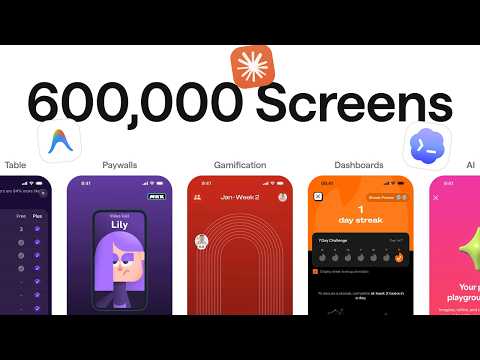
I Gave Claude 600,000 UI Screens… Then This Happened
The creator gives Claude access to 600,000 real app UI screens via the Mobbin MCP to test whether AI-driven design improves when the model can reference real-world patterns. The video compares results from the same prompt, walks through researching with the reference library first, building a design flow, and using the setup with tools like Figma Agent and Paper. It also covers five other use cases and setup instructions.
# Video Identity Observations
## Observable Presentation Evidence
- **Channel focus: design research and AI-assisted product design workflows.** The video demonstrates connecting AI tools to design reference databases — "I gave Claude access to Mobbin MCP" — and walking through research-then-build design processes.
- **Production style: screen-recorded tool demos with narrated workflow.** The transcript walks through concrete steps: fetching "account opening flows in the finance category," building in Figma ("design the map and filter views for iOS screens"), including candid failure displays ("some of the UI are broken").
- **Credibility claims via scale of research:** "over 600,000 real app and website screens," "We studied 3,000 paywalls," "we've also studied over 1,000 onboarding flows."
- **Practitioner-to-practitioner stance:** the creator shows design judgment, e.g., "We don't recommend one-shotting a design right away. Research… first," and acknowledges limits: "what Mobbin MCP can't do is help us decide what to prioritize… That part's still our call."
## Intended Audience
- **Designers and product teams using or considering AI tools.** Evidence: references to Figma, Claude desktop app, MCP setup ("Go to mobbin.com/mcp for the setup instructions"), and design terminology ("PRD," "design system," "empty states," "edge cases").
- **Potential Mobbin customers** — the video is effectively product-affiliated content: "Mobbin MCP is included with any paid Mobbin plan."
## Claimed Scope
- **AI + design reference integration as a workflow:** "handing your AI a library card to over 600,000 real app and website screens, flows, animations from products that have already been shipped."
- **Compatibility breadth claimed:** "works with popular AI tools like Claude, Antigravity, Codex, Cursor, and a lot more."
## Explicit Self-Description vs. Demonstration
- **Demonstrated (not claimed):** the research → report → build pipeline, competitor comparisons ("how DoorDash and Uber Eats can do checkout"), and copy suggestions with cited sources.
- **Channel-level claims appear in the outro** ("we've studied 3,000 paywalls"), suggesting an ongoing research-breakdown content series, but this single video cannot confirm the broader catalog.
# Delivery Observation: Mobbin MCP Demo Video
## Overall Delivery Style
Fast-paced, product-demo narration with screen-share walkthroughs. The speaker alternates between explaining concepts and narrating live agent actions in real time ("It's actually fetching account opening flows in the finance category").
## Tone
- **Conversational and direct**, with short declarative sentences: "Here's why." "Now, the report is done."
- **Confident but not absolute** — includes honest caveats about tool output: "some of the UI are broken."
- **Practical/advisory** in transitions, especially toward the end: "We don't recommend one-shotting a design right away."
## Vocabulary & Word Choices
- Heavy use of **industry-design jargon**: "onboarding flow," "fintech," "compliance requirements," "edge cases," "trade-offs, blind spots," "user flows," "patterns."
- Recurring framing around **research-grounded vs. generic output**:
> "This one, it looks fine, but it's generic."
> "This one feels much more considered."
- Comparative verbs dominate: "compare," "contrast implicitly," "dig deeper," "remixing ideas across industries."
## Recurring Phrases & Terms
- **"Mobbin MCP"** — repeated many times as both product name and verb-like action ("Using Mobbin MCP, research how top apps…").
- **"Research first"** framing appears at least twice:
> "Research using Mavin MCP first, then use Mavin MCP to solve specific design problems."
- **Top/best framing** recurs: "top apps," "the best apps do differently," "top companies converge on."
- **"It's actually…"** construction for narrating agent behavior: "It's actually fetching…," "it's actually pushing back on the brief."
## Teaching Habits
- **Problem-then-solution structure**: shows a weak generic output before the improved one.
- **Numbered/implied step sequences**: "Attach two things…," "Lastly, I'll ask it to…"
- **Concrete examples as proof**: names real products (Curve, DoorDash, Uber Eats, One) and quantifies scale ("600,000 real app and website screens," "3,000 paywalls," "1,000 onboarding flows").
- **Ends with a human-limitation caveat**, a notable teaching move:
> "That part's still our call."
- **Cross-promotional close** with study statistics as credibility: "We've also studied over 1,000 onboarding flows to find out what works."
## Communication Patterns
- Uses the **inclusive "we/us"** when giving advice ("we tend to miss," "we don't recommend") but switches to **"I"** for personal demos ("I asked Claude…," "I'll open a fresh Claude session").
- Short imperative prompts when showing usage: "click on it, it will bring you to Mobbin."
- Optional-step hedging when instructing: "This is optional, but it helps the agent understand the full context."
## Uncertainty Notes
- Single video; all patterns are based on one ~4.5-minute sample, so repetition evidence is limited.
- Voiceover vs. scripted narration is indistinguishable from the transcript alone; musical interludes ([music] markers) suggest heavy editing, which may compress natural speech patterns.
# Observed Positions & Claims — "I Gave Claude 600,000 UI Screens… Then This Happened"
> **Note on attribution:** No curated speaker metadata is provided. The video is a single narrator voiceover (plus brief unnamed voice fragments labeled only as unattributed interjections). All claims below are attributed to **the Narrator** unless the transcript explicitly indicates otherwise. The video is promotional content for **Mobbin MCP**.
---
## 1. Core Claim: Grounding AI Design Output in Real References Improves Quality
**Speaker:** Narrator
- Comparing two Claude-generated fintech onboarding flows:
- The first is described as: *"it looks fine, but it's generic."*
- The second — produced with Mobbin MCP access — *"is grounded in real finance apps"* and *"accounts for things like identity checks, compliance requirements."*
- The Narrator's stated judgment: *"This one feels much more considered."*
- The claimed reason: giving Claude access to **Mobbin MCP**.
## 2. What Mobbin MCP Is (as described)
**Speaker:** Narrator
- Connecting an AI tool to Mobbin MCP is described as: *"handing your AI a library card to over 600,000 real app and website screens, flows, animations from products that have already been shipped."*
## 3. Claimed Workflow Demonstration: Research Phase
**Speaker:** Narrator (describing a Claude session in a browser with Mobbin MCP connected)
The prompt to Claude reportedly included instructions to:
- Research how top apps design onboarding and account opening flows across fintech/banking.
- Find relevant screens and flows, compare patterns, and identify what the best apps do differently.
- Create a **visual report** of top examples, common patterns, and converging best practices.
**Stated observations of the result:**
- Claude *"studied some welcome screens from fintech apps"* and *"understands the industry context, so it knows a banking onboarding flow is not the same as a generic one."*
- The report pulls out common patterns, **trade-offs**, and *"blind spots that we tend to miss."*
- References link back to Mobbin for deeper study of full user flows.
- The report *"distills what the best apps do differently from the copy and the user flow."*
## 4. Claimed Workflow Demonstration: Build Phase
**Speaker:** Narrator
- Setup: a Figma file ("paper") with a made-up design system, a fresh Claude desktop session with **paper MCP** connected.
- Inputs: the research report plus (an *optional*) short spec document — *"it helps the agent understand the full context."*
- Prompt asked Claude to propose an onboarding flow for "Curve" and to *"flag anywhere that you're intentionally deviating from a pattern."*
**Claimed example of agent pushback:**
- The PRD asked where the *"safe offers nudge"* belongs *"without feeling manipulative."*
- Claude placed it on the homepage right after onboarding, citing **One** (an app where *"the setup bonus is actually on the homepage as well"*), because *"it has done its research."*
## 5. Claimed Anti-Pattern: One-Shotting Designs
**Speaker:** Narrator
- **Explicit recommendation:** *"We don't recommend one-shotting a design right away. Research using Mavin MCP first, then use Mavin MCP to solve specific design problems."*
- *Note:* the transcript spells it "Mavin MCP" here but "Mobbin MCP" elsewhere — likely a transcription artifact, recorded as-is.
**Claimed comparison (via Figma agent demo):**
- Direct one-shot prompt ("design the map and filter views for iOS screens") produced broken UI — *"some of the UI are broken."*
- With Mobbin/Mavin MCP research first, the agent *"studied the references citing the source"* and produced a better result.
**Additional cited use cases:**
- Head-to-head competitor comparisons (e.g., **DoorDash vs. Uber Eats** on checkout, tipping, order summary).
- Fast lookups (e.g., 10 empty states from productivity apps).
- Copy suggestions *"tailored to your users"* with cited sources of inspiration.
- **Remixing ideas across industries** (attributed to what *"people"* are doing).
- Nailing different edge cases.
## 6. Availability & Limitations
**Speaker:** Narrator
- Setup instructions at **mobbin.com/mcp**; Mobbin MCP is *"included with any paid Mobbin plan."*
- Works with *"popular AI tools like Claude, Antigravity, Codex, Cursor, and a lot more."*
**Explicit limitation acknowledged:**
> *"What Mobbin MCP can't do is help us decide what to prioritize, what to keep, and what to cut. That part's still our call."*
## 7. Closing Promotions
**Speaker:** Narrator
- A breakdown of **3,000 paywalls** on what converts.
- Study of **over 1,000 onboarding flows** on what works.
---
## Unresolved / Unqualified Points
- Quality claims (e.g., "much more considered," "better result") are the Narrator's subjective assessments shown via demo; no independent evaluation criteria are stated.
- The "Mavin" vs. "Mobbin" naming inconsistency is left unexplained in the transcript.
- The comparison demo (one-shot vs. research-first) reflects a single example, not stated as a controlled or repeated test.
# Video Attribution & Provenance Record
**Video:** *I Gave Claude 600,000 UI Screens… Then This Happened*
**Video ID:** 01a15ba0-786d-7f28-89d6-9b9f34b7bd03
---
## Speaker Identification & Roles
| Speaker | Role | Evidence |
|---|---|---|
| Unnamed lead speaker | **Creator / presenter** (first-person narrator throughout) | Opens and closes the video in first person ("I asked Claude…", "I'll see you there"); demonstrates the workflow hands-on |
| Second voice | **Unidentified secondary voice** | Brief overlapping lines ("this is what it came up with", "some of the UI are broken") during the Figma/Mavin MCP segment; name and role not stated in transcript — **uncertainty: explicit** |
| Claude (AI) | **Tool output**, not a human speaker | Referenced and quoted only via descriptions of its outputs; no direct attributed speech |
> No curated metadata was supplied beyond the title; speaker names are not established anywhere in the source.
---
## Referenced Products, Tools & Sources
- **Mobbin MCP** — central product being demonstrated; "over 600,000 real app and website screens, flows, animations from products that have already been shipped"
- **Claude / Claude desktop app** — AI tool connected to Mobbin MCP and paper MCP
- **Paper MCP** — used with a "made-up design system" file
- **Mavin MCP** — used for research-first workflow in Figma (note: transcript also appears to refer to it as "Mavin" consistently; transcript text at one point reads "Mavin MCP first, then use Mavin MCP")
- **Figma** — design environment where the agent is invoked
- **mobbin.com/mcp** — cited URL for setup instructions
### Third-party examples cited in transcript
- Fintech apps referenced generally (identity checks, compliance requirements)
- **Curve** — target app for the proposed onboarding flow
- **One** — cited by Claude as reference for homepage setup bonus
- **DoorDash, Uber Eats** — comparison example for checkout/tipping/order summary
---
## Promotional Segments — FLAGGED
- **Primary promotion:** the entire video promotes **Mobbin MCP** ("Mobbin MCP is included with any paid Mobbin plan"; "works with popular AI tools like Claude, Antigravity, Codex, Cursor, and a lot more").
- **Cross-promotion at end:** links to the channel's own breakdowns — a **paywall study** ("3,000 paywalls") and an **onboarding flows study** ("over 1,000 onboarding flows").
---
## Third-Party Claims (recorded, not evaluated)
- Claim that Mobbin MCP provides access to 600,000+ shipped screens.
- Claim that a paid Mobbin plan includes Mobbin MCP.
- Claims about study sizes in prior channel content (3,000 paywalls; 1,000+ onboarding flows).
- Attributed claim about the app **One** placing its setup bonus on the homepage (stated as Claude's research finding).
---
## Comment Availability
- **Not determinable.** No information about comments is present in the transcript or supplied metadata.
---
## Availability & Access Limits
- Mobbin MCP access is conditioned on a **paid Mobbin plan** (explicitly stated).
- No other access restrictions stated.
I asked Claude to draft me an onboarding flow for a fintech app, and it gave me these two flows. This one, it looks fine, but it's generic. As for this one, it's grounded in real finance apps. It
accounts for things like identity checks, compliance requirements. This one feels much more considered. Here's why. I gave Claude access to Mobbin MCP. \[music\] Once you connect your AI tool to Mobbin MCP, you're essentially handing your AI a library card to over 600,000 real app \[music\] and website screens, flows, animations from products that have already been shipped. So, now I have Claude on a browser connected to Mobbin MCP. Let's say we're designing the onboarding flow for a fintech app. Using
Mobbin MCP, research how top apps design their onboarding and account opening flows across fintech or banking apps. \[music\] Find the most relevant screens and user flows, compare patterns across
products, and identify what the best apps do differently. Lastly, I'll ask it to create a visual report showing the top examples, common patterns, \[music\] and the best practices that top companies converge on. It's actually fetching account opening flows in the finance category. It studied some welcome screens from fintech apps. It understands the industry \[music\] context, so it knows a banking onboarding flow is not the same as a generic one. Now, the report is done. It pulls out all the common patterns, trade-offs, blind spots that we \[music\] tend to miss. If you see a reference you want to dig deeper on, click on it, it will bring you to Mobbin. From there, you can look for similar screens or study the \[music\] end-to-end user flow. It also distills what the best apps do differently from the copy and the user flow, as well.
Now, we move on to building it. So, here I've got a file set up inside paper \[music\] with a made-up design system. I'll open a fresh Claude session on the Claude desktop app with paper MCP
connected. Attach two things, the research report and a simple document describing what you want to build. This is optional, but it helps the agent understand the full \[music\] context. Using paper MCP in this file, propose an onboarding flow for Curve and build it. Flag anywhere that you're intentionally deviating from a pattern you found. While Claude is building this, it's actually pushing back on the brief and telling us why. In our PRD, we asked where does the safe offers nudge belong without feeling manipulative. Claude decided to put it inside the homepage right after onboarding because it has did its research and reference an app like One where the setup bonus is actually on the homepage as well.
We don't recommend one-shotting a design right away. Research using Mavin MCP first, then use Mavin MCP to solve specific \[music\] design problems. Inside Figma, when we go to the agent and ask
it to design the map and filter views for iOS screens, \>\> \[music\] \>\> this is what it came up with. As you can see, some of the UI are broken. \>\> \[music\] \>\> On the other hand, when we connect to Mavin MCP to research first, it studied the references citing the source and gave us this. Compare competitors head-to-head like
how DoorDash and Uber Eats can do checkout, tipping, order summary. Look something up really fast like
showing you 10 empty states from productivity apps like this. Suggest copy tailored to your users citing the sources of inspirations that it got it from. We've also seen people remixing ideas across industries. Ask Mavin MCP to nail different edge cases. Go to mobbin.com/mcp for the setup instructions. Mobbin MCP
is included with any paid Mobbin plan. And it works with popular AI tools like Claude, Antigravity, Codex, Cursor, and a lot more. But what Mobbin MCP can't do
is help us decide what to prioritize, what to keep, and what to cut. That part's still our call. Next up, watch our latest breakdown on paywalls. We studied 3,000 paywalls to find out what actually converts people. We've also studied over 1,000 onboarding flows to find out what works. I'll see you there.