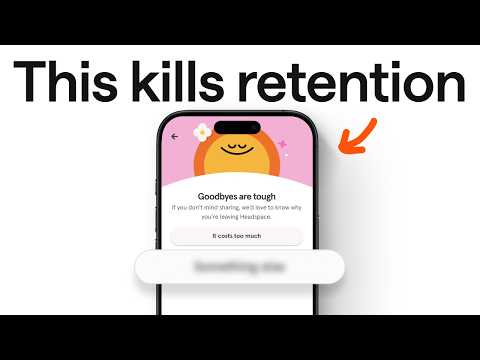
We Studied 393 Cancel Flows. This Wins People Back.
An analysis of 393 subscription cancellation flows, examining how to design cancel flows that retain customers without dark patterns. Drawing on retention data, the video covers discount offers at cancellation, pause options, plan downgrades and switches, free trial extensions, handling rejection of all offers, exit survey design, ease of cancellation, churn rate benchmarks, and retention metrics. The episode notes that 'cancellation flow' means cancelling a subscription specifically (not account deletion or order cancellation) and acknowledges a caveat: most iOS subscription cancellations occur in iOS Settings rather than in-app, so iOS data is under-represented.
# Video Identity Observations
## Explicit Self-Description
The channel closes with a direct audience pitch and scope claim:
> "If you're into **design data-backed breakdowns of real shipped apps and websites**, we studied thousands of paywalls, dashboards, and onboarding flows to see what works and what doesn't."
- **Claimed scope:** design-focused, data-backed analysis of real production apps/websites, covering **paywalls, dashboards, and onboarding flows**.
- **Evidence of study methodology:** "I studied hundreds of cancel flows" and the title claims "We Studied 393 Cancel Flows."
## Intended Audience
The material demonstrates an audience of **product builders, designers, and subscription business operators**, not end consumers:
- Practical implementation advice: "So, you've redesigned your cancel flow. Now, how do you know if it's working?" — followed by metrics (churn rate, save rate, reactivation rate, LTV).
- Business-metric vocabulary assumed: **save rate, LTV, voluntary/involuntary churn, B2B product** pricing tiers discussed as benchmarks.
- Operator-level tactics: segmenting discount eligibility, exit-survey copywriting, confirmation-screen personalization.
## Demonstrated Format Pattern
- **Research-heavy teardown format:** surveys a large corpus of real apps (Netflix, ClassPass, Adobe, Duolingo, Spotify, Canva, Disney Plus) for comparative examples.
- **Expert-interview format:** features Daniel from **Churnkey** ("His team watched 12 million people try to cancel a subscription") with quoted consultant commentary throughout.
- **Data-forward framing:** frequent statistics (e.g., "only 7% of apps offer a pause," "every subsequent question drops your save rate by 6.7%").
- **Self-critique segment:** "And I let him roast our cancellation flow" — implying the creator operates or designs a product of their own.
- **Call to engagement:** "comment below on what you'd like to see next," consistent with an ongoing series format.
## Channel-Level Claim vs. Demonstrated Evidence
- **Claim:** "we studied thousands of paywalls, dashboards, and onboarding flows" — creator-stated scope, broader than this single video.
- **Demonstrated here:** deep coverage of **cancel flows and retention** only; other content areas are asserted but not shown in this video.
# Delivery Observation: "We Studied 393 Cancel Flows. This Wins People Back."
## Overall Format
The video uses a **host + expert-interview hybrid** structure. A main narrator delivers findings directly to camera, punctuated by quoted soundbites from "Daniel from Churnkey" whose remarks appear as second-voice interjections. The transcript marks these switches plainly, e.g.:
> ">> Other is essentially a new cancel button. >> Making it easier to cancel doesn't make you lose more customers."
This alternating pattern is stable throughout — roughly every major claim from the narrator is followed or supported by a Churnkey quote.
## Recurring Vocabulary and Phrases
- **"Churnkey recommends" / "Churnkey suggests"** — the narrator repeatedly attributes advice to the company rather than stating it as personal opinion:
- "So, ChurnKey recommends to set a maximum duration."
- "Churnkey recommends to personalize this number."
- "Churnkey suggests to give trial users a longer trial."
- **"On Mobbile / Moby"** (transcript spelling varies) — a recurring data source cited for benchmarks: "only 7% of apps offer a pause," "about 60% of apps do this."
- **Specific numbers as anchors** — delivery leans heavily on precise statistics: "every subsequent question drops your save rate by 6.7%," "40% and under is typically the safe spot," "29% of customers that go through leave usable feedback."
## Teaching Habits
- **Rule-of-N enumeration**: the delivery is organized as explicit lists — "The four offers that win people back," "In third place, downgrading," "Second metric is the reactivation rate."
- **Do / Don't contrast pairs**: teaching via framing opposites:
> "Don't write 'It's too expensive.' You're saying your product isn't worth it. Instead, say 'It doesn't fit my budget.'"
- **Concrete app examples after each principle**: nearly every concept is followed by named apps — "Clout lets you pause up to 3 months," "Duolingo reminds you 2 days before your trial ends," "Toggl extends your trial only if you add five more teammates."
- **Etymology asides**: brief definitional digressions, e.g., "The word churn comes from churning butter, constant stirring."
## Tone and Rhetorical Devices
- **Conversational hypotheticals and questions**: "So, how do you stop people from gaming it?" "Now what?"
- **Vivid analogies**:
> "You built something that is essentially furniture that your customers can come in and sit on anytime they want."
- **Humor / light provocation**: "I'm going to come and knock on your door and say, 'Hey, we should probably reduce those offers.'"
- **Self-aware hedging on judgment calls**: "There is also this where I'm not sure if it's accountability or guilt-tripping." Also: "Mobb might use other to great effect. I'm not sure, so."
## Closing Pattern
The outro uses a **direct audience invitation** with the channel's positioning statement:
> "If you're into design data-backed breakdowns of real shipped apps... Thank you for watching and comment below on what you'd like to see next."
## Uncertainty Notes
- The single transcript contains no speaker labels; the attribution of quotes between narrator and Daniel is inferred from the ">>" markers and context, and could be misassigned in places.
- Tone is assessed from one video only; whether the "Churnkey recommends" attribution habit is a stable series-wide convention cannot be confirmed from this sample.
- Transcript spelling inconsistencies ("Mobbile," "Moby," "Mobb") suggest auto-transcription; exact brand names are uncertain.
# Observation Record: "We Studied 393 Cancel Flows. This Wins People Back."
## Speakers
- **Host** (narrator, unnamed in transcript): presents research findings, app examples, and metrics.
- **Daniel (Churnkey)**: recurring quoted guest whose team "watched 12 million people try to cancel a subscription." Most quoted analysis in the video is attributed to him or to Churnkey as a company.
- **Nick Fogel (Churnkey CEO)**: credited by the host as the source of exit-survey writing tips (quoted tips, not direct dialogue in transcript).
---
## Framing Claims (Host)
- Cancel flows vary widely in friction: *"Canceling Netflix takes two steps. ClassPass? Eight. Adobe? You'll need a tutorial to find the cancel button."*
- Apps lose about **39% of paying users** per year (figure presented with a [music] transcription artifact).
- A good cancel flow can get **one in three people to change their mind**.
---
## The Four Most Accepted Offers (Host, with Churnkey data)
### 1. Discounts
- The **most commonly accepted** offer; takers stay ~**5 months longer**; **1 in 10** still paying a year later even after the discount ends.
- Some apps go as high as **80% off**; one app uses a spin-the-wheel; another uses a countdown timer for urgency.
- **Daniel — on limits:** *"while it is high, the LTV is decimated by that."* Host: a bigger discount doesn't always work better.
- **Daniel — sweet spot:** *"40% and under is typically the safe spot"* — highest save rate **and** highest LTV.
- **Duration:** *"three-month discount offers seem to be the best option"* (Daniel). Host adds: discounts stop working if offered every single time.
- **Gaming prevention (Daniel):** segment customers by whether a discount is currently applied; prevent coupon stacking or pause-then-pause abuse.
### 2. Pauses
- Pause-takers stay **5.5 months longer**; only **7% of apps** (on Mobbin) offer a pause.
- **Risk:** overly long pauses lead to forgotten subscriptions → disputes or immediate cancellation when charged.
- **Churnkey recommendation:** set a **maximum duration**.
- Examples: Clout (3-month max, auto-renew, resume date shown); Hers (next ship date); Disney Plus (duration picker + resume date); Juice Box (start and end dates).
### 3. Downgrade / Plan Switch
- **Daniel:** *"Budget is far and away the most common failure reason"* — high discounts don't necessarily match it best.
- Plan-switchers stayed the longest: **~7 months more**; **~30%** still around a year later.
- Examples: Spotify (cheaper plans before the cancel button), Netflix (ad-supported plan), Revolut (one free month).
- **Daniel (surprising finding):** annual plans requiring more upfront cost are *"accepted at nearly the same rate as discounts"* and those customers stick around a long time.
### 4. Free Trial Extension
- Only **2% of apps** offer this at cancellation.
- **Memrise founder (via host):** half of cancellations happen within **3 minutes** of starting a trial — users don't trust themselves to cancel before renewal.
- Reminders (Duolingo — 2 days before trial end; Masterclass) are nice *"but only delay the decision"* (host).
- **Churnkey suggestion:** longer trial gives more time to experience value.
- Examples: Opportune (+3 months), Etsy (extends but **auto-charges** the moment it ends), Toggl (extension conditional on adding five teammates).
- **Daniel:** push customers to pay quickly — *"the more value they put into it, the more value they're going to get out, theoretically."*
---
## When All Offers Are Rejected (Host + Daniel)
### Remind them what they're giving up
- **Daniel:** *"The cancellation is your last chance to... bring them up to speed of what they're missing."*
- Churnkey recommends **personalizing** the "average usage" number. Examples: Foodpanda and Wolt (savings shown — host notes this *"works great unless you've saved nothing"*); Canva reminds users on older, cheaper pricing.
- Host (tentative): one example leaves him *"not sure if it's accountability or guilt-tripping."*
- **Daniel:** generic templates fail because *"this is a personal thing they're making a decision about."*
### Fix the exit survey
- **60% of Mobbin cancel flows** have an exit survey, but **7 in 10 do nothing** with the answer (host).
- **Daniel:** **29%** of customers leave usable feedback (pricing, technical issues, missing features).
- **Churnkey recommendation:** match the offer to the cancel reason (budget → discount; not using it → pause; missing feature → feedback form or support).
**Survey-writing tips (attributed by host to Churnkey CEO Nick Fogel):**
- Money is the #1 cancel reason. Use *"It doesn't fit my budget,"* not *"It's too expensive"* (which implies the product isn't worth it). Only **18% of apps** frame it as budget.
- *"I'm taking a break"* instead of *"I don't use it anymore"* — don't make leaving sound permanent.
- **One cancel reason only** — multi-select (Foodpanda) creates ambiguity about which offer to show. *Note: Churnkey doesn't recommend multi-select.*
- **Remove "Other":** *"Other is essentially a new cancel button."* Offers matched to "Other" are less accepted than any other offer type. Recommendation: *"Let's get rid of other altogether."*
- Host (counter-tentative): *"Mobbin might use other to great effect. I'm not sure."*
- **Keep it short:** every question after the first drops save rate by **6.7%** (Churnkey data). Daniel: *"four or five survey responses at maximum."*
### The no-offer exception
- Some Churnkey customers offer nothing at all yet achieve a **14% save rate**, with **~65%** returning to pay the next year — using only a market-specific survey plus follow-up feedback (Daniel/host). Presented as a counterpoint to offer-led flows.
### Easy cancellation paradox
- **Daniel:** *"You need to make cancellation as easy as signing up"* — easy-to-find cancel buttons correlate with **higher** save rates across the board; customers don't enter the flow defensive or frustrated.
- Host: in several US states this is now law.
- **Daniel:** *"You build a lot more trust with the customer if they have the ability to cancel on every screen."*
- Finding: even with a cancel button on every screen, save rates don't drop. Host's interpretation: *"those customers feel a little bit more empowered, and that empowerment leads to better results."*
### The confirmation screen
- **Daniel:** if someone leaves because you helped them win, ask for a case study.
- Host: 40% of customers may read the confirmation step; replace loss-framing (*"you'll lose access"*) with personalized, clear language: exact cancellation date, no further charges.
- ~**60% of Mobbin apps** do this.
- Make return easy: Netflix one-click restart banner; Skillshare offers 40% off post-cancellation.
---
## Metrics (Host + Daniel)
- **Churn rate:** share of subscribers leaving; 5% monthly churn ≈ nearly half gone by year's end. Two types: **voluntary** (chosen cancel) and **involuntary** (failed payment). **Daniel:** for most companies they work with, *"the vast majority of churn comes from voluntary churn."* Benchmarks vary by price point/industry ($500/mo B2B vs. $7/mo AI tool).
- **Save rate:** teams see **20–36%** depending on industry. **Daniel (counterintuitive):** *"we don't really want to be saving 100% of customers... If we're saving 50% of customers, that means that offer is way too high."*
- **Reactivation rate:** **40–70%** is healthy (Churnkey). **Daniel:** at 75%, *"we should probably reduce those offers."*
- **LTV:** tells you whether saved customers are worth keeping; example: 150 accepted a discount, 65 remain at year-end — *"a pretty good LTV rate"* (Daniel).
---
## Roasting the Host's Cancel Flow (Daniel's Fixes)
1. **Small offer up front:** e.g., 10% off one month — *"to change the psychology of that canceling customer."* Customers are more likely to accept an offer when an initial offer is presented.
2. **Remove "Other":** 20% accepted it; removal forces critical thinking about why they're leaving.
3. **Turn "budget" into price options:** structured feedback — three budget ranges, each matched to a corresponding offer.
4. **Fewer, sharper survey options:** merge overlapping items (*"Missing content and missing features are kind of the same thing"*); 4–5 max; be specific (e.g., *"Have you found another design inspiration site?"*).
5. **Make the goodbye personal:** host notes many brands make it *"fun or lighthearted"*; Daniel flags this as an easy fix area.
---
## Qualifications, Tensions, and Open Points (preserved)
- **Discount depth tension:** bigger discounts raise acceptance but *"decimate"* LTV — hence the ≤40% sweet spot.
- **Save rate tension:** high save rates look good but may signal over-generous offers (Daniel's 50%/75% thresholds).
- **Host's hedged doubts:** unsure whether one reminder screen is "accountability or guilt-tripping"; unsure whether Mobbin's "Other" option *"might be used to great effect. I'm not sure."*
- **Etsy caveat:** trial extension auto-charges when it ends — presented without endorsement.
- **No-offer flows** achieving 14% save rates sit uneasily alongside the offer-first strategy; presented as an observed exception, not reconciled.
- Attribution caveat: some figures are attributed to "Churnkey" collectively vs. Daniel personally; Nick Fogel's tips are relayed by the host rather than spoken directly.
# Speaker Roles & Provenance Record
**Video:** "We Studied 393 Cancel Flows. This Wins People Back."
**Video ID:** 01a15ba0-77bb-770e-9313-59128de29d02
---
## Speaker Identification & Roles
| Speaker | Role | Basis in Source |
|---|---|---|
| **Main narrator / host** | Creator, presenter | Speaks in first person throughout ("I studied hundreds of cancel flows"); asks interview questions of Daniel |
| **Daniel (from Churnkey)** | Guest, subject-matter expert | Identified explicitly: "talked to Daniel from Churnkey. His team watched 12 million people try to cancel a subscription." All `\>\>`-quoted analysis attributed to him |
| **Nick Fogel** | Cited authority (Churnkey CEO) | Referenced by name only: "These tips come straight from Churnkey's CEO, Nick Fogel." He does **not** speak directly in the transcript |
**Note:** The narrator's name, channel identity, and a channel name "Mobin / Mobbile / Moby" (appears under multiple inconsistent spellings, likely an app-patterns platform associated with the creator) are not definitively established. Uncertainty is flagged rather than resolved.
---
## Referenced Sources & Data Provenance
- **Churnkey data** — claims attributed to Daniel/his team:
- 12 million people observed attempting to cancel
- 12 months average retention for discount-takers; "40% and under is typically the safe spot" for discounts
- 29% of exit-survey respondents "leave usable feedback"
- Every additional survey question drops save rate by 6.7%
- Offer-less flows achieving 14% save rate, ~65% year-two payers
- Healthy reactivation rate range: 40–70%
- **Mobin/Moby platform stats** — cited by the narrator: 7% of apps offer a pause, 2% offer trial extension, 60% of cancel flows have exit surveys, 18% frame cost as "budget," 60% use personalized confirmations, two-fifths include an "Other" option.
- **Consumer apps cited as examples** (screens/features shown): Netflix, ClassPass, Adobe, Spotify, Revolut, Disney Plus, Duolingo, Masterclass, Etsy, Toggl, Foodpanda, Wolt, Canva, Skillshare, Clout, Hers, Juice Box, Opportune, Memrise, Mobin.
- **Named third-party individual:** Memrise founder — paraphrased claim that half of cancellations happen within 3 minutes of a trial start.
- **Legal reference:** narrator states easy-cancellation is "now the law" in several US states (no statute named).
- **Etymology note:** churn traced to churning butter (narrator's aside).
---
## Promotion Flags
- **End-of-video self-promotion:** closing segment promotes the creator's own content ("design data-backed breakdowns of real shipped apps… we studied thousands of paywalls, dashboards, and onboarding flows").
- **Potential vendor association:** the video heavily features **Churnkey** (its data, CEO advice, and Daniel roasting the narrator's flow). The transcript does not disclose any commercial relationship; flagged as an unverified potential promotional bias.
- **Audience call to action:** "comment below on what you'd like to see next."
---
## Comment Availability
- The closing request implies **comments are open/active** on this video; no other availability limits (paywall, region lock) are stated in the source.
---
## Explicit Uncertainties
- Daniel's full name and title beyond "from Churnkey" are not given.
- "Mobin," "Moby," and "Mobbile" appear inconsistently in the transcript; assumed to reference the same platform, but not confirmed.
- Industry churn benchmark figures are referenced but not numerically stated in the transcript ("These are the industry benchmarks" — values not verbalized).
Canceling Netflix takes two steps. ClassPass? Eight. Adobe? You'll need a tutorial to find the cancel button. Every year, apps lose about \[music\] 39% of paying users.
But, a good cancel flow can get one in three people to change their mind. So, I studied hundreds of cancel flows and talked to Daniel from Churnkey. His team watched 12 million people try to cancel a subscription. Here's what I found. The four offers that win people back. What to do when all offers are turned down. Like one option in the exit survey that's costing you customers. \>\> Other is essentially a new cancel button. \>\> Making it easier to cancel doesn't make you lose more customers. \>\> You build a lot more trust with the customer if they have the ability to cancel on every screen. \>\> The numbers that tell you if your cancel flow is working. And at the end, Daniel rose our cancel flow.
\>\> \[music\] \>\> So, what wins a canceling customer back? The most commonly accepted offer are discounts. People who take the discount stay about five months longer. And one
in 10 are still paying a year later, even after the discount's gone. Some apps go as big as 80% off. Even makes you spin a wheel for a discount. This one puts a countdown timer to create urgency. Obviously, if you offer a 100% discount, most people would take it. \>\> And while it is high, the LTV is decimated by that. \>\> Your customer lifetime value is how much a customer pays you over their whole time with you. A bigger discount doesn't always work better. This is the sweet spot. \>\> 40% and under is typically the safe spot. The highest save rate paired with the highest LTV with the most long-term customer base. \>\> And keep the discount short. \>\> We often see that three-month discount offers seem to be the best option for customers who thinks in terms of quarters. \>\> They're right. Discounts stops working if you offer it every single time. \>\> If you're really willing to give me 50% off coupons every time I come to cancel, you built something that is essentially furniture that your customers can come in and sit on anytime they want. \>\> So, how do you stop people from gaming it? \>\> Segment your customer base based on whether or not they have a discount currently applied. You can also segment and prevent customers from stacking coupons or pausing one after the other so that your customers aren't abusing those systems. \>\> Discounts work, but sometimes people leave because they just need a break.
Pauses make customers stay 5 and 1/2 months longer. But on Mobin, only 7% of apps offer a pause. If someone pauses their subscription for too long, they
tend to forget that they're subscribed. So, when the charge hits, it might result in a higher chance of disputes or immediate cancellation. So, ChurnKey recommends to set a maximum duration. Clout lets you pause up to 3 months. It auto-renews once the time's up and always show the resume date. Hers show your next ship date depending on how long you pause. Disney Plus has a duration picker and the resume date. Juice Box states both the start and end of a pause. In third place, downgrading
or switching to a different plan. \>\> Budget is far and away the most common failure reason and matching really high discounts to that doesn't necessarily lead to the best results.
\>\> The better move is to put them on a plan that fits. People who switch to a cheaper plan stayed the longest, about 7 months more. And almost 30% are still around a year later. Spotify shows you cheaper plans before you ever reach the cancel button. Netflix offers a cheaper plan with ads. Revolut tempts you with one free month. So, you keep your plan. \>\> So, you would think that oh, maybe this annual plan that's going to require more upfront costs will not work. Those customers stick around for a very long time. That's accepted at nearly the same rate as discounts. \>\> You can also offer people a free trial extension. On Moby, only 2% of apps offer a free
trial extension when you try to cancel. In one of our episodes with Memrise, the founder told us that half of their cancellations happen within 3 minutes of starting a trial. People cancel right
away because they just don't trust themselves to remember before it renews. So, Duolingo reminds you 2 days before your trial ends. Masterclass offers to remind you, too. A reminder is nice, but it only delays the decision. Churnkey suggests to give trial users a longer trial, as it gives people more time to experience the value of your product. Opportune extends a free trial by 3 months if you try to cancel. Etsy extends it, too, but auto charges you the moment it ends. Toggl extends your trial only if you add five more teammates. \>\> And you should be pushing those customers to pay as quickly as possible because the more value they put into it, the more value they're going to get out, theoretically. \>\> So, that's the four most accepted offers that Churnkey has found based on all the data. Let's say people turn down every offer that you gave. Now what? The first
is to remind them what they're giving up. \>\> The cancellation is your last chance to kind of bring them up to speed of what they're missing, what they're going to be losing. \>\> Usually, we see something like this. But
this is just the average number. It doesn't speak to that specific customer. Churnkey recommends to personalize this number. Foodpanda tells you how much you saved. Wolt does this as well, which works great unless you've saved nothing. There is also this where I'm not sure if it's accountability or guilt-tripping. If you're on an older, cheaper price, Canva reminds you of that right when you try to cancel. \>\> A lot of people just use generic templates and then they come to me and they're like, "Why isn't our save rate improving?" And this is a personal thing they're making a decision about. So, you're not talking to them like a person. \>\> On Mobbile, 60% of cancel flows have an exit survey, but seven in 10 of them do nothing with your answer, which is kind of a waste. \>\> 29% of customers that go through leave usable feedback on what pricing they would consider fair, technical issues they might be experiencing, any features that they might be missing from the platform. \>\> So, Churnkey recommends to match the offer to the cancel reason. If someone selects budget as the reason, give them a discount. If someone's not using it at the moment, maybe a pause. A missing feature? Show them a feedback form or bring them to support. So, how do you write a good exit survey? These
tips come straight from Churnkey's CEO, Nick Fogel. The number one reason people cancel is money. Don't write "It's too expensive." You're saying your product
isn't worth it. Instead, say "It doesn't fit my budget." Yet, only 18% of apps on Mobbile frame it as budget. Next, "I don't use it anymore." sounds final. "I'm taking a break." makes a pause more likely. Don't make leaving sound permanent. Foodpanda lets you pick more than one cancel reason. Churnkey doesn't recommend this. If people can tick three boxes, which offer do you show them then? So, keep to only one cancel reason. And then, there's this. \>\> Tell me if you've ever been honest when selecting other or something else. Looking at a screen of survey responses, most of them are going to be maybe five words long, and then I've got this other that's so small down there, and my eyes are going to go right to that. I'm going to select other, and I'm going to move on. I'm just going to make something up because I've already checked out at that point. Any offer types that you match with other are less accepted than any other offer type. Other is essentially a a new cancel button. You're giving them an out in your cancel flow when you have the opportunity to get some of the best feedback you can possibly have. Let's avoid it. Let's get rid of other altogether. \>\> Two fifths of apps with an exit survey on Mobb include an other option. \>\> Mobb might use other to great effect. I'm not sure, so. \>\> Churn Key also recommends to keep your exit survey short. After asking your first question about why they're canceling, every subsequent question drops your save rate by 6.7%. \>\> I like to do four or five survey responses at maximum. \>\> The more you ask your customers with unnecessary questions, the less likely you'll be able to recover that customer further down your cancel flow. \>\> We do have some customers that do not give any offers, but their customers are saved at a 14% save rate. Nearly 65% of them come back and pay for the next year. They only present a survey to their customers that is market specific, and then asking for additional feedback after that. \>\> Name the reason only your customers have. Their survey options are written so specifically that picking one makes you stop and rethink. Is it true that the apps that make canceling easy are more likely to keep more customers? \>\> You need to make cancellation as easy as
signing up. If I'm not having to reach out to support, if I'm able to find that cancel button easily, if you have a manage subscription button that is within my account where I expect it to
be, those save rates are higher across the board. The customer is not entering the cancel flow from a place of defensiveness. Like, "Oh, I am frustrated. I just want to get out of here." \>\> In several US states, it's now the law. \>\> You build a lot more trust with the customer if they have the ability to cancel on every screen. \>\> Even when every screen in the cancel flow has a cancel button, save rates don't drop. People don't lose more customers because of it. \>\> So, that tells me that those customers feel a little bit more empowered, and that empowerment leads to better results. \>\> If someone leaves your product because you helped them win, \>\> make them feel special, give them a round of applause, reach out to them, see if they're willing to give you a case study. \>\> And most confirmation screens sound like this, "At the end of your billing period, you'll lose access." \>\> That didn't feel great. 40% of your customers might actually read that confirmation step. What if it said my first name? "Hey, thank you for your business. Thanks for giving us a try. Here is exactly when your cancellation will take effect. You will not be charged from here." \>\> On Moby, about 60% of apps do this. Then, make it easy to come back, like this one-click restart banner on Netflix. Skillshare even gives you a 40% off after you cancel. So, you've redesigned your cancel flow. Now, how do you know if it's working? Well, the first obvious one is to track
your churn rate. The word churn comes from churning butter, constant stirring. Some subscribe, some leave. The share that leaves is your churn rate.
If you lose 5% of people each month, almost half are gone by the end of the year. These are the industry benchmarks on churn rates. There are actually two types of churn. Voluntary churn where customers choose to cancel and involuntary churn, a failed payment. \>\> For most of the companies that we work with, the vast majority of churn comes from voluntary churn. \>\> This is how it looks like across different industries. \>\> A $500 a month B2B product is going to have a much different churn rate than the $7 a month AI video tool.
\>\> Churn tells you how many people left, but are there any metrics that we should track? First is the save rate. Teams that put work into Ver save anywhere
from 20% to 36% depending on industry. The higher the save rate, the more customers you keep, which is great, right? \>\> I know it sounds crazy, but we don't really want to be saving 100% of customers. We don't even really want to be saving 50% of customers. If we're saving 50% of customers, that means that offer is way too high. You're making your own product look less than what is actually worth. \>\> Second metric is the reactivation rate. Of the people you saved, how many would pay you again? Churn key says somewhere between 40 and 70% is healthy. \>\> If you're at 75%, I'm going to come and knock on your door and say, "Hey, we should probably reduce those offers because it means you're probably giving away too much." \>\> The save rate tells you who stayed, but what tells you if they're worth keeping is LTV. \>\> So that you get a clear bird's-eye view into hey, 150 customers accepted this one discount and now here at the end of the year, we have 65 of them left. That's a pretty good LTV rate. \>\> And I let him roast our cancellation flow. So, the first fix that he
suggested is to add a small offer up front. \>\> I'm going to give them maybe a small discount, 10% off for the next month to change the psychology of that canceling
customer to think, "Oh, wait, there might be other options besides canceling." Customers are more likely to accept an offer if there's an initial offer presented to them. \>\> The second fix is to remove other. \>\> 20% have accepted the other option. If you remove other, those customers are going to have to think critically about why they're leaving. \>\> Turn budget into price options. \>\> We offer structured feedback options. If I click budget related, I can be presented with three ranges of budget that I would be willing to pay and then be presented an offer that matches that. \>\> Next, fewer and sharper survey options. \>\> Missing content and missing features are kind of the same thing. I like to do four or five survey responses at maximum. Try and be as specific as possible. Have you found another design inspiration site? Because you're not really finding that out within the current survey. \>\> And make the goodbye personal. \>\> A lot of people update this to kind of match their branding and make this fun or lighthearted. This would be an easy way to do it. \>\> If you're into design data-backed breakdowns of real shipped apps and websites, we studied thousands of paywalls, dashboards, and onboarding flows to see what works and what doesn't. Thank you for watching and comment below on what you'd like to see next.