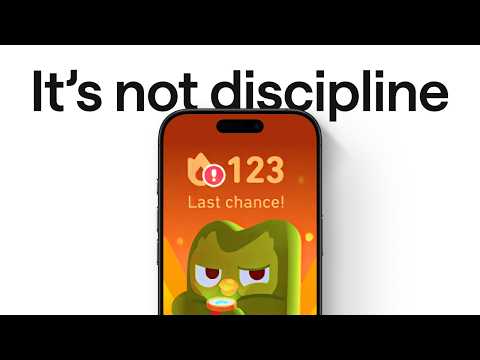
The Psychology Behind Streaks
An exploration of streak mechanics in habit-forming apps: why breaking a streak feels bad, and whether streaks actually help build habits. The video reviews 859 streak designs on Mobbin and covers the psychology behind streaks, including fear of loss, the habit loop, dopamine and reward prediction (drawing on Wolfram Schultz's research), habit formation research (Lally et al.), the Zeigarnik and Tamagotchi effects, and case studies of how Duolingo designs and improves its streak feature. Chapters cover: fear, optimism, anthropomorphism, pattern completion, why streaks motivate, what happens when a streak breaks, Duolingo's fixes, and whether streaks genuinely make habits stick.
# Video Identity Observations: "The Psychology Behind Streaks"
## Observable Presentation Evidence
### Format and Method
- **Research-driven video essay**: The creator grounds claims in primary observation and cited studies — *"Here's what I found after looking at 859 streak designs on Mobbin"* — signaling an analytical, evidence-based presentation style.
- **First-person experimentation**: Personal narrative is woven into analysis — *"At some point, keeping my streak alive mattered more than actually learning"* and *"I realized that mascots aren't just there to make apps feel cute."*
- **Multi-episode series positioning**: The outro references adjacent research videos — *"analyzing a thousand onboarding flows"*, *"2,000 dashboard designs"*, and *"our next deep dive on paywalls"* — indicating an ongoing **UX/design research format**.
### Intended Audience
- **Designers, product people, and UX-curious viewers**: The video analyzes interface patterns at scale (Mobbin data, Duolingo A/B tests, Opal features) with vocabulary like *"copy changes"*, *"calls to actions"*, and *"retention"* — language oriented toward people who build or design products.
- **General psychology enthusiasts**: Concepts are explained accessibly — *"loss aversion"*, *"Zeigarnik effect"*, *"anthropomorphism"*, the *"habit loop"* — each defined in plain terms (*"That's why we yell at computers, name our cars"*), so no specialist background is assumed.
### Claimed Scope
- **Behavioral psychology applied to product design**: Streak mechanics, dopamine anticipation (Professor Schultz), and habit formation research (missing-a-day study) are connected to real app design decisions.
- **Critical, not promotional framing**: The creator questions the industry's own metrics — *"optimizing for engagement and optimizing for long-term habit formation is not the same thing"* — presenting streaks as retention tools rather than purely habit-building aids.
## Self-Description vs. Demonstrated Pattern
| Creator Claims | Demonstrated in Material |
|---|---|
| First-person research process ("Here's what I found") | 859 Mobbin designs reviewed, Duolingo experiment data cited (0.38% DAU lift, 40% streak retention) |
| "Watch what we learned from analyzing…" | Series-style quantitative analysis framing |
| Subscribe call: *"our next deep dive on paywalls"* | Established recurring cadence implied, though only this video is observed |
## Notes for Channel Synthesis
- The demonstrated pattern is a **quantitative UX research video essay** blending app teardowns, cited academic findings, and product-industry metrics, addressed to an audience of designers and behaviorally curious viewers.
- The playful but rigorous tone (mascots, Tamagotchis, "angry owl") suggests presentation optimized for engagement with serious underlying sourcing — no inference beyond this is made here.
# Delivery Observation — "The Psychology Behind Streaks"
## Tone
- **Conversational explainer with personal framing.** The narrator opens with a first-person confession: *"At some point, keeping my streak alive mattered more than actually learning."*
- **Curious, investigative posture** — the video is framed as research the narrator did, not a lecture: *"Here's what I found after looking at 859 streak designs on Mobbin."*
- **Even, measured pacing** with rhetorical questions used as transitions rather than dramatic hooks.
## Vocabulary
- **Psychology/UX jargon introduced conversationally, then defined inline:**
- *"This is what we call loss aversion."*
- *"It's called anthropomorphism."*
- *"This is called the Tamagotchi effect."*
- *"Part of this relates to the Zeigarnik effect."*
- **Casual asides soften the technical content:** *"It's just a cartoon owl, just pixels, but I still felt it."*
- **Everyday analogies anchor concepts:** *"The smell of coffee before our first sip, the notification chime before we even read it."*
## Recurring Phrases & Structures
- **"Some streak systems / apps lean on X"** organizes the taxonomy: fear, optimism, attachment, visual attention.
- **Question-driven transitions** appear throughout:
- *"Why does breaking a streak feel so terrible?"*
- *"But why do people give up entirely after breaking a streak?"*
- *"Do streaks actually help people build long-term habits or are they just really good at making people come back?"*
- **"More and more apps are doing this today"** is repeated nearly verbatim as a trend-signaling phrase (used at ~81s and again around the recovery-design section).
## Teaching Habits
- **Evidence-first claims:** concrete numbers cited repeatedly — *"859 streak designs," "0.38%," "over 200,000 more people," "Over 40% more people maintained their 7-day streak."*
- **Real quotes from practitioners:** the Duolingo product team is quoted directly — *"We used to say continue and we changed that to commit to my goal and it was like a massive win."*
- **Named attributions:** *"Professor Schultz found…"*, *"A study tracked people building real habits over months…"*
- **Layered structure:** each mechanism (fear → optimism → attachment → visual patterns → dopamine → habit loop) is introduced, illustrated with an app example, then named.
- **Reframing as a closer:** *"Maybe what matters isn't how long you keep your streak. It's whether you come back even after breaking it."*
## Communication Patterns
- **Second-person address pulls the viewer in:** *"We used to…"*, *"our brain," "you had to feed and care for."*
- **Callback structure:** the opening question (*"What makes us come back tomorrow?"*) is answered explicitly near the end — *"That's what makes us want to come back tomorrow, not the lesson, not even the streak, but the habit loop itself."*
- **Series continuity is signaled at the end** with teases for onboarding flows, dashboards, and paywalls — suggesting a recurring deep-dive format.
## Uncertainty Notes
- The transcript contains no timing/thumbnail context, so judgments about **visual delivery (animations, b-roll pacing)** are not possible from text alone.
- The repeated "more and more apps" phrasing is observed twice; whether it is a signature catchphrase or coincidental cannot be confirmed from one video.
- Tone observations are based on wording only; actual vocal delivery (pitch, pacing) is not verifiable from the transcript.
# Observation Record: "The Psychology Behind Streaks"
**Speaker attribution:** The video is narrated by an unnamed first-person narrator/researcher (no name supplied in source material). One quoted speaker is identified by role only (Duolingo product team member). All claims below are attributed to the narrator unless otherwise noted.
---
## Core Framing Questions
The narrator opens with personal experience:
> "At some point, keeping my streak alive mattered more than actually learning."
Posed questions driving the video:
- Why does breaking a streak feel so terrible?
- Are streaks actually helping us build habits, or just making us afraid to stop?
Stated evidence base: analysis of **859 streak designs on Mobbin**. Every streak design, the narrator claims, revolves around the question: *"What makes us come back tomorrow?"*
---
## Four Psychological Mechanisms Identified
### 1. Fear (Loss Aversion)
- **Claim:** Losing $10 stings more than winning $10 feels good — the principle of *loss aversion*.
- **Stated reasoning:** Streak mechanics bet on this: urgent copy, countdown clocks, and guilt-inducing mascots (an "angry owl").
- **Conclusion:** Fear-based streaks work "because we're protecting something we could lose."
### 2. Optimism (Identity Promises)
- **Claim:** Some designs frame streaks as building "a better version of ourselves."
- **Direct quote (Duolingo product team member):** "We used to say continue and we changed that to commit to my goal and it was like a massive win."
- **Narrator's observation:** Apps reframe calls to action into "a promise you make to yourself."
### 3. Collectibles (Tangible Progress)
- **Claim:** Some apps turn streaks into badges and milestones — e.g., **Opal** earns "literal milestones that you can collect over time."
### 4. Attachment (Anthropomorphism / Tamagotchi Effect)
- **Personal account:** The narrator reported opening Duolingo not for the streak number but because of not wanting to disappoint Duo — "It's just a cartoon owl, just pixels, but I still felt it."
- **Definitions given:**
- *Anthropomorphism* — assigning human emotions to non-human things (yelling at computers, naming cars, apologizing to AI).
- *Tamagotchi effect* — attachment formed "when a digital thing appears to need you back," referencing 1990s Tamagotchi pets that "literally die" if ignored.
- **Narrator's conclusion:** Mascots "are designed to create attachment"; once you feel something for a product, "the barrier to leaving feels a lot higher."
### (Also) Visual Attention (Zeigarnik Effect)
- **Claim:** Some systems work through visible patterns; gaps are noticed immediately.
- *Zeigarnik effect* cited: "Unfinished things stay active in our mind longer than completed ones." Filling a missing block feels satisfying; breaking the chain feels worse than it should.
---
## Neuroscience & Habit-Loop Explanation
- **Dopamine (Professor Schultz cited):** Dopamine "doesn't just respond to rewards. It responds to the prediction of rewards" (coffee smell, notification chime). A streak "just needs to make our brain feel like something satisfying is about to happen."
- **Four-stage habit loop** (as stated by narrator):
1. **Cue** — trigger of anticipation before opening the app
2. **Craving** — e.g., the Duolingo jingle after lessons
3. **Response** — make it easy (auto-progressing steps)
4. **Reward** — the anticipated satisfying feeling
- **Supporting claim:** Studies found people reminded of their streak number are more likely to keep going — even before opening the app.
- **Narrator's conclusion:** "Not the lesson, not even the streak, but the habit loop itself" brings people back.
---
## Recovery Over Perfection (Duolingo Data)
- **Problem posed:** Why do people quit entirely after breaking a streak? "The longer the streak, the more our identity gets wrapped up in it."
- **Counterintuitive finding:** Stricter streaks would seem obvious; Duolingo found the opposite.
- **Streak freeze** feature (missing a day without losing everything): allowing up to two freezes increased daily active learners by **0.38%** — "over 200,000 more people coming back every day."
- **A/B test:** Full daily goal required vs. one lesson preserves the streak. The lenient variant won — **over 40% more people** maintained their 7-day streak.
- **Trend claim:** Apps increasingly design streaks around *recovery* — repairs, freezes, pauses, grace days.
---
## Central Tension: Engagement vs. Habit Formation
The narrator explicitly preserves an unresolved tension:
> "Optimizing for engagement and optimizing for long-term habit formation is not the same thing."
Key claims in this section:
- Most evidence around streaks "focuses on engagement and retention, not necessarily lasting behavioral change."
- Once a streak becomes routine/predictable, the dopamine signal **weakens**; apps "keep layering in new surprises" (animations, milestone celebrations, bonus XP) — "manufacturing unpredictability to keep the loop alive."
- A cited habit study: "missing a day had almost no effect on whether the behavior eventually became automatic" — which the narrator calls "the opposite of how most streak systems are designed."
- Final reframing (framed as personal conclusion, tentative): "Maybe what matters isn't how long you keep your streak. It's whether you come back even after breaking it."
**Status:** The narrator's opening question — do streaks build real habits or just drive return visits? — is left as an open tension, not resolved into a settled conclusion.
---
## Promotional Content (End of Video)
Teasers for future videos: onboarding flows (~1,000 analyzed), dashboard designs (2,000), a "deep dive on paywalls," plus a subscription call to action.
---
## Self-Check Notes
- All mechanisms and studies are attributed to the narrator's reporting; no claims elevated beyond what was stated.
- Quantified figures (859 designs, 0.38%, 200,000, 40%, 7-day streak) recorded exactly as expressed.
- Unresolved contradiction (engagement vs. habit formation; streak design vs. habit research) preserved as expressed.
# Video Attribution & Provenance Record
**Video:** *The Psychology Behind Streaks* (ID: `01a15ba0-78e4-7a44-852a-8386a4226208`)
## Speaker Identification
### Primary Speaker — **Creator / Narrator** (uncredited by name)
- A single first-person voice narrates the entire video. No name or on-screen credential is supplied in the transcript or metadata.
- Speaks in two capacities:
- **Personal experience:** opening reflection (*"keeping my streak alive mattered more than actually learning"*), Duolingo/Duo owl attachment (*"I didn't want to disappoint Duo"*), closing takeaway (*"good news to me"*).
- **Research narration:** reports on the Mobbin review, cited studies, and product tests.
- No guest speakers, interviewees, or second voices appear.
### Embedded Third-Party Voice (paraphrased, not a direct interview)
- **Duolingo product team** — quoted in paraphrase regarding copy testing: *"We used to say continue and we changed that to commit to my goal and it was like a massive win."* Attribution context is loose; no individual is named.
## Referenced Sources & Third-Party Claims
| Source / Claim | As Stated in Transcript |
|---|---|
| **Mobbin** | Creator reviewed **859 streak designs** on the platform |
| **Professor Schultz** | Dopamine responds to *prediction* of rewards, not just rewards (no first name or affiliation given) |
| **Duolingo streak freeze experiment** | Equipping up to two freezes → daily active learners up **0.38%** (~200,000+ people/day) |
| **Duolingo A/B test** | "One lesson keeps streak" variant won; **40%+** more people maintained 7-day streaks |
| **Unnamed habit study** | Missing a day had almost no effect on habit automatization |
| **Unnamed streak-reminder study** | Seeing the streak number increased likelihood of continuing |
| **Tamagotchi / Bandai** | Historical example; "Tamagotchi effect" as attachment phenomenon |
| **Concepts cited:** | Loss aversion, anthropomorphism, Zeigarnik effect, habit loop (cue–craving–response–reward) |
## Product Promotion Inventory
- **Duolingo** — primary case study throughout; no promotional intent flagged by the creator, but it is the central brand example (features, jingle, mascot, experiments).
- **Opal** — cited as an example of milestone/collectible streak design.
- **Mobbin** — source dataset for the design analysis.
- No sponsored-segment language, discount codes, or affiliate calls to action appear in the transcript.
## Channel Promotion & Availability
- **Outbound teasers (flagged):**
- Upcoming content: analysis of **1,000 onboarding flows** and **2,000 dashboard designs**.
- Subscription prompt: *"Be sure to subscribe for our next deep dive on paywalls."*
- **Comments:** No information about comment availability is present in the transcript or supplied metadata — **status unknown**.
- No paywall, membership, or geographic restriction mentioned.
## Uncertainty Notes
- Creator identity, channel name, and credentials are **not stated** anywhere in the source material.
- Multiple studies ("studies found…", "a study tracked…") are cited **without titles, authors, or publication venues** — provenance is unresolvable from this source.
- The Duolingo team quote has no named speaker or role within the team beyond "product team."
At some point, keeping my streak alive mattered more than actually learning. Why does breaking a streak feel so terrible? And are streaks actually helping us build habits or just making
us afraid to stop? Here's what I found after looking at 859 streak designs on Mobbin. Every streak design revolves around this question.
What makes us come back tomorrow? Let's start with the most obvious pattern, fear. Let's say you won $10 today. It feels nice. Now, imagine losing $10
instead. It stings way more. This is what we call loss aversion. Streak mechanics bet on this. The copy becomes more urgent. The clock starts counting down. And look, an angry owl giving you a sense of guilt. Fear-based streaks work because we're protecting something we could lose.
Now, some streak systems lean on optimism. These designs make us feel like we're building towards a better version of ourselves. Copy is positive and encouraging.
Even tiny shifts to calls to actions. Duolingo's product team tested these copy changes. We used to say continue and we changed that to commit to my goal and it was like a massive win. More and more apps are doing this today. Reframing a call to action into a promise you make to yourself. Some apps even turn streaks into collectibles, like badges, milestones, and tangible proof of progress. In Opal, your streak earns you literal milestones that you can collect over time. I noticed I wasn't opening Duolingo
because I cared about the streak number anymore. I opened because I didn't want to disappoint Duo. It's just a cartoon owl, just pixels, but I still felt it.
So, I looked into why. When we assign human emotions to non-human things, it's called anthropomorphism. That's why we yell at computers, name our cars, and apologize \[music\] to AI. Software uses this, too. A mascot cheering you on like it believes in you. A little bird growing alongside you. So, back in the '90s, people got emotionally attached to these tiny virtual pets you had to feed \[music\] and care for. Tamagotchi, the original virtual reality pet. Your care determines the pets you get from Bandai. If you ignored your Tamagotchi, they would literally die. People carried them everywhere, even grieved when they died. This is called the Tamagotchi effect. It's the attachment that forms when a digital thing appears to need you back. Duolingo took it further than most. It became a personality. I realized that mascots aren't just there to make apps feel cute. They're designed to create attachment. The moment you feel something for a product, the barrier to leaving feels a lot higher. And maybe that's why we care so much about a cartoon owl.
Some streak systems don't rely on fear, hope, or attachment. They work through visual attention. They all turn consistency into a visible
pattern. Once there's a gap, our brain notices it immediately. Part of this relates to the Zeigarnik effect. Unfinished things stay active in our mind longer than completed ones. That's why filling one tiny missing block feels strangely satisfying, and why breaking the chain feels worse than it probably should.
These mechanics are everywhere, even in places that have nothing to do with self-improvement. Different interfaces with the same underlying idea, giving \[music\] people something they don't want
to break. These patterns keep pulling us back, but why? What's actually working here? We tend to think dopamine is the chemical our brain releases after something rewarding happens, but Professor Schultz found that dopamine doesn't just respond to rewards. It responds to the prediction of rewards.
The smell of coffee before our first sip, the notification chime before we even read it. Our brain starts to reacting to \[music\] what it thinks is coming next, which means a streak
doesn't need to feel satisfying every single time. It just needs to make our brain feel like something satisfying is about to happen. And that's exactly what
the habit loop is built around. Almost every habit follows the same four stages. The first stage, cue, something that triggers the anticipation before we
even open the app. Then comes craving. The Duolingo jingle after each lesson makes us want the next one. Next, response. Make it easy so we'll do it, like auto progressing to the next step. Finally, the reward. \[music\] It's that satisfying feeling our brain spent the last minute anticipating. Studies found that when people are reminded of their streak, just seeing the number, they're more likely to keep going. We haven't even opened the app yet, but the cue already triggered the loop. That's what makes us want to come back tomorrow, not the lesson, not even the streak, but the habit loop itself. But if just seeing the streak is enough to pull us back in, why do people give
up entirely after breaking a streak? The longer the streak, the more our identity gets wrapped up in it. The obvious solution to this would be
making your streaks stricter, adding more pressure and accountability, but Duolingo found the opposite worked better. They implemented a feature called streak freeze that lets you miss
a day without losing everything. And when Duolingo allowed users to equip up to two streak freezes at a time, daily active learners increased by 0.38%.
That's over 200,000 more people coming back every day. People were more likely to keep going after failure when goals included a little built-in flexibility. Duolingo tested two variants. First, users must hit their full daily goal in order to preserve the streak. The second variant is where users could keep their streak alive by just completing one lesson on Duolingo. This variant won. Over 40% more people maintained their 7-day streak. More and more apps are designing streaks around recovery instead of perfection. Repairs, freezing your streaks, pauses, and giving people grace days. But that raises a bigger question. Do streaks actually help people build long-term habits or are
they just really good at making people come back? \[music\] On hindsight, streaks seem like the perfect habit-building system. All we need to do is to show up every day and eventually the behavior became
automatic. But the more I research, the more I notice that most evidence around streaks focuses on engagement and retention, not necessarily lasting behavioral change. We know that dopamine responds to the prediction or the anticipation of reward. But once the streak becomes routine, when things become predictable, that dopamine signal actually weakens. So, apps keep layering in new surprises. Animations, milestone celebrations, bonus XP. They're all manufacturing unpredictability to keep the loop alive. But, optimizing for engagement and optimizing for long-term habit formation is not the same thing. So, what actually makes habits stick? Most streak systems are designed around
never missing a day, right? We got to show up every single day to keep our streak moving. A study tracked people building real habits over months and found that missing a day had almost no effect on
whether the behavior eventually became automatic. People simply resumed and the \[music\] habit continued, which is the opposite of how most streak systems are designed. Maybe what matters isn't how long you keep your streak. It's whether you come back even after breaking it. And that's \[music\] good news to me. Now I know that one bad day doesn't erase everything. Next, watch what we learned from analyzing a thousand onboarding flows and what separates intuitive dashboards from overwhelming ones across 2,000 dashboard designs. Be sure to subscribe for our next deep dive on paywalls.