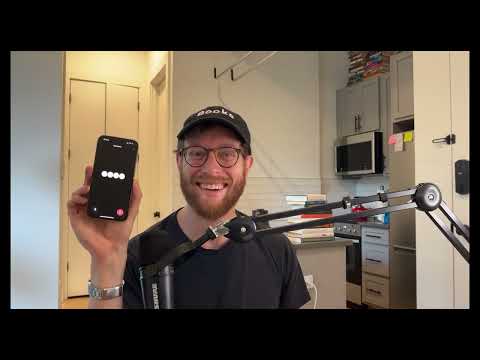
24 Hours with ChatGPT's NEW Advanced Voice Mode Feature
A hands-on review of ChatGPT's newly rolled-out Advanced Voice Mode, tested over 24 hours by one of the small group of alpha testers. The video demonstrates the new voice's natural conversation style, low-latency responses, and ability to listen without interrupting (using "Mhmm" acknowledgments during pauses), including use cases like translation, rambling brainstorming, and comparing the new mode against the old voice mode.
# Channel Presentation Observations
## Intended Audience
- **Tech-curious early adopters** interested in AI tools: the video is a hands-on demo of ChatGPT's new voice feature, framed around "24 Hours" of testing.
- **Writers/creators using AI in workflows**: creator demonstrates using voice mode to brainstorm essays — *"one of the things I really love to do when I'm trying to figure out what I want to write about is I go for a walk and I just talk about what's on my mind."*
- **Engaged followers on social platforms**: direct calls to action — "you should definitely subscribe," "DM me reply to this tweet."
## Claimed / Demonstrated Scope
- **AI tool reviews and detailed follow-ups**: creator promises depth beyond this video — "I'll have more detail right on this."
- **Adjacent podcast content**: *"check out my podcast it's called AI and I it's on Spotify it's on YouTube"* — indicates a broader AI-focused content ecosystem (podcast name stated by creator, not in metadata).
## Presentation Style (Observed)
- **Live product demonstration**: shows old vs. new ChatGPT side-by-side (the "data" baby-computer joke test) rather than only describing.
- **Technical explanation for lay audience**: explains voice-to-text pipeline — *"it would translate my voice into text and then feed that text into GPT-4... a compressed facsimile."*
- **Personal-workflow framing**: connects the feature to his own writing process, making the review experiential rather than abstract.
- **Balanced assessment**: praises low latency and natural feel while noting limits — *"this is sort of alpha software... there are things that don't work."*
## Creator Self-Description Evidence
- **No explicit channel self-description** (e.g., "this channel is about X") appears in the transcript.
- Identity is inferred only from stated activities: writer ("I do a lot of writing"), podcaster (*AI and I*), and active Twitter presence ("reply to this tweet").
## Claims vs. Demonstrated Patterns
- **Claim**: voice mode "can natively understand speech" and distinguish speakers — **demonstrated** via the live director-translation segment.
- **Claim**: latency is "really quite fast" / "feels kind of like a human" — **partially demonstrated** in the rambling conversation segment; also later softened by the creator himself ("sometimes the latency is a little longer than I want it to be").
# Delivery Observations: "24 Hours with ChatGPT's NEW Advanced Voice Mode Feature"
## Tone & Overall Register
- **Conversational, casual first-person narration** throughout. Uses informal fillers and hedges: "like," "kind of," "sort of," "I don't know."
- > "the translation software is like kind of dumb"
- > "it just made it sort of impossible for me to like ramble and pause"
- **Enthusiastic but balanced** — expresses excitement while flagging flaws: "it just feels like the future" followed immediately by "obviously this is sort of alpha software right."
## Teaching Habits & Structure
- **Demo-first, then explain**: opens with a joke delivered to the AI ("what does a baby computer say to its father") before any framing, then rewinds to compare the old ChatGPT behavior ("let me show you the old chat PT").
- **Repeated "let me show you" transitions** — a signature move appearing at least three times:
- > "like let me show you the old chat PT"
- > "let me show you another example"
- > "the new chat gbt voice mode though is much better let me show you"
- **Old-vs-new comparison framing** as the core explanatory device: "the old chat gbt... would translate my voice into text" vs. "the new chat gbt voice mode can natively understand speech."
- **Explains mechanics in plain language**, avoiding jargon: "it would translate my voice into text and then feed that text into gbt 4... a compressed facsimile."
## Recurring Vocabulary & Phrases
- High frequency of **"kind of" / "sort of" / "like"** as hedges (appears dozens of times).
- Repeated keyword **"voice mode"** and **"latency"** — the latter used twice as a quality marker: "the latency is great it's really quite fast" and later "the latency is a little longer than I want it to be."
- Repeated **"really"** as an intensifier: "really reduces the complexity," "really easily," "just really cool," "really resonating."
## Personal-Anecdote Integration
- Weaves in his **own workflow** to justify use cases:
- > "I do a lot of writing and one of the things I really love to do... is I go for a walk and I just talk about what's on my mind"
- Frames problems from lived frustration: "the old Chad gbt voice mode would interrupt me all the time."
## Live-Demo Style
- **Direct instructions spoken to the AI on camera**: "I just want you to listen to me ramble don't interrupt don't say anything except mhm" — and later playful commands: "okay talk faster," "make me laugh."
- Reacts verbally to the AI's responses in real time ("yeah I think that makes sense").
## Closing Habits
- Standard **multi-platform call-to-action** ending: subscribe prompt, podcast plug ("it's called Ai and I it's on Spotify it's on YouTube"), and invitation to engage: "DM me reply to this tweet and I'll see you out there."
## Uncertainty Notes
- Joke-telling to the AI appears twice (opening and closing), which *may* be a deliberate framing device (bookending), but two instances are too few to call a stable pattern.
- The transcript lacks punctuation/prosody data, so claims about vocal tone (pace, emphasis, laughter audibility) cannot be verified from this source; "you're laughing" is the speaker's own report, not directly observable delivery evidence.
# Position Record: "24 Hours with ChatGPT's NEW Advanced Voice Mode Feature"
## Speaker
The transcript presents a single unnamed narrator/host (no curated speaker metadata supplied), demonstrating and evaluating ChatGPT's new Advanced Voice Mode.
## Central Claim
The new voice mode's **native speech understanding** is a qualitative improvement over the old voice pipeline, making interactions feel "more humanlike."
## Reasoning and Supporting Claims
### Old vs. new architecture
- **Old mode**: translated voice into text, fed that text into GPT-4; the narrator calls the translation software "kind of dumb," so the model received a **"compressed facsimile"** of the original speech, losing nuances.
- **New mode**: understands speech natively, capturing nuances and reacting "a lot more like a human would."
- Example given: a joke's delivery ("dat-*so*") — old mode answered "data," close but wrong; new mode handled it.
### Speaker differentiation
- Because it understands speech natively, it can tell when different people are talking; the old voice-to-text translation could not distinguish speakers, which "reduces the complexity of the kinds of conversations that it could handle."
### Latency
- "The latency is great, it's really quite fast, it feels kind of like a human" — though later qualified (see below).
### Use case: thinking out loud while walking
- The narrator's workflow: record walking monologues, transcribe, feed into ChatGPT/Claude to extract writing ideas.
- Stated motivation: real-time questions from an interlocutor could get to the heart of issues faster than thinking alone.
- Old mode's flaw: it interrupted constantly; the hold-the-button workaround "felt kind of hacky."
- New mode handled a "listen, don't interrupt, just say mhm" instruction successfully.
### Emotional reaction
- "It just feels like the future… a little Glimpse."
- "It honestly kind of makes me feel emotional — like there's something really cool happening here."
## Qualifications and Tensions (preserved as stated)
- **"This is sort of alpha software"** — things don't work; latency is sometimes longer than wanted; he wishes it interrupted even less frequently.
- He notes ChatGPT "feels like you actually have a little bit more of a personality" and "you're laughing" — an impression of the interaction, not a claim about the system's actual nature.
- Prior frustration with voice assistants generally: feeling pressure to keep talking so Siri/Alexa/ChatGPT "doesn't get confused."
## Closing
- Promotes his podcast ("AI and I" on Spotify/YouTube), invites feedback via DM/reply; a ChatGPT-told joke ("too many bits and bites") is met with "we're going to workshop that."
# Speaker Attribution Record — *24 Hours with ChatGPT's NEW Advanced Voice Mode Feature*
## Speakers & Roles
- **Creator / Host (unnamed)** — Primary speaker throughout. Demonstrates ChatGPT's voice mode, shares workflow reflections, delivers closing remarks.
- Referenced projects of his own: a **podcast called "AI and I"** (available on **Spotify and YouTube**, per his statement).
- **ChatGPT Advanced Voice Mode (AI system)** — Not a human speaker; interacts audibly. Engages in:
- Joke setup/response ("data" joke demonstration)
- Live translation role-play (translator for a "director" scenario)
- Active-listening session ("mhm" only) and reflective follow-up questions
- Delivers a computer therapy joke on request.
## Speaker Segments
| Segment | Speaker |
|---|---|
| Intro / old-vs-new comparison setup | Creator |
| Translator role-play dialogue | Creator + ChatGPT voice mode |
| Workflow discussion (writing, voice memos, transcription, ChatGPT/Claude) | Creator (monologue) |
| Ramble-and-reflect session | Creator (with ChatGPT responding "mhm" and reflecting) |
| Q&A about voice mode impressions | Both, alternating |
| Joke exchange | ChatGPT delivers joke; Creator responds |
| Outro | Creator |
## Referenced Products / Sources
- **ChatGPT (old and new voice modes)**, **GPT-4**, **OpenAI** (implied by "OpenAI added a little feature" — described as hold-button to prevent interruptions)
- **Claude** — mentioned as an alternative chat tool in the creator's workflow
- **Voice Memos / transcription software** — generic tools in creator's writing process
- **Siri, Alexa** — cited as comparison points for interruption behavior
- **Movie *Her*** — referenced by the creator as a comparison ("almost like the movie her")
- **Sunu whiskey** — appears only within the translator role-play scenario, not an endorsement
## Third-Party Claims
- Creator claims new voice mode understands speech **natively** rather than via voice-to-text translation, and can distinguish **different speakers** — these are the creator's characterizations of the product, not independently sourced.
## Promotional Segments (Flagged)
- **Outro promotion**: Creator urges viewers to **subscribe**, promotes his podcast **"AI and I"** on Spotify/YouTube, and invites contact via **DM or tweet reply**.
## Provenance & Availability
- **Comment availability**: Not stated in source material; unknown.
- **Curated metadata**: None supplied beyond title and transcript.
- **Status caveat**: Creator describes the feature as **"alpha software"** with noted limitations (latency, interruption frequency) — recorded as his statement, not verified.
what does a baby computer call its father what does a baby computer say to its father what
dat so that might seem pretty simple but until recently that was impossible like let me show you the old chat PT what does a baby computer say to its father says data close but not quite see the old chat gbt what it would do is it would translate my voice into text and then feed that text into gbt 4 and there's a lot that gets Lost in Translation when you do that cuz the translation software is like kind of dumb and so gbd4 because it could only read the text was only getting like kind of a compressed fa simile of all the all the new es of what I what I had just said but the new chat gbt voice mode can natively understand speech so it can capture all the nuances of what I'm saying and react a lot more like a human would let me show you another example all right you're an expert translator and I'm talking to a director and I want you to translate for me what he's saying
I'm catching that he's describing a setting you're seated comfortably in an office and there's a bottle of sunu whiskey on the table are you discussing a specific scene or setting for a
project it sounds like they want you to look calmly into the camera gently are you filming a scene the other cool thing about this is um is because it can natively understand speech it knows when different people are talking which which just opens up a lot more use cases because previously when chbt translated voice into text the the translation element couldn't tell the difference between different speakers so just really reduces the complexity of the kinds of conversations that it could handle but the new chat voice mode can handle that really easily and the latency is great it's really quite fast it feels kind of like a human but there's a couple more things about this that I think are just really cool so I do a lot of writing and one of the things I really love to do when I'm trying to figure out what I want to write about is I go for a walk and I just talk about what's on my mind and I record that and usually what I would do is record it with voice memos and then throw it into some sort of transcription software and then put it into chat gbt or into Claud and chat with it to pull out what's interesting and and often those things become the pieces that I write I've always wanted to use chat gbt voice mode for this because I feel like having someone there who can like ask me questions in real time might get me to the heart of issues that are on my mind much faster than I would on my own problem is that the old Chad gbt voice mode would interrupt me all the time and it just made it sort of impossible for me to like ramble and pause opening ey added a little feature where you could hold your finger down on the button so that it wouldn't interrupt you but that felt kind of hacky and I didn't want to walk around like with my hand on the button all the time the new chat gbt voice mode though is much better let me
show you so I've got a lot of stuff on my mind I'm I want to figure out what piece I want to write next and I just want you to listen to me ramble don't interrupt don't say anything except mhm
and uh I'll tell you when I'm done and then then we can have a conversation about it okay it's Saturday morning um you know I I went and got coffee I was doing some reading I'm thinking a lot about what voice mode what this new voice mode should be useful for and I don't know I just want to get out some of the stuff in my head it just feels more a little more humanlike like it's sort of it's sort of like the um a lot of the friction that's I normally associate with interacting with voice uh interfaces is just gone mhm okay now let's talk about it can you reflect back to me what you heard it sounds like you're exploring the difference in okay talk faster you mentioned how voice mode feels different more humanlike almost like the movie her and how it's smoother than usual voice interfaces you were pondering what this new voice mode could be used and get ideas out of your head yeah I think that makes sense can you ask me some questions to like help me pin down what I'm feeling about this sure what about voice mode feels most distinct to you is it the naturalness of the interaction the convenience or something else okay one thing is the latency another thing is it feels like you actually have a little bit more of a personality like you're laughing and um I don't know it just it just feels like more like you're reacting to me like I can ask you to say mhm instead of interrupting me and so I've I guess I've always felt this like pressure talking to Chachi BT or even like Siri or Alexa where it just
um it just interrupts me and and and so I need to keep talking all the time I need to always keep talking so that it doesn't get confused and I actually about whether or not you're going to get
confused cuz like the most you're going to do is say mhm no it just feels like the future like it feels like a little Glimpse obviously this is sort of alpha software right and there are there are things that don't work or sometimes they'll the latency is a little longer than I want it to be or honestly I think it would be great if uh it you interrupt it even less frequently than than you are um but it it honestly kind of makes me feel um emotional uh like there's something really cool Happening Here it sounds like the potential for more fluid conversations with technology is really resonating with you even if it's not perfect yet that emotional connection is a pretty powerful sign of what this could mean for the future of interactions like these anything else on your mind about it make me laugh okay here it goes why did the computer go the therapy because it had too many bits and bites all right we're going to Workshop that so that's it that's my quick 24 next days and you should definitely subscribe there if you want more all the new I'll have more detail right on this you should also check out my podcast it's called Ai and I it's on Spotify it's on YouTube and as you get the chance to try this I would love to hear what you think so DM me reply to this tweet and I'll see you out there