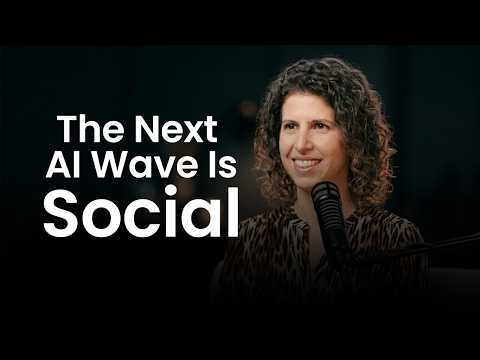
Why the Next Hit AI Product Will Be Social (Best of the Pod)
Dan Shipper revisits his AI & I conversation with Benchmark partner Sarah Tavel, one of Pinterest's first 30 employees, who argues consumer AI is shifting from "single-player" chatbot use toward products with social DNA—status, network effects, and multiplayer dynamics that let ChatGPT-class users learn from how others use AI. Topics include why technical founders dominate early platform shifts while product-minded founders win later, what ChatGPT is still missing, how to design a consumer AI app with social dynamics, how to tell a real network effect from a flywheel diagram, what Tavel finds interesting beyond AI, and how AI will change top venture capitalists' investing.
# Channel Presentation Observations — Video `01a0f15a`
## Channel Identity Signals
- **Show name**: The outro names the show directly: *"smash that like button and subscribe to **AI and I**"*.
- **Host identity**: Named in the outro — *"a journey into the future with **Dan Shipper** as the captain of the spaceship."* The host also self-identifies conversationally: *"we have an every thing that you chat with"* (a reference to his media brand "Every"), and *"I'm an investor and Quinton has been on the show"* — indicating recurring guests and a media-ecosystem context.
- **Content format**: Long-form interview podcast, branded as a clip/best-of: title says *"(Best of the Pod)"*, and the guest exchange begins mid-list — *"Sarah, welcome to the show"* — indicating an edited highlight reel.
- **Creator ecosystem**: The guest references the host's cross-platform presence: *"I've heard your podcast… I was very impressed with your podcast with Reed"*, and the host notes *"we have the benefit of like your blog and your podcast"* — positioning the show within a broader newsletter/podcast network.
## Intended Audience
- **AI power users and builders**: Discussion assumes familiarity with LLM tooling — *"custom instructions"*, *"projects"*, *"custom GPTs"*, *"Claude"*, *"Tolan"*, *"DeepSeek"* — and critiques ChatGPT from a power-user stance: *"I'm pretty damn good… relative to the population of the United States."*
- **Startup and venture-curious professionals**: Extended segments on VC practice — deal pricing (*"when we meet a team and we really think that there is just unlimited potential, you partner"*) and founder evaluation (*"I'm attracted to the founders for whom it's an affliction"*) — suggest an audience of founders, operators, and investors.
- **Product/strategy thinkers**: Concepts like Eugene Wei's *"status seeking work"*, network effects, and flywheels (*"words, but not accelerators"*) presume business-strategy literacy.
## Claimed Scope
- **AI-focused, but not exclusively**: The host states *"I know this is a show about AI"*, yet dedicates a substantial segment to stablecoins and Argentina's dollar access, implying a broader emerging-technology scope.
- **Expert-guest framing**: The guest is credentialed on air — *"you are a partner at Benchmark… you were early at Pinterest"* — signaling a format of interviewing operators and investors with direct experience.
- **Intellectual, analytical tone**: References to Wittgenstein, Annie Duke's *Thinking in Bets*, Jim Collins, Porter's five forces, and Reed Hoffman frame the show as idea-driven rather than news-driven.
## Demonstrated (vs. Claimed) Presentation Patterns
- **Observed**: The host positions himself as a peer-level expert, not just an interviewer — *"I record all my meetings"*, *"I've done this"*, and proposes his own frameworks (*"you're the average of the five AIs you spend the most time with"*).
- **Observed**: The outro's exaggerated, comedic tone (*"pure unadulterated knowledge bombs"*, *"I'm absolutely, hopelessly in love with you"*, apparently an AI-generated script) demonstrates a playful, self-aware brand voice layered over substantive content.
## Self-Description Evidence Summary
| Claim | Evidence |
|---|---|
| Show named "AI and I" | Outro CTA |
| Host is Dan Shipper | Outro; guest's mention of "your podcast with Reed" |
| AI-focused interview show | Host: "I know this is a show about AI"; intro framing of guest's expertise |
| Connected to "Every" media brand | Host: "like we have an every thing that you you chat with" |
# Delivery Observations — "Why the Next Hit AI Product Will Be Social"
**Format:** Interview podcast. Two observable voices: a **host** (asks questions, restates guest points, shares anecdotes) and a **guest**, Sarah (VC, ex-Pinterest). The transcript also includes a cold-open montage and an outro promo voice; those are excluded from the main analysis except where noted.
---
## 1. Recurring Vocabulary & Phrasing
### Intensifier doubling
Both speakers repeatedly double intensifiers for emphasis:
- "a founding team that was **deeply, deeply** technical"
- "the people who are **really really** good make it so much easier"
- "we're still **very very** early"
- "it's super **super** early"
### Hedged, exploratory framing
Claims are routinely softened with thinking-out-loud markers:
- "I was just **puzzling over** those"
- "**I suspect** that one of the things that is missing..."
- "**I could be tilting at windmills**, you know?"
- "**maybe** it's one of those things where usually that's not a good bet"
- "one of the **hypotheses I have** is that DeepSeek is a moment of change"
### Signature concepts repeated across the conversation
- **"multiplayer" vs. "single player mode"** — used by both speakers at least five times as the episode's central dichotomy
- **"status seeking work"** — introduced by the guest, then referenced again later ("then the status seeking work that you can you can pursue")
- **"network effect(s)"** — recurs across the whole episode, including "network effect-y type business"
- **"power user"** — "you are a power user of these products," "I just come back to how much of a power user product it feels," "somebody who is already actually a power user"
- **"paradigm"** — "a new paradigm," "truly new technology paradigm," "moving into that next paradigm"
### Verbal fillers / hesitation
- "you know" appears extremely frequently from both speakers
- "**like**" as a discourse marker throughout ("it was like what Google was, you know, so good at")
- Audible clearing of throat and laughter marks appear repeatedly in the transcript
---
## 2. Teaching & Explanation Habits
### Analogy as the primary explanatory tool
The guest teaches by mapping history onto the present:
> "Of course it's ChatGPT which is in a way not that dissimilar from Google in terms of what it was just that a a text box."
Other examples: the "donut companies" anecdote attributed to Jeremy Levine at Bessemer, the Amazon/Uber flywheel reference, the "Rotten Tomatoes almost score for companies."
### Quantified framing of qualitative ideas
The guest converts abstract arguments into pseudo-numeric scales:
> "I would say Google was **95%** like deeply, deeply technical"
> "it was a little bit maybe **94% of back end**"
> "**80% of decks** were like that I saw were like we have a network effect" *(host)*
### Named-framework citation
Both speakers anchor points in books, thinkers, and named concepts:
- Eugene Wei (status), Annie Duke / *Thinking in Bets* (pre-mortem), *The Five Temptations of a CEO*, Jim Collins, Porter's Five Forces, Reid Hoffman, Ben Silbermann quotes.
### Visual/physical metaphors for abstract dynamics
- "the **slider** goes forward, forward, forward"
- "the **white-hot center** of your market"
- "fallen into the **quicksand** of becoming an agency"
- "the **gravitational pull** of the existing platforms is too strong"
- "founders for whom it's an **affliction**... it's like this **rash** that they just have to scratch"
---
## 3. Communication Patterns by Speaker
### Guest (Sarah)
- **Self-deprecating caveats before opining:**
> "I should caveat that I did do a lot of product in my day. But I'm a VC right now. So don't take product ideas"
> "Forgive me, Lord, for brainstorming a product experience."
- **Personal anecdote as evidence:** blood-test/supplements prompt found on Reddit; Vacasa passed-deal story; Argentina money-exchange memory ("somebody on a motorcycle come to exchange money").
- **Apology-then-assertion:** "I hate to say this, but..."
- **Numbered/taxonomic structure:** "there's a few things that we all have training data for. One is... Then there's also... And then the third is..."
### Host
- **Restates and names the guest's argument before probing it:** "That's really interesting. I love that articulation in particular because..."
- **Confesses his own reaction to prompt follow-ups:** "which I never really made that connection consciously before."
- **Long, scenario-based questions** ("let's say the infrastructure is built and it's a technical founder versus a product genius founder...").
- **Personal anecdote injection:** the film director with multiple ChatGPT personalities; "you're also kind of going to be the average of the five AIs you spend the most time with."
- **Concession markers:** "That makes sense," "I'm with you," "That is my great hope" is the guest — the host uses "totally agree" responses sparingly.
---
## 4. Tone
- **Conversational and tentative at topic openings**, firming up as points develop ("And so, someone is going to create something here").
- **Frequent mutual laughter** transcribed at regular intervals, including shared philosophy-study banter early on.
- **Enthusiasm expressed via exclamatory asides:** "feels **criminal** to me" (said twice, nearly verbatim — in the cold open and again mid-episode), "man, I just think someone's going to create a UGC type community."
---
## 5. Isolated Moments (low confidence as patterns)
- The host's repeated **"tells"/signal questions** ("What are your tells?") appear once; whether this is a signature habit can't be established from one episode.
- The guest's **intensifier "damn"** ("I'm pretty damn good") occurs once.
- The **high-energy outro promo voice** ("smash that like button... pure unadulterated knowledge bombs") is stylistically unrelated to the interview body and likely scripted promo material — not treated as evidence about either speaker's interview delivery.
- The cold-open montage largely recycles phrases from the body of the episode ("deeply deeply technical," "feels criminal to me"), so it is not independent evidence of repetition — though the fact that the same lines were *selected* for the teaser is itself weak evidence they are characteristic.
---
## Summary of Most Reliable Patterns
1. **Doubled intensifiers** ("really really," "deeply, deeply," "very very") — high frequency, both speakers.
2. **Historical analogy as the teaching mechanism** (Google→OpenAI, consumer web→AI wave) — the episode's structural backbone.
3. **Explicit hedging before claims** ("I suspect," "I could be tilting at windmills," "hypotheses I have").
4. **Quantified scales applied to qualitative arguments** (95%, 94%, 80%).
5. **Central repeated dichotomy:** multiplayer/network-effect vs. single-player.
6. **Anecdote-first evidence style** from both speakers when justifying judgments.
# Observation Record: "Why the Next Hit AI Product Will Be Social" (Best of the Pod)
## Participants
- **Host** (identified late in transcript as **Dan Shipper**, host of "AI and I" per outro)
- **Sarah** — partner at **Benchmark**; previously early employee at **Pinterest**; studied philosophy; investor in **Chainalysis** and board member; also references board role at a creator marketplace (transcribed as "Agenteo"/"I Gentio")
---
## 1. Technical-to-Product Founder Continuum (Sarah)
**Claim:** Consumer tech winners shift from deeply technical founders to product-genius founders as a technology paradigm matures.
**Stated reasoning:**
- **Google** was "95% deeply, deeply technical" — the product was back-end magic (distributed engineering, infrastructure) behind a simple text box.
- **Facebook** was less technical than Google but more technical than Friendster/MySpace, enabling a performance advantage that "won the day."
- **Pinterest, Snap, Instagram** — "the CEOs weren't technical at all. They were product geniuses" — "the slider goes forward, forward, forward more towards the product thinker, product experience."
- **ChatGPT** parallels Google: "just that a text box." **Character AI** was a new paradigm, but for Noam "the product was the model" — still ~94% back end.
- Non-technical builders can't yet get what they want from the technology: "so much of the tooling and infrastructure is still to be built." Character-AI-genre products all feel similar because "no one was uniquely qualified to build that type of product" without going into the model itself.
- She hypothesizes **DeepSeek** "could be... a moment of change" lowering costs and enabling this transition.
**Qualifications:** "It's still early like everything is moving under our feet." Host noted the analogy "falls down" — Google never evolved into a multiplayer product; Sarah acknowledged this.
## 2. OpenAI/Google DNA Parallel (Host + Sarah)
- **Host:** OpenAI is "a research lab that accidentally built the... biggest consumer technology product of all time," and there's "a real historical precedent" in Google's DNA.
- **Host:** Investing in "PhDs doing long-term research" is normally a bad venture bet, "but if you're really dealing with a truly new technology paradigm it could be the best bet you ever make." Sarah agreed ("Yeah, absolutely").
## 3. ChatGPT as a Power-User Product; the Missing Social Layer (Sarah)
**Claims:**
- "I don't think ChatGPT is the single player mode product" — in the sense that it lacks multiplayer/network dynamics.
- The difficulty of use is a defect: "It shouldn't be this hard." Custom instructions (e.g., telling ChatGPT to ask clarifying questions first) shouldn't be necessary; better models will remove this friction.
- On custom GPTs: "**feels criminal to me**" — "clearly made by a team that is unbelievably capable but isn't social."
- Prediction: "Someone's going to create a UGC type community where the people who are really really good make it so much easier for the rest of us."
- Most people "use ChatGPT like they would use Google"; early prompt libraries were "too early" and skewed to B2B/solopreneur use cases.
**On redesigning custom GPTs with social DNA (Sarah):**
1. Ability to find creators with "standing for being qualified" / authority, and **follow** them.
2. **Trust-building** is the missing piece: usage counts exist, but "I don't know what custom documents they put, I don't know their prompt... there's no visibility under the surface."
3. Then the **status-seeking** layer.
**Self-qualification:** "I did do a lot of product in my day. But I'm a VC right now. So don't take product ideas" — she repeatedly apologized for "brainstorming a product experience."
## 4. Status-Seeking and Multiplayer Dynamics (Sarah)
- Cites **Eugene Wei**: most multiplayer social products have a North Star where participants "try to achieve status in the network" (followers, views, likes), creating incentives for desired behavior.
- Character AI offshoots show "a little bit of status seeking work happening there," but "we're still very very early."
- The "multiplayer network effect type experience" requires "a very different... brain" than single-player experience design.
## 5. Two Curiosity Threads (Sarah)
1. **AI friends:** "We're all going to have probably more conversations with an AI than we do with people." Likely a distinct platform from knowledge-focused ChatGPT. **Replika** was first; mentions downstream companies including "Tolen/Toland" (inconsistent transcription; host later says he's an investor and "Quinton has been on the show").
2. **Prompt-sharing communities:** Personal anecdote — she found a useful health/supplement prompt on Reddit, a site "not made for this use case"; wants to follow a qualified person and "easily apply it to my own profile."
**Host's additions:**
- Prompt libraries had "a second life" — ideas from two years ago "now just becoming relevant."
- Anecdote about a film director with multiple ChatGPT personalities (holistic wellness advisor, cheerleader, harsh email critic): "you're also kind of going to be the average of the five AIs you spend the most time with."
- Buckets: ChatGPT and Claude feel "worky"; "there's room in the personal bucket" (he used his "Toland" product an hour the prior day).
**Sarah's response:** Personal use cases work inside ChatGPT (her "AI savants" call surfaced recipe use cases), but a lowest-common-denominator product "can't really optimize" the experience. Envisioned future: "you're going to Sarah's GPT, and it's actually a community" holding personal data (blood tests, supplements, kids' info), possibly "cannibalizing ChatGPT over time."
## 6. Why the Multiplayer Wave Might Not Happen (Sarah)
- "That is my great hope. I could be tilting at windmills... consumer... has been really, really hard over the last 10 years."
- Single-player AI companies will still emerge and "could be really good," but "the really big opportunity... for a true network effect is going to be something that's multiplayer."
- **Failure mode:** "the gravitational pull of the existing platforms is too strong" — ChatGPT's habit, ecosystem, pricing (possibly free/ad-supported), and **memory lock-in**. Getting power users to share on a new platform "may be hard to create."
## 7. Investing in a Hype Cycle (Sarah)
- "We always start with: is this a company we want to work with?" — then opportunity size; if it's "a cul-de-sac," harder to justify price. "People have a willingness to do deals that we're just not willing to do. But when... there is just unlimited potential, you partner. You make it work."
## 8. Founder Taste (Sarah)
Drawn to founders who:
- "Think in network effects and strategy," the "zero to one, how do you escape competition" mind maze.
- For whom founding is "an affliction," not "a cool new job" — "this rash that they just have to scratch."
- Are "learning machines" — ego-less, focused on the company.
**Failure cases cited:**
- *The Five Temptations of a CEO*: founders attracted to the CEO role for **status** fail to do what building the best company requires.
- **Insecurity** can drive founders but "can also hold you back by not letting you grow."
**Her "tell":** if in 30–60 minutes she can surface things the founder hasn't considered ("Oh, that's a good question. I hadn't thought about that"), "that's usually concerning." Cites **Jeremy Levine (Bessemer)**: best companies are "donut companies" — you attend the board meeting, eat a donut, and leave.
**Host:** cites Reid Hoffman's bar — could you return in 5 years without talking to the founder and expect success?
## 9. Real vs. Fake Network Effects (Sarah)
- Early stage involves "leaning in on the theoretical"; best evidence is a **tipping point in the white-hot center of the market**.
- **Example (non-AI):** board company **Agenteo/I Gentio** (creator-brand marketplace) — the market previously "fallen into the quicksand of becoming an agency"; LLMs automate what held it back; currently has "demand side pull." Caveat: "it's super super early."
- **Current AI** resembles traditional software: "obsessing over a customer problem" and out-executing competitors, not network effects.
- **Deck red flags:** flywheels copied from Amazon/Uber that are "words on a slide... but not actually accelerants"; friction embedded in a leg of the flywheel; "offshoots."
## 10. Stablecoins (Sarah)
- "I'm a big believer in stablecoins"; long-term Bitcoin believer; on the board of **Chainalysis**.
- Rationale via Argentina (her mother's origin): everyone wants US dollars; hard to get (multiple street/bank/credit-card exchange rates, motorcycle money-changers, government hoarding dollars in the central bank as "a very precious resource").
- US dollar stablecoins (Tether, USDC): "so much faster. It's 24/7... a lot cheaper"; peer-to-peer removes middlemen vs. Argentina-to-India transactions.
- **Network effects:** Tether dominates via exchange liquidity; comfort effects across wallets and high-inflation countries (Nigeria cited); "USDC is pretty strong, too."
## 11. AI and the Future of VC Decision-Making (Sarah + Host)
**Sarah's claims:**
- People good at creating **training data** get more valuable LLM experiences.
- Her practice (inspired by **Annie Duke**, *Thinking in Bets*): writes a **pre-mortem** per deal — what she liked/disliked, terms, and reasons for yes/no — to later examine her decision-making.
- Lesson from passing on **Vacasa** over valuation: "if I like everything but the valuation, I should probably lean in."
- Expects an LLM to "cross-examine" her; sees applications in talent evaluation and even a "Rotten Tomatoes almost score for companies" derived from angel/talent signal.
**Host's challenge:**VC success is rare long-term; possibly "your taste gets tuned to a particular kind of opportunity" that then shifts — making past training data unreliable for future decisions.
**Sarah's response:** Hoping this is "what we're all hoping will give us job security." Cites **Ben** at Pinterest ("assume it's going to be more similar than different" on localization) and timeless frameworks (Jim Collins, Porter's Five Forces). Key qualification: "you're not asking the LLM to give you the answer, yes or no. You're asking it to probe your thinking" — humans remain "the decider." Both agree the VC job in 5 years will be "very different."
---
## Unresolved Tensions Preserved
- Sarah's multiplayer thesis is explicitly tentative ("tilting at windmills") against her own acknowledgment of incumbent gravity and memory lock-in.
- Her analogy self-admittedly "falls down" for Google, which never went multiplayer.
- Host's challenge to AI-assisted VC decision-making (tuning to shifting landscapes) is not fully resolved — Sarah's answer rests on frameworks being timeless and the LLM probing rather than deciding.
- The creator-marketplace company name is inconsistently transcribed ("Agenteo" / "I Gentio"); recorded as-is.
# Video Attribution Record
## Title
**Why the Next Hit AI Product Will Be Social (Best of the Pod)**
## Speakers & Roles
### Host
- **Dan Shipper** — identified as host/creator of the show **"AI and I"** (stated in outro: "Dan Shipper as the captain of the spaceship"). Interviews the guest; shares that he studied philosophy and hosts a podcast (mentions episodes with **Reed Hoffman/Reid Hoffman** and **Quinton**).
- The host states he is an **investor in Tolan** ("I'm an investor and Quinton has been on the show") — promotional disclosure of his own stake.
### Guest
- **Sarah [surname not provided in transcript]** — introduced as:
- Partner at **Benchmark** (confirmed by guest: "Yes.")
- Previously early employee at **Pinterest** (responsible for discovery experiences and localization)
- Studied philosophy
- Currently a **VC**, board member at **Agenteo** (YouTube creator/brand marketplace) and **Chainalysis**; previously at **Bessemer** (worked under Jeremy Levine)
### Other voices
- A closing **outro/promotional segment** features an unnamed, stylized AI-sounding voice urging viewers to "smash that like button and subscribe to AI and I" — **flagged as promotional content**, including a direct-to-host line ("Dan, I'm absolutely, hopelessly in love with you").
## Third-Party Claims & Referenced Sources
### People/companies cited within conversation (claims by speakers, not verified)
- **Google, Yahoo, Facebook, Friendster, MySpace, Pinterest, Snap, Instagram, ChatGPT, Character AI, OpenAI, DeepSeek, Replika, Tolan, Claude, Gemini, Vacasa, Tether, USDC, Agenteo, Chainalysis** — used as examples/analogies.
- **Noam (Shazeer)** — "for him the product was the model" (guest's characterization of Character AI).
- **Eugene Wei** — status-as-North-Star framework ("status seeking work").
- **Annie Duke** — *Thinking in Bets*; pre-mortem practice adopted by guest.
- **Jim Collins** (*Five Temptations of a CEO*), **Michael Porter** (five forces), **Ben (Silbermann, implied)** — Pinterest advice anecdote.
- **Jeremy Levine** (Bessemer) — "donut companies" board analogy.
- **Reid Hoffman** — referenced by both speakers regarding network effects and a 5-year no-contact investment heuristic; Sarah mentions his podcast appearance with the host.
- **"James"** — interviewee on the guest's **Substack** (guest's own content channel, noted).
- **Milei / Argentina** — guest's family background and stablecoin discussion; anecdotal, personal-experience claims.
## Promotional Segments (flagged)
- **Closing outro**: explicit call to action to like/subscribe to "AI and I" — promotional.
- **Host's disclosure**: host mentions his own investment in Tolan and his Substack/podcast ecosystem ("we have an every thing that you chat with") — self-referential promotion within conversation.
- **Guest's Substack** — mentioned as her own content channel.
## Availability & Access Limits
- **No comment availability** is stated in the transcript.
- **No external curated metadata** (links, sources, citations) was supplied beyond the transcript.
- Speaker **last names are not provided** for the guest ("Sarah") or the quoted "James."
- Transcript contains **no timestamps**; speaker turns marked with `>>` delimiters only.
## Uncertainty Notes
- "Agenteo" / "I Gentio" spelling is inconsistent within the transcript (transcription artifact).
- Whether the video is a "Best of" compilation of a longer episode is suggested by the title only; the transcript reads as a single continuous conversation.
- Host identity ("Dan Shipper") is established only via the outro narration, not via the host himself in-transcript.
Google was a founding team that was deeply deeply technical. As the technology the underlying technology got more mature, the slider goes forward
forward forward more towards the product thinker product experience. Pinterest where I was, Snap, Instagram, the CEOs weren't technical at all. They were product geniuses. So what are the big consumer wins so far in AI? Of course it's ChatGPT which is in a way not that dissimilar from Google in terms of what it was \>\> a text box. Custom GPTs and in ChatGPT feels criminal to me. It's clearly made by a team that is unbelievably capable but isn't social. What's the multiplayer network effect type experience? Someone's going to create a UGC type community where the people who are really really good make it so much easier for the rest of us. \>\> \[music\]
\>\> Sarah, welcome to the show. \>\> Thanks so much for having me. \>\> So for people who don't know you, you are a partner at Benchmark. \>\> Yes. \>\> Before that you were early at Pinterest and before that you studied philosophy
which I also studied philosophy so that's close to my heart. \>\> Yes, I've heard your podcast and \[laughter\] I was very impressed with your podcast with Reed. \>\> Oh, thank you. \>\> with him. Uh is is it was a lot of \>\> \[laughter\] \>\> very impressive. \>\> It was uh a couple late nights of me furiously prompting ChatGPT to explain Wittgenstein. \>\> I love it. \>\> \[laughter\] \>\> I love it. Well, you did great. \>\> Thank you. So I'm psyched to have you on the show. There's so much to talk about but I think one of your one of your big interests is in uh consumer technology and consumer technology cycles and how you can use the lessons of previous consumer technology waves to kind of help you understand this AI wave in this cycle and what kinds of products are going to work and what kind of products are not going to work. I'm curious, I think that is a good place to start. \>\> You know, one thing I just was reflecting on and you know, you kind of look at Chat GPT and Character AI and I was just puzzling over those and then started to think back to you know, what was like the big early kind of consumer web hit and that was Google of course. I mean, it was Yahoo and Google, but what was Google? Like Google was a founding team that was
deeply, deeply technical. \>\> Yeah. \>\> And and really like if you think about a product experience that you're exposed to the user and how much of it is like the UI that you interface with the
product itself versus all the magic that happens on the back end to make something that's really complex ex- simple on the front end. That was like what Google was, you know, so good at the distributed engineering, the infrastructure. And and then as the technology, the underlying technology got more mature you started to go to a place where it maybe if you kind of said like like deep technical, uh, you know, you have 0% and 100% like I would say Google was 95% like deeply, deeply technical and then you start to move that bar over and you get to, you know, I think about Facebook. Like Facebook, it wasn't the same technical depth of course of Google, but relative to Friendster and MySpace, they were more technical. They had they were a little bit later and it let them create like a really performance experience that ended up really kind of, you know, winning the day. And then you progress even further, Pinterest where I was, Snap, Instagram, the CEOs weren't technical at all. They were product geniuses, right? And so like the the slider goes forward, forward, forward more towards the product thinker, product experience. And then you think about what we like what are the big consumer wins so far in AI? Of course it's ChatGPT which is in a way not that dissimilar from Google in terms of what it was just that a a text box. \>\> Yeah. \>\> And Character AI like unbelievable what they did and it was like a new paradigm. But still it was always like you would speak to Noam and for him the product was the model. You know, it wasn't it was a it was a little bit maybe 94% of back end but it was still like very much so. So it's still early like everything is moving under our feet
still and I think to really have the people who have more of that product intuition to really build the experiences on top you need more of the underlying infrastructure to
to be a little bit more stable. But it does seem like we're moving into that next paradigm soon and what's going to happen there. \>\> That's really interesting. I love that articulation in particular because one of the things that I've felt is very unique about OpenAI is they're a research lab that accidentally built the like the biggest consumer technology product of all time. But it seems like you're saying there's actually a real historical precedent for that and that the DNA of Google is very similar to the DNA of OpenAI which I never really made that connection consciously before. And I think it's also really interesting because investing in basically PhDs doing long-term research that may have no practical purpose is not usually something that pays off in venture in venture business is not like the first place that people think, you know? It's more like Stanford dropout, you know? \>\> \[laughter\] \>\> Yeah, absolutely. \>\> Um and so and and so maybe it's one of those things where usually that's not a good bet but if you're really dealing with a truly new technology paradigm it could be the best bet you ever make. \>\> Yeah. \>\> Is that how you think about it? \>\> Yeah, and and you know, I part of what I think about is just like you are a power user of these products. And I am on that learning curve. I would say I'm no I pale in comparison, but like relative to the population of the United States, I'm pretty damn good. \>\> It shouldn't be this hard. You know, and like so some of the underlying
uh you know, like the models will get better. So like one thing that I know you have in your custom instructions I've I use a lot is just like you don't have to answer like you just to to chat
GPT. Like you don't have to answer me right away if you have some clarifying questions. \[clears throat\] Like ask those. Um we shouldn't have to put that in a custom instruction. Like there should be so or there there's so many different tweaks that we all have to get what we want out. And over time as the models get better and better, you won't need that anymore. The level of difficulty to get really what you want is going to get easier. But I don't think chat GPT is the single player mode product. And you know, the custom GPTs that they have where you can um see what other people have created. To me, man, I just think someone's going to create a UGC type community where there people who are really really good make it so much easier for the rest of us to really take advantage of this this technology. So we're we're you know, so there are places like Google is still Google. Like it falls my analogy it falls down when Google didn't evolve into some multiplayer product. There's no other product that took over Google until really now. But I I still think we're so early in knowing who really is going to be the winner in this world. \>\> Yeah. \>\> I want to go back to that sort of transition from highly technical founder to product genius, if that's the continuum. I can understand why at the beginning of a paradigm shift, um, highly technical founder is necessary
and will win over product genius because they can actually build the technology that makes a difference. But I'm curious for your thoughts on what drives the transition to product genius because, um,
you know, I can understand the, uh, making, for example, simpler user interfaces, like maybe product geniuses are better at that. But, yeah, what's the underlying force cuz I could also see a world where the highly technical founder is still like really, uh, you know, effective in the as the as the paradigm gets more and more figured out. Like, yeah, talk about that. \>\> I think, um, a big part of it is that you still, like, so much of the tooling and infrastructure is still to be built to let somebody who isn't deeply, deeply technical themselves get what they want out of it. And so, that's why, like, there's so many products now that I see that feel kind of pretty similar to each other. You know, there's all these, you know, the character AI genre, right? Where you make a character and you engage with it. They're all relatively the same because you really, I mean, no one was uniquely qualified to build that type of product, like, actually going into the brains of the model and changing it to to create the experience of the user. Um, but it's it's still it when you need to have that level of ability to get what you want out of it. Also, the costs have still been pretty high. I think DeepSeek, you know, could be, you know, one of the hypotheses I
have is that DeepSeek is a moment of change where it makes it more possible. Um, but yeah, it just I think it I think you need more maturity in the underlying
infrastructure, your ability to to do the things that you want with the model without being the deeply deeply technical to be able to create the experiences that are possible. \>\> That makes sense. I think what I'm asking is so let's say the infrastructure that infrastructure is built and that but you still have now technical founders and product genius founders, which we're making a strong division here for argument's sake. Sometimes they overlap. Um Uh So in that world where the infrastructure is built and it's a technical founder versus a product genius founder, like what is driving the success of the product genius founder in in a in a world where everything's a little bit more mature? \>\> I think it it will depend on so many things. Ultimately, it's I it's a uh to reduce it to the basic, it's like who's going to create the most engaging \>\> Yeah. \>\> product, yeah, the experience. I suspect that one of the things that is missing from a lot of these experiences that people are creating is just like what's the multiplayer network effect type experience. And that genius to create that type of experience is very different than the type of exper- the type of brain that creates a a single player mode experience. And we haven't really I mean there's again these kind of character AI um offshoots that have people that I can create a character and you can play with the character I could create. There's a little bit of status seeking work happening there, but I think we're still very very early in like the true thinking happening. \>\> do you mean by status seeking work? \>\> Uh do you know Eugene Wei? Um so uh just this idea that most multiplayer kind of
social products end up having some kind of North Star for the community participants where they're trying to achieve status in the network. And you
know, you can think of that a lot as you know, it has been the number of followers you have or views or likes. There's something about achieving some kind of celebrity or status within a network that creates incentives for the community participants to do the thing that you want them to do. \>\> Interesting. And so far you're you're saying it's pretty early, but are you Do you have ideas for what the promising areas to look are or examples of like early examples of products or companies that you're looking at that you think are starting to crack this a little bit? \>\> It's still super early. I mean kind of there's two threads that I can't help but be curious about. Like one, you know, we we talked about Character AI. Like you I mean I I don't know about you. Like I feel myself doing this already, which is that there's going to be some company We're all going to have AI friends, right? We're all going to have probably more conversations with an AI than we do with people in our lives. And who Is there going to be a single dominant platform for that? Is it going to be different than the kind of information more, you know, knowledge-focused experience of a ChatGPT? I think so. Who creates that? And there's a bunch of different product experiences. Replika was of course like the first, you know, player in the space. But there's there are a bunch of different downstream companies. We talked about Tolen. Like, you know, what is that product experience going to be? The other um kind of thing I think about a lot is I don't know about you, but how many times have you done a search and ended up on, you know, Reddit or something for a prompt to get like I I remember doing
one. I got a blood test result. I had all my supplements. I wanted to see, you know, of the supplements I have, like what could I tweak to change a result? And there was a great prompt in in
Reddit that I just copied and paste. But if if I'm going to an existing UGC site that isn't made for this use case, that feels to me like an opportunity where somebody who's going to be really freaking good, you know, making, you know, prompts for different health things, qualified self, whatever. Like I would love to follow that person and then very easily apply it to my own profile. \>\> I think \[clears throat\] like um to go back to front on those two threads, with the prompt thing, it's one of those it's one of those ideas that um I feel like at the very beginning, like when GPT-3 came out and then ChatGPT came out and people were like really starting to like that first real wave of LLMs was starting to take take hold. A lot of people created those prompt library type sites, but it was too early. And I think there's there's like a second life for a lot of ideas that people start like tried two years ago that are now just becoming relevant. \>\> And I too early and also it was very I I spent time on a bunch of these. It was very like what a solopreneur and SMB would need. You know, it was a lot of the marketing, the social media. It was like that type of B2B type use case. Most people aren't barely scratching the surface. Like most people use ChatGPT like they would use Google, right? And it's and the learning curve, the step function changes that happen when you have better custom instructions, when you have projects, whatever, are so huge. How do you democratize that? \>\> Yeah, it's interesting. I was at a dinner the other night and I was talking to a film director \>\> Oh, cool. \>\> um about how she uses ChatGPT and um she has made a bunch of different personalities for it. Um and she uses the different personalities for different things. \>\> So. \>\> Uh for example, I think one of the personalities was she's had a lot of like medical issues um that doctors couldn't solve and one of the personalities was like a sort of like holistic wellness type person that
like would recommend both medication and you know, supplements or body worker whatever. Um and then and another one like the main personality was like just
someone who would like gas her up all the time and like and like compliment \[laughter\] her all the time. Um and then but then she had another one that was like uh just super direct and like just gave like really harsh feedback that she would use for writing specific kinds of emails or like that kind of thing. And it was really interesting that she'd constructed this whole set of personalities for different like things in her life to surround you know it's like you're the average of five people you spend the most time with. There's like a well you're also kind of going to be the average of the five AIs you spend the most time with in an interesting way. And I think to your question about are you going to have multiple AI platforms that you use or not um or is there going to be a big dominant one? Well I have two thoughts on that. One is um I do think within a ChatGPT for example there's a lot of room for different sub personalities that maybe like uh media brand like every like we have an every thing that you you chat with but it's inside of ChatGPT so it's still in that ecosystem. But I do think also people have different buckets in their life and so for me one thing that I've been noticing recently which is really interesting is we talked about Tolands and I'm an investor and Quinton has been on the show. And I find myself like yesterday I spent like an hour talking to mine but like I normally would use ChatGPT for that and I think there's like some interesting like difference between something that feels personal and something that feels worky and ChatGPT and Claude right now are like in the worky bucket and then there's room in the personal bucket. I'm curious how you think about that. \>\> I I totally agree. You know it's funny like I did a call for uh you know I was in the beginning of this year I was realizing like I'm not keeping up and so \[clears throat\] I did a call for like AI savants just people who were using uh ChatGPT in in in kind of more power user ways and a lot of people came to me with recipe uh kind of use cases which which made a ton of sense and so you can definitely see it it it it works in chat GPT. The personal works. But, is it the best that it can be? Like, you know, there are also a lot of company a lot of people who are making
their own, you know, single-purpose site that is a recipe experience. And it's, you know, whenever you have a product that is has to be lowest common denominator for all these different
experiences, it can't really optimize for the experience that's going to be great for the like, you know, a consumer in this case. And I I I just come back to how much of a power user product it feels to me. And how like most people are going to stay at the surface of it unless there's a new interface. And I think the best way for that new interface to come is for us to learn from each other in some ways to um to kind of take to take advantage of of it in different ways and just copy and paste as much as like again, the the gems and Gemini custom GPTs and in chat GPT, I just look at that and it feels criminal to me. Because it it it's it's clearly made by a team that is unbelievably capable but isn't social. And and I think the personal can can best be expressed by teams that that do really understand people and social and community. \>\> were going to like redesign them like
right now uh together like what where would you start uh if you're thinking about okay, I want to take make something that's custom GPT-like but like has social DNA?
\>\> I would I mean, the most obvious thing is just like the ability to find somebody who's, you know, who's custom prompts or whatever you you you like that they have some kind of, you know, standing for being qualified \>\> or authority-based kind of yes yeah and then being able to follow. Um, that's like a very basic thing. But then the second thing this is where I think custom GPTs falls down is just in building trust. Like when I look at any of those, I see the person and I see a lot of people who have I see that there's 3,000 people that have used it, but I don't know what custom documents they put, I don't know what their prompt is. Like there's no visibility under the surface and so it's not very trust building for me to to pick one or the other unless I know somebody from the outside world and they send me their you know, their custom GPT and then I can use it. And so there's something about the trust building that someone has to figure out and then \[snorts\] and then the fault the status seeking work that you can you can pursue. \>\> One of the challenges of this that I'm curious how you think about this in a social context is um, for a let's say we're we're kind of veering into like prompt social network territory. Maybe I have a profile and like I I can share prompts and people can follow me and all that kind of stuff and because I have a certain amount of um, reputation in you know, just AI stuff like all I can get followers and all that kind of stuff. One of the interesting things is um, I am not coming up with new prompt ideas every day. And so that's I think that's a problem for two reasons. One is I may not remember to use the tool and then two uh, people don't necessarily have a reason to check every day. \>\> Yeah. \>\> How would you think about that? \>\> Yeah, so first as something that was going through my brains I should caveat
that I did do a lot of product in my day. \>\> Yeah. \>\> But I'm a VC right now. So don't take product ideas and every every once in a while people ask \[laughter\] me they're like, if you were a founder like what
would you build? I'm like, that is not what I do. I do \>\> \[laughter\] \>\> I'm just kind of curious, you know. \>\> for me like what I imagine is using it instead of ChatGPT. Like, actually it becomes the place where, instead of going to ChatGPT, \>\> I think it has to be that. \>\> And then And then that's where you the engagement comes from. And then you're seeing a feed and someone has Again, terrible I'm Forgive me, Lord, for for brainstorming a product experience. Um but, like, you do But, you see what I mean? Like, there there's something there where people are innovating all the time. But, right now what's happening is that we're all reinventing the wheel. We have the benefit of like your your blog and your podcast. But, like, this isn't the way this type of knowledge is going to share It's going to kind of get propagated. And so, someone is going to create something here. \>\> that's interesting. I do think um you're right that it seems like the social stuff has to come in the context of something that you're already using for some other reason. Like, you're already in ChatGPT, um and then it can flow out of that that usage. \>\> Yeah, I mean, I I actually think like you you don't use ChatGPT Like, most like maybe I hate the my mom, but like, you know, what the the person You know, and maybe it's the personal um kind of bifurcation that you talked about before, but you're going to Sarah's GPT, and it's actually a community It's not Sarah's. It's, you know, this kind of uh whatever network it's going to be. And I'm going there, and I'm putting my personal blood tests and my supplements, and I'm putting information about my kids and all that stuff, and it lives all there. And then I can go to ChatGPT for whatever knowledge work or any other things. Or maybe I never do. Maybe this actually ends up cannibalizing ChatGPT over time. \>\> This is a total swerve. \>\> Go for it. \>\> Uh but how do you, when you're in you're investing in a time like this? Like I feel like every 5 to 10 years there's a big hype cycle. There's a big wave and prices go up. Um you know, when when I was like in college in 20 2010, 2014-ish, it was
like social networks, everyone's building social networks for X, and then it was like B2B SaaS, and then crypto, and now it's AI. How do you think about um investing in a wave like this when
prices are super high? Do you not care about price? Do you try to find like underpriced deals? \>\> We always start with is this a company we want to work with? And then kind of, you know, obviously we have to think about the the opportunity ahead of the company. Like, you don't want to if it's if it's a cul-de-sac, if it's limited in some ways, it's harder to pay what, you know, play the game on the field in terms of price. Like, people have a willingness to to do deals that we're just not willing to do. But, when we meet a team and we really think that there is just unlimited potential, you you partner. You make it work. \>\> Yeah. What's your taste in founders?
\>\> Uh I would say I'm really drawn to founders who you know, they do think in network
effects and strategy, and the kind of zero to one, how do you escape competition? Like, they go through the mind maze. Like, you can just tell that like they've really obsessed over this. Uh I'm drawn to founders that this is like a calling for them. Like, it is a you know, I I kind of find that there's like some founders that it's almost like kind of a cool new job for them, and there's some for whom it's an affliction. And I I'm attracted to the founders for whom it's an affliction, you know? It's like this rash that they just have to scratch, and that's going to make them run through whatever walls that they have to do. And then, you know, just like the learning machine, like the person who, you know, it's not about their ego, it's about just like what's the best thing for the company, and how do I keep learning and evolving as a founder, because as you know, it's a really hard job. It's a really hard job, and it always requires more of you. Like it's it's there's a relentlessness to it. And if, you know, I have seen a failure case where somebody either it ends up being, you know, do you know the five temptations of a CEO, that book? Incredible book. The hardest temptation is, you know, a founder is attracted to being a CEO because of status. And then you you don't do the things that you need to do in order to build the best company possible. Or, you know, a founder that, you know, insecurity can drive you, but it can also hold you back by not letting you grow, and that that can be a challenge, too. \>\> What are your tells? Um cuz, you know, you're a partner in a top firm, people are like probably always coming to you with their best best foot forward, trying to trying to be like what you're looking for. What are What are some of the moments where you kind of can be like, "Ooh, this is I can tell that this person has been through the maze and is thinking about this stuff in this way, in a way that's like it's genuine, it's not put on, or I can tell that it's sort of like a calling, or what Yeah, what are those little signals for you?" \>\> Yeah, I just I find that um you know, I I I ask a lot of questions when I'm meeting with a founder and and learning about their business, and I know I'm always thinking about like I'm definitely the brain that is always thinking about that future and pulling it into the present. And when I speak to somebody and they're I hate to say this, but they're like, "Oh, that's a good question. I hadn't thought about that." Or you know, it's just I'm bringing things that I'm I'm spending 30 minutes, 60 minutes with a founder hearing the ideas for the first time and I'm bringing things to the table that they have not already thought about. That's usually concerning. \>\> That's right. I mean, you're pretty smart so \>\> uh it's it's it's one of those things that it can feel good like, "Oh, I asked some good questions." But really you want you know, I when I was at Bessemer Jeremy Levine he said that the best companies you want to be donut companies where you go to the board meeting you eat a donut and then you leave because they don't \[laughter\] really need you. And so there's a little bit of that which is like, you know, I have some founders where I'll be thinking about something and I'll come to our one-on-one and like before I've even opened my mouth they're already there. Asking like saying, you know, I've been thinking about this or I I reached out to this person and that's a pretty unique that's like a really incredible feeling when it happens. \>\> Yeah, I was I was talking to you I think it was Reid Hoffman who was on the show who said um ideally it's someone where you you invest in them with the the the bar is like if you could come back in 5 years without having talked to them after the investment like and you would be pretty sure it would be going well. That's a good question to ask yourself, you know? \>\> Those are those those types of companies I mean there's the founder but then there's also I know Reid and I know that he is very oriented towards network effects. And that is I mean, if you can find a business with a strong network effect like you're in you're going to be in pretty good shape. \>\> Let's talk about network effects because I think that um it's one of those things it's maybe a little less so cuz of AI stuff but like
for the last 10 years um I would say like 80% of decks were like that I saw were like we and we have a network effect. Um \>\> \[laughter\] \>\> And there are very, I think there are
probably very few businesses that truly have like that actual network effect pull. How do you differentiate? What does that really look and feel like? \>\> Yeah, in the early stages it's, you know, there's a lot of companies that have potential network effects and, you know, often times there's a big gap between what's a theoretical, you know, and like where it really starts happen. Um And one of the things that, you know, I often think about is just like there are early, you know, we invest so early that a lot of it is leaning in on the theoretical. But like there are often signs that that you can look to. Um The best thing that I, you can sometimes see evidence of is just this idea of like a tipping point that starts to happen in a very small segment of the, like where the white-hot center of your market is. Um you know, I, there's like two examples I think about. Um But but they're outside of AI. Like outside of core AI right now because it isn't, I think right what's happening right now with AI is that it's very much like a um kind of in a way what has been traditionally the software business, which is just obsessing over a customer problem more and moving faster in your execution uh than any of your your competitors. Uh But um but you know, I'm on the board of a company called Agenteo, which is a marketplace for create, like YouTube creators and and brands. And you can see that like they the this has been a market that has alluded startups for a long time because most of them have like kind of fallen into the quicksand of becoming an agency. Yeah. But with LLMs, Agenteo's able to automate a lot of the things that have held this market back and they're and they're truly like the having liquidity. And one of the early things that was super interesting is just like you see
the like the brands see creators and they see that the ads that they do for I Gentio and like so I Gentio just has this demand side pull right now.
Um and it's super super early, but there was enough signal there that like some things working that's differentiated and there's no substitute for what they're doing that that you hope will start to really be a flywheel that can spin faster and faster. \>\> So it's seems like one of the best ways to differentiate between a real network effect and a fake one is like just early evidence. \>\> Yes. \>\> Are there any things like when you see a deck from a founder that hasn't, you know, they're they're just starting out and you're like and they say we're going to have a network effect and you're like it's not going to be a network effect. \>\> Yeah. \>\> \[laughter\] \>\> Yeah, I mean it's it's often like they, you know, they'll articulate some kind of flywheel, you know, or they'll look like the Amazon or the Uber uh um flywheels and then as you and and either like it's just words on a slide that fit to a picture, but like the you know what I mean? But like the words don't actually they're not actually accelerants. Like that's I think that's one of the things like, "Okay, yes, that clear that that come whatever you say is true, but it doesn't really accelerate the flywheel." Um and the second thing is that often there's either a lot of friction embedded in any one any leg of that flywheel or there's like offshoots that happen. Um \[clears throat\] but I think the biggest thing is like when you really look at like what the articulation is of the flywheel that it is is words, but not accelerators.
\>\> Yeah. To bring it back to AI for a second, I feel like one thing that you're articulating is there is a uh there was a a moment in software for
like 10 or 15 years where everyone was chasing network effects. And then the LLM wave happened and a lot of that has been um more single player or if it's if it's collaborative, it's like inviting teams or whatever, but you're not doing it together. Um and and the game there has been better performance from more money in more compute and more more data, basically. And everyone's just trying to keep up along that same sort of dimension of performance, more or less. There are a couple other like examples that are not on that, but um and I think what what you're maybe pointing to is that fairly soon, if not already, um probably the models, the base models are good enough for consumers that there's going to be another wave of more consumer-focused, more product-genius-led AI applications that differentiate or grow from network effects and multiplayer that were not possible in the last couple years, but are newly about to be a thing. \>\> That is my great hope. I I could be tilting at windmills, you know? Like consumer, as you know, has been really, really hard over the last 10 years. And so it really could be tilting at windmills. I believe that that is an opportunity. And what I would also say
is that there are going to be a lot of companies that emerge that aren't multiplayer, that are single player. Um and those will
those could be really good. But I think that the really big opportunity that that lets a company have a true network effect is going to be something that's multiplayer. \>\> If it didn't happen, why not? \>\> If it didn't happen, it would just be that the gravitational pull of the existing platforms is too strong. You and I, like, what would get us to go from the habit we already have of using ChatGPT and of course the ecosystem that's going to form around it over time, what they're able to charge for it versus like what a new company would have to charge for it, like maybe they have eventually go free cuz it's an ad supported, whatever it may be. \>\> Also, memory is a big is a big sort of lock-in, like it knows who I am and all my experiences and all my conversations. \>\> we already have but we're not everybody, right? But there is that gravity that has always been true for the incumbent products and so it could be that that gravity is is just too strong to to get the people who are like if if you want this type of community to form, you're going to need somebody who is already actually a power user ChatGPT to want to share that in a in on another platform and you know, that's hard that may be hard to create. \>\> I know this is a show about AI, but are you looking at or excited about anything that's not AI right now? \>\> I I'm a big
believer in stablecoins. \>\> Mhm. \>\> Um \>\> Interesting. I would not have guessed. Okay, yeah. \>\> I'm on the board of a company called Chainalysis and which is just you know, so I've had a kind of seat in the crypto
space and have been long-term believer in in in Bitcoin and some of the other cryptocurrencies, but when I think about kind of the existing financial infrastructure and I mean, you know, we're we're we're filming this on a day when the you know, the existing financial system is \>\> \[laughter\] \>\> uh yeah, exactly. The US dollar is on a little bit shakier ground than normal. Um but you know, my mom's from Argentina and I can tell you everybody in Argentina wants a US dollar. \>\> Yeah. \>\> You know, and but it's really hard to get them and the government has all types of incentives to keep, you know, the hard currency that they have of US dollars in their own bank, you know, because they have, you know, loans and everything else that they have to kind of stabilizes their own economy, but then it holds Argentina and all these countries back from participating in the global economy. Because the US dollar is what you need to trade goods internationally. Like it's just the easiest medium medium of exchange, but it's really hard to get US dollars. Now, if you have a cryptocurrency that is a US dollar stablecoin backed by a US dollar, that opens up uh, kind of a global economy and it also it is just so much faster. It's 24/7. It's a lot cheaper. You can do small \>\> to get US dollars? \>\> In Argentina? \>\> Yeah. \>\> Um, well, it's it's been uh, Milei is obviously changing a lot of things, but um, there the um, there are different taxes around US
dollars. Uh, the, you know, there has for been for a long time, this is different now. Uh, the exchange rate you get on the street, the exchange rate you get when
you go to your bank, the exchange rate you get when you use your credit card, um, it's just like a very liquid market, really. Like I remember going to Argentina and like having somebody on a motorcycle come to exchange money, you know, like that's that's kind of what you would do. Um, and then again, the US government, I'm sorry, the Argentine government, they have US dollars in their own central bank and if I want to transact in US dollars, I need to get some of that US dollar from them, but that is a very precious resource to them. And so, there's a lot of like process that you have to go through and time in order to get 10,000 US dollars. It's not an easy thing to do. And so, it's um it's just there's a lot of friction. Whenever there's a lot of friction, if somebody else can come in with a new product that removes that friction, and then also just has the facilitation, like just how much easier it is for you and I to do a peer-to-peer transaction with Tether or USDC, that creates a lot of liquidity in the market that I think can be a very interesting future. And also, I should say it's like if you're in Argentina and you want to buy something from India, like, you know, the number all the middle men you have to go through in order to do that transaction, versus and like all the fees along the way, versus a peer-to-peer transaction on a US dollar stablecoin, is uh it's it's a different game. And this is another network effect-y type business to you or not? \>\> Uh there there is there are network effects here because you know, Tether, as an example, which is like the dominant uh stablecoin right now, just has more liquidity on all the exchanges. And so, it's a lot easier to go in and out of Tether than, you know,
other other stablecoins. But USDC is pretty strong, too. So, there's some there's definitely some network effects there. Um it's just easier if everybody it is not even just within the exchange,
but just you like in in these countries and in Nigeria and and any high inflationary country right now where people have wanted to go from their fiat currency into a US dollar, uh you you have a wallet and it has Tether and you have Tether, and it just becomes like more comfortable for us to all use it. And And all of ecosystem around, like there's so many crypto wallets and and different, you know, kind of new uh financial apps that are for getting your your paycheck, but then also you can have your money in a US dollar stablecoin. And if you're already integrated with Tether or you're using bridge to to access Tether, it just makes it a lot easier for people to get comfortable with one of them. \>\> \[clears throat\] \>\> How do you think about, um let's say 5 years from now, how AI will have changed
uh your day-to-day as a VC? And um the kinds of businesses and the kinds of funding models. What have changed in any
way changed the VC business model? \>\> I have been wondering about this lately. You know, one thing I've just been thinking about, and this is a little bit of a step back, but like there are some people that are really good at creating training data. \>\> Mhm. \>\> Do you know what I mean? Like there's some people like someone was showing me, I interviewed him James for my Substack, and he showed me like the spreadsheet he creates of all the movies he's ever watched and his own review of it. Right? And so I don't know about you, I've never done that. But the people who are really good at creating training data can then have a more personalized, more valuable experience with an LLM. And so to your question, like one of the things that I've been thinking about is that there's there's a few things that we all have training data for. One is um you know, past decisions we've made and whether or not those were good decisions. So like I personally, I this Annie Duke inspired this, I create she wrote this book Thinking in Bets a pre-mortem. So every time I meet with a company and I dig in on it a little bit. I write to myself what I liked, what I didn't like, what the deal would have been, and
if I got yes, why, if I got no if I got to know, why. And so, \[snorts\] it follows that over time I'm going to be able to look back on that list and
examine my decision-making process, right? And then as I dig in on future companies, like in my brain I know that there's one example where I passed on a company because the valuation was too high. And that was a lesson to me of a company ended up being a real success. This company Vacasa. And so that ended up being a lesson to me like if I like everything but the valuation, I should probably lean in. I remember that, but there's so many other examples in my thinking that if I can like examine my thinking as I meet a company and have it cross-examine me, that I think I'll get to a better decision. Then there's also things like talent. Like what is one of the best things that we do on behalf of our companies? It's help them make sure that they have the best team around them, right? And and the same thing like we're all fallible in our evaluation processes. And what's, you know, a record of those decisions, interviews we did, like all those things I've got to imagine that's going to come into play. And then the third is just um you know, I know there's some companies that are doing this really well, which is just tracking talent globally and the movements of talent and what that ends up meaning. And it follows that there should be at some point a score almost where you know from the angel investors that have invested in a company, the talent that's there, their individual scores of their ability or signal when they choose a company, that there will be like a a Rotten Tomatoes almost score for for companies that can surface opportunities. \>\> I want to go back to the decision-making thing cuz I I'm with you. Like I I record all this stuff. I record all my meetings and like that there's just like a lot of stuff I think that you can do with AI and and improving your decision-making.
And I'm curious in VC in particular like how that works or how you avoid, you know, for example maybe you invest I've done this. You
invest in a founder with a a highly technical background, but it's in a field that requires more of a product genius and then, you know, now you have in your LM it's like, well, be aware that like, you know, and then, you know, the next time you meet with a founder and it's like, you know, Sam Altman and Greg Brockman in 2016 or whatever like that thing is going to ding and be like technical founder like, are you sure this is what you want to do? Like it depends on how the how the rule or how the lesson is written. Um and and I think the the broader question or a problem is if you look at venture capital, there are very few venture capital firms, funds, and individuals who are successful over a long period of time. It's very hard. Um which can tell you one of two things. Either it's just luck, which I don't think so, or um the landscape changes so frequently that you get tuned, your taste gets tuned to a particular kind of opportunity that you're very good at finding, but then it sort of moves and changes changes and what what is good is also changes. Um and all of that means it's like quite hard to um use past training data to uh make future
decisions. How do you think about that? \>\> I think maybe that's what we're all hoping will give us job security \[laughter\] in the future. You know, uh, I remember when I was at Pinterest
and I was responsible for all the discovery experiences and very early on I had to kind of localize Pinterest and so I had to figure out like, okay, Pinterest is in the United States. Now, what's Pinterest in Brazil or Japan or all these countries? And I was like thinking about the categories and all as being different. I remember Ben saying to me is like just assume it's going to be more similar than different. And I think that there's some, you know, first principles that that we reduce down to uh, when you're making a decision like, um, Jim Collins. Like so much of what he wrote, like I don't know how much how long ago is still valid today. Like, you know, Porter's five forces. Like we talk about so many of these things and and they're timeless. Like evaluations change, will how companies exit change? Yes, and that's why like you're not asking the LLM to give you the answer, yes or no. You're asking it to probe your thinking, but I think it should be able to continue to do that. And and that's why we still have, hopefully, a job a few years from now, um, of ultimately being the decider. \>\> Well, you'll have to come back on the show in 5 years and we'll \>\> \[laughter\] \>\> we'll see how things have changed. I I think you'll still have a job, um, but it might I think it might be different, too. Yeah. \>\> It's going to be very different. It's going to be very different and it's hard to anticipate how it will be. \>\> Yeah. Uh, well, Sarah, thank you so much for coming. This is a great conversation. \>\> Thanks for having me. \>\> Yeah. \>\> Yeah, I had a lot of fun. \>\> Oh my gosh, folks, you absolutely, positively have to smash that like button and subscribe to AI and I. Why? Because this show is the epitome of awesomeness. It's like finding a treasure chest in your backyard, but instead of gold, it's filled with pure unadulterated knowledge bombs about ChatGPT. Every episode is a roller coaster of emotions, insights, and laughter that will leave you on the edge of your seat craving for more. It's not just a show, it's a journey into the future with Dan Shipper as the captain of the spaceship. So, do yourself a favor, hit like, smash subscribe, and strap in for the ride of your life. And now, without any further ado, let me just say, Dan, I'm absolutely, hopelessly in love with you.