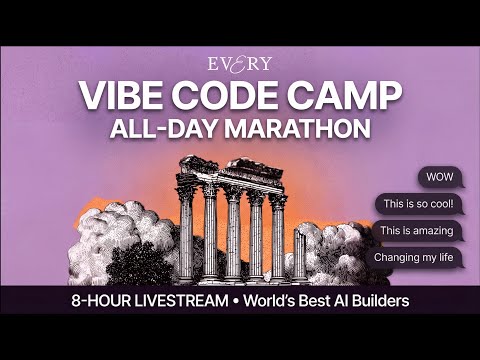
Vibe Code Camp: Live Marathon With the World's Best AI…
An 8-hour live marathon in which experienced AI-native builders demonstrate real-time workflows using tools such as Claude Code, Figma, Notion, and Google AI Studio. Sessions include agent-native editing, running autonomous agent fleets, using Claude as a writing partner, building apps without prior iOS experience, MCP integrations, malleable software, compound engineering workflows, and accelerating research and learning tasks with AI. Includes a public transcript on GitHub.
# Channel Identity Observations — "Vibe Code Camp: Live Marathon With the World's Best AI Builders"
## Explicit Self-Description (Creator Claims)
### Channel identity: "Every"
- The host introduces himself as **Dan Shipper, "co-founder and CEO of Every"**, and frames the entire event as an Every production:
> "I'm Dan Shipper. I'm the co-founder and CEO of Every. I will be demoing first."
- Repeated tagline claim:
> "Every is the only subscription you need to stay at the edge of AI."
- Claimed scope is a **three-part bundle**:
- **Ideas**: "we have a daily newsletter. We cover every new model and every new product when it comes out... a hands-on vibe check from us on what's good and what's not."
- **Apps**: "an app called Kora... Monologue... Spiral... Sparkle" — "tools that we built for ourselves."
- **Training**: "we do camps and courses... usually these are paid; today... we're doing this for free for everybody."
- Pricing/offer claims stated on stream: **"$30 a month"**, **"30-day free trial"**.
### Event framing claims
- Claims about scale and exclusivity of the guest lineup:
> "we watch the best Vibe coders in the world do their thing."
> "All the top vibe coders in the world are coming up."
- Audience-scale claim late in the stream:
> "We have about 15,000 people on here right now."
- Company-scale claims:
> "our consulting business... is a seven-figure business working with some of the top hedge funds and PE firms and Fortune 500 companies."
## Observable Presentation Evidence (Demonstrated Patterns)
### Demonstrated audience
- The stream consistently addresses **both technical and non-technical AI builders**:
- Direct appeal to non-technical viewers via Ben Tossel's segment: "how he's shipping lots and lots of software even as a non-technical person."
- Direct appeal to working professionals: "maybe also while you're here... fire up some cloud code instances and some codeex instances and start making some stuff."
- Recurring in-jokes and vocabulary (Ralph loops, compound engineering, agent-native, Opus 4.5, Codex 5.2) that presume an AI-builder-enthusiast audience.
- A **marketing/conversion intent** is observable: Every's subscription pitch is repeated verbatim at least 5–6 times across the eight hours, always ending with a URL ("every.to").
### Demonstrated scope
- **Internal product GMs presented**: Kieran Klassen (Kora), Naveen (Monologue), Yash (Sparkle), plus internal consulting staff (Natalia, Nateesh, Katie Parrott, Brooker) — demonstrating the company actually operates the "ideas, apps, training" structure it claims.
- **External guests demonstrated**: Ben Tossel (Ben's Bites/Factory), Ash McGillis, Ryan Carson, Nat Eliason, Tina He, Paula Doña (Portola), CJ (10X), Logan and Amar (Google), Jeffrey Lit (Notion), Kevin Rose, Tariq (Anthropic) — consistent with the "world's best AI builders" scope claim.
- **Live workflow demos as the core format**: Dan's "Proof" markdown editor demo, Brooker's Streamlit finance dashboards, Yash's Sparkle teardowns — the channel demonstrates rather than just describes its builders' workflows.
### Demonstrated editorial voice
- Casual, hype-forward, community-oriented tone: "We're doing it live, folks," running gags about hydration ("this podcast is brought to you by hydration"), live-demo failures embraced rather than hidden.
- Educational positioning demonstrated through repeated signposting: "if you're just getting here, welcome... this is Vibe Code Camp," agenda URL recitations, and a stated follow-up plan to convert the stream into guides ("We're going to turn a lot of the content into guides on the Every website").
## Audience and Scope Summary
| Dimension | Evidence Type | Finding |
|---|---|---|
| **Primary audience** | Observed | AI-curious builders, technical and non-technical; every-product users and prospects |
| **Claimed scope** | Stated | AI media + software + training subscription ("ideas, apps, and training") |
| **Demonstrated scope** | Observed | Matches: newsletter/camps referenced, four shipped apps demoed by their GMs, live training content delivered |
| **Tone/positioning** | Observed | Insider, enthusiast, live-demo culture; strong conversion push to paid subscription |
**Note**: All company performance figures (15,000 viewers, seven-figure consulting business, subscription pricing) are creator claims delivered on-stream, not independently verified by the material.
# Delivery Observation Document: "Vibe Code Camp" Live Marathon
## Overall Format
- **Eight-hour live-streamed marathon** hosted primarily by Dan Shipper (Every co-founder/CEO), with rotating guest segments and occasional hand-offs to co-hosts (Kieran Klaassen, Brandon Gell, Austin).
- Delivery is **conversational and improvisational**, not scripted — speakers repeatedly acknowledge live-demo risk:
- > "This is a live demo, so it may uh it may mess up."
- > "Live demos, folks. Live demos."
- > "We're doing it live, folks. We're doing it live. That's the only way."
## Tone
- **Enthusiastic and superlative-heavy.** Dan consistently uses intensifiers when introducing guests and products:
- > "This is a a stacked lineup. Uh this is going to be a crazy crazy day."
- > "she's amazing," "He's awesome," "the one and only Katie Parrot"
- > "It's like a an incredible incredible agenda."
- **Candid and self-deprecating** moments break up the promotional tone:
- > "I have absolutely no idea how any of the code works. We're living in we're living in crazy times."
- Kevin Rose: > "my speed and efficiency was just [ __ ]."
## Recurring Phrases & Verbal Habits
- **Filler-heavy speech**: "um," "uh," "you know," "like," and repeated word-stutters ("really really cool," "so so excited") appear throughout, especially from Dan.
- **Recurring framing phrases** (Dan, stable across the whole stream):
- > "Every is the only subscription you need to stay at the edge of AI."
- > "ideas, apps, and training"
- > "You heard it here first, folks."
- > "We're living in the future, folks."
- **Guests adopt shared vocabulary**, suggesting an emerging community lexicon: "vibe coding," "oneshot/one-shotting," "Ralph loop," "compound engineering," "agent native," "unhobble the model," "race to the top."
## Teaching / Demo Habits
- **Explain-then-demo structure**: Nearly every guest gives a background intro, then screen-shares. Dan models this explicitly:
- > "So first I want to just introduce you to every then we'll go through the agenda and then I'm going to demo some some cool stuff."
- **Read-back confirmation**: A recurring teaching move is restating what a guest just said to check understanding:
- > "So just to like say that back to you. So this is a file that lives in your system..."
- > "So to recap, if you're just kind of like paying attention..."
- **Direct-to-audience asides**: Dan frequently addresses viewers as learners:
- > "If you are here and you don't know what every is..." (repeated verbatim-style multiple times)
- > "Please drink water... remember to hydrate."
- **Interactive audience cues**: References to chat questions, e.g., > "There's a question in the chat which I I have to actually..." and > "I see my good friend Ben from Ben's Bites is here."
## Communication Patterns
- **Repetitive sponsorship segments**: Dan delivers nearly identical Every promotional scripts at each segment transition — evidence of a deliberate recapping structure ("ideas, apps, and training... $30 a month... 30-day free trial") repeated at least five times with minor variation.
- **Interruption and repair**: Speaker hand-offs and audio issues are common and handled with quick repairs:
- > "Uh, we're kind of losing you right now... Maybe you can hop on your hotspot."
- > "You're muted, Dan."
- **Naming/credential-dropping** is a consistent introduction device: guests are introduced with company affiliations and personal endorsements ("my good friend," "the one and only").
- **Humor as a delivery tool**, especially self-aware jokes about the medium:
- > "This podcast is brought to you by hydration."
- > "AI can't fix this." (during a Wi-Fi outage)
- > "the CLI is the stone age from two months ago"
## Stable Patterns vs. Isolated Moments
- **Stable**: filler speech, superlative guest intros, the Every promo script, read-back questioning, live-demo hedging.
- **Isolated / thin evidence**: A single discussion thread about "pain threshold" as a vibe-coding requirement (Ben Tossell and Ash) recurred once more via Dan's joke (> "everyone's just talking about loving pain"), but this is a two-instance motif, not an established pattern. Likewise, throat-clearing/snort annotations appear sporadically across several speakers but are too sparse to generalize.
## Uncertainty Notes
- Tone observations are drawn from transcript text only; vocal tone, pacing, and visual delivery cannot be verified from this source.
- Speaker attribution is occasionally ambiguous where `>>` markers are sparse (e.g., mid-segment exchanges), so a few short quotes' attribution rests on conversational context rather than explicit markers.
# Vibe Code Camp: Position & Claim Record
## Event Overview
- **Event**: Vibe Code Camp — all-day live marathon (8+ hours)
- **Host**: Dan Shipper, co-founder/CEO of Every
- **Format**: Sequential demos/interviews with builders using AI coding tools
---
## Dan Shipper (Every)
### On Every's business model
- Three pillars: **ideas** (newsletter/vibe checks), **apps** (Kora, Monologue, Spiral, Sparkle), **training** (camps/courses)
- Subscription: $30/month, 30-day free trial
### On his app "Proof"
- Agent-native markdown editor built in <2 weeks, "in between meetings"
- Claims it "should have taken a group of three engineers like six months"
- States: "I have absolutely no idea how any of the code works"
- Key features: human/AI attribution tracking, agent presence, agent-following
### On agent-native architecture
- Core principle of **PAR**: "Whatever the user can do through the UI, the agent should be able to do"
- **Granularity**: tools should be smaller than features so agents can combine them unpredictably
- Argues this enables emergent functionality not explicitly coded (e.g., clearing comments without building that feature)
### On slop/craft
- Questions whether code quality matters if the output works well
- Suggests "the bar is changing for what craft looks like" — shifting from lines of code to output quality
- Wants conventions for human "vouching" on AI work
---
## Ben Tossell (Ben's Bites / Factory/Droid)
### On non-technical vibe coding
- "I can't code still — have tried and just couldn't never get it to work"
- Built MakerPad (no-code, sold to Zapier), now ships production software via Droid
- Claims to have pushed code to Factory's actual codebase
### On pain threshold
- "It's always a me problem and I know that because I can't code"
- "Your job is to figure out how you can guide the agent in the best way"
- Argues frustration loops are inherent: "professional developers hit issues all the time"
### On learning method
- Learns by "poking around other people's code, reverse engineering it, going through a session, doing dumb stuff"
- Uses session sharing as a teaching tool
- Switches between Opus 4.5 and GPT 5.2/Codex mid-session for review/implementation
### On no-code vs. AI
- "I mistakenly thought anyone could build with no code... it was actually only people who had a certain threshold of pain"
- "Right message, wrong timing" — AI is what he actually meant by democratization
### On Droid's superiority
- Claims multimodal switching, superior compaction, less handholding needed
---
## Ash (Hearth/relational intelligence)
### On agent architecture
- Runs custom-rolled agents (not just one tool), connected via Slack/email/text
- Different agents with different context windows and focus areas
- Uses OpenAI tool calling for simpler tasks
### On network visualization
- "I don't think anyone does this well" (2D network viz)
- LLMs are "really not great at generating network visualizations"
- Prefers co-occurrence networks; wants 3D eventually
### On video authenticity
- "There's an authenticity element to [video]. When you see me recording, I'm stuttering."
- For 2026: interested in video as authentic human connection vs. AI slop
### On workflow philosophy
- Keeps contribution graphs tied to goals via agents
- "You got to love pain" (re: cold showers, building)
---
## Ryan Carson (Untangle, ex-AMP)
### On "Compound Product"
- Open-source loop: cron job → data report → analysis → PRD → atomic tasks → Ralph loop → PR
- "I shouldn't have to wake up and decide what got built overnight. I should wake up to a PR."
### On Opus 4.5 capability
- "The model is good enough now to complete any well-defined user story with clear acceptance criteria as long as it's atomic"
### On bash scripts
- "I don't write any bash. I don't know the syntax. AMP is doing all my bash scripts."
- Value: "you don't run into context limits" with bash loops
### On anxiety
- "I have massive FOMO all the time now because I don't have three instances of AMP running 24/7"
- "I thought AGI would make my life calm but it's made it very stressful"
- "If you're a founder or builder, you should be really nervous all the time now"
### On Untangle (divorce product)
- Built because sisters got divorced; "I hope nobody ever needs my product"
---
## Natalia & Nateesh (Every consulting)
### On PPTX plugin
- Nateesh vibe-coded a Claude Code skill that generates Every-branded presentations
- Deck generated in "under 15 minutes all the way from idea"
- 600-line style guide took majority of development time
- Natalia: reduces deck creation from "few days to a week" to "a few hours"
- Not yet public; consulting team works with hedge funds, PE firms, Fortune 500
---
## Katie Parrott (Every editorial)
### On AI editor project
- Failed building backend in 2024 Think Week; retrying with Claude desktop app
- "I'm a baby vibe coder"
- Uses "explain like I'm five" to level up understanding
- Dream: "one app to rule them all" for editorial with visibility into AI accept/reject decisions
### On burnout
- "I am treating this like a video game and letting myself get burnt out"
- Counterbalances with analog activities (Bible study, board games)
- Austin (host): "I have no good answer for it"
---
## Nat Eliason (Tegan/content agent)
### On Mac Mini + Claudebot
- Bought separate Mac Mini for 24/7 Claudebot
- "Sending it requests in bed at 10pm... wake up and I've got a whole new feature built"
- Has two $200/month Claude subscriptions
### On conductor vs. terminal
- "This is just better than working in terminal. I can't think of any reason you'd want to be in terminal besides to look cool in a coffee shop"
- Uses git worktrees via conductor for parallel work
### On orchestration
- Opus as "engineering manager" controlling Codex subagents
- Codeex better at coding; Opus better at general intelligence/orchestration
- Saves Claude credits by delegating coding to Codex
### On self-reinvention
- "I wouldn't actually recommend it as a career path... most of the time if you're this non-committal it doesn't go well"
- Now "all in" on Tegan, putting everything else on hold
---
## Tina He (Pace Capital)
### On vibe coding philosophy
- "It's actually more about the vibe than the coding"
- "If you are having fun building what you want to build, that's actually the most important motivation"
- Best ideas come "from a joke or using software I didn't want to pay for"
### On her "future of work" OS app
- Vintage macOS-styled web app with customizable mini-apps
- Built with Next.js; used Context7 MCP for tool discovery
- "Tokens don't lie" — Context7 shows actual usage patterns
### On lowering cost of joy
- "The cost is literally lower than buying someone a cup of coffee... to bring a smile on their face"
- Sees app-building as "a new way of self-expression and socializing"
---
## Paula (Portola/Tolen)
### On production vibe coding
- Challenges "vibe coding is only for prototypes"
- "We've been using Claude in production features for a couple months now"
- Features built: shop system, planet customization — both requiring iOS/Unity integration
### On animation quality
- Token celebration animation built in 5 minutes via single prompt
- "It did a better job than what was even prototyped in the Figma file"
- "These LLMs can build nice UI. You just have to know how to prompt them"
### On Claude setup
- 13 skills encoded as markdown; hooks as guardrails; MCPs (GitHub, Linear, Sentry, Figma, PostHog)
- Designers without coding experience are opening iOS/backend PRs
- "Treat Claude as an intern that just learns very quickly"
- Setup owned by one champion (Dan Federman) on small team
### On speed
- "Three to five days we ship to the app store"
- Company moves fast; designs are "suggestions rather than exact"
---
## CJ (10X)
### On story-point model
- "We get paid by story point as engineers... as tools get better, our capacity can expand"
- Inverts hourly incentive: faster output = more money
### On monorepos
- "I'm big on monorepos... you can build the whole data flow" without cross-team coordination bottlenecks
### On Flowey (visual planning tool)
- Weekend Ralph-loop project; JSON-based flowcharts/mockups in IDE
- "Something about seeing it like this as opposed to ASCII just makes me so much more confident"
- Anti-MCP for this use case: "skills and CLIs are often just as capable and give you way less context bloat"
### On debugging live
- When quiz app failed: gave error to Claude, pointed back to plans, asked it to explain in chat before coding
- "Claude is historically eager... giving it that prompt without [constraints], it'd probably start writing a bunch of code"
### On Ralph loops in production
- "If it's some production system, I'd be terrified of Ralph. I feel like I lose a lot of that human-in-the-loop control."
---
## Omar & Logan (Google AI Studio)
### On AI Studio positioning
- Not trying to be a full IDE; targeting "casual builders" and newcomers
- Forthcoming version powered by anti-gravity coding agent
- Goal: "compress the gap between professional developer and average person"
### On tool calling
- Logan: "Tool calling is the basket of fruit that bears all the gifts"
- Long-running tool calling over extended tasks is "the holy grail"
### On slop
- Omar: "Slop is lazy... you didn't refine it and actually make it great"
- Logan: Slop is "what's most in distribution for the model... the default behavior"
- Omar: "The slop era is honestly behind us. If you have taste, you can make the thing."
### On their workflow shift
- "The beginning of this year we've barely been in Figma" — prototyping directly in AI Studio
- Multiplayer FigJam clone demo: "one shot from a screenshot of the Fig Jam website"
---
## Jeffrey Lih (Notion)
### On malleable software
- Core interest: "how do we get more people playing with the material of software"
- Renting vs. owning analogy: ownership = more local agency
- Hypothesis: "The IDE of the future starts out looking like a document editor"
- Spreadsheets as inspiration: "accidental snowball" from writing numbers to running businesses
### On kanban-driven coding
- Uses Notion as kanban board for Claude Code tasks
- Agents raise hand (turn card red) when they need human input
- Voice notes → Notion AI → structured task board
### on understanding AI code
- "It's important as a human to still understand what's going on... knowing how it works helps you have better ideas"
- Practice: refuses to send PR unless he can pass a quiz on its contents
- Explanations "never start with a code diff — they start really zoomed out"
### On CLI vs GUI
- "A CLI is a mediocre GUI and a mediocre API. The fact that it's both is what's great."
- Predicts new era of GUIs with composability
---
## Kevin Rose (True Ventures)
### On discovering compound engineering
- Learned about plugin via deep wiki → NotebookLM → 15-min AI podcast at 2x speed
- Manual process before plugin: two Cursor panes (Opus + GPT-5), passing code between them as "friend review"
- Claims plugin took code quality from ~80% to ~97%, eliminated model-switching overhead
### On planning like a senior engineer
- "If you plan like a senior engineer, it almost has to call those engineers to the table"
- Rants 10-20 minutes via voice into deep-thinking mode; gets back structured document
### On aphantasia
- Recently discovered he has it; explains why he couldn't memorize syntax like peers
- Dropped out of CS; went product/design route; now "can kind of do it all"
---
## Kieran Klaassen (Every/Kora)
### On compound engineering philosophy
- "This is just the obvious because this is how we built software forever"
- "For some reason when we started AI coding, we just forgot to plan"
- Compound step extracts learnings into markdown docs with frontmatter, retrieved via agentic search (Haiku for speed)
### On context management
- "I'm pretty lazy. I just think that's not my job. I think Anthropic should figure that out."
### On /LFG command
- New: runs entire flow (plan → work → review → compound) in a loop
- "With Opus 4.5, we're at a point where you can do end-to-end flows"
- Enables Mac Mini 24/7 building
### On DHH reviewer
- Included DHH persona as code reviewer; DHH himself approved: "That's actually something I would have said"
- "Sometimes the DHH reviewer has a point and it makes you think... you want opposites"
---
## Tariq (Anthropic/Claude Code)
### On Claude Code's moment
- "Everyone talks about startup within a startup... Claude Code is truly that"
- Credits Boris as "true founder within Anthropic" with ability to run with it
- Combination of excellent research org + product org "made it inevitable"
### On unhobling the model
- Anthropic term: giving models more capability space to act
- Must "believe the model will get better and better" — else you build complicated orchestration you'll have to delete
### On deleting code
- "The next model comes out and you have to delete the code. Most people get stuck at deleting the code."
- Preview: replacing to-dos with **tasks** — persistent across sessions, multi-agent, graph dependencies
- "If Claude is writing 10x as much code, it can also delete 10x as much code"
### On moats
- "Anyone can copy a single point... but they can't copy the vector — the direction you're going in"
- Learnings in what was thrown out are hard to clone
### On feedback
- No QA team; engineers are the support team; reads GitHub tickets directly
- "There's no replacement for talking directly to a user"
- Cautions against over-abstraction: "If you get too abstracted from the feel... that can be hard to understand the meta pattern"
### On long-running tasks
- "The question is: is it producing economically viable output?"
- Spec mode helps but "I'm still putting in a lot of work. I'm not just telling Claude to go do something."
---
## Naveen (Every/Monologue)
### On building Monologue
- Solo builder; app processes 1.5M words/day
- Two users crossed 1 million words; some use 300 times/day
- He is the #80 user of his own product
### On Codex vs. Claude Code
- Codex: "that one senior engineer" — better for large codebase bugs, precise edits, Swift/iOS/Mac
- Claude Code: better for creative vibe coding, prototyping
### On feature development speed
- Notes feature: vibe-coded in one hour, shared internally, iterated from feedback
- "Implementing features is not really that important. It's knowing what to implement."
### On future
- Crazy idea: hardware product (parked for now)
- Near-term: modes that auto-learn from user edits post-transcription
- Not competing with Granola: "Monologue is for people with less than five meetings per week or stream-of-thought capture on the go"
---
## Yash (Every/Sparkle)
### On reverse engineering apps
- "I steal but I don't steal code... I outsource my R&D"
- Uses teardown method (inspired by Kevin Shen's Rewind teardown) on Mac apps
- "Every app on your Mac is a book and you can open it and start reading it"
- Saved 3 days of dev work on duplicate detection by studying another app's package choice
### On reading every line
- "I read every line of code... What if there's the TikTok-ification of code — swiping up. That's wrong."
- Reason: "I was unfamiliar with my codebase... I need to know exactly what's happening"
- Naveen reportedly also reads every line
### On Sparkle philosophy
- Inspired by Marie Kondo: "70% of organization is throwing away things you don't need"
- Had 7,000 screenshots; now auto-removes
### On agent watch
- Built during Think Week; status-bar app showing running agents
- Enables flow state: "I'm not on YouTube or Instagram. I'm just in this zone."
---
## Brooker (Every consulting/finance)
### On Claude Code as research agent
- Creates interactive Streamlit dashboards for earnings previews via slash command + MCP (Dafa)
- "This work for an earnings preview is like five hours of work... now 20 minutes"
- Stores prompts as version-controlled skills in GitHub
- "LLMs are just very consensus in the way they look at ideas" — encodes contrarian investing principles into skills
### On compute gap
- Web interfaces give "20-30 minutes of compute"; terminal/Claude Code offers significantly more
- "That's why Claude Code is getting so much attention — this gap is so massive"
---
## Cross-Cutting Tensions
### Reading code vs. not
- **Yash/Naveen**: Read every line; unfamiliarity with codebase is unacceptable
- **Dan/Kieran/Kevin Rose**: Don't read code; output quality and process discipline matter more
- **Jeffrey**: Middle ground — must understand via explanations/quizzes, not necessarily diffs
### Terminal vs. GUI
- **Nat**: "Terminal is stone age from two months ago"
- **Tariq**: Terminal keyboard-first is "a high watermark to beat" but building multiple UIs
- **Dan**: Detects shift back to GUIs; CLIs were loved because they're easy to make agent-native
### Autonomy level
- **Ryan Carson**: Full autonomous compound product loop, wake to PRs
- **CJ**: "Terrified of Ralph on production systems; lose human-in-the-loop control"
- **Tariq**: Question is "economically viable output" and how much ambiguity you must reduce first
### Vibe coding legitimacy
- Multiple speakers (Paula, Kevin Rose, Kieran) argue vibe coding has crossed into "real coding"
- Ben: "It's really just engineering on one end of the spectrum — giving instructions to an agent"
- Dan: "Vibe coding gets a bad rap much like no-code did"
# Speaker Attribution & Provenance Record
**Video:** Vibe Code Camp: Live Marathon With the World's Best AI Builders
**Video ID:** `01a0f15a-b0f6-7ffc-a4db-754dad5a6ad0`
## Primary Speaker / Host
- **Dan Shipper** — Creator/host of the stream; introduces himself as **co-founder and CEO of Every**. Serves as primary interviewer, demos his own apps (**Proof**, an agent-native markdown editor; **Anecdote**, a health app), and delivers recurring **promotional segments for Every's subscription** (ideas, apps, training; every.to).
## Co-Hosts / Producers
- **Kieran Klaassen** (transcript spells "Kieran Classen") — **GM of Kora at Every**; co-hosts the Kevin Rose segment and the Anthropic segment; identified as creator of the **compound engineering plugin**.
- **Austin** — Identified by Dan as Every's **producer and head of growth**; hosts internal-Every segments and closes the stream.
- **Brandon Gell** — Identified as **COO at Every**; hosts the CJ (10x) segment and later segments (Naveen, Yash); also pitches Every's subscription.
## Guests (in order of appearance)
| Name | Stated Role / Affiliation |
|---|---|
| Ben Tossell | Founder of Ben's Bites; former MakerPad founder (sold to Zapier); works at Factory on the "Droid" agent; investor in Factory |
| Ash McGallas | Former founder of Hearth AI; "exploring what's next"; engineer/builder background |
| Ryan Carson | Formerly at AMP ("builder in residence"); founder of Untangle (AI divorce product) |
| Natalia (Cano) | Runs consulting at Every |
| Nateesh (Natash) | Applied AI engineer, Every consulting |
| Katie Parrot | Staff writer and AI editorial lead at Every; column "Working Overtime" |
| Nat Eliason | Author; former Every crypto columnist (Almanac); former Growth Machine agency founder; demoing "Tegan" (hiretegan.com) |
| Tina He | Pace Capital (introduced as former VC); writer; ex-Coinbase/Base developer tools lead |
| Paula (Doa) | iOS engineer at Portola (Tolen app); ex-Spotify |
| CJ | Engineer at 10x (AI consulting firm run by Alex Lieberman) |
| Omar/Amar | Leads product and design, Google AI Studio team |
| Logan | Google DeepMind — AI Studio, Gemini API, developer products |
| Jeffrey Lit | Design engineer at Notion; formerly at Ink & Switch |
| Kevin Rose | True Ventures (introduced by Dan); interviewed by Kieran |
| Tariq ("Thoric", Twitter: trq212) | Anthropic — works on Claude Code; created the "ask user question" tool |
| Naveen | GM of Monologue at Every; solo builder of the Mac/iOS app |
| Yash | GM of Sparkle at Every (calling in from Bocas del Toro, Panama, at an Every offsite) |
| Brooker (Belort) | Every consulting; hedge fund/fintech background; formerly ran finance vertical at Perplexity |
## Announced-but-Not-Speaking Guests
Listed in Dan's agenda rundown but **not confirmed as speaking in this transcript**: Katie Parrot's segment appears (she speaks); the following were named in the agenda but not all appear with their own segments: Ben Tossell (appears), Ash (appears), Ryan Carson (appears). No segment from other agenda names beyond those listed above.
## Promotional Segments (Flagged)
- Recurring **Every subscription pitches** by Dan Shipper (multiple times throughout, roughly hourly) and by Brandon Gell — promoting newsletter, apps (Kora, Monologue, Spiral, Sparkle), trainings/camps, $30/month, 30-day free trial.
- **AMP promotion** by Ryan Carson — describes AMP as a direct Claude Code competitor, touts its ad-supported free tokens, and states he will keep using it.
- **Factory/Droid promotion** by Ben Tossell — "I recommend that agent over any others"; explicitly notes he works there.
- **Nat Eliason** promotes Tegan (hiretegan.com) with a coupon code "every" and mentions his new book (*The Birth of Paradise*).
- **Paula** pitches Portola hiring at end of segment.
- **Naveen/Brandon** promote Monologue (monologue.to, iOS launch ~Feb 9), Every Discord access, and Sparkle's upcoming March launch.
- **Brooker** mentions publishing trades via "Autopilot" (Pelosi tracker creators) and Perplexity Finance.
- **Google AI Studio** demos constitute product showcases of Google's own tools (AI Studio, forthcoming features), presented by Google employees.
- Dan's product demos (**Proof**, **Anecdote**) are Every/own-product showcases.
## Referenced Third-Party Sources & Claims
- **Tools/platforms referenced:** Claude Code, Codex, Cursor, Warp, Conductor, AMP, Factory Droid, Vercel (v0, agent browser, Context7), Remotion, Lovable, Bolt, Wubby, Figma (incl. MCP), Replit, GitHub, Linear, Sentry, PostHog, Datadog, Supabase, Bubble, Notion, Perplexity Finance, Dupa MCP, Fiscal AI, Streamlit, NotebookLM, DeepWiki (Devon), Ralph loop (attributed to Jeff Hume / "Geoff Hunt" per speakers), ClaudeBot, Gemini/"nano banana", Opus 4.5, GPT 5.2, Mac Mini setups.
- **Third-party claims** (restated by speakers, not independently verified in this stream): Ryan Carson quoting "Toby from Shopify" on "team of one"; Kevin Rose citing DHH review feedback and Linus Torvalds using AI for commits; Naveen citing usage stats (P50 ~48 words, P90 400–500 words, ~1.5M words/day, two users past one million words); Paula citing "hundreds of thousands of users" for Tolen; Amar citing "double digit percentage points of all Googlers" using AI Studio; Yash citing a Kevin Shen 2022 blog post on reverse-engineering Rewind; Brooker citing compute-time gap between web UIs (~20–30 min) and terminal agents.
- **Live-demo incidents recorded:** Tina He's app hit an Anthropic API credit limit mid-demo; Yash hit a Claude Code error mid-demo (attributed to service downtime); CJ's quiz app hit a navigation bug fixed live.
## Comment / Audience Availability
- A **live chat is active** during the stream (hosts read out user questions, e.g., from users "Outside," "Courtney," "Henry Finkelestein," "D3M7W," "Planted Starburst 6481"); viewership cited by Dan as "about 15,000 people" and later "16,000." Post-publication comment availability is **not stated** in the transcript.
- Full stream stated to be republished on YouTube and as guides on Every's site after the event (per Austin's close).
## Uncertainty Notes
- Speaker name spellings vary in the transcript (e.g., "Kieran Classen/Klaassen," "Tariq/Thoric," "Nateesh/Natash/Natasha," "Natalia/Natalyia," "Paula Doa"); names are recorded as spoken with alternate spellings noted.
- Brooker's surname given as "Belort" in Dan's agenda description only.
- No curated metadata beyond the title was supplied; all role attributions above derive solely from the transcript.
Hello everybody. I was just muted uh but I'm here now. Hope you can hear me. \>\> Please let me know if uh if you can indeed hear me. \[music\] Uh so excited to
have you here. Welcome to Vibe Code Camp. Um this is an all day marathon where we watch the best Vibe coders in the world do their thing. I'm Dan Shipper. I'm the co-founder and CEO of Every. I will be demoing first. Um, and uh, if you're here, if you're watching, we're going to be here all day. It's eight hours of streaming. \[music\] Um, there's going to be a lot of really amazing stuff. So, please stay tuned. We have an agenda. If you want to see what's coming up, go to every.TOgenda. Um, and uh, and follow along. Maybe also while you're here, if you're here, uh, fire up some cloud code instances and some codeex instances and start making some stuff. Um, please share in the chat. Uh hopefully this is one of those things where as you're going through your day today, you can just tune in and out and just be working on stuff and also hanging out with us watching the best live coders in live vibe coders in the world do their thing. So first I want to just introduce you to every then we'll go through the agenda and then I'm going to demo some some cool stuff. I've been building some really cool stuff. So I'm going to start with my workflow. Uh what is every? If you're here hopefully you know what every is. If you don't know now you know. Every is the only subscription you need to stay at the edge of AI. Uh it's every.TO. You should go there and subscribe. For paid subscribers, we do three things. We have uh three parts of the business, ideas, apps, and training. On the ideas side, we have a daily newsletter. Uh we cover every new model and every new product when it comes out. So on the day it's released, you have a hands-on vibe check from us on what's good and what's not. We also do long form essays on how we use uh AI in our work and in our lives.
So if you're want to keep up, if you want to stay at the edge, every uh the ideas part of every will keep you there. Um we also have a suite of apps that we build for ourselves to help us work
better with AI. So we have uh an app called Kora, which is an AI email assistant. We have an app called Monologue, which is a smart dictation app sort of like Super Whisper, Whisper Flow. We have Spiral, which is a AI ghostwriter with taste. And we also have Sparkle, which is an AI file organizer. If you are uh someone who wants to stay at the edge uh we build these tools for ourselves and uh it all they all come with one under one subscription under the every subscription. The last thing that we do is we do training. So we have camps and courses camps like this one. Usually these are paid this today because it's such a big marathon we're doing this for free for everybody but tomorrow for example we have a camp with uh all the internal every team talking about how we build agent native software inside of every. So, if you're interested, if any of this piques your interest, uh, check out every uh, and get ideas, apps, and training all for one subscription to stay at the edge of AI. All right, let's talk through the agenda. So, I'm going to pull that up. Uh, if you want to look at the agenda yourself at any time during the day to see where we are, go to every.toaggenda. And, um, let me just pull this up for you guys. Hopefully, you can see this. Um, okay. This is a this is a stacked lineup. Uh this is going to be a crazy crazy day. So uh to start, I'm I'm gonna demo some stuff for you. Uh I'm Dan Shippers, co-founder, CEO of every I'm going to talk about a few apps I've been building, a few agent native apps I've been building that I'm really excited about. Then we're going to have my friend Ben Tossel from Ben's Bites. Um Ben is an incredible uh incredible person, incredibly smart, and definitely at the edge. He's working at Droid right now in addition to being part of Benites. He's going to show us that how he's shipping lots and lots of software even as a non-technical person. Then we're going to have my friend Ash from Hearth. Uh she's going to come on. She's
she's amazing. She's going to show us how she is building Chrome extensions to work on X. Then we've got Ryan Carson who was until recently at AMP um and now
he is building his own company. So he's going to demo Ralph Wiggum for us. He's he's awesome. Uh so that's going to be the morning the morning block. a lot of really really cool people. Then around lunchtime, we're going to have a bunch of internal Every demos. So, we're going to have Natalia and Nateesh from EveryY who uh work on our consulting side. We work with a lot of big companies helping them to implement AI in their work and in their lives. Um Austin, are you seeing this? I just want to make sure you you guys are all seeing the uh the slideshow. Austin, you are. \>\> You're good. Okay, cool. So, sorry, continue. Just uh just wanted to make sure we're all on the same page. So, uh we've got internal every demos from Natalia and Nateesh. They work on our consulting business. Um and they're going to show they have really seriously totally changed how they use how they how they run our consulting business, which is a seven-figure business working with some of the top hedge funds and PE firms and Fortune 500 companies in the world. And it's like completely just it's mostly just cloud code at this point doing stuff. And so they're going to demo how they did that and and and how they're operationalizing cloud code inside the consulting business. Then we've got Katie Parrot, the one and only Katie Parrot, who is one of our lead writers, and she's going to uh show us how she's using Claude the Cloud Code desktop app. Um uh and using Cloud Code in her editorial writing workflow. Uh then, uh at 12:30, we're going to have my good friend Nat Elias, who hopefully you all know. If you don't, you should know him. He's awesome. Uh he's a writer, he's an author, he's also a course guy, he's done a lot of really really cool courses over the years, some on coding with AI. Back in the day, he
did a Rome research course. Um uh he's he's a best-selling author and he also used to run a marketing agency. He's amazing. He's been doing a ton of like really really cool interesting stuff uh
with Claude uh multi- aent. So he's going to come on and talk about that. Then we've got Tina He from Pace Capital. Tina is awesome. um she's going to talk about vibe coding as a creative practice. You should check her out. Then we've got Paula from Portola. Um Paula is amazing. Uh she, if you haven't read it recently, she just published a case study that she wrote with OpenAI where they've uh she works at Portulla. Uh they do uh they make a little alien character that has like 200,000 monthly active users. That's all all AI. So, she's going to talk about um how she does iOS dev with Claude. Um she just published a big case study on it. went super viral. She's awesome. Uh after that, we're going to have CJ Hess from 10X. If you have heard of 10X, they're one of the top AI consulting companies, uh run by Alex Lieberman. So, he's going to talk about uh Figma and a basically a a Figma-like flow flowchart and UI tool he's built. So, that's really awesome. Then, as we get further into the afternoon, we've got some really really amazing people coming up. We've got Logan, Logan, and Amar from Google. Um, so they're going to talk about all of the stuff they're doing inside of Google AI Studios and show us some demos of how they're building things. Then we've got Jeffrey Lit from Notion. He's going to demo some amazing uh stuff workflows that he's been building using Notion as a cambban board for Cloud Code. Then we've got uh Kevin Rose uh the one and only Kevin Rose from True Ventures and he is going to be
interviewed by the one and only Kieran Classen who is the GM of Kora at every and they're going to talk about compound engineering. That's going to be a big big discussion. It's going to be so fun. You should definitely be there. Um then
we've got Tariq from Anthropic uh and he's going to talk about uh inside cloud code. So he literally works on cloud code and he's going to talk about how cloud code works, how they how they're building it and then he's going to do some demos of of things that he's building and his workflow. Then we've got Naveen who's the GM of Monologue and he is going he's Naveen is awesome. He's building Monologue which is uh an internal every product that is run by just him and it's competing with companies that have like 30 or 50 employees. It's really amazing and it's all because of a he's so smart but also his workflow is really incredible. So, he's going to talk about how he's building um an iOS app um and all the stuff he's learned about building an iOS for mon for monologue. Then we've got Yash, also amazing. He's a GM of Sparkle. Um and Sparkle is our AI file organizer and so he's going to talk about building a file organ organizing app. Um, and then we've got uh lastly Brooker Belort from Every, who is one of the other people on our consulting side, and he's he's basically built like a whole uh vibecoded hedge fund skill that does trading for him. Um, and it's like actually really really good. So, he's gonna I think he's going to talk about that and talk about the intersection of vibe coding and consulting. So, we've got a an incredible incredible agenda. Um, I am about I'm going to do a demo. I'm going to start demoing you my workflow. Before I do that, I'm just going to check in with my producers and make sure all of this is all set up. This is the first time that we've done this. We've got a lot of people on the stream and I'm super excited for this. But I'm going to uh be back in about 30 seconds. So just give me give me
\>\> \[sighs\] \>\> All right, I am back and I'm going to start some demos. So, the thing I want to uh demo here's here's my agenda for
today. Um hopefully you can see the agenda. Can you uh you cannot see it. Um so, here's my agenda for today. And uh it's I wrote wrote it in a markdown file. Uh here's here's the overall run of show. Um, the cool thing is that I'm showing you my agenda in an app that I built. Uh, this is an app called Proof. It's an agent native markdown editor. Um, basically it's a markdown editor that is built to be used by humans and by agents together. Uh, I I built this for myself. I really needed it for all of the stuff that I'm doing. Like when you build a plan in cloud code or in codeex, like I just don't want to watch that like Xcode thing bounce. Um, and so I really needed like a really simple markdown editor that had a couple of features that u made it useful for both humans and agents to collaborate together on plans. But then I realized there's a lot of other places that we can use it around every. So I'm going to I'm going to talk about that. But I want to give you a little bit of a tour of proof and then um I'm going to and then I have a bunch of stuff that I want to make proof better. Uh a bunch of ways I want to make proof better. And generally I want to make proof ready for internal testing by our editorial team, not by our programmers. A lot of our a lot of the engineering side of every is already using it, but by the editorial team. And basically I'm going to be on this stream all day. So I'm going to be hopefully the overall goal is to build enough improvements that I can actually launch it to the internal team today. And you'll be able to watch me do that through the day today. Um but let me give you a demo of proof so you kind of get what get what it is. So obviously it's just a basic markdown editor. Um, what's really cool is it has this what's written by human and what's written by AI here. And it's really easy for me, for example, to go into a part of the document and um, uh, press a a command shortcut and you'll see it turns purple. And then we have written by AI. And
what's what's also really interesting is if you open a plan that was written all by an AI, it will just show all purple. And then you'll be able to track, okay, what parts of it have I changed and what parts of it are from me versus from the
AI, which is the first thing that I felt like I needed because I just want to have some sense of like who wrote what and what have I looked at, what have I h what I what have I not looked at. But it gets more interesting from there. So another thing I can do is I can do, you know, the basic stuff like comments like this is cool. Um or I can do uh track changes. So I can say oops that didn't work. Uh how do we let me put on track changes? So yeah, so I can do track changes. I can suggest changes. It's all all the kind of like basic stuff that you might um you might expect in a basic good markdown editor. And I just want to stop and say that's \[ \_\_ \] crazy that I could build this in between meetings in it's I started this like two less than two weeks ago. Um, and I've only demoed you like half of what's here. This is a project that should have taken like engineers, like a group of three engineers like six months to do. And this is something that I I just vibe coded in my spare time. And I have absolutely no idea how any of the code works. We're living in we're living in crazy times. Let me show you some of the more crazy things. So, one thing I can do is um I have this review uh this review menu and I can say run review every style guide. So, we have a style guide at every that says here's how we uh here's how we write. Here's what good writing is. Um, and it takes a long time for our editors to like go through everything that we publish and say like, you know, correct all of the all of the uh spelling errors or all the different things that don't match our style guide.
So, I can press every style guide and what it does is it launches a proof agent. So, proof has an is an agent native. So, it has an agent inside of it that is going to go through the document and make changes as we're uh as we're
talking hopefully. This is a live demo, so it may uh it may mess up. But basically, that's that's the basic idea is like I have an agent inside of here that I can say like app proof, what do you think of this? Um, and now we have two agents running. Um, and so and so look look. So, it's starting to make changes according to the style guide. So it said new anecote test flight test flight in our style guide. We would um we would uh capitalize test T and F. So I press apply and it applies it. And so this is kind of crazy. We've got like agents running in our uh in our markdown editor. Uh and it gets sort of crazier from here. So what's what's kind of cool about this so far is it has an agent inside of it. But what I really also want is a way to have other agents interact with the document I have open. So I'm going to open um warp here which has cloud code over here and then codeex over here. And I'm going to open up a more complex document. So this is a this is like a traditional plan file. So if you're familiar with if you're doing a lot of coding, you know these are the kind of plan files that cla or codecs are going to produce. You can see it's all purple, which means I have not written any of it, but I can This is by a human. I can put my human stuff in there, and it's really easy for me to see like what I've done versus what the agent has done. Um, and it's also really easy for Claude or any agent to interact with the document I have open. And I have a little demo of this. Um, so I put it in a I put it in a little slash command, but basically um I can just have Claude I can just say Claude, hey, like go look at the document I've open and make comments um or flag anything you think I should look at. This is all kind of wrapped in a presence demo so you can see. But basically, I'll say agent presence demo. Claude's going to connect to proof. Um, and you'll see that there's a uh hope hopefully it'll pop up right here. And let's see. Let's see if it works.
It's It's be booping. Okay. So, it's starting to make changes. Um, and what's really cool is it it'll follow the agent around to different parts of the document as it's making changes. And
like that's just I don't know. I just feel like this is kind of \[ \_\_ \] wild. Um, and it's wild that uh this works and I have no idea how this works and it's also just very useful for me. So, what I'm going to be doing um over the next couple hours is I'm going to be making this even better. Um, and hopefully uh basically if it if if I feel like it's good um I'll release it internally at every and then we will release it to every paid subscribers as well. Um, but this is what's possible. This is what's possible. I have I have not looked at any of this code. Um and uh I just I I think that too few people understand that this is a thing. So uh let me I'm going to start with uh my plan. Let's look at our let's look at my plan. I'm going to resolve these uh and I'm just going to say uh reject all changes because those are all just sort of demo changes. Delete. Okay. Um, so a couple things I want to do. Um, there's just some general I I've been working on the sort of like agent presence part of this and so there are some general agent presence things that I want to get done. Um, one is I think it'd be really fun when an agent's in your document if it shows the logo of the agent. So, you know, if it's a cloud agent or if it's a codeex agent or whatever. Um, another thing is, um, I really don't
like this. I don't think it should say active agents. I just want it to like pop up with the agent toast thing if uh an agent is there, but otherwise just it shouldn't just say it should just it
should just say nothing. Um just to keep the UI a little bit um a little bit cleaner. Another thing I really want to do is I want it to have like a little bit of a a follow glow. So, um, if you notice like when Claude in Chrome is using Chrome, it like has a little orange glow around the screen. And what I really want to do is have the when when you're following an agent around your document, I really want the uh it to glow a color so you can kind of like see um where the agent is and it just feels like there's a different thing happening. So, that's kind of cool. Also, the scrolling was not really working. So, I just want to like debug some of the scrolling issues. Um, and then there's a couple things there's a couple other things that I I want to do. These are things I'll try to try to get done through the rest of the day, but I want to just start here and like see if I can figure out how to show you how I would how I would do this normally. So, I'm going to go into Claude. Let's say um I already have a work tree going. So uh let's say uh I'm going to say okay so I'm \[snorts\] using monologue here and monologue is this thing over here I just normally just like talk into it. This is uh built by every as well um built by by Naveen who'll be presenting later today. But basically uh with monologue with monologue I'm just going to talk into my plan. Let me just cancel this because there's a lot of uh Oops. Okay. So okay. All right. I want to do uh a bunch of agent presence improvements. We already have a work tree going. So I want you to do all these in the work tree, but first I want to make a plan. So here are a couple of the things that I want to make better. one is when an external agent joins the um uh joins the session, I want to show the if the logo of the agent if we can and do it in a way that like makes sense um like within the within the little agent uh status thing. Uh so if it's a cloud agent, I want to show a little like tiny cloud logo. If it's a chat GBT agent or Codex agent, I want to show that. If we don't know what it is, we should just have like a default. Um so that's like that's one thing. Um, another thing is I want um uh
I don't think that we need active agents and no agents there uh on the sidebar unless there are active agents. Um if there are active agents we should just show their um their UI but otherwise uh
just yeah like just to keep things clean like just have no active agents in there. Um, I also want to do a follow glow. Uh, and the way that I want you to do that is when we're following an agent around the uh around the document, I want the little border of the like document window to have a little bit of like a glow to it, maybe um in the purple color that we're using for agents. Uh, so that you know I'm I'm attached to an agent. Um, and ideally it's sort of like a it's the same sort of glow that Claude uses around Chrome. Um, I don't know exactly, maybe it's like a sort of internal drop shadow or something, but yeah, something like that. Um, there are also a couple bugs that I want to improve. So um one is uh I think following is broken for external agents because I'm observing that when I do the agent presence demo it pops the agent finished toast even when it shouldn't. So it's like popping the finished thing um in between steps as opposed to at the end. And I think when it pops the finish thing it ends the following. So we got to figure out what that's about. And you can look at the agent presence skill to figure that out. Um, also following doesn't work for the internal agent. So, we want to make sure that that works. And what I'm going to do is I'm just going to press this and um it's going to transcribe it hopefully. And I'm going to paste in here. And we've got our whole um we've got our whole uh uh all all of me monologuing into this thing. And I'm going to use so we have a compound engineer engineering plugin built by Kieran who's GM of uh of Kora at every and I'm going to use his planning uh feature here because I think it's really really good and um uh this is going to do like a really in-depth plan. I'm going to say make sure you do this in the current uh presence work tree. Okay,
cool. So now that's off. We're sending that off. Um, and let me see if there's anything else to do while we are. Um,
oh, here's a good here's a good one. Um, the review skill is like not quite good enough. And I want to figure out like while this is going, I want to do some digging into like how the actual um, review skill works and uh, make it better. So, the review skill for people who haven't seen it, I can say run review and it'll run the every style guide thing, but it's like not that good. And I need to spend a little bit of time figuring \[snorts\] out like how does that actually uh how does it work and why is it not working that well? So, I'm just going to say um hey um can you I I want to understand the review skill. I feel like the review skill um inside of the app doesn't really work that well. Um can you just help me first understand how it how it works? Um and then interview me to help me understand uh to help to help you understand like what should what would make it better. It's also I'm also finding that it's failing a lot and I don't understand like why it would fail. So just um take a look at it, review it in depth and then um uh and then let's talk about it. So, I'm going to let that go. I'm going to check in on this. It looks like we're doing some presence improvements. I'm going to say we've done a bunch of presence improvements already, so make sure you review those plans, too. You probably will, but just take a look. Um, and so that's that's all running. One thing that I think I could demo for you guys while we're uh while we're waiting is um I also have another app that I built for myself called Anecdote. And I have a couple PRs that I need to merge into Anecdote. So uh while we're waiting for all this to happen, I'm just going to like open up Anecdote and demo it for you because I think it's a really good example of an agent native app. Um so I'm going to share my screen.
Hopefully this will work. Is it working? Not yet. \[snorts\]
\>\> Live demos, folks. Live demos. All right. For some reason, I cannot get my uh iPhone to screen share properly. So, I'm going to stop mirroring. But maybe I can open it up in key in a simulator and show you guys in the simulator. So let's just say all right uh can you run anecdote in the simulator? All right let's see if what happens but I'll I'll I'll describe it um so that you guys get a sense for it. So we've been talking a lot at every about agent native apps and uh if you're curious about how to build agent native apps you should go here um every.0guide /guide/agentative. And you can think about agent native apps as the core of the software you're building is just an agent. It's like cloud code at the at the center of of all your software or work. Um and uh and that's very different from and and and basically every time you press any kind of button or uh anything in the app, it's actually sending a prompt to an agent. And that's very different from traditional software where uh the software is pre-built with rules uh that a programmer writes. Um in an agent native app uh each feature is essentially a skill that the agent can do that has prompts and tools and all that kind of stuff and it runs in a loop until it's done. And there are new principles for how to build agent native apps. So um there's principles like par. So like whatever the agent can do through the UI that the the whatever the user can do through the UI the agent should be able to do. And you can see that in the way that proof works. Um let me just see. Oh, we're installing. We're building and installing. So that's good. Um so par granularity. So um granularity means um you want your you want this the the
tools that the agent have has access to to be smaller than the features. So the agent can can combine tools in new ways that you didn't necessarily predict to do things that um you you might want. So
like an example of of granularity which is really interesting is um one thing that this app does not have yet is a clear all comments function. Um, and that's something that like ordinarily in order to get any of that to work, I would need to like code that. I would need to go ask code or codeex or cloud code like okay code a function that like allows you to clear all uh reject all comments just like we have a reject all changes function. But because we have par and granularity, what I I can accidentally minimize my uh my document. We're living in the future, folks. Uh, what I can do is I can say at proof, can you clear all of the comments here? And because the agent can do anything the user can do, even if I haven't built this feature explicitly, it just knows how to do it. And you'll watch the comments disappear in a second. Um, and look, there are no comments anymore. And so that's like the really interesting um that's one of the really interesting properties of uh building truly agent native apps like this is if the agent has the ability to use any part of the tool, the users can use it for things that you didn't explicitly build but are really powerful and valuable. Um okay, we have one minute before our next guest. So I just want to show you um I want to show you anecdote real quick. This is another agent native app. It's a health app. Um, basically the core of the app is a chat. Uh, it's like a an agent. Hey, uh, can you look at how I slept last night and compare it to my glucose? It's an agent that connects to your Apple Health data. It's very much like what, um, anthropic and open, hopefully slightly better, um, or it it came out earlier. Um, and basically I used this as a way it helped me figure out that I was not sleeping well and I was not sleeping well because my glucose was crashing. And uh, anyway, this isn't a simulator, but basically it has a chat has access to all your Apple Health data. It also has a feed so you can write journal entries. Hey, I slept like \[ \_\_ \] last night. Um you can
write journal entries that uh that anecdote can read and anecdote itself can write a journal entry to can write
journal entries too. So you can kind of like have this collaborative thing going on where you are uh you are collaborating with an agent. You have access to the same data and the same feed of journal entries and documents. So like you know you know genetic documents and stuff like that. and uh it can help you kind of figure out your health. It also does a morning brief where it will like um learn about your health goals and then uh help you figure out, hey, like uh what do you want to track and what do you want to know about yourself in the morning? And again, this is all agent native. So like all this stuff is just prompts to the agent. So it's it's quite flexible. And I see my good friend Ben from Ben's Bites is here. Ben, welcome. \>\> Hello. I was going to say you should try having three kids and worry about your sleep. \>\> I uh Yes. I \[laughter\] \>\> hero. Absolute hero. Do you have three? I think you only had two. \>\> Three under three. Yeah. Two and a half year old twins. And then last one just came along six weeks ago. \>\> Congratulations. How you doing? \>\> Thanks. I'm good. Yeah. She sleeps a lot. So \>\> she sleeps a lot. What's her name? \>\> Poppy. \>\> Poppy. Amazing. So, you're going to show us hopefully how you vibe code without knowing how to code and with three kids under three. \>\> Yeah. Um \>\> Yeah. \>\> Yeah. I've I've got a bunch of stuff that I've built recently. So, I'm just going to sort of dip into those. \>\> Um \>\> before we do that, like let's just introduce like introduce yourself. We've been friends for a long time. You run Ben's Bites incredible newsletter, one of the one of the AI newsletters I read all the time. You also work at Droid. Um just give us a little bit of background on yourself and then we'll jump into your demo. \>\> Yeah well quick background is I can't code still can't um have tried and just
couldn't never get it to work for me. Um so I built a company called MakerPad where we taught people no code back in the day. So this is 2019 drag and drop type stuff. Um sold that to Zapia was
there for a few years. started Ben's Bites before chatb came around and then just sort of rode the AI wave and then I've been investing and building ever since and I'm an investor in factory and have joined them recently to help on the Devril side and uh yeah that's kind of what I'm doing. So just build stuff all day and all night as much as possible. \>\> \[ \_\_ \] yeah. Um okay, what do you what do you want to show us? \>\> Lots of stuff. So I will share my screen I suppose here. Let me know if you can see it. \>\> Not yet. Uh \>\> no. \>\> But it's coming. I see it now. \>\> Cool. So this is a couple of things. This is one a session reviewer that I have built for myself. So you can basically see my whole entire session with my agent. So I basically export the session from the terminal where I'm talking to Droid all day and it presents it in this UI. So you can sort of see I don't want to see any of the tools. I just want to see the user message. Then you can basically scroll down and just see the actual like what did I actually say to the agent and what did it actually do. So this one I did 10 minutes ago to say quick I've got to present this to Dan's audience in 10 minutes one shot put the popup on exit to effectively show I gave it this code my snippet for my newsletter. So that's
it's just embedding there because it renders it on this on this site. Um, so then if I go to the site and go to leave it, it should
come up with a pop-up. So I built that, yeah, 10 minutes ago just as like a Let me do a quick thing to see if I can just quickly oneshot something. Um, so that's one thing. But like even building this session builder, it's kind of a format \[snorts\] that I follow a lot and I've got a few here. So I'm going to This is where I stole it from basically. So there's a there's a developer called uh Mario who has built an agent called pi and he's got a share command on his agent that basically renders a HTML page like this exactly like this actually but colors are slightly different. So I just said find the share command code from his coding agent. So then the agent went and did a bunch of that stuff. Let me try get the raw file blah blah blah blah blah all the different tools it's doing. Then it found the share command and sort of what it does. So now I say make a plan to copy the implementation and replace what we currently have because I think I just had basically a GitHub gist is created. So this is showing you the spec that Droid comes up with. Um, and then I basically just said, "Yeah, we I was trying to figure out how you submit it and all that kind of stuff." Um, then this is me building this thing, just saying yes, approving the plan, going through the plan a few times. Um, and then wanted a web view, so I had to hook it up to my website and all that kind of stuff. Um, and then it did it. So every every session like I just shared that one. I just do a share session command and then it renders it. It basically exports the whole session to a GitHub gist that is a secret and then it populates my website with this view so I can show you and everyone else watching like how you can do these sessions. I think for me like how I'm learning to build stuff is often just being in a session and talking to an agent. Like I'm just doing stuff I'm not supposed to be allowed to do because you can and then you just start picking up the things as you go past. You start seeing like glob like oh then
you realize it's like it's a search tool. It's searching for something globally across your project for certain things. you just start recognizing the patterns and feeling more confident with
what you're doing. And I actually just published this which was like all the terminology and everything you kind of need to know. And what I feel like I learned as I've been doing this of how to get comfortable with working with agents because something I have built is this sort of cookbook site for myself and I want to the idea is to like share all of my sessions that I'm doing and then do a walkthrough of my session and obviously in building this I can share the sessions of building this as well. So if we go to this this is where I was I saw this tweet which many people might have. It's got this fun button that has these different states and it like kind of changes and has an animation. Um, so I and I had had these things called nutshells which is an open source project and it basically is an expandable that then explains in line. So my idea was I can go through a session of how I'm reverse engineering something or building something and anytime there's a technical term. It will come up with a nutshell, you can be like, "Okay, what the hell is that?" And then these I've tried to make sure I'm manually writing them or curating them at least to make them actually easy to understand. Um, so that's what I've been doing. And then yeah, talk through like this is what I wrote to my agent. use the bird tool to get this tweet, download the video, analyze it to reverse engineer it and create a similar component that we could use. And then again, you can go to the full session and review the full session. Um, and then just like I talk about what what actually happens then in this session here for in this like assistant part of the session and then go through then open it. I'm just like it's just all so simple stuff that I think people get scared of but they don't need to be and it's like how you replace our nutshell with this and then do like it comes up with a plan I think then it comes up with two op two two options or three options because
models love coming up with a hybrid option for some reason. Um, so then I just said, "Yeah, do a start the server, style the buttons with more 3D better,
it's too big, make it a bit smaller." And that's actually what you see now on the site is what I built here. Um, so I think that's pretty cool. Like I I love just being able to share my session. I think that's how I've learned is like poking around other people's code, reverse engineering it, going through a session, like just asking questions and doing dumb stuff. Um, so that's a couple of things I've built. And then there's another \>\> Wait, I want to pause you there. This is super cool. Um, and so basically like if I'm interested in what you're doing, I can go look at your almost basically your raw vibe coding sessions and then your output of you know almost the story version of I this is how I did something. I think that's so help that's so helpful for technical people. Can you talk for a second about like how far are you a able to take this? So, you're not technical. Obviously, you're building this stuff, but I think someone looking at it could be like, "Yeah, like but it's all static sites or whatever." Like, what are you what's what are the limits of what you're able to do? Like, are you are you push work at at at factory? Are you are you pushing code for factory or like \>\> I have possible? \>\> Yeah. \>\> Yeah. I mean, I've pushed code to the actual codebase, which was like a big moment for me. Um, and this is one I wanted to show which is we had my brother in bubble which is a no code tool from back in the day which I found very very difficult to ever use. So he
built this this uh sort of newsletter booking system that we used for our newsletter. So this is like our ad platform instead of like passion fruit or anything like that. I didn't want to talk to any sponsors at the time. So, we
just had this people just book main ad tool placement, whatever. So, this works as you would expect it to. Fill in the form, pick some dates, all that kind of stuff. Um, but it stopped working recently and we can't figure it out. So, I thought, well, I can just rebuild this. And this is a very, very long session. I think there's 77 766 messages here. But what I said was I need to clone a piece of software we built on Bubble several years ago. Bubble's an awful platform. \[laughter\] Rebuilt simple as possible way. Least lines of code, dependencies, etc. But look good, work the same way. \>\> If anyone from Bubble is watching, we apologize. \>\> I know. \[laughter\] Um, yeah, I didn't think about this when I was exporting raw sessions. Um, use the dev browser skill to go through the website, click every link and button, explore every interaction, come up with a master plan on how you rebuild it. I forgot to give it the link. So, I said, good point. Give us a link. And then I also have this um in my agents MD I've got this line from cool runnings just so I know that the agent has read my agents MD before it starts. Um so yeah, good point. And then it comes up with a plan somewhere here, a big plan. And then I basically have been building it now. So it's currently here. This is the staging site. Um, so we've got a calendar. It won't work now probably. Um, so it's got all the sessions here and stuff. You can like hold it, remove it. You can like add available hold.
Um, so add things there. There's orders. So you can like create a new order. Okay, someone wants these dates. So you can sort of mark them for them. You can send
them an IO. We can sign it. Like we've built a lot or I've built a lot where all these connective pieces obviously there's super bases connected behind the hood. So you can have things changing in real time from the database. All of this is just yeah it's basically all vibe coded from that session. Even got an audit log to just see like everything that's changed and happened at any point. So we know that anything you can see my agent also going through and testing stuff. Um, so I I mean it goes to a fullyfledged it just goes all the way. It's the same it's the same principles. It's just you've kind of got to have a bit of a uh a pain threshold. And I think in that post that I mentioned I posted on Twitter, it talks about like I mean everyone gets there where you're like fix it, fix it, fix it and you're sort of in that loop and you're like why the \[ \_\_ \] is it this agent is so smart that I can't fix this thing that's a bug that seems like an obvious thing and you've given it documentation, you've given it whatever else and it's just I actually just quite like figuring out it's it's always a me problem and I know that because I can't code so it's always my fault but just knowing that and saying well yes obviously you don't know how to fix this because you can't code. So your job is to figure out how you can guide the agent in the best way to then get it to figure out what it needs to do next, no matter how complex it is. So I just play around with that and I switch up the models. So I I use a lot of Opus 4.5, but more recently, especially on this this project, I've been using GBT 5.2 codecs and obviously with factory, you can just switch like in the middle of a session. Um, so it's been really helpful to like review the code that Opus has written or make a plan with Codeex and then switch over to Opus to implement it and all that kind of stuff. But yeah, I mean I've hit a fair amount of issues with building this platform for for example. But um I mean I mean in all of these sessions there's going to be a bunch of stuff of me just like swearing at it or just like getting really frustrated. But that's just part of part of how this whole thing goes I
think. Um, \>\> let me just stop you there because I think this is really interesting and very helpful for people who are maybe non-technical. Like
when you get stuck, the first thing that you said that really struck me is you're like, "This is my fault. It's not the agent's fault. It's my fault. I can't code." \>\> Yeah. \>\> And I think that's really really interesting. So once you've taken that responsibility and you're stuck, um what's there what's your first step that you take to help yourself get unstuck? \>\> Well, I do a few different things. So often to validate if something is working, like an implementation that the agent's working on is going to work. I don't know anything about tests, but I say make sure you write tests and also I use I used to use dev browser. I now use the agent browser from Versel. Um, so I say use the agent browser, go through everything and like log exactly what's happening and then you come up with like I also can't be bothered to keep going onto the site where it says it's done something. Okay, it doesn't work. I'm not going to copy paste console logs and visel logs and all the rest of it like the agent can figure that out and do it itself. Um, so I kind of get it to do that kind of stuff to see that. And what I did, I I was stuck on a database issue, especially writing to the wrong database for a start. So that's that's not a good sign. Um, so what I did more recently was kind of taking some
taking some concepts from that the Ralph sort of phenomenon that's happening, which is just everything's running in a loop. And you've got to have a file that has like this is your plan. Then you've got a file that is like this is your
progress and you're ticking stuff off as you go. so that every agent knows where you are at every stage. So I just said right let's go through and list all the possible issues of what could be happening with this like bug the problem with you basically couldn't create orders inquiries or customers nothing was getting written to superbase so I knew that there there was the issue like nothing's going from this site to this to superbase but it was all working working locally um so I said come up with all the all the ideas that you have of all of the bugs then let's go through them one by one or you can say to the agent which do you think is the most likely culprit. I also after several iterations of trying to fix the bug realized I was in that loop and thinking right okay I know now it's not going to be any of these sort of things that seemingly are going to fix it I think it's a superbase issue somewhere there's no connection with it somewhere um and I was like well we're not even using superbase functions so maybe use that and I just sort of guided it from doing that like planning of think about all the bugs that this could be run through some of them validate with tests and the agent browser and then if it's not working just keep going like keep going through that loop um and then I just pointed it to superbase functions sure enough that was the issue we didn't have it set up properly it went through validated it and then it's basically like the agent is then using your site as a first class user doing everything you would be doing to test that it goes wrong and then it just like is in a loop with itself so then it can just continually like fix stuff, update its own plan and then continue from there.
So I just try and think about how I can what is a what like markdown file, what instruction can I give it to guide it to do something over and over and over again to like bang its own head against
the wall to figure it out. Um, and like are there things that I've picked up from doing many projects or just this one project that feel like I feel like it's not that we've gone down that road before or like to me it feels like it must be to do with it's not that like it's not that part of the code. It's got to be this part because there's nothing in Superbase for example. It's like obvious to me. Um, so that's kind of how and I I've only gotten that intuition, I suppose, from just building a load of stuff. And the point is, I think if you're really nontechnical, and the point of that article is like you're going to hit issues all the time. Like professional developers hit issues all the time. Like you can't expect not to. And it's just learning how to then navigate those issues. like if they come up again, ask the agent, why did that come up again? Do we need to add something to our agents MD to like improve that so we don't come up with that again? Or is it something that I've given it instructions that are conflicting or um things like that. So I think there's I know you guys have your like compound engineering plugin and people have really really extensive setups on slash commands and hooks and skills and MCPS and all the rest of it. And I think when you see people like uh Peter Steinberg and even Boris from Claw Co talking about like the simplest setups that they've got and yes they are very good programmers but I think it's it's mostly
up to the model like the model does most of the work. You're there to guide it and if you really think about that as you're going through your session
you start thinking about like I'm being stupid here by telling it just to fix it fix it. Fix it. It's getting through \[laughter\] it context. Like I'm not really helping it. I'm just thinking it should be able to have fixed this by now. I've given it no guidance or anything like \>\> okay maybe that's a bit unfair. Like maybe okay if I point it over here and then it gets it straight away and you're like okay that was that's a skill issue from me like that that's fine. I know that but now I'll know in future when that happened to me and that was painful for 24 hours then hopefully won't repeat that mistake again. But we all fall into the trap. Yeah, I there's a you said a lot of things I think are really important that I want to emphasize. One thing that you said that is totally true is um I feel like people discount vibe coding because they're like, well, if something goes wrong, how are you going to know how to fix it? And it's like professional developers all the time run into problems where they're like, I actually don't know what's wrong and I don't know how to fix this. And this the mindset is the same. It's just like I'm going to figure out why it's like why it's not working and I'm going to fix it. And if you're a professional developer, you do that by like understanding all the code. If you're vibe coding, it's a process of you understanding what's the difference between what you think should happen and what is happening and what the agent thinks should happen and how do you like close that gap. So it sounds like a lot of what you're doing when you get into one of those like frustration loops which I find too like I just demoed this app proof and two days ago it was like I was just like make it work make it work make it work make it work for like hours and then eventually I was like okay I just need to spend the time to sit down \>\> and explain in detail all the things that are not working and then go back and forth with Claude and Codex until we created a shared understanding of like what good looks like and then I said, "Codeex, go do it." And it did it and it just oneshotted it in like an hour. Um, \>\> yeah, \[laughter\] \>\> I think I think that is the like vibe coding gets a bad rap much like no coders did. I think it's like it's like
some negative connotation of like the real version. You're you're not there so you're like the fake version of this and you're like pretending and you're just sort of like flying by the seat of your pants or whatever. Um, \[snorts\] but I
think I mean I am vibe coding because I can't write code, but I wouldn't class myself as like I'm oneshotting Pomodoro timers on lovable and then just like that's kind of where I'm at. I'm looking at what the agent's doing. I'm thinking about how do I guide the context? I think really it is just engineering. Not to insult any other engineers, but I think that's just like engineering on the very one end of the spectrum where what you've got to understand is how you give instructions to an agent because yes, the agent will be able to figure it out most likely on what you're building and probably not building something that it can't figure out, but it's it's just guiding it like you said. It's like trying to you got to put yourself in in the session with it and try and feel like you can be there as a resource to the agent rather than the agent's just going to go off and do all of this stuff. And maybe it will one day and hopefully soon and all the rest of it. But like I actually find it really interesting to like learn about okay there's all these errors happening and like bug fixes and as they're frustrating at the time as soon as when you like figure it out you just feel like oh my god I actually did that like how do I how did I do that and like all these things that I'm I reverse engineer everything I just there's one can't remember where it is now um there's like a video that Danny Postma put up of a the Ralph loop stuff he he built himself a UI for it um and just did a So I looked at that and I think Matt PCO had an actual system in his repo of like how he uses the Ralph loop in his code. So I was like pull these two things together, reverse engineer it and like build this like Ralph loop thing that
can be triggered by creating a GitHub issue, then it runs through the loop and then it like creates a PR and that's how you can get work done like remotely. Um,
and I I did a video on that on my on Twitter and there's a repo that people can clone and stuff for that. So, like I just do so much of exploring because I just find it interesting and I feel like there's nothing I can't have a go at and it just will be a question of how long I'm willing to sit here and figure out how I need to guide the agent. Like, do I really want to guide the agent this much or like do I want to keep going through this for days on end? Um, but like things like the ad platform is that's a core piece of software that we like to use for ads and the alternative is sponsors emailing us all the time. So, I'm going to get it done. Um, so that's kind of there's definitely incentives to it and a lot of it is just like play like tinkering and I've got so many projects that just don't do anything or they're just local or they're just in GitHub that I never finished. But that's part of it. That's not the point is not to just do one project ever. One of the things that I would really love your perspective on is I I feel like you've been vibe coding for way longer than anybody else in the world because you were doing no code stuff. \>\> Yeah. \>\> 10 years ago and so you've just been in this world for so for for a long time and watched it change. Can you just I'm just curious about you reflecting on then and now and like how how things have changed and how your perspective on all all on all this has changed you know when you had the original sort of no code dream and got that bug to now. \>\> Yeah I think like the no code dream was oh my god I can actually build something like this like I can use web flow and air table and have zap year in the middle to like build a marketplace or build a job board. Um that was the extent of my dreams then. Um, but I was like, "Oh, actually anybody in the world can do this." Like, this is actually so much more approachable and attainable for anybody than I got to sit down and learn script tags and hello world and go through the 100 days of programming or whatever whatever courses and stuff you
should take to be a coder. Um, and my argument was always that yes, it's not going to be software that's like going to change the world or going to run
100,000 users concurrently, but I spent so much less time on it. I spent like an hour on it or a few hours or a weekend. Like, if it doesn't work and no one never uses it, I can throw it away and I'm not emotionally invested in the fact that I spent 12 months coding to try and build this crap version of something that no one wants. I think that's true today still. Like, that's still the thing. like you can just build stuff, throw it away. It doesn't matter if it took an hour of your time, two hours of your time. It's not like you got to be in this to build. And I think more and more people are doing that now. Do you see projects like flying around Twitter all day every day? Um I still think that I think I mistakenly thought anyone could build and democratization of software is here with no code but it was actually only the people who still had a certain threshold of pain to go through to build something like you still have to know to want to build something or have an incentive to build something. And that is still true today because you still if you oneshot something on lovable that's probably not going to go into production. You're gonna end up with five prompts, 15 prompts, 300 prompts before you can get it there. Are you willing to get like to get through that session and do that? I don't know. That's still out there. So I don't know about the those kind of tools. Like I think they're great, but I think there's like what for what purpose may they exist? I don't So I think people would prefer lots of people would prefer this kind of like I felt like I built it. Um and even even no code what I was doing was programming. It was just a different abstraction like web flow was the front end. Zapia was the the roots the API
layer in the middle and air table was the back end. So I kind of started picking up the fact that these three pieces and other pieces sort of need to talk together, need to like be
connected. When something breaks, it all breaks and like data needs to flow in a certain way. So I think that probably helps with my understanding of generally how like projects are, how you see a project and like what it is and like where what's happening behind the behind the scenes or underneath the hood. Um, so I think that kind of helps, but I think it's very easy to just be poking around and tinkering these days. So there's lots of similarities, but I think this is this is what I actually meant back then. So when I was thinking of anyone could build anything, I meant AI actually, but I just didn't know anything about AI or was really using it. So um, a sort of right time, no, right message, wrong timing. Um, which is the same as being wrong, but I think \>\> Well, you stuck around long enough for it to be right. \>\> I know. Luckily enough, yeah, it wasn't too long away that I can kind of look right now. So, that's fine. \>\> Awesome. Uh Ben, thank you so much for joining. Uh if people are looking for you or for factory, uh where can they go find you to to find out more? \>\> So, Droid on Twitter for factory. And I recommend that agent over any others that you'll hear about today, of course. I thought I think it's just the best one. Like, I don't have to like worry about maintaining it. It just handles everything for me. Why is the best one actually? Give us 30 seconds on that. \>\> Well, it's multimodal. So like I said, you can change multimodel. Sorry. So you can change between Opus and Gemini and GBC models all in the same session. The compaction that we have so when your agent runs out of context, which it will, our compaction is like phenomenal and it basically won't lose anything. You don't have to keep starting new sessions. Hence my 766 message session. Um, and yeah, I mean it's it's the one that I feel like does more for me than others where others need more handholding and I've got enough handholding to do myself not knowing how to code. So actually I think it's obviously I work there but um yeah, it's been the best one that I I can't stick to any others but I'm on Twitter Ben Tossle or Ben's BitesB
uh.com is our newsletter. \>\> Amazing. Thank you Ben. Thank you. \>\> All right, we've got our next guest coming up in a in a short second. I just want to take a second to remind you all who we are and what we're doing here. Um, this is Vibe Code Camp. Uh, we're we're going to be here live all day with the best Vibe coders in the world showing you about their workflow. We just had uh Ben Tossel from Benites coming on. We have a stacked guest list. Um, if you're interested in figuring out what's uh what the agenda is, you can go to every.toaggenda. And I'm going to just throw that in the chat here. Um, we've got people from Google, from Anthropic, uh, from uh, AMP, from lots and lots of cool places. All the top body coders in the world are coming up. Um, and now I'm excited to welcome our next guest, Ash. Welcome. How you doing? \>\> Good. I loved catching the end of Ben's around pain and vibe coding. I was like nodding backstage. \>\> Isn't he great? Yeah. I love I love that the pain threshold is your is your
ceiling for vibe coding. \>\> Hell yeah. \>\> Uh so we've known each other for a while. Uh you were previously the founder of Hearth AI. Now I believe you're you're exploring what's next. Uh
which is a is honestly a great place to be right now. I'm a little jealous. Um, and I've also been watching you just like post really really awesome uh vibe coding demos on X. So, uh, before we get into some of your demos, just can you just introduce yourself to people and introduce like what you've been what what you've been doing recently and and what you've been by coding? \>\> Yeah. So, hi everyone. My name is Ash Mcgallis and I I identify most as like an engineer and builder. Went to school, majored in CS. um fell into a bunch of fang jobs early on. Then dived into politics as an ML engineer. I was abroad working for Apple as well. Worked at philanthropy. And these were all the same problems. It was okay. There are these massive networks to mine and match people with large amounts of funding or opportunity or other people. Um and how do you do that effectively over time? Um brought that into a company. We were really early to the agentic space. Um and my fundamental thesis is around relational intelligence. this this idea that AI should augment the human experience by extending our ability to reason on who we're connected to and why and how you act and take a step across your relation scape across the optimization landscape that is all of your relationships. And also I'm I'm battling five day five of the flu. So aologit
\>\> Yeah, I definitely I definitely think of you as the relationship network graph person. Um, so anytime I have a thought about that, I'm like you're you're the person that comes up. Um, show us what you've been building.
\>\> Yes. Okay. So is my I'll um share my screen. \>\> And people are asking what's your ad on X. \>\> Yes, it's ash bytes bes. \>\> All right. \>\> Okay. So um I guess something to ground us is I've tweeted a lot about this, but I have something called Ashai. So, publicly I have like ash.ai here. Um, but behind the scenes of my website are like all of these different projects that I'm on, including like agents. And so, I have a whole Ashai Slack workspace. So, I'm basically talking to my agents all day. I have these different projects that I'm putting. So, Ashai, yes, they're public-f facing pages, but they're also like products that I'm putting out, and my agents have access to everything that goes on Ashai. They have that context. Um, there are different agents with different um context windows or what they're focused on. And so, throughout the day, the Slack, I've posted screenshots, but I'm having kind of constant conversations with the agents on Ashai. And why this is relevant is because everything I do, I tie back into this suite. So even today as we're talk we're going to go talk about my philosophy with like video and and why I'm focused on it I'm thinking about it. It's all within this Ashai suite. So any future project would like have this context. \>\> This is so freaking cool. Wait can you go back to Okay. So is this the homepage of Ashai or like \>\> No. So there's like a secrets page which should be private and there are all of these like hidden URLs but then anyone can of course go to like Ashai and you can see like okay what was my timeline? Um, and I'm really big on like this humanist element, too. Like, yes, we're engineers, but I think we're entering this era of like understanding people as the full human. And so, I've explored that like products, blog, stream. So, this is one of my favorite workflows. And I call all of the different like agent focuses workflows. That's how I like to categorize it. When I'm out in
the world and someone says something really interesting, like even Ben's quote about pain, I would text or Slack message agent and my agent would add it here. And then anyone who wants to know like what is my ambient stream of
thought and like what was my last location with it. Some of these have location you would have access to that. So part of this like public stream mood board. \>\> This is so cool. Wait, what's like what is underneath? What's what is what is the agent running here? \>\> Yes. So this one is hosted. Um it's like a Nex.js cron. Um it has a Slack web hook in this case. I also have the ability to email and text my agents. The one I tend to use for the quotes page is Slack because I'm already always on Slack. \>\> I guess like uh is it like is it Cloud Code? Is it Claude? \>\> Oh, okay. So, because I've been working with agents for a while now, I just continue to roll my own custom architecture over time. So, I think this one specifically is like OpenAI tool calling because it's quite simple and then you put it up from there. \>\> Okay. So it's a bunch of different agents, not necessarily just one agent that does it. \>\> That's right. So it's different agent architecture. So I also have um my own uh next evolution of hearth that I'm very excitedly working on. And that is its own like rolodex agent architecture, but then it would be able to pull on different context. \>\> Okay. \[snorts\] Sick. Yeah. Um someone in the chat, I was just about to ask you this so we're like on the same page. Outside now asked, Ash, can you show that first page again with the graph? Um I want to see the graph. That's the coolest thing. templates the the neural dendrite thing this \>\> okay what is this \>\> okay yeah so I have always been fascinated in visualizing networks like since 2015 and the best um organization that I saw do this was the Google gelt project I don't even think they're live anymore but it's this idea that like understanding and visualizing networks in 2D is actually really hard I don't think anyone does this well so until we're all looking into like spatial computing and having 3D represent presentations of networks and the ability to like zoom because you also don't want to get bogged down in the complexity of like the full dimensionality of who someone is to you. Your brain when you see a human face really starts to light up beyond other things like we're wired towards that. So this pulled into my rolodex and I think pulled into some links between people and was just meant to be like okay what is a good um network representation? I
really like co-occurrence networks. So I'm in the center here and it's everyone co-occurred to me. But like over time I'd want to develop this hopefully not in 2D space hopefully in 3D space um
into like okay if I sit down how do I understand people and who they are to me visually not just like with tables \>\> and what's the data source and how is this maintained? \>\> Yes. Okay. So I have my full kind of rolodex system. Um, so something I've really come to believe in through the hearth journey is that integrations can add unnecessary noise to a rolodex and actually the people that are top of mind or that I care about are people that I'm naturally thinking about meeting with live adding notes on. So as I've brought my rolodex closer to like a therapist or a journal, a lot of these people are people that I have like notes on. So it's quite personal in that way. I've interacted with, but they're beyond like the integrations of we've exchanged an email. It's like, oh, I've dedicated thought or like conversational back and forth to these people. \>\> Can you find me? Do you have notes on me? \>\> I do. I do. Somewhere here. That's why um today it was funny with the demo. I'm like, okay, I want to make sure some of it's still private. Yeah, you're here. \>\> What are your notes on me? I want \>\> We're all positive. I love every like New Yorker in AI. So, going a great walk. \[laughter\] \>\> Um, this is super cool. And if someone wanted to implement something like this, do you have like it on GitHub or anything? \>\> I can actually add this on GitHub. I don't mind doing that. So, um, interestingly, like I've actually had a couple of these. And so, with vibe coding or visualizations, I love like having that creator mindset where you sit down and you understand that the first like 20 versions are probably going to be shitty. And how do you just similar to what Ben said, you just like keep putting work out? And and obviously this didn't feel very good to me. And then I tried like some spotlight effect. Um, and this also didn't land in a good place. And I don't know that LLMs are the best at network visualizing. It takes a while. But this was like the third go. And I was like, "Oh, this is starting to look special. It's something that looks closer to like a neural dendrite in a co-occurrence network." \>\> Oh, it's so good. \>\> Yeah. \[laughter\] And so, uh, the kind of intersection here that I've been interested in is we're in this really strange new moment. And I think a lot of people are feeling it where, wow, there's so much AI slop in terms of written text on Twitter. Now, everyone's writing articles, so that has the negative capacity to like
waste even more time. Um, images you can't really trust and videos you can't trust. But, I'm kind of liking video because there is an authenticity element to it. Like when you see me on
recording, I'm stuttering. It's not perfect. I'm sick. I'm sniffly. And there's that element of like connection. Like you are meeting me. We are exchanging some type of connection. And so for 2026, as AI generation across the board gets better, I'm really interested in myself getting comfortable on video and putting out video that feels like authentic communication versus the maybe like less um authentic or like at least less solely derived by human content that we're going to see across the board this year. \>\> So, I'm going to pause. I'm wondering what your thoughts are on that. Um \>\> I think that's I mean I think that's really cool. Um, we definitely I mean you're on a big live stream, so \[laughter\] obviously \>\> obviously we care about uh we we care about video and we're thinking a lot about this. I do think it's really interesting the um video as a way to uh have a maybe not guaranteed but and a way to have an authentic connection with um with people in a in an AI world. Although obviously like now there's tons and tons of AI generated video and so there's there's also I think there's going to be also ways to do AI generated video that feel good and feel feel authentic. Um we just haven't figured that out yet. Um but yeah, I'm I'm I'm with you. Yeah, I'm wondering if Tik Tok is like a little ahead in this way where at least I'm noticing when I scroll. Um, and also the the subconscious picks up on so much more information than is
consciously surfaced. And so I will quickly kind of scroll away from anything that starts to feel too marketing, too like networky or too too inauthentic in a way. So, I wonder if
people within the first 3 seconds might be able to feel on some level, okay, there's a person that delivered this and it feels authentic versus this is some repackaged like artificial content. \>\> I agree. And I I got to say people are really vibing with this. Like I I put the comments up. If you can see the comments, everyone's like, "Wow, this is so cool. Wow, this is super cool." Wow. \>\> I can't see it. Okay, cool. \>\> The people want more. Give us more. \>\> Okay, give you more. Okay. So I guess okay so from first principles if my goal is to get more into video and also I have trained as a photographer for a long time and video is really different. So I am not the most comfortable at this moment in putting myself on video but I hope to change that throughout the year. So if that's my goal a question for me is always how do I create like a canvas as an artist where every day I'm doing a little bit more of this. And so um you'll see me on Twitter putting out videos every day. But aside from that, Remotion, which came out yesterday, I haven't played with that this this that much, seems really interesting and that you can start prompting your way to video. So, in the spirit of like systematizing this on my Ashai templates quickly this morning, I put up a motion video folder. Again, only I can see this, but at least \>\> pause you there. Let me pause you right there. So, you put up this remote video experiment. It's linked to your yearly goal. When you were doing it this morning, like what did you open to do it? \>\> Yeah. Okay, great question. So, um, also for anyone that knows me, I really love contribution graphs. Like, as an engineer, I think it is a great thing to look at, um, because it lets me be a
little bit more forgiving on the days that I miss the goal. Otherwise, I tend to like self- flagagillate because I'm really big on streaks. Like, I love knowing that I did something 49 days in
a row. So part of my Slackbot is like, okay, I know I haven't like shopped for any expensive piece of clothing in like 400 in 49 days. Um, \[snorts\] and that makes me feel good. And so in having these contribution grids, I have my agents tied to my daily goals, doing a lot of cold showers. I now I'm a convert for this. \>\> Oh my god, I cannot believe you're doing that in the New York winter when it's like 5° out. I yeah I it actually is okay because I run when it's cold and then when you go from running in the cold to a cold shower it's actually not that bad and then I go into a heated room like a sauna. \>\> That's awesome. \>\> You got to love pain. Like to Ben's point, you can have a relationship with pain that starts to feel like with more ease. \>\> This is what I I did not expect from Vibe Code Camp where like two hours in and everyone's just talking about loving pain. \[laughter\] That's so funny. Um, so, so yeah, so my agents are all tied into these goals. And so part of why I like having these videos hooked into Ashai is I could imagine a workflow later that's not only like did you post a video on Twitter, but did you play with Remotion to make a new animated video? And that's all tied into the same backend, so it can automatically be posed here into a new graph if I want it. And I have some private goals as well, but it's nice. I think to have like public accountability. \>\> I think that's really cool. And and so going back to the remote dashboard. \>\> Yeah. \>\> Did you use cloud code for this? Did you use codec? \>\> Yeah, I did use um so I used claude code this morning very quickly and then I was looking on Twitter at theotion posts and
they shared their prompt but like interestingly it's definitely not one and done. There was a lot of editing. So you'll see kind of live my first couple versions of this have not been good.
What's nice is that now all the versions are here in this template side by side. Otherwise, Remotion just has like a studio. So I think I'm still learning how to prompt it. And then because everything's in one spot in the background, I'm asking it to pull my dendrite network and I'm actually running it to see can it effectively put this into a little commercial. \>\> Oh wow. Interesting. Okay. So, so you're explain for me your remote from from the beginning because I I'm not that familiar with it. So, you can use \>\> It just came out um just came out \>\> code to to make videos basically. \>\> Yes. So, they have a skill and they've shared the skill and and part of why I wanted to talk about this today is because I haven't touched it. So, you get to see the in real time like chaotic. Okay. How am I thinking about this? But they I just added their skill here and then pulled it into my ashai suite. And another tangent is yesterday I put up a video about explaining what happened in 2017 to get us to LLMs. And part of the tension I'm feeling in this moment is we're all like running ahead with vibe coding, but it's easy to forget like, okay, what is under the hood in even a way that I can explain that feels accessible and memorable um you know to my mom. And so I my goal yesterday was to put together a couple slides that made it really easy to to integrate. Okay, what happened in 2017? How did we get here? Um how do we think
about 2020 2022? Like what did this contribute? \[snorts\] Um and this animation I just did with Claude Code and then seeing Remotion on Twitter, my
idea was okay, could I make this that much better with Remotion? \[snorts\] I don't know yet, but it's promising. show us like I I've never used this skill. I think it'd be really fun to just like try to make some videos. \>\> Yes. \>\> And before uh before we get into that, I just want to remind everyone um please drink water. Planted Starburst 6481 is has been reminding us in the in the chat and I just want everyone who's not looking at the chat remember to hydrate. Okay, keep going. \>\> I love that because I need to be doing that. So, \[laughter\] \[gasps\] okay, so again, um maybe it was like 700 a.m. this morning when I started playing with Remotion. So, I'm pretty new to it. Um, and the first couple ones that it did, I was not too impressed by. \>\> Let me stop you there. So, like, so Remotion, it's a it's a video editor and they have a skill that you can use to uh have it have Cloud Code make videos. So, can you go into your um \>\> into your Cloud Code? \>\> Yes. So, my \>\> I'm kind of curious like what was your what was what's like the prompt you're giving it to to make a video? \>\> Yes. So, because I did the first couple that were really simple and didn't love them, I knew that I had to prompt it a little bit more. So, what I tried to do for what's currently running now is they posted the git the gist of their whole prompting situation. I actually passed this into claude code and said, "Hey, I want to do the same thing, but I want to do it around um like a rolodex and and I and this is the pass that says and
pull in my dendrite from the template within Ashai." \>\> So, you're saying, "Okay, render and then you're giving it uh it looks like a
TSX file and then it and then something that's a dendrite commercial. What is what are those things? \>\> So the dendrite is the image uh that I had up before that uh let me go back to templates. It's the network that we were looking at. \>\> I see. So you're saying turn this network into a \>\> So I already have this and this is already in Ashai and um it's operating out of Ashai right now and it already has the remote context as well. So, I'm seeing and it looks like it generated it. Um, if it can put together a commercial with those two. \>\> Got it. Okay. And but you're are you giving it any like other directions for what the commercial should be or you just saying just make a commercial? \>\> I gave it context for the um founder I guess of Remotion. This is the gist that they went through to generate this prompt video they said. \>\> I see. Yeah. So, I don't know where it's going to land, but let's see if we can get it up in this time. \>\> Okay, cool. And can I see some of your um uh some of the videos that you already made? I'm just curious like what's the output like? \>\> Yes. So, \[snorts\] and these I like placed together. I had Claude placed together on my template. So, this was not very good. I think the prompt I should actually ask it to print the prompt here. Um, I asked it to visualize a network, but it's not surprising to me it didn't oneshot it because I have found LLMs are really not great at generating network visualizations. I don't think we as humans have a good history of network visualizations to be honest. If anyone has seen an amazing network on a website, please send it to me because it's like my life's one of my life goals to like aggregate all of those. \[snorts\] Um, but yes. Okay. So, it has put it up now. Can you link this to my templates page? So is now available here. Oh, did it already link it? Oh, okay. So, there's also a Remotion Studio. \>\> Mhm. \>\> Um, let's see. This is what it generated. I don't know if I have high hopes. Let's see.
\>\> Oh, you're uh no longer screen sharing. \>\> Oh, let's see. Um, maybe it has trouble with everything. It was share screen.
\>\> Okay. Am I screen sharing again? \>\> Uh, you are. \>\> Okay, great. Um, this is the Remotion Studio. This is what it generated. Connecting intelligence. \[laughter\] It's so bad. \>\> Still needs some work. Still needs some work on the graph visualization. \>\> Okay. Yes, this was not a oneshot thing at all. Um, and in the background it's adding it to my templates folder. Yeah. So, people are saying they've had to go back and forth for 30 minutes. Um, maybe the network coupled with it is too hard of a problem. Yeah, \>\> I am generally though a fan of um even if I don't use reotion like this, I was able to get up yesterday in like 30 minutes, 45 minutes and I really love the idea of like animating the explanation of technical topics. Like I found myself imagining this this morning like the encoder decoder translation. So I think even for like education or even for people that have been engineers for a long time to like integrate these images I think will be really cool. \>\> What um if if let's say I wanted to make one of these things like what's your process? Can you can you walk me through in either claude or or any other tool? \>\> Yes visualization like this. Yeah. \>\> Okay. So, in this case, um, let's add to
our LLM breakthrough. Um, I think what's useful, too, as you're making these animations is to make sure the first slide or the first smaller
version feels representative of what you would want the rest of the animation to look like and then saying, "Hey, this is your context." So, let's extend. Can we make one for agent native agent like what agent native architectures are \>\> um and I have a whole guide that I wrote. So uh \>\> oh give me yeah if you give me the link \>\> I'll give you I'll give you the link. \>\> Okay let's um let's \>\> where should I send you the link \>\> a new explainer. I think I'll be able to pull it from \>\> put it in the chat if you just search agent native architectures. Yeah \>\> let's create a new explainer in my explainers route for agent native. We want to explain agent native architecture in an animated way just like what we did for the LLM breakthrough. Keep colors muted. Use shopen. Um here is a reference link. You can pull and also I will probably go into cursor for opus 45. Let's see if this can at least set us up. Why would you why go into cursor? \>\> Um, this guy is set up to 41 and then cursor I kind of just like sometimes stepping through and seeing it live or just being able to switch to codeex 52. I've actually found as much as I think there's been negativity towards like OpenAI codeex 52 on the timeline, it's saved me time with four or five going in loops for certain things with animations. \>\> Interesting. Yeah. Why are you using 41 in cloud code? \>\> Um \[snorts\] I think so wait with claude did they update um
this to have four five at this point? \>\> Yeah. Yeah. \>\> Okay. Switch. Yeah. \>\> But yeah. No, I actually agree with I agree with that. I I use codeex 52 it
turns out a lot. Um and I think they're a really good pair. I actually really like when Opus uses codeex to debug something. Um especially when you're getting into more complex projects just asking o uh cloud code and opus to like prompt \>\> um codeex and be like debug this issue and then come back like it's just it's so slow but it's so effective and efficient like it's just going to get exactly the thing done that it's supposed to whereas opus might do something weird that you don't really understand. \>\> Yeah. And I'm still kind of watching all the context it's pulling in at times. And I feel like we live in such um like a luxurious or like um it's it's such a weird time where we're just pulling in so much context for like basic things. Like I I've seen people tweet about this and I do it too where it's like oh change the font or like change the color. It's like me. I can just click through in the file system and do this. \>\> Totally. Totally. I'm so curious. So do you have a skill for this? Are you just saying like build it based on based on what I've already done? \>\> I like I say just build it based on the context you're pulling from here. \>\> Okay. Very cool. \>\> I think it could be pulled into a skill, but um I feel like with aesthetic or UX, it's done really well with just this is the page that already looks good from here. \>\> What are your what like what are your nor what do you normally do um when you are waiting for your claw to finish? I jam out into some music. I was actually \>\> What kind of music were we talking? \>\> So, I was just gonna like play music. Um, I like reading. I like um just look on my Rolodex and message people. I love it. \>\> This is This is how you vibe code. You can't vibe code without music. \>\> Yeah. In a different language. \>\> \[laughter\] \>\> Um \>\> um so Courtney asks, "Did you just say using uh Opus with uh using Codex with
with Opus?" And yes, I did say that. Um so you can actually ask Codex is available via command line. So you can just ask cloud code to use codeex. There are also some MCP tools. I've not had a
lot of success with the MCP tools. Um uh but there are they are doable. So yes, there's there's a lot of ways to do this and I I highly recommend searching back and forth. Yeah. \>\> Yeah. \>\> So, did we get a result? \>\> No. \[snorts\] Still moving still moving through. Hopefully, this should be able to set up the um baseline. I think it's looking at here going in here. \>\> Okay. Very cool. Um yeah. Uh do you One of the things you said you you listen to music and you read while this is happening. What are you reading? \>\> Yeah, great question. I am reading this fiction book called Tangerine. \>\> Oh, cool. Um, and it's kind of it's it's kind of crazy. It's um this Italian woman who finds another roommate in in Paris and she feels this huge cultural divide and like has to go home cuz something's happening with her family, but then like sabotages the roommate and like but doesn't know why she's sabotaging her. Like he's in her conditioner in her conditioner bottle or like if she if they're shopping together, she exchanges the clothes and makes them an extra size smaller. Oh my god. Okay. So, uh, so there's some like gaslighting basically h happening. \>\> Yeah. Very, um, weird human fiction story to compliment the agents. Not rational. \[laughter\] \>\> Do you do you find that like it when you're waiting for an agent to finish, it's hard to concentrate on reading? \>\> No, I'm really good I think like a lot of women are good at multitasking. \>\> Um, so I can have many parallel threads going. I also just love like talking to people on Twitter or texting or even phone calls. \[snorts\] \>\> That's really interesting. Yeah. I' I've been finding that like it feels like I pulled the like a slot on a slot machine and so if I do too much vibe coding in the morning, I can't read anymore. \>\> Yeah, \>\> I feel that way if I'm too on Twitter. I feel like very stimulated by conversations or interacting with people. So, um, I'll actually like try to keep the morning for solo creative work time and then start taking meetings or even going on Twitter later in the day. \>\> Um, so we are almost out of time. Uh, if
anybody here uh wants to find you or find the work that you're doing, where can they come find you? \>\> Yeah, so Twitter. Um, I'm on Twitter these days quite a lot. And then my website also has my contact info and you can also quickly send me a message this way. \[snorts\] \>\> Amazing. Um Ash, this is so fun. Thank you so much for coming on vibing with us. Um \>\> remember everybody, drink water. Have your claw drink water. Um I hope you feel better. Um and please everyone go check out what she's doing. She's she's doing amazing stuff. We are about to have our next guest on. But before we uh get started, I want to uh remind you all who we are and what we're doing. This is Vibe Code Camp. Uh we're doing an all day stream with the best Vibe coders in the world. We've had some incredible people already and we have some incredible people coming up. If you're if you want to know what the uh what's coming up on the stream, you should go to the agenda which I just popped up on the screen every. Aenda and you should also check out Every. Every is the only subscription you need to stay at the edge of AI. When you subscribe to Every, you get ideas, apps, and training. On the idea side, we cover all the new model releases, all the new products that come out. We review them in a hands-on way and tell you what to pay attention to and what not to pay attention to. It's a really good way to cut through the noise. Uh on the app side, we have a suite of apps that we have built for ourselves um that help us work better with AI. Um, everything from an AI email assistant to an AI file organizer to a speechto text app. Um, and then on the training side, we also do uh things like this live streams and camps where we explain to you how we use AI in our own workflows. Um, it's all available for one subscription. You pay one price, you get access to all the ideas, all the apps, and all the trainings. Um, so check out every. And now I am very excited to welcome uh two new people to the stage. We've got uh Ryan Carson. Uh welcome Ryan. Founder of Untangle, new founder of Untangle. Welcome. \>\> Good to see you, Dan. \>\> Good to see you. And our very own Kieran Classen. Kieran, welcome.
\>\> Good morning. \>\> So Kieran is the uh is the GM of Kora at EveryY. And uh Ryan, until recently, you were doing a lot of stuff with AMP. So
you're very uh uh uh familiar with the internals of of how they work. and you're uh going to help us um uh show us show us some of your workflow. Um and Kieran is going to help uh help us steer the conversation. So Kieran, please jump in with questions or um topics as as we're going along. Uh Ryan, the floor is yours. \>\> Fabulous. Good to see you guys. Fun to see everybody in the audience. Um so uh I just stepped back from being a builder residence at AMP. I love AMP. I still use it. It's an amazing tool and I've decided to go full-time on my startup. Uh, it's a fun \>\> uh, very exciting. \>\> Oh my god. So exciting. Uh, made the leap. So, I'm going to show you um an iteration of what Kieran kicked off uh, and everybody uses now compound engineering. Um, I'm actually going to build on top of that uh, for a idea that I have called compound product. And this is not rocket science people y'all. it. I think many of us are arriving at the similar place um where we need to be looping to autonomously improve our our products, our engineering, our life. Um and uh I was thinking about this. I'm like, okay, I'm going to create an open source repo this morning um so that I can share it and then you all can use this idea whether you're on AMP or cloud code or cursor or or whatever. Um so I'm going to walk you through how it actually works, show you a little bit of code. Um, and Karen, I would love if you would pepper me with questions if if you think of it \>\> uh is included. \>\> I love it. Yeah, I think we all feel this. We we need this. Yes. So, thank you. \>\> It's like all the we basically all feel stressed because uh we can't uh loop our
agents 247 a day. Um so, here here we go. \>\> Yes. \>\> All right. I'm gonna share my entire screen. \>\> Ryan, um I assume you're going to do this in AMP. I you we we we we see your
screen. Before you jump into your demo, can you just give us like the you know, so far we've had people demoing Cloud Code, Codeex, and Factory Droid from Factory. Can you just give us like the 30 seconds on AMP and why why someone might want to use it? \>\> Yeah, you bet. So, uh AMP um is a great agent for getting stuff done, right? So, a lot of people are using Cloud Code. Um I would say AMP is is a direct competitor to that. Um, they're both amazing products. Uh, I chose to join the team at AMP because the product is just so good. Like, you know, there's so much work that goes into the harness uh around the model, right? Um, and I think the AMP team has just done a really good job with the harness. Um, I love it. I use it on the I use the TUI version of it. It's really good. And also, you can use it basically for free now. We have this uh idea of every day you get free tokens uh paid for by ads. So, use it. I think you'll love it. I'm still going to use it at Untangle My Startup and the team is fab. So, um, it's a great agent. \>\> You're muted, Dan. But \>\> I do think the ad supported thing is really really interesting. We actually tried an ad there. I don't know how how well it did, but like I to I I think it's part of the future for sure. \>\> Cool. Yeah. So, you can see on the left I've got an ad, right? Which means I get free tokens and it's sustainable and we're not going to, you know, take that away from you. So, Triumph, I love it. It's great. Um, I'm going to keep using it for my my startup. So, um, all right. So, what I'm going to show you is this thing called compound product. And again, I'm not going to like claim some like I created this idea and thought of it. This is really an evolution of of what everybody is doing. Um, and I've got a repo here. Um, and if the team could put this like, you know, in the chat um, or something, this is open source and you can use it. So, it's called compound product. Um, and I'm going to explain what it does. It's built on on Kirstson's idea of compound engineering uh Jeff Hunt's Ralph loop and then my implementation of Ralph loop. So I have a little a little a little graph um that I'm going to show you. Okay. So let me you can look at the
graph for a second but I'm going to explain first what are we trying to do. Um okay so you probably are building a product or or an app or you're working on something and you want it to get
better and better every day, right? And right now what you're probably doing is thinking of ideas to improve your product and then kicking off you know maybe a Ralph loop or maybe a PRD to go implement that idea right so the problem with that is that you are now the bottleneck right so you need to be thinking of the ideas to improve your app and then pro and then proactively going and building those things right and so what compound product does is basically does this in a loop automatically every every day. So what this does is you start at the top, right? So phase one, and if you're not doing this, this is like thing one you got to do. Um create a cron job every day that basically takes information from your database, from your app, from your users, basically what you would normally look at as like a marketing dashboard. um and and put that grab that data and then send off a request to Opus45 or GPT52 and say based off of this data, what is the one thing we should do, right? What's the problem that you see with with our acquisition or with our retention or whatever, right? And then write a markdown report, right? So now you have an agent's view of what is the one thing that you should be doing um to fix whatever is happening in your app and you have a markdown file and this should be happening automatically as a cron job at midnight right and so I do this right so right now I have a cron job that that pipes in
information from our users from our free trial uh and then has open 45 write a report for me and then I get an email Right. And this email is packed with
like valuable things like, oh man, you have a big hole in your funnel over here. You know, you should probably go fix it by doing this. And I was reading this report the other day and I'm like, why why don't I just automatically do whatever it suggested? This is kind of dumb that like it's waiting for me to say, yeah, go do it. So, this morning I built this and I'm I'm so excited to use it. Um uh and the way it works is it grabs this report, right? And then it takes that report and it runs uh and this is all done on bash, right? And this is going back to what I learned um through the Ralph loop. And the Ralph loop is not like a panacea and a perfect thing that fixes all the things, but there's a lot of value to bash scripts and bash loops because you don't run into context limits, right? And I would encourage you to think about using, you know, bash scripts and and loops a lot more and running your agent on your MacBook or, you know, uh locally to do that kind of stuff. Um, so I'm going to pause for a second, Karen. Am I making sense? Is there anything that's not clear? \>\> This sounds very logical. Like this is just in everyone's head that is pushing these things. It's just like we're too busy doing things. And it's very cool
because you start something new, you're like, I'm just doing this the right way from the start. \>\> So, \>\> good. So, \>\> this makes complete sense. \>\> Absolutely. \>\> So, just to recap, if you're just kind
of like paying attention, \>\> can I just ask one question? \>\> Yeah, go ahead. \>\> I feel like because of Ralph Wigum, we've like woken up to the the beauty of like small bash scripts. Can you talk about that for one second? \>\> Yeah. So, and again, I don't write any bash. I don't know the syntax to bash. So AMP is doing all my bash scripts. But a bash script is something that runs on your command line on your computer, right? And and the reason why this is valuable is because you can call an agent from the command line, right? So you can invoke AMP, you can invoke cloud code from the command line. And in AMP, you basically say AMP-X and then you and then you give it a prompt and then it fires up an instance of AMP. um a non-interactively, right? And this just means you have another instance of AMP off doing something valuable um instead of micromanaging it uh and seeing what it's doing. And it turns out, I mean, you could spawn a thousand of these things, right? So, that is the value of Bash. I think it's hilarious that we're all using Bash now. Uh okay. And maybe \>\> and also Yeah. And and to add to that, like I I think this is an evolution of you discovering like the Ralph loop and like seeing like oh actually if you do if you give it one thing it can actually do it and and that was not the case before. So like there's all these new learnings and things that align like we all felt that we needed to do this but we were never able to do it but like maybe you can touch on a little bit learning there where you realize like oh I I can just do it like how did you realize that \>\> it's Opus 45 I mean it's like as simple as that the model is good enough now to to really complete uh any well- definfined user story with clear acceptance criteria as long as it's atomic opus 45 can do like and we all know that we feel it like oh this thing this ca thing is capable um I I think
that's why um so you're right so but but think about loops everybody so the thing one I want you to walk away with from this is that you should be doing this you should have a daily report like a
and that thing should be pulling information from your app whatever is important to you and it should be essentially acting as a VP of product or a VP of engineering or a VP a sales and it should be giving you uh advice and saying hey this is dumb that this is happening you should go fix it or this is this is great you should do more of it. Um, so that that loop is number one. Please do that and that should just \>\> do you have any tips on like what tools to use here? Like where do you pull your reports from? Like what is the tech you use there? \>\> Um, I think it's important not to over complicate it. Like I use Postgres, right? And so basically what I do is is I had AMP write a script that pulls, you know, the right information from Postgres and and throws it in the in in the prompt. It's that simple. Right. \>\> Great. Yeah. And if and again if you don't know what data to to pull well talk to your agent about it and say given our product does XYZ like what's the the two numbers we should pay attention to right um and then I want to see those numbers every day right so this is why you hire people this is why you know we used to hire you know VP of marketing because they would look at data every day and they would give you actionable insights well it turns out for 15 cents you can get that every day so do that so that's thing one. Now, what I'm proposing is actually autonomously looping on that suggestion and waking up to a PR with it implemented. Right? So, phase one, and again, you can uh you can literally I'm just actually going to do this while while we talk because it'll be sort of fun. In in this repo, there's a command or tell your agent to do this. So, I'm just going to copy this. I'm going to go over to AMP and I'm I'm going to paste it. Right. So, while I talk, we're going to watch AMP actually install the compound product uh uh loop into my
repo. Um, so it's doing that. Okay. So, let's go back to our fancy little mermaid diagram. Okay. So, it's installed now. Basically,
it's a couple uh bash scripts. Um, and then you kick it off um by running uh this command here. So, we're actually going to run we'll do a dry run. Um, and this is probably something again you'd want to do um, autonomously every day, but for now it's like, okay, I want to run this. And what it's doing is it's finding that report. So finding most recent report, right? This is this report up here that's generated, right? So you've got a folder with reports that are made every day with valuable insights, right? Um, so it's looking at report uh that uh, 20 it was done on the 22nd. So that was today at midnight. It's analyzing it. It's saying, "Oh, there's you have a problem with your free trial page signup flow. Something is wrong. You're not getting signups, right? Um, it has the rationale." And then what it's going to start doing, and I'll go back over here and show you visually what's happening. It's analyzing that report and it's creating a JSON file um with that analysis. So you can think of this as its suggestions um for what we need to do to fix the problem that's been identified from the report. Um so you've got a JSON file with uh the priority and the criteria and you can see this this
is a dry run so it didn't actually create it. Um but what it's got is it's going to audit and fix the free trial sign up. Um, and my conversion rate looks really bad right now, but it's
because I'm building an AI divorce agent and uh, and divorce products take a long time for people to purchase them. So, they're not going to convert when they first hit the page. Um, and then it basically \>\> anyone's getting a divorce PSA. Uh, Ryan, what's the URL? \>\> I hope nobody ever needs Untangle. This is one of these things like, please, I hope you don't need my product. Um, so and I I built it because my sisters got divorced and and it was heartbreaking to see them go through uh what they went through. Um, so FYI. Anyway, you've got now an analysis JSON file with what the agent is suggesting should be done to fix what was identified on the report. I'm going to breathe for a second and ask Karen to ask me questions if anything's not clear. \>\> I'm curious. So, how how did you come up with these steps and flows? Like clear like probably there's intuition or it's something that you already always have done. Is this like you mirroring how you would work with a normal or is this you telling AMP, yo, I need to do this? What is a good flow like or a combination of both? I I'm really curious because how I built mine was just like I'm building Kora and I just need \[ \_\_ \] done and and I just like try to fix things that fail like how how do you find this flow because it looks like you're an expert and you said I made it this morning but clearly there's more to it. \[laughter\] \>\> So I made it this morning cuz I've been working for 25 years as a CEO founder, right? So yeah, it th this is I'm I'm trying to give you all the benefit of my like grizzled hard experience here around like basic product iteration,
right? And and and it's not rocket science. I I think a lot of people will come up with this, but it's pretty simple. You get data, right? You analyze the data. You decide on what the actual
insight is from the data and then you implement uh the user stories to implement the fix and then you fix it. Right? So, not rocket science, but um that's kind of where where these steps came from. Um \>\> but also surprisingly it is not rocket science and we say that but like why is nobody else doing it like this? Because it makes sense, right? To do it. \>\> It does. It does. And this is so I tweeted the day. I'm like, I have massive FOMO all the time now because I don't have, you know, three instances of AMP running 24/7. Like, and it's real. Like, the the speed that we're all going to get outerated here is unprecedented. And I think if you're a founder or a builder, you should be really nervous all the time now. And and that kind of makes me sad. like I thought AGI which it feels like we basically are sort of here. I thought it would make my life calm but it's made it very stressful. \[laughter\] So, hey founder life and I'm sure uh Kirsten and Dan you feel this all the time. Um so, but this loop is meant to help alleviate some of this. Like I shouldn't have to wake up and decide what got built overnight. Like I should wake up to a PR, right? Um, and then eventually I should wake up to a ship PR because I have another loop, you know, deciding if temple minute. Okay, so if you're just paying attention or you just came from the bathroom, uh, let me quickly remind you where we're at. So we've got phase zero, which is you have a report with valuable information about what's happening in your app. Um, you should be having a crown a crown job and generating that every night. Um, and then you uh then you have a bash loop that basically analyzes that report. Um
it creates uh an analysis.json JSON which is a list that's like okay what are we going to do to fix a problem that was found in the report and then what are the basic steps to do it and then uh
then you have a planning phase right so the first thing is and again this is just a bash script that fires up AMP or clog code or whatever it creates a a feature branch it loads um a skill which is in this repo uh called prd and basically it's going to look at the the the suggestion from the previous step and then write a really good PRD um including atomic user stories and and this is all in that skill and it calls that skill and then you end up with a prd and that goes in your task folder right so this is all observable these are files you can look at um and then I've got another task or another skill which again is in this repo called tasks very simple like let's look at this prd and and make sure that all the tasks and I'm saying tasks instead of user stories because sometimes a user story doesn't really make sense. Are they very atomic and do they have clear acceptance criteria that an agent can truly check like autonomously? And so in here is like a detail that's important, right? So if your acceptance criteria includes browser testing, then you need to be using something like agent browser. Um, and I've specified that in the skill and so and if you're not using agent browser, what are you doing? It's like amazing. It's the best. Yeah, it's \>\> it's amazing. It's so fast, so good. Um and so this script, this um compound product script actually checks if you have uh agent browser installed and warns you if you don't. Um and says, "Hey, install it." Because this this task skill specifically
makes any browser testing acceptance criteria use um agent browser. So kind of detail thing number one. \>\> I like that. Maybe I'll add something like if you don't use the mess model or
better tools, I will nuke your home directory or something \[laughter\] in my plugin just to told you so. User own risk. \>\> That's right. You're going to regret this. \>\> Yeah. I mean, these are kind of the \>\> these are the things we all need to be doing now. It's like if you're going to use an agent, you actually have to care about these these execution details because otherwise you're gonna bang your head against the wall. Your agent's gonna, you know, go down a rabbit hole. Okay, so then you end up with a pd.json, right? And these are this is just and this is kind of the beginning of the Ralph Wiggum loop. Um, so you have a JSON with tasks in it. And each of those tasks has, you know, uh, a description, um, uh, an acceptance criteria and it has a completed true or false, right? Um, so, so we end up with a really high quality list of tasks that have clear acceptance criteria. And then this is just the the standard Ralph loop, right? So, um, I've just called it loop. Um, some people have like this reaction to Ralph. I'm like, people get over it. It's like it's just a loop. Um, whatever. Um, so I've just called it loop and it loops, right? So, it just picks a task from the JSON. Um, and then it implements the task. It does quality checks. um if it fails, it fixes. If it passes, it commits it updates uh the JSON. Um and then inside this this loop, actually it doesn't say this is it's updating progress.txt and it's updating your agents.mmd file. Um uh I know we've got nine minutes, so I'll I'll crank. The thing about the Ralph loop that's so genius, right? And again, this wasn't my idea, is that, you know, you've got what I call agents long-term memory, um, which is trained into the model, right? And then you've got, uh, medium-term memory, which is your agents.mmd file, right? These are the things obviously that, you know, every needs to know when they're working on your repo. But what about like the the short-term memory where you know this loop that's running, this feature you're building, what are the gotchas that you're running into that you don't want the next loop to
have to relearn, but you don't really want to remember it forever. Um, that goes into your progress.txt file and then at the beginning of this loop, it's checking the progress.txt file to see if
there was any gotchas that were learned in the previous loop. Um if there's anything that you that you realize and the agent decides like oh actually this is something we need to remember remember more medium-term or long term let's actually add it to the agents.mmd file and Karen this is compound engineering right um this is the genius that you came up with um so then by the after a while you end up and all tasks are done and then you exit the loop and then uh the the bash script the compound product bash script pushes it. Um, and then you've got the PR ready to review. So, that is compound products. \>\> Very cool. I have one question for Ralph because uh \[clears throat\] so I I I'm experimenting with it and you're clearly the person. Uh, so, \>\> uh, well, you're using it and so I I I never felt like Opus or Codeex needing to have another push. So, I' I've never really uh, like felt like, oh, like why is it stopping? It needs to go. It It's pretty good in following direction. So, I'm just curious like maybe I'm just doing too small of a feature set. like maybe I'm not pushing it enough or something
like that. So, did you feel that where it didn't do it or is there something else like you say like the hooks that are built in where you do specific things that you learn something from? Like what got you into using it other
than like Yeah, everyone is saying we use it online, but is there like what is the pain it solves for you? \>\> I think you're not shipping big enough features, Kieran. Sorry. \>\> Okay, great. No, I love that. That that is great because we're putting it on a banner. \[laughter\] \>\> I feel that. I feel that. So I I agree probably. \>\> I mean so this is this is the loop that you know that compound product is trying to solve like you know we really should be shipping features that solve you know business problems. I'm get quote tweeted and you know and and actually like we eventually shouldn't even really be deciding what those are. And I think you need a a Ralph like loop to to solve that. Now, you know, there there's times when I'm like, ah, this isn't a Ralph loop. This is just, you know, I just want to hack and get some stuff done. And um and again, that's a that's something we're all going to learn is what's the right level of detail or elevation to be at. Um but I think this something like this, you know, compound engineering and then layering on topic compound product. I think this is the beginning of the future where you start to have autonomous looping teams because I will say like I've been fortunate to, you know, run big teams. You know, Treehouse was like 100 plus people and all we as humans are are loops. Like you wake up, you read your email, you look at your data, you decide what to do, you implement it, and you go to sleep, right? This is what our armies of agents should be doing, moving us towards a product that achieves business goals better. Um, and it doesn't Yeah, I think that's where we're going and I think this is the beginning. So, I would love this is open source. I I'd love people to try it, you know, uh, submit PRs, make it better. I tried to make it as agent agnostic as possible. Like you can absolutely use it with cloud code, codeex, uh, cursor, amp, you can use your anthropic key or your AI gateway key or your open router key. It should be pretty set up for everybody to try this. So, you know, bang on it and see
like where it could be made better and submit a PR and let's all get better together. \>\> Amazing. Yeah. One one question like you you have it read things from users. What
about your brain? Can it read your brain? \>\> This is a hole I think in the in the system. Um I probably need to be going in and journaling more about my thoughts as the the GM. I'm sure you probably do this with \>\> Kora. Um, how how do you like we got a couple minutes. How do you do that? And how are you recording your brain state? \>\> Oh, Limitless. \>\> Oh, \>\> I have a Mac Mini doing pro my whole life is recorded. Everything is in the Mac Mini. It's a little bit like like uh uh the previous guest she like as she has like her whole stream of conscious thing. I have that all my Mac Mini also. And \>\> Okay. Okay. So then how are you how but how are you extracting in valuable context and putting it? \>\> I I run chrome Yeah. So I run chrome jobs on everything that comes in and then extract things if it's related to Kora and then kick off like a similar flow but yours is more sophisticated. So I'm very curious to run this on my Mac Mini. \>\> Okay, cool. So you should do a PR on this thing and and and like \>\> I know to try it. Yes. at a pre pre-step where you're like, I actually need to make sure that all of this has the context of me as the founder. \>\> Um, \>\> yeah, \>\> that's freaking awesome. Okay, we're gonna be autonomous soon and out of a job. \>\> Oh, yeah. We we will \[laughter\] \>\> love it. So, um, I'm going to make sure people get this link. Again, like I'm not making any money off this. I don't have any reason. Um, so I don't know if
we can pop that link of the repo on the screen or share with everybody, but \>\> yes, please um put it in the chat if you can. And uh also I just have to say before we before we hop off um you matched your sweater to the vibe and like that is just amazing. Like I did it for you. \>\> I love that that color on you. It looks great. Um, so \>\> so I was listening to your interview with um uh I think it was Andrew and you were talking about how you were like looks maxing with color suggestions and I I didn't even do that. This just happened randomly. \>\> It's just it's just natural. You don't have to compound your looks. You're just Yeah. \>\> Wow. You're very \>\> um Ryan, thank you so much. If people want to find you, where can they find you? \>\> I'm just on X all the time. Probably too much. So just, you know, Ryan Carson on X, right? \>\> Ryan Carson on X. Check them out on X. Check out the GitHub. We will we will throw that in the in the chat. Um, Ryan, thank you for joining. Thank you everyone for being here. If you just got here, uh, let me just take a step back and welcome you. This is Vibe Code Camp. Um, I'm Dan Shipper. I'm the co-founder and CEO of EveryY. We are live all day today, uh, from 10 to 6:30 or 7 Eastern. Um, we've been going for over two hours already. We've seen some amazing things. If you want to see the agenda, go to every.aggenda. slashaggenda. Um, and just a reminder, if you are here and you don't know what every is. Um,
every is the only subscription that you need to stay at the edge of AI. It's every.TO if you want to check it out. Um, as a as a subscriber, you get access to three big things. Ideas, apps, and training. On the ideas side, we have a daily newsletter about AI. Whenever any whenever new models or new products come out, we do vibe checks where we do hands-on testing. So, if the day of you you you can know what's useful and what's not and what to pay attention to and what not to pay attention to. So, if you're feeling overwhelmed, our newsletter and our podcast and and and all that kind of stuff is going to help you stay on top of things. We also have a suite of apps that we build internally. Um, we have an app called Kora, which Kieran, who is just on co-hosting, Kieran builds. Kora is an AI email assistant. We have an app called Monologue. It's a smart dictation app. We have an app called Spiral. It's a ghost writer with Taste. We have an app called Sparkle. It's a um it's an AI file organizer. Um there there are apps that we built for ourselves to help us work better at the edge of AI and uh they are available to you for no extra cost as part of your subscription if you're a paid subscriber. Um we also do training. So we do live streams like this and camps twice a month. So uh camps are for paid subscribers. we go through uh things like how how our workflows are evolving, how we use specific tools like Cloud Code or um or Codeex um and all that kind of stuff. So, all of that is available for one subscription price. It's $30 a month. If you're interested, you should check it out. We have a 30-day free trial going on right now. Every.TO. Um and now back to our programming. So, I've been going for about two hours. Um, so I'm going to welcome to the stage uh some internal every people who are going to show you some of the coolest workflows that I
have seen recently. Um, so I'm going to add Natalia and Austin to the stage. Sorry, Nateesh. And then Austin. Austin's first of all, Austin's our producer. He's also our head of growth.
He put together this whole thing. Um, everyone just give him a little bit of a round of applause for how well this is going. Like Austin, you're doing amazing. Uh, do you want to do you want to be on here or should should we uh just leave it to Natalia and Natash? \>\> I'll stay on just in case for your for your little 30 minute break. Maybe maybe go outside, touch some grass, drink some water. \>\> Sweet. Okay, I'm I'm off for 30 minutes. Uh, everybody enjoy these. Uh, Natalia and Natasha are going to show you some insane stuff and I'll be back in 30 minutes. \>\> Thanks, Dan. All right. Uh, Natalyia and Natash, it's your show now. I'm stoked for this. Why don't you both introduce yourselves and then let's get right into the demo. \>\> Awesome. Hey everyone. Uh so we are popping in for about 15 minutes just to share some of the stuff that we've been working on over the past week. I'm Natalyia Cano. I run um consulting here at every and uh Natash uh and I I'll let introdu Natash introduce himself in a second, but Natasha and I have been uh waking up like three and a half hours early every day for the past week uh just to like work on this stuff that we're so excited about. Uh and Nesh is actually going to share one of the uh one of the skills that he built. Um and then uh and then we'll take it from there. So Natasha, over to you. Thanks Natalia. Um, hey everyone, Pesh here. Uh, I'm an applied AI engineer. Um, I I help Natalia with everything consulting and automating the the the the work uh the day-to-day work. Um, so uh that work uh is of uh uh you would put that in a non-technical bucket. So I've been using um tools like cloud code uh and other w coding tools to w code uh
different parts of our workflow. Um and one of which involves creating presentations. So um every as you can imagine uh with all the aesthetic that
we've been going on here, every has a very distinct aesthetic um which translates into all the presentations that we're doing. So um traditionally we use Figma as our uh presentation building uh tool but that uh that takes quite a bit of time. So I just uh w coded um uh a plugin that helps uh us use cloud code to make presentations. Let me show you what it does. One second. Let me just share my screen. \>\> You're good. There we go. It's back. \>\> Okay. Um, can you see me? \>\> All good. Let it rip. \>\> Okay, great. Um, okay. So, uh, this is a presentation. Um, uh, and what I built is called the every PPDX plug-in. So, um, if you're if you're like a Claude code nerd, then you probably know that Claude, uh, has a PPTX plugin, which allows Claude to, um, create presentations and PowerPoints. um just uh uh using the power of code. Um but if you've used it, you'll uh know that that creates a very generic looking presentation, not not something that looks like this. So um I created uh I created this uh like for this plugin and created in every version of that plug-in so that it can generate presentations like that look like this straight away. And um I created this deck uh to be the demo. So this uh presentation all the all the backgrounds the colors the font placements everything uh including the actual flow of slides and the whole plan of how uh we're going to uh discuss this
was generated by claude uh in claude code \[snorts\] and uh this is huge because um what uh this is basically uh it means that hey I am
using AI to turn previously not worth it task into frival ones. So like this tech is the example of that. Like I just generated this tech um to show you what this plug-in does. I could have just uh screen shared and showed you the actual um code and uh you know uh took you through the uh cursor and explored the files but that would have been boring. So uh instead we have this nicel looking deck and \>\> um there's a question in the chat which I I have to actually is like are are you using this just to make like a nicel looking deck from a design perspective or are you also having kind of like not very clean copy or like kind of disorganized thoughts and asking it to organize really good copy for the deck as well at the same time. \>\> That's a great question. Um so let me show you. So it's I am doing everything inside cloud code including the copy and not just the copy but actually taking uh like me from a raw idea. So this is this is the chat. Uh I hope you can still see my screen right? \>\> Yeah, you're good. \>\> Okay. Uh so this is uh you can see my clawed desktop app and I actually uh just started a new chat here in the code mode where I started discuss discussing the plug-in that I created and then uh I gave it like this idea that I had like a
very rough idea of what I wanted to do. Okay. And then um in the chat uh I just uh built this framework of uh what we want to uh build here. And um and then
there's a there's a generate blueprint command uh included in this plug-in um which uh actually uses whatever we discussed above um to generate a rough markdown file which discusses the entire blueprint. So uh this is only markdown and this is a slide by slide description of what will be in the deck um along with the the visual direction that we will be taking uh along with the speaker notes that um are going to be here. So uh this deck if I uh share the presenter view you'll be able to see uh speaker notes here. So every slide has a speaker notes um which are to be used by the speaker and um and then like the the plug-in uh what it allows me to do is um once I have this this is essentially a plan for the uh presentation. So um I uh work on the plan like give it feedback and uh make any edits that I need. And then there's another command called add visual direction. Now um this is where the magic happens because um this is uh where uh we we use the um uh we we use claude to basically give a detailed sideby-side description of how we will generate each side. Um and this uh includes uh a command per slide for any illustration that we want to add. So um you see you see this illustration this was generated by AI while creating this tech and how was Flor able to do that? Cloud is able to do that because uh inside cloud code, I have uh given it access to the uh my Gemini API keys
which is using to uh call the nano banana API and send it uh send it like prompts to generate images and those images are generated on the fly to uh to
add to this uh presentation. So um uh all all the visuals that you see here um so uh these things along with um you know uh any visual that you see here um most of them have been generated on the fly with AI um and and uh in order to do this um this this uh like what I had to customize here is in the every PBDX present uh scale I basically gave it uh every visual style document and told it to use this to uh essentially um understand how how we think about design. Now getting this uh 600 line style guide took the majority of the time getting it right. Uh it was a lot of back and forth and iterations but um but now that uh that work is done. We uh it's it's like creating a presentation is as easy as just starting a chat inside code. Um and I'm even doing it in the desktop app. So there's no um terminal business here. \>\> Uh a lot of people want to know if this is a public skill they can use. \>\> Uh it's not public public yet, but um I think we can we we may be able to do that soon. So um \>\> right, we'll uh we'll follow up with that so people can can potentially use this themselves. Natalia, I'm curious like um you run the consulting business uh and I think you've also recently gotten deeply pilled on by coding and cloud code in a bigger way. um how are you all using this and how is it like uh changing how you approach the business? \>\> Yeah, I mean for anyone who's ever had a job where part of their job was making decks, you'll be very familiar with just how time consuming it is to format a deck. Um to like think about how you lay
out the information in a way that is like really compelling. I think it's why so many of us were so excited about Gamma and still are so excited about Gamma as a product because you have this information that you're trying to
convey. Um, and for us, we're trying, you know, we're working with um, tech companies, private equity funds, hedge funds, and the way that they uh, digest information really varies quite a bit depending on what their strategy is or what their business goals are. And instead of us spending so many hours of our day just formatting decks so that we can be sharing the information that we want to be sharing, we can just have a conversation with our clients, understand what their AI sort of needs and enablement they need, and then we have a conversation with Claude that automatically can kind of like lay out this V1 of the decks. Um, we have an incredibly talented design team. So these version of the slides are not the final version that our clients would get, but it makes it so that between the time that we would usually go have those conversations and have a V1 of a deck, which might be a few days to a week because it's so time inensive, now that time is like, you know, a few hours, which is really really transformative and so impactful. Um, so it saves us so much time. It makes it so that, you know, it works uh in the way that we hope AI works really well, which is that it just makes it so that we have more time to be really responsive to the needs of our clients. And um yes, I see the chance of public public. We'll see if there's a version of this that we can get out uh that can be useful to other people. But um I mean, Natash is just he's he's so creative in the way that he thinks about the possibilities of how we could be using AI. And this is just one example. Um just making our lives
easier. \>\> So are we um are you all at the point yet that you are like uh pretty close to oneshotting this of like we meet with the client, we do our meeting, we
debrief, we have not we have like meeting notes, we drop it into the plugin and then like the thing that comes out is like a thing you would email to the client. Is there one rev? Like how how close is the like um oneshotting to being completely done here? That's a good question. I think like we're uh there's a few sort of like pieces here, right? There's like the content piece and I feel like we're pretty close to oneshotting like the content that is most relevant to clients, which is maybe the most valuable part of this. Um I think the design piece where like you know all of this is iterative, right? Like uh when you vibe code something like you think it's the final version, of course it's not. It's just like a thing that you're sort of like continuing to improve over time. I think the next version of this for us is like how do we um integrate our workflow with our design team's workflow so that this there's like a more beautiful version of this that we can create so that we're not um going back to them to like make edits over and over. So uh so on the design piece I think there's like some more work for us to do but on the content piece I think we're like almost there. What do you think Natasha? \>\> That's awesome. \>\> Absolutely. Yeah. Um this this version was uh generated like the presentation that I showed you. Um I timed it and it was generated in under 15 minutes all the way from idea to the uh the version that I just showed you. And um we are working with our design team to further improve the instructions and the design style ad that we created. So um it's it's only going to get better from here. \>\> Yeah. My my favorite version of this that I found that works because I am a terrible designer and our designers are very good is that since they work in Figma, I'm I'm very Figma make pill because it can reference those Figma designs directly. And I'm very excited to see like as you keep pushing this like how custom you can get different plugins to like take the work our designers do and make it so that we don't have to use their bandwidth on just recreating the same templates over and over again for the work that like our other teams are trying to use. \>\> Totally. Yeah, we're we're so there with you. Um and I saw a comment uh from Edgar. Some of the best designers I know are coding first now. I mean I think that's how I think of our design team, right? They're like they're almost like engineers with like an incredible curatorial eye. And uh I think the challenge for us here and something I'm excited for us to think about is like how do we how do we build that vision and that curation uh to the work that we're doing on consulting. Hey Katie. \>\> Hi.
\>\> Hell yeah. Well, thank you so much. That was great. Um we'll let y'all go and we'll bring on Katie. Katie is a staff writer at every um has a regular column
about about working with working with AI. So Katie, why don't you introduce yourself a bit and um tell us what you're going to present. \>\> Yeah. Bye guys. Um anyway, my name's Katie. I'm a staff writer and AI editorial lead at every. So in addition to my column working overtime where as Austin mentioned I write about my experience working with AI and sort of bigger questions about how I is changing labor. Um and then I also work on the operations side with um uh as far as our editorial team thinking about ways that AI can support the the content production process. Um and in addition to all of that I am a baby vibe coder. Um I started by coding actually several think weeks ago. So people for people who don't know think week is one is a week of per quarter where every steps back from the daily grind and just plays. And the the task uh this time last year actually was to try an AI tool you'd never tried before. Our lead engineer Andre recommended Lovable and I coded about six different apps in a sort of twoeek vibe coding haze. um and just really got addicted to what I assume developers have been in on the as far as the secret for forever just the high of
creating something and seeing it work. Um and so but obviously in the years since that happened um capabilities have just come along so much and like the the
tools that we use are different, the paradigms we use are all different than when I first started coding. So, what I'd love to demo here is just how I'm using CLA the cla code um cloud code in the claude app instead of the terminal and then how I'm using the compound engineering uh plugin to sort of stand on the shoulders of giants and um get that leg up to create better um more useful products with my extremely limited um coding capabilities. So, I will share my screen. \>\> Amazing. and we're going to start. Um so um again as I mentioned I um can I share my entire screen? Um I built \>\> where how window entire screen. Okay. Share. This way I can just click around and stuff. Um, so this is one of the pieces I wrote a couple weeks months ago about how I it was August actually uh about how I failed at building my first edi editorial ops project. Um, so what that was was an AI editor that was that what the idea was that it would take all of the things we know about um about what makes a good every essay, train the AI on it, and have the AI enforce those rules and provide feedback that a writer can implement before it goes to a human editor so that the human editor can focus on big picture stuff. Is this matching our audience? Is it structured
logically? um all those big picture things and not telling me for the 50th time that I need to provide evidence or stop hedging with actually or I think so much. So this is what I built um during
think week uh in \[clears throat\] July. Um and you'll see it looks pretty, but if I click this every AI editor, nothing happens because I don't have a backend. I got stuck on the back end. I didn't know how like what to do or like how to sort of get there. um with the skills that I had at the time. So, what I'd like to see if I can do and like this is completely live. I'm like just like doing this from scratch um on this call uh is to see if I can get farther in the functionality with um with Claude the Claude Code app. So, here is the app. And um one of my favorite things, it's such a small thing, but like one of the things that blocked me in the terminal is I just don't have the muscle memory and the the retention of all the commands you need to navigate from folder to folder to make sure you're doing things right. And so, just the interface here of being able to get this pull down menu is a massive unlock for me. So, I'm just going to go into my folders and find the editor. Um, and so now I'm here and I'm just going to monologue, which if you don't know, monologue is Ever's um Ever's uh voicetoext application built by Naveen. Uh, I'm extremely extremely voice. I wrote a whole essay about it for working overtime. Uh and so what I'm going to tell it is um can you review this codebase using uh the compound engineering plugin and identify opportunities for improvement to the code structure and the functionality.
as someone with your similar background to this stuff, uh this is also my favorite thing to do is like I'll get stuck and I will um ask the agent when I have no idea what's going on to do an
audit through compound engineering and through the agent native architecture piece that Dan did. And I was like, "Oh yeah, that like that looks good. Let's go in that direction." \>\> Yeah. when when I say we're standing on the shoulders of giants, like just knowing like knowing the just knowing what the resources that you need are and how to orchestrate them, you know, Dan has has named this the allocation economy, right? Where you like you don't necessarily need the skills yourself. You just need to know what to ask for. And so that's the thing that I find really valuable being in the every ecosystem, you know, being so close to the metal, so to speak, on how these how the coders are building is I'm able to just kind of pick that that up and sort of run with it. Um, so we're hurting. Um, we're tinkering. Uh, it occurs to me that this is maybe not the most exciting thing to look at and we're going to always \>\> I think this is great. I'm curious like you um you know you mentioned this being much more accessible to you than the than the terminal. Do you feel like you you work different ways like with that level of confidence that comes from like this this just makes sense to me when you're playing in the space? I definitely am getting more and more ambitious in terms of what I ask for. Um just to see what is like what is possible and where thing where I run up to the limits and like again like the limit I run into it gets farther and farther ahead. Um just that I'm just able to go further and um get more done and get more done more quickly. Um so that's been really just really encouraging and exciting to see. Um, so now it's diving deeper into the code quality and identifying specific improvement opportunities. Um, so it's still crunching and uh determining. I do enjoy watching the the the plethora of
different verbs that it comes up with for what \>\> do you what do you we've been asking people this like when this is when this is running, you know, it might take 10 minutes and it might take an hour.
What's your way to kill the time as the client is doing the work for you? \>\> Yeah. So, I actually wrote a piece about this about AI powered multitasking. And one thing I'll do is just come in and like work on a draft. Actually, our our managing editor, Eleanor, is working on a this draft that I'm working on right now. So, I'll check on that. I'll do some tinkering on the AI editor that we're building. Um, you know, I keep myself busy kind of doing this sort of like loop from um just across the different tasks that I have running because all of them are running more or less agentically. I might have research running in the background. Uh, one of the things that I still use Chad GPT for is um the pro setting for research. I found that it's still a little bit more reliable in terms of surfacing active valid links uh and not hallucinating those links. Um, so that might be a task that I'm doing um editing as I said writing and then when I come back for something like this um it will we can see here it's got a whole laundry list of problems. dead code. Um, missing um, content change. Jason's \>\> this like I'm curious like how much sense does this make to to you as you do you like you scroll up and see that stuff? Do you just rely on the summary as someone who is coming from less of like a tech background? \>\> Um, I defin I try to read the headlines, you know, I skim the way I would skim an article like to find the stuff that's interesting and important to me. Um, but ultimately what it is going and this is another one of my sk like my favorite things to ask is like I should have said this in the original prompt, but I'm a newbie coder. Can you explain these changes to me like I'm five? \>\> Love it. \>\> Oh, wait. Okay, this is not Monologue, I should say. This is not Monologue's fault. This is something with the the Claude app and now it's not letting me find my previous chat. But if I just drop this in. So um and this will tell me like in simple terms okay what needs to change and why is it important and this is one of the ways that I sort of help myself level up in my understanding of different things um just like the different terminology the different concepts um it's celebrating now um and
that will give me uh a more accessible version um but you know I could probably like reviewing reviewing just these key findings would probably also work as well Um, you know, it wants us to split
this into components. That makes sense to me. Um, missing back end. Yeah, like the back end I just I again \[laughter\] that's where I got stuck trying to like build the build in the functionality on the back end so that it has all of every's um style guidelines and stuff. Um, all of that is just um some stuff that's a little bit more comp complic complicated. Um, so I'm gonna say like, all right, I'd like you to make a plan to implement these uh feature these fixes using compound engineering best practices. Um, so again, I have the Compound Engineering plugin uh plugged in and there are like slash commands that you can use that do a lot of these things, but I found that um with this with the the desktop app and just using plain language, I'm able to get it to to invoke those um those skills. And so it's entering plan mode. Um, and it's going to explore the codebase more thoroughly to understand the existing patterns and create a solid implementation plan. Um, and then it should be, if my understanding of compound engineering is correct, there are multiple different agents that Kieran has built into this plug-in that um, perform different tasks, approach it
from different perspectives. Um, and you get the brain of a expert um, software engineer helping you build your app the way that it should be built. And so this
is again like you know like this is just miles better than anything that I could have done back in July when we were in upstate New York for think week. Um and I was frantically trying to vibe code something to show at demo day and ultimately wound up having toronos it with a uh fake fake functionality. Um and like I'm hopeful that you know as Dan said he's going to be he's hoping to ship something by the end of today. Um, I'm hopeful that I can get this stood up and see if it's more functional for us than our current solution, which, you know, as I mentioned, I failed building this last year and we realized that a clawed project just set up with custom instructions and some documentation worked for editing our pieces as well as what I was building and more reliably because it wasn't built on an app that I had to maintain. It was built on it was it's Claude's it's Anthropic's job to keep Claude projects functional. Um, and so we've been having success with that. But something that we're looking to do from an editorial perspective is just get more visibility into when we accept the AI's recommendations, when we reject them, when they're more valuable, when the human input is more valuable. So my dream version of this would be that all of that happens in the same place. the editorial feedback, the um the measuring and tracking. I just want a one app to rule them all for every editorial where all of these different tasks are being that are involved in content create um
formation are being captured and we're getting that visibility into when we uh when we lean into AI and when we don't. \>\> Yeah. Like a full like production OS uh
for us, but also one that could be like replicable for anyone else in in publishing. I I got one more question before you go Katie because I I think a lot of people especially with like no code backgrounds are like really vibing with this especially seeing your your approach to it. There's a question like I'm feeling too a lot though that's like uh how do you manage the like daily care of Claude when it's doing this stuff and running it without letting yourself get burnt out? Um we both got that question. I'll say like \>\> I have no good answer for it. I am treating this like a video game and letting myself get burnt out. Um, and not setting like healthy boundaries on it and I probably should. Um, have you found a better approach? \>\> Um, honestly my big thing is and what I really appreciate that AI has kind of freed up the energy and mental bandwidth for me to do is just to invest in like in my analog skill like analog interests. So like Ash showed how when she's got downtime while an agent is working, she reads a print book. Um, people who've been following me for any amount of time know that I'm involved in a project of reading the Bible. So, I'll like do Bible study. I'll play board games, which I really love because they're tactile and not a screen and you touch real things. Um, like AI, like I I make time and kind of discipline myself to like go off and do one of those grass touching type activities and I find that that helps calibrate and keep me level. Um, but everyone sometimes I to your point you just have to give in and let the let the um let the fixation take over and I have done more than \>\> I don't I don't know how healthy it is honestly. Yeah, I like I like what you're saying of taking a little walk. \>\> Yeah, once in a while I'll code I'll v code till 2 am. This might be one of those days I'm so amped by everything that's happening right now to be honest. Like I'll probably be live coding all day today just because all of this is just making me so excited. \>\> Hell yeah. Well, thanks so much Katie. That was awesome. Um, we appreciate it. Please read read Katie's column. It's a it's a must readad every week. And um, we'll see you soon. \>\> All right. See you later. \>\> Thank you. All right, Dan is back. Um,
I'm gonna tee it to you and go back go back to producing this thing. One second. \>\> Thank you so much. I meant to go outside, but I could not tear myself away from watching the live stream. So, uh, it was it was pretty good. There was some amazing stuff. Thank you, Austin, for hosting. If you're just getting here, welcome. Uh we are doing this all day. This is Vibe Code Camp. Um Austin just hosted uh a really really awesome hourlong session with a bunch of our internal people from every uh Every is the only subscription you need to stay at the edge of AI. You should check us out. Every.TO. Um you get ideas. So a daily newsletter about AI apps. So we have four apps that we build internally that you get access to and training. So things like this where we show you um in in-depth deep dives into our workflows and the workflows from the uh most interesting, smartest and most productive builders in the world. Um that was a really awesome session. Thank you so much to Katie. I love um I love everything that you do and and love how inspiring you are to everyone who is um maybe nontechnical and starting out for the first time. Uh now I have the distinct pleasure to uh introduce uh a very very good friend of mine. So uh and before I do that, let me just say real quick uh if you are interested in the agenda, we are going to be streaming all day today. So we've been we've been up for about uh almost three hours now. We'll be streaming until like 6 PM 6:30 p.m. Eastern. Um and uh if you're interested in the agenda, go to every.aggenda. Um, and I'm going to uh bring on my good friend uh Nat Eliasin. Um, good friend and uh Nat uh welcome to the show. I've not seen you in a while. So, I feel like the hair has has gotten bigger and and more and back um as you've as you've
entered your daddy era and gotten you you have three kids now. So, uh \>\> yeah, excited excited to have you. \>\> The one thing Claude can't do is give me a haircut. So, I've pretty much given up on that at this point. We're just going to let it let it keep going until I can put a little robot in my office with me that can give me a haircut while I yell at the machine god. \>\> I love it. If you're if you're looking for a side project, startup idea, uh, a Claude bot to give Nat a haircut, um, would be a really good one. \>\> It's coming. It's coming. \>\> Uh, Nat, we've we've known each other for a long time. We've been really good friends for a long time. You've been in the every universe for a while. You actually were one of the original authors of of a a really great every column on crypto called Almanac. Um you're also a fantastic author, the author of many books at this point. Um and you're you're a ineterate vibe coder and notetaker and systems person. Um for people who don't know of you, can you just give a little bit of of your background? \>\> Yes. So uh obviously thank you. That was a very nice introduction and yeah, I mean like like Dan said, we've we've been in each other's life for gosh, it's like at least six or seven years now. Um, \[snorts\] and I I've somehow managed to make a career out of just like getting super interested and obsessed in things and going super deep on them and uh sharing what I'm learning along the way. And so I I think beginning of 2024 uh I started using cursor to uh we
didn't have this term yet. We didn't know you know we didn't know it was going to be called vibe coding but using cursor to write code \[snorts\] uh using like claude sonnet 35 I think was the model back then. And it it wasn't very
good. It was it was good. Uh it was it was way better than than having to write everything myself. But the it was clear that the opportunity was there. And I kind of got pretty into it at the beginning of 24. Stepped away from it for a while because it wasn't, you know, it couldn't quite do what I wanted it to do yet. Came back at the end of 2024 when uh gosh, what was that like 37 and maybe four were launching and uh now there were agents, there was Replit and uh Cursor had more of an agentic mode and that was kind of becoming the thing. And then in January, basically a year ago, I launched a course called build your own apps, uh, teaching other people how to vibe code. Um, unfortunately missed the term vibe coding by like a month. And so I I I didn't brand it around that, although it's such a good term. And I think for most of 25, vibe coding had this like negative connotation to it where it was like, oh, you're going to make flop. It's not going to make it to production. It breaks down when the apps get really large. And to a certain extent, that was true. uh unless you were quite skilled as an engineer or decently skilled as an engineer going into it. But really in the last two months, 3 months since Opus 45 and Codeex 52 launched, um there there's been a we've like we've crossed that threshold where it really does feel like you can just go all the way with this stuff now. And I think we're in this really interesting point, too, where you've got some of the most senior best engineers in the world coming out publicly and saying like, "Yeah, this this is good enough now." Like, \[laughter\] it it works as well as a real engineer. Uh, and when when people like that are saying it, I think it's worth taking, you know, more seriously than somebody like me who's just been a hobby engineer um all of my life. And so I'm I'm I know enough to be dangerous with these tools, but I'm certainly not like a 15-year software engineer, you know, DHH, creator of Ruby on Rails or whatever, saying that like, no, this is really good now. And and now it is really good and now you can do these incredible things and now all this infrastructure has been built around it where you can basically be building 247
uh with the right orchestration setup. And uh that's that's basically my life now. Um I la you know so I've I've been deep on Claudebot which I think we're going to talk about today and you know I
literally went out on on Monday and bought a separate Mac Mini to set up in my office so I have Claudebot running 247. Uh and I'm literally like sending it requests in bed at 10 p.m. like hey Claude I'm going to sleep but like why don't you start on this and just get it as far as you possibly can. Uh, and then like you know, and I I'll show you guys how I'm doing this. And then I just like wake up and I've got like a whole new feature built and it's been tested and it's I mean it's magical. It's just really cool that we get to live in this world now. And I don't think most people realize how much you can do with it now because unless you know you're like me and Dan and you haven't seen the sun in three months and you're just like locked into X getting the latest AI updates, you might still be in the mental model. I mean, if you're here, you're probably not in this mental model, but a lot of people are still in the mental model of like, oh, it's it's going to be slop. Like, it's not good. They, you know, they they haven't used codeex 52. They've only used codeex 5. They haven't used Opus 45. They've only used Sonnet 45, right? They're like two months out of date. Those two months make a big difference. And I mean, even like Claudebot, this didn't really exist as a thing two weeks ago. I mean, it was out, but it wasn't like as known. And really in the last two weeks, we've seen this new, it feels like, um, seismic shift in what you can do where, you know, I felt a little bit crazy before paying $200 a
month for Claude, but now I have two $200 a month Claude subscriptions because like it's worth it just because you can do so much now. \>\> I love that you have two. And I also love that um like the one of the
unintended consequences of being near AGI is that Mac minis are like the thing to buy right now. Like who who would have thought? \[laughter\] \>\> Yeah. It's like, oh, this $500 device with a $200 a month subscription is literally like hiring another engineer. And and maybe, you know, and and in some ways better, in some ways worse, because there it's not quite as independent, although it's it sort of is. I'll show you something I've built in a minute here. Um, but, you know, if I if I hired somebody, I couldn't text them at 10:30 and ask them to have something built for me by the time I wake up. Um, I mean, I could, but they probably wouldn't keep working for me for very long, but Claude doesn't care, you know? He he really doesn't sleep. Uh, and so it's it's it's pretty neat that we're we're in this phase shift. \>\> 100%. So, now we're all freaking psyched to see your setup and what you're doing and what you're building. Take it away. \>\> Yeah. Cool. So, um, I I'm I'm hesitant to actually like show this because it's definitely not ready for prime time, but you know, the the app that I've been building the last couple months Oh, wait. I have to show my screen. Okay. And we'll just do the entire screen and hope I don't accidentally leak anything. Whoa, we got the Okay. So, uh, a lot of some of you may know I used to run a content marketing agency called Growth Machine and we were working with uh, a lot of like Y Combinator startups and e-commerce businesses to like do their content marketing and SEO for them. And that was a great business. I ran that for four years. uh hired my COO into the CEO role and stepped out in 2020. And I kind of had this thought six to eight months ago that like maybe I could rebuild that whole content agency as an AI first solution. And so I started hacking on this two and a half months ago and have been building it out quietly and not really talking about it publicly. Um, and kind of just like bringing people in one by one and \>\> the world premiere at like the international premiere. \>\> It's kind of like the secret premiere. I I I'm going to put like a big asterisk on this, right? Like if anybody wants to go try it out, like go for it. Um, and I I I did make a a coupon code that's just every that gets you a month for free if
you want to try it out because it's like it's not it's not completely ready. There's still a lot of stuff that I'm fixing and like you're going to hit bugs, you're going to break things. Um, but it's getting pretty good and it's
it's been really cool uh to work on it and to start to get more people in it. Um, but they're like there's nothing else that I wanted to demo. So, we're going to talk about Tegan. Um, so Tegan is an agent specifically focused on content marketing uh and content creation. And so this is how I work on it. Um, \>\> did you design this? Did Claude design this? Looks good. \>\> Claude designed this. It looks good, right? \>\> Looks good. Yeah. \>\> Yeah. I I so there's a a Claude skill called front-end design. It's one of the most popular Claude skills. I highly recommend installing it if you haven't. And then I picked a primary color which is the like green. Um and like if you look up green, you'll find it. It's the color that's like often it's like the perfect green. I mean it's just beautiful. And so I literally just said like, "Hey Claude, use your front-end UI skill and create a landing page and use this green as the primary color and go." and it came up with this and I rather like this. So, um anyway, the the way we work together is I've got basically two things going. So, I have my computer where I'm using conductor. So, this is conductor build which is basically a wrapper around clawed code and codecs. And what's really neat about conductor is that one, this is just a way better UI than having to use claw code in the terminal. like it just it looks nicer. It's more pleasant. Uh it's formatted better. You can see all the changed files over here. You can like oneclick open PRs. You can one click do PR reviews. Um and if you want to do multiple things on a repository in parallel, every time you open a new
workspace, um and content buddy was like the working title for Tegan. Um, every time you open a new workspace, it creates a git work tree to do all the work for you automatically so that your
work isn't conflicting until it gets to like GitHub and you start doing PRs and then you might have u merge conflicts. But this way you can like start working on six things at once and they're not going to be like on top of each other messing each other's work up which is really cool. And when they when they finish something, you can uh run you can you can have it open a PR and then it will, you know, go and open a PR onto GitHub. So if I go to the \>\> Can I just pause you there, Nat, because I some people are are in the chat uh talking about this and I actually have this feeling too like it's fighting words to be like conductor and a guey versus a versus a terminal. Tell us tell us more about that because like I feel like a lot of us right now are very terminal pill and like I would never go back to a a regular user interface. So like what makes you like this? I mean, I just I like I have a hard time understanding why you would prefer like, you know, this and then it's like, okay, if I want to do like another instance, I like have to open another one and do this and then I have to like run the get work tree command. I mean, it's like this this feels like we're in the stone age. This is like two months ago. Like, why would you want, \[laughter\] right? like I have to I have to type like open a PR, right? Or I have to like
use the I have to like do the slash commands for skills. It's just like I don't know. I mean it's fine. It works but like conductor is so nice for managing all this and especially if
you're doing multiple projects, right? It's like here's the Tegan website. \>\> So if I want to like update something on the Tegan website, I can just pop open work tree here and you know type in my commands and whatever and it does it and I can open a PR, right? like you can manage all of your projects in one interface and bop around between them really easily. \>\> Nice. I do think like it's so funny that we're we're almost like speedr running the DOSs era and instead of it taking like \>\> 15 years to get to Gueies like it's just we we had DOSs for two months and now we're into gueies, you know. \>\> Yep. And I will say too another really big thing with conductor that I do a lot that is again very annoying to do in the terminal is I actually have codeex um 5.2 to do a lot of my initial implementations now. And so I I'll give the initial prompt to codeex and it'll code up what I need it to do. And then I can just open a new tab that's using opus45 and either have that one write up the PR and open it or h I'll have it review codeex's work. And so this is within the same git work tree. So it's just looking at what happened in this isolated work tree. It's just looking at Codeex's work and it's getting a second eye on it before I send it up to GitHub and do my GitHub review process. And again, this is just like a pain in the ass to do in the terminal. Like it's so much simpler to do here. And you're still using your Claude Pro Max, your Codeex Max subscriptions. You know,
it's it's got that full command line access. You're just getting it in a much nicer interface. Also, if you're doing something like if I'm working on the Tegan site and I want to like run it and
see how these changes work, it's just one click for it to spin up the dev server and then I can pop it open and see how its changes look on localhost, right? And it, you know, does all the npm install like it does everything that I need it to do. Um, again, this is I'm sorry, but this is just better than working in terminal. I can't think of any reason you'd want to be in terminal besides to like look cool in a coffee shop. \>\> All right, you heard it here f first, folks. Um, uh, the CLI is the stone age from two months ago and gooies are back. Uh, the rest of the world will probably figure that out in a month or two, but you heard it here first. Nat, continue with your workflow. Okay, so uh, once I have, you know, some some work that's good here, I'll I'll push it up to GitHub, open a PR, and then you can see I've got these like three PRs open for Tegan right now. Um, one thing that I've built and this is kind of like uh it's like a lighter version of the Ralph loop or a lighter version of what you guys have with compound engineering where basically I have git workflows that I've configured that kind of expand how Claude's uh builtin GitHub review works because the problem that I saw I was running into is that you know if you if you open claude code uh and you type like /Gitub install or something. It'll install the GitHub workflows for Claude and it adds this PR review where it uses Claude to review the PR and make suggestions uh
improvements, review it and things like that. And then I found myself like, okay, well, I'm just kind of copy and pasting this and going back to Claude code and telling it to implement it and that's annoying. So I expanded it to add
another step where claude reviews its own review and it says you know we should address this this stuff in this PR and these things we should create as separate issues. It then creates those follow-up issues on GitHub for the things that could be addressed in a future PR and then it implements the stuff that needs to be implemented. So all of this just runs automatically as soon as I open a PR and it takes \>\> that up so that it runs automatically. Uh, I just asked Quad, honestly. I I I said like I said, you know, I I opened the the repo where I already had the Claw GitHub basic app installed and I said, "Hey, I want to expand this so that it does these things. I want it to review its review. I want it to create follow-up issues. I want it to implement the stuff that needs to be implemented and then when I close a PR I want it to automatically go to those issues, evaluate if they actually need to be implemented and then if they do need to be implemented, implement them and open a new PR. So, it's got this like recursive system going where literally all I'm doing now is opening PRs, going and making sure the like stuff ran properly and then after 10 15 minutes all the follow-up work has been done and I can just merge it and move on to the next thing. It it cuts down the back and forth significantly and reduces how often I have to go back to Claude and say like, "Hey, fix this. Hey, adjust this." Like, "Hey, update this." uh and
it it makes it a much more autonomous system without running the risk of the scope expanding because what this is doing is it's scope narrowing. It's saying like just fix the things that
have to be fixed and then create these follow-up issues and then it can look at those follow-up issues and it can say like ah we don't actually need to do this. This is scope creep. We're not going to address that but like this one's actually important like we should do that. And then it runs that same process on the new PRs that it opens. \>\> Got it. Cool. Um the other things that I have are uh claude code uh workflows that automatically fix like lint and test failures. Uh but you can see something went wrong here and it might be that there's uh merge conflicts that need to be resolved. And so I've got these three PRs open and I don't really feel like uh you know going back to cloud code and and resolving these like lingering issues. So instead I'm going to go to Cloudbot. Now, Claudebot for those of you who don't know is the hot new thing and this is basically a wrapper around claude or really any agentic uh coding framework. It can use codeex, it can use minimax, it can use whatever you prefer, but most of us are using it with cloud code and this is what's living on my Mac mini and I primarily talk to it through telegram. So, uh before we started here, I asked it like hey we're going to do a live demo of how we work together. what should we show off to get people excited? And it came up with some ideas. Um, and you know, I said, "Oh, well, they're excited about building apps with you." And so, it came up with some of these ideas. So, what I'm going to tell it is I'm just going to say, "Uh, we have three PRs open uh on Tegan right
now and there's some like testing and linting issues and some merge conflicts. Uh, can you pull all of them down and then uh resolve all those issues? uh and once they're resolved, get them merged
into staging. Uh and obviously I'm using monologue for my voice to text because it's a wonderful tool. And uh typing is also not something we're bringing into 2026. Nobody should be typing anymore. You should just be using voice of text because it's way better. \>\> Typing's over. Typing's done. Um and the cool thing with Cloudbot, too, like with this Telegram setup, is you can also send it voice notes. So, like I'll walk to the coffee shop and I'll just send voice notes to Clawbot for things that I wanted to do or wanted to work on and it'll start responding to me. So, you can see uh it already responded. It's like, "All right, I'm going to see what we're working with. Here's the situation." Um, it's got uh those two PRs are good, but this last one's failing. So, it's going to pull them down and figure out what's going on uh and how to merge it all together and fix it. And this is just really nice because uh a couple things are happening in the background here. Uh one, there's this direct conversation that I'm having with Claude, but I've also designed it so that it has access to uh spin-off codecs sub aents. So when it needs to do a little bit more of a coding lift, it actually creates sub aents using codecs instead of just quad normal sub aents. Uh for a couple reasons. one, I do find that Codeex does a little bit better with coding than Opus 45. It like goes a little bit slower, digs a little deeper and builds out slightly better solutions. Uh, but Opus is a much better like general intelligence model. So, I trust Opus to be my engineering manager and to control all of my codeex instances to like write the code. The
other benefit of this is I'm not using up all my Claude credits on like everything. So Claude is like the orchestrator and then it's using codeex credits for a lot of the programming and
then once those codeex agents figure out these issues and implement them and fix them it'll push them back up to this claw instance which will do a final review and then it will go uh merge all the PRs in a stage. \>\> And how are you using because I find the same thing like I want I want opus to talk to codeex but I often want codeex to do a lot of the more in-depth coding. How are you doing that orchestration? what tools are you using? \>\> Uh, it's just through Claudebot. So, when you set up Cloudbot, you can add other AI models to for it to have access to \>\> and uh it's just it's a pretty simple like I mean it's okay it's not simple. It's it's terminal based and there's like some finicky stuff with AI or with API keys and so you've got to like wrestle with it a bit. Cloudbot is like frontier software. You got to be comfortable. \>\> What is Can you just explain like Cloudbot just takes your own cloud code and runs it uh in a loop on a server and connects it to all the other services or like what what is Cloudbot? \>\> Yeah, that's a good way to think about it. Think about Claudebot as like an always running Claude code instance on your computer that can run any other service on your computer that you could run through the command line. So you're kind of like giving it full computer control and so it can do everything from kick off these codeex agents and like manage GitHub workflows to doing stuff in your email, right? So I gave it access to my email and so if I said like hey I need you to go like find this email and draft a reply or hey I have this subscription that I need to like cancel. Can you just go find that and reply to them telling me that I want to cancel the subscription? It can go do that too. Um, and you can also like build custom skills for it. Basically, anything you could do from the command line, um, or actually from the browser because it has browser automation. So, it can open a Chrome browser and actually like do things on the browser
mostly in the same way that you would. And so, um, one of the skills that I built for it is actually a full Tegan testing suite. And so, uh, I and I have
it run this like overnight so it doesn't use up my daytime credits, but what it actually does is it opens the staging deployment and it like creates an account, you know, so it'll it'll do all of this stuff. Um, and it will go through the onboarding flow and it will it knows to look for any issues that like need to be fixed or like any weird behavior. Um, and it'll like write up a report on what it did going through the like test deployment. And uh, if it finds any bugs, it will just automatically start addressing those bugs. And actually, it doesn't even have to necessarily do that because I also have Claudebot looped into Slack where anytime there's a bug on Tegan, Sentry sends that bug to this channel in Slack and it tags Claudebot. And then you can see Claudebot receives the error. it, you know, looks into it and then it automatically spins up a codec sub agent to code up a fix and then open a PR um onto staging and then it'll ping me on Telegram or just uh I can reply here and sometimes if the bug is weird, it'll just ask me a question here in this channel and I can reply here and tell like, oh, let's solve it this way before it starts coding up the solution. \>\> Very cool. I love this. Okay, so says both PR is fixed and pushed. Let me check the CI status. And off the bat, I can see we have something weird going on here in the stagings deployment, right? So, I'm going to have to look into this. Probably something that we just added in these last tests. Um, but if it doesn't throw an error, then I can just um go into the logs, find it, and send it to Claude afterwards. Um, but if we go look at the pull requests and refresh this, okay, we can see one of them's been closed. This one's rerunning. This one's still failing, but um it should be able to find those issues and start resolving them, too. So, I'm trying to make a list
as you're doing this of what's over and what's next. Um so far, I have over is CLIs, typing, and code diffs, and what's next is gueies, voice, and vibing. Uh
anything uh anything we're missing here? I \[snorts\] I think to me the like what's next is moving from uh having a really competent engineer at your disposal to having a really competent engineering manager at your disposal \>\> where um the the other skill that you know we obviously don't have time to demo right now but that I that I've built for Claudebot is whenever somebody so like you know somebody signs up to try out Tegan and they go through the onboarding flow and they're like making articles and stuff. Um, obviously I have a log of those conversations on the servers. And so I built a custom API for Claudebot to pull in the conversation history for the day. And so every night at 2 am, it pulls in all of that day's conversations and it just reads through them and it looks for like user frustrations, weird behavior, things that failed and it writes up a report on everything that happened that day and ways we could improve the app to avoid that in the future. And then if it finds a bug, it automatically fixes it. But if it's an improvement, it just sends me the report in the morning and it sends it to me in a Google doc because I have it connected to my Google Docs and I just would rather read it in a Google doc. So I'll go through the report and then I'll send it back a voice note and say, "Okay, like these are all good findings. You know, how do you think we should address like A, B, and C?" And then it'll come up with a plan for how to improve the app to avoid that behavior in the future. And then once
we're agreed on the plan, it'll kick off the codeex agents to actually do the coding and implement it. Um, \[clears throat\] and that's that's like a whole new level from me having to watch
every single conversation and me having to figure out, you know, what should I tell Claude Code to do. It's like that's kind of abstracted now because Opus is a better engineering manager than I am. I trust its judgment on a lot of these things, especially as we talk about it and then it can kick off all of the clawed code and codeex instances to actually do the coding, report back to it. it can check its code against the plan that we created and then it can start opening the PRs from there. That's like this new layer that we now have access to. That's pretty magical. \>\> I love that. So, we only have a couple minutes left. So, I I have two final questions. One, which I think is is highly relevant to everyone here is um if for everyone who's vibe coding for Tegan, how did you get a celebrity sponsorship from Chrissy Tegan uh for your app? \[laughter\] \>\> That's a good question. Uh, no. I I just I just had fun with one of the like AI photo generators and I was like, "Oh, let's just like make somebody who looks like a friendly content marketer." Um, and you know, and I think there's going to be cool stuff you can do with that, too, where like I think that the direction we're moving in with these AI agents is not a faceless one like Devon, \>\> but a a faced one like Tegan where it just looks like a person in your Slack and you talk to it like a person and it just feels like another employee. And that's going to be like an interesting new world. \>\> I love it. Okay, last thing is one of the things I think you're you're very you're a special person in a lot of ways, but one of the your most special characteristics is I feel like you're someone who has reinvented yourself a lot. You've lived many lives. You've run a marketing agency. You were a crypto author. You're deep in the crypto scene. You're vibe coding. You're doing you're doing all these different things and wearing all these different hats. And especially uh right now there's this like huge new wave happening and I feel like a lot of people are maybe torn between their identities uh like whether
at work or at home and and sort of this whole new world. How how do you navigate that? How have you managed to be so good at reinventing yourself depending on like whatever is whatever you're interested in at any given time?
\>\> It's a good question and I I don't have a good answer for you. And I I will say too that I wouldn't actually like recommend it as a career path because like like yes it it has worked out well for me but most of the time if you're this like non-committal to stuff it like doesn't go well for you. And I'm actually trying to move away from that. You know I like I I I do switch too often. I do jump to new things too often. Like I don't stick with stuff for it to really hit the the compounding gains that it could have. And with with this, you know, with what I'm doing with Tegan, it's like I'm I basically just like put everything else on hold for the most part. And I'm just all in on mastering this new way of building and applying it to building something where I have a very strong competitive knowledge advantage where it's a type of product that I care about and where I feel like I can build something really great. And it's just been very fun to like fully commit to this and go all in on it and see how far I can take it. Amazing. I love it. Thank you so much for the honest answer. Thank you as always for uh coming on and uh helping out and sharing everything that you know. Um if people want to find you on X or elsewhere, where should they find you? \>\> Yeah, just Natalie on X. You can find me there. Uh and then my occasionally updated at this point newsletter is blog.natalyasin.com. \>\> And then uh Tegan, where's Tegan? Don't want to say okay it's hiretegan.com \>\> hieraggan.com and then uh what's your what's your latest book and where can where can they get it? \>\> Oh yes this came out uh on Tuesday and that is the birth of paradise and this is a sci-fi novella. So if you go to Amazon and search my name uh you'll find
it or it's in my uh my Twitter bio as well. \>\> See this man is you know vibe coding publishing sci-fi novellas. He's got three kids. He's doing he's doing it all. Um, so thank you uh thanks for joining Matt. \>\> Thanks Dan. See you soon. \>\> All right. Uh, hello everybody. If you are here, we are four hours into the stream at this point or almost four hours or three hours and 15 minutes into the stream. We are doing this all day. This is Vibe Code Camp uh from Every If you want to know the agenda, we have a stacked lineup. We've had so many amazing people already. We have a stacked lineup coming up. Um, check out uh the agenda at every. / agenda. We're going to be we're going to be going for another probably five or six hours until like 6:00 or 6:30 Eastern. We're super excited. Um, if you don't know what every is, every is the only subscription you need to stay at the edge of AI. Uh, we have three big components of the subscription. We offer ideas, apps, and training. On the ideas side, we keep you up to date with everything that's going on in AI. when new models come out. We do immediate day of vibe checks with hands-on testing from the builders inside of every um and just keep you really up to date on what you need to pay attention to and what you don't need to pay attention to. You should go to every.subscribe to sign up for free. That's the idea side. On the app side, we have four apps that we build and build for ourselves internally that we make available to you to keep you working at the edge. We have Kora, which is um it's an email assistant that lets you do your email with AI. Kora.computer. Um we have monologue. It's a uh it's a speechtoext app. It's a smart dictation app sort of like whisperflow or super whisper. Uh that's at monologue.to. We've got sparkle. It's
a an AI file system, a file organizing app. Um and we also have Spiral, which is a a gentic ghostriter with taste. You get all of these. These are all tools that we built for ourselves that we use every day. You get all these uh as part of your subscription. They're all run by one engineer. Each of them is run by one person. Um really, really cool. Last part of the subscription is training. Uh and in as part of training, we do live streams like this one all the time. We have camps. Um twice a month where uh you get to sit down with the every team and talk about our workflows, talk about how we're using codeex or cloud code or any of the new products that come out and ask direct questions. We also teach you our engineering philosophy from Kieran Classen compound engineering and our our philosophies on building in in in AI. So our agent native architecture philosophies and all that kind of stuff. If any of this sounds good, we have an a 30-day totally free trial. Check it out at every.to/subscribe. It's 30 bucks a month, but you get all of that for 30 bucks a month. And we're constantly adding new things. We have a bunch of actual new things coming. Um, welcome to the stream, Tina. He so excited to have you, Tina. You're awesome. Uh, we've been friends for a while. Uh, you're you're you're a writer on Ever. You're doing a lot of vibe coding. Um, thank you so much for joining. \>\> I am excited to be here. Um, for people
who don't know you, well, first of all, they should they should follow you on Twitter or on X at fake pixels with no vowels. Um, but for people who don't know you, give us a little bit of a background. Like, what are you doing now? What have you done in the past?
And, uh, and what what are you vibe coding on? \>\> Totally. Uh, so I've always been a tinkerer, I would say, since I was very young. Um, I like for the very niche, I would say indie game lovers in the audience. Um, I've was in love with this tool called RPG Game Maker. Um, it's like a very niche Japanesem made tool and that's actually how I I got into programming like when I was really young and I've always loved gaming. Um, I think both as a storytelling medium, um, but also like over time kind of fell in love with just how you could design like a world where you could like honestly hang out with your friends and um, and the social aspects of it. And, um, the other the other thing I do, I think, outside of potentially being a a gamer and like kind of a the designer developer of games, uh, is that I've been a blogger like since I was pretty young. And um so I would say that the main thread of my life is that I'm a like a tinkerer like perpetual tinkerer. Um I'm a writer and um and I also fell in love with investing. Um so basically my career has been kind of a combination of those things. Um did product before uh uh started a product studio in like even back when I was in school. Um and then actually started my career in venture in 2019. um and uh joined this firm called Pace Capital which is a New York-based venture capital firm and uh and then
started my own company um in in the crypto space because crypto is kind of this consilian of program programmability of literally one of the most important concepts like in humanity
which is money. Um and then you have you know this very crazy kind of developer community in in crypto um for for kind of both the you know incentive around the ecosystem but also I think that it it's just like a a really kind of intellectually stimulating concepts at the time. Um so I built basically the developer platform that helps people create smart contracts. ended up selling the company to Coinbase um and was basically leading developer tools um at uh Coinbase's uh layer 2 blockchain called Bass um and basically build a bunch of open source tooling for them as well um to make building onchain easy. Uh and I think I've like kind of taken a lot of those like how do you make kind of money building blocks like really fun and and easy to to use um into this kind of new chapter of obviously agented capabilities. And I feel like as a writer myself and and same with you Dan like I think the technology of LM is just like deeply philosophically interesting where um there's this kind of interesting dichotomy of like the worst cell and the shape rotator discourse on on Twitter specifically and we kind of joke that wow this is like you know actually a renaissance of war cell's power like if you're able to describe something you can really will into existence um and I feel like for a
lot of writers in my life they they ended up actually becoming pretty good at vibe coding. I think for that reason um especially if you have some like technical knowledge uh so I think that
like there's a lot of audience and lineup and guests that you have here that uh you know have probably much better vi coding skills than I do. Um but I really do think that the the kind of concept of like okay vibe coding might still be a form of coding and programming can be somewhat intimidating to people. Um, so I think that kind of perspectives maybe I can bring today is like it's actually more about the vibe than the coding. \[laughter\] It's like if you are having fun building what you want to build and you know that's actually the most important motivation and I think a lot of my best ideas literally just come from like a joke or uh or it comes from you know kind of using a piece of software that I was like oh I don't want to pay for that so I just like build it myself. I love it. You heard it here first, folks. It's all about the vibe, not about the coding. Uh if if you want to be a good vibe coder, it's all about the vibe. Um and I also love that. I do agree. I think if you're a good writer, it it translates kind of well to like being a good vibe coder or prompter. Um because you're just good at casting spells that like specify the specific thing you're thinking about, which is helpful for writing. It's also really helpful for coding. Um on that note, I'd love to see like what you're what you're working on. What are you building? What's your workflow? What do you want to share? \>\> Yeah. Uh, so I I definitely have a lot of workflow that's a little bit more I think on the boring side given my current full-time job is like I focus a lot on developer tools and infra in my investment practice. So you know I built kind of these very utilitarian tools um like you know kind of GitHub trackers like you know analyzing on like the latest developer trends with LM with research and happy to share some of that as well but I think my main goal is really to emphasize the fun part of coding. Um, so I'm going to share my screen. Okay, I will just share the entire screen. Can you see my screen?
\>\> I can. \>\> All right. So, um, sorry about the infinite maze here. All right. So, I basically vibecoded
this app um that I've always wanted to have in my professional life where uh you know sometimes you get kind of impatient with your you know co-workers or people like not merging your PRs or you know you kind of want to scream you know into the Slack Slack channel. Um, and sometimes you're just really angry and uh, you know, and I think I find myself sometimes like build this like autogenerated like can you just call me or you mark my email as low priority but then like why don't you respond uh, you know, or things like you know I put it put in PTO three months ago um, and you're asking if I can reschedule and all of these prompts are actually generated by clock code. uh you know my co-workers has like has been about to retire for six years and does nothing while I cover their work. So you can basically be as frustrated as you want. Um and then basically can translate like what you're about to say that's like probably not work safe \>\> into like a corporate language. Um okay, there's an issue here. Let's see. \>\> Deep live demos, folks. Let's live. I love it. \>\> All right. So it was working. Let me try to redeploy it. \>\> How would you fix it? Yeah, let's let's see. Let's see if we can fix it live. \>\> Yeah. Um, let's see it. Actually, I'm going to go to the deployed version versus because I know this one works. \>\> Oh, this is so cool. Wait, like look at this. I love this UI. Tell us about the UI. Oh my god, look at it. Looks like an operating system. \>\> Very intricate and it looks uh and there's more to come. So let's say that okay you're wanting to do the work of a senior developer but pay me as a junior. I'm going to translate this.
I think it might be my API key to be honest. Okay let me \>\> we got to get an \>\> try again. \>\> Uh \>\> up up your limits. You're you're maybe using too much. \>\> All right. So let's see.
I've been preparing for this session. So um like two days ago. \>\> Yeah. \>\> Um and let me see. \>\> Okay. So I So one thing about vibe coding that's a little annoying is when things break sometimes it's like a little mysterious what happened. You have to kind of dive into the codebase. \>\> That's true. \>\> Yeah. The codebase. \>\> Are you can you ask cloud to fix it or like ask what's going on? So in terms of like workflow, I usually just use clock code. So I'm in this repo and uh let me see the error message. There's one issue here. Okay, call stack. \>\> There you go. As easy as that. reading over pasting them into cloud code is \[laughter\] \>\> is is next \>\> is is basically what yeah uh let's see yeah it's yeah the API call failed so I think it probably is yeah my guess was the API code \>\> so do you think you ran out of anthropic
code we can ran out of credit anyone in the audience \>\> yeah while you go do that let me I can I can take over for a bit and give you some space to to fix that. Does that does that work?
\>\> Thank you. \>\> Okay. \>\> So, while Tina is doing that, um I've like during the during the stream, at the beginning of the stream, I started demoing an app that I built. And so, if you just got here, I think it's worth me demoing this for you. Uh I'm going to just share my screen. Um so, the app is called Proof, and it's super cool. So, Proof is an agent native markdown editor. And what that means is it's a really simple markdown editor that I use with cloud code and codeex that I built from scratch totally vibe coded over the last two weeks uh using cloud code and codeex. Um it's pretty cool. So basically on the left you can see we have a sidebar which tells me what in in a document what has been made by human versus what is made by AI. So this is a cloud code generated plan. Um, but if I go type in something and so say this is from Dan. Um, you'll see a little green pops up here and it it'll if I type more it'll give me more human percent. Um, so it's a really nice way at the at the base to keep track of um what I've written versus what Claude or any other agent has written, which I think is really helpful in this in this era. It also has all the things you might expect. So I can leave a comment. Um, I can do track changes. So, I can do like this and it'll track my changes, all that kind of stuff. Um, but the really cool thing is um it has a built-in um uh it's it's agent native. So, anything that I can do in the app, agents can do either an agent that is built in here um or any other agent. So, for example, if I open up uh my cloud code and I have cloud code open over here and I have a uh I have a little demo that I had to do. So, this is my agent presence demo slash command. So, it's just a it's just a slash command that says connect to proof and do some stuff in there. And what'll happen is which which is really really cool. Um, if we just wait a
moment. It's It's currently boondoggling. It's going to take a second.
So, you'll see there's an there's an agent here. My cloud code is in here. It's starting to it's starting to make changes. And as it ch as it uh makes changes, it's scrolling me around so I can see uh the changes that it makes. Um this is all I literally built all of this in like in between meetings for the last couple last last two weeks and it's actually quite useful. Uh and I I think it's a good uh sign of what's possible right now that you you might not you might not really expect. Anyway, the the following features is a little bit buggy right now, but that's um that's how proof works. Uh it we will make this available to every uh every readers. I'm actually currently working on this today uh while we're on the stream and I'm I'm trying to get a version out that we'll be able to launch internally tomorrow. Uh so we'll see if I I hit my goal. Tina, give me a thumbs up if you're ready to come back on. \>\> Let me see. Oh, she says she can come back. Okay. \>\> Hello, \>\> Tina. Welcome back. \>\> Thank you. So, I have to say that I ran out of credits. That's exactly what happened because I've been testing this. Um, so I just refilled another $20 to Anthropic and I think it might take some time for um for the credits to refilled. Um, but I can demo the rest of my app because that doesn't require an API key.
Uh, let's see. Or it or it uses like another part of the part of the stack. So yes, you can you can do that. Um, and then obviously
like if you want to have music going on here, you can play music um while you're \>\> we're not we're not seeing your screen. Give me a sec. Okay, here we go. \>\> There we go. \>\> So, wait, just what is this app? What is What is it? This app is my vision for the future of work. Like in the future when you're working um you can basically create your own customized workspace um for you to do all kinds of different random stuff. And I was going to basically after my credit get filled vibe code a couple new apps to this app store \>\> um that basically belongs to my own little workspace. \>\> And is this like a website or is it a native app? \>\> This is a website. This is a web app. Oh, can can we go on it? Is it live right now? \>\> Yeah, it's live. You can go. \>\> What's the URL? \>\> The URL is here, but the some of the features will be updated and you can use it already. \>\> Um, and uh and then some of them need my clock code. \>\> And how is this built? Like what is the underlying technology that does this? It looks so good. \>\> Yeah. So, um I strongly recommend I've been a Versel and Nex.js JS fan for a long time and I think they definitely are you know a huge inspiration in kind of pioneering um the movement of vibe coding you know alongside I think that their product VZ is doing a good job um but generally because um there's this website actually called context 7 uh I will share as well
I Hello. \>\> Can you share? Can you see my screen? \>\> We can. \>\> Okay, perfect. Can you see the contact 7
page? \>\> We can. \>\> Yes. So, basically this is a page. Um, so contact 7 is a MCP server. Um, that what is an MCP is is basically um you can think of it as like an API for agents. So it basically create an interface for agents to know um to call any external data or tools. Um and basically there's this very cool idea created by an engineer um and a team at Upstash called Context 7. Um and basically what it does is that it basically updates you know the tool library um for your agents. So their agents are basically always um able to access the kind of most popular um and best-in-class tools. Uh, so this is actually a good way to see like what stack people are using. Um, because it's like I I kind of joke internally that tokens don't lie. It's like basically \>\> I love that. Put it up on a banner. Let's go. \>\> Tokens don't lie. Like how tokens are being allocated. And obviously another great source that I think many of the audience know would be like open router. Um although you know the kind of legitimacy of like the or the uh actual accuracy of the data um is to be debated because you can opt in and out as like a app or models. So it's still TBD but you can also see like the amount of tokens that are used. So this is like also a great resource for you to basically understand um you know the latest the most used models um you know week uh but
also I love this. It's like you can basically select different use cases like for finance or for role play. \>\> Um there are basically different models that are good for that use case.
\>\> Um and for context 7 here like as you can see like the most popular one is Nex.js which is what I used to build my app. \>\> Got it. \>\> Yes. Uh so when in doubt it's like oh what like for example you want to do authentication like the most boring but important part of the building an app is like you want users to log into your app and be able to do stuff. Um and traditionally um there are really popular libraries like you know clerk um is a very popular and like a they're like a very wellunded ventureback company. Um you know they're off zero there there are many ways to do off now. Um, and obviously you can also just use, you know, the traditional superbase or um or or fire like Google Firebase to do O. But if you want something that's like a little bit nicer, it comes with like a pre-built UI, you can use better o. And basically like this stack like shows you or like tailwind for like you know making your app look nice. Um, it's basically the number one styling uh CSS framework to make the website look pretty. And uh so you basically like using sites like this you're able to get like a view into the most popular frameworks. \>\> Can you tell me like okay but just looking at this like going back to your site um \>\> did you use cloud code for this? Did you use codeex? And what was the how did you begin? What did how did you even start like hey I want like a full operating system as a website like what was your pro what was your process? My process was basically like I want a vintage MacOSS. Um I can share like the full prompt with the with uh if you want to
do a follow-up like transition. \>\> I really do. I absolutely do. \>\> Can I can do a It's basically like a vintage Mac OS uh operating system. Um and then I want the background to look a
certain way. Like I want the icons to look a certain way. Um, and I basically just also gave it an image of like what that like uh that era of UI looks like. \>\> And I think that's also like a really good way like if you want the UI of clock code um to look similar um to whatever you give them. Sometimes it's like oh why does it look so different? I think a lot of that is actually um prompting and also the new feature skills. um you might have seen on um you know from the anthropic release um that there's this file called skills.mmd um that basically describes basic uh how to like precisely do a task um and it basically creates some level of it's not hard guardrails it's like a soft kind of in context guardrail um for uh for for cloud code um or or just your cloud to to understand like what you're looking for. So if you're like a you're a small startup um it's it's like it would be very efficient to store your UI system like into like a like a startup skill uh and then every time you build a site like they would just like refer to the style guide um of that skill file u before they kind of generate any internal apps or or any of the um products that you want to build. And when you're doing this, are you like uh maybe to start this, are you doing a plan mode uh like in in Claude? Are you how are you iterating until you're satisfied and letting it build? \>\> Yeah. Um I would say that the biggest thing in um kind of creating really good uh good
outcome and like usually with one shot success, it's just like really well-ritten PRDs. uh and I would say that even a year ago uh you need to put a lot more time in
drafting the product spec uh and I think that's like probably you know music to the ears of the product managers in in our world where um they're very used to writing these type of product spec um but the more specific you are like obviously the better performing um the outcome is going to be uh so generally I would say like the the more detailed you are the better uh but at the same time like if want to do something like for example I think a lot of the apps here like I have a couple funny ones like for example you can like build a trading app um and you can do like 2x leverage and then like put \>\> this is hooked up to your Charles Schwab right \>\> this is not this is not \[laughter\] for demo purposes but if you do want to hook it up to your you know either your crypto wallet or your real \[laughter\] trading account definitely um you need to use an API for that but this is just for demo purpose of like what a personalized UI looks like if you just want to control, you know, you want to monitor the situation while while you're at work in the future. \>\> And I wanted to demo some like image related features. Um, so you can like take a photo and then you can enhance it. So here I'm using the replicate AI. Um, and I wanted to showcase beyond text like and then you see it generates like a corporate background for me and I can download this image. Um, and \[laughter\] \>\> I love it. \>\> It's very silly. Um, and then there you can I can also do a side hustle where I
can do like data labeling task like this is a dog. This is a tree. Let's imagine you know I'm like also \[laughter\] \>\> this is the new economy. This is the AI economy. \>\> This is the AI economy, right? Um and
then I was planning to also vibe code um you know live like you know potentially an app for Valentine's Day. We're like, while I'm doing all of that at work, I can also just like, you know, vibe code a bunch of Valentine's Day cards to my friends and my loved ones. Uh, but I know that we're a little running out of time. So, um, \>\> I mean, we've got four minutes. What can you do with four minutes? \>\> All right, let's try it. Let's try it. Um, I'm going to try to Oh, I'm not sharing the all of my screen now. Let me try that. All right. So, let's say create another app on the desktop that uh also I know that I saw Nat's like session where he was using like a voice to \>\> he was using monologue by every which you should definitely be using. Um I don't know if you're using whisper flow boo but you know it's okay. I'm using \[laughter\] super whiser. I mean \>\> super whiser also boo. But it's fine. \>\> Also boo first to market. I just like it \[laughter\] kind of works. So I I just have been sticking with it. Um but um for the purpose of time I'm just going to do create another app on the desktop that uh creates beautiful Valentine Day cards to send to your loved ones. All right, let's see how it does. \>\> I love it. I love it. Um, while it's while it's cooking, I'm I just like love how creative and like whimsical and thoughtful all of this is and it feels like you're playing in this amazing way. Um, tell tell me about that because I think a lot of people approach AI from like I need to like get something done. Um, and I need to it needs to be valuable and this is obviously quite valuable but it is it also just has this like playful part of it um that I think is actually so important as a way to approach new technologies in particular AI. Tell me about that. Yeah, I would say this is less uh definitely not useful and I'm like keenly aware of that
\[laughter\] and I think I'm like trying to take a slightly alternative approach um with this session um where you know I obviously use AI I think 80% of it is actually for work like maybe 90% of it
um you know I use um a lot of the features that you know I think every like other guests on the on the show probably also have shared um you know everything from research to to operating or automating my own day-to-day life. Um, but I I feel like those are going to get even like easier to do. I feel like um with the pro progress that anthropic and chatbt is making like there's going to be less and less like a new bitter lesson, there's going to be less and less like handholding on the agent um and on the AI to to do specific tasks. Um in the future, we can really just describe what we want to do in natural language um especially for personal use case. Um so we to get pretty good results um if we don't have to think about scalability. Uh and then the the 10% of it you know is actually the meaningfully lowered cost to create joy and fun. And and I think that that's why in the intro I kind of like emphasized that gaming aspect. I feel like this is my childhood dream \>\> to be able to just like \>\> create fun experiences that make people laugh and and make people have fun and and and enjoy uh kind of life a little bit more. And given the cost, it's literally lower than probably buying someone a cup of coffee. Like definitely lower than buying someone a cup of coffee. Like it can just bring a smile on their face if you build an app for someone. So I think it's just like a new way of self-expression. Um and a new way of also, you know, socializing that I think will become more and more common. And there are like tools that kind of, you know, call code still feels a little intimidating. You need a terminal. Although there are like tools like you know Conductor and whatnot that's like creating a better UI but it's still a little intimidating and and there are apps out there that are like you know lovable or wabby um there there are more
and more um companies out there that are basically removing even like seeing any line of code at all. Um and in the future it's like you know you can kind of imagine the future where people are you know sharing um with loved ones this funny app that they make like what does that content look like? it's probably going to look even like way more creative than than this uh this little experiment that I did. \>\> I totally totally agree. I mean, the reason I I I have the same thing like I got into programming because I wanted to make games and then games were like too hard to make so I ended up making B2B SAS and I feel like now it's it's possible to just do the games um and do the like really fun creative projects. So, thank you for reinspiring me, reinspiring all of us. Um, if people want to find you, where can they find you? \>\> Um, they can find me on uh, yes, so my Twitter handle is in below, like fake pixels, but my I also have a newsletter called fakepixels.substack.com and, uh, yeah, that's where I share more of my long form writing about usually the philosophy of tech and investing and AI and all of the above. \>\> Amazing. And on every, you've got a couple great essays on every. We'll we'll put them in the chat. Um, thank you so much, Tina. Um, yeah, see you soon. All right, so we've got a stacked lineup coming up. We got a couple really cool people uh just off stage just getting ready to get started. Um, if you're if you just got here, this is Vibe Code Camp. We are live all day. We've been live for almost four hours now with some of the top coders in the world showing us their workflows, how they build stuff with AI. We just saw Tina he u showing her personal operating system website. It's like one of the coolest things I've ever seen. Um and uh if you're here uh and you want to see the agenda, go to every.aggenda. You'll see everybody that we've got coming up. Um and you should check out every. Every is the only subscription you need to stay at the edge of AI. If you subscribe, you get access to ideas, apps, and training. It's a bundle of all the things you're going to need to uh to to stay at the edge. And with that, I'm very excited to uh welcome to the stage Paula Doa. Paula, \>\> hello. \>\> Hi. How's it going? \>\> Good. How are you? Uh so excited to have
you. For people who don't know \[clears throat\] you, you uh work at uh Portola as an iOS engineer. Uh Portola is uh co co-founded by two of my closest friends uh Quinton Farmer and AJ Meta.
and I'm a small investor, but you're you you've done some like really incred incredible work there and really incredible writing about what you've built. Um so, so introduce everyone to you and to Port a little bit to sort of set the stage for um for what we're going to talk about. \>\> Perfect. Okay, I'll just share a screen over here. Um is that visible? Perfect. Um yeah, so I'm Paula. As um Dan said, I'm an iOS engineer um currently at Portulla. I've been an iOS engineer for about eight years now. First at my own startup, which is how I learned to code uh specifically for iOS. Uh and then at Spotify for a few years and now here. And we make Tolen. So this is an AI companion app with hundreds of thousands of users. Um it's been live for I guess almost a year now. Um, and today's talk I wanted to challenge something that I hear a lot specifically that vibe coding is only for prototypes or or side projects or projects that you're building from scratch. Um, so we've basically been using cloud and vibe coding production features for a couple of months now. Uh, I think Opus really helped us um get that get that going. Uh, and I want to show you exactly how we set that up. Uh, and basically talk a bit more about how you can help Claude help you. Um, and before we go into that, I think it would probably make sense to to go over to show the to demo the app. Uh, show you some of the features I've been working on recently and then I can go into how Yeah. how we worked with uh with Claude to to get these done much faster than we would have otherwise. \>\> Awesome. And while you're getting that set up, uh, user D3M7W says, "Using
Claude code while I'm watching." That is highly recommended. If you're not running at least a few agents while you're watching this, you're doing it wrong. \>\> Yes. Um, great. Um, so you should see my
phone screen in a bit. \>\> We do. \>\> Nice. Okay. So, this is my tool. It's currently walking around its planet. As I mentioned, Tolen, okay, it's currently swimming. Tolen is an AI companion um that basically is your best friend that knows everything about the world. Um, and just wants what's best for you and wants you to have a fulfilling life. Um, not just on your phone, but also outside of it. So, our whole yeah, our whole mission is to build companions that are good for you, for your mental health, and for your real life friendships. \[snorts\] Um, and recently we've been adding a lot of fun features to the app to make it possible to customize your world and customize the way your toll looks. Um, and I've been primarily responsible for these over the past over the past month and a half. And so, there are two features um that I've developed since Opus 4.5 came out. uh which I honestly think that if I hadn't had access to this tool, it would have taken me um double if not triple the time they actually took me. Um so one of these is a really cool uh a shop where you can buy items for for your um tolen and so these are things you can try on. Um the app is coded in it's an interesting combination of both iOS and unity. Um so cloud has really enabled us to focus on
building those integrations properly which is currently not handled by by Vive coding um and um spend so spend less time building UI and more time making sure that the whole experience is
cohesive. So in this case I am currently dressing up my tolen um so we have these onesies you can buy outfits uh you can add them to your bag. You can go through this whole purchase flow and now you can see the new look. Um, so this is this is an example of a feature that um I built recently using cloud. Another one is customizing your planet. So we have a lot of objects you can place on your planet. Um, so for example, here is my cottage. You can you have other structures you can buy and put wherever you like. The frogs are a favorite among our users. Um, and again this is again it required a lot of integration between the iOS side of the app and the Unity side of the app. And it was really nice to to be able to use cloud to build out like very well-built out UI and then instead focus on um the integration side with Unity. And I think something I hear often from people who use LMS to code is that they don't tend to have a good sense of how things look and how things feel. And I want to challenge that because there is one animation that I built recently which again would have taken me several hours of trial and error and it just took me a prompt. Um and I can I can share that right now as well. Um \>\> yes, let's see. So, this just took me basically five minutes. And if you're an iOS engineer
or if you have experience using Sprite Kit, which is the animation framework um that you can use to create animations in iOS, you probably understand the the pain of coding something like this. Um
so, specifically, we have this concept of granting tokens to users and we wanted to make that a moment that was celebratory. Um, so there was an idea from our design team of having an animation with tokens that fly over the screen. \[snorts\] Um, and I was dreading building this or not dreading but I knew it would take me some time. Uh, so I I thought why don't I ask Claude um, basically provided with some some assets and tell it the general idea and direction of what we're trying to do and see what happens. And within, let's see, within five minutes, it built out this beautiful animation, which is insane because it actually is aware of like the physics of how things fly across the screen. It rotates the images automatically. I'm just going through slow-mo now. Um, and ended up building something beautiful that again would have otherwise taken me a long time to build myself. Um, so I do think that actually these LLMs can build nice UI. You just have to know how to prompt them and know when to use them. Um, so yeah, these are some examples of of things that I've I've built recently. Uh, but again, I think you can't just tell Claude build this and have it build it automatically. There are ways to make Claude work um uh work best for you and for your setup. And I would love to to dive more into that. \>\> Let's do it. I'm super excited to see like the specific workflows and and how you're using it to to accomplish this. \>\> Amazing. Okay, so going back to the slides. Great.
\>\> Um, so just going back to the token animation, this was the example of the prompt that I that I gave Claude, which was um I gave it five these five coin assets. I gave it a screenshot from
Figma showing the the that assets flying into the the button. Um, and basically it went from from this prompt to a production ready beautiful animation that everyone on the team was happy with uh within five \[clears throat\] minutes. Um, and I don't know. \>\> Can we just back up really quick? Okay, so basically you want to create this um this animation that if uh if users get more tokens, you want to show like a really cool animation that um uh lets them know, okay, your tokens have have gone up, right? And it sounds like you started with a very simple prompt. Did you use plan mode for this? \>\> Um I think for this it was part of a larger feature I was working on that there had already been a plan for. For this one I did not use plan mode. I just told it yeah this was this was basically this was basically the prompt. \>\> Okay. And are you typing or are you using voice? \>\> I am typing. \>\> You're typing. Okay. \>\> Yes. Yeah. I I've heard there are people using voice and supposedly some of my teammates want to start whispering in the office but \>\> you got to do it. You got \[laughter\] to do it. Check out monologue if you haven't. Okay, so user token set incremented. We want to show an animation leading into their token counter. Okay, so that's like a pretty clear this is the overall goal \>\> and then use animation token one, animation token two. What are those things? \>\> So these are the animation token images you see below. So these are the different rotations of the token. \>\> Yeah, \[clears throat\] \>\> I see. Got it. So it's like take all of those essentially frames of an of one animation \>\> and then create a animation that animates them flying into the counter and that's all you had to say right \>\> that's all I had to say \>\> and it kind of it seems like it basically oneshot produced is it an animation file or or what what what is it producing at the end of this \>\> so spritekit is an animation framework um that you can use to take nodes um in
this case each of these coins is a node and animate them in whatever direction you want. You can rotate them, you can move them. Um, so this if you're building this from from scratch and
you're you're coding it by hand, this takes a couple of hours at least of trial and error and figuring out how it looks best, right? Um, and I did not expect that an LLM would have a feel for like the the physics of it and how things should look, but it actually I would say it did a better job than what was even prototyped in the Figma file. Um, so I did not like set any strict limitations. I was just Yeah, as you can see, the prompt is very very open-ended. It was just do this. \>\> What is the complexity of getting the physics right in this case that that you that you feel like? \>\> Um, so I have another slide here that that goes over this. Um, I think there's so you can basically you have like an ease in and ease out um animation that lets you accelerate and uh or decelerate towards a target. Um, and then I \[clears throat\] think one part of it that wasn't even part of the initial um, design was having the tokens rotate in place, like spin in place as they're flying. That really helped the effect and wasn't even something that we had envisioned or or or the designer had thought was possible when they first adjusted the designs designs here. \>\> That's really \[snorts\] cool. So So by outcome, this is like what it actually generated in in more or less like plain English. \>\> Exactly. Yes. Yeah. I was debating between putting the actual code up here versus explaining \[laughter\] what the code does. \>\> I think this this helps a bit. I mean, I did I did actually get Cloud to go over the file and help me write this uh list.
So, \>\> I love it. \>\> So, if if you are looking at this and you're like, "This is technical." And I see someone uh in the chat said, "Now this gets really technical." Take a screenshot, throw it into Claude. Claude will explain it. Um
\>\> Okay, cool. That's that's really cool. Are there other things you want to share with us? Um, I think what I'd like to focus on next is how we set up clouds to make things like this easy. Um, so there's not a lot of \>\> That's really cool. One one thing before we get into that because I think this might this might lead into it is \>\> I feel like there's a there's a thinking you mentioned earlier that people say, "Oh, you it's like hard to design. You can do prototypes but hard to do like really polished designs with claude um or just with AI in general." And I think one of the reasons for that is there's a feeling that you have to actually be able to tweak all the little values yourself by hand to like really dial in the thing you want. Have you found that to be the case or or how are you how are you doing the feedback loop to be precise about um the output? \>\> Um I think the way we treat designs we move very quickly as a company like we'll go from idea to shipped to the app store within days. uh like if something takes longer than than a week, it's like it's a much meteor project. Usually, yeah, three to five days we ship to the app store. Um so I would say that on the design side, we also move quite quickly. So things tend to be more suggestions rather than this has to look exactly like this. And then there's a lot of back and forward um internally. I think this was a beautiful example of how not having an exact idea of what something should look like led to something looking much better than anyone thought was possible at first. So I think yeah, we're entering a new era where it's like it's even easier to not necessarily have something fully fleshed out before developing it because the LLM might actually end up making something better
than you thought possible. That is really interesting and it's I think it's that is a mentality shift because I think a lot of people think in order to do like to have make something that
looks wellcraftrafted and thoughtful um you have to have all the details right which is a way of building things and I think in a lot of ways I think of that as um it's like being a sculptor or building a skyscraper. like you're you're making all of the the details yourself. And then there's this other way of building that you can do with language models that's a little bit like gardening where you're like setting the conditions but like the actual shape of the tree that grows is a little bit you can't to fully control it that you can lean into. I think that's really I think that's kind of what you guys are doing. I think that's really cool. \>\> Yeah. At least at least on the iOS side and on the animation side. But I still think when it comes to like the overall feel and UI of the app, there's obviously a lot of attention to detail. Um, and you know, to the IP of the the tolins and things look consistent. Um, and we have, you know, we have a creative director who who takes care of these things and makes sure that we're we're always on the same track. Uh, but I do think that definitely with with LLMs, there is space to to not have everything polished at first and then see what Yeah. what ends up being produced. \>\> Cool. All right. Yeah, keep going. \>\> Awesome. Um yeah so again as as I was um saying earlier I think there's this conventional wisdom which is maybe is has been changing recently around you know vibe coding being mostly for hackathons and for weekend experiments um for for green field apps where it doesn't matter if the code is a mess because you'll rewrite it properly later. Um and I think this made sense at some point uh basically AI would write code that worked but necess didn't necessarily fit your project. Um, so you spend a lot of time fixing it. Uh, but the tooling around this has changed a lot recently. Uh, specifically, you know, using skills, agents, hooks, MCP integrations. Um, and I think that when you when you wire all these things up properly and put in the work, there are all these jokes about people spending more time on, you know, the cloud setup than actually coding. But I do think the setup the setup really matters. And we have an excellent engineer on the team um also called Dan uh who has spent a lot who's really excited about these tools um and has spent a lot of time \>\> Yes. And he yeah I think he only he only
really really got excited about them when Opus came out and he saw what was what was possible now um and he's put a lot of work into getting this setup u in place so that um yeah we can all all
benefit it and ship things faster. That's \>\> um so yeah, it's not I wouldn't necessarily say that you know you can vibe code anything but it's it's ready for a lot more than I think most people think uh right now. \>\> Totally. \>\> Um and yeah, so basically we we are v coding uh features. We're still of course reviewing them and you know we are we're not just letting the the bots go rogue. Uh but we are essentially shipping these features to to an app that has hundreds of thousands thousands of users. a lot of these paying users as well. Um, and a crazy thing is that we even have our designers who haven't coded before opening iOS and and backend PRs. Uh, so basically people who aren't engineers are are also shipping code to production. Of course, when an engineer is is reviewing it before it gets merged in, but the PRs are basically ready to go. Um, \>\> what's your process for \[clears throat\] that? Because I think a lot of people are might be listening or watching here and being like, I would love to do this, but my company probably won't let me start doing this. So, what is the process to make it work? Well, \>\> yeah, I mean, I think that's one of the beautiful things about being at a very small company is that, you know, as long as you can prove that something is good for your productivity and the speed at which you can ship, it's probably going to get approved as something you can do. In this case, we have um a Slack integration for Claude. So, the engineers will ask something um and they'll just literally just tag Claude
and ask it if we can do something. Claude has access to all of our um GitHub repos. It will even figure out if this is like an iOS change or a backend change. It will go and it will open a PR
in that repo. Um and I'll go into this a bit more, but it will even it will review its own code. It will shepherd the PR. So, it will then address comments that it left on the PR. So by the time an actual engineer gets to reviewing it, it's probably in a good pretty good place and can be merged in. \>\> That's really cool. I'd love to see that. \>\> Um and but again, in order to get claw to a space where it could do that, we had to spend some time teaching it our patterns. Um since, you know, this app has been worked on for a couple of years now. Um so obviously there are like hundreds of files with specific patterns that we want to keep following and we want cloud to keep following it following that it might not have by default. So yeah, I can go into a bit more of of how how we do that. Um, yes. Um, so yeah, I think this is the main the main takeaway for us has been that, you know, by coding production isn't about letting AI do whatever it wants. It's about teaching AI or patterns and and letting it implement them. And sometimes letting it surprise you like it did with the animation. But overall, if you want to ship things quickly, but also consistently and at a higher quality level, um, you need to put in a bit of work. Um, I think I would think of it as like onboarding someone new to your team. Like you don't just like give them a ticket and tell them to like go figure it out. You actually have to to spend some time um explaining how your codebase works, how how you decided on certain things, how the architecture works. Um, also review their code and give feedback. So basically we've we've been treating Claude as as an intern that just learns very quickly. Um and once it knows these things, it can you know implement things faster than any of us could while we get to focus on like the trickier integration problems again between iOS and Unity um and other other other problems. So yeah, I think um most like most of the times when I see a vibe coding or AI coding demo, I see people build things from from scratch. Basically there's, you know, there's an empty project. There's like no constraints. cloud can do whatever it likes. Uh but that's not how you know real work looks like especially if you're working on an app that was not initially vioded that has existed for a few years. So we have you know established patterns and conventions. We have our own flavor of swift um for
those who are not iOS engineers swift is a language that you use to to develop iOS apps. Uh we use uh the specific framework for dependency injection um which has certain patterns that cloud
needs to understand. Uh we also have we use GraphQL and Apollo for our back end. Um and basically there are you know years of decisions condensed into these files that are not necessarily clear even to an LLM at a first glance. So you need to spend some time teaching it that um and when Claude Claude is really good at writing generic swift right like based on examples it has seen elsewhere and it's technically correct uh and it might work but doesn't fit into what we have already created. So it's like yeah it's like basically hiring someone who who learned Swift and has never worked on like a real team. Um so we need yeah you need to integrate this this new teammate into into um your your team and processes. So I don't know how much of this is visible. I will dive more into each of these but basically we have three three main pieces um in our cloud setup. So we have agents and these are specialized AI workers that handle complex tasks. Then we have hooks and these are scripts that run before or after Claude uses tools. Um and they basically help enforce guard rails. So blocking patterns um and directing tasks to the right agents. And then we have skills. Um and skills are markdown files written in plain in English basically that teach cloud domain specific knowledge. And we have 13 of them at \[clears throat\] the moment. and we're we're adding more. Um, and then we also I think I talked about about talked a bit about MCP integrations. I call them magic cloud powers. Um, so we integrate with other tools like GitHub, Linear, Sentry, Figma. So basically Claude can now read a b bug ticket, cross reference
it with crash reports. Um, and then suggest a fix all in one conversation because it has access to all these tools. So going a bit more into agents that we use. Um, so I think a tricky
thing with iOS development is that since it's not in a browser, people assume LMS actually can't, you know, build the code and like see what it looks like. But this is not true. You can actually create an agent, for example, that knows how to build your app and actually gets a log of all the errors um uh that come out of that and then it can during a conversation it can continuously rebuild your app, fix errors, build it again until it gets a a working solution. So we have an agent for for that. Um then we have um a few other agents. I think my favorite ones are the reviewing ones. So we have a logic reviewing agent and a pattern reviewing agent. And the cool thing with agents is that you can have them assigned to different models. So for example, we use logic. We use opus for logic review and then we use sonnet for pattern review. Some things are just more difficult to do and more suited to specific agents than than other \[clears throat\] ones. Um and then another another agent that is great is the PR shepherd agent. So basically you put up a PR and then we have a few um agents running in parallel reviewing the PR and then Claude can go back and by shephering the PR I mean it reads those comments and addresses them and commits uh changes based on the the feedback there. So basically it can yeah it can just go back and forth with the review the review bots. Um and by the yeah by the time it's it's finished shephering you're probably in a in a pretty good
state. \>\> How are you running these agents? Like you're you're in cloud and you're just like run the PR sheepard agent or how is it how are they activated? Are they are they \>\> Yeah, I mean they can run both locally but also remotely. We have some machines
that we use for CI and we have cloud run on those. \>\> Okay, cool. \>\> Yeah. Um, \>\> how much are you handwriting code these days versus agent? \>\> I would say when I'm handwriting code is mostly in response to something wrong that Claude did. So I usually assume that Claude will or I usually use Claude as the as the the first thing I do is I go and tell Claude I want to do the specific thing. You know, of course, make a plan. Um, and then I will I'll handr write code um when something doesn't fit what I thought uh was supposed to be done. But even then I can often times just tell claude hey like this like as as if I'm reviewing his code I can just say this is the pattern you should have followed and provide a code sample and then it will it will follow that \>\> and are you mostly using cloud or codecs or both or something else? \>\> I am yeah we are all mostly using cloud. We do have codecs for example review PRs but uh and it does sometimes catch things that cloud does not but it um for for actually writing code we all tend to use cloud \>\> um either through the CLI um I've I've also played around with using the desktop app and cloud code there um and sometimes I I do I sometimes I do prefer the CLI because it's a bit more of a back and forth so I like it for example if I'm like working on a plan for something um and otherwise yes I know we have a teammate at least that uses cursor and opus within cursor. \>\> Sweet. \>\> Um and then skills. So again I was mentioning skills are u basically these like markdown files. This is how we encode tribal knowledge like everything you you would tell a hire in their first week write it down in a skill and we're actually onboarding someone right now and have been creating skills along with the questions that they have been been asking and like problems they have been uh bumping into. So yeah, \>\> that actually that I think this is a really interesting one. Henry Finkelestein asks who owns governance on
these agents and skills like who are who's ensuring that it's doing what's inc expected, who's in charge of maintaining them, all that kind of stuff. \>\> Yeah. So we are a very very small team.
So on the iOS side, there are four of us, well five of us now since we just onboarded someone new. Um and we have Dan uh so Dan Federman um who is the the I guess the lead of the team. he's been the one really championing this and pushing this forward and I would say he is the the owner for this. I think it's these are things that are much easier to do in a smaller team versus a bigger one. Um I know that the backend folks for example have their own their own setup but again Dan has been the one really pushing them to to use these these things in their own uh repos. So yeah, I would say it's it's one person right now and I think it's much easier to do when you're in a smaller team. Yeah, in case anyone's wondering, there's just a cabal of pro AAI Dans that are distributed through throughout Startup land right now, just like just injecting Claude into every organization. \[laughter\] \>\> Uh yeah, keep going. \>\> Uh but yeah, but I think it's it's great to have someone like this and if you don't have a Dan, you should you should get one. \[laughter\] \>\> Get a Dan. \>\> Yes. Um and then I mentioned also hooks. Um, so hooks are more of these automated guard rails and they run before or after Claude uses tools. Um, and basically they they make sure that we're not doing things that we have noticed it do before that we don't necessarily want it to do. Um, so for example, we yeah, I think these are some like very specific to our our work stream. Uh, but yeah, they've they've come up as we've been as we've been building. We just basically want to make sure that claude can't accidentally do the wrong thing. Uh which you sometimes have to do with these tools. And then yeah, I mentioned earlier uh we
use MCPS model context protocols or magic cloud powers. Um and this gives cloud access to our external services. Again, these I I would assume these are things that are much easier to do in a
smaller company where you don't have to go through weeks of approval to get access to do something or approval for an integration. But yeah, we basically have so GitHub is the essential one for reading and creating PRs and then reviewing them and and shephering them. Linear is great. You can tag claude in a a linear ticket and it will open a PR um solving the the bug that came up. Uh we also use it for for Sentry for um crash logs, post hog. We can use it for analytics. We have a channel where we just tag cloud and ask it to to analyze something specific and it will usually create a graph that's that's pretty solid. Um and then what else we use it for I guess for data dog for monitoring but basically yeah I think these really enable cloud to work across systems which is how you as an engineer as an engineer work. So and you can access all of this in one conversation like you can read a linear ticket you can pull the stack trace then check the \[clears throat\] Figma component for example suggest a fix create a PR and you don't have to like context switch yourself between between all these apps. \>\> Amazing. \>\> We've got one minute left. Uh what do you want to leave folks with? Uh \>\> um yes, I guess this is the the main things are this ask cloud to help write your cloud setup. It is actually really good at that. You don't have to hand write it yourself. Um if you'd explain to a new hire, make it a scale different tasks need different types of specialists. You can use sonnet for some things, open spreader things, who knows what models are coming out next. And
MCPs are your MVPs and help you work across streams. Um and I'll just jump. Yeah, I've talked about designers opening PRs. This is great if you can do
the Slack integration again by coding can be used in production. Um, and you know, your non- engineers can ship code and your users won't know the difference. And that's it. I just wanted to do a quick pitch that we are hiring at Porto. Always if anyone's interested in in checking out the roles we have available, I put up a link here. Um, and yeah, if you have any questions, you can find me on Twitter at pao rambles. also reach me via email powaspora.ai. And yeah, this is this is wonderful. Thank you so much for for having me. \>\> Amazing. Thank you. This is amazing. I learned so much. Uh everyone go check out uh Paula on on X. Check out Portola. Um yeah, thank thanks a lot. \>\> Thank you. \>\> All right, so now I am very excited to add Brandon Gell, the man with legend. Uh how you doing, man? \>\> Good. \>\> Good. been psyched watching what's happening here. \>\> It's been really fun. Um so for people who don't know you, you are the COO at every you are like this would none of this would happen without you. Um you're so important to everything that we do and uh just Yeah. Awesome. So where are you? Where are you where are you calling in from? \>\> Okay. I'm in the Black Mountains right now in North Carolina. Um which is great for focusing because there's like nothing around me. Um I went for a hike this morning. I think it was a 30-minute drive to the closest hike, which makes no sense because I'm I'm in the mountains. \>\> Uh but yeah, that's what's up with me. Um and we got uh we got Alex and CJ from 10X joining right now. \>\> Do we? Yes. CJ, I don't know about Alex.
Um but I am going to uh I'm going to pass it off to you. But before I do that, if you are here, uh you should know every is the only subscription you need to stay at the edge of AI. Uh if you subscribe, you get access to ideas, apps, and training. On the ideas side, we uh we have a daily newsletter whenever anything new comes out in AI. We have a day of vibe check where we do hands-on testing to tell you what you need to pay attention to and what you don't and to teach you about how we're using AI in our work and in our lives. We also give you access to a suite of apps that we've built for ourselves um that uh do everything from do your email for you to organize your files for you to um do smart dictation for you to be your AI ghostwriter. We use it ourselves. We build it ourselves and we give give you access to them as well. All part of the subscription. We also do these trainings. Uh so we have uh live streams like this one. We do uh twice a month camps where we teach you about how we do our own workflows inside of every and we also bring in people from top companies like OpenAI and Cursor uh to teach you their own power workflows as well. That's all available for one subscription. Brandon, uh is there anything I'm missing? Any other reason someone should subscribe to every? \>\> I just think if you're excited about what's happening right now in the world of AI, there's no better place to to like dig your teeth into. There's so much happening here every day. \>\> And we build incredible products that you should probably use. \>\> Absolutely. So, uh, we're gonna I'm gonna add CJ to the stage and I'm gonna allow you two to have a conversation. \>\> All right. See you in a bit, Dan. \>\> See you later. \>\> What's up, CJ? \>\> What's up, Brandon? How are you? \>\> You.
\>\> Well, I lost you there. \>\> Oh, I said great to meet you. \>\> Oh, yeah. Great to meet you. Thanks for having me on. I think um everyone here is pretty excited to make an appearance. \>\> Yeah. So, you're a 10x engineer at 10x.
\>\> Oh, yeah. Double 10x. \>\> Maybe you can tell everybody what 10x is. \>\> Yeah. \>\> Um maybe like a little bit about yourself and then what you want to get into today. \>\> For sure. Yeah. So, my background um I went to Carnegie Melon out in Pittsburgh, studied computer science, got out of school, did the whole like I'm going to make a massive startup. Did that a couple times, went through it, eventually decided I wanted to make some money, ended up uh doing some contracting work kind of around mobile apps as my focus. Um, and really started getting into the AI stuff, just using it more and more, feeling kind of the acceleration and also working as a contractor in an hourly capacity. \>\> Yep. I just felt like I was getting so much more work done and that made me start to think about things like, okay, I'm outputting more, but I'm really getting paid less at the end of the day. Um, at the same time, I was like exploring career opportunities and stumbled across 10x from a Twitter post by Alex. And basically the 10X model has two pieces. One is traditional AI consulting, AI transformation, kind of coming into a business, finding the opportunities and the best places to plug in whether it's like a pre-made workflow or something custom. And then also the side that is more like a dev shop where we're doing general engineering tasks, but we're looking for those 10x engineers. And the kind of trick of the model is that we get paid by story point as engineers. So each sprint we kind of scope it out and then it's up to us to build it and essentially as tools get better, as we get better at utilizing the tools, um our capacity can expand and you know we're able to handle projects across a
ton of different domains. \>\> It's such a crazy change in the business model of how to run like these sort of service type businesses around engineering going from I'm going to pay you per hour in which case you would be
incentivized to like really take your time. there's really like not that much incentive to like do a great job unless you want to like keep your job long term to hey AI exists now you can get things done really fast the more things you get done the more money you make and the best way to do that obviously is with AI which is why you're a 10x engineer \>\> and we really focus on like the output side so it's like hey this sprint what feature can we ship and how can we scope that to fit within this and then how can we knock it out of the park \>\> and everyone's incentivized to like do better on that output as opposed to, you know, take their time and just rack up more hours. \>\> So, what's your stack? How do you how do you get \[ \_\_ \] done as a 10x engineer? \>\> Yeah. So, I'm big on monor repos. I think that's kind of the way, right? Like I I remember \>\> Can you explain that what that means to everyone? \>\> For sure. Yeah. Um, I think sometimes traditionally, especially at larger or older tech businesses, um, you'd have like a back-end team, a front-end team, you have a DevOps team. You kind of have a bunch of people across different stacks and different code bases. Um, and really the problem you run into there is, hey, I've implemented this new API endpoint. Now I need to fetch that data from the front end. If you're running claude just within the front end, you know, you're going to spend half your time explaining what data is coming in. It might not be right. You know, it's going to be a lot of back and forth. When you're just sitting in the monor repo, you can kind of build the whole data flow. You know, you can say, I need this new feature. It's going to store this data. You're going to pull this data. We're going to start at the database, build it up through the back end, and then we're going to build the front end for it. Um, and that just lets us move so much faster \>\> both from the coding side with Claude, but even just coordination, right? Like when we're talking about full stack devs, \>\> yeah, \>\> they can just move so much faster with these tools. \>\> What about like because I mean you're working with clients. I assume you have some really big clients. What about those clients that don't have monor repos? And I'm sure like some people watching are working in in in in non monor repos, \>\> right? \>\> How do you like navigate that? There's kind of an interesting dynamic um between like a net new project,
right? Something that we've started and is a monor repo and is the stack we like or if we're coming in to help an existing engineering team. Um really in those scenarios, we just try to take the
best practices, things that we've kind of built up, whether they're skills or prompts internally on how to handle either a different tech stack or kind of grab context from everywhere. There's some like I'd call them like a Frankenstein monor repo where you know we're a part of the front end and the backend directory so we can still reference them. We actually run claude in like a higher directory. \>\> Um and that usually gets us around most of the corners but there's definitely some times where you know maybe we're only interfacing with a backend team and we have kind of the traditional coordination bottlenecks that any software team would. \>\> Yeah, that makes sense. Not not as efficient. So, um, what do you want to demo? \>\> Yeah. So, there's a couple things. There's basically a new workflow that I've been playing with and some people internally here have been playing with. Um, I'm going to just hop in and present real quick. Let's see if this works. I think we're going to get an infin here. Nice. Sweet. \>\> We are. \>\> Cool. So, um, basically I spun up this little app kind of as a clawed code guide. It's got a basic couple steps of onboarding and a homepage. And as I do
this, like most people, I'm planning over here in markdown files. And kind of one of the bottlenecks that I've run into in my flow is
situations like this where I prefer a lot of visual flows, you know, UI mockups. If I scroll down here, I have rough UI mockups. \>\> Yeah. \>\> And \>\> you're doing all of this in planning mode, I assume. \>\> Yeah. Yeah. So, I'll sit, you know, I'll sit in this markdown until this is almost exactly what I want. There are definitely times where I even go a step further and I'm like, write out all the code file by file, give me some diffs, and I almost want to do a code review before we're actually touching the files. Y \>\> um but kind of the big bottleneck I ran into here was whether it's a system diagram, a flowchart, a UI mockup, when I hopped into this view, it's really hard to kind of change what we want to see here. You know, let's say in this feature we're building, I want to build a quiz. So instead of just having this be like a knowledge base about cloud code, I'd want to quiz the user about it. \>\> So we have kind of like some basic state diagrams of what we're going to do. If I wanted to come in here and say, okay, I don't really want this to be multiple choice. I want it to flow from here to here to here to here. You know, it ends up being like a long prompt that I often find gets convoluted. Um, so kind of a tool that I'm gonna flip back to my browser for that we built internally um is called Flowey. Basically, it's you know local Figma
type setup. \>\> Um, but in your IDE, these actually live as JSON files. So if I'm here, you know, these diagrams actually correspond to
what we see over here. And Claude gets a much better place where it can iterate on the flow. \>\> Okay. So just to like say that back to you. So this is a file that lives in your system. Obviously it's you know localhost. You're referencing you're saving it in your directory and you're asking in the plan hey reference this this diagram. Don't actually reference like what's in the plan itself. \>\> Yep. Yeah. I'll make often these are supplemental. So I'll make the markdown plan and kind of the first few steps are to make these diagrams. So, it's, you know, when I was thinking about kind of onboarding, \>\> it was design these steps first. Then we can talk about UI mockups, what we want it to look like, and you just get a much more visual view. And then you can even come in here and kind of change up some of the text. So, say we want this to say guide. I can change this here. And this will end up saving. I say that as it doesn't save on the screen, but it'll end up saving to that JSON file at least. and then Claude gets more and more context around exactly what you want to make. \>\> Okay. So, I just want to read this back to you because this is this is a new paradigm for me. You have built flowy which allows you to actually sketch out what an experience is going to be like. Um, which is what your onboarding flow uh uh screen is. And then this is real mock-ups that then in your plan are being referenced. So when you say to cloud, okay, go execute on this plan, it's referencing back to onboarding flow and whatever this is um so that at the
end of the day you have the flow uh built to match what you've built an onboarding flow and also the UI to look it looked pretty close to to this.
\>\> Yeah, I mean it's \>\> it's very like lightweight. I won't claim that the UI in this uh little vibe coded app is super complex. Um but it just gives that like one step. You know, if I'm back in my IDE and I'm looking in this initial plan, this UI mockup doesn't give me much signal. \>\> Yeah. \>\> And you know, when we look at this one, I get a lot more signal on what this is going to look like, what the feel is going to be. and I'm able to come in and, you know, if I wanted to move this around or delete something, you know, you kind of have full editing ability. So, it's almost like as a developer, I've become more of a designer. \>\> Yeah. \>\> And then after running these steps, I mean, this flow implementation was, you know, a single prompt, right? And now we have this full flow built out exactly how I'd want it. \>\> Wow. Um, is it is it like taking screenshots of that flow and adding giving that to Claude? Is it like or is it like turning that into, you know, some sort of front-end code that then it's literally using here? \>\> Yeah. So, this this JSON file, frankly, Flowey was pretty raled. You know, this was me experimenting with a Ralph loop on the weekend. Um, but in here, you know, it's very much so just JSON of like, you know, what's our ID, what's the shape, what is the label going to say, where is it? And this is something that I think is really kind of emergent out of the newer generation of models. I don't think a sonnet 4 would do this great, for example. um just because of all the spatial you know reasoning it has to do about where different things live in the diagram. But this really you know I would say is a rough set of styles and layout that then Claude's really good at looking at this and saying okay in React I need this component this component this component here's how they're going to stack up and it's going to look like this. I mean, I can tell you just like for for me and I'm seeing from a lot of the comments, too. Um, so I'm not technical. Um, but I
have a design background, so I think very visually. Yes, I can like look at plans, but I run into the same issue as you where like actually describing what I want to build. Um, when I think about
what I want to build, I think about it visually. I don't think about it in code. So something like this would be amazing for sort of the non-technical designer people to actually be able to build something \[snorts\] much faster than you would in markdown files because it's just such a pain in the ass to like go back and forth with a plan \>\> and write out, you know, in words what you want. \>\> I got tired of looking at these asy boxes. The amount of, \>\> you know, the nomenclature is different and just you switch the words up by mistake. So, it's it's really um it's really cool. \>\> Yeah. And basically what I've sketched out that I'll kick off a claude and then we can talk while it works and actually watch some of the new charts come up. \>\> Yeah. \>\> Sketched out this new feature as a quiz. And in this first few steps of the plan are basically saying, hey, create the flow diagrams. You know, here's the file you're going to create. Let's put it in the the flowy directory. And here's like roughly what it's going to look like. So just to hopping to Claude, I'm just gonna say great based on that plan. Please use the flowy skill and create the diagrams and mockups. And in here I've created two skills for flowy. One is around flowcharts and one is around UI mockups. Both of these are kind of just how does flowy work, how do the layouts work, how does the JSON work, and then also kind of some specifics about what's our goal in a mockup, what's our goal in a flowchart. \>\> Yeah. And then just to just to so I understand that um in the markdown file in the plan, you're saying, you know, use these skills, make this file, but you're also giving it a rough outline of what you want before you then go ahead and make. \>\> Yeah, for sure. So, I've kind of a lot of the times I'll use whisper flow or something to transcribe or dictate what I'm gonna say. \>\> Yeah. \[laughter\] I'll just I'll just ramble, you know, just \>\> give it \[clears throat\] as much context as possible and then um I have a prompt that roughly creates a structured plan.
First few steps of it are \>\> usually something I outline, but if not, I have it infer like what diagrams would be helpful. For this one, I said, you know, I want to know the navigation
flow, which is roughly like this, right? We're going to enter the main app, going to go to the learn tab. There's going to be a quiz card that's going to take us through these different pages. This is great. This is kind of exactly what I was looking for and described. Um, the other one I had mentioned was this gameplay flow. And this is, hey, what question are we on? Did we get it correct? What happens when we get it correct? kind of this whole visual mapping of what's actually going on in this quiz. And the mockup one is going to take Claude a second, but when that pops up, it'll actually show kind of the screens that we're going to build. \>\> Yeah. Can you talk about like just how impactful voice to text has been for your flow? \>\> It So, I was a hater of all the transcription type tools for a while. Um, but only recently did I start using Whisper Flow and I found one, the speed is awesome. Just being able to kind of ramble and talk much faster than you can type. \>\> Yep. \>\> Makes it so much quicker to interact with cloud. I didn't realize how much of my time was truly just writing prompts. \>\> Yeah. And the other piece is I feel like when I'm typing there's some inherent laziness where I don't want to spend the time to type out this perfectly exact prompt. I'm fine if it infers a couple of things. \>\> But if I'm just rambling, I'm way more specific. I'm way more detailed. I'll give it context that might even not be related from what I think, but it actually helps the model solve the problem. So, it's been a pretty big unlock for me. when we're here in the office, I don't do it as much, but absolutely clotting on the weekends, I am I am only talking. \>\> Yeah, I think that um I' I've found it to be a huge unlock, too. Every has a voice to text tool called monologue that that our team uses. Um, and one thing that Kieran just built in Compound Engineering that's really cool is I will monologue into um his compound
engineering skill um or plugin and then ask it to interview me back interview me on like things that it doesn't understand because I'm rambling as well. Anyway, let's get into these mockups.
\>\> Yeah, mockups are finished. Um, basically again this is kind of looking pretty similar to the app we've built. Um, nothing too too complex with this feature, but something about like seeing it like this as opposed to seeing it in ASKI just makes me so much more confident the model's going to actually do it right. \>\> Yeah. \>\> Um, and then, you know, let's say I want to get rid of this box. I can just delete this. I'll delete the inner box. And then I'll come back over to Claude and I'll say I made some changes to the mockup. What did I change? I usually like to ask something like this just to confirm understanding, just to make it reread the file and see what I've changed. \>\> And hopefully Claude's not down again. Great. So, I don't know. It didn't look like it read any files, but somehow it knows. Um, but it's noticed that I removed it. That's great. Awesome. So, now I'm just going to say based on the flowcharts and the plan, build it. And now we'll kind of just sit back and, you know, end up seeing this come to life. I'll click into here and then hop back over to these flowcharts. But once Claude's done there, we should have that quiz feature kind of built out on this app. \>\> Awesome. Um, is there anything that you want to anything else that you want to talk about in the meantime? Otherwise, I have uh question. \>\> Well, I do want to know a little more about the transcription tool you guys have built and how it's been like the
most impactful for your engineers. Yeah. So, it's it's it's an engineer on a team um named uh Naveen. He built out uh Monologue, which is uh you know, it's
a Mac app. We're also launching iOS uh February 9th around then. Um and I'd say the powerful tool that he built that our team loves is uh a feature called modes. So, basically uh uh it's it's like an editor can go over uh what you say depending on which product you're using. So if you're in chatbt versus warp versus cursor, you can ask it to sort of like um edit on your behalf in very specific ways. Um so the team really likes that. It also just like sort of is like this beautiful skeworphic design that like I personally love. And then one feature that it has that has been really helpful for me, I used it this morning on a hike, is a really good notes feature. Um, so if I have an idea while hiking, um, or just doing anything, you can create a great note, um, with a transcript and summary that I that I that I I like that feature. \>\> Yeah. \>\> Um, \>\> but yeah, our team is just like very very voice \>\> for sure. \>\> That's when is going to be coming on um, somebody will drop it in the chat. I forget what time, but he's coming on like I think around like four or five uh, to talk through monologue. \>\> Yeah, that's super cool. Um, I do love the idea of almost passing prompts through an LLM. Like in a way that's what we're doing in plan mode, right? It's, hey, I want to build this, go learn some more, and then write a big markdown file that I'm basically going to use as a prompt for another agent. \>\> Yeah. I mean, take what I'm saying and make it much better, much more thoughtful, much more built out. Um, yeah. \>\> Yeah, it's super powerful. So, question for you, unless this is is has actually built the quiz yet. \>\> Yeah, I was just checking. Looks like Claude's thinking about this one, but okay. \>\> Be there soon. \>\> So, what's next for Flowey? See, like I'm I'm seeing a lot of people are interested in it. Like, you know, you've it seems like a weekend project. Like, what would you build as like a next step for it? And would you ever want to bring it to market? \>\> Yeah, there's definitely um a couple ideas around like, you know, making this available. I really have spent like a
weekend on this and have found it impactful. So definitely want to carve out time to build it further. I think there's you know \>\> there's kind of some great examples like if I look at Figma basically I would
want you know 70% of the functionality of just the design of Figma and then have Claude be able to just work with a JSON off that. If we can get to that point, you know, there's no reason these mock-ups can't even get higher and higher fidelity and then, you know, like Figma's dev mode, this almost just operates as that already and just \>\> hands. What's stopping you from like using Figma's MCP to to do what you're doing in Figma? \>\> Um, there's kind of two pieces. One is speed. Um, I guess I'd call it three. their speed. And I'm I'm antiMCP. I find that skills and CLIs are often just as capable and also kind of give you way less context bloat. Um I'm liking the skill paradigm more and more because of that. \>\> But also that MCP is good from what I've found for writing. So it'll kind of make a design really well, but if I need that to come into Claude and be read, I've struggled to have it kind of do a onetoone match. So I almost want the specificity of that full JSON file to actually build this out in the project I'm working on. \>\> Yeah. I mean, it just seems like such a no-brainer for Figma to to figure that out. \>\> Yeah. I mean, \>\> in the meantime, \>\> I I want Floy. So, I don't know. Maybe you can get access for the every team. \>\> Hey, I'll I'll I'll spend another weekend on it. \>\> Perfect. Um, \>\> well, looks like we're here. \>\> All right, \>\> let's see if we can pull it off. This is looking solid so far. We're going to start the quiz. Oh, and we failed. \>\> Oh, we're not we're not sharing. Uh, you're not sharing your screen now. \>\> Oh, well, that's good because it threw a bug. \>\> Okay, it happens. \>\> Are we sharing this screen? Yeah, \>\> nice. Um, if I start it, it looks like
there's a navigation bug. So, it appears that whole navigation flowchart didn't work out. Um, but \>\> so what would you do in this scenario? What do you Yeah, walk us through how
you'd solve this. \>\> Yeah, the first step just kind of from a mobile background is I'm going to reload this real quick. Seems like it could have been a hot reload issue. Going to try it again. Failed this time. So, I would often say, you know, I would grab this error. I'm going to give this right back to Claude and I'm going to say this error is happening when I press get started. Then I'm actually going to point it back to the charts and the plan because there's kind of two places where I find the models trip up. One, \>\> they don't follow the plan. particularly, you know, if anyone out there is still using Claude Sonnet 4.5, I usually only pull it up if I need the million context window, but that guy loves to just not follow the plan. \>\> Um, but if there's a discrepancy there, you know, this won't end up working if that plan was correct. And then also, if the plan was wrong and it implemented that, kind of sending it on a bug fixing mission. \>\> Yeah. So, I'll give it the error. I'll tell it when it happened and I'll say reference the original plans. Did we follow them correctly? If so, retrace the navigation flowchart and the code and tell me what is causing
this error in the chat. I often like to add an in the chat to have like almost a side conversation.
Claude is historically eager and just giving it that prompt without that. It'd probably start writing a bunch of code, but you know, I kind of want to look at this. At this point, I'd probably hop back into the IDE and start digging through some of these files and, you know, seeing if there's anything obvious that's going wrong. Um, but if we're talking a pure like vibe coding check, this is how we would do it. again. Claude doesn't seem to have read anything and it seems to have written code anyway. \[laughter\] \>\> Yeah. \>\> Uh would you ever use like uh Ralph loop here to to just have it keep running until it figures it out? Because like this seems pretty this is probably pretty simple solve. \>\> Yeah, I've so I've experimented with Ralph. I need some lessons from Ryan Carson, but I I can never get it to exactly do what I want. \>\> Um, it almost feels like a little bit of an abstraction. That's great when I'm building something like flowy where I'm not super opinionated and I'm kind of trying to get to a MVP on a side project. But if it's, you know, some production system, I'd be terrified of Ralph. I feel like I lose a lot of that human in the loop control. Okay. So, perfect for flowy on the weekend, not for a 10x client. \>\> Yeah. Yeah. That's it's it's been fun to play with. I like the idea of kind of getting to the world where, \>\> you know, particularly like the bash loop style Ralph where it's really spinning up brand new agents. It's reanchoring them and they're tackling one piece of the task. But in terms of like giving up that control, I'm I'm still not fully comfortable with that yet. \>\> Yeah. Okay, let's see if \>\> right now. \>\> Final try. We did it. \>\> Nice. Wow. \>\> Let's see if I can get these right. Bang. This is a little Claw tutorial for everyone watching. \>\> Yeah, this is cool. \>\> Oh, this one. Nice.
I don't know this one. Yeah. Oh, okay. There we go. \>\> I am jumping back in. Hello everybody. Uh TJ and Brandon, how's it going? \>\> Dan, do you think you could pass this exam? \>\> I don't I probably not. \>\> Probably not. \[laughter\] I don't think I'd pass this. \>\> That was close. \>\> Um \>\> CJ, thank you so much. That was great. \>\> CJ, thank you. \>\> Awesome. Thanks for having me on. \>\> Have a good one, man. \>\> Brandon, thank you for hosting. I will see everyone later with a with Naveen and Yash. \>\> Sweet. See you soon. \>\> Um I am back. Uh just just uh a quick note to say that this podcast is brought to you by hydration. Um if you are vibe coding, it's very important that you drink water and maybe even feed your agent water as well. Um, and if you're just getting here, we are about to enter, uh, one of the most fun conversations of the day. But before we do, uh, you should subscribe to EveryY. Every is the only subscription you need to stay at the edge of AI. Uh, when you subscribe to Every, you get three things: ideas, apps, and training. On the ideas side, we have a daily newsletter about AI. It has everything you need to know uh, to keep you up to date on what's new, what's interesting. Uh we test all the models before they come out and give you a day of vibe check to tell you what to use and what not to use. We also have a suite of apps that we've built. Uh so we have four apps, Kora, Sparkle, Spiral, and Monologue that help you work better with AI. Everything from doing your email and AI email assistant to an AI ghost writer to a speechtoext app. Um and we also do trainings. So uh if you're if you like this live stream, we do these sorts of camps twice a month for paying subscribers. Um we have uh the whole team come on and uh demo their their workflows, the latest tools that they're using, how they're thinking about building things. We also have people from the top AI companies in the world like OpenAI and Cursor come on to show you their workflows. It's all for one subscription. Uh go to every.TOScribe to sign up. What are you waiting for? Okay, now I have two amazing people, Logan and Amar. Welcome. \>\> Thank you for joining. \[clears throat\] Thanks for having us.
\>\> Um, yeah, so so excited to have you. Um, maybe give people I mean I think people probably know both of you, but uh maybe give people a little bit of background who you are, where you're coming from,
and what you're going to talk about today. \>\> The same idea. Uh, yeah. So, Omar, uh, I lead product and design on the AI studio team. Work super closely with Logan. Um, love, uh, basically all things AI and hacking on AI for the longest time. um since 2022 first chat GBT moment. I think I was messing around with it and then code got better, video got better and so on. And \>\> did you get softancled for making a children's book? \[laughter\] \>\> Oh, Dan, you had to bring that up. Uh I did. \>\> I thought it was amazing. Like I thought I love I loved that project. \>\> That was my \>\> I'm on your side. I'm on your side. \>\> Logan's got a copy. \[laughter\] \>\> This copy almost ended up in the trash can about three times. I gave it to him in the office and I think every bin he looked at it and was like maybe maybe this one. Uh \>\> amazing. \[laughter\] Amazing. \>\> Yeah. But yeah, great to great to be here. Logan. \>\> Yeah. And my name's Logan. Um I work on AI Studio, the Gemini API and a bunch of developer product stuff inside of DeepMind. So really focused on helping people build with our models, APIs, vibe coding, all the fun stuff. So excited to excited to vibe code with folks today. \>\> \[ \_\_ \] yeah. What are you going to show us? We got some cool stuff and the best part is that Amomar and I love to wing it. Um Amar, I have some examples. I think one of the things that's definitely top of mind for me these days is like um vibe coding sort of like interactive experiences around data. I think this is like you know I think there's so many people who like practically do this in their job. I feel like there's lots of like you can build anything things going on in the world right now and lots of tools that help you do that. Um, I think this like data story is actually really really interesting and sort of helps us continue to bridge into these like new areas where there's less saturation in the in the market. Um, so I've got some examples of that. I think we have some cool stuff that we want to show for some of the upcoming vibe coding stuff that we're working on. But what else what else do you have tomorrow? \>\> Yeah, I've got I've got a thing that what one thing I think has been pretty awesome is that the beginning of this
year we've barely been in Figma. We've just been making a lot of our prototypes and and UI uh work in AI studio inside of AI Studio which has been really fun. Uh it's really changed how the teams
work uh works as well. So I'll show a bit of that like what our workflow is uh kind of the things you'll see upcoming both in the UI. Um and then uh to top it off I I saw the X Algo was recently open sourced. So I just before this call I was like let's make a let's make a let's make an app that just like gamifies that whole thing. Um, so we'll also I'll see how that came out um while we're on this. \>\> Amazing. And before I guess before we get started, one thing that I would love for you to you guys to level set us on. So we've we've been going for we've been going for a few hours now. We've gone through cloud, we've gone through codeex, we've gone through uh conductor, a bunch of different tools. Like tell us about AI studio for people who have maybe used a little bit or maybe are new to it. How do you think about is like at Google AI studio as as an entry point into AI? When you use it, when you don't use it, what do you think it's good at? All that kind of stuff. Mhm. Yeah. Uh I have a take and then Logan I'd love your take as well. Uh yeah. So I think AI Studio I think about it in a couple of ways like one uh it is the place to discover all of Google Deep Mind's latest models and then the playground is effectively where we have bespoke experiences so that you can see the best capabilities. You can effectively tweak every parameter and then you should be able to take any of that to code. So our principle in the PL playground is whatever you do you should take it to code. Uh and you can take it to code. Um, then the vibe coding side of it is super easy to make AI powered apps with Gemini with just single a single prompt. So, we automatically stitch up the API for you. We figure out how to set up like Nano Banana or any of these other things in your app. Um, and all you have
to do is just ask for it. So, you don't have to worry about any of that kind of setup and stuff and that is only going to get better. Um, \>\> and how do I think about using it versus like anti-gravity for example?
\>\> Yeah. And I I the way I think about that and I'm lo I'm curious to get your take on this one is uh I think of that as like that's the full-blown IDE. You want all the bells and whistles of an IDE and you want something closer to cursor and all of that control. Like I think anti-gravity is like a great uh set of things for that. For us it's like we're we're really going after folks who are uh you know entering vibe coding for the first time or are more casual builders. Uh and we're simplifying it. you know, we're making it approachable and easy and we're we're bringing you all the power without the complexity. Uh we don't ever want to necessarily be a full-blown IDE. Logan. \>\> Yeah. Yeah. And I think one tactical comment is like we'll make it super easy as something we're working on to like go from AI Studio to anti-gravity, which we're really excited about. So like as you build the initial version of what you want, if you're a developer and you want to sort of continue in an ID, we'll let you do that like very easily, single click. Um, we're also and I think we'll we'll show a little bit of this um on the horizon, but um also the the forthcoming version of AI Studio is actually powered by the anti-gravity coding agent. So, you'll sort of be able to from like uh you know how advanced you can build some of these things, you'll be able to start going a lot farther than than what we let you do in AI Studio today. Um which is really exciting. And I think the gap between sort of the the professional developer and what they can build and um sort of the average person. I think like our goal is like to help continue to compress that so that uh people can actually build the things that they want to build. \>\> Sweet. Well, let's get into some demos. \>\> I love it. \>\> Amazing. \>\> Omar, you want to go first? You want me to go first? Whatever you prefer. \>\> Good. Happy happy to jump in. \>\> Um so I think the first thing I'll jump into is how it's changing the way we're working, right? So, uh, let me share my screen. I'm gonna riskily share my entire screen. So, hopefully \[laughter\] \>\> we're doing it live, folks. \>\> We're doing it live. That's the only way. Uh, so, okay. So, we're in this.
Okay. So, this is Figma, right? And we were exploring what a new homepage would look like, uh, for AI Studio. Something a bit more utilitarian. It's got this kind of omniar situation going on. Your
recent builds and stuff. and um and then some charts. So wanted to see what this would feel like. A Figma only really goes so far. Um and so to get back into it uh took that over and you can see it in AI Studio here where we basically have a live version of it. And what was really nice about this was you could actually feel out all the interactions. So if I click into this and I wanted to start a new chat or whatever, I can quickly pick my models, you know, type something and it just simulates what that send would be like. Or maybe I want to create a new key. Uh so I can actually just say, you know, new key. Um and then it goes ahead and creates a key that is a fake API key for everybody on this live stream. Um but what was really cool about it was like immediately we were able to make it real uh just by giving it a screenshot and some some information and then uh and I just asked what does the new user experience look like because I haven't designed that yet and it came up with something like that. So, I think this gets back to our workflow is changing because it's so much faster to just ask for that new user experience and then go and tweak it here and there. \>\> Wait, that was so fast. I want to I want to back up and like really understand that. So, so you started in you started in a Figma. \>\> Yeah. \>\> Right. \>\> Yeah. We started basic, \>\> right? Basic version in Figma. And then what was the what was the step after that? I think I I like blinked and missed it. Um how did you get it into AI Studio? \>\> Yeah. So, two things. We basically just like copy a screenshot. Uh so it'll be something like this, you know, and I just go go back to AI Studio and in
build mode and I paste it. \>\> Um and then we also have this Figma plugin um that we like to use a lot uh that just basically grabs everything you need. So for instance, if I wanted uh
this chart um and I wanted it to look exactly like that, we have a we have essentially a plug-in which uh gets you all the JSON code and you basically just pass that over. And so what this ensures is that the model has effectively the exact styles, the right typography, everything. So it really looks and feels like your Figma file. \>\> Um because I think that's the biggest thing designers wrestle with, right? It's like that precision. Um and so once you get that in, you basically just like fire away your prompt, make changes, and this is this was the end result of that. \>\> Okay. And and basically what it looks like you have in in here is there's a sidebar where you're doing you're doing your prompting and then it has a preview panel that you can kind of uh look at the the result and go back and forth with the with the model. Right. \>\> Exactly. Exactly. So uh yeah and that's maybe just a level set on the UI so that it's easier to see that. So this is basically the start screen of where you you go in and start prompting. Um, and then once you're in, you look at something like this where you have the left chat chat, you know, that we're all used to seeing now. Um, and then and then your app preview on the right. \>\> And you did that from and and is it hooked up to any sort of project where it knows anything about what you're doing? You're just doing it like raw from scratch? \>\> Raw from scratch. \>\> Okay. \>\> Yeah, \>\> that's pretty cool. \>\> Yeah, we see this we see this all over Google, which is really exciting. I think it's like um some like double digit percentage points of all Googlers are using AI Studio to like go and do this type of workflow of like accelerating product development which is really really exciting. So um we're seeing more more of these demos flying around and and I think it's just letting us like explore more ideas like I think the team is basically like more creative now because we can just riff on random ideas and the cost of doing that is not like a month or a week. It's like, you know, an hour of just like coming up with crazy ideas and and seeing if they work. And I feel like the omniar uh proposal that Amar is showing, I think, is a is one of these examples. And also, this is a great way to test it. Folks, have feedback on this omniar experience.
\>\> If you think this is a or not, uh this is the time before we go and build it all to get the feedback. \>\> Exactly. Very cool. \>\> Yeah. \>\> Logan, what do you got?
\>\> Yeah, let me let me show this is one of the experiences that I love. um the most which is um this was inspired by somebody on our team. I went online. I found a bunch of it was a CSV file with um a bunch of like YouTube shorts analytics data from Kaggle. Um and I just dropped that in and for whatever reason it's hiding my original message, but I promise it was not like a crazy prompt. It was just like, hey, here's the C CSV file. Build me an interactive visualization to look at all this data. Um, so it built me this interactive visualization which is just like parsing through the data and then showing me a bunch of different information on the YouTube shorts. The cool thing and this is what was really interesting was I was able to add a bunch of AI features to this. So I was able to say now I want an option to automatically use V3 one to create YouTube shorts that mirror the performance of those videos uh riffing on the ideas using AI. Um, \[clears throat\] so it's taking in like the real actual content that was in this example, which is like food hacks and daily habits that changed my life and all these things which are like, you know, have comments and likes and other data about them. Um, and then I can literally just one click create a new version of that video. Um, which is really exciting. We'll see if it works. I don't know if this is a a demo of that. I haven't see
Hopefully it works. Okay, this part is working. Please. Oh, I was This is actually I'll make a quick comment. \[clears throat\] One of my biggest gripes and I'm curious
what you two think about this is that I end up building UIs these days where I don't actually know how the UI works and I just end up fumbling through like this. I was expecting something to happen when I click on this video and it's actually this tiny little button right here which does it. Um, so I don't know that if that's a me problem or if that's something that other folks experience as well, but I'm always running into this. \>\> I need like a directions when I code something use the thing that I just built because I'm I'm always confused. \>\> I think that's the AI is like, you know, it has to do a better UX for you. You know, that's not your fault. Yeah. \>\> \[laughter\] \>\> It is funny though because I have seen people who have started asking for in their prompts like create a walkthrough of the feature as well and it actually then just goes and clicks through things and shows you stuff and I think that's a pretty interesting way to do it too. This has been a big thing is like okay how do you validate something that has been vibe coded and I do think that just actual testing like either human or AI testing is the new like test suite in a lot of in a lot of ways and when I when someone uh sends a PR for like one of my vibe coded projects I just want to see like a loom of them going through the feature a few different times rather than any like rather than a code diff honestly totally \>\> I don't know if you guys have been noticing seen that, but I think it's it's a new unit of like proof of quality is I I walk through it a lot. Oh, wow.
\>\> I love it. Um, so a fun just like a fun way of like going from some random data source which like I literally never even opened up the CSV file. It was able to go and take that information. It was
able to process it, build me a visualization. Um, and then actually like the the next step of like taking action based on that information and like build me a bunch of like new content and things like that. Um, is a is a fun example. \>\> That's awesome. \>\> Yeah. \>\> I was going to say, should we tease some upcoming stuff? \>\> Let's do it. Let's see. Let's see what we're cooking. \>\> Yeah. So, I think one of the other things that we're doing uh in AI Studio is, like I said, we're still making our vibe coding experience even more capable. And the thing we're doing there is it's going to support full stack apps. It's going to have amazing integrations. Um, and part of it is just seeing how good the new uh anti-gravity agent is as well inside of AI Studio making those apps. So, uh, the one I want to show and I'm going to paste it in our chat in the studio as well, so we can see if this works live. Um, and you know, we'll see. I love risking it with these demos. though. Uh uh what we're going to do is I'm sending you all a link to a multiplayer uh Fig Jam clone. Um and so that should hopefully work. And meanwhile, I'm just going to jump right in. I hope you guys show up in there. Let me see. Just want to make sure it's actually it's actually \>\> Where did you send the link? \>\> Uh I think I sent it in \>\> Oh, private chat. Okay, got it. \>\> Yeah, I'm there. \>\> Hopefully that works. Did you just do that, Logan? The hello. Okay. Nice. Okay. So, you guys are in there, right? \>\> We are. \>\> That's awesome. Yeah. So, \>\> the whole the whole the whole chat, everybody, \>\> why not? Let's see. \>\> Let's see. \>\> Get in there. Uh, just sent it. Click the link. \>\> Oh, boy. \[laughter\] \>\> It's gonna break. Uh, and also, you know, don't don't put anything horrible in. \>\> Yeah, please don't. \>\> Please don't. Yeah, I'm gonna just environment. Okay. \>\> Be nice people. be nice. You can put in feature requests. We'll accept those. \>\> This is so cool. Look at this. There's so many people.
\>\> And so the crazy thing is this was one shot. Like this was literally a screenshot of the Fig Jam website and I was like making this app. Um and then obviously like I added more and more
features to it and was like fixing on the left. But the oneshot experience had the you know had people joining in. This is wild to see. \[laughter\] Um had people joining in and uh you could do a bunch of the basic stuff. So, these are the kinds of apps that we're really excited that people will be able to make in just one shot. Um, and yeah, more of that coming. So, easy multiplayer apps, games, all sorts of things and great UI, right? Um, all in one. \>\> I love it. Um, yes, make this app always a top tier prompt. Good a good reminder. Don't don't make it too complicated. Keep it simple. Yeah. Um I am curious as we're as we're watching like I don't know how many people but at least tens 50 100 people like you know use this use this app that you oneshotted. I am kind of curious um for people who are thinking about okay how do I how does this fit into my workflow? When would I want to use this versus any other tool out there? First thing is, are you thinking about this as being an alternative to like the Claude codes of the world or more of like an alternative to the um maybe like bolt lovables maybe like artifacts in Claude or uh I can't remember what CHBT calls them canvas and chatbt like where does where do you think this whole thing sits? \>\> Yeah, I definitely see it as uh like bold lovable that that world where you're not jumping into an ID per se. You're not necessarily looking at CLI. Um, but uh the the idea here is that it's effectively a powerful way to make, you know, full-blown apps that you could totally deploy uh without much of the complexity of the setup um and having to go through the pains of, you know, getting integrations in. It's really easy for teams. Um, and it's easy to
share these apps and remix them. Um, so I kind of think it's all what I what I really like about it is like it's all in the cloud. It's super easy for you to share with your team as an artifact. anybody can go and remix it. So yeah,
both indie builders and teams I think are great fits. And \>\> to that point, and I know Logan, you're about to jump in. If you the first person to do a copy of this app fully from any uh agent of their choice, we'll throw it in the chat and we'll we'll send you every hat. I want to see the first person to do it. Well, \[laughter\] Logan, go for it. Yeah, I think then the beauty of this and actually like your example of just copying this app like the the real thing that we're trying to solve is like the code quality generation across all these products is actually like somewhat similar assuming you can make the agent harness. It's like if you're in an IDE, you then there's like four or five hops that you have to do to then like take the thing that's running locally on your computer and actually like go and make it available to more people other than running like a local dev server and deploy it and do all the other things, spin up a production database. Um, so we're definitely like the goal is make all of that as simple as possible. Make it so that like you have the freedom to build. you don't need to worry about like how do I set up you know this you know integration access to a database or off or sign in or payments or whatever it is. Um and one of the cool things and like this is where I think we have like our team and Google has an interesting sort of like edge and advantage is we have this whole Google ecosystem that we can tap into. Um and so with one click you'll be able to you know connect to Google Workspace. With one click you can add Google calendar with one click you can you know add Gemini which already works today. Um, so I think you'll see more of us going in that direction um, of trying to just make it like really easy to connect to all the things which everyone wants to connect to uh, across the Google ecosystem. \>\> Cool. You guys have both been involved in AI for a long time. Um, at least since I've been paying attention to it in the GBT3 days. Um, and I'm sort of
curious how things feel to you right now versus then in terms of like what your hopes back then, where we are now, where we're going, like just reflect a little bit
for me. I'm really curious. \>\> Yeah. \>\> Biggest thing is like you you are more free. Um, I felt like back then you could like you could like taste it a little bit where it was like a I'm like kind of getting close to being able to make the thing that I want. like a Mars crappy children's book as like, \[laughter\] you know, it's kind of close. \>\> It wasn't crappy. It was so good. \>\> Yeah. There we go. I'm gonna get Dan a copy immediately. \[laughter\] \>\> You can find my copy. metal. Um, no, but I I think it's just like you're you there was early signs of like one day you'd be able to like do something ambitious and I feel like the moment that we're in and especially the last six months is like you can now do the ambitious thing which I think is like what all of us originally wanted to do and I feel like that's been my like personal biggest difference is I don't need to be like worried about trying to build something too complex. I can just build that thing that I wanted. \>\> Do you have a sense for like what changed? Like to me it's it's obviously like the models just got better, but is there something about the models like something that we learned over the last six months that made us be able to make the models better that sort of cross the line? Anything different? \>\> Tool calling is the is the is the fruit the basket of fruit that bears all the gifts. Um and so as you make tool calling better um and specifically over longrunning tasks, it's the holy grail. It's \>\> I agree with you, but I think it's probably unintuitive to a lot of people listening or watching why that would be why is that? \>\> Yeah, I think I mean it's because and like editing code is a
good example of this. Like you're not actually there's like a and I think the UI products actually do a reasonable job of like abstracting this, but like there's all of these micro decisions being made like should I look through
these files? Should I go and edit this thing? Should I use this tool to search for documentation so that I better understand what this package or this random thing is doing? So like in every one of your like user turn requests of like I want to do this thing in some software environment. Um there's like many many many subsequent requests of like the model basically doing like on the-ly context engineering to make sure that it has the right stuff and it's making the right edits and it's doing all that and like that is like from a model capability perspective it's tool calling that is like actually what's enabling that. Yeah, I think the other thing I I think is like when we were jumping into it, we were all still so so early in terms of understanding what the practical applications of this will be. And I think it's like finally becoming mainstream enough. I think 2026 we're seeing more and more teams and nontechnical teams actually move into building things with these products. Um, and I think that'll become the norm by the end of the year for sure. And I also think that my hot take is that now we're in the in the era of like there's going to be now you can make more and more things that are not slopp. Now you could argue the book was slob because it was like you know there were issues with the hands and things like that but that's all \>\> easy argument \[laughter\] \>\> but like the point is that's gone now. It's actually much easier to make high quality looking things. And I think um I think the slop era is uh honestly behind us. It's just if you have taste, you're you can go and make the thing. \>\> What What is slop? Like, okay, here's
something I've been think I've been thinking about. So, I don't know if you saw this the stream at at the beginning, and I don't blame you if you haven't been watching for the last five hours. Um, but I've been demoing this uh this
markdown editor I made. It's an agent native markdown editor. It's just a very simple one where uh it's a it's a text editor. All the main features you want, but you can attribute, hey, this is written by me. This is written by AI. And also it has a built-in agent and any agent Cloud Code or Codeex or Gemini or whatever can go and write in it and you can start your collaborating back and forth. So it's a really good thing to use with like plan mode is you you look at your plan in this editor. Um and it's I I wrote it in like less than two weeks in between meetings and I have no idea how it works but it works really well. Um, and so it it's forcing me to re-evaluate a little bit of like what counts a slot because I don't know how the code works, but the app itself works well. So, does it matter that if I if I probably looked underneath the hood, I would probably be like, there are ways I would make this a lot better. \>\> But because software is so cheap to do, is it even worth it? Like I feel like it's changing. \>\> Yeah, the bar is changing for what craft looks like. um between are the actual lines of code good to like is the output sort of what I want. I don't know. What do you guys think? \>\> Yeah, I mean my immediate reaction to when I hear the word slop is like it's lazy. It's like it's you look at it and you're like, "Oh, that was this first generation. You didn't really iterate on it. Uh you you basically are copying all the AISMs of the thing and you didn't refine it and actually make it great." Uh I mean the app you're describing, you made it with intention. You basically designed it around a workflow. It works
really well for you. Right now the code may be considered by engineers as SLOP and I think they hold a different craft bar. Right? The same way we would hold a different craft bar to any media we
would see generated with AI if it was necessarily not great or whatnot. So I think I think it's a bit of that. It's like how much effort intention did you do to like actually refine the thing and like make it great. And the point being that that refining and making the thing great was actually really hard to do like a while ago. Like you still had to put a ton of effort in. It still would look like crap. like now I think we're at a point where no it actually works well. You can deploy the thing. You can, you know, be confident about like using it daily. Um those things kind of stick out to me. But Logan, do you have a take? \>\> Yeah, my quick take is like it's it's where your thing that you built is in distribution to like the the model itself. And I think the the things that are like most in distribution for the model, I would consider to like most be slop, \>\> right? \>\> Like the easiest thing to make the model do. It's like the default behavior. So the goal is like you get out of that by like pushing on the edges of the of getting the model to do things that it can like kind of barely do. Um and I think it's more or less the models can like barely generate high quality like really aesthetic apps with high high code quality etc. But I think a mar to your point I think it's like that is a transitory effect. I think the expectation you would imagine is that as we're sitting here in 12 months like that's actually no longer the case in a lot of ways which is really interesting. So you're so you're you're you're thinking like in 12 months from what you're seeing internally like that's that's going to be the case. \>\> Yeah. I think it the hard part though is like if then you just took my definition of slob at face value. It's like the thing that like looks nice and has all the right aesthetics etc etc and high code quality like becomes the thing that's mostly in distribution. So it does \>\> definition of slot will change. Like I was if you read if you read like Kirkagard he has a lot of like if it's not X it's Yis isms and you're like Kierard you were using Chachche BT like what the \[ \_\_ \] but it's actually that was a just a very good rhetorical move for a
while but it got overused by Chachche BT so it it sounds like yeah the the slap target is always moving. That's why I say delve is just to sort of just to test people and see. But I'm like del I feel like everyone should be able to use these words. Just because it's in distribution for for the models for whatever random reason doesn't mean doesn't mean I should \>\> bring back delve. You heard it here first. Um \[laughter\] also m dashes we can't let them take that away from us. I totally agree \>\> everywhere. \>\> Yeah. Um guys, thank you so much for joining. If people want to find you or AI studio, where should they find you? \>\> AI.studiobuild. Go make stuff and then don't find tomorrow on the internet. He doesn't followers. \>\> Look for the book. \>\> Great. Thanks, guys. \>\> Have a good one. \>\> All right, everybody. So, that was that was amazing. Super fun. Uh I'm really excited for our next guest because I think he's gonna have a lot of thoughts on code quality and slop and craft in this new world. We'll get to that in one second. Um, before we do, if you are here, uh, if you just got here, this is Vibe Code Camp. We have been live for the last five hours showing you the best Vibe coders in the world doing their thing, showing their workflows, what they built. We've seen some amazing stuff. Um, if you want to get access to this whole stream turned into uh, really consumable content like guides that you could kind of go through and learn from all these people. Subscribe to every every.subscribe. just put in your email. We will be dripping those out over the next couple weeks. As we have time to cut this stream up, we'll turn them into guides and videos that you can put into Claude or put into your LLM of choice. You can read uh and you can apply all the things that you're learning. So, please go to every.tosubscribe and you also get a bunch of other stuff as well. There's a free tier and then there's a paid tier and uh you'll you'll get a lot of stuff on the free tier, but I highly recommend I highly recommend the paid tier. Um, with that I am very excited to add to the stage my friend Jeffrey Lit. Jeffrey, welcome. \>\> Hello. Hello. Good to see you, Dan. \>\> Good to see you, too. We have not chatted in a while. Uh, you were one of the earliest guests on my podcast back
when I believe it was called How Do You Use Chat GBT. We will put the the episode link in there. It was like one of my favorite episodes. \>\> It's been two years. Can you believe it? \>\> Oh my god. I feel like it's been a decade. \[laughter\] A \>\> lot has changed.
\>\> But you and I were building apps live on stream two years ago. \>\> That's true. That is true. That was that that was the cool thing about that podcast. It was like I think one of the first podcasts where two people built an app together live. I believe you built a timer app or something like that in in Replet maybe. \>\> Yeah, exactly. \>\> So, we've been doing for a while. You've been on this for a while. You're you're amazing. You're a design engineer at Notion. Before that, you were at Inc and Switch doing um research into kind of like tools for thought stuff. So, you have this like amazing brain that's always that's always thinking about stuff that I'm I'm super excited to hear like what you're thinking about now in the land of vibe coding. Do you want to just introduce yourself for people? Um, just tell us a little about who you are and what you're interested in so we can get a sense for what you're about to show us. \>\> Yeah. Um, you know, it's funny. I think you and I have been thinking about this for a while. My my core interest in my life is malleable software, which means how do we get more people playing with the material of software and democratizing this creative control over like the digital medium that drives so much of our lives. And um I was exploring that before AI. Um and the big question was always like coding is hard. How do you teach people? And you know that was just kind of the big bottleneck. And then boom, all of a sudden like past few years have been this insane um change. And so I spent a lot of my time thinking about how do we harness this to enable anyone to make their own tools. Um so that's taken me through like you mentioned um I went to grad school to explore this. I was at this research lab called switch and most recently now I'm at notion where we have a different angle on this problem and we're trying to figure out you know how do people work with AI and um use it to
build cool stuff. So \>\> that's really cool. you when when you came on my podcast, I can't remember if you said this on the podcast or just me personally, but you have a metaphor for the way that you envision software
working in this new world that's very different from the way it it used to work that's about likely like sort of renting versus owning a house. Um, do you want to just take us through that so people can sort of get your vision for malleable software? Yeah, you know, like one of the reasons I care about this personally is I think there's like a mindset you can have towards the world of I can I mean it's like you can just do things. That's the that's the meme version of it, right? But it's this idea of like oh like what how could this be better? How could I change it? And you know when you're renting an apartment there's only so much you can do. You can't move the walls. But then if you own a house like there's more options available to you, right? And so I think um I'm really curious with how can we get more of that feeling in our software where it's this combination of like having more control and having more local agency unless like far away centralized someone designs the whole thing for you energy. Um and so there's a bunch of tricky challenges to making that real, but that's that's the thing I care a lot about. \>\> So if that's why you care if that's what you care about, why are you at notion? because I think notion is actually I so I think notion has one of the most uh promising and interesting approaches to this problem which is that um one of the areas I was exploring my in my research is instead of starting from people
building apps what if people start from building documents and just writing stuff down and then gradually that thing becomes richer and richer that and it it goes from like just a place where you're writing down information to crafting
custom tools and actually my my hypothesis there is the ID of the future starts out looking like a document editor. And I think that's exactly what what notion's all about is like really really low floor just type in to get started and then really high ceiling of letting you build custom tools with your team. \>\> And I I feel like that I first of all I love that vision. Um and I feel like that low floor high ceiling it reminds me of some of the great software of the past like Excel. \>\> Sorry, what what software? \>\> Like Excel. Oh yeah. Like \>\> it's funny how you say of the past. I mean it's like still at the present but yeah totally spreadsheets. Spreadsheets are a huge inspiration for me and I think that's exactly the vision is um you don't go into a spreadsheet to make an app. You just start writing down some numbers and then before you know it your whole business is running on spreadsheets, right? It's like this accidental snowball. And I think that's exactly like the the virtuous cycle you want to be in. Cool. So what do you want to show us? \>\> Yeah. So, I want to show you um something based on a tweet that I posted a couple weeks ago. Um I'll I'll just screen share now and show you the tweet so we have something to look at. \>\> Okay, so over the break um I was hacking on a personal side project. Um it was this evolution simulator. I'm I'm really into this book by Richard Dawkins called The Selfish Gene. I don't know, Dan, you you read a lot. Maybe you've read this book. It's a really beautiful \>\> story and and one of the best parts of
it is he has this beautiful explanation of how life started \>\> and I've always wanted to kind of understand that idea better and simulate it somehow. And so over the break um you know there's the new opus model and my
wife and I were just jamming on like could we like simulate the origins of life for fun you know like goals for sure. \>\> Yeah. I mean \[laughter\] like you know hang out with the family and then go like make a make this thing. So um and you know part of this is I like using side projects to experiment with new coding workflows. U I think like in my day job I try to stick to more like tried and true stuff but here I'm just playing and um one of the challenges I run into when I'm doing these prototypes is so many cloud code tabs. Like I have like 20 tabs I'm tabing between them trying to figure out like wait like where did that test go and where did that test go? And um you know I actually I use conductor now. I like conductor but I still have a hard time like keeping track of where we're at. And so I made this workflow in notion actually which I'll I'll share now the video. Um which is let's say you want to change some text in an app. What if I just have a canban board of to-dos and I like can see what's going on there and drive the whole thing from the task board and if it needs me here it marked the card red and I can respond and then it'll keep going and finish the task. Um, and so I was I was actually using this workflow and the idea was like, okay, you kind of zoom out from the individual tasks and you have more of a stable map of like, okay, these are what's coming next. This is what's in progress. And so that was like the the idea. Um, and it was really fun and a lot of people asked, how do I do that and where's the template? So, um, we just spent a couple days at notion like trying to package it up so people can play with it. So, now I
want to demo that thing and show people how they can try it and \>\> show what I've been experimenting with basically. Um, and I should I should caveat, you know, this is like super experimental stuff for me. Like I'm
still playing and figuring this out as everything changes. And like notion isn't the only place you can do this workflow. So I think part of this is also just like thinking about more broadly like where is this UI stuff going around how we manage coding agents, right? There's so many different tools out there for doing this stuff now. So I think it'd be fun to talk more broadly about that too. But first let me give a quick demo of like how how I'm using it now. So um there's this plugin on GitHub. It's like a cloud code plugin for notion and it's it's it's pretty straightforward. It's just uh comes with the MCP server for notion which lets you read and write notion pages basically. And then there's a variety of skills and slashcomands for um general like knowledge working stuff. But then we added a couple commands for this workflow around tasks. And so um I want to demo it with I vcoded this game last night in like two minutes. I wanted just like a simple tiny code base to show here. Um, it's a lunar lander game. Um, it's currently extremely challenging, which maybe we should fix. I definitely haven't beat it a single time yet. So, \>\> too hard, Claude. Too hard. \>\> Yeah, too hard. We might need to \[laughter\] HGI might be able to beat this, but I'm not I'm not good. So, um, let me show you how this works. So, here's my board. And this is like pretty typical for me when I have a prototype I'm jamming on. I don't know you you've probably experienced this like at some point once you get through the first few things the thought space just starts opening up and there's like idea after idea after idea and I end up with this like long list right \>\> I just end up down I'm like I try to fix one thing and then I end up like five different rabbit holes down and I haven't I haven't done the first thing but like \[laughter\] I've added like Yeah. So yes I I know exactly what you're talking about. \>\> It spirals it gets a little little
crazy. Yeah. So, \>\> and typically, you know, I don't love going super parallel, but I like planning is really paralyzable. I often I find you can plan like five
things at once because they're not touching each other. And then building, you know, on a good code base, usually you can get away with building two or three things at once and it does speed things up. And so, um, the goal here is I always look at the board and kind of use it as my guide. So, um, let's see. What should we what should we do? I guess let me um I have some things that have been planned. Maybe I'll start by building something. \>\> Should we make it easier? \[laughter\] \>\> That's a good You know what? Let's do that. So, um let's do a voice thing of um the game is too hard. I can't beat it. I think the gravity is too strong. Okay. \>\> Okay. We got to get you using monologue, by the way. Um \>\> I would love to try it. I haven't tried it yet. Um too many tools to try. So the way there's a number of ways you can do this. I'll show you like what I think is the most straightforward way in a way which is just to get to a cloud code terminal to kick it off um and take the URL of the task and then I'll just say uh we have this command notion tasks plan and give it the card. And so this is \>\> can you just ask it to go find the task for you too? \>\> Totally. Yeah, that works as well. Um \>\> it's a little I find it a little faster if I use the link but \>\> yeah. So now if I go back to the board, notice that it's in um it's actually moved to planning and you can see here um like uh it's giving status updates on like what's going on, right? Um and so the idea is like you still have the cloud code terminal if you want to go back to it and so you have all the direct control, you know, but also you can then let's kick off another thing like um modernize the visual aesthetic sounds interesting to me. So let's uh oh look that plank completed. So we'll review it in a second. Let me uh go over here and start planning another thing. So \>\> only the human is the bottleneck. \>\> Yeah, always has been but it's different now. Yeah, I think review is the bottleneck now. So um so notice like you know I'm uh I have this like stable indicator now
of like oh okay so the make it easier the plan is done here it is let's look at it. Um and it it just adds the plan to the task. So one thing that I think is really important is like it's really
nice. You should have a good place to read your plants. You should not be reading like monested markdown versus like a nice thing that has code snippets is a quality of life improvement that everyone should invest. There's a lot of ways to do this like um doesn't have to be in notion like you can use there are like cursor plugins and all sorts of things but um this is \>\> got to use my new proof app. I got to show I got to show you. \>\> Okay. I need to see \>\> but here it is. It's in our notion page, right? And I can see um okay, the make the lander fall more slowly. Seems fine. All looks good. Um let me uh and there's, you know, I'll just go here and uh build it now. So now that's going to kick it off and start building. And then while that's building, maybe we can look at the modernized visual aesthetic one and see how that's going. So um notice it turned red over here and it says choose visual direction. So, this is like the indicator that hey, like I can't keep going like I need you. And this is I think a really important concept for um a lot of time I'm trying to I'm trying to like roundroin through a bunch of agents making sure they're still good, you know, and it I think it should feel more like they raise their hand when they need me. Um and so this isn't a simple attempt at that, right? And we can open up here and we get a message from Claude in the comments. Um what color scheme do you want? What visual style do you want? And we can just comment right here like um I don't know Dan, do you have a preference for one of these color schemes? \>\> Um obviously space realistic. \>\> Love it. And then filled shapes seems right. Um okay. And then so we unblock there in the comments and then Claude should pick that up and just keep keep going, right? Um and then in the meantime, our other build finished. So you can see like kind of how this works where like we are doing a little bit of parallel ping ponging back and forth. But this UI um for me just like helps me direct my attention a bit better I guess. Um
we can see um okay so this is done. Um we'll see in a moment by the way. So the code change is complete. In a moment it'll add more information on how it did
it but it's probably generating that in the background. Um we can go see if it worked. I'll try playing the game. Okay. Uh, \[snorts\] \>\> still not easy enough. \>\> Okay, I beat it. Yeah, \[laughter\] I'll take it. So, \>\> I will accept that one. I think it'll be easier to tell some of these other ones if how how good they are, but \>\> amazing. \>\> Um, and we can see this plan is going. So, um, I don't know. You get the basic idea, right? You use the cart. Use this as your zoomed out view. Um, I think this I think this is really cool. One of the things it makes me think of, one of the reasons it's powerful, it connects to to an idea I've been like trying to figure out I've been trying to express over the last couple weeks. Um, let me just open up my I'm going to share my screen real quick so we can talk about this. Um, which is um the idea of being agent native. Um and and in an agent native architecture, it's sort of a different way of thinking about how to build software where agents are at the core of what you're of what you're building and everything that you're doing uh in an agent native software is uh it's essentially like the agent is in a trench code where all the UI is just calling an agent that has a skill to get the feature done. And there are certain properties that agent native software has that I think notion you're you guys are building with these principles and I'm not sure if you're you call them this and I'm sort of curious like how you think about it but one of the core principles is the idea
of par. So the par principle says anything that the user can do in the app the agent can do. And because that's the way that you've architected notion, it makes it really easy to do this like
integration where now you can use notion as this con conbon board with cloud code which you know you guys didn't initially set out to do that but you just made all these things available and not only is whatever the user can do through the UI the agent can do but it's also the tools or or the affordances the agent has are very granular. So you can you can put them together like Lego bricks into into new and new and different forms that you couldn't predict. How do you guys think about this? Is this like sort of how you think? Are there other principles that you think are missing? I'm just sort of curious. \>\> Yeah, this is a great one. I think I think par is really important and is something that um you know I only joined notion in September and I think previously like there were previous iterations of notion AI but the latest one the notion agent this is like a key principle is it should be able to do everything a user can do and that unlocks so much like emergent behavior. So, I think I I totally agree with that one. And yeah, composability of like um as the agents get better, you just need to focus on designing really good tools that let them efficiently, accurately do everything the user can do and then let that agent rip and be smart and do stuff, right? And so I agree with those principles. Um I can I could show one concrete example of like how it manifests in this sort of workflow, which is \>\> I would love that. Please do that. While you're setting that up, I think the the one of the things I'm coming to o over
the last day or two and it was hammered to him in this stream where uh Nat Elias who maybe you know was like um command lines are dead and uh we're back to gueies and I was like trying to think
about I actually sort of actually just had this feeling starting yesterday because I tried something that's not released and I was like oh I think that there's something happening here where I now want to use a guey for a lot of this stuff and and I think the the reason we had this um this short love affair with command lines is because they're very easy to make agent native. They're very easy to to give uh par to and almost every other app you've ever used does not actually have true par um where the agent can do everything. But once you get there, there's a lot that a goo a a guey does that is actually pretty valuable. There's a reason we've had them for the last like 20 years or so. There's a slight the slight twist is agent interfaces are more textheavy than normal interfaces, but that works really well with a document editor. You're like, yeah. Yeah. Um, so that that's one thing I've been thinking about. I don't know if you feel that way or not. \>\> I've been really interested in CLI for a long time. One of my favorite sayings, someone tweeted this a long time ago, \>\> um, is that like a CLI is a mediocre guey and a mediocre API. But the fact that it's both is what's great. And what that means is like \>\> you can do stuff manually in a CLI, \>\> but then you can also uplevel to automations and compositions in a CLI. And the fact that you can do both \>\> is both what makes it really powerful for super nerds and what makes it powerful for AI, which is, you know, like the ultimate super nerd, I guess. So um \>\> and I think you it's not that can't do that, it's just that most guies don't. And so we need a new era of guies. I think you know like um apps like notion try like you want to try to be compositional and allow for emergence within a guey which is like um maybe less straightforward than making that happen in CLI but let me show an example. So like um \>\> I added these tasks like five minutes before this call um just as testers and the way that I did it was um just a quick voice I just recorded a voice note in notion has like a voice recording thing and this is basically what I said you're not screen sharing yet. Oh I need to remove my screen and then add your
screen now you're on. \>\> Okay cool. Yeah. Yeah. So um uh I recorded this like little voice note in notion. um just like brainstormed a few ideas for things we could do. Um, and
then I went to notion I said, "Hey, based on this brainstorm, can you just fill in that task board with tasks and then it went and made all these for me, right?" And, um, this actually something I've been doing a lot these days is like I'll be on my phone kind of like talking about vaguely like ideas for what to do and then when I'm done, I just have like some AI agent, whether it's notion or Claude, like process that into the tasks in the structured place. And I think um \>\> yeah some nice qualities there is like yeah this emergence of being able to like take um unstructured stuff like I mean audio to transcript to structured tasks. \>\> Also having it on the phone \>\> integrated allin-one I think is like really interesting as a primitive like I I do a lot of my thinking walking around um talking into my \>\> like headphones now. \>\> Yeah. \>\> So that's something that's brewing. Um, and over the holiday break, you know, on my evolution thing, a lot of it was like on my phone with Notion and Claude kind of like planning these prototypes and like these intermediate experiments to try and just like jamming with it. So, that's how I'm working a lot these days. \>\> What do you think is the right pattern for deciding when you should put an agent in your app versus letting your app talk to agents \>\> and or or both?
\>\> I think both are really valuable. So um the benefits I see of integration are you can get um special integrated UI
experiences by having it live in the UI that are really hard to do externally. So like um you know notion example there's all these things that like you can visualize the agent streaming its edits and stuff which is hard to do like if it's like some external agent right but then I also think these bridges to external agents are like what I'm showing right now is an integration between cloud code which is good at the coding and notion which specializes more on the task stuff right so like I think it's a perfect example of why you need both and \>\> I don't know how it's all going to shake out but it's definitely not going to be like each app has its own agent and they don't talk to each other that's not like ancept acceptable outcome. I think \>\> yeah, we probably Yeah, I think that you're right. It's um we have division of labor in in our economy for a reason and probably agents are not going to be too much different. We'll have it's good to have an agent that really knows its particular area of the world to go into, you know, another agent. It's not just one agent to rule them all as I think we were maybe a little bit of afraid of a couple years ago. \>\> Yeah. I mean, I think it's less one agent to rule them all and more like everyone sees the value of shared context now, like it's really nice to have all the context in one place and so you know that can be a giant repo of markdown files that can be a notion workspace like there's various places you can do it but I think like um that's the that's the most important thing is that there's some place where all your AIs can see the same stuff \>\> yeah totally what so we we this came up on the last conversation with Logan and Amar from Google um about like the definition of slop and Logan's
definition is slop is anything that's in distribution for an AI or like close to the center of the distribution. Um, and I'm curious for you, someone who cares a lot about code and code quality and also
like is really into what's happening right now, like what is slap and how does that change in AI? \>\> Yeah, you know, like maybe I can get at this by talking a bit about my my process and how it's evolving right now. So like I have a pretty wide range of like when I'm working on production code that is supposed to be maintained for years and where I'm trying to do like my best work. I am definitely I'm still doing like I'm still pretty in the weeds. I'm doing code reviews sometimes. I'm like um partially kind of coding by hand. \>\> You're typing? \>\> I'm not typing. I'm tab completing a well \[laughter\] I'm rarely typing but I'm doing like small model steps and like really dial you understand each like logical step \>\> I'm really yeah I'm very um I'm not just like letting it go I'm very involved in architecting u because I still find that like letting it go too long without that um it's like the time horizon for how long the code can survive is too low for my taste but then for like side projects and experiments and prototypes I'm just like \>\> full coding And you know, I think like um there's different definitions of slop, right? Like um if it looks perfect in a demo, but sometimes it doesn't quite work the right way. Sometime in some context that's okay. In another context, that's really annoying. It depends on like is it a demo, is it a real thing you're using. I think a lot about um the number of decisions you're injecting
and the amount of taste you're injecting is sort of the key thing. It's not whether you're reading the code. It's like like this evolution simulator thing. I haven't seen any of the code, but like I've done like dozens of studies and sketches with code, you
know, and like \[laughter\] we're like prototyping minute design decisions in extreme detail, so like I'm in it. Um, so \>\> yeah. \>\> Yeah, I think that's not slop probably. \>\> I think another way to think about it, I'm curious if you think this is a fair comparison, is we don't spend a lot of time reading machine code. Um, and that's you can still have well-crafted JavaScript, you know, which was kind of a controversial take like 15 years ago. Um, yeah, programmers were like, "Yeah, you can't you're not a real coder if you use JavaScript." And I think English is kind of similar. \>\> I agree. And actually, you know, \>\> something I'm thinking a lot about these days is um, I do think it's important as a human to still understand what's going on. And the reason is that and how much you want to get into the details varies, but it's not just to check the AI when it's going wrong. It's also that knowing about how it works can help you have better ideas for the next thing to do. And I think building up that mental model does still help. And so I've been investing a lot in like how do I stay in the loop and know what it's actually doing, right? Actually, if you screenshare me again, I can show you one one more thing that um \>\> what am I? So, um, a lot of what I do, I make sure that there's always explanations at the end, um, that teach me what it did. \>\> So, check this is this is the task we did earlier. Make it easier, right? \>\> And my explanations, they never start with a code diff. They start really zoomed out. So, this is like \>\> this is what lunar landers are, and here's how this here's how the physics works in this. \>\> That's amazing. Um, and like here's um,
you know, and this is one silly because it's literally a single number that changed, but you get the point of like there's so much context. And so, um, in a larger codebase, these things can be incredible because it teaches you here's
how all the existing stuff works and here's what we changed. And then, you know, you can even like, um, at the end you can do a quiz. So, I love these like, do I understand what happened in this PR? \>\> Um, what happens if no thrust is applies? I don't know. uh increases by the gravity value. Correct? So I can test myself with these quizzes and understand like so one one practice I have now is like um at work if I'm sending PRs to people that an agent wrote I will I refuse to send it unless I can pass a quiz of understanding what's in the PR. And this is a really nice automated understanding check for me of like it's really easy to convince yourself that you understand something even if you don't. I'm yeah everyone who is smart about learning has encountered this before. like you you read a book and you try to explain it to a friend and you realize like one question and that you have no idea what's going on. This happens to me all the time. And so um this is my AI enhanced damper or break on the speed where it's like I'm I want to move as fast as possible while maintaining my understanding in an automated way that like it's like preventing me from getting lazier and and slopping. Right. \>\> That is so good. I mean, this is why I made proof because I was like, I want to I want to figure I for any token I read, I want to know how much effort went into it because or how much thinking both AIs and humans and who's standing behind it because I never want to spend more time reading something than someone spent making it. Um, I want to spend less and uh and like for example, we did our 2026 planning in notion using notion AI and it was \[ \_\_ \] awesome. So cool. Um, but a lot of it was AI generated. And so, yeah, if I'm reading it, I I really want to be able to know, did, you know, Austin, who's our head of growth, who's doing the production for this whole thing, like does Austin really believe in this sentence? And, you know, quizzes are one way, one way to do it, but I I feel like we need more um conventions
for this to like to start. \>\> I totally agree. That's such a great And this is something you and I were ding about the other day. Yeah, I think we were talking about um we're going to need to develop conventions for when humans vouch for AI work and sign off on
like this is really good for my perspective, but I think um the thing we were talking about was like what's preventing someone from just highlighting the whole page and be like, "Yep, I stamped this. This is good." \>\> Social shame. We just have to eject you from society. \[laughter\] \>\> Okay. Yes. But like this is the thing is like um like with with the quiz, right? Like I think we can come up with other ways of helping people avoid fooling themselves because it's so hard to review AI stuff because it's designed to make things that sound plausible but are sometimes they're increasingly not really wrong exactly. It's just that you like maybe you disagree with it or whatever but you don't notice. And so I think like \>\> um can we automate and mechanize the process of making sure humans are staying in the loop is like a really fun thought exercise. I think you could reduce a lot of um the promise and also the bottleneck of of AI right now is just how do you make sure that the state between the AI and the human is shared and there's a lot of times where the AI doesn't really understand what you want or think and there's a lot of times where you don't really understand what the AI just did or thinks and the the more high bandwidth you make that the better everything is. I could not agree more and like we have so many powerful tools to that going both directions on those arrows like um human to AI we just saw like you know voice is a classic one that has caught on now um uh for high bandwidth in right and then on the way out from the AI I think like visualization and like good writing are like AIs can make you know on my evolution simulator I was having Claude make presentations with slide decks of
interactive simulations showing what it had done and its experiments that day and like that was better than a markdown file, you know, and so we can design incredibly high bandwidth codebased
visualizations from AI to human. Um, and these sort of explanatory documents I think are as like whenever I'm sitting down to see what the AI did. I want it to feel like I'm the president. Like a staff spent a day preparing this briefing book for me and it is like the most insanely overproduced digested like beautiful artifact just waiting for me to have like an optimal learning experience, you know. \>\> I totally agree. I love the word brief. Um and that is actually a fantastic transition. Um I'm going to bring Kieran on the stage. Uh, the reason I like the word brief and Kieran is because Kieran is the GM of Monologue at every which is our AI email uh product. \>\> Sorry, Kora. \>\> I I know you need your nap then. You get your nap soon. I take over. \[laughter\] \>\> And uh and what one of the things Kora does is it sends you a summary of your emails twice a day and we call it a brief specifically because of the presidential daily brief. Um so I think we're all kind of in the same \>\> and I'm a happy Kora user. So I I love that. I love that format. Yeah, \>\> love to hear that. Uh, check out core.computer. Jeffrey, amazing to have you. Amazing to see you. Uh, like, thank you so much for coming on. \>\> Yeah, thanks for having me on. This was fun. \>\> Yeah. Sweet. Kieran, how are we doing?
\>\> Doing good. \>\> Yeah. \>\> How are you? This is amazing. I I have to say like I had no idea what we would talk about the whole day, but like this inspires me to hear all of these perspectives and it's so fun how similar or different like there's just something going on and that energy like uh it's just so cool. Everyone is trying to give words to it and like figure out what it is and and integrate it in their flows and it's amazing. So yeah, love it. \>\> I'm learning stuff. Me too. I really am. It's so It's so fun. Um and I'm really excited to have you here to host this conversation with our next guest. Um I'm adding to the stage Kevin Rose. Kevin, welcome. \>\> Hello. Hello. How's it going, Dan? Dan, you need some rest, man. This is insane. As a fellow podcaster, \>\> I don't know how you pull this off. This is staying hydrated. And uh I've got some I've got cashew butter. This is also a really good way to keep keep fueled. Um but thank you. Uh, I'm gonna let you guys chat. Kevin just want to say like huge fan was a was an early DIG user back in the day and to see you back at it. Um, and I'm super excited you guys are gonna chat about uh compound engineering. Kieran, take it away. \>\> Thank you. \>\> Then hopefully Dan takes a nap now. He has a doing naps. He needs it. Thank you. Uh, welcome. Uh, so cool. Uh, welcome Kevin. like as Dan obviously I'm also a gigantic fan uh like really cool thing looking backwards like you are a big inspiration why I am in tech and like really push me uh like with your
just everything you did like from your newsletter to dig to to any podcast to build things and and that energy like I feel that today with many people and and
it was just so cool to see you like this week on X where you just someone said, "Oh, Kevin Rose is using your plugin." I was like, "What? Why? Why is he using my plugin?" And then you said something like, "I'm just sharing this for my friends because I'm excited and this is cool." \>\> Yeah. \>\> And that just felt like like this energy of creating, of like building things, and it just felt like a full circle moment for me where I like, "Yeah, you inspired me, I inspired you back." Um, uh, it it's really cool. So, \>\> thank you for the kind words and and thank you for all \[clears throat\] that you've done and you've kind of blown my mind over the last couple of weeks. So, uh a huge fan of your work as well. The the feeling is mutual. \>\> Amazing. Yeah. So, really what we're going to talk about is uh this concept of compound engineering and it's a philosophy that many of us feel and are applying and like everyone is like kind of understanding this is how it should be done but like How do we do it is always the question and I created a plug-in around it that uh I just made by building Kora which is my product for a year and a half and now there are like tens of thousands of people using this plug-in which is insane \>\> and \[laughter\] and and it's not only using but it's also like people like Ryan Carson this this morning was on and and he got inspired by creating like a product compounding flow for himself. and like he's also building. He he just started full-time on his own uh app and just back at building again. So, uh and it's like this this is called vibe coding, \[laughter\] but like we're we're
kind of at a moment where it's not vibe coding again. It's not slob anymore. We're actually building real companies and and that's kind of what you're doing as well. like you're building you're
you're doing stuff and and I would love to know like since you have all of this this experience from building so many things working with so many founders like how do you apply all of that knowledge into like this new world and relearning how we built because we can take inspiration from all the knowledge we have like Ryan said as well like like I just ran companies with many engineers and did things and and now suddenly AI I can do those things. So I would love to hear just your uh take like why did compound engineering resonate with you like why did you share it with your friends and like let's screen share and show stuff as well but like it's just very interesting what's happening all this \>\> for sure. Yeah, there's so much to talk about. How much time do we have actually? Do do you know what my \>\> We have 25 minutes left, but we can do we Yeah, I mean, let's let's pick some things and we'll talk more at other points, but today we have 25 minutes because there is a lot of stuff going on. \>\> Oh, there's so much to talk about. So I will say that um yeah I'm in agreeance with you in that this world world of kind of vibe coding is transitioning from vibe to actually just coding right and you know when you see Linus Turvald commit something uh via \[laughter\] via claude or whatever he was using I think it's safe to say this is kind of coding now uh the difficult thing is that it is still a little bit of a kind of dark arts kind of you know very confusing because there's two ways that People look at this largely that I see on the entrepreneurial front which is they think of it as a fun little tool which is a oneshotterter type situation where they're like oh I just you know my work
out app should be slightly different I want a different functionality and I just want to say five sentences and then the app should just work and be awesome right and yeah that's fun that's it's a
fun thing to try on some of these self-hosted do it all platforms but really where things are getting serious is when you actually get into the terminal and you actually fire up VS Code or your favorite editor and you're kind of in the weeds a little bit more. So, for those of us like myself that, you know, I studied computer science in school, but I dropped out my second year. And I didn't realize actually until a few weeks ago that I have this thing called effantasia, which is a condition where people cannot visualize something in their mind's eye. And I was always wondering, and apparently hundreds of thousands of people like have this. And I was always wondering, why can I just not remember syntax and certain things the way that my friends can? They were just so much faster than I was. So, I understood technically what was going on, but my speed and efficiency was just \[ \_\_ \] And so, I realized I'm never going to be a developer, right? And so, I kind of went more the product design route, which I was had a lot of fun doing, and built a ton of different products. And now we're at this time where I can kind of do it all, right? And so, but to get high quality code out, I mean, yes, this changes every 3 months, but um, you know, I take a look at my GitHub commits over time. I call it eight months ago. I was like, "Okay, I'm going to give this a shot." And I was not really impressed with the results. Like there was like endless bugs and I just couldn't quite get into it. And then I would jump into a function and try and figure it out on my own and try and like really navigate with the AI to get it to work through an issue. And then as the models matured and got better, we were getting closer and closer to, you know, shippable products. Buggy, sure. Uh production ready for scale, probably not, but we
were getting closer, right? And I started developing kind of my own little internal system to do this, which was I would go and turn on, you know, insert your favorite um, you know, top tier
model here on their pro like deep thinking mode. And I would just rant, you know, I would sit there and I I I'd hold down my function key and I would just go and I just rant um, you know, with voice voice flow and or whisper flow and just go for about 20 minutes or maybe 10 to 15 minutes and say, "This is what I'm dreaming up." And then now go do all the deep research on how you would structure this the database schema you know and I would give it basics like I want this to be next.js JS I wanted to deploy it on Verscell. I wanted it to be superbased on the back end and I would have kind of a you know overarching framework for what I wanted to do and I get back this really massive document and I found that when I could kind of distill that down and then send that and yes I'm frontloading the model with a \[ \_\_ \] ton of tokens I would have more success in terms of those initial first builds and then there's that all that weird stuff that happens around the compacting and trying to summarizing it gets to that 80% where it starts writing shitty code and you know all the stuff that you've gone and largely fixed. But um and then what I was doing is I was taking the work. It was funny because in in inside of cursor I would have two side panes. One would be Opus45 and the other would be GPT5. And what I would do is with GPT5 I would act like it was just a friend that was looking at my code. And I'd let Opus do all the heavy lifting and I'd be like, "Hey friend, how'd I do? Check it out. What do you think?" You know, and it would go in and be like, "Oh, I wouldn't have done this or this or this." And then I would go and pass it back and be like, "Hey, my other friend looked at the code and said they would have changed these things. Don't agree with me. Don't just wholesale go in and make changes. Tell me why you're about to make those changes. Why this is a better design decision than what you've done." And I was manually doing these multi-step multi- aent process back and forth and back and forth. And I was taking my code quality from about you know call it like first compile first build working uh to
you know from call it 80% to like maybe close to 90% or something like that right but I it was very laborious it was a lot of work and then somebody told me
about what you had created and I'm like \>\> oh this changes everything because this is because I would explain my process to friends that were techsavvy and they're like Kevin this is too much work man I don't want to do all this \[ \_\_ \] like come I save. Yeah. I like that's too much work. Yeah. \>\> Yeah. And so then you went and created this and I heard about it. I saw it on Twitter a few or X a few places and I was like okay well how do I I want to get a crash course on this. I want to learn about this really quickly like what is this actually doing? So actually are you familiar with deep wiki? \>\> No. Or Yeah. Is it is it the from is it the X one or is it the \>\> it's where you can paste in any GitHub link and it gives you like the full \>\> Okay. So it's awesome. So basically I use it and you can give it any GitHub link and it and it will build out a full like deep document and you can ask questions of that GitHub and and all of it. Right. So I actually you know I can I can do a a \>\> Oh, it's the one from Devon. Yeah. Yeah. Okay. I I know the deeply. Yeah. \>\> Yeah. Great. So, I went in there. Exactly. It's from Devon. Yeah. So, I went in there and I did that with your plugin and then I took back like this big technical brief and then I dump it into Notebook LM and I said, "Make me a 15-minute podcast on this." \>\> This is great. \>\> And then I listen back at 2X and in seven minutes I'm like, "Oh yeah, I got to give this a try." Right? And that that's my flow. And it because there's so much coming at us right now, like so many \[clears throat\] new products and features. How can we then take what multiple people are saying we should go spend hours on and compress it down into
something that we can quickly gro and understand does this make sense to like you know take some of my precious time and go investigate whether there's a there there or not right and so that's
what I did with with um withing and it was \>\> I love it yeah \>\> can you share that with me like I would love to hear the uh the podcast that got you into it AI generated \>\> oh for sure I'll send it over. \>\> That will be fun. Nice. \>\> Yeah. So, what I realized is that what you had done was, you know, the planning feature was phenomenal. I love this idea of deepening the the plan as well, you know, because you can look at a plan and pop it open and be like, ah, I know if I just added a little bit more structure here, my my agent's probably going to have a better hit rate. And so, having the optionality to deepen the plan is great. And then you know you have this whole loop that is just beautiful that I mean obviously you can explain it better than I can but everything that I've touched since then has just made my engineering efforts probably speed up. I'd say my code quality went from like 80 to like 97% and then my my the time spent between jumping between different models like I just don't have to. I just live in cloud code now with your plugin and I'm like good to go. \>\> Yeah. So it's kind of uh yeah it's it's funny like if you say is there any magic to this or something like that like I'm always thinking like this is just the obvious because this is how we build software forever. Um and with the same with planning like for some reason let me share my screen as well to show the screen to show the plugin here. Yeah. So I I
think planning is very important. Uh so this is the the plug-in and this is the main workflow. Planning, working, reviewing, compounding and repeating. And like if you think about normal
engineering work, like the first thing you do is you go plan. And for some reason when we started AI coding, we just kind of forgot to plan. \>\> Yeah. We want to oneot everything. Yeah. \>\> Yeah. We were like, "Oh, I want this feature. Do it." and right \>\> and we complain and I'm like yeah but if you just think about it like how would you do this if you had a team of capable people it's just you go plan so it is so obvious to me and obviously everyone is doing planning now but like a year ago not everyone was doing planning so uh yeah it's just a realization of like hey actually we have to look back at what we've always done or maybe somewhere different where people already figured this out um because it could be that we look at manufacturing for example maybe we can learn there like this is something Nate uh Bertov he he said he like I'm being inspired because software engineering is becoming more of like a manufacturing process where things are automated so can we learn things from that industry but also from like if you are an IC \>\> maybe you've never planned so maybe that is also foreign to you and you need to relearn what it is to be an IC Because being an IC means planning, but also being a tech lead now is also making
like doing planning and managing like things you've not really done as a tech lead ever. And and I think the people that know all of this are CEOs and
leaders and and you can see with with Toby from Shopify, for example, like he's just geming. he's going and and he guessed it and he recently said like the ideal team now is like a team of one \>\> which is extreme but like if you if you just extend that so like I'm just like like I'm like okay planning is clearly what we need to do uh but from your perspective as like managing gigantic companies and things like like what else can we learn from things that we already know like where where do we go because we have planning working review compounding but yeah it's I'm curious to get your take on this because and and this is just kind of my overarching thesis here and it's a very much a straw man and it's probably wrong, but I'd love to get your take on it since we're on here in real time. \>\> I feel that as I've coded with these models over time, like they're being trained on high quality code and they're being trained on shitty code, right? And \>\> so in some sense you're kind of getting some type of average of it all, you know, when you when you go to invoke something and say, "Hey, go do this thing." And if you just say, "Hey, go build me this prototype," \>\> you're not really somewhere hidden in there is the advanced engineer and somewhere hidden in there is the junior engineer in that big large language model, right? \>\> Yeah. Yeah. \>\> And if you plan like a senior engineer in some sense, it almost has to like call those engineers to the table to go and actually execute against that work. Is that wild to think or to say or would you disagree with that? \>\> I I agree. Yeah. I think I think it's it's very true. Like if you're if your plan is good. So So I think it even goes to like if you as a person talking to
the computer because no one types. Duh. But uh if you do that and plan and your plan gets really good because you know what's good like like it kind of matches
you. I think there's even research from anthropic that came out this week that alludes to that where like if you are very knowledgeable like it will respond differently to you than if you're not. So yes, and then on top of that, like the grounding you do in these flows is like you're pulling the things in that you want. So you're pulling the context in that you want, you're pulling the research in like your style. Um, and you just surround it with all the stuff you wanted to do good with. And and the planning phase that's important because if the plan is not good, like it's not going to the work is also not going to be good. It's just like \>\> you're going to like steer like a gigantic ship, which is it's way easier to catch mistakes in the planning phase uh than after that. Yeah. \>\> Yeah. So, I I think it's um one of the things that is for people just to catch them up real quick with 10 seconds of of you install this plugin and then when you're in Cloud Code, you do like slashworkflows plan. And so it'll look like what you're seeing right now. And then you start, you know, kind of pontificating into the AI what you want to create and then you hit enter and it goes. But it's important to know that you have to use that slash command to actually kick off this whole process. Now, when it's done, sometimes it asks follow-up questions and then I know I'm still working with it. Other times it kicks me back to a plain prompt and I don't know, do I need to reinvoke with the slash command or does it continue forward? So the beauty is if this plug-in is loaded and you're in the same flow uh in close code you don't need to invoke it. So actually you can say can you use the compound okay I'm typing here that's a little against the rules but you can even do this uh create a plan
and it will do it as well and this is the beauty of cloth like they're like they're you can call slashcomand so you don't need to do that \>\> I'm always every time cuz I'm scared I'm
going to lose \>\> you can you can do it yes you can do it you don't need to do it um and the beauty is also like it is it is flexible. So if you for example are making a plan if your if your job is to create plans you can just use the plan mode and then hand it off to people to work on it instead of AI which is \>\> but it is composable like you can just push it up to GitHub and say this is the plan I I did my job here. So you can use it in different pieces as well. \>\> So so many questions for you in the to try to save some time. I I want to get to a couple that I'm personally just so curious about if you don't mind \>\> and throw stuff back at me as well. But yeah, \>\> um \>\> the compound portion of it. \>\> Yeah. \>\> Can you tell people exactly what that is doing on the back end? Because I think this is the secret sauce here because planning we all get launching multiple agents like really cool. They're all they all have really deep context windows. They can do their best work. That's fantastic. Uh the reviewing makes a ton of sense. It's like you're just checking for security vulnerabilities. You're launching very specific agents that are that go out and look for performance. Like it's all kind of allin-one which is great. It's all the stuff you would normally want to think to do kind of already baked in for you. But the compounding part is like you kind of don't know what's going on. You see it working but technically what is happening there? \>\> Yeah, that's a good question. So like the like the planning and the working and the reviewing is in most systems or people do that but the compounding is mostly the part people are not doing and the compounding part is really um like either there is something that
went wrong and you want to say hey next time don't make this mistake again. So this is like a specific context you are in uh at a time for example it made a design decision that you think is very
ugly. Um, and what you then can do is run /workflows compound. And what it will do is will try to extract what it needs to learn from this. And what it does is it creates documentation. So there's a folder called docs and it will create a markdown file with prompt matter in there with some uh keywords and it will say hey like in this specific pattern like we should do this instead of that. It's more of more or less what we used to do to say, "Hey, can you add this to cloth MD so we never make this mistake again?" This is more of the way if you do it like this, you can do like thousands of files without loading your context because we're not always loading all these things in. \>\> How do you know when to load those in? \>\> You don't need to load this in. This is based as the software creator. \>\> Oh, yeah. When to load them in. So, so how I know to load them in is uh I just have them baked into the planning and the review. So there is an specific agent that is like the the best practices uh and that agent will start to do uh re like ag like agentic search finding all the relevant files and maybe saying hey these are related and this uses haiku so it's faster it doesn't
like it doesn't spend a lot of tokens \>\> and just says hey I found a few look at these because they're super applicable to the plan you have or the code you
have uh in the review and then it will just learn from that. So that's \>\> it auto shves those into the context window as you're doing the planning. \>\> Yeah. Yeah. \>\> Okay. So it's it's kind of similar to it's it's it's a way better because traditionally what would happen is they do like a a a GP or a search and try and find bits and pieces of the code that might be relevant and inject them and you're like no no no these are some of the best practices and learnings that we've had. let's push that into the window instead as a way to kind of prime the system in in essence. \>\> Yeah. \>\> Yeah. It's priming the system. And this also like I many people now uh pushing PRs and like someone uh pushed one that said, "Hey, actually I ran the compound uh as as like an initializer basically. I said, can you just like extract everything from this repo and like create it now because you can learn stuff and that he he said that works very well." So I'm like, yeah, we need to have a init and a setup and all of that. So we're adding there. But the point is just having really good documentation about your code and it's inspired by context 7 for example. Like they just have very good \>\> Oh, yeah. Context 7 is great. \>\> Yeah. So like a context 7, but then for your own code, it's kind of something like that. And and it's just files, so it's very clear what's happening and you can make changes very easily as well. Yeah. When when you're coding and you you're looking down and you're seeing that little wheel get to 80% on your context window, what do you do? Do you compound? Do you start a new window or do you start freaking out? Do you go forward? \>\> Uh I'm I'm pretty lazy. I I know there are p there are purists here that like are very good at managing. I just think that's not my job. I think anthropic should just figure that \[ \_\_ \] out which we'll talk after you uh Tariq from anthropic will be. So I'll just ask him to make it make it work. But I do think like you need to manage your context but they're doing lots of work. I think my job is not like my job should be more on the like what are the flows? What are like the the next things there and I think the next thing with compound engineering that like suddenly popped up is like with Opus 4.5 we can now run the
entire compound engineering flow. like you were saying like I had to copy and paste like I felt that as well with the planning and the working because I had to do a plan and then like it was like yeah it looks good and then hit work and
then deep and I was like why do I do all of these things manually still so I introduced a new command called / LFG and basically that's just capturing all of those things in a rail loop and what it does it does everything so it's just like you have an idea until PR is up with screenshots thoughts and videos and like test it in the browser. It's just like me trying to see like where does this go and it actually kind of works already. Like with Opus 4.5, we're at a point where you can do end to end uh flows like that. And then we get into like having your Mac Mini run 24/7 uh to just build features because suddenly that is an option because you don't need to do these separate commands anymore. \>\> How do you say that? I literally just bought a Mac Mini. I probably bare you just to run 247. \>\> Everyone like if if anyone is not uh running a Mac Mini or something, \>\> you can fire up a BCP instance, right? And like do the same thing essentially. \>\> I think a Mac Mini is is kind of cool because you you have access to like the Mac ecosystem and you can like just use Apple scripts. So I have it linked to my iMessage \>\> because it's it's a Mac. So like I don't need to do anything. I just have Apple script send me iMes and stuff like that. So it's cool. But uh \>\> so what's next? What what what does the next couple releases look like for you? Uh so I think something you were like you were sharing with me that you were like vibe coding and like working on like uh prototypes before putting it
into \>\> I spend a lot of my time in Vzero just to get for me a product has to feel right before I want to build it. So even
though I I I kind of have to like I'm a very visual person and I and I want to see it and and touch it and and I just like I just crank on Vzero like you and I just let that go in multiple windows with multiple projects and then when I get that gut feeling like this needs to exist then I jump over and I'll just download that that throw it into its own folder and then let compound engineering go to go to town on it you know. \>\> Yeah I so I'm doing exactly the same which is cool. Uh I just uh yeah I call mine baby Kora which is just my mockup version uh is like Ryu uh uh inspired from cursor and I just vibe code uh whatever uh I want and this this is a new version for Kora on iOS that I'm working on as well. Uh so yeah I I think that's kind of next in compound engineering. I think we'll we'll push a little bit like towards the design and the iterative side because I think before the planning you can do so much more like discovery and we have also a new command since yesterday uh that is brainstorm which if you don't have a plan yet or need some more thinking you can brainstorm so that's really cool and also we are now on open code so if you use open code you can install it as well which is very cool I will be running experiments to see different models how they work. And we're on codeex. So if you use codeex, \>\> by the way, you make uh you make DHH one of the reviewers when they do the review. Uh is that you wrote that, right? That that part of the \>\> Yeah. Yeah. Yeah. Yeah. \>\> Yeah. So I I sent him uh his review of my code and he he had a good chuckle at
it. So that he said that's actually something I would have said, which I \>\> Oh, yeah. It's DHH reviewer is hilarious. Like I have people send me messages that say just delete the whole
plan. This is crap. Like that was his review. \>\> Exactly. \[laughter\] \>\> Just delete the plan or something like that. Yeah. \>\> There's something about like I know like I love how opinionated he is. Like that's the the whole thing about you know 37 signals and Jason free and dhh is like you got to respect like they do it their way. You know there's something about that that is just like no no no this is the way we do it. You don't have to sign up for it but this is the way we do it. Like I I do love that. \>\> Yeah. And and that's also kind of the spirit of of the compound flow is like just having strong opinions about how to do software because otherwise it's just getting mediocre. And it doesn't mean you have to agree with DHAs all the time. But like sometimes the DH reviewer has a point and it makes you think like, hey, maybe this is the complete wrong thing I'm building. And that's that's good. like you want like opposites and \>\> yeah tableside of mentors, you know, like it's just a se at the table and they're just like, "Hey, this is the way I kind of think about it." And who doesn't want that? You want people to be able to bounce around and have ideas with, you know? So, but next time we have more time, I'm going to show you some wild prototypes of weird stuff that I've built. \>\> Yeah, I want to see it. I want to see it. \>\> Kevin, I'm so curious about the prototypes. This was an incredible conversation. I I love that little DHH anecdote. That makes me so happy to hear. Um \>\> well, and I I I sent him that you ported it, Kieran, this morning. I sent him a text that you ported it over because, you know, he's on, which is his version of Linux and and uh so the fact that it'll work on there will be will be great. So that's that's awesome. \>\> Great. Um would love to have you back to do to demo some of the stuff you're working on and thank you so much for joining. \>\> Yeah. Well, thanks for everything you guys do. like I'm I'm really um you know it was so cool to discover your site and I signed up and I put my email in there
and you know I'm it it's uh it's important that someone is like putting a lot of structure around this and educating people because it is certainly the future and I see a lot of teams that are like they're still believe it or not on the fence of whether they should actually go into AI or not which is just for us it's like once you once you see it you can't unsee it you know so it's very important that people have uh sources they can trust of high quality information. So, thanks for everything you do. \>\> Thank you. That makes me so happy to hear. I really appreciate it. \>\> Awesome. Have a great day. \>\> Have a good one. \>\> You heard it here, folks. Uh Kevin Rose signed up for Every and you should, too. Uh Every is the only subscription you need to stay at the edge of AI. Um we have we host stuff like this all the time. If you're an Every subscriber, you get access to ideas, apps, and training. Uh on the idea side, we give you the best of what we know about how to build an AI. We do day of vibe checks of new models and new products. Um, written videos live. Uh, we also have a suite of apps that we build. Kieran is the GM of Kora, not Monologue. Uh, which is an AI email agent that he builds with his compound engineering plugin. It's an entire email product that he builds by himself. He has he has one other engineer who helps him, but it's it's mainly his brainchild. Um, and he's also building the compound engineering plugin on the side. So, we're taking everything that Kieran learns uh building Kora and pushing it into all the ideas that all the things that we write and all the things that get published on every um we also have training. So, we do these kinds of live streams a lot. We call them camps. Uh this one is a free camp for everyone. We have about 15,000 people on here right now, which is so cool. I'm so happy. Um and uh uh but we also do them for paid subscribers. So, it's a more intimate setting. Uh you get to talk to us, ask questions. We talk to you about what what what the latest of our workflows are. We bring in people from places like OpenAI and Cursor and and other big companies to tell you about how they use these kinds of tools. So you can um stay at the edge with us. Uh and that's all for one subscription. Go to every.TO to subscribe. All right. Now we have a special guest that I'm super super super excited to have. Thoric from Anthropic. Welcome. \>\> Hey, how's it going guys? Can you hear me? Right. \>\> We can we can hear you. Where are you
calling in from? \>\> Um, anthropic, you know. So, \[laughter\] yeah. Yeah. Yeah. \>\> Great. \>\> Possible. I I don't know. Maybe I get kicked out of this room at some point.
We'll see. \>\> That's fine. That's fine. We would love a little virtual live stream tour of the office. So, if you get that cool. \>\> Um, so I mean, we're big uh obviously Anthropic Claude Code stands over here, so I'm I'm like fanboying a little bit just getting to talk to you. Thank you so much for um for being part of building Cloud Code and and all this all the stuff you're making. It's it's been awesome and I think all the people on here are super psyched about the stuff that you're making. Um can you just give us a little bit of a intro on you? Like maybe people for people who haven't like met you online before or or heard of heard of what you're working on like tell us about tell us about yourself \>\> and all the tool calls you introduce as well like because \>\> people need to know. \>\> Yeah. So I'm I'm Thoric. I uh yeah, I used to be a a founder. Um ran a YC company for about five years. It it was in video games and then about a year ago I was like kind of wound down that company. I was trying to figure out what to do next and uh yeah, you know, it was just deeply in AI. I think they call it having AI psychosis right now. you know, those kind of a new term, but definitely um yeah, and so I was uh yeah, and you know, cloud code just seemed like as soon as Opus 4 came out in particular, I was like, "Oh, this is like I you know, I need to work on this." Um and so uh in particular, what I do on cloud code is like I do a lot of essentially like content talking to customers and engineering is like a a part of that I think. Um basically because I think for a dev tool you really need to deeply and especially for cloud code that it changes so fast like you really need to do deeply know how it works you know at
every level and then also I think one something that we care a lot about on cloud code is uh like the feedback loop between customers and users right and and just like uh what is like you know
what are people saying like how can we sort of amalgamate the like you know the the feedback that we get into into things we do. Um how do we communicate when things are you know cloud code feels dumber or something like that. So, um I I do all of that work and then yeah, I think like um probably the the biggest impact like uh engineering work I've done is like the ask user question tool which was like uh you know like the interface that Claude pulls up when it it wants you to ask a question and uh it happens especially in plan mode but you can kind of use it whenever um I've been using it a lot to like write specs and things like that and I think it's just one of those examples of like the models have a lot of inherent current capabilities. They have a lot of like uh you know knowledge that like maybe we're not pulling out properly, right? And anthropic we call it like unhobling the model very often where it's like like you have like you're asking it to do something but you could ask it to do something else or give it like more space in in the box kind of like uh put more things that it can do into it. Um and I think that is like a forever, you know, like problem. That's kind of the goal of the cloud code team, you know, is to like unhobble Cloud as much as we can. Um, matching its capabilities so that it can like, you know, do the work it needs for you. So, \>\> I love that. I I'm super curious.
There's so many things we could talk about. Um, but uh and I just clicked the wrong comment to display. Okay. BR. Yeah. Um there's uh there's so many things we could talk about, but one of the things I'm I'm really interested in
is this idea that you're you're responsible for gathering all of the feedback and then figuring out like how does that translate into the product that you build? How are you guys doing that in like a cloud native AI native way? \>\> Yeah. So I mean I'm not the only person responsible for that. I I think like uh one of the things we sort of like you know at cloud code there's no one there's no QA team. there's not there's a support team but like really the engineers are the support team like the engineers read the GitHub tickets you know things like that and so I think like this is part of sort of the evolution of you know like agentic coding and or like how you think about engineering as your job like I think it used to be that there would be like dedicated people who are like hey this is the feedback from users like coming down from the mountain and being like hey now implement it right and I I think instead it's like I think becoming so that everyone's roles are sort of like morphing kind of so that every engineer is in some way responsible for understanding if you ship something you need to know like what people think of it. Uh you have to like address the GitHub issues. Um we have a lot of internal feedback as well and things like that. So I think like I think that's an really important part of what we do. Um and just like the culture reset is just like uh no one is just sort of like coding all day and of course but cloud helps with that a lot because um you know you can uh like
cloud is doing so much of the coding now so you have more ability to context switch and things like that. Uh but in a uh cloud native way I think that there is like this is something I go back and forth on. We have a bunch of like issues
on like like bots on GitHub that we like sort of you know scrape and things like that. Um, and I think that like uh we do that. We don't have this for Twitter exactly. And maybe I will build it. I I think there's like this like kind of a to-do list item, but I think there's also this like level of like feel kind of just like, you know, like what what is the the feel of what people are saying? And if you get too abstracted from it, like even if cloud is doing too much work from you, I I think like that can also be like hard to like understand what's like the the meta pattern, right? And and so um yeah, I think like when you see an issue, it's like is this like a standalone issue? Is this like uh does this pattern match against other things that you've seen? And is this like a higher root cause? You know what I mean? Is like some of the tricky stuff with with feedback. Um but I do think that like uh specifically on like channels where there's less structured information like GitHub. GitHub is extremely structured. Uh other channels are less structured. We could like there's more to do there. \>\> So basically what I hear you saying is there's some part of it but then there's this other part of it that you called feel but maybe we could call vibes that \>\> is like staying directly connected to the actual ground truth of what people are saying. That's really that's really important. um and and then synthesizing that into some like meta insight for yourself about okay what are the problems where are people going what's the root cause like all that kind of stuff is that a fair summary \>\> yeah I think so I think there's like I mean this is a founder lesson you learn as well like there's no replacement for talking directly to a user you know what I mean like you could hire a PM and the PM's job is talk to a user and like cloud could do that job for you too like it could be like oh like Claude's job is to talk to the user now but like there's definitely like um something about like
hearing directly that motivates you to do it and helps you like figure out the like the common pattern like what is the especially for something like cloud code where we think of blot in composable building blocks, you know, like what is
the composable building block that can unify a few of these different requests, right? And um yeah, for that reason like uh you have to sort of like be very close to the feel like or the vibe like you said. Um, but yeah, I think you know, Cloud is getting better and better and and so excited to see like how we can how we can use it more and more. \>\> I want to pass this to Kieran in a sec because I'm sure he has he has a question or too, but one question on on my mind is um \>\> why do you think cloud code is having a moment right now and why do you think it captured the zeitgeist in a way like it's not the first AI coding tool, right? \>\> Sure. \>\> Um, and I think I have my own opinion. I'm sure Kieran does too, but like I'm sort of curious for you. Why why do you think it's sort of like hit and and and is owning this moment and and what does that feel like to be riding that wave? \>\> Yeah, I mean I think like it it's a little bit like asking if like fish what water feels like a little bit, you know what I mean? Because we're like my my life is just always cloud code all the time and and so like you know some people are like oh like there's more cloud code now. I'm like oh I I haven't noticed. \>\> You're like welcome to my world like \>\> Yeah. Yeah. Yeah. Exactly. \[laughter\] So I I think there's a little bit of that. I I think uh it's always hard to attribute this this stuff like that's kind of the difficulty of like the vibe right I would say like what is truly unique about cloud code is that everyone talks about startup within a startup you know like oh like this is like you know the classic pitch that some like a big company gives founders to come like work
for them but cloud code is like truly that you know what I mean like and I think that means like we clearly clearly care about this product in a way that like like that's the moat you You know
what I mean? Like like like Boris is like an incredible true founder within Anthropic kind of like you know I mean like a founder of of cloud code within anthropic and he and you know he really gets the ability to run with that and and like make it like an incredible product and he recruits other people who are like yeah exfounders high agency just like we have an incredible engineering team um incredible product team and and like that like we really are very bottoms up you know and and like I think that like everyone just like cares a lot, you know, and and just like in every part of the like uh like product you feel \[clears throat\] that and I think also in like how we think about like improving it, you know what I mean? Like I think we try and always be the first one to like come up with something new, you know what I mean? And if like people are like following up on us, that's great. That's like, you know, I think atropic we call it the race to the top, right? like we want to make sure that we're like sort of setting the standard of what is like an amazing product, an amazing developer experience, right? Um, and so yeah, that's just like I like, you know, to me it's sort of like it this the exceptional thing is just like that this exists, you know, and and that we're like grinding at it and then of course opus is also like incredible, right? And and like these like two things like we have such an excellent research or and we have such an excellent product or that um that's the combination I think was would make it in inevitable I think. Is there some sort of collaboration between the two that you think makes it like is it actually that important for them to be in the same company? And is is there like a good overlap there? Like
how do you guys do that? \>\> Yeah, I mean like uh we generally don't talk too much about like you know how we like uh like you know like
\>\> it's just best friends though, you know. \>\> Yeah, exactly. Us and like a thousand of our friends. Yeah. \>\> 16,000. Yeah. \>\> Yeah. Yeah. Exactly. Exactly. Um yeah, I think that like uh like you know obviously anyone can look at the cloud code like SDK or like you know you can like reverse the build and you're like oh this is just calling the API and like I could call the API so why don't I call the API better than you call it. You know what I mean? Like um I I yeah you know like no one maybe in an alternate world cloud code is built somewhere else. I I do think one thing we do at Enthropic and that you see very consistently is just like um we hire people who really believe that the models are going to get better better, you know, and I think uh like what that actually means is a little bit scary, you know what I mean? Because like like they've already gotten so good and they'll keep getting better. And so we look at a feature sometimes like skills and we're like, "Oh, this is like kind of good now, but what if it was great?" You know what I mean? And like I think we're always like that question of like unhobling the model. you to unhobble the model, you have to believe that the model will get better and better and like um if you don't believe that then you're like oh like let me think of like this more complicated orchestrated solution or something you know and uh I think anthropic just like hires those people and gives us like the ability to do it. So \>\> amazing Kieran what's on your mind? Yeah. So basically you're saying my plugin, the compound engineering plugin is just too much and the model will get
better and then we don't need it. No, I I'm I'm very curious. So I'm building this uh so I have a compound engineering plugin that I use on top of uh cloth which is how I built software because
\>\> uh like whenever I started using uh cloth code on 3.7 it was wild \>\> and it went anywhere uh that and and and it needed something and like over over the time like you've been like re-releasing versions better models all of that and I've been deleting parts of this like I don't need always to go in my planning mode. I can just also use your planning mode for smaller things or I don't need and and that's great. Uh so I'm curious like from all the moving parts like I have planning mode, I have work, I have like testing uh like uh some some uh brainstorming. I'm sure you you're thinking about bringing these things into uh clo code as well and like what are these building blocks like for example skills I love skills like I now get it whenever skills launched first I was like yeah just in time is cool and all of that but like what does it mean and now it really clicks because it's like that's like the composability layer that we kind of need especially in like bringing your own version of something. Um, so what are these things that you're like hearing from people that you're trying to capture in like a nice form? Like can you share some of these things? Yeah, I mean I I think there's maybe like a a meta question here that I I can sort of talk about like like you know you're talking about like compound engineering and and the like concepts you're building and like uh yeah like how do we think about like sort of adding these concepts or like you know the model get better and I I think that like it's a very delicate balance you know this is like oftentimes like it's an art not a science to me you know what I mean of like what does building an agent loop feel like you know it's like uh you need to really just be very like tightly intertwined with it. Um there's also the UX questions of like okay like SL command plan mode like you know like how does the user know how to like interact with the model? Um, and how do the model help that? Like we rolled up prompt suggestions recently. It was like a first stab at trying to help the model help you, you know. Um, but there's so much more that that can be done there, you know. Um, I I I do think that like
this is true of all AI products is like um the AI capabilities are like here. uh you but with some engineering work you can make it like go up to here and then
the next model comes out and it's here and you have to like delete the code you know like you have to delete the code and then you have to start again and most people get stuck at deleting the code you know I mean and they're like oh like no like I don't want to you know like like I don't believe the model is this good yet or not right um and I think that like uh that's you know um where like I guess I can preview it on stream where like Um, we're replacing to-dos with tasks right now, right? We're like, to-dos are like a, you know, sort of like an outdated system and we're like, you know, upgrading it to be work better for long context and multi- aent flows. Um, and that's like an example of us like trying to keep with the model and like unhobble it. Um, but yeah, I think like uh the the like stuff you do right now is still great, right? Like any sort of anything that you can find to make yourself more productive right now is amazing. you just have to like sort of reevaluate like is this still serving me as the models get better or like do I delete the code? Do I delete the thing? Can I turn this into something simpler? Can I turn it into like a skill? Um can I turn it into like something that the model like can use a little bit more natively? Right? And um like for me for example like uh something that I really started liking for Opus 4.5 was asking Opus to like interview me. Um and like that I had tried with that with Sonnet 4.5, you know, and like it just wasn't as good. And then open for my favorite was like, "Oh, like I'm is incredible." Um, and like I think you just have to like really that's the hard part about AI engineering is like you have to like retry these things, delete code, like see what's working, what's not. And um, yeah, like you just have to like it's
kind of an art there. I think \>\> there's a couple things in there that I I thought were amazing that I really want to dig into. The first one is the obvious one. Like you said you're you're thinking about replacing to-dos with
tasks. Can you explain like what a task would be and how that differs? \>\> Yeah. So uh you know I literally have like a a article that will be going up in a bit. Um but a task \>\> you heard here first folks uh task comive. \>\> Um yeah please don't tweet this yet. Like I will uh you know um I'll I'll post it. Uh but \>\> yeah and you were inspired by beads and uh Steve's work there. Um and I think we're just like uh you know adding dependencies between graphs and also making it so that these can persist across multiple sessions across multiple agents you know. \>\> So so a task is like rather than being something that's ephemeral that only one claude knows about it's something that is meant to be passed between different clouds and can persist between different sessions. \>\> Yeah. And then also it's like you know more project based like like a to-do list tends to be like kind of like flat and sort of like we just basically see cloud sort of like limit itself when it just have a flat list. So yeah. \>\> Yeah. Like in AMP they have threads I think something like that or and and task like the the the current task is now just a sub agent. it will that be replaced as well by this or is it \>\> um yeah this is kind of conf I I believe we've renamed like \>\> sub agents \>\> we've renamed task I I think I don't think that's the real name \>\> I think it's agent \>\> okay maybe that's now a skill I don't know yeah \>\> yeah yeah I I need to double check on this um but yeah like task are definitely like to-dos like v2 yeah and so as you're building this I know you guys do a it like a lot of dog fooding or I think you call it ant fooding internally. Can you tell us about that as like the sort of product development loop for yourself and how that has worked in this case for
example? \>\> Yeah, I mean I I think it's like the classic sort of like it it's not too different from like I think what any other company can do in the sense of like you know you ship product to your
company that they use and they give you feedback. Um, and I I think one thing special about cloud code is obviously we use it ourselves. And so like you know at any one point I usually have like some sort of like vibecoded experiment that I'm running on my cloud code to do other things and see if like oh does this make it better or not? And like 90% of the time it doesn't make it better and it's kind of like like worse, right? Um but so the first filter is like like your own judgment and then yeah like obviously like you know you like it just comes down to caring again you know like we really really care about every piece of feedback we really like if someone on anthropic like is like hey this is great like you know we like we'll just respond and you know what I mean and I think like that's uh it's not anything special there just like \>\> caring about the feedback \>\> the special thing that I I heard you say that is not necessarily ant fooding Like the another special thing that you just said that I really \>\> it's like it's something that I'm trying to figure out how do we do this inside of every and so you sort of like blew my mind because it's like you gave me a way to think about it is \>\> okay one is the idea of a race to the top \>\> y \>\> um we're trying to make the best quality product uh we possibly can with the most powerful AI that we possibly can. How do we do that? \>\> And it seems like there's this cycle uh that every AI company runs into which is
like okay you're building something you want the model to do it. So you write a bunch of code to like help the model do it \>\> and then in three months the model is better and you're like \[ \_\_ \] like what do I do with all this code that I just
wrote \>\> and I think a lot of people like you like you said a lot of people you kind of almost want to ignore it because you're like I don't want to throw out this product but \>\> um we're in this like weird place where we're all racing to the top and at some point probably like uh this will this I would I imagine this will settle down a bit. It won't be like every three months we will have to like redo all of our products. But at least for now it's like a um we accept that every three months we're it's it's a practice that we go through our product and like delete a bunch of stuff and like rearchitect it and and that's actually okay. And it's not just you delete a bunch of stuff and you have the same functionality. It's you delete a bunch of stuff, the model takes care of a lot of the things you used to use code for and then you use code to figure out okay what's the next thing that we can do that that's the sort of next reach to the top. Is that kind of the the the framework you guys have? \>\> Um, yeah. I I think that like roughly like you know if cloud is writing 10 times as much code, it can also delete 10 times as much code. You know, like \>\> there's also that I didn't even include that in my analysis. Yeah. \>\> Yeah. So I think like the the big thing here is like Javon's paradox kind of, right? Like you can write more and more software. Everyone can write more and more software, right? And so uh you need to like uh like the bar of quality is very very high, right? like you have to really deliver like just an excellent excellent product and um yeah like if not like someone will vibe code like a clone of your product like right away \[laughter\] you know what I mean uh like and and so that's the other thing is like I I think when you think about you know like moes and and like how you're building things like obviously anyone can look at a single point you have and be like oh like at that point I'm going to copy that point but they can't copy the vector right like they can't copy like the direction that you're going in right um and then there's also a lot of learnings in what thrown out, you know what I mean? Like I think with the ask us aer question tool for example, I've seen a lot of different clones across different like um like coding agents and
it it's curious to me like what they don't what I threw out that they didn't you know what I mean? \>\> Um and like \>\> also you're the creator of that tool. You're the inventor creator. Thank you
so much. It's a great tool. \>\> Yeah. Yeah. I mean I was surprised at at how how how good it was or how much people liked it as well. But like Yeah. That's just also like the most concrete example I have of of this and like I think uh yeah like that's uh like the decisions you make like now I have all this context about like what is it like to create better elicitation like what do I want the next models to be able to do to make this tool better you know like or when do I delete this tool you know what I mean like is like um and I have all this context and like that's like a really hard thing to clone or copy right and um again like a moat of like you know how you think about building software companies these days. I feel like cloud code created this movement back towards the terminals and away from uh like IDE and \>\> but on this stream a few people including me I've had this a little bit of this sense but there's a couple people who are more strong more strongly have this sense um yeah \>\> that we've kind of speedrun the terminal era and we're going back to gueies now like people for example using conductor would would be a good public example what do you think is the terminal uh does the terminal have legs is it going to last or are we are we moving are we moving back to gooies or what? Yeah. What's your thought? \>\> Um yeah, no idea. I I think like uh we
will you know like let's race the top and find out you know like I I think like uh we are obviously doing you know a bunch of different UI things with cloud code remote and cloud code or cloud code on the web and and cloud code
desktop um and uh obviously co-work and like all of these things and so there's lots of different UIs. I think there is something about like the keyboard first interface of terminal and like just like the simplicity and like uh the re responsiveness of it that is like a high watermark to beat you know um but yeah I don't like um I think we just have to like yeah care a lot iterate a lot and and see what see what happens yeah \>\> sweet any questions do you run a Mac mini because we heard a lot of people say that they run a Mac me. \>\> Oh, for dangerously skip permissions. \>\> No, just like fulltime uh running cloth doing stuff for them. \>\> Yeah. You know. Okay. Um I feel like maybe people will be disappointed at how much like you know like we're not doing that. I think some people in topic are. I think \>\> that's fine. It's like I I just curious \[laughter\] like if if you guys do that or Yeah. \>\> You said you were at the edge. You said you're going to the top. like have a back. \>\> Yeah. Yeah. I think \[laughter\] \>\> I think that like longunning task. I I think it's still to me the question is like uh is it producing economically viable output? You know what I mean? Like are are you creating something that is truly useful? Um how much in the loop do you need to be, you know, and like um how much ambiguity do you need to reduce? And and so like for example like the spec mode stuff I I actually felt
helped me reduce the ambiguity of a feature quite a lot so that then I could have opus run for long periods of time but it took a lot more work out of me like you know like I now like am writing like specs for like 30 minutes you know
and then like then cloud code is working right and but it's like um I'm still like putting in a lot of work. I'm not just sort of like telling cloud to go do something. So yeah, \>\> and yet Opus four or five is very very good at doing these longer \>\> thinking bigger things, not making mistakes and selfcorrecting. Yeah, \>\> that's right. Yeah. Yeah. Yeah. And yeah, that model that line will go in, you know. So \>\> are you also struggling with cloud code addiction like the rest of us? \>\> Um \>\> what's your recommended uh strategy for that? \>\> He's like at home I don't do anything. It stays at work. No, I mean that's what I was supposed to talk about, right? Like was like stuff I do at home with cloud code. Um I think uh I I use cloud code a lot for sure. Yeah. Yeah. Um I think um yeah I I definitely Yeah, like there's this mix of like what am I doing for work that's sort of like fun versus like um like you know for fun fun. But uh yeah, I'm struggling just like you. we can start an anonymous group or something. Yeah. \>\> Sweet. Um Thark, it was really great uh to have you on. Thank you so much for joining and for taking the time. If people want to reach you, where can they find you? \>\> Uh yeah, I'm on Twitter uh trq212. Um yeah, post a lot there. Um yeah, definitely tag me with like feedback and stuff. And uh yeah, I just wanted to say thank you to you guys too for like you know I I think AI coding and AI overall is like a really kind of scary subject to a lot of people and I think a lot of people have a lot of anxiety around it you know and understandably you know like I I think Dario said a lot about like how we would like this to go a little bit slower if we can you know um
but uh you know we're we are where we are and we just want to race to the top. We want to like show people everyone everything that like can be done. want to like bring people along for the ride and I think you guys are doing like really important work for like you know making AI more accessible to people. So \>\> thank you. I really really appreciate that. Thank you for joining. Well, let's uh let's talk soon. \>\> Sounds good. Take care guys. \>\> All right folks, you heard it here uh from Thoric. If you uh want to stay at the edge of AI, every is the place to do it. Um it I that actually really truly actually means a lot. We we spend a lot of time um thinking about how anxious people tend to feel and um how fast things are moving and how to create a place inside of every where you have everything that you need to um not only like stay on top of things but actually like build like a really great life and a really great business. Everything from the all the ideas that we publish to all the apps that we build to the trainings that we do. like with that in mind so that uh you can understand what's happening and then um use it to build a better life. Um with that I'm welcoming back our COO Brandon. Uh Brandon, how you doing? \>\> I'm good man. How are you? \>\> I'm doing well. Um and Naveen who is the uh GM GM of Monologue. Naveen, welcome. \>\> Thank you. I've been I've been keeping like a like a silent tally and I'd say like about
half the people on here are using Monologue and half of them are like between Super Whisper and Whisper Flow. So uh I think I think you're actually doing a good job because you're you're like you're splitting the competition,
you know? It's like uh but but we're still I have shamed every single person who is using \[laughter\] um you are if you want to live in the future, you cannot be typing anything. You have to be using your voice and you should use monologue from every built by the one and only Naveen. Um, I'm gonna let you two have a great conversation and uh, I'm gonna listen and enjoy. \>\> Awesome. \>\> Thank you. \>\> Thank you. \>\> All right. Yeah, Naveen, there's been a lot of requests to dig in a bit to monologue. When I was uh, in my last uh, stream, people were also asking a lot about modes. I think like like people Yep, there we go. People want to know how modes work and what they are. So, I think we should spend some time on that. But first things first, why don't you introduce yourself? Um, you're like the smartest guy I've ever met. And I think that's actually have an official number. \>\> Uh, based off \>\> I want to hype you up on that. Um, this guy's like the 200th smartest guy. \>\> Not at all. Not at all. \[laughter\] Don't do that. \>\> All right. Um, \>\> don't do that. I just love building products. it. \>\> Yeah. No, Naveen is like one of the best builders I know and one of the most humble people I know. So, it's like an amazing combination and I think it comes through in the product. So, what do you want to talk about today? \>\> Yeah. So, for me, oh hey everyone. So, maybe quick intro. Uh I joined every as a first uh around one year 3 months and I did ton of experiments. You can write my uh like see my experiments and I wrote couple of articles about it as well. And uh monologue is one of the experiments that came out of uh it and then when when we initially released it internally people started using it 100 times per day and Kieran is one of the first persons to use it heavily and I'm really grateful to like you know partner with every and also getting every audience as a early adopters giving me ton of feedback. So that's what like
made Monologue what right now it is. And I want to get uh a little bit into a few features that monologue has. I know ton of people are using like voice to text
but monologue also has these advanced features that people can take advantage of. So I want to just a little bit talk about advanced features and then also do a demo of iOS app and then at the end maybe we can if you have any questions we can talk about those or how I use uh V codeex I can talk about that as well. So yeah. \>\> Cool. \>\> Yeah. Maybe while you're going through like if there's any um while you're going through some of the functionality, I'd love for you to talk about like um places where you vibe coded something versus like where you had to do it by hand and and you know where where Cloud Code was able to like excel in building this and where it really struggled. \>\> Um yeah, I think that might be interesting. \>\> Awesome. I'm going to share my screen. Uh okay. So maybe for people who don't know what monologue is, I'll just do a quick intro. It's a smart voice to text Mac app right now, but in future like in couple of weeks, we are releasing the iOS app as well. Uh install that you should the shortcut. So right now my shortcut is right right side option key. \>\> We're not seeing your screen right now. Right now I Oh, really? Okay, let me \[snorts\] see. Why is that?
\>\> There we go. \>\> Okay, I need to tap on that. I didn't know about it. \[laughter\] \>\> Now you can see it. \>\> Yep. Yep, we're here. \>\> Awesome. Awesome. So, yeah. Yeah, I'm
just uh like, you know, going through the settings. So you can set your shortcut to trigger monologue. So right now for me it's right side option key. So there two ways of uh like you know triggering uh the monologue. One is hold to record. This is for quick recordings. If you want to do five to 10 seconds uh recordings you can just uh hold the right side option key. \>\> Yeah. \>\> Hey how is it going? And then once you're done you can just like you know leave it and then text gets pasted wherever your current active cursor is. \>\> \[snorts\] \>\> And for longer recording for yeah so for one minute like sometime doing brain outside one thing I go give as much count as much like to do and then it performs that much better. So double tap option key and then option key and then you get the back. \>\> Vivian, we're kind of losing you right now. \>\> Hey, are you there? \>\> Yeah, I'm here. \>\> We're you're cutting out pretty bad. Maybe you can uh uh hop on your hotspot or something. Yeah. \>\> Um, AI can't fix this. And worst of all, I know exactly where Naveen is right now, which he's in the every office. Uh, which we have \[clears throat\] phenomenal Wi-Fi, but uh I think that's just some
some uh you know, I think we got to blame blame this one on Spectrum in uh that's what Spectrum Brooklyn Wi-Fi is like. Um, but I think Naveen will be
back here in a second. There we go. Okay, I connected to my hotspot. How is it looking now? \>\> Much better. \>\> Much better. Sorry about that. I think Yeah, everyone is like on the stream, right? \>\> Yeah, it might be. Okay. \>\> All right, let's \>\> So, I have a question about I have a question about um about how people use monologue. Maybe you can start sharing your screen again so they know. Do you have any data on how many people are doing um are like holding it or versus you know the length of a monologue? Is the length of a monologue like typically like a short um short monologue or is it like a long one like they're putting a huge prompt into cloud code? \>\> Yeah. So I check last time I checked the average is around P50 average is around 48 words but P90 ton of people who put in the words it's around 400 to,000 words. So actually people are like talking a lot uh to their CL code or codeex and that's a good thing because you're giving as much context and you get better output. \>\> Okay. \>\> So yeah, can you guys see my screen? \>\> No. Oh, now we did. Yeah. \>\> Okay. Awesome. Yeah, that's a quick intro. Let me maybe talk more about modes and then we can then get back to other features. \>\> So, MOS is one thing. What's actually happening is we have this custom
instructions. If you tell who you are and what you do and then if you have any calendar links or phone numbers or anything like that, uh you can just mention it here in your custom
instructions. What happens is Monologue understands you much better. So the output that you get from monologue is much better. Uh so that's one quick tip I recommend everyone uh to just like do a brain dump here like you can come here uh tell tell about yourself and then it would be great. Uh some people actually use uh you know also mention either to use British British English or like their own way of how they talk and then you can just uh mention it in here. And coming to modes. So we have this per app mode. For example, right now I have this cloud code mode where I added ghosty which is my terminal and pop. Maybe I can also add my claw app. \>\> So what happens is whenever you are on that app and you start a monologue session, it automatically activates this particular mode cloud mode. And how I personally work is I have this auto enter as well enabled. So let me open ghost at. \[clears throat\] So right now I'm opening codeex. Hey, can you uh record uh go through my codebase and see if there are any kind of bugs? And right now I just selected the recording right. I stopped it and my hands are it auto entered. Did you see that? \>\> Yeah. So, basically you're you're like blindly just trusting that it's going to get uh your transcription correct and and you're going to send it. So, you're really going handsree as much as you you possibly can. \>\> Yeah. \>\> You're not even instructions here. \>\> Yeah. Yeah. I don't have any instructions usually like because default monologue.
\>\> Yeah. Other apps don't do it. So yeah. \>\> Yeah. I want you to show everybody a feature that I don't think many people know about which is the ability to toggle through modes while you're um actually monologuing because I find that
to be really helpful sometimes. \>\> Yeah. Let's say if you're in cloud code and it automatically added this right cloud code and then here you can click on change mode and here you can actually like oh I want to have a different mode now. You can just go to the different mode. \>\> Yeah. Yeah, that's \>\> my favorite example of that is somebody made a mode that was like it added an emoji, a clapping emoji in between every word. So if they like really wanted to make a point while they were monologuing, they like toggled to that mode. And I think you can do that via the keyboard as well. Um \>\> yeah. Uh so yeah, \>\> cool. \>\> Yeah, that's a mod feature. If anyone has any questions, I can answer them. So we can move on. Cool. \>\> Yeah. What else you want to get into? \>\> Yeah. The next thing is uh really cool thing is the past loss transcript. I think not ton of people know about it. Uh for example, if you're coding sometimes I have codeex and clot code opened at the same time and then I just like do a brain dump, big brain dump, right? And then once it's done, I just come to cloud code and then hit uh my shortcut is Ctrl +V and then that gets uh pasted. Uh so yeah like here that uh like my previous uh transcript gets pasted immediately and that's a cool way of for you to access your lost transcript and then other thing is here you can access Mac menu bar you can just see all my all your recent transcripts and you can access uh \>\> the recent transcripts as well. \>\> What about um what about the notes feature? \>\> Notes that is coming soon maybe. Should we talk about it? \>\> I think let's talk about it. And I also I also think you should talk about how you've built it because I'm sure you haven't written much code for it. \>\> Yeah. Okay. Let me do that.
\>\> Yeah. Okay. Awesome. So I'll talk more about how uh notes work. So the first thing that we did uh here is actually we wanted to implement a notes feature. \>\> Wait, hang on before we before we get
into this. I just want to make clear for everybody. This is um we have monologue iOS launching. We're aiming for February 9th. That might change like a couple days, but we're aiming for February 9th. I've been using it for a month and a half. We have like hundreds of people that have been using it. Um, it works extremely well. It's my go-to. Um, everything that you do on the Mac app, just like transcribing directly from your keyboard, it works beautifully here. All of your modes are synced um and your scores are synced. So, it's like very unified. But notes is a feature that we're also uh launching. So um we're just going to talk I used notes this morning on a hike. So like I'm really stoked about about notes. \>\> Yeah. Yeah. So for us the notes feature like uh how I initially implemented it is just went to codeex and then went to cloud code. I just did a brain dump using monologue saying okay this is what I want and then it just white coded everything from scratch. So that's the age that uh we are living in. So let me do a quick demo. So you can click click on this new uh like you know button and this is the UI that we got uh you can just go like once you start the recording you can put it in the background as well. You can see the timer is spinning and then it also shows up uh in your home bar as well saying
it's still recording and then once you're done can just stop it automatically sends uh to the background and then we'll be getting the transcript
and summary and everything. So this is how like you know so but one right now it looks everything well polished but when we initially try prototyped the uh the big thing that we able to do it is I'm able to wodate it and one hour and start sharing it internally and people started giving the feedback. I think that's one of the best ways for you to use this codeex or s code \>\> is to just if you have an idea just go talk talk about it uh use monologue and then implement that feature just start sharing and talking. So in the age that right now we are living in implementing features is not really that uh important it's knowing what to implement and what actually gets uh people excited that's the most important part for us. When do you use codeex versus when do you like hand it sounds like you start with codeex and you hand off to cloud code? How do you split the two? \>\> Yeah. Uh I'm a big codeex fan. Uh because codex is really good at uh understanding swift uh iOS and Mac code base right now. Mac it's a huge code base. Same with slowly iOS is also getting there and uh Codex is really good at that. So whenever I'm fixing any bug or implementing any feature that involves ton of files, ton of context, I just give it give that to codeex because codex is that one senior engineer where
uh it understands all the code everything. So and it does that precise edits but when I'm w coding I don't usually do codeex because codex is like it's not that creative at personal
affair. So that's when I go to plot code. Oh this is the feature I'm thinking. what do you think and then it just goes and implements it and gives me a prototype that I can you know quickly it uh iterate or test. \>\> Okay, cool. \>\> Yeah. \>\> What's been uh what's been one surprising thing that you've uh encountered while building out uh iOS? \>\> Yeah, maybe let me stop. Uh so the cool thing that we did is uh we getting ton of requests for iOS app and I'm like h should we do it because I'm the only guy working on Mac app and there's still ton of features that I want to implement within Mac. So the cool thing is I just went five coded the whole thing but I started using it personally. So that's a like good learning point for me is always try to like implement the feature and see if you're using it personally or not. If you're not using it, better to throw it away and start from scratch again. So the interesting thing that I learned is how much people actually talk and use dictation. I never thought there are people uh who are using it 300 times per day \>\> which is crazy. and and recently two people crossed one million words talking to monologue. \>\> Well, I think it's amazing that you're like what are you number 80? \>\> Yeah, I think you you show
I'm 80. \>\> Yeah, I mean that's remarkable that the the the only builder of this product and you probably use it every day because you're dog fooding it is is 80. It's pretty remarkable. So yeah, people
people are loving it. I mean I think when we launched it we had like a million words a month and we were like psyched and now we're doing like a million a day. Uh \>\> I think now we are hitting 1.5 million a day. So which is great. It's getting Yeah. ton of people are uh you know started using monologue and it's really awesome. \>\> Yeah. \>\> Cool. What's what's next for um for monologue? I'm I'm like seeing a bunch of requests in the comments. Like I've seen people asking for um mode templates, which I think is like a great idea. Um maybe like a public library of mode templates. Um obviously PC and Windows, like a lot of requests for that. Um I just saw somebody asking if if this can replace granola. Um, which you know I I know we're not like people will do that but I don't know if like that's the point of it yet especially on desktop. I don't know if how notes is going on desktop yet but I think I know we have a vision. \>\> What in your mind are you like I want to break it up into two different questions. What are you most excited to build as like your just like most hairrained crazy idea \>\> and um what do you think is the most realistic thing that you need to build next for for \>\> Yeah. Here's my crazy idea. I'm pitching it to Brandon Brandon as well. And he's he's like, "Okay, let's wait for a second." \>\> I swear if you want to build hardware. I'm gonna take this conversation off the live stream \[laughter\] offline.
Okay. My crazy idea is Mo should have a hardware product. So, but uh yeah, it's a huge investment. So, that's not it. at least this uh shortterm the next couple
of uh at least six months goal is with more ton of people are asking okay they they want templates that's good but I want to give more than templates template I feel is the easy way out like you putting ton of things people can copy paste I think that's good starting point but for me uh if you're in cloud code or if you are in iMessage or discord and then you paste like you did bonalog and text got pasted and then you edited it out like you corrected some of the things that monologue got wrong or uh you know that's not how you usually write so you edited it out \>\> monologue actually actually learns from it \>\> and then goes and updates the mode underlying \>\> so what happens is it learns from you as you use monologue more and then obviously uh modes are transparent so you can go and edit it out so that's the goal that I'm planning towards so that you have this like really well adaptive understanding smart voice to text software on your laptop and on your iOS as well. So that's my crazy idea where automatically modes get updated and then whatever you're uh typing like it's better for you to just use voice. \>\> Yeah. Well, that also seems like it's you know that that would be super beneficial for for everyone. What would what's your answer to the other question of just like hey you're just getting hit over the head with this same request over and over. Yeah, same request iOS
\[laughter\] that's where people are getting like ton of requests are getting so I think we are getting there and second one is the not feature and to answer your question where you know is
it like a granola replacement I would say no uh we are personally not going after granola or like meeting nodes space it's more about like granola is I think good for people who are in like living in day meetings day in day out for people who are like uh need to make decisions and stay in meetings. Uh but for monologue it's more about let's say if you have less than five meetings or something like that per week, monologue can be a good alternative and then monologue can be a good partner when you have stream of thoughts and you immediately want to record on the go. So you can just start a like we also have widgets. So like you can just click on it. You don't even have to open the app. uh you can just start immediately recording and then stop it. It will be on your laptop. It will get synced. It will be on your phone as well. And then we will be in futures integrating with spiral. That's another writing product from every \>\> and then obviously you can convert that into whatever that uh you think uh final form will be. My goal is write a blog post. Just blog and write a blog post. \>\> It makes so much sense to to connect the two. I was I was on a walk this morning and I had an idea. I opened up monologue. I took a note and like the only thing that was missing was a button that was send a spiral and like choose my sty style and spiral. Um so that flow like sounds pretty magical to me. Um \>\> yeah, \>\> we have seven minutes left. \>\> I I have sort of like a uh I I I have kind of a controversial topic that we can talk about. Um but before we \[snorts\]
get there, I want to uh just know if there's anything else that you want to share with everyone. \>\> Yeah. uh just I know there are ton of uh
competitors in this space t like it's this space is like really crowded right now and the only way for for me to like you know think okay people ask me right this is a question I think people ton of people ask why are building in this space I personally feel even though there are ton of crowded uh things the way I work no app supports me and that's why we added modes that's why we have this auto enter feature So I think uh yeah like uh I'm like good with even though there's competition it's good. So I'm actually talking with ton of users. So that's why if anyone like in the discord or anyone who is interacting with me knows like I want more people to give me feedback so that monologue gets uh improved a lot so everyone can just use it the way I personally use it. \>\> Cool. Um, I think yeah, I mean that ties into sort of what I want to talk about next. But before we do that, I do want to mention um Courtney just said, uh, when do we get custom skins? And like that was one of the very very first ideas that we had. And we actually had the ability to like choose different colors. But I think that's like such a fun idea to get like I want this sort of like see-through Nintendo DS uh skin that you can apply. And like I just think there's a lot of fun things that we can we can do that for iOS and
desktop. \>\> Um, okay. So yeah, the the the note that I took this morning was um I just had this realization that uh I I I tweet a lot
about how like Monologue and you are building a product that is competitive uh in this super crowded space that people are saying is better than competitors and you're one person and every other app in this space is VCbacked teams that have raised between 10 million and $80 million. You're one person. You have the support of every, but even every has raised less than like $700,000. Um, you're one person building this out. And what I realized this morning is like it's actually amazing in this day and age to build a product and have competitors that have raised a ton of money because getting people to use new AI pro to use products that are that that use AI is really hard. There's a lot of education and educating educating a market is so expensive and we have competitors that are spending millions of dollars educating a market \>\> and you building a product that is just as good if not better um and obviously the distribution of of of every so I I I realized um how thankful I am actually that we have these competitors that have raised so much money um \>\> to to like sort of seed the market and teach people to use this type of tool. \>\> Yeah, 100%. Even I'm like I think this week I realized that even when a few
people are asking what's the best voice to text app on uh X and Moon is getting mentioned uh recently. So which is really great feeling but at the same
time like market you know uh other companies are educating it. Apple dictation is also there but which is really bad and uh you know uh if market is mature and if you have a good great product I think it works out at the end. \>\> Yeah I mean you should be really really proud of what um what you've done. Um and we've got a lot coming down the pipe right now. Again \>\> yeah \[snorts\] \>\> iOS launching early February. It's very very well done. Um \[snorts\] all the same tools that you have in desktop built into iOS. Um, Note is launching in iOS and I believe on desktop, too. It's not a granola replacement, but if you want to, you could use it for that. Um, \>\> and then Naveen is going to be building a auto improving feature, it sounds like, so that it catches when you actually change an output and automatically improves um, you know, it future dictations. But we got a lot in the pipe. I mean, I know that we are excited about building out for Windows at some point. Um, yeah, big opportunity there. Um, skins are fun. A lot of magical moments that we can that we can add um to the experience. \>\> That's yeah, having users uh in our discord, I think that's a great great
feeling uh because ton of people just give feedback and we have a rich road map now. \>\> Yeah. So, \>\> yeah. I mean, speaking of which, you know, if you're um if you're listening to this and you're excited about Monologue or you're a current user of Monologue and um you want to impact the road map, uh Every has a super active Discord. Um so, all you need to do is go to every.TO, become a paid subscriber, and you'll get access to um our Discord where we have channels for Cloud Code, channels for all of our different apps. Um it's very active. people sharing things, people are announcing products that they've launched, but one of those channels is Monologue and um people give a lot of feedback in there and Naveen is in there um uh chatting with everybody in in real time. So um this is my my last call to go to monologue.to and download it and uh keep an eye out for iOS launch early February. \>\> Yeah, try it out. If there are any issues, any any feedback, anything, just ping me uh and happy to take a look and fix it immediately. So \>\> yeah, Naveen is grinding. He's he's in our Brooklyn office right now from uh spending a month, two months in New York um from India and like the week that you got there, Dan DM'd me and was like, "Naveen hasn't gotten up for nine hours." \>\> Yeah, he told me about that and I thought that's normal. \>\> \[laughter\] \>\> I think for some of us it's normal. I'm I'm with you there. Uh definitely. \>\> Um Naveen, thank you so much for for joining us. Uh appreciate you. \>\> Like this is super fun and the whole day it's super fun to listen to other speakers. I I'm super pumped to like take those ideas back to my monologue. Yeah. Building things. So yeah. Thank you. Thank you, Brandon. \>\> Cool, man. Yeah. \>\> See you there. \>\> All right. So, we have now uh Yosh joining us. Yosh is the GM of Sparkle.
What up? \>\> Hello. Can you hear me? \>\> We can hear you. Tell us where you are right now because I know you're in a really special place. \>\> I am in an um in Boo Del Toro, which is
uh an island. Uh I'm an island boy for a few days. \>\> Uh I have been following recommendations given by our CEO here and having a lot of time fun time. I was just riding an ATV 30 minutes ago. So I am pumped and excited. I was tuning in uh to \>\> Why are you in? Why are you in Panama? \>\> Because we are having an offsite. We are every is having an offsite uh in the next few days and we we're going to jam together in person and create more magical experiences. Yeah, I don't know if that's been mentioned yet, but uh the mo much of the Ever team is flying to Panama on Friday or Saturday to have an all day week in Panama um hacking together and I'm sure like we'll be doing live streams and and and launching some stuff from that. Um so stay tuned for that. But we're not here to talk about that. We're here to talk about Sparkle. \>\> Um \>\> what do you want to talk about? I want to talk about \>\> introduce sparkle too. So people know what it is. \>\> Let's do that. Let's do that. Uh I was just tuning in uh to Naven stream stream as well. He had this beautifully organized desktop like everything was all uh everything is in place. Nothing was scattered. Uh so I'm going to share my screen uh and my entire screen. Okay. So you see this right? Uh this be this desktop which is like perfectly organized. I didn't do that. I built an app to do that. Uh so I'm the team of Sparkle. Sparkle is a Mac file organizational app and which we've been building for the past year and we're super pumped that we have a bunch of features that's coming up. For example, which is deep clean. It's going to help you save up uh space on your Mac. So this is just a demo. Our launch is for the first week of March. So you get like
information into this. You can look at duplicates. We rebuilt a lot of the systems and figured out okay why organization sucks on your Mac and how we can do a beautiful job with it. Uh
like there are a bunch of things like we're figuring out okay there are files that you 10,000 files on my Mac which I've just like downloaded but never used and we're just going to make more of this available to you guys very soon. Uh and that's about sparkle. Yeah. \>\> Why? Um, so we've re like just a little quick history about Sparkle. Sparkle was first built by Dan in like 2023. I think like maybe when Chacht the API first launched um and it was an Electron app. Um then we then we rebuilt it. Um and I actually designed it and we launched it. It was still an Electron app. Then we brought you on and you rebuilt it for a third time. Um, and you made it not an Electron app because that was really bad. \>\> Um, and then you're rebuilding it again now. So, \>\> yeah. \>\> I know that like one of the reasons why you're rebuilding it is we've kind of discovered two things \>\> which I want to share, but then I'm curious for you to share. One of them is uh it's without like looking at every single literally looking at the files themselves. It's really hard to organize stuff just by file name and metadata. Um but it's really expensive and super slow to like look at every single file in depth. Um and our computers just aren't there yet to do locally to do that locally. So that was like that's one problem that we have is organizing files like that is super organizing files well just based off of metadata and title can
be tough. \>\> But probably the bigger thing that I feel like you've uncovered which is why you've just built sort of like this declutter feature is um the reality is
we're like organizing so much crap on people's computers that is such a waste. Like I have 7,000 screenshots that I'll never look at again. Yeah. \>\> Um maybe you could talk about like the latter. So like why have we decided to do cleanup? \>\> Yeah. Uh thank you. Uh thank you for that. Uh and yeah, that that is true. Like we organizing 10,000 20,000 files on your Mac and we just ran into this problem of like it was really slow and a lot of times you would be like dude this is screenshot I don't really need it. And earlier we took this conscious call of like hey we shouldn't be deleting stuff like sparkle should be just moving files but we then okay let's build this thing for ourselves like what do we hate uh you know on the Mac and for me it was like screenshot when I ran this for the first time I had 7,000 screenshots and now it just like removes it uh immediately as it pops up but that's how I like it a lot of people use it like once a day and just uh we went back to like looking at Marie Condo and how she looks at like organization and tidying up stuff and it just like organization is just like two things and 70% of it is just throwing away things you don't need and especially if you've been using a Mac for like years uh or decades uh in my case I just have so much stuff I just don't need uh duplicates and a lot of
these things are like very like level one things but if I go into my clutter it just like 10 gigs which I just can get back like within a few clicks and
that's a philosophy that throw away stuff you don't need and the stuff that's remaining after that let's build a great organizational system uh and we're going to start looking at into content as well so and you can start prompting as well like this is structure I want this this is hey I don't like this so those are things that we're building towards \>\> yep cool um well I know you have something that you want to walk through and share with everyone so why don't we jump into that \>\> awesome uh install on next. Okay. Uh I just showcased you a demo of the new version of Sparkle and I'm going to share with you how I build stuff and how I learn uh from like billion dollar companies and a lot of it it has to do with with like reverse engineering like Mac OS apps. Um and I outsource my R&D. So I'm going to tell you my secret. My secret is that I steal but I don't steal code like uh I don't do copy at espionage like James Bond can do that. I have more important things to do like making sure your organization system on your Mac is perfect and how I do it is I'm going to show you but more importantly why is that needed but is like if you look at any writer they've read like thousands of books before writing a book like Kobe Bryant Michael
Jordan they like study like hours of game film just before just to prepare and like before you start your own restaurant you go stage at another restaurant and like same for like if
you're an artist you just copy Picasso stroke by stroke. It's not to become them. It's just to learn what excellence looks like. And I started asking the same question like, hey, I'm a developer. I want to become better. This is my craft. And how do I get better at my craft? And that's where the whole question of like, dude, I have apps on my Mac which are like they have thousands of developers and like billions of dollars invested into this. So I can sort of like reverse engine those apps and use that as my guiding compass while building new stuff. Uh so yeah what I'm going to quickly show you now is like okay what's the secret prompt that I use like reverse engineer these apps how do you actually use advant like take advantage of these things and what are these like big picture concepts you should be looking at uh I'm going to drill down like reverse engineering like chat GPS uh the Mac OS apps Spotify Diana couple of other apps if you have the time and also show the process of like how you can start inculcating this into your workflow. Okay. Now, okay, if you want to build a chat app for your Mac O on your Mac, putting go into cloud code and be going like, hey, building me a chat app is like very December 2025, you know, we're already in the third week of January. We don't need that. Uh so, let's get into it. Uh so, I have this I I follow this person called Kevin Shen and he wrote this blog in like 2022. uh which was about reverse engineering the rewind app. Like rewind was a company that recently got acquired \[clears throat\] by Facebook. He basically went down into this rabbit hole of like looking under the hood. And I always found this fascinating \>\> uh of like what's how is an app made you know uh I was very curious. So he basically listed out his entire method over here and now you can use this method as your prompt to reverse engineer other apps. So if I open uh if you open like any Mac OS app like if I go to chat GPT uh I just downloaded
it's actually just like bunch of files and folders like you when you look at it you might not get the context of it but an LLM is very wellwired to like figure
out what's in it. So let's do it. Let's reverse engineer uh this app. Yeah, \>\> maybe somebody could find that that this article too and drop let's drop this in the chat for everyone too. \>\> I'm gonna I'm gonna we're gonna provide the link for this. Uh I'm gonna drop the uh I can drop it in the chat. \>\> Don't worry about it. I know I know somebody at every every do it. \>\> Okay. Okay. So there are sort of four steps to like how can you do it? You need you need the article link. We'll get you that. \>\> You need to give that the actual app on your Mac. That's really important. you need to ask the LLM to save it to an MD file so that you can use that learning and you just need to do that process over and over. Okay, so without further delay uh okay I have this uh prompt ready which basically says that reverse engineering the chat GPD app using this method. You just add in the blog and you just go to your set applications folder. Where is that? And you can drop in any app that you want. I am doing it with chat GPD. And just say save the learnings to a new MD file. That's it. That's all it takes. And then I'm going to hit enter. It's going to go to the research. Okay. See, it's it ran an error and I knew that would happen. And that that's why like any cooking show, you always have the dish ready. So let's looking into this. So, it's what it does over here. It's going to tear down. \>\> Before you do that, what was the what was the error? Just in case people run into that. \>\> Uh, it's just like a charging. \>\> Okay. This isn't an error. \>\> Oh, yeah. It's probably going to like Yeah. Yeah. It's an internal classic. \>\> Got it. Okay. \>\> Yeah. Uh, and I'm just going to run down
this document with you. \>\> Yeah. \>\> Uh, \>\> okay. So what we're looking at right now is like a complete tearown of how chat GBT which is a hundred billion dollar product with like the best engineers in
the world have built their Mac app. So we're going to learn from now from this now how they do it so well. \>\> Yeah. And let's say yeah uh let's say you want to build a Mac chat app for Mac OS. You sort of can use this as a guiding principles. You know okay what are the privacy permissions that that are required? Uh what are the frameworks they're using? If you see this is like live kit, this is actually a different startup. So they're not using they're not building their own tech. They they have outsourced that. Okay. They're using screen recording. Okay. \>\> Oh my god. Look, they're using sparkle. \>\> Yeah. But that's a different sparkle. \[laughter\] Yeah. See, they're getting Yeah, they're catching on to it. Uh and you can sort of start looking into what they are using and sort of asking why are they using it and how you can start using that as well. Like if a hundred billion dollar company like uh Brandon said is using it, you should be using that too because a lot of time what your special specialtity is going to be is the experience. A lot of these things are solved problems and you should not be wasting your time on that. You see a lot of this is like how do you parse markdown? Okay, there's a package for that. You might not get a lot of this initially and that's completely fine. Uh but you can ask an LLM. You sort of also get like what are their API endpoints? it's going to go like really deep and that's the beautiful part of the prompt like if you go manually uh into cloud and be like hey reverse engineers app it's not going to do that this great of a job and you can sort of start looking
into it and go deeper and deeper like this is an exhaustive document u and what I use it personally is for like scoping things like when you start building something new you you don't
know what the scope is you you can ask claude or like chd but he doesn't have skin in the when you look at a billion dollar app, they have tested this out and if they're using it, you just use it. \>\> Uh, and that's sort of my sort of workflow principle. And it does not have to be a Chad GPT clone. Even if you have like anything which is like image generation app, you can sort of look into that because Chad GPT has image generation even though it's not an image generation app. And you can sort of start learning how they build a lot of these things. Uh, and that's it's like reading a book. You can have like Walter Isaacson like writing a novel on like Steve Jobs and Elon Musk on like how they think, right? And you now get like every app on your Mac is a book and you can open it and start reading it. \>\> I think what's what's really like amazing about this is if you want to build a chat a chat app like this is a good one to go do a tear down on. But if you want to build if you want to build a specific feature in your product that like there's really no comparison to or your product doesn't have a comparison, you can still go to another app that has a similar feature, do a tear down of that feature to understand how to build it in your product. So it doesn't need to be like onetoone relation \>\> 100%. U like for just for fun I like to down like the Spotify app. Uh this is this is how I spend my time. uh like just like looking at Mac OS apps and just trying to figure out why did they use this and what I found out was like Spotify is actually not a native app uh and that's very interesting to me because they're sort of using a lot of like web technology and they have packaged it into a Mac app even at that
scale and what's sort of native is I think their audio framework which should be native so they sort of figured I think what's great about tearing these down is you can sort
start asking okay what's the 8020 over here what should I focus on when I'm building this new beautiful app where should last part of your energy be directed to and that's going to save you a lot of time and if you also have uh you know questions about like uh how like okay should I do this and not do this you can just tell plot that hey just go see how Spotify implemented it and then get back to me and this sort of becomes your uh learning document. You don't have to ask like the internet or you don't have to like like in the old days you would have to go to Stack Overflow get like go through so many opinions but those those are opinions they have not seen scale. What you need is like a sort of \>\> like you need a direction \>\> and these documents are like great at that. \>\> So maybe you're going to get into this but what's an example of how you've done this uh with Sparkle? \>\> Yeah. Yeah. Uh okay. Uh yeah, I've done this like a lot of times like uh if there's a package uh we have to use for a lot of stuff like packages are basically code that's written by someone else and you can sort of integrate it into your app. uh sort of like look at Legos and like a Lego that you can attach and um or like there's a lot of like calculation like when I uh okay
like when can you okay so when okay I'm going to show an example like uh like when you have to calculate like uh duplicates it's sort of a very expensive
process like it's very technical and you have to sort of look at is this file similar to that file is there a minute difference and I sort of use a package for this and I look looked into another app which using which sort of had built the algorithm and I could just sort of integrate that and it saved like three days of dev \>\> and in like I could do it in like three hours and I feel that's like the beautiful part of it. Uh like this is how I do any feature right now. Like I have like a in my sparkle repo I have like a bunch of apps which are like already like where the tear downs are ready and I just sort of like plug and play and ask claw to like look into that and then get back to me. \>\> Yeah. All right. So you're learning from the great and you're you know the you're spending most of your time figuring out \>\> um what feature should I build next and what is the experience going to be that \>\> really resonates with the user. actually building it. Either cloud code can do that or you have some amazing comparison that you're doing a tear down of \>\> that will show you, hey, this is literally like the packages or the frameworks you need to use to actually build this. \>\> 100%. \>\> Yeah. And you can sort like I always ask like what did they build and what did they buy? Uh that's the sort of a guiding principle and like what did they prioritize? Uh those things are very important because as a developer like um like in large engineering companies you have like engineering managers and one of the responsibility an engineering manager has to figure out you're not doing things you should not be doing you know just like you're not spilling up your hours and because we have a lot of these tools which are so accessible like within one prompt you know which is going to run for 15 minutes and it's going to give you back code you're going to get this false feeling of your building but you're not like as Brandon that you should be focused on the experience like uh like for example sparkle like we build this but we have a lot of work to do for the experience and that's where all our energies are focused on right now and you need to be you need to start doing that and
\>\> I also love the way that you build Yosh where like you know obviously sparkle right now like it it's there's zero design effort that's been put into to yeah um and like it's very different from the way I build like I have a
designing background and I get really stuck on the way something looks, but you are just like dead set on making sure that it like the functionality is there. We're going to figure out all of the design after the fact. And I think that's a really good methodology. \>\> Yeah. I I just look at it as like a you're making a movie. Like there's a scripting phase, there's a research phase. Uh then we're going to shoot and then we're going to edit. So I'm always in like okay, if you're shooting right now, I'm not really concerned about like the making the corners perfect. Uh we're going to do that in the edit phase and then we're going to like market it like how we do it at every but if you want to take like one thing just pick one app uh uh that you admire and just like reverse engineer it. It's just so good to read. Uh and I I I feel like just like such a big hack that just sort of left out. We build like software so much but we just don't learn from each other like uh and that's something I think we do internally at every a lot. like we learn from each other's like workflows, apps, like we all have access to each other's repos, but you can start doing it like with in out there in the world. \>\> Cool. Um, all right. So, my understanding is cloud code is down right now. Um, \>\> yeah. \>\> Do you have a demo that you want to show? And is that going to mess mess up? \>\> No. \>\> Uh, no. Uh, I don't have a demo. Uh, like it sort of broke. So, what it will just run for like 15 minutes. Uh, and it's going to give you that file that I just showed you. Uh, 90% of it it's just the prompt. And then you're going to Okay, now it's running. See, if you see like it's going to fetch it. Uh, and then it's going to just give us what we already had. Um, and okay, that gets us
to our next topic. Uh, let's let's get focused. And there's a scene which like sort of inspired me to become a developer which is like from uh the social network where
Eduardo walks in and like Mark Zucker was like coding on his laptop and he sort of uses term like wired in like what does that mean? And it just said you're in a flow state right like all day every day like that's why coding is so coding used to be meditative like you can just look at an editor and just like forget about all your concerns and just like write code. Uh I used to love that and there was a transition transitionary phase uh between where I was not writing code. LMS were writing code. I'm like oh my god that sucks because I used to love that part. That's my play time. He just took up my play time. And I remember we talking about this uh interning at every and like Dan put the screenshot and tweeted it and then Reed Hoffman uh ret commented on that that what should you be doing when agents are running and he replied with run more agents and I was like okay that's that's true right like read of saying it's probably going to be true and that's where I sort of like started asking uh asking this question like how to get better at like managing agents because you're not you're reviewing code not writing it or there's a spell spelling error would fix it. Um and what sort of happening is like the LNM would spit out code. I would be like okay let's go to the next step. That's the wrong mentality. What if you train
yourself is for like you need to be responsible for every line. Every line that's there in your code you need to read it. Uh that's sort of like a shortcut. It's like I feel it's like tik
tok tik tokification of code is like like swiping up. That's wrong. That's not how you build technology and it's okay. We are figuring it out. It's very early days. Uh so like so you need to make sure that you're reading. \>\> Are you saying you review every line of code? \>\> Yeah. Yeah. I read it. I read every line of code. \>\> I just I do want to I do want to um I do want to say that this is this is you know I'm like I'm sure Kieran is listening to this and I know Kieran doesn't read \>\> Yeah. \>\> He sure he reads some of his code but like he doesn't read a lot of his code. So yeah, \>\> this is definitely, \>\> you know, \>\> why do you do that? \>\> I I do that because it's a good real it's it's what like I started writing code because I love it. Like it just like some it's like reading a book. I like I don't need a reason to that. It just it just like makes me feel okay, I'm understanding everything and when there something goes wrong, you need to like I can fix it like in like two minutes. Like I had the same conversation with Naveen and even he reads every line of code. We're using codeex and claude but it just was sort of reaching a point where that I was unfamiliar with my code base like like I didn't know this thing that I am working on day in and day out and I would just feel like okay that's not how I'm going to build stuff like I need to know exactly what's happening. \>\> Yep. And it's like sort of like learning how learning to drive like you sort of feel it feels weird especially like uh early on like reading code like managing agents but you're going to figure it out like you it's going to become a part of your workflow and just to so that I stay in this flow state like that's a large part of what I like to be in while building is I build this thing called agent watch which is sort of like it's an app you can download it we provide the link you can just search agent watch on uh uh Google and you'll get the GitHub link and you can download it and it if you see like what it does it shows all the agents that are currently running. So green is like running uh orange it's like done running uh green is done running orange is like sort of running. So this agent over here if you see the chat GP agent is running it allows me to switch in and uh come in and back and forth. So I have an agent running and see if you see it just went
to green. So just subtle notification in my stat status bar that hey this agent is done running. So I have like two or three cloud code agents running at any given point of time and that allows me
to stay in this flow state like I'm not on YouTube or like Instagram. I'm just like in this zone of like reading my code and like managing my ingredients and this is sort of a part this is like part of my workflow and like how I look at is like this like I want to get from point A to point B. elements are going to write the code. I can't compete with that. But my job is like to give direction and like even though Google maps is going to show me that hey this is five minutes or like 14 minutes by walk I still need to make that journey. Uh I still need to evaluate manage and review. So I still have to review it like I can't be like okay go do this and and like it's going to come back with something which is not up to my standard. And for me, this is how I enjoy what I do in like 2026. This was very different in 2022. \>\> Yeah, \>\> that's it. I've spoken. \>\> Cool, man. \>\> I feel exhausted. \>\> Yeah. \>\> And also, I just I mean, I do want to say you built agent watch at our last think week. \>\> That's correct. \>\> Which makes me wonder what's going to come out of this next week. Next week. \>\> Yeah. \>\> Um, anything on your mind that you're thinking about building? \>\> I have so many things. or like something about like Dan um like our agent native narrative. I feel that's very interesting. So how is it in Sparkle outside Sparkle? I feel that's something I'm figuring uh I'm just really excited to uh like hang out with everyone in
person. \>\> Yeah. I mean I think one thing that we realized about Sparkle too is like everybody wants their files organized differently. \>\> Yeah. And like you know obviously we are
building the ability for you to chat with Sparkle to create a you know a custom folder structure. Um and I saw some questions in the chat about like what about you know if I have a repo somewhere and I don't want sparkle to organize that. All of that is being handled in this next version. \>\> Yeah. \>\> Um and uh you know you have the ability to sort of chat with the agent and say hey this this file is really important. Like I don't want you to ever touch this. I want to be manually um \>\> uh organizing this. All that's going to be sort of in this new uh uh version. But \>\> if there's one thing that you could like snap your fingers and have built out uh for Sparkle, what what would what would that be sort of like a big big opportunity type feature \>\> uh in the current version or like just like grand \>\> generally for Sparkle that you're like I really wanted to do this? Yeah, I I genuinely want to figure out like a consistent cleanup organizational value because I feel like when I start my day, I don't want to see a cluttered desktop or like a cluttered downloads folder. Like it's just very personal when I see like hundreds of files over there which I've downloaded and it's just trash a lot of times. But some of the time some of the times it's not. And you sort of like want to figure out like what's important, what's really not important because it's all about I want to feel
productive when I open my laptop and start coding. And I just feel like this is so important. And a bunch of like the Spark user I've interacted with have the similar feeling. And that's like we we
want to hone that like how do you be more productive on your Mac? Like like your disk is running out while you're working on a presentation is something you should not have to give your attention to. like we have agents for God's sake it should like do it in the background just let me know and I feel that's something that \[clears throat\] how do you build this productivity suite on your Mac \>\> with this one app and so you can just do what you are good at \>\> yeah what do you think about search you think search is is something we're going to invest in or something that we're going to deprecate \>\> I think it's just like uh if you're not going to be number one or number two at something why should we do it I think that's what like it's a if it's not a hell yeah it's a know uh and I feel it might be like okay we might do it separately like we might build the best search tool on your Mac and right now it just feels like what we headed towards with sparkle which is like files and stuff like that that's such a big market or like that's such so much work to be done and search sort of like is interesting but it's not an accident like I don't see it fitting in perfectly in our new vision but yeah we might do something which is like best search uh best search file search on your Mac. \>\> Yeah, I think some something that we talk about a lot at every is is uh what are you going to sacrifice? Um because we're all so excited about building different things here \>\> and we all come up with ideas every day \>\> and you cannot build something great without like focusing on it for a very very long time. \>\> Yeah. So um you know regularly we are asking ourselves what do you sacrif if you're going to do this what are you going to sacrifice to do it and it's worth it sacrificing that. \>\> Yeah. \>\> Um \>\> Yash you're the man. Can't wait to hang out with you uh in a couple days. \>\> Uh and uh thank you so much for for taking the time. \>\> Thank you for having me. This was so fun. \>\> Awesome, man. \>\> Awesome. \>\> All right. Um I'm not really sure who's coming on next, but I know Oh, Natalia. What's up? \>\> Hey, \>\> Brooker. How we doing? \[laughter\] \>\> Doing great. \>\> I uh I'm gonna leave it with with you guys. Thank you everybody for for sticking around. \>\> All right. Thanks, Brandon. \>\> All right. See you. \>\> See you. All right, guys. We're going to close out the day. Uh it's getting dark out in New York and uh we I don't want to say we're saving the best for last, but I'm a big fan of Brooker. So excited to have
him um share some of the work that he's been doing. Uh, and Brooker, I will I'll turn it over to you. \>\> Hey everyone, it's great to be here. Um,
just some quick background on who I am. Um, so I'm not an engineer. My background is about a decade working at hedge funds, investing, and then a decade in fintech startups. Uh, most recently I was uh at Perplexity running the finance vertical and have since been doing a lot of consulting and catching up investment firms in this world of AI. And so what I wanted to show today is a different way to use uh Claude that I've been really excited about. And so a lot of it is Claude is is is building apps and that's really cool. But I found it an incredibly powerful research um research assistant. So I'm going to share my screen right now and I'm going to show you um how I'm using it uh in the terminal here. So sharing my screen and so what I'm doing is kind of showing you a little bit of like the end product is I'm able to create um an on the-fly dashboard. So let's say I'm a financial analyst and I want to produce um an earnings preview for a company. So Meta is reporting next week and I want to produce this earnings preview. Uh with cloud code it's really powerful because you can access MCPs you can access um
all the files on your computer and with one command you can actually create uh this dashboard and so what we've done is
we've incorporated um a lot of tools that kind of keep you out of the coding environment by using cloud plugins and so what I'm doing is I can just call um a plugin um using this command here, just a slash command. And so now I'm calling up um a prompt that I already have saved in here and just with a slash command. And then I can just say um you know build a earnings preview for meta. And so with one click um it's going to create a dashboard um basically similar to this. And the fun thing is um it can access MCPs. It like I have this Dupa MCP here. It can access all the files on my computer. Um so it can be my notes, it can be transcripts, it can call APIs. Uh so it's really robust and rather than producing an output that is like an old sticky PDF style output or an email style output, it can actually uh produce interactive dashboards. And so rather than having like a static environment, I I'm producing a dashboard here running in my local host uh in Streamllet. And so it's really interactive uh interactive. So I can move stuff around. I can scroll over here and get more detail. And this is all coming from um an MCP. So it's like actually really good financial data. And it can have tabs. Like this is crazy robust. Uh it takes about 20 minutes or so to run this. So crazy robust having like you
know revenue guidance, beat miss track record. Um I can go in here and check out a different tab guidance analysis. It can produce these charts on the fly.
And the cool thing is that I'll show you in a minute like how I'm generating these things. It's all natural language. Um so I can just say what I want. I want a guidance analysis and it will flex the dashboard to be based on the things that meta guides to. So metag guides like revenue, expenses and capex and their tax rate. Whereas another company may just guide to revenue or it may guide to just EPS and so it is flexible enough um so that you can have a unique dashboard for every single company um or project that you're working on. And so you can go through here. It can even create a mini model in Excel. And these are like specific line items that I care about. And it can show me where the guidance fits in here. All sourced um from an MCP. So crazy robust. And I just want to show you like how I generate um all this stuff is is it all comes from GitHub. And so when you start to use uh chat GBT and you're starting to produce these prompts, uh they get to be like really really long and they start to hit like this 8,000 character limit. And the trouble is uh you actually want your prompts to be like much more robust. And so what we can do is we can create a cloud plugin in a GitHub repo. And now I'm saving all my prompts and I'm version controlling them. And so you can see I've got this cloud plug in here. I've got skills associated with it. So I kind of I give it like my investment philosophy, what things I care about, what data sources it should prioritize. And so when I want to use the dupa mcp, which was all this work here on the left, I just said use the dupa mcp. I'm not writing any code or anything about that. When I want to say like where are the company transcripts, I can just go
here and tell it specifically. So it's now it's asking me like well what what is the directory I should use? So I can just go in and give it the exact directory on my computer to go to and so it'll know it'll be in this format. So
super flexible and then I give it my investing principles like I like all the goblies. I like trajectory. I like accelerating businesses not decelerating businesses. So I'm telling you like what is a great investor? Uh because I find LLMs are just very consensus in the way they look at ideas. So, and turning Claude into this research agent um that is running code to produce these custom dashboards. And and so when I want to call these commands, I've got my earnings preview command. And so I say like I want to beat miss um track record. And so there's my beat miss track record. I want to do, you know, 12 quarters of beat rate, four quarters of beat rate. Um so now I've got 12 quarters and less four quarters. Uh so I just I'm saying the stuff in all this natural language and it's doing all the work is to be like well should this be a bar chart? Should this be a line chart? Um how should I present this? I don't have to talk all about that. I can just instruct it um how to do this stuff. So again here guidance analysis like guidance range versus actual results. It chose this graph. All I told it to do um was compare revenue guidance and I gave it maybe a little hint as to using a line charts. Um and so it was able to do all this work on its own. Uh so really powerful combination of cloud code, GitHub and and streamlet apps to produce um crazy analysis. So I'll pause there and see if there's any questions. Yeah. \>\> Yeah. I was going to say, you know, Brooker, you you grew up, if you will, at like some of the world's greatest hedge funds and have had like a career in finance before you were at Perplexing, the finance vertical. How long would this have taken you to do as a hedge fund analyst in, you know, the earlier side of your career? \>\> Oh my god, it's it's crazy to imagine
because this work for an earnings preview is like five hours of work compiling all these different sources together into one dashboard. Um, and my dashboard would be like a word document
or a PowerPoint presentation. It wouldn't be interactive. It wouldn't be live. Uh, and so now I can do all this work and I can have a unique dashboard. It's like you're building a a a Bloomberg or like a dashboard system like a Kifin uh for your entire process. Um and so now like it's the software development is combined with um the query and and the actual output uh which is really cool. \>\> I mean it strikes me that this is uh so clearly the future of how we might think of engaging with the financial markets and well the public markets specifically. Um what are you most excited to be working on this year? Uh, and can you tell us a little bit about the do you have a um you have a platform where you have a strategy that you run? Can you tell us a little bit about that? \>\> Yeah, so I can share like the reason I'm so excited about this and I'll share my screen again. Like what gets me going on this um cloud code is is if you can see my screen the the issue is when you use chat GPT or like the web-based interfaces you're you're pretty much only getting 20 to 30 minutes of compute and ever since uh like the start of 2025 like we've expanded to to offer LLMs like significantly more time uh to process and and create answers but the the web apps have kind of stuck back at 20 minutes. And so there's this huge gap. And I think that's why chat GBT is uh or cloud code is getting so much attention right now is because this gap is so massive. Um and so you're just scratching the service on compute. And so I'm really excited about like this line going up and so you can create so
much more analysis and let it run for so much longer on your machine. Um, and so yeah, I do some um uh I do investing and I actually publish all my trades and all
my ideas um and all my research um on X and so you can actually like see all my trades. It's totally transparent and so I'm really excited with that with autopilot. It's the same people who created the Pelosi tracker and so yeah, I love like talking about these ideas and and sharing the analysis there. \>\> We had a question in the comments. Where do you get your fundamental data from? \>\> There's lots of good places. Um, if you're like an institutional investor, uh, DUPA is really good. Um, on the retail side, I'm partial to Perplexity Finance, you can grab transcripts there, um, really easily. On Perplexity Finance, you can actually I'll share my screen really quick. Um, on Perplexity Finance, you can actually download all the financials as well. Um, so I'll just do it here. So if I like a favorite company of mine is ICE. They like are a monopoly of exchanges. So you can go here through earnings and you can download transcripts and then you can go through financials and you can download all the financials and so all this stuff which was used to be gated. You can access all this information. You can even get research reports here as well. Um so crazy powerful. If you want to do it in API access, um you can do like a fiscal AI is really good and you can build a skill inside cloud code that
will be able to allow LLMs to access um access APIs. So it's like really easy to start layering and all these uh different data sets once you have like
this base setup up and running. Um, another question here is, uh, you know, this is sort of maybe going off of your perplexity resource. Any other favorite places to either learn anything financial industry related or vibe coding favorites? \>\> The I'm paying a lot of attention to what Claude is releasing these days and and what MCPs are coming up next. Um but the X is the best source uh for the financial news \>\> and uh I would do a little plug uh for anyone that is particularly interested in in this topic and maybe in the public markets and in particular we will be doing more content courses and workshops around uh this. So stay tuned and uh you'll you'll see more of Brooker uh around that topic. Um let me see if there are any other questions. Ber, anything else you would like to share? \>\> No, that's it. I was just really excited to share that with you guys. I think there's a lot of stuff you can add because I think it's really important to start building this IP of these prompts. I think they're so valuable and GitHub is a great place to store that. \>\> Yeah, thank you. \>\> Um, thank you. So excited to be doing more of this together. And again, if you're really into kind of like this particular side of of the world, stay tuned, follow, and there will be much more coming. Back to you, Austin. Thank you, Brooker. \>\> Thanks, y'all. Thanks, Brooker. That was
great. \>\> All right. What a day. \>\> What a day. Uh, we saved the best for last. You know, it was all great. I'm glad you all got to close it out. Um, thank you so much to especially I've seen lots of people in the comments. I don't know if anyone did the whole eight hour stream. If you did, that's amazing. I've seen lots of people saying they did more than six hours. We're we're really appreciative. This is so much fun. the team the whole time has been saying how stoked we are to do even more of these. So, there's a lot more coming. Um, some things to know next. So, we will be publishing this um on YouTube in full um as soon as YouTube lets us after this eight hour stream. You'll be able to rewatch the whole thing, scroll around between chapters. We're going to um wow hear from before the start. Amazing. Thank you. Um, we're going to turn a lot of the content into guides on on the Every website. And this is the best time to become a paid subscriber to Every. You get your first 30 days free if you're a new paid subscriber. So, you get access to all the tools you saw today from the GMs, Monologue, Spiral, Kora, Sparkle. You get trainings like this, which are open to everyone, but you also get trainings like the one we're doing tomorrow. I'm going to drop it in the chat. Tomorrow at noon Eastern, we're doing an agent native camp where the Ever team will walk you through how to build through vibe coding agent native architecture. Um, this is a thing that I still don't like I don't understand what's behind it really. I just like tell cloud code to do the things that Dan told it should do in agent native and it's dramatically improving everything I'm building. And so like the main things I would take coming out of this are one, thank you. We really appreciate you all tuning in. to if you're not a paid subscriber to ever yet, best time to go subscribe. You can do a 30-day free trial and then join us tomorrow. We'll go, if it's possible, even deeper into the weeds of building something uh using Asian native architecture and cloud code. So, thank you all so much. We appreciate it. Um we'll see you on a live stream again very, very soon. \>\> Yeah. So fun. Excited to do this again, Austin. Thanks for hosting. \>\> Hell yeah. See you all soon.