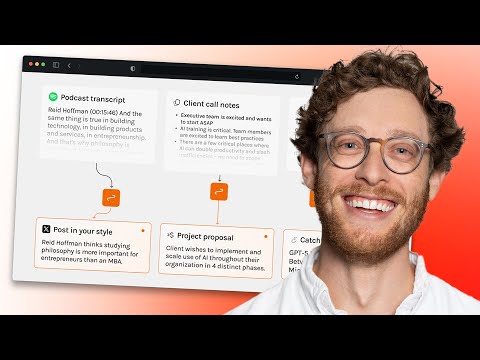
Automate 80% of repetitive writing tasks with AI -…
Introducing Spiral, an AI prompt builder that automates repetitive writing, thinking, and decision-making tasks. It repurposes existing text for different channels—e.g., turning podcast transcripts into tweets, blog posts into LinkedIn posts, essay intros into headlines, or client call notes into project proposals—producing drafts that are roughly 80% done so users can focus on creative work.
# Channel Presentation Observations — Video: "Automate 80% of repetitive writing tasks with AI - Introducing Spiral"
## Explicit Self-Description
- **Creator role: co-creator of the product.** The speaker states, "That's why we created Spiral" and "we've created a spiral that's trained on all of our most effective headlines" — positioning the channel as operated by someone who builds/ships products.
- **Team/organizational context.** "We use this all the time within the company. We have many other authors and content teams who use it" — the creator explicitly describes a company with content-producing teams.
- **Content-production footprint claimed.** The creator references running a **podcast** ("Let's talk about my podcast"), writing **articles**, and posting on **X/Twitter, LinkedIn, YouTube, and Spotify** — indicating a multi-channel content operation.
## Intended Audience
- **Content creators and knowledge workers** burdened by routine distribution work: the video opens by addressing the pain of "creat[ing] a title," posting on "X," "LinkedIn," writing "a description for YouTube and then for Spotify."
- **Teams as well as individuals**, evidenced by the sharing features: "I can make it public or share it with the team."
- **Product-curious AI adopters**, given the framing "automate 80% of your routine writing, thinking, and decision-making."
## Claimed Scope of the Video
- A **product introduction/tutorial** demonstrating Spiral, a "powerful query builder" for automating writing tasks.
- Demonstrated workflows:
- Podcast transcript → tweet conversion
- Article → headline generation
- Building/customizing a Spiral (examples, "extract templates," editable prompts)
## Observable Presentation Patterns (Demonstrated, Not Claimed)
- **First-person product walkthrough style**: live demo language ("If I click 'edit'… I click 'extract templates'") with screen-referenced steps.
- **Evidence-based persuasion**: the creator cites a real outcome — "here's the tweet I actually made for this episode… Spiral actually wrote this and it went pretty viral on Twitter."
- **Candid, informal tone**: admits dislikes and friction ("I hate making up tweets for my podcast," "finding the right headline is always a bit of a pain"), and frames the video around a "dirty little secret of creative work."
- **Invitational close**: "I'm really looking forward to seeing what you create with it" — community-engagement framing typical of a creator building a user base.
## Claims vs. Demonstration Distinction
| Creator claim | Observable demonstration |
|---|---|
| "Automate 80% of routine writing" (title/stated) | Demo shows drafts generated; creator still edits: "Sure, I spent some time editing" |
| "Trained on all of our most effective headlines" | Output shown matched the creator's actual published title |
| "It went pretty viral on Twitter" | No metrics shown in transcript; claim is unverifiable from material |
## Notes
- No curated metadata was supplied; all observations derive from title and transcript only.
- No statements support inferences about the creator's private motivations beyond the explicitly stated convenience/use-case claims.
# Delivery Observation: "Automate 80% of repetitive writing tasks with AI — Introducing Spiral"
## Tone & Register
- **Conversational, demo-driven style**: the speaker narrates a live product walkthrough rather than delivering a scripted pitch.
- **Casual candor**: opens with a confessional framing — *“The dirty little secret of creative work is that it actually involves a lot of routine.”*
- **Personal admission as persuasion device**: *“something I desperately need, because I hate making up tweets for my podcast.”*
## Vocabulary & Recurring Phrases
- **"So" as a discourse marker** (stable pattern, high repetition): appears repeatedly to pivot or resume:
- *“So let me give you an example.”*
- *“So this is Spiral…”*
- *“So, it is really good and very useful.”*
- *“So if I just paste in some text…”*
- **Positive intensifiers** used frequently: *“very, very great hook,”* *“really simple and very powerful,”* *“really good and very useful.”*
- **Conversion framing** — the from/to vocabulary recurs: *“turn podcast transcripts into tweets,”* *“turn an article into a headline,”* *“specify what I want to convert from and to.”*
## Teaching Habits
- **Concrete personal example first, then generalization**: podcast-to-tweet example, then article-to-headline, then a "how it works" explanation.
- **Show-then-tell evidence**: after demonstrating output, he validates it with real-world results — *“Spiral actually wrote this and it went pretty viral on Twitter.”*
- **Step-by-step process narration** during the explanation segment: *“First”-style sequencing conveyed through “I specify… Then I give him… Then I click 'extract templates'… After that, I get a form…”*
- **Hands-on immediacy**: narrates UI actions in real time — *“I just take the transcript, paste it in there and press 'run.'”*
## Communication Patterns
- **Direct audience address** at open and close: *“let me give you an example,”* *“let me tell you a little bit about how it works,”* *“I'm really looking forward to seeing what you create with it.”*
- **Balancing enthusiasm with hedged honesty**: *“Sure, I spent some time editing, but I didn't have to spend much time because Spiral had already done the groundwork for me.”*
- **Problem–solution structure**: pain point (*“finding the right headline is always a bit of a pain”*) followed by the tool as remedy.
- **Closing pivot from personal use to community scale**: *“We use this all the time within the company… I'm really looking forward to seeing what you create with it.”*
## Uncertainty Notes
- Transcript appears to be a translation (e.g., *“give him a bunch of examples”* referring to the AI), so word-level verbal tics may not reflect the original-language delivery; pattern strength is uncertain at the phrase level.
- No timestamps or curated metadata supplied beyond coarse segment markers; pacing and nonverbal delivery features are unobservable from this source.
# Observation Document: "Automate 80% of repetitive writing tasks with AI – Introducing Spiral"
## Video Overview
- **Video ID:** `01a0f15b-0c6e-72cc-b6d7-9ff5d3f2b583`
- **Speaker:** Unnamed presenter (identifies as the podcast host and a member of the company that created Spiral; no curated speaker metadata provided)
- **Product discussed:** **Spiral**, described as a "powerful query builder" for automating routine writing, thinking, and decision-making.
## Claims and Positions
### 1. Creative work contains substantial routine
- The speaker asserts the **"dirty little secret of creative work"** is that it involves "a lot of routine."
- He distinguishes between:
- A **core creative element** the creator enjoys building.
- The **distribution process** across channels (X, LinkedIn, YouTube descriptions, Spotify descriptions), which he characterizes as pervasive ("It's everywhere").
### 2. Spiral automates routine work
- Claim: Spiral automates **"80% of your routine writing, thinking, and decision-making."**
- No evidence or methodology for the 80% figure is provided; presented as a headline capability claim.
### 3. Use case: Podcast transcripts → tweets
- The speaker states he "hates making up tweets" for his podcast; Spiral lets him paste a transcript and press **"run"** to generate a tweet.
- He cites an example output referencing **Seth Stevens-Davidowitz** writing a book in 30 days using ChatGPT, which he evaluates as "a very, very great hook."
- He claims Spiral "extracted the most interesting ideas from the podcast."
- He asserts Spiral wrote a tweet he actually published, that it "went pretty viral on Twitter," and used the same hook.
- **Qualification preserved:** He acknowledges, *"Sure, I spent some time editing, but I didn't have to spend much time because Spiral had already done the groundwork for me."*
### 4. Use case: Articles → headlines
- Claim: A spiral "trained on all of our most effective headlines" produces headline suggestions reflecting "what resonates most with readers."
- He lists example outputs ("a living map of language," "demystifying language models," etc.) and states one matched the title he actually used, calling the tool "really good and very useful."
### 5. How the tool works (per the speaker)
The speaker describes a four-step setup process:
1. **Specify conversion** — e.g., "podcast transcripts into tweets."
2. **Provide examples** — prior tweets reflecting his style/voice, plus input/output example pairs (transcript + resulting tweet).
3. **Click "extract templates"** — this "forces the AI to write instructions for itself" on how to perform the task efficiently.
4. **Receive a reusable form** — shareable publicly or with a team, or kept private; the full prompt is editable "to anything you want."
### 6. Adoption claims
- "We use this all the time within the company."
- "We have many other authors and content teams who use it."
- No specific numbers or named external users are provided.
## Unresolved Tensions / Notes
- The **80% automation figure** is asserted without supporting evidence.
- Virality of the tweet is self-reported without metrics.
- Editing effort is acknowledged but minimized — full automation is not claimed.
- Speaker refers to the product once as "Spiro" near the end, likely a transcription artifact; original name is **Spiral**.
# Speaker Attribution Record
## Video
- **Title:** Automate 80% of repetitive writing tasks with AI - Introducing Spiral
- **Video ID:** `01a0f15b-0c6e-72cc-b6d7-9ff5d3f2b583`
## Speakers
| Speaker | Role | Evidence |
|---|---|---|
| Unnamed presenter ("I", "we") | **Creator** — co-creator/maker of Spiral | "That's why **we** created Spiral"; "we've created a spiral that's trained on all of our most effective headlines"; "**We** use this all the time within the company." |
- **No guests, narrators, or other speakers** are present in the transcript.
- The speaker's personal identity is **not stated** in the transcript; no curated metadata was supplied to establish a name.
## Promotional Segments (Flagged)
- **Entire video is promotional** in nature: it introduces and demonstrates the product **Spiral**, created by the speaker's organization, claiming it "automate[s] 80% of your routine writing, thinking, and decision-making."
- Product features promoted: transcript-to-tweet conversion, headline generation, share/public/private/team options, editable prompts.
- Claimed adoption: "We have many other authors and content teams who use it" — **unverified third-party/internal claim from the creator**.
## Referenced Sources & Third-Party Claims
- **Seth Stevens-Davidowitz** — named in a tweet generated by Spiral: "wrote a book in just 30 days using ChatGPT." This is a **claim reproduced within a demo output**, attributed via the tool, not independently verified in the video.
- **Spiral's headline model** — stated to be "trained on all of our most effective headlines" (creator's own dataset; provenance internal to the company).
- Underlying AI technology referenced generically ("the AI", "language models") — **no specific model or provider named** in the transcript.
## Provenance Notes
- The viral-tweet claim ("it went pretty viral on Twitter") is the **creator's own assertion** about their content.
- Editing disclosure: speaker states "I spent some time editing" the Spiral-generated tweet — human post-editing acknowledged.
- **Comment availability:** not indicated in the supplied material.
- **No curated metadata** was provided; role identification rests solely on the transcript.
The dirty little secret of creative work is that it actually involves a lot of routine. There's a core that you spend a lot of time on and that you love, that's incredibly fun to build, and then there's the process
of distributing that core through various channels. You need to create a title for it. You should post it on X. You should post it on LinkedIn. You need to write a description for YouTube and then for Spotify. It's everywhere. That's why we created Spiral. Spiral is a powerful query builder designed to help you automate 80% of your routine writing, thinking, and decision-making. So let me give you an example. Let's talk about my podcast. So this is Spiral, and it's a spiral specifically designed to turn podcast transcripts into tweets— which is something I desperately need, because I hate making up tweets for my podcast. So instead of staring at a blank page and spending hours trying to figure out, “Okay, how do I tweet about this? » I just take the transcript, paste it in there and press "run." And boom, I have a tweet. Seth Stevens-Davidowitz wrote a book in just 30 days using ChatGPT. This is actually a very, very great hook. He also highlighted who he was . He extracted the most interesting ideas from the podcast. That's all I need to do and it just does it for me automatically. And if you look, here's the tweet I actually made for this episode. It has exactly the same hook. Spiral actually wrote this and it went pretty viral on Twitter. Sure, I spent some time editing, but I didn't have to spend much time because Spiral had already done the groundwork for me . And I use it for many other things as well. For example, one of the things I often have to do is turn an article into a headline. And so if I go here and take one of my articles, you know, finding the right headline is always a bit of a pain, but we've created a spiral that's trained on all of our most effective headlines. So if I just paste in some text and click " generate some," I'll get a bunch of headline suggestions based on the article and what resonates most with readers.
So we have a living map of language, how language models actually work, demystifying language models, a map of meanings, language models for people. That's actually a very good headline. This is the same title
I used for the material. So, it is really good and very useful. And let me tell you a little bit about how it works. If we go back to the original Spiral we talked about, to turning podcast transcripts into tweets. If I click " edit", it generally works like this: I specify what I want to convert from and to. So, I want to turn podcast transcripts into tweets. Then I give him a bunch of examples. I provide examples of my previous tweets that have the style and voice I need. I also provide examples of input and output data. That is, I give him an example of a transcript and an example of a tweet created based on it . This way, the model will learn as many details as possible about how to take the transcript and turn it into a tweet in my style and with my voice. Then I click "extract templates", and this will force the AI to write instructions for itself on how to do this efficiently. After that, I get a form that I can use myself. I can share it with my team. You see a share button, so I can make it public or share it with the team. It can also be private. You can also edit the full prompt, so you can change it to anything you want. And, actually, that's all. This is Spiro. It's really simple and very powerful. We use this all the time within the company. We have many other authors and content teams who use it. And I'm really looking forward to seeing what you create with it.