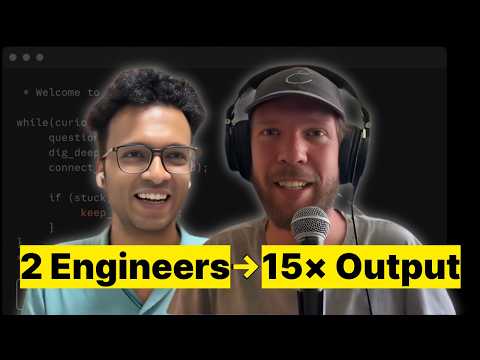
Best of the Pod: Inside the Claude Code Workflow That 15×…
An episode of the AI & I podcast in which Dan Shipper interviews Kieran Klaassen (general manager of Every's inbox tool Cora) and Cora engineer Nityesh Agarwal about compounding engineering productivity with AI agents. The pair shipped six features, five bug fixes, and three infrastructure updates in one week by designing workflows in Anthropic's agentic coding tool, Claude Code, where each task makes the next one easier, faster, and more reliable. Topics: why Kieran believes agents are turning a corner (00:03:18); why Claude Code stands out from other agents (00:06:36); what makes agentic coding different from tools like Cursor (00:11:58); the Cora team's workflow for turning tasks into momentum (00:15:20); building a prompt that turns ideas into plans (00:23:07); new mental models for software engineering (00:34:00); why traditional tests and evals still matter (00:39:13); and Kieran's rankings of the AI coding assistants he has used (00:42:00). Nityesh also cites the book High Output Management as helping him form mental models for working with AI agents.
# Channel Identity Observations
## Explicit Self-Description
- **Host name and show name stated directly**: The host is identified as **Dan Shipper** ("a journey into the future with Dan Shipper as the captain of the spaceship"), and the outro names the show **"AI and I"** ("smash that like button and subscribe to AI and I").
- **Claimed show purpose**: The host frames the episode as delivering practical AI lessons to viewers: > "I just think that it's really important to bring what you guys are learning to everybody that watches the show because it's like we have new tools and so we need new principles and new workflows for using those tools."
- **Outro self-characterization** (hyperbolic/promotional tone): > "this show is the epitome of awesomeness... filled with pure unadulterated knowledge bombs about chat GPT."
## Intended Audience
- **People learning to build with AI, technical and non-technical**: Kieran explicitly addresses non-technical viewers: "Even if you're not technical, subscribe for their max or pro plan," and "I've converted friends who were not technical to use [Claude] code."
- **Engineers and builders tracking the agentic-coding shift**: Content assumes familiarity with tools like Cursor, Windsurf, Devin, GitHub, CI pipelines, and PRs (e.g., the S-tier-through-F-tier agent ranking segment).
- **The show acknowledges a listening vs. watching split**: > "for people who are who are listening instead of watching" — indicating an audio podcast audience in addition to video viewers.
## Claimed / Demonstrated Scope
- **Scope: AI-assisted software engineering workflows** — the bulk of the episode is a live walkthrough of a Claude Code–driven development process (git-log queries, automated issue creation, evals, agent tier-ranking).
- **Scope: interviews with practitioners inside an AI company**: Guests are identified as working at "every" (Every Media) on **Kora**, "every's AI email assistant" — Kieran as GM, Natash as engineer.
- **Observable presentation pattern: promotional integration** — a mid-roll sponsor ad for **Pitch** (pitch.com) with a distinct read, then "And now back to the episode."
- **Observable pattern: multi-tool, vendor-comparative coverage** — discussion spans Claude Code, Cursor, Windsurf, Devin, Charlie, Friday, Codeex, Copilot, Factory, and AMP, positioning the channel as a survey point for the AI tooling landscape.
- **Cross-promotion of related company shows/products**: The host references a prior guest ("Danny, who's been on this show, is the GM of Spiral") and plugs Kora at "Corora.computer," showing the channel surfaces the broader organization's product portfolio.
## Claims vs. Demonstrated Patterns
- **Creator claim**: The show delivers "new principles and new workflows" for new AI tools. **Demonstrated**: The episode does walk through a concrete workflow (voice-to-text prompting, prompt-that-builds-prompts, human-in-the-loop review, evals) with live screen shares.
- **Creator claim** (outro): Every episode is "a roller coaster of emotions, insights, and laughter." **Demonstrated**: Casual, humorous tone (e.g., the "always a bigger fish" Star Wars bit, agent runtime competition), but only this single episode is observable here.
# Delivery Observations: "Best of the Pod: Inside the Claude Code Workflow That 15× Their Output"
## Overall Format & Structure
- **Podcast interview format** with a host (Tom/Dan) and two guests, Kieran (GM) and Natash (engineer), discussing AI-assisted engineering workflows.
- The episode includes a **live screen-share segment**: the host narrates for audio-only listeners — *"for people who are listening instead of watching he's in his terminal. It's you know the the classic black screen"* — and asks guests to demo: *"Do you want to share your screen and like show us?"*
- The episode features a **sponsor read** (Pitch, with a distinct promo voice: *"Do you want a winning deck that'll actually help you land big deals?"*) and a stylized outro (*"smash that like button and subscribe"*).
- A recurring structural habit: the host **plays back what he just heard** to confirm understanding: *"So what I'm hearing is like it's not just about developing with AI…"*, *"Oh, interesting. So, it's like that whole conbon we were looking at earlier…"*
## Tone
- **Enthusiastic and informal** throughout. Frequent superlatives from the host: *"I'm psyched to have you," "That's really cool," "This is awesome," "I love it."*
- Guests are casual and self-deprecating. Kieran, despite being praised, says: *"like I'm I'm I have no idea what I'm doing. Like I need to like I'm running behind."*
- **Humor and laughter are marked repeatedly** in the transcript ([laughter] appears at least seven times), often around the competitive running-agent gag: *"we're trying to see who can have claw code running for the maximum amount of time."*
## Vocabulary & Recurring Phrases
- **"Compounding engineering"** is the episode's anchor phrase, introduced by the host and revisited by guests: *"you're figuring out how to do compounding engineering."*
- **Filler pattern — "like":** extremely dense across all speakers, e.g., *"like there's like a million versions of it and like why don't you just have the best version."*
- **Hedging with "kind of" / "sort of" / "just":** the host especially: *"it's kind of crazy," "you just sort of like send off requests like that."*
- **Recurring technical vocabulary:** *agents / agentic, prompts, issue(s), pull request, code review, tests/evals, codebase, human review / human in the loop, vibe coding.*
## Teaching Habits (Guests)
- **Concrete demonstrations instead of abstract explanation.** Kieran repeatedly demos live: *"let's say what did we ship in the last week?"* then narrates the result; later he narrates a bug hunt step-by-step: *"it made a checklist uh to-dos like fetching recent log changes."*
- **Everyday analogies for non-technical framing:** *"it's like the inbox zero. Does it take less than 5 minutes? Do it kind of thing,"* and *"coding genie for us."*
- **Quantified claims** are a consistent habit: *"simplifying it by I think like a factor of 10," "20 issues," "it fails four out of 10 times," "25 minutes you ran it for 25 minutes."*
- **Citing sources/practices:** Natash grounds his main principle in a management book: *"I read this in that uh management book like high output management which the Intel CEO wrote like 50 years ago."*
- **Emphasis on boredom/tedium as a virtue** in engineering hygiene: *"just boring traditional tests and emails are very important," "PRDS are boring and you can make them a little bit more fun."*
## Communication Patterns
### Host (interviewer)
- **Check for audience comprehension** frequently: *"Wait before you move on… for people who are listening, so basically you have this sort of Trello board type thing…"*
- **Pop-culture analogies** to explain guest points: the Star Wars reference — *"there's always a bigger fish"* — and the lever/rocket metaphor: *"if you point a rocket at the moon like uh one inch means thousands of miles of difference."*
- **Invites quieter guests in explicitly:** *"if you want to jump in at any point, feel free… I'll lob it to you."*
### Guests
- **Interrupt-and-build pattern:** speakers frequently complete or extend each other's sentences: *">> and it's written in a in a nice write up that can >> technical. Yeah."*
- **Reciprocal crediting:** Natash credits Kieran (*"Kieran is at a whole level… he's never typing. He's always speaking into the uh computer"*), and Kieran deflects the praise.
- **Livelogue-style speaking:** Kieran describes voice-to-text as his main input: *"Kieran almost never types anything… does all voice text."* Note this is the host's characterization; Kieran himself doesn't confirm it directly in the transcript.
## Notable Isolated Moments (Not Stable Patterns)
- The **tier-ranking game** (*"S tier through F tier ranking of agents"*) is a one-off segment with rapid, terse verdicts: *"C because they don't have claw four."*
- The **"we just got AGI" prompt anecdote** appears once as an origin story for their custom command: *"We just got AGI. Uh it got delivered."*
## Uncertainty Notes
- Speaker attribution in the transcript is unreliable in places (e.g., the product name appears variously as "Kora," "Cororo," "claw code," "cloth code," "plot," "clo code"), likely transcription errors; tool names cannot be verified beyond the transcript.
- The outro voice and sponsor read appear to be produced inserts, not the host's normal delivery style — treated here as distinct segments.
- The transcript shows "Tom" as the host name in greetings but the outro names "Dan Shipper"; the host's identity is ambiguous from the transcript alone.
# Position Record: "Best of the Pod: Inside the Claude Code Workflow That 15× Their Output"
## Participants
- **Dan Shipper** — host, AI and I podcast (Every)
- **Kieran** — GM of Kora, Every's AI email assistant
- **Natash** — engineer on Kora
Note: Speaker attribution below relies on transcript context and the host's identifications; some fast exchanges are attributed by best available evidence.
## Central Claims & Positions
### "Compounding engineering" — a new way to build software
- **Dan:** Kora has "two people on the team, but it really feels like there's 15" because agents pull down PRs, work branches, and review each other. Kieran's phrase "compounding engineering" means each piece of work makes the next easier.
- **Kieran:** Kora is simultaneously a product and an experiment in *how* to build. He says they're "barely starting… scratching the surface" of a big shift driven by new models, MCP, and changing mindsets — a stated qualification, not a settled conclusion.
### The core realization: AI for everything, not just coding
- **Kieran:** "Coding with AI is more than just the coding part… it should be used for everything" — research, workflows, product marketing, status checks. Agents are now "good enough that they can actually do everything."
- **Kieran's framing of history:** ChatGPT-era → cursor/windsurf "vibe coding" → agentic coding. The "agentic evolution… suddenly it works and it's working in real world non-experimental… thing."
### Why Claude Code specifically
- **Kieran:** Claude Code (Anthropic's terminal CLI agent) has more tools than a normal Claude interface — file access, running commands, screenshots, web search, GitHub, CI checks. Flexibility and generality (not over-specialized) matter most to him.
- **Natash:** Cursor and Windsurf "have agentic coding capabilities, but [Claude Code] takes it one step further by simplifying it by a factor of 10" — just a text box, no shortcuts; this works "because the underlying Claude model is so much more capable now."
- **Natash:** "We haven't even touched [Windsurf or] cursor in the last 3 weeks" — used now only as a file reader, functionally equivalent to VS Code.
### The workflow demonstrated
- **Kieran (per Dan's summary):** A custom Claude Code command (`cci`) takes a voice-dictated feature idea and runs a research pipeline: ground in codebase → search web for best practices/open-source patterns → present plan for human review → create a detailed GitHub issue in the correct lane.
- **Natash:** The day before a Claude launch, they jammed for two hours and created ~20 issues to feed to the incoming "superior model."
- **Prompt-built-by-prompt chain (Kieran):** Natash prompted ChatGPT with a dramatic "we just got AGI" scenario, then Kieran fed the output into Anthropic's **console prompt improver**, producing the custom command. Dan highlights this as the essence of compounding: "a prompt that effectively builds other prompts."
### "Managing the AI" and parallelism
- **Kieran:** "We've been really leaning into let AI do the work for us and we're just managing the AI." They ran 6–7 agents in parallel during the conversation. Work gets done during calls — Dan says he shipped a feature to prod mid-call without touching the codebase, calling it "a more social way to code."
- **Kieran's example:** An unanswered survey form (PMF question) — Claude Code built a checklist, found removed code, fixed it, created a PR and a migration script. "It didn't cost me any energy." Dan contextualizes: that task could take 30 minutes to hours manually.
- **Fun competition (Natash):** Trying to run Claude Code longest; Kieran holds the record at 25 minutes (long plans + tests), Natash at 8.
### Limits, qualifications, and unresolved tensions
- **Kieran:** Human review remains essential — "taste, experience, intuition." A bug he solved required hinting "look at the history"; Natash's identical attempt without that hint concluded "everything works fine." "There's no magic prompt that does everything."
- **Kieran:** The research docs are "kind of boring to read," but skipping or compressing them makes the agent "miss things." He makes them more readable via user stories and PM-style questions with options.
- **Natash's key principle:** Citing *High Output Management* (Intel CEO), "fix any problem at the lowest value stage" — review the *plan* before letting an agent implement it, because catching a wrong direction early is far cheaper.
- **Dan's lever/rocket metaphor:** More power amplifies error too; catching direction early prevents shooting off into space. Dan admits he personally tends to rush through planning documents.
### Verification practices
- **Kieran:** Lean on "boring traditional tests" — smoke tests, and **evals as tests for prompts**. Example: ran an eval 10 times, found 4 failures, had Claude Code iterate the prompt until consistent passing while he got a coffee. Also mentions trying Figma MCP + Puppeteer screenshot comparison as checks — noted as not yet tried much.
- **Dan:** Suggests agents should shift into "interview mode" (asking questions rather than producing long documents to read); Kieran calls it "an interesting idea for a custom command."
### Natash's personal trajectory
- Self-taught programming starting when ChatGPT launched; migrated ChatGPT → Cursor → Windsurf → Claude Code. He believed he was "at the forefront" until joining Kieran: "there's always a bigger fish" (Star Wars reference, Kieran as the bigger fish).
- **Kieran's counterpoint:** "I have no idea what I'm doing… I'm running behind" — nobody is at the forefront; practice using AI daily or you'll miss things.
### Agent tier list (Kieran, with reservations noted)
| Agent | Rank | Reasoning |
|---|---|---|
| Claude Code | **S** | (implied top pick) |
| AMP | **S** | Gets work done; good ergonomics; builders dogfood it |
| Friday | **S/A boundary** | "Very opinionated way of working… I love their opinions"; one-shot a Figma design — despite not yet using Claude 4 |
| Cursor | **A** | "Very good with Claude 4"; confusion over many versions/modes criticized |
| Charlie | **B as agent, A as code reviewer** | "Really good at something" — code reviews |
| Devin | **B** | Not as integrated, hard setup, less well-rounded code |
| Codeex | **B** | — |
| Factory | **B** (slightly below Devin/Codeex) | Good multi-repo; "enterprisey… not my style"; web+local is awkward |
| Windsurf | **C** | "Because they don't have Claude 4… 3 weeks ago they would be A" |
| GitHub Copilot | **D** | Tried briefly half a year ago, "not agentic" — with the qualification that the new agentic version is untested |
- **Kieran's framing:** Use agents like hiring specialists — Friday for UI, Claude Code for research, Charlie for reviews — agents "work together," hooked into GitHub/PR flows so humans can plug in.
### Expert-collaboration example
- **Kieran:** Recorded a 2-hour infra call with an expert, fed the transcript to Claude to generate research issues in 10 minutes. The expert (not an AI skeptic, working in an area where "AI is not good at yet") was "very impressed." What "would have taken 2 weeks maybe is now in a few hours."
## Closing Recommendations
- **Kieran:** Everyone should try Claude Code, even non-technical users — $100/month Max/Pro with unlimited access; a friend rebuilt his cursor-vibe-coded project in Claude Code and "felt that next step." Push your tools.
- **Natash:** "Check the AI's work at the lowest value stage… catch those problems early."
- **Dan:** Use Kora (cora.computer); promo for Pitch and the channel.
## Preserved Contradictions & Qualifications
- Kieran simultaneously claims agents "can actually do everything" **and** that human intuition/taste is still required and decisive — both stated without resolution.
- Kieran frames the shift as "the future is here" while also saying "we're just barely starting… scratching the surface."
- Natash's belief in being "at the forefront" is explicitly revised: "nobody's at the forefront."
- Copilot's D rank is explicitly flagged as unfair (untested agentic version), and Charlie ranks differently by use case.
- Figma MCP + Puppeteer screenshot checks are described as aspirational ("haven't really tried it out").
# Speaker Attribution & Provenance Record
## Video
- **Title:** Best of the Pod: Inside the Claude Code Workflow That 15× Their Output
- **Video ID:** `01a0f15a-b74f-7e46-80ea-b7ad2b015c0e`
- **Format:** Podcast episode ("AI & I" show), screen-shared demo and interview
## Identified Speakers & Roles
| Speaker | Role | Evidence |
|---|---|---|
| **Tom / Dan Shipper** (identified inconsistently in transcript — introduced as "Tom," closing ad names "Dan Shipper") | **Host / Show creator** | Welcomes guests; asks questions; shares screen for tier-ranking; delivers closing calls to action |
| **Kieran** | **Guest — GM of Kora** (Every's AI email assistant) | Introduced by host: "Kieran, you're the GM" |
| **Natash / Nateesh / Natashesh** (spelling varies in transcript) | **Guest — Engineer at Kora** | Introduced by host: "Natash, you're an engineer"; describes self-taught programming via ChatGPT |
**Naming caution:** The transcript machine-rendering is inconsistent (host called both "Tom" and "Dan Shipper"; guest spelled "Natash," "Natesh," "Nateesh," "Natashesh"). Roles are explicit; exact name spellings are uncertain from transcript alone.
## Other Referenced Persons (non-speaking)
- **Danny** — GM of Spiral, prior guest on this show (per host)
- An unnamed **infrastructure expert** Kieran consulted in a two-hour recorded call
- Kieran's unnamed friend who migrated from Cursor to Claude Code
## Promotional Segments — Flagged
- **Mid-roll ad (Pitch):** Full sponsor read for Pitch (pitch.com) presentation platform, including CTA "Start your free trial today."
- **Closing audience promo:** Exaggerated subscribe/like appeal naming Dan Shipper as host.
- **In-content promotion:** Host endorses Kora ("use Kora... Corora.computer") in outro; Kieran promotes Claude Code paid plans ("only $100 per month").
## Referenced Sources & Third-Party Claims (per speakers, not verified)
- **Tools/products discussed:** Claude Code (Anthropic), Cursor, Windsurf, Devin, Charlie (code reviews), Factory, Codeex, GitHub Copilot, Amp, Friday (agent), Figma MCP, Puppeteer, ChatGPT, Anthropic console prompt improver, "Monologue" (unreleased Every incubation tool — host states it is "under wraps")
- **Book cited by Natash:** *High Output Management* (attributed to "the Intel CEO," ~50 years ago) — principle of fixing problems at the lowest-value stage
- **Models referenced:** Claude Opus 4 / "cloud 4" / Claude 3.7, OpenAI models (guests claim early/pre-release access via Every)
- **Third-party claims:** Guests claim Every's Discord provides early access to OpenAI and sometimes Anthropic models; Kieran cites "25 minutes" longest Claude Code run as personal anecdote
## Availability & Uncertainty
- **Comments availability:** Not stated in transcript or metadata — **unknown**
- **Curated metadata:** None supplied beyond title; all attributions derive from transcript
- **Uncertainty:** Speaker name spellings and the host's identity (Tom vs. Dan Shipper) are flagged due to transcript inconsistencies; no timestamps preserved in source
You're figuring out how to do compounding engineering. There's two people on the team, but it really feels like there's 15. \>\> Coding with AI is more than just the coding part. Utilizing it for research,
for workflows. It should be used for everything. We haven't touched on cursor in the last 3 weeks. Both of those have agentic coding capabilities, but plot just takes it one step further by simplifying it by factor of 10. We've been really leaning into let's AI do the work for us and we're just managing the AI. \>\> What you did \[music\] first is spent time building a prompt that effectively builds other prompts. That's really cool. \>\> Kieran Natash welcome to the show. \>\> Thank you. so much for having us, Tom. \>\> I'm psyched to have you. So, for people who don't know, um, both of you, uh, work on Kora, which is every's AI email assistant. Um, Kieran, you're the GM. Natash, you're an engineer. And beyond the fact that Kora is a really cool product, and I'm really excited to bring that to everybody who listens to this show or watches this show, I wanted to do an episode with the two of you because I think that you're figuring out a new way to do engineering. Um because really Kora has, you know, there's two people on the team, but it really feels like there's like 15 because you've got uh you've got agents who are uh pulling down PRs and working on branches and then you're like pushing them up and other agents reviewing and it's just like this kind of crazy thing that um it's a new way to build software. Um and and Kieran, you said something the other the other day that like really stuck with me, which is like um you're figuring out how to do compounding engineering. So with each piece of work you do, you're making it easier to do the next piece of work. Um, and I just think that it's really important to bring what you guys are learning to everybody that watches the show because it's like uh we we have new tools and so we need new principles and new workflows for using those tools and so I'm really excited to talk to you about that. \>\> Yeah, thanks. It's really fun to build Kora but like being part of every and
like being in an environment where you get access to tools like access to thinking access to exciting new ways to to work really helps us rethink how we
build. So like it's it's really an experiment. We're building a product Kora, but at the same time, we're figuring out how we should build and and that's super interesting and we're like right in the middle where people say, "What do you think of this new model?" Like like how do we use this research tool and we're just trying things out? And Natasha and I, we've been like really feeling a shift in the last weeks, I would say, where we're like like things are changing and we're not the only ones. like we hear other people say that as well. Um but not a lot of people and what we've learned is a lot and we want to share a little bit of what we learned and also what we know is like we're just barely starting. We're scratching the surface of this and it's a big shift that's happening right now uh by new models, by how people think, by MCP, by like just it's a lot and uh yeah, like it's great to talk about that from different perspectives. Uh yeah. \>\> Yeah. Um I I I agree and and I think it is so special to be at every because we do like every day there's someone new in the Discord who's like, I built an AI agent. Do you want to like use it before we launch it? Um, and so you know, we get access to uh open AI models before they come out and and sometimes anthropic models. And so we have this like early edge and then and then you guys are so good at figuring out how to actually incorporate them into like a production process. Um, so you said Kieran that something changed. So I guess I I want to get a sense of uh what you think changed and what like draw the broad strokes of what the workflow is that's starting to emerge for you guys. Yeah, for me like obviously it's it's like everything coming together but I think the biggest thing is a realization in myself that
uh coding with AI is more than just the coding part and it's really about uh like utilizing it for research uh for workflows for for
everything like it should be used for everything and we're now at a point where the agents are good enough that they can actually do everything. So we need to rethink again like hey cursor wind surf like the old school way of coding was great like more of the vibe coding like that was one step and then now um it's the realization oh actually we can just give a task and it will do it but still the work needs to be done by like what do we do how do we do it and just the realization that we should lean into that more and really go deep and and it's like clo code like it's just good coding agents or agents available that actually start to work with new models like cloud 4 like really good at following directions and instructions and it's all that coming together um that that I realize like oh we're here like the future is here this thing we've been talking about that was going to be the agentic evolution suddenly it works and it's working in real world non-experimental playing thing it's just like we're building an app and it's working building the app. \>\> So what I'm hearing is like it's not just about developing with AI, it's all the things that go into developing that you're using AI for and that the the thing that you're using the most for this is cloud code. Is that right? And if it's right like tell tell me about like for people who don't know cloud code or haven't used it give us a little introduction to cla code and then tell us about like exactly how you're using it. Yeah, cloth code is basically the
coding agent version from anthropic uh that uses cloth under the hood and it runs in your in your terminal as a CLI
tool which is kind of \>\> Do you want to share your screen and like show us? \>\> Yeah. Yeah. So, cloth code is a tool that you use in your terminal and I know for non-technical people this is like h this is scary. Um but I've converted friends who were not technical to use cloth code and they were like oh this is great. Uh but it's really simple. You just hit uh you start your terminal. You say cloth and an interface will pop up. And basically for people who are who are listening instead of watching he's in his terminal. It's you know the the classic black screen that you're you know feels like you're using DOSs or something and he just typed Claude. Um and then we just got a a thing that says welcome to Claude Code. Um, and uh there's a little text box for him to type in any command. \>\> Yeah. And why is this different or what makes this different? This uh has access to the directory or the computer. So it can look through files on my computer uh already. It can run things on my computer. It can take screenshots of websites. It can search the web. like it has tools but way more tools than available in a normal uh cloth uh version. And that's important because engineering work like building stuff you do need more tools than just uh like the basics. you need GitHub to see what you need to build or what the status is or what the the the pi the CI pipeline does like do the test fill like having all of these things available in one coding agent actually makes it possible for me to um have a workflow or like an a thing I do actually be done by an agent and and that's that's the important thing like really the compound word comes in by doing more than just coding because lots of like if you talk to an engineer like most of the work uh is maybe coding but maybe it's actually 20% maybe 80% of the work is like figuring out what to do next or uh understanding what people
like what their feedback is and how to interpret it. Um and what you can do here is you can for example like a fun way is like to to use it say uh let's
say what did we ship in the last week? So like it it it knows stuff. So I'm asking it what we shipped and it will most likely look at the git log because that's how we track what we did ship. And yeah, so it looks through the git log. It looks at what we merged to main. And yeah, that's a fun way to use it. And for example, we can use this for product marketing. And it says, "Oh, these are the bug fixes, uh, a brief skip functionality, chat panel state, email summary, XML text, major features, um, brief help monitoring, time zone, auto detection." These are all things we released and now I can say, \>\> and it's written in a in a nice write up that can \>\> technical. Yeah. \>\> And it's actually a lot for for two people. \[laughter\] There's there's what, like six major features and like five important bug fixes and three infrastructure updates. Like that's a lot. \>\> Yes, it it's a lot. And and like this week we've been really leaning into like let's AI uh do the work for us and we're just managing the AI. One other thing for example is if if you have someone come to you like oh what is the status on this or like what are you going to ship next week? Let's see what it will do. Can you see what is in the pipeline and what will come out soon?
\>\> So, this is awesome, Nate. While this is going, um, if you if you want to jump in at any point, feel free to at some point I'll I'll lob it to you, but also like just I'll, you know, feel free to jump in. Yeah, \>\> sure.
\>\> Yeah. \>\> Um, so we'll see like I don't know if it has project access, but like you you get the gist. like if you have the information connected to the agent, it's very easy to use it and and it's very important to use a tool you're familiar with. And at this point, I think cloth code works the best for me. Uh it is the most flexible because it doesn't only solve coding issues. And that's important. Lots of these coding agents are made to code, but I want to do more than coding. I wanted it to be like a like a support in engineering in general and I think the cloth team really thought about that. They made it not too specific and they kept it general while actually being really good at solving things and looking at what it did, thinking about the mistakes it made and and selforrecting. So that is stuff coming together that's very hard that makes it possible to uh use now. Yeah. What's the difference between coding and cursor and agentic coding? \>\> Claw code is such a uh simple departure from the cursor and vinsurf that we're used to. Like both of those have agentic coding capabilities. Um but plot just takes it one step further by simplifying it by I think like a factor of 10. So um
what Kieran was uh tying earlier about how uh claw code may feel intimidating because it is a terminal but in reality it is like so much simpler than uh the
winer cursor because there is nothing except a text uh but text box here like there's no uh no like command K no shortcuts no except delete reject remove like there's nothing it's just a a text box and it works because the model the underlying and claw model is so much more capable now. So it's able to work for longer and do tool calls. So uh it it's uh it's like a simpler UI which makes it uh at the same time more powerful even though even though like the underlying uh model behind like cursor and uh plot code is the same. \>\> Yeah. And an example of this is this morning I was pulling some metrics. I was like, why didn't we get any any uh responses to this form? And then \>\> and for for for context, like basically we have a form that we ask people how disappointed they would be if they could no longer use Cororo so we can tell how how well we're doing. And you noticed we have a we have a weekly meeting where we go through all the metrics and we not you noticed that um no one had filled out that form. So you're going into cloud code and you're asking hey like why is no one filling out this form? \>\> Yeah. I was like there has to be something like this form was not sent and I asked like hey 14 days ago
something went wrong. Uh can you see uh what went and what it did it made a checklist uh to-dos like fetching recent log changes to the the controller
searching the codebase. So, it looked through what changed around that date and it found uh we removed a piece of code that adds people there, which is here. Like it says, "Hey, actually, you just need to add this." And I said, "Okay, do it for me. Create a pull request." And it did that. And I said, "Oh, yeah, by the way, I'm also going to create a script that will then add everyone that we missed uh to it." Uh, migrate it. And that was it. Like and the fun part was like I didn't it didn't cost me any energy. Like it was as easy as me writing it down in GitHub to look at later. I don't need to. I just ask it and it does it immediately which is really nice. It's like the inbox zero. Does it take less than 5 minutes? Do it kind of thing. \>\> Yeah. I think the thing that people may not fully realize is that that's a thing that task could take anywhere from like 30 minutes to a couple hours um without without AI. And it's not just that it would require you to like focus on it and like put aside time to like sit down and do it. And now you just sort of like send off requests like that and then you can send off another one and another one and you have a bunch of these like sort of working in parallel. So give me like a snapshot of of what that looks like concretely like what your actual workflow is. What are you actually doing? How many tabs do you have open? Like are you actually doing any hand coding yourself? Do you have like five in parallel? Are you just using cloud code? Like give give us give me a sense of that. \>\> Yeah, I'll show you my screen as well. Maybe Nesh, you can you can tell what we did before like when we got early access to cloth like we were excited what we did. I'll show share my screen. Yeah. Yeah. So, um this is like uh like one
day before uh the claw live stream was scheduled. We were like, "Okay, tomorrow um coding is going to change. We'll have a much more capable model which we'll be able to work for everything that we
want. We're basically going to get like a coding genie for us." So the best most productive thing for us to do today instead of doing our regular scheduled programming we should just jam for a two-hour call where we make a massive list of issues that we want the future like tomorrow's superior model to solve and uh we did that we we created like 20 issues uh in terms of you know like what we want to fix uh what were the things that we were uh uh planning to work on and um prepared uh the system for uh the new cloud model. \>\> Yeah. And it was funny because uh Natash had like he prompted uh chatbt to say, "Hey, tomorrow we have a we we reached AGI. Uh can you can you uh yeah, can you help us come up with everything we need to do and like prepare the AGI to solve everything we did?" And then we fed that into the prompt improver uh of uh Enthropic. And then we use that as a prompt and we created \>\> Wait before you move on before you move on. So so for people for people who are listening so basically you have this sort of Trello board type thing inside of GitHub um combon board and for each thing that you've identified as what you want to do. It looks like you have a document that um lays out in detail okay if it's a feature or it's like a bug fix or whatever lays out in detail what it is and how to actually do it. Can you open up one of one of them? Okay. So like a feature is you want to generate um you want to have AI generated synthetic data um and it has this document has everything from a problem statement to like a solution vision to all the requirements um and all the technical requirements and like a bunch of a bunch of stuff but it's and even it has seems like it has implementation steps with day counts and stuff like that. So \>\> which is funny. \>\> So this is one day is like one second.
\>\> Okay. \>\> Yeah. Yeah. Yeah. So this we use cloth code and we have this custom prompt that we generated to create these um because like it it's a lot of work to create
these and even with jet GPT like there's a lot of steps you need to look at all the code you need to come \>\> you have to think about it yeah there's a lot of thinking so it's really hard to do well so what we did we created an command in clo code and command is kind of a custom prompt that you use a lot and ours is like, hey, there's a feature. \>\> This is a command in cloud code or a command in cursor because you have cursor open. \>\> Yeah, I have cursor open because that's how I edit files, but it's cloth code. So, you can see we're in cloth and and I can use this command um by hitting CC, which is cloth code, and then I say something like a problem. I have like a bug, a problem, anything. So, it's very low friction. So, I have this CCI command and Nesh and I were just jamming. We're like, "Oh, what if we do this? Oh, that sounds cool." And then uh voice to text and it starts um so so let's let's see how this works. And then uh while it's running, we can go over the thing. So I want infinite scroll in Kora where if I am at the end of a brief uh it should uh load the next brief and it should go until every brief that's unread is read. So like \>\> so yeah I I just want people to understand like Kieran almost never types anything um and uh and does all voice text. So he was just doing voice texts into his into his terminal into cloud code with I believe an internal as
of yet in unreleased internal every incubation called monologue. Um which he is the number four uh biggest user of uh but still still under wraps but uh but
you know a little preview in here coming soon. And basically uh what what it seems like it's doing is it's it's taking that is it turning is it turning that into the that document that we were looking at earlier or is it actually going and executing it? \>\> Yeah. So what it does is it will insert whatever I said here in the f uh feature description and then it will follow all these steps and these steps are research research best practices. So one is grounding itself in the codebase. So researching what exists. Then it's researching best practices. So it's searching the web, finding open-source patterns. So it's like grounding it in like best practices in general. Then it's uh will present a plan and when I say, "Yep, sounds good." Like I like that review human in the loop for the plan because sometimes it does it wrong, but most of the time it's right. Then I say, "Yep, sounds good." And then it creates the GitHub issue and it will put it in the right lane and all that. \>\> Oh, interesting. So, it's like that whole conbon we were looking at in GitHub earlier. You've created a way for \>\> you you speak your feature into cloud code and then it does all the research to create that long document and then just adds it into into GitHub issues. That's really cool. Yeah, it's it's an important step because it's like this is different from cursor coding because in cursor normally you skip this step because the tool is not really made for it like the tools made to code. Yes, you can do create you can create markdown files and all of that but let's lean into like an issue tracker. it exists
and it works well and people use it and it already hooks into existing uh like patterns like it like we we can give this to a developer and they can
implement it. \>\> Yeah. And one of the things um that just to point out is like you're running this and I I think one of the special things that when we saw Opus 4 for the first time we were like holy is that it just runs forever with without any intervention and then gives you a pretty good result which we've had sort of agentic type things for a little while but it it's just a way different level of autonomy and quality than um than we've ever had before. and and it's like just checking things off of this to-do list in a way that I think other agent loops are just going to be a lot less thorough. \>\> Yes, absolutely. \>\> Me and Kieran have like a fun thing going on where we're trying to see who can have claw code running for the maximum amount of time \[laughter\] and uh Kieran uh is topping the list right now. He 25 minutes you ran it for 25 minutes. \[laughter\] I'm only at 8 minutes right now. \>\> Oh man. Um, \[clears throat\] how uh how did you get it to go so long, Kieran? \>\> A very very long plan. Um, includes Yeah, it's just very very complicated long plan and also include a lot of tests and just make sure that it runs all the test and fixes all the tests and \>\> interesting. \>\> It goes pretty long. Yeah. \>\> Mhm. T take me through. Wait, I want to understand how did you make that prompt that that creates the prompt like the prompt that creates the research document. So like um how did you know
which elements to put in? Did you just use did you just do the same thing where you you used like a the claude prompt improver the anthropic prompt improver to make that or yeah why how did you
think about putting that together? \>\> Yeah, this is part of like the compounding effect. It's like having an idea that has like a lot of uh a lot of outcomes. So this was what Nateesh sent me. He said, "We just got AGI. Uh it got delivered and uh we can write software. Uh that that this was your initial prompt, which is kind of fun like uh like it's very dramatic." And then Chad GBT said, "Uh I'm ready. Okay. So now do this." And I was like, "Okay, yeah, that's fine. Um that's fine, but like uh do you know uh the anthropic console prompt improver?" like what is that? Uh well, anyone that doesn't know this is the Oh, they changed it. Is this console? Yeah, it is the Oh, yeah, it is. Okay, they change it a little bit. But this is great because basically you paste in a prompt or something like that. And you can say, yeah, we will have thinking and you click generate and it will improve the prompt automatically. And you think like how good can it be? It's pretty good because \[laughter\] it's also very low friction. So, like it's very easy to just take a minute to see if something comes out if it works. If it doesn't work, delete it. Doesn't matter. We were just jamming and we were like, well, we're going to come up with 30 research tasks, so like we better have a prompt. So, I just copied this prompt and that became the document. Yeah. Okay. Into here and change the arguments. And then you can trigger those in cloth by doing slash. And we have these two custom prompts here.
\>\> H. And then I think that actually gives me a much better idea of like what you mean by compounding engineering because what it says to me is what you did first
is spent time building a prompt that effectively builds other prompts because those research documents are effectively prompts for cloud code. And so now that you have a prompt that builds prompts, um, every time you want to make a new feature, you have to specify less. Like you just say the little feature and then it'll go do the research to like build it out into a big document versus before every single time you have to do a feature, you have to say, first I want you to research it and then I want you to like think through all these like different corner cases or the ways that you know I like things built or whatever. I think that's so that's so cool. And and what's also really interesting to point out is um it's working while while we've been talking and that's just a different way to code. Like I we were, you know, we were on the phone together like last week or the week before um and we were testing this out together and I shipped a feature that went to prod while we were talking which I'm not in the codebase at all. So it's like kind of crazy that that actually happened and it's it's like it's a kind of more social way to code. Like we're coding right now, building stuff which was not possible before. Do you want a winning deck that'll actually help you land big deals? Pitch combines design, collaboration, and delivery all in one platform. With Pitch, there's no version chaos \[music\] and no off-brand
slides. It's everything that you need to create and present \[music\] professional, beautiful decks. Pitch's new AI actions let you instantly rewrite slide text for any audience. They let you maintain brand tone and automatically generate slide summaries and speaker notes. And they \[music\] even let you enhance visuals without starting over. Pitch manages your entire presentation workflow from design to delivery. \[music\] And it does all of this without compromising on design quality. It features cloud-based collaboration, brand libraries, interactive embeds, and smart scaling tools. With pitch, every slide you create stays on brand thanks to custom templates and brand \[music\] tones. And every presentation you share tracks engagement so you know whether prospects have opened it. If you have a new audience, AI rewrites your messaging instantly. Do you want to track which slides resonated? engagement analytics show you. If your client needs a dedicated space for their deal, create a custom pitch room. The pitch platform adapts to how you actually work. When you're ready to present, share via live links or custom rooms. \[music\] Pitch handles the hosting, the tracking, and the professional polish. Are you ready to design, collaborate, and close \[music\] deals all on one platform? Start creating for free at pitch.com and get your team set up in minutes. That's pitch.com. \[music\] Start your free trial today. And now back to the episode. \>\> Yeah, absolutely. And uh oh so it while we were talking we did the research and we created this issue which is cool and we had I think six or seven running at the same time because we were just like new idea let's go new idea let's go and what we also did we went through user feedback we read emails we just everything we could we we gathered and we were just like brainstorming and it's really fun because if you're in this brainstorming uh place you can just kick off agents
and see what comes up what they come up with and take another time to then review. So what we do also is um yeah like to agree with you on like
it's really fun to do this together on a call um because that's where magic happens and there is still a human review step here because we found that we want to look at it see if it makes sense if anything is missing like this is having taste experience intuition um like this this uh the the bug I solved earlier with the email not going out. Natash did the same with his clothes code, but it didn't give the right answer. Yeah. So, so there is like there's still like a human touch of intuition. Like I hinted at look at the history and that actually made it think into the right direction and then Tesh didn't add look at the history and then it said no everything works fine. So there is still like intuition and \>\> it's it's still a skill. It's still a skill. \>\> It is a skill for sure. Yeah. It's not Yeah, it's absolutely a skill. There's no magic prompt that does everything like it is about using it the right way and using it to its strengths. For sure. Yeah. \>\> Yeah. Natashesh, how have you found this all? because I know I you know Kieran is like a longtime like Rails like expert person who's just like an incredible programmer and I think you're a little bit earlier in your programming journey. So what has that been like to come to every uh start working on Kora and start working on it in this way?
\>\> Yeah. No. Uh this has been like incredibly eye opening I would say because um honestly uh like my experience with programming is that 2 years ago when chat GPT came out I
thought okay now it's uh perfect for me to teach myself programming and build that SAS application and uh that I always wanted to. So I taught myself programming using chat GPT from the very first day. So I have gone through all the transitions. I went from chat GPT and then when cursor came out I shifted the workflow to cursor. Then then windsurf got better. We shifted into windsurf and uh you know I was always thinking like okay I am at the forefront. I don't know any of my friends who are doing so much with AI and I'm at the forefront. Then I join uh Emory and start working with Kieran and Kieran is at a whole level \[laughter\] like he's in our meetings he's like never writing code. he's never typing. He's always speaking into the uh computer and um uh so I was like okay I need to log that into the overflow. Um and then uh even when Claude code came out um Kieran actually pushed me into using it and uh clearly it it is now the the way uh to program like me and Kieran both I was like we haven't even touched uh when or cursor uh in the last like 3 weeks or so um or even if we do touch it like it's it's usually uh just because we want to read something it's it's basically like we're using it because we don't have VS code on our computer like it wouldn't matter if it was VS code like the older VS code or cursive and stuff because uh all the AI stuff is happening with clot code now and um it's uh really fun to uh you know have in be in this position where the entire coding landscape just changes completely every 3 months and uh you realize like nobody's at the forefront. I got to say I'm jealous of you learning to code right when chatbt came out because I learned to code from books like 20 years ago. \>\> BHP for for dummies. \>\> Yeah. Like basic for ba learn basic in 24 days. Like Sam's teach yourself basic or whatever. Yeah. \>\> Deli5. \>\> Yeah. Um, and and also it's so funny for you
to say like I thought I was I thought I was sort of at the at the forefront of AI coding and then I joined every and started working with Kieran because it just reminds me of I don't know if like there's this scene in um Star Wars uh
the prequel episode one where like they're they're under the water and and they're like being attacked by a sea monster and it looks like they're going to die and then another bigger sea monster comes out and just like eats the eats the the one that's killing them and Qui-Gon is like there's always a bigger fish. \>\> There's always a bigger fish. \[laughter\] \>\> And um yeah, Kieran Kieran is the bigger fish. \[laughter\] \>\> But I feel I feel the same like like you say that about me, but I'm like I'm I have no idea what I'm doing. Like I need to like I'm running behind. We need to do like a million more things. So that's just the reality of the landscape. Like there is always more. But it's really about practice. Like you should practice using AI. You should push yourself every day. If you don't, like you'll miss very cool stuff. Yeah. Well, what are I I I guess I'm curious like personally and also for people in the audience like what are the problems with this? Right. So, basically it sounds like you're moving to a form of coding where you don't touch the code. Um you're one level above. And so what are the problems that come up with that and how are you solving them? like what are the new engineering practices that you need to incorporate in order to make sure that things go well? \>\> For me like the the most important realization uh for me has been like this thing uh that I always uh keep going back to uh especially with broad code. I read this in that uh management book like high output management which the Intel CEO wrote like 50 years ago and the first chapter he mentioned something like how um uh in in any production process you should fix any problem at the lowest value stage and uh I just can't uh stop thinking about that uh statement because um because AI and plot code can now do so many things for us it has become really important to focus focus on the earliest part of things. So what I mean by that is uh when when we see that uh you know when we are using uh the workflow that Kieran just showed to create a GitHub like a very detailed GitHub issue um then it's very tempting
to uh like start another cloud code to uh ask it to just hey go now uh work on this GitHub issue and fix it but that's actually uh going to be a problem because um there are chances that uh you
know the the plan that Lord was able to uh in that issue. It wasn't the direction that you wanted to go and you want to catch that uh before you ask plot to go and implement the solution and then you fix it over there. \>\> That makes perfect sense. I really really like that idea. The thing it reminds me of is just um it's like all this stuff is like it's like a lever and like the further out you get on the lever like the more power you have but also um the more power you have to go in the in the wrong direction. like every little inch makes a big difference at the end. Um and uh and so trying to catch it earlier I think is the thing that makes sure that you're not shooting off into space or this Liz lever metaphor is totally breaking but like you know what I mean like if you if you point a rocket at the moon like uh one inch means thousands of miles of difference. Um, and so I guess the same thing is true with AI stuff. And I think that's actually a good lesson for me cuz I I tend to want to like rush through the planning stuff. It's like it's just hard for me to like look at a document like that, like the thing that's that causes writing and concentrate on it. Um, so how have you guys found that? \>\> Yeah, it's it's kind of boring to read most of the time. \[laughter\] But you can make it more fun like you can say just like minimal minimal this is too much just but but then the thing is then it misses things again. So it's actually important. So for code I like it to focus on user stories or like
asking questions and answering them. So let's say like hey what are some questions a good PM would ask about this like that we should consider and give like two options like that's it's more
fun to read that than like week one we'll do this week two we'll do that like that's it's like PRDS are boring and you can make them a little bit more fun or give more examples or like you can shape that research and that's normally what we do in the in the human review step. It's like, do we see any red flags? Uh, do we need more stuff to be added? Uh, because it will save so much time. Yeah, \>\> that actually reminds me of something that we're finding in another part of the business. Um, so Danny, who's been on this show, is the GM of Spiral. Um, and inside of Spiral, uh, we're building a writing agent. So, um, you can think of it sort of like hot code, but specifically for writing tasks. And I think there's something similar about that where sometimes you want the writing agent to shift into like an interview mode where it like tries to understand more about what who you are and what you want. Um rather than just like spitting out a bunch of stuff that then you have to read through. And it sounds like there's maybe something missing here in cloud code or these sort of coding work coding workflows where it would be really nice instead of having to read that like long document. It's finding ways to like ask you questions so that the thing it outputs is more likely to be right without you having to read through the whole thing. \>\> Yeah, absolutely. That's an interesting idea for a custom command click here. We should totally try that. \>\> Yeah, for sure. Like this is something we should automate and make better. Like for sure and at the same time it it knows a lot because it has access to your codebase and your style and like that's that's very powerful. So like like you have the code base and it's actually pretty good. Um doing it like I I think in addition to like making it very good at the beginning, I think just boring traditional tests and emails are very important as well. Um because how
do you know what you did is actually working? Well, you can open a console and click through it, but like why just h have it test it, write a test for it.
Uh like just just the bare minimum. Smoke tests are great where you just see does does it kind of work? Uh because otherwise it does way too much. But it's a very good way to have it iterate and fix things by itself. And we haven't tried it as much yet, but we we used the Figma MCP where we say, "Hey, implement this from Figma and then now there's like you can have Puppeteer take a screenshot for a mobile version and then say compare the two." Like we haven't really tried it out, but like we want to try more of that out. So there are these checks in place, tests in place that you normally do manually. Um, and the same for prompts like eval uh for prompts. So I kind of think of uh an eval as like writing a test for uh code. An eel is a test for a prompt. And what I've seen last week as well, I had cloth code run an email and then say actually it fails four out of 10 times. I said run it 10 times. Does it always pass? No, four times it doesn't. And I said, "Oh, look at the output. Like, why didn't it call that tool? It was a cool tool uh uh tool call test." And it says, "Oh, yeah, it wasn't specific enough." And I said, "Okay, just keep going and change the prompt until it's passing consistently all the time." And it did it. Like I just walked downstairs, got a coffee,
walked up, and that was it. So, emails are also very powerful because they will tell you if a prompt works and similar
to writing code, a test says your code works. So, leaning into those more boring traditional ways is also very powerful. Does that make sense? Um, I have a thought. Um, and uh, because one of the things I think is really special, and I think Natasha, you're in this boat, too. So, tell me if I'm wrong, but one of the things I think is really special about you, Karen, is that you just test everything. So, like you've tested every single agent. Um, Natash, have you have you used like a lot of the agents as well? \>\> That's Karen. \>\> Okay. Well, I I think we could still I think we could still do this. I think it'd be kind of fun. Um, I want to spend five minutes um with Kieran doing a S tier through Ftier ranking of agents. Um, and so what I'm going to do is I'm going to share my screen and I'm going to uh I'll call out an agent and then you tell me where it ranks. Um, are you game? \>\> Yeah, let's do it. \>\> Okay, cool. Uh, let's see. Uh hm. Uh does I guess curs? Let's do let's do cursor. \>\> Yeah. So it it's fun because cursor like what cursor is it plot 4? Is it max? Is it \>\> cursor on the best possible settings? \>\> And is it the background agent or is it the the okay cursor traditional best possible setting cloth? Like that's the confusing part about cursor windsurf. like there are like a million versions of it and like why don't you just have the best version and that's what I love about certain agents they just say look this is the best agent uh so that's why it wouldn't be the best
I would say uh a \>\> a okay cursor is \>\> cursor is very good with clot four \>\> um all right uh wind surf
\>\> c because they don't have claw four it It's ridiculous because three three weeks ago they would be a and now now they're not. \>\> Wow. Wow. Okay. Uh \>\> because I I switched from wind surf to or from cursor to wind surf uh like a few months back, but I switched back. \>\> Um okay. So we've got windsurf is a windsurf is a C. Cursor is an A. Uh let's see. Devin, \>\> it's a B \>\> B. Why? \>\> Um, it's like it's not as integrated. It's a little bit hard to set up and the code quality is like it's not as wellrounded as cursor or cloth code. I don't know if they use cloth for in the background, but like it's not as usable as the the others. \>\> Uh Charlie \>\> Charlie is like for code reviews. So we use Charlie for code reviews mostly. So uh I haven't really used it as an agent as much. Um I think Charlie as an agent is B, but it's A as a code reviewer. like I I really like the code reviews it does. So that's interesting. Like it it's really good at something. \>\> And then what about Friday? \>\> Um I put Friday
uh higher than cursor maybe between S and A. \>\> And and it's funny because they don't even use cloth 4 yet. They're still wow like they're still working on how
\>\> how they like really make it work. Well, it's 3.7, but like why I like it there. It it's definitely different than CL code, but Friday has a very opinionated way of working and and I love their opinions and it really works well and it just does it like you give give an issue, they make a plan, you approve and it does it. uh it creates a pull request and I've I've seen it do this stuff that I couldn't do with clo code like for example implement this Figma design it just oneshoted a Figma design for the assistant and uh and I've seen moments where more multiple moments like that where it it did things where like wow okay this I taste the future which is really unique and it's a small team as well so \>\> uh codeex \>\> um This is B for me. All right. Codeex is a B. Uh C-pilot. Uh I haven't used C-pilot. You never use GitHub Copilot? No. I mean I used it three years ago, but I like No, I I Okay, let's be fair. I tried it maybe a half a year ago and
after one second I stopped using it. \>\> \[laughter\] \>\> Where do you where do you rank it? \>\> Uh D like it was not aentic but but I mean
I should try the new version for sure. \>\> We have not tried Yeah, we we haven't tried the the agentic co-pilot. So that's that's not totally fair but um okay. Uh are we missing anything? I feel like we are \>\> cla obviously Claude code but I I assume S tier baby. \>\> \[laughter\] \>\> We have uh factory as well. \>\> Oh yeah. What's how where do you rank factory? \>\> Uh it's interesting. Factory with certain things is like better than any others, but it's not my style. It's like factory is for more enterprisey people that are very nerdy and want like absolute bangers of code. And it's actually good like multi-reo stuff like that. It's a little bit hard to use because it's on the web but also local. So I rate it B. Uh maybe a little bit below Codeex and and Dev in. Yeah, but it's like there is a use for it for sure. \>\> There's something going there's something good there, but it's maybe not not for us. \>\> It's not my thing. Yeah. \>\> Amp also. \>\> M. What's that? \>\> AMP. A M P. \>\> AMP. Oh, AMP. Yeah. Yeah. How's that? \>\> Yeah. Uh, I would put it um S tier under cloth coat between
\>\> another S tier. \>\> Yes. \>\> All right. \>\> Why? It's It's very good at just getting work done. The ergonomics are pretty good. Good
tools already. Like like people people use that tool that build it. They're dog fooding. like you can feel from CL code and amp they're developers that love agents and they're just building the best thing and they're trying new things out. Um so yeah that's it. Let's see. \>\> This is exactly why Kieran is the big fish. \[laughter\] \>\> \[gasps\] \>\> I mean \>\> you are you're stringing them together like you're using cloud code and Friday and and other stuff all at the same time which is yeah the thing that is really cool. \>\> Yeah like like there are yeah like how I think about like I'm I'm thinking about it more is like you're interviewing for a role and you find a developer to like solve a certain problem. I think it's similar with coding agents like Friday is good at like doing UI now. So if I need UI work, I will go to Friday. If I need to do research, I go to clo code. Um and and yeah, there's a if if I want a code review, I use Charlie. Like it's it's fun and agents work together. You don't need to have one agent. We have clo code \>\> and that's because Charlie like works in GitHub. So you can just like CC Charlie and and Charlie will do the the code review on the PR. \>\> Yeah. So we use GitHub and pull requests and normal developer flows. So humans can hook in. So we can hire someone that's very good at specific thing and review code and then cl code will just do the work. But it's very powerful because it is just an ecosystem that we refined over like 20 years or whatever
like and it works. So, let's lean into that. And that's probably why Copilot will probably be fine since it's in there already. Yeah. Wait, you actually
did that recently like we had some infrastructure things where, you know, we've handled tons and tons and tons of emails at Kora. So, we had some infrastructure issues to work out and you seems I think you brought in someone who's like a real expert and then work with them in a specific agentic way that you got what you needed from them, but it was less work for them. Yeah. Yeah. So like like there was no issue yet but we wanted more visibility in in delivery of like the most important things. Uh, and like I'm not very good at it or like I know stuff but like let's bring in someone and what we did we just had a conversation like a two-hour call and I recorded everything and at the end I just fed that into cloth and say okay can you make two issues research issues from this and like 10 minutes later I said okay here are the issues can you re review them and he was like holy what what \[laughter\] what like this guy like he's not an AI skeptic but he's like he he's very good at what he does and normally what he does AI is not good at yet because like there are things AI is not as good at yet. Um but he was very impressed with it and he had like very good uh like comments on it to iterate over it and like what we basically did we just iterated more quickly through ideas because we had something to talk about and then I said the next day when we he was like did the human review like let's go I just use cloud code to implement it and we sat down and did the code review. So, it's like it's just accelerated. What would have taken 2 weeks maybe is now in like a few hours, which is really cool. \>\> I love it. Well, there you have it. You've got your tier list of agents. Claude Code takes the cake. We've got AMP coming up uh coming up in second and uh GitHub Copilot unfortunately uh bringing up the rear but with room for improvement once we try out their their agentic capabilities. Um, anything else you guys want to want to say or talk about before we uh before we end today? \>\> Everyone should use cloth code or try it out. Even if you're not technical, subscribe for their max or pro plan. It's only $100 per month. You have unlimited access. If you're skeptical
about being technical that it's very easy and I've seen people, a friend of mine, he he used cursor and I said just use cloth code. It's better like how how
much better can it be? and he said yes it's better and he rebuilt everything he did with cursor vibe coded uh into cloth code and he's like yeah this is great he felt that next step and you should everyone should try it and really push push their tools yeah \>\> Natash any other words of wisdom \>\> um just be sure to uh check the AI's work at the lowest value stage uh you want to catch those problems uh early \>\> yeah that's that's It's a great one. Uh, and also use Kora. Um, Corora.computer. Check it out. It's pretty awesome. We're shipping new things all the time. Uh, thank you both for coming on. This is a true pleasure. I cannot wait to see what else you cook up over the next couple months and we'll talk soon. \>\> Thank you. Thanks so much. \>\> Oh my gosh, folks. You absolutely, positively have to smash that like button and subscribe to AI and I. Why? Because this show is the epitome of awesomeness. It's like finding a treasure chest in your backyard, but instead of gold, it's filled with pure unadulterated knowledge bombs about chat GPT. Every episode is a roller coaster of emotions, insights, and laughter that will leave you on the edge of your seat, craving for more. It's not just a show, it's a journey into the future with Dan Shipper as the captain of the spaceship. So, do yourself a favor, hit like, smash subscribe, and strap in for the ride of your life. And now, without any further ado, let me just say, Dan, I'm absolutely hopelessly in love with you.