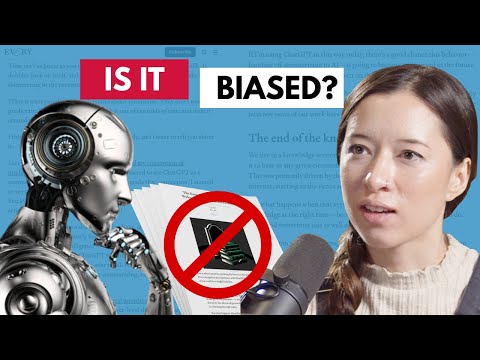
Can You Remove Bias From Your Writing With A.I.?
Host Dan Shipper and guest Steph Smith (Andreessen Horowitz) explore whether writing can ever be truly unbiased, using Sunlight, an AI tool developed by a16z that critiques articles and identifies bias. The clip shows Dan running his own writing through the tool.
# Observation Document: "Can You Remove Bias From Your Writing With A.I.?"
## Observable Presentation Evidence
### Format & Style
- **Casual conversational format**: The transcript reads as an unscripted multi-person discussion (speakers responding to each other with "yeah," "mhm," overlapping turns), indicating a podcast or panel-style video.
- **Live demonstration**: The speakers walk through an external tool in real time ("if you go to every... scroll down... click the Chain of Thought icon"), showing screen-share–driven exploration rather than a prepared tutorial.
### Intended Audience
- **Writers and content creators**: Discussion centers on having one's own articles analyzed for bias — "for the kind of content that we write, yeah, obviously there might be some bias."
- **AI-curious knowledge workers**: The conversation assumes familiarity with concepts like LLMs, ChatGPT, and "Chain of Thought" without basic explanation.
### Claimed / Demonstrated Scope
- **Explicit self-reference to the channel's work**: Speakers describe articles written by the participants ("the knowledge economy is over... I cited in the intro of this episode," "my most shared article was the how to be great article"), demonstrating the channel produces written essays/articles alongside episodic content.
- **Named creator**: The tool's output identifies "the author Dan Shipper," indicating a participant and probable channel principal.
- **Exploratory, not instructional framing**: The video poses a question in the title ("Can You Remove Bias From Your Writing With A.I.?") and demonstrates skeptical, open-ended evaluation rather than promoting the tool.
### Distinguishing Claims from Demonstrations
- **Creator claims**: One speaker explicitly frames the tool as "more helpful for things that are truly biased, whether it's along the political spectrum" — a stated opinion, not a demonstrated fact.
- **Demonstrated pattern**: The speakers show willingness to critique their own work on-air ("it ripped me apart... yep, that's guilty, it's true"), demonstrating a self-critical editorial culture.
- **Skeptical stance demonstrated**: Repeated questioning of whether bias-reduction tools can change behavior: "there's so much incentive to be more biased."
## Notes for Synthesis
- No curated metadata was supplied; all observations derive from title and transcript.
- No private motivations inferred; skepticism and openness are shown through quoted dialogue only.
# Delivery Observations: "Can You Remove Bias From Your Writing With A.I.?"
## Overall Format
- **Conversational, multi-speaker dialogue** rather than a scripted presentation. Speakers interrupt, react, and hand off control while sharing a screen:
> "oh yep and then click newest mhm and let's see keep going keep going"
- **Live demo structure**: the segment walks through a tool ("Sunlight") in real time, with navigational talk mixed with commentary:
> "if you go to every. yeah um and then scroll down mhm to see where it says Chain of Thought just click the Chain of Thought icon"
## Tone
- **Playful self-deprecating humor**, especially when the tool critiques the speaker's own writing:
> "well let's see what it does to me I'm I'm sweating a little bit here now that I know it's not very nice"
> "it like ripped me apart... and I was like yep that's guilty it's true"
- **Genuine surprise and amusement** at the tool's accuracy:
> "okay so like yeah it's it's getting it's getting right"
- Shifts to a **more sober, analytical tone** when discussing extreme bias:
> "there's so much incentive to like be more biased you know"
## Verbal Fillers and Hesitations
- Heavy use of **"like," "um," "you know," "just,"** and repeated words, consistent with unscripted speech:
> "it's it's it's a good question"
> "whether it's like along the political Spectrum or or or just"
- **Stuttered repetitions under mild stress**:
> "I'm I'm sweating a little bit here"
## Recurring Vocabulary and Phrases
- **"I think"** as a frequent hedge before opinions:
> "I think different articles would get different flags"
> "I think our brains are so like hardwired to seek out certain things"
- Repeated **"like"** as an all-purpose connector throughout.
- **"Guilty"** used twice as a joking admission:
> "and I was like yep that's guilty it's true" / "true like guilty"
- Recurring framing of things as **clever or a hard problem**:
> "I think that's a really clever way to do it" / "it's a it's a hard problem to solve"
## Teaching / Explanation Habits
- **Summarizing tool output aloud** for the audience before reacting:
> "okay so it's given us some factual claims the author Dan shipper has started using AI tool chat gbt for summarizing tasks..."
- **Reading and condensing the analysis section** with brief meta-commentary:
> "okay so it says the article the knowledge economy is over welcome to the allocation economy presents a speculative view..."
- **Contrasting usefulness cases** — a common analytical move: distinguishing mild authorial bias from "truly biased" content:
> "what I think this is more helpful for are things that are like truly biased whether it's like along the political Spectrum"
- **Posing open questions instead of giving conclusions**, then jointly answering:
> "the question though is just whether um anyone would ever actually change their habits based on this"
## Use of Anecdote
- Supports points with **personal or secondhand stories**, e.g., the friend's Chrome extension built on a cross-partisan news study:
> "I had a friend who worked on this thing... if you were a conservative it would feed you liberal stories from Fox News"
- Ends the segment with an **analogy to everyday behavior**:
> "it's kind of like when people Google themselves"
## Uncertainty Notes
- **Speaker attribution is not marked in the transcript**, so distinct individual habits cannot be reliably separated; patterns above reflect the combined conversation.
- Some apparent repetitions (e.g., "I think") occur across turns and may reflect shared conversational style rather than one speaker's habit — evidence is insufficient to attribute them individually.
# Position Record: "Can You Remove Bias From Your Writing With A.I.?"
## Overview
Speakers (unnamed in transcript, one identified as **Dan Shipper** via tool output) demo a tool called **Sunlight** that uses an LLM to "debias" content, testing it on their own articles, then discuss whether bias-checking tools can change reader behavior.
## Demonstrated Claims (from Sunlight's AI output, read aloud)
- **Factual claims extracted**: Author Dan Shipper has started using ChatGPT for summarizing tasks, freeing his intelligence for directing/editing; the author predicts handing off summarizing to AI will become widespread, impacting the economy.
- **Bias analysis of "The Knowledge Economy Is Over"**: flagged as **speculative** and **techno-optimistic**; asserts AI will take over tasks like summarizing and humans will shift from makers to managers in an "allocation economy."
- **Criticism quoted**: The claim that AI is "an abstraction layer over lower level thinking" is called an **oversimplification** that ignores AI's complexities and limitations and dismisses human intelligence, creativity, and problem-solving.
- The tool was also run on a "How to Be Great" article and reportedly called out **tropes**, weak research, and **simplicity**.
## Speaker Positions
### Reactions to being analyzed
- Speaker A (author of "The Knowledge Economy Is Over"): initially "sweating," but concedes the flags like **tech optimist** are "guilty — it's true"; feels "bad officially" after the fuller analysis.
- Speaker B: found the tool "nice about it but accurate" on his own most-shared article — "it ripped me apart… it definitely surfaced some accuracy about how it could be interpreted."
### On the tool's usefulness
- **More useful for truly biased content**: Speaker B argues the tool is more helpful for content that is genuinely extreme — e.g., politically biased — rather than the kind of content they write, where some statements simply lack scientific backing.
- Speaker B notes he doesn't think the tested article is "extreme in that way."
### Skepticism about behavior change
- **Open question raised**: whether anyone far down a bias would ever change habits or think to use such a tool.
- **Incentive problem**: "There's so much incentive to be more biased."
- **Chrome extension anecdote**: A speaker recounts a friend's extension based on a study claiming conservatives believe liberal-leaning content more when it appears on Fox News (and vice versa for liberals in the NYT); the extension cross-fed stories to reduce polarity. It "got some traction" but remained a **niche thing**.
- Speaker B praises the cross-feeding approach as clever, contrasting it with "show all sides in one place," which he says **doesn't work** because people gravitate toward humans they resonate with.
- **Counterpoint preserved**: Even cross-fed content may fail — people's brains are "hardwired to seek out certain things," and a highly biased reader would "sniff out" that an article "is not the kind I actually like." Conclusion: "It's a hard problem to solve."
### Closing note
- Speaker compares the experience to Googling yourself — a reflexive self-lookup, described as "disturbing" but revealing.
## Unresolved Tensions
- Whether AI "debiasing" produces genuine critique vs. surfacing stylistic/preference judgments (simplicity, optimism) as "bias."
- Whether tools like this can affect anyone other than already self-critical writers — left as an open question.
# Observation Record: Speaker Attribution & Provenance
## Video Metadata
- **Title:** Can You Remove Bias From Your Writing With A.I.?
- **Video ID:** `01a0f15b-110b-7761-8938-5745f7d72804`
- **Curated metadata:** None supplied.
## Speakers & Roles
- **Speaker A (unidentified, likely host/creator):** Opens with disclaimer *"I wasn't a part of this project"* — distinguishes self from the tool's team. Guides the demo, reads analysis output aloud.
- **Speaker B (unidentified, likely co-host/guest):** References *"one of my articles"* — **Dan Shipper**, author of *"How to Be Great"* (his most-shared article) and *"The Knowledge Economy Is Over."* Reacts to his own article's bias report: *"it ripped me apart... it's true."*
- **Exact role attribution is uncertain** — transcript lacks speaker labels; identity of Speaker A is not stated.
## Referenced Sources & Third-Party Claims
- **Sunlight (AI tool):** LLM-based tool to "debias your content"; built by a team one speaker wasn't part of; accessed via a website with **Chain of Thought** icon and "newest" filter.
- **Article:** *"The Knowledge Economy Is Over"* — cited in the episode's intro; flagged by the tool as **"techno-optimist"**, speculative, oversimplified.
- **Article:** *"How to Be Great"* — described as most-shared; tool found tropes and lack of research depth.
- **Study (unnamed):** Claim that partisans believe cross-leaning content more when it appears in an ideologically aligned outlet (e.g., liberal stories in Fox News, conservative in NYT).
- **Chrome extension (unnamed friend's project):** Fed users cross-leaning stories from ideologically aligned outlets; "got some traction" but remained niche.
## Promotional Segments
- **None flagged.** The Sunlight discussion is demonstrative/critical, not explicitly promotional.
## Availability & Limits
- **Comments:** Availability unknown — no metadata supplied.
- **No timestamps, named third-party sources with citations, or verified speaker identities** present in the transcript; provenance relies on in-transcript claims only.
I wasn't a part of this project um but they did ship this thing called sunlight and I just think it relates to the thing that we're talking about where it basically um is it says use an llm to debias your content and you put in one
of my articles be curious which but just um uh if you go to every. yeah um and then scroll down mhm to see where it says Chain of Thought just click the Chain of Thought icon oh yep and then click newest mhm and let's see keep going keep going uh the knowledge econom is over that's the one I I I I cited um in our uh in the intro of this episode so I'm curious what the bias is well what's funny so obviously this is such a human thing by the way I also the first thing I looked up was one of my own articles or like the same way people look themselves up on the Internet um and it was funny because it was my most shared article was the how to be great article and it like it was nice about it but it was accurate too it like ripped me apart it was like this this is like it's just a lot of like you know tropes or like things that are like maybe like not super well researched like not there's like maybe um some Simplicity here is I guess what it was saying and I was like yep that's guilty it's true well let's see what it does to me I'm I'm sweating a little bit here now that I know it's not very nice well no no no it does it in a very nice way but I was just kind of like it definitely surfaced I think some accuracy about you know how how it could be interpreted okay so it's given us some factual claims the author Dan shipper has started using AI tool chat gbt for summarizing tasks freeing up his intelligence for directing or editing the summarizing the author predicts that
handing off summarizing to AI will become widespread in the future impacting the economy okay so like yeah it's it's getting it's getting right okay so it has factual claims and then I'll scroll down there is an analysis
which this part is about um I guess so it says Tech Optimist techno optimistic and so I think different articles would get different flags true like guilty but see it's like is it you see these things and you're like yeah um okay so it says the article the knowledge economy is over welcome to the allocation economy presents a speculative view of the future of work in the age of AI the author's bias is evident in his optimistic View's role in the future economy which he refers to as the allocation economy he suggest that AI will take over tasks such as summarizing and humans will transition from being makers to managers allocating tasks to models um okay the author for further Reveals His his bias in his assertion that AI is an abstraction layer over lower level thinking this is an oversimplification does not take into account the complexities and limitations of AI it also dismisses the value of human intelligence and creativity and problem solving it's filled with speculative statements Wasing to I got something similar it was like yeah basically like she did not like you know wow okay okay um yeah I uh I feel bad officially so I would say like for the kind of content that we write yeah obviously there might be some bias and like maybe it's um you know there are certain statements that aren't necessarily backed by like a scientific study or something like that but what I think this is more helpful for are things that are like truly biased whether it's like along the political Spectrum or or or just I mean something that if someone happens to Chase certain content uh of a certain style this could help them recognize that it's like quite extreme in One Direction versus I don't think I haven't read this article in depth but like I don't think it's extreme in that way the question though is just whether um anyone would ever
actually change their habits based on this or even think to use something like this if they're that far down a bias that that makes it's it's it's a good question there's so much incentive to like be more biased you know yeah
um I had a friend who worked on this thing that um it was this uh it was based on this study that if you if you're a conservative and you read something in like Fox News um that is liberal leaning you're more likely to like believe it same thing for like if you're liberal and you read it in New York Times or whatever and so he built this Chrome extension that um would basically if you were a conservative it would feed you liberal stories from Fox News ifed conserv stor from York reduce poity it was pretty and it got some traction but like it it's like it's not it's always going to be a niche thing you know yeah I mean because I I think that's a really clever way to do it I think the other ways I've heard people do it is like let me just like show all of the different sides in one place and I think that version definitely does not work because we do gravitate towards certain certain you could say like other humans that we resonate with and um I think that's a clever way to do it the question is just like I think our brains are so like hardwired to seek out certain things even with the Nuance of like even though this is from Fox News let's say if someone is like quite far in One Direction they will even sniff that out I think like I think they would be like oh this article is like not the kind I actually like and same in the other direction it's yeah it's a it's a hard problem to solve um okay so uh so that was um disturbing um you know it's funny is it's like it's kind of like when people Google themselves and they're like oh I'm not here there are other more important steps SMS are like