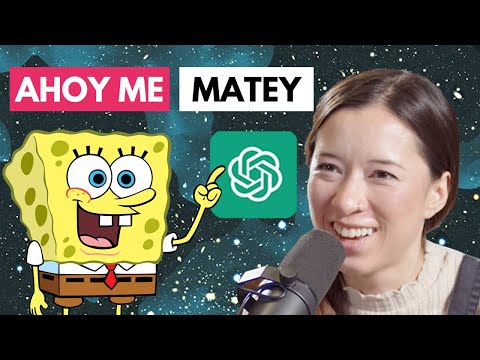
ChatGPT Explains Dark Matter In The Voice Of SpongeBob…
A clip in which Steph Smith of Andreessen Horowitz demonstrates using ChatGPT to explain dark matter—an unsolved problem in physics and astronomy—in the voice and style of SpongeBob SquarePants, as a playful alternative to "explain it like I'm five" prompts. She discusses the technique with host Dan Shipper.
# Video Identity Observations
## Explicit Self-Description Claims
- **No direct channel self-description present.** The transcript contains no statement by the creator about what the channel is, its mission, or its name. Identity must be inferred from presentation only.
## Observable Presentation Evidence
### Content Scope Demonstrated
- The video demonstrates an interest in **hands-on exploration of AI tools**, specifically ChatGPT prompting:
- "all I said in this case is really simple prompt hey chatu BT could you explain what dark matter is in the voice of SpongeBob"
- It frames AI as both **useful and playful**:
- "Chachi is obviously like very useful in its utility but like I think an underrated part is the like it's almost a game in a way"
- It draws comparisons to **existing learning resources** (Wikipedia):
- "it seems to like replace some amount of like Wikipedia rabbit holing... you can like get a Wikipedia article that's written specifically for you"
### Intended Audience
- The conversation addresses viewers interested in **casual, accessible learning about AI capabilities**, not a technical or specialist audience:
- Discussion uses informal language and pop-culture framing (SpongeBob, Gandalf, Dexter's Laboratory) rather than technical terminology.
- There is also a general-audience learning angle around **making complex topics digestible**:
- "the real again 10x experience is to be able to Usher it into the like level of complexity that you're at"
### Presentation Style
- **Conversational, two-person dialogue format** — a host and a guest discussing the guest's experiments:
- Host questions: "why SpongeBob you know why not in the other cartoon character"
- Guest answers with first-person experience: "I went to this conference and I met this astrophysicist"
- Tone is **enthusiastic and informal** — repeated expressions of delight: "it's just like hilarious right", "I mean it's pretty incredible"
### Thematic Interests Demonstrated
- **Education and pedagogy**: the "explain it to me like I'm five" discussion, the "curse of knowledge" concept, and the gap between experts and learners.
- **Science communication**: dark matter discussion ("we can measure it we just don't know... it breaks our brains").
- **Iterative interaction with AI**: "I would just say like bring it down further and you can kind of like move with the program"
## Claim vs. Demonstration Distinction
- **Claims**: Only one soft evaluative claim about utility — AI offers a "10x experience" over dense sources like Wikipedia. This is an opinion expressed in dialogue, not a channel-level promise.
- **Demonstrations**: The video shows a demo-and-discussion format where AI outputs are read aloud and reactively discussed, with tangents into science and learning theory.
# Delivery Observations: "ChatGPT Explains Dark Matter In The Voice Of SpongeBob Squarepants"
## Format & Context
- This is a **conversational, dialogue-style delivery** (two speakers, likely an interview/demo setting), not a scripted presentation.
- The speaker is **demonstrating a live artifact** (a ChatGPT output) rather than presenting prepared slides — they search for it mid-talk: *"sorry I'm trying to find it"* and *"here it is."*
## Tone
- **Casual and enthusiastic**, marked by frequent laughter indicators and delighted commentary:
> "it's just like hilarious right"
> "like how perfect"
> "Gandalf we love that yeah"
- Enthusiasm peaks when quoting the AI output, with emphatic repetition:
> "it was like so incredible"
## Vocabulary & Recurring Words
- **"like"** as an extremely high-frequency filler/discourse marker throughout nearly every turn.
- **"underrated"** used twice as a framing word:
> "I think something that's underrated here"
> "I think an underrated part is the like it's almost a game in a way"
- **"Usher"** as a distinctive metaphor for adjusting complexity — repeated verbatim:
> "to be able to Usher it into the like level of complexity that you're at"
> "this program can take something very complex and Usher it back down"
- **"rabbit hole"** repeated: *"internet rapbit hole"*, *"Wikipedia rabbit holing"*
## Teaching Habits
- **Quotes source material directly as evidence**, reading the ChatGPT output aloud:
> "it starts literally with bracket says imitating SpongeBobs enthusiastic and playful voice"
> "glad you asked about this wondrous mystery of the deep Universe known as D dark matter"
- **Contrast-based explanation**: repeatedly sets a boring baseline against the better alternative:
> "the more boring version is you can just say like explain this to me like I'm five"
> "Wikipedia is dense"
- **Structural summarizing** of the material's pedagogy: *"it basically does go through um not just the concept"* — walking through the explanation's sequence (stars/galaxies first, then dark matter).
- **Iterative-adjustment framing** as a teaching point:
> "I would just say like bring it down further and you can kind of like move with the program"
## Communication Patterns
- **Self-correction mid-sentence**, e.g. *"I had went to I went to this conference"*; *"it's like a little descending or like"* (apparent misspoken word for "condescending").
- **Hedging and epistemic modesty** when making claims: *"I mean I think I could be wrong but I'm pretty sure like the scientific Community agrees"*.
- **Analogy to human cognition**: grounds abstract physics in relatable terms — *"it's kind of like how our brains operate right like we're not structured to understand dark matter"*.
- **Deferring uncertainty explicitly**: *"there's the curse of knowledge right where they don't know how to like or that's not the term is it"* — openly questioning their own terminology mid-thought.
- **Rhetorical questions to advance the topic** (from the interviewer side): *"why SpongeBob you know why not in the other cartoon character"*.
## Pattern vs. Isolated Moments
- **Stable patterns** (repeated across the transcript): "like" filler, "underrated" framing, enthusiasm markers ("right," "I mean"), contrast-based explanation.
- **Isolated/uncertain**: the "Usher" verb appears twice but in adjacent turns — may be a one-conversation coinage rather than a stable habit; the Gandalf anecdote (*"you shall not see Dark Matter"*) is a single humorous moment, not a pattern.
# Observation Record: "ChatGPT Explains Dark Matter In The Voice Of SpongeBob Squarepants"
## Speaker Identification
- **Speaker A** (primary narrator): recounts using ChatGPT to explain dark matter in SpongeBob's voice.
- **Speaker B** (interviewer/interlocutor): asks questions, offers contrasting example (Dexter), and corrects A on terminology.
- No speaker names supplied in metadata; identification is inferred from conversational turn structure only.
## Positions and Claims
### Dark Matter
- **Speaker A** reports attending a conference where an **astrophysicist** gave a talk; the most interesting point was that "we just like don't understand it as a species."
- **Speaker A's claim (with qualification):** "I think I could be wrong but I'm pretty sure like the scientific Community agrees that this thing exists... we can measure it" — but "it breaks our brains" and "does not follow the laws of... normal matter."
- **Speaker A's reasoning:** Humans "are not structured to understand dark matter," which is why "we can't see it hear it feel it."
- **Terminology exchange:** Speaker A self-labels as a "dark matter truther"; **Speaker B corrects**: "I think Dark Matter truthers think that dark matter is *not* real." Speaker A responds he'd need to look into that "internet rabbit hole."
### Why SpongeBob?
- **Speaker A:** the choice "wasn't super thoughtful" beyond picking a character that is **simplistic and fun**, useful for introducing conceptual elements.
- **Contrast with "explain like I'm five":** Speaker A finds the ELI5 framing "a little descending" (condescending) and less memorable, whereas the character-voice version is funny and engaging — "the fun in things being helpful in learning."
- The output reportedly began with a stage direction "[imitating SpongeBob's enthusiastic and playful voice]" and an "Aye-aye" opener, which A found "hilarious."
- Speaker A reports the explanation structured itself by first covering stars and galaxies, then introducing dark matter as "our mysterious friend."
### Follow-up: Gandalf
- **Speaker A** asked ChatGPT to "pick your favorite" iconic character; it chose **Gandalf**, producing a "wise and somewhat grave tone" explanation.
- **Speaker B** quips: "you shall not see dark matter."
### ChatGPT's Pedagogical Value
- **Speaker B's position:** it can "replace some amount of Wikipedia rabbit holing" — a "10x experience is to be able to Usher it into the level of complexity that you're at."
- **Speaker A's reasoning:** Wikipedia is "dense"; with ChatGPT, if output is too complex, "I would just say bring it down further and you can kind of move with the program, which is fundamentally not what we had before."
- **Curse of knowledge:** Speakers note that even top scientists "don't know how to articulate something complex to other people" because of the knowledge gap; the program "can take something very complex and Usher it back down and also the other way around too."
- **Speaker A:** an "underrated part" of ChatGPT is that "it's almost a game in a way."
### Contrasting Preference
- **Speaker B:** "I would have picked Dexter from Dexter's Laboratory," citing it as a childhood favorite — offered as personal preference, not criticism.
## Unresolved Tensions
- Speaker A's tentative epistemic status on dark matter ("I could be wrong but I'm pretty sure") remains qualified.
- The "truther" terminology dispute is left unresolved — A defers to a future search rather than conceding.
- All claims about ChatGPT output are Speaker A's recollection; the transcript contains no verbatim reproduced model text beyond A's paraphrases.
# Observation: ChatGPT Explains Dark Matter In The Voice Of SpongeBob Squarepants
## Speakers
- **Speaker A (creator/presenter)**: Main speaker; recounts using ChatGPT to explain dark matter in SpongeBob's voice; attended an astrophysics conference.
- **Speaker B (interlocutor/guest)**: Asks questions ("why SpongeBob?", "dark truther?"), suggests Dexter from Dexter's Laboratory, discusses Wikipedia comparison.
> Note: Neither speaker is named in the transcript; roles inferred from conversational structure.
## Referenced Sources & Third-Party Claims
- **Astrophysicist talk at a conference**: Speaker A cites a talk by an unnamed astrophysicist about dark matter as inspiration.
- **ChatGPT outputs**: Read partially aloud — SpongeBob-voiced dark matter explanation ("glad you asked about this wondrous mystery of the deep Universe known as dark matter") and a Gandalf-voiced follow-up ("you shall not see Dark Matter").
- **Scientific community consensus**: Speaker A claims (personal claim, unverified) the scientific community agrees dark matter exists and can be measured.
- **Wikipedia**: Referenced as a denser alternative to AI-assisted learning.
## Promotional Segments
- None explicitly flagged in transcript.
## Provenance / Uncertainty
- Speaker identities and roles are **inferred**; no metadata confirming names.
- Conference, astrophysicist, and ChatGPT outputs are paraphrased; full outputs not read on record.
- Comment availability: **not stated**.
show us show us some things you've been uh learning the Dark Matter one I mean that was like the best example for me of I had went to I went to this conference and I met this astrophysicist and he
gave this talk about um well astrophysics and and the most interesting thing from it for me was this point about dark matter and how we just like don't understand it as a species sorry I'm trying to find it it's like me talking to SpongeBob on here it is see explaining dark matter um with SpongeBob okay so so all I said in this case is really simple prompt hey chatu BT could you explain what dark matter is in the voice of SpongeBob what like why SpongeBob you know why not in the other cartoon character like how did you pick SpongeBob yeah um I feel like in this case I don't know if it was like super thoughtful other than thinking about like what is a car cartoon character that I know um is like really simplistic and also fun right like like how can we introduce like different like conceptual elements and I think something that's underrated here is like you know you can the more boring version is you can just say like explain this to me like I'm five um but if you think about like even just the what we talked about earlier the fun in things being helpful in learning as well like if I get the explain it to me like M five version I almost feel like like it's like a little descending or like just I won't remember it but in this case it's like I mean it starts it starts literally with bracket says imitating SpongeBobs enthusiastic and playful voice and then it says like aoy M like it's it's just like hilarious right and then it's like glad you asked about this wondrous mystery of the deep Universe known as D dark matter and it's just like I mean this is one of those
examples where I was like I will be doing this again like it's like how perfect um and so I won't read through the whole thing but it basically does go through um not just the concept of dark
matter in this case but it was like so incredible it just talks about like you know the stars and the galaxies first and like like let's first acknowledge what those are and what we know about them and then you know it it goes on to talk about okay well there's this thing that we actually don't know it's like our mysterious friend dark matter and um it it was really good at kind of breaking down that concept that's awesome and after reading this like would you characterize yourself as a dark truther or do you think that dark matter is like a real thing or like what's your what's your take on dark matter I mean I think I could be wrong but I'm pretty sure like the scientific Community agrees that this thing exists like we can we can we can measure it we just don't know exactly like it's kind of hard it breaks our brains which is why I went to ask SpongeBob about it because it's it's a thing that we can like measure and we know exists but um does not follow the laws of many things that we like of normal matter which is kind of like how our brains operate right like we're not structured to understand dark matter it's like that's why we can't see it hear it feel it Etc so um yeah I I definitely I guess I'm a dark matter truther I think Dark Matter truthers think that dark matter is not real oh oh interesting I I got to go down that internet rapbit hole oh by the way I didn't even remember I did this then I said great job just cuz I was curious and like asked it to do another iconic character and then they chose I said pick your favorite and they chose Gandalf Gandalf we love that yeah and
Gandalf's wise and somewhat grave tone yeah you shall not see Dark Matter yeah exactly like I mean it's pretty incredible like that's why I I mean
Chachi is obviously like very useful in its utility but like I think an underrated part is the like it's almost a game in a way totally I think I would have picked Dexter from Dexter's Laboratory yeah if I had to if I had to pick one that was that was one of my favorite cartoons growing up yeah but I think this is great I think it seems to like replace some amount of like Wikipedia rabbit holing that that people do because you can like get a Wikipedia article that's written specifically for you yeah I mean Wikipedia is dense uh and I think the real again 10x experience is to be able to Usher it into the like level of complexity that you're at yeah cuz actually like I mean think about it this is not I chose SpongeBob but had it come back with something that was like too complex for me to understand I would just say like bring it down further and you can kind of like move with the program which is just fundamentally not what we had before I mean you can imagine like different versions of humans like that but even in the case of like something like dark matter we even our top scientists don't quite understand all facets of it those people like there's the curse of knowledge right where they don't know how to like or that's not the term is it the basically the pH where they can't articulate something complex to other people because they don't it's hard there's just so much of a gap yeah there yeah but in this case they can this program can take something very complex and Usher it back down and also the other way around too