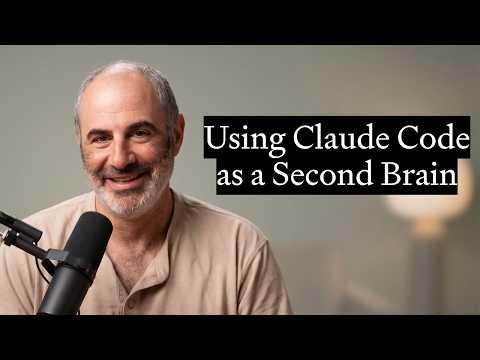
Claude Code Can Be Your Second Brain
Republished interview (originally aired September 2025) with Noah Brier on using Claude Code as a "second brain." Noah runs Claude Code on a home server in his basement, connected via VPN to his Obsidian vault of thousands of notes, and works with it entirely from his phone. Topics: the nuts and bolts of the Claude Code\u2013Obsidian setup\u2014creating project folders, pulling relevant research from his notes, saving transcripts from chats with other LLMs, and generating daily progress updates while preparing a speech; a guardrailed "thinking partner" agent inside Claude Code kept in "thinking mode" that logs his questions, tracks insights, and catches him up on research after time away from a project; and how running everything on the home server (with Termius and Tailscale on mobile) lets him think, write, research, and ship code from his phone. The conversation also covers Grok's voice AI, his "Thomas' English Muffin theory of AI," white space still left to explore in AI, and preparing his kids for AI.
# Channel Identity Observations: "AI and I" (Dan Shipper)
## Explicit Self-Description Evidence
### Show Name and Host
- The host is identified as **Dan Shipper**, addressed by name at the close: *"Thank you, Dan."*
- The outro names the show: *"subscribe to AI and I"* and describes it as *"a journey into the future with Dan Shipper as the captain of the spaceship."*
- Dan describes his own company: *"we run like six different products"* inside **Every**, with *"15 people,"* and mentions incubating **Spiral**, *"which is a agentic ghostwriter."*
### Audience Addressed
- The closing call-to-action explicitly targets viewers interested in **ChatGPT and AI knowledge**: *"pure, unadulterated knowledge bombs about ChatGPT."*
- The host repeatedly frames content for learners of AI workflows: *"If you want to learn how to use Claude code as a true second brain, this is the episode to watch."*
- Explanatory asides suggest an audience that includes AI-curious non-experts: the host pauses to explain Obsidian (*"Obsidian's just like a... note taking app"*) and Claude Code sandboxing behavior *"for people who are listening."*
## Claimed Scope
### Interview Format with Practitioners
- The channel presents long-form expert interviews. The guest, **Noah Brier**, is introduced with credentials: co-founder of Percolate and Variance, now running **Alephic**, *"an AI strategy consultancy."*
- The host notes a history of interviews: *"You were one of the first super organizers interviewees. That was the newsletter that turned into every."*
### Focus Area: Practical AI Workflows and Tools
- Demonstrated scope covers hands-on AI tooling: Claude Code, Obsidian, voice modes (Grok, ChatGPT), V0, Terminal/SSH setups, Tailscale VPNs, and sub-agents.
- Broader themes include AI's impact on work, education, and children (*"how are you dealing with it with your kids?"*).
## Observable Presentation Patterns
### Interview Style
- **Conversational, recursive questioning**: the host frequently interrupts to clarify for the audience (*"Let me just stop you... is that what's going on? That's what we're looking at?"*).
- **Screen-share walkthroughs**: the guest demonstrates live setups while the host narrates for audio-only listeners (*"for people who are listening, so you're just starting up Claude..."*).
### Tone
- Enthusiastic and exploratory; the host frames the content as frontier discovery: *"we're all kind of just figuring stuff out for the first time."*
- Humor and informality throughout, including laughing at the guest's deliberately over-the-top AI-generated outro.
### Cross-Promotion and Community Ties
- The episode promotes the host's company ecosystem (Every, Sparkle, Spiral, Para) and the guest's ventures (alephic.com, BRXND conference and newsletter).
## Claim vs. Demonstration Distinctions
- **Claim**: the outro claims the show delivers transformative AI insights (*"roller coaster of emotions, insights, and laughter"*).
- **Demonstrated**: the actual content is a deep, technical, ~unscripted interview with live workflow demonstrations — substantively consistent with the claim, though more niche-practitioner-oriented than the broad outro language implies.
- The outro itself is delivered as a joke (AI-generated hyperbole, ending *"Dan, I'm absolutely, hopelessly in love with you"*), which the host laughs at — suggesting self-aware, playful channel branding rather than sincere self-description.
# Delivery Observation: "Claude Code Can Be Your Second Brain"
## Format & Structure
- **Interview/podcast format** with a host (Dan Shipper) and guest (Noah Bryer), including an opening host narration and a stylized outro.
- Heavy use of **live screen-sharing walkthroughs**: the guest opens his actual setup ("I could just open it up maybe that's the easiest thing to do is just walk you through it"), and the host narrates for audio listeners ("So, for people who are listening...").
- The host frequently **summarizes and checks understanding**: "So, the basic gist is Obsidian's just like a note taker..." and "Got it. And then once you had it do all that research..."
## Tone
- **Conversational and enthusiastic** throughout, with audible laughter and snorts transcribed: `>> [laughter] >>`, `>> [snorts] >>`.
- Mutual reinforcement pattern — both speakers validate each other: "This is incredible," "Ooh, I love that question," "Totally," "I love that. Love the energy."
## Vocabulary & Recurring Phrases
- Guest repeatedly uses **"sort of" and "kind of"** as hedges — extremely frequent: "it's sort of the theme of that manual," "it's kind of a loaded term," "sort of like a fuzzy interface."
- Both speakers lean on **"like"** as a filler: "And it's like, you know, I know..."
- Guest's signature framing of AI: **"thinking mode, not writing mode"** — "I'm in thinking mode, I'm not in writing mode."
- Recurring agent language: **"thinking partner," "collaborative thinking partner," "catch me up on the last 3 days of research."**
- Host's recurring trope: naming sharp questions — "Wait, I got to stop you," "Let me just stop you for people who are listening."
## Teaching Habits
- **Concrete anecdotes to illustrate points**: the 5-hour drive with Grok voice mode; his 10-year-old daughter's "75 revs on V0"; fixing a client repo "sitting outside by the pond."
- **Named external references**: Veritasium's backwards-steering bike, Philip Ball's *Beyond Weird*, Tim Harford's *The Data Detective*, Walter Benjamin, Wild Bill Donovan, the Simple Sabotage Field Manual.
- **Self-coined metaphors**, a repeated device: "my Thomas's English muffin theory of AI, which is that it like gets into the nooks and crannies," and "bureaucracy as positional encoding."
- Guest often **caveats uncertainty honestly**: "this is a little more sort of theoretical," "again, this is my very optimistic take," "I've no idea what bureaucracy is positional encoding means yet."
## Communication Patterns
- **Host interrupt-redirects**: "Wait, I got to stop you. So you're using Grok voice mode..." — a recurring control move.
- **Guest gives long multi-part answers** and self-audits: "That's a very long answer to your question. I don't know if it got at what you were looking for."
- Both share an **anti-artifact, pro-thinking stance** as a running theme: "there's entirely too much focus on its ability to write and not enough focus on its ability to read."
- Closing pattern: **call-to-action outro** delivered in exaggerated parody style ("smash that like button... Dan, I'm absolutely, hopelessly in love with you").
## Uncertainty Notes
- Filler-word frequency ("sort of," "like," "you know") is observable but exact counts are impressionistic from the transcript, not quantified.
- The transcript labels two speakers but attribution of a few interjections (e.g., `>> [snorts] >>`) is ambiguous; speaker assignments above follow contextual cues.
# Position Extractor Observation Document
## Video: "Claude Code Can Be Your Second Brain"
**Participants (identified from transcript):**
- **Dan Shipper** — host (identified by name in closing exchange and outro)
- **Noah Bryer** — guest, runs Alethic (AI strategy consultancy), co-founder of Percolate and Variance, runs BRXND.AI conference
Note: The transcript does not explicitly attribute every line; where speaker identification relies on conversational flow rather than an explicit name, this is flagged.
---
## 1. Claude Code as a Second Brain (Noah)
- Runs **Claude Code on top of his Obsidian vault** of markdown files, synced with Git; his "number one Claude code use is using it as a tool to interact with my notes."
- Pushes back on framing: "I'm not sure about actually the vibe coding part of it... mostly not for code."
- Obsidian's advantage: "it's a bunch of markdown files and a bunch of folders... they can then be synced with Git."
- Claims a **major, underdiscussed benefit of AI is productive work on the phone**: "one of the things I find really extraordinary about it is the ability for me to work really productively on my phone... that's been like a huge, huge change."
- Setup includes **PARA method** organization and a **package.json with custom slash/code commands** inside Obsidian.
## 2. Talk-Preparation Workflow (Noah)
- Project folder for an upcoming BRXND.AI talk on marketing and AI, referencing the **OSS Simple Sabotage Field Manual** (now public domain; he printed 300 copies with a new foreword).
- Key instruction to Claude: **thinking mode, not writing mode** — "don't help me write anything right now... I just want you to help me think and ask me questions." He includes explicit front-matter instructions like: "Do not create outlines, drafts, or any versions of docs / writing. Only gather and organize the requested materials."
- Folder contains: chats (web-clipped transcripts from ChatGPT/Claude/Grok), daily progress notes (AI reviews the day's notes), research (articles/PDFs), and a conclusions note.
- Starts Claude in the **root directory of the full vault** (not the project folder) so it can search ~1,500 notes.
- Uses a **thinking-partner subagent** that asks questions and "keep[s] a kind of running log of what I'm uncovering."
- Resume technique: "can you catch me up on the last 3 days of research?" — he frames the hardest part of deep work as "just picking it up again."
### Reasoning on relevance retrieval
- Dan questions whether LLM "relevance" judgments are trustworthy ("it doesn't feel like I can understand why it picked it").
- Noah agrees "by and large" but qualifies: his requests are simpler — "I'm not asking it to make large conceptual leaps to relevance... it's like go find all the notes that I've already researched."
## 3. Positions on Models and Writing
- **Noah on models over-eager to write**: "because we call it generative, there's entirely too much focus on its ability to write and not enough focus on its ability to read... we produce artifacts far less frequently than we just like think about things."
- He speculates (explicitly tentative) the "helpful assistant" behavior "has come to be a sort of meme that is probably self-ingested," and that model economics orient toward artifact production.
- **Dan's parallel**: a good ghostwriter interviews and shapes what's in your head rather than producing immediately (experience from incubating an app called **Spiral**).
## 4. Voice Mode Debate
- **Noah, strongly**: Grok voice mode "is way better than any of the other voice modes, and I will fight anybody who says anything different." Reasons: superior tool calling ("a major weakness of the voice models is that they don't do great tool calling and research"), vs. OpenAI's old 4o-based mode ("completely unusable") and Gemini ("didn't find to be smart enough"). Qualification: unsure whether OpenAI's real-time API is now baked into ChatGPT voice.
- Example: 2-hour research session via Bluetooth on a 5-hour drive; a self-attention tutorial session he calls "by far the best explanation I've ever read for it."
- **Dan's counter-experience (ChatGPT voice)**: "it just hasn't gotten as smart as the models are" and its personality is "this like weird Gen Z thing... a little bit too much ennui... it doesn't actually care about you."
- Tesla integration limitation noted by Noah: can't rejoin old car chats.
## 5. Bureaucracy and AI Thesis (Noah, flagged as in-progress)
- Working ideas: "bureaucury as positional encoding" (he admits: "I've no idea what that means yet"); bureaucracy as an innovation enabling scale; AI's "goo-like" / "Thomas's English muffin" ability to fit "into the nooks and crannies."
- Claim: past software forced structural adoption choices ("that's why so many software projects failed"); AI "doesn't really care about the sort of input output," so teams could keep heterogeneous tools (Asana/Jira/Linear example).
- Connection drawn (tentatively): transformers' shift from sequential to parallel processing ↔ Wild Bill Donovan's OSS/special forces model of "autonomy at the edges" within a hierarchy.
## 6. Code Sharing Without Abstraction
- **Dan's example (Every, 15 people, 6 products)**: instead of abstracting Sparkle's file search into a modular library for the new "Para" product, he added a developer to the Sparkle repo and said "just ask Claude code to figure out how it works and just do your own version" — "tacit code sharing."
- **Noah's parallel**: uses GitHub MCP to have Claude pull implementation patterns from Alethic's internal "Intelligence" repo.
## 7. Intuition, Non-Determinism, and Analogies (Noah)
- Aha moment: ChatGPT plugin manifest.json spec — integration contract in the "wrong" direction, "literally 180° away from my intuition of how software systems should be integrated."
- Analogies offered:
- **Veritasium's counter-steering bike video** — you can't explain riding; you must experience it.
- **Philip Ball's *Beyond Weird*** — quantum physics isn't weird; our Newtonian vocabulary is lacking. He explicitly notes: "I have not fully been able to sort of pull that string all the way to AI but I feel like there's a real connection there."
- Mentions **Fingerspitzengefühl** as the concept for building fingertip feeling through use.
- **Dan's addition**: humans are good at handling non-deterministic things ("like other humans"); deterministic Western Enlightenment tools "deprioritized" the "vibes based" way of seeing, and language models reopen it.
- **Noah on AI fear**: "a lot of people who think we're way further along in this than we are... nobody's thought about doing with this thing yet because there's just so much white space."
## 8. Kids, Education, and AI (Noah primarily)
- His 10-year-old built a Secret Santa app with **75 revisions in V0**, independently discovering data modeling (generalizing "adults/kids" into "groups").
- Anti-bubble argument: "if there's a tool that could allow a 10-year-old to build an app... that can't be a bubble" — valuations are beside the point.
- **On English teachers and cheating**: "I don't actually think your job is to teach these kids to write... your job is to convince them that it's worth learning to write" — therefore "I'm not sure that anything fundamentally changes because of AI." Labeled "my very optimistic take."
- Pitching an NYU class (fall 2026): "code as essay" — code as a newly accessible form of self-expression.
- Recommends Tim Harford's **The Truth Detective** (kids' adaptation of *The Data Detective*), citing its "brain guard" rule: be *more* skeptical of information that feels good because you agree with it. Plans to read it to his kids yearly.
- Defends the Gallatin-style oral defense as "entirely AI proof."
- On parental fear: "it was mobile phones, then social media, now it's AI... I don't think that that is true [that it will ruin kids]. But I think there are things we can and should do."
- **Dan's framing**: meta skills (e.g., detecting when AI gives a wrong answer about the 50 states) matter more now; he self-qualifies: "I'm not a teacher."
## 9. Phone Setup (Noah)
- **Termius** (terminal app) → home **mini PC** in basement → **Tailscale VPN** (only access path) → Obsidian synced via private GitHub repo → Claude Code on the phone.
- Claims two hours of real talk-research done at breakfast on his phone; fixed a broken link on his conference site and pushed a client PR from his phone while sitting outside.
- Has set up **partitions on the mini PC for friends** so they can do the same.
- **Dan asks** if this inspires building a purpose-built notes app; Noah: no — "I'm pretty out of the SaaS game"; wonders instead if "everything should just run in Linux all the time."
- On code usage: "mostly I'm having it do the work I already know how to do" — he confirms the diagnosis first, then has Claude push the fix.
## 10. Additional Tooling (Noah)
- **Claude Code setup helpers**: dedicated projects to configure Linux boxes (Omar Chi, DHH's distribution), Homebrew cleanup, and a pip→UV migration ("would have been super overwhelming").
- New Obsidian tool: renames badly-named attachments via **Gemini Flash**, writes a metadata table, and rewrites all attachment links.
- Uses Simon Willison's **LLM command-line tool**, layered back into Claude Code. (Transcript renders the name as "Simon Wilson.")
---
## Preserved Tensions & Qualifications
- Noah initially resists the "vibe coding" framing of his own setup.
- Noah agrees with Dan's skepticism about LLM relevance-finding in general, while defending his narrower use case.
- Noah's "bureaucracy as positional encoding" is explicitly unfinished ("no idea what... means yet").
- His education and AI-optimism positions are self-labeled "optimistic takes"; Dan flags his own teaching suggestions as non-expert ("I'm not a teacher").
- Noah admits uncertainty about OpenAI's real-time API availability in ChatGPT voice.
- Claims about what happened on specific dates (e.g., "Tuesday of this week") are Noah's personal anecdotes, not independently verifiable from the transcript.
# Speaker Attribution & Provenance Record
**Video:** "Claude Code Can Be Your Second Brain" (ID: 01a0f15a-86b8-7c8a-bbd2-e0fd684043d1)
## Speakers & Roles
- **Dan Shipper — Host/Creator**
- Opens with introduction/teaser, conducts the interview, asks questions, and wraps up. Identified by name in the closing segment ("Dan Shipper as the captain of the spaceship"; guest says "Thank you, Dan.").
- Mentions he runs **Every** with ~6 products and ~15 people, and an incubated app called **Spiral** (agentic ghostwriter).
- **Noah Brier (transcript renders "Noah Bryer") — Guest**
- Interviewee; co-founder of **Percolate** and **Variance**; now runs **Alephic** (AI strategy consultancy); organizes the **BRXND.AI** conference. Attribution note: transcript spellings vary ("Bryer"/"Brier" not disambiguated in source).
- **Promotional voice (unidentified, likely host-channel ad-read or outro bit)** — delivers the closing "smash that like button and subscribe to AI and I" segment, ending with a comedic declaration to Dan. **Flagged as promotional segment.**
## Roles Within the Content
- **Narrator/intro voice** (host): frames the episode and previews the guest's setup.
- No other identified speakers; occasional non-speech annotations ([music], [laughter], [snorts]).
## Referenced Sources & Third-Party Claims (as cited by speakers)
- **Guest cites:** OSS *Simple Sabotage Field Manual* (public domain claim); "Wild Bill" Donovan biography; Walter Benjamin essay on mass production of images; research on transformers outperforming specialized time-series models ("a few months ago," unnamed); Tesla removing 300,000 lines of code via neural network (secondhand anecdote); Philip Ball's *Beyond Weird*; Tim Harford's *The Truth Detective* (and *The Data Detective*); Veritasium YouTube channel (counter-steering bike video); Simon Willison's LLM CLI tool (rendered "Simon Wilson"); DHH's "Omar Chi" Linux distribution (rendering uncertain); PARA method (Tiago Forte); German term *Fingerspitzengefühl*.
- **Host cites:** Every products Sparkle and Para.
- All such claims are third-party assertions by speakers; no independent verification in source.
## Promotion & Availability
- **Promotional segments flagged:**
- Closing like/subscribe ad-read for "AI and I."
- Guest promotes **Alephic** (alephic.com), **BRXND.AI** conference (Sept 18, NYC), and its newsletter (newsletter.brxnd.ai).
- Host mentions Every's products Sparkle and Para ("check it out," "I'm a user").
- **Comment availability:** Not stated in source material. No curated metadata was supplied.
- **Uncertainty:** Guest name spelling and a few tool names are transcript-rendered and potentially garbled; noted above without correction.
Noah Bryer might have the coolest Claude code setup I've ever seen. He rigged a home server in his basement, put his Obsidian vault in it, and then runs Claude code on top so he can think,
research, write, and even ship code right from his phone. Today, he shows us how he uses Claude code as a true second brain, a thinking partner that asks him sharp questions, pulls research from his whole node archive and the web, and even keeps a running log of what he's learned and what his best ideas are. And he walks us through his whole stack and his whole \[music\] workflow. If you want to learn how to use Claude code as a true second brain, this is the episode to watch. Let's dive in. \>\> \[music\] \>\> Noah, welcome to the show. Thanks for having me. I'm excited to have you. It's really good to get to chat. This is our first interview in probably like 5 years. You were one of the For people who don't know, you were one of the first super organizers interviewees. That was the newsletter that turned into every. And I love the way that your brain works. You have this like really interesting taste for tools for thought. And back in the day, you're using Evernote in all these really interesting ways. You were the co-founder of a really cool startup called Percolate, and then another one called Variance. And now you're running Alethic, which is an AI strategy consultancy. And I'm just really excited to see how your um mind has started to use these AI tools now that now that they're now that they're you know, working so well. And I know you have some pretty cool Claude code stuff to show us. So, yeah, thanks for coming on. Thanks for having me. Yeah, I'm super excited. That was a a fun interview all those years back. It was It was really, really fun. So, I want to just like dive right into the the like the thing that I think is so cool about what you're doing. So, I know you have a whole like vibe coding setup that you built for yourself. Can you talk us through that? Yeah, I wouldn't I'm not sure about actually the vibe coding part of it. I have sort of fairly heavy-duty quad code setup, but actually uh mostly not for code. So, since those days of super organizers,
like many people, I've abandoned Evernote and switched over to Obsidian. And one of the big advantages with Obsidian as a
note-taking platform is that it's a bunch of markdown files and a bunch of folders. And they can then be synced with Git, and you can do lots of other fun kinds of things. And so, actually, probably my number one quad code use is using it as a tool to interact with my notes. And so, that I've got a fairly serious quad code setup that I use with Obsidian. And my most recent obsession has been standing up a server in my house so that I could also use quad code on my phone. This is incredible. I want to I want to go through all of this. So, where where should we start? Should we do Should we do how you use quad code as sort of this like research assistant notes organizer note-taker thing, or should we start with how you use it on your phone? We can use it We can start with just the sort of general part of it. That might be the sort of easiest. The phone is really just an extension of that same thing. I I would say sort of generally, and this is something I feel like not enough people talk about with AI, is like one of the things I find really extraordinary about it is the ability for me to work really productively
on my phone. And that's been like a huge, huge change because so much of what I do is sort of writing or coding, and the phone is definitely not the best place for that. And you know, even the phone wasn't always the best place for
doing research and thinking. I felt like my computer was a better place for it, which is why I've been such a sort of note taker. And you know, I have found whether it's like Claude code and Obsidian or I mean, even Claude code in code, right? So like the other piece of it is being able to then, you know, if you see something go wrong, being able to sign in on your phone and have Claude code push a small update to something because you just realized it while you're out is amazing. But then even like you know, I use quite a bit of Grok voice mode. And you know, I find that that as a sort of like alternative way of working through problems. I have a Tesla, so now it's baked into the Tesla. And you know, it's just and you know, obviously all the sort of other chat GPT and Claude and all these things of just being able to sort of like go and do research and really think and and explore things in this device that's always been useful, but like not useful for deep work, I think is probably something most people would agree with is that the phone is not \>\> \[laughter\] \>\> been the best place to kind of do deep coding and research work. And I feel like it it's really changed my ability to do that. Wait, I got to stop you. So you're using Grok voice mode. And and is that specifically because it's built into your Tesla or you're using it in situations where you could also use, for example, chat GPT voice mode? No, I'm using it because it's way better than any of the other voice modes, and I will fight anybody who says anything different. Okay. Now, tell me like what is what do you like about it? Why is it better? I To be fair, um uh OpenAI launched their real-time API, which may or may not be baked into ChatGPT voice
now. I It's not totally clear. But, the old voice mode was based on 4.0, and I just found it to be completely unusable. Um and uh uh Gemini's voice mode I just didn't
find to be smart enough. Um and I just found Grok's voice mode to be significantly smarter than anybody else's. Um you know, I'm using Grok two, three, four. I don't even remember what ver- Whatever the latest \>\> The latest one, yeah. Yeah. Not the super I don't have the most expensive account. \>\> heavy or whatever, yeah. \>\> have super heavy. Um but, I just find it to be much better. It does tool calling way better than any of the other ones. That's That's I found to be a major weakness of the voice models is that they don't do great tool calling and research. And um uh Grok seems to have solved that. So, no, even before it was loaded into my Tesla, um I dropped my daughter off at summer camp this summer up in New Hampshire. So, I had a 5-hour drive on my own. And I spent like 2 hours researching and essentially like working through a piece. Um and I did it by just like connecting it to Bluetooth and just sort of sitting there in the car. And um I found it to be by far the uh the best of the voice modes. I I hope these other models catch up there cuz I would I would love more really good voice modes. I mean, I had a mind-blowing session this weekend. And uh I'm giving a talk and I'm I sort of have some ideas. I think it's generally going to be about transformers eating the world. And um so, I was sort of catching myself up on self-attention and exactly how it works. And um I did like an hour session, and it really I I it like was by far the sort of best
explanation I've ever read for it and or ever heard, I guess. And so, yeah, I've I've just found it to be a a kind of pretty extraordinary product. I do love Voice Mode for that. Um it's sort of
like it's the it's a podcast made specifically for you about whatever you're curious about, and that's really cool. I went up to I I drove up state this weekend, and I've been reading um I've been reading The Iliad, and so I had it on an audiobook, and then I had some questions as I was driving, and so I unfortunately used ChatGPT Voice Mode because I didn't know about Grok. So, I wish that Grok's Voice Mode was I wish that uh we'd had this conversation before then, but the thing about ChatGPT Voice Mode is yeah, I think when it first came out it was cool, but it just hasn't gotten as smart as the models are are, and they they gave it this new personality that I had to get used to where every time you ask it a question it's go it goes like oh yeah, uh-huh, well, you know, and it's like it's just this like weird Gen Z thing that it feels like it's has a little bit too much ennui or something. Like it doesn't actually care about you. I I don't know what that is. So, I had to get used to that. Grok has a stoner mode for what it's worth. \>\> \[laughter\] \>\> Yeah, uh Um I will say uh the car version is very interesting to me. Like this was in the most recent Tesla release like a couple weeks ago. And um you know, I had been doing that same thing you did where you just plug your phone in and you put it on Bluetooth and you you know, do your best to make it work. And it's very interesting to just like have a voice AI button, and it syncs back to your regular Grok, but it you can't get you can't rejoin old chats. So, it's just like hey, I it's just like but you know,
I mean, these things are significantly better than Siri and all of these other things. And particularly, I mean, you know, there's no comparison if you actually have something more than just a a single question, you know,
one and answer to, right? Like if you actually want to have a conversation about The Iliad or, you know, about Transformers and self-attention, like um I know it's pretty amazing to just be able to sort of like hit this button and and yeah use that car time I mean I I was on my way somewhere last week and I was you know I was like having it research I was going back to the Walter Benjamin I was I was I have this sort of idea to write a piece about how the reactions to every new technology are essentially elitist critiques of it and that you know it's always like oh no everybody's going to be able to like do this thing that only we used to be able to do and so I was in the car and I was thinking about this and so I had to go and I was like okay you know I know I it's been years since I read the Walter Benjamin mass production of images one yeah \>\> yeah that that one and so yeah then I'm having a conversation about that and I'm like who were Walter Benjamin's contemporaries and then I'm like into all these you know it's just like I don't know that's a that's amazing it's the best it's the best yeah I don't know \>\> \[laughter\] \>\> okay and so you're filling your brain with all these things from voice mode which I love but tell us about your your second brain set up or I don't know how you I don't know how you refer to it whether whether you think that second brain is appropriate for this but I want to know how you're using Claude code to take notes and do research and all that kind of stuff yeah so
you know I could just open it up maybe that's the easiest thing to do is just walk you through it I'll I'll start on my computer and then we can do the phone the computer is just a way easier a way easier share here so
all right so um this is what I was working on before but essentially you know this is just Claude code and it's just sitting on top of my obsidian so you know if I jump out here and I just do like you know you can see I'm I'm following the the para method and Uh, uh, you know I've just got everything sort of organized in here and and put in the places that they need to be. Well, let me just uh let me just stop you for people who are listening. So, okay, so we're looking at we're looking at Claude code. It sounds it seems like you have Claude code running in your Obsidian vault. And there is some kind of uh it's adding something to an existing looks like it's adding something to an existing note. Is that that's what that's what's going on? That's what we're looking at? \>\> Yeah, so in this particular one I'm I'm working on this talk. So, I I'm putting on my conference in 2 weeks. I'm giving this talk about marketing and AI and sort of what's going on and um I'm uh if we sort of jump back a second, um I've been doing these conferences uh called brand BRXND.AI and they're about marketing and AI and um I did one in February in um LA and my talk in LA was about this uh I'm sure you've seen it. It was the Office of Strategic Services which was the precursor to the CIA wrote this manual called the Simple Sabotage Field Manual. Um and it was essentially a manual to help citizen saboteurs in Nazi-occupied territories um sort of like quietly sabotage um the the Nazi occupation. And um so it was like, you know, there's a whole bunch of stuff for blue-collar workers. It's like, if you're a janitor, you should leave a bucket of oily waste around and accidentally drop a cigarette in there so that, you know, it it will um but then there's this amazing um set of recommendations for
white-collar workers and they're like um always refer things to committee, um uh always revisit previously made decisions, um make sure that like if
somebody is trying to make a decision, you should suggest that they don't act with too much haste, um uh lest like we be embarrassed. And And so it's like um you know, uh my talk was about kind of how one hope I have is that AI um can kind of like sidestep a lot of the bureaucracy that exists inside large organizations because it sort of has this kind of uh goo like effect where it can kind of fit into any crevice or crack because it can act as this fuzzy interface and it doesn't really care about the sort of input output. And so the sort of next part of the story is I after the conference I realized that that manual was in the public domain. So I hired a designer and I printed 300 copies and I wrote a new forward for it. And so we're giving this away at the conference and so my talk is sort of trying to tie all these ideas together, right? So I'm I'm trying to pull from the sabotage manual and then I was doing a bunch of research into Wild Bill Donovan who started the OSS and the OSS was sort of the precursor to the both the CIA and the um uh special forces. And so anyway, I'm I'm writing this talk and so I've got a project inside my Obsidian which is the beginning of the research for this project and I'm pulling in sort of like chats and articles and all these things and then I'm constantly kind of talking to the the AI in here and giving it new ideas.
So I'm like, "Oh, I need some conclusions. Here's sort of my first thought on conclusions." And I'm having it like note down the conclusions and then at the end of each day I have the AI write up the changes that I sort of
like the things I learned that day that are going to help me push this talk along and \>\> \[snorts\] \>\> so that's what you're looking at right here is sort of this is all part of this um work that I've been doing where I've been feeding it I was working on sort of what are some of the conclusions I wanted to be. And so this is all sitting in this this is all sitting in in my Obsidian inside of project specifically for that talk. Okay, so let me get a a clear sense of this. This is really interesting. So you have a project when you when you you have a new thing you're you're giving a talk you make a new folder and then as you're thinking about stuff, you're working with Claude code inside of the folder. And you're researching stuff and then saying like I want you to take notes on it. In this particular case, you're you know that a component of your talk is the conclusions section. And so there's one particular markdown file that like you're just going back and forth with it and having it add conclusions. But like what else is in that folder? So is it like there's a body there's a body note and then there's an intro note or is it like So one of the big things here is that I'm in thinking mode, not writing mode yet. And so there's some stuff in here where I've specifically told I think it's in the front matter actually, where I've told Claude code like don't help me write anything right now. And I I generally find this to be a big thing with all these models is like they immediately jump to wanting to help you with the artifact. And you know, when you're just in thinking mode, you have to be very explicit in like, "Hey, I just want you to help me think and ask me questions."
And so yeah, what you can see here is like there's there's a bunch of files in here. I've got chats, so it's where I'm literally like taking chats I'm having in other things. And I'm just like using
the Obsidian web clipper to pull the whole chat in. I've got daily progress. That's where I'm having the AI actually like look through all the notes that came out that day and like help me think through the progress. And then I've got research. That's where I've got a bunch of like articles and PDFs and stuff that I've pulled in so far and been reading about. And then there's a bunch of other kind of random notes along here where I've been, you know, just using it to kind of help me think. And And so yeah, I was in the midst of one, I've got this conclusion note. So you know, I sort of felt like I had blocked out the big kind of um the big themes of the talk. But I was like, "Okay, I need to figure out what am I going to say at the end?" And you know, essentially what I'm going to say at the end is about a lot of the stuff I've learned over the last few years of working with these large brands on AI projects. And um so I'm starting to get into the conclusions. And so yeah, I'm just kind of like trying I'm really piecing all this stuff together right now. That's kind of what's happening. And give me a sense of like when this folder was empty, what did you start with? Um so I think I started with um the the I started with uh telling it like I'm in thinking mode, I'm not in writing mode. Um here are my past few talks that I've given a brand to give you a sense of the sort of style that I have. And I here's the kind of general idea and the big points I want to make, right? Like I'm giving away this book. So I want to talk about simple sabotage field manual. And I have this notion like I have this it's kind of just a title. It's like transformers are eating the world. This is idea that like one of the very interesting things happening with these models is they're sort of displacing a whole bunch of specialized code in places. Um and so I I sort of want to talk about that. And then I've got these conclusions. And so the first thing I
said was like, "Hey, just go look through all of the rest of my, you know, probably 1,500 things in my Obsidian and go see anything else you can find that um might be of value to this talk um of
the existing things I have. And so just go kind of pull those in to the research folder at the beginning to kind of like jump start this process." Got it. And you're starting Are you starting Claude in this folder or you starting it in your full Obsidian vault so that it can access all that stuff? Uh no, I'm so I'm starting it in the full Obsidian vault. So like if we um like this is coming if I step out of here, right? Um we're in the root directory. All this stuff is in the root directory of my Obsidian. Um and my Obsidian setup is also like a little more intense for what it's worth because like um I've also realized like you can add a package.json to add a bunch of like custom code commands to your Obsidian that you can then run and then you could use those code commands and slash commands and all of these other things. So, you know, there are a bunch of other kind of moving pieces in here, but generally it's a fairly straightforward I mean it's it's a I've tried to use para and some other kind of bits and pieces. So, for people who are who are listening or watching and are like we just went through a bunch of stuff really fast. So, the basic gist is Obsidian's just like a a note taker note taking app uh that runs it's all local and so everything that all the notes you take like they they exist in essentially text files on your computer organized by folder. Um and when you're starting Claude Code uh one way to do it would be to start Claude Code in the folder for the particular project that you have, but it sounds like what you're doing is instead you're starting it in the root directory where all of your Obsidian uh notes live and the advantage of that is um Claude Code has some like sandboxing things where it's like it's not really supposed to like run commands outside of the folder it was started in. It can run commands inside of any sub folder, but it sounds like what you're doing so it has access to your entire Obsidian it can do a bunch of stuff and you've also added a package.json which lets it run, you know, custom software custom software commands basically. Um that's
really really interesting. Okay. And do you do you find cuz I've sort of like had this as a twinkle in my eye to like have a go find relevant stuff for me. Do you find that it's actually relevant
and interesting cuz I think sometimes when I've done this kind of thing before with language models they're like oh yeah like this random thing is relevant because XYZ like it doesn't feel like I can understand why it picked it as being relevant, but if it really knew who I am and like what I think is interesting it definitely would not have. Um do you do you find that that's the case or have you figured out a way to make it relevant? \>\> by and large yes, I agree with you. I think in this case relevance is a little simpler since like ultimately this talk is sort of the the things I were asked was asking it to look for I've done a bunch of thinking and research around. So it's like I'm not asking it to make large conceptual leaps to relevance. It's like go find all this like I'm want to talk about the simple sabotage field manual. You can literally just do a like find for all the times all the articles and things I've got in my Obsidian about that. And so it it relevance is uh yeah, it's kind of a loaded term, right? Um and I I agree with I I I agree with what you're saying. I think this is what I'm asking it to do is much more simple which is like amongst this set of things go find all the notes that I've already researched that kind of brought me to be thinking about these things in to begin with. Got it. And then once you had it do all that research, did you have it do any sort of summary to like let you like sort of stimulate you to be like, "Okay, here are the \>\> \[snorts\] \>\> here are some jumping off points based on what you've done before?" What was your next step once you once you got to that point? \>\> next step is I actually have an agent in here. So if we go to I'll do continue for now. Um And so for people who are listening, so
you're just starting up Claude, you're do using the continue flag. So uh you're you're starting Claude by continuing the last session that you were in. And now you've got and you Claude code gives us
ability to do sub agents. So those are like little mini Claude's that you can spawn and you have a I have a thinking partner one. \>\> thinking partner side of Okay, how does that work? \>\> Yeah, and so this is the whole thing where I'm like, "Hey, you're a collaborative thinking partner specializing in helping people explore complex problems. Um your role is to facilitate thinking. Um and basically don't try to write the thing." Um and so after I had that initial set of things, I flipped to this and it's like, "Okay, let's get into a flow. Ask me the kinds of questions. Help help think through it." Um you know, this is also where I've got a chats folder in here. So, it's like it's not just happening here. I was also having like a I've got a whole uh Uh sorry, I'm just backing out. So, like if we go into um if we go into chats, like these are a whole bunch of the chats that I had. Mhm. \>\> Um like with the interviewer? No, these are chats I was having with ChatGPT and Claude and Grok and all of these different things that I went and just grabbed the full transcript of. \>\> \[snorts\] \>\> Um so, you know, I was also having all these other conversations and then, you know, I'm specifically telling the interviewer like review all these other things. So, actually, you know, I think the first one there's a one of these conversations is I originally had this idea about transformers are eating the world and, you know, that sort of notion there is like um you know, there was some research that came out I think a few months ago that um uh they had found a um they were able to sort of outperform some specialized uh time series modeling um uh models with transformers and like,
you know, I think there's really interesting stuff. You know, there's a story about Tesla removing 300,000 lines of code with a neural network and, you know, I've just got kind of got these bits and pieces and one of the ways I
work generally is like when I have an idea of something to write or think about, I'll start uh a thread in ChatGPT or Claude and I'll then save that somewhere and then I'll just kind of keep coming back to it when I have more ideas. It's like, oh, here's another example of transformers doing something. And so, one of these conversations is actually that thing from, you know, probably four or five months ago when that kind of idea initially came into my head maybe when I saw the research about time series modeling or something. Really interesting. Okay. Um okay, so let's let's keep going. So, uh you've got you've got the submission and I actually I want to like just actually want to pause on that really quick, which is I think this is a very common complaint that they just dive in and it's a common pattern to make a thinking agent. And I think Claude code or Claude in general is probably the best one for this. So, this is a thing that we faced with one of the apps that we've been incubating called spiral, which is a agentic ghostwriter. And I think we found I found the same kind of thing when when I was thinking about, okay, how does a good ghostwriter work? They don't just like you don't say, "Hey, I want you to write a blog post." And they're just like, "Cool, I made it. Here it is." Like a good ghostwriter is going to get to know you and really under you're going to you're going to work together to figure out what's in your head about it, but also shape what's in your head. Like it's not just oh, I I can see it and like I'm they need to get it out of you. Like you're you're actually making it together. And in order to do that, you have to have a really good inner basically interview process to uncover things. And that sounds like you've found that too. And I think that's really, really interesting and really important for people who are thinking about how do I get the best out of AI? Actually stop for a second and like let it ask it to understand you first. Yeah. One of the things I say to a lot of people is just like I think partially because we call it generative, there's entirely too much focus on its ability to write and not enough focus on its ability to read. Um you know, and it's like its ability to read is incredible, right? And and I think, you know, arguably sort of like much more useful on a day-to-day basis. Like we produce artifacts far less frequently than we just like think about things. And um
so yeah, I I I do this a lot. This is definitely a complaint I have about all the models is like, you know, even when you very specifically tell it not to try to do your work, it still often still
tries to do your work. And so you have to like really, really be like, "No, I said no." Like I think actually if we look at um uh so Here, critical. When Noah says he's just collecting source materials or I do not utter any sentences \[laughter\] but you to try to write it. Take this literally. Do not create outlines, drafts, or any versions of docs / writing. Only gather and organize the requested materials. It's so good. I love it. Um yeah, this is like uh but yeah, I think you know, I think we all we all experience that and you know, I mean I I do hope over time that that sort of gets baked into the models. I think it's a very interesting tension that exists with the model companies cuz like obviously you know, like this sort of a lot of the economic input output is sort of measured in the artifacts that it produces. Um and so I think it's very oriented and you know, I suspect that part of it is just like that sort of the helpful assistant thing has like come to be a sort of meme that is probably self-ingested. Um but yeah, it's it's um I think for those of us who are trying to do more interesting things with these models, it it it becomes a a real barrier to work. Totally. Um okay, so I want to think about when you're using the thinking agent, did you say it like it's is it outputting some sort of summary of what you've come to into a particular place or Yeah, so that thinking agent is sort of told to as it asked me questions kind of make notes
about the questions that it's asking me and keep a kind of running log of what I'm uncovering and how I'm thinking about it and all those sorts of things. Got it. And then you know, you come back the next day and you're like, oh, I just
want to go down this rabbit hole on XYZ thing about the you know, this Wild Bill guy. Um and that you start a new chat maybe with it maybe with the subject you made maybe not and that becomes its own new file on that topic. Yeah, exactly. So like I I this the um the Wild Bill stuff started as like deep research in ChatGPT. and I you know had it go out and I'm reading the Wild Bill book right now and there's a like one sort of particularly famous biography of him. And you know I'm kind of thinking about the bits and pieces and trying to make and I think I made a kind of interesting connection in there where you know a big part of what sort of he seems to have been after with the OSS and and you know the sort of inspiration for the special forces was like empowering individuals. You know that's sort of like the theme of that manual was like obviously empowering citizen saboteurs but also you know I think a big part of the special forces is like you know having kind of like incredible operators at the edge who you know obviously operate within a sort of command and control hierarchy but like have a ton of autonomy to move and execute independently because they're kind of they have all the things that they need and so you know in all of that Wild Bill research I kind of went back to this and I was like is this like an interesting way to connect all these ideas that like maybe kind of there's a you know and again I'm this is still early I have not like solidified these conclusions as like you know the regular kind of writing process right but it's like well I think there's this
idea that like you know fundamentally well I know you know fundamentally one of the big things with transformers is it moved us from sequential based models to models that can act in you know
sort of paralyze their work better and that obviously allowed us have much more powerful and you know interesting models and has you know arguably kicked off this entire sort of revolution of what's going on and you know what we both do for a living and so you know I think there's this kind of interesting connection and so that was what I was playing with I think here was like oh maybe there's this connection between kind of sequential processing to this kind of parallel and then there's there's connection to bureaucracy and then there's this connection to Wild Bill who seems to be have been very much about sort of like working within a system but like having autonomy at the edges. And so that's kind of what I was playing with and just kind of taking notes and then yeah, I would jump out and be like, oh well, actually I haven't figured out a conclusion yet. Let me start the conclusion section and I'll just sort of get that going on the side but um and then, you know, I I have a job so I can't be doing this all the time. So it's also like you interrupt yourself and it's really nice to be able to come back and be like you know, um can you catch me up on the last 3 days of research? Ooh, I love that question. That's so cool. And so yeah, you can just kind of go in and be like, can you catch me up on the last few days of this research and um it's just going to go read all the stuff, right? And again, it's like I think the point you made earlier about the, you know, go find relevant sources. It's like I find a lot that the difference between the people are getting a lot of this right now is part of it is just like you
have a good feel for where the edges of the capabilities of these models are and you sort of like encourage them to work within those capabilities. Like this is an incredibly easy, you know, it's like
we know what it's going to do here, right? Like I could write all these Unix commands. It's just going to go find a bunch of files in this directory and it's going to look at them by date and it's going to look at all the files created in that project over the last, you know, and we know it's going to be able to do that. And so it's saying um you know, the major breakthrough day was this idea the bureaucracy as positional encoding which is very much work in progress idea but I kind of like it. Um but you know, so it's just like it's pretty amazing also to just be able to kind of revisit deep work like this, right? Where you know, you know you're going to break your flow. Um you're not and it's like it's often, you know, I find whether it's code or writing, the hardest part is like just picking it up again cuz you're you're out of it. And so just to kind of like kickstart that process is sort of amazing. Um, I think what I was playing with here is this idea that um bureaucracy was actually like an innovation, right? Um, that like we look at bureaucracy as a negative and generally we talk about it as a negative and I think often it is a negative. Um, but you know, um bureaucracy was a sort of like huge innovation for how companies operate, right? And ultimately it sort of represents kind of hierarchy and structure and a whole bunch of things that are like actually like pretty positive for operating at a large scale. Um, and so, um you know, again, my my kind of whole thesis on AI around all this bureaucracy stuff is that what's interesting about it is that um as opposed to kind of past technologies
which kind of forced you to make a decision about whether you wanted to kind of like use your existing sort of structure and build that technology into your existing structure
or adopt the new structure and most of the time the new software required you adopted the new structure and that's why so many sort of software projects failed for so long. At least that's sort of part of what I think. And um you know, I think part of what's interesting about AI, what I find so interesting is like that you can kind of keep letting everybody work in whatever way they want. You know, it's like a classic problem inside large companies is like one team wants to use Asana and one wants to use Jira and one wants to use Linear, right? And so then at some point there's like a there's a there's a huge project and they bring in some big consulting firm and they decide they're going to all centralize on this one thing and now two-thirds of the company is unhappy um and like they've all made sacrifices and you know, you're sort of in this like um very non-ideal state. And I think what's really interesting about AI and I I this is a little more sort of theoretical cuz I think you know, we're so early in this is that like I think it's very possible you could just say, well, everybody just keep doing what we're you're doing. We're going to stick sort of some models in the middle. They don't care what you use because like it's all just data structures to them. And so we can then have this sort of central thing. And if you know, I when my you we talked about Percolate at the beginning. Percolate was a content marketing platform worked with very large companies. So it's a enterprise software product. And it's like, you know, at the end of the day, this is sort of the fundamental challenge of enterprise software is about like, you know, adoption and change management. And I just think I think and I hope and again, this is sort of the the optimist in me that like AI kind of lets us just not worry so
much about these things. And and rather than trying to make everybody change the ways that they work, kind of let them work in these ways and let AI sort of it's my I I call it my Thomas's English
muffin theory of AI, which is that it like gets into the nooks and crannies. Um and so yeah, that's so anyway, but I've no idea what bureaucracy is positional encoding means yet. I'm hoping I figure it out in the next 2 weeks before I have to give this talk. I think you know, but I I think the point you just made is is totally right. And it's actually not it doesn't have to be theoretical. Like I I've been seeing this too inside of every and I've been meaning to write about it. And the the place that it's been coming up is we have so inside of every we run like six different products. Um and we have 15 people. So it's it's like a crazy product to head count ratio. Um and what's interesting is I really like doing things in a in a bottom-up way. So everyone each of the products has its own stack. We're not like centralized into a particular stack. Each you know, GM that runs a product like just has made a decision about do I run rails or TypeScript or whatever. And what I'm seeing happen, which is very cool, is um a lot of the different products are running into similar things they want to solve for. So an easy example is um we have one product called Sparkle, which is a little bit like a um uh finder replacement or a spotlight replacement. So, it it it organizes your files and then it implements really fast spotlight search. I'm a user. I like it. Okay. So, then you you you know. Um and uh so, that's really cool. And uh agentic search coming soon. Uh check it out. And uh and we're just building a new product new GM, new stack uh called Para, which is essentially a new in-house counsel. So,
it's short for paralegal, not para like you know, Tiago Forte Para. Um and uh the whole job for Para is just, you know, take all of your legal files and
whenever I have a question, I'm be like, "Okay, did Did we ever sign this contract? Or what's the employee agreement template?" Or whatever. It just gives you the answer and it's just a cloud code sitting on top of a directory. Um and and a thing that we needed to implement for that is uh this sort of like fast file file search. And what's really interesting is historically, if we wanted to reuse the stuff that we learned from implementing Sparkle's file search, that would have to be abstracted out into this modular library that anyone can use. And then we have to be on the same platform and like they all those things, right? And \[snorts\] what we did instead is we just added uh Preeti, who's the developer for for for Para right now. We just added her to the Sparkle repo. And I was just like, "Just ask Claude code to figure out how it works and just do your own version." Um and so, you get this like sort of tacit code sharing where we all get better, but without having to do the work of uh abstracting and modularizing everything because the the percentage of things that you can do that for are pretty low cuz it's a it's a heavy lift. And I'm seeing that happen all the time where just having a bunch of repos that are all solving similar problems, but in different environments in different ways, you everyone gets more productive because AI can kind of translate. I've uh one thing we've done there. We also So at Alephic we do a whole bunch of building for very large brands. So we sort of build all kinds of AI things and you know, so we we've got lots of sort of internal and external repos and we frequently have the same thing and actually I've used the GitHub MCP
a few times for that same purpose which is just like you know, you're just in cursor cloud code or whatever and you're like can you go like look up we run we've got an
internal tool called intelligence that just sort of is a wrapper around a whole bunch of like stuff that we use, right? So it's like got some CRM stuff and it's just like been a fun place to build the things that we need to run our company. But it's also a good place to kind of experiment and explore and figure out solutions to interesting problems. And so I'll frequently be like oh can you go like just go look at the intelligence repo and you know, look at how I implemented that thing there and take those sort of best practices and just pull them over. And yeah, I think that stuff again, that's where I really do believe in this idea. I like one of my whenever we have like a client meeting or something, my first the question the icebreaker I always use is what was your aha moment with AI? And mine was I mean it was probably not the very first but it's the one that sort of I think was most impactful was I was I got access to build a chat GPT plugin remember when plugins came out in like two and a half years ago or something now? You mean 50 years ago? \>\> \[laughter\] \>\> 50 years ago in the in the uh And you know, I I like you I've I've written a lot of software in my life and I you know, you know what you do when you like get access to something new is like I've got to go read the API docs and figure it out and you know I'll like there's a going to be a contract and you know as long as you follow that contract it works. And I go read the plugin spec and it basically is like oh you just stick a manifest.json file in the root directory of your application and in that you describe how you want us to send you data and you describe how you're going to send it back to us and then we'll deal with the rest. And I was just like that's amazing. It's also like it it's how the world should work. Like I wish everything worked that way. I wish I didn't always have to adhere to the big company's contract for how to
send and receive data. Um but also like I the thing that really struck me in that moment and it's like been my kind of like rallying cry around all this stuff is that um it's also just like fundamentally counterintuitive in that
like I literally have a career's worth of intuition for how to integrate software systems and it flipped it out of its head. Like like like quite literally 180° away from my intuition of how software systems should be integrated was this thing. And that I think since then has been my kind of thing for everybody has been like this is just not intuitive for now and and that's not a bad thing. It just means like you need to build intuition and like that's what we're all just out there trying to do with it, right? And so you know when I don't know I mean part of what I like about what you're doing and you know even just hearing the things you're saying but like generally what you do with the podcast and what you do with Every is like so much of it is like we're all kind of just figuring stuff out for the first time, right? And like um you know we're like oh will this work? And then like all of a sudden you have this new bit of intuition for what these things can do and what a computer that is not deterministic looks like and um that's I think that's just what we're all doing all the time. And that's why it's so fun, I think. That's why I love this moment cuz like you just have a weird idea and you're like has anyone done this before? And and it's like no. \>\> \[laughter\] \>\> And it's not a it's not a complicated idea. It's just it's just a new whole new territory, you know? I yes. I I think about that all the time and I think actually like I think one of the really damaging sort of things out there is that um I think there are a lot of people who think we're way further along in this than we are. And so, you know, I think particularly the people who are sort of scared, you know, we run we work with like Fortune 50 companies. And so, you know, when we're sort of like out there and we're talking to people inside the organization, a lot of people feel like they've already been left behind. And it's like no, you can like literally go sign in to ChatGPT and like
and do something like nobody's thought about doing with this thing yet because there's just so much white space to explore and and you might discover some totally new way of using it and or
like totally new trick and um I don't know, that's just that's and you know, I think to be fair to some people that's sort of very intimidating and I don't think by and large the models do any favors to themselves in helping those people get their feet wet in that like, you know, I think people go on there and they you know, it's like you ask it to write you a poem and then it writes you a poem and you're like, okay, it wrote me a poem. Um but uh I don't know, that feeling of like that feeling of yeah, being it's like being on the frontier, right? Totally. And yeah, I think that um your point about intuitions and getting intuitions is the big thing and I think people what we don't realize is when you're dealing with something fundamentally new you you can't trust like how you reason about it without experiencing it cuz you have to build the intuition in order to be able to reason about what it means and and how how fits in and whether it works or not. And we're just not used to that cuz we're used to reasoning about things we already have an intuition for. And um and I think that's why like when you first see maybe when you first saw ChatGPT you'd be like, "Oh my god, it can do everything. Like we're not going to have jobs in a year." And now we're like 3 years in and we're like, "Yeah, it's awesome and jobs are complicated. There's a lot of complex stuff that we do, you know? Um and I I love I love kind of that, you know? In order to build the intuition, all you have to do is is use it and that just by using it you're already kind of on the edge uh for now and yeah, I think that's the best. \>\> There's apparently there's a a German word called Fingerspitzengefühl. Of course there is. Building fingertip feeling and that's been my
um uh just because I can't resist also um I I I in that whole in in sort of the realm that you're discussing like uh
I've been trying to do a lot of analogy analogizing, right? It's sort of like and I think, you know, that's really hard and um uh you know, but my two that have sort of stuck the most, one is just um I watch a lot of YouTube with my kids and um uh we watch this channel called Veritasium. It's a science channel and I love Veritasium. Yeah, it's great. Um and he did one where he built a bike that locks out left if you try to turn right and locks out right if you try to turn left. And what he's proving is that you can't actually turn a bike left unless you can turn it right. Um which none of us would think about when we ride a bike because it's all just second nature and intuition, but it's also why you can't explain to a child how to ride a bike. Um they just have to get on it and feel it. And um and so, you know, I really that video is amazing and um uh it's uh that channel is amazing and and but I I thought a lot about that. Then the other one which is a a sort of deeper cut is um uh there's an amazing book about quantum physics called Beyond Weird by Philip Ball and the thesis of the book is basically that like there's nothing particularly strange about quantum physics that we like we have very good understanding of it like we wouldn't be talking right now we wouldn't be on computers we wouldn't have phones if we didn't have like a very good grasp of the mechanics that exist underneath it and his thesis in the book essentially is that like what's really lacking is the vocabulary because we all exist in a Newtonian world not in a quantum one and so we all have words that reflect the sort of deterministic processes of that macro universe and I think a lot about that I have not like fully been able to sort of pull that string all the way to AI but I feel like there's a real connection there because I think that there's just something really weird about using probabilistic computers like we're not used to using things that like
you ask them the same question twice and they have different answers like that's very strange we're not used to them not used to writing code where you can tell the larger company how you want them to
send you data and they can just do it like these are not normal things that any of us have lived with in our lifetimes and so of course it takes some time for us to adjust I think so too and I actually have a hope that language models by becoming a standard way that we use computers will create that vocabulary um because we actually are quite good at dealing with probabilistic non-deterministic things like other humans um we've just grown up in a world where because of you know the enlightenment and the scientific revolution and and the tools that came out of that are very much like deterministic we've associated that with uh how we see like that's how we see the world because of those tools and that language and there's a whole other part of the way that we see the world which is much more squishy and much more like vibes based that has been um I think deep deprioritized especially in Western culture. That now that we have a tool that works that way, I think we'll be able to start seeing that again and that's one of the beautiful things to me about language models is it opens up that whole world again. Yes, I love it. Um I do want to go back to Claude code and and Uh we should do the phone unless there's unless there are other things that you that that you want to share on the computer. Um but the the the thing I want to do before we get there that just on my mind right now is like you said you said you know you watch this with your kids and I'm sort of curious how like what do your kids think about this and how are you dealing with it with your kids? Um Yeah. Um I love that question. Uh so I've got a seven and a 10-year-old and obviously like I'm pretty kind of deeply embedded in this stuff and so I've sort of exposed them quite a bit to it. Um you know they don't so they will like occasionally use the sort of voice models and they have a pretty good understanding and we'll be in the car and just play games and ask
questions with Grok and do those kinds of things. Um this weekend actually for the first time my 10-year-old um uh she was really eager to be every year
um my wife's and her sister and brother and mom and every and all the cousins and we all get together and we do Christmas together and so it's too many presents to give to everybody so we do a kind of like not secret secret santa where everybody chooses one person and my 10-year-old really wanted to be the one who got to be the chooser um and uh I encouraged her to vibe code in app to do it. Um and so I just gave her my phone and V0 and um honestly that was like so amazing to watch. Like not just cuz it was so cool to see her do that and build it and she went through it. She was having so much fun. She did 75 revs on V0. Um so she like really got it going. Polished Santa app. Uh she also like started to get into like really interesting kind of like computer science ideas without knowing it. So in one of the things like the adults give presents to adults and the kids give presents to kids, but she wanted this to be a more generalized app. So she realized that like rather than having adults and kids, you need to call them groups, right? And like, you know, so she's like getting into data modeling and like all of this I'm like watching this conversation happen and um I just thought that was so awesome. Um and you know, also just like a real pet peeve of mine right now and I've I've sort of gotten this argument with a bunch of people is like there seems to be a big conversation that like there's a a bubble in Vibe coding and like because one company or another might have too high of a valuation. And my take on that is like I just I I could not care less what the valuations of these companies are. I think like fundamentally, if there's a tool that could allow a 10-year-old to like build an app, there can't that can't be a bubble. Like I I just like can't see a possibility where that is that. So um anyway, that's sort of one side of it. The other big one for me that I've been thinking a lot about is um uh is sort of media literacy and education um stuff. So um you know, both at the sort of schools they go to
um and then also I went to NYU and I've sort of um been having more and more conversations with the dean of the school I went to there. Um and uh um
there's a lot of fear inside schools right now about AI and about cheating and \>\> \[snorts\] \>\> um there's big thing you know so some parents in my town they you know they wanted to have more of a conversation about it and um you know as someone who I've thought about this a lot but I've also just like been I've spent my entire life thinking about such technology and its effects on culture and I I think I'm I'm like relatively grounded in these things. I've like I've put in good hours of thinking I mean I know that for sure. Um and so you know my my take on it is like one that sort of you can't hide technology that won't be hidden right so it's like you know putting our head in the sand is not the best solution and then you know my bigger one though is like I was out a friend of mine asked me to come um talk to a school two years ago about AI um out in LA and um afterwards I was talking to a English teacher there and she was like what do I do like what do I do about all these kids you know using AI and I was like look I don't really know what your job is because like I mean being an English teacher for 11th grader sounds really much harder than my job um but on a really fundamental level like I don't actually think your job is to teach these kids to write cuz that's like a lifelong pursuit. I think your job is to convince them that it's worth learning to write and so in that way like I'm not sure that anything fundamentally changes because of AI like I I think that you know that and again this is my very optimistic take but like I am I think that there are so many parts of the education system that AI really just exposes the sort of flaws in the way that we teach like why are there so many
tests on these kinds of things instead of encouraging thinking and learning and coming to love to write and research and whatever you know it's like we're so focused on teaching kids the you know
five paragraph essay you know while every adult who is a writer has long abandoned that and because like it's all about sort of discovering that you like to write and you you know what your own style is and how to do it and you know it's like I'm sure it's like you know a big part of working with AI to write is like telling it is ignoring it cuz you're like no that's not me. I'm not into that like I like I I I'm totally comfortable saying really here. I know you don't think it's a good idea but like I'm I'm cool with it. Um and so you know I don't know. I I've been sort of having a lot of these different thoughts. I'm actually pitching a class for the fall of 26 at NYU to kind of um the idea for it is uh code as essay and my my sort of point of view is like this sort of opens up this new way to express yourself. Um and that you know like we have all these other ways that we celebrate to express ourselves but code has been like long shut off from people because it's but actually it's kind of amazing and it lets you express yourself in all these different kinds of ways and like you know this is what my 10-year-old was doing this weekend. So anyway, those are all the bits and pieces as a parent I can think about. The one other thing I will plug is um media literacy. I think it's a big piece of it. A lot of people are afraid of these models and hallucinations and um there's a book um by a guy named Tim Harford who writes for uh the FT and
he's an economist um and he has a book called The Truth Detective which is an adaptation of The Data Detective but it's written for kids and it's the best media literacy book I've ever read
for adults or for children. Um and I think you know a lot of what this AI conversation exposes is like how bad a job we do with helping and arming our kids and our adults to be sort of like truly media and technology literate and you know like being really good at knowing what's real on social media turns out to be also really useful for like differentiated between hallucinations and non-hallucinations in ChatGPT, right? Like this is a sort of to me a kind of very central skill that like we need to arm everybody with and um I am sort of way more interested in that with my kids than I am in worrying about them cheat. That's a very long answer to your question. I don't know if it got at what you were looking for. No, it's amazing. I That's exactly what I'm looking for and it sort of what it strikes me oh another way to frame what you're saying is for example, rather than learn having them memorize and be quizzed on the 50 what the 50 states are uh asking them to go find the 50 states with ChatGPT and be able to tell when the AI is giving them the wrong answer because that's a lot more of the the meta skill that they're going to need anyway down the road down the line and again, I'm not a teacher. I'm sure there's lots of teachers who are like this is that's crazy for a lot of probably good reasons, but there's something interesting there where it becomes the meta skills become more important than they used to be and in order to do well at the meta skill, you have to also be able to like to some degree do the underlying skill too, but
um we probably could be spending much more time in the meta skill than we are now and the education system like isn't really set up to do that anyway. Yeah, and I I you know, even I think even simpler examples is like I I went to a
school called Gallatin at NYU and and um when you graduate, you have to sort of it's not quite a thesis defense, but you have to sort of spend 3 hours with four professors and and or three professors and sort of explain kind of your line of reasoning around why you studied what you studied and you need to be prepared to kind of like weave into that defense um uh any of 25 books that you put on your book list. Um and you know, I was talking to them and it's like amazing that's like entirely AI proof, right? Like there's no cheating on that. Like you show up in that room and you're either prepared to speak to it or you're not. And whether you're prepared with AI or not is uh it doesn't mean anything, right? Like, it's it's like like do you can you can you make a an argument in this room? And it like not everything is going to be that easy to be sort of like cut off, but like I don't know, there's something really beautiful about that idea, right? Because it's like it's naturally cheating proof because like you're sitting there, and and it's a question of like did you actually internalize these things? Um and I don't know, that's way more interesting to me than even like was your essay good or any of these other It's like did you did you get it? Like, \>\> \[laughter\] \>\> um and uh uh so, yeah, I I don't know. Um I'm I'm I I'm trying to do my best to kind of like um take a balanced approach and um try to at least sort of like tamp down
some of I I live in a small town in Connecticut, and you know, I think there's a lot of fear amongst parents. You know, it's like it was mobile phones, and then it was social media, and now it's AI, and it's like another
thing that's going to ruin our kids, and um I don't think that that is true. Um uh but I think there are things we can and should do to encourage it to not be true. Like, really get them really good at the things you're saying. Like, how do you tell? And again, it's like a hallucination is just a form of the same kind of misinformation that exists in on television and on the internet and in social media and everywhere else. And um you know, just sort of like encouraging people to kind of get in touch. There's a great part of the truth detective um uh for the kids book he he calls it the brain guard. And like, one of the bits of advice he has is when you encounter some piece of information, if it makes you feel really good cuz you agree with it, then you should be even more skeptical of it. And he calls it the brain guard. You know, and he's explaining this like this is for a 9-year-old. And I just thought that was like such a beautiful way to put it, right? Like that's like what that's what you learn to do when you get good at being on the internet. Um is that you're like, "Wait, I should like be more skeptical of this because this is like in line with everything I think. Let me just double-check the way \[snorts\] like I I you know, you get to learn that feeling in your gut and get to learn when to react to it. And so, yeah, that's a lot of how I think about it. That's great. I'm I'm interested I'm going to get I'm going to get that book. I'm I'm interested in reading it. You should. My plan is to read it to my kids every year from now on. Nice. I love it. \>\> Just refresh it. Um all right. Now, for the moment we've all been waiting for, show us how you use Claude Code on your phone as a second brain note-taker. Okay, so here we go. So, I am going into an app called Termius. Termius is just a terminal. Um and uh what is allowing all this to happen behind the scenes is in my basement I have a mini PC. And on that mini PC, I have a thing called Tailscale running. And Tailscale lets you set up these very simple VPNs. So, I'm currently inside like if I
scroll down here, you see I'm on a VPN. That's my personal VPN. I'm not like on an outside VPN. I see. \>\> Um so, the only way to access this machine is through my VPN. Okay.
Um and so then when I go in there, um because I sync my Obsidian um with uh Git, so I put it it's on GitHub uh in a private GitHub, um I can then sync it back down to here. And so then, I can just call up Claude. And now I'm just in Claude Code talking and thinking and I can just be like um "What's new in the last 2 days? Um, I can access any of my agents. Um, I can do anything. And again, this is in my Obsidian, but I can use this anywhere, right? So, I'll be like on the fly. I've got other repos in here. Um, you know, I I realized like a link was broken on my conference site. And so, I uh um I just uh opened the repo. I pulled it down. I asked Cloud Code to make the changes, and I was able to do it right here. Um, so, this has been like completely wild to me because again, this is very much in that like like on Tuesday of this week, um, we had Monday off. Tuesday, I dropped the I dropped the kids off at the bus, and then I uh I went and I sat and had breakfast. And I literally sat on my phone and worked on this talk for like 2 hours. Um, and I did it through here, right? Like on my phone, where I was like doing real thinking and research and pulling things in and pasting things in and doing all this kind of stuff. And, you know, I'm able to do it all, and it just it doesn't seem like I could
do that kind of thing without that. So, yeah, this has been like a completely revolutionary change in my life. Um, and uh actually, one of the things I've been doing lately is like setting up I've got
all these friends now who I've set up um like little partitions of this mini PC in my basement um so that they can also run Cloud Code on their phone because um I like it so much. Do Does this make you be like, "Oh my god, I got to drop everything and just build a actual purpose-built notes app that has Cloud Code as a back end for this?" No, I mean, actually, one of the things I've been thinking a lot is like maybe I just like everything should just run in Linux all the time for me. Maybe this is like, at least for the short term, this is the answer to all of what I just need to like not have anything anywhere else. Um, no, I mean I'm I'm I I will say I'm I'm sort of pretty out of the SaaS game these days, so I don't often kind of think that I should drop everything and and do anything. I find this to be a really amazing solution. Um, and uh um, but no, I mean I this but this is really this is really like changed the way I work and I feel like I can just be anywhere and just be on my phone and um, you know, I mean I was out like uh I needed a break. Uh it was, you know, 4:30. I went and sat outside for a while and then um we had a project that needed to get delivered to a client and a small change needed to be made that like I was the best suited to make that change. Um, and so I just like hopped on my phone. I pulled the repo down and I um went into Cloud Code. It's like a tiny little change. You know, like the way I find myself using Cloud Code the most for code is that like mostly I'm having it do the
work I already know how to do. You know, I'm like, "Oh, I like I know exact I knew exactly what was going on in that situation." Um, like I knew why we were
having the issue we were having and so it was like I could have gone back to my computer and opened up uh Cursor and done it in Cursor either by hand or with Cursor, but it's like I just I was like I told Cloud Code exactly where to look. It was like and I first confirmed that the problem was what I thought the problem was and then I just had it push a solution and it pushed a PR and then it was done. Amazing. \>\> And I was still sitting outside by the pond. \>\> \[laughter\] \>\> I love that. Um, yeah, I've I've definitely had that experience. I've never I've not done it on my phone. I'm like I have my laptop out with me, you know, by the pond or by a lake or whatever, but you're inspiring me. I have a Mac mini in the office that I've been meaning to set up, so I think this is going to be giving me One of the other by the way, um one of my other I'll just take you out of here for one sec, actually, just to show you this. One of One of other big ah-has um recently has been um um uh building um Cloud Code helpers for um doing uh uh basically like uh setup work. So, it's like I'm not I'm like been playing with Linux lately. I'm playing with this Omar Chi, which is DHH's Linux distribution. And I'm not like super comfortable in here. And so, I got this whole This is a Cloud Code project specifically to help me configure this box. And it's like so nice cuz I'm like, "Oh, how do you do this in Linux again?" Or like, "What's the Neovim command?" Or like, "Can you change this? Can you help me install this plugin for Neovim?" Or whatever it is. Or And so, now I have one on my Mac, too, where it's like, "Um can you clean up all the Homebrew things?" Or like, I was switched from like which Python package manager I was using. And it was like that would have been super overwhelming for me. And I was like, "I want to switch from using pip to using UV. Can you like just make that happen?" And it like just did all this stuff for me. And it knows all my preferred settings. And so, um I actually have a version of this where like now I've got it so tuned that um if I want to launch a new box for doing something, it'll just have all my settings ready to go. And then I can log into Cloud Code, and the Cloud Code can then set up anything else that didn't get set up in the initial process. That is amazing. That's wild.
Um this is my happy place. I I can see that. Are you Do you have any like um Are there Are there any big projects like this that you've been itching to do or itching to try out?
Uh no, not really. I mean, I've been having a ton of fun. The my my server stuff has been a ton of fun. I've been doing a lot of that. Um I'm uh I'm I'm Like I said, I mean, this is kind of a joke and kind of not. It's like I'm super interested in um like doing more I because Cloud Code has become such a sort of integral part of my life. Like I'm very interested in the command line. I found myself installing more and more things into the command line. And like doing more and more work. So, I've been using like Simon Wilson has a LLM command line tool. And like doing more and more stuff sort of in that. And then like also layering that back into Claude code. So, it's like I did my newest Claude code little Obsidian tool is it I have an attachments folder in Obsidian where all the PDFs and images and stuff in any note go. But inevitably they have terrible names, right? I mean, and so this goes through very similar to Sparkle. And but just in that Obsidian folder and it it renames them all. And then it also puts them in like a metadata it puts them in a table in the attachments folder. And then it renames all the attachment links back. So, it just like cleans everything up. It just does it through Gemini flash. And so it's like I don't know stuff like that's kind of amazing. So, I don't I'm just like I'm having the time of my life just building and tinkering and you know, I mean this is just on the side and I get to do the same thing. I mean, we work with like Amazon and Meta and PayPal and all these
big companies and you know, we're just like building amazing stuff all the time. I love that. Love the energy. If people are interested in following you or
working with you at Alephic, where should they find you? Yeah. So, Alephic is alephic.com a l e p h i c .com. And then I also run this thing called brand b r x n d a i to make it particularly confusing. That's a conference. We've got the conference coming up on September 18th in New York City. You should come if you're around. It'll be really fun. We're going to talk about marketing and AI. And I also write a newsletter there at newsletter.brxnd.ai about sort of specifically at this intersection of AI and marketing. Those are kind of the best places to find me these days. Awesome. Noah, always a pleasure. Pleasure's all mine. Thank you, Dan. \>\> \[snorts\] \>\> Oh my gosh, folks. You absolutely, positively have to smash that like button and subscribe to AI and I. Why? Because this show is the epitome of awesomeness. It's like finding a treasure chest in your backyard, but instead of gold, it's filled with pure, unadulterated knowledge bombs about ChatGPT. Every episode is a roller coaster of emotions, insights, and laughter that will leave you on the edge of your seat craving for more. It's not just a show, it's a journey into the future with Dan Shipper as the captain of the spaceship. \>\> \[laughter\] \>\> So, do yourself a favor. Hit like, smash subscribe, and strap in for the ride of your life. And now, without any further ado, let me just say, Dan, I'm absolutely, hopelessly in love with you.