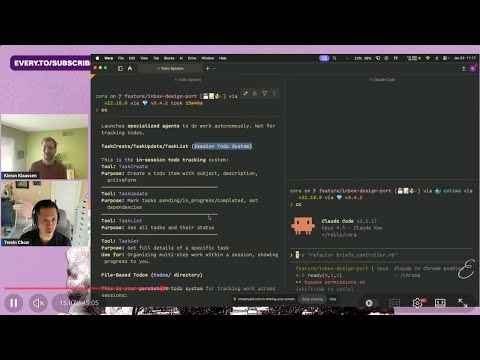
Claude turned Todos into Tasks. Let's test it out.
Kieran Klaassen, GM of Cora at Every and maker of the compound engineering plug-in, goes live to test Claude's new shift from Todos to Tasks.
# Video Identity Extraction: "Claude turned Todos into Tasks. Let's test it out."
## Video Format & Presentation
- **Live stream / collaborative jam session** with a guest ("we're live", "let's just jam a little").
- Spontaneous, exploratory format: neither host nor guest had prepared an example of the feature being tested ("I don't have a great example right now", "Me neither, but like should we try?").
- Interactive audience component: chat suggestions directly steer the testing ("people are actually saying what to do. Check cloth tasks. Let's go", "someone says also to do CtrlT").
- Ends with a wrap-up and channel community call-to-action: "if anyone else has ideas, uh just create a pull request".
## Intended Audience
- **Developers already working hands-on with AI coding agents** (Claude Code / "cloth", OpenCode, Codex, Beads, git hooks, work trees) — assumes fluency, no onboarding explanations.
- **Contributors to and users of the host's "compound engineering" plugin ecosystem** — frequent references to "the compound engineering plugin", pull requests, skills, and converters.
- Solo/small-team builders curious about agent workflows: guest notes "I'm one person", host references "we have two on core".
## Claimed / Demonstrated Scope
### Creator's explicit self-description (host)
- Maintainer of an open-source plugin ecosystem: "the compound engineering plugin", with sub-projects discussed — "compound writing", a proposed "compound planning", "compound product" attributed to a prior guest (Ryan Carson).
- Accepts community contributions: guest (Trevan) "started doing pull requests on the compound engineering plugin"; host asks viewers to create pull requests.
- Runs a recurring guest live stream series: references "yesterday we talked with uh Thoric", "yesterday we also had Ryan Carson on", and "we'll do more live streams" from an upcoming team meetup.
- Has a **paid subscriber community**: "you know how you have the every um subscriber discord" (per guest's description), plus "every subscriber" chat participation implied.
- Works at a small company (Kora is referenced by guest: "when you're working on kora and other things there's so few people"; host: "we're all flying to Panama... to meet all my lovely colleagues").
### Demonstrated scope (from behavior, not claims)
- **Hands-on testing of bleeding-edge Claude Code features** on stream: creating tasks, listing them, poking at home-directory task files, reverse-engineering source code ("can you reverse engineer look at the source code of cloth code").
- **Community-driven development**: live decisions to modify the plugin ("I'm going to delete this and start using that", "we can just hack it... add that as a skill").
- Discussion level spans tooling tactics (env variables, session scoping) to strategic speculation ("Anthropic eating the world here", "contextual intelligence is the next frontier").
## Identity Signals
- **Informal, profanity-adjacent, self-deprecating tone**: "I'm a dumbass probably".
- **Cross-platform presence**: host met the guest "on X" two days prior; mentions of "TK's post" and "Boris reshared it".
- **International guest pool**: guest notes "I have a thick dud accent".
- **No formal self-description or channel boilerplate appears in the transcript** — identity is conveyed entirely through demonstrated activity and community references.
# Delivery Observation Document
## Overview
A live-streamed, two-person jam session between the host and guest (Trevan) exploring Claude Code's new task management system. Delivery style is exploratory, improvised, and dialogic — closer to paired debugging than a presentation.
---
## Tone
- **Conversational and unpolished**: heavy filler throughout — "Uh," "Um," "Yeah. Yeah. Yeah." Frequent false starts: "so so yeah, like let's just jam a little bit."
- **Enthusiastic, escalating when surprised**:
> "Multi- aent swarms. Holy moly, that sounds great."
> "Wow. Holy moly. Is this true?"
- **Self-deprecating moments**:
> "I'm a dumbass probably."
- **Friendly, appreciative opener**: the host spends the first minute publicly crediting the guest's pull requests: "he was just reading my mind."
---
## Vocabulary & Recurring Phrases
- **"Jam" / "jam on stuff"** — used repeatedly to frame the session:
> "It's fun to jam on stuff." / "Uh, but yeah, like let's just jam a little bit."
- **"Compound"** as a recurring morpheme: *compound engineering, compound planning, compound writing, compound design, "how do you compound."*
- **"Context"** as a central keyword: "context management," "contextual intelligence is the next frontier," "contextual organizational intelligence."
- **Repetitive intensifiers**: "really," "just," "kind of," "literally," "very" appear very frequently.
- **Playful hyperbole**: "Skynet is going to do its thing," "anthropic eating the world," "beads is taking the world by storm."
---
## Teaching / Communication Habits
- **Thinking out loud**: the host narrates hypotheses live — "So, it says it has task create task. So, this like I know DK, he wrote a beautiful post, but I don't read."
- **Live trial-and-error demonstration**: rather than explaining features, he tests them on screen and reacts: "let's just do some random thing so what I want to see it's create."
- **Audience incorporation**: chat suggestions are read and acted on:
> "Oh, people are actually saying what to do. Check cloth tasks. Let's go. There we go."
- **Question-driven dialogue**: the host repeatedly turns exploration into questions to the guest — "What do you think? What is in your head?"
- **Metaphor and analogy** (mainly the guest): "the brainstorm doesn't need to be the ledger of its work," tasks as "sub agents," comparing env-variable config to "a hack."
---
## Structural Patterns
- **Opening ritual**: greeting, introductions, crediting recent contributors and prior streams ("yesterday we talked with uh Thoric... yesterday we also had Ryan Carson on").
- **Middle**: hands-on experimentation with visible confusion and recovery ("Okay, so it is global but it's scopes. Uh okay. So I'm confused still.").
- **Closing ritual**: forward-looking action item ("make a plan... and we'll just I'll just post this"), personal logistics ("fly to Panama"), thanks, and an open call for pull requests.
---
## Speaker Differentiation (with uncertainty)
- The transcript's `>>` markers distinguish speakers inconsistently; attribution of some quotes is uncertain. Broadly:
- **Host**: drives the demo, addresses the audience, handles sign-off.
- **Guest**: delivers longer conceptual monologues (context intelligence, Unblocked, project-management framing) and predictive commentary — "my prediction here is that like most people are going to have their own version of a task or to-do list."
- Given overlapping speech and unreliable markers, individual pattern attribution beyond this should be treated as low-confidence.
---
## Stable Patterns vs. Isolated Moments
**Stable (repeatedly observed)**:
- Filler-heavy, improvisational tone
- Live experimentation with verbalized reasoning
- Recurring vocabulary ("compound," "context," "jam")
- Audience-chat responsiveness
**Isolated**:
- The "Holy moly / swarms" excitement spike (appears once, around a suspected hallucination, then self-corrected: "we got too excited")
- The self-deprecating "I'm a dumbass" line (single occurrence)
- Travel/sign-off logistics (single closing moment)
# Observation Document: "Claude turned Todos into Tasks. Let's test it out."
## Speakers
- **Host (Kevin, per closing "Thanks, Karen/Kevin")** — host of the livestream, creator of the compound engineering plugin. Attribution uncertain; transcript only shows closing thanks.
- **Trevan (Trevan)** — guest, contributor of pull requests to the compound engineering plugin.
## Context
- The two met ~two days before on X over pull requests. Host: Trevan's PRs "were just reading my mind" and did work the host "already wanted to do and never pushed forward."
- A previous day's conversation with "Thoric" alluded to a new **task management system inside Claude Code**, now released, which prompted this live test.
## Trevan's Positions and Reasoning
### Markdown-first convergence and tool churn
- Everyone has converged on **markdown task lists**; Claude updates them unprompted.
- He has installed/uninstalled **Beads** "like a dozen times" — the git hooks are "doing too much."
- Tried a Beads Rust port, but faced the **database syncing dilemma** ("Do I want the syncing or do I not?") and abandoned it, returning to markdown.
- Wants **no dependencies** in the plugin; he's added Beads to a repo and "ripped it all back out" repeatedly.
### Compound planning as super-set of writing
- Planning is the superset of writing: brainstorming → plan → tasks.
- He contributed a **brainstorm workflow** and had success with an iterative document-review loop that self-reviews, corrects, then Q&As with the user.
- **Waste observation:** agents spent excessive time and tokens updating markdown ledgers during execution; the brainstorm "doesn't need to be the ledger of its work" — it should seed the plan, and the plan is "a snapshot in time."
- Proposal: possibly **split compound engineering into multiple plugins** (engineering, writing, planning/design), since mixing them is "dangerous."
### Reactions to the new task system
- No guidance exists for grouping/labeling tasks; tasks live in the home directory's Claude folder.
- Prediction: Anthropic will inevitably build project management, dependency tracking — "a version of Beads in itself" ("Anthropic eating the world").
- Counter-position: instead of telling the model how to track tasks, **just state the tasks**; it derives dependencies itself during planning. The value of the compounding loop is "judgment, taste, and scaffolding above" task tracking.
### Contextual intelligence
- Claims "contextual intelligence is the next frontier."
- Argues the engineer's instinct that "everything should be in markdown" is **at odds with reality**: in larger companies context lives in Notion, Google Docs, Slack — "context is messy."
- Uses **Unblocked** (getunblocked.com) — connects repo, Slack, etc., offers MCP, desktop apps, Slackbot. He wired a skill combining the learning analyst skill with the Unblocked MCP. Compares it to "Contact 7 but for your internal" knowledge.
- **Caution:** using task management *as* contextual intelligence "gets very bad" — mixing two things that shouldn't be the same.
## Host's Positions and Reasoning
### Context management pain
- Feels pain in context management: token overuse, over-compaction, "lessons learned are lost."
- Hopes tasks enable **compounding steps and handoffs** between phases (planning → work), viewing tasks as "kind of like sub-agents" with their own context.
### Beads-inspired multi-agent pattern
- Likes Beads' **persistence across sessions** enabling parallel Claude instances: a planner (talks with him), a worker (picks up tasks), a tester (runs browser tests). Now "natively possible" — though this was a tentative assumption ("I assume").
- Values the home-directory location: no work trees ("it works once in a while but it's always confusing"), tasks referenceable from any branch.
- Constraint: **won't add dependencies** to compound engineering.
### Live testing findings (joint session)
- `/task` is confusingly tied to background-task/sub-agent terminology (verb vs. noun confusion).
- Created a task in one session; a new session **could not see it** — no automatic sharing.
- Tasks stored in home directory `tasks` folder (not `todos`); per-session files found there.
- Setting `CLAUDE_CODE_TASK_LIST` to an ID can share a list, but both speakers agree it's **"a hack"** — just a global ID, no subcategorization.
- Documented tools: task create, update, list, get — **no task delete** (host notes he'd want delete; workaround is status change).
- Status workflow: pending → in progress → complete. Both note missing states:
- Host wants a **"ready"** state (approve AI-proposed tasks before execution).
- Trevan suggests **"blocked"** status; host flags possible side effects coupling blocked-by-dependency with status.
- **Dependencies exist**: tasks reference IDs via `blocked_by`, but only **within a thread/session** (cross-thread/cross-project unresolved).
- A "teammate tool / multi-agent swarm" feature surfaced in a summary; both got excited ("Is this true? Do teams exist?") — then discovered **it was not real in the source code** (likely hallucinated). Contradiction preserved: initial excitement, then "Okay. This is not there."
### Planned workarounds
- Host: reverse-engineer the official tools and add them as a **skill** doing the same operations hackily via the file system, "and then we wait until Anthropic makes it."
- Trevan: create **namespaced custom attributes** (e.g., `compoundengineering.*`) on tasks to avoid collisions with future native fields.
- Trevan predicts most users will have to **unlearn and remove their own todo-list tentacles** built into skills/commands.
- Host: remove the compound-engineering `todo` skill (only used in review gathering) — but complication: he just added **OpenCode and Codex support**, which lack the native task system; Trevan suggests conditional instructions or converter-script filtering per target.
- Host precedent: native `/plan` broke his `compoundengineering plan` slash command (namespace lesson learned).
## Agreement and Open Tensions
- **Agreed:** home directory is the logical first step for solo/small teams but "you can't store this in your home directory" for multi-team — "which then you get all the way back to the Beads problem."
- **Agreed:** Linear/Jira lessons still apply — complexity of taxonomy, organization, metadata storage.
- **Agreed:** cross-session/cross-agent orchestration is the most powerful near-term use ("orchestrator agent" picking up queued tasks, auto-filing independent issues, creating PRs).
- **Unresolved:** how task scoping/global sharing actually works; whether cross-project dependencies are supported; whether the summary's "teams/swarm" features exist.
- Closing: host plans to run "plan Ultra" on findings, send it to friends, and post it; he's flying to Panama to meet colleagues; invites more pull requests.
# Speaker Attribution & Provenance Record
**Video:** Claude turned Todos into Tasks. Let's test it out. (ID: `01a0f15a-b089-7af8-a043-1786fa8de18a`)
## Speakers & Roles
### Primary Speaker — **Creator / Live Stream Host**
- Identified as **"Karen"** (addressed by name in closing: "Thanks, Karen.")
- Runs the **Compound Engineering** plugin project; the guest submits pull requests to it.
- Describes his own setup: solo operator ("I'm one person"), mentions "two on core" team.
- Drives the live demo (shares screen, creates/tests tasks in Claude Code).
### Guest — **Trevan / "Trev"**
- Introduced as **Trevan**; met the host **two days ago on X** over pull requests to the compound engineering plugin.
- Role: **open-source contributor / collaborator** on the host's plugin (contributed the "brainstorm" workflow and a "learning analyst" component).
- Contributes the product-side perspective; describes his own experiments with tools (see below).
- Explicitly **cannot share his screen**; participates verbally.
- Closing: he is flying to **Panama** with colleagues ("we're all flying to Panama next week").
### Mentioned Third Parties (not present, no dialogue)
- **Thoric** — prior-day guest who alluded to the new task management system.
- **Ryan Carson** — prior-day guest doing a "compound product" and demoing loops.
- **TK** — author of a post about the new system; **Boris** reshared it.
- **DHH** — referenced via a "DHH agent" and "a beautiful post" (host says he doesn't read it).
- **Live chat audience** — offers suggestions mid-stream ("people are actually saying what to do. Check cloth tasks").
## Provenance & Referenced Sources
### Products / Tools Referenced
- **Claude Code task management system** (the video's subject) — claimed to store tasks in home directory (`~/.claude` tasks folder), session-scoped by default, with env vars `CLAUDE_CODE_TASK_LIST` / shared task list options; claimed tool surface: task create/update/list/get; **no task delete** (per chat claim); statuses pending/in-progress/complete; dependency via `blocked_by` referencing task IDs.
- **Beads** ("Beads is taking the world by storm") — guest describes installing/uninstalling it a dozen times; also a **Beads Rust port** requiring manual database syncing.
- **Unblocked** (getunblocked.com) — guest endorses as "game-changing"; connects repo, Slack, offers MCP, desktop apps, Slackbot.
- **Compound Engineering plugin** — host's project; includes to-do skill, brainstorm workflow, converters, recent support for **OpenCode and Codex**.
- **Notion, Google Docs, Slack, Linear, Jira** — referenced generically in project-management discussion.
### Claims to Flag
- **Possible hallucination:** mid-stream output describing a "teammate tool integration" and "multi-agent swarms" in Claude Code source; hosts explicitly question it ("Is this made up?... Is this real?") and it is **not confirmed** in the transcript.
- Dependency-tracking claims about the task system come from the hosts' live reading of tool output/docs, not an authoritative source.
## Promotional Segments
- **Unblocked endorsement** by the guest ("pretty game-changing product") — unpaid/undeclared status unknown; flagged as promotional in tone.
- Host promotes his **subscriber Discord** and his own **Compound Engineering plugin**, invites viewers to submit pull requests.
## Availability & Uncertainty
- **No curated metadata supplied** — titles, channel, dates, and full legal names unverified.
- Speaker name spellings ("Trevan"/"Trev," "Karen," "Thoric," "TK," "Boris") are inferred from phonetic transcript; uncertain.
- **Comment availability:** a live chat exists (viewers interact), but archived comment availability is not stated in the source.
- No timestamps available; speaker turns are separated by `>>` markers only.
Yeah. Okay. Hello, we're live. Uh uh welcome Trev Trevan. Uh \>\> hey \>\> Trevan I met two days ago I guess on X
and P request. \>\> Um he he started doing pull requests on the compound engineering plugin and and there are lot lots of people that do pull requests but like his were just he was just reading my mind. He was he just added pull request for like oh yeah I I that's in my mind I needed to do that already or like okay great this is just he's just doing the work I already wanted to do and just pushed forward and and never did. So thank you Trevan for for doing that. That's amazing. Uh and yesterday we talked with uh Thoric who uh alluded to a new task management system inside cloth which has been dropped now and it has implications. \>\> For sure. For sure. and and I would love to just like talk with you and like hear your thoughts uh on on what that means, how we can put it into um into compound engineering as well. Uh so so yeah, like let's just jam a little bit. I haven't tried out the task management system either, so uh we can just try that out as well. But yeah, like it has lots of cool interesting parts and I'm just figuring out what
does it mean? Like what do what do you what do you think? What is in your head? \>\> It's interesting. I mean yeah like I think one thanks for having me. It's fun to jam on stuff. I it's funny how you
can just meet people serendipitously and kind of have a mind meld and so makes sense. Um yeah, I mean t like we've all centered around so far I think like this whole write write in text write in markdown keep everyone has converged on to like some base level of like a markdown task list and then cla's really great even without you even telling it. \>\> It just knows to go back and touch it and update it. And then, you know, obviously Beads is taking the world by storm here and I've played with it, but like you I haven't I've gone back and forth like I've I think I've installed it and uninstalled it like a dozen times because I it's doing too much. Like all of the git hooks and things like that like it just is too much. And then so then I've started experimenting with the beads rust port that someone did. \>\> Yeah. Lighter weight. It's lighter, but I quickly then realized, oh, wait a minute. I have to manage all the \>\> beads database syncing and I'm like, oh wait, now I'm stuck. Do I want the syncing or do I not? So then I kind of abandoned all of it actually and kind of stuck with the tried and true thing of like markdown files and and things. And so then I started really diving into the compound engineering stuff and kind of thinking through like even I saw your PR for compound writing which kind of read my mind too. So because I've been thinking about compound planning \>\> and the planning is like the supererset of writing right where it's just like from a product side it's hey I'm brainstorming the feature which is why I contributed the the brainstorm uh
workflow recently and I've been having a lot of great success at that \>\> but the issue is like how do you compound and iterate on this thing which involves a lot of tasks so you have a lot of interesting agents like the DHH
agent and all that stuff I think is really slick it's obviously I think given your background it's really like technical oriented mine was from like a product side where I'm like, "Hey, so now cuz now I proposed at Open PR I have on the on the repo a uh document review like iterative loop and I was playing with this last night and had some really great luck with it with it basically reviewing its own brainstorm plan and then basically automatically doing corrections and then going into a Q&A with you. \>\> So I've had so I've had good success with that. problem is is then you have tasks that come out of that and when you do so what I found it was doing it was spending so much time and tokens updating markdown documents I'd see it it would say it wait 3 seconds and say okay cool I've gone back and updated the task but then it was even going into the plan and documents markdowns that were originally created to update it as it was going and that feels like wasteful because the brainstorm doesn't need to be the ledger of its work it's like brainstorm to seed the plan and the plan's like a snapshot in time. \>\> So then that whole thing dropped and TK's post went up and and Boris reshared it. I was like, "Oh man." And I sent you that note yesterday. \>\> So it's like I I it feels like So then I immediately got into, "Okay, so it should be more specific actually and or maybe less specific and just let \>\> Claude cook and do its thing." \>\> But then I started diving into it thinking like there's no instruction for how do tasks get grouped and labeled.
it's just in your home directory in the cloud folder which in one way is very powerful because then you have multiple agents that are picking from this but then you start thinking about normal
things like organization priority dependencies like all the stuff that beads is \>\> tackling and all things I think that we think of as humans but the machines need to reason over it so then I don't they don't have any guidance yet on how to interact with the task and how do I it feels like they're inevitably going to get to which essentially like anthropic eating the world here which is like they're going to build project management and dependency tracking and essentially like a version of you know beads in itself. \>\> So my neurons are all firing about this. So that's where my mind has gone you know like recently like literally last night and this morning about \>\> how how can we reduce instead of telling it how to track the tasks and mark the task it's really just state the tasks and even do we even have to tell it dependencies because it's figuring out the dependencies especially during the planning phase so if we if it can derive all that it needs to keep its ledger we kind of trust Skynet is going to do its thing \>\> we then focus on like the compounding part is different. It's like the value in the compounding loop isn't about task tracking and and dependency management. It's really thinking using judgment, taste, and \>\> like the scaffolding above that. So that's where I kind of I've been obsessed recently, which is why I sent you that note about compound planning, which I think is like a whole other like a maybe \>\> it's time for compound engineering to split really into two different plugins \>\> because you're now dangerously \>\> mixing like so like even your compound writing it's not about the engineering part. I think it can be used but it now you have maybe three. \>\> Yeah. \>\> Anyways, that's my \>\> Yeah. Yeah. Absolutely. Yeah. So yesterday we also had Ryan Carson on and he's basically doing like pro a compound
product that's \>\> I saw that I saw that. Yeah. So like I was like yeah I agree and and I feel this as well like combat engineering like everything works so well now that we can go more out in both ends so we
can like do more planning or more like product marketing or stuff after and uh I I agree uh and at the same time on also thinking like how how does it all work because like these are all really cool thoughts. But like how would I use it? \>\> Like how can we make it practical? How how will help me ship features to quicker and \>\> uh so like this all resonates a lot like let me give my take what I was thinking like with with with this coming out I was thinking that context management like I I feel a lot of pain in context management like where people say oh it's using too much tokens or it's compacting too much and Um and things are lost like lessons learned are lost within the massive amount of context. So you cannot compound everything like how do you compound where are the artifacts and that was always a little bit hard but maybe with a task management system we can actually have like compounding steps after tasks or we can have handoff from like a planning phase creating tasks and
then the work like phase has more context or like better understanding of what happened in the phase before and if we have this plugin that is good at
planning for example like how do you like currently it's a markdown file which is a plan but like is that the best form like I still think it's good but maybe the tasks um are also there and it referencing the task so I'm just curious how how we do that because I feel like tasks are kind of like sub aents in a way since what they share is it has their own context. That's at least how I understand it a little bit where like you can pass information or context around. So, have you tried the task management system already? \>\> I I have I \>\> Do you want to share your screen and see just show how it works because \>\> I don't have I don't have a great like I'm I don't have a great example right now. I'm \>\> Me neither, but like should we try? \>\> Yeah. I don't I don't have a I got some since my screen I can't really share right now. So, it's a little tricky. I'm kind of popping in. So, I'll I'll talk about it verbally. Um, this idea \>\> I'll I'll try to do it on my on my screen. \>\> Then you you stumble into it really quickly actually. Um, because it automatically did it for me uh this morning when I was working on something. It just literally said I'm writing out tasks. I was like, "Oh, this is interesting." And the way it worked. I I think that your point about context is really important. I think this contextual intelligence is the next frontier. I think as engineers like you when I hear now I see I see kind of the way you think about through the repo I think it's natural for a lot of engineers to think everything should be in markdown how do we you know create an artifact and a summary of this thing I think in general that's at odds with I
think how reality works I think there's context in so many places and I think maybe at every when you're working on kora and other things there's so few people but I think the reality is
context is messy and shared across notion like in a real like a in a in a much larger company that's like you know quote real but it's not you guys aren't real but like big \>\> you have slack \>\> yeah I I'm one person which is very different or like we have two on core but it's different yeah \>\> totally so imagine I think context in like a multi like a say even 10 people it's notion it's Google docs it's slack a lot of the time and a lot of how many times have you been in a slack conversation where they talk about hey let's take this out a thread because this information is going to get lost. So the pro the reality is that doesn't work like humans work through different modalities. So I think this idea that you're talking about this contextual intelligence is really important. I think there's this rise of these systems that are about instead of forcing everything to create an artifact that the machine reads, how do we create a system in which the machine can query for context? Like one of the products I've been using recently is called unblocked. It's get unblocked.com. I sent it to you. It is a pretty pretty game-changing product. Like you connect basically all your sources of institutional knowledge. It connects your repo, Slack, everything. And it offers an MCP as well as well as desktop apps and a Slackbot. So it's just a really interesting thing because the way I have it wired up is I have a a skill that basically when I have a question it can invoke it and one of the things it does is it does the learning analyst from the thing that I contributed to the
competent engineering but it also asks for the unblocked MCP. So it actually tries to combine it and it actually get information back. So \>\> so it's like contact 7 but then for your
internal \>\> for your internal. So imagine even cuz you know how you have the every um subscriber discord. I imagine it was like a there's a raging conversation about a very specific bug or something like that. If you if this contextual engine could pull that knowledge from there, it could actually just reference that and it wouldn't be lost. So I think there's this I'm currently obsessed with that idea as well. not only this compound planning but the idea of contextual organizational intelligence like how are we making the machine smarter instead of trying to do so much work to give it the context that it needs and so I think there's a lot of people building this stuff and I but I think it's much harder than people realize which is why I go to like companies like Unblocked I think they're working on such an interesting product that I think people trivialize that is hard and then everyone the rest of us \>\> can then focus on like actually building the product that we're actually trying to build instead trying to build the scaffolding like around it. So, so then I think that then relates to tasks as well because then the dangerous part is I think we could then think about we should create a ta use task management \>\> as contextual intelligence and I think that's where it gets very bad because I think you're then mixing two things that shouldn't be the same. \>\> Yeah. Yeah. So here, so I'm I'm figuring out how So yeah, I I agree on those things and it's kind of interesting because I I feel these less because it's just a smaller team and and the Yeah, like it's very real if you're a bigger uh but but it's about gathering the right information, linking things together. Um but I think yeah so tasks are so it's inspired by beats and what I like about beats is that \>\> it persists across sessions like that's just a strength. So you can have different cloth instances do different things. So, for example, with beads, a pattern I like is having different uh clothes running next to each other where one is just I talk with. I say you're
like the the planner where I say, "Hey, I want to do this and this and this." And one is the worker that picks up tasks. \>\> Yeah. \>\> And works on it. And then the third is the tester that runs and tests runs the
browser and sees if it works. So it's like that is now natively possible I assume which is kind of cool. Um and so okay so uh \>\> yeah that general that that that cross agent thing I think is initially the most powerful thing cuz now all of a sudden how many times have you been in a cloud session where you're like oh there's that thing that has to get done but it's a completely different task. What do you what do you do? And so the fact that there's now a task ledger that's kept outside of that session I think is very powerful. And I think what we probably will see is a lot of skill and tooling and then ultimately cloud will just do this is knowing when to file an issue that's completely going to be tackled in an independent thing and at some point it should just ask you and know oh this is a really small task. I'll just go do that for you. Create the PR \>\> some agent or does something. Yeah. So, so let's see if we can get that to work here. Uh, so just for me to learn how this even works. So, it says it has task create task. So, this like I know DK, he wrote a beautiful post, but I don't read. I uh I just ask \>\> AI to do things. So, you can see there are like it's it's also a little bit confusing because task is still a sub agent I guess, \>\> right? uh and the task create list and update are session level progress tracking which I'm curious what session level is that in this thing because I thought it was shared uh and this is my own. So \>\> that's an interesting that's an interesting description of a task that it's a verb versus a noun here because I think if when someone says create a task the way this is it's like a sp this is actually going to go do the thing. Um, so it just terminology wise it throws me a little bit. Um, \>\> yeah, but this is old. Like this is like sub agents were renamed tasks at some point. And I don't know if that's still the case or not. Maybe that's in my own prompting that I do this. Uh, so but but let's see. Let's see if I can create uh create a task.
Uh, okay. Let's see. create a task a new task and say review the landing page see if we have all the meta data set
correctly let's just do some random thing so what I want to see it's create and see how I can okay so task one created review the landing page do I have any open tasks okay so it says something so on the Right. One I ask, do I have no no task found? Okay. So, there's no sharing, which is interesting. \>\> I wonder if you have any of your skills or agents that is influencing this behavior of where to look. Do do you have anything in the comment engineering stuff that is specifying a to-dos folder or not at all? \>\> There's a to-do scale. That's that's about it. But, uh, yes. What if you what if you disabled that skill and then reloaded a new session and did the same thing? This is what I'm kind of getting at cuz I've realized that I've had to delete a bunch of skills and commands that I I've had accumulate, not realizing influencing behavior. \>\> Oh, sorry. Uh yeah, I I yeah I will I will do that. But I think yeah, I I I just want to understand this first. I think it is in session. So So CtrlT to hide. So you can see tasks like this which is cool. Um \>\> oh you know what I wonder if you restart the session just as is it reloading it and managing my session. \>\> So like resume you mean or \>\> Right. Right. Right. I wonder if you did a continue on that and asked it what are the tasks like? \>\> Yeah. So no it forgot it. \>\> That might be the background task but what about asking it does it have tasks? Like this is with our problem of terminology now all of a sudden. \>\> Uh but it sad to run this right \>\> or
\>\> Yeah. Oh wait there. Oh this is \>\> I mean these are mine. So I know these these these are not okay. So okay let's see \>\> what about in your cloud.cloud folder in
your home directory. It that that's where they're supposed to be saved. \>\> Okay. Let Let's see if we can find this. Uh, see, we're experts here. You You see you're seeing it. Um, yeah. So, maybe maybe what I should just do is uh put in the documentation or something. Um, good tasks announcement something. Um, here I'll do a can you look for uh the documentation on tasks in the anthropic docs so we know how it works. We have no idea. So, one thing I I So, I've thought about adding beats to compound engineering, but also um I don't want to add any dependencies. So, that's \>\> it's tough. It's tough. I've gone like literally I one day I'll go all in on it. I say, "Oh, I got to add this to the repo." And then I say, "What have I done?" and I rip it all back out because for the same reason, but I also think it's the friction of \>\> there's just too much going on \>\> that is relying on Git hooks and automatic stuff that I've had so much chaos happen um uh that I have shied away from it. \>\> Yeah. Okay. Oh, people are actually saying what to do. Check cloth tasks. Let's go. There we go.
I have not checked that. So, let's go.
Uh oh. Is it in the session? Oh, it's weird. So, it's not in there. \>\> Interesting. Is it in your home directory? I thought that's what they said. \>\> Yeah. Okay, let's see. Okay, there is something here. Okay, there is something here. Let's use cursor. There we go. Okay, so this is the session I guess. \>\> Yeah, this is probably session ID. I think storing it in your home directory is the only reasonable way because if they really want to go cross agent, they can't assume it's in the same repo or whatever. I would assume that it would eventually support hierarchy as well. Like it almost has to, I think. \>\> Yeah. But it's it's weird that it's not showing here. So \>\> that's why part of me is like if you I wonder if it's a nomenclature problem. \>\> Uh oh. Oh, I resumed. Ah, I think I resumed my ride session. Okay. I'm a dumbass probably. So now this is here. \>\> No. Um, \>\> so this is the challenge. You're doing this tasking. It's literally that this is the background task. So when you ask for tasks, it's almost confused at what you're asking it about. \>\> Uh, okay. List my tasks. \>\> Oh. Oh, there it is. \>\> Okay, it's there. Okay. Boom. Uh, we got it. Um, yeah. And uh we yeah you so we can also cloth code task list ID you can set to one and start. Okay so there's an environment variable where you can also do that which is cool. Okay so it does persist it doesn't persist across uh sessions. \>\> Yeah you can set an environment variable
like they have an environment variable that's like you can specify the ID but the problem is is that's not that's like during the invocation and the terms like that's not natural. \>\> Yeah.
uh globally. So, can we set it globally? Because it says in session, it will be cool to do it globally as well. And yes, I'm saying be d I'm sorry. I'm I have a thick dud accent, so my DNT it's it's all the same, you know. Uh okay. So, so it is global but it's scopes. Uh okay. So I'm confused still. So if I \>\> have the to-dos added, it uh it adds the thread ID or not. Or if I open any other cloth code, does it read all the to-dos in my home directory? But one one thing I know I can remove in uh compound engineering is my skill to-do right \>\> and so there's a to-do skill sorry todo it's not used a lot but it's used mostly or the only place it's used is when you run the review and it gathers all the information \>\> and it just uses this. So I'm going to
delete this and start using that. But the so the issue now also which is really fun is I recently uh two days ago also added support for open code and
codecs. \>\> Okay. \>\> And obviously they don't have this. So \>\> yeah, you might need you might need instead of deleting it, you might actually give a specific instruction instead and saying um you know if you're this do this otherwise you know use the skill as is \>\> and also like I already do that for example with codeex uh codeex doesn't support invoking slash commands programmatically so I just moved all my slash commands to be skills inside codeex \>\> which is either way what is already being done internally kind of with cloud code. We talked about it to do it for cloth code as well. So we can change this conversion because there's a script that like converts it to a specific format here somewhere converters. So I can say maybe don't include this skill for here and or inject the skill for I mean I I have not reviewed this but it works. \>\> Yeah. Yeah. Yeah. \>\> So we can do different conversions as well. um like the friction that they're running up of. I mean this feels so natural that they did this not because of bees. I think bees almost is because it's relevant in the conversation but like \>\> it's natural because as we've scaled up you have all these agents but even if you don't say they're autonomous like your last the person you spoke to yesterday it was like \>\> very different like I laughed at the time where he said maybe you weren't working on big enough features or whatever that was a funny part but I think his his turn of the crank is like really different than I think where most are doing it where they're you know they have multiple sessions open there is some autonomy going on but they're not trying to necessarily do it fully autonomous I I don't I don't think most of us are there yet or really want that. \>\> But I think it's interesting. But I think where we're at when you have multiple tabs open with multiple sets of work that you are queuing work
essentially your mind. It's really how do you get this out? And so \>\> it's essentially another version of multi- aent orchestration through tasks. And so this is it feels so inevitable that they got here. But I think
\>\> how does it work? because I cannot really I cannot really load it now because these are two different sessions and \>\> and it's can't it's not seeing it. So the task thing again I think that this slashtask is tied incorrectly to the notion of background tasks that it natively has had historically. So I wonder if you said something like what are my task lists or something like that? Yeah. \>\> Still not it still didn't find it. So it has what was \>\> but it is still being influenced here by looking in your Oh, it says no cloud code. \>\> I already ran task. There are no tasks in the current. \>\> Oh, what about in any in any conversation? I wonder if it's scoping it automatically \>\> because this will be very cool if you can have an orchestrator agent running and just have different things like put things. \>\> So see this it doesn't even know it's not even it's not even referencing. What if you told it what if you asked it about your home directory? Can you just look in my home directory in uh homecloud slash todos? It should be there.
\>\> Okay, so it found it. Good. \>\> The beauty of grab and bash. Um,
can you look in your What? I mean, this is a lot, but pending. Oh, these are pre from previous cloth sessions. Wow. Okay. Oh, interesting. What did I It's more than this. Okay, just let me just see if we do this. \>\> Oh, you know what? It's It says it's stored in not to-dos. It's stored in tasks in your \>\> Oh, sorry. Tasks. Oh, okay. Uh, yeah. Here. Check there. It's It's funny how confused confusing all the names are. And it's also like names in the app versus the programmatic way. Okay, there. Okay, found it. Okay, there we go. \>\> Okay, can you reverse engineer look at the source code of cloth code and understand why we're not loading every task just the ones in the session? And can you see in the source code of cloud code as well? Uh if there is a way if we can load all the tasks from here.
So we can access it. We just have to brute force it to read the files and most likely it has uh understanding. So like worst case we can read it.
\>\> My guess my prediction here is that like most people are going to have their own version of a task or to-do list and they're going to need to like not only unlearn it but also remove all of the tentacles that they've built into all their \>\> everywhere. Yeah. Yeah. Like I still have like to-do the the to-do uh add to-do or like to-do list or tool calls inside compound engineering even though they removed it I think a while ago already. Um okay let's see if it can reverse engineer and explain why they did this. This is always fun because I I like I think for like really what this makes this powerful. Yeah, I'm curious now. It's it's just a to-do list, but also like does it do how is it picked up as well? Like that's also an interesting Okay, maybe on the left. Can you also pull in the documentation about the new task update, task create, task list? also look at the source code maybe to see what it can do. Is there anything more and beyond just sorting files and doing things?
Okay, let's see. Someone says also to do CtrlT.
I don't think that does anything for me. Thinking no. Okay, let's see what comes out of this. But but worst case it's just a better to-do system that is file based which is just more clear \>\> right I mean I think they they has said as well that it is early and they're you know feeling that makes sense I think it is going to be just a \>\> it replacing our markdown like checkboxes with this makes sense I think the next step has got to be about project management and how they manage \>\> contention over tasks like you take a task. How do you know how do you follow dependencies? How do you not start a task before the \>\> I think that's built in. I think there's some dependency tracking. \>\> I didn't see it actually. So, actually look, if you look at um the task that was created in your folder there, I didn't see any metadata around it. Does it? \>\> Oh, it did. \>\> Oh, interesting. Okay. When I did this actually, I didn't have I didn't have those fields actually. I only had status. So, I or or I missed this. \>\> Yeah. Yeah. So I think there is the dependency I I think said yesterday that was in there which is cool. \>\> Um and \>\> I wonder how it does cross project
dependencies cross conversation. Yeah, like it should be able to do that I assume and so okay so a higher level
is the plan and there is a plans directory actually if you go into planning mode \>\> it's also in the home directory \>\> I have thought about moving compound engineering planning \>\> to the same location but I also like to have it bundled with my code that I ship \>\> I do I do too I do think there's value of that as an artifact. I don't know if \>\> Well, it's funny because then you suddenly get into multi-team. \>\> Yeah. \>\> Project management. You can't store this in your home directory, the task. \>\> No, exactly. Yeah. It has to live somewhere. Yeah. \>\> Which then you get all the way back to the beads problem. \>\> Yeah. Exactly. Yeah. Yeah. Um, \>\> but for smaller projects and things like that where there's fewer people, \>\> the home directory is the the logical first step because you definitely got a support cross session. \>\> Yeah. And and it's also you can kick off more research without work trees and all of that stuff. Like it's just it like work trees are always a little bit like it works once in a while but it's always confusing. Uh, as to me even uh like you always forget that you're in a work tree and like this and that and like where am I and and yeah it's just more to track. So I like that part and I also like that you can reference it immediately from any other
branch because if you check like you have that available if you go somewhere else because it's just there but I don't like that it's not uh okay so here we got actually something back. Oh, here
uh you can set cloud code task list to use shared task list. I'm sure someone said this already or not. \>\> But the issue Well, here's the problem though. So, I've seen this before. The problem with this is that \>\> if you set it to global, \>\> it feels like it's now just a global ID. How's there's no sub like there's no subcategorization. \>\> This is a this is a hack. Yeah, I get it. Yeah, this is just setting an ID and hacking it and then Yeah, like Yeah, I I get it. Yeah, this is not great. \>\> I mean, everything that we've learned about linear or Jira in the past still applies here, which is the complexity of the taxonomy of organization of all these workspaces and tasks. It's just a matter of how how like where are they going to choose to store it and how they will they store the metadata. \>\> Yeah. Yeah. Yeah. I Yeah. But this is I I now kind of understand. But also we can just hack it and say just go look for other tasks somewhere in this directory and and pick them up. And I'm probably uh probably it knows how to change it as well. So let's see. Let's actually I I have to go in a little bit, but let let's do this. Let's say um so look at there. Can you pick up the open task, spawn a sub agent, and uh change the status and everything uh like you know how to do like let's see if it can do it the
unofficial way as well cuz this was so on the right side this was not the session uh there where this was created on the left it was created so it shouldn't know
about this through the official tool calls but we're just going to see if it can be forced. \>\> It's doing interesting. It's not using any of its built-in tooling for any of this. \>\> So, that scares me into like it's unclear whether or not it actually is doing it in a smart way or just inferring it that it's a JSON file and your your own custom task list. \>\> Yeah, probably. But then we can just reverse engineer what these tools do and add that as a skill and then we have that and then we wait until anthropic makes it. Yeah, I'm curious to how quick it is for someone how quickly we will see people creating skills to basically augment the metadata and kind of work around it and then see um \>\> I think that's the first thing we'll do probably for compound engineering \>\> to \>\> create a better like a little bit \>\> oh I got what you could do is actually create your own attributes and prefix them in a namespace \>\> you know what I mean like have competent engineering and subattributes and then \>\> presumably they will write compound engineering attribute. \>\> Yeah, that's that's smart. Yeah, nice. Yeah, I had that where before slash plan was compound engineering plan, but then
slash plan was introduced and that didn't work anymore. So, I learned uh that where I got bug reports of it not working, but then I was like, that's not \>\> the code.
\>\> Um, okay. So, it's doing things. Uh, found pending task. It's doing a lot for let's see this uh \>\> yeah my I I was saying can you check the metadata in my homepage okay so let's see there's something here on the left as well teammate tool wow okay teammate tool integration wow okay there there's actually let's go over this and let's call a stream if that's okay to you as well \>\> yeah that works \>\> okay so we asked like to look at the code come up with something. So, uh, task create, task update, task list, and task get. I know someone said task delete doesn't exist, which is kind of interesting. Um, because that is what I do with task as well. If you find something in the review that you don't want to do, I just delete it. I don't want to see it because it's just \>\> not helpful. But I guess you can just \>\> say you're not doing it or change the status or something. Okay, so it's pending in progress is the status workflow. \>\> Clearly not doing that here. It's still pending. \>\> So if if that is the case, we need to just create a scale that has like the \>\> a new skill \>\> that will that will really pay attention. \>\> Will follow all these workflows and actually do the same things with these tools but then kind of hacky in the file
system but pending in progress complete. Um, I think that's good because um or actually I miss one workflow state
here because I sometimes have AI come up with tasks and sometimes I want to approve whether those tasks are good \>\> totally. It's almost like is it ready to begin or \>\> Yeah. So I I have the like the the like the pending and then ready. It's like okay this is good to go. So I would love a ready uh \>\> yeah it's almost like pending. I agree with you. Pending is actually interesting. It like in the parlance of most project management software it's like backlog versus ready. \>\> Yeah. Is this inbox like do do we need to do stuff or is this ready to go? It's just Yeah. So I I do miss a step there. \>\> There's also even a block status that they should have because literally it could be blocked on \>\> something catastrophic or something like that. \>\> Yeah. Yeah. And and if it's blocked by something else that is not completed, maybe it's blocked, but that's also like then suddenly you have side effects with status and stuff like that. But yeah, I agree as well. So active form uh present continuous text shown in spinner running test. Okay, this is just how it should do it. Dependency system. Okay. Okay. So it says run blocked by number one. \>\> Okay. So it blocks by \>\> and it references the ids. Okay. So it
does reference the ID \>\> but only within only within \>\> the threat. \>\> Yeah. \>\> Yeah. It's within the thread and like Yeah.
\>\> There probably will the easiest way to evolve that is to pre have a prefix where it's like the project ID colon whatever. \>\> Yeah. Mhm. Yeah. Yeah. Yeah. Um okay. So, team tool teammate tool integration. I don't even know what that is. \>\> That's interesting. Multi- aent uh \>\> spawn agent assigned. \>\> Oh, it's doing communication here essentially. \>\> Multi- aent swarms. Holy moly, that sounds great. Is this actually in this code? That would be kind of cool. Uh yeah. \>\> Or is it? Yeah, if it if it is, I mean, that's funny. So create a team autocreate task list create task create spawn teammate agent. \>\> Is this made up? You should I wonder if it's hallucinate this because it sounds uh \>\> it sounds amazing. I want this but teams. So in cloth you can have teams. \>\> Is this true? \>\> Wow. Holy moly. Is this true? Do teams exist? This sounds amazing. Can you check the source codes? Is this real? It starts to \>\> I mean \>\> this you have you have coordination problems though suddenly where you're like you almost have now the idea of \>\> parent task and child task because not every task like we start to again get into all the project management stuff. Um, ah, this should be \>\> Yeah, but if you have a good plugin like compound planning or compound engineering, compound writing, compound design, you're fine. If you do the the the the loops like uh Ryan was showing yesterday \>\> like \>\> Okay. So if this is not in Z probably
this is nice uh a native swarm support. Well if this is
in secret. Okay. \>\> Ah look at that. \>\> Okay. Okay. Wait. Okay. Sorry. But uh \>\> we got too excited. I was already surprised that that was it. That sounded way too far out there. But it's Totally. \>\> It is interesting to see. Uh no there. Okay. This is not there. \>\> I mean we should basically the next step is spin up a instance and have it write it and send it to talk about this is the next thing you should do. \>\> Yeah. Okay. Let's do Okay. It is interesting. So let's let's actually do this the proper way. Um plan Ultra. I think I'll do the deep end as well. This is very interesting though, the agents. So, can you make a plan of how this could look like and we can send it over to our friends and then we'll just I'll just post this. Cool. Okay. Uh I'm grabbing lunch. Uh I'm going to \>\> later today fly to Panama to meet all my lovely colleagues. \>\> Oh, you're they're in Panama. We're we're all flying to Panama next week uh to jam, so we'll do more live streams and things. Uh but yeah, like uh thanks so much, Trevan. \>\> Yeah, thanks for having me. \>\> Yeah, and keep just pushing pushing things to compound Engineering. Uh if anyone else has ideas, uh just create a pull request and uh yeah, we'll we'll make better. \>\> Thanks, Karen. \>\> Thank you. Okay, have a good one. See you everyone.