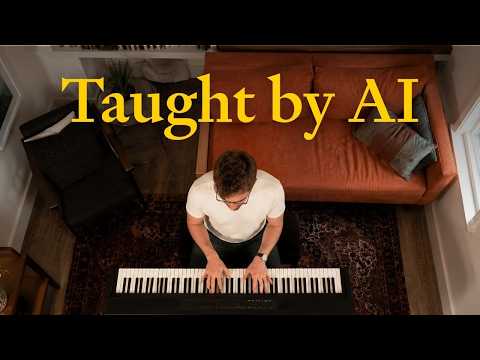
Codex Taught Me How to Play Piano
Dan Shipper, CEO of Every, plugs his piano into his computer and has Codex build a simple app that shows what he's playing in real time — the notes, chords, and music theory behind his favorite flourishes. He uses it to learn a passage from one of his favorite songs, break down why it works, and turn noodling at the piano into actual learning. The video covers building the app, recording MIDI input for Codex, the theory behind the flourish, and why this complements but does not replace a real teacher — an argument that it's the best time to learn anything if you're curious.
Timestamps:
00:00 Codex builds a piano teacher
00:41 Learning without endless scales
01:11 Finding the song that unlocked the idea
02:33 Recording for Codex
03:29 The theory behind the flourish
04:47 Turning noodling into learning
06:08 Codex watches Open Studio
07:06 Why this does not replace a teacher
07:27 It's the best time to learn
# Channel Presentation Observations: "Codex Taught Me How to Play Piano"
## Explicit Self-Description Claims
- **Direct channel promotion**: The creator closes with an explicit endorsement: *"If you liked this video, you should check out Every. Every is the only subscription you need to stay at the edge of AI."* This implies an affiliation with or promotion of "Every," positioned as an AI-focused subscription product.
- **Creator self-positioning as a learner, not an expert**: Repeated self-descriptions frame the presenter as an amateur enthusiast — *"I was the worst possible student ever,"* *"as an adult, I just like [ ] around on piano and guitar."*
## Intended Audience
- **Curious, self-directed learners**: The closing statement addresses this directly: *"if you're like just a curious person, this is the best time in the world to like learn... anything."*
- **AI-tool-interested hobbyists**: The entire video is framed around demonstrating an AI coding tool (Codex) applied to a non-coding hobby, suggesting an audience interested in AI capabilities beyond programming.
- **Music learners specifically**: The creator assumes viewers interested in learning piano/music theory, e.g., *"for someone like me who just wants to like learn stuff that I'm into."*
## Claimed Scope of the Channel (Observable Presentation)
- **AI tool demonstration format**: The video demonstrates a specific product workflow — plugging a MIDI piano into a computer and using Codex to build a note-display app (*"Can you make a little app to show me what I'm playing?"*).
- **Personal experimentation narratives**: Content is presented as first-person discovery and enthusiasm (*"It's so [ ] cool,"* "It just keeps surprising me") rather than tutorial or structured instruction.
- **AI-optimistic framing**: The presenter makes strong positive claims about AI-assisted learning: *"It's like I have this master teacher who is just into all the same stuff I'm into"* and *"the best time in the world... to learn anything."* Note this is a creator claim about AI, not an established fact.
## Demonstrated Patterns (vs. Claims)
- **Hedged endorsement**: The creator distinguishes the tool's limits: *"It doesn't replace having an actual teacher"* — suggesting a pattern of tempered rather than purely promotional claims.
- **Casual, unscripted delivery**: Censored profanity, laughter, and mid-recording surprises (*"Oh, [ ] An- another [laughter] time"*) demonstrate an informal, raw presentation style.
- **Third-party resource references**: References external channels/products (Open Studio's "root shell pretty" exercise; Lizzy McAlpine's channel; pianist Taylor McCall), showing the creator situates content within a broader learning ecosystem.
## Notable Absences
- No channel name, upload cadence, or format commitments appear in the transcript itself.
- No curated metadata was supplied, so identity context beyond the video's own content is unavailable.
# Delivery Observation — "Codex Taught Me How to Play Piano"
## Overall Tone
- **Enthusiastic, casual, first-person vlog style.** The speaker reacts in real time rather than presenting a polished lesson.
- Heavy use of **profanity as enthusiasm markers** rather than aggression:
> "Okay, this is [ __ ] sick."
> "It's so [ __ ] cool."
> "And um yeah, it's [ __ ] sick."
- **Conversational fillers throughout**: "like," "just," "you know," "basically," "um." These appear on nearly every line, e.g. "So basically, what I have going right here is I've got Codex on the left."
## Recurring Phrases & Vocabulary
- **"like" as an all-purpose connector** — the single most frequent word pattern; multiple instances per line.
- **"just" as a minimizer**: "I just press record," "Codex just goes off," "Codex just comes with me."
- Repeated positive evaluations: **"sick," "cool," "fun," "the best"**:
> "it's the best time in the world"
> "it's the best thing in the world"
> "music is the best"
- Repeated **"kind of / sort of" hedging**: "that makes it kind of hard to do more of it," "I'm just like kind of going up the keyboard."
## Communication Habits
- **Narrating prompts to the AI as quoted speech** — a stable teaching device:
> "I just told Codex, 'Hey, I want to... record stuff and I want you to tell me about what it is.'"
> "hey Codex, can you help me like figure that out?"
- **Self-interruption and restatement**: "I I I love Open Studio," "the the pianist," "It doesn't necessarily It doesn't replace."
- **Live demonstration paired with explanation** — describes on-screen actions as they happen: "This is the first position, this is the second. This is the third. Just going up the keyboard."
- **Declarative mini-lessons** embedded in the flow: "A flat and G sharp, if you're not familiar with music theory, it's the same thing."
- **Caveat then re-endorsement** at the end — repeats the same limitation twice, suggesting a deliberate framing move (though only two instances, so modest evidence of habit):
> "It doesn't necessarily replace like having an actual music [teacher]"
> "It doesn't replace having an actual teacher, but..."
## Structure
- Loosely chronological demo: setup → backstory → example song (Liziy McAlpine's "Older" — transcribed as "Lizzy") → music theory payoff → future use cases → sponsor outro for "Every."
- Ends with a **call to action / promo pivot**: "If you liked this video, you should check out Every."
## Uncertainty Notes
- Timestamps in brackets are line markers; no visual delivery cues (pace, gesture) are observable from transcript alone.
- The "caveat and re-endorsement" pattern appears only twice; treat as a possible but unconfirmed habit.
# Position Record: "Codex Taught Me How to Play Piano"
## Speaker
Single unidentified speaker (video presenter). No curated speaker metadata was supplied; all positions below are attributed to the presenter.
## Core Claims
### Codex enables real-time piano learning
- Built a **Codex-generated app** by prompting: plug piano into computer, display what's being played.
- The app shows **which keys are pressed and names them**.
- Claimed benefit: it lets the presenter "understand the music theory behind what I'm doing instead of just playing it blindly," which "helps me be a better piano player."
### Example workflow: recording and analysis
- Extended the app on request: press **record**, play, then ask Codex to analyze — chord progression, theory, influences/flavors.
- Codex pulls the saved phrase with **time signatures and keys** written out.
- Reported analysis result: the flourish is **A-flat add nine to A-flat sus two**, "basically a four to a one chord."
- Presenter's takeaway: what looked complicated is a **G-sharp chord (equivalent to A-flat) laid out across the keyboard** — a technique transferable to other keys/moments.
### Learning philosophy and motivation
- Background: learned piano from a jazz musician but was a poor student because he "didn't want to do" endless scales.
- Now plays piano, guitar, and other instruments casually "because music is the best."
- **YouTube claim:** "any song I want to play, there is a YouTube video" — cites *Older* by Lizzy McAlpine and a teaching video by pianist **Taylor McCall** on her channel.
- Stated danger of learning only what you like: "you don't know why it works... it doesn't generalize." Codex lets him move from interest → understanding → applying it anywhere.
- Claims Codex **opened an Open Studio YouTube exercise ("root shell pretty") in Atlas, downloaded it, and helped him apply it** — "like I have this master teacher who is just into all the same stuff I'm into."
## Qualifications and Caveats (preserved as stated)
- **"It doesn't replace having an actual teacher"** — stated twice explicitly.
- Honest acknowledgment of limits: "I may not find something that sounds good while we're recording."
- Presenter admits prior context: "I've done this before so Codex is going to know something about this" — i.e., the analysis wasn't from a cold start.
## Broader Claims
- "If you're a curious person, this is the best time in the world to learn anything" — generalize from piano to any domain via Codex.
- Ends with a promotional claim for **Every** ("the only subscription you need to stay at the edge of AI").
## Emotional/Aesthetic Positions
- Repeated enthusiastic endorsement ("It's sick," "the coolest possible thing").
- Surprise expressed at Codex autonomously using his computer to watch the Open Studio video.
# Observation Record — Speaker Roles & Provenance
## Video
**Title:** Codex Taught Me How to Play Piano
**Video ID:** `01a0f15a-8657-7335-b260-2810653792ef`
## Speakers & Roles
- **Unidentified solo speaker (presumed creator)** — narrates throughout in first person; demonstrates using Codex with a piano. No name provided in transcript or metadata.
- **No guests, interviewers, or additional speakers** appear in the transcript.
## Referenced Sources & Third-Party Claims
- **Codex (OpenAI)** — used to build a piano-display/analysis app; speaker quotes prompts given to Codex.
- **Lizzy McAlpine — song "Older"** — cited as a favorite song; short music excerpt played.
- **Taylor McCall** — identified as the pianist on "Older"; has a teaching video on Lizzy McAlpine's channel.
- **Open Studio (YouTube channel)** — cited as a favorite channel; exercise "root shell pretty" referenced; speaker describes having Codex open it "in Atlas," download, and analyze it.
- **Childhood jazz piano teacher** — mentioned anonymously ("incredibly cool jazz musician").
## Promotional Segments ⚠️
- **Closing promotion:** Speaker promotes **Every** ("the only subscription you need to stay at the edge of AI").
- **Extended positive framing of Codex** throughout may function as product promotion, though no explicit sponsorship disclosure appears in the transcript.
## Availability & Uncertainty
- **Speaker identity:** not established — no metadata supplied; role inferred from first-person narration.
- **Comment availability:** not indicated.
- **Censored profanity** appears as `\[ \_\_ \]` throughout; exact words unavailable.
- **Music excerpt** transcribed only as `\[music\]`; content beyond "Older" reference unverified.
Okay, this is \[ \_\_ \] sick. You can use Codex to teach you how to play piano. So basically, what I have going right here is I've got Codex on the left. The basics of what I did were basically just
said, "Hey, I'm going to plug my piano into my computer. Can you make a little app to show me what I'm playing?" And now it shows me whatever I'm playing. I can see which keys I'm pressing, and then it just like tells me what they are. And the cool thing about that is I can finally like like understand the music theory behind what I'm doing instead of just like playing it blindly, and that helps me be a better piano player. It's so \[ \_\_ \] cool. Um and I I think the reason it's cool is when I learned to play piano, I learned from this guy,
this like incredibly cool jazz musician that I had like no business at all learning from. I was the worst possible student ever because, you know, in order to like be a jazz pianist or learn any instrument, you have to do like endless
scales. You have to go and I just like didn't want to I didn't want to do that. Now that I'm an adult, I just like \[ \_\_ \] around on piano and guitar and a couple other things just cuz like I think it's really fun. Like it's just it's music is the best. And what I love about this moment is that there like any song like any song I want to
play, there is a YouTube video. Um So for example, I love this song Older by Lizzy McAlpine.
\>\> \[music\] \>\> Like it's sick. It's so fun to play on the piano. I love listening to it. And literally uh the the pianist on this song is this guy named Taylor McCall. He just has a video on Lizzy McAlpine's channel where he just like goes through it and teaches it to you. The the most amazing part of of is, okay, I can take any song, I can maybe learn it from YouTube, but I still don't really know like, you know, there's this part of the song that I love like Like it just it's a this little flourish like right at the very end of the song and I'm so excited and happy that I can play it. But I don't really know like what he's doing or why I like it. And so that makes it kind of hard to do more of it. Like if I would just wanted to noodle around and like have more of those little moments in a song, um that would be hard. But what I can do now with this little app is I just press record and I just told Codex, "Hey, I
want to I want to be able to record stuff and I want you to tell me about what it is." Um I just I just press record and then I just like play it.
And then I'll be like, "Go take a look at it." Um and then explain to me what I'm doing like what's the music theory behind it. I want to understand like what are what's the chord progression and then what are the like influences or flavors in there? And then Codex just goes off and I obviously I like I've done this before so Codex is going to um know something about this but like basically it's just going to go pull the save phrase and the phrase is like you know, written out here with all the time signatures and all the keys and like all that kind of stuff. Yeah, and it it says you're doing A-flat add nine to A-flat sus two.
Basically a a four to a one chord, which is really interesting. So like that makes me think like, "Oh, okay." In music theory each chord is uh it has a position on the scale so
like this is this is a C scale. And so this is the first position, this is the second. This is the third. Just going up the keyboard. And so, you can make chords like that. So, what this is telling me is this thing, which is really hard to understand, is when I really look at it, I'm like, okay, this is actually a G sharp chord. It says A flat A flat and G sharp, if you're not familiar with music theory, it's the same thing. \[music\] This is actually a uh a uh G sharp chord. And what I notice is okay, this looks like very complicated, but it's really just a G sharp chord like laid out across the keyboard. There's this. There's this. There's this. There's this. All the same chord. I'm just like kind of going up the keyboard. And that's a little technique now that I can be like, ooh, there's like something interesting there that I might want to do in maybe another key or at another moment or whatever. Like I just find myself noodling around more. Like
And I'm just like trying to find something find something that sounds good. And I may not find something that sounds good while we're recording, but what this does is uh like I now I have this
this whole universe of possibilities where I find something that I like, either like a song I like or maybe I'm just like noodling around and I'm just like um I don't know, like uh like maybe I like this. And I can just look at it and be like, okay, why do I like that? Um hey Codex, can you help me like figure that out? I start learning music theory cuz I think the the danger of and what a lot of music people will tell you, the danger of just like learning stuff you like is you don't know why it works. And so what you can't it doesn't generalize. But now I get to go from just like whatever I'm into into learning it and then learning why it works. And then I can take that and apply it wherever I want. And Codex just
like comes with me. Like I can literally have Codex like there's this exercise on YouTube by this channel I love called Open Studio. And it's called root shell pretty. I want you to like go open it up, watch
it, and then explain to me how it works, and then help me apply it. Literally Codex will just open this in Atlas and then like download it and look at it and then help me apply to whatever I want. And it's like it's like I have this master teacher who is just into all the same stuff I'm into. And I think that's like the coolest possible thing. It doesn't necessarily It doesn't replace like having an actual music Oh, \[ \_\_ \] An- another \[laughter\] time. It just keeps It just keeps surprising me. It's like Codex is like just using my computer to watch this \[ \_\_ \] I I I love Open Studio. They're the coolest. So it can like it just helps you It just Yeah, it just helped me take all the stuff and like learn how it works. And for someone like me who just wants to like learn stuff that I'm into, it's it's the best thing in the world. It doesn't replace having an actual teacher, but I think it if you're a if you're like just a curious person, this is the best time in the world to like learn to learn anything. Just
literally fire up Codex and ask it to help teach you or build an app or you know, help you connect your piano or maybe record your guitar or I don't know what you want to learn, but it's it's the best time in the world for that. And um yeah, it's \[ \_\_ \] sick. If you liked this video, you should check out Every. Every is the only subscription you need to stay at the edge of AI.