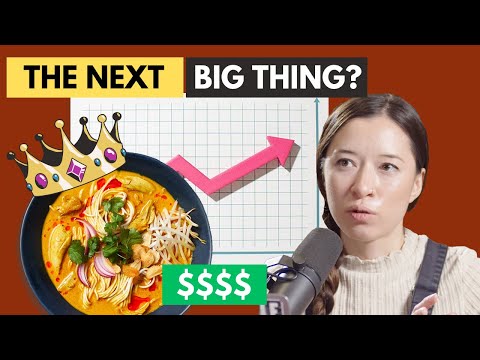
Could this Thai dish become the next American food trend?
Dan Shipper fell in love with khao soi, a Thai coconut curry soup, but couldn't find good versions at most U.S. Thai restaurants. He and guest Steph Smith of Andreessen Horowitz use internet research tools to explore whether a market exists for khao soi in the U.S. and whether it could become the next American food trend.
# Observation Document: "Could this Thai dish become the next American food trend?"
## Explicit Self-Description Evidence
- The speakers describe their activity as an exploratory research session: > "we just went down these... this list of ideas we took two of them and in like five minutes I'm already like I don't I'm probably not going to do the worm hat thing"
- One speaker frames the session explicitly as producing **data, not definitive answers**: > "some people might be listening and they're just like you know you don't have a clear answer by the end"
- Reference to a book one speaker wrote: > "there's a whole chapter in Internet Pipes which I think is like very underrated which is taking things from one part of the world and applying them elsewhere" — indicating the creator has authored written work on internet-driven trends/business.
## Demonstrated Scope: Live Business/Idea Validation
- The video demonstrates a **repeatable methodology for evaluating startup/product ideas** using free and paid tools:
- **Google search volume and SERP intent analysis** (search volume ~110,000/month for "khao soi," interpreting recipe-page dominance as intent)
- **Google Trends** for long-horizon trend lines (edamame example since 2003)
- **Reddit mapping tools** (a GitHub subreddit-connection tool and a "map of Reddit")
- **AnswerThePublic** for associated queries
- **SimilarWeb** for competitor traffic
- **Jungle Scout** for Amazon product revenue, margins, and keyword competition
- It demonstrates **qualitative signal reading** alongside quantitative: > "there are t-shirts that people are selling that are like about khao soy... just to be like okay it's like I'm not the only one who really loves this thing"
## Intended Audience
- **Aspiring founders / entrepreneurs** evaluating product ideas — evidenced by the framing: > "you're just gaining data right? you're getting data about the reviews the latent demand out there... seeing if you can create something that's differentiated"
- **Viewers interested in applied market research** — the walkthrough is tutorial-style ("tell us what we're looking at here"), with one participant asking questions on behalf of a learner.
- A listener audience is implied: > "some people might be listening"
## Claimed vs. Demonstrated Distinction
- **Claim (creator opinion):** > "I think khao soi is going to happen at some point" and > "khao soi is like it's inevitability" — presented as personal prediction, not channel promise.
- **Claim:** One speaker disclaims operational follow-through: > "I'm definitely not the right person to start this business"
- **Demonstrated:** Tool fluency and a structured, multi-tool validation workflow carried out live, regardless of the specific dish's prospects.
## Format / Presentation Pattern
- **Two-person conversational format** — one guides the research, the other reacts and asks questions ("tell us what we're looking at here").
- **Screen-share walk-through** of search tools, evidenced by references to on-screen content ("you can see like this is a recipe page").
- **Recurring series framing** suggested by: > "we just went down this list of ideas we took two of them" — indicating idea-evaluation episodes are a channel pattern.
# Delivery Observation: "Could this Thai dish become the next American food trend?"
## Overall Format
This is a **two-speaker conversational walkthrough**, not a monologue. Delivery is casual, exploratory, and structured around a live "research rabbit hole" — the speakers investigate search data, Reddit tools, and Amazon analytics in real time.
## Tone
- **Casual and unpolished**: heavy use of filler — "um," "uh," "like," "you know" appears throughout, e.g. *"it's like not good it's not good a lot of places um."*
- **Enthusiastic and riffing**: repetition for emphasis — *"it is so good so good it's so good."*
- **Self-deprecating asides**: *"I'm definitely not the right person to start this business"* and *"this is going to sound really obvious and dumb to some people."*
## Vocabulary & Recurring Phrases
- **"rabbit hole"** — repeated framing device: *"we could like start going down that rabbit hole,"* *"this little rabbit hole,"* *"if you go down the rabbit hole of like comparing different credit cards."*
- **"like"** as an all-purpose hedge/connector — extremely frequent.
- **"to your point"** — conversational handoff: *"but to your point if something is good,"* *"but to your point there's just like operational or logistical constraints."*
- **Tool names dropped naturally**: Google Trends, Answer the Public, SimilarWeb, Jungle Scout, Reddit subreddit maps.
- **"cow soy" / "khao soi"** repeated as the anchor topic, including a self-correction moment: *"oh so I said Sai I mistyped that."*
## Teaching Habits
- **Explains reasoning behind tools, not just results**: *"something that's really important to note as you search these things is Google tells you the intent of the people searching it."*
- **Uses concrete benchmark examples**: edamame as a long-trend comparison — *"edamame is my favorite because it's something that um people are pretty familiar with now."*
- **Meta-commentary on process**: *"some people might be listening and they're just like you know you don't have a clear answer by the end"* — anticipates audience objections.
- **Turns data into heuristics**: *"the point of search volume isn't necessarily to determine like is an idea good or bad... it's more so just to get a sense of like broadly where does it fit."*
## Communication Patterns
- **Question-and-answer rhythm**: one speaker investigates, the other reacts — *"tell us what what we're looking at here"*, *"is the number of searches like more or less than you expected."*
- **Hedged conclusions throughout**: *"you're not going to get a definitive answer but it's probably enough to start working with."*
- **Humor as connective tissue**: *"billionaire cowy lovers uh if if they exist"*, *"we're not going to fly in like lemongrass first class."*
- **Vocabulary mixing ("DToc" = DTC/direct-to-consumer)** used as shorthand both speakers share.
## Uncertainty Notes
- Speakers are **not clearly identified by name** in the transcript, so observations about individual habits can't be attributed to a specific person.
- Some patterns (e.g., exact filler-word frequency) are hard to quantify precisely from transcript text alone.
- The "D Toc" term appears to be a transcription of spoken "DTC"; delivery context around it is inferred from usage, which is thin.
# Position Extractor Record: "Could this Thai dish become the next American food trend?"
**Note on speakers:** The transcript contains two participants but no curated speaker metadata. Attribution below uses **Speaker A** (the person who visited Thailand and proposed the idea) and **Speaker B** (the person demonstrating the research tools), identified only by conversational context.
---
## Core Thesis
**Speaker A** — *Khao soi (cow soy) is likely to become a US food trend.*
- Experienced the dish in Chiang Mai, Thailand, while traveling with Hursh, the CTO of Arc (the browser company).
- Claims it "is so good" but unavailable in good quality in the US: "you can get it a little bit but it's like not good."
- Predicts "cow soy is going to happen at some point," while conceding: "I'm definitely not the right person to start this business."
- Later: "I think cow soy could be the next bone broth."
## Supporting Reasoning & Claims
### Search Demand Evidence (Speaker B)
- **110,000 monthly searches** for "cow soy"; ~590/month for a common misspelling.
- **Search intent**: Most searchers want **recipes**, inferred from the composition of the Google results page (recipe pages dominate).
- **Trending upward** over time; "khao soi near me" shows **5,400 monthly searches and increasing**.
- Search volume alone doesn't determine idea quality — it situates demand as "huge / medium / tiny / nothing."
### Precedent Argument (Speaker B)
- Cites **edamame** on Google Trends: a "trickle up" growth pattern since 2003 as a model for how food trends compound slowly.
- Claims "latent demand" exists: "try finding someone who's tried khao soi who like hates it — there's not many people."
### Barriers & Qualifications (Speaker A and Speaker B)
- **Ingredient freshness problem** (Speaker A): Food tastes better at origin (e.g., Vietnam) because herbs/spices are local. Speaker B reframes this as a question of feasibility: is it *possible* and *how hard* is it to make it good abroad? Speaker B asserts "it's definitely possible but it is a question of like is it hard."
- Joking exchange: they're "not going to fly in lemongrass first class" — quality-at-cost tension left unresolved.
- **Product friction** (Speaker A): The curry paste is the hard component; a **DTC curry paste product** could simplify the rest — proposed tentatively as "maybe it's like a DTC curry paste."
- **Competitor signals** (Speaker B): Khao soi cooking kits on Amazon show **low revenue** (~$1,500/month top result) and **very low review counts**.
- **Keyword tension** (Speaker A, flagged as "interesting"): khao soi is a **low-volume but moderate-competition** keyword — "that seems like a not a great thing to play in."
- **Takeout Kit** (competitor, "Global Pantry meal kits"): only ~10,000 site views/month, essentially no paid search.
- Amazon listings include **"I love khao soi" t-shirts** — cited by Speaker B as qualitative evidence of passion/latent demand.
### Distribution Insight (Speaker B)
- Absence of paid search in a space cuts two ways: either an **opportunity** to out-advertise organic-only competitors, or a **signal that the category is only viable via organic search** (contrast: NerdWallet's credit-card market, where organic search dominance would be a prerequisite).
## Methodological Positions (Speaker B)
- Process is **exploratory, not conclusive**: "some rabbit holes... there is a very clear like no and then sometimes there's not necessarily like a definitive yes."
- Tools endorsed: Google SERP reading for intent, Google Trends, subreddit-mapping tools (unnamed GitHub tool and "map of Reddit"), AnswerThePublic, SimilarWeb, Jungle Scout.
- Proposed next step: run **ads as validation tests without building the product**.
## Conclusions & Unresolved Tensions
**Speaker A's final position:**
- "Khao soy is inevitable... in five years or 10 years that chart will have continued that trend and someone will do that."
- Explicitly declines personal ownership: "am I going to be the leader of the khao soi movement — obviously not."
- Frames it as **a future opportunity once search volume grows** — i.e., not necessarily now.
**Speaker A on a separate idea (worm hat):** "I'm probably not going to do the worm hat thing" — abandoned after cursory research.
**Preserved tensions:**
- Low current demand vs. predicted inevitability.
- Ingredient-freshness problem acknowledged but never resolved.
- Whether to enter now (social/DTC marketing play) vs. wait for market growth — left open.
# Speaker Attribution & Provenance Record
## Video
**Title:** Could this Thai dish become the next American food trend?
**Video ID:** `01a0f15b-115e-7e68-a343-0b465fd470f7`
## Speakers
The transcript contains an unattributed two-person conversation. No speaker names are provided in the transcript or metadata.
| Label (inferred) | Role | Evidence |
|---|---|---|
| **Speaker A** | Likely the video creator / host | Initiates the topic (recent Thailand trip), proposes the khao soi business idea, says "I'm definitely not the right person to start this business" |
| **Speaker B** | Co-host / researcher demonstrating tools | Walks through Google search data, Google Trends, Reddit tools, SimilarWeb, Jungle Scout |
### Third parties named (not speakers)
- **"H"** — described as **CTO of Arc (the browser company)**; traveled with Speaker A to Thailand. Second name/surname not given in transcript.
## Referenced Sources & Tools
Cited within the conversation (as demonstrated research inputs, not verified data):
- **Google search / SERP data** — search volumes cited: "khao soi" ~110,000/month; "khao soi near me" ~5,400/month (stated as increasing); mistyped query ~590/month; "khao soy recipe kit" — no search volume
- **Google Trends** — edamame trend shown since 2003; khao soi trending upward
- **Reddit** — r/Thailand and adjacent subreddits explored
- **Unnamed Reddit-mapping tools** — a GitHub tool by a developer whose surname "isn't on vodka" (per transcript), plus a "map of Reddit" tool by the same creator
- **AnswerThePublic** — keyword association tool
- **SimilarWeb** — traffic analysis; Takeout Kit shown at ~10,000 views/month, "basically no paid search"
- **Jungle Scout** — Amazon analytics; khao soi volume <450 searches/month; top khao soi kit ~$1,500/month revenue, low review counts
- **Amazon** — competing products (khao soi seasoning mix, vegetarian hot cup)
- **NerdWallet** — mentioned as an organic-search competitor example in credit cards
- **Book reference:** Speaker B mentions "a whole chapter in *Internet Pipes*" about applying ideas across regions (title as spoken; no author given)
## Claims by Third Parties
- Recipe pages dominate the khao soi SERP (inferred search intent: recipes)
- Amazon sellers of khao soi kits/t-shirts ("I love khao soi" merchandise) exist
- Takeout Kit self-describes as a "Global Pantry meal kit" service
## Promotional Segments
- **None identified.** No sponsored segments, product placements, or self-promotion calls-to-action are explicitly present in the transcript.
## Availability Limits & Uncertainty
- **Speaker identities unconfirmed** — names are not stated; roles inferred from conversational dynamics.
- **All statistics are speaker-reported screen-share figures**, not independently verifiable from this transcript.
- **Comments availability:** not specified in provided material.
- **Curated metadata:** none supplied beyond title and transcript.
- Place names rendered phonetically ("changai" = likely Chiang Mai; "cow soy" = khao soi) — spelling uncertain from transcript.
I was in Thailand recently um actually with h who's the CTO of of of Arc of the browser company um uh and uh there's this there's this dish in changai which
is a city in the north if you've been yeah um called cow soy yeah and it is so good so good it's so good and you can't get it here like you can get it a little bit but it's like not good it's not good a lot of places um and so I've been like looking at a bunch of you videos on how to make it or whatever but like and I don't know if it's like a if it's like a d Toc cow soy like Ramen type thing or it's like a a cow soy restaurant or whatever but I just think cow soy is going to happen at some point and I'm definitely not the right person to start this business but like it would be kind of interesting to in investigate you know yeah we could that one's interesting because I'm like I agree with you that I mean this is like a whole another like tangent of just this is going to sound really obvious and dumb to some people but just like if you've traveled the world enough I've had this realization when I'm in like Vietnam for example I was like oh the F here is so much better because the ingredients are local like as in like the basil and all all of the spices that go into the soup are just fresher there and so there are questions around just as you're like spreading food around the world which is inevitable yeah if you can do that well is it even possible yeah to like to make it good because the ingredients are not going to be as fresh basically yeah well I mean I think it's it's definitely possible but it is a question of like is it hard yeah how
hard yeah how hard yeah like we're not going to fly in like lemongrass first class uh for for this experiment yeah exactly I mean you could it's just like what Market are you going
for billionaire cowy lovers uh if if they exist I don't know I mean we could like start going down that rabbit hole so I mean the first thing like again I know this is oh so I said Sai I mistyped that Cy um okay so you're you're so the first thing you're doing is you're Googling um and oh sorry I'm just curious how many by the way 590 people mistype that just like me every month not very manyun um so I mean yeah like just even so just people who are searching like this um cowy 110,000 per month by the way something that's really uh important to note as you search these things is Google tells you the intent of the people searching it just by the nature of what is on the page and so if you think about even like cow soy as a query at face value doesn't seem that interesting but it's like are they searching the definition are they searching for pictures of it are they searching for recipes are they looking for cow soy near me like and Google has enough context from all of the 110,000 searches per month to kind of bake that in and in this case it looks like most people who are searching this are looking for recipes right you can see like this is a recipe page this is a recipe page and just like like in your in your view like is the a number of searches like more or less than you expected and it does it seem interesting um I mean 110,000 is like not it's not low right it's not like the the 300 for
the but it's also um I mean there's definitely like broader queries that to many millions a month the point of like search volume isn't necessar like necessarily to determine like is an idea
good or bad from like the raw uh number cuz we'll go further you know in other dimensions it's more so just to get a sense of like yeah broadly like where does it fit in the like is it like huge is it like medium is it tiny and or is it nothing which is also even more valuable um how is that trending and you'll notice the trending up I'm I'm ahead of the curve here look at you I think cowy could be the next bone broth you know I mean I do think like there's a whole chapter in Internet pipes which I think is like very underrated which is taking things from one part of the world and applying them elsewhere um with the right branding or the right like uh operational strategy like you said D Toc right making it simple um so I mean even just at face value I love just showing people a Ser a search engine results page like this and just being like what can you learn and already you can learn like roughly the volume you can learn that when people search this they're looking for recipes not some of the other things I mentioned we learn that it's growing over time we can look at the related keywords you can see it's you know not surprising but like House St Meeting House story restaurant Main Ingredients paste recipe so there's demand for not just obviously the term but all these other things so we can also look at the people also search for thing um and so like let's just quickly get a sense of like cowo near me that's like you know the classic like location based thing by the way are you thinking like I guess we can figure this out along our journey but like a restaurant a kit uh one of the things that occurred
to me is that a big component of cow that makes it difficult to make is you have to make the cowy like curry paste first um and if you just had the curry paste it would be a lot easier to like put the rest together and so maybe it's
like a d Toc curry paste yeah yeah that's interesting um so yeah like 5400 people it is increasing I love to see charts like this by the way which are like low volume but like growing for sure because I mean it's one thing let me show you like if we just go to like Google Trends I always just like you know how there's like saved queries I always open TIG for it's just it's just there it's just saved in my bar um but I just wanted to show you and others like how long some of these Trends can go so like edamame is my favorite because it's something that um people are pretty familiar with now um but you can see it has trickled up since 2003 when they started tracking this and it's just like continuously because I think to your point if something is good and like try finding someone who's tried cowy who like hates it there's not many people but to your point there's just like operational or logistical constraints but to me this is like if someone can fix that there's like latent demand for it um I'm trying to think of like is just like a force I didn't realize that another few places that I would check for example are I mean Reddit of course and so one tool that I always check and it's not always guarant aned to um surface something but it's just to see what subreddits exist so tell us what what we're looking at here this is a tool made by this guy um his last name isn't on vodka so that's you know why it's like his GitHub he didn't really name it um but it's a tool where you can see the interconnections on Reddit in any given subreddit and so we can I typically start with something broad that I know exists so for example r/ Thailand and then once this does it's whole animation you can see the like related separate this one doesn't seem as interesting but you can kind of see like what potentially let's go to interesting vase forums isn't this the edge like people who go as teachers like to Thailand but yeah I mean one interesting part of this little rabbit hole is purely just what other subreddits exist and by the way the same
person who made that um also made this map of Reddit which is I use both both often because they for whatever reason don't always function exactly the same
this one tends to give you less subredits like less nodes um in connectivity but it views everything in more of like an extended map where you can see if I zoom out all of the subreddits in this like large oh wow you can see it's kind of like a a world map right like that's so cool yeah so you can see where like of all things like r/ Thailand is in this thing which is kind of in Travel Land but also like kind of next to Parenting interestingly enough got it so so coming back to like the the idea we're trying to refine based on the things you've seen so far like what is it making your brain do and what do you think we should do to take the next step in the in the idea either validation or refinement or whatever yeah I think so maybe the next thing I would open up is something like answer the public and I what I want to get a more color around is like what people are associating this thing to so again some of those secondary keywords to see if there's enough volume for things like oh like I actually just want a better recipe or I'm like I need something here um another thing you might want to do is just start looking into competitors or like to see if anyone's actually doing it doing this so like we can look up like like cow soy um like recipe kit or something like that and not so much for the volume but to actually see who's doing it um who's doing this and um you can see a few so then you would take something like some of these kits and either put them into a tool like similar web to see the um the volume the number of page views they have a month or you can also look into I see some of these on Amazon for example and so I would be interested in pulling up something like a jungle Scout to see how much they're actually doing and on Jungle Scout you can see like the margins and things like that as well so I think one One
Direction that you could take it is actually just trying to see what is being sold so we we searched cow soy recipe kit there is no search volume according to that um but you start to
see a few different uh companies that do have for example cow soy seasoning mix um a cow soy vegetarian protein hot cup that are selling on Amazon for example and then we see on the actual results page a few different companies that aren't advertising but do sell some sort of Kit and so the next place you could take is you could take some of these companies that sell uh on the serp and you can put them into a similar web for example so if we take actually this is this is just one product on takeout kit for example but actually yeah why don't we put takeout kit into similar web I'm just curious how that does and then in addition I pulled up jungle Scout um which is a an Amazon Analytics tool where you can see specific products like we saw two of them advertising yeah so we can actually get a sense of how much volume they do all right while this is loading let's look at jungle Scout so I searched in their keyword Scout tool to start cowo and this is again where you can um we'll get to the product search as well um but where you can get a sense of just like how much volume there is so in this case down here we have cowy there's very limited volume less than 450 searches per month but you can also see yes some people are bidding uh easy to rank moderate this is where you can get additional ideas like you can see something for example like Asian noodles actually has way more search volume but is actually much easier to rank on um there's a lot of branded terms here um but you can get a sense of what people are actually searching for and again like maybe pivot if you yeah um if you're not like set onest I'm pretty to okay so then let's go to product research we can we can pivot if you want whatever you think is is uh is The Right Move let's go to the product data base and just see let's see let's see how much these companies are making interesting it's so interesting that
it's it's a low competition keyword sorry it's a it's a low volume keyword but it's still moderate competition like that seems like a not a great thing to to play in right all of this is data so I should say like you know some people
might be listening and they're just like you know you don't have a clear answer by the end and to be fair some some rabbit holes you go down there is a very clear like no and then sometimes there's not necessarily like a definitive yes but you're like oh actually there's seems to be like this Gap where no one's addressing this like huge keyword search volume and uh I could create a product in it um but often you're just gaining data right you're getting data about the reviews the lat demand out there the products and how they're currently doing in the space and you're all kind of like bunching that together and seeing if you can create something that's differentiated um so in this case like there's this like cow soy cooking uh kit and we can sort all this by the way with like monthly Revenue in Jungle Scout so so in this case it's low right like the top for caloy at least what's coming up here is like $1,500 um versus oh but see I mean coming back to the review conversation like really low reviews right and that's like the top one according to this also something that's interesting kind of paying attention to what this is surfacing not just pure numbers there are t-shirts that people are selling that are like about Cal soy and like I love C soy and I don't know sometimes you just have to pull in those qualitative data points just to be like okay it's like I'm not the only one who really loves this thing um if we pull up the similar web if it's going to load I'm just curious how much that website about like um takeout kit take out kit
yeah and takeout kit is bigger than just cow but it's correct but it kind of gives you a sense of like look at its description here which is helpful even just on itself it says it's uh Global
Pantry meal kit so it's not just like any meal kits they're specifically orienting around Global Pantry meal kits Asian meal kits Robin meal kits so it is like in the Wheelhouse of what you're describing um so it's pretty low 10,000 views per month um the nice part about this uh a similar web even their free version is you can start to see the related sites as well so this is where you can kind of go down another rabbit hole and you're like oh what's try the world what's House Foods um and then in this case what's also helpful is just to see like okay so they basically do no paid search and sometimes this is helpful um you can it in different ways sometimes if you look at a space and you're like oh every participant in it is doing organic search for example um well like what if I actually Juiced you know my product with paid like could I out compete them could I like get more attention build a stronger brand but there's a second side to this where it's not like binary where what you actually might be seeing is like this kind of thing you can only do with Organic search as in you can only really be profitable or build something sustainable um and so so it may be an indicator like another data point for when you're assessing these things to be like is this the kind of business I want to build for example if you go down the rabbit hole of like comparing different credit cards and points and that's what like what nerd wallet does yeah they have so much organic search and like all their competitors are also like organic search Kings and like in that particular Market if I were to assess it I'd be like oh actually I would only ever do this if I think I have some advantage in organic search right like I'm not going to be able to compete with paid or like social or something else that makes sense um so yeah I mean to me is everything we've learned so far is like one I probably if I had more time I'd be going further down this like Reddit rabbit hole and looking for signals in terms of like maybe not only on the r/ like Thai food but some of these like adjacent subreddits to see if there's just like lat in demand of people who want like way better Asian food in
America uh as an example but then I also would be kind of like bringing every all of this together to be like okay clearly there's not like a huge amount of demand do I think I could create like a
differentiated product that probably in this case because there's not much search demand I could mark it really well on social for example and like create something like d Toc and like do I have like good enough Facebook ad chops to do that effectively and you know again you're not going to get a definitive answer but it's probably enough to start working with to be like can I create some like basic tests where I don't even need to create the product but I could run some ads and get some data yeah I mean that makes a lot of sense it's so valuable like cuz we just went down these these this list of ideas we took two of them and in like five minutes I'm already like I don't I'm probably not going to do the warm Hat Thing If you pursue the worm hat thing after our like cursory research you just want that product I just want yeah and then I think for the cow soy thing like the vibe I'm getting is cowy is going to happen cowy is like it's it's inevit right and then I have to like I have to do this culus of like am I going to be the leader of the cowy mov obviously not um but like I feel like what I'm seeing like looking at that chart is probably in five years or 10 years that chart will have continued that Trend and someone will do that and that's like an interesting thing to to pay attention to and it might be an opportunity later on down the road once it's like a little bit bigger and there's more search volume and there's there's all that kind of stuff