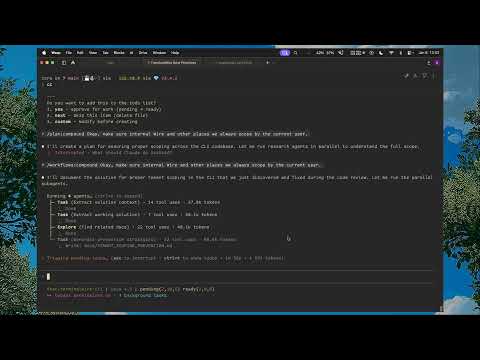
Every LIVE: Building Agent-Native Software in Real Time
A live stream in which Kieran, GM of Cora, discusses building AI-native applications, focusing on the development of Cora, an email management tool. Topics include agent-native applications, integrating a command-line interface, user-centric design in AI development, and advice for junior engineers navigating AI-driven software development. Includes live Q&A with viewers.
# Channel Identity Observations: "Every LIVE: Building Agent-Native Software in Real Time"
## Explicit Self-Description Evidence
- **Channel/brand affiliation**: The presenter states, "I work at every and every is the only place you really need to subscribe to to get on the edge of AI and really understand what's going on."
- **Presenter identity**: "My name is Kieran. Um I'm a GM of Kora. I work uh at every" — also restated later: "my name is Kiran, GM of Kora."
- **Product claims**: Kora is described as: "it summarizes my email. It briefs um briefs all the emails that are not needed to respond to immediately and sends a brief twice a day."
- **Methodology claim**: "I built Kora using AI and I created this system called compound engineering while building it."
- **Subscription scope claim**: "every is um the only sub you need to stay uh on top of AI. So if you like this stuff subscribe to every." Also: "These are all the products you get access to... we write about AI and we predict like there this one is called the predictions for 2026."
- **Content publication claim**: "I'm actually writing a piece. It will come out on Thursday on every. So, subscribe to every."
## Observable Presentation Patterns (Demonstrated, Not Claimed)
- **Format**: This is a first-time live stream: "This is my first live stream, so uh bear with me if anything goes not ideal."
- **Format intent**: Live building rather than polished tutorial — "This is not planned in any way other than I just want to work and show things."
- **Intended audience**: Developers and AI-coding practitioners; questions answered concern Claude Code, subscriptions, model choice ("Sonnet is a viable alternative if Opus is overkill"), libraries vs. custom code.
- **Interactive audience engagement**: Repeated invitations — "if you have questions drop them in. I will go through him once in a while" and "if anyone has questions, just drop them in the chat."
- **Multi-platform reach**: Simultaneous streaming on X and YouTube — "because we're on X and we're on YouTube."
- **Open-source community posture**: The compound engineering plugin is promoted as usable by viewers: "You can install that as well uh and use this yourself too" and "It's open source."
- **Cross-promotion of ecosystem products**: Mentions Monologue ("one of the apps that you get in the every subscription for voice to text") and an upcoming article on Every.
- **Direct audience outreach**: "if someone wants to join me once, uh shoot me a message on X as well... let's jam together like I would love to do it together."
## Audience & Scope Summary
- **Audience**: AI-native software developers, Claude Code users, and people interested in agentic workflows — evidenced by technical Q&A about sub-agents, compacting, model tiers, and CLI tooling.
- **Claimed scope**: Every is positioned as a subscription covering AI analysis, predictions, and multiple software products (Kora, Monologue), with staff working "full time" on it: "we're all doing this full time and really giving you the like the summary of everything you want to know."
- **Demonstrated scope**: Real-time AI-assisted software development on a production app ("Thousands of people use Kora"), showcasing a personal methodology (compound engineering) end-to-end from planning through pull request and review.
# Delivery Observation Report
## "Every LIVE: Building Agent-Native Software in Real Time"
---
## 1. Tone & Overall Register
- **Conversational, self-deprecating, and improvisational.** The speaker frames the session as unscripted: "This is not planned in any way other than I just want to work and show things."
- **First-ever livestream nerves are openly acknowledged:** "This is my first live stream, so uh bear with me if anything goes not ideal."
- **Casual humor**, often at the expense of the small audience: "I feel way way too much pressure of these two people watching this" and "probably if you're one of the two people that watch this, oh, 11 people now, uh, major."
- **Tangential asides** frequently interrupt the technical work — discussing background music ("we need background music cuz this is very boring"), his room setup ("I just redid my room"), and Pomodoro technique.
---
## 2. Vocabulary & Recurring Terms
- **Domain vocabulary repeated throughout:** "agent native" / "AI native," "compound engineering," "feature parity," "CLI," "sub agents," "plan," "skill," "worktree."
- **Product/ecosystem names recur constantly:** Kora, Every, Terminal Wire (also transcribed as "ternal wire"), Opus 4.5, Claude Code ("cloth code" in the transcript), MCP, Typora, Warp, Tmux.
- **Signature phrase — "the golden standard":** "this is what I found to be like the golden standard like it you get really good results with these three agents."
- **Framing of AI as a person:** "It should feel like a colleague or something that supports you rather than something that annoys you… like a good senior colleague."
---
## 3. Recurring Phrases & Verbal Tics
- **"Let's go" / "Let's see"** — used constantly as a transition marker:
- "Um let's go. Hey, John."
- "Cool. Let's see. Um so this the getting started"
- "Let's go. Um core as a reals app."
- **"So yeah" / "Uh yeah"** as a soft landing after nearly every explanation — appears dozens of times.
- **"Sure."** — a one-word acknowledgment when accepting a plan point or AI suggestion: "Sure. Um. Nope. Okay." / "Sure. Yeah. Well this is a good list."
- **"Boom."** — punctuating successful command execution: "Work. Boom. There we go." / "work. Boom." / "Let me open it here… Boom."
- **"Um" and "uh" fillers** are extremely dense throughout, consistent with unscripted live commentary rather than rehearsed delivery.
---
## 4. Teaching Habits & Structural Patterns
- **Explicit signposting of his own workflow philosophy:** He repeatedly names steps of his "compound engineering" flow — plan → review → work → review/triage — and explains each on first use: "So this is how I start. I kick off a compounding engineering plan command."
- **Re-explains context for late joiners**, a clear recurring habit:
- "Yeah, for people that just joined, welcome. Um, we're building something."
- "Okay, if anyone joins uh we're doing coding on Kora…"
- "Also, for anyone joining later or now this is the company I work for every…"
- **Think-aloud narration of decisions**, not just actions: "So what I do here is I get inspired basically. I I I didn't think of to-dos as a good one, but while reading is I'm like, 'Oh yeah, actually to-dos might be interesting…'"
- **Pattern → principle extraction.** He often generalizes from the moment to a reusable rule: "So this pattern of like you want to research something and then use that in your work. I I wouldn't do this if it's just a one-time thing."
- **"Meta" self-commentary on his own tooling:** "So this is how I develop compounding engineering. I have these meta things where I just say, 'Oh, this is wrong. Fix it.'"
---
## 5. Audience Interaction Patterns
- **Repeated invitations to the chat:** "if anyone has questions at any point, please drop it in the chat" — restated at least four times across the stream.
- **Reads and answers chat questions by name:** "Pito asks…" "Glenn asks…" "Mr. Son asked…"
- **Frequent promotion of Every** (his company), a stable recurring behavior: "every is the only place you really need to subscribe to to get on the edge of AI" — repeated in near-identical wording multiple times.
- **Technical struggles with the livestream itself are narrated transparently:** "Apparently, I have lots of views on X and chat messages that don't come through here. Sorry." — later resolved: "I do see it now. So, next time I know how to open it."
---
## 6. Uncertainty & Caveats
- **Heavy enthusiasm about Opus 4.5 borders on strong claim-making**, but he flags his own uncertainty about hype: "you don't want to claim those things that early because you you don't want to look like a fool that just like hypes everything up."
- **Delivery is one continuous live session** — all observations above are from a single event; whether these are stable habits across sessions **cannot be confirmed** from this transcript alone.
- Transcript quality issues (e.g., "cloth code" for Claude Code, "ternal wire" for Terminal Wire) mean some quoted fillers may reflect transcription artifacts rather than the speaker's actual pronunciation; uncertainty is noted where relevant.
# Observation Record: "Every LIVE: Building Agent-Native Software in Real Time"
## Speaker
**Kieran** — GM of Kora, works at Every. First-ever live stream for him.
## Core Positions & Claims
### 1. Agent-Native Software
- **Claim:** Agent-native is "a shift that's going to happen this year"; Every is trying to make everything in its ecosystem agent-native.
- **Grounding:** Inspired by a tweet from **Dan** (Every's CEO) on agent-native architecture, whose key principle Kieran restates as: **"anything the user can do in an app, the agent should be able to do."**
- **Qualification:** Kora, initiated ~1.5 years ago, is *not* agent-native — this is a retrofit, not a greenfield design.
- **Stated priority:** Feature parity (agent can take any user action) should come first because "a world opens up" once an agent can act fully in the app.
- Notes others (e.g., "Greg") are also going agent-native.
### 2. CLI as the Interface Choice
- **Position:** Chose a **CLI** for Kora over alternatives (REST API client, MCP, Playwright/browser automation — the latter called "a little bit hacky").
- **Reasoning:**
- Agents know CLIs with no token overhead; "MCP feels like a big thing."
- He can use the CLI himself — same interface for human and agent.
- Tool calls needed for MCP would reuse the same CLI logic anyway.
- GitHub works this way ("that's how GitHub does it as well").
- **Library choice:** **Terminal Wire** (by **Brad**, whom he met at SF Ruby) — streams CLI apps over websockets from a Rails app, so the CLI updates instantly without local reinstalling. He paid for a license to support a single developer and says this made the work faster because Brad "solved a problem for himself and for others."
### 3. Compound Engineering (his plugin/system)
- **Claim:** Created "compound engineering" while building Kora with AI; uses it daily and updates it daily.
- **Philosophy stated:**
- "User in the loop, but the goal is to have you in the loop the least amount."
- "It's not to save tokens. It's also not to max tokens" — the goal is a balance where AI feels "like a good senior colleague."
- **Planning is where the real work is:** review plans carefully; "the most interesting part is the plan and the taste extraction" — did you pick the right libraries, solve the right problem.
- **Workflow demonstrated:** plan → review → work → review → triage (conversational decision-making where the human acts as "tech lead" resolving agent disagreements).
- **Compound command:** when a mistake is found, run it so the setup learns to check for that mistake in future plans/reviews — "it will learn and compound."
- **Sub-agents pattern:** deep research happens in sub-agents (40k–70k token contexts) that pass findings to the main agent — keeps context clean and runs in parallel.
- **On compacting:** doesn't mind auto-compacting; argues the better fix is "use more sub agents" to reduce context rather than disabling compaction — "I just like convenience."
### 4. Claims About Opus 4.5
- **Strong claim:** It's "a different realm of a model... a new model that didn't exist before"; felt the same shift as when GPT-4 and Sonnet 3.5 launched ("I told my wife the world has changed again"; texted Dan "it's big").
- **Hedging preserved:** "you don't want to claim those things that early because you don't want to look like a fool that just hypes everything up."
- Capabilities he attributes to it: long-term thinking, seeing missing flow pieces, Playwright/browser clicking, working across libraries, context-switching between plugin and project "without losing sight," not messing up.
- **Corroboration cited:** DHH (Rails creator, "always a skeptic") is "now impressed with AI models"; colleague Ulik, previously skeptical, "redid whole libraries in a day" over the holidays.
- **Haiku contrast:** Accidentally left on Haiku once, found it "dumb" for 30 minutes — "a good reminder of how good Opus 4.5 is."
### 5. Emergent Capability vs. Bugs
- Responding to a chat question: flexibility means giving users building blocks and trusting them; "it's not a bug, it's a feature" is the flip side.
- **Limit stated:** fine "as long as it's not dangerous" — e.g., deleting all email or mass-sending emails to thousands without checks is not acceptable.
- Optimistic example: if users repurpose Kora to-dos as a reading list and share it, "I never thought about that use case... let's pull it in." Even agents *pushing* data (e.g., WhatsApp) into Kora could be interesting. "I'm just an optimist... I don't think it will break."
### 6. Advice & Preferences (from Q&A)
- **Junior engineers:** "Don't be boring. Don't listen to old engineers because they're probably not right. Go on X. Subscribe to Every." Junior engineers are well-primed for AI; whether you'll be fine depends on engineer type — if you like solving problems, taste, plans, "you'll be fine"; if you like writing code or "bookkeeping and spreadsheets... you'll have a hard time."
- **Libraries vs. hand-rolled:** Prefers libraries/boilerplate because they "focus the AI"; but admits you can vibe-code it yourself, and he built his own orchestration (T-Max) anyway — "there's no right and wrong... whatever works for you."
- **Multi-threading projects:** Wants ~20 projects; frameworks/systems help, "my brain is the bottleneck."
- **Cost:** One Claude Max subscription; first month ever he paid ~$150 extra usage — "it's fine."
- **Tension preserved:** Uses worktrees/"not coding yet" sometimes, sometimes skips; sometimes uses plan mode because it's "lighter" — he mixes approaches rather than one strict flow.
### 7. Tools Mentioned (attribution: Kieran's endorsements, variously qualified)
- **Monologue** (Every app) for voice-to-text; **Typora** with the "Whitney" theme for reading plans (Obsidian is "great, too" — chosen just as a viewer).
- **Peter Steinberger's** tools (PT CLI for X, "convert X into agent native"); **Conductor** — "never really gotten into it because I just want to create my own thing," though acknowledges it's cool.
- The **prime command** idea: a CLI help command specifically instructing agents how to use the tool — inspired by "Beats"; he asked that this be added to the agent-native architecture skill.
## Demonstrated Outcome
- Within ~1.5 hours: plan, implementation, tests, and a pull request for a Kora CLI with login/auth and to-do commands (login worked after fixes; logout/session destroy initially failed). The CLI's to-do commands ended up **more feature-rich** (priority, due date, status) than Kora's own UI — a contradiction he notes with amusement.
- Review found real issues: tenant-scoping bugs (email lookup without account scoping, session manipulation risk, timing attack on token lookup) — he accepted the scoping fixes and ran the compound command to prevent recurrence.
- Release plan: enable for beta users via Kora settings; "I'll release this later today."
## Preserved Uncertainties/Tensions
- Session describes an in-progress, unpolished build (forked Terminal Wire "might be just broken"), not a settled architecture.
- His hype about Opus 4.5 is stated alongside explicit self-awareness of hype risk.
- Chat viewer counts and X/YouTube streaming mechanics were unresolved live (he couldn't see X chat for much of the stream).
# Speaker Attribution Record
## Video
**Title:** Every LIVE: Building Agent-Native Software in Real Time
**Video ID:** `01a0f15a-b325-7f3e-886e-327d4283a999`
## Speakers
### Primary (and sole) Speaker
- **Kieran** — self-identified as **GM of Kora**, an employee of **Every** (the company/publisher running the stream).
- Role: **Creator / host**, live-coding solo. States: *"My name is Kieran. Um I'm a GM of Kora. I work at every."*
- Notes it is his **first live stream**; broadcast simultaneously on **X and YouTube**.
### Mentioned Third Parties (do not speak)
- **Dan** — CEO of Every; author of the tweet/article on **agent-native apps** and the **agent-native skill** referenced/used in the stream.
- **Brad** — creator of the **terminal wire** library; met in person in San Francisco (SF Ruby).
- **Greg** — mentioned as planning to "go agent native."
- **DHH** — Rails creator; cited as now being impressed with AI models.
- **Peter Steinberger (PT)** — mentioned for his CLI tools (X CLI, Conductor theme).
- **Natash / Ulik** — Every colleagues/engineers mentioned anecdotally.
- Chat participants (no verifiable identities): **John, Pito, Glenn, Amit, Mr. Son.**
## Referenced Sources & Claims
- **Dan's tweet/article** on agent-native apps (feature parity: anything a user can do, an agent can do).
- **Terminal Wire** — third-party Rails CLI library by Brad (paid license; speaker forked it).
- **Compound Engineering plugin** — the speaker's own open-source plugin/skills.
- **Kora** — Every's email-summarization product; **Monologue** — Every voice-to-text app.
- Tools cited: Claude Code, Opus 4.5, Sonnet, Haiku, Playwright, MCP, Typora (Whitney theme), Warp, Conductor, Tmux, GitHub, Riverside streaming software, Ableton Push.
- Personal anecdotes: DHH's stated view, colleague experiences, first impressions of Opus 4.5.
## Promotional Segments ⚠️ (flagged)
- Repeated **Every subscription promotion**: *"every is the only place you really need to subscribe to to get on the edge of AI."*
- Promotion of the **"Predictions for 2026"** Every content and an **upcoming Thursday article on the triage command**.
- Promotion of **Kora beta opt-in** at settings, and install commands for the **compound engineering plugin** placed in chat.
- Paid **terminal wire license** mentioned; speaker frames paying it as supporting a solo developer.
## Availability Limits
- **Comment/chat reliability issues:** Speaker states X chat messages were **not visible during the stream** and lack history; he repeatedly asks viewers to re-ask questions.
- **Curated metadata:** none supplied; identity claims rest solely on the speaker's self-identification.
- **Timestamps:** transcript contains none; timings (e.g., "58 minutes in") are speaker statements only.
- Stream **video/camera did not display** to viewers per speaker's own mid-stream remarks.
Hello everyone. This is my first live stream, so uh bear with me if anything goes not ideal. But
uh I was inspired by this tweet and I thought like why don't I just live stream and do this short intro. My name is Kieran. Um I'm a GM of Kora. I work uh at every and every is the only place you really need to subscribe to to get on the edge of AI and really understand what's going on. And that's what we're trying to do today. And Dan has this great tweet that I would say read because this inspired me to say let's go and um yeah show what I'm going to do. So I'll just give it a few more minutes to get some more people to join. I have no idea how many people are here. Um let's go. Hey, John. Cool. It seems it's working. So, um, welcome everyone. Um, let's start this. Uh, my name is Kiran, GM of Kora. I built Kora using AI and I created this system called compound engineering while building it. Um
yeah and um I want to just share how I work. This is not planned in any way other than I just want to work and show things. So please if you have questions
drop them in. I will go through him once in a while as well. Um but really this is the inspiration. Then our uh CEO um of our company every um wrote this great thing about agent native apps. So once again what every is is um the only sub you need to stay uh on top of AI. So if you like this stuff subscribe to every. Um so agent native what it is. So this is really a shift that's going to happen this year and we've been kind of trying it out and Kora was built a year and a half ago or initiated and it's not agent native. So we're trying to make every app everything in in uh in our ecosystem at every agent native and what that does is that um agents can do the work and some architectures here that Dan is describing is that anything the user can do in an app the agent should be able to do that and I want to focus on this one today because I think that's the first step because if you give the agent the ability to take any action in the app you as a user can um suddenly a world opens up and you can do so so many more things and we'll go into others as well but for
me it's it's uh yeah this the focus on today um so other people realize that as well so Greg says he's going to go agent native as well which is really cool
this is my plugin the compat engineering plugin uh this is what I will be using um you'll see me use it as well uh I'll do maybe some other things about this um at some other point. But um let's go. So if anyone has any questions at any point, please drop it in the chat. I think I see all the chat here. Uh but we'll see uh because we're on X and we're on YouTube. So uh welcome to to the to the live stream. So Kora, so this is Kora. Um, it summarizes my email. It briefs um briefs all the emails that are not needed to respond to immediately and sends a brief twice a day. So, everything that's very important stays on my inbox that I can deal with, but the rest I get twice a day. And really what I want to do is like I want to make whatever I can do in this app here. There's assistant as well. I can read emails, summaries. I want to expose that to uh like some kind of interface uh for an agent and there are different ways to do it like traditionally like an API with a client. Um you can do MCP as well. You can do like uh playright or something like that which is like a little bit hacky in this case. So what I want to do is make a CLI and here I've been like just hacking a little bit on some this is not design but this prototypes where imagine like Kora to have some kind of different connectors. So these are connectors where you can connect Kora to the every ecosystem, your calendar, some other things, maybe an MCP as well, but I'm interested to do a CLI as well. And I think um
yeah I I think the reason to do the CLI is that it's very easy for us to like it's it's it's
something agents know a CLI there's no overhead and tokens with MCP MCP feels like a a big thing and also CLI I can use myself. So I kind of want to start there and and you always reuse the same things like if you need MCP you need the same tool calls and all of that uh as a CLI. So what I'm going to do is uh I'm going to create a CLI and and I think this is a very good first step into making something AI native where there's parity. So if there's a CLI, I can use it, but also other people can use it. Um and and and and any agent can use it. So if you use cloth code for example or cloth code SDK, uh you can just say, hey, this is the CLI, use it. And and that's how GitHub does it as well. Cool. Let's see. Um core as a reals app. There's this uh reals project called terminal wire uh which is very interesting. It's it's kind of uh yeah it's like a CLI but then you define the CLI and its actions in the app itself. I think it's very cool. Uh streaming I did some digging and I like it enough to say let's use this. So let's do it. So this the getting started for that and normally uh this is how I go. Let's see.
Um so I use Monologue which is one of the apps that you get in the every subscription as well for voice to text which is great. Um so if I'm talking and
you see the text appear that's what it is. Um, can you research the documentation for terminal wire here in detail? All the steps I need to know, all the information, and can you create a skill from it? So really what I do here like maybe terminal wire has this already somewhere in a in a in an agent's text file or something like that. Um uh it's doing chrome. Sure. Well that's fine. Um, so I want to make a skill. I like to extract this in a skill because then I can just use that skill more often. Okay. See, I'm sure there's a GitHub for this terminal wire. Get GitHub terminal wire. Yep.
Can you find the GitHub uh for this that's easier to navigate and then pull off information? So, this pattern of like you want to
research something and then use that in your work. I I wouldn't do this if it's just a one-time thing, but since I'm going to use this library uh a little bit more, uh is web search off or something? That's yeah I don't know web can you not just grab it yourself without using Chrome see this is when you think AI sold everything. uh it can do it easier. So yeah, like I like to extract this into scale. Other examples are like if you want to like deep dive in uh DSP or digital like sound processing or something like that. I did that over the holidays with juice and like just read all the books, all the things and deep research and then create a skill. Um I I think this works pretty well. So let's see. still really likes to use networking now. Well, okay. Well, uh Brad, make a easy page for me to uh use all of this. This works. But yeah, I I I'll let this do and then the next thing. So, okay. So, here let's start cloth. I start um So, let's go to Kora. Let's go to main.
So, we start uh cloud codes uh by propos permissions. So skip dangerously because uh that's what I do.
Um so why the scale? Yeah, we don't need the scale really but uh if I reuse it handy for the future. So we're here in cloud code and um yeah so the compound engineering flow. So the question is like what is what is everything a user can do like because the the thing the tweet of Dan says like agent native is like feature parity anything the user can do the agent can do and I think we shouldn't oneshot say implement everything um I think we should just focus on one thing like first of all I I think I want to make the integration with the CLI and the terminal So we need to log in and maybe see something like so authentication uh layer something like that. Yep. So let's kickstart use what fetch. I'm done with this Chrome thing. Uh, there we go.
Let's go. Um, I'm experimenting with new
commands. So, this is not the actual current command, but there I'm thinking to maybe change it a little bit. So I run the plan command which is the workflows plan command in your version. Um but yeah so we have this I want to add terminal wire CLI to Kora. Um can you research everything we have already personal access tokens API keys for users? Uh can you make a flow where we use that? Um yeah, maybe a basic system. So maybe you can fetch um the name of the user or something like that and it will go from there. We want feature parity um use the agent native skill here as well. So you can already think about what it should do but uh for now let's keep it simple for step one. Maybe maybe we can have two steps or three steps here. Use the agent native skill. Okay. So this is how I start. I kick off a compounding engineering plan command. And what this does, it's going to go through a bunch of research and thinking and iteration about all of this. And I also triggered
a command called the agent native skill. And this is a skill you can use.
So here this is a skill from Dan. So agent native. So if you install the compound engineering plugin, you get the skill as well. And this skill is basically grounding itself in what the philosophy is and what you should do and what you shouldn't do. So you don't need to explain what it should do because then or other people who who will contribute to here will do that. So like this is kind of an example of what agent native means. Um, so that's cool and we'll we'll keep updating this. Um, so there it goes and it it injected this skill and yeah, it will it will use that. Okay, I'll let let this run. I'll quickly check if all the streams are going well.
So normally if you run this either I go drink some water which I can do now or I stretch a little bit or I go to another
feature or worst case I check X. Um whatever floats your boat practice some piano playing. Um the philosophy of the compound engineering flow is like it is it is uh user in the loop but it's also like the goal is to have you in the loop the least amount and it's not to save tokens. It's it's also not to max tokens. is just defining a good balance between uh reaching what the models actually are capable of without you having to like struggle to make it do that. Like it should feel like a colleague or something that supports you rather than something that annoys you all the time and does the wrong thing. So like a good senior colleague, senior style colleague, something like that. Um, and the most important part about planning is after the planning phase, I get a plan out and I want to review the plan. So, I open that plan and then see if I like it or not.
So we can start thinking also this is one other thing I do once on this is running I can start thinking about what is the next step what is the next thing we have to do and
I think the next thing is after the CLI is to see what parity is like what is everything a user can do. So we could even already start uh a plan for that. So let's do that actually. So we we will have a complete picture of everything the user can do. They're all split panes here. Orango plan compound use the agent native skill and I want to investigate everything a user can do in Kora. So we have an extensive list of everything it can do and we can design a CLI interface for all these features so that the CLI can do exactly the same thing as the user can do. So this is more research towards feature parity um which is nice. So we'll just kick that one off. You can see I'm not in a work tree here. I'm not coding yet, but you could go into a work tree if you want to, but uh we're just doing planning stuff and two plan markdown files will be generated from this that I can review. Um so yeah, there is a command uh for research as well. So it finished the three like this is what I found to be like the golden standard like it you get really good results with these three agents and there's a next step after this which is like spec flow analyzer which is kind of looking at the big picture and seeing if anything is missed. This is like drilling into the details and now someone is going to look at like hey does it flow? Did we miss a step? Did we miss a screen? Uh anything like that. So that's what it's doing now.
And it uses sub agents here. So you clean you you have kind of a clean uh context window because all the deep
research all the like the tokens here like 40,000 70,000 48,000 they're only inside the sub agent and they just pass their findings to the main agents. Uh which is a very nice pattern. Also it works way quicker since it goes in parallel. Also, if anyone has questions, just drop them in the chat. I do see them here. I'm figuring out what works. But I think it's interesting to see how people work. the my most favorite like my favorite things are just people doing work and being themselves. So, uh it always inspires me. Let's go here. So, okay. So, we have the ternal wire skill here which is nice. So I'll download this. So why why do I do this in cloth and not in um yeah why don't I do this in cloth code? The reason is that there is the deep research which is very good and the deep research agent is pretty good and going for a long time. So I like to do that. I didn't do deep research here because it kind of takes a while. Um but yeah, like I like to do it here for some reason. Uh obviously a cloth code can do it as well. Uh but the yeah the the skill I use here is just the the standard create here. What is it capabilities? I think just is a standard
uh example skills. Is that it? Yeah, skill creator here. So you enable skill creator here then you can just say do this and then create a skill. So capabilities
uh example skills and then skill creator. It's also on the GitHub repo and you can install it from there as well. Yeah, for people that just joined, welcome. Um, we're building something. Uh, so first of all, we're working on Kora, which is my product I work on uh which drafts uh give you uh yeah, it it summarizes email that you shouldn't look at immediately. um and sendense uh draft twice a day. So you just have a calm more peaceful inbox with only stuff you really should look at. And I'm going to make this app uh more AI native uh like uh agent native which is a thing we're like figuring out now what that is and how that works. And agent native architecture is something then figured out whenever Opus 4.5 launched. She was like, "Okay, this is time. It works." And the first thing is making sure that the user can do anything in the app, uh, the agent can do as well. And I chose to go build a CLI for Kora. So, we're building a CLI for Kora and making sure everything the user can do, uh, the CLI can do as well, which means if you give that CLI to your agent, the agent can do anything as well, which is nice. So on the left here we're creating a plan. Um and I'm using the compound engineering plugin. You can install that as well uh and use this yourself too. Um left I'm doing a planning phase for integrating terminal wire which is a library to create um CLIs inside a reals app that I like. And on the right we're researching what it is and means to be feature
parity between the CLI and the user like what can the user do actually and it's researching that. So on the left is done. There are a few things in this flow that you can use also. You can see
here it's storing it inside the native plans directory that cloth has. This is uh like a early early version of this version of the plugin. is is a little bit different for yours. But what I like to do now is either plan uh review the plan. You can deepen it. This is just more token maxing. But if you're like yolo, just go hard. Why not? I use it normally more on fun projects where I'm like, well, let's see how far the agent can go. This is like just testing the model a little bit. It's it's going very hard on everything with every angle. You can review where where you're like, "Hey, actually, I don't want to review it. Let the agent just review it, which is this one." Or you can say, "Just start working on it. I don't even want to look at it, but we're going to look at it. This is what I would do normally for actual uh production things." And this is actual production thing. Thousands of people use Kora. So, I don't want to yolo anything here. Here it is. So, I use Typora and I just like to read my plans uh in a a little bit of a nicer way. So, I have this uh theme here. I think the theme is called
appearance Whitney. Whitney is the theme and I like it. So, let's see. So, this is the plan that's generated here.
as CLI interface to query using terminal Y allowing users to interact with the app via command line. Terminal Y streams CLI apps over websockets which is interesting. So if you update your app, your CLI is updated immediately. Uh so you don't need to update your CLI ever which is a very cool concept. Uh the CLI runs on the server with full reals access while thing uh clients okay blah blah blah. Uh Brad is the creator of terminal wire. I met him a few weeks ago in San Francisco uh while being at SF Ruby and uh yeah and he he built something really cool and I think uh yeah I used it for another project before to see how it is kicked the tires a little bit and I decided let's use it for Kora. Okay. Uh currently Kora in interaction requires web interface power developers AI benefit CLI. Sure. Like um and we can always you can always bring that back to the app and stuff like that. But like just leveling the playing field, we should have programmatic access or like agentic access. Uh scripting automation. Sure. Native. Yep. Okay. Sure. Sounds good. Uh very nice. uh a not aligned uh sheet. Uh I should probably do mermaid. I should probably make a note here. Let's see. Let's quickly do that. Modif modify plugin
in the plan. Can you make sure that uh we use mermaid markdown always just include it in the plan the compound version of the
planning? And can you also update this plan to use mermaid markdown? So this is how I develop compounding engineering. I have these meta things where I just say, "Oh, this is wrong. Fix it." And uh so it does it like this. So it's like this plugin I use daily and update daily since this is how I do it. You can actually also do that by report bug. I think reports. Yeah, you can do report bug and then it reports it in in my repo and then I can look at it. or you can do something um okay so it will be updated I don't like this um but really the idea is this is how it works uh but I know how that works okay so this is interesting um API token model I know I already have so we use that um 30-day expiration sure uh user personal account by default No, that's wrong because uh yeah. So yeah, this is wrong. So we have accounts. Okay, so this is one thing we need to update. So okay, here we go. It looks nicer. Um okay, let's let's iterate on here. This is actually wrong. If you look at how Kora works, uh you should use nonpersonal accounts because that's where the Gmail accounts are coupled to. We don't want to switch to personal accounts. This is just for billing purposes. So, can you change that ultra think
ultra think? I don't know why I didn't get that. Uh I triggered ultra think here. Uh yeah. So this is so here it's
deploying or like releasing uh improvements uh in version three. I I not no one has or that's a branch if you want to try it out. But uh it did that. So you can see how cool Opus 4.5 is. It can like switch context between working on the plug-in versus the project going back and forth. It's not losing sight. And I think that's very good. Uh yeah, it's very good at that. Okay, so it goes there a little bit. Token validation. Okay, that's fine. We have the API tokens phases MVP. Is this okay, so it's going to allude to some more already. Login, log out, who am I, status, help. Yeah. And I like so in in these commands I like to have a Kora prime as well or something like that. And the prime is kind of the custom prompter instructions for AI. It's a little bit like beats. Beats is or like inspired by Beats. Um okay. So it's updating that. Let's do that in commands. I think it's good to add a prime command as well, which is basically a description or it's help, but then specifically for agents on what to do and how to work. So you can run that and then the agent is fully primed how to use the CLI in detail and what to do and what not to do. So can you add that command as well?
And I think I think we should do that also. So I'll also do modify plug-in. Can you also add this into the agent native architecture
that if you are building a CLI tool that there is a prime command with this instructions. I think that's beneficial. So in the future that won't happen. So basically what we're now doing is compounding a little bit. Uh making sure but this is a little bit meta because I'm working on the plug-in from here. So I'll add that there. Um this plan is also done which is good. We'll go after that. Um status help. Sure. Okay. Files looks like where I look in files is like do I see any red flags? I'm not going into detail. Do I see anything that doesn't look good? Um, current user. Current account as well with tenants. Yep. Yeah. Okay. Looks good. Um, these are the act. So, this is cool because these are CLI every login and then it runs this. So, it's streamed from here. So, you define the logic on the server, which is really cool. Um, it's interesting because if I push an update, your CLI is immediately updated. So, it's especially good when you're figuring out what's going on here. There's some lag. So, if you go for like the most performant thing, but like it is already an API call either way. So, it doesn't matter if we do it like this or um Yeah. So, uh, this is a little bit weird. It's
messed up some formatting here, but it doesn't really matter. Okay, so prime is here as well. Um,
so this Okay, sure. We can commit that. our production. Okay, you make sure that we use our production URL. I think we have it already defined. So on local host and production, it works correctly as well. And what I Okay, so agent native classify brief. Yeah. So wow. Okay. It did a whole road map. Um, so I think this I did ask for this. So I did ask for this. Um, but I think we should put this into the next. Uh, yeah. So maybe read operations and agent native enhancements. So phase two and three I'll just remove. Can we remove phase two and three? I'll do this in a different plan. And then next what I want to do is make sure like we're we're doing the terminal wire way. Terminal wire just want to see here read.
Can you read the getting started of terminal wire here and see if we follow all these steps? Just a double check. Can you read everything in terminal wire and see if we do these as a double check? We can use their generators. And this is me. I just want to make sure it's correct that we're following the steps there because AI can like hallucinate a little bit. And also uh yeah, also I created this skill, but that kind of went a little bit uh slow or weird, so I just want to make sure. Um and then we'll do a final check of the plan. And really the most work always with this is the planning phase. Um also for anyone joining later or now this is the company I work for every um and we write about AI and we predict like there this one is called the predictions for 2026. These are all the products you get access to. Um, and yeah, it's it's all very good content. Uh, so it it's if you want to not miss out on anything or like understand what's happening, we're all doing this full time and really giving you the like the summary of everything you want to know most likely. We do miss stuff, but we're really on the on the edge really trying to push uh push this. Um, okay, cool. plan here. Summarize. Okay. Okay. Edit. Okay. Okay. Good. Um, okay. Let's then open this plan now and let's start working. So, workflows work.
This one was terminal wire CLI. So I can say terminal wire.
Oh yeah. Okay. Yeah. It's now that's interesting. So it's now this is new. Yeah. Let's see if this works. It should. It's in my main cloth directory here because I uh try to mimic cloth a little bit. But yeah, it gets it. Okay. So, I say work on this. Um, normally the first step of the work you want to say, oh yeah, like maybe let me let me do it again. And normally best practice is to just start clean. I just went and it started compacting. So, let me clear here and just do work on here. I think that's better. Work. Boom. There we go. Clean sheet. So, normally work looks at the plan, see if anything is missing or needs any more questions uh before starting. We'll see. It's going to look at that quickly. So if it's going then we'll jump into the plan for an implementation phase here.
Uh documentation help. Yeah, for now it's okay. Audit logging.
Okay, those are probably good, but not for now. like I'm going to use it first and maybe whoever wants to uh beta users if you're in the beta package. Okay, it's going. I can see it checked out a branch here. It's installing it. So, we'll let it go. We'll go here. Um, no other questions. Okay. So, you can see here, uh, yeah. So, this one and this one would be cool to see if it can do it in one go. I would say this is more if you vibe code, you can say yolo go uh or deepen plan and hopefully it works. with the actual production app, I would try to break it up into things. But let's see if uh yeah, if this is the right direction. Um
so it's not a REST API actually. So that is already Okay. So it it it needs to look uh look
at um we don't need a rest API. This is the format we'll use. Um so can you look at this plan and then adjust the plan for that. So you can see I kind of needed to tell it already that and it's already starting to create uh an implementation plan. But let's uh skip the technical things. Let's just see what what are the things. So here we are briefs. So onuthentications sure we have briefs listing showing marking is read unwet uh delete uh Gmail copy. Sure. Yeah. Well this is a good list. Cora inbox list. Um archive return drafting showing all drafts. Sending to-dos is actually to-do might be an interesting one to start as a thing because it's kind of here. So it's it's a feature we have but it's not great which is is this uh list here and you can say hey you can click here and say add to to-do and it uh comes here but that's it. Uh so it might be a cool place to maybe the
to-do is the next one we can do a CLI for. It's not super useful but it's at least uh yeah it's a system that is not super
used and might be very interesting. So to-do is an interesting. So what I do here is I get inspired basically. I I I didn't think of to-dos as a good one, but while reading is I'm like, "Oh yeah, actually to-dos might be interesting as a first feature for the CLI because I don't want to do everything in one go." Categories um is interesting, but also it's a little bit complicated with classification rules. Chat is also a good one um where you can just say hey so what that means is uh what day do I go to Panama for example you can ask questions like like this um and it will search your email and the fun part is the it's way better the built-in Gemini Gmail version like I don't know why or how but this is like a thousand times better than uh is actually usable. So like it would be cool to um have this in the CLI because you can ask anything about your uh emails. So there we go. Um chat is a good one. Memories is interesting too because Settings is also interesting. Account management subscription utility commands. Okay. So I think it updated the Yeah. Okay. So yeah, it's this technical approach. You can see it remember to use mermaid markdown. Uh it's updated the framework. Okay. So let's iterate on that a little
bit. So I think we can break this up in sections. And I kind of like to start with the to-dos and the chat maybe as a
first feature. So can you move that in phase one and then move everything else to phase two and zoom in on those a little bit more. And the beautiful part is on the left, it's like doing the CLI now and doing everything while I'm working on the next thing that it's going to work on. Um, and you can do multiple projects too, but this is my happy place, I have to say. Okay, it's running test now. Um, so the next next thing I'm have Okay, the this is high level what we need to do. Um let's see if it already thought about it actually like how do we do Yeah, it has the implementation here already. So it's kind of like uh controllers in reals. It just routes model data and structures it somewhere and and it like here I guess it it gives back JSON. Um,
like this should probably be everywhere. Um,
yeah, maybe that we should do the to-dos and uh like the agent is maybe already a little bit more complicated since it's streaming and yeah, I don't like technically we could do it, but it might need an entire rewrite of the service for streaming as well. So I think first first we should do um actually can you do todos only in phase one and can we create yeah can you create two different uh documents. So maybe uh move everything else into the repo plan directory so we can work on it later for reference later. And we can now change this one. We're working on the to-dos uh for the to-dos only and deepen that one. Okay, if anyone joins uh we're doing coding on Kora, uh which is my app I built. I work at every and I'm using my compound engineering plugin here. If you're curious, just install it by running these two commands. I'll put them in the chat if anyone wants to if that works. Yeah, that works. Nice. Maybe next time I can get some background music going, but uh I just wanted to go live before anything else.
Okay, so on the left, we're almost there. We almost have it working. It's We have all the tests. We have the lint running now.
So, that's cool. And um I think yeah, I want to try it out and see see what it does and yeah, create a pull request and do some more testing. But I think that's a good first start uh with this and I'll yeah, I'll keep you posted. And probably it will roll out soon. Um, can you try this out? Uh, can you start the server and can you run the commands and show me how it works? I think it's in bin, right? In bin Kora or something like that. So this is the best part about Opus 4.5. Before coding, you needed to test everything yourself. Like if it was test, yeah, sure, it could run it automatically. But since this is like this is actually uh yeah, this is a CLI tool, it can run it very easily. But also if it's playright or browser, it's very easy. So agent native is also great to develop for since the agent can test the agent native CLI. So uh yeah that is nice. Okay let's see it needs to start up the server. I think it's just an old server.
Okay, there we go. It's running. And then I want to do it manually as well because why not? That's fun.
Can you try to log in with the test user from the seat data and make sure every command works? Okay, this looks like a nice error. I did change some things in the terminal wire like I forked the project and did some things there. So it might be just broken there. And there we go. Okay, it works now. See, so this command, this is streaming from the server, which is really cool. And if you change anything, uh, yeah, it it immediately adapts. Um, okay. Well, it's not doing anything. So, or it's going wrong. Uh, core API token.
Okay, I want to just do login and then it goes through like a instruction of going go here on your core account, copy the API token
and paste it here. I want it to work like that. Sure, you can do core API token as override as well. But can you see if that flow works and maybe it works also? Um, compacting, I don't care. It's fine. I let it compact all the time. Although it's good to just start new and fresh. Uh, I think that's better probably, but it's not too bad compacting. uh at least after they rolled back their continuous compact thing uh that broke everything. Okay. So basically if the login works in authentication I think it's ready. They should Okay. It doesn't work when piping. Sure. Okay. Maybe you can also pass it as an argument as an option. Ultra think what is the cleanest way best practices. Okay. Um here so here we have the plan here and the phase two here. Good. Can you commit the phase two? And this one is here. So this one we can do after. It's not bad. Like I almost have everything working and we're 58 minutes in. Normally what I do is I work in 2hour blocks uh where I work 25 minutes Pomodoro style, 5 minute break, 25 minutes etc. And in those five minutes, I just walk around or do something else. Um, but now I feel way way too much pressure of these two people watching this. So, thank you for watching.
But if if you like this format, uh, I'll do more. Personally, I like this because it makes me share a little bit of my thinking and
it's very low effort for me. I just this is what I do either way. So, the only thing I change is that I talk about it. Uh so, yeah, please give feedback on what you like, what you don't. I think background music is nice for next time. You can work along Yeah. So the prime works. You're interacting with Kora. Log out does not work. Okay. So it works. Login works. Great. Session destroyer doesn't work. Internal. Okay. Sure. Well, it almost works. It's reset. Okay. There we go. Also, I think we need to authenticate in most places. So, should we just do a before action for certain things or what do you think? What I'm thinking actually next is we should just do this login and we should also do the
to-dos only plan because then we have like um yeah then we have something
we have something that actually is useful because now it's not useful. So, we'll we'll finish this and then we'll we'll add that to it and then we'll review. Um, okay. Some good questions. Oh, okay. Apparently, I have lots of views on X and chat messages that don't come through here. Sorry. Uh, uh, it looks like there are like two people watching here. So, cheers. Um, I need to figure that out next time. But there are some good questions. Uh, Pito asks, "How do you feel about about using libraries boilerplate versus just having cloud code uh with the minimal functionality you need directly and having it in the core code?" That's a good question because I chose to use terminal wire in this case, but clearly you can just code this very easily yourself. I personally like using libraries um because it's uh yeah because it just focuses the AI to just use that. So I just say look at the source code and then it like it's more structured. Obviously you can do it yourself and if things cost money you can just v code it. Uh, that's fine. But I like to have a boiler plate, but you can also create your own boiler plate. Obviously, you can you can do that as well. Um, but that's my preference. I use the free warp version. Like I like it, but not enough. And also I've like another thing where I do T-max here. So I can t-m this is running on a different machine somewhere. Um
but yeah like uh t ditto I I I like to like have frameworks and things and that's also why I have the compound engineering framework. It's like something I know I feel comfortable
with. I feel it helps me. Um so yeah like that's that's kind of the the idea there. Do you tend to multi-thread projects or focus on one at a time? Um, let's see. I Yeah, this is hard. Like I want to do I want to do like 20 projects. That's my dream. And that's also why I'm creating this T-Max thing here where I can just say, "Hey, work on this." Boom. CL code starts here. Can you do something here? And then I switch back to here. I do something here. Then switch to here. So, it's going to happen. Uh, it's a little bit hard to do all of that while live streaming as well and also me explaining everything. Uh, so for live streams, I think more focus is good, but I like to do as many as possible, but clearly my brain is uh is the bottleneck here. So, uh, but having frameworks and systems in place uh where it just nudges you and helps you uh make decisions. Yeah, I I like multi-threading uh projects as well and you saw me do it already if you were earlier and I was making changes to my compound engineering plug-in while being in here. I think uh Opus 4.5 is very good at like pooling things. So if you work on something just making changes to a library you use in there and then another or making a pull request like to like even an external library with a fork. It's it's very good at doing all of that. So, uh, why Tapora and not Obsidian? I installed Typora at some point. Uh, but Obsidian is great, too. I
just wanted the viewer that viewed it something. So, uh, yeah. Let's see if I can go to X if there are any things here as well.
Okay, cool. Uh, okay. Okay, we have this. So, we have test passing. We have it working. We have a token option cloth code. This all works. Um, my question is, okay, what is the kora command versus the kora-dev command? I don't really understand it. Can you look at the documentation between the differences? Is this what is um instructed like should we do it like this or is binora just always development? Okay. And after that, I want to go work on this. So, and then review it. And then I think we'll wrap it up. Uh like probably 10 20 more minutes. Also, welcome to our live show. That's what I tweeted. It's funny. I need to uh Anyone have good uh documentation or cloth code skills for setting up uh streaming thing? Please shout out send it to me on X. Uh whatever is easy. Uh but I do like the the streaming. Yes. And also if someone wants to join me once, uh shoot me a message on X as well. If you have an idea or like questions or like struggling with something like let's jam together like I would love to do it together. I'll do some more podcasts and stuff soon as well for that. But just like randomly jamming is always the best.
Okay. So, it is doing the generation again. Okay. What I'll do is here like we're in the same branch which is fine. So, here let's go. I have it here. I'll just
clear this here. We're going to go a little bit rogue. Okay. So, it is doing this. Okay. Now, it's for development. Okay. Great. Um well just work with two agents in one directory which is dangerous but you can do totally do it if you just focus one on testing and the other one on work that's fine. Uh I do that as well. One way to even do it is having to and then use beats and say yo add to-dos with one and then one is implementing it and then the third is actually testing if it works and then you have three sessions running at the same time coordinated by beats which is kind of fun as well and you can do research in one and then have it work and and all of that. Um another time maybe. Okay, so this is it. um commits. And then we're going to clear out this one. And we're going to go back to here and say work. Boom. And that will implement the to-dos. And I think if that's that should not take too long. That's very easy. Um and then we have kind of a MVP CLI feature done in an hour and something which is amazing. And I think I could have done this. Yeah. Yeah. I use a library here. And actually the library you pay a license for because Brad is a single developer and like it's like I support him obviously. Um
but that also made me do this way quicker because he thought about what he likes. Like he's a reals engineer that likes CLIs and solve a problem and solve
that for himself and for others. And I'm just riding that wave. Um and other things you should check out uh from Peter Peter Steinbagger PT and uh stbeat stybeat. Uh this one for example like Peter has so PA has so many good ones. Um and for example like just install this and use it for example this is a CLI for X. So convert uh X into agent native basically. So you can hook it up. Um but then you don't need to do this from scratch. So I am like just pick where you want but at the same time I'm like building an orchestration agent here from scratch with like commands and things in T-Max. So do whatever you want, but sometimes you want to uh just pick uh people that have taste and uh know what they're doing as well. Okay, clarifying questionn can you check what the best practice is in terminal wire because that's what we're using. So make sure turn the wire and yes it's now been cor
uh add has prefix ID. Sure. Okay. So this is cool because it's kind of finding still things that are missing in the plan. What the first step in the plan is uh always it checks whether it's
missing anything and then asks for anything else. Um, and the beauty is like we we use this to work on a plan generated by my plug-in, but you can totally use this to work on a on a plan generated by your tech lead or by someone else using a different flow. Like there are different ways to do this. You can use plan mode in cloth for example if you like plan mode. Like sometimes I use plan mode because it's a little bit lighter and less heavy and you can do that or you can say work on this uh uh bug report on GitHub and you say work and then you pass the GitHub issue and then it pulls the GitHub issue. So it's super flexible. You don't need to use all the steps. You can just use one step and the same for planning. You can create the plan and push it to a GitHub issue and have an actual engineer look at it and implement it. Although that's dumb, but look, there are dumb people in this world. So, let them do their dumb thing until they see the light. Um, but probably if you're one of the two people that watch this, oh, 11 people now, uh, major, uh, then you know, because either you're on X, uh, or or you're on YouTube and you're like, I I don't know. bit if you're on XT. Um, okay. Prefix ID. Let's go. It's doing its thing. Definitely music, background music. Next time I or maybe even live music because I have uh Ableton Push here. I just redid my room. and installed my computer speakers things. Um,
so yeah. Oh, I have two views on X as well. Thank you. Thank you all. I appreciate your uh
watching. Okay, output helpers. Okay, I already see what is this output helpers that's in the application terminal. I know already there's like there has to be a better library for this. So Brad, please share best practices. How do you do output? Would love to see some examples here. I know. Maybe maybe we can go like a view layer where where there's like a CLIB or something like that. That would be kind of cool. Um maybe hack on that some other time if anyone feels inspired. Uh or maybe it should just be markdown. Uh um yeah, someone says, "I think Dex was talking about doing PR review just on the plan rather than implementation. I like the idea of working at that higher level." Yeah. Yes. Yeah. Totally. That that's what I do all the time. So when the plans are done, we did it manually now, which is like more control, but you can totally automate that and you can just run the review commands that I have for pull request just on the plan because the whole point is if you catch the errors in the plan, it won't make the mistake and it's just early on. So like it's if if the plan is good, it's pretty good at just figuring it out like
codeex uh 5.2 2 um and Opus 4.5. They're both very very good at just doing and completing
and testing and fixing it. So like what we're looking at now is really boring really because it's kind of working. The really actually the interesting part is the plan and the style extraction like do you have good taste? Do you have uh yeah did you pick the right libraries or the framework or are you even solving the right uh um problems. So yeah. Yeah. I know people people are saying I don't have two people on X. I'm I'm joking guys. Everyone thanks and girls. Uh everyone thank you for watching. But for some reason on my Riverside studio it says I have 11 people watching my stream. So it's just funny. It just it's good for my ego. Uh because uh then I can just say more real things I guess. Okay. Um it's compacting again. Like I don't really care about compacting. It can do whatever it wants. uh I feel it's pretty good in handing off people complain because it shortens the context window. I want to flip it a little bit say it's your job to use more sub agents because that will shorten the context window. So I think yes you can uh increase the context window by just disabling auto compacting but it makes it less smooth like you need to remember to do compacting and it's like a very active involved process and I think the whole power of AI development is that you don't need to be involved as many times. So yeah, maybe it's more performant, but if if you want to optimize anything, just say less or use more sub aents because if you say less and use more sub aents, that will reduce the context window. So um yeah, that's my my take. I just like convenience. Uh so yeah. Okay. Uh I think it's implemented and it's doing the testing now. So that's great.
And I think everyone that wants to so okay so let's go back everyone so we're doing uh this we're doing uh we're converting traditional software into
agent native software and the first step is to expose everything a user can do in an app to an agent or in a way and you can do MCP or whatever. We chose a CLI because developers we love CL CLIs and tuies. So um and also you can use this abstraction then again for for MCP and you can do that. Brad business idea convert terminal wire into an MCP uh adapter. Um let's see. Oh yeah, I like the idea of emergent capability, but how to distinguish that from a bug? Yeah. So, uh let's see where is that uh the emergence. So, this is the interesting part. Uh and and this is really what I love cold for and what Boris is so great at is uh like we're doing stuff he didn't even know uh you could do or like everyone is uh they're doing that. Yeah. And and the question is like I like the idea of immersion capability, but how to distinguish that from a bug? Uh which is kind of saying it's not a bug, it's a feature. It's like that's the the the flip side of it. And and I think it's like it's important to give flexibility. So what this means is you give building blocks to users and you say I trust you all. Um, and you can screw up things probably with these because it's easier to screw up things, but you can also create pretty cool things. It's a little bit clo as well. So, it is a power user thing. Um,
as long as it's not dangerous, I think it's fine. Like, if it deletes all your email, probably that's not a good thing. or if it uh sends an email to like thousands of users without like a check,
I think that's probably also not good. Um uh but but yeah like if we discover that by exposing a to-do thing through the CLI that like everyone wants to integrate it with like suddenly people use to-dos for read list like to read like build a reader on top of it like it could be like you could say I want a cool reader experience in Kora and you say add a to-do and then we're like oh but a lot of people show this and they share it on X or they share it with me like well great I've never thought about that use case or that flow. Uh, but let's pull it in. Uh, it could be a flip side even where agents push things to Kora. Like Kora is made for reading your email, but I I don't know, maybe some people want to push their WhatsApp into Kora. Who knows? And it's kind of cool to give that and probably things break, but we'll also learn. Uh I'm just an optimist. So uh I I don't think it will break. And also I think Opus 4.5 is uh yeah Opus 4.5 is very good and not messing up and screwing up. Like it's it's very good. So like I this is the first mod like when I got early access to Opus 4.5. I was testing it and I just felt something like the same that I felt when GP4 came out and Sonet 3.5 came out. I I I told my wife like, "Okay, the world has changed again." And I texted
uh Dan in our private channel. I said, "Holy it's it's big." Or like, and and you don't want to claim those things that early because you you don't want to
look like a fool that just like hypes everything up because I don't like hyping everything up. I want to make sure it's actually true. But I was like, "Holy fuck." Like, "This is amazing. So, and and I think we're just scratching the surface of what this can do um and how good it is and especially like the the longer like this model is very good at thinking long term which means it can like start to see missing pieces in flows. It can like do uh like screen things and clicking through with playright very well. there's like this it feels like it opened up a new dimension and also in like it can work on code base further than itself like in libraries and like it's it's very good at all of that and uh not making mistakes and I think using a framework like compound engineering you just even push it even further like you don't need to use the framework for everything anymore because you can just like I don't use it for everything because if I just want to v code something like I'll just do it and it's very good at it. But uh using a system like this makes it even better. So uh yeah and yeah but yeah like try it out. Even even DHH uh creator of reals is now impressed with AI models which says a lot. He was
always a skeptic and he says okay finally I like what it writes. Um, so that means people that have very good taste, very high standards and are like the
best engineers in the world now actually see value like the models are now at a level where these engineers uh are impressed with it and and I work with Ulik uh he's a very talented engineer as well and he was always a little bit skeptical but I've been saying like use Opus 4.5, use Opus 4.5, use my plugin and and he over the the holiday break he's been sending me like vibe coded apps left and right and he redid whole libraries in like a day he was like oh okay and he still likes to write code uh I don't but he he he just likes writing code but he's like this this is very interesting and this is amazing so yeah um okay so it's still doing something still going. It's just a test. Hello everyone. I'm live coding. Uh, one thing I learned is the audience for AI coding is a little bit higher on X in live streaming than on YouTube. But hello
YouTube. Maybe maybe this will find its ways uh somewhere. I like YouTube as well. Okay, it's um
I think it's done. And really what I do now is um normally I I just try it out by just running some commands and stuff. Um cuz these are tests. You never know if it said assert true or like stopped some very important endpoint to always return true or something like that because then it fixed the test although it's not as uh normal anymore. Okay, so it's running old test. Okay. Can you now manually use the Kora CLI in bin Kora and just log in, add some to-dos, make sure everything works, and then let's go. After everything works, actually, you can create a pull request. Uh because I think we're ready for that. Okay, I think an hour and a half we'll we'll hit this. That's great.
Oh, interesting. I hope everyone can hear me, though. I think so cuz I see a different image
that streams to X than to my Riverside. Let's see. I can see it here as well on YouTube how it looks there. Oh yeah, you don't see my screen either e either here. That's weird. Okay. Well, I thought I was streaming with a camera, but apparently it's not showing that, which is fine. But next time I'll say hi. And we need background music cuz this is very boring. Okay, so it completes to-dos, which is cool. It can interact, can update them, can list them all. And the the fun. Okay, this is kind of fun because I initially included priority and due date and status in to-dos, but that was removed from at some point in the design. So we actually
have more more uh featurerich uh CLI commands here that you do than we have in Kora itself which is kind of funny. Um yeah I think I think this is it. So
it's all working. I am yeah I'm going to so I'm going to create a pull request and then saying a review uh which is workflows review and it just reviews it all. is also compound engineering and if anything is called there it will fix it. I'll release this later today. Uh if you want uh access to it and you are a Kora user, you can go to kora.computers/s settings and there's this thing beta and you can say I want to be the first to try new features and opt in as beta user. And if you go here in settings then uh you can opt in and you'll get access you can get early access to that. So yeah, let's see. There are some more questions. Um, what's the most the single most important piece of advice you'd give a junior software engineer in the age of AI? Uh, don't be boring. Don't listen to old engineers because they're probably not right. Uh, go on X. Uh and third uh subscribe to every because we are figuring out what the hell junior engineers should do. Like I don't know but what I've seen is junior engineers are actually very very good for this
because they are more primed towards working with AI. I work with a very talented engineer Natash uh he worked on Kora. He's now working on the consultancy side from every and he just
learned Ruby on reals using chat GPT. Well, if you if you just lean into that and uh yeah, really get you'll get it. Like if you just do that, don't do the old school stuff. Just make sure you listen to the right people because uh yeah, that will work. Also, it depends what like figure out what type of engineer you are. Are you an engineer that likes to write code? Eh, maybe do do another job. If you're an engineer that likes to solve solutions and like be creative and create plans and have taste and have an opinion and refine that, you'll be fine. But if you like to write code or do bookkeeping and spreadsheets or like you'll have a hard time. So that's my advice for just realize what kind of engineer I've been using. conductor lately. Great for multi-threading. Get work trees by default. Ever tried that one? Yes. Um I Yeah, I shouted out Petar Steinbaga uh earlier in this episode. And I've never really gotten into Conductor because I just want to create my own thing. And and that's why where this thing of like do I use a library or an app or do I do my own comes to play like I'm just too much of a nerd and thinker that like that part I just want to do myself but for other things like I'm perfectly fine using like for example his his X uh CLI tool I'm very happy to use. So um okay so review here. So yeah, like
whatever works for you. There's no right or wrong. And also like I use my compound engineering plug-in and like you can use it. It's open source, but
um the best thing would be even to just look at it and be inspired by something and create something that works for you. Uh it's not the thing. It's more of like this is the philosophy. This is the way uh it works. Um so yeah like if conductor works for you that's great. It is really cool and also uh it is the plan mode now is inspired by my theme. So uh Peter did implement the same theme that I use here. Uh so uh that's kind of funny uh that he implemented that. So yeah I uh yeah I like that. But many ways uh you can do this. Um, but I liked I this is what I like now is like I'm trying to come up with my own uh like T-Max based agentic uh flow here. So um I'll share more of that. Uh it's really cool but uh it needs some more work. Cool. Okay. So now last step it created pull request. Uh here it's somewhere here. Boom. Let me open it here. So I still use GitHub for some reason. I don't know why, but uh that's the old school engineering me. Uh I do scroll through it and look at everything. You can see the step two phase is here. The tests are here. The terminal is here. Uh and everything is implemented. It's reviewing now. And this yeah this is really where you can customize um your compound engineering thing where you can add your own review agent as well. It will pull in review agents that you have in your own local version. So uh that's a good way to do it as well.
Um let me just do the whole flow. We'll we'll let this run as well. Uh, I'm having fun. Uh, because there's a cool step called triage. I'm actually writing a piece. It will come out on Thursday on
every. So, subscribe to every. Um, it will come out on Thursday where I go through the details of all these agents and what the plan mode is. And really the point is you you want to review a lot like you need to review a lot of code and especially now everyone is using cloth codes after apparently after the holidays everyone is into cloth code which is amazing. Um but uh that means also there's a lot of code to review. So like how do you review code and how can you automate that and how can you make sure that you are in control because it's a lot of stuff um and reading through like reading through like this like you see I'm not going to read through this and there is a way which is the the review command here where I do that uh that can make sure you feel confident about the code you write. Um it's almost done. So basically it has all these sub agents do analysis and reviews. Um so we have code simplicity reviewer which is like it's less relevant but it's still relevant where cloth code tries to make things too complex or backwards compatible or whatever. Uh DH rules reviewer will that will over anything that he doesn't like. uh pattern recognition specialist sounds so but they're like software patterns best practices um agent native
reviewer which is basically Dan uh giving me a lesson on how this is not agent native I think the agent native reviewer is very happy with this it should be very happy the architecture
performance related and security related and it will bring all of these things in findings and then we'll go through it using a triage command uh which is this and it will just ask me questions and say hey I found this like blah blah blah I I want to suggest to do this and this and this um what do you want to do you'll see it and this is like a conversational review it's more like you sit down with the engineer that wrote the code uh and then had another engineer review everything and make comments and then you are the tech lead because they cannot make a decision what the best solution is. You're the tech lead. I say you need to make decision because we have this uh conflict. I don't know what to do and we need your input. It's kind of that um vibe here. So we'll do that and then normally after that I feel very confident to release this like clearly like I like I'm not immediately releasing this and there's like another step to enable this for certain people like for data user stuff like that but um
if If no one knows about how to install the CLI, you can release it, right? Um, so probably that's what I will do. Okay, it's almost done. So it's going to
collect everything it found and this is all the findings. Okay, so we have two critical. Okay, cross standard email lookup. Sure, does seem good. Um, exit codes. Nice. No raid limiting. Sure. Um, timing attack on token lookup. Sure. So, I I go through this already a little bit. Duplicates. So, okay, it is compacting now. What it does now is uh it's going to store all of these in to-dos and then create markdown files. You'll see. And then we're going to triage all of these and say yes, we want to do these or not. We'll just go through the whole flow. Even if it takes 20 more minutes, it doesn't matter. I have 15 viewers on YouTube. Hi, 15 viewers. Welcome. I feel honored. Okay. Uh yeah. So this Okay. So to-dos, it's a thing. I have a skill. So let me show you what that is. Compile engineering plug-in to-do skill file to-dos. It's a skill. Um,
basically, yeah, you can use to-dos for whatever you want, but I use this in mine and like if you say create a to-do, uh, then it creates something with uh,
state as well and there is front matter in there as well. So, you can see um, what the status is. And if it's pending, that means it's found by the AI most likely. and you need to say whether you want to do that. So the triage command looks at all pending to-dos to either set them to ready and then you can resolve all of them. Uh and we'll see how that goes. Uh Mr. Son asked, do you do all of this with one cloud max subscription? Yes, I do all of this with one max subscription. So it's fine. Like I do a lot of it. I have to say last month I had to use some usage, extra usage, but that was honestly it was the first month ever that I had to buy some extra and I I don't know $150 extra or something like that. So, uh it wasn't even too bad. It was the first time, but it's fine. Like it the the the Mac subscription has a lot and also you can buy two if you want. So, if you do this for work, $200 is is not a lot. If you do this for hobby, maybe $200 is a lot, but I would still say try the 20 or the 100 and if you hit limits a lot. Um, okay. So, okay, it found it. So, now I do triage. Sometimes I switch to haiku here because it's faster. But the issue I had yesterday was I did that and I forgot I switched it and then I started working on something else and I got very very annoyed by how dumb it was and it took me 30 minutes to realize I was using Haiku and I was like what is going on and and then it's nice to realize it's it's a good reminder of like how good Opus 4.5 is. Haiku is great but it's not as good as Opus for sure. Okay. So, CLI authentication stores account ID in the WT use a tenant. Okay. Without vering, the user has merge to access the account. So, user could potentially manipulate the session. How? Uh so what
would it uh change account find to current? Okay. Yeah, sure. Yeah. Current accounts of course. Yes, we should um
we should scope always. Yes. Yeah, honestly I is there Oh, maybe there's a chat on X as well. Oh I forgot. Okay, so I'm just looking at the chat. I don't know. I don't see any chat on X. Sorry guys, if anyone is chatting with me on X, I've not seen any of it. I will figure out how it works next time because if I open it, I just see nothing here. So, I've only be responding, hi, maybe there's no one on X. I don't know. I don't like in my head, I just have two viewers on X now. Uh some professional show me how how chat with live stream on X works. But, uh yeah, I see nothing on X. So, uh, chat wise, but I see only the the stuff in, uh, so, okay, it works. Okay, I was just the first one to chat on X. So, see, two viewers on X. I told you. I told you. Um,
yeah, I know there are a bunch of viewers on X. I think we're hitting 2,25 now. I don't know if that's total viewers right now or views in total. It doesn't really
matter. I'm very happy with my uh 10 uh 10 viewers. So, Sonnet is a viable alternative if Opus is overkill. Sure. But I never hit my limits. And Opus 4.5 is like it is special. It's better like and and it's not like better in like it's a higher number or it's like newer. It's like it's like a different realm of a model. It's like a new model that didn't exist before. So I think is like set 3.5 is you would say can I use Sonnet 3 um or set 3.5 like it's just different like it's a it's very different. Okay, someone sent a link. Go here. Yeah, I do see. Yeah, I I do I do see all of the the chat for Google coming in here. It's just on I don't see any on X. Maybe maybe I had to open it to see it in live, but I I do see it now. So, next time I know how to open it. So if anyone asks me questions uh in X, please ask them again because I now see them but didn't see them before. Sorry, my apologies. Okay, let's go. Let's continue. The email option into the create command looks the without tenant scoping. Yeah, that's bad. Um yeah, that's bad. We need to scope to the current account because we use uh yeah, we use current account. So just current account.dos that's the scope. So this is great. It's catching
good stuff. I'm just surprised that it did that. But
so actually this is a good point to say compound. Can you make sure internal wire and other place we always scope by the current user. So this is the compound famous compound command from the compound engineering. Oh. Oh I do the wrong do workflows uh workflows compound. So workflows compound is uh now you have something that you don't want to make the same mistake another time. Um, running this command will like change your cloth setup in a way where it will review for those mistakes in the future, especially in a review command and it will document that this shouldn't be the case. So next time when you do a plan, uh, it will make sure it didn't do it. That's the whole point. So it will compound. So it will learn and compound over. So this is the compound command in action. And yeah, after that we'll continue with the triage. You can also see here in the bottom my status line here has the has these to-dos here. So I can see how many pending there are and how many ready there are which is kind of fun. Um Glenn asks, do you have special use cases where Opus excels compared to SMAT? the current workloads seem to fit for set. Uh I mean yes what I do now probably set
or haiku would be fine because this is not very intense but I just use opus for everything because why not? But if you are token conscious
uh I would in triage for example just use uh you what you also can do is you can define it per sub agent. So you can say the sub agents use haiku if it's like easy stuff like linting or stuff like that. But it's just for me I never really hit the limits and if I go over it's like never more than uh a little bit. So that's fine. Okay. So it's compounding. Hey Amit, I sorry guys I've not seen the chat in X and it doesn't have history of it. Um what is the purpose of workflow command you use earlier with work? Yeah work. So workflows work you give it a plan and it will just implement it. So it's like go finish this work. It's the second step in the compound engineering flow. So you have a plan or a GitHub issue or linear ticket whatever you have and you say okay do it and the output is a pull request. So you have a plan and outcomes a pull request. That's that's the the command there. And we're what we're doing now is the review one. Uh yeah. So what does compound do? It can do different things. Uh it can create documentation so with front matter. So like it can look things up a little bit ragish. So when when there are some best practices it can store docs. Um it can do um yeah it can change your cloth MD. It can change agents as well like if if a certain thing is encapsulated in agent and it can also change skills. So basically it can do all of those things. Uh but but yeah it's basically you change files. That's what it does. But it's just handy that it's it's it's more