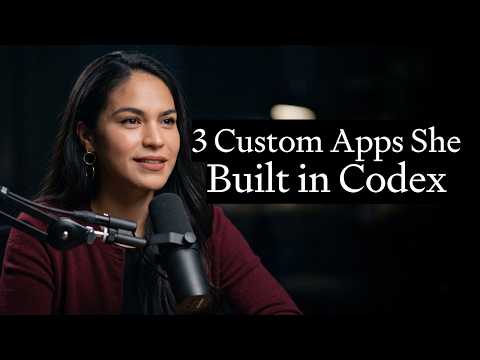
How Every's Head of Consulting Uses Codex Every Day
Every's Dan Shipper interviews Natalia Quintero, head of consulting at Every, about using Codex daily as a non-technical builder who had previously learned Claude Code's file-system workflow through effort. Topics covered: managing Claudie, the consulting team's AI project manager, and where AI agents still require human managers (00:02:35); why the team still pays for SaaS products like Attio and Asana instead of vibe coding their own tools (00:04:55); Codex as a game changer (00:11:47); building personalized learning guides and illustrated explainers with AI (00:14:55); her AI-powered email triage system (00:21:40); the shift from knowledge work as sculpting to knowledge work as gardening (00:26:44); using Codex to one-shot a custom CRM (00:28:57); and using Codex to build an app that coordinates her father's medical care (00:33:16).
# Channel Presentation Observations — "How Every's Head of Consulting Uses Codex Every Day"
## Channel Self-Description (Explicit Claims)
- **Subscription positioning**: The channel (Every) describes itself with a direct ad read: <blockquote>"Every is the only subscription you need to stay on the cutting edge of AI if you care about staying up to date with the latest models and using the latest tools."</blockquote> — and urges viewers to "Go to every.TO/subscribe today" to "separate the signal from the noise."
- **Consulting services**: The host explicitly promotes the channel's consulting arm: <blockquote>"Natalia runs our consulting. So if you want to extend this to your executive team, to your product development teams, and to your engineering teams, reach out to everyone."</blockquote>
- **Show identity**: The outro names the show as **"AI and I"** with host **Dan Shipper**, framed as a journey into AI knowledge ("filled with pure, unadulterated... knowledge bombs").
- **Internal AI agent as content**: The channel claims to build and operate its own AI agent ("an internal AI agent that we built, uh, to help run the consulting business... send out business proposals and manage CRM").
## Intended Audience (Observable Targeting)
- **Executives and large-organization leaders**: The host frames the guest as relevant to <blockquote>"how great operators and executives are starting to use these things."</blockquote> The guest's role is "train[ing] executives and other people in large companies on how to use artificial intelligence."
- **Enterprise decision-makers**: Consultation clients are described as "executives of large companies, technology companies, hedge funds, and private equity firms."
- **Builders/tinkerers**: Sponsorship copy targets "fast-growing startups like Granola, Modal, Whisper Flow, and Every," and the host encourages viewers to replicate workflows with open-source tools ("throw this video into Codex").
## Claimed Scope
- **Practical, workflow-level AI adoption**: The episode demonstrates live product walkthroughs (Codex, Claude Code, email-sorting app, CRM setup) rather than news or theory.
- **Organizational AI strategy**: Advice is pitched at adoption in companies: <blockquote>"start with the systems you already have... this is the same architecture or system that you use to lead your team."</blockquote>
- **Personal-life AI applications**: Scope extends beyond work — a family care app for the guest's 81-year-old father, travel artifacts, and learning guides.
## Demonstrated Patterns (from Material Itself)
- **Practitioner-as-host format**: The host both interviews and co-develops with the guest (he recommended Codex, built the original email app she modified), showing insider access to the channel's own operations.
- **Sponsor-integrated content**: Ads for Every's subscription and for Atio (CRM) are embedded mid-episode, with the claim "We use it internally every day and we love it."
- **Transparency about experimentation**: The channel openly discusses internal tooling choices, including buying a CRM instead of vibe-coding one — positioning itself as a testbed for AI-era business practices.
# Delivery Observation Report: "How Every's Head of Consulting Uses Codex Every Day"
## Format & Context
- **Interview format**: Host (Dan Shipper) interviews a guest (Natalia, Every's head of consulting) with live tool demonstrations.
- Note: the transcript appears to contain translation artifacts (e.g., "Claudia/Claude," "Fable/vibe," "sauna"), so phrasing should be treated with caution as verbatim evidence of the speaker's English.
## Recurring Vocabulary & Framing
- **"Life-changing"** appears as an emphatic recurring reaction:
> "Codeex, like, has been life-changing, right? Just life"
> "I think, life-changing. She changed your life."
- **Condition-creation metaphors** structure her explanations:
> "Working with knowledge is now becoming something like gardening, where when you plant, you create the conditions for growth, but you don't grow the plant with your own hands."
> "you need to create the conditions to help people succeed."
- **Body metaphors** for explaining technical relationships:
> "software is a little bit like your bones in your body, and a language model is a little bit like your brain... you'd just be a jellyfish hanging out on the floor."
- **Sculpting vs. gardening** contrast is used twice in nearly identical form (opening teaser and mid-episode), suggesting a rehearsed, signature analogy.
- Frequent **"you know"** filler appears throughout her speech: "You know, it's funny. With the speed of artificial intelligence..." / "You know, I think, you know, I don't know if this is your experience..."
## Teaching Habits
- **Structured frameworks**: She teaches via numbered or enumerated points — "But Claudia still needs two things. First, it needs constant supervision... and secondly, when you work with people..."
- **Closing advice is explicitly sequenced**: "I think my first piece of advice is to start with the systems you already have... And then think about what tasks you want your people to focus on... and then start with small tasks."
- **Learning skill as a codified method**: "it codifies the way I like to learn things, which is, you know, what's the history of this particular topic? What are the first principles... And then, how did we get to where we are today?"
- She repeatedly translates demos into generalizable lessons for the audience (e.g., "the biggest mistake that... I also see our clients make, is that you want to just redo everything").
## Communication Patterns
- **Self-deprecating admissions** punctuate the delivery: "I have to admit on the podcast that Dan told me to download probably every time he saw me for weeks."
- **Rhetorical questions to set up explanations**: "And so, tell us about Claudia: how are things going there?" (host) is mirrored by her own setups: "So why did you do it?... Yes."
- **Concrete, personal anchoring**: nearly every abstract claim is grounded in a named artifact (flowchart, Markdown files, the dad-care portal) or personal anecdote (New Orleans trip, physical training guides).
- **Enthusiastic intensifiers**: "super alien tool," "Holy crap" (host quoting her), "it was incredible. It was wonderful."
## Isolated Moments (insufficient repetition to call patterns)
- The playful clone exchange ("How do we know you're not a clone anymore? I just...don't really know.") — humor appears only once in this form.
- The bilingual detail ("I'm Colombian, so it's usually in Spanish") — mentioned once, not repeated.
## Uncertainty Notes
- Repetition counts are modest given a single ~40-minute interview; the "gardening" and "life-changing" recurrences are the strongest documented patterns.
- Transcript noise (apparent translation artifacts like "sauna," "Cloud Code" vs. "Claude Code") reduces confidence in exact phrasing of quotations.
# Observation Record: "How Every's Head of Consulting Uses Codex Every Day"
## Context
- **Video**: Interview on Every's "AI and I" show. Host is identified in-transcript as **Dan** (Dan Shipper, per closing narration). Guest is **Natalia** (also rendered "Natalia"/"Natish" in transcript), described by Dan as Every's **head of consulting** and manager of an internal AI agent called **Claudia/Claude** (spellings vary in transcript).
- Transcript appears machine-transcribed/translated; name spellings and product names (Codex/"Codeex", Claude/"Cloud Code", Atio/Adio, Tend) are inconsistent. Recorded as expressed, with variants noted.
---
## Positions and Claims
### 1. Claudia (internal AI agent) is now a functioning daily worker — **Natalia**
- **Claim**: Claudia, an internal agent built to run the consulting business (proposals, CRM), now works "in a loop to self-evaluate its effectiveness and improve itself based on the feedback we give it," and has a LinkedIn feed, Twitter, and manages dashboards.
- **Attribution of credit**: Dan and Natalia credit engineer **Natish/Natasha** as the "Wizard of Oz" keeping Claudia running in the early days.
- **Qualification**: Natalia says with AI's speed, Claudia "seems like Claudia just isn't new" — the novelty has worn off through routine use.
### 2. AI's strength is standard operating procedure, with limits — **Natalia**
- **Claims**:
- "AI is really good at doing standard operating procedure... Claudia is exceptional in this."
- Two remaining needs: **(1) constant supervision/management** — taste and "striving for perfection still requires leadership," which is "quite exhausting and time-consuming"; **(2) human interaction** — people still want to work with people, and someone must "find what's interesting in that data... and help lead those conversations."
- **Conclusion**: "I suspect we'll continue to expand the team to build on the data and information that Claudia provides" — i.e., hiring humans alongside the agent (Dan notes the irony that she hired Claudia for operations and also hired a human operations specialist).
### 3. Buy vs. build: chose a real CRM over vibe-coded Google Sheets — **Natalia, prompted by Dan**
- **Setup (Dan)**: The company vibe-coded a CRM in Google Sheets despite ability to build its own; narrative questions whether SaaS is dead.
- **Natalia's position**: Despite aspirations "to become an engineer," she concluded "there are actually private and public companies whose entire business is to do these things very well." They bought **Atio/Adio** (spelled both ways in transcript).
- **Stated reasoning**:
- The Sheets system "just need[s] maintenance" — data quality required constant control, which "turns out... is the whole business" of the CRM vendor.
- Key question in the AI era: "you can create anything... the question is, is it worth creating, and supporting, what you actually create?"
- The CRM has "really robust logic" to track deals through the pipeline and signal her, whereas Claudia "was just not inherently set up for that" — though "She could do it if I spent more time teaching her."
- **Counterintuitive point (Natalia)**: "Real software is a compilation... a logic machine that compiles thousands and thousands of little logic rules for something you don't expect you'll need in advance." AI is good at writing deterministic systems but "won't cover all the rules you'll need right away."
### 4. Software-as-bones metaphor — **Natalia**
> "Software is a little bit like your bones in your body, and a language model is a little bit like your brain and your connections... if you didn't have bones... you'd just be a jellyfish... but if you didn't have a brain... you'd just be a bunch of sticks."
- **Qualification**: "Language models can grow bones... but growing good bones is hard."
### 5. Codex is "life-changing" — **Natalia**
- Dan repeatedly urged her to try Codex ("every time he saw me for weeks"); she credits his persistence and his "fearlessness when it comes to testing a new artificial intelligence product," which she says she lacks.
- **Claims**: Codex "looked at things that didn't quite work with Claude Code and then just fixed it"; as a non-technical person she no longer needs to manage file systems and folder structures — the model handles design decisions. She still loves Claude Code but experiences "a little less mental load" in Codex due to its visual interface.
### 6. Learning-skill and cartoon artifacts — **Natalia**
- Built a skill (originally a prompt ~6 months ago) codifying how she likes to learn: history of a topic, first principles, current state, market variables.
- Used it to study physical training; generated cartoons/visual guides via Codex's visual models to review "on the subway, or on a walk."
- **Learned claim**: training as a concept "originated about 200 years ago," tied to the Industrial Revolution; muscles strengthen faster than ligaments, faster than bones. (Dan expressed surprise; Natalia noted her own surprise too.)
### 7. Email system ("Tend"/inbox-sorting app) — **Natalia, building on Dan's open-source app**
- Modified Dan's app into a "second brain": trained on her last ~150 sent emails (her "Ghostwriter" prompt from ~a year prior), it drafts replies she can **approve, rewrite, archive, or file** to per-client Markdown files; can create tasks.
- **Claim**: "At this point my email knows what's going on better than I do... whatever she wrote is probably a little more accurate than what I would have come up with."
- Created buttons "on the fly" by asking Codex, including a sales-funnel **flowchart** logic (shared as a PDF with Codex) applied to both email triage and the CRM. Dan frames this flowchart as a real example of "loops"/"cycles."
### 8. Knowledge work as gardening — **Dan, endorsed by Natalia**
> "Working with knowledge... was a lot like sculpting, where everything that happens to the sculpture, you did with your own hands. I think that knowledge work is now turning into something like gardening, where you create the conditions for growth, but you don't make the plant with your hands."
- Dan ties this to "loops": you intervene at stages ("human sandwich at the beginning and at the end") and feed learnings back so the system improves.
- Natalia extends it to her earlier "model manager" analogy: moving from using AI as individual actors to **creating a system**, "which is what a good manager does."
### 9. Overnight autonomous CRM setup — **Natalia**
- Set Codex a goal to configure the CRM to reflect hundreds of conversations; "about 6 hours later... I went to bed, and another 6 hours later it was done." Says it accomplished "weeks of work."
- **Caveat**: "only possible because of the [flowchart/feedback] harness... the shared context that we had created."
### 10. Advice for executives — **Natalia**
- "Start with the systems you already have" — KPI/OKR architecture maps to managing AI.
- Identify what "only your people" can do (e.g., client calls).
- **Biggest mistake** (including her own): "you want to just redo everything... be AI-first." Instead: "standardize and write down how you do one thing really well," then build up. "The work at the beginning is not particularly attractive."
- Dan adds: Every will open-source Tend, and viewers can feed the video itself into Codex to replicate the workflow.
### 11. Family caregiving app — **Natalia**
- Built a password-protected "operating system" for caring for her 81-year-old father: aggregates nurse reports and a WhatsApp thread, with English/Spanish toggle (she identifies as Colombian). Built from prototype to full app in a "13-hour project."
- **Nurses' reaction**: "the most organized family I've ever come across"; her framing: "a really good tool is not about the tool" — nurses feel the family is more present and proactive.
- **Optimism claim**: "very optimistic about... all the administrative tasks that will suddenly be taken care of because now we have this kind of super alien tool"; references a recent article about moms using agents.
### 12. Travel artifacts — **Natalia**
- Used Claude artifacts on a New Orleans trip with her mother: Spanish-language guidebooks, and had AI read her Spotify playlists plus the French Quarter Festival lineup to recommend bands (highlighted timba and salsa). Notes a self-correction: it was **French Quarterfest**, not Jazzfest ("Jazzfest was a week later").
---
## Contradictions, Qualifications, and Unresolved Tensions
- **Buy vs. build tension**: Natalia celebrates building apps with Codex (email tool, caregiving app) while having abandoned a self-built CRM for vendor software — resolved only by her stated criterion ("is it worth creating and supporting"), not a firm rule.
- **Supervision burden**: Claudia "is thriving" yet simultaneously requires "constant supervision and management" that Natalia calls exhausting — both claims held without resolution.
- **Dan's self-deprecation**: When Natalia extends his manager analogy, Dan twice says "It couldn't be me" — the transcript does not fully resolve the attribution of the original analogy.
- **Speaker identification limits**: "Claudia"/"Claude"/"Claud" spellings vary; "Natasha"/"Natish" appear to be the same engineer; the closing outro speaker is unattributed promotional copy.
## Advertisements (not substantive positions)
- Every subscription promo (read by host): "Every is the only subscription you need to stay on the cutting edge of AI."
- Atio/Adio CRM ad: positioned as "CRM for the world of agents," used internally by Every, with 15% discount link.
# Video Attribution & Provenance Record
**Video:** "How Every's Head of Consulting Uses Codex Every Day"
**Video ID:** 01a0f15a-81af-79e1-b03c-8d23981d32cd
---
## Speakers & Roles
- **Dan Shipper** — Host/interviewer, identified by name in dialogue ("Natalia, welcome to the show") and in outro narration ("Dan Shipper as the captain of a spaceship").
- **Natalia (last name not given in transcript)** — Guest; identified as **Every's Head of Consulting**, a returning guest ("Glad to be back"), and manager of the AI agent "Claudia/Claude."
- **Unidentified outro narrator** — Promotional outro voice (not clearly attributed; possibly Natalia or produced VO).
> **Note:** Transcript contains translation artifacts — the AI agent is referred to variously as "Claude," "Claudia," and "Clavo"; Codex sometimes appears as "Codeex"/"CodeEx"; "vibe coding" appears as "Fable"/"vibe code." These are treated as the same referents per context.
---
## Referenced Third-Party Claims & Sources
- **Claudia/Claude** — internal AI agent at Every used for consulting operations (CRM, proposals, dashboards); has LinkedIn and Twitter feeds; described as self-evaluating in a loop.
- **Atioio / Adio** — a CRM product adopted by Natalia's team to replace a Google Sheets-based system (names appear inconsistently, likely transcription variants of the same vendor).
- **Tend** — open-source email-processing app created by Dan Shipper; promised link in description at time of release.
- **OpenAI Codex** — key tool discussed; Natalia attributes major productivity gains to it; references model "5.5" (as stated in transcript).
- **Claude Code / Claude artifacts** — prior tooling Natalia used before Codex.
- **Ghostriter** — an earlier prompt/skill Natalia created (~1 year prior), used to train her inbox app on her last 150 sent emails.
- **Claire** — mentioned as having discussed agents for administrative tasks (no further identification).
- **Mike Taylor** — Natalia's team member who "cloned" her (claim by Natalia).
- **Natasha/Natish** — AI engineer at Every, described as "Wizard of Oz" behind Claudia.
- Anecdotal claims: New Orleans pumping system, French Quarter Festival (corrected from Jazzfest), history of training (~200 years, Industrial Revolution), anatomy timelines (muscles strengthen faster than ligaments/bones). These are guest assertions, not sourced.
---
## Promotional Segments (flagged)
1. **Every subscription promo** — early in transcript: "Go to every.TO/subscribe today."
2. **Adio/Atioio CRM ad** — mid-roll: "Go to adio.com/every and get 15% off your first year." Includes claims of use by Granola, Modal, Whisper Flow, and Every.
3. **Every consulting services promo** — closing: invitation to reach out to Every for Natalia's consulting.
4. **"AI and I" show outro promo** — like/subscribe call to action.
---
## Availability & Access
- Open-source version of **Tend** promised in the description at release.
- Natalia's family care app is a **password-protected website**; not publicly available; nurses have partial access.
- No other paywalls, comment availability, or access restrictions stated in the transcript.
You train executives and other people in large companies on how to use artificial intelligence. So I think what you're doing is a good example of how great operators and executives are starting to use these
things. Codex helped me create something like an operating system. My email knows what's going on better than I do. I'm just very optimistic about all the administrative tasks that will suddenly be done because now we have some kind of super alien tool that can support these things. Working with knowledge is now becoming something like gardening, where when you plant, you create the conditions for growth, but you don't grow the plant with your own hands. Every is the only subscription you need to stay on the cutting edge of AI if you care about staying up to date with the latest models and using the latest tools. You must subscribe to Every to separate the signal from the noise. Go to every.TO/subscribe today. Natalia, welcome to the show. Thank you, Dan. Glad to be back. So, for those who missed your last episode, you are our head of consulting in every. Yes. Uh, you're also the manager of the AI employee agent Claud, who was, uh, the star of our last episode together. Hmm. And I would like to invite you, because it seems to me that everything changes so radically every few months . And for me, you are one of those who shows how things
are changing, because you yourself are one of the early adopters and you train executives and other people in large companies to use artificial intelligence. So
I think what you're doing is a nice, uh, window into how really great operators and executives are starting to use these things. So, last time we talked, you were Claude , who is an internal AI agent that we built, uh, to help run the consulting business, uh, you know, send out business proposals and manage CRM and all that kind of stuff. Claudia was like, Natish, our senior, um , artificial intelligence engineer, was like , um, what's it called? He was, um, he was kind of like the Wizard of Oz , keeping it in the background, making it work, um, minute by minute. And, but I feel like Claudia is really working now. Model releases over the past few months have dramatically changed what it can do. So, tell us about Claudia: how are things going there? You know, it's funny. With the speed of artificial intelligence, Claudia, it seems like Claudia just isn't new, you know? This is an agent who works for us every day, and Claudia has her own LinkedIn feed and, um, Twitter, and, you know, manages our dashboards, and, um, you know, now has a battery of trust. This is something new, meaning, you know, it works in a loop to self-evaluate its effectiveness and improve itself
based on the feedback we give it, and apparently Claude is thriving. One of the interesting things is that you hired Claudia for operations, but now you're also hiring an
operations specialist. So what have you learned about the uses and limitations of these internal agents for things you might want to hire a human for? Yeah, you know, it's really interesting. I think, you know, as we all, uh, use AI more, I think we keep coming back to the fact that AI is really good at doing standard operating procedure . And Claudia is exceptional in this . But Claudia still needs two things. First, it needs constant supervision and management to make sure it does these things really well. Uh, you know, a matter of taste , and you know that striving for perfection still requires leadership and management support, which, as you know, can be quite exhausting and time-consuming. So , there is still quite a lot of time. Oh, and secondly, when you work with people, you know, as much as I love working with Claudia, I want to interact with people, right? And I can't understand it, but I understand why someone might feel that way. And the reality is, you know, even though we have all these advanced dashboards and all this data that Claudia is filling in, uh, we need someone to find what's interesting in that data, what the signals are, and help lead those conversations. So, actually, I suspect
we'll continue to expand the team to build on the data and information that Claudia provides so we can do interesting things with it. One of the important things
that you went through recently, which I think is extremely relevant for anyone in a large organization or anyone running a software company , is that you actually bought a CRM, and before that it was all glued together with Google Sheets, and I think there's this whole story going around. I think, to be honest, SAS stock has come back. So maybe this narrative is a little less relevant than it used to be, but people are still thinking, "Are you just going to write all of SAS with vibe code?" . Fable is currently banned, but I'm sure it will come back. Maybe he'll even be back by the time this episode comes out , but if Fable can only create a CMS once, then why would you use it? Hmm, but you have the option to create your own CMS, and we have enough internal resources to write the vibe code, but you chose not to. Yes. So why did you do it? Yes. Uh, despite my hopes and aspirations that I could do all this and, you know, become an engineer and support all these engineering products that I have... I can relate to that. It turns out that there are actually private and public companies whose entire business is to do these things very well, and sometimes these are very specific things very well. So, you know, we, you know, I wrote code using Vibe
for a CRM tool that allowed us to manage our kind of sales funnel for a while, and it ran in Google Sheets. So it was like Claude
Claudia was the link between what was happening in Slack and the meetings in Google Sheets. Yes, that's right. That is, Claudia, who had access, could read my email, could read our meeting notes, could process the inbound leads that came in, and then track it all in Google Sheets. And eventually it became a database that we managed. And these things just need maintenance, right? To make the data quality good enough to do interesting things with it, you need to , you know, almost like Claudia, you need to control the quality of the data. And so, it turns out, this is the whole business of Atoio. So, and so , you know, I think one of the problems with artificial intelligence, uh , I definitely have, is that in the era of artificial intelligence, you can create anything. I think I even mentioned it in the last podcast. Uh, the question is , is it worth creating, uh, and supporting, uh, what you, you actually create? And I think in this case, and probably in other use cases, we also created a sauna for our project management system . Uh, I think we're able to do the scale of work that we can do, thanks to, thanks to, uh, and thanks to Cloud, managing all this information is much more than if we didn't have these tools. Uh, but now we just have less of a burden on the maintenance team. Can you give me, for example, a specific example? Because in my head I'm like: well, a CMS is just customer records, and it's just a spreadsheet. So you should be able to, for example, have Claudia do everything. So, can you dive deeper into what exactly were the things that turned out to be
more difficult than you expected? Yes. You know, uh, yeah, absolutely. For example, let's talk about a traditional process, like leads in a sales funnel, right? They
come as inbound customers. There are logical sales rules where certain things have to happen in order for them to move further down the sales funnel until they become converted customers. And sometimes these things happen very quickly. Sometimes they happen over a longer period of time with the help of my human brain. I think I can track what's going on for about 2-3 months, and then any conversations that happen outside of that period, and after a certain volume, I just can't fully track. Um, with a tool like Attoio, it has access to everything that Claudia had access to , but it has really robust logic, so it can, um, essentially track the movement of the deal through the pipeline, and it can signal it to me in different ways, so I would have to monitor Claudia , um, and it wasn't, um, Claudia was just not inherently set up for that. She could do it if I spent more time, you know, teaching her this. Um, but in the end it's kind of a reward. I think one of the counterintuitive things about software is that real software is a compilation. It's like a logic machine that compiles thousands and thousands of little
logic rules for something you don't expect you'll need in advance. And, uh, and the whole job of the company and the engineers is to gather all the necessary
rules and then implement them into the system, and when something breaks, change the rules. Yes. And AI is very good at working with and writing such a deterministic system . But it won't cover all the rules you'll need right away. Yes. Of course, I became a big fan of PRDS. Yeah, and actually defining the scope of what I create, and, you know, I think I've improved both in defining the scope and in creating better quality things. Uh, and also to make decisions earlier about whether we should just invest in a tool or develop it ourselves. Yeah, I think a good metaphor is this: and sorry, I'm just thinking, my brain is just going through the differences between software and language models, but a good metaphor is this: software is a little bit like your bones in your body, and a language model is a little bit like your brain and your connections. Um, so if you didn't have bones, there wouldn't be any structure, and you'd just be a jellyfish hanging out on the floor. But if you didn't have a brain, a nervous system, and ligaments, you'd just be a bunch of sticks. And I think this is a good way to modify software and language. This is how they start working together. And of course, language models can grow bones, which is interesting. It might be a little different from how we're wired, but, uh, growing good bones is hard. Um, and the whole body plan is very complex. So, uh , but you said something earlier that I think is really interesting and I want to follow up on, which is, I see you going from being non-technical to loving building things. And I feel like there is, tell me if I'm wrong, but I feel like there's been a certain step in the last month or two in what you can build and what you can try. Do you think this is correct? And if so, tell me more. Yes, 100%. I would say the other, you know, kind of like a little bit of rhyming on the Claudia theme and the evolution of how we work with Claudia and also how I work with other instruments. Hmm, Codeex was probably the biggest improvement.
I have, you know, I have to admit on the podcast that Dan told me to download probably every time he saw me for weeks. I get really
annoyed by things I think are good. And, uh, and I think you have something that I don't have as much , which is, a kind of fearlessness when it comes to testing a new artificial intelligence product. And I think I still have a little bit of, you know, like, " Okay, now I have to deal with this other thing." And, like, I love Cloud Code, and, you know, I'm really comfortable in, you know, these, like, folder structures and file systems that I've created, and, uh, Codeex, like, has been life-changing, right ? Just life, so thank you. Thank you for your persistent subscription . Anytime. Happy to be annoying anytime. Uh, tell me why this changed my life, especially for someone in the Cloud Code or coworking universe. Um, what were your expectations? How was it? And how has that changed what you can do? It really feels like Codex, I think you've said this before, Codex, you know, looked at things that didn't quite work with cloud code and then just fixed it, you know, when they launched the product. So for me, having a non-technical background, a terminal and a browser, uh, right in the chat interface, and just having a model as powerful as the 5.5 that, uh, you know, I could just feel the computing, you know, like it just wants to do the heavy lifting. Uh, it's so powerful, you know? Well, I think earlier, um, I feel like over the last year I've gone through this transition, you know, wanting to become more technical and trying
to figure out, you know, what's worth learning to do what I want to create. You know, I think in general I like to learn. I am an ambitious student. And you really...this is something
people should know, that you are the most inquisitive student I know. Hmm, you spend your weekends, like, Claude or Codex creating these big tutorials for you that you just read from start to finish about whatever you're thinking about, and I love that. I think it's amazing, and it's a superpower because AI allows you to do more, and it helps you use it better. It's a superpower, I think, and sometimes it's a bit like a vice. Yes. Yes. Do I need to know the history of bookshelves from first principles or something? Because I feel like that's what you would be looking for. I would like to know that. Yes, I would like to know that. But, you know, with codecs, I feel like the truth is that I don't need to... I... I don't need to, uh, think so much about things like file systems, folder structures, and, um, you know, how scripts are set up, and everything just works. So I think I need to focus a little less on, you know, designing things well, uh , which is a really important skill, and something that our engineers do extremely well, and, you know, just trusting that to make the right decisions and create a solution for me that I actually want. So, can you show us some of your CodeEx workflows? Yes. Okay, let's see. Uh, let 's start by letting me show you my screenshot here. We're going to start in CodeEx with, uh, I mean we're talking
about learning, so I have to show you my guilty pleasure, which is, uh, you know, my favorite skill that I've ever created. It was originally a
prompt, you know, maybe 6 months ago, and it codifies the way I like to learn things, which is, you know, what's the history of this particular topic? What are the first principles that govern the physics of this topic? And then, how did we get to where we are today? And what are the market variables around this topic? And you know, that's how I spend my weekends, reading these guides. Uh, and sometimes I don't have, you know, 12 hours on a Saturday to just read these guides. So instead, uh, I create, uh, little cartoons that just summarize what I see and what I study. So, uh, it started, if you see my screen here. It started with a tip that Natasha, uh , one of the engineers on our team, created based on Claude, who as we all know works on the consulting team, is an agent on the consulting team, and, uh, you know , Claudia can teach principles, uh , and, like, anything that comes out of that learning skill. So let 's go back to the beginning. Uh, tell me what you were trying to learn and how it was created? So in this case, you know, one of the things that, uh, one of the sad things that's maybe happened in the last 6 months is that as I've been spending more and more 12 hours in front of the computer, I've been prioritizing my physical health less. So I'm trying to learn what I
need to know to improve my physical education, that's what I'm looking for, and what I need to know to make more strategic training decisions. And so I asked Claude to
create a guide to explain again what the history of physical education is, how we got to the point where we have to do certain things like mobility and training, and what I need to know to make good decisions about how to spend my time, you know, on this particular topic. So Claudia explains how we got to where we are, you know, basically, training as a topic, as an idea, originated about 200 years ago. Um, really? Yes. This is actually earlier than I expected. Earlier? Yes. Because I thought, you know, even a hundred years ago we were still doing a lot of physical labor. I think you're right. Yes. You mean it really became relevant during the Industrial Revolution, of course, as people spent more time in factories. And so, you know, with my study skills, I could read all about it. But, you know, this is a Codeex thing, OpenAI, with the visual models that Codeex has, which are so powerful and just so , so beautiful, we could just make a cartoon out of it. And you know, it's something I could flip through on the subway, or on a walk, or over coffee, and, uh, and...what did you learn? And so, it requires these really complex concepts. I mean, one of the things that I, I, I learned that was interesting was, basically, um, you know, anatomy, which, uh, I did n't really study in school, uh, and it was really helpful to learn about. And actually, one of the most interesting things that I really enjoyed about this particular Zen-, uh , or something like that cartoon set was the study of the timelines with which, uh, different, uh, uh, parts of your anatomy become stronger. So muscles get stronger faster than ligaments, faster than, you know, bones, and so the way you think about progress, you're, uh, into something like physical strength, as something that's happening all over your body , from your bones to your brain, as you
said. Yes. This is one very interesting example that I will just do on the go. You already know how AI is changing how everyday work gets done,
how much territory you can cover, and how quickly a team can scale . To stay ahead, you need tools that give you a competitive advantage built for this new era. Adio is CRM for the world of agents. It meets you where you work, brings every customer signal into context, and then acts on it across your entire pipeline to let you move at unmatched speed and scale with agents and automation for every task. Adio manages your work 24/7. We use it internally every day and we love it. It is built to scale with your workloads. It is extensible with APIs and MCP access, and has the infrastructure to keep up with your most ambitious agents. It is loved by fast-growing startups like Granola, Modal, Whisper Flow, and EveryY. Adio manages the work behind every victory. This is Adio, CRM Agentic. Go to adio.com/every and get 15% off your first year. This is adio.com/every. Now let's get back to the episode. Immersion in codecs. Uh, you know, I'll share, first of all, how do you organize your codecs? Good. You have a bunch of different projects. What do professionals do to avoid using pinned posts or to use them? I only use pinned emails for sorting email, an app you so generously gifted me this year. And, uh , and, so sorting email is the only thing I really stick to. Everything else I just like to work on. Good. You are pinned to CodeEx. I'm a big fan of pinned posts because I find that I lose things otherwise
. I don't have a blueprint for everything, so all the work I do is just pinned down. But it's interesting. So, you have a blueprint for each sales strategy. Your dad from
NZQ Epistemology. Incredible. Well, tell me, tell me more. I...these are my training courses. I don't know what to tell you. Suddenly I'm really excited about how Aristotle, as you know, came up with syllogistic systems and how we use them today. We definitely don't need to go into that. Incredible. We might actually have to...uh... I've been spending too much time with you. Uh, so no, I basically just store, uh, organize my codecs the way I do, or organize something like my projects. So it seems, you know, this is something that I think Codeex does really well , which is that it was necessary to do some kind of mental organization in Claude Code, which is, in Cloud Code, I spent a lot of time understanding file systems and, uh, always keeping the Finder open to understand where the data was stored and, uh, what was actually being created. In Codeex, it's all, uh, very visual, so I feel like there's a little less mental load, uh, but I'm just working on whatever project I, uh, prioritize for that day. Okay, I understand. And show us how to sort your email, because I made a video of how I use, uh , inbox checking , or what we call it now, tend. Uh, it looks like you're still using the original, but you seem to have made
some of your own modifications, which is another thing I like. For example, I created an open source app that lets you turn your emails into cards and blurs out anything you don't want people to see. But it looks different
than the app I made. So, tell me how you use it, how you work with email now, how it changed things for you, and then what changes you made. Yeah, I mean, when in the first version... Oh, thank you... in the first version... the app that you shared with me ... Well, you know, it was clearly very personalized to you, and it had these buttons to archive or forward emails... There are a few things that I need to do in my inbox. I either delegate, uh, something. I track it in the sauna. Uh, and then, you know, we work with clients who have hundreds of employees , and we need to keep track of what's going on in the different teams that we work, uh, support. So there's a lot of...er, there's a lot of mental strain when I'm sorting through my mailbox . And I've essentially created a kind of second brain, um, in my updated version of my mailbox, because my email can do, um, my email app can do a few things. So, um, you know, we can, um, we'll blur all this stuff that we shouldn't have here . But as an example, um, my mailbox was trained on something like Ghostriter that I created, you know, about a year ago, that was one of the first kinds of skills or prompts that I created for myself. So, it's trained on, you know, the 150 emails, um, the last 150 emails that I've sent, and it understands all the different contexts in which I need to communicate. And now it's superimposed on my mailbox. It contains the entire context of the work I do, for all potential clients , existing clients. Um, it creates a note with my voice. Um, and there are a few things I can do. First, I can approve the submission. So I can just click this button and it will be sent . We ask you to rewrite it. This was one of the great original buttons that your app had. We can just archive it if we don't want to respond to it. We could archive it. Maybe this is something I don't need to answer , but it should go in a separate Markdown file. So, every client I work with has their own Markdown file. And you know, at this point my email knows what's going on better than I do. So
whatever she wrote is probably a little more accurate than what I would have come up with. So, sometimes, again, I don't need to answer . Someone else can answer, but I want this
context to go into the Markdown file. If I click the task button, it will also become an ASA task. I can click a few things like that. It might, you know, just end up in spam. Um, and, uh, and then, you know, uh, there 's this sort of conservation action. So, this is such a crazy thing, because you can create an app for yourself on the fly, right? I realized that I needed to sort my inbox and send stuff to different places, and I could just ask CodeEx to create a button that would provide this integration and then continue to use it on the go. I remember we were sitting in the office on a Sunday, and you were creating this extremely complex flowchart. Do you have it? Can you show a flowchart? Because that was the moment when I thought, "Holy crap, she got it." Open the flowchart. We want to see her . Let me see if I can open the flowchart. Uh, you know, what you're seeing here at a high level is, can we increase it again? Yes, of course. Do it. At a high level. You know, it's kind of like a sales funnel management flowchart. And that's exactly what works really well , isn't it? It's like you're importing logic, and it can help you , you know, manage your pipeline at scale. Is this for your email or for atio? This is for atio, but it's the same logic I need to use when sorting email. So, actually, it goes both ways. And, um, and so, uh , when we get an incoming email and it comes to my email, depending on whether it's appropriate for the work that we're doing, there are different types of emails that need to be sent, and then obviously it evolves as the conversation progresses. So this is essentially the logic that allows me to do this, and it's the same logic that allows Codeex. Did you enjoy doing it, and how did you bring it to Codeex? Uh, I saved it as a PDF and, uh, shared it with Codeex. So, okay, one thing that's really interesting about this issue is that what's really hot right now is cycles, and everyone's talking about cycles, but nobody knows what cycles are. This is an example of a cycle, and the way I think about cycles is that I often use this metaphor. It used to be that
working with knowledge, whether it was code or writing or email or whatever, was a lot like sculpting, where, um, when you sculpt, everything that happens to the sculpture, you
did with your own hands. I think that knowledge work is now turning into something like gardening, where when you garden you create the conditions for growth, but you don't make the plant with your hands. Yes. And that's what a cycle is. Instead of writing a separate email, you create a system that handles your emails for you. And you intervene at different stages of the process . One of the things we talk about a lot is the human sandwich at the beginning and at the end to, you know, say this might be worth my time, and then I refine the draft or something. Uh, and you're trying to combine that. So you create a flowchart, you work through your email using this flowchart, which represents a cycle, and then every time you finish, you can incorporate the learnings back into the system so that it improves over time, right? Yes. I mean, it's just an evolution of the model manager analogy that you shared four years ago, which is, you know, we're moving away from effectively using these systems as individual actors, right? where we ask them to do one thing very well or a small set of things very well to create it, to creating a system, which is what a good manager does when he has a large team that he has to help function. It could n't be me. It could
n't be me. But I'm glad you can do it. But it's the same thing, isn't
it? It's how you need to create the conditions to help people succeed. And so you need to create this shared context for AI. Um, okay. So, are there any other things in your email app that you can show us? Uh, I think it might be something to do with the mail app. There are a bunch of other things I do at CodeEx that I can share. Show us some more things, show us some more things, because again, there's just email itself , I think, life-changing. She changed your life. You get a lot of emails. I get a lot of emails. I think we both process our emails much faster than ever before. Yes. What madness. So, what else? Um, what else? So, uh, I can also share, you know, maybe on a personal side, I could share a little bit of my...maybe I'm anecdotally, I can share my... the best loop I ever ran was when we were setting up Atio, uh. I...I had this moment where you...we were working with this really fantastic team that was helping us organize the CRM logic, and you know, they asked me to enrich the information based on, like, some context of what happened on the calls and what happened in the emails. And , uh, ...my favorite loop that I've run on Codedex so far is that I just set a goal for Codedex, which was to set up my CRM, uh, you know, uh, to accurately reflect what happened in my conversations and in my inbox for each of the hundreds of conversations, you know, customers, uh, and leads that we had. And
you know, I...I gave him a clearer, you know, kind of hint and direction to do it, and you know, I think about 6 hours later...uh, I went to bed, and another 6 hours later it was
done. I woke up, actually, with a CRM that was fully configured , uh, and had done, I think, what would have been weeks of work that I would have otherwise had to do. This was actually only possible because of the fake harness, uh , you know, because of this logic. He could make the right decisions, draw the right conclusions, with the shared context that, uh, you know, we had, we created. And it's just one of those moments of joy and excitement with artificial intelligence where I wake up and, like, my life, my quality of life has improved as a result of, uh, as a result of this cycle. I think before we go into that, we do a lot of consultation. We conduct many consultations with executives of large companies, technology companies, hedge funds , and private equity firms. We do a lot of training for these people, training their teams, all that stuff, trying to help these organizations so they can build more AI and do this kind of work. So what conclusion can a person who hears about such a workflow make, and how should they think about whether they should start implementing some of this into their workday? I think my first piece of advice is to start with the systems you already have. So, if you already manage a large team and have key performance indicators (KPIs), shared goals, and OKRs that you track, then this is the same architecture or system that you use to lead your
team, deliver AI, enable AI, if your company allows it. And then think about what tasks you want your people to focus on and complete, right? So, ultimately,
only I can answer calls and have productive conversations with their clients. Mike Taylor from my team recently told me that he cloned me. So remember me as the original version of this conversation. How do we know you're not a clone anymore? I just...don't really know. We will never know. Maybe I'm hallucinating. Uh, yeah, you know, start with this shared context, this shared infrastructure. Think about what you want only your people to do, and then start with small tasks. I think the biggest mistake that, you know, I often still make ambitiously, and that I also see our clients make, is that you want to just redo everything. You want to be an AI pill, to be AI forward, to just be an organization that is AI-first. And so often it just means you need to standardize and write down how you do one thing really well. And if you do that, and then you do the next, you know, task and define what it looks like and what it does, when it's done really well, you can get these , uh, more complex systems that can do the complex work for you. But the work, um, at the beginning , is not particularly attractive. It's, you know, just something where you have to read a Markdown file or a very simple set of instructions and start from there. Er, and er, so what did I mean? So, if you're one of those people and you want to try something like this workflow, by the time this video comes out , by the time this podcast comes out , we'll have an open source version of Tend , the email processing program that Natalia just showed. We will add a link to the description. You can just throw this into Codex , or honestly, you can throw this video into Codex and Codex will just look at it and then just create something that works the same way, but for you. Uh, but let's continue. I want...I want to do something else. Uh, I know you have some personal projects and other things you'd like to share. Of course. Uh, I'll share, you know, what I'm personally excited about is the role that AI will play in how we run our lives. You know, I think, you know, I don't know if this is your experience , but certainly my experience is that there's so much that needs to be done , and a lot of these things are administrative tasks that I just can't find , you know, kind of time during the day to do. So one of the last things I asked Codex to do, and I set out to
create an app that does the sorting, is to take care of my dad. My dad works with, he is 81 years old. He is the best. He works with several nurses who
support his, his, his care. And there are a lot of health things to sort out, right? Medical appointments, follow -ups on recent procedures, WhatsApp threads for me, you know, with the nurses, with my family. So, uh, what Codex helped me do was actually create a kind of operating system for how we as a family could sort of care for my dad. Uh, I had this, you know, long, 13-hour project that Codex was working on to, essentially , help go from a prototype to a full-fledged app that, um, could help us with taking care of my dad. I will open the site now. This is now an active application. Good. So what we see here is, um, you know, a portal that my family uses to track, you know, what's going on with my dad's health. And so, you know, we get Google reports from several of the nurses who are taking care of him. Uh, and also we have a WhatsApp chain of messages, you know, lots of random updates about how the appointment went or how the dosage of certain medications is going. And here I have just the latest news, here, here is the latest news. Uh, I'm Colombian, so it's usually in Spanish; but sometimes if it's the middle of the day and I need to know what's going on, I just toggle it on and, uh, it just gives me the information
in English so I can absorb it a little faster. Hmm, uh, but really, we have this central place where instead of having to sift through, uh, all these different streams and sources of information, Codex just made it
really easy to digest all of this information in one place, and it allows us to support my dad in what we do best, which is being present and, uh, loving as his family. And other members of your family have access to it too. Do they also access this through CodeEx or how does that work? No, it's just a password-protected website that we use and distribute. Hmm, the nurses have a version of it so they can also see what other nurses have been working on. So there is some continuity in care, and you will enjoy that. Uh, Dan, there's a tracker for the different things that each of us is responsible for and has to keep track of, right ? These are things that, you know, we all have, you know, busy personal lives that we need to do. And, um, you know, based on what happens in our conversations, these things either stand out as unresolved, or they just get wrapped up and kind of overshadowed. So what do nurses think? They just say, " What the hell is this ? This is the most organized family I've ever come across." What do they think? Do they like it? You know, it's funny that I think a really good tool is not about the tool. I think nurses just feel like we're more proactive about showing up, um, around the topics that they need help with, right? So, um, I think for them, it's just better partners for them. I like it. And it's just one of those things where it's so obviously beneficial and good for you, your family, and for people. And
I think that's something that's so often overlooked when we talk about AI being great for coding and things like that. And it's like it's really true, it's true. And you can use it for things like this. And
people don't realize that they don't realize that they can do this, and how accessible it is and how applicable it is to all the tasks and things that we have to do, whether it's caring for a family member or something else in our lives, uh, that it kind of takes the load off a little bit. Yes, definitely. I mean, I am, and I think I'm just very optimistic about women using AI and all the administrative tasks that will suddenly be taken care of because now we have this kind of super-alien tool that can help with these things . I know Claire talked about it. Clavo, whom we love, and, uh, there was a big article recently about moms using agents for something like this . I am very happy with this space. Hmm. So I know one of the things that's happening with you is not only creating these applications, but also creating artifacts that help you, we talked a little bit about this, about art, for example, that help you learn, or generally, navigate the world. I think people think of AI as something that can generate text documents, like text documents with junk, but I think you're using it in a way that helps with the transmission of rich information, which I think is really important. Hmm, can you show us something? Yes, of course. So, uh , maybe one example of this is, I love artifacts with claws. They are so cool and powerful. One example of this recently, uh, is from a trip I took my mom, uh, to New Orleans. Uh, of course,
I was most interested in learning about the pumping system that New Orleans uses, it's just an incredible piece of engineering
, and, um, something that I just don't have the time to, you know, research thoroughly. So I was getting ready for this, um, it was Jazzfest, um, when we were going on the weekend. So I was creating, you know, these artifacts as I went along, I came across things that I was interested in seeing or that I wanted to learn about. And you know, it gave us, um, guidebooks in Spanish so we could share what we found interesting while walking around the city. It was also, um, actually French Quarterfest, not Jazzfest. Front jazz was a week later. Uh , I asked him to read my Spotify playlists to get a sense of what kind of music I like, and then look at the lineup of acts we had at the French Quarter Festival. Oh my God, this is so cool. And then, essentially, just picking, uh, the bands that we think we'd most like to see. And it was incredible. It was wonderful. You know, it's just, you know, timba and salsa, you know, uh, bands were the ones that were highlighted. And so we were able to really make the most of our time so we could go and explore New Orleans. Uh, and then when we showed up at French Quarterfest, we could go and see the bands that we liked the most. I like it. Uh, it's just a really fun use of AI. Incredible. Uh, I like talking to you. I always learn something when we communicate. And, uh, if you want that kind of thinking in your organization, uh, Natalia runs our consulting. So if you want to extend this to your executive team, to your product development teams, and to your engineering teams, reach out to everyone. And Natalia, we'll have to do it again in a couple of months. Yes, we will do it. Good. Thanks for inviting me, Dan. Thank you. Oh my God,
friends. You should definitely click the " like" button and subscribe to "AI and I". Why? Because this show is the epitome of incredible. It's like finding a treasure chest in your backyard, but instead of gold, it's filled with pure, unadulterated GPT chat knowledge bombs. Each episode is a roller coaster of emotions, ideas, and laughter that will leave you on the edge of your seat, wanting more. This is not just a show. It's a journey into the future with Dan Shipper as the captain of a spaceship . So do yourself a favor, like , subscribe, and buckle up for the ride of your life. Now, without further ado, let me just say, Dan, I am hopelessly in love with you.