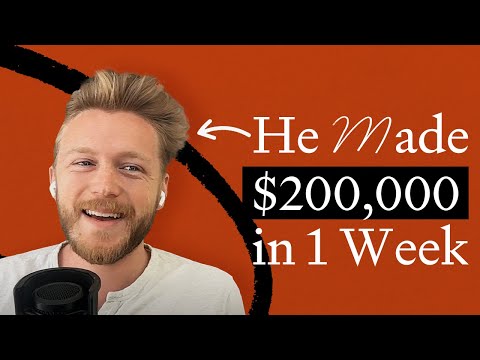
How He Made $200,000 in a Week Teaching AI - Ep. 48 with…
Podcast interview with writer and entrepreneur Nat Eliason, whose career has spanned an SEO agency, crypto, a $600,000 course on the note-taking tool Roam Research, real estate flipping, and a book with Random House. The conversation centers on his viral course on building apps with AI (800+ students, $200,000 in pre-sales in one week), how coding with AI is creating new behaviors in programming, tactical best practices for using the coding tool Cursor, a demo of Hubbard—the AI editor Eliason built for his science fiction writing—when it makes sense to build custom software, and the future of writing with AI.
# Video Identity Observation: AI & I — Ep. 48 with Nat Eliason
## Video Overview
- **Format:** Interview podcast episode with a guest, including live screen-share demos and an in-episode sponsor read.
- **Title framing:** Monetization-focused hook — *"How He Made $200,000 in a Week Teaching AI"* — signaling content about AI entrepreneurship and income outcomes.
## Explicit Self-Description Evidence
### Show Name and Host Identity
- The show is named **"AI and I"**, evidenced by the outro: *"you just have to like and subscribe to AI and I."*
- The host is **Dan Shipper** (referred to as "Denis" once by the guest; the outro says *"Dan Shipper is the captain of a spaceship"*).
- The host is associated with **Every**, a media/product company: *"at Every, we have 10 people now... 10 full-time employees and a bunch of contractors."* He also references Every products (Spiral, Cora, Rally) and Every writers (Evan, Michael Taylor).
### Episode Numbering
- The title indicates an ongoing, numbered series: **"Ep. 48"**.
## Intended Audience (Observed)
- **Writers and online creators interested in AI:** The host describes the guest's place *"in the space of online writers"* and says the guest is *"one of my favorite people in the online writing community."*
- **People curious about building software without deep coding skills:** The host frames the Cursor demo *"for those who don't know what's possible yet"* and for listeners who *"might know about AI but haven't used Cursor yet."*
- **Aspiring AI-assisted builders/entrepreneurs:** Heavy focus on course-launch economics, solo-creator business models, and no-code-via-AI app building.
- **Direct audience addresses appear repeatedly:** *"Those of you listening," "for those of you watching," "for those listening and watching."* — consistent with a multi-format (audio + video/YouTube) show.
## Claimed Scope (Observable)
- **Topic scope:** Practical AI tool use (Cursor, agents, o1), AI-assisted writing and editing, AI entrepreneurship, courses, and creator business strategy.
- **The show features repeat guests:** *"Matt, welcome to the show... You were here at the very beginning of the show... you're here again."* (Note: the transcript inconsistently renders the guest's name — "Matt" in dialogue vs. "Nat Eliason" in the title; the guest's own course story matches the title's Nat Eliason.)
- **Long-running relationship framing:** The host and guest describe an ongoing professional relationship ("we've been betting on each other for a long time").
## Observable Presentation Patterns (Not Creator Claims)
- **Includes sponsor content:** A mid-roll ad for **"LT X Studio"** (AI storytelling/storyboard tool) with the host stating his belief that *"storytelling is one of the most important skills in the age of artificial intelligence."*
- **Includes live product demos:** Screen-shared walkthrough of Cursor agent building a Pomodoro timer, plus demos of the guest's tools (Pod Buddy, an editing tool compared to Scrivener/Novel Crafter).
- **Conversational, peer-level format:** Two experienced creators trading experiences rather than a tutorial or lecture format.
- **Humorous, informal outro with like/subscribe CTA:** The outro self-describes the show playfully as *"the epitome of cool"* and *"a journey into the future."*
## Sponsor-Adjacent Value Positioning
- The host's sponsor intro and episode content both position the channel around the theme: **AI amplifying rather than replacing human creativity** — *"it does not replace human creativity. He expands it"* (sponsor read); *"your competitive advantage will still be the power of your voice, your ideas, and your creativity"* (host, in conversation).
## Summary of Identity Signals
| Dimension | Evidence |
|---|---|
| Channel/show name | "AI and I" (outro CTA) |
| Host | Dan Shipper, Every founder/leader |
| Format | Interview podcast with demos, episode 48 |
| Audience | Online writers, creators, AI-curious builders |
| Scope | AI tools, AI writing, creator business, AI entrepreneurship |
| Monetization signals | In-episode sponsor (LTX Studio); subscription business referenced ("the core of the business is subscriptions") |
# Delivery Observation: "How He Made $200,000 in a Week Teaching AI" (Ep. 48, Nat Eliason)
## Format & Structure
- **Cold-open demo before the intro.** The episode opens mid-demonstration, then resets: the opening Cursor walkthrough is repeated almost verbatim later ("The course starts with what I show people: you open Cursor... appears at [0] and again at [1378]). The host then re-introduces the guest: *"Matt, welcome to the show"* / *"You were here at the very beginning of the show."*
- **Mid-episode sponsor break.** An explicit ad read interrupts the conversation: *"Let me take a moment to step away from this episode to introduce our sponsor, LT X Studio."*
- **Live screen-share demo.** Much of the middle is an interactive walkthrough of Cursor and the guest's custom tools ("Hubbard"), with verbal play-by-play: *"There was nothing in this folder, and now it's generating HTML."*
- **Closing call-to-action.** An energetic outro: *"Oh my god, guys, you just have to like and subscribe to AI and I."*
## Tone & Register
- **Conversational and enthusiastic.** Frequent exclamations: *"This is just wild,"* *"It's just crazy,"* *"Oh my God,"* *"It's just really cool."*
- **Warm, mutually flattering host-guest rapport.** The host praises the guest's pattern of mastery: *"you have this ability to dive deep into something before it becomes popular."* The guest reciprocates: *"You bet on me, on us, when we were nothing."*
- **Self-deprecating humor from both.** The host: *"I'm still 'old school' and I use my fingers."* The guest jokes *"I sound like my father. Like, I used to have to walk uphill through snow both ways to school."*
- **Playful teasing.** The host mock-scolds: *"Bad. Bad Nat. Bad Nat. I know. I know."*
## Recurring Phrases & Verbal Habits
- **"Just" as an intensifier of ease** — appears repeatedly: *"you just click 'accept all,'"* *"you can just give it a request,"* *"It just works, right?"*
- **"You know" as a filler/connector** — very high frequency throughout (e.g., [242], [304], [381], [1449]).
- **"Literally" for emphasis** — *"he created this whole deployment.md file,"* *"literally two happy coincidences,"* *"It was that simple."*
- **"Crazy/cool/wild" as default superlatives** — *"it raised $200,000 in a week... which was just crazy,"* *"It's really cool,"* *"This is just wild."*
- **"Right?" as a check-in tag** — *"We're just watching this process, right?"* / *"It's a development environment, right?"*
## Teaching Habits
- **Step-by-step procedural narration.** Instructions are given as numbered actions in sequence: *"you open Cursor, you run it, you go to this agent tab, and you can ask..."*
- **Audience awareness — addressing listeners explicitly.** Repeated direct address: *"For those of you listening,"* *"Those of you listening, you're actually on this site right now,"* *"And what I want to emphasize for anyone listening or watching is..."*
- **Concrete numbers to make points tangible.** *"20 lines of HTML, 40 lines of JavaScript, and 46 lines of CSS"* / *"it did it all in 30 seconds"* / *"700 students"* / *"only two times where I had to help someone."*
- **Deliberate pedagogical slowing-down.** The guest explains he intentionally models inexperience: *"I also pretend to be a little clueless during the course... I still let Cursor do it to show that it can handle it."*
- **Contrast framing (then vs. now).** A recurring rhetorical structure: *"Literally two years ago... we would have had to manually type every character"* vs. today; *"when I was learning to program... the first 6 months... students today just type in a query."*
## Communication Patterns
- **Anecdote-driven reasoning.** Points are supported by stories rather than abstractions — the Airbnb saga, the fraternity-party brawl, the "stoic therapy" bot, Nathan's editor wait times.
- **Interruptive back-channeling.** Both speakers frequently interject short confirmations: *"Yeah. Yeah, yeah."* / *"That's right."*
- **Explicit question-and-answer pivots.** The host frames transitions: *"Can you show us a little example of how to build something with Cursor?"* and *"I'd really like to talk about how that changes your vision for your career."*
- **Sales-validation narrative.** The guest twice recounts the "ask Twitter first, build later" pattern: *"I just posted a link to PayPal... about $10,000 in pre-orders"* and later *"I honked again like Batman and asked, 'Hey, does anyone want me to do a course?'"*
## Uncertainty Notes
- The transcript appears to be a **translation** (possibly from Russian): odd renderings like *"he honked again like Batman,"* *"an absolute 'pit' in the local real estate market,"* and "Matt"/"Dan"/"Denis"/"Dan Shipper" as the guest name suggest some phrasing quirks may be artifacts, not the speakers' own delivery.
- The transcript contains **no timestamps beyond sequential indices**, so timing/rhythm claims (pauses, pace) cannot be verified from this source.
- Whether the "just"/"you know" frequency reflects the original speech or translation smoothing is uncertain; the pattern is consistent enough across the text to be observable, but its strength in the original audio is unconfirmed.
# Position Extraction: "How He Made $200,000 in a Week Teaching AI – Ep. 48 with Nat Eliason"
## Speakers
- **Dan Shipper** — host (identified in transcript: "Matt, welcome to the show... Thanks for inviting me, Denis"; hosts "AI and I"; runs Every)
- **Nat Eliason** — guest (author, course creator, former Growth Machine founder)
Note: The transcript appears to be a Russian translation rendered back into English; some name renderings (e.g., "Matt"/"Denis") are inconsistent. Attribution below follows conversational context.
---
## 1. AI Coding Tools Enable Non-Programmers to Build Software
**Position (Nat):** Agent-based tools (Cursor's agent/Composer, Replit Agent, Bolt, Lovable) represent a "truly new leap" in how much programming can be done without knowing programming.
- Reasoning: With a rough idea of what you want and basic programming understanding, "you could just give it a request and it would start writing entire applications for you."
- Demonstrates live: one prompt ("simple Pomodoro timer in HTML, CSS, JavaScript, as simple as possible") produces multi-step autonomous editing — planning, file creation, writing, linter checking — finishing in ~30 seconds what he estimates would take 20–30 minutes by hand.
- **Qualification:** "As the codebase grows and the application gets more complex, more questions arise, and you have to be a little bit smarter with your prompts."
**Position (Dan):** Agrees this is "a completely different way of learning programming." Contrasts his own learning (books on BASIC/C++, months of abstractions before building anything) with today's "type in a query, and—there it is."
- Self-aware qualifier: "Even saying that, I sound like my father."
- Frames the change positively: "how many people couldn't create anything because they couldn't go through those 6 months of hard work?"
---
## 2. New Behavioral Norm: "Accept All"
**Position (Dan):** Users have shifted from reviewing AI changes line by line to clicking **"accept all"** — "just turning off their brains."
- Qualification: "There are still certain cases where the code base, the quality of the code base, matters. But especially for things like this, for early development like this, it doesn't matter."
---
## 3. The $200K Course Launch
**Position (Nat):** His AI app-building course generated **$200,000 in a week**, purely from pre-sales before the course was finished.
- Demand test method: tweeted asking if people wanted a course, got 100+ positive replies, then posted a sales page. "I've never seen anything like it."
- Prior Roam Research course (2019–2020): ~$10K pre-orders from tweets; ~$600K revenue over a year, aided by Roam's deal (course cost $100 offset by $100 product credit).
- **Key evidence claim:** Of 700 students, "only two times where I had to help someone fix a problem that they couldn't solve with Cursor" — addressing his biggest fear of unsustainable support burden.
- Course pedagogy: recorded on a never-used computer; he "pretends to be a little clueless" to show Cursor can handle fixes.
**Position (Dan):** Frames the launch as exceptional, though acknowledging bigger launches exist (including his own): "it even surpassed that, because the real sales didn't start until after the course was finished."
---
## 4. Career Strategy: Opportunistic Diving, No Big Teams
**Position (Nat):** His pattern is to dive deep into emerging fields (SEO → Roam → crypto → AI coding), monetize, and move on rather than build durable infrastructure.
- Reasoning: "An easy way to kill a successful course business is to hire a bunch of employees... only to have interest die out after 2–3 years."
- Goal now: a **"hyper-productive solo creative business"** — "I want to mostly write... but also have a fairly sustainable business, managing as few people as possible."
- Plans to teach the AI course "while it's relevant" — estimating "a good year or two" before tools make teaching unnecessary — and can stop without layoffs.
**Position (Dan):** Endorses the opportunistic model over institutional scale. "It's hard to make it a sustainable business unless you're Harvard... And nobody's ever been able to become the second Harvard because it takes too long." Adds that MasterClass courses are "just infotainment."
---
## 5. Courses Won't Disappear as Models Improve (Disagreement)
**Position (Dan, explicit disagreement):** "The thing that I kind of disagree with... is that even when the models get better, people will still need the courses, it's just that the level of teaching is different."
- Reasoning: "There are a lot of meta-levels, and as it gets cheaper to do, you just move to a higher level of abstraction."
**Nat's implied counter:** his course is effectively a programming course — "a whole new way of teaching programming, where it's all about prompts, not 'hello world'" (progression: assembly → C → scripting languages → English).
---
## 6. Personal Tools: Build for What Matters Most
**Position (Nat):** Decision rule: "If you're competent enough to build it, you should build a personalized tool for what's most important to you."
- Builds **Hubbard** (named, he says, after L. Ron Hubbard) — an AI editing/novel-management tool (tasks, characters, locations, reader-persona feedback, character chat/role-play) — because it will serve multiple future books.
- Doesn't build custom tools for low-stakes work (e.g., YouTube thumbnails — Canva suffices); instead uses Cursor for quick utilities (a 3-minute video/audio compression script).
- **Strong claim:** "I don't think you're going to be competitive as a novelist in the next few years if you don't learn how to use these tools."
**Position (Dan):** Raises the note-taking caution — systems can consume the work they were meant to serve: "the note-taking system itself is the most interesting thing they've done." Nat's tool "could be this thing on steroids." Deems Nat's approach correct.
---
## 7. AI for Writing: Assistant, Not Generator
**Position (Nat):** Code vs. writing differ fundamentally: code is result-oriented; in writing "every detail of how the work is done should be your expression." One-query novel generation is "not good for a writer."
- Reasoning path: novels break down (plot → 7-point structure → 50–80 key scenes → drafting), and "a good assistant can help at every stage."
- Analogy: James Patterson's ghostwriter model — "I think that's how we're all going to do it," while writing "the old-fashioned way" remains possible "like writing on a film camera."
- Aspiration: build **"Cursor for Writing"** — document center, chat/editor sidebar, trained to the author's style, accept/reject suggestions.
- Promise: AI lets you access "that best 1% of yourself all the time."
**Position (Dan):** Writing is "translating a network into a linear structure," and AI makes the translation much faster. His pain point: a 20–30K-word notes file that Claude's attention can't mine effectively ("overall, okay, this thing could be pretty interesting... that's never good enough") — a Composer-for-writing would fix this. Wants someone to build it.
---
## 8. AI as a Learning Tool for Programmers
**Position (Nat):** Watching Cursor work makes him a better programmer — he asks why it did something and it explains. "I think that's how people are going to learn to program now."
**Position (Dan):** "I totally agree."
---
## 9. Deflationary Logic of Building Now vs. Waiting
**Position (Nat, agreeing with Dan's framing):** Waiting to build is rational because tools improve — "It's kind of like a deflationary phenomenon... your time is going to be more valuable the longer you wait."
- Dan extends: "We're rapidly approaching intelligence that's going to be too cheap to measure"; jokes everyone should relax since podcasts will be "much more valuable" in a year.
- Tension left unresolved: Dan admits being "always torn" between building now vs. waiting six months or letting someone else do it.
---
## 10. Speech-to-Text as Input
**Position (Nat):** You can now talk to Cursor via speech recognition models; speech-to-text is important and will be more so in 5 years.
- Dan's evidence: Kieran (who runs Cora, Every's email app) "just talks to it."
- Nat admits he's "old school" and still types — "just tapping keys like an old grandpa."
---
## 11. AI Editing Removes a Publishing Bottleneck
**Position (Nat):** Editing bandwidth is a major constraint on writing productivity — human editors take 3–4 weeks (or, per Nathan's manuscript example, 4–5 months including queue time). A tool "at least 80% as efficient as these professional editors" with instant feedback "would be incredibly powerful."
- Concrete feature: a task manager so the AI editor only flags issues the author hasn't already planned, avoiding redundant feedback.
**Position (Dan):** "I feel that pain so acutely right now" — editing is a bottleneck for Every's daily essays and products. References Every's tool **Rally** (by Michael Taylor) simulating audience reactions.
---
## Notable Contradictions / Unresolved Tensions (preserved)
- **Course durability:** Nat expects his topic to obsolesce in 1–2 years; Dan disagrees, arguing course demand moves up abstraction levels.
- **Build vs. wait:** Both acknowledge the deflationary pull to defer building while actively building.
- **Quality vs. speed:** The "accept all" norm coexists with acknowledged cases where code quality still matters.
- **Meta-tension (Dan):** AI tools risk becoming the note-taking trap — the system becoming the product.
# Speaker Attribution & Provenance Record
**Video:** *How He Made $200,000 in a Week Teaching AI - Ep. 48 with Nat Eliason* (ID: `01a0f15a-e609-710f-8ffb-65184766e39f`)
## Speakers & Roles
### Host / Creator
- Identified as **"Dan"** — the transcript renders his name as *"Denis"* when the guest addresses him, and the closing call-to-action names **"Dan Shipper"** as "the captain of a spaceship." *(Name rendering inconsistent due to apparent machine translation; treat with mild uncertainty.)*
- Role: **Host / show creator**. Conducts the interview, shares his own experiences (Every's 10 employees, prior AI chatbot course, essay "Seeing as a Language Model," article "AI in the Age of the Individual").
### Guest
- **Nat Eliason** (per video title). Addressed by host as *"Matt"* in the transcript — likely a translation/transcription artifact of "Nat." *(Explicit mismatch flagged; title metadata is the stronger identifier.)*
- Role: **Guest / interviewee**. Discusses his AI coding course ($200,000 in first-week sales, 700 students), prior Roam Research course (~$600k revenue), real estate dealings, and his writing-tool demos.
### Narrator / Sponsor Voice
- Mid-episode, the host delivers a **sponsor read** in first person ("Let me take a moment to step away from this episode to introduce our sponsor, LT X Studio").
## Promotional Segments (Flagged)
- **Sponsor read:** **LTX Studio** — character generation and storyboard creation tool; promo includes "follow the link in the episode description."
- **Channel promotion (outro):** Call to "like and subscribe to AI and I," praising the show; ends with an on-camera aside ("Del, I am absolutely, hopelessly in love with you") addressed to an unidentified person.
## Third Parties Referenced (not speakers)
- **Adam Kisling** — first Every employee; his 2019 tweet about Roam Research cited as origin of the Roam course.
- **Nathan Ball** — sci-fi writer, co-host of the podcast *Between Drafts* with the guest.
- **Paul Millard** and **Kat Lavery** — cited as course students who shipped projects.
- **Kieran** — runs Cora (Every's email app); cited re: voice-to-code workflow.
- **Ryan Holliday**, **James Patterson**, **Michael Taylor** (builder of "Rally"), **Tolstoy** — mentioned as examples/references only.
## Referenced Products, Tools & Sources
- **AI tools:** Cursor (Composer/agent), Replit Agent, Bolt, Lovable, Windsurf, Claude (Sonnet/Haiku), OpenAI o1/o1 Pro, GPT-3, Canva.
- **Guest's projects:** AI app-building course (podbuddyai.com demo), editing tool "Hubbard," writing-tracking app, "Stoic therapy" bot, Roam Research course, book *Crypto Confidential*, in-progress sci-fi novel.
- **Host's/Every's:** Spiral, Rally, Cora, "How to Write with AI" course (second cohort February), article/essay titles as noted above.
## Provenance & Availability Notes
- **No curated metadata** was supplied beyond title; all attributions derive from the transcript.
- **Comment availability:** Not stated in the source material — unknown.
- **Claims of note (speaker-attributed, not verified):** $200k one-week course sales and 700 enrolled students (guest); ~$600k Roam course revenue (guest); two support cases out of 700 students (guest); 6x real-estate return (guest).
I, I mean, I've never seen anything like it. The course starts with what I show people: you open Cursor, launch it, go to the agent tab, and
you can say something like, “Can you create me a simple Pomodoro timer in HTML, CSS, and JavaScript? " Make it as simple as possible." You click "execute ", it will "think" a little , and then start creating files. So, there is nothing in this folder right now. And now it generates HTML, and you know, I didn't even have to create this file. I didn't have to copy anything. He just automatically inserted everything. This seems like the simplest version of how you can create a website or web application, right? Only HTML, CSS, and JavaScript. Here are these three files. And what I want to emphasize is: you gave one query, and it performs multi-step editing. It has a plan, it creates a file, writes it, and then checks through a linter whether the file works. What strikes me about this is that we're just watching this process, right? Just 2 years ago, to do this, we would have had to print every character in each of these files. This is just wild. Entering code manually now seems like something from the dark ages. There are 700 students on the course. There have only been two cases where I have had to help someone solve a problem that they couldn't solve using Cursor. I thought I would never create another course again. I put the page up for sale, and it raised $200,000 in a week. Matt, welcome to the show. Thanks for inviting me, Denis. Again, right? Yes, you're here again. I'm back. You were here at the very beginning of the
show. You bet on me, on us, when we were nothing, and now we are here. So, we've been betting on each other for a long time . That's true, and you're one of my favorite
people in the online writing community, and in general. But, let's say, in the space of online writers, because I think your specialty is this ability. You have so many different career paths, and you have this ability to dive deep into something before it becomes popular , learn everything about it, succeed, and then move on to the next one. And I think people are too preoccupied with the question, "Who will I be?" and "Who will I become?" And you had so many different topics in which you became a true master, and you just give yourself to them completely . And you, you know, when we first started working together, you were doing SEO, then you moved into crypto. You wrote a book that you recently released, and I love it, I think it's great. Um, and you seem to have gone from being an online author to a writer. And then, just recently, you were in the AI coding space, and you launched a new course where you teach people how to build products using AI. And you have this interesting—I'll stop now—but you have this interesting experience with courses: when we first started working, you made Roam popular. Em. And you essentially launched the course, bought a house with that money, and then disappeared from the game. And now you're back, and it's really interesting to watch. Tell us about it. Well, I have to give you credit, because I don't know if you remember how it started, but Adam Kisling tweeted at... Adam Kisling, our first employee at Every. Yes. Yes, he tweeted in October 2019, I think. October or November. Where he said, "Wow, I just tried this thing called Roam Research, and it's really cool." And then almost no one knew about it. And I was running my marketing agency, Growth Machine, but I was looking for interesting topics to
research. So I dived into it, was amazed by this tool, and started tweeting and talking about it. And this made
other people very interested. So I just asked, "Hey, does anyone want me to do a course on how to use Roam?" And many people on Twitter responded positively. And I just posted a link to PayPal. And I think I got about $10,000 in pre-orders from those tweets, before I even wrote any code or course material. I thought, "Well, damn, now I have to do it." Pretty good test of the idea. Good test , then I launched the course and it brought in about $600k in revenue over the next year, which was just crazy. Yes. And I owe this to the Roam team, because they didn't really want to create an onboarding system for their product. They were focused on other things. So they said, if you take Nat's course, which cost $100, we'll give you a $100 registration credit, because it was about $15 a month. So, it was, as they say, 6 months of free use. They said, yes, take Nat's course and you'll actually get it for free because you'll have the product for 6 months. And, of course, it generated a ton of sales. We had a really good deal. And then I realized that, you know, I don't want to do this anymore . I no longer wanted to continue the cohort learning model. And it turned out to be a pretty good decision, by chance, simply because Roam's development had slowed down somewhat.
Competitors like Obsidian have emerged, and I think an easy way to kill a successful course business is to hire a bunch of employees and build a huge structure around it, only to have
interest in it die out after 2-3 years. And then suddenly you have all these accumulated liabilities, and you lose those huge advantages you had when it was just you or a small team with crazy cash flow. And as you hinted , I used a lot of the profits to buy Airbnb properties outside of Austin in June 2020, which was an absolute "pit" in the local real estate market at the time. We made a very good deal. We turned it into an Airbnb , tried doing that for a while. It turned into a terrifying experience, which reached its peak when a brawl broke out at a fraternity party in the house . Someone, I'm not kidding, put it in the bathroom. Oh my God. And left it for our cleaning lady. And she, you know, she was wonderful. She was like, she was like a Rottweiler. She was so angry at those people. She wasn't mad at us. It was along the lines of, “I can’t believe these people. They showed disrespect to your beautiful...you know, I...She was amazing. She handled it so well. But they...they did it. They broke the street water tap, which flooded the entire yard and caused so much damage. And then, literally 2 weeks later, Austin hit with such a terrible freeze that it burst the pipes in the upstairs shower and flooded the second floor. And the repairs cost about $15,000. And after these two events, we said, "Okay, this is terrible. It's not worth it. Everything we supposedly earn, we lose on repairs ." So we sold it in May of the 22nd, which was the peak of the Austin real estate market.
It's...literally just two happy coincidences in a row . And this resulted in a 6- fold return on invested capital in a
year and a half in real estate investments, which never happens. I just want to say , you have great timing. So I just want to follow all your deals. Although sometimes, you know, I also opened a cafe in January 2020. So it's not always the best timing. And you know, the release of " Cryptoprivacy " in the middle of last summer, when no one was talking about crypto, well, it could have been planned a little better. Things picked up when the market picked up in the fall, but yeah, the timing was pretty good. So, fast forward to the present day, we talked about some of the cool capabilities of this AI. I remember when we launched GPT-3, you and I were experimenting...You were doing a lot more with it than I was. We were texting about it: "Okay, you know , can we train these models?" Can we use them in our writing and such? Using metaphors and all that. Yes, yes. I was trying to create a kind of stoic bot, you know, I called it " stoic therapy." I trained him on the works of Marcus Aurelius and Seneca, so that you could have a conversation with him like a therapist, but he would answer like a Stoic. It did n't work very well then. So I put it on the back burner, and to your credit, you continued. You worked much harder than me. I put it aside for a while, and then last winter, which is from December 2023 to January 2024, during the holiday break,
I started experimenting with it again , because these AI software tools were just coming out , mainly Cursor. And I had a question: Can I use this to actually build a mobile app? Let me take a moment to step away from this episode to introduce our sponsor, LT X Studio. I believe storytelling is one of the most important skills in the age of artificial intelligence. You can bring your stories to life with just a few words, adding characters, plot, and settings to suit your style and desires. LT X Studio helps storytellers visualize their stories in completely new ways. The two most magical parts of LT X are character generation and storyboard creation. Here's how it works. If you enter a description and possibly add a photo , LT X will create unique, dynamic characters, each with their own look and personality. Let's take this Plato Dan. With just two words—" wise philosopher"—and a few style guidelines, LT X created my version of a wise philosopher, complete with a toga. Remember those days when you had to struggle with storyboards? LT X simplifies this task. Whether you need to plan a raucous debate in ancient Greece or an underwater castle , LT X builds and expands your vision frame by frame. Moreover, it offers new perspectives and plans that you may not have guessed. First-person perspectives, wide angles, close-ups— you have it all. I can switch between six different styles of character and scenery rendering. Whether you want ultra-realistic characters or a cartoonish style, it's all available with one click. The AI revolution is just beginning, but one thing is clear : it does not replace human creativity. He expands it. So, if you had a story in your head that you didn't know how to bring to life, start with LT Studio
. Maybe this is the creative partner you've always needed. Follow the link in the episode description to learn more. And now back to the episode. Since I'm primarily a writer, I kept all my
writing records in a spreadsheet. I thought it would be cool to have an app like Strava to track the writing process . And it seemed like it could be done without deep knowledge using Cursor, so I tried it and it worked. I launched the basic version of the app pretty quickly. By the way, I think I'm still crying for him. Oh, really? Okay. Well, I wo n't, I won't, I won't be offended if you, if you cancel. Um, I mean , it turns out that no one really needed this tool , and that's okay. You know, it's like... Except for me. Yes, I know. For example , I even stopped using it after a while. I thought, "Yeah, you know, a spreadsheet is actually..." That's right, it seems like any good software can replace Excel at some point; There has to be a certain level of inconvenience to give up Excel, and that level of pain just wasn't there. But it pushed me to use these tools to write programs for my own life. But back then it was, well, normal. You still had to be pretty good at programming to achieve anything. And then, it seems, four months ago, maybe in the fall of the 24th,
agents started showing up. So, Replit agent appeared, there were things that came out recently, like Bolt and Lovable. And Cursor added its own
agent. It was a truly new leap in how much programming could be done without knowing any programming at all, because if you had a rough idea of what you wanted and a basic understanding of programming, you could just give it a request and it would start writing entire applications for you. And, uh, so, yeah , after "Crypto Confidential" came out, I worked on this science fiction novel and I've been working really hard on it for the last 6 months. In December, I finished the draft and put it in a drawer, and I said, " Okay, while it's sitting there, let's play around with these tools, because maybe there's a way I can actually use them in my work." And the first thing I thought was, you know, I'm sure you have one too. Maybe not anymore, since you have, uh, Spiral, but most people, a lot of writers, have a bunch of saved prompts somewhere. And they kind of copy and paste them into Claude. Aha. to get similar results. And my good friend Nathan Ball, he's also a science fiction writer. We write together every week. We exchanged hints, but it was quite a complicated process: "Okay, we have to put this into Claude and then get the result." We may have to create a new chat. You have to go through all these hurdles, and I thought, well, I could probably just build an app that would do a lot of these things. And another advantage of this approach is that with some models there are problems with text limits, right? Let's say the 01 context window has 200,000 tokens, or whatever, but in one chat
only 40,000. So if you want to upload the full manuscript of your book, you have to break it up into three or four messages, which is terribly inconvenient. So I decided: well, let's use these new
Cursor agents and just try to build an application that helps me edit a book. I started working on it and literally within a day I had something better than what I could do in the Claude web interface. And it was just cool. Because, first of all, I was still getting replies from Claude Sonnet . But all my prompts were saved. And it gradually turned into a kind of editing tool. I can show it to you in a minute. I want to see it, yes. Yes, yes. Unfortunately, this is not ready yet. This is not even close to the state I was hoping for, because I started tweeting about it . I'm like, "Yo, that was cool, I made this thing." It was that simple. And then Nathan and I started a podcast called " Between Drafts," where we talk about the author's journey: how to build an audience, sell books, write, and edit. And, you know, a podcast requires a lot of work on the backend. You need to prepare release notes, timestamps, format everything for YouTube and Spotify, and also create content for social media. This takes a lot of effort, and I've hired people to help with this before. But I thought, okay, I can probably create an app that does that too. So I took on that, and within a day I had an app: I would just upload an audio file, and it would create a nice description, timestamps—well, you know, take care of all the release notes. He formatted everything in different ways so I could just copy and paste it into YouTube, Spotify, or my blog. And I thought: this is just great. Because now it saves me several hours a week and is very useful for running a podcast. And so,
you know, it was helpful. And then I tweeted about it. And then history literally repeated itself. I thought I would never do courses again. I didn't really want to get back into the business, but someone
tweeted me, "Hey, I really want to learn how to do some of the things you do. That looks really cool." So I honked again like Batman and asked, "Hey, does anyone want me to do a course on this?" Something like building your own AI apps." I got over 100 replies to that tweet saying, "Yes, please do it." I created a page where people could buy the course, and in a week it did $200,000 in sales. I mean, I've never seen anything like it. I don't know if I've ever heard another story like that about a course launch. Of course, people have done much bigger course launches. There have been cases like your own last course. Well, yeah. I mean, but it even surpassed that , because the real sales didn't start until after the course was finished. So, you know, those were just pre-sales. And so that's literally all I've been doing for the last three weeks -- recording videos and building all of that. And it was really, man, it's so cool to see people take the course and publish all of the stuff that they've built, even though they did n't know how to do it before. And it's not stuff that which I teach them directly. They just say, "Okay, I learned to do this." Now I can go and create another thing I want to do." For example, you know, Paul Millard has been wanting to create a calculator for solo entrepreneurs for a long time, and he finally did it and launched it on his website. And Kat Lavery has created a journaling tool that's like "morning pages," where everything you write gets deleted if you stop writing for more than five seconds. You know, it's just cool things that people do. And I literally just finished the last video of the last module this morning. So hopefully I can edit it all and upload it. And I'm still
fixing bugs, so I can't do a full demo right now, but for the course I literally took a new computer to record it to show: here's a computer that's never been
developed on. So let's set up a development environment. The course is structured in a way that it walks you step by step through building these basic applications, and eventually I, you know, create a whole AI content studio: landing pages, payment through Stripe and all that. Those of you listening, you're actually on this site right now. It looks like it's podbuddy.ai, and it's podbuddyai.com. Someone's already taken the .ai domain. It's a shame. podbuddyai.com, which is probably what the students in the course are going to be left with when they graduate. And, uh, if you scroll up, go back to the main page for a second. Yeah, it looks like it's a podcast studio. So it does transcriptions, it generates content, it works with social media. I don't believe you're competing with me here. Uh, we need to... we're going to... Wait, did you build an app for that? Well, I mean, Spiral kind of does that. Yeah, yeah, yeah. It's kind of like Spiral, but it's okay. It's, it's really cool. Yeah. And I think what I'm most interested in about it is how complete it
looks. There's a lot of things that people are building right now, and you know, I created, uh, I did a similar course about a year ago, and it wasn't as popular as this one, but at the time it
was a big deal, something like "how to build an AI chatbot using..." Yeah, yeah, I remember. And it seems so archaic now. But the interesting thing is, I had a lot of concerns about people who did n't have a technical background taking the course. Would they even be able to take the course? It turned out they could, but it was pretty difficult, there was a limit to what we could do, and I had to provide a bunch of code examples to make it work. We're in a whole new era now where you can build with English much better, and if you have enough persistence and persistence to copy and paste between O1 and your Cursor instance, you can overcome any bugs . It's crazy. Man, that was my biggest concern before I started the course. Here What was holding me back the most was : if this course became popular, would I be getting dozens of messages every day from people with bugs they were encountering and problems I had to fix remotely? Because if it did, it would be unsustainable, and it would be a nightmare. But the first lesson came out two and a half weeks ago. There are 700 students in the course now . There have only been two times where I had to help someone fix a problem that they couldn't solve with Cursor. It's just crazy. And yeah, it's absolutely incredible. Because the course starts by teaching you how to use Cursor, how to troubleshoot, and how to fix bugs. And I also pretend to be a little clueless during the course. Even if I know how to fix something, I still let Cursor do it to show that it can handle it . And yeah, people just figure it out on their own. It's pretty cool. And you know, there's a common problem: as the codebase grows and the application gets more complex, more questions arise, and you have to be a little bit smarter with your prompts, but people are gradually getting the hang of that. And it's really cool to see how much you can build now without having a lot of programming experience. I've also noticed that it makes me a better programmer. Because I look at how he does things. You can ask questions like why he did something that way . He'll explain everything. And it's a pretty interesting new way to learn programming. I think that's how people are going to learn to program now. I totally agree. You can ... because I think for those of you who are listening and watching, they might know about AI but haven't used Cursor yet. Or maybe they used Cursor a year ago and are like, "I kind of get it," but this full agent experience -- I actually tried Windsurf first and I was just shocked. Windsurf was the first one to really implement full agent capabilities, and now Cursor has them. Can you show us a little example of how to build something with Cursor , and then we Let's talk about that? I want to move on to your more advanced tips on Cursor, to be honest , selfishly, but I think we should set the stage for those who don't know what's possible yet. Yeah, yeah. So let 's just...Cursor, you know, if you've used it before, it only had a chat feature where you could... For those of you listening, you basically have Cursor open. And Cursor
is a development environment, right? You have the file system on the left, the files in the center, and the chat window on the right. And Cursor always had this, well, not always,
but yeah, it seems like the chat was always there. It always had this chat. But the chat was like, it didn't work autonomously. It didn't make edits for you. You had to highlight the changes and hit " apply," and it was a real mess. Yeah. Yeah. Now it has a Composer tab next to the chat, and Composer is basically their agent. There 's options there: "regular" and "agent." If you choose "agent," it will do pretty much everything for you. The course starts with what I show people: you open Cursor, you run it, you go to this agent tab, and you can ask, can you create a simple Pomodoro Timer for me in HTML, CSS, and JavaScript. Make it as simple as possible. And you hit " run." It'll think about it for a bit , and then it'll start creating files. There was nothing in this folder , and now it's generating HTML. And you know, I didn't have to create this file. I didn't have to copy anything. It just automatically added everything. Now it's like saying, "Let me create a CSS file with a basic design ." This is the simplest version of how you can build a website or a web application, just in HTML, CSS, and JavaScript. Here are these three files. And what I want to emphasize for anyone listening or watching is that you make one request, and then it does these multi-step edits. It has a plan, it creates a file, it writes it down, it checks that everything works, and then it goes to the next one and the next one until it's done. And what I find so funny is, unusual or even crazy, is that we're just watching this process, right? Literally two years ago, to do this, even if you knew how, and we both knew how to do it, we would have had to manually type every character in every one of these files. It's just unbelievable. It feels like the Stone Age, typing code by hand. It used to be impossible to imagine that this would become a reality, and now it is. So, there's about 20 lines of HTML, 40 lines of JavaScript, and 46 lines of CSS. If we were to type this by hand like two years ago, it would have taken 20 to 30 minutes of work. Sure, it's going to take a little while, but he did it all in 30 seconds. We can click "Accept All." Now I can open index.html in the file manager, double-click it, and there we have the Pomodoro timer . Oh my God. I can just click "Start" and the timer will start. It just works, right ? We can see it live. It works. And it's such an incredible moment. You know, everyone was texting me , "Oh my God ." Yeah, yeah, yeah. It's just really cool. And we can go back to Cursor, start a new chat, and say, everything works great, but the design is a little boring. Can you make it more modern, like in a web app? Maybe use blue as the main color. And I'll just hit Enter again. While it's working, I have a question about using Cursor Composer: when exactly do you open a new Composer window? So, I
open a new window when I don't want the previous context to be in the conversation. Okay, but how do you know that you don't need the previous context? Like, why did you do it now? Well, I
think of it this way: if I'm working on a new feature or some new part of the application, I open a new window. Or if I'm stuck fixing a bug and I can't figure it out , I open a new window. Got it. This is a little digression again, but do you even use o1 or o1 Pro for this? And how do you engage them if you do? I use them in two ways. First, if I have a problem that Sonnet can't solve, I can go to o1 in the chat and give it a try. If I'm doing a bigger plan, I use o1. For example, during a course for a thesis project with the Pod Buddy tool, when it was almost ready to go live, I went into the chat, selected o1, and said, " Please do a deep analysis of all this and see if there's anything we need to fix before we go live ?" " That's cool. security, thinking about the user experience, you know, and creating a checklist of everything we need to do before we launch. And he actually created a markdown file. I can find it here. Show you. Yeah, he created this whole deployment.md file. I wonder. Did you have the agent walk through the deployment file or this markdown file? I had him do some of the work, yeah. Yeah, I just started putting a few of these things one by one into composer and had him start doing them. And that was really helpful. But, you know, as we speak, right? He took and did this redesign of the Pomodoro timer. If we go back to our browser and refresh the page, look, we have a nice new design. I like that. For those of you watching, it's now blue. It's now blue. Actually, it's not quite. It's not blue. But he also changed the fonts, you know, he followed the instructions. That's good. I like to track new the norms that are emerging, and I think the shift that's starting to happen—it happened to me, I see it happening to you, watching you use it, and I think it's happening to other people—is that when we first started using AI, we started going through line by line of the changes it was making and making sure the changes were correct, accepting them one by one , and now everyone just clicks "accept all." Yeah. Just turning off their brains. And I just want a T-shirt that says "accept all." You should wear one. Because I think it's so relevant to the moment, that this is a completely new thing that we've never done before. And I think what it shows is, um
, there are still certain cases where the code base, the quality of the code base, matters. But especially for things like this, for early development like this, it doesn't
matter. Um, and we don't have to worry about how it's done. It does a really good job. And it's a completely different, it's a completely different way of learning programming, like you said, because, um, when I was learning to program, when I think you were learning too, I learned to program by reading books when I was in high school. I would literally go to the bookstore and buy a book on BASIC or C++ or something. And the first 6 months of learning programming, you're just learning all the abstractions. You're just learning if statements and for loops, and you have no idea how that translates into something that you want to create, and you have to be willing to go through that stage to actually do something. And, um, students today just type in a query, and—there it is , you know? And even saying that, I sound like my father. Like, I used to have to walk uphill through snow both ways to school or something. It doesn't really sound like that, but it's a little bit like that. Um, and I just think it's so different and so much better, because how many people couldn't create anything because they couldn't go through those 6 months of hard work? Um, and how many people will be able to do things now that they couldn't do before, and I think that's really good. Oh, yeah. Those are the two most common responses I get. One is, I've wanted to do this for years , but I never had the time to figure it out, and now it's really easy to build things like this. And the other is, people have tried to use all-in-one online builders, right? Like Bolt, which is often mentioned, or Lovable. Eventually, there are bugs that are hard to fix. And you often have to bring the project locally and work in Cursor to figure them out. That can be a stumbling block for a lot of people. But now those two barriers have come down a lot. If you learn—well, you just have to learn how to solve problems. You don't have to learn syntax anymore. You know, when you get to the point where things start to slow down, then you should think about code structure, DRY principles, and all that stuff, but that's a long way off . And when you get there, in you'll already have a pretty good work app. So you'll be much more motivated to tackle these difficult questions. Yeah. I'd really like to talk about how that changes your vision for your career, what you want to do in life, and how you spend your time . I think one of the reasons we get along is because we're both generalists who love new things and have a bunch of different skills that we combine to build a product or a company or a book or whatever. That's what really appeals to me about AI: I now have so many opportunities in areas where I didn't know much before, and now I can achieve so much more. You're building this course, you 're building little apps, but at the same time you've made this very big decision to become a writer and write books, and I just want to know how all of that fits together in your head and what your plans are for the future. Yeah, I'm really excited about the opportunity to build these tools with AI, because
I love the idea of hyper-productive solo creative business, because I was already building a business and hiring
people. That's not something I'm really looking to go back to. I want to mostly write and do and talk about things that I'm interested in, but I also want to have a fairly sustainable business, managing as few people as possible. And the opportunities for that have just increased dramatically, right? With this tool for my podcast with Nathan , I don't have to hire anyone to do a lot of the editing and management anymore, because I can do it very quickly with my tool. And I think in the near future I'll be able to use it to create short videos and things like that. So all that extra management that was needed is just gone , although I can still use those marketing channels. And for writing: you know, a lot of the work is editing. Having the patience to fully edit your work, being able to get good feedback and analyze it properly. So a lot of the writing tools that I've worked on have been about editing, not writing, because the text that they generate, it becomes pretty good, even better. But it's still not quite your writing. But the feedback that it can give you as an editor becomes great. Especially in the
book world, a big " bottleneck" or one of the main factors that holds back high productivity is the pace and bandwidth of editing. Right? You
finish a draft, you send it to someone for review, and it's at least three to four weeks before you get a response. I had n't even thought about that, but it makes so much sense. Yeah, totally. Yeah, yeah, at least three to four weeks before you get it back. Or if you, you know, have to wait in someone's queue , right? Nathan hired an editor to proofread his manuscript because he's in the process of sending out inquiries and looking for an agent, so a professional review would be really helpful. He found some great people, but the earliest they can look at it is 3 to 4 months . And then it takes them another month to read it and give him feedback. So that adds up about 4-5 months of delay. That's, well, pretty bad, right ? Yeah. But if you could build a really great editing tool that was at least 80% as efficient as these professional editors , and gave you instant feedback, that would be incredibly powerful. And it allows you to move much faster. Um, and it allows you to do things that you couldn't do before. So one of the features that I've built into my editing tool is a task manager. It collects everything that I know needs to be fixed in the book. And every time I make an edit request, it also sends the tasks that I already know about so that the editor only points out the things that I haven't planned to change yet. That's interesting. I definitely want to look into that. You've said so many things that I want to discuss. So, um, first of all, in response to yours, you essentially want to live the life of a solo creator, but have a business. Yeah. And that's exactly what -- I wrote an article about 2 years ago called "AI in the Age of the Individual." Um, and that's the
promise that initially excited me, for example, at Every, we have 10 people now. Um, 10 full-time employees and a bunch of contractors,
right? But I have to pay a lot of people to do that. Um, and so I have to reach a certain level of revenue and success, or raise funds to do that. Um, and you see that with a lot of writers who are much, much, much more successful than me. Like Ryan Holliday, he has a whole team, and that's how he does everything he does, right? Um, and to some extent, any solo writer can get the leverage of a big team because of that, and I think it's just incredible. It's very valuable. Um, and the editing thing -- I feel that pain so acutely right now, because that's a bottleneck for us, right? We have so many different lines of work. We publish essays every day. Then we have three different products that we run internally that send out emails, that have copy
examples of something in the text, while Claude only finds two. I wonder if that's what you did.
Properly integrating 01 is the next step on my to-do list. It's using Sonic right now. And the only reason it's not integrated yet is because my API isn't up to par to get full access to 01. I know a guy. I can give you access to the API if you want. Honestly, I just need to deposit $1,000 and I'll get access. So literally, I just need to do this. Um. You just need to direct your core sales directly to your OpenAI account. Yeah. I have to admit that I haven't been working on the book at all in the last month because I've been so focused on the course. Bad. Bad Nat. Bad Nat. I know. I know. So you open
this tool. It's called Hubbard, I guess after L. Ron Hubbard, and it looks like a dashboard where there are tasks, characters,
locations, and technology. You chose the character view, which is a list of all your characters. So it's a little bit like Scrivener, but maybe it's Scrivener adapted for AI. Yeah, yeah. Or there's another tool that I like—Novel Crafter. Yeah, I think you recommended it to me once . Yeah, but that tool came about because of some frustrations with Novel Crafter: it didn't have some of the world-building features that I wanted and the editing aspects that I needed. So the editing features here aren't working right now , so I'll have to fix them later. But basically, the way that part worked was that you could put in your whole manuscript, and then you could choose reader personas, like: editor-in-chief, casual reader, angry critic, romance lover, whatever. And it would read your draft, and then it would give you really detailed feedback based on those personas. It's really cool. We have something like that here, it's called Rally. It was created by one of our writers, Michael Taylor , and it does just that. It's like you can create an audience of a thousand people, like Hacker News commenters or Every readers or whatever, and then ask them a question like, "What headline would you click on?" "and he'll tell you what the crowd thinks. It's really cool. Yeah. That's the next level that I want to implement: have each of these personas
do three or five passes, and then the editor-in-chief, probably using 01 Pro, summarizes the feedback from all of these people into one kind of master guide.
It's really cool. And the way I set it up was that under the feedback you could mark things that you wanted to create as tasks for the next revision of the book. And they all show up here, right? So when you're going to work on a book, you can look at, essentially, a task manager that looks a little bit like Trello , where there's something like Trello. different tasks organized by description, relationships, world, plot, all that. That's right. And they also feed into the editing prompt. So when you're trying to get feedback on a draft, the system already knows about all the things that you are aware of, and doesn't mention them. So you can run this a few times to make sure everything is ready before you get started. But the other thing I really wanted to do is: I'm pretty good at coming up with stories, but I have a hard time really fleshing out characters. So I created a whole character editor where you can take a character in a book and start filling in information about them. Age, celebrity resemblance, inspiration, physical characteristics, you know, backstory and personality traits. Yeah.
aspects of their health and relationships , well, and also a built-in chat with them. So the chat can work in two ways. One, it can be role-playing,
right? Where you can say, "If Isaac came back to camp with, uh , a broken leg, how would Grant react?" Yeah? And he'll use these descriptions to respond like a character in a book. And that can actually be really helpful, because sometimes it's hard to get away from it and write like your characters are talking. You might not want to use it verbatim, but it gives you some great ideas for how to make your dialogue more diverse. It's really cool. You know, I'd like to, and it seems like you're already on that path, so if you think about doing that, I'd be happy to just use that. Uh, there are a few writers who I think are just fantastic at this kind of thing. Here's the simplest one, Tolstoy. He's incredibly good at using the behavior of characters and some of their internal monologue to tell you who they are and paint a very vivid picture. I just want some agent to parse Tolstoy and turn it into a vector database that, when I need to describe a character, picks out a few relevant passages and combines them into something interesting to nudge my brain in that direction. . I really want that . Yeah, or even if there was a way to highlight the methodology, right? So, how would Tolstoy approach writing a character? Yeah. Yeah, yeah. That's a good idea. But so, there's this role-playing mode, and also a character discussion assistant. So, we can look and ask, you know, what else could be added here, right? We could
even just ask about that. Based on what you know about Grant, how would you fill in those details?
That might give us some ideas, especially for the secondary characters, where we need to add some unique traits. That'll start to give you some ideas, right? And it gives you answers pretty quickly. I just use Haiku for that, so you can do it all day, and it costs next to nothing. And then you can start adding more character details based on that. That's really cool. What I'm worried about is that we're both, so to speak, uh, recovering or, you know, maybe not even recovering, and we're still productivity and note-taking fans. In the world of
note-taking, there's always this question: How much time do you spend on your system and how much time do you spend on the actual work that you're building it for? I
think in the previous era, like with Rome Research or Notion or something like that, people were building these complex database structures and tagging systems and stuff. And you always look at that and think, "Okay, cool, but what exactly did you build?" And it often turns out that the note-taking system itself is the most interesting thing they've done. Yeah, yeah. And I think there's a pitfall: this or something like that —I'm not saying this thing—could be this thing on steroids. Like, " Yeah, I could build a whole Scrivener or Novelcrafter or something." I wonder how you find that balance between building something completely custom that's perfect for you and a ready-made tool that has some of the functionality and just lets you get through a novel faster, you know? Yeah, I think about it like this: if you're competent enough to build it, you should build a personalized tool for what's most important to you. For me, that means I'm very focused on Husk and the next books, and the better this tool gets, the better all these books potentially will be—well, definitely three, maybe six or more, right? It's just going to be useful for years to come, the better it gets. And I really do n't think you're you're going to be competitive as a novelist in the next few years if you don't learn how to use these tools to improve your work, to create it faster, or to expand it into other media. There are many ways that this can be useful, but it's worth investing the time to learn it now so that you don't have to catch up in a year or two. But it would n't make sense for me to build some super powerful tool for YouTube thumbnails or something like that, would it? Because what I can do in Canva is more than enough. I'm not a professional YouTuber. I make videos for YouTube, but that's not my main job. So there's not much point in it. On the other hand, where can you quickly build a tool that will save you time and money, and that you know will be useful . Like this morning I wrote a script, or rather, I asked Cursor to write a script to compress video and audio files. Because sometimes I get huge WAV files from my editor, and I just need a more compressed one MP3. I could have bought a ready-made tool to do this, but Cursor did it for me in 3 minutes. And now I can just run it from the command line. So that also kind of makes sense. I think it makes sense. I think it's the right approach. But I want to talk to you about the future of writing. Because I've been thinking about this too. Because I want to write a lot. You called your app Prolific, right? Isn't that right? The best way to become a writer is to be prolific, and I think there's no better tool for making writers prolific than AI. I think there's an interesting difference between Cursor, which you mentioned, where you can just click " accept all," and writing itself, because when you're writing on your own behalf, you want to sign off on every word you write. But code is different. Code is more result-oriented, where the main thing is that it does its job, and the way it does it is less important. Whereas in in writing, every detail of how the work is done should be your expression . So using something that generates an entire novel in one query is not good for a writer, because you want it to be your novel, not just a novel. So I'm wondering how... this question is not about how do we avoid AI garbage. or how do we do this or that. It's more about what do you think will happen in a few years when a
skilled writer is working with AI? What exactly is being done for you and how does it help you get all of this out as quickly as possible so that it's still
yours? I think one of the things I'll probably try to work on next is something like Cursor for Writing . I love that. It's so necessary. Yeah. Yeah, where you have your main document in the middle, and next to it is a chat and an editor, and you try to teach it to your style so that it doesn't add formulaic things. It just works, you know? It writes the way you do it, and it suggests options that you can accept or reject, which again is your style. Because when I think about planning a novel, I have an idea of the general plot line, and then I break it down into a seven-point structure or a character's journey, and from that I'll have 50 to 80 key scenes, and in the scenes, the main points, and then the writing itself. And when you start breaking it down into these levels, you see how a good assistant can help at every stage. It becomes a very collaborative process, similar to how some very prolific authors write their books. You know, James Patterson doesn't write most of his books himself. He has assistants and ghostwriters who are trained in his style who can write like him, and from what I understand, he's more involved in proofreading than actually writing the text. I think that's how we're all going to do it; you can still write the "
old-fashioned" way if you want, like you would write on a film camera. But most people will use
And to some extent, your competitive advantage will still be the power of your voice, your ideas, and your creativity, but you'll have an assistant who can help you put them on paper much faster and probably as close to your best as possible . Because everyone , absolutely everyone, has had that experience where you're in flow, and what you create is just incredible -- it's the best 1% of what you're capable of. You'll be able to bring out that best 1% of yourself all the time , and I think that's what assistants help you discover. I love that. I also think that part of writing is how your brain works -- it's a network of things that are not yet fully formed, like ideas, quotes, just a whole network in your brain of things that you're interested in, and the essay starts out as a network. It's this interconnected set of things. And writing is about translating that into a linear form, it's about translating that network into a linear structure. And of course, the process of transforming that network into something incremental and linear changes the very network and changes the linear structure, it's a kind of feedback process. But there's a lot of translation work that's really hard, and I think AI makes it a lot faster and easier. For example, I've been writing this big essay for about six months now. It's called "
Seeing as a Language Model," and I think I sent you some stuff. Yeah, yeah. I've written about 10,000 words, and I haven't published anything this month, except for today, I haven't published anything at all this
month, because I'm trying to focus on this big piece of writing. I have a notes file that I've been keeping for about six or nine months now, it's just a note in the app, and it's, I don't know, 20 or 30 thousand words, or something. And I know that in the section that I'm working on right now, there's a bunch of stuff that would be really useful in that file. Um, but it's just too hard for me to get anything out of it , even if I upload it to Claude, because Claude's attention mechanism is not good enough to really understand where I'm at in my work, what would be useful, and then go through each note individually and say, is this useful and why? Claude is like, " Oh, yeah, overall, okay, this thing could be pretty interesting" or something, and that's never good enough. Um, but I think something like Cursor Composer, but for writing, would do a great job of that , and I just want someone to build it, because it would speed up my process incredibly. Yeah, and as for him having a hard time finding the important little details in the big picture, you know, you could quickly put together an agent system where it looks at each chapter individually and, you know, evaluates certain aspects of it, but at the same time keeps track of the individual plot lines across all the chapters, and each one of them runs as its own little process so that it doesn't overload the system with too many tasks at once. And I think we can build that. It's going to take a lot of work, but it's worth it. It's totally worth it. Yeah, especially with novels. It's just so easy to miss something when you're editing or reading it yourself . And if you have this
swarm of agents who are constantly doing the editing work for you and maybe even suggesting changes, then again , your productivity increases a lot and the quality of the work
becomes a lot better. Yeah. I think I'm always torn between options in some of these things. I mean, of course, we're incubating different ideas. So we've created a lot of stuff and all that, but I'm always also torn between, "Okay, do I want to spend time on this now, or should I wait 6 months when it's a lot easier or someone else will do it?" " Yeah. That part is absolutely true. It's kind of like a deflationary phenomenon, you know? It's like not wanting to spend money because in a year it's going to be more valuable. Yeah, yeah. Yeah, we're rapidly approaching intelligence that's going to be too cheap to measure. Yeah. It's time deflation. Like, your time is going to be more valuable the longer you wait. So, I guess... we should all, you know, just record podcasts right now. We should all be relaxing on the beach right now, because in a year or so podcasts are going to be much more valuable. I know, and that's a tough one, right? And I'm sure it's the same with a course, because in 3 to 6 months all the videos are going to be outdated because the tools are going to be much better. I mean, courses are a great business, we've done them, our friends have done them, but they go out of style very quickly . And that's why it's so hard to build a long-term sustainable business on that. I It seems like your approach is this opportunistic way of saying, "I have the knowledge that people need, I'll make a course, and in three months it's gone, " and that's the right way to do it without hiring a whole team. That's right. We do it in a similar way, except the core of the business is subscriptions. And when one of the Every authors— me, Evan, or anyone
else—says, "I have something to teach," we create a course. For example, our How to Write with AI course is relaunching, and we're taking a second cohort in February, and it's great. People love it. You can
build very successful products. It's a really successful cash flow source, but it's hard to make it a sustainable business unless you're Harvard or something. And nobody's ever been able to become the second Harvard because it takes too long . Yeah, or you're a MasterClass, where the courses don't really teach much. Do they teach? Yeah, it's just infotainment. Yeah. It's entertainment. Yeah, yeah. It's really interesting... There's so much nuance to being long-term creator on the internet, and this topic of courses... I think a lot of the experience of startup founders is not really relevant here. But I think the rules of the game have changed now that any internet creator can build software. It's just a whole different, it's a whole different level of business now that wasn't available before. Yeah, and you can potentially grow in profitable directions even if those directions aren't as long-term as a startup, right? It's like , yeah, you can, you know, I can probably teach this course while it's relevant. I think I have a good year or two on this topic before the tools get so perfect that you don't need someone to teach you how to use them anymore. So I'm going to teach it while it's relevant. And when it's irrelevant, I can stop, and that's easy to do because I don't have to lay off 10 people, you know? Uh, yeah. Uh, the thing that I kind of disagree with is that I'm still I think the same thing is that even when the models get better, people will still need the courses, it's just that the level of teaching is different. It's not going to be at this particular level. There are a lot of meta-levels, and as it gets cheaper to do, you just move to a higher level of abstraction, and I think even years
from now there will be a lot of possibilities. Yeah, because that's really what this course is—it's a programming course. Yeah. And, you know, it's just a whole new way of teaching programming, where it's all about prompts, not "hello world." Or, you know, before, yeah, it was "hello world," we went from assembly to C to scripting languages and now to English. Yeah, yeah. And even
now you can just take one of the good speech recognition models and just talk to Cursor. You don't even have to type anything. Honestly, that's how Kieran, who runs Cora, our email application, writes code. He just talks to it. And I think speech-to-text is a very important input method, which I think a lot of kids use, but adults hardly use it now. But I think in 5 years it will be much more important. Yeah, yeah, I need to start using it more, because I'm still " old school" and I use my fingers. Yeah, just tapping keys like an old grandpa. Uh, it's just great. I always enjoy talking to you . Thanks for coming. Yeah, thanks for inviting me, buddy. And, uh, good luck with your course. I can't wait to see what happens next. Thanks, dude. Talk to you soon . Oh my god, guys, you just have to like and subscribe to AI and I. Why? Because this show is the epitome of cool. It's like finding a treasure chest in your own backyard, but instead of gold, it's filled with invaluable knowledge about ChatGPT. Every episode is a roller coaster of emotions, insights, and laughter that will keep you on your toes and will make you want more. This isn't just a show, it's a journey into the future where Dan Shipper is the captain of a spaceship. So do yourself a favor. Like , subscribe, and get ready for the biggest adventure of your life. And now, without further ado, let me just say this: Del, I am absolutely, hopelessly in love with you.