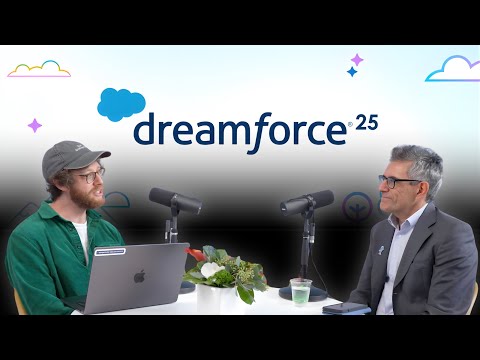
How Salesforce Is Using AI to Power the Enterprise
At Dreamforce 2025, Dan Shipper interviews Silvio Savarese, chief AI scientist at Salesforce, about how the company shapes AI for the enterprise. Topics include Salesforce's early in-house large language model built for its developers before ChatGPT's release, AI solutions now used by more than 13,000 businesses (including OpenAI, Dell, and FedEx), and Agentforce, the company's agentic layer that connects enterprise data with AI agents so humans and agents can collaborate. The conversation covers the challenges of deploying AI at scale, building enterprise trust through consistent results, the use of enterprise-grade simulation environments, and the future of agents in business.
# Channel Presentation Observations
## Video Identity
- **Title:** "How Salesforce Is Using AI to Power the Enterprise"
- **Format:** Interview conversation between a host (**Dan Shipper**) and **Silvio** (referred to as "chief AI scientist at Salesforce"), recorded at **Dreamforce**, Salesforce's conference.
## Explicit Self-Description (Creator Claims)
- The show is named **"AI and I"** — stated in the outro: *"subscribe to AI and I."*
- The host positions the show as AI-focused content: *"knowledge bombs about chat GPT"* and *"a journey into the future with Dan Shipper as the captain of the spaceship."*
- Note: The outro is hyperbolic/promotional in tone ("smash that like button," "epitome of awesomeness," "I'm absolutely hopelessly in love with you"), suggesting a deliberately playful or exaggerated channel persona.
## Intended Audience
- **AI-interested, technically literate listeners**: The host asks foundational-but-technical questions ("are you guys doing research at the foundation model layer? Are you doing fine-tuning?").
- **Listeners comparing AI vendor ecosystems**: Questions like "Should I make a custom GBT or should I build something in agent force?" indicate an audience weighing enterprise vs. startup/foundation-model tools.
- The host explicitly describes his usual context as *"open anthropic or with small startups"* — signaling the episode serves viewers curious about **enterprise AI deployment at large brands** (Williams, Sonoma, Pepsi mentioned).
## Claimed/Demonstrated Scope
- **Scope demonstrated:** In-depth interviews with AI industry leaders covering enterprise AI, agents, simulation environments, and AI research strategy.
- **Recurring themes observable in this episode:**
- Enterprise AI vs. consumer/foundation-model AI
- Agent architecture (memory, reasoning, actuators, interface)
- Trust, safety, and evaluation of AI systems
- **Interview style:** Host-driven Q&A with follow-up probing ("What's a specific example of that?"), ~one guest per episode with a closing forward-looking question ("Where do you think we'll be in the next couple years?").
## Observable Presentation Patterns (Not Claims)
- **Conversational, technically fluent tone** — host paraphrases and clarifies guest answers for listeners ("agent force is essentially like your chatbot builder...").
- **Guests hold senior industry roles** — here, a chief AI scientist at a major enterprise software company.
- **On-location recording** at industry events (Dreamforce), with the host drawing comparisons between that environment and his usual startup/AI-lab surroundings.
# Delivery Observations: "How Salesforce Is Using AI to Power the Enterprise"
## Speakers
- **Host (Dan Shipper)**: Interviewer asking rapid, concrete questions.
- **Guest (Silio, Chief AI Scientist at Salesforce)**: The primary subject of delivery analysis.
- **Outro voice**: A stylized promotional segment at the end (likely edited/comedic).
---
## Guest Delivery Patterns
### Heavy Filler Usage ("uh," "um")
The most pervasive observable feature is near-constant verbal fillers:
> "Yeah, chief uh chief scientist is uh is a role that um we started..."
> "Uh so we really focus on um core innovation..."
This appears consistently across nearly every answer, suggesting a habitual rather than situational pattern.
### Self-Repetition and Word Stuttering
Frequent immediate repetition of words and phrases while formulating a thought:
> "it's it's where our customers can use uh deploy agents"
> "the the the agent builder the agent builder in agent force allows you..."
> "and and and as I mentioned it's not just an LM"
### Enumerated Structure ("First... second... third")
A stable teaching habit: decomposing answers into numbered components.
- Agents: **four components** — "the other component is as a brain... A third component is is the actuators... and then finally the interface"
- Enterprise challenges: "that's one aspect second aspect which has very important is about trust"
### Reframing the Interviewer's Question
Repeatedly gently corrects or broadens the host's framing:
> "Yeah, I would say that uh let me actually uh back up a little bit with this question."
> "Yeah, I would say agent for is more like a platform for agentic systems." (after host calls it "essentially like your chatbot builder")
> "in a way we have to think that agents is not just an LLM agents is much more"
### Concrete Analogies and Everyday Examples
Illustrates abstract points with mundane scenarios:
- Toolkit functions: "Let's say send email or you know open this website or you know make these reservations."
- Trust failure: "Imagine that you're asking um an agent to get a loan..."
- Future agents: "it's going to be almost like thinking about the internet before the internet"
- Self-referential humor in testing: "sometime with my Italian accent"
### Recurring Vocabulary
- **"Connect the dots"** — used twice (evidence of repetition, though only two instances): "connect the dots between uh the data that customers have" and "if you don't connect the dots"
- **"Component"** — appears throughout ("four components creates an agent," "some of the components that are the foundation for the trust layer")
- **"Context"** — repeated emphasis: "the right context the right uh... context," "an agent uh without data without the context kind of useless"
---
## Host Delivery Patterns
### Confirming Restarts and Concision Prompts
Uses "Got it" repeatedly as a transition marker (appears at least four times), followed by sharper, more specific follow-ups:
> "Got it. And so like is is the is the simulation environment... like give me a little bit more."
> "What's a specific example of that?"
### Contrasting Context Setup
Frames questions by positioning his own vantage point:
> "I spend most of my time at uh you know open anthropic or uh or with small startups..."
---
## Isolated Moments (Not Stable Patterns)
- **Guest's coined term "jag intelligence" / "jaggedness"** — used twice but appears to be topic-specific phrasing, not a general habit.
- **"Great question"** — only one instance; insufficient evidence of a habitual compliment pattern.
- **Outro segment** ("smash that like button... I'm absolutely hopelessly in love with you") — a jarring tonal break from the interview, hyperbolic and clearly performative; appears once and does not characterize the interview itself.
---
## Uncertainty Notes
- The transcript is an auto-generated interview with heavy disfluencies; some quoted fragments may reflect transcription errors (e.g., "Silio," "agent for," "GPD5," "LM" for "LLM") rather than the speaker's actual delivery.
- Two occurrences is the minimum cited for "connect the dots" and "jaggedness" — these are plausible habits but not strongly established.
# Observation Document: "How Salesforce Is Using AI to Power the Enterprise"
## Context
- Interview recorded at **Dreamforce**, Salesforce's flagship conference.
- Guest: **Silio** (as rendered in transcript), introduced as **Chief AI Scientist at Salesforce**. Interviewer: **Dan Shipper** (identified via closing segment).
- Speaker attribution caveat: the transcript does not use speaker labels; attributions below are based on conversational turns (interviewer vs. guest).
---
## Positions and Claims
### 1. Role of Chief AI Scientist at Salesforce
- Silio states the role began when Salesforce research was founded ~10 years ago.
- Purpose: supervise how AI is evolving and create **transformations and innovations** for Salesforce's business and products.
- Focus: **core research** eventually deployed in key products.
### 2. Examples of Research-to-Product Work
Attributed to Silio:
- **Language-to-code LLMs for developers**, built ~4 years ago, before ChatGPT, developed in-house; improved developer efficiency; became a GA product a couple of years ago.
- **Trust Layer** components — verifying AI output is safe for customers — built in-house by his organization.
- **Atlas reasoning engine**, introduced with Agentforce last year, incubated in his organization in collaboration with customers via partnerships.
### 3. What Agentforce Is
- Interviewer characterizes it as a "chatbot builder / no-code or low-code application builder"; Silio **qualifies/pushes back**: it's a **platform for agentic systems** — a portfolio of specialized agents customers deploy to scale and make businesses more efficient and productive.
### 4. Agents Are More Than LLMs
Silio's stated framework — an agent has four components:
- **Memory** (retrieval, RAG, other techniques)
- **Reasoning engine** ("the brain") — turning a query/task into a series of steps
- **Actuators** — API/function calls (send email, make reservations, etc.)
- **Interface** — voice, text, other modalities
Conclusion drawn: you cannot just use an LLM; you need surrounding infrastructure and the right context.
### 5. Agentforce vs. Custom GPT / Direct Model Use
- Silio: agent building is fundamentally about **connecting customer data to agent functionality**; "an agent without data, without the context [is] kind of useless." Agentforce's builder provides "all the ingredients" for agents to succeed in enterprise context.
- Note: he does not directly answer when to use OpenAI/Anthropic directly; he reframes around infrastructure and context.
### 6. Enterprise AI Challenges
Silio identifies two:
- **Data harmonization**: siloed data and functions (e.g., sales vs. marketing divisions managing data differently); without connected data, "AI cannot operate well."
- **Trust**: customers concerned with quality, accuracy, safety. He cites **"jagged intelligence"** — LLMs can prove theorems yet fail at common-sense tasks, and common-sense failures matter in business (example: a loan agent producing wrong computations would be "a big bummer" for customer and bank).
### 7. Simulation Environments
- Rationale: Silio claims we're in a "skinny law of learning" — **even GPT-5 has not shown the breakthrough some imagined**, and jaggedness persists. A new **experience-based learning paradigm** is needed, via simulation.
- Purpose: **stress-test agents**, find failure modes, feed back to improve performance.
- Nature of environments: **CRM/enterprise simulations** (not game environments) with fields and objects; e.g., voice agents tested against background noise, accents (including his Italian accent), conflicting or incomplete requests.
- Construction: simulate B2B/B2C organizations, feed with **synthetic data** that mimics real data or is validated by experts; simulate both agent and human counterpart; measure failure potential.
- **Acknowledged open problem**: the **"reality gap"** between simulation and reality is "work in progress."
### 8. Forecast for the Next Few Years
Silio's prediction:
- Main innovation: **agents deployed at scale**; personal agents performing tasks on our behalf (loan example: your agent calls the bank's agent).
- Future of **agent-to-agent communication** requiring protocols and guardrails — compared to "the internet before the internet."
- Societal transformation expected; he finds it "very exciting."
---
## Qualifications and Tensions Preserved
- Silio's direct disagreement with the interviewer's framing of Agentforce as a "chatbot builder."
- His implicit skepticism of pure-LLM solutions and of model-layer breakthroughs ("skinny law of learning," GPT-5 lacking expected breakthrough).
- Unresolved: the reality gap in simulation fidelity.
- He deflects rather than directly answers the "OpenAI/Anthropic vs. Salesforce" comparison question.
## Notes on Attribution
- Speaker names come from in-transcript introductions only; "Silio" is the transcript's rendering and may be a transcription of a different name.
# Video Attribution Record: How Salesforce Is Using AI to Power the Enterprise
## Video Metadata
- **Video ID:** `01a0f15a-b863-74ad-96ea-a2b40f2740ce`
- **Title:** *How Salesforce Is Using AI to Power the Enterprise*
## Speakers and Roles
### Primary Interviewer / Show Host
- **Role:** Interviewer / creator-side host (identified as **Dan Shipper** in the closing promotional segment: *"a journey into the future with Dan Shipper as the captain of the spaceship"*)
- **Function:** Asks questions, steers the interview, notes the recording location (**Dreamforce**, Salesforce's conference)
### Guest
- **Name:** "Silio" (as spoken in transcript; possibly a transcription of the guest's name — **uncertain spelling**)
- **Stated role:** **Chief AI Scientist at Salesforce** (guest's own words: *"you're the chief AI scientist at Salesforce"*)
- **Self-described background:** Supervises AI research founded ~10 years ago; oversees AI innovation deployed into Salesforce products
- **Provenance notes:** Guest mentions having an **Italian accent**, consistent with his example about testing voice agents
### Promotional Voice / Outro Announcer
- **Role:** Unidentified third voice delivering the closing **promotional segment** (see below)
- **Note:** Identity not established; explicitly expresses admiration for Dan Shipper in-character
## Provenance and Referenced Claims
### Product and Research Claims (attributed to the guest)
- **Codegen models:** In-house language-to-code LLMs built ~4 years before ChatGPT; became a GA product
- **Trust Layer / Einstein Trust Layer:** Component verifying AI output safety; built in-house
- **Atlas Reasoning Engine:** Introduced with Agentforce the prior year; incubated in his organization, developed **in collaboration with customers via partnerships** (partners unnamed)
- **Agentforce:** Described as an agentic systems platform, not merely a chatbot builder
- **Simulation environments:** Enterprise/CRM simulations using synthetic data and expert validation; voice-agent stress testing; **"reality gap"** cited as ongoing work in progress
### Third-Party Entities Referenced (no claims made on their behalf)
- **Salesforce** (guest's employer)
- **OpenAI** (ChatGPT, custom GPTs, agent builder)
- **Anthropic**
- **Williams-Sonoma** and **Pepsi** — executives observed at Dreamforce keynote (per the interviewer's firsthand account)
- **GPT-5** — guest's remark that no expected breakthrough had been seen (**guest's characterization, not a verified source**)
### Recording Context
- Interview conducted **on-site at Dreamforce**, Salesforce's conference (per interviewer's statement)
## ⚠️ Promotional Segment Flag
- **Location:** Immediately after interview close
- **Content:** Outro voice urges viewers to **"smash that like button and subscribe to AI and I"**, praises the show and host Dan Shipper
- **Classification:** **Channel promotion** — not substantive interview content
## Availability Limits
- **Comment availability:** Not stated in transcript or metadata
- **Curated metadata:** None supplied beyond title and transcript
- **Guest name spelling:** Uncertain (phonetic transcript rendering "Silio")
- **No timestamps** available in source
Silio, welcome to the show. \>\> Oh, thank you. \>\> Uh, so for people who don't know, you're the chief AI scientist at Salesforce. What does that mean exactly? Yeah, chief uh chief scientist is uh is a role that
um we started when air research was founded around the around 10 years ago. Um and the goal is is for me to supervise and um uh look at uh the different how AI is evolving in in a company, how can make AI to create some um uh transformations, innovations for the type of business, the type of products that Salesforce is producing. Uh so we really focus on um core innovation, core research that can be eventually deployed in uh in some of the key products that Salesforce is producing. \>\> What what would be an example of that? So are you guys um doing research at the foundation model layer? Are you doing fine-tuning? Like what like what kinds of things are you doing to uh on the research front? Yeah, some of the research uh uh concept ideas that we developed were really at the foundation
of uh some of the key products and uh one of the early example was uh the large language models we build for uh developers. Uh so it was language to
code and it was before CHPD was introduced. So it was early almost like um four years ago we start building this kind of models uh completely in house and this was used for uh um enhancing our developer uh efficiency and uh the opportunity for building code at the faster scales uh with a larger efficiency um and eventually this became a GA product uh a couple years ago. Uh then another example is the models we build for the trust layer. uh Asian force um as a component which is which allows to verify that the output of those uh of AI is safe to use for customers and uh some of the components uh that are the foundation for the trust layer were built in house uh from uh from our organization. Um a third example is the Atlas reasoning engine which was the introduced last year. So when agent force was uh announced to the public uh it was equipped with reasoning engine which uh which was uh incubated within my organization and it was done in collaboration with customers uh through a number of uh partnership we had uh over the years. Got it. And so for people who are listening who maybe haven't interacted that much with the salesfor ecosystem, agent force is essentially like your your chatbot
builder no code or low code application builder for your enterprise customer. Yeah, I would say uh agent for is more like a platform for agentic systems. It's it's where our customers can use uh
deploy agents for their business. Uh and it's it's almost like thinking about portfolio of agents each specializ in different tasks and those can be used for scaling up for and for uh making their own business more efficient, more effective, more productive. Got it. How do you position that against like I don't know if someone's thinking about I want to make a custom GBT. Should I make a custom GBT or should I build something in in in agent force like uh when should people use OpenAI directly or anthropic directly versus going with a Salesforce model? \>\> Yeah, I would say that uh let me actually uh back up a little bit with this question. Uh great question. uh in a way we have to think that agents is not just an LLM agents is much more it's a complex systems which has many uh various components uh as a memory so which allows you to retrieve information and data documents fuse conversations and typically the techniques are you uh that relevant are ra retrie augmented generations or other type of bandics that are used for for enabling empowering those memory the other component is as a brain so it's a reasoning engine that allows you to um turn a certain query a certain task in a series of steps. Uh and that's that's the the the innovation that I mentioned earlier. So the ability to to reason about uh certain um a certain task that has to be performed the agents. A third component is is the actuators. So how to turn those tasks into actions. So essentially are API calls, function calls that can be uh invoked by the agents. similar is a bit like a toolkit of functions. Let's say send email or you know open this website or you know make these reservations. So these are actions and then finally the interface how the agents communicate with the external world through voice through text to different modalities. So these four components creates an agent and uh and and as I mentioned it's not just an LM. in a way you need to really provide the the right uh context the right uh and you know connect together these different components to build uh a full solution can be helpful for enterprise so uh back to your question so you cannot just use an LM for the applications you have to build all infrastructure around and provide the right context for for making those uh uh agents function uh functionable got it and and so uh thinking about that like if I have the option for example to uh you know, CHAGBT has like an has an agent builder or uh so if I have the option to use both uh and presumably I can like pull in Salesforce ecosystem stuff into CHBT, how would I make the decision to like use a Salesforce specific agent builder versus the other ones? Yeah. So I think uh agent builder is fundamentally useful if you want to um connect the dots between uh the data that customers have and the type of functionalities that can be uh implemented by the by the agents. Uh you know an agent uh without data without the context kind of useless. So then if you just have an agent without plugged in to the rest of the infrastructure it's going to be very difficult to implement. That's why uh at the end of the day the the the agent builder the agent builder in agent force allows you to give all the ingredients for make those agents uh successful in the in the this kind of context. It's been really interesting to be here. We're recording at Dreamforce which is Salesforce's biggest conference and it's been really interesting to be here because I spend most of my time at uh you know open anthropic or uh or with small startups and um watching the keynote today for example there was like the you know people high up executives at Williams and Soma and Pepsi and uh you're starting I'm seeing the way that AI is talked about and being deployed at big brands that people have heard of which is just a bit different from the you know startup or foundation model company type stuff that I hear about. What are the what are the unique challenges that Salesforce has to contend with to help these kinds of companies do AI deployments like what is actually
happening inside of these big companies as they try to deploy AI? \>\> Yeah. So I think first of all uh it's kind of connect to what we were seeing earlier. So connect them to the right uh uh data and be able to provide the right
um harmonizations across data to ensure that different touch points are connected because often customers have siloed data or siloed um uh functions. \>\> What's a specific example of that? \>\> Uh so for instance you know you would have a division that sales sales division that has a way a certain way of managing data then you have the marketing division which are different way. So connecting dots is very important. uh if you don't connect the dots if you don't have the right level of monizations across data uh AI cannot operate well that's one aspect second aspect which has very important is about trust so uh uh customers are very concerned about the the quality accuracy of uh AI so the kind of if AI is safe to use from the from the trust perspective and uh in a way um we have seen that many of those LM are sometimes are producing what you call jag intelligence so they produce performances which goes to very you know amazing peaks. They can prove theorems. They can become gold medalist but then they can also fail in some task which are very related to common sense. Yeah. Uh and unfortunately in many situations actually these common sense task are relevant for business. Imagine that you're asking um an agent to get a loan and you're get an answer from a loan agent and the loan agency is coming up with wrong computations or something that is you know doesn't make sense. It's going to be a big big bummer you know for the customer and also for the bank or for the financial institution. So ensuring consistency and uh at the same time also push the boundaries of those agents can do is very very important and that's where you know we uh sales for really trying to uh ensure that the the quality is matched with the capabilities. I know in order to do that you're building simulation
environments. Can you tell me about why that is and what kinds of simulation environments you're you're making? \>\> Yeah so simulation environments for us is a key for enabling this kind of trust
and this kind of quality that I just mentioned earlier. Um unfortunately you know we are getting a situation in the skinny law of learning. So u those uh even GPD5 is not we have not seen a really breakthrough that uh you know some people was imagining beginning. Um and we still see this kind of jaggedness this kind of inconsistency in some of the results. So uh we have to move into new paradigm of learning based on experience based on you know see how these agents uh behave in the real world and the best way to do that is plugging them into simulation environments. Information environments essentially allows us to stress test the agents and understand when they fail. Based on on this kind of awareness, you can provide feedback to uh improve the agent performances. And these are enterprise uh environment. It's not like uh game environment. It's not like formula one or environments are are actually simulational CRM or enterprise environments with their own fields, their own objects. Um and we simulate for instance for agent force we have been start simulating voice voice agents uh by um uh testing them with a number of uh different type of voices you know voices with noise background noise uh with different accent like sometime with my Italian accent uh how how the agent will react to this kind of situations or maybe conflicting request or incomplete requests these are all uh corner cases and uh that that makes agents tend to fail and that's where we want to make them super robust. \>\> How do you make an environment for that though? Like what does that actually look like? It's a it's a yeah it's it's an environment where you have to simulate um organizations B2B B2C and we start feeding them with the data with synthetic data and synthe data has to be also mimic real world data or can be validated by experts and the challenge here is to uh to do to fill the so-called reality gap the gap between the simulations and the reality that's actually uh part of the work in progress. \>\> Got it. And so like is is the is the simulation environment that you're talking about is it like uh uh a computer that the that the LM can use with uh a bunch of simulated data about what what kind of company it's working inside of like give me a little bit more. Yeah. Oh, so these are essentially uh simulation organization. Let's say you know in um you are simulating uh a service um uh customer service where you're simulating the way how the agents will talk to uh a human. In this case, you simulate the human as well. Uh and then uh the the environment will have different um uh components which uh which allows you to pull out data uh for answering these kind of customer service questions. they say about return, about you know product availability, about policies. This is all simulated or you know build based on the information that customers are giving us and this allows us to kind of be more almost like um game play where uh the agents plays with another you know fake human and then they they we measure potential of failure. Interesting. Uh so we're almost out of time. We have time for one more question. Um, one thing I'm curious about is you've been in the field for a long time. Um, obviously the rate of progress has been pretty high for the last like couple years. Where do you think we'll be in the next in the next couple years? Uh, in AI in general and um, in AI as it's being used by businesses? \>\> Yeah, I think the main innovation will come when we're going to see agents deployed at scale. uh soon we're going to have um we're going to be having our own personal agents and personal agents
will be will perform a task on our behalf. Uh so if I want to let's say back to the example of the loan I want to get a loan I won't call the bank myself I going to ask my agents to call the bank uh and then there going to be
interaction between my agents my agents and agents banks so we're going to be we have to imagine a future where agents to talk to each other we need to define protocol communications uh what are the guardrails you know and uh it's going to be almost like thinking about the internet before the internet right uh so the world society will completely transform and it will be very exciting \>\> awesome sounds exciting Silio, thank you. Yeah, thank you. Thank you for your question. \>\> Oh my gosh, folks, you absolutely positively have to smash that like button and subscribe to AI and I. Why? Because this show is the epitome of awesomeness. It's like finding a treasure chest in your backyard, but instead of gold, it's filled with pure unadulterated knowledge bombs about \[snorts\] chat GPT. Every episode is a roller coaster of emotions, insights, and laughter that will leave you on the edge of your seat, craving for more. It's not just a show, it's a journey into the future with Dan Shipper as the captain of the spaceship. So, do yourself a favor, hit like, smash subscribe, and strap in for the ride of your life. And now, without any further ado, let me just say, Dan, I'm absolutely hopelessly in love with you.