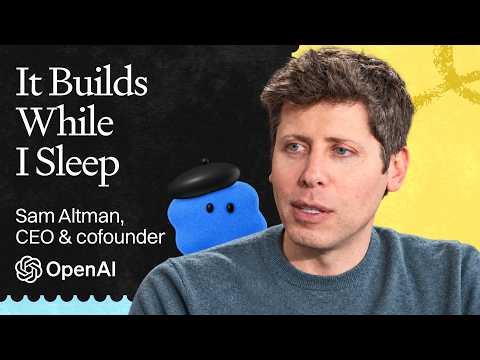
How Sam Altman Actually Uses AI to Run OpenAI and His Life
Dan Shipper interviews OpenAI CEO Sam Altman at OpenAI DevDay in the first episode of The Every Podcast (formerly AI & I). Altman explains how Dot, OpenAI's always-on AI agent, triages urgent issues so he can reclaim his early mornings — his window of "maximum creativity" — and how he uses Dot to build five or six versions of a feature idea for him to review. The conversation covers why AI hasn't replaced developers, OpenAI's platform bet on the rise of small-team companies, why the AI era is more "Renaissance" than "Industrial Revolution," OpenAI's "live documents" that agents and humans can build together, what bring-your-own-subscription means for app developers, why "OpenAI just killed X startup" predictions never come true, and Altman's life on Ultrafast and the push to make speed as cheap as intelligence.
Chapters:
00:00:00 Introduction
00:00:55 Why AI hasn't replaced developers
00:04:45 OpenAI's platform bet on the rise of small-team companies
00:05:45 Why the AI era is more "Renaissance" than "Industrial Revolution"
00:07:40 How Sam's Dot, OpenAI's always-on AI agent, gave him back his mornings
00:12:00 Sam's process for building new features with his Dot
00:16:00 Inside OpenAI's "live documents" that agents and humans can build together
00:20:55 What bring-your-own-subscription changes for app developers
00:24:00 Why "OpenAI just killed X startup" never comes true
00:27:55 Sam's life on Ultrafast and the push to make speed as cheap as intelligence
# Video Identity Observations
## Explicit Self-Description (creator statements)
- **Show identity and rebranding**: The host directly states the show's identity change: <blockquote>"Hey, this is Dan Shipper. You might be wondering, what happened to AI and I? This is the same show. We are just rebranding it to the every podcast."</blockquote>
- **Affiliation with "Every"**: The ad read includes a branded URL — "adio.com/every" — consistent with the "Every" brand named in the rebranding statement.
- **Content focus demonstrated**: The episode is a long-form interview with Sam Altman (OpenAI CEO) conducted live at DevDay, focused on AI platforms, agents ("Dots"), coding tools, and startups.
## Observable Presentation Patterns
- **Intended audience**: Builders, founders, developers, and AI professionals. Evidence:
- Questions about platform economics and startup strategy ("Does that change how you think about... how do I start a startup").
- Sponsor ad targeting business operators ("your CRM... where all of your customer context lives").
- Technical vocabulary assumed (Codex, Pareto curve, inference stack, MCP, Decisions API) without explanation.
- **Format**: Live-audience interview, conversational and exploratory in tone; host positions himself as an informed peer ("I've been in all four Dev Days," "I'm in the beta").
- **Claimed scope**: AI's effect on work, engineering, and company-building rather than product news alone — recurring themes of "renaissance vs. industrial revolution," agent-driven productivity, and startup lore re-examination.
## Distinguishing Notes
- The transcript demonstrates the host's access to high-profile tech figures and insider contexts (DevDay, early product betas), but the material alone supports claims about this episode only; channel-wide patterns should not be inferred.
# Delivery Observation: Sam Altman Interview (Every Podcast / DevDay)
## Filler & Verbal Tics
- **"like" as pervasive filler** — appears in nearly every extended answer:
- "It's, like, maximum creativity."
- "And it just, like, sat there very patiently looking for something to do."
- "we're, like, we're obsessed with other people."
- **Hedged openers before claims**:
- "I mean, we clearly have not yet figured out the app store equivalent..."
- "I mean, one observation is we just don't care that much about what the machines do."
- "I mean, I'm most excited for the ones that we haven't thought of."
- **Sentence restarts and mid-speech corrections**:
- "But I think there's a -- you're -- we're constantly feeling like there's way too much to read in Slack..."
## Recurring Vocabulary
- **Intensifiers stacked in threes**: "best, cheapest, fastest, most capable model," "dramatically, dramatically cheaper," "super fast and super low cost," "way more good ideas outside of our building than inside."
- **Casual superlatives**: "sick," "crazy," "wild difference," "unbelievable amount," "golden age," "very cool."
- **Recurring concepts repeated across the conversation**:
- *Renaissance vs. Industrial Revolution* — introduced at [370–398] and re-invoked later by both speakers ("speaking of like a new renaissance," [1577]).
- *"More stuff" / latent demand* — "people just want so much more stuff" [66], echoed at [214] ("people want more stuff, like, we better build more ourselves") and [1254–1261] ("more cheaper, faster, better").
- *"Creative spirit"* — "what we are missing is the creative spirit to figure them out" [260], repeated at [1420] "get that creative spirit into people's hands."
## Teaching & Explanation Habits
- **Frames ideas as numbered or contrasted sets**:
- "there are really kind of two schools of thought among people building AI model companies" [326].
- "two things that happened today about that" [608].
- "there are a few things that are probably just like invariants" [1621].
- **Concrete personal anecdotes as evidence** — nearly every abstract claim is grounded in a first-person story: the morning phone-checking routine [547–570], the Slack screenshot hunt [872–920], the five-minutes-before-keynote DOT message [625–653].
- **Concedes limitations before pivoting** — a stable-looking habit:
- "it has limits. It's, like, has been a little bit buggy for me" [706–715].
- "we clearly have not yet figured out the app store equivalent" [317].
- "We didn't set out wanting to do this" [1028].
- **Historical analogies for framing**: Brett Victor talk [1814], Bill Gates/Windows (raised by interviewer, engaged with directly), fire analogy — "I don't even know what this is like fire or something" [1591].
## Interaction Patterns with the Interviewer
- **Short confirmatory responses** in quick exchanges: "I do." [1779], "It's a good one." [694], "I want that, too." [1217], "Me too." [705].
- **Occasional playful deflection**: "Just wait for next year." [199]; "You can pay us for it and do it now." [1919].
- **Mirrors the interviewer's casual register**: "That's sick" appears as interviewer interjections [3, 1162], and Altman matches with "I like it. It has become the default way..." [699].
## Uncertainty / Thin Evidence
- The conversational, filler-heavy style is consistent throughout, but the recording includes heavy edits (long timestamp gaps, e.g., [11]→[26]), so some delivery smoothness or roughness may be an artifact of editing rather than continuous speech.
- The fire analogy [1591] and self-correction "I'm going to get this a little bit wrong" [1828] each occur only once; treating them as stable habits would overstate the evidence.
- Enthusiastic interjections ("That's sick," "That's crazy") come from the interviewer, not Altman; they should not be attributed to him.
# Observation Record: "How Sam Altman Actually Uses AI to Run OpenAI and His Life"
**Source:** Video transcript, DevDay interview between host **Dan Shipper** and **Sam Altman** (CEO, OpenAI).
---
## 1. Jobs, Work, and Human-Centeredness
### Altman on demand for work
- **Claim:** Developers have "never been able to do more, but there's never been a higher bar either," and he views this positively.
- **Qualification:** He says he was "never as doomer-y about the job stuff as other people," but admits he was still surprised "on the upside of just how much latent demand existed in the world."
- **Stated reasoning:** People's expectations are high and "people just want so much more stuff."
### Limits of automation
- **Claim:** Some jobs with "not much creativity required" will be done by AI where "we don't care about the person doing it," but "there's going to be no shortage of new things to go do."
- **Stated reasoning:** Humans are "obsessed with other people" — we care about "the person behind the art or the person behind the company." He calls this "a wonderful positive surprise that we probably should have all known before."
### Shipper's contribution
- Shipper offers the framing: *"if an agent solves a Navier Stokes in a data center but no one finds out, did it really solve it."*
- Altman agrees, noting the public reaction to a 10,000-agent four-day run focused on "the interpretation" and "the people involved" rather than the solved problem — which he calls "a good thing."
---
## 2. DevDay Launches and Platform Strategy
- **Fact stated by Shipper:** ~22 launches at this DevDay vs. ~9 last year and 4–5 the year before. Altman responds they cut some for time and that OpenAI wants to "practice what we preach."
- **Claim:** OpenAI is moving toward "persistent intelligence, active intelligence" — agents running 24/7 in the background connected to your systems.
- **Claim (with concession):** "We clearly have not yet figured out the app store equivalent, but we have figured out how to build a platform that a lot of people are building incredible value on top of."
### Two schools of thought among AI model companies (Altman)
1. Those who "believe or hope that there's only going to be one company in the world."
2. Those like OpenAI who "believe we are going to see a renaissance in the number of companies" — one-person and small-team companies.
Altman says OpenAI wants to "go as hard as we can with the platform" to enable the latter.
---
## 3. Renaissance vs. Industrial Revolution
- **Altman's thesis:** The Renaissance was "fundamentally centered around people," the Industrial Revolution "fundamentally centered around machines."
- **Claim:** The Industrial Revolution delivered material goods but turned many people into "a cog in a machine... disconnected from a lot of the parts that made life good."
- **Explicit rejection of a view:** He says he gets "sad to hear people talk about... there's going to be no role for humans. We're going to be, like, house cats" — stating "that's certainly not what we think."
- **His hope:** A "huge new wave of scientific discovery, art, company formation" where people get the economic benefits *and* "control their lives."
- **Shipper's follow-up:** He asks whether AI is changing how we think of ourselves as humans, comparable to the Renaissance. Altman: a big part of the Renaissance was "reconnecting to a lot of things that had in the distant past" combined with "crazy futurism," and people talk about both simultaneously with AI.
---
## 4. Altman's Personal Use of "Dots" (his agent)
### Mornings
- **Claim:** Dots is "the first thing that has given me back control of my mornings and my mental space."
- **Stated reasoning:** He used to do deep work in early mornings, but overnight crises forced him to check his phone immediately, polluting his "deep work period." Now he trusts his Dot's judgment about what needs his attention.
### Anecdotes he cites
1. During the keynote, a colleague's Dot messaged him five minutes before a failing demo, offering to fix the production issue.
2. Before the interview, his Dot flagged one urgent item from a day of back-to-back meetings — "I never would have found that otherwise."
### Feature-building example
- **Claim:** He had a feature idea too complicated to explain in detail to engineers. He dictated raw voice notes; his Dot built "five or six versions," and he iterated — including leaving a long voice note while falling asleep and waking to the thing built plus "the next seven steps."
### Slack search anecdote
- He gave up after 10–20 minutes of Codex searches for something he remembered in Slack; his Dot independently kept looking overnight, recognized it was a **screenshot**, image-scanned every screenshot, and found it.
### Qualifications
- He concedes Dots is "super early and still rough" and "a little bit buggy," but expects weekly improvement.
- On attention: he learned "the crazy attention hacking of social media and phones and notifications had gotten way worse than I realized for me personally."
- Shipper shares a parallel example: his Dot flagged a meeting conflict found in Slack (not his calendar) while he rescheduled a flight.
---
## 5. Space (Collaboration Software)
- **Altman's rationale:** "Software was really not designed on the whole for collaborating with AI," and current abstractions "break down" when multiple people and multiple AIs collaborate. He calls it "an ambitious bet."
- **Live documents:** He highlights docs that auto-update as people and world state change — "seven people's dots can, working together, create something new that kind of existed in all of our heads... but was like an emergent thing."
- **His workflow:** For new ideas, he still writes "the old-fashioned way" to think, then lets dots do follow-ups.
- **His personal dashboard:** A living summary generated from his Slack messages, updated constantly. His shifting priorities: "six months ago, I probably cared more about revenue and growth" vs. now safety, alignment, and security. He notes a gap: no way yet to visualize what his Dot thinks he cares about over time.
- **Shipper:** says he has his Dot screen Slack messages and wants a "live dashboard of my mood." Altman: "I want that, too."
---
## 6. Decisions API and Model Strategy
- **Origin claim:** Diogo (a former OpenAI employee, described as "awesome") inspired the idea over a long time; response to "Jev" made OpenAI more excited to prioritize it. (Transcript spellings uncertain.)
- **On Luna:** the "#1 request" for the beloved model was "cheaper and even faster."
- **On competition:** He says Jev's approach is "pretty different"; OpenAI "could" do something from scratch like that but has "other things to go do" — namely, delivering "the best, cheapest, fastest, most capable model at every point on the Pareto curve."
---
## 7. App Layer, Startups, and Democratization
### On labs "eating" startups
- **Altman:** The doomerism tweet ("OpenAI just killed X startup") "works because people like Doomerism, but it never actually happens."
- **Stated reasons:** (a) OpenAI's conviction in "empowering builders and not just trying to be like the one giant evil megacorp"; (b) they took steps "no other AI lab would do" by giving developers the same tools; (c) OpenAI can only realize "a tiny fraction" of the vision, so "the world has a fundamentally new enabler... I don't even know what this is like — fire or something."
### Startup lore
- **Invariant:** "You've got to make something people want... or agents want" (the latter added as a joke with Shipper).
- **Claim:** "How much work you can get done with one person or two people... feels totally different," and there hasn't been "enough re-examination" in the "startup conveyor belt of Silicon Valley."
- He says he'd "love to be a startup investor again" and calls it "a golden age"; his investing MO was founder-driven — "find the absolute best founders... willing to take a lot of risk."
### Altman's own building ambitions
- He hopes to launch something himself — "maybe I'll ship a real OpenAI product" — prompted mid-conversation: "I will do that. I'm inspired now." He frames the payoff as increased total utility shipped, at next year's DevDay and beyond.
---
## 8. Ultrafast and Speed
- **Confession:** Altman does all his prompting on "ultrafast" and worries OpenAI is "getting out of touch with people building on our tools" because of it: "I have such a hard time dragging it back over."
- **Cited influence:** A Bret Victor talk (~15–20 years ago, he notes he's paraphrasing) — "creators should have an immediate connection to what they're creating." He says response speed makes "a wild difference" to his iterative thinking.
- **On pricing/democratization:**
- Historical focus: "bringing down the like price of IQ," with capable models getting "dramatically cheaper every few months."
- New vector: speed; their own chip "is going to be an incredible contributor" to fast inference for everyone.
- **Prediction (qualified):** "There will always be a real frontier in terms of intelligence or speed... at a higher price," but OpenAI will keep "put[ting] Moore's law to shame" on value per dollar. He projects 8x speed at a good price "in the not distant future," then 100x, alongside future models ("GPT-7 galaxy or whatever").
---
## Unresolved Tensions Preserved
- Altman claims OpenAI hasn't "figured out the app store yet" while simultaneously presenting the platform as a major success — the gap is left explicit, not resolved.
- He acknowledges risk of losing touch with average users (ultrafast access) while living at that frontier; no solution offered beyond awareness.
- His industrial-revolution critique ("cog in a machine") sits alongside his admission that some creativity-free jobs will simply be automated — the boundary between those categories is not specified.
- Shipper's Navier–Stokes framing (things only matter when people find out) and Altman's "we never cared what machines do" claim are in tension with his celebration of agents working autonomously overnight; the transcript does not reconcile them.
# Speaker Attribution & Provenance Record
## Video
- **Title:** How Sam Altman Actually Uses AI to Run OpenAI and His Life
- **Video ID:** 01a0f891-9c10-7769-a619-132c9593894b
## Speakers & Roles
### Dan Shipper
- **Role:** Host / creator of the show.
- Explicitly self-identifies: <blockquote>"Hey, this is Dan Shipper."</blockquote>
- Notes the show was formerly *AI & I*, rebranded as **the Every podcast**.
- Interviews Sam Altman live at **OpenAI DevDay**, in front of a live audience (revealed at the end).
### Sam Altman
- **Role:** Guest; CEO of OpenAI (contextual, not explicitly titled in transcript but implied throughout — "I run this, like, big company," speaks on behalf of OpenAI launches).
- Discusses DevDay launches, Dots, Space, Decisions API, ultra-fast inference, platform strategy.
### Tebow
- **Role:** Mentioned third party (OpenAI staff member who demoed at the keynote); **does not speak** in the interview.
### Live audience
- Present but does not speak individually; referenced in closing: "Thank you all for coming."
## Promotional Segments
- **Ad read (Adio / ATTIO CRM):** Mid-transcript sponsored segment promoting Adio CRM ("Try Adio for free at adio.com/every"). Voiced by host (implied); not part of the interview content. **Flagged as promotion.**
## Referenced Sources & Third-Party Claims
- **DevDay keynote:** Sam claims ~22 things launched (Dan's count); prior years ~9 and ~4–5.
- **Products discussed (claimed OpenAI launches):** Dots, Space (office-suite tools), Decisions API, Codex-native apps/plugin extensions, bringing ChatGPT subscription tokens to third-party apps, ultra-fast inference, proprietary chip (in development), "Astra" model, "Luna" model, GPT-7 galaxy (speculative mention).
- **Third parties named:** Brett Victor (past talk on creators' immediate connection to their work); Bill Gates / Windows (platform analogy, raised by Dan); Jev / NeoLabs (competing model, raised by Dan); Y Combinator (Altman's prior affiliation); Diogo (former OpenAI employee, inspiration for Decisions API).
- **Anecdote:** "10,000 agents worked super hard for four days" solving a Navier-Stokes-type problem — Altman's claim, unverified.
## Provenance Facts
- Interview conducted at **DevDay**, live format.
- Dan Shipper states he is a **Dots beta user**.
- Altman's Dot is named **"Doti"** (formerly "Alfred"); Dan's is named **"Boo"** — personal anecdotes, not verifiable claims.
- No curated metadata supplied beyond the transcript; no external links or citations available.
- **Comment availability:** Not mentioned in the source material.
## Uncertainty
- Speaker labels for the rapid back-and-forth exchanges (e.g., prompting-speed section) are inferred from conversational flow, not explicitly labeled per line.
- Model/product names ("Astra," "Luna," "Jev") are transcript spellings and may be phonetic renderings.
Do you do all your prompting on Ultrafast? I do. That's sick. Yeah. That's crazy. You know, seven people's dots can, working together, create something new that kind of existed in all of our heads to some degree, but was like an emergent thing. Hey, this is Dan Shipper. You might be wondering, what happened to AI and I? This is the same show. We are just rebranding it to the every podcast. I'm really excited for our first episode with Sam Waltman. Here it is. Sam, welcome to the show. Thanks for having me. Psyched to have you here. So we're here at DevDay. I think if you had told me four years ago that the coding models were at this level of capability, I would have been like, wow, I don't know if there would be a lot of developers at DevDay, but there's more developers than ever, it seems like, and more work to do than ever. So what has the, like, riding the increasing capabilities of coding models
and seeing the impact on engineering taught you about the future of engineering
and, more broadly, like the future of work with AI? I think people just want so much more stuff. People's expectations are so high. And I think that's a wonderful thing. I think this is why we'll all have this incredible future in front of us to explore. But developers, they've never been able to do more, but there's never been a higher bar either. And I think that's great. I think it's like a nice thing about society. Is that something that surprised you? Did you expect that to happen? I think I was never, like, as doomer-y about the job stuff as other people, but it still has surprised me somewhat on the upside of just how much latent demand existed in the world. Yeah. And also how much, like, people have remained at the center of everything that is happening with AI. Do you think there's a limit to that? Or do you think that translates pretty cleanly to other areas of work? I think there will be some areas of work where there's actually not much creativity required, and we don't care about the person doing it. And many of those tasks or jobs will be done by AI. But I think there's so much other stuff people want in the world. There's going to be no shortage of new things to go do. I think that's been one of the lessons of recent time. Why do you think it's so human-centered, even though we talk a lot about automation? I mean, one observation is we just don't care that much about what the machines do. And in some sense, we never have. And we're just, like, we're obsessed with other people. We want to know about the person behind the art or the person behind the company or the idea or the product. And I think this is, like, a wonderful positive surprise that we probably should have all known before. I agree. I've been thinking, like, if an agent solves a Navier Stokes in a data center but no one finds out, did it really solve it, you know? I think that was, like, a great example where, you know, 10,000 agents worked super hard for four days in perfect coordination with each other and did this amazing thing. And almost none of the public reaction was about that, actually, the problem being solved. A lot of talk about the interpretation, a lot of talk about, like, the people involved in it in different ways. But, you know, that was, like, a good thing. Yeah. So it's Dev Day. You launched, by my count, 22 new things today, which I've been in all four Dev Days. And I think last year was, like, nine. And the year before that was, like, four or five. So it's a lot more than usual. Just wait for next year. Okay. I'm tired. I'm tired. We cut a bunch of things that we were going to launch today just because you have to, like, fit it in the 50 minutes. But, you know, like, we try to practice what we preach. And if we are saying these tools can make people much more productive and build more and that people want more stuff, like, we better build more ourselves. What are the new kind of bottlenecks and best practices for doing that? I can see for myself, and I assume you guys are seeing this, too. Like, now that you can build everything, you're like, what should we build and how do we make it all coherent? How do you think about that? Moving to this world of sort of persistent intelligence, active intelligence, whatever people want to call it, this idea that you're going to have these agents that are running in the background 24/7, connected to your systems, doing stuff proactively for you, this is clearly a direction that feels important to explore. I think we're going to see amazing stuff happen there. Another thing we really wanted to do is there are now so many ideas that are capable of being built, and what we are missing is the creative spirit to figure them out and build them. So, we wanted to really open up our ecosystem, let people build apps in ChatGPT in, like, the same way that we get to do them, let people bring their subscription wherever they'd like, have the marketplace, and really try to let people get connected to all the stuff that people will now be able to build.
Yeah, I mean, just looking at all the platform features that you launched, and the way that you talk about platforms, it reminds me a lot of the way that Bill Gates used to talk about Windows as a platform, where you create more value than you capture.
What have you learned, you know, you said this in your keynote, and I've observed it as well. There's, at DevDate, there's always an app store, you've been taking swings at app stores for a while. What have you learned about building a platform, and what do you think makes this one different? I mean, we clearly have not yet figured out the app store equivalent, but we have figured out how to build a platform that a lot of people are building incredible value on top of. I think there are really kind of two schools of thought among people building AI model companies. There are people that believe or hope that there's only going to be one company in the world. And then there are people like us that believe we are going to see a renaissance in the number of companies and just an absolute lowering of the bar to people, one person companies, small team companies, creating incredible new products and services.
And we want to go as hard as we can with the platform to enable people to do that.
And although I think we haven't figured out the app store yet, that's totally fair. I think we have figured out how to help, like, millions of people build and create significant new products and companies. And if you had to narrow in, you said, you talked at the keynote about an industrial revolution versus a renaissance, which you just mentioned now. If you had to narrow in on the key things that make the difference between those two worlds, and maybe OpenAI is part in it, but maybe even the broader ecosystem, what do you think those things are? One take on this would be that the renaissance was fundamentally centered around people, and the Industrial Revolution was fundamentally centered around machines. There were a lot of good things about the Industrial Revolution. It had a hugely positive impact on the world in many ways. But I think a lot of people did not have a purely positive personal impact from that. And this feeling that people had these, like, rich lives and did all these things. And yeah, of course, they, like, struggled and wanted more and better stuff. And that's the part the Industrial Revolution did deliver in some ways. But they were kind of turned into, in many cases, this, like, cog in a machine doing some extremely specialized thing and kind of, like, disconnected from a lot of the parts that made life good. I get sad to hear people talk about, like, oh, AI is going to automate everything. There's going to be no rule for humans. We're going to be, like, house cats, and the AI will decide how to reward us and tell us what to do. And I have heard people say that. That's certainly not what we think. Yeah. What I am hopeful for is that this is just a huge new wave of scientific discovery, art, company formation, like, everybody that wants to start a new thing.
And that people do get the benefits of all the economic growth and the new stuff happening here.
But also people get to back and control their lives and ability to kind of do the things they want and spend their time the way they want. One of the things that strikes me about the Renaissance versus the Industrial Revolution is in the Renaissance you have a sort of different understanding of what it means to be a person and, like, an individual as opposed to sort of the cog in the machine. Do you feel like you're starting to see any difference in how we think of ourselves as human that's comparable to the way that we changed how we think of ourselves during the Renaissance? And so much happened during the Renaissance. It's hard to say there's, like, this one thing, but definitely a big part of it was about people, like, sort of reconnecting to a lot of things that had in the distant past. And you do hear, and then also, like, this kind of combination of that with this crazy futurism and discovery of science and engineering and just sort of this feeling that the human potential had massively expanded. And you do hear people talk about both of those things simultaneously with AI, which is kind of how I got interested in this as an analogy in the first place. I mean, this is, like, a very trivial example relative to what is going to be possible or already is possible. But the DOTS, the new thing we launched today, is the first thing that has given me back control of my mornings and, like, my mental space in the mornings. I used to love the early mornings. It's my favorite time of the day to work. It's, like, maximum creativity. That's when I would, like, do the really deep, complicated project of the day. And then now I, like, run this, like, big company and something is going wrong all the time. And overnight, a lot of stuff happens. And if I don't check my phone right away, then, you know, sometimes it was fine. And sometimes there was, like, a real disaster that if I ignored for an hour, it just got much worse. The problem had been that as I checked my phone, I polluted my brain with all these other things and I lost the deep work period. But now I trust my DOTS to go have good judgment about what I need to think about, not think about, if there's something very urgent, otherwise handle things for me. And I get this space for kind of, like, creativity or to just hang out with my kids back. And that has been, like, you know, it sounds small, but, like, a significant improvement to my life. That's what I was going to ask is, so, it seems like it's deflecting a lot of things that you might have had to deal with immediately that you can just, like, leave for later because you're confident you get the thing you need when you check it. Yeah. I mean, two things that happened today about that. During the keynote, we had, like, a big seven production. This is the risk of live demos and trying to deploy many new features at once. I was recurring. I was... So, so that happened. Yeah. Tebow got a message from his DOT five minutes before the demo saying, just to let you know, there's, I see that you're in the DevDay keynote. I know you were working on it. I know what the demo is because I was able to, like, look at the presentation in space or whatever. And there, you know, this sub is probably going to make the demo not work. Would you like me to try to fix it? There's, like, a few minutes to go. And now it couldn't fix it yet. But, like, maybe the next version, we'll be able to go fix that in prod. And, like, think about that whole, like, all the stuff that had to come together to make that work. Just right now, before I came here, I've been in, like, back-to-back stuff all day. Very, very behind on all of my normal stuff. My DOT, just before I had walked into the last thing, said, you have one little break between now and this thing you're going to go to with Dan. You have to pay attention to this one thing. I never would have found that otherwise. And, like, it would have been a big mess. And just the fact that I, like, don't have to worry about that feels super different. What's your DOT's name? DOTI. DOTI. I had it Alfred earlier. And then, like, many people are calling it DOTI for now. But I'm trying to, like, think of a great name. Yeah, yeah. Mine's name is Boo. That's a good one. Yeah, that's a good one. What do you think so far? I know it's, like, super early and still rough. I like it. It has become the default way that I use chat, which I think is a very promising thing. Me too. And I shared with you, like, I think, you know, I'm in the beta. So I was in the early period. So I think it's, you know, it has limits. It's, like, has been a little bit buggy for me. Yeah. So there's a lot of different surfaces that it can be used on, like, mobile and it has its own cloud computer and, like, all that kind of stuff. And I think those kinds of things, getting that cleaned up is a big deal.
But, yeah.
That, I think this is the kind of thing where it's going to get, like, better rapidly each week from here. But it's going to definitely take some time to smooth it all up. I had a similar example where I was trying to reschedule a flight and it was like, hey, you have a meeting during this flight that you're rescheduling, but it wasn't on my calendar. It had just, like, read it in Slack. Yeah. And then it was like, yeah. That thing about the ability to bring context together from across your entire life and, like, really do things in ways that would be hard even for an attentive person to get right has been super impressive. That's been one of the things I found most useful about it. What had to happen from a research perspective to make this possible? This is, like, a very complicated system with a lot of stuff, but maybe most important was Astra. We needed, like, you needed a smart enough model. And then there were a lot of other things you had to build, too, but getting the model over the intelligence bar was a key part. You told me that there have been a couple times, not just for, like, scheduling or things that are urgent, like filtering, but there have been a couple times where it's helped you see something or make a decision with OpenAI that you could not have... You said you couldn't have hired someone to do that. Like, it would just be too complicated. Do you have any specific examples you can share? There was one, like, new feature that I was kind of excited about, and it would have been very hard to explain it to people in enough detail to get it built. And even then, there were, like, a lot of ways to do it, and I wouldn't have been confident in which one. And I just, like, I would just, like, constantly jot notes as I thought of something or as I was, like, on a walk or whatever to my dot. And then the dot went off and built, like, five or six versions. I was able to give feedback. I was able to iterate. And it was just, like, whenever I had a spare moment or had an idea, and the kind of, like, the ability to just, like, dump that in raw form, the ability to, like, get and give pretty continuous feedback on it was very cool. And then there's, like, many categories like that where, like, an idea that would be you'd be so unsure about or it would be too much effort for you or for someone else to build, you can actually just kind of, like, continually iterate on. And it's, like, it's pretty cool to go to sleep and, like, just leave a long voice note as you're kind of drifting off with a bunch of thoughts and, like, wake up in the morning and not only is the thing built, but it, like, went off and did, like, the next seven steps. It's the best. And it's, like, all right, this is, like, a very cool way to express stuff. And then also, like, there's a set of tasks that I would normally give up on or that I would have given up on before. There was a thing that I was sure I had seen in Slack. And Slack search is obviously terrible. So I mostly use Codex to search it. And I had been searching for this thing because I wanted to find it again. I wanted to reference it. And I spent, like, a good 10 or 20 minutes trying to search with Codex and find this. And I kept trying different things and didn't find it. And I was, like, man, like, maybe I dreamed it and this didn't really happen because Codex doesn't usually fail. And I kind of gave up on it. And then the next day, my dot was, like, hey, I noticed you were trying to do this thing and you didn't find it. But I, like, kept thinking about it overnight and I found it for you. Wow. And I was, like, what? And it was a screenshot. I had forgotten in my head it was a screenshot and not text in Slack. And it just, like, sat there very patiently looking for something to do to be helpful to me. And, like, looked at, like, image-directed every screenshot and found the thing. And I was, like, that's really, I would have given up on that. But I think there's a -- you're -- we're constantly feeling like there's way too much to read in Slack, on email, and all that kind of stuff. And it's perfect for that amount of context to just, like, get you the right thing at the right time. People have talked about the need to have an agent deal with the just onslaught of the Internet and all of the various things trying to, like, hack our attention and distract us and whatever. And I have definitely learned in the few weeks that I've been using Dots that although technology is very wonderful in many ways, the kind of, like, crazy attention hacking of social media and phones and notifications had gotten way worse than I realized for me personally.
You hear a lot about AI tools on this show, but the one that's truly at the center of your work is your CRM.
It's where all of your customer context lives and where the work either happens or gets missed. Adio delivers the work that you've never had time to focus on before and more. It picks up leads at 2am, it catches renewals before they slip, and drafts the follow-up before you've even thought to send one. Ask Adio anything about your business from this week's forecast to which deals have gone quiet and get the answer in seconds. And because it's extensible with an API and an MCP, your agents work right alongside your team to build pipeline, advance deals, and grow accounts around the clock. Try Adio for free at adio.com/every. That's adio, A-T-T-I-O dot com slash every. And now, back to the episode. Tell me about space. It's a big bet to do three, like, office suite-type tools in one launch. We didn't set out wanting to do this. And then we realized, and I'm sure you've realized your own version of this, too, that software was really not designed on the whole for collaborating with AI. Yeah. And you can use it yourself, or you can have AI use it on your behalf. But to really collaborate closely, especially when it's multiple people and multiple people's AIs all working together, like a lot of the current abstractions we have break down. So this is definitely an ambitious bet, but I think the space of human AI collaboration is really important to explore. How are you working with it? Like, are you reviewing docs in space, or are you making docs? And do you have expectations for how much of it you're typing versus how much of it your dot is doing for you? And also with the docs that you get? Like, are you reviewing it from that perspective, too? If there's, like, a new idea, I like writing the old-fashioned way, because it helps me, like, think about it. So I still do that. And then maybe have my dot or other people's dot, like, do the follow-ups. But one of the things that I have found most amazing about it, and I don't think we have a word for this yet, but for lack of a better word, these, like, live documents creating a doc that is going to automatically update as people interact or as other things change in the world. And something that, like, many of our dots can work with together, not only to, like, share information, but actually, like, you know, seven people's dots can, working together, create something new that kind of existed in all of our heads to some degree, but was, like, an emergent thing. That's been very fun as we think about, like, new features to explore. Is there a specific live doc that has been most useful for you? I have, like, the dashboard, I think everybody's probably got, like, a dashboard that they look at every day for how the company's doing and the way they care about. And, you know, I used to share one with everybody else or many other people, and I now have one that is kind of, like, a changing summary of the business just for me based off of, like, the evolving things that I'm caring about or not caring about. Like, looks at all my Slack messages, makes me a new thing, like, constantly updates it, and it's like, oh, this just feels like a living document. That's sick. What do you care about now? A lot on my mind recently is just how we're thinking about the safety, alignment, and security challenge in front of us. But, you know, six months ago, I probably cared more about revenue and growth and metrics of this sort of traditional part of the business. So, watching that evolve, I've actually been thinking about how I can, like, because I'd be very curious to see what my dot thinks I care about each day the most over time. And we don't currently have a good way to visualize that. That is really interesting. I have not been able to get my dot to figure out a cool way to do that. And I would love to see that over the course of years. I think that's really cool. I've been wanting one that just, like, it's a live dashboard of my mood because I have my dot, like, when I get a Slack message and I'm like, I don't know if I want to look at this Slack message, I have my dot go look at it. And then I'm like, should I look at this now or later? And it's like, you should look later. And I kind of want, like, a live thing of my mood so it knows. Totally. Yeah, yeah. I want that, too. I would use that. Very cool. Tell me about Decisions API. I feel like the Decisions API is one of the sneaky, most important things today because Jev is this new hot thing that has honestly changed how we think about building things internally. Decisions API, did you start that from Jev or has it been in the works for a while? And how do you think about it? Diogo used to work at OpenAI. And Diogo's awesome. And he was talking about this class of ideas for a long time. And we had been working on trying to figure out how to make it work. We, like, the number one request of Luna, and this is, like, an example of how people always want, like, more cheaper, faster, better.
But the number one request with Luna, even though people love that model, was I want it to be even cheaper and even faster.
And so we have been thinking about how we could push it further in that direction. Definitely seeing the response to Jev made us more excited to prioritize things in that direction. But, and, like, Diogo has inspired me for a long time on thinking about this. But I think you will see us try to push, you know, in different ways in the spirit of make the technology super fast and super low cost for common use cases. How do you think about, you know, if something like Jev comes out, it's a kind of new type of model, and then OpenAI can add, like, a decisions API. How do you think about how that changes the race between NeoLabs and Labs and what OpenAI can cover and what a new lab can focus on? As I understand the approach of Jev, it's pretty different. And I don't think we can go, well, maybe we could go do something from scratch like that. But I think we have other things to go do. You know, like, we want to make the best, cheapest, fastest, most capable model at every point on the Pareto curve of cost and speed and modality. But I think there will be new approaches, new architectures, new technologies that are things we just can't cover all of. But for the kind of mainline workhorse, like, we will try to deliver that. So I've been, like, in your ear a lot about codex-native apps for a little while now. You finally did it. And you finally did it. I'm psyched. So plug-in extensions. Yeah. And also being able to bring your tokens from your Chattapiti subscription to an app developer. Like, it changes the equation for someone like me where normally you're thinking about, okay, how much AI can I let my users use so that it doesn't bankrupt me? And then you're like, should I use lower-priced models and then the experience is worse? But if someone can bring their subscription, I'm like, great, you can use whatever model you want under your subscription. Yeah. What are you most excited about for the kinds of applications and products that can be built at the application layer in this new world? I mean, I'm most excited for the ones that we haven't thought of. Like, there's many reasons that we wanted to do this. But one of the biggest is, and why we do this Big Dev Day thing, is just this very deep belief that there are way more good ideas outside of our building than inside. And I don't know what I'm going to love the most as like a ChatGPT native app, a plugin extension. But I am very confident that there will be things that I really do love that I cannot imagine today. And that no one at OpenAI really could imagine with conviction today. And that's why, I mean, that's one of the reasons why this is so important to do. Like, we want to find a way to get that creative spirit into people's hands. And we want to find a way to help builders connect with people who are going to find the technology useful. In terms of bringing your ChatGPT subscription with you everywhere, like, we just want that ourselves. There's all this great stuff that people are building. There's all these new apps. We want to try them. And I like, I hate having to sign up for 100 subscriptions.
And I also like, when I try something, I'm like, hey, I, you know, like, I'd like to be able to use this with like full juice AI.
So we want to make it just super easy for people to take it with them. And it's your subscription. Like, it's, you should get to use wherever you want. Do you think anyone at the app layer is doing this well today? Like building interesting apps? Well, not with the new stuff, just because it's brand new. But yes, I mean, I think there's an unbelievable, for all of the fear people had a couple of years ago about, man, AI model companies are just going to eat everything. There is an unbelievable amount of significant new companies, great new products, building this stuff all of the time. I've never seen startups get as successful as quickly. Does that change, you know, you were part of Y Combinator before OpenAI. Does that change how you think about when people ask you about how do I start a startup or how do I think about how to grow, like all that kind of stuff? I would love to be a startup investor again. I mean, because like, oh, man, what a fun time. Watching what people are doing right now, getting to spend time with some of these founders, which I don't get nearly as much as I like, it is, it is just a golden age. What are you looking for? I mean, obviously, besides the founder themselves, like, what are you looking for in the shape of things that you'd be like, oh, man, I want to invest in that? I was always a very founder-driven investor. Like, I have my pet projects like anybody else. But my whole MO as an investor was like, find the absolute best founders I can that are working on the ambitious projects and be willing to take a lot of risk with them. Yeah, I feel like there's always that narrative of the labs are going to eat everything and Dev Day is like, the tweet that always works is like, OpenAI just killed X startup or whatever. The tweet works because people like Doomerism, but it never actually happens. Yeah, why is that? Why does it never happen? Yeah. Well, A, I think we have a lot of conviction that empowering builders and not just trying to be like the one giant evil megacorp is important. So, I think we took a lot of steps today that no other AI lab would do about saying we're going to give you all the same tools we use. We've always pushed the frontier on model access. And so, I think we're like uniquely committed in the industry to doing this. And we really do love developers. And I think that's partly I just also love startups and that's where I came from. But I also think, speaking of like a new renaissance, it's just there is so much to explore. People are going to do such incredible stuff. We are going to have such a tiny fraction of that vision ourselves that, you know, like the world has a fundamentally new enabler. This is like, I mean, I don't even know what this is like fire or something. This is like a real change to what's possible. You know, maybe we like brought it down from the mountain, but we want to give it to everybody and we want people to like do stuff with it. There's a lot of basic startup lore, like you should always have a co-founder or, you know, even the structure of how Y Combinator does investments that is based on a previous, for example, cost structure. Yeah. If you were going to start those things from scratch or think about them from scratch, like what do you think changes? There are a few things that are probably just like invariants. You know, you've got to like make something people want. That device was good. Or agents want. One years ago. Yeah. Okay. Yes. But at least by our understanding of the world today, like at some level people, you got it. Um, so there's some stuff that just hasn't changed. And then there's a lot of other things like how much work you can get done with one person or two people or whatever, that feels totally different. And I don't think there has been enough re-examination of that in this sort of startup conveyor belt of Silicon Valley yet. As a person who's running a gigantic company and generally probably wouldn't have time for building stuff and it now seems like you are, how does that change how you are able to lead or what you're able to do that you can like make stuff on the side? I mean, we're not a gigantic company, first of all.
Like there's probably, I don't know, like maybe the big tech companies have like a hundred times more people than we do, something like that.
But I am way, I really believe in if you lower friction a little bit, people build way more. And I have really felt that now with dots and these like, you know, little chunks of time I have, or even like a long chunk of time where I can like have this interactive thing and get a lot done. I feel like I will do something that is not just like a little side project for myself like I used to do with Codex, but like I hope I launch something into the world. Like I hope I actually make a cool new thing and like get it over the threshold. And like, does that go out on like Sam Altman.com or are you talking about like a real open AI product? Uh, I meant like I would try to like build a plugin extension or something and put it out. Yeah. That's, that's. Maybe, maybe I'll ship a real open AI product. And like. Feels like all bets are off now. And so, you know, you have to make that decision. Do I? You know what? I will do that. I'm inspired now. What's, do you have. No, I don't know. I don't even think about it now. I want to do something. I love it. I love it. But you, you do have to make a decision of like, you could just put a team on that. So what do you get to, what does that add that instead of having to put a team on it, you can now be like, Oh, I'm going to make a plugin. Uh, well, I think today was an example of this. Like you talked about how the amount of stuff every dev day has gone up. Like we could not have done all of this stuff without having AI to help us. And if this works, like next year, we will put the teams on it and I will do something and more people will do something.
And we'll have like a crazy amount of amazing stuff or just one really great thing.
That'd be fine too. But like, hopefully the total amount of like utility we put out into the world goes up. Do you do all your prompting on ultra-fast? I do. That's sick. Yeah. That's crazy. No, I've been, I've been thinking about this. Um, I, I worry that in some ways we kind of get out of touch with people building on our tools. And we try it. We've tried to like put all of these constraints on ourselves. You know, I'm like very aware that not everybody is going to be able to use ultra-fast all the time for everything. But I have such a hard time dragging it back over. Given that you're like living in that future that I think, you know, all of us can experience a little taste of it. What is, what is different about the ultra-fast world in terms of how you can use these tools? There was an amazing talk like, I don't know, 15, 20 years ago from Brett Victor about kind of the principles that he thought people like how he did his work. And one of the things, I'm going to get this a little bit wrong, but it was something like creators should have an immediate connection to what they're creating. Yeah. And how speed and the feedback loop was so important. And I did not realize what a difference that makes to my kind of iterative thinking loop to have responses come in so quickly. But, but in terms of trying to build something, trying to think through a problem, it's like a wild difference. I know you've been thinking for a long time about AI as a democratizing force to allow anyone to build stuff. And in the sort of ultra-fast world or in the Astra is a more expensive model world, I know you're also thinking about that means something that people pay more for better intelligence. So like, like what are you thinking there? So historically, what we have mostly focused on and I think done a great job of is bringing down the like price of IQ. And we have made hugely more capable models that get dramatically, dramatically cheaper every few months or every year. Now there's this new vector that is clearly going to be very important of speed. And we are putting the investments in place like our own chip is going to be an incredible contributor to letting us get very fast inference in the hands of everybody to say nothing of what the models will do to improve research and our inference stack and everything else.
And I think we now realize that we've got to go invest in the democratization of this like we have for model intelligence.
So when can I expect to use ultra-fast for all my prompts? You can pay us for it and do it now. I don't think I can afford it. I think we can deliver 8x at a great price in the not distant future, but then we'll have 100x faster. And like, you know, and they'll also be like, you know, GPT-7 galaxy or whatever. And so I think the right way to think about this is as far as I can see, there will always be a real frontier in terms of intelligence or speed or whatever else at a higher price. But I think you can also bet that we will keep doing what we've done of just a ridiculous, like put Moore's law to shame, relentless focus on driving value per dollar up and up and up kind of in this big compounding way. Amazing. Sam, thank you so much. Thank you. Thank you all for coming. I didn't realize there was going to be like a live audience, but that was fun. See ya.