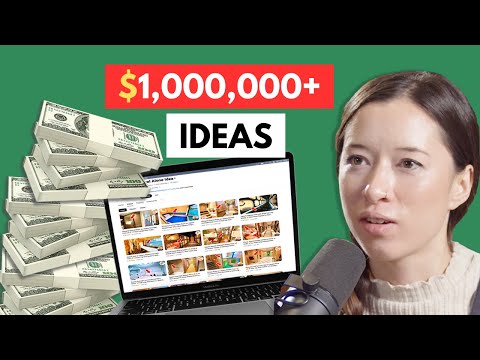
How To Find Million-Dollar Business Ideas In Internet Niches
A discussion with Steph Smith of Andreessen Horowitz about how niche internet content — like YouTube channels about Japanese passenger trains or Reddit communities for TVs mounted too high — can reveal unexpected markets. She and host Dan Shipper explore what viral, super-specific online communities teach people searching for business ideas.
# Video Identity Observations: "How To Find Million-Dollar Business Ideas In Internet Niches"
## Format & Presentation Evidence
- **Interview / conversational format**: The transcript shows a two-person dialogue with an interviewer asking follow-up questions ("I want to get to how exactly you use ChatGPT in a second. But I have another question...") and a guest giving extended answers.
- **Live screen-sharing moments**: The guest says "I'm just opening it now" while discussing the train channel, and later "I even brought them up on my screen" regarding the subreddit — indicating a video call with shared visuals.
- **Explicit acknowledgment of an audience**: The interviewer addresses viewers/listeners directly: "For those who watch or listen and ask: 'Why are we talking about this?'" — confirming both video and audio consumption contexts.
## Intended Audience
- **Aspiring entrepreneurs and internet-curious builders**: The framing "maybe I can build an app, or a website, or something" and the title's promise of "million-dollar business ideas" position the content toward people seeking business opportunities from internet trends.
- **Also people interested in internet culture for its own sake**: The guest explicitly validates non-commercial curiosity: "there's a big part of each of us that's not focused on being serious and looking for profit right now."
## Claimed Scope (from title)
- **Finding business ideas in internet niches**: The title claims a method for discovering high-value opportunities in narrow online communities — though the transcript itself is exploratory discussion rather than a step-by-step tutorial (the interviewer notes "I want to get to how exactly you use ChatGPT in a second," implying practical content arrives later).
## Demonstrated Content Themes
- **Niche internet subcultures as signals of demand**: The guest cites "Travel Alone Idea" (Japanese passenger trains, "30 videos and... 1.5 million subscribers") and r/TVTooHigh ("180 thousand subscribers... people posting photos of TVs hanging too high").
- **Debunking content-creation conventional wisdom**: "I think it debunks a lot of common content mantras, like 'you have to find your niche before everyone else' or 'you have to master the art of thumbnails.'"
- **Philosophy of paying attention to 'nonsense'**: The guest's thesis: "You shouldn't ignore nonsense... I think it's a window into what people really want."
## Self-Description Evidence
- **No explicit channel self-description present**: Neither speaker states the channel's name, mission, or upload schedule. Identity signals are implicit (title framing, interview format, business-idea orientation).
## Claims vs. Demonstrated Patterns
- **Creator claim**: Title promises a method for finding "million-dollar business ideas."
- **Demonstrated**: Free-flowing discussion of internet niches, trend-spotting mindset, and tool references ("some of the tools on the internet are very interesting, because they help you understand: 'Is there even a demand or interest in this thing?'") — practical method is referenced but not shown in this segment.
- **Credited third parties mentioned**: "Congratulations to fellow creator Pat Walls. He was the one who shared it on Twitter" — indicating a networked creator community context.
# Delivery Observation Report
## "How To Find Million-Dollar Business Ideas In Internet Niches"
## Format
Two-speaker conversation (interview/podcast style). One speaker asks questions and reacts; the other delivers extended explanations with examples.
---
## Tone
- **Conversational and enthusiastic**, especially when discussing internet oddities:
> "This is the most 'Internet' thing in the world."
> "I thought that was just brilliant. This is great. I like it."
- **Admiring, deferential to creators** rather than purely transactional:
> "there's a deep respect not just for trends that you can make money off of, but also for creators who come out and do cool things just for the fun of it"
## Vocabulary & Framing
- Recurring **scale/interest framing**:
> "the most niche things on the internet aren't niche anymore"
> "because of the scale of the internet, there are enough people now who might be interested in it"
- Repeated **consequence language**:
> "the second-order consequence is that we actually discover things that would never have been created before"
> "it's almost like a second or third order effect"
- Business vocabulary woven in casually: **demand, subscribers, views, business idea, profit**.
## Teaching Habits
- **Concrete case studies with numbers** as evidence:
> "30 videos and have over a million subscribers... 240 million all-time views, 1.5 million subscribers... an average monthly view count of 700k"
- **Explicitly debunking common advice** using the case:
> "it debunks a lot of common content mantras, like 'you have to find your niche before everyone else' or 'you have to master the art of thumbnails.'"
- **Live demonstration habit** — pulling things up on screen mid-conversation:
> "I'm just opening it now. It's called Travel Alone Idea."
> "I even brought them up on my screen."
- **Attribution of sources**:
> "Congratulations to fellow creator Pat Walls. He was the one who shared it on Twitter."
## Recurring Phrases & Verbal Patterns
- Frequent **"I think"** hedging and self-positioning:
> "I think it's because...", "I think it's a window into what people really want", "I just think..."
- Repeated **"just"** as a minimizer to emphasize simplicity:
> "There is no voiceover here. There is no sound... This is just a person riding Japanese passenger trains."
> "there are just people posting photos of TVs hanging too high"
- Repeated **"again"** as a discourse marker:
> "So again, the scale that allows you to reach enough people..."; "And again, these are just TVs..."; "maybe, again, there's a direct benefit"
## Audience Orientation
- The interviewer **addresses listeners directly** and signals structure:
> "And for those who watch or listen and ask: 'Why are we talking about this? What's the point anyway?'"
- The main speaker **anticipates audience application**:
> "Maybe someone in the audience will come up with a business idea from this"
## Humor & Playfulness
- Both speakers use **banter and jokes**:
> "I just decided that I don't like ChatGPT anymore. I'm now seriously into trains."
> "Just a photo and a red arrow."
- Playful observation of internet culture:
> "there is a subreddit called 'TV Just Right', but it's closed."
## Uncertainty Notes
- The speaker **explicitly flags uncertain claims** rather than asserting them:
> "There is a saying, I don't know if it's an urban legend or true"
> "Maybe this hidden interest has always existed"
- Some facts are hedged ("I think", "I need to remember the name"), suggesting the case-study numbers may be recalled from memory rather than verified live — though the speaker does verify one channel on-screen mid-conversation.
# Position Record: "How To Find Million-Dollar Business Ideas In Internet Niches"
**Note on speakers:** The transcript does not name the participants. Roles are inferred from conversational structure only: **Speaker A (Interviewer)** asks questions and reacts; **Speaker B (Guest)** develops the core positions. Pat Walls is mentioned as a third party (credit for sharing a subreddit), not a speaker.
---
## 1. The Internet Makes Niche Interests Non-Niche
**Speaker:** Guest (B)
- **Core claim:** "The most niche things on the internet aren't niche anymore."
- **Reasoning chain:**
- Every individual has narrow interests (a favorite sport, an obscure book).
- At the internet's scale, enough people exist for any such interest to find an audience.
- **Second-order consequence:** things get created that never would have before — e.g., sending garlic bread into space, building a maze for a squirrel.
- **Qualification preserved:** B explicitly notes the hidden interest "maybe" always existed; what changed is motivation, since creators previously "would know that only you yourself would enjoy it."
- **Underlying value:** B expresses "deep respect not just for trends that you can make money off of, but also for creators who come out and do cool things just for the fun of it."
### Unverified anecdote flagged as such
- The **Interviewer (A)** relays a saying about cats becoming popular on Reddit — uncertain whether it's "an urban legend or true" — because cats are antisocial and Reddit gave people a place to share cat photos. B endorses the story ("I like it") without verifying it.
## 2. Case Study: Japanese Passenger Train Channel
**Speakers:** A introduces having seen it; B supplies the data.
- Channel: **"Travel Alone Idea"**
- **Stated figures (per B, reading from screen):**
- Started in **2021**
- **~30 videos**, **1.5 million subscribers**, **240 million all-time views**, **~700k average monthly views**
- **Key interpretive claims (B):**
- Not an early-adopter advantage case (started 2021).
- Not an editing/algorithm mastery case: "There is no voiceover here. There is no sound. Installation is minimal." Content is "just a person riding Japanese passenger trains."
- **Claim it "debunks" content mantras (B, seconded by A):**
- "You have to find your niche before everyone else."
- "You have to master the art of thumbnails" — A adds that the channel's thumbnails are "mediocre. Just a photo and a red arrow."
### Humorous aside (A)
> "I just decided that I don't like ChatGPT anymore. I'm now seriously into trains."
*(Joke; B responds "Of course," adding "if only I could get that many views with just 30 videos.")*
## 3. Case Study: r/TVTooHigh and Spin-offs
**Speakers:** A asks; B explains. B credits **Pat Walls** for sharing it on Twitter.
- **r/TVTooHigh:** ~**180k subscribers**; people post photos of TVs hung too high. B calls it "the weirdest thing on the internet I've ever seen" and "the most 'Internet' thing in the world."
- **Derivative communities:** someone created r/tvtoolow and r/tvtoofar.
- **B's favorite detail:** a subreddit called "TV Just Right" exists **but is closed** — B finds this "just brilliant."
## 4. Core Position: "Don't Ignore Nonsense"
**Speaker:** Guest (B), responding to A's framing question.
- **Claim:** Seemingly absurd internet phenomena are a **window into what people really want**.
- **Reasoning:**
- A large part of human nature is "not focused on being serious and looking for profit right now" — people want to laugh, watch train rides, lock-picking, podiatry content, "because there's something a little weird about each of us."
- The scale of these communities is **evidence of real demand/interest**.
- Tools on the internet help answer: "Is there even a demand or interest in this thing?"
- **Two-level payoff (B):**
1. **Direct:** possible business ideas ("Maybe someone in the audience will come up with a business idea from this" — explicitly tentative).
2. **Indirect / second- or third-order:** understanding what people genuinely want "helps create better things in the world" and "you understand your fellow human beings a little better."
## Unresolved Threads
- The **ChatGPT usage question** A promises at the start ("I want to get to how exactly you use ChatGPT in a second") is **never answered** in this transcript.
- All statistics (subscriber/view counts) are B's on-screen readings; no independent verification offered.
- The Reddit cat-origin story remains flagged as possibly apocryphal by its own teller.
# Speaker Attribution & Provenance Record
**Video:** How To Find Million-Dollar Business Ideas In Internet Niches (`01a0f15b-11f2-7375-9570-23e9d168468f`)
## Speakers & Roles
- **Host / Interviewer** (unnamed) — asks questions, frames discussion, mentions their own notes.
- **Guest / Interviewee** (unnamed) — answers questions, shares examples (ChatGPT usage, niche channels, subreddits).
> Note: No curated metadata was supplied; speaker names are not stated in the transcript. Both roles are inferred from dialogue structure and remain unidentified.
## Referenced Third-Party Sources & Claims
- **YouTube channel "Travel Alone Idea"** — cited as being about Japanese passenger trains; guest claims (as read on-screen): started 2021, ~30 videos, 1.5M subscribers, 240M all-time views, ~700k average monthly views.
- **Subreddit r/TVTooHigh** — described as a community (claimed ~180k subscribers) posting photos of TVs hung too high; guest says it was shared on Twitter by **Pat Walls** (referred to as a fellow creator).
- **Related subreddits:** r/tvtoolow, r/tvtoofar, and "TV Just Right" (described as closed).
- **Reddit / cats anecdote** — a saying of unknown veracity ("urban legend or true") about cat photos and Reddit's origins; flagged as unverified by the speakers themselves.
- **Mentioned content categories** (no specific sources): lock-picking YouTube channels, podiatrist content, someone sending garlic bread into space, a squirrel maze.
## Promotional Segments
- **None identified.** No promotional or sponsor segments appear in the transcript.
## Provenance & Availability Notes
- **ChatGPT** is referenced as a tool by the guest but no usage details are given in this excerpt.
- The "TV Too High" example is a **secondhand claim** attributed to Pat Walls via Twitter.
- **Comments availability:** unknown — not specified in transcript or metadata.
- Factual figures (subscriber counts, views) are guest-stated, apparently read live from a screen; not independently verified within the source.
I want to get to how exactly you use ChatGPT in a second. But I have another question that just occurred to me : I think when you talk about
searching for things on the internet, it always refers to searching for business ideas, opportunities, or trends, which I really like. It's so interesting to see all these little things that are starting to become trendy. You're like, "Oh, maybe I can build an app, or a website, or something ." Yes. But I also think you have a fundamental curiosity about what's going on on the internet, and I wonder what that state of mind is—what exactly about such deep explorations excites you? Yeah, I think it's because the most niche things on the internet aren't niche anymore. And that in itself is fascinating, because each of us has a certain narrow interest that we can talk about with others. Maybe it's your favorite sport or some niche book that might interest someone else, but because of the scale of the internet, there are enough people now who might be interested in it. And the second- order consequence is that we actually discover things that would never have been created before. At the very beginning of the internet, I would talk about the strangest things: someone sending garlic bread into space or someone creating a maze for a squirrel. Maybe this hidden interest has always existed, but you never had enough motivation to create something like this because you would know that only you yourself would enjoy it. So again, the scale that allows you to reach enough people who might be interested in it really changes the paradigm of what people are willing to do. And I think that's really cool. So yeah, I think there's a deep respect not just for trends that you can make money off of,
but also for creators who come out and do cool things just for the fun of it, and the internet really makes that possible. it. There is a saying, I don't know if it's an urban legend or
true, that cats became popular on Reddit because before it appeared, no one had a place to share photos of their cats, because cats are antisocial creatures, and Reddit became the place where you could finally show what they were doing. Yes, I know. I like it. One of my—I often talk about these not-so- niche YouTube channels, this can also be applied to websites and so on. And one of them is a channel only about Japanese passenger trains. Oh yes, yes. I need to remember the name, but it's just Japanese passenger trains, they've only posted, I think, 30 videos and have over a million subscribers, I'm just opening it now. It's called Travel Alone Idea. And they started in 2021. So this isn't a case of someone being one of the first on YouTube and getting an advantage because of it. They have 240 million all-time views, 1.5 million subscribers , and yes, again, only 30 videos, and an average monthly view count of 700k. And the best thing about this is that , by the way, this is not a situation where someone is a master editor and has figured out how to conquer algorithms. There is no voiceover here. There is no sound. Installation is minimal. This is just a person
riding Japanese passenger trains. But then again , I admire that there are enough people who like it, Yeah. that this channel is
incredibly successful. I just decided that I don't like ChatGPT anymore . I'm now seriously into trains. Of course. If only I could get that many views with just 30 videos. Well, I mean, one of the reasons I bring this up is because I think it debunks a lot of common content mantras, like "you have to find your niche before everyone else" or "you have to master the art of thumbnails." Especially since the miniatures there are also mediocre. Just a photo and a red arrow. Exactly. Hmm, but that's why I think some of the tools on the internet are very interesting, because they help you understand: "Is there even a demand or interest in this thing?" » Yes. There's another one you shared, I think it's called "TV Too Far." Yes. "TV Too High", "TV Too Low". Oh, "TV Too High." This is the most " Internet" thing in the world. "TV Too High" is the biggest subreddit , and I think people have seen it, and it has ... You know what it is, tell us. Yeah, well, "TV Too High" is a subreddit, I mentioned it in my notes because I thought, "This is the weirdest thing on the internet I've ever seen." Congratulations to fellow creator Pat Walls. He was the one who shared it on Twitter. So, this subreddit has 180 thousand subscribers. And there are just people posting photos of TVs hanging too high. I even brought them up on my screen. And again, these are just TVs that people think are hung too high. Some of them are obvious, and some are not . But, as happens on the internet, someone saw it and created r/tvtoolow, r/tvtoofar. And the best part is that there is a subreddit called "TV Just Right", but it's closed. I
thought that was just brilliant. This is great. I like it. And for those who watch or listen and ask: " Why are we talking about this ?" What's the point anyway?" You have this opinion: you
shouldn't ignore nonsense. Yes. Tell us what this means and why you think it's important to pay attention to things like "TV Too High." Yeah, well, in this case...I don't know. Maybe someone in the audience will come up with a business idea from this, but I think there 's a big part of each of us that's not focused on being serious and looking for profit right now. It's more like, " Let's laugh about this." Let's look again at the Japanese train or a bunch of other YouTube channels where someone picks locks, or works as a podiatrist, or does all these weird things, because there's something a little weird about each of us. By the way, if there is interest from all these people, which is evidenced by the scale of some of these things. I just think it's a window into what people really want. And if you understand what people really want, maybe, again, there's a direct benefit in terms of how to use it, but I also think it just helps create better things in the world. And it's almost like a second or third order effect: if you go down these paths, I think you understand your fellow human beings a little better.