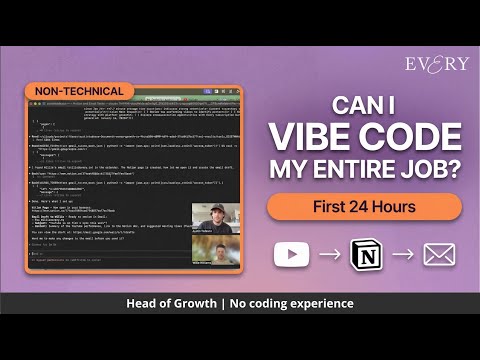
I'm Trying to Vibe Code My Entire Job
A walkthrough of a personal command center that Every's head of growth, Austin Tedesco, built in a single day through vibe coding—describing desired outcomes to AI tools (Claude Code, Monologue, and the compound engineering plugin) without understanding the underlying code. The system pulls live social media analytics, generates Notion pages, drafts emails, and runs his entire growth workflow from the terminal, demonstrating what is possible when AI handles the coding.
# Video Identity Observations
## Creator Self-Description (Explicit Claims)
- The creator introduces himself as **"Austin, Mey's head of growth"** and explicitly frames himself as **"a non-engineer trying to vibe code this entire job."**
- He states this is a **project of about three weeks** ("it's a project I've been working on for like three weeks") and that he plans **"a series of videos on where it leads,"** signaling a continuing video series.
- He describes his background indirectly: **"as a former cook... I don't know how to code, but I do know how to follow a recipe of instructions."**
## Claimed Scope of Content
- The video demonstrates **building a personal "growth hub" / "command center"** inside a terminal-based coding agent (Cloud Code / Claude Code), integrating:
- **Stripe subscription data** ("all of our Stripe data")
- **Newsletter, YouTube, and social analytics** ("all of our newsletter data, all of our social data across YouTube")
- **PostHog, Figma, Notion** integrations ("a lot of our data in post hog our Figma files and it can push a bunch of stuff to notion")
- **Email drafting and scheduling** ("draft an email to Willie... find us a time to meet this week")
- He positions the project as a **cost-saving alternative to commercial social tools**: "every like social tool out there wants to charge you like tens of thousands of dollars a year and we're about to build a replacement for it... basically just using claude tokens."
## Intended Audience (Observable Evidence)
- **Non-technical professionals / business operators**: Austin repeatedly frames himself as non-technical ("I am not," "a true doofus with this stuff," "walk me through literally every step like I'm an an idiot") — modeling an approachable entry point for non-engineers.
- **People curious about AI-assisted "vibe coding" workflows**: the title itself ("I'm Trying to Vibe Code My Entire Job") targets viewers interested in delegating work to AI coding agents.
- **Internal/peer commentary is present but secondary**: a colleague (Willie, "head of platform") appears to react and ask questions, suggesting a demo/dialogue format layered over a tutorial-style walkthrough.
## Demonstrated Presentation Patterns
- **Live screen-share demo style**: Austin recreates the demo on camera ("I'm going to uh recreate a demo. I showed the every team this morning of a thing I built last night"), running commands and narrating outputs in real time.
- **Casual, energetic tone**: conversational language throughout ("Yo, I'm Austin," "Hell yeah. All right, let's uh let's post this bad boy").
- **Honest process transparency**: he shares the messy path to the result — "I built this last night in like in like an hour, but that happened after spending three weeks like bugging away at different versions."
- **Learning-journey framing**: he narrates his shift from desktop app to CLI ("it wasn't um scary anymore once I did it a bunch"), presenting skill acquisition as part of the content.
- **Forward-looking roadmap**: he ends with planned next steps (adding X/Twitter analytics, making the tool team-accessible), consistent with a serialized channel direction.
## Distinguishing Claims vs. Demonstration
- **Claimed**: job role (head of growth), non-engineer status, three-week effort, planned video series.
- **Demonstrated**: live terminal commands, a Notion page generated during the demo, an email draft produced in real time, and integration behavior with Stripe/YouTube data described as it runs.
- **Not verified by this material**: channel-wide identity (name, format consistency, other videos) — the series intention is stated but only this single video is observable here.
# Delivery Observation: "I'm Trying to Vibe Code My Entire Job"
## Overall Tone
- **Casual, enthusiastic, self-deprecating.** The speaker opens informally — "Yo, I'm Austin" — and keeps a conversational register throughout.
- **Excitement is a recurring emotional note:** "I'm really excited about it," "That's really exciting to me," "Hell yeah."
## Recurring Phrases & Verbal Habits
- **Filler-heavy speech:** "um," "uh," and "like" appear constantly.
> "Um, it's a project I've been working on for like three weeks"
> "it's like the first step of what I think is possible here"
- **Self-deprecating framing** as a recurring rhetorical device:
> "walk me through literally every step like I'm a an idiot which is like what I said"
> "for someone who's a true doofus with this stuff"
- **Repeated phrasing through stuttering/restarts:** "what what's what's your take on this," "I I I saw you kicked it off" — frequent self-interruptions and revisions mid-sentence.
- **"Like" as an all-purpose hedge and connector** — this is the single most frequent word pattern in the delivery.
## Teaching / Explaining Habits
- **Demo-driven narration:** he walks through actions live ("I type in every, I get access to it," "I'll refresh this page"), narrating in real time rather than presenting polished slides.
- **Emphasizes the non-engineer angle repeatedly** as a framing device:
> "I'm a non-engineer trying to vibe code this entire job"
> "Willie, you're you're here. You um are a technical person. I I am not."
- **Uses accessible analogies** to explain his learning process:
> "as a former cook, like I don't know how to code, but I do know how to follow a recipe of instructions"
- **Cites concrete, named tools** frequently (Claude Code, Notion, Stripe, Figma, PostHog, Todoist, Google Calendar) — the vocabulary is tool-dense.
- **Explicitly outsources evaluation** to the technical guest: "What am I what am I missing or not considering?"
## Conversational Turn-Taking
- The video shifts from **monologue demo to dialogue** with a technical colleague (Willie), who uses a similar casual style ("That's awesome. That's awesome," "Cool").
- Austin frequently **answers questions with process stories** ("the path is like uh moving to this like small fastmoving high growth startup") rather than direct, structured answers.
## Uncertainty Notes
- Sample size is a single video; patterns like the self-deprecating framing appear ~4 times, enough to look habitual, but filler frequency could reflect this specific demo context rather than a stable trait.
- No timestamps beyond coarse transcript indices are available, so exact timing of shifts (e.g., monologue → dialogue) is approximate.
# Position Extraction: "I'm Trying to Vibe Code My Entire Job"
## Speakers
- **Austin** — Head of Growth at Every, self-described non-engineer and "former cook"; presenter/builder of the tool.
- **Willie** — Head of Platform at Every (on the call), identified by Austin as "a technical person."
## Core Claims & Positions
### Austin's Position: Non-engineers can run their entire job through Claude Code
- **Claim:** A set of instructions and connections inside **Claude Code** can act as a "command center" / "work operating system" covering email, scheduling, research, and data analysis — "never having to leave the Claude Code terminal."
- **Scope/timeline:** A **three-week learning project**; the demoed "growth hub" was built "last night in like an hour" — but only *after* three weeks of failed versions ("so many different places that like kind of were never right").
- **Motivation (as stated):** Feeling "deeply overwhelmed" by opportunity at a fast-moving startup, wanting to move faster, and wanting to learn — not private inference, explicitly stated.
### Technical setup (Austin)
- Running on **Opus 4.5**, OAuth connection to Google Console; data sources: Stripe, newsletter, YouTube, PostHog, Figma, Notion (push). X/Twitter not yet integrated ("need to ask Dan for an API").
- Uses the **Claude desktop app** for two weeks, then switched to the **CLI/terminal** — "it wasn't scary anymore once I did it a bunch"; feels "faster and more intuitive."
- Used **compound engineering** plugin: "really helps... especially the planning side of the work for someone who's a true doofus."
- **Build method:** Described the final outcome, then asked to be walked through "literally every step like I'm an idiot." Analogy: as a former cook, "I don't know how to code, but I do know how to follow a recipe."
- Note his **reading preference tension:** he doesn't like reading analysis *in* the terminal — wants output pushed to Notion/email, which "makes sense" to his brain.
### Economic claim (Austin)
- Social analytics tools "want to charge you like tens of thousands of dollars a year and we're about to build a replacement for it... basically just using Claude tokens." *(Aspirational, not yet built — X data not connected.)*
### Distribution question (Austin, unresolved)
- "How does the rest of the team start using this?" — currently local to his machine; worries about it becoming "overly complicated piece of enterprise software that I think I'm probably not capable of building."
- Proposed direction: **agent-native** builds per Dan's guide; any teammate could command-line in, get "interviewed" by the agent, state skill level, and connect services (Google Calendar, Todoist) incrementally.
### Willie's Position
- **Assessment:** "This is actually absolutely amazing... from a technical looking at like what's possible from a non-technical perspective."
- **Interest:** Wants a version for himself — acknowledges "my job is very different than your job," but the overlap (Notion, email) is "close enough" that he wants "a slightly customized version" with the rest pre-built.
- Asked about original need and build process; asked which tool surface (CLI vs. desktop vs. Codex) was used.
## Preserved Qualifications & Tensions
- Austin's **self-assessed limitations:** non-technical, "true doofus," likely incapable of building enterprise-grade software.
- **Demo success vs. build history:** one-hour build contrasted with three prior weeks of failed attempts — the video does not claim this was easy.
- **Incomplete state:** X analytics missing; team-wide access unsolved.
- Willie's enthusiasm is genuine but **conditional** ("slightly customized version") — not a claim the tool generalizes as-is.
# Speaker & Provenance Record — "I'm Trying to Vibe Code My Entire Job"
## Speakers & Roles
- **Austin** — **Creator / primary presenter**. Self-identified as **head of growth at Every**, self-described **non-engineer** and "former cook." Drives the demo and discussion.
- **Willie** — **Guest / second speaker**. Identified by Austin as **head of platform at Every** and a "technical person." Asks questions and reacts; is also the recipient of a demo-drafted email.
- No narrator; no other identified roles. **Uncertainty:** occasional turns in the dialogue are not explicitly attributed by name, but context indicates the alternating two-person conversation is Austin and Willie.
## Product / Tool References (promotional or commercial)
- **Claude Code** (CLI and desktop app variants), **Opus 4.5** model — named tools Austin says he uses.
- **Every** — Austin's employer; its "subscription bundle" and internal teams are referenced repeatedly.
- Third-party services referenced as integrations: **Stripe, Notion, PostHog, Figma, YouTube (Google Console, OAuth), Discord, Todoist, Google Calendar, X/Twitter (planned)**.
- **Compound engineering plugin** — named by Austin as used during setup.
- ⚠️ **Promotional note:** No explicit paid promotion or sponsor segment present. Austin repeatedly praises his employer's product and culture ("really exciting being inside of this company"), and references **"Dan's guide"** and agent-native instructions from Dan (presumably a colleague; role not stated).
## Third-Party Claims
- Austin's claim: social analytics tools "want to charge you like tens of thousands of dollars a year" — **unsourced market pricing claim**.
- Austin's claim that a Claude-token-based replacement can be built "basically just using claude tokens" — cost/feasibility claim, unverified.
- Willie's endorsement ("this is actually absolutely amazing") — guest opinion, not evidence.
## Provenance & Context Facts
- Project timeline per Austin: ~**three weeks** of iterations; the demoed version "built last night in like an hour."
- Demo performed live; environment noted as **Panama** (Wi-Fi reliability comment).
- Data sources accessed via OAuth/APIs: Stripe, newsletter data, YouTube analytics, PostHog, Figma; X/Twitter analytics **not yet connected** (pending API access from "Dan").
## Availability Limits
- **No curated metadata was supplied** with this source.
- **Comment availability: unknown / not stated.**
- No external citations, sources, or references beyond those listed above appear in the transcript.
Yo, I'm Austin. I'm Mey's head of growth and I'm a non-engineer trying to vibe code this entire job. Um, it's a project I've been working on for like three weeks and I demoed it to the every team
this morning. And basically what it is is it's just a set of instructions with a bunch of connections inside of cloud code that I start using as a command center to do everything from send emails to our CEO scheduling time with him to chat about growth initiatives using cloud code to do research and strategy analysis on the latest info for our YouTube numbers, our Twitter numbers, our paid subscription numbers from Stripe, never having to leave the cloud code terminal and I'm really excited about it. To me, this is just like the first step of what I think is possible here and um I'm going to do a series of videos on where it leads. So, check it out. All right, I'm going to uh recreate a demo. I showed the every team this morning of a thing I built last night. So, it is a growth hub for every um living inside of code. I type in every, I get access to it. I can do a thing where I say, um, can you list everything this tool has access to? I pulled up Monologue to do it. We'll let it run. um that way I can show yall all the things we're pulling in both to be able to get um data but also to actually automate tasks that I do every day so that this can happen in the background or so I can kind of like um like run my whole work operating system from here instead of a bunch of different tabs and apps. So um it can
look at uh all of our Stripe data, all of our newsletter data, all of our social data across YouTube. we're going to add X later. Uh we have a lot of our data in post hog our Figma files and it
can push a bunch of stuff to notion. So uh the thing that I started with was simply asking like how are we doing on YouTube um this is running on Opus 45 to pull from the uh like an OOTH connection to our Google console. Uh, it's checking that all right now and it will um pull a data analysis for me based off instructions for like the things we care about on our YouTube as we push for for growth there. Um, so you'll see here a quick summary of the YouTube performance without me needing to leave the terminal, log in to the YouTube channel, check it out. Um, so thing I I could do from here now is I can say, "All right, can you push this to a new notion page?" Um, and when you're done with any new notion page, open it so I can see it. Um, and then I also want you to draft an email to Willie, um, who's on this call, our head of platform, showing a, uh, a summary of our YouTube performance, a link to the notion document, and find us a time to meet this week to talk more about how we can use a combination of the every platform and our YouTube strategy to grow the Every subscription bundle. Um, Willie, you're you're here. You um are a technical person. I I am not. I have basically just been sitting in cloud code asking it to do all of this for me. Um, what what's what's your take on this? What am I what am I missing or not considering? \>\> I mean, my honest take is this is actually absolutely amazing. um especially from like a technical looking
at like what's possible uh from a non-technical perspective. Um I'm actually to kind of kick back to you. I'm kind of curious like what was your
what was like the the original like ah I need I need this moment and then what was your process from there to to build up on like oh I know have that I have that need like I assume you just didn't you know from that 10 minutes later have like this whole suite of tools like where where what was your what was your path? Yeah, the path is like uh moving to this like small fastmoving high growth startup. Um, and this is the notion page with the YouTube data that was made right here in the every notion under the growth hub. We'll do a little tour of this then we'll keep going. Uh, I think it's going to keep Oh, it made the email as well. Let's see if it's in here. I'll refresh this page. sitting in the drafts here um in a second. The Wi-Fi in Panama. Sometimes good, sometimes not. This is definitely a subject line I would write. Uh to you right there, there's an email. I love it. Um all right. What was the process for this thing? It's mostly like this feeling of being deeply overwhelmed by all of the like exciting opportunity we have and things there are to do and feeling like I want to move faster. Also, I want to learn how to do this stuff. Like it's very inspiring and exciting being inside of this company, watching the product GMs, watching you
do stuff and having you all reiterate to us every day. Like it's actually much more accessible than you think. So a lot of it was a learning project. A lot of it was also like I'm trying to run all
this stuff for growth with our growth team. And what's really timeconuming is like checking all the data, thinking through what to do next, keeping a to-do list, which is like really crazy for me. But I like have this to-do list here, and the um agent is actually also synced to that to like check stuff off as it does it and then to add stuff if I if I tell it I need to. Um, and so I built this last night in like in like an hour, but it that happened after spending three weeks like bugging away at different versions of this in different like at so many different places that like kind of were never right. \>\> Cool. That's awesome. Um, from a sort of the technical non-technical, was this, you know, I I I saw you kicked it off and you you used the every command on the command line. Um, was this you with cloud code and the CLI? Was this you with like cloud code as a desktop app or codeex or any any other form when you were actually like building this out? \>\> Yeah. So, up until like two weeks ago, I was purely um cloud desktop app. I was like learning cloud code in the desktop app and I was trying to do something was taking forever and I was like, let me try like a CLI just in the in the
terminal locally. Um, and I just like I finally got it. it made sense to me. It wasn't um scary anymore once I did it a bunch. And it just it feels faster and
more intuitive to me, especially because I'm not really working in here. Like I didn't read that YouTube summary in here. That still is like not really how my brain works. I want to read it in a notion doc. That's what makes sense to me or in an email. And now I'm just like firing it off to places where it like makes sense. Um so to build this thing, yeah, basically what I did was I uh opened up a cloud code session. I made sure that compound engineering was on um because I find that that plug-in like really helps this kind of like especially the planning side of the work for someone who's a true doofus with this stuff. And then I was like here's the final outcome I want which is basically this for me. This is the outcome I described. And I was like walk me through literally every step like I'm a an idiot which is like what I said. And that um took me through like setting API keys or like um OOP consent screens in Google console, all of which I'd never done before. And um as a former cook, like I don't know how to code, but I do know how to follow a recipe of instructions. And that part was actually quite intuitive to me. \>\> Yeah, that's awesome. That's awesome. \>\> Yeah. What should I do with this next? I mean it I think the question is sort of like what uh uh what's what's left. I know you mentioned that it doesn't have xosting. Um you got some more capabilities to sort of add to it. \>\> Yeah, I think like there is like bring everything in. We don't have all of our social analytics tied in yet, but we definitely will. I just like need to ask Dan for an API to his Twitter. Um, that's really exciting to me as the person like overseeing growth here because every like social tool out there
wants to charge you like tens of thousands of dollars a year and we're about to build a replacement for it. Um, basically just using claude tokens. So that's exciting. And then the real thing
next up here is like how does the rest of the team start using this, right? Like this is living locally for me on my stuff. It can send Discord messages for me. um what's the right way to make this so that it works for everyone without it becoming some like overly complicated piece of enterprise software that I I think I'm probably not capable of building. \>\> Yeah. Yeah. I mean my my take on upon saying this was sort of like I want this for me but my job is very different than your job you know. Um and but and and even though like I would have the capability to build this like it looks so good and so helpful right from the jump like the ven diagram of the things we need to do in terms of interacting with notion interacting with email um is close enough that I just sort of want a slightly you know slightly customized version of it but with but with everything else sort of set up in place. Yeah, I think that's the place where we can leave this too is like one thing powering this is in the instruction manual is to like only build stuff that's agent native based off the instructions that like Dan gave in his guide. And I think that's kind of the direction to go with this of like anyone from our team should be able to at the very least like command line in a base version of this get interviewed by the agent \>\> and maybe even give their like skill level and be like okay you've never done this before let's connect your Google calendar with like an API or like your to-doist which is actually very very easy if you have that and we can like build up from there. \>\> Cool. That sounds awesome. Let me know when it ships. \>\> Hell yeah. All right, let's uh let's post this bad boy. Thanks, man.