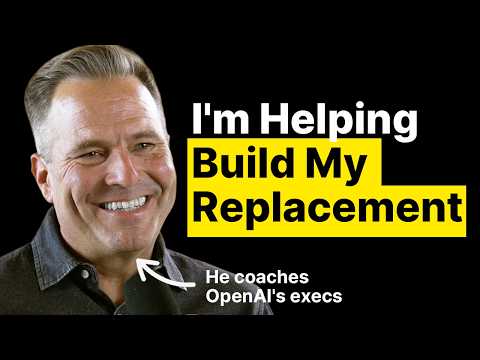
Inside OpenAI: Coaching the People Creating AGI | Joe…
Episode of the AI & I podcast in which host Dan Shipper interviews Joe Hudson, founder of The Art of Accomplishment and an executive coach who works with OpenAI leaders building AGI. Hudson describes the emotional spectrum inside OpenAI — exhilaration, fear, and the weight of creating transformative technology — and shares his belief that AI will eventually replace coaching work like his. Topics include facing the possible loss of what you've built your life around, finding identity beneath professional roles, sitting with uncertainty as a catalyst for transformation, preparing children for a post-AGI world, the three layers of human awareness (thinking, feeling, reacting), staying grounded while coaching people shaping the future, not taking things personally under high stakes, and why Hudson sees intention as the key to growing with AI.
Timestamps:
00:00:00 - Episode start
00:01:49 - Introduction
00:03:14 - What it feels like inside the room where AGI is being built
00:08:15 - The most important question to ask yourself as AGI approaches
00:17:49 - The importance of sitting with uncertainty
00:21:11 - How Joe is preparing his daughters for a post-AGI world
00:27:25 - How we think, feel, and react; the three layers of human awareness
00:35:34 - Staying grounded while coaching the people shaping our future
00:42:44 - Why Joe doesn't take things personally—even when the stakes are high
# Channel Identity Observations: "AI and I" (Every)
## Observable Channel Presentation
### Show / Channel Name
- The closing segment names the show: **"AI and I"** — "you absolutely positively have to smash that like button and subscribe to **AI and I**."
- The host is identified as **Dan Shipper** ("a journey into the future with Dan Shipper as the captain of the spaceship").
### Host Presentation
- The host introduces himself by first name in the ad-read segment: "Hey everyone, **David here**" — note: this appears in the mid-roll ad for Google Gemini, and the name "David" conflicts with "Dan Shipper" named in the outro; treat both as transcript-reported host references.
- The host conducts long-form, one-on-one conversational interviews with personal familiarity with the guest: "we've known each other for a while and I just love hanging out with you… we do this like now it seems like a yearly beach walk together."
### Intended Audience
- Audience is addressed as listeners interested in **AI, AGI, and the inner/emotional lives of people building AI**: the host frames the guest as "the guy who's inside the minds of the people who are building AGI."
- The host explicitly addresses practical AI users: "for people listening who may not be familiar with your work," and the outro describes "knowledge bombs about chat GPT."
- The host also represents a hypothetical anxious listener concerned about AI displacement: "I'm like a lawyer. I'm like a paralegal… I can't just go to like my formless void place" — demonstrating the show addresses non-expert, economically concerned audience segments.
### Claimed Scope
- Per the outro, the show positions itself as covering **ChatGPT and AI topics** with "a roller coaster of emotions, insights, and laughter" — a mix of AI coverage and personal/psychological conversation.
- Demonstrated scope (observable pattern): in-depth interviews exploring **emotional, psychological, and philosophical dimensions of AI development** (grief, identity, responsibility), alongside practical AI-use advice (e.g., the daughter anecdote: "how do you use AI to make you smarter").
### Guest Selection Pattern
- Guests are figures adjacent to AI labs and personal-development spaces — here, **Joe Hudson, "Founder of The Art of Accomplishment,"** described as coach to "senior executives at some of the big AI labs" (specified as OpenAI).
### Sponsorship / Commercial Presentation
- Two ad reads present in the episode:
- **Google Gemini** ("This podcast is supported by Google… one of the product leads for Google Gemini"), promoting video generation with "a Google AI Pro plan… or the Ultra plan. Sign up at gemini.google."
- **Attio** ("this episode is brought to you by Adio [Attio], the AI native CRM"), with promo code "adio.com/every."
- The Attio URL ("**/every**") and outro host name indicate affiliation with **Every**, a media brand.
### Self-Description vs. Demonstration
- **Explicit self-description** (creator claim, from outro): "the epitome of awesomeness… pure unadulterated knowledge bombs about chat GPT… not just a show, it's a journey into the future."
- **Demonstrated pattern**: an intimate, reflective long-form interview format focused on the human/emotional side of AI builders, punctuated by sponsor reads and a high-energy, hyperbolic outro CTA ("Dan, I'm absolutely hopelessly in love with you") that contrasts tonally with the episode's contemplative body.
## Evidence Notes
- No curated metadata was supplied; all observations derive from the transcript alone.
- No private motivations inferred; the "savior/villain" projection remarks are the guest's claims about AI labs, reported as interview content, not verified channel claims.
# Delivery Observation: Joe Hudson Interview (AI and I / Dan Shipper)
## Participants & Roles
- **Host (Dan Shipper):** interviewer; drives topic shifts, paraphrases guest, adds ad reads.
- **Guest (Joe Hudson):** executive coach; delivers most of the substantive content.
---
## Joe Hudson — Delivery Patterns
### Metaphor-Driven Explanation
Hudson repeatedly grounds abstract emotional concepts in extended concrete analogies:
- **Birth/hospital metaphor** for the AI company experience: > "it reminds me of when we gave birth the first time... There's um there's a lot of growth happening really quickly."
- **Divorce metaphor** for societal transformation: > "two people get divorced and one of them is like how am I going to go about doing this."
- **Hammer analogy** for AI tools: > "Just like a hammer, I can build a house with it or I can smash somebody's brains in."
- **Falling/flying** for uncertainty: > "falling and flying feel really similar for a while."
- **Basketball** for overthinking: > "If you're thinking about like where does the ball have to go... you're going to have a horrible game."
This is a **stable pattern** — at least six distinct extended metaphors appear across the conversation.
### Aphoristic, Repeated Phrasings
He compresses ideas into quotable one-liners, often restating them:
- > "if grief doesn't come, your transformation ain't coming either."
- > "every time I allow my heart to break, it increases my capacity to love."
- > "which we resist persists."
- > "uncertainty is freedom."
- > "I get to love people or I get to take responsibility for them."
### Rhetorical Question → Direct Answer Rhythm
A recurring teaching move: pose a question, then answer it himself:
- > "Will they get better? Oh, yeah. Will they be as good as me one day? I can't imagine that they won't be."
- > "do I think they do a great job of it? I absolutely don't."
- > "Who is it exactly? Like what are we talking about?"
### Structure Signaling with Fractions/Frameworks
He organizes his method explicitly:
- > "a third of what I do is all about having that emotional... fluidity."
- **Three-brain model:** > "humans have three brains... the prefrontal cortex... the emotional brain. I call that the heart... the nervous system."
- "seven or eight different tools" for self-talk (mentioned but not enumerated).
### Interactive Mini-Exercises with the Host
At least once he runs a live exercise mid-conversation:
- > "pick somebody that you love... I'm thinking about my sister's dog... now I want you to take responsibility for that dog."
- Earlier: > "stop thinking and if you're listening to this stop thinking."
This suggests an in-the-moment coaching habit, though it appears only **twice** — repetition is limited.
### Self-Correction Mid-Sentence
Frequent in-flight refinement of his own wording:
- > "the way I've seen birth happen, especially in modern America..."
- > "we gave birth the first time or when my wife and I gave birth and my wife gave birth. I I didn't do that."
- > "better versions of ourselves or more more authentic versions of ourselves, I think, is a more specific way of saying it."
### Pop-Science / Authority References
He cites loosely attributed evidence to support claims:
- > "50,000 times a day which is about how many thoughts we have in a day according to I think it's a Mayo Clinic."
- > "there's this great study about how leaders have a lot more theta brain waves."
- > "a little cortisol bump" when self-critical thoughts occur.
The hedged attribution ("I think it's a Mayo Clinic") is characteristic — confident claims, soft sourcing.
### Filler-Heavy, Conversational Pace
Transcript shows heavy use of "um," "uh," repeated conjunctions ("and and," "so so"), and sentence restarts — an informal, thinking-aloud delivery rather than rehearsed speech.
---
## Dan Shipper (Host) — Delivery Patterns
### Elaborative Paraphrasing
He regularly restates the guest's point before asking the next question:
- > "basically, I'm hearing you say coaching these people... you feel like to some degree you're helping them build something that will replace you?"
- > "Seems like you're sort of pointing to in some ways the difference between guilt and shame."
### Testing Steelmanmed Objections
He voices anticipated listener pushback:
- > "there's a misinterpretation of what you're saying that I'd like to represent for you... that's a way for me to avoid responsibility."
### Personal Disclosure
He shares his own experience to validate the guest's points:
- > "as someone who I have for many years had that kind of like very weighty responsibility sense... I've like made a lot of decisions that ended up hurting people more."
### Warm, Relationship-Forward Opening
> "we've known each other for a while and I just love hanging out with you... We do this like uh now it seems like a yearly beach walk together."
---
## Uncertainty Notes
- **Turn attribution:** The transcript lacks consistent speaker labels; role assignments above are inferred from content and response patterns. Individual quotes are exact, but who said "Yeah" / short affirmations is sometimes ambiguous.
- **Single-sample features:** The live exercise, the Dead Sea Scrolls aside, and the "sister's dog" moment occur once each — observable but not established habits.
- **Ad reads and outro:** The Google Gemini and Adio segments, plus the exaggerated outro ("smash that like button"), are clearly scripted insertions and not representative of conversational delivery.
# Position Record: "Inside OpenAI: Coaching the People Creating AGI | Joe Hudson"
**Speakers:**
- **Joe Hudson** — Founder of The Art of Accomplishment; coach to one AI company (identified as **OpenAI**), with employees of other AI labs attending his courses
- **Dan Shipper** — Host (identified in ad reads and outro)
---
## 1. Coaching Inside OpenAI
### The "birth/hospital" analogy
- Hudson describes working with OpenAI as reminiscent of the hospital environment during the birth of his child: rapid growth, high intensity, and the sense that "we're giving birth to something here."
- He claims he has **never seen** a company release products at that speed and level, or "cross a chasm the way that this company is."
### Projection from outside
- Hudson: both inside and outside the company, people project extremes — "this is going to be the best thing ever" / "this is going to destroy my life."
- He asserts **no essential difference** between people inside and outside AI companies: "every position you can think of from excitement to repressed excitement to fear... they're all expressed both inside and outside of the company." The only difference he observes: insiders "think about it more often."
- His wish: "If I could push a button and control everything, I would want the entire world to give all the AI labs a tremendous amount of love" — instead, they receive projections of **savior** and **villain**, both "a heavy load to handle."
- Noted characteristic of insiders: "hyper intelligent folks" with possibly higher propensity toward neurodivergence and sensitivity.
### His reframing question
- Hudson proposes shifting from "What's going to happen when AGI is created?" to **"How do we want to be while AGI is created?"** — which he calls "a far more powerful question."
---
## 2. Personal Transformation and Grief
- **Hudson's claim:** His experience has followed something like the five stages of grief (which he subscribes to, with caveats about order and nuance). He has had "massive grief" tied to AI replacing his profession.
- On AI coaching/therapy: he claims it is "one of the number one use cases of all the AI labs right now," but he does **not** think they do a great job — citing "the recent thing that happened with sycopency" [sic; as spoken] as an example. He expects they will improve and could match him in 1–20 years (he is uncertain).
- **Identity collapse:** He says what he "digs" most is that knowledge work (writing, coaching, doctoring, law) is being commoditized, forcing the question "who are you then?" — and he believes identity collapse creates freedom, though "very few people understand" this.
- **Grief as prerequisite:** "If grief doesn't come, your transformation ain't coming either... if someone doesn't grieve that, then the transformation doesn't come."
- Grief comes in waves; he doesn't schedule it: "Every time I allow my heart to break, it increases my capacity to love."
- On "what am I": he has an answer to post-coach identity, "but it's not an intellectual one" — referencing decades of asking "what am I" and finding a silent, non-conceptual answer. Something essential "can't be taken, can't be given."
- **Shipper's gloss:** Shipper notes this answer "is unsatisfying unless you're in a particular place," but suggests there will be another identity word in a post-AGI world; Hudson agrees ("We always find a way to identify ourselves").
- **Uncertainty:** Hudson: "uncertainty is freedom... falling and flying feel really similar for a while." He advises staying in the unknown "for as long as possible" rather than rushing back to what you know.
### Personal nervous-system experience
- Hudson reports getting "amped up" from daily office visits at OpenAI (bureaucracy, intensity), and drawing on prior experience of identity "falling through the floor" — including COVID as an example of collective unknowing nobody predicted correctly.
---
## 3. Parenting Through the Transition
- He encourages his daughters (ages 16 and 19) to use AI. Anecdote: his youngest daughter said AI would "make me dumb"; he reframed to "how do you use AI to make you smarter," which "changed her whole perspective."
- Tool framing: like a hammer — can build or harm; the key is conscious, intentional use rather than addictive defaults. He predicts "somebody is going to try to make AI as addictive as possible," making personal wisdom decisive.
- **No post-AGI strategy:** "I don't have a big strategy on... how you prepare for a post AGI world because I don't believe I know what that is." Instead, resilience will depend on **emotional resilience, open-mindedness, low neuroticism, low need for perfection/control**.
- He is forthright with his daughters about his own fears, hopes, and excitement, teaching them "how to be with intensity in a way that actually creates freedom."
---
## 4. His Coaching Framework
### Three "brains"
1. **Prefrontal cortex** (thought) — self-talk, relationship with self
2. **Emotional brain / "heart"** — emotional fluidity (about a third of his work)
3. **Nervous system / "gut"** — the reactive, reptilian part
Transformation requires addressing all three; "I know I should exercise, but..." shows understanding in one system without the others.
### Emotional basis of decision-making
- Claim: decision-making happens neurologically in the emotional center; without it, "your IQ would stay the same, but your entire world would fall apart." Overwhelm, stuckness, and indecision are usually **emotional stagnation**.
### Self-criticism
- Claim: nearly everyone has a self-critical voice (he guesses ~1% don't). People listen to it "the same way that... a deep believer of a politician listens to a politician."
- Resisting the voice doesn't work ("what we resist persists"); each self-critical thought produces "a little cortisol bump." Cites a figure of ~50,000 thoughts/day "according to I think it's a Mayo Clinic" (stated with uncertainty).
- Counter to "I need it to get off the couch": "the same way a baby learns to walk... everything in the world evolves without that negative voice."
### Projection onto AI predictions
- Claim: "the people... trying to predict the future are the people who are scared and trying to figure out how to be safe," so their nature predicts "a really shitty future." He cites prophecies and the Dead Sea Scrolls cult as evidence of doom-oriented forecasting. **Shipper pushes back:** the messiah tradition is a counterexample; Hudson partially concedes ("and then somebody comes and saves us").
- Shipper's wave analogy: with hyper-complex unfamiliar situations, better to surf than to try to predict where the wave breaks. Hudson agrees and cites a claim that leaders have more **theta brain waves**, comparing to basketball ("get out of your head").
- **Shipper's qualification:** thinking helps only if you've been on the wave; Hudson allows "a little thinking in advance" but agrees on diminishing returns.
---
## 5. Responsibility vs. Ownership
- Hudson deliberately avoids taking **responsibility** for clients' actions despite years of training; taking it disempowers them ("making you a victim... a puppet") and reflects "hubris or narcissism."
- **Distinction he draws:** *ownership* = empowerment; *responsibility* = weight, obligation, guilt/shame — it stagnates.
- Applied to OpenAI researchers: heavy responsibility reduces resilience to correct mistakes ("Oh, I did it. I knew I was going to do that" instead of "misstep. Let's turn here").
- **Shipper's guilt/shame framing** ("I am bad" vs. "I did something bad"): Hudson responds "yes and no" — he appreciates the nuance but holds that **both** guilt and shame stagnate emotional experience, and shame specifically is "meant to stop things" (fart-on-the-couch illustration). Empowered apology is "the difference between I made a mistake and I'm iterating."
- **Iteration claim:** AI development "is just going to be a series of mistakes"; first iPhone vs. iPhone 4 illustrates iteration vs. mistake-framing; weight-loss science favors iterative mindset over single diets.
---
## 6. Handling Criticism and Not Taking Things Personally
- Hudson: of ~50,000 daily thoughts, "you didn't decide to have one of them" — so taking thoughts personally is misguided.
- He practices **non-defensiveness**: when criticized ("you're screwing everything up"), he engages ("What am I missing?") rather than defending, claiming defense drains energy and blocks alternative frames of reference.
- He uses Twitter as a practice: comparing it to Tibetan Buddhist teaching by relentless teasing — "every piece of me that gets triggered is something that I haven't reconciled in myself."
### Shipper's challenge (potential misreading)
- Shipper voices an objection on listeners' behalf: the formless/detached stance could let privileged people (like Joe, who may benefit from AGI) avoid responsibility unavailable to, e.g., a paralegal facing displacement.
- **Hudson's responses:**
1. "You can't prove it."
2. Is that thought process helping *you* succeed in a post-AGI world?
3. Non-defended partial concession: yes, he is deliberately choosing not to take on self-abuse so he can love people better.
4. Empirical claim: working with billionaires and ambassadors, he "consistently" sees heavy responsibility degrading decision quality.
- **Shipper agrees from experience:** his own weighty sense of responsibility led him to decisions that "ended up hurting people more."
### The love-vs-responsibility exercise
- Hudson's exercise: feel love for something (Shipper picks his sister's dog), then try to take responsibility for it "without constraining the love" — Shipper: "definitely not" possible. Hudson concludes: "I get to love people or I get to take responsibility for them."
### Residual form of responsibility
- Hudson clarifies he does hold a "deep sense of responsibility" — to live by his principles, not answer unasked questions, not help unless asked — but it is "not heavy" and contains no "should": choosing otherwise "will be painful."
### Shipper's closing frame
- Referencing *The Master and His Emissary* and a study of hand anatomy, Shipper maps analytical left-hemisphere relating to **grasping/holding**, contrasting it with the open, loving mode Hudson points to — while noting holding remains necessary (drinking, typing). Hudson: "almost all of my work is pointing to that, the balance of those two ways of being."
---
## Unresolved Tensions (preserved)
- Hudson's claim that fear drives doom prediction vs. Shipper's messiah counterexample — only partially resolved.
- Shipper's stated objection that non-attachment may be a privilege unavailable to displaced workers — Hudson deflects, concedes partially, but the class-based concern stands unanswered in the transcript.
- Hudson is simultaneously "grieving" AI's threat to his profession and actively coaching those building it — he frames this as positive transformation; the tension is acknowledged but not dissolved.
- Claim accuracy caveats: the 50,000-thoughts figure and the sycophancy reference are stated with uncertainty/as-spoken; the theta-brainwaves-in-leaders study is cited without source detail.
# Speaker Attribution Record — Video 01a0f15a-ddf3-7655-9a43-9855d00f1602
## Video Overview
- **Title:** *Inside OpenAI: Coaching the People Creating AGI | Joe Hudson, Founder of The Art of Accomplishment*
- **Format:** Interview podcast episode (host/guest conversation) with embedded ad reads.
## Identified Speakers and Roles
| Speaker | Role | Evidence |
|---|---|---|
| **Dan Shipper** | **Host / Interviewer** | Referenced by name in outro promo ("Dan Shipper as the captain of the spaceship"); conducts the interview throughout. |
| **Joe Hudson** | **Guest** | Founder of The Art of Accomplishment; introduced as coach to senior executives at OpenAI ("I'm really just the coach of one company… Open AI"). |
| **"David"** | **Ad reader (Google promotional segment)** | "Hey everyone, David here, one of the product leads for Google Gemini." Reads Google ad copy. |
| **Unnamed narrator** | **Ad reader (Attio promotional segment)** | Reads Attio ad copy; no name given. |
| **Unnamed narrator** | **Outro promotional voice** | Delivers the like/subscribe promo ("smash that like button and subscribe to AI and I… Dan, I'm absolutely hopelessly in love with you"). |
## Promotional Segments (Flagged)
- **Google Gemini sponsorship** — mid-episode ad read by "David," promoting Google AI Pro and Ultra plans, sign-up at gemini.google.
- **Attio sponsorship** — mid-episode ad read promoting the Attio AI-native CRM; offers 15% off first year at adio.com/every; cites customers Union Square Ventures, FlatFile, and Modal.
- **Channel self-promotion** — outro segment encouraging likes and subscriptions to "AI and I."
## Referenced Sources and Third-Party Claims (per transcript)
- **Joe Hudson claims:** coaching role at **OpenAI**; personnel from other AI labs attend his courses.
- **Referenced works/products:**
- *The Master and His Emissary* (book on brain hemispheres, cited by host).
- The show **"100 Foot Wave"** (host's reference).
- **Mayo Clinic** — attributed by Hudson for the ~50,000 thoughts/day figure ("according to I think it's a Mayo Clinic" — speaker uncertainty explicit).
- **Dead Sea Scrolls** — cited anecdotally by Hudson.
- **Sycophancy incident** — Hudson references "the recent thing that happened with sycopency" at an AI lab, unspecified.
- Study on **theta brain waves in leaders** — referenced by Hudson without named source.
- **iPhone 1 / iPhone 4** — used by Hudson as an iteration analogy.
- **Host references:** podcast episode of his daughter interviewing Joe Hudson; his sister's dog (in Hudson's exercise).
## Confidentiality / Provenance Boundaries
- Interview conducted "without revealing confidences" regarding Hudson's coaching clients, per host's framing.
- Hudson states he coaches **one company only** (OpenAI) to avoid conflict of interest.
## Comment Availability
- Not specified in the provided material.
## Uncertainty Notes
- Host named only via outro promo ("Dan Shipper"); show name "AI and I" also appears only in promo text.
- Attio ad reader and outro narrator are unnamed.
- Mayo Clinic attribution includes speaker hedging ("I think").
You're a coach to a lot of the senior executives at some of the big AI labs. What is that like? There's just all this projection of savior which is a heavy
load to handle for any of these folks to villain which is a heavy load. Everybody in the company I noticed is just as human as you and I. I want to know how you're sitting with it or how it's transformed you and your perspectives. I've had massive grief. Right. So, one of the number one use cases of all of the AI labs right now is coaching. Like, you know what I mean? And or therapy. Uh, do I think they do a great job of it? I absolutely don't. Will they get better? Oh, yeah. If grief doesn't come, your transformation ain't coming either. Like, there is a natural necessity for grief to hit there. And if someone doesn't grieve that, then the transformation doesn't come. It might be easy to be like, "I've been through this before. I can handle it." But, you know, your kids are off in the world like trying to figure things out when things are changing in this dramatic way. Like, how are you handling it with them? This podcast is supported by Google. Hey everyone, David here, one of the product leads for Google Gemini. If you dream it and describe it, V3 and Gemini can help you bring it to life as a video. Now with incredible sound effects, background noise, and even dialogue. Try it with a Google AI Pro plan or get the highest access with the Ultra plan. Sign up at gemini.google to get started and show us what you create. Joe, welcome to the show. Thank you. Good to be here. I'm psyched to talk to you. Uh, one because we've known each
other for a while and I just love hanging out with you. Uh, we spent the whole weekend together here and it's been just really fun. Yeah, I really enjoyed it. We do this like uh now it seems like a yearly beach walk together, right?
So, a lot of good stuff. Um, but the reason I I I invited you on um is you're in this really interesting position. Um, I think of you as the guy who's inside the minds of the people who are building AGI. And that means you're a coach to a lot of the senior executives at some of the big AI labs. And you get to watch the uh emotional experience of bringing this into the world. And I want people to get to know you and I want to get to know like what that is like and how how you think about it and how you feel about it. Cool. Yeah, I'm excited for it. specification. I because it would be a a conflict of interest to be the coach of many. I'm really just the coach of one company, but the a lot of the other people from a lot of the other companies come into my courses and do the really deep emotional and and introspective work. So, okay. What company? Open AI. Okay, cool. Um, and obviously without revealing confidences, um, what is that like? H it's a little bit like being in a um
like it reminds me of when we gave birth the first time or when my wife and I gave birth and my wife gave birth. I I didn't do that. Uh but in that process I
remember going into a hospital. We were deciding where we were going to give birth and again where she was going to give birth and and I went into a hospital and we were just looking at how it was going in there and that's what it that's very reminiscent of what it is like at a company. There's um there's a lot of growth happening really quickly. That company is just multiplying quickly. Everything they're doing is hitting like a massive amount of success. So I don't think I've ever seen, you know, a release of products at this kind of speed and level both in the industry and in a company or this kind of growth. I've never seen anybody cross a chasm the way that this company is. So there's a lot of change very quick and there's this, oh yeah, we're we're giving birth to something here. And so there's that's what it feels like. That's interesting. I feel like there's a lot of different um things that could be true about the experience of being in the hospital while uh while someone is giving birth. Like there's the um there's probably like a lot of fear maybe or there's a lot of like chaos. There's a lot of excitement. There's a lot of um this I'm witnessing something that's almost this indescribable mystery happening. Um so when you say it's sort of like being in that room, what is that like? Yeah. All of that. Okay. Tell me more. Um, you know, the way I think about the way I've seen birth happen, especially in modern America, is the
first thing that happens is the pregnancy is happening. It's obvious that something big is going to occur. And so there's a tremendous amount of projection that occurs. This is going to be the best thing ever.
This is going to destroy my life. This is going to take away all my freedom. This is going to finally give me someone to love. Like all those things are happening. I see that that happening both inside the company and outside of the company. So I don't see any difference and and inside of the company you have all of that. You have people who feel like oh this is going great and this is a wonderful thing and some people who are more skeptical and some people are really more skeptical. And so all all of humanity is in both outside and inside of this particular company and every other company that I've had any kind of exposure to. is just it it is it's very human and and what we like to do as humans is to say oh those people those people but it's it's us people and my experience is the only difference between the people inside the company and the people outside of it is they just think about it more often but the but every position you can think of from excitement to repressed excitement to fear to repressed fear to concern to optim optimism. They're all expressed both inside and outside of the company. And you've coached a lot of different um people in a lot of different companies. Yes, that's right. So, I'm kind of curious if there is any specific difference between the kinds of issues you deal with with your general companies that you um that you're a part of um versus this one given its
particular project which is like creating minds. Yeah, that's a great question. Again, I I would say outside of the fact that the growth is so exponential and
the and the amount of pressure from the outside world is extremely different. You know, if I could push a button and control everything, I would want the entire world to give all the AI labs a tremendous amount of love. just send like a tremendous amount of love and care and and just like support because these folks are giving birth and instead what seems to be happening is and and as humans are you know instead there's just all this projection of savior which is a heavy load to handle for any of these folks to villain which is a heavy load for to handle for any of these folks. folks. Everybody in the company I noticed is just as human as you and I. There's some distinction obviously they're they are hyper intelligent folks you know more with a higher propensity to fall into a spectrum of some level neurode divergence right there's and maybe more sensitive just in general but but in in general what I would want is just uh people to like actually acknowledge that we're you know we're creating something different in the world as a as a species And how do we how do we instead of saying, "Oh my gosh, what's going to happen when this baby is born or AGI is created or whatever, how about like how do we want to be while AGI is created?"
I think it's a far more powerful question. There's these moments of transformation in a individual's life um uh divorce or graduation or breakups.
And those are the moments that when people come to me, that's when the most of the transformation can occur. It's like that's when we can really become, you know, better versions of ourselves or more more authentic versions of ourselves, I think, is a more specific way of saying it. And we're in a moment in society of a massive transformation. And that means it's a massive opportunity if we treat it as such. Or we can treat it the way some pe like two people get divorced and one of them is like how am I how am I going to go about doing this and they how am I going to grieve? How am I going to feel all there is to feel and they're going to be better on the outside of that divorce? And the other one's like this is all and it's all devastation. You blame blame blame blame. As a child of divorce I rec I recognize this. Yeah. And on the other side of that divorce, they're they're and and I think it's all of us have that same choice right now. The only thing I can say is that it will be massively transformative. I don't really believe anything that anybody tells me about how it's going to be transformative. I have my thoughts. I don't believe them either, but it's going to be transformative. And what I know for sure is how you sit and be with that transformation is what determines whether you grow or whether you get crushed. Well, then I think this is I think that's really interesting and I want to know how it has how you're sitting with it or how it's transformed you and your perspective. So coming into this like obviously you probably had some feelings about um what it is to build a company or maybe even what it is like what AGI is or what AI is and now you're obviously I I assume you've gone through all the same stages of like panic and like excitement and I don't
know I don't know what it is but I want to understand what that process has been like for you really similar to you know the process of of grief you know there's like I I subscribe entirely to those
five stages and I don't think they always happen in order and I think there's there's nuances but it's really similar. I've had massive grief, right? So, one of the number one use cases of of all of the AI labs right now is coaching like you know what I mean and or therapy. Uh do I think they do a great job of it? I absolutely don't. I mean, I think that the recent thing that happened with sycopency is an example of that. But will they get better? Oh, yeah. Will will they be as good as me one day? I I can't imagine that they won't be. I don't know if that's 5 years or 20 years away or 2 years or one year away, honestly. Like that's the other thing is the speed of progress is so uh unique and so so there's the grief there's the grief of of a change of a transition. Um there's also an identity collapse which is the thing that I like the most about it is you know a lot of us are identified with what we know and what we know is getting commoditized. I I know how to write or I know how to coach or I know how to and the the question becomes well who are you if if being a doctor is commoditized and and
they can do and a and a computer chip can do it better than you or what happens when a lawyer can can do it better than or a computer can do it better than a lawyer like who
are you then if you're not you know the fancy lawyer in the suit with the Mercedes like so so that's the part I actually really dig because I know how much freedom is on the other side of that, but I think very few people understand how an identity collapse can actually create a lot of freedom in a system. Interesting. I I think this is so I want to go deeper on that. So basically, I'm hearing you say coaching these people, helping these people bring this into the world. You feel like to some degree you're helping them build something that will replace you? Uh yeah, they I think most of them know that they're building something that will replace them. Um and you that's causing you grief. Yeah. Um and it's also causing you to have to ask yourself what happens if I'm not a coach or like coaching is not the thing that makes me unique and who what's left. Yeah. M um both of which are in my world very clear stages of positive transformation. So that's the good news cuz I see that. I don't think most people see that. But the moment of, "Oh my gosh, I have been trying to please people my entire life and it's gotten me nowhere and I could have been being in my truth this whole time." Or, "Oh my gosh, uh, I have lost myself in other people for decades and I never needed to do that." That moment is a moment that if grief doesn't come, your transformation ain't coming either. like there is a natural necessity for grief to hit there and if someone doesn't grieve that then the transformation doesn't come. So yes it's grief but it's also Yeah. grief. Yeah. Yeah. I I love that because I think it it gets to something that is um just it's this latent thing in a lot of um AI criticism, which some of it is totally val valid, but some of it is sort of like coming from a place of um I actually want the world to stay the same. Yeah. Which is never really possible. And um grief is a legitimate
valuable response to the fact that the world changes to to any form of death which is just transformation. Yeah, that's right. And Okay. So, so you're
you're going through the grief or maybe you're still carrying it. Maybe that's still like happening for you. Yeah. For me, all emotions come in waves. So, yeah, it comes and goes. Yeah. I don't look at grief and go, "Okay, you should be done by now." According to my calculations, I've grieved enough. Like, that's not how it works. That's that seems very healthy. Yeah, it is. Um I have this saying that is every time I allow my heart to break, it increases my capacity to love. So for me, I hope there's more grief. Yeah. and sort of coming from this place of facing this question and do you have an answer of here's who I am after being a coach is not the thing that makes me special I do have an answer but it's not an intellectual one and so I've luckily you know if you look back into my history I wrestled with a question what am I for decades that question came across my mind for 10 20 times a day for decades thinking that I would find an answer only to find that the answer is very silent. It's a very quiet answer. It's nothing that the intellect can comprehend. And so there's an answer, but it's not one that's ever going to satisfy the intellect. It's not a thing. It's not a thing. Yeah. There's the way I think about this is that there's something that we have been and always been and then there is a whole
bunch of things that we that come and go that arise and fall. You know, our thoughts come and go. We sometimes think we're our thoughts, but how could we be our thoughts if we weren't able to think even at a young age? And we might think
it's the body or we might think it's an emotional and we might define ourselves by all that stuff. But when you really sit down and uh and and just be with that question like what am I essentially that has never gone. It's always been there. It's it can't be taken. It can't be given like that is a the quintessential question. Yeah. I think it's um that is an interesting answer because it is unsatisfying unless you're in a particular place. Yeah. Um, and I think it's also interesting because um, it can create a sense of um, faith or belief that um, you may not know what the thing is that you're going to be able to say. Yeah. But there will be something eventually that you'll be able to say. Like I don't think um, you have this sort of like you have this very deep knowing of like there's this thing that you can't say. But I also don't think one way to interpret what you're saying is that in a post AGI world or you know progress continues whatever that means. I don't think that there's not going to be a word for you to be like I'm a AI code. I don't know what it is. There will be another word. There will be another. We always find a way to identify ourselves. Yeah, that's right. I need to be different than you for me to maintain a sense of self and so I will find that. And we can't know like during these times of transformation we can't know ahead of time right which is really interesting and it's something that people hate because it's uncertainty and uncertainty sucks right but people hate it not because it's uncertainty and uncertainty sucks uncertainty is freedom like falling and flying feel really similar for a while
and then falling feels a lot like flying if you never end if you never land right so that there's a freedom the only thing that gets in the way is, you know, the
thought that I'm going to land. But in this particular case, we don't know if it's going to go splat or not. So, might as well enjoy the falling/flying, you know, and and I think that that So, you were asking me a little bit about how this transition was for me on a personal level. I was noticing that I was getting amped up. I'm I'm quite sensitive. I'm quite empathetic. I'm going into a office every day that is, you know, first of all, just an office, which is not the way that I typically hang out. You know, there's a bureaucracy and everything like that. And and there's this feeling of like, oh my gosh, we're doing something big and exciting and all the all the things that you mentioned. And I was noticing I was walking away a lot of days very amped up. My nervous system was really amped up. And um and I was wrestling with it. And I had this recognition. I'm like, I've never I have no idea what's going to happen. Nobody does. Everybody thinks they do, but they don't. Um, this transition is occurring. And I re recognized I don't know how it's going to be, but I know I've lived this before. I haven't lived it in this, but I've lived it both in the form of like co like we all live through that unknowing of CO. Um, we all try to convince ourselves we knew none of us predicted it correctly. Um, but I've also lived through it in personal shift like the way my inner world has shifted. There's moments where my identity fell through the floor and I know what it is to not be able to figure out what to do next. I mean, when I work with people, it's not uncommon for, it's very common, in fact, somebody to have like a really powerful session or go through a a week-long thing with me and they get to the grocery store, for example, and they're like, I don't know what to buy. I always bought this thing. I've always just done this on routine, but now I I don't. And because they're they're living their life aresh, cuz they're looking at the world through different eyes. And I know what that is. I know what that looks like and and what I know about it is don't try to get back to what you know quickly. Being in the unknown for as long as possible creates the most freedom and the best transformation. If you go right back to what you know, you're in the same relationship again. Yeah. How are you handling this as a parent? Um because like uh I don't you know I I've not met met your kids but one thing I've noticed just uh watching you walk around here um there were one or two times where you were on the phone and someone mentioned you were talking to your daughter and you were just laughing and smiling the whole time and I was just like ah and um so uh yeah I think that's a that's a really important thing is like it might be easy to be like I've been through this before I can handle it but um you know your kids are uh off in the world like trying to figure things out when things are changing in this dramatic way like how are you handling it with them? I'm definitely encouraging them to use AI. One of my youngest daughter was I don't want to use AI it's going to
make me dumb and I was like how do you use III to make you smarter and that changed her whole perspective. What does that move? What does that move for her?
like uh I think that's such an important move that most people don't do, but if you do it, it's a huge unlock. Yeah. I think it's like any technology. It it has the ability to empower you and it has the ability to to harm you and and it's just really how you use it. Just like a hammer, I can build a house with it or I can smash somebody's brains in or my own brains in with it. Um and so for me, the the the quintessential move is how do you trust yourself? That's the most important thing. And then how do you bring consciousness to the tool that you're using? How do you and how do you learn it? And and how do you learn what you can do with it? I think the thing about AI or any really complex tool is really spending time with thinking how am I going to use this thing? I think that's the the thing that most people don't do. Most people don't look at the television and go, "How am I going to use this to make my life better?" They just go to the addictive behavior. And I think without a doubt, somebody is going to try to make AI as addictive as possible. And and it's going to be up to us and our own personal wisdom to decide if we're going to use it or not use it. And so for me, teaching my girls
that at the end of the day, they're deciding, they get to choose. there at choice about how they use this. That's kind of the easy basic thing around it.
The secondary thing around it for them is I actually I'm very forthright. So my girls are 16 and 19 and I'm very forthright about my fears or my concerns or my hopes, my aspirations, like the coolness of it. I'm very like very open with them about that whole thing and and you know I I'll just share what's going on. They'll be like, "Holy Dad, that's intense." You know, and and so so I'm bringing them along for the ride with them with my nervous system being like, "Here we are." So I'm teaching them how to be with themselves in this very intense situation. We're in an intense situation. And so, oh, like how do you be with intensity in a way that actually creates freedom for you? So that's another thing that I'm I'm deeply I'm doing with the girls. I don't have a big strategy on okay here's how you prepare for a post AGI world because I don't believe I know what that is. Uh but but what I know is that their ability to pivot is going to be based on their emotional resilience. It's going to be based on their open-mindedness. It's going to be based on um like how not neurotic they are. So, how much they don't need perfection,
how much control they need. And so, I've just raised daughters. If you've seen the podcast with my daughter interviewing me, you can see it's like they're just they are those kinds of people. So, I feel like that's the deeper strategy rather than, okay, learn these six tools and be ready to go into the post AGI economy. Like, I don't. I love that answer. Yeah, this episode is brought to you by Adio, the AI native CRM built for the next era of companies. With Adio, setup takes minutes. Connect your email and calendar, and it instantly builds a CRM that mirrors your business with every contact enriched and organized from the start. From there, Adio's AI goes to work. It gives you real-time intelligence during calls. It prospects leads with research agents, and it automates your team's most complex workflows. Industry leaders like Union Square Ventures, FlatFile, and Modal are already building the future of customer relationships on Adio. Go to adio.com/every and get 15% off your first year. That's at io.com/every. And now back to the show. Well, I mean, I guess, uh, so some of those things you mentioned, um, being able to be with intensity, um, resilience, flexibility, um, curiosity, how do you, how do you develop that with your girls, with yourself, with the people you work with, um, for people listening who may not be familiar with your work? Yeah, so that's a good one. So one of the main keys is that decision making neurologically speaking happens in the emotional center of the brain. So if I took out the emotional center of your brain, you would take maybe like a half an hour to decide what color pen to use, your IQ would stay the same, but your entire world would fall apart
because you couldn't make a decision. When people feel overwhelmed at work, usually that's emotional stagnation. If people uh feel stuck, that's usually
emotional stagnation. It's not they don't know what to do. Um if people feel like they can't make a decision, that's emotional stagnation. And so a lot of what I do or a I'd say a third of what I do is all about having that emotional um that emotional fluidity which means I can feel and accept and welcome all my emotional experiences without trying to manage them in a way that doesn't like take me out of myself and behave in a way that I'm not proud of. So, um, and that like it's moving the anger and the sadness and the fear is a lot of my work because that clarifies decision-m that helps you, um, not feel overwhelmed in the world and it does a whole bunch of really positive things. So, that's a part of the work. Um, a part of the work that I do is really pay attention. So, to back up for a second, the reason I say a third is because I think of my work as humans have three brains. They have one brain obviously but they have three brains. One is the prefrontal cortex. It's the very human brain. It's the thought. There's the emotional brain. I call that the heart. It's about emotions and emotional fluidity. And
then there's a nervous system part of the brain which is I put it in the gut and it's that u reptilian uh reactive part of us. And if you want
transformation to happen for humans, you want to address all three parts of the brain. So, we've all been in the place where like, I know I should exercise, but I'm not exercising. I know I shouldn't be such an or whatever it is, right? Um, that shows that like you get it here, but you haven't gotten it in the emotional system. You haven't got it in the the nervous system. And so, you want to get it in all three places. So if I think about the work that I do generally, it's um in the prefrontal cortex, it's about how we talk to ourselves and what our relationship is with ourselves and and so how do you have a great relationship with yourself is a massive part of the work. Um, so for instance, there's a lot of people who have self-criticism, self-critical thought. I would say almost everybody has it. I think it's like 1% of the population maybe who doesn't. Some of it, some people recognize it, some people don't recognize that they're having it. Uh, how do you interact with that is a great question. So, most people either don't recognize it or if they recognize it, they just believe everything it says. you know it's hey you should uh you on that it's just like okay well according to that I on that so I must with that we in fact most people listen to their voice in their head the same way that like a a deep believer of a politician listens to a politician yep uh-huh yep uh-huh yep uh-huh um and so so I'm often one helping somebody recognize that in themselves that it's
happening. And then two, the second thing that people will do is like, how do I stop that voice from happening, which doesn't work, that which we resist persists. So, um, what I'll often do is
help people, and this happens in our courses as well. Um, I help people react to the voice differently because there is a reaction to that voice. We know neurologically that every time your voice speaks to you like that, a little cortisol bump. It's like it's under threat. We're under threat when it speaks like that. And so it's draining our adrenal glands. It's it's it's costing us a little some of our energy. It makes us not work as well. Then the next thing that typically happens is somebody says, "Yeah, but I need that because how will I ever get off the couch and stop drinking beer if I don't beat myself up?" Um I don't know. the same way a baby like learns to walk apparently that the way everything in the world evolves without that negative voice in the head. And so typically I help somebody with that think about it uh imagine if you had a boss and the boss 50,000 times a day which is about how many thoughts we have in a day according to I think it's a Mayo Clinic. Um so imagine you're sitting there doing your work and there's a boss who's like nope you didn't do that right. Nope. Uh hey wow that's a little slow. That's like it's like how could you ever get work done without a boss doing that? Well, apparently it'd be a lot easier than doing it with a boss. And so that's another pa place that we unpack for them. And so, and there's seven or eight different tools that we go into about how to change the way that we speak to ourselves. And what it turns out is that the way that we relate to ourselves is often what we project onto the world and the way that we relate to the world. So an example of this that pertains specifically to AI is often times the
people I notice who are trying to predict the future are the people who are scared and trying to figure out how to be safe. And so their nature is to predict a really
shitty future. Like that's the thing. And if you look back through humanity and you look at like the prophecies, none of them are like and everything works out well at the end, you know? like all the prophecies are and people are and there is that whole messiah thing like that's that's one counter example but yes well that's people are and then somebody comes and saves us you know uh so and even like I was reading this wonderful thing about like preJesus times and the Dead Sea Scrolls and the apparently the Dead Sea Scrolls were kept by a a cult that was basically like we're in a couple hundred years like this has been going on forever ever. And so and so it's like, oh, so that's the relationship they have with their life, too. Their relationship with themselves is typically not a relationship of trust with themselves. The relationship that they have with themselves typically is um it's it's not trust and it's worried about how they're going to act next or what's going to happen or if they're going to be able to do the next thing rather than I've got it. And so that's the person's relationship with themselves is being reflected into their actions in the world. And so when you really work on that, it changes that. One of the things we've been talking about this weekend is um my obsession with the show 100 foot wave. Yeah. Yeah. One of the things that what you're saying uh reminds me of is sort of uh looking at a wave um coming in from the beach and either being like trying to figure out exactly where the wave is going to break or just going out and surfing, right? Um and those are two very different ways of being. And sometimes the like figuring out where it's going to go um can be a helpful frame of mind, but for really big things that you have no familiarity with that are like hyper complex situations, it's just better kind of to to surf. Yeah. I think I think about it often times there's this great study about how leaders have a lot more theta brain waves. Theta is that place that you hit meditating or place that you are between dream and awake. It's it's what little kids from 0 to 8 years old are in. And
and I think about it like a basketball player. There's a time in basketball when you're thinking about logically dissecting the situation. When there's a time when you're putting it in your
body, but when you're playing the game, you're out of your head. If you're thinking about like where does the ball have to go and d you're you're going to have a horrible game. Like get out of your head is is what people are going to say. And it's the same way with lifer with the surfing that you're talking about. And so a lot of what I do is teaching people, right? And I think um critically in order for the thinking about it to make any sense or be helpful, you have to have been on the wave and come back out and been like, "Okay, what did I do wrong? How do I fix that?" Yeah. Uh you can't just think about it without being on the wave. I think you can do a little thinking about it in advance. Mhm. Maybe a little little bit watch watching some people surf like look at some things dissecting it. There's a little bit there's a little bit of that but like you hit diminishing returns pretty quick. Absolutely. Yeah. Yeah. Exactly. And then you could literally go be on the wave then go watch those same videos and you'll learn twice as much than before being on the wave. Yeah. One of the things you brought up earlier is the tremendous sense of responsibility that um the people internally at OpenAI feel and the tremendous amount of pressure that they're under both like positive to like deliver on this like amazing thing that they're trying to do and negative with people being like you're going to totally destroy the world. Yeah. Um and I imagine and I would assume all of that's going inside of all of them. Right. Right. And and I imagine as someone who is like inside their heads and and and caring for them, um you must feel that too. Uh yeah, I'm years of training not to do that. And yet it still happens. But I have years and years of training of not taking responsibility for other people's
actions. Right? If I'm a coach and I'm taking responsibility of your actions, if I'm coaching you and I'm taking responsibility, then I'm disempowering you. Then I'm saying that I'm
responsible for you. I'm making you a victim. I'm making you a a puppet. It's a amount of hubris or narcissism that is incredibly uncomfortable for me to exist in. And so I the way I coach generally is I'm following people. It doesn't look like it when I'm coaching, but there's I'm kind of opening doors and seeing where they go and then I'll follow them into the door. I you if you were a coach, where you need to go next, only you know, I can't I can't tell you that. And so I might be able to say here's some doors that you might not know about and then they can go there. But to take responsibility for them to take responsibility I don't find that that is like an a useful perspective it ownership yes responsibility no what's the difference uh so semantically I don't I mean I'd have to look at it how does it feel to you yeah exactly the feeling difference is ownership is a sense of empowerment and and responsibility is feels more like it's a weight or a have to or guilt or shame. It's it's something that stagnates. Yeah. It's
you know and and so and it does something really screwed up when somebody feels responsible. So let's say I'm working with somebody, I'm coaching somebody
and I say something that really hurts them. If I feel responsible, I'm like, "Oh, sorry." Like uh making them more of a victim, like they can't handle it. Um if if I don't feel responsible and they go uh I'm like cool what did we just find there? What's happening there? Like what's the thing that we need to investigate there that like I'm excited for the hurt because I see somehow that that we've run across their story. And so and and so the difference there is if you feel this intense form of responsibility, say if you're an open AI researcher, is you're not going to be as resilient to correct the mistake. Oh, I did it. I knew I was going to do that. Oh, I instead of oh yeah, wait, misstep. Let's go. Wait, turn here. Seems like you're sort of pointing to in some ways the difference between guilt and shame. Um and and and there's like a when people feel ashamed of something because it's the difference between guilt and shame and classicalally is like I am bad or I did something bad. When people feel ashamed um they tend to not take ownership over it um when they're confronted with it because it's about them. Um versus like uh when people feel guilt it's easier to to take ownership because it's like not about me. It's just I did something wrong. Yeah. I that up. So, it sounds like that's maybe a little bit of what you're talking about. Yeah, it's interesting. Um, yes and no. Okay. So, I love I love that framing. I haven't heard it before. I've heard the did something wrong am something wrong before, but I never heard the nuance after which I really like. Um, for me, both guilt and shame are a I'm going to do this in two parts. So, the first one is guilt and shame both of them kind of stagnate the emotional experience. shame more than guilt for sure. Um, and oftentimes when someone's guilt tripping them, they're actually shame tripping them, but we call it guilt tripping. Um, so I don't want people to feel either of those two things because it typically I don't mind if they feel it, don't get me wrong, but to stagnate in it really just stops uh progress. So, as an example is shame is
used to stop things, right? So, I'm a little kid and I'm on a couch with my aunts and I fart and my and my and my aunts laugh. Cool. I'm not stopping anything. I sit
on on a couch and I fart with my aunts and my aunts are like, "Shame, shame, shame, shame, shame." I'm going to I'm going to literally hold, right? It's the same thing with any of the action. Is this a personal story? Is this no if it was happen my that probably would have been totally shamed. My arms are totally rigid. Um, but the but the the point is is that the shame is meant to like stagnate us. And so often times you can't steer a ship that's stagnating. You want to have that movement so people can but with what you're saying I think that there is a similarity in the fact that empowerment is is apologizing in an upright way. It's I there's nothing I made a mistake. It's from It's the difference between I made a mistake and I'm iterating. Yeah. Yeah. Yep. I'm iterating and I It's like I failed and I made a mistake, I think, would be maybe even the better way to say it. It's like I failed. No, you you're iterating. We're all going to like make a ton of mistakes. There's no way that any AI lab isn't going to make we're doing something new for the first time. It's just going to be a series of mistakes. And but the way that a mistake is looked at is so critical. So you could look at the first iPhone as a mistake. All you have to do is look at the iPhone 4 and you look at iPhone 1 and you're like, "Yeah, that's a piece of compared to iPhone 4." So iPhone 1 must have been a mistake. But we don't. We just say first iteration, second iteration, third iteration. But if we like eat cake when we say that we're going to be like be on a diet, then we failed. We're not like iteration one, cheesecake next time, you know, like we don't do we don't iterate. Even though the the science is really clear that if you want to lose weight, you don't come up with a diet and fail. You say, "Here's the 20 different things I'm going to try in succession because that iterative mindset is what succeeds." Hm. And for you, I I know that um it's it's much less present than
it might be for someone else who hasn't spent a lot of time with this kind of topic. Yeah. But I'm sure as you said, like it sometimes even still sometimes you kind of feel that that weight. Um
yeah. What is that like for example, you know, you brought up the glazing thing earlier or um you see a headline in the news and you're like that second of like oh uh yeah. Uh because you do you are very connected to even if you're not making any choices for anybody. If you've opened a door for someone that they go through um uh even though they chose to do it like maybe if you hadn't been there they wouldn't have gone through that door or whatever like there's always that kind of thing. So how do you like how do you deal with that and how do you think about it? The first thing is I don't take it entirely personally. So this is a hard thing to explain to folks but um you know right now for example
uh stop thinking and if you're listening to this stop thinking. So almost everybody who was listening
has already failed. They've already had a thought, right? So but yet we think that those thoughts are ours and that we're responsible for them. But out of the 50,000 thoughts you've had in the last 24 hours, you didn't decide to have one of them. And you can't make them stop. So is it you? Who is it exactly? Like what are we talking about? But yet we take things really, really personally. So there's a way in which you know life is so much more joyful when you're not taking things personally. So that's part of what's happening. The other part is that I I really work on not being defended. defended really. You know, if somebody comes up to me and they say, "Wow, you're the planet or you're screwing everything up, you know, and I have the time in that moment," I'll be like, "Oh, how? What's going on? Like, what am I missing?" Or I'll be like, "Absolutely, yes, totally." Like, yeah, I can't like, "Yeah, I just drove here. Fossil fuels. I'm with you." Like, there's I can think of 30 ways I destroyed the planet today. I I'm not going to defend against that. And so, and what I notice is that in my defense, if I if I have to defend myself, if I have to say no, I'm doing something good for the world or no, this is all going to go well or I'm going to justify it in some way. All of that, first of all, takes a huge amount of energy out of me. But second of all, it makes it so that I'm not actually open to an alternative uh frame of reference. And to me, the the more I
mature in the world, the more I can see the truth in everybody's frame of reference. And so I want to see the truth in all those frames of reference because that's what's going to allow me
to do my best work and potentially make the best decisions and ask the best questions and and do all do my work in the best possible way. Um the same is if I'm constantly questioning myself, then it's like playing basketball and being in my head. it goes wrong. So there's this so what I typically do is I take I take time to reflect oh how do I want to be? What am I doing? What am I missing? And then I don't that's that was done and now I go do the thing and then you know a couple weeks later I come back and I spend some time reflecting seeing what I miss. I love like it's a little bit less now for weird reasons but I like love Twitter because people like they with me on Twitter and it's like I don't know if you know this but uh Tibetan Buddhist teaching the second stage of teaching somebody is to just make fun of them relentlessly like try to trigger them to teach them what they're still taking personally and Twitter is like a Zen master at that like a Tibetan master at doing that and so often Often times I'll take time just to listen to everybody's crap on Twitter. So it's like the opposite of a trigger warning. Exactly. Trigger warning. I'm like, great, let's go get triggered. Let's let's see what I can be triggered by so that I can find more freedom because every piece of me that gets triggered is something that I haven't reconciled in myself. I think there's a misinterpretation of what you're saying that I'd like to represent for you and hear for sure what you're saying, what how you respond to it in case there are people listening who who who hear that, which is um
well, when hard things happen, I can just sort of go to a place where I'm like this formless thing and I have a lot of space from all the thoughts and it's not really me. And then otherwise, I just sort of like do what I want and
like uh and so it's a way for me to avoid responsibility. And um and that's well and good for Joe because like when they invent AGI like he's going to have something's good's going to happen, but I'm like a lawyer. I'm like a parallegal and like I'm Um and I can't just go to like my foremost void place. So how do you how do you think about that? How would you respond to some someone who's who's uh interpreting what you're saying in that way? Uh well the first thing I would say you can't prove it. So, and B, is that whole thought process that you've just put yourself in actually helping you be more successful in the post AGI world? That would be my second. Um, the third thing I would be non-defended and I'd be like, yeah, there's some absolute truth to that. Yeah, there is a part of me that is choosing specifically choosing not to um take on a a sense of self- abuse and and and heaviness because I don't think it's going to allow me to love you or the people at OpenAI or anybody as well as I could if I wasn't taking that on. So, I would also agree with that. Um I think as far as logically I would say um show me somebody who is making those decisions successfully that has like that heavy hard sense of obligation and responsibility. And so what I would say is I've looked I have worked with billionaires and ambassadors and people who have a lot of responsibility and consistently I see that heavy hard sense of responsibility that weighs on you on a day-to-day basis makes you make decisions. And so if you want to project that on to me feel free. It's cool. and maybe take a look at the decision quality that you're making and
see and do an experiment and say, "Oh, let's see if I like lessen up on that. Does my life get better? Do I am I better to people? Am I Yeah, I agree
with that. I mean, I as someone who I have for many years had that kind of like very weighty responsibility sense. Yeah. um it feels like the right thing to do or it feels moral or whatever, but I know that I've like made a lot of decisions that ended up hurting people more because I had that. Yep. You know, um and it's definitely like a tough place to be. Like I didn't choose that. I didn't really want to feel that way, but I did. Yeah. And um I don't feel that way anymore, and it's so much better. So, here's a direct experience for people who are listening that they can have a feeling about it. literally have a feeling of love towards anybody in the world. So to try it out like pick somebody that you love or something that you love and then like I'm thinking about my sister's dog. Cool. She's very cute. Great. So think think about that. Right. And now I want you to take responsibility for that dog without without constraining the love, without making the love smaller. See if you can even do it. Oh, definitely not. You can't do it. So you got a choice. It's a different way of relating to her. That's right. So I have a choice. I get to love people or I get to take responsibility for them. I think loving them is going to be far more effective at being of service to them than taking responsibility for them. That's really interesting. One way to um that was a very interesting exercise because um there's this book I love called uh the master and his emissary. Wow. Fascinating title. It's really good. It's about the relationship between the left hemisphere and the right hemisphere. and he quotes um this person who did a a really um intricate study of the anatomy and physiology of your hand. Mhm. Um and his basic point is that uh any kind of like more logical leftrain analytical way of relating to the world is very associated with your dominant hand. It's very associated with the idea of grasping something. Mhm. Um, and I
think that uh that sort of when you have that sort of sense of responsibility, it's at least for me very associated with like I need to hold this thing. Um,
and it's very hard to hold something like that and grasp it. You're totally like taken out of its environment. It's completely within your control and feel the kind of like open loving thing. It's just a different way of relating that I don't know what physiological I don't know what we would relate it to instead, but it's just different from holding something. And holding is important. Like I need to hold stuff to like drink water or whatever. Um or feed myself or type on my computer, but there's this other way of being that I think we really underemphasize and don't understand particularly well that I think you're pointing to that's really important. Yeah, I would say almost all of my work is pointing to that, the balance of those two ways of being. And it's interesting because as you were talking I was like oh there is this one way in which I hold responsibility but it's a little bit different and so I don't think I would call it responsibility but I I have a deep sense of responsibility to say to not take responsibility for people or I have a deep sense of responsibility of not answering a question that wasn't asked of me or not helping somebody unless they ask for help. I I have a deep sense of responsibility to to um live by my principles. The difference is I don't feel like there's a choice to be made there and I have to make a particular choice. They are a sense of responsibility because I know choosing anything else is painful. So there's not it's not like I have to do this thing. I have to like should it's not a should. There's no should. There is just like I can either do that or it will be painful. I will either do that or I will hurt somebody. I'm not doing so. And so there's just nothing in me that wants to do it. But there is a sense of responsibility. It's just not heavy. Yeah. Joe, this is great. Yeah. Thank you so much for doing this. I really appreciate it. Ah, pleasure. Pleasure. Yeah.
Oh my gosh, folks. You absolutely positively have to smash that like button and subscribe to AI and I. Why? Because this show is the epitome of awesomeness. It's like finding a treasure chest in your backyard, but instead of gold, it's filled with pure unadulterated knowledge bombs about chat GPT. Every episode is a roller coaster of emotions, insights, and laughter that will leave you on the edge of your seat, craving for more. It's not just a show, it's a journey into the future with Dan Shipper as the captain of the spaceship. So, do yourself a favor, hit like, smash subscribe, and strap in for the ride of your life. And now, without any further ado, let me just say, Dan, I'm absolutely hopelessly in love with you.