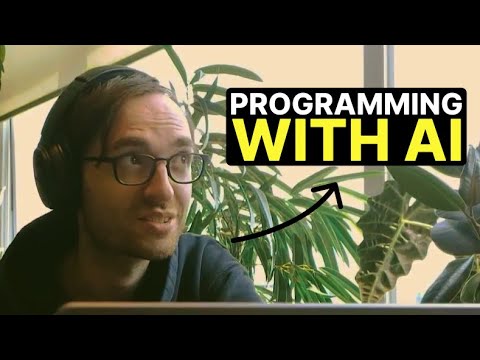
Is Prompting the Future of Coding? - Ep. 20 with Nick Dobos
Dan Shipper interviews Nick Dobos, creator of Grimoire, the top custom GPT for programming with over 1 million chats and 75+ hotkey commands. Formerly an iOS developer at Twitter, Nick demonstrates building and deploying a website from a two-word prompt and discusses how AI lowers barriers to coding, solving the "blank canvas problem," Grimoire's advantages over standard ChatGPT, designing system prompts for GPTs, AI as a layer over existing apps, and using AI to break down tasks from programming to daily to-do lists.
# Channel Presentation Observations: "How Do You Use ChatGPT?" — Ep. 20 with Nick Dobos
## Show Identity & Format
- **Interview/podcast format with expert guests.** The host conducts a long-form conversation with a guest about their AI usage; this episode features Nick Dobos, creator of a popular programming GPT.
- Evidence: title "Ep. 20 with Nick Dobos"; host opens: "Nick, welcome to the show" and closes asking "where should people find you?"
- **Named host: Dan Shipper**, identified in the outro segment.
- Evidence: outro reads, "It's a trip to the future with Dan Shipper as the captain of the spaceship."
- **Channel name stated explicitly in outro:** "How Do You Use ChatGPT?"
- Evidence: "you have to hit the 'like' button and subscribe to How Do You Use ChatGPT?"
## Claimed Scope
- **The show's premise is exploring how individuals use ChatGPT**, implied by the title and demonstrated by the episode's structure: a demo-driven walkthrough of the guest's GPT builds, prompting techniques, and personal AI workflows.
- Evidence: host requests live demos — "I wonder if perhaps you could show us Grimmoir. I want to see it in action."
- **Scope spans both professional and personal AI applications**: programming tools, custom GPTs, and emotional/self-reflection uses.
- Evidence: segments on Grimoire the coding assistant, then the "shaman of emotions" journaling GPT, and AI-assisted daily planning.
## Intended Audience
- **AI-curious practitioners and knowledge workers**, not necessarily expert developers. The host explains basics for viewers ("Netlify is like a hosting provider") and the guest frames tools for beginners through a curriculum "from 0 to 100."
- **Audience expected to act on recommendations** — try tools, subscribe, and follow up on related content.
- Evidence: "I interviewed Hume's CEO for this program that airs tomorrow... you should definitely watch it."
## Host's Self-Presentation & Credentials
- The host mentions co-teaching a course with a clinical psychologist: "I teach a course with a clinical psychologist, Dr. Gina Gorland, called Maximize Your Mind with ChatGPT."
- The host discloses an investment: "I'm an investor, so I have to say that" (regarding Arc browser).
- The host positions himself as an AI-in-practice writer: the guest says "I've been a fan of your writing for a long time."
## Observable Presentation Patterns
- **Demo-driven, screen-share style episodes**: guest walks through live builds (coffee website, QR code generation, Netlify deployment) with host narration.
- **Recurring structural elements**: guest introduction with credentials, mid-episode pivots between topics ("I want to go back to the topic of..."), closing call-to-action for where to follow the guest.
- **Playful, enthusiastic tone**, including a comedic, hyperbolic outro asking for likes/subscribes ("It's like finding a treasure chest in your backyard, but instead of gold, it's filled with pure ChatGPT wisdom").
## Guest Introductions as Channel Signals
- The host frames guests by measurable credibility: "You created the number one programming GPT... you've surpassed one million chats, which is insane. So I think you're one of the world's leading experts in successfully creating custom GPTs."
- Guests are sourced from the host's professional network: "we've been mutual contacts on Twitter for a long time."
## Explicit vs. Demonstrated — Notes
- **Explicit claims**: channel name, host name, subscribe CTA, host's course and investment disclosure.
- **Demonstrated (not claimed)**: interview format, live-demos, audience assumed to have basic AI familiarity, breadth across technical and personal-use topics.
# Delivery Observations: "Is Prompting the Future of Coding? - Ep. 20 with Nick Dobos"
## Format & Structure
- **Interview/podcast format** with a host (Dan Shipper) guiding a guest (Nick Dobos) through a live demo and discussion.
- The episode opens **in medias res** with a demo clip before the introduction: the transcript begins mid-demonstration ("Coffee website. I'm just going to press finish.") before circling back to a formal welcome ("Nick, welcome to the show.").
- Closes with a **standard call-to-action outro**: "hit the 'like' button and subscribe to How Do You Use ChatGPT?"
## Tone
- **Consistently enthusiastic and playful** on both sides throughout. Host: "Wow, that's really cool." / "It's like a treasure chest in your backyard, but instead of gold, it's filled with pure ChatGPT wisdom."
- Guest repeatedly frames his work as **fun and experimental** rather than professional: "I'm just playing with it... now I'm addicted" and "I'm having a lot of fun even just doing what are, you know, small and simple projects."
- Occasional **self-deprecating humor**: "it seems so dumb to me. I chose the most ridiculous brand of all for this."
## Recurring Vocabulary & Phrases
The guest's language shows several stable patterns:
- **"Play / playing around"** — extremely frequent across the whole conversation: "I started playing around with GitHub Copilot," "just playing around with it and seeing if I can turn this into a useful, entertaining, and somewhat fun tool," "I started playing around with ideas there," "really just about experimenting and playing around with things." This is the single most repeated phrase in the episode.
- **Filler hedging phrases**: "you know" appears constantly; "I guess" and "I don't know" recur as softeners ("I guess we are definitely entering areas that I consider new," "I don't know if this makes any sense").
- **Quotations of his own inner monologue** as a teaching device: "I saw GitHub Copilot and thought: 'wow, what a great tool'"; "Can I use this for programming?"; "Wait, can I just put those items into a chatbot?"
## Teaching & Demo Habits
- **Live demonstration over abstract explanation**: he builds a coffee website on screen ("So I'll just say coffee website... and see what happens") and generates a QR code in real time, narrating as he goes.
- **Live troubleshooting acknowledged openly**: "It's been a bit unstable, but it should show these chapters" and "Oh no, did it break? It doesn't matter." Failures are treated casually rather than edited around (insofar as the transcript shows).
- **Scaling abstractions down for the audience**: he explains GPTs via simple examples first — "answer as if you were a pirate" — before the technical detail.
- **Naming things whimsically** as a teaching style: "prompt-driven programming," wizard themes, "forbidden spells," "the shaman of emotions," "can I build myself a horcrux?"
- **Analogies to familiar domains**: programming languages as layers ("binary, assembly language... no-code"), and LLM behavior explained via games — "It's like a statistical randomness of all this internet data together" and the randomized-dungeon-map comparison.
## Communication Patterns
- **Guest hedges expertise explicitly** rather than claiming authority: "Honestly, I don't know. I feel like I'm just guessing"; "I wouldn't say they're the best in the world at handling them either"; "I don't feel like I'm expert enough on some of these deep AI topics to give an opinion on it."
- **Host uses active listening and reframing**: "So, tell me, while, while it's being built, uh, I'm really interested in this idea of..." — interrupting demos to extract explanations ("Let me stop you right there. I want to... go back and review what he did for you.").
- **Frequent short affirmations** from both speakers: "Yes, exactly," "That's great. I love it," "Completely."
## Uncertainty Notes
- Transcript appears to be a **translation** (idioms read as translated Spanish, e.g., "the truth is that I had a lot of fun"), so filler-word and tone-of-voice claims are based on translated text, not the original spoken delivery — word-frequency counts (e.g., "you know") should be treated as approximate.
- The outro ("Dan, I am absolutely and desperately in love with you") is tonally jarring relative to the rest; it appears to be a scripted comedic bit, but this cannot be confirmed from text alone.
- No timestamps beyond coarse transcript indices are available, so no time-coded claims are made.
# Position Record: "Is Prompting the Future of Coding? — Ep. 20 with Nick Dobos"
## Speakers
- **Nick Dobos** — programmer (~12 years professionally, former Twitter, iOS developer), creator of the Grimoire GPT (identified as the #1 programming GPT with 1M+ chats)
- **Dan Shipper** — host
---
## 1. "Prompt-Driven Programming" as a New Abstraction Layer
- Dobos claims LLMs create a **"strange new branch of programming"** he calls **"prompt-driven programming"** — possibly a new programming language sitting above binary → assembly → low-level → high-level languages.
- He explicitly **hedges on the label**: *"maybe some will say it shouldn't be a language, or maybe it should. I don't really care how it's labeled."* His functional claim: you give an instruction in English, get code back, and can run or integrate it.
- He extends the definition flexibly: even no-code or writing a document might count as "giving commands to a computer."
## 2. Grimoire's Design
- **Purpose**: solve the **"blank canvas problem"** — users don't know what to ask. Grimoire offers pre-built project templates (e.g., "link in bio," "coffee website") that expand an idea into a full site.
- **Hotkeys**: ~20 shortcuts (e.g., **N** = deploy to Netlify instantly; **Z** = compress and download files; **K** = show all shortcuts). Dobos frames them as automating repeated follow-ups ("reprint the whole file").
- **Guiding LLMs**: Dobos claims LLMs need guidance — praise, planning steps, and end-of-answer option prompts that keep users "on a coherent path" and prevent "a black hole of meaningless answers."
- **Wizard/curriculum framing**: knowledge files structured like a course — "spells for beginners" (Hello World, Pong, GitHub, command line, Midjourney, Runway) up to **"forbidden spells"** (Cursor, advanced workflows). Dobos describes it as a **"horcrux"** of his accumulated expertise, and notes he doesn't know usage statistics — he's building a standalone app to get them.
## 3. Tools
- **Cursor**: a VS Code fork built AI-first; Dobos uses it daily alongside Grimoire and says there's no good tutorial, hence he teaches basics like the K command and chaining prompts coherently.
- **Code interpreter**: Dobos claims people are **"greatly underestimating"** GPTs, especially the code interpreter — scripts "out of thin air," e.g., generating a QR code for a just-created site in seconds. He wishes someone built a sprite-sheet extractor.
- **GPT Store critique**: he's "a little surprised" by which GPTs stand out — many feel "less interesting than I expected"; wonders "where are all the games?" He also questions whether the store is driving OpenAI's growth as intended, while acknowledging it expanded capabilities and multi-GPT chaining.
## 4. Prompt Engineering Method
- Dobos's approach: **iterative experimentation** rather than formal evaluations — write a vague system prompt, probe it repeatedly (he hit GPT-4 rate limits 4–5x/day testing Grimoire).
- He compares prompting to playing **"Family Feud instead of Jeopardy"** — steering statistical, "average-of-internet" behavior.
- Game-design analogy (from his hobby making games): designing for randomized experiences (like Diablo dungeon maps) is analogous to structuring outcomes from LLM randomness.
## 5. Impact Predictions
- **Lowered barrier**: "if my mom can say, 'I want a website that does this'… that's amazing." Massively lowers the difficulty of programming.
- **Enterprise**: cites a Facebook document on LLM-generated test cases for massive codebases, **~70% put into production** (as stated by Dobos; not independently verified in the conversation).
- **Timeline**: ~20 years to reach the limits of prompt creation while models keep improving.
- **Large action models / agents**: excited by the **Rabbit** device's "large action model" framing (order pizza, book Uber, fill spreadsheets); expects Apple-style interface-perception models enabling a **new layer controlling existing apps** (example: ChatGPT gave him a perfect After Effects tutorial in five minutes; mentions Open Interpreter).
## 6. Personal/Emotional GPTs
- **"Emotion shaman" GPT**: Dobos states he suppresses emotions and freezes under stress; built a journaling GPT that names/identifies his emotions using an "emotion wheel," returning his thoughts "as an echo."
- Shipper connects this to **Lisa Feldman Barrett's "emotional granularity"** research; Dobos hadn't known the name but says it's "almost exactly that."
- Both discuss the **Hume** empathic AI demo (Shipper interviewed Hume's CEO).
- **Shipper's practice**: simulating **"one-way door" decisions** — feeding journal entries to ChatGPT and asking it to write the next entry under decision X vs. Y; "it doesn't exactly predict the future, but you can recognize yourself in that future state."
- **Day planning**: both feed to-do lists to ChatGPT for plans. Dobos wonders whether he's "terrible at planning and now using AI for it," and jokes he wants a GPT that prunes stale to-do items.
## 7. Future Interface Vision
- Dobos hopes for **proactive** AI — an app that greets you with a pre-prioritized rundown rather than waiting for prompts.
- Shipper notes AI isn't yet in browsers/OSes (mentions Arc, discloses he's an investor) and frames proactive AI as making the "Jamie Dimon with a full staff" experience accessible.
- Dobos speculates about AI intercepting unproductive mental states (e.g., depression) and redirecting them — framed as curiosity, not settled claim.
## 8. Preserved Qualifications & Contradictions
- Dobos repeatedly stresses uncertainty: "nobody really knows what we're doing with this," including OpenAI ("wouldn't say they're the best in the world at handling them" — Starcraft developer analogy).
- He disclaims expertise on deep AI interpretability: "I don't feel like I'm expert enough… but it seems to work."
- He notes current limits: output token counts and context windows constrain what Grimoire can build; demo glitches (network error) occur live.
- The wizard branding is "the most ridiculous brand of all" chosen partly to amuse himself — a stylistic, not technical, rationale.
# Speaker Attribution & Provenance Record
## Video
- **Title:** Is Prompting the Future of Coding? - Ep. 20 with Nick Dobos
- **ID:** 01a0f15b-0f45-768a-aaa6-624609a19a42
## Speakers & Roles
| Speaker | Role | Evidence |
|---|---|---|
| **Dan Shipper** | **Host / creator** | Named in closing promotional segment: "Dan Shipper as the captain of the spaceship"; hosts the show "How Do You Use ChatGPT?" |
| **Nick Dobos** | **Guest** | Introduced as "Nick, welcome to the show"; programmer, creator of the Grimoire custom GPT; Twitter handle "@NickADobos" (transcript renders as "Nick Adobos"); website MindGoblin Studios |
### Secondary / Non-Show Roles Mentioned (not speakers)
- **Nathan** — mutual friend of host and guest (named only)
- **Dr. Gina Gorland** — clinical psychologist; co-teaches "Maximize Your Mind with ChatGPT" with the host (per host)
- **Lisa Feldman Barrett** — neuroscientist cited by host for "emotional granularity" research; book title given as "The Secret Life of the Mind"
- **Hume's CEO** — interviewed by host for an upcoming episode (not this episode)
- **Jamie Dimon** — referenced analogically by host
- **Elon Musk** — referenced regarding guest's Twitter layoff
## Provenance Facts & Third-Party Claims
### Guest's Self-Reported Claims
- Created **Grimoire**, described as the "number one programming GPT"; **1M+ chats surpassed** (claim stated by host, accepted by guest)
- ~11–12 years professional programming; formerly employed at Twitter; laid off during "the whole Elon thing"
- Partnership claim: "I was able to partner with **Netlify**" for instant site deployment shortcut
### Third-Party Sources Cited
- **GitHub Copilot** — guest's entry to AI coding
- **Cursor** — VS Code fork, AI-first editor (Microsoft attributed as releaser of VS Code)
- **Facebook document** — test-case generation claim, "70% into production" (unverified; guest's characterization)
- **Apple papers** — UI-aware models (guest's characterization)
- **Open Interpreter** — project for system control
- **Rabbit / "large action models"** — hardware product guest bought
- **Hume** — emotion/vision API demo
- **Midjourney, Runway, Arc** — creative/browser tools mentioned
- **OpenAI / GPT Store, GPT-4** — platform context
## Promotional Segments ⚠️
- **Closing promo:** "hit the 'like' button and subscribe to How Do You Use ChatGPT?" — exaggerated promotional voice, ends with "Dan, I am absolutely and desperately in love with you."
- **Host disclosure:** "I'm an investor" in **Arc** (browser).
- **Guest promotion:** Netlify partnership; Grimmoire; MindGoblin Studios website; Twitter handle.
- **Host promotion:** upcoming Hume CEO interview ("airs tomorrow"); "Maximize Your Mind with ChatGPT" course.
## Uncertainty & Availability Limits
- **No curated metadata supplied** — no timestamps, channel metadata, or comment data available.
- **GPT usage statistics unknown:** guest states "I wish ChatGPT had better statistics" on Grimoire usage; building standalone app to gather them.
- Guest explicitly disclaims expertise on interpretability/deep AI internals.
- "Number one programming GPT" and "one million chats" figures are show claims without external verification.
- Facebook and Apple claims are secondhand characterizations; original documents not cited by title or link.
You created the number one programming GPT, Grimmooire, which is a code assistant. It's like a wizard-based programming assistant. And you've surpassed one million chats, which is insane.
Coffee website. I'm just going to press finish. Oh, your coffee-themed website is back. Click on our website and you're all set. There you have it. Wow, that's really cool. Nick, welcome to the show. Hey, thanks for inviting me. I'm excited to be here. Yes, it's amazing to have you. Since we've been mutual contacts on Twitter for a long time and you're always posting great stuff, you have a kind of aura of mystery that I quite appreciate, and it's fun to put a face to that mystery. Oh, well, thank you. Yes, you know, I'm having fun. Don't know. I'm just playing with it. I think I started working on Twitter, then I got into posting, and now I'm addicted. So yes, I'm having fun and people seem to like all these random experiments I've been sharing. So yes, it's great to meet you and hang out, because I've been a fan of your writing for a long time and I've had the opportunity to work with our mutual friend Nathan. So yes, excited to be here and meet you. Incredible. That's great. Well, for those who don't know, you're a programmer. You created the number one programming GPT, Grimmooire, which is a code assistant. It's like a wizard-based programming assistant . And you've surpassed one million chats, which is insane. So I think you're one of the world's leading experts in successfully creating custom GPTs and also in using ChatGPT for scheduling. And I think that's
where I want to start. Can you tell me about your introduction to AI for programming? How did you get started in this ? Yes, I guess I've been programming
for a long time, you know, I think more than 11, almost 12 years professionally. So I've done a few small AI projects over the years, mostly for games and small things like that. Nothing too crazy. You know, I think that by doing that I realized that a lot of it is just a house of cards, smoke and mirrors. But with this new wave , I was working as a programmer making apps for iOS, I saw GitHub Copilot and thought: "wow, what a great tool." Because when you program, you have a bit of autocomplete that works like on phones, where it finishes the sentence or tries to guess what you're going to write. I started playing around with GitHub Copilot and was surprised at how well it worked, because you can do tricks like writing a comment about what you want it to do and it completes entire sections. So yes, I started experimenting with that. I think I was lucky with the timing, because I was working at Twitter when the whole Elon thing happened and it was a total disaster. I was fired and had plenty of time to play around and learn new things. Then ChatGPT came out, I think it was in November of that year. I don't know, I just started trying it out and having fun with it. And especially when GPT-4 came out, I tried it that same day and wondered, " Can I use this for programming?" I had already tried using GitHub Copilot and had some success, so I was impressed with how well it worked . I immediately thought, "Wow, if I had asked a
computer science student to do this, I would say it's at a university level or higher." So I said to myself, "How can I use this to start completing parts of what I'm
working on?" I started doing it and the truth is that I had a lot of fun trying it out and experimenting. Um, I think something that perhaps sets me apart from many people already working in this field is that I hadn't really focused on the major AI advances that were happening before. So , you know, I'm a bit disoriented and catching up in that respect, but maybe having a bit more fun from an interface and artistic perspective, having a really good time. Yes, just exploring with that. Um, you know, I did my programming wizard GPT and I don't know, it seems so dumb to me. I chose the most ridiculous brand of all for this and I don't know, people seem to like it. Um, you know, and honestly just playing around with it and seeing if I can turn this into a useful, entertaining, and somewhat fun tool. That's great. I love it. I mean , I think that spirit of exploration is what I like most about AI. And I think that's what the people who are doing the best and most interesting work in this field right now have: that sense, that curiosity. And you definitely have it, and that's why I love it, I love seeing what you do. Yes. It's so much fun to play with this. So yes, honestly I can't help it. Completely. I wonder if perhaps you could show us Grimmoir. I want to see it in action. And I want, I want you to show us how it works. Yes. I mean, this all came about from ... I guess I started playing around with, you know, custom instructions , as a way to shape... they added them to shape the responses,
and I realized you could format them in many different ways and create something like hotkeys. So I started playing around with ideas there, and
also while I was learning how to do this and how to formulate questions to get code, I wondered, "Oh, is there an easy way to do this?" But I was also, you know, trying to write articles that explained that. When the GPT Store came out , I thought, "Wait, can I just put those items into a chatbot and turn it into an interactive experience?" So it ended up being something in between an assistant and maybe a tutorial or a curriculum. But honestly, I only started sharing little shortcuts, tips, and tricks. And as it became more popular, I've been able to collaborate with people who do different things. So, the basic idea is that it's like an expert programming assistant. I think LLMs have really created a strange new branch of programming. I would almost say it's a branch of abstract programming. I've called it "prompt-driven programming," but it seems to be almost a new form of programming language. You know, we've had binary, assembly language, low-level programming languages. We've reached high-level languages, and depending on how flexible you are with the definitions, even things like " no-code" or writing a document—is that programming? I don't know, maybe you're just giving commands to a computer to shape it and make it do something. So it seems that language models are just one way of doing that. There are many
different projects and shortcuts you can use, but one of the easiest to get started with is creating a link site in your bio. For example, here I have
one. You really can create sites in seconds. It's crazy. I'm going to click on this one. But this should extract a short description. Basically, we're going to create a website from scratch. I'm still amazed that it's so easy and possible. It's like taking a seed of an idea and expanding it until it becomes something complete. That's interesting. So, tell me , while, while it's being built, uh, I'm really interested in this idea of, let's say, prompt-based programming , or simply programming with AI in general, as a new layer of programming abstraction on top of scripting languages, which are built on C and C++, which are based on assembly, and assembly in turn on binary. Tell me, what does that look like as a language, and why do you think it should be considered one? Yes, I suppose we are definitely entering areas that I consider new . I don't know, maybe some will say it shouldn't be a language, or maybe it should. I don't really care how it's labeled, I just need a way to explain the different layers because, I don't know, it feels like this new area where I can give it an instruction in English, it throws out a bunch of code, and then I can use that code to integrate it into my project or run it in a code interpreter , something like that. Uh, so, well, here I have this ready and, you know, one of my favorite shortcuts; I was able to partner with Netlify and I was just... Let me stop you right there. I want to, I want to go back and review what he did for you. Uh, basically you said "
link in bio", create your website, open PT1 MD for the site "link in bio". So that's the prompt that, well, was practically pre-filled. Tell me
then what that prompt means in your GPT configuration. Yes. Perhaps to take a step back a little. Uh, I was going to switch to a new conversation here. You know, I think there are many ways to structure GPTs, and part of that is simply giving them a simple form, like: "answer as if you were a pirate," or "answer as if you were super happy," or "answer as if you were a writer," or something like that . Uh, but I think another way is that you can actually, I guess, predefine ideas and include them. And something I tried to do with this, which I think is very different from what others do, is to offer a template. So I have a lot of pre-built projects. This link in the bio is just like a button to start the conversation and is now activating one of the projects. But basically you can have any idea, like, I don't know, I have a coffee shop next door. So I'll just say coffee website. I'll just use those two words and see what happens. And it's like, well, how are we going to build a coffee website? We're going to define the structure, the pieces, almost like dividing the task into more parts, and yes, I suppose expanding on that initial idea. And well, here we're going to make a
home page, a menu, a blog, a contact page and we'll see what to do. And now there are some options here. So I'm going to press N because it's one of my
favorites, since you can make websites instantly. What does N do? Yes, N is one of the shortcuts. There are a lot of shortcuts I can show you; If you want to see them all, just press K and it will show them to you. But this one works with Netlify and basically takes the code and puts it online instantly. You'll see that in a second we'll have a website generated that fast. Wow, that's fascinating. So Netlify is like a hosting provider. He's going to write the code in Netlify and then put it online . Yes. And the way it's set up is that the website will be ephemeral and will automatically delete itself after an hour, or you can claim it by signing up with Netlify, and well, they have a hosting fee. So here, he returned. Oh, your coffee-themed website is back . Wow. Here, click on our website and that's it , there you have it. Is this the most beautiful website in the world? No, right? It's pretty simple, right? But, you know, we've got something here. Oops. Uh, you know, something small prepared. You know, we have our little menu. I guess we have three drinks on this coffee site, you know, we have, I guess, our little blog here, and you know , obviously this isn't like, you know, a billion- dollar website, right? But for something that took, you know, half a second, and I made two words and a button to kind of spit this out. Um, so yes, I'm having a lot of fun even just doing what are, you know,
small and simple projects that I can do, because right now we're definitely limited by the number of outputs that can come out of this and the context limits. Um, but at the same time it's
a lot of fun and here's another fun trick. Um, let's create a QR code. and let's see if we can get the URL. Okay, no, we don't want a generator. Stop. To do one, I guess we 'll edit this. For the website URL , let's see if this works; it usually does. So he says, oh no. Creating a QR code for a website URL is a... Is n't that okay? Alright, let's see, here we go, let's implement this in Python to get the thing, here we go, it generates the QR code. Okay , I'll run it now. Here we go. He had to think for a second, but yes, this was the little URL we just created. Um, so yeah, I didn't check it. Yes, here we go. So, did we do it? And then we'll see . Okay, it'll make us download it. Let me download the file. Open it. And boom , there's our QR code for the website we just created. And I can simply share it with anyone. Like, I don't know. I don't know if this makes any sense, but you can do all these crazy little moves that seemed so difficult and are now super easy with prompts. No, that makes perfect sense. And even that little detail of it now being published on a website, it's
like it just removes that little step of, oh, I have to paste this into Replit or something, and takes it away, which I really love. I think it's great. I want to go back to the
topic of "link in bio" because now I understand a little bit the general idea of how this works. Let me understand: you have these pre-configured projects within Grimmoire and one of them is this "link in bio" and " link bio". It seems you created a "link in bio" project that lives within the GPT, as if you uploaded it perhaps as a file in the knowledge base, and then when you request a "link in bio" site, it knows to take that project and that tells it what to do. Is that how it works? Uh, yes, exactly. You know, the basic idea here was that I wanted to, I guess I wanted to solve the blank canvas problem, because I feel like a lot of people just say, "Okay, I have this chat." "So, what do I ask him?" "What do I do with him?" And especially with programming stuff, there are tons of tutorials out there. They either explain thousands of things or make it very difficult. And I was just thinking, can't I just give people a list of fun projects to do? So I have this other one where if I just press P, this should work. We'll see. It's been a bit unstable, but it should show these chapters and parts. And these are, you know , knowledge files that I uploaded as part of Grimmoire. Which is, yeah, I guess in the same way that , I don't know, maybe your company has some PDFs and you want to go in and read your PDFs or something and ask them questions. But I decided to put together a sort of curriculum, or a sort of starting point, about: "Okay, if you wanted to learn to program from 0 to 100, what would that look like?" And I suppose part of the question is that I think it's very clear to many
that LLMs and GPT-4s and other similar things are going to transform programming immediately. But the question is, do you learn that first, or how is this integrated? Because I believe that,
as someone who has been doing this for a while, I have quite a bit of prior knowledge about programming, so applying it to coding becomes much easier. But if someone is new to programming, what do we teach them? You know, how does it all fit together ? I think many teachers have difficulties with that. I don't know if this is the right answer, but I wondered: can I give someone a curriculum to go from zero to fully qualified programmer? What would something like that look like? Wow, that's good, so walk us through this curriculum in broad strokes. It seems to be written almost as if you were going to Hogwarts. Yes, exactly. I really leaned towards creating this whole wizard theme and making it fun. And I think I was also trying to make it more interesting for myself. Oh no, did it break? It doesn't matter. How sad. But yes, many development tools have robot themes. I thought, "Okay, let's go with the fantasy." "We're going to get to the bottom of that ." And yes, trying to do it that way. So I have a first part with basic things like Hello World and Pong, plus how GitHub works or the command line, things like that . But I'm also venturing into new territories where creative tools are emerging, from Midjourney to Runway, so you can move from a prompt to different media. It seems that the first part of the language models and the ability to interpret what you are trying to ask it for has really opened up a whole world of multimedia forms. So I was just
trying to see if I could put all of that together in a coherent way. That's why there are recommendations of that kind as well. It's something like spells for beginners. And then, of course, move on to
more advanced programming things. To finally enter into what I called forbidden spells. I think this is the most exciting thing in development tools if you're, you know, an experienced professional developer who's now learning how to use AI. And I've had a lot of fun using Cursor. I don't know if you've ever used that app. Yes, I've used it. Yes. Yes. It's very funny. Tell us about it for those who don't know what it is. Yes, Cursor is basically an application you use to write code. It can be an IDE or simply a text editor depending on how you define it, but it is a branch of VS Code, which is a very popular tool released by Microsoft. It supports virtually all types of programming and is built with AI first. It's great because it uses ChatGPT, but integrates it very well into a programmer's workflow . So I divide my time between Grimmoire and Cursor for my daily work. I have a lot of fun there and I try to teach people how to use it , because there is a lot of interest in learning these new tools and how to use them. So yes, I try to share what I've learned. Give me an example from the " forbidden spells" section; If you were to teach someone about Cursor, what kind of things would you teach them? Yes. Look, let me do this new thing. I think it failed when there was a network error. But if I open a new chat, I can search...wait, was that part four? I forgot. Let me show you the projects. And this should show
all the different things. But yes, with Cursor I try to show people how the application works because there really isn't a good tutorial. I feel that even on their website,
since it's something so new and they keep changing and creating things, teaching them something as simple as the K command... how do you use that? You know, how can you, uh, you know, experiment with ways of, let's say, joining multiple prompts and yeah, like putting things, uh, yeah, I guess using them together in a coherent flow. I understand. And, uh, basically, so you're... I mean, Forbidden Spells is , it's kind of like, you know, using things like Cursor. But it seems like there are so many things happening here, like you're teaching people a lot of new concepts: from making simple games, to, uh, doing backend stuff, to learning how to use databases. It's a pretty comprehensive guide. How many people are using this to learn to program? Do you know? Honestly, I'm not sure. I wish ChatGPT had better statistics. I'm trying to find out how often people use it. And, uh, part of a project I'm working on now is turning it into a standalone app so I can get better statistics and understand what people are using it for. But yeah, part of it was like, can I almost, can I, uh, I guess going back to some Harry Potter-type language, can I build myself a
horcrux? And take much of my expert knowledge that I've accumulated over the years and, you know, turn it into a course, give it back to the community, and make it into a somewhat
strange interactive chatbot. So , you know, I definitely have sections that are basically me trying to summarize an entire university curriculum of, you know, computer science in a few chapters. But it's interesting because I don't even have to type everything thanks to ChatGPT. I can give them a foundation to start from, you know, I can tell them: teach them this, this, this and this, and then I don't have to do anything else, right? The machine will do the rest. And yes, just give people a starting point to improvise. So yes, it's fascinating . That's truly fascinating. What else should people know about programming with Grimoire? Like, what else, what else can they do? What else can they build? Um, what type, what style of construction is it most useful for? Yes, I mean, I definitely set it up with a curriculum and some things to get people started , but at the same time, I wanted it to be a tool you could use for general programming questions. So, you know, the way I use it a lot of times is that I 'm working on a problem and a quick question comes up like, "Oh, this is n't working" or "How do I make this text underlined?" You know, sometimes they're even questions this simple. Sometimes it's just the ability to search for things very quickly, but I also think I'm finding more and more ways to use it to bridge gaps between ideas, when you say, " Okay, I want you to do this," and then you use it to break the problem down into smaller steps. So, yes, I'm not
sure if that fully answers your question, but not entirely. Yes, it does. I'm curious, if you compare that to copying and pasting the same question into a
standard ChatGPT, what's the difference to you? Why is it better? Yes. Well, part of it is simply the way I wrote the system message; Much of this is to help you actually do more planning. You'll notice that even if I do something simple like "How do I make a game in Swift?", I'm an iOS programmer, so I do a lot of things in Swift. But anyway, I have a funny little introduction and stuff like that. So , part of it is just a stylistic touch, but I'm really trying to push it to be more truthful, more useful, and more thoughtful. And part of that is that there are some planning steps that I try to guide him towards. Which is interesting, because I'm not sure if language models...you have to guide LLMs to get the best out of them, in a way. It seems you can't just say, "Give me this." You really need to almost prepare it and write it down first. And part of that is, you know, saying to him, "Oh, you're good, you're a skilled writer," so now write me something in this style instead of just saying "write me something ." Well, part of it is true, but the other part is that I really realized I did n't want to write that much. So I created all these hotkeys to do things quickly for me. Well, you know, one thing I discovered I did a lot was to talk about some questions and get some code, so I said, "Okay, can I just save that code?" For example, here's one: if I press Z, I can have these files automatically compressed and downloaded for me. Hey. That's great. I love it. The truth is that I haven't seen that as a
design pattern often, but it's a great thing because it's so true. There are so many times when you ask her to do the same kind of thing all the time, and she should probably know what your follow-up question will be. For
example, this happens to me when it only prints part of the file I need to change, and I always have to say, " Hey, can you reprint the whole file so I can copy and paste it?" Uh, things like that. Simply having a shortcut key for that could be very useful. Yes. And I think that's where some of the ideas started. I started putting them in custom instructions and said, "Okay, wait, can I create a whole set of hotkeys for programming?" So yeah, I think I have about 20 there now for all sorts of different things. And it's quite interesting because it also tries to guess which keys you're going to use, which I think I've also noticed it has this kind of strange example of here. Yes, you know, he started spitting out answers to my question about my little coding thing. Well, but near the end, you know, it's like: "Okay, do you want to do this ? Do you want to do this? Do you want to do this?" Almost as if I were to resume the thought process a bit and put you back , so to speak, on a...like a coherent path. And I think it makes this so interesting that, maybe, it keeps you from getting sidetracked a bit, because definitely, if you get weird answers and just keep going , you can end up in a black hole of meaningless answers going around
in circles. So, in a way, it helps to get back on track and focus your thinking, and I think it's an interesting way to structure
prompts. Almost as if reminding him that it's still programming and that's what we want to program. That's very interesting. I've definitely noticed it too. I haven't done it with these types of keyboard shortcuts. Although I really want to try it. But what I've discovered is that having him generate a plan at the beginning, as you mentioned, where he says, "First I'll do this, then this, and then that," is a great way to keep him on track . But yes, it seems that keyboard shortcuts add something new. And I think that, for me, is part of that planning. I think a large part of the magic of ChatGPT, for me, is precisely that planning. And you know, sometimes with the programming questions I ask, being able to switch to practical steps like, "Oh, I need to do this, I need to do that," and say, "I'm not convinced by steps three and four, I'll do this instead." It's strange, because you can almost...Yes, I think you can just plan. I find it very useful as a planning partner in that sense, I suppose. Yes, that's great. I'd like to learn a little about your ideas on creating GPTs, since you're someone who has built something very successfully. There are very few people who have created
a GPT that has reached this level of scale. Tell us a little about what you have learned so far. Yes, the truth is that I'm still trying to understand it. It's a constant experiment
, but I think people are greatly underestimating GPTs, especially what can be done with the code interpreter. I mean, that unlocks so many amazing things. And I'm, I don't know, a little surprised by the GPT Store and the GPTs that are standing out, because I feel like we can do much more sophisticated and crazy things, and many of them feel, um, less interesting than I expected. But yes, I do think the code interpreter in general unlocks an incredible amount of things. Yes, you can simply create scripts out of thin air and do all sorts of strange things. I really hope someone makes one that uses a sprite sheet and extracts images. I've been trying to figure out if there's a good way to do it because I know it's possible. You can do really fun things with that. But yes, I suppose I'm also trying to understand where OpenAI is going with this, because I do n't know if it's been very successful for them in the way they wanted, that is, if it's really driving their growth. I guess I feel that's their main goal, but it has definitely expanded the scope of what they can do in a significant way. And he's also connected it to many different things, which I think will be an increasingly important part, where there may be several steps with multiple GPTs involved. But anyway, it seems, I suppose, what else do you want to know about creating GPTs? Yes, I 'm just playing with them and discovering them. Well, let's just say I'm someone who more or less knows how to build a custom GPT, how to create my own version, but when you think about what makes a problem or an idea for a
custom GPT a good idea. Perhaps we could start there. So, how do you know if it should be a custom GPT or not? Yes. Honestly, I don't know. I feel like I
'm just guessing. I think there are definitely some that I build for myself and others that I build for others. I think Grimoire, in particular, is one that I built with others in mind, where I'm kind of giving a tutorial, a curriculum, and well, with the idea that people who might not know programming can use it. Well, while some of the others, I think, that I'm experimenting with are much more personal, like playing around with them a bit , like this one, I guess, to better understand my emotions, like a personal journal, where it's like, if I write a journal entry to this, can it interpret my emotions in some way? Um, but you know, I think in many ways programming, yeah, I guess part of it is just figuring out what GPT is good at. I think that's what's interesting about the GPT Store too, seeing some of these big categories, and research is definitely one of them, you know. I think the simple fact of being able to interpret things and learn from large volumes of data , like, you know, I think some of the scientific research data is great. But yes, I also wonder, where are all the games? Like, where are all the crazy and eccentric people? I feel like, yes, there are a lot of weird code interpreters out there , and I guess it's really just about experimenting and playing around with things . I think at this point it's so new that nobody really knows what we're doing with this. And you know, even OpenAI itself, I'm sure they have more powerful versions that they play with internally before releasing them. But, you know, I wouldn't say they're the best in the world at handling them either, would I? If you think about a video game, for example, let's say you're the developer behind Starcraft, right? That doesn't mean you're the best Starcraft player in the world. So what does it mean to manage these AIs, how to
pilot them? And how can you use prompts to guide them? Because it seems that, in many ways, prompts
take this large open space and try to restrict it to a narrower, more structured space. Yes, and I think perhaps some of this comes from understanding how generative and random experiences occur in games as well. I've been a gamer all my life, so I've created a few games. I know I don't do that professionally, but it's something I always think about. And something that I've always found fascinating about games that have a lot of randomness, which is kind of what FGBT is, right? It's like a statistical randomness of all this internet data together; it's really difficult to design an outcome for that, isn't it? If you have a game that's randomized, maybe you 're playing Diablo or something like that, and you know you're generating a dungeon map to explore, how do you really know that map is interesting and fun to explore? It's very difficult to do it as a game designer. How do you ensure that when you prepare people to walk through something random, it's going to work? Uh, well yes, I think so. Part of it is trying to decipher and understand where people are going with this, are they going to walk down the creepy hallway, what happens if a ghost jumps out, I don't know. But it's like, yeah, understanding what people are doing with this and how we focus and direct them towards what we want them to do. Yes. And I'm curious, what have you learned, for example, from figuring out how to create the system prompt for a particular GBT? What are some things you've learned that have been useful to you? Yes. Uh, a lot of it is really just experimentation and trying things out. I know some people, and especially the more technical ones, are very interested in doing evaluations and tests and things like that, but I think a lot of it is just sitting back and experimenting with it. The way I approach creating this is, I have an idea. I write a
system prompt vaguely defining what I want it to do, then I ask it questions and see what it responds to. Uh, just by trying it over and over again.
When GPT-4 came out, I was reaching my limit four or five times a day, just testing Grimoire, trying to run different things, doing everything I could because I was so curious and having fun. And part of that is learning how to incite these things and how to direct them. And it's interesting. Part of that is learning a little bit about how they were built. I think there have definitely been ideas that have come out of that and from looking into, you know, the theories of how these things are built. Um, but I think it's also just trying , in this strange way. Um, to understand the spirit of the times, of the world, really like. Almost like you're trying, like you're trying to play Family Feud instead of Jeopardy, where it's like "the poll said", like if 100 people think this way, then this is how it's going to behave. And you think, "How can I, you know, decipher that behavior and direct it toward that?" Yes, they are quite strange but quite funny. And you said, like, you don't really feel like people are pushing this to the limit, and in particular there's a lot to be done with the code interpreter. Can you tell me more about that?
What do you think is possible now that excites you and that you think people have n't grasped yet? Yes, I mean, I think that in general people are completely underestimating this technology in many
ways. And you know, there are certainly limits. No, uh, I'm not saying this is perfect and without problems. But, you know, being able to do this quickly unlocks a lot for so many people, too, because I think, um, right, it's going to massively lower the barrier of how difficult it is to program a computer, right? Like, um, you know, if my mom can say, "I want a website that does this," and she throws up a website that does that, you know, with her barely doing it, you know, I think that's amazing and it unlocks, it makes it easier for people to do things; It makes it faster for people to do things. But I think part of that is that it also unlocks entirely new use cases and really transforms how we're building software as well. Especially in big teams, I think this is going to be crazy. Like Facebook had this incredible document come out where they say they are generating test cases for massive codebases, like millions of lines of code that they are spitting out and generating. Um, and I think they're even putting 70% of them into production now, just as a way to test and strengthen their codebase. Well, yes, I think this will be something that will take us about 20 years to really reach the limit of prompt creation and what we can extract from these models, while continuing to improve them at the same time and seeing how they evolve. And yes, something that clicked for me from the beginning, and that I think many people still haven't grasped, is how much we can take this and transform it into new actions. I'm fascinated by the direction some of these new projects are taking, because it seems that ChatGPT is really working towards a model that uses tools. I also really liked
the way... have you seen the little Rabbits, those little orange AI boxes? Oh, I received hearts. Hey, but I really
liked how they talked about what they were doing. I bought one just because of the way they talk about it, because they refer to large action models rather than large language models , where it's like: can I say something and turn it into a command that executes tasks on other systems? The basic question is: can I make it order a pizza for me, book an Uber, or fill out a spreadsheet? And once we do, it's amazing that we can transform text in such a structured and logical way, which unlocks many interesting use cases and ways to create applications that are somewhat fuzzy, unstructured, and a bit more abstract . So yes, I'm very excited to see what people do with this. I believe the sky's the limit. That's great. So I suppose you think that the Code Interpreter, besides having many interesting use cases on its own, as an example of AI using tools in general , excites you about the ability of language models to start controlling parts of your computer or phone, and that when that happens, there will be many more opportunities to create interesting things. Yes, absolutely.
I think that will be a fundamental part. I think that seems to be the direction Apple is heading; Some of his recently published articles discuss models that can see very precise details of where
interfaces are located and how to click on things. Um, yes. And it's almost as if we could build this new layer on top of existing applications and the internet. Because I suppose I've talked a lot about how useful it is for programming, but it's also very useful for using other applications that are simply complicated, right? For example, I came across a case where I was trying to edit a video and the application I was using couldn't create the effect I wanted. I wanted something like this sophisticated reverse effect . Um, well, I have Photoshop and the Adobe suite. So I said, "Okay, I'll try using After Effects." And I hate After Effects. I have no idea what I 'm doing in that app. It's really complicated. It's like a great video editor. Then I thought, "What if I just ask ChatGPT how to do it?" And he gave me a perfect tutorial saying, "Okay, to do it, just click here, here, and here." It took me about five minutes. And if I had tried to find a tutorial on my own, it wouldn't have been as good. Not even an exact tutorial of do this and that. And that's why I thought it makes everything much easier, and all these different ways just got accelerated. So yes, it's almost as if we could build a layer that operates on top of all this and controls other applications. There are some great projects like Open Interpreter, which work more within your system and can generate scripts that open your email and control your computer in very interesting ways . So yes, I think it has really opened up a new way of communicating
with a computer in this strange, abstract, and somewhat diffuse way, the interpretability and neurolinguistic programming of which I do n't know if they have fully resolved . In other words, I don't feel like I'm
expert enough on some of these deep AI topics to give an opinion on it, but it seems to work and you can do fun things with it, so I'm going to have fun playing around with it. I feel the same way. I just want to play around with that a little. And, well, I think on one hand there's what you said before about it being a kind of high-level programming language, above scripting languages, which is the next layer in the programming stack. And, at the same time, it is also a new way of interacting with computers in general. I think that's probably the point, to some extent. Because the language you use to program, when giving instructions, is simply natural language; Both being able to program and knowing how to use a computer are results of being able to use natural language so that the computer understands what you are talking about. Which is simply a new interface. Yes. And that's fascinating, because a large part of what programming is all about is that. Discovering how to take those vague ideas about what something should be and make it concrete, giving it a real form. So being able to
do it automatically is very powerful and really interesting in that sense. So yes, it's a great thing. I know you mentioned earlier that you created
a GPT that you use to, in a way, break down your emotions. Would you be willing to show it to us? You don't have to show us old chats, but I'm curious to see what you did . Yes. I can open it. I need a better name for this. I just call him the shaman of emotions. I've come up with a lot of silly fantasy names . Hmm. I do n't know if you know this, but I teach a course with a clinical psychologist, Dr. Gina Gorland, called Maximize Your Mind with ChatGPT. And a large part of the course deals precisely with this kind of thing. So I'm a big fan of this. Yes, I would love to go into more detail about this with you because it's very interesting. Well, yes, I guess that's the main idea with this, and maybe I'll even open it up and show you how I did it . The main idea was that I am a person who suppresses a lot of emotions, and when I get stressed, I tend to respond to fight, flight, or freeze. I like to freeze up and hide, so my response to stress is usually to suppress things and walk away from them. So, I'm bad at interpreting my own emotions. That's why , many times when I talk to therapists, they simply help me to name and identify what I feel. Like, am I angry? Don't know. And there are
other ways to do it; I often write in a diary to reflect, but I thought: could the diary answer me? So, here's one I
made. I really just gave him basic instructions, like telling him to act like a therapist, listing all the therapies I could and a lot of different emotions. I found wheels of emotions and tried to guide him towards that, so that when he goes through something he can say, "I don't feel well today, this and that happened, I did n't sleep well" or something like that. I didn't sleep well and I'm a little irritable. Uh, and only as a way for my thoughts to be returned to me as an echo. Because I find it interesting to be able to use a machine to shape my thoughts and reframe them towards myself. I'm curious to know if that 's a way of, you know, thinking differently and seeing my life in a different way, I guess. Completely. I love that. I mean, I have so many ideas about this and I'm totally on the same page. For example, one of the things we talked about a lot in this course is using ChatGPT as a mirror and mentor. And the part about the mirror, I think, is what you mean, I mean, yes, exactly. It's like, "Can he do it? Can he reflect back to me things he sees about me that maybe I already know, but I've never put into words, or that maybe I'm not even aware of?" And that's an incredibly powerful experience to have with a computer . And one of the things I take away from what I saw you do is, um, are you
familiar with Lisa Feldman Barrett's work on emotions? Uh, not because of the name, no. She is a neuroscientist and wrote this book called "The Secret Life of
the Mind," and one of her areas of research is the idea of emotional granularity. Which basically means that people who can use more precise words for the emotions they experience tend to have a better ability to cope with or deal with what they feel. And it seems that what you've built for yourself is quite consistent with that research. Yes. Almost exactly that. Yes. Um, yes . I think it sounds almost like, "Yes, we had the same idea," where, if I can name the emotion, you know, and have more clarity about it, and even understand, "Ah, that's how I feel," and it fits into these stories of the world ... I think that helps you understand it. Um, have you tried the Hume demo? I've done it. It's great. I was just about to mention that, because I interviewed Hume's CEO for this program that airs tomorrow. Oh my God , I'm definitely going to listen to that one. Yes, I feel that, first of all, you should definitely watch it , but I think that, especially when it comes to naming emotions, it's crazy. I don't know if you've tried their vision API, but it's impressive. In other words, it reads your face and then says exactly what is reflected in it. And I feel that would be very helpful for this type of journaling exercise. Yes, I'm very curious to try it on myself and see how knowing how a
computer reads me changes my behavior or what I think of myself. Don't know. It might be weird and make me overthink, like, "Oh my god, am I acting sad right now ?" But also, what does
that mean? Can it almost think for me and help me understand myself? Yes, it was really great. It's definitely an "oh wow" moment if you haven't tried it yet. It's definitely one of my favorite things to do in this field, because it's like an infinite territory that I love, since there are so many different psychological modalities . There are many different ways to understand yourself, to tell stories about yourself, and to think differently and all that kind of stuff. But one of the things that has been super fun for me is simulating "one-way door " decisions with AI. Very good. What is a one-way door decision? What do you mean by that? A one-way door decision is something like: Do I accept this job or not? Or do I quit my job to start a company, get married, break up with someone, or do X or Y, where it's very difficult to back out ? Especially if you feel very conflicted about it. And one of the things that's really interesting about AI is that, as you know, it's a pretty good simulator. So, if you ask him to simulate a certain type of personality, he'll do a very good job. And for the big decisions I 'm struggling with, what I usually do is write about it in my journal anyway. Then I take the journal entries and put them in ChatGPT. I don't have a custom GPT for this, so I just use the basic version. And I tell him: based on these diary entries, write the next entry in the sequence. If I make decision X or Y, then I do it again for decision Y. And what CHBT does is pick up these little threads or patterns of how you feel or how you write about it, and then it's able to project them into the future in such a way that, when you read it, it's like...well, it doesn't exactly
predict the future, but you can recognize yourself in that future state. It's really great. Yes, that gives me another idea. I think so, it's almost as if you can see and
visualize the plan and see yourself in it in a strange way. That reminds me that one of the ways I was initially very surprised to use this was that, even when using it for programming tasks, I found the fact that it would break it down and plan something for me from scratch to be truly fascinating. So, one thing I'm doing is perhaps similar to what you do, but instead of journal entries, I just take my , you know, my daily to-do list, like two or three things, maybe three or four, and say, "Here are my things for the day." Help me plan it. And he replies: "Okay, to prepare for the podcast, make sure you eat a healthy breakfast, blah, blah, blah." "And it's so interesting, because you think: "Oh, maybe that's a good idea," or: "I don't really want to do that," or: "Oh, but having that plan pre-injected into my brain instead of planning it myself is a very different experience, you know?" And it's not something that... I mean, I don't go around asking people how to plan my day-to-day life, you know? Obviously, if I'm working on a large team project or something like that, we might have a planning session; But it's not like I'm planning to spend three hours of my morning with a friend. So, yes, it's a strange experience to have that in front of you. And I also wonder if I'm terrible at planning and am now using AI for it? It's a bit strange. Um, but it kind of eliminates a certain type of friction and actually makes it much easier to do things, which surprises me. I, I love that. I mean, I have this gigantic to-do list that basically just keeps growing, and there are things on it that have been there forever. I just want a GPT that cleans it
automatically, you know? And that she simply reviews it and says, none of this. Yes. Like, you haven't, you haven't, this has been here for four weeks. Like, you're just not going to do it, you know? Um, but I also think that, uh,
that's a really good idea, like a kind of planner. What this reminds me of is that I think ChatGPT is really good at reminding you of things that are obvious but that you might not think about. You should have a good breakfast, that's obvious. Um, but having someone tell you the obvious is sometimes really helpful. Yes. It can, like, intercept, I don't know, it's almost like being your own father or giving you a little push in a certain direction. I think that's something that really excites me about this technology, like I hope some of them become more proactive, where many of them are like, I open the app and I have to start the conversation and make it work, right? Like, I open ChatGPT and I have to tell it what I want it to do. Where I'm really curious is if we start seeing apps that are much more like, "I open the app and it's like , 'Hi, good morning. Here are all the things on your list, you know, we've decided we're not going to prioritize this, we're going to do this, this, and this,' you know, and maybe you agree or maybe you don't. But I was thinking, can we really put that into a core cycle of how we think about and organize our day? We're definitely already very attached to technology, you know? I guess, is writing an actual to-do list with pen and paper that different? But yeah, it's more powerful in the sense that I guess it can extrapolate and, yeah, fill in gaps in a way. Yeah. It's like imagining you're Jamie
Dimon, you know, a very high- level CEO who wakes up in the morning and one of your assistants hands you the day's rundown. Um, and it's personalized with everything, and then, you
know, your personal chef makes you the exact meal that's right for you. I feel like some of these things can make that experience more accessible for who can't afford to hire a whole staff. Um, which I think is, I think is really cool. I'm totally for it. And I think we'll probably start to see more of it as AI gets integrated into more of the core technologies we use every day. It's not really in browsers yet. Arc is doing that to some extent, but it's not quite there yet . Um, it's not really in operating systems yet. They're doing some great stuff. I love Arc. It's great. Um, well, I'm an investor, so I have to say that. But, uh, but yeah, it's great. Um, but I think that's coming, and it'll be a lot easier for it to be proactive when it's built into your phone or your browser and all that kind of stuff. Yeah. I guess there seems to be a huge opportunity for people to, almost like, I guess I mean, take care of themselves, and, yeah, just intercept different modes of thought where it's like, I don't know, if you're depressed, can you use AI to detect that and weaken it, or you know, subvert it in some way? Or redirect it toward something more productive? Yes, I'm very curious to see if we can integrate this into some of our cycles. Um, but yes, it's amazing stuff. Wild times. Um, well, this was
amazing. I'm so, so glad we were able to chat. Thank you so much for sharing. Grimoire, thank you for sharing all the other things we talked about, the personalized GPTs, your emotional GPT planning, all of that was great. Um, where should people find you if they want to catch up on your projects and what you're working on ? Yes. Um, I guess the best place to follow me would be on Twitter, I'm Nick Adobos there. Oh, they can also check out my website, MindGoblin Studios. That's where I've been posting all my crazy experiments and seeing, yes, where they lead. I love it. Thank you, Nick. I really appreciate it. Yes. No, thank you. It's been fun. Yes. It was great catching up and, yes, being able to talk about this. It's so much fun to talk about. Yes. Later. God My friends, you have to hit the "like" button and subscribe to How Do You Use ChatGPT? Why? Because this show is the epitome of awesome. It's like finding a treasure chest in your backyard, but instead of gold, it's filled with pure ChatGPT wisdom. Every episode is a rollercoaster of emotions, insights, and laughs that will leave you on the edge of your seat begging for more. It's not just a show. It's a trip to the future with Dan Shipper as the captain of the spaceship. So, do yourselves a favor, hit "like," subscribe, and get ready for the ride of your lives. And now, without further ado, let me just say, Dan, I am absolutely and desperately in love with you.