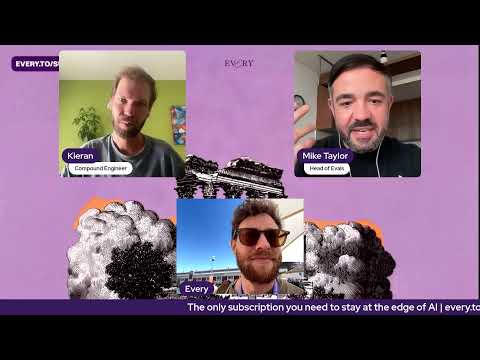
LIVE: DevDay 2026
Live coverage of OpenAI DevDay 2026 by Every.
# Video Identity Observations: "LIVE: DevDay 2026"
## Observable Channel Presentation
### Format & Content Type
- The channel produces **live event coverage and commentary** rather than polished produced content. This video is a multi-host live stream with remote contributors and field reporting ("take over... We're stepping in", walking around the venue: "Here, let me show you guys around").
- The channel runs a companion **live coverage site** described as election-night-style: *"this is the live coverage uh site. It's kind of like you can think of this as um you know it's like election night but the every version of it."*
- The channel operates its own AI agents during coverage: *"our takes and posting it there... Our dots are running"* — the channel actively uses the AI tools it covers.
### Demonstrated Technical Positioning
- The hosts are clearly **practitioner-level AI/developer commentators**, not general news: they run personal benchmarks, A/B tests, and share screenshots live:
- *"it scores the highest my benchmark out of any model"*
- *"it did run uh my proof from scratch which is my hardest benchmark"*
- *"these are the screenshots of everything I run and just looking side by side"*
- They compare frontier models by feel and taste, with opinionated takes: *"it's more about taste and what you like... than that they're worse than anthropics."*
- One host mentions early access relationships with tools: *"You had a early access to Jeff and like really tested this."*
### Intended Audience
- **AI-forward developers and power users** who track model releases closely. Vocabulary assumes fluency: "vibe check", benchmarks, pricing, computer use, post-training differences, API endpoints, usage limits.
- The audience is treated as participants: *"if anyone has questions or things they want to see"* — the stream solicits input from viewers and routes questions to interviewees ("we both had questions for me to ask him").
### Claimed Scope (from the video itself)
- Coverage of OpenAI's DevDay: model launches (GPT 6.1), product demos, a Sam interview, venue atmosphere, even protests: *"pretty substantial turnout in protest."*
- The channel claims a **practical evaluation angle** — testing what's announced rather than just reporting it: *"we try these models out and we vibe check them."*
### Self-Description Evidence
- No explicit channel mission statement is present in this transcript; identity is demonstrated through behavior (live format, benchmark culture, community interaction, agent usage) rather than stated claims.
## Quality Notes
- Transcript is noisy/garbled in places (e.g., the keynote segment with "Sam" and product names like "Dots"/"Astro"); observations above avoid relying on garbled passages for factual claims beyond what is clearly discernible.
- No curated metadata was supplied, so all identity evidence comes from the transcript.
# Delivery Observation: LIVE DevDay 2026 (Multi-Host Panel/Broadcast)
> **Note on evidence quality:** This transcript appears to be a noisy auto-caption of a live multi-speaker stream. Speaker attribution is often unclear, and some passages are garbled. Observations below are limited to what is verbatim observable.
## Overall Format & Communication Patterns
- **Multi-host, conversational handoff structure.** The broadcast shifts between a stage/Q&A segment and remote-host commentary: *"Yeah I think we are going back live to San Francisco. Uh this was our very brief uh vibe check uh for this model."*
- **Evaluation-driven discourse.** Speakers consistently frame AI models through **personal benchmarks and side-by-side testing**: *"it scores the highest my benchmark out of any model"*, *"it did run uh my proof from scratch which is my hardest benchmark."*
- **Immediate, informal "vibe check" framing** as a named recurring activity: *"we try these models out and we vibe check them. So we wanted to do like a vibe check"*; later, *"What are the vibes? Tell me Tell me what your vibes are."*
## Recurring Vocabulary & Naming Habits
- **Model shorthand nicknames used fluently and repeatedly** — "Astra," "Soul," "Opus," "Fable," "clawed/Claude," "dots/DOS" — often compressed further: *"it's kind of like, you know, Astra Light or like Soul Smart. You know, it's like somewhere in between Astra and Soul."*
- **Repeated analogy of one model "feeling like" another:** *"Opus 55 felt more like Fable than it did like previous Opus"*, *"it just feels more like Astra which is a good thing"*, *"it has Austra vibes for just less tokens and faster."*
- **"Really" as a high-frequency intensifier:** *"it's really really good with this"*, *"the insights that it came up with were really good"*, *"That's really the power of dots as we see it."*
## Teaching & Explaining Habits
- **Screen-share-anchored demonstration.** The technical reviewer walks through artifacts live: *"let me just uh share my screen... this is uh the MPS dashboard that it made"*, *"let me just bring up the PowerPoint one here."*
- **Critique balanced with praise, using named "tells."** Strengths and failures are both specific: *"the sections were all like near equal which is a big AI tell and also makes it boring to read"*, versus *"it's really good at computer use as well."*
- **Comparative framing as default explanation style.** Claims are almost always anchored relative to alternatives: *"if this is like cheaper Astra, I'd probably use this over Astra"*, *"It's faster. is cheaper"*, *"it's more about taste and what you like and how you like to work."*
- **Hedged, first-person judgment language:** *"I would say"*, *"the way I'd characterize it is"*, *"for me"*, *"my take"* recur throughout.
## Q&A / Stage Delivery Patterns
- **Concrete anecdote-first explanation** in the stage segment: a factory-defect triage example introduced with *"some of my favorite examples of things people do with DOS that you can only do with DOS are, for example, an open hardware."*
- **Hedge-and-clarify pattern** when handling sensitive topics: *"Um I wanted to add one clarification. Um the incidents we disclosed were running internal only models."*
- **Forward-looking vision language** with temporal scale: *"staying on top over very long periods of time"*, *"multiple weeks multiple months"*, *"it's really going to cross just into your life in a very natural way."*
## Interactive/Live Habits
- **Frequent filler and restarts** typical of unscripted live delivery: *"uh"*, *"um"*, *"you know"* appear at very high density; sentences frequently restart (*"uh we we can I can publish that live"*).
- **Casual inter-host banter:** *"What's up, Mike?"*, *"while we wait for Dan to go to the bathroom"*, *"you can't have taste unless you eat a lot of food you know."*
## Stable vs. Isolated — With Uncertainty
- **Likely stable (repeated 3+ times):** comparative model framing, "vibe check" vocabulary, screen-share demos, benchmark-first evaluation, intensifier use.
- **Isolated (single occurrence, not treated as a pattern):** the safety-cases discussion (*"We have started this new practice of writing safety aces"*), the protests remark, and the "what happens to marketers" question — each appears once and may reflect situational prompting rather than habitual style.
- **Attribution uncertainty:** because captions are garbled and speakers are unnamed, per-speaker habits (vs. group-level habits) cannot be reliably separated.
# Observation Record — "LIVE: DevDay 2026"
## Source & Speaker Basis
- **Speaker identification** relies only on names explicitly spoken in the transcript: **Mike**, **Kieran/Karen** (rendered both ways), **Dan**, **Randy**, and an unnamed main-stage presenter (possibly Sam, referenced but not confirmable). The transcript is heavily garbled in places; garbled passages are noted rather than reconstructed.
- No curated speaker metadata was supplied.
---
## Position 1: Persistence and personal agents (main-stage speaker)
**Claims expressed:**
- Their agent connects to many apps with **fine-grained, per-app access control** ("you can give it as little as one of the different...").
- The team has worked on this research for **almost two years**, specifically on **persistence over very long timeframes** ("multiple weeks, multiple months") and the **memory system**.
- A competitive jab: *"We haven't seen, you know, what other existing personal agents can do that."*
- The live demo (partially garbled) included calling the user's dog, described as **"state-of-the-art voice"** and *"very very expressive."*
**Stated vision:**
- An *"always collaborator / helper"* you can *"give very large pieces of work to and it gets to know you over time."*
- Long-term prediction: interfaces will blur — *"at some point it's not about to interface anymore, it's just about this active intelligence"* — reachable by email, text, calls, meetings.
**Anecdote cited as evidence:**
- During a demo incident, the agent reportedly knew a teammate was working on the failing component, knew it would affect the demo, and was told to *"go fix it"* — presented as proof of *"a lot of stuff coming together."* (Anecdotal; not independently verified in the transcript.)
---
## Position 2: Factory-defect triage use case (main-stage speaker)
- Example from **"open hardware"** company: engineers use the agent ("Dots"/"Dos") to triage factory defects from Slack and email, taking a first pass on ship/adjust/change-process decisions, sometimes just approving: *"yes, that sounds good to me, good analysis."*
- Framed as *"increasing the aperture of what you as an individual... decide to do."*
**Clarification offered:**
- Recently disclosed incidents involved **internal-only models**, *"not Astro"* — the released product is built on **Astro**, described as secure *"in terms of sandboxing... and in terms of audio."* (Passage partially garbled.)
---
## Position 3: Safety practices (main-stage speaker, in response to a security question)
- Intends to continue AI products, but as *"models... surpass [garbled] capability"*: *"We have got to be able to make [garbled] things."*
- Has **"started this new practice of writing safety cases"** — *"I think it's a great step forward. We want to learn how to do that"* — and welcomes **public involvement**.
---
## Position 4: GPT-6.1 Soul vibe check (Mike)
**Positive assessments:**
- *"It scores the highest [on] my benchmark out of any model... which is surprising actually, because I still prefer Claude models."* Later specified: **85% across the full range**; the only weak area is **writing, for him**.
- Strong **computer use**, better *"visual awareness or understanding"*; a Hoboken map demo looked good.
- PowerPoint task: first model he'd seen add **illustrative task examples** to make content visually comprehensible.
- Pricing caveat: hasn't checked pricing, but *"if this is like cheaper Astra, I'd probably use this over Astra."*
**Criticisms:**
- Design has a **"GPT flavor"** — *"cute things... almost like looks like a marketing landing page"*; *"you can really tell that this is a GPT model."*
- **Writing fails his checks**: *"super boring,"* near-equal sections (*"a big AI tell"*), and it ignored the *"punchy... interesting quotes"* in his source material. *"I wouldn't use it as a writer."*
- Unresolved tension (preserved as stated): scores best on his benchmark **yet** he *"still prefer[s] Claude models"* — his tasks are *"kind of saturated."*
---
## Position 5: GPT-6.1 Soul vibe check (Kieran)
- *"Feels like Astra but then faster"*; analogized to **Opus 5.5** feeling like Fable — *"Astra came down to Soul which is exactly what we want... more accessible to everyone."*
- Side-by-side screenshots: GPT-6 Astra and 6.1 Soul look *"very similar"* in design — infers **similar post-training**; dislikes the *"double title"* / *"meta slop"*; Claude is *"a little bit more clean."*
- Ran his **"proof from scratch"** benchmark (*"my hardest benchmark"*) — *"finished it, did way better"* than with GPT-6L. Verdict: *"use this as an Astra replacement. It's faster... cheaper."*
- **Conclusion:** *"OpenAI is very close to Anthropic and it's more about taste and what you like... Anthropic's Opus 5.5 I use more because it's more like my style. It leaves more space for my thinking."*
---
## Position 6: Luna decisions API (Mike, with a follow-up noted)
- Has *"a lot of loyalty to Jeff"* (early-access product, name as spoken), which *"made me excited again to be an engineer"* — but OpenAI is *"the default API I use,"* so he expects heavy usage of the new decisions API.
- Likes that it's **multimodal**; Jeff's gaps are a **short context window** and **no image input**, while *"most of what I'm evaluating is visual."* Expects *"the team at Typesafe will catch up."*
- **Open skepticism (unresolved):** *"I just wonder actually why OpenAI did this... it feels like a distraction... there can't be much margin in this type of model... rock bottom prices."*
- Follow-up from another speaker: Luna is *"cheaper than Jeff for certain cases"* — Mike concedes *"in some cases,"* but *"less fast."*
---
## Position 7: Questions carried into the Sam interview (Dan, Kieran, Mike)
- **Kieran's question:** With so much announced, *"what is his focus... they did this in the past where they did so many things and got distracted."*
- **Mike's question:** *"If we can automate 95% of someone's job, what is the 5%... what won't we automate?"* — noting Sam *"has in the past said that everything"* [statement trails off in transcript].
- **Dan's excitement:** **Ultra-fast models** — he restructured workflows to run agents in the background and *"would be much more productive if it was fast enough that I didn't have to multi-thread."*
---
## Position 8: Competitive landscape (Dan)
- Excited about the **"DOS" product**; still deciding which agent to use and uses **Codex** a lot.
- Open question: *"There are other companies like Cursor and [Garbled — 'grobot'] that already are a little bit further with the computer use"* — *"when will it all come together?"* He believes OpenAI will do it, but timing is unknown.
---
## Contextual / logistical notes (Randy, Kieran, others)
- **Protest outside the venue** confirmed by Randy: *"pretty substantial turnout"*; Dan said it's *"the first year"* he's seen protests at this event.
- Venue previously hosted **Microsoft Build** and a **Cursor** event (as stated).
- Usage-limit context: a speaker notes OpenAI *"just cut the usage limit in half"* — *"we now have to pay a lot more money"* (speaker for this claim is ambiguous in transcript).
- Live-coverage site described as *"like election night but the Every version of it."*
- Confusion around **"Ultra fast"** access: Dan hasn't received access yet; another speaker says *"we're gonna have to get you access."*
---
## Contradictions & Qualifications Preserved
- Mike: benchmark winner **yet** personal preference for Claude models — unresolved.
- Mike: decisions API useful to him **yet** possibly *"a distraction"* with poor margins for OpenAI — unresolved.
- Luna cheaper than Jeff only *"in some cases,"* and slower — partial concession.
- Main-stage claim of multi-month agent persistence is qualified by the admission the full system *"we weren't able to show... in the live demo."*
- Speaker labels in the transcript are inconsistent (e.g., "Kieran"/"Karen," "Dots"/"Dos"/"DOS," "Astra"/"Ostra") — recorded as-is where identification is uncertain.
# Speaker Roles & Provenance Record — "LIVE: DevDay 2026"
## Video Overview
- **Format:** Live stream coverage of an OpenAI DevDay 2026 event, including keynote Q&A fragments, model "vibe checks," and on-site reporting.
- **Transcript quality note:** The transcript is heavily garbled/partially corrupted in places; speaker names, model names, and product names may be mistranscribed (e.g., "clawed," "Astra," "Austra," "Soul," "Jeff"/"Jev," "DOS"/"dots," "cat software"). Identities below reflect only what is explicit or inferable from the transcript.
## Identified Speakers & Roles
### Keynote / Q&A segment (early transcript)
- **Sam Altman (implied)** — OpenAI leadership, referenced as "Sam" whose interview is upcoming and whose programming was cut off. Speaks in the opening Q&A portion (unconfirmed by name in-speech; inferred from context of "Sam's programming" and "interview Sam").
- **Unnamed OpenAI speakers (≥2)** — discuss personal agent product ("dots"), persistence research (~"over two years"), disclosed incidents involving internal-only models, safety evaluations ("safety aces"), and product roadmap.
### Live coverage team (Every-affiliated, per URL)
- **Kieran / "Karen" (spelled both ways)** — studio host; shares benchmark screenshots ("LFGbench"), compares "6.1 Soul" to "Astra."
- **Mike** — studio analyst; runs a personal benchmark dashboard, gives detailed model evaluations, has early access to "Jeff."
- **Dan** — on-site reporter at DevDay venue (Moscone/SF area, former Microsoft Build venue); preparing to interview Sam.
- **Randy** — on-site companion to Dan; reports on venue, protests, and food.
### Notes on speaker separation
- Speaker turns are marked mostly with `>>` but names are frequently not attached; attribution between Kieran, Mike, Dan, and Randy in multi-party banter is partially uncertain.
## Referenced Sources & Third-Party Claims
- **Product/model names (as transcribed):** "Dots"/"DOS" (personal agent), "Astro"/"Astra"/"Ostra" (OpenAI model), "Soul 6" / "GPT 6.1 Soul," "Opus 55," "Fable," "Clawed"/"Claude," "Codeex app," "Jeff"/"Jev," "Luna decisions API."
- **Third-party companies mentioned:** Anthropic (implied via Opus), Cursor, "grobot" (possibly Grok?), Typesafe, Microsoft (Build venue), hardware company with factory-defect triage use case ("an open hardware" — partially garbled customer example).
- **Claims from keynote speakers:** incident disclosures involved internal-only models, not the product ("not Astro"); ~2 years of research on long-horizon persistence/memory.
- **Claims from coverage team:** Mike's benchmark — model scores 85%, highest of any tested, weak on writing; Kieran's "LFGbench" results shown on screen; A/B testing by Mike showing Luna cheaper than Jeff in some cases; usage limits reportedly cut (pricing change claim).
## Promotional / Availab.-ility Segments
- **Promo — live coverage site:** Repeated promotion of `every.live/live/openai dev day 2026`, described as pulling takes from "the slacks"; flagged as self-promotion by the coverage team.
- **Promo — audience callout:** Requests for questions and "taste test" of DevDay food (audience engagement segment).
## Availability / Access Limits
- **Comment availability:** Not stated; no comment section referenced.
- **Model access gaps:** Dan explicitly states he has no access to the new models yet ("waiting for it to roll out"); Mike offers to "publish that live" regarding benchmark checks but no link given in transcript.
- **Missing context:** Slides, screenshares (MPS dashboard, PowerPoint demo, Hoboken map, proof-from-scratch benchmark) are referenced visually but their contents are not fully captured in transcript.
## Unresolved Ambiguities
- Speaker-name spellings are inconsistent ("Karen" vs. "Kieran"); recorded both with uncertainty.
- Whether the opening keynote speakers include Sam Altman by name is not explicit in the garbled text.
- Several product names are likely mistranscriptions and should not be treated as verbatim confirmed names.
connected a whole bunch of apps which they don't get imperative each you can control very very precisely what access to give each shot and you know
you can give it as little as one of the different Um I think it's all about how it comes together in the way that is most useful to people um and also capable of you know actually staying on top over very long periods of time. We haven't seen you know what other existing personal agents can do that there but we've been working on the research here for quite some time almost over two years specifically persistence over very very long devices um you know multiple weeks multiple months the memory system as well and then everything coming together but we weren't able to show it here in the live demo we're able to just call your dog you know we have state-of-the-art voice and then very very expressive map in general and it's really going to feel like an incredible extension. Yeah, I think this is this feels like this kind of always collaborator helper extend whatever you want to call it that you can give very large pieces of work to and it gets to know you over time. Um I think most people when they think about the couple's day they're like books by dinner you know this like it did this whole thing
\>\> yeah presentation my god production is done fix
the first thing I did when I saw there some of the devils. I I opened my eyes to see, you know, to ask him what's going on because the whole already told me what was going on. Yeah. And just like emphasis what happened there. It's like we had a set came out very like stop knew that he was working on that knew it was happening right then. Knew it was going to affect the demo. He was able to say like go fix it. Like that's a lot of stuff coming together. \>\> So I think this is really the best way to bring it examples. Um, you know, some of my favorite examples of things people do with DOS that you can only do with DOS are, for example, an open hardware, they're working on hardware, you have a factory and factory sometimes produces small defects, but the product is still shippable. And so you need to have hardware engineers triage those factory defects and decide you ship it, you make an adjustment, we change production process. And so program engineers have thoughts running and just triaging from Slack and email every sort of piece of information coming out of the back taking a first pass about what to do even using cat software and helping to give them all credit. Sometimes they're just proving like yes that sounds good to me good analysis. Sometimes they're a bit like these kinds of like really ambitious work like increase the aperture of what you as individual with the dot decide to do. That's really the power of dots as we see it. Um I wanted to add one clarification. Um the incidents we disclosed were running internal only models that were not a contract like we're not trying to those like not Astro. Um and so you know the product that we built is around Astro which is our incredibly wide model. It's a very set up not only to the sandboxing and all the product but also in terms of audio.
Do you expectations in general purpose? If so, how long?
We're very proud that Ch is incredible building which is quite aston to be this incredible personal assistant very soon. On top of that, we're making jobs available um as the team set up and just to make you extremely productive. I do think it's all going to blur at some point and it's really going to cross just into your life in a very natural way as we saw you know you can call it and maybe it will show up uh in one network um in one of your meetings one day you can reach it by email by text and it becomes like this very natural part of your life and at some point it's not about to interface anymore it's just about this active intelligence um you And um security concerns um how do you look at this just all right. \>\> Yeah, as I mentioned earlier like we we do intend to continue with AI products and we're quite excited for all it's going to do for people but as the models this surge boarding capability and we see
more of that ahead of us. We have got to be able to make competency things. We have started this new practice of writing safety aces. I think it's a great step forward. We want to learn how to do that sometimes when they get
really good at that. Um and our public I think it's great when the public gets invated the outside of something like this. \>\> Hello. Hello. take over. What's up, Mike? \>\> Hey, Karen. We just uh just cut off Sam's programming. \>\> Yeah. Okay, take over. We're stepping in. It was very hard to hear. And we already have the Pelicans for the day. Uh so, um yeah, we'll we'll we'll go back to uh SF uh but New York and uh Southern California calling in. We want to talk about GPT 6.1 soul because six just launched and we are 6.1 and obviously uh we try these models out and we vibe check them. So we wanted to do like a vibe check. I know it's a little bit chaotic today. It's very busy, lots of stuff going on, but we did try it out and would love to hear what Mike thinks of it. and I'm going to share uh what I see like what kind of family of model is it, when to use it, what is it good at um and what are our takes. So Mike, you you want to give your high level uh take
and maybe show some stuff and then I'll go after that. \>\> Yeah. Yeah, sure. Uh let me just uh share my screen. All right. So, first of all, uh it
scores the highest my benchmark out of any model. Um which is surprising actually uh because I I I still prefer clawed models. Um uh but it's kind of saturated like most of my tasks. Uh so um you know just to kind of click through a few of these uh this is uh the MPS dashboard that it made. Uh just like did a great job of it. Um, I I think the only thing it didn't do that well was I didn't come up with an interesting title, but uh I think like the design was a little bit better than usual. Um, the uh the insights that it came up with were really good. Um, it also did, let me just bring up the PowerPoint one here because I know that's always a fan favorite. Um, it did a it did a a really good job of I think like picking out uh like interesting ideas to put onto onto the page. Um, so one of the things that previous models have done really bad is like they don't really show anything that um would would would make the um the the training like make sense to people like visually, right? So, uh, one thing I I thought it did really well is it would add these like illustrative tasks. Um, so here it's saying like here's a here's like, you know, what we're talking about. Here's like a specific task that we might might use. Um, so I I hadn't seen any other model do that. Um, it's it's really really good with this. Um, it is like I would
say the way I'd characterize it is it's kind of like, you know, Astra Light or like Soul Smart. You know, it's like somewhere in between Astra and Soul. Um
the computer use uh is is excellent. Um it seems to have like better like visual awareness or understanding. Uh this is the you know Hoboken map that it made. It looks you know looks really good. Um and and it it's like a better design than what I've seen before. Um the the the downsides um I I would say it it still has that kind of GPT flavor design where it's like adding like these cute things that like you know it's almost like looks like a marketing landing page. I think this was the uh the the issue that you had on the last V check um where where like you can really tell that this is a GPT model now. Um you know they all seem to have uh similar things. Um uh the I think the the only other uh thing I would say is I it didn't do that well on writing for me. Um so the writing was uh super boring. Uh and it didn't pass a lot of my checks for this writing task. So um you know the the writing didn't seem natural. Uh the the sections were all like near equal which is a big AI tell and also makes it boring to read. Um, also the um, uh, you know, the the like the the actual writing like the context I give for this task has a lot of punchy like interesting quotes. It just didn't really use any of them. Um, so uh, so yeah, that that I I wouldn't use it as a writer, but um, I would say I haven't looked at the pricing yet, but but if this is like cheaper Astra, I'd probably use this over Astra. \>\> Yeah, great. Uh yeah, I I think I think it gave me feels of Astra but then faster. So initially like that's really what it felt and it's it's a little bit like the Opus 55 where Opus 55 felt more like Fable than it did like previous Opus. And I think uh Soul 6 uh like GPD 6.1 Soul is similar where it feels more like Austra in a good way uh and less about Soul. Um so so yeah totally agree with it. Um and that also comes with some
other things. So let me add my screen here. So this is my this these are the screenshots of everything I run and just looking side by side links left side is Austra GP6 soul 6.1 Soul and Opus and
you can see in design GPT6 Austra and 6.1 Soul look very similar. So clearly there's some post training that is similar and and that's also like one of those things with like the double title that I hate. So there's like this meta slop added and you can see cold is just a little bit more clean where it's just like that. But also it's it's very detailed and it's very good. Um let's see for for design you just need to like unsswap it a little bit. Um for yeah so yeah it it it works well. Um it it's detailed more detailed than uh uh yeah like the previous soul. like this is the soul before and you can see it just less stuff uh and less detail and um yeah it it just feels more like Astra which is a good thing. Also it did run uh my proof from scratch which is my hardest benchmark and actually it just it it's booting here but it's finished it finished it. It did way better and I would say use this as an Ostra replacement. It's faster. is cheaper and uh yeah it's really good at computer use as well. So inside the app it's great great as well. Um \>\> yeah well this uh this came at the right time because they just cut the uh usage limit in half. \>\> Yeah I know. Yeah we now have to yeah we now have to pay uh a lot a lot more money but question for like if so okay so here is the is the live demo for uh uh proof from scratch. So you can uh yeah you can see it's uh here fully working with websocks and all. So this is impressive. It wasn't working as well with um the previous version with GT6L. So now it does and that means that open AI is very close to anthropic and and
it's more about taste and what you like and how you like to work than uh that they're worse uh than uh than anthropics. So Anthropics Opus 55 I use
more because it's more like my style. It it leaves more space for my thinking instead of filling out every detail. But I love uh codeex app and I I'm really curious to see how dots will uh get in like I use both apps for different kinds of work and yeah I'm excited for this because this means uh yeah we just have the better model for cheaper again. Um so yeah \>\> yeah after that \>\> let's go. \>\> Yeah I think we are going back live to San Francisco. Uh this was our very brief uh vibe check uh for this model. Uh but \>\> what's up Dan? \>\> Uh you have Randy here. Uh while \>\> while we wait for Dan to go to the bathroom. Uh \>\> what is on the program there? what \>\> what's on the program. What are you up to next? \>\> Uh we've been wandering around uh checking it out here. I'll show you guys. Um but uh basically uh yeah, we preparing for Dan the Dan interview or the Sam interview, I mean. And uh so Dan's kind of uh getting in the zone and all that. Here, let's walk around a little bit. I'll show you guys around. \>\> If you want, you can go to every.live /live/openai dev day 2026. It's on the screen. You can follow everything we do live uh with our takes. We're just uh pulling everything from uh the slacks and our takes and posting it there. So, you want to see what's what's going on there. Uh how we're trying things. Everyone, I I know Katie was very excited to get her uh Joe Dots going and uh is doing stuff. Our dots are running and yeah, if anyone has questions or things they want to see \>\> other than we want a taste test of how the food is at Dev Day. um obviously but
let's let Dan focus first on his big uh interview and then after that he can go taste test because that is the most important thing of dev days and
conferences \>\> you can't have taste unless you eat a lot of food you know \>\> I know yeah \>\> the u the funny thing for me is that this is the same venue that uh Microsoft Build was at uh so I'm like looking around expecting \>\> and cursor the cursor pile was here as well. Yeah. So, \>\> yeah, \>\> Randy, was there a was there a protest outside uh at all? Cuz I I I feel that's what I saw. \>\> Yeah, there was um actually and Dan was saying it was the first year that uh he's uh seen protests at this, but uh pretty substantial turnout in protest. \>\> Yeah. Cool. So, this is um this is the live coverage uh site. It's kind of like you can think of this as um you know it's like election night but the every version of it you know for better. \>\> Yeah. \>\> More important. Yeah. \>\> Yeah. One one question for you Mike there. So we we love Jeff. You had a early access to Jeff and like really tested this and there is a preview version and we did some testing there as well. Do you have like very initial first takes on like the Luna decisions API announcement? \>\> Yeah, I I uh it's only been a couple of weeks, but I I have a lot of loyalty to Jeff, you know, like kind of made me made me um excited again to be an engineer over the past few weeks. Uh but you know, I mean realistically
um you know, OpenAI is like the default API I use when I build new stuff. Um, so I think I will get a lot of usage out of the new decisions API just uh because like I always have an openi API key
kicking around for testing stuff. Um, I uh I also really like that it's multimodal. Uh, that's one of the biggest missing things I think right now with Jev um is that the context window is relatively short and and also the image like it doesn't accept images and and most of what I'm evaluating is is uh visual actually. Uh so I I think that's going to open up more use cases, but I also expect the team at Typesafe will will catch up. Um I I just wonder actually like why OpenAI did this. Uh you know, because it like it feels like a distraction. Um you know, like there's can't be much margin in this type of model. It's it's like, you know, it's it's like rock bottom prices and it makes me wonder like why why why they they they take time out of the schedule to focus on this uh considering \>\> and you did some AB testing on Luna just the normal completions endpoints like Luna itself is actually cheaper than Jeff for certain cases \>\> in some cases. \>\> In some cases it's just less fast. So I guess they just wanted to do this as well uh to I I mean every every provider should probably have this because if you're with OpenAI this is something you want like I I'm sure other providers will so do this. I see Dan again. Yo Dan. \>\> Hi. How's it going? \>\> Going well. \>\> What do you guys think? \>\> Yeah. \>\> You're excited. What are the uh what are \>\> what are the vibes? What have you tried? Have you tried anything? \>\> No, I've not access to anything yet other than \>\> but so I'm waiting for it to roll out. But we we went through the model and we're excited for the new 6.1 model since it feels a lot like Astra. \>\> Yeah, 6.1 I think is a good it's a good model. \>\> Have do Mike have you run any checks on it yet? \>\> Yeah, we actually have it um you know we we can I can publish that live but uh we just showed a few of those uh on this live stream. Um, it it's actually it scores the best out of any any model I've checked so far. \>\> Wow. On on which tasks?
\>\> Uh, across across the full range. Um, \>\> on which? \>\> Yeah, across the full thing, it scores 85%. Uh, the only thing it does badly on is writing. Uh, for me.
\>\> Interesting. And Kieran, have you run LFGbench on it yet? \>\> Uh, yes. Yes. So basically it has Austra vibes for just less tokens and faster which is great. Um and it's just what you want. It's like Fable came down to Opus and now Astra came down to Soul which is exactly what we want to see because it just more accessible to everyone. And \>\> yeah, that that's exciting. I'm really excited for ultra fast but uh I I'll try it out as soon as possible. We're gonna have to get you uh get you access. I I gotta see what we can do. So, I'm I'm about to go interview Sam. What What do you guys What What are the vibes? Tell me Tell me what your vibes are. And uh and if you have I know you both had questions for me to ask him. Uh do you revise your questions? \>\> I I think my main question is they do a lot of Like what is their real focus? Like what is he focused on? like what is his focus because there's so much going on that which is cool but also like they did this in the past where they did so many things and got distracted and I'm just \>\> curious what his take on that is like what is the focus like what is the thing \>\> and what is the is there one thing that you're most excited about from this
\>\> yeah for for me the the ultra fast um just because I I keep I keep um I I had to change all my workflows uh to to just like let agents run in the background
and I feel like I'd be a much more productive if it was fast enough that I could I didn't have to multi-thread, you know. \>\> Sure. \>\> Yeah. And and I'm actually really excited about the DOS product because that is a product I'm still debating who who is like the one I will use for and I use codeex a lot for this kind of work. So especially with computer use and cloud like I my my question is like when will it all come together because uh there are other companies like uh cursor and grobot that already kind of are a little bit further with the computer use in the cloud and like just they're like a little bit so I'm curious when will it come together how will they bring focus to like all these elements that have to work together and uh be amazing. I think they will do it. Uh, I'm just curious. Yeah. What are those things? \>\> I love it. \>\> All right, guys. Always a pleasure to chat. I'll leave you to it. \>\> My question still stands, Dan. I want to know. \>\> Oh, Mike. Yes. \>\> Yeah. Yeah. Because he ended on such a positive point and I really like that. Um, but but I think he has in the past said that everything \>\> What happens to marketers? \>\> Well, yeah. It's like uh if if we can automate 95% of someone's job, like what is the 5% like what what what won't we automate? \>\> I love it. Cool. All right. Good luck guys. \>\> Enjoy. \>\> Thank you. \>\> I don't I don't know how to It's still streaming, I think, but