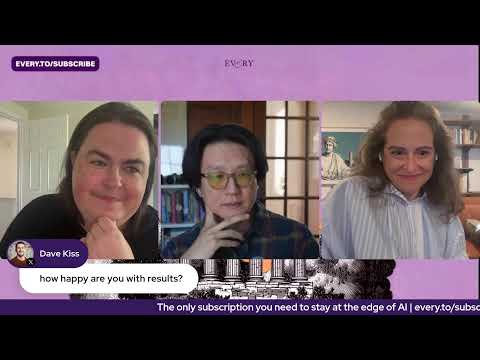
LIVE: How Professional Writers Write with AI | Write-along
A live write-along session exploring how professional writers use AI in their writing process. Related Every guides cover compound writing, beliefs about AI writing, and preparing to write with AI before prompting.
# Channel Presentation Observations — "LIVE: How Professional Writers Write with AI | Write-along"
## Explicit Self-Description
The host provides a direct identity statement in the opening minutes:
> "My name is Kate Lee. I am the editor and chief of Every. We are the only subscription that you need to stay at the edge of AI. We publish ideas, apps, uh, and and do trainings."
Additional self-descriptions from the team:
- **Katie Parrot**, staff writer: "My personal column is working overtime where I write about how AI is changing work and then I write our vibe checks and our context window daily roundups of the the latest you need to know in AI."
- **Jack Chang**, senior editor: edits staff pieces, writes his own, and both are "on the frontier team," "tasked with prioritizing our... experimenting with different tools, different ways of working."
- Products referenced as channel offerings: **Compound Writing** ("a plug-in that we do have in uh available to you"), an internal tool called **Proof**, an "Every agent" in beta ("a company agent that we have in in beta that we're going to be releasing in a couple of weeks"), and **Katebench**, a benchmark replicating Kate's editorial copy-editing tastes.
## Claimed Scope
- The channel claims a dual identity: **media publication** (columns, daily roundups, model reviews called "vibe checks" with "early access to new models" and "rigorous testing") and **tooling company** (plugins, agents, trainings).
- The video itself is framed as a capstone: "we have done a series on writing with AI... we wanted to cap it off with what we're calling a write along."
- Motivation claimed by the host: the "discourse had sort of reached a little bit of a fever pitch this summer with... news organizations and journalists... sharing policies, sharing opinions about writing with AI," so they wanted to share "our what we're doing, why we're doing it, what we believe."
## Intended Audience (as demonstrated)
Evidence suggests an audience of **AI-engaged knowledge workers and writers**, at mixed skill levels:
- Katie describes the reader persona explicitly: "That's a knowledge worker using AI. Uh, you know, anywhere from my friend's what is context level to someone with their own sprawling setup."
- Existing-community signals: chat mentions by name (Betty, Kashik), references to prior reader familiarity — "hopefully many of you have read" the Opus 5.5 vibe check, and "Everyone who reads Working Overtime knows I love nothing so much as to overshare."
- The write-along is framed as practitioner education: "we would use this time to basically literally take you through the process... because his process is entirely different from Katie's," with a caveat that "this is a process that works individually for us... you can hopefully adapt it for yourself."
## Distinguishing Claims from Demonstration
- **Creator claims**: process transparency, reader frameworks ("a reader should leave with a new lens or framework"), and product utility (Compound Writing "allows you to incorporate her methodology into yours").
- **What the material demonstrates**: live use of Claude desktop/Opus 5.5, structured writing artifacts (`style.md`, `voice.md`, idea farm, 10%/30% outlines), AI persona reviewers (Hitchcock, Sorkin, Vonnegut, "mom"), editing skills ("Titan Draft," "jargonify"), and editorial workflow through Google Docs to a final "Kate" top edit. This supports the channel's positioning as a practitioner-demonstrator rather than a commentary-only outlet.
## Recurring Presentation Patterns
- Heavy use of **named internal systems and jargon** (vibe checks, context window, frontier team, compound engineering, TK placeholders), with ad hoc explanation for newcomers ("A TK is sort of the the kind of like publishing industry like a placeholder").
- **Live, unpolished format**: screen-share failures, technical hiccups ("we lost it... my computer is completely freaking out"), and mid-stream audience Q&A.
- **Openly tool-ecosystem-embedded content**: frequent shout-outs to external products and people (Anthropic, Monologue/Naveen, Kieran Clawson, Emily Campbell at Figma, DIA browser, ChatGPT browser extension), consistent with a channel positioned "at the edge of AI."
# Delivery Observation — *LIVE: How Professional Writers Write with AI*
## Format & Setting
- **Unscripted live demo**, three speakers: **Kate Lee** (host), **Katie Parrot** (writer), **Jack Chang** (editor).
- Heavy real-time troubleshooting and interruption: `"We lost it. We lost it. Live demos."` / `"My computer is completely freaking out."` / `"You're muted."`
- Occasional host recaps for late joiners: `"just if you're just joining us... we are going through a write along hosted by every"` and a structured mid-stream recap by Jack ("we are now 55 minutes into this live stream...").
## Tone
- **Conversational, self-deprecating, enthusiasm-forward.** Katie: `"I'm just a a verbalizer. I'm a yapper"`; `"my chronic oversharing, pathological oversharing comes in."`
- **Casual interjections and laughter markers** recur: `[snorts]`, `[laughter]` appear repeatedly, often after Katie's own jokes (`"That's exactly what I had done with my context... I absolutely wound up making it worse."`).
- **Direct-audience hype moments**: `"Look how fast Opus 55 is, you guys. It's amazing."` / `"shout out to the team at at anthropic for amazing work."`
## Recurring Phrases & Vocabulary
- **Promotional tagline repeated verbatim** by Kate at open and close: `"the only subscription that you need to stay at the edge of AI."`
- **"Shout out to..."** used twice by Katie: `"shout out to Naveen, uh, the general the the the brains behind the the process"`, `"shout out to the team at at anthropic."`
- **AI-pedagogy coinages repeated**: *"friction to framework arc," "worse and bettering" (Schlimmbesserung), "prune your context like a bonsai tree," "AI psychosis," "oneshot / oneshotted," "context," "TK," "vibe check," "compound writing/engineering."*
- **Editorial-idiom teaching**: `"Love a TK"` (Kate), `"How the sausage is made"`, `"kill our darlings"` framing via Hitchcock reviewer.
- Frequent **"like," "um," "you know"** fillers throughout — dense hedged delivery typical of live speech.
## Teaching Habits
- **Define jargon for lay viewers on the fly**: `"a hook, for those who don't know, is the the opening of the piece... it needs to pull you in and reel you in like a fish"`; Jack on **TK**: `"a TK is sort of the the kind of like publishing industry like a placeholder."`
- **Anecdote-as-principle pattern**: each lesson is anchored in a personal story (the context disaster, the Hitchcock bomb-under-the-table, the "10%/30% outline" from her agency background).
- **Explicit permission-giving**: `"you don't have to use AI for every part of the process"`; `"this is a process that works individually for us... you can hopefully adapt it for yourself."`
- **Naming and personifying tools/personas**: reviewers named **Hitchcock, Sorkin, Vonnegut, "mom," "nemesis"**, each with a stated rationale (`"mom as somebody who cares about you very much but is confused by everything you're saying"`).
## Communication Patterns by Speaker
- **Kate (host)**: logistics, transitions, audience management; repeats branding; asks clarifying bridge questions (`"Quick question, Katie... why you're using monologue instead of Claude's voice mode?"`).
- **Katie**: long, rambly verbal thinking; narrates her own process while performing it; reacts to AI output aloud and edits on the fly (`"I don't need no keep it simple stupid, especially not."`).
- **Jack**: shorter, more measured; teaches via concrete editorial judgments (`"this sounds like AI"`, `"can we say this more directly?"`) and low-key self-description (`"I'm much more of like an ultra light hiker"`).
## Stable vs. Isolated Features
- **Stable-looking** (recurs across the session): teaching-by-definition, story-first explanation, promotional tagline, "shout out" praise, reactive live editing commentary.
- **Isolated / thin evidence**: the "wedded to Google Docs" exchange and the "Katebench" walkthrough occur once each; their recurrence as habits cannot be confirmed from a single session. Similarly, speaker-specific filler rates would need more footage to generalize.
## Uncertainty Notes
- Quotations reflect the transcript's own repetitions and artifacts (e.g., `"worse and bettered"` vs. `"Schlimmbesserung"` renderings vary); some spellings in the transcript appear garbled, so exact wording of German terms is uncertain.
- Personality claims are avoided; only observable speech and behavior are reported.
# Observation Record: "LIVE: How Professional Writers Write with AI | Write-along"
## Speakers
- **Kate Lee** — Editor-in-chief of Every (identified in transcript: "My name is Kate Lee. I am the editor and chief of Every"). Hosts the session, asks clarifying questions.
- **Katie Parrot** — Staff writer at Every; writes the *Working Overtime* column, vibe checks, and *Context Window* roundups (self-introduced).
- **Jack Chang** — Senior editor at Every; edits Katie's pieces and writes his own (self-introduced). Both Katie and Jack say they serve on Every's "frontier team."
- **Mike** — Colleague expected to join; Jack states Mike is "at a conference and unable to find a quiet spot," so he does not appear.
---
## Framing and Purpose (Kate Lee, with Jack)
- Every is described as "the only subscription that you need to stay at the edge of AI" — publishing ideas, apps, trainings, and bio/vibe checks with early model access.
- **Stated motivation for the series**: AI-writing discourse "reached a little bit of a fever pitch this summer" with news organizations and journalists sharing policies and opinions; Every wanted to share "what we're doing, why we're doing it, what we believe."
- Kate emphasizes the process is individual: "it works for Katie or it works for Jack, but it may... you can hopefully adapt it for yourself."
- Katie has published a guide to **compound writing**, a plugin adapted from Kieran Klaason's "compound engineering" framework for software.
---
## Katie Parrot's Writing Process
### Model preference and history
- Katie states Claude was "my first love as a writing model" (starting around Sonnet 4.5), but that around Opus 4.7/4.8 "definitely opus 5 era" the models "just stopped working for me" and she moved to ChatGPT.
- With Opus 5.5's release, she believes "claude has gotten its groove back."
- She works inside the **Claude desktop app in Code** rather than the main Claude interface: "I like this is just where I live and it makes me happy."
- She uses the **Monologue** voice product rather than Claude's voice mode; asked why by Kate, she says, "honestly, it's just... I love Monologue... that's just where we do it," and later "I'm very much leaning into the familiar... everything is just muscle memory."
### Folder/context system
- Drafting folders per column are "the engine behind all of the writing that I do." Every holds a weekly "show us your folders" session.
- Key files:
- **style.md** — defines the column's purpose ("a first-person ethnography of the ways AI is changing work"), reader payoff, structure, and weaknesses to avoid.
- **voice.md** — "captures sentence level patterns" (not shown).
- An **idea farm** where potential column ideas are captured.
- The **"friction to framework arc"** structure was discovered, she says, by "feeding my essays to Claude and asking, 'What do you notice?'"
### The demonstrated piece
- Katie drafts an essay about ruining her own context by instructing her machine to "save literally everything that it produced, every outline, every decision, every piece of feedback."
- She learned the German word ***verschlimmbessern*** ("worsen-bettering") from **Emily Campbell** (AI at Figma) on X, and explicitly credits Campbell in the draft: "We do need to credit Emily Campbell um because I don't want it to seem like I came across this on my own."
- She diagnoses the failure: the context was "the only variable that had changed" between a successful GPT-6 Astra vibe check and the failed piece. Five templates "had somehow gotten fused together into like an impossible list of conditions."
- **Rebuild**: She asked Codex "what's going on with my context," which invoked a compound-engineering skill called **doc review**; she then "nuked the entire thing," archived folders, and rebuilt from scratch in a "Marie Condo kind of way."
### Lessons Katie states from the experience
- "Good intentions can go bad."
- "More memory is not always a good thing. Sometimes it pays to let your model forget things that no longer serve you."
- "Prune your context like a bonsai tree."
- **"Never edit your context under pressure or duress"** — she says she was in "AI psychosis" after Astra's release and was trying to fix context while hitting deadlines.
- On trust: "I was kind of ready to trust my context again. That trust had been broken. The trust in me myself had honestly been kind of broken."
### Workflow stages demonstrated
1. **Interview** — Claude interviews her "one question at a time." She notes Claude asks psychologically tough questions and that she stays in control: "you're very much in the driver's seat... a failure mode of this is that you give the model too much agency."
2. **Outlines** — a **10% outline** (story beats + working thesis) and a **30% outline**, a practice she attributes to her background at content marketing agency "Animals": certain framing problems "become harder to untangle" if caught late.
3. **Reviewer personas** — including **Reader** (cold first-time reader), **Hitchcock** (suspense, "bomb under the table"), **Sorkin** (pacing), **Vonnegut** (eight characteristics of story), **Objections/Nemesis**, and **Mom** ("somebody who cares about you very much but is confused by everything you're saying"). She frames the reports as "a mechanism for self-reflection and saying, 'Do I agree with this?'"
4. **Section-by-section drafting** — she resists one-shotting: "you will actually see when Jack edits what happens when I try to oneshot things because it's not great." She defends AI drafting against the objection that it removes discovery: "this is my version... instead of having to write the sentence out myself and decide that I hate it... I have AI write out the first draft and then that's something for me to react to."
5. **Selective saving** — instituted after the disaster: "I don't want every single outline saved."
6. She notes AI is not needed at every step: "you don't have to use AI for every part of the process."
- Kate summarizes the arc near the end; Katie says post-rebuild work has gone smoothly and reports the Astra vibe check took **eight minutes** one-shot end-to-end.
---
## Jack Chang's Editing Process
- Self-describes as an "ultra light hiker": "I just like try to keep everything minimal."
- **First pass**: reads top to bottom without editing, leaving comments about reactions "without necessarily prescribing solutions."
- Notes he is "a little more brusque" with internal writers whose comments may be addressed to an AI, and "a little more gentle" with outside contributors.
- Saves title/subtitle for last.
- Specific editorial observations in the demo:
- Flags direct address ("reader") as possibly untypical of *Working Overtime*.
- "This sounds like AI" — because AI "really loves... overuses like handing stuff to other stuff."
- Flags over-lyrical lines, jargon ("hypomanic stretch" — Katie agrees she'd make it "more broadly relatable... we don't need to get into my particular pathology"), and AI-favored words like "shape" and "broke."
- Notes rules of three: "I'm very mad that AI took away my rules of three... it's even more devastating than the dash." Katie responds that the "story of what broke, how I dug my way out" construction is "a little content marketingy."
- On keeping AI-sounding lines, answering a chat question: "For sure... there's definitely things that I end up wanting to keep" — he cites an AI top-edit clone of Kate that flags things he doesn't mind.
- **Tools**:
- Uses the **ChatGPT Chrome browser extension** with GPT-5.6 ("soul") at medium effort; he says he hasn't tested Opus 5.5 enough on editing "that I really trust it yet."
- Avoids editing inside Codex/Cloud Code browsers: "I feel like I want separate apps for different types of activities."
- **Titan Draft** skill — applies "the Stephen King rule" (second draft = first draft minus 10%), 10–15% word-count reduction, structural cuts before sentence tightening, concrete detail over abstraction, removing "throat clearing."
- **Jargonify** skill — removes jargon, then a tightening pass, then a flow re-read (a multi-pass workflow he evolved after finding single-pass versions introduced new problems).
- A **proofreader** skill for CMS paste artifacts.
- Estimated full edit time for a piece like the demo: "three to four hours."
- Publication stays in **Google Docs** (not Every's internal "Proof" tool) partly because Proof "doesn't handle undo very well," which he relies on heavily.
- **Katebench**: before handing to Kate for top edit, Jack tags the "Every" agent (in beta, "releasing in a couple of weeks") to run Katebench — a benchmark encoding Kate Lee's copy-editing tastes. Its output goes into the doc via a "Kate assistant" Google Doc employee as tracked changes; Jack marks clear accepts/rejects and leaves uncertain ones for Kate. Kate notes it "can take up to about 10 minutes to run."
---
## Points of Tension and Qualification (preserved as stated)
- **Katie contradicts her own early framing of the incident**: her pitch said the context problem "basically ruined my life," but the actual piece is about a messier partial experience; the AI interview flags this as an open loop, and Katie says the personal-toll material ("I was already not doing so great") is "fair game to a certain extent."
- **Katie's praise of Opus 5.5 is conditional on recent history**: she explicitly says Claude models previously "stopped working for me" — she does not present her current preference as settled.
- **Katie acknowledges her writing-style guide contains flaws the process itself created**: "argumentative weaknesses, straw men, both sides fallacy... here's our friend, not X but Y. Let's get that out of there."
- **Katie notes a live-demo failure she'd fix**: the outline asked whether to "flash the crash earlier so the readers feel the stakes"; the Reader report later said "the reader waits a long time to see the damage," and she says that was "actually something that I would say yes to... I wish I had just hit monologue and told it."
- **Jack's AI suggestions are treated as negotiable**: "It's like close, but it's not. It's like I feel like it's better in some ways, but like worse in other ways" — he then asks for more variations.
- **Jack flags the GPT-5.6 extension as sometimes "lazy"**: it did not proactively check working-overtime style norms the way "5.6 wouldn't have... before" — wait, as stated: he says earlier versions would have read the site via the Every MCP, and "maybe with soul um I actually need to like crank up the effort level."
- **Katie's admitted uncurated habits**: "I'm a yapper and I kind of find my way to what I think through the process of narrating"; "chronic oversharing, pathological oversharing."
- **Final satisfaction is qualified**: asked how happy she is with results, Katie says the live-written intro "was so much better than the one that I just yeeted out in order to get Jack something to edit," but the session was explicitly a test case, not a real piece; Kate notes a version of the article may be published "hopefully."
---
## Unresolved / Open Items
- Mike's process was never demonstrated (he was absent due to a conference).
- Katie mentions a journey "trying to harmonize the documents available on both of my machines" (laptop and Mac Mini) — unresolved at time of recording.
- The demo piece was not fully drafted to completion on stream; the process was summarized rather than executed for the remaining sections.
# Video Attribution & Provenance Record
## Video Overview
- **Title:** LIVE: How Professional Writers Write with AI | Write-along
- **Format:** Live stream (Streamyard, per on-screen mentions) featuring screen-share demos
- **Topic:** Every editorial team demonstrating AI-assisted writing and editing workflows ("write-along")
## Speakers & Roles
| Speaker | Stated Role | Notes |
|---|---|---|
| **Kate Lee** | Editor-in-chief of Every | Host; introduces participants; notes she performs the final "top edit" on all pieces (not demonstrated live) |
| **Katie Parrot** | Staff writer at Every | Writes the "Working Overtime" column, vibe checks, and Context Window roundups; demonstrates her drafting process in Claude; member of Every's "frontier team" |
| **Jack Chang** | Senior editor at Every | Edits pieces, writes some of his own; member of the "frontier team"; demonstrates his line-editing workflow |
| **Mike** | Colleague, writer at Every | Announced as joining to show his process, but **did not appear** — was at a conference and unable to find a quiet spot to stream |
> Note: Transcript transcriptions of names, model names, and technical terms are inconsistent (e.g., "EveryY"/"Every," "Kieran Clawson" likely = Kieran Klaassen, "Abri" likely = Every). Names above reflect the most plausible readings; exact spellings for some third parties are uncertain from the transcript alone.
## Attribution of Key Claims
- **Katie's claims:** Her context failure story; discovery of "verschlimmbessern" via **Emily Campbell** (works on AI at Figma, per Katie); the "friction to framework" arc found by feeding her essays to Claude; her 10%/30% outline concept from her background at a content marketing agency called "Animals" (spelling uncertain).
- **Jack's claims:** His editorial rules ("sounds like AI" patterns like "handing," overuse of "shape"/"broke"); Stephen King's "second draft = first draft minus 10%" rule (cited from *On Writing*); his skills "Titan Draft" and "Jargonify" (demoed live).
- **Reciprocal mentions:** Katie credits Jack's "Titan Draft" line-editing skill; Jack references Katie's "How to Keep Your Writing Weird in the Age of AI" piece and Katie's top-edit clone agent.
- **Audience/chat interjections:** Questions read aloud from viewers "Kashik" (colleague, per hosts) and "Betty" — treating chat queries as third-party inputs, not speakers.
## Third-Party Tools & Products Referenced
- **Claude** (desktop app, Claude Code), Anthropic models: Sonnet 4.5, "Opus 4.7/4.8," Opus 5.5, GPT "6 Astra"/"Soul" (OpenAI), Codex GPT — model names as spoken; transcript spellings unreliable
- **Compound Writing** — Every's writing plugin descended from Kieran Klaassen's Compound Engineering
- **Monologue** — voice tool (Katie); credited to "Naveen"
- **DIA browser**, **ChatGPT Chrome extension**, Google Docs, Every's internal "Proof" doc tool, "Every" Slack agent (beta, "in a couple of weeks"), "KateBench"/"Kate Assistant" Google Doc agent
## Promotional Segments (Flagged)
- **Every subscription pitch** — Kate opens and closes with "the only subscription you need to stay at the edge of AI" (intro/outro)
- **KateBench / Every agent beta** — announced as releasing publicly "in a couple of weeks"
- **Compound Writing plugin** — Katie notes it's "available to you" as a plug-in
- **Bio checks** — referenced as Every's known offering
- Shout-outs to Anthropic, Monologue/Naveen, and Kieran Klaassen function as endorsements within the demo.
## Source Cited Materials
- Katie's prior essay "How to Keep Your Writing Weird in the Age of AI" (referenced, not quoted)
- Emily Campbell's tweet about "verschlimmbessern" (paraphrased)
- Stephen King's *On Writing* (paraphrased rule)
- An in-production draft essay (worse-and-bettering/context essay) worked on live — stated to be published in some form later
## Comment/Interaction Availability
- **Live chat was available** during the stream (comments from Betty, Kashik, and an anonymous "no love for proof" question were read/responded to). No information about post-live comment availability or a VOD URL is present.
## Unavailable / Uncertain Evidence
- Mike's process segment — canceled; never shown
- Kate Lee's top-edit process — mentioned only, not demonstrated
- Exact spellings of model names, "Kieran Clawson," "Animals" agency, and German terms (verschlimmbessern, Kummerspeck, Backpfeifengesicht) — transcript renderings are garbled; identities inferred, not confirmed
- Whether the demo essay is actually published — Katie/Jack say "hopefully... soon," unconfirmed
We're live, Kate. \>\> Thank you. Thanks. Hi. Um, hello everyone. Thank you to Katie for for alerting me that we're on. Um, we are now live. Um, thank you for joining us. My name is Kate Lee. I am the editor and chief of Every. We are the only subscription that you need to stay at the edge of AI. We publish ideas, apps, uh, and and do trainings. And you may have come to us because you know us for our bio checks, um, where we get early access to new models and, um, run them through rigorous testing uh, and publish our findings to you, the audience. Um I'm here today with two members of the a of the editorial team. Um who I will let introduce themselves shortly, but we have done a series on writing with AI and uh we'll share a little bit about what we've done there. And we wanted to cap it off with what we're calling a write along. Um so before we go any further, Katie, go ahead and introduce yourself. \>\> Hi, my name is Katie Parrot and I am a staff writer here at EveryY. Um, I write across a variety of columns that we have. My personal column is working overtime where I write about how AI is changing work and then I write our vibe checks and our context window daily roundups of the the latest you need to know in AI. So that's that's me \>\> and Jack. \>\> Hey everyone. Uh, I'm Jack Chang. Um, senior editor here. Um, I edit all of the kinds of pieces that Katie writes. um and uh write um a few of my own as well. Um should also mention that um Katie and I are both on uh the frontier
team here at Abri, which means that um we're also um sort of tasked with prioritizing our like just experimenting with different um tools, different ways of working. Um, I see, you know, uh, Betty's comment in in the chat about my post on on Jev and and just like, yeah, trying to, you know, make it do really interesting things. Um, so yeah, so very excited to be here to to share more about um, my uh, editing process. \>\> Awesome. And our colleague Mike will be joining us uh, in a little bit as well to show his process. Um, so just to set this up, we decided to do a series on writing with AI because first of all, it's something we already write about regularly. That's something that both Katie and Jack and Mike and everyone on our team and Dan have been writing about. Um, but it also felt like uh thing the discourse had sort of reached a little bit of a fever pitch this summer with um lots of just different uh news organizations and journalists and others um sharing policies, sharing opinions about writing with with AI. And we felt like it was um it was just a a good moment for us to share our what we're doing, why we're doing it, what we believe, and how we think you can do. um you know your best work with AI when you know how to use the tools well. Um this has also grown out of uh a writing camp and a writing workshop that Katie uh and I have done. I think we did one or two of them earlier this year where people were just um incredibly curious about the process and the actual process. And
I think one thing we um you know try to emphasize is that like this is a process that works individually for us. it works for Katie or it works for Jack, but it may, you know, you can hopefully adapt
it for yourself uh for what works for you. Um, but we thought that we would use this time to basically literally take you through the process that Katie goes through when she's writing something, the process that Jack goes through when he's editing something, and the process as well that Mike goes through when he's writing something because his process is entirely different from Katie's in pretty much every way. Um, I also do just want to show you that um if you haven't seen it yet, uh if you haven't seen it yet, the um we did publish uh uh Katie's guide to writing with uh to compound writing, which is a plug-in that we do have in uh available to you. Um and that essentially allows you to uh incorporate her methodology uh into yours. Uh, and so it's really a way a way to um to uh to to do that for yourself. So I'm going to stop screen sharing and I'm gonna go over to Katie. Let's get started. \>\> Let's get started. Um, bear with me while I talk my way through finding my window. Um, \>\> can you share my Can you see my screen? \>\> Yeah. Uh, yes.
\>\> Okay. Okay. So, we see Claude. \>\> No, we see Streamyard. \>\> Oh, we see Streamyard. Oh, that's not as exciting. Um, let's see.
Share screen. Um, window Claude. Entire screen. That's what I want. Um, \>\> yes. \>\> Great. So, now we see Claude, \>\> right? \>\> We do. Yes, we do. \>\> Great. So, we're going to be writing inside Claude. This is a little bit of a vibe shift for me because um backstory, Claude was actually my first love as a writing model. \[snorts\] Um I remember back in the days of Sonnet 4.5, the team was going crazy for it. I you know I started using it for writing fell in love with the writing style but somewhere around the opus 4748 definitely opus 5 era um you know opus just stopped uh cloud models just stopped working for me and I kind of refugeeed over to chat pt but um in the with the release of opus 55 I really think that uh claude has gotten its groove back uh shout out to the team at at anthropic for amazing work. So, I'm going to be working inside of the Claude desktop app in code, which might sound weird to people that I'm not in the the main Claude the for artist formerly known as Co-work. Um, but I um I I like this is just where I live and I it makes me happy. Um, so before I go into the actual drafting in Claude, I do want to just give a little bit of context about the context that is driving this behavior. So \>\> for sure, \>\> um, \>\> for those that don't know, um, like folders are kind of the driving force for a lot of us here at every we even have a weekly session called show us your folders at our standup where uh on show and tell on Fridays where we show each other our folders and how they help us do our work. The drafting folders that I have, I have one for each of the kinds of columns I do are the engine behind all of the writing that I do. And there are really um three or four key things to know about. The first is my style.md. So style defines um the column, what it is, how it works, and what a good uh
example of the of the um of the column looks like. So, we have the purpose working overtime is a first-p person ethnography of the ways AI is changing work. Uh, it is a first-person
laboratory where Katie Parrot documents the emotional, cultural, and practical reality of working with AI while actively experimenting with her herself. And then I have reader payoff. So, a reader should leave with a new lens or framework that they can apply to their work and language that can help them better understand their own relationship with work in the era of AI. Oh, we we lost it. We lost it. Live demos. Where do we go? Um, my computer is completely freaking out. Um, so I apologize for that. \>\> Okay. \>\> Um, \>\> do you need to do a restart? \>\> Um, I shouldn't. Let me just like let's just chill out for a second. Um, I can voice over a little bit about of what um what's else is in the style MD. So that that covers um Oh, it came back for a second. Um, but I'm not going to click it again. That covers structure. So, there's something in there called the friction to framework arc, which is actually something that I uncovered through the process of just feeding my essays to Claude and asking, "What do you notice? What do these have in common?" And it found this pattern in my work where I start with a personal experience of struggle, conflict, um, or an aha moment, and then we go from the friction through the example to a framework that the reader can use. So, that's something that we're going to be trying to work through in this example. And then the other thing that lives in the folder that's really important. Oh, well here it is. Um, that's really important. Um, oh, here are some like the sex success equation. Um, narrative driven analysis, personal vulnerability. Everyone who reads Working Overtime knows I love nothing so much as to overshare. Strategic use of humor and wit. And you just see that um, you know, this is just um, just big picture guidance. Things to watch out for equally important in your style. MD, argumentative weaknesses, straw men, both sides, fallacy, flattening binaries, here's our friend, not X but Y. Let's get that out of there. Hedging, and then a pre-publication checklist. So, that's everything that's in the style MD. And then the voice MD I'm not going to show because it's not quite as
exciting, but it just captures sentence level patterns. um the way I like to architect sentences so that you can sort of see the um how
an idea progresses. And so now that we've kind of done that, we're just going to run through the process in compound engineering or compound writing. Compound writing uh descends from compound engineering, which is Kieran Clawson's amazing plug-in and framework for uh compound engineering for for software engineering that gets smarter and learns with you. Um and the core engine of that system is this pipeline of steps you go through. And the thing about writing is that it follows similar steps. You start with brainstorming. You go through a sort of planning phase which is in the in um in writing is the outline. Um you go through uh drafting which is the work phase and then you kind of review and give feedback. So, um, I have an idea for a working overtime article. And so, where this is going to start, uh, is I'm literally just going to t double tap monologue and say, I have an idea for a working overtime essay about how I hopelessly messed up my context and basically ruined my life because the models weren't behaving anymore. Can you interview me one question at a time to draw out my thinking on this topic and we'll take it from there? Okay. So, I'm going to get rid of this just so it doesn't really matter if you catch a couple stray thoughts, but um and then we're just going to let uh let Claude take it away with some questions. It's going to um check in. It's going to call the skill, which I love. It's looking at the style guide, the idea farm, um all of these things. Um don't get too nervous when it says a command
failed. I don't usually find that that works. Um, yeah, this sounds exactly like the piece in your idea form. Um, okay. We're going to ignore the
existing 30%. Um, I'd like to draft this from first principles because we're in a demo. Um, can you start the interview process over and we will um we will take it from there. Um, but you see it it found the ideas like all of these things like my idea farm is where I capture um capture ideas that I want to grow into potential columns. Um, and then outlines and drafts are all saved so I can come back to things. But for the purposes of this demo, we don't want to like like skip the line. So, what \>\> quick question, Katie. Quick question just uh actually from from Kashik, our colleague, who wants to know why you're using monologue instead of Claude's voice mode. \>\> Um, honestly, it's just it's I love Monologue. It's an amazing product. It's in every product. Shout out to Naveen, uh, the general the the the the brains behind the the process, who we actually just, uh, shared that he built an entire language model for voice mode. Um, so we love monologue and um and that's just that's where we do it. \>\> So it's like habit. You love it. Go at it. \>\> Yes. I I I'm very much leaning into the familiar. This is everything is just muscle memory for me at this point. Y \>\> um and this is and this is how I work. So what happened? Tell me about the moment you realize the models weren't behaving anymore. \>\> I was trying to write through a draft of an essay about um the relationship between work and play in my AI life. and it just went completely off the rails. Um, I couldn't get the models to do what I wanted. Drafts were coming out overly crowded and flat. There wasn't the shape that I was used to seeing. And no matter how much feedback I gave, no matter how much I tried to sort of brute force my way through the drafting process, um, it just wasn't working. And this was a sudden change. Um, you know, I had oneshotted a vibe check for um for uh GP chat GPT's uh or OpenAI's GPT6 Astra with no trouble. And then this was literally the next piece I tried to draft and it had gone completely haywire. And the thing that had happened
in the middle of that was that I had gone a little bit crazy um and started layering way too much stuff into my context. I made the disastrous decision
decision to tell my machine to save literally everything that it produced, every outline, every decision, every piece of feedback, um, every experiment. And the result was just an absolute catastrophe in terms of, uh, my contacts ability to support me and do work the way that I wanted to do it. So, that was that's the origin story behind where we find ourselves now. And the thing, the reason that this is labeled uh uh is that I came across this word. I'm a German major, so I speak German, but that's not how I I didn't magically know this word. Uh Emily Campbell, who is uh somebody who works at AI at Figma, um had tweeted that she just learned this word, which means uh literally worsen better. So it refers to the process of trying to make something better only to make it worse. Uh and that's exactly what I had done with my context. I had um just loaded it down with so much stuff well intention to try to make it better that I absolutely wound up making it worse. So that's my going to be my first brain dump. And you'll see it's very long. I kind of just let myself ramble a little bit. This is why I prefer speaking out loud
um a lot of the times, especially at this early stage of the process. I I'm just a a verbalizer. I'm a yapper and um I kind of find my way to what I think
through the process of narrating. So, I realized I could have hit enter and been talking and had this thinking churning while we um go. But look how fast Opus 55 is, you guys. It's amazing. Um so, take me back to when you told the machine to save everything. what were you hoping it would do for you? Um, this ties to my new role on the frontier team where we are actively experimenting on the frontier of AI and I just wanted a methodology for capturing experiments that I was doing, learnings I was accumulating, processes that were evolving. Um, and I just thought it would be great to capture all of that both for future learnings and like retrospectives and then also for potential writing. Um because this is actually something that I do a lot is uh in when I'm trying to reconstruct the lessons I've learned for working overtime piece for example, I will very often go back into my saved context, my save the chat histories and things and to reconstruct what I did. Um so this is something that I've been able to rely on in the past, but I just overdepended on it. Um and um and it turned out to be a horrible mistake. You said this was something you'd been able to rely on before. What was
different this time? Where where did ordinary reliance turn into overdependence? Okay. And this kind of highlights something sometime, especially uh Claude models, they will get a little they they are very
psychologically insightful and they will ask you tough questions that actually make you um wrestle with um the with what you're thinking and and the consequences of it and sometimes take it in a direction that you weren't necessarily thinking about. So for example, where did ordinary reliance turn into overdependence? Like I don't know if that's necessarily what I want to drill into in this piece. Um I'm more because like that's a separate question of over depending on your context versus just having context you can depend on. \>\> Um so I'm going to say that um I I'm not necessarily as interested in exploring overdep the idea of overdependence as just as much as what happens when context that you've historically been able to trust kind of betrays you. And we should state Katie that you were this was earlier this week. You were working what you were working on was the very vibe check for Opus 55 that um hopefully many of you have read along with um some inputs you gave into the GPT soul. I'm not even remembering which number it was but uh which just came out on Tuesday as well. So um this was literally three or four days ago. \>\> Yeah. How did you figure out the context was the problem? What was it like to realize the thing you trusted was the thing going wrong? I kind of covered this already, but it really was the only variable that had changed in between the successful Astrovibe check and this workplay piece that had gone completely haywire. Um, so it was about um, yeah,
just knowing that's what changed. I didn't change. The models didn't change. They've changed since, but they hadn't changed at this point. Um, and honestly, what was it like to realize the thing
you trusted was the thing going wrong? Uh, it was terrifying. Um, it was really, really worrying because work doesn't stop. You need to keep making progress through your commitments and realizing that this essential infrastructure that I was really relying on had gone haywire. um you know I needed to stop what I needed to do was stop everything and rebuild from scratch which I actually have done and we'll talk about that when we get to solutions but um at the time I was trying to throw oneoff fixes into the context I was and I was actually making it worse by layering on more instructions and more contradictory um inputs that just made the models more confused because I was just layering on more and more and more into these documents like my style.md and my voice.md and my agents.mmd and the whole thing just got hope hopelessly tangled lessly tangled I cut it off a little early there um it's okay when you finally looked inside style.md and and yada yada what did the tangle actually look like is there a specific instruction or contrad prediction that sticks with you. And this is honestly where I would probably send the model looking like exact. This is exactly the kind of thing that I have on my machine. It's not on this machine
though. It's on my Mac Mini. Um, which is a journey I'm currently on is trying to harmonize the documents available on both of my machines. Um, but uh it's
less it's less specific. But what I noticed in my working overtime context, for example, is that there were like five different templates that I had meant to be different templates that the model could choose from that had somehow gotten fused together into like an an impossible list of conditions that every draft had to meet, you know? So, it had to have a story and a cultural connection and a an actionable framework and funny joke and like it just it just it completely broke the model's ability to help me decide which of those building blocks made sense for the piece at hand. Okay. Who do you picture reading this piece? what might they be doing in their with their own context right now that makes the story matter to them? I think context is really um something that you know you kind of come to the realization of how important it is to how you're building um the the farther you get into working with AI. So for example, I was talking to a friend of mine who's a little bit farther behind me in the sort of AI journey and I was telling him how I had messed up my context and he was like wait what is context why is it important and then I explained to him kind of a brief history
of the concept of context engineering which started in the developer space and refers to this orchestration of instructions preferences um style guides
that you bring together to allow to make AI behave the way that you want it to behave. Um, and so this is a a a topic that I kind of caught on to around the time that projects became a thing and claude. Um, however many eons ago that was in AI time. Um, I started I I I I started adding examples to projects. Then I I created these style guides again just based on my own like and bottomless curiosity about myself and my writing process. Um, and the output and I found very quickly that the outputs helped shape pieces like the way that I wanted them to be shaped. And then when I made the transition over into the the wild west of Claude Code and Codeex GPT um so much more became possible with having you know these files on your on your desktop that are interrelated that you can orchestrate together to um and combine with a plug-in like compound writing to get the AI to work the way that you want to to work with it. So, I think where this becomes interesting to our readers, um, you know, maybe they don't have context yet, and this is an early cautionary tale to them to keep it simple, stupid, um, the way that I should have, or maybe they're a little
farther along, and they've noticed some of these challenges with, um, unruly context and things getting out of control. and then they can learn from the you know the process of disentangling and some of the principles
that I think I've landed on as far as uh how to keep this from happening. So, just if you're just joining us, um just uh for those of you who have just come on, we are going through uh this is a write along hosted by every we are going through Katie Parrot's uh compound writing process to actually show literally how the sausage is made, how she writes a piece using her AI tools and systems. um she has been going through uh having her AI interview her um to draw out what she's been uh thinking about with this uh in this piece. So um Katie, keep going. So the next question is tell me about the rebuild. What did you actually do and which principles came out of it? Kieran comes into play here again because I actually just asked my codeex like what's going on with my context and it without me even specifying called a compound engineering skill I didn't know existed called doc review and it actually went through my context and analyzed it against five different core principles like feasibility um product experience three others that I have amnesia about and it delivered \[snorts\] a report to me about um what was wrong with my context and that's where I discovered okay all these instructions and agents MD and style MD are conflicting and fighting each other and confusion and confusing each other and
so um what I did honestly just earlier this week is I nuked the entire thing uh I moved all of my folders into a
historical folder and rebuilt them from scratch. Um, so I kind of went through the compound engine, the compound writing setup process again for my writing folders. I reset the examples that uh, AI had access to. I rebuilt my style MD and my voice MD and just kind of reset everything in a in a Marie Condo kind of way. Let go of what was not bringing me joy. Um, and the principles that came out of it. Um there's a there's a there's a couple and I I remember them because you know I cheated a little and went through this process before but um you can make something you can you know good intentions can go bad. You can mean to make something better and not make it better. Um more memory is not always a good thing. Sometimes it pays to let your model forget things that no longer serve you. Um prune your context like a bonsai tree. You're kind of always in the process of taking things away. shaping things to the way that you want them to be shaped. Um, so that's kind of some of the examples of the takeaways. Um, and then just because we're a little short on time and I want to make sure other people have time, I'm just going to run through how we go from this to the outline, a couple reviewers quickly. Um, and then \>\> one note, Katie, we do have some time. Mike uh Mike, just for the audience, Mike is uh at a conference and unable to find a quiet spot to uh to stream from. So, so it'll be the three of us. \>\> It's the Katie and Jack show. Yay. Okay, cool. So, we'll just keep rocking then. Um, so since the rebuild, what has it been like to work with the models? Has anything come back or stayed broken? \>\> Um, so far we're rocking and rolling cuz
we're we're going through this process and it's going smoothly. Um, I've written some pieces for my personal newsletter that have gone well. I um I
test r test test drove the um the process for vibe check through a uh a model that we were you know that we had not reviewed um and it went smoothly. So I'm kind of ready to trust my context again. That trust had been broken. The trust in me myself had honestly been kind of broken. Um and that's another thing that I want to say. This is another important lesson that is important. the never edit your context under pressure or duress. Um, so at the time that I was doing this, uh, I was kind of in the midst of like AI psychosis. Astra had come out. I felt like I was flying and could do anything. And that was really the origin of all of these amazing ideas that I thought were so amazing to change my context. And then, you know, deadlines happened, vibe checks had to go out and I was trying to fix it while I was working. And that's just not a good environment to do these things in. So, um, finding a quiet state of mind from which to work with your context is also important. And so, we're we're getting toward the end. I can tell from the questions that it's asking, like, you know, who what you want the audience to take away? Um, what did you learn? And it says, I think there's enough here for an outline. Um,
how do you want to go from here? Reflect. Generate possibilities. Keep asking. So, I'm going to have it reflect back what it knows. Let's reflect back what I've said and uh then you can tell
me and then we'll we'll we'll shape it from there. I'd say Katie, you've done this enough times that you see you have a sense of the questions and the back and forth and when it's going to say essentially I've gotten what you need or I've gotten what I need, excuse me. \>\> Yeah. And like the the thing that I'll say is like you're kind of in charge like you're you're very much in the driver's seat. I think a failure mode of this is that you give the the the model too much agency and too much control over things. And so there are times when it's like again like I said it'll ask me a question that I'm not interested in. I'll be like let's not talk about that or it will or I'll just get to the point where I feel like I know what the piece is about and I'll cut it off. But a lot of the time and this is tied to the fact that it has this context about the the structure that my pieces often follow. it naturally. It kind of pulls out the information that it needs to to find the the friction, find the um the action steps, find the lessons, and then we can move on to drafting. So, um what happened? You on one shoted of with no trouble. the very next piece, an essay about your life went completely off the rails, why you saved everything, what you want to explore, how you knew, what the tangle looks like. And now, obviously, um I'm not going to stop and read all of this right now because that would make for bad TV, but um but I would stop and
um and review all of this. And this is something that I always have it do is open loops that I haven't resolved. Um, your original pitch said this basically
ruined my life. You haven't yet said how much \[snorts\] of that personal toll belongs in the piece. Um, that's that that's where like my chronic oversharing, pathological oversharing comes in. Um, so that is probably something that I would do, but um I can always add \>\> You mean you would go back and specify is what you mean? Yeah, I would I would um you know how much of the personal toll like we can we can be honest about the personal toll and the fact that I was like already not doing so great and getting a and I was a little underwater and then the fact that um the fact that my context wasn't helping me anymore put me that much farther behind. Uh and I you know I I'm always open to share that that kind of stuff. I've written about my mental health on the channel on the column before. Um, so that again, so that's that's that's fair game to a certain extent. Um, Kieran comes into play here again. Yes, it did. Oh, wait, no, that was on the call before I started interviewing. Um, so Kieran, so we have Yeah, we have to establish the context that Kieran built something called compound engineering, which has tools that can be applied to non-engineering work like doc review. Um, and then the three do review things. I don't remember which we're not going to dwell on. What's wrong or missing? Um, I think we're ready at this point. Honestly, I think I'd rather see a 10%. Um, so, so a 10%. This comes from my background in a content marketing agency called animals. um our the founder sort of created instituted this principle of the 10% frame outline and the 30% outline and the idea is there are certain problems with a piece of writing that if you wait until later in the process they become harder to untangle. So if you wait till you have a whole blog post and the framing is completely wrong or the the reader takeaway is what are you doing is completely off then um the
whole thing falls apart and it's really better to fix those issues upstream. And so I took that concept of the 10% and 30% which is like this is a 10% which is
just the story beats and the the working thesis. Um, and so I review this, make sure all of this makes sense, and then I move it to a 30%. So, I'm going to look at the thesis here because that's really the important part. Um, context you've learned to trust can betray you, and it happens through good intentions. The effort to make it better is what makes it worse. The way back is to prune your context, not add more to it. So, that's that's a good place to start. Um, you know, I might um I might do some things. So like I actually like have something in mind for this a little bit. Um so I want to start with the concept of fimbasong. So I'm just going to go ahead and tell it \>\> pronunciation by the way. But go on. \>\> Yeah. German. I I I got to use the the I got to use the the um that the um the I got to use the the degree that I got somehow. It was very expensive. But so like something else that I will often do with these pieces is I will at the beginning of the process rather than just the brain dump like I I have existing notes. So here I've got all of this stuff um that I had written out and this is what I initially gave the model when I did this pre-bake that Jack is going to edit. Um so I'm
going to just give it this part. That's the opening. Um, I think I have an opening or a direction for the opening that I'm really happy
with. So, I'm just going to give you that and then we can rework the we can build the 30% based on based on this hook. And a hook, for those who don't know, is the the opening of the piece. And it's called a hook because it needs to pull you in and reel you in like a fish. Um, so what I'm always looking for in a hook is something that opens a curiosity gap. So, it needs to make the reader wonder, oh, what does that mean? Um, what happened and like how did you deal with it? Um, and so a lot of times the hook or the intro will just come to me fully formed or very close to it and I'll start there. Um, so you don't h that's another point is you don't have to use AI for every part of the process. if it doesn't serve you or if if you like want to like get in there and and tra if you will, you can totally do that. Um, so here we have our 30% outline for Schlim Besselong. Um, and the the the structure here is very um very structured and this is actually something I really appreciate about Opus 5.5 is that it follows this structure because I've had some very we've had some very know-it-all models lately who don't like to be told how to format things. Um, and that makes it really difficult for me to see the information that I need to see in order to confirm. Yes, this is the direction that I want. So, like here we see the the main point um name what you did to your context with the word and establish what the thing you broke is how you stay sane. um the beats um the thesis which you know I might workshop a little bit um the promise and then what's in the folders uh worse and bettering round one um the betrayal worse and bettering round two um diagnosis and rebuild after
conclusion um and then kicker's not set yet that's the conclusion and then open loops so this is Another checkpoint where if I
wasn't, you know, live, I would spend some time reviewing this output, changing things. You know, maybe I want to move some things around. Maybe I think it's a little getting a little too long to happily fit inside 1500 words, which is very often a problem of mine, so I'll cut some things. Um, uh, you know, it says the crash here. The crash comes after the explainer and the save everything, which is chronological. Do you want a quick flash of the crash earlier so the readers feel the stakes before the backstory? Like that is actually something that I would say yes to. Like I want to show the the stakes and the consequences. Um so that's something that I wish I had just hit monologue and told it that because that would be efficient. But so this is what the outline stage and this is the point in the process where I start bringing in reviewers. So reviewers are my favorite part of the compound writing plugin. They are a group of a bunch of personas that I have built um based on different writing principles um that um come from some of them are tied to specific writers and storytellers I admire. Some of them are just principles of good writing. So um I think what I'd like to run here first of all is reader. Um so reader is reader is a firsttime reader. This is a cold reader who doesn't know the have the context um on the piece and I just want to check like is there anywhere in this outline even that the reader might get lost where we need to explain things a little bit more. Um and so I have this
skill set up with this definition of this is what I want you to look at. I think it's things like where do you get lost? What's disappointing? Like what's what's missing that you would that you
would want to see? Oh, what? What? Oh, it's not here. So, let's do Hitchcock instead. Uh, \>\> I was gonna say, can you explain, Katie, you've got names for some of your readers, like Hitchcock, Sorcin, \>\> um, I don't know if you've Sedaris. Um, and essentially what this panel of readers is. \>\> Yeah, it's it's so we've got Hitchcock is for suspense. So, that's really like the lean in. The principle that that's built on is there's a there's a saying that Hitchcock has about a bomb under the table where if you have there's a bomb under the table in your scene and it blows up, okay, you surprise people for one second. Um, but if you show them the bomb and say this bomb will go off in 10 minutes, you have 10 whole minutes to sort of draw that out and the reader leans in. So that's the principle behind Hitchcock. um the principle behind Sorcin that's inspired by the famous walk and talk in um in West Wing in general. Sorcin's dialogue moves very quickly. Um and I want to I want to see if the piece is moving along or if it's getting slowed down anywhere. Um and then um who else? Hitchcock is just for concision. Um keeping it keeping it tight, killing our darlings. Um and mom is one that I love quite a bit. mom as somebody who cares about you very much but is confused by everything you're saying. \[laughter\] That's \>\> that's a person reader. \>\> Kitty Kitty, how do you how do you decide like which personas are you're going to throw at a piece? \>\> Um, at this point I have a kind of a consistent set like reader I always run because I always want to see where are people getting lost. Um, Hitchcock I
very often run when it's a piece that has a story. Um because I want to know that this I want to feel like I clearly understand. Okay, are there stakes? Um oh, Vonagget is another one that I
really \[snorts\] love. That's like Vonagget has eight characteristics of story. Um things like start close to the end, respect the reader's time, give them someone to root for. So that's another one that I would run. I don't run Vonagget on a vibe check. Um but I run Vonagget very frequently on working overtime pieces that are um that are narrative driven. Um, so that's some of them. And then there's things like objections I will very often run, which is just what could somebody say no to? Um, there's also a meaner version of that, which I've recently renamed from to nemesis. So that's imagining your nemesis reading your piece. But, um, so here we have the reader report, which it actually found despite saying it didn't exist. Um, so the first-time reader, it's reading as a working overtime reader. That's a knowledge worker using AI. Uh, you know, anywhere from my friend's what is context level to someone with their own sprawling setup. What I think the piece is saying, the writer tried to improve the files make her AI tools work, broke them, and learned that pruning beats piling on. Overall first impression, the the reader waits a long time to see the damage. So maybe we should have taken that um taken that that guidance to move that damage up the way that the outline step had actually opened up. Um, the reading experience, Shod and Frea. Shod and Frea is one the f my favorites that are in the draft that Jack will review is um, uh, Baken Gaz, which means a face worthy of slapping. And um, \[laughter\] and there's another one that's like uh, it involves bacon somehow. So, we'll see that \[laughter\] used in a sentence. which means I have ruined my uh context. Um I have worse and bettered my context. This causes a stumble. Um causes a stumble causes a stumble. So we're we're
seeing here that we're kind of like noticing where things are lost or missing. Um what may \[snorts\] put the reader off? AI psychosis if it isn't calibrated. That's a good call out. that
is a very specific experience that is topical sensitive. So I might not want to use that language in the finished piece. Um what works on first contact fix first the question that I still have. So that's a reader and if I thought that it was going to work I would have stopped and said okay we need to make this this and this change but I went ahead and did another one. So, suspense analysis, current tension, medium. The hook plants the bomb well, but the outline then diffuses it for two sections. Um, the bomb under the table is the instruction to say everything. Um, your hook already told readers your worst and bad you worse and bettered your context, so they know the disaster is coming. \[snorts\] Um, right now the outline covers that scene quickly instead of letting it tick. So, um there there's just more cert more suggestions and like I've got to sit and wrestle with these and be like um so here's a suggested revision of sequence um the hook um the the peak um a bomb gets planted the explosion round two. So like um and what changed um where this disagrees with the reader report. That's interesting. Um, showing the crash earlier would turn suspense into surprise. Reordering around the astrop peak fixes the momentum problem without spoiling the fall. That's your call. So, again, this gets really it gets really deep a lot of the time and like obviously this is an AI's reconstruction of these kinds of theories of different theories of mind so to speak. Um, but it's so it's really it's really a mechanism for self-reflection and saying, "Do I agree with this? Is this something that I would not have caught that I that I want to incorporate into my outline at this stage?" Um, and so
that's the kind of thing that I would do um at this stage in the process. But for the purposes of this session, I think we're going to go ahead and move forward
to drafting. Uh well, there's one more thing. Okay, we're gonna draft, but um we're gonna go section by section. So, this is a this is a point in the process where I have to fight my own impulses because I want to go fast. You know, I want to be I want to I want to think this thing knows me so well. It has so much context. I've talked it through the whole story. Surely, it can write it can oneshot a piece. Um, and you will actually see when Jack edits what happens when I try to oneshot things because it's not great. \[snorts\] Um, so the the process that I try to follow when I'm behaving myself uh is section by section. So I'll start with the intro. I'll often spend a lot of time on the intro because that I find that really sets up the whole thing. And then I'll go section by section because even with an outline that I've approved through the writing process, you discover things that change. Um, and this is true of TRAD writing too. In fact, many of people the objection they have to the concept of writing with AI is that what that the piece emerges from the drafting and they sort of and and they argue that um writing with AI kind of robs you of that process of discovering the piece through the process. But this is my version. Um, I I still find that it's just that oftentimes instead of having to write the sentence out myself and decide that I hate it. Um, I um I have AI write out the first draft and then that's something for me to react to and be like, okay, is this right or is this not quite right? So, I'm going to say, let's go ahead and start drafting just the intro. Make sure we have the hook, the bridge, the thesis, and the promise. um which that's that those those kinds of for people not familiar with kind of writery language. We've talked about the hook. So that's what pulls the reader in. The bridge is kind of my shorthand
for the larger for zooming out to like the stakes and why the reader should care and kind of creating that connection uh from the hook into the thesis. The thesis is your main
argument. Uh, and the promise is what the reader stands to gain from reading the piece. It's like a a a g a gesture toward what the piece contains to give the reader a reason to keep reading. So, we're going to see how our model friend does at producing the draft. It's calling the skill. It's reading the voice guide. Um, it may have read some examples in the background. I'm not 100% sure. And hopefully it'll come out with my opening line, which I'm actually very fond of. Um, but we're still thinking. \>\> And about how long does it take then to to oneshot what I mean and this is a new model so it may be quite fast but \>\> yeah it's uh to oneshot a whole piece end to end. Honest like I can tell you the Astro the Astro vibe check took eight minutes. \>\> Wow. \>\> Yeah. And like I just kind of set it up and was like make a goal. And I probably didn't need to tell it to make a goal at this point. Um but um and like honestly I'm a little surprised that it's thinking so much at this stage because um I haven't really seen it take this long, but sometimes it does. And this is the point where Hello. Here we go. Um so we're just going to read a little bit. So it's a wellknown fact of the universe that the Germans have a word for everything. Commerc literally grease bacon is the run from emotional eating. Bacon is there to panic. Gate closing panic is the fear that time is running out to do the thing you're supposed to do with your life. \>\> Oh my god, that's amazing. \[laughter\] \>\> Recently, this gem came across my ex feed for literally worse and bettering. It refers to the most human of impulses, our desire to make something better only to wind up making it worse. Used in a
sentence or I have worsened bettered my context reader. That's precisely what I have done onto the folders on my desktop, which is inconvenient because those
folders are the main way I stay sane out here on the decidedly unpaced AI here. Uh, inside them is what people who build with AI call context. The style guides and samples and instructions that tell and chatb2 who I am, how I write, and what I'm working on. When my context is good, the models hand me drafts that already have the shape I'm after. Then mine went bad. And like this is this is an example of something I might change because like that when my context is good I expect and I think this is an expectation that I would want to lean into is like I want when my context is bad to come after that. Um so this is just you know and then and like I think the the the the model is probably trying to avoid repetition there because that's something that usually I'm looking out for because models will often state and restate the same idea over and over again. So I think it's it has a good impulse here but this is something I might steer I might push back on and be like let's construct it as um when my context is bad yada yada. So drafts come back crowded and flat feedback bounced off them. I was already a little underwater and the system I'd built to keep me afloat started pulling me down with it. For \[clears throat\] a while I stopped trusting my context. Then I stopped trusting myself. \>\> The worst part is that I had done this to myself on purpose with a clear conscience and a \[laughter\] lot of enthusiasm. I gave my context more memory, more rules, more of everything. And each addition made it a little worse at the job I built it to do. Context you've learned to trust can turn on. And good intentions are how it happens. The way back for me was subtraction. If you haven't built context of your own yet, consider this a cautionary tale. Keep it simple, stupid. \[laughter\] Um, I don't know that I that was more like on the fly writing with which sometimes I'll come up with some good lines and I get happy when they get included, but I don't need no keep it simple stupid, especially not. Um, if you have and you're you watch yours get unruly, I'll show you how I figured out
what went wrong, how I tore the whole thing down, rebuilt it, and the principles I'm using now to keep it from happening again. Um, honestly, pretty good, man. Um,
\>\> like this is it's like this you I was able to read it really naturally because this sounds like me to me. Um, and that's that's really what I that's all you can ask for in a in a in a first draft is something that's close enough that yeah, you want to get in there and tweak here and there. Um me and like um you know I in a piece I wrote called uh keep your how to keep your writing weird in the age of AI. I talk about the need to kind of get it up and get in there and rough it up and like take some of the smooth pros and make it weirder. But that was in an era before I had this whole comprehensive system that does a lot of that roughing up for me because it uses the language that I used in the interview and it has examples and it has guidance about my my sense of humor uh my use of examples and all of that kind of stuff. So things to check uh the German examples both are real. That's good. Typoix, thank you. I have is not right. Um self trust. I really like that quite a bit. Thesis wording is pretty good. Um the way back from me was subtraction. We do need to credit Emily Campbell um because I don't want it to seem like I um came across this on my
own. Um, and then it says, "I haven't saved this anywhere. Tell me if you want it in drafts or we can keep working on it here." And that's something that I instituted \[laughter\] as a lesson from
this whole uh disaster that we're sort of reconstructing is I don't want every single outline saved. you know, I want certain checkpoints saved so I can go back, re-examine choices, um, pull things back in if I like, you know, if I draft something and then draft it different and then decide I want to revert back to the old thing. Version control, as we say, as we call it, um, gets a little tricky when you're working on your desktop versus, you know, in a Google doc where it just naturally saves all that stuff. But, um, so I I try to be deliberate about what I save and don't save. So, I'm gonna say let's go ahead and save this intro. Uh, I'm quite pleased with it. Um, yeah, I think we can go on and draft section one. And this almost never happens, by the way. Um, you usually I have to wrestle with it to get the thesis right. I have a thesis skill that gives you three different constructions of the thesis, so you can pick which one you agree with. You you go back and forth to get the argument right. But um for whatever reason, the the writing the the AI writing gods are with us today probably because we're with we're on OBS uh 5.5 which is just a a lovely model to work with. \[snorts\] Um and um it's going to think because it's got to save the MD file to the folder. Um \>\> where are Let me just do a quick interruption and just say where we're at because we are now 55 minutes into this live stream and Katie, you've taken us
through \>\> um quite extensively your process. Um where we are now is um Katie has taken through the compound writing process uh
her AI in this case it's opus 55 has interviewed her \>\> um based on an idea that that she initially had um created two outlines one a 10% outline one a 30% outline that um Katie checked both of those Katie also had her um her reviewers uh her reviewers ers uh her panel of viewers which are based on um personas like Hitchcock uh Sorcin Vonagget um review the piece for and the outline for certain for certain qualities and then one she had a one shot the introduction um and went through that introduction and thought it was pretty good thought it thought thought it was sort of up to snuff. So, I think next we would um mindful of where we are with time, \>\> what where would we get to next to then get to a full piece and then that that Jack would then be taking over to edit in his own completely AI native way. \>\> Yeah. So, as I'm writing through section by section and having it save things, usually I will be working um I will have the Google doc open in the inapp browser. Um, I didn't do that here just because I wanted to keep the screen big and have people be able to follow what's going on. Um, but as I'm drafting and be and getting content that I'm happy with or almost happy with, I'm porting it over into the Google doc. I'm getting in there and tinkering with what I want to tinker with manually. Um, and then when the piece gets fully drafted, um, there are some additional checks that I run. I will do sorcin again very often to make sure things aren't dragging in places. Um I will I have some I have some there are some there are official steps in that in the pipeline. So, we've got um brainstorm, which is the inner or and
the interview, outline, draft, and then we there's a line edit stage and a and a or there's a developmental edit stage, which I off I sometimes do, and sometimes I just swap in the specific
reviewers I want. But the developmental stage looks at the argument and then and make sure it's continuous and logical and supported. And then the line edit goes in and fixes some sentences. Jack actually has a lovely skill uh for line editing called Titan Draft, which I use quite a bit um because um it it does a really good job. It it has a really good sense that Jack has baked into it with his editorial intuition and experience. Um it kind of knows the kinds of things that we would want to cut. And then I make sure all the links and if I'm behaving myself, the screenshots get in. Um and that's the point at which I would pass it to Jack, which I will do now. Um, excellent. Uh, so yeah, I'll I'll share my screen um here. Let me see. All right. So, yeah, you should be seeing my screen here. Um, so what I have here is basically the um the you know the the pre-baked version of of this um that Katie created. Um and what so what I would typically do from here when uh you know when a draft from Katie or another writer whether it's like our other staff writer Laura or someone outside of every um an outside
contributor what I would typically do is um the first time through I just want to read it from top to bottom. um and just kind of have these like bigger picture
uh thoughts and and comments. Um for the sake of you know time and and the stream um I'm basically going to kind of like combine that like pretend I'm going to pretend that like I did that and you know the the big picture it looks looks okay and and is fundamentally solid. Um and then I'm going to go in and I'm going to do um my line edit. Um, so even when I do my line edit, um, I I think you'll find that like I my setup is like very very different from Katie's. Um, I'm uh I I think like I'm much more of like an ultra light hiker in that in the sense in that like I I just like try to keep everything minimal, but the first time I go through what I'm actually doing is I want to not actually be making like suggestions or making edits on the page. What I'm going through and doing is basically like reacting to things and putting in comments about what needs to change without necessarily prescribing solutions. Um, so you know, so just kind of like going from the top. Um, I usually kind of like save the title and the, you know, the subtitle for for last once I'm like so immersed have have been so immersed in the piece that I I really understand it and really understand, you know, what we might title it. So I'll just start from here. You know, it is a well-known fact of the universe that the Germans have a word for everything. Kumers, literally grief bacon, is the weight you gain from eating your feelings. Backfish, I don't know if I pronounce it, is a face that's begging to be slapped. Um I I this is Yeah, this is hilarious. So, you know, I'm just going to comment a smiley face. Um, and uh, uh, you'll find that like it's like as I'm going through because I'm working with Katie here, like she knows that in some
cases I'll be leaving notes for her and in other cases I'll be leaving notes for either her AI or my AI. Um, so I tend to be a little more like brusque with my
notes and and and for someone who's like contributing from the outside who might not actually be using an AI agent to help them write, I'm I'm tend to be a little more gentle. \>\> Basically, you're not worried about offending the AI. \>\> Yeah, I'm not worried about offending the AI. I'm not worried about offending Katie because she knows that sometimes like my comments are more meant for like Yep. \>\> an AI. Um, so okay. So recently this gem came across my ex feed courtesy of Emily Cam Campbell, director of AI model design at Figma. Um so like sometimes I'll I'll pick up like um you know little style things like we usually like bold um you know bold names and I I'll kind of like make little changes like that there. Um so uh Schlimmerbang literally worsen bettering. It refers to that most human of all impulses that our desired to make something better only to wind up making it worse. Um, can definitely relate to that used in a sentence. Uh, not going to try to pronounce that. Uh, I have worsen bettered my context. Um, I love this like um like like great transition into you know AI topic. Um and so uh so okay next here like reader that's precisely what I have done to the folders on my desktop. So I'm curious about this because like I can recall a few instances where Katie does kind of like direct address saying reader like this um in working overtime pieces. So I'm not entirely sure. Maybe that's more common than than I think, but it's like it's like, you know, do we typically do this kind of direct address in working overtime pieces?
Um, so I I'm I'm basically just like trying to articulate, you know, what I'm feeling, what what my reactions are as I'm going through. um reader. That's precisely what I've done to the folders
on my desktop, which is inconvenient because those folders are the main way I stay sane out here on the decidedly unpaced AI frontier. Um, this this is like this is cute, but maybe needs some more context or at least a link to uh a post about pacing the frontier because I feel like yeah, if if you're not immersed in AI then and you're coming to this and you're not aware of what's been in the news, then then it could, you know, it it it might not land. Um, so the next one, okay, how badly did I worse and better them? Badly enough, that one essay ate roughly 35 hours of my life and produced 91 complete drafts. Yikes. Um, and I couldn't get any of them right. Um, so I I see a couple things here like um like any of them right seems a bit vague. Uh, what does right mean in this context? Can you be more specific? I probably don't need that last bit. Um, the other thing I noticed is like, uh, how badly did I worse and better them? And there's only a badly here. And I think it might be neat to actually like follow the structure of this like phrase. And so, um, you know, like like maybe I'll highlight this and say, you know, I wonder if it works to like have lines that follow the
worse and better structure. So like worse enough or like badly enough
that TK um well enough that TK \>\> love a TK. \>\> Yeah. Um and and for for those who who aren't familiar with the terms, a TK is sort of the the kind of like publishing industry like a placeholder for like you know something goes here. Um, and the reason that it's those two letters is because they don't typically appear in most in words um, like next to each other. So, it's it's easier to to kind of like spot and and and you won't actually like, you know, see a TK in in in a real phrase. Um, okay. So, I did it to myself. I've been handling handing AI bigger and bigger pieces of my work because I trusted my context to carry it through. Um, this sounds like AI. And the reason it sounds like AI to me is I feel like AI really loves like overuses like handing stuff to to other stuff. Um, and then like something about \>\> such a good observation. It's always handing things over, handing things off. \>\> Yeah. Um, so so but but it's like it's not that alone. It's the handing in combination with I trusted my context to carry it through. like something about those in the same sentence like just strikes me as like AI sounding and so I
just like mark it like this. Um um and then uh but I built much of that context during a hypomomanic stretch. Um
uh so this sticks out because we um we should give like a little context about you know like like what is a hypomomanic stretch? like what how like how does it pertain to Katie and and Katie's writing? So, um we should quickly define or give context here about Yeah, I think \>\> and this is the kind of thing that like if I had not just oneshotted this from the previous interview I did, this probably wouldn't have made it in or if it had it would have been a little bit more grounded. But I think like if I did this piece for real, I would keep it more broadly relatable about like hectic, crazy change, um things moving fast, and we don't need to get into my particular pathology. \>\> Yeah. Yeah. Yeah. For sure. For sure. Um, and uh, yeah, I I I think, you know, I think it's like it's it's so fascinating, Katie, to actually like see your process live because because I feel like I've heard and seen like bits and pieces of it and and for you to actually like show, you know, kind of like how you got to this um this state or or like how you got to something similar to this um was really like uh enlightening for me, I think. Um and so just like very quickly continuing um uh uh but I built much of that context during a hypomomanic stretch and
it absorbed my state of mind. So a comment that I often leave is can we say this more directly? Um
uh every experiment got saved, every correction got promoted to a rule. The system I was trusting was in effect a transcript of me at my least steady. H system effect like there's something about this line that's maybe like maybe a little too lyrical. Um I don't know. Um \>\> I think it leans too much on knowledge that the reader doesn't have yet. Um \>\> yeah, \>\> like what like \>\> promoted to like correction devoted to a rule like what does that mean? \>\> Yeah. Um here uh yeah like right this is about comp compound writing but we haven't set it up yet. Um, and then so this is a story of what broke, how I dug my way out, and what I learned about shaping your context while you depend on it. Um, uh, avoid AI over use of shape. \>\> Also broke. AI loves to write about \>\> story broke. Um, and I think I think it's also like this construction like the story of what broke, how I dug my way out, and what I learned. Sounds like AI. \>\> It's very like that. \>\> I'm very mad that AI took away my rules of three. Like \[laughter\] it's even more devastating than the dash. \>\> You you naturally did that yourself is what you're saying. \>\> Yes. This is a this is a structure I very often follow and and like it is a little content marketingy. Um like I think like my my background being in content marketing, not journalism. you see the like I'm gonna make it super clear for you like what the I'm gonna map the structure of the of the piece into the promise and we want to be more artful than that. \>\> Yeah. Um Yeah. So, so kind of like you know this intro is an example of how I would kind of like go through and do my line edits. Um I'm just going to say let's see. I'm just to kind of like speed things up. There's a passage here that
I I think like spotted earlier. Um so like for instance like this, you know, just just for the sake of
demonstration. Um um let's tighten this. Um and then or actually actually I I'll save that I'll save that for for another thing. Um, there's another one here that like uh that I spotted earlier. Let me see if I can find it. \>\> We have a comment to Kashik is asking, "Do you ever flag something as quote sounds like AI but decide to keep?" \>\> For sure. For sure. Yeah. Um I think you know I think like given the right context um or like sometimes you know sometimes we have we have another like a an AI kind of uh clone of of Kate who will kind of do a top edit and there there'll be some things that like you know that bot will flag that I'm like actually you know I don't mind you know I don't mind the use of the word shape here. Um, and so, so there's definitely things that like I end up, you know, uh, wanting to keep. Um, and so, yeah. So, for sure. Um, let me let me see if there was a Let me see. Um, oh, I'm actually going to here. I'm going to delete this one and I'm going to say, um, sounds jargonish. Um, okay. So, so basically like it's like if if if we do that then and like I you know I'll go through the entire document and kind of leave my comments all the way through and then from there depending on a few things like one is like depending on how much time we have um in some cases like if you know if we have plenty of time to edit it I'll just kind of like let Katie address these comments without necessarily like providing suggestions of my Um if unless like unless you know
there's something that I feel like isn't clear unless I also give an example. Um sometimes when we are like on deadline crunch um I'll sort of basically like
try to leave the ones that I think need Katie's specific personal experience um to fill in um in order you know for her. And then like the other ones, I'll try to like provide suggestions and to to help me create those suggestions. Sometimes that's when I will use um my AI agent. And so what I found that like I really really don't like um editing documents in the cloud code or codeex browser um just because like it's like I I I feel like I want separate apps for different kind types of activities. Um, and so, you know, more like codelike things that happens in the the orchestration apps, whereas like I like to do my editing just like in this, you know, I'm using the DIA browser here. Um, but just straight in the browser. And um, recently um, in the past couple of months, I've really been using the uh, Chat GPT um, browser Chrome browser extension. And so what this does is if you have codeex or the chatgpt app on your computer, it uses that account and pulls in everything that that has. So all your connections, all your kind of like you know like like uh chat transcripts um and and and things like that. Um and so uh so what I'll do here is basically say like okay you know like review the comments in uh in this document
and let me know your suggestions here. Um so you'll see I'm using uh soul at medium. Um I haven't really sort of
uh played around with opus 55 enough. um uh on editing tests that I like you know really trust it yet. Um but ever since kind of like you know the the the sole models and even GPT56 I've just found that like 56 on medium does a great job of editing. Um and so so lately I've been more using so editing. So um what it does is this whatever tab you have open um it knows what you're looking at in the open tab. So if you open a different tab then like this chat context gets uh it that that new tab also has its own chat that is like unrelated to the to this one. Um so it says okay I've read all 14 comments um keep the German uh word opening line transition those they're positive. So, this is like it reacting to my smiley face here, you know, and sometimes it'll like, you know, uh the agent will think I'm like, you know, I'm like addressing it when that's mostly meant for Katie, but it, you know, no harm, no foul here. Um, okay. So, uh, in place of the paragraph beginning, I did um it to myself. Um, it says, "Okay, I'd been giving AI more of my work because the instructional examples in my folders had served me well, but I built much of that material during a hypomomanic stretch. So, what it's doing here is it's it's seeing all these comments and basically like trying to address them together. Um, and so what I would be doing is I would be like reading this and say, okay, you know, it's like, do I want that? Do I actually want it to tackle these individual comments? Um, and if I do want it to
tackle individual comments, one neat thing about the um, extension is I can actually just say like highlight something and when I highlight something, the selection gets passed in
as context automatically. So uh along with the comet um it so so it knows you know it it has access to um the Google workspace connector and so it's able to also figure out like what comment is um attached to uh whatever is highlighting. So maybe I just want to like address this this uh highlight for now. So um um look at the comment here or address Um, so, so now it's basically reading the selected passage and its comment and suggesting a revision here. So, uh, instead of I'd been handing AI bigger and bigger pieces of my work because I trusted my context to carry it through, it's saying I'd been giving AI more of the writing because the instructions and examples in my folders had worked so well before. This is like close, but it's like not. It's It's like I feel like it's better in some ways, but like worse in other ways. So, I might be like, "Give me a few more variations. \>\> Big fan of using AI for options." \>\> Yes, for sure. \>\> I should just say we we do also have someone in the in the chat who says, "No love for proof writing. We uh it's
referring to our document uh an AI document uh tool we have called proof that we all use for a lot of internal docs um a lot of internal memos and
things like that but we uh we do when it comes to writing and editing things for publication we are wedded to Google Docs \>\> on we're wedded \[snorts\] to Google Docs um in part because it's like familiar and also I think like um proof currently doesn't handle like undo very And so, \>\> um, like there are sometimes where I'll leave a comment and then I'll change my mind and I'll have to like undo it. \>\> And so, as an editor, I use I rely on that like so much that Yeah. that it's sort of just, you know, it's like Google Docs is like second nature to me. \>\> Yeah. Editing the edit. \>\> Yeah. Um, and so, yeah. So, so it kind of, you know, it gives me more suggestions. Um just to kind of like jump back a little bit like like the other comments um you know replace reader that's precisely what I have done um to that's what I did to to the folders on my desktop um it avoids so so see this is an interesting thing because I feel like like before like 56 wouldn't have done this where 56 would have been like let me let me look at the over working overtime pieces because I have the every MCP. It's like I know the site. Let me read the site, figure out and and so this is a case where like you know maybe with six soul um I actually need to like crank up the effort level because it seems like it's being a little like lazy here. Um \>\> like it should have told you that already. It it should know what was typical of working overtime. \>\> Yeah, it should have told me that already. So, so what what I would do, you know, what as I'm going through, it's basically like I'm reviewing each of these suggestions one by one and deciding, you know, whether or not like
like it's something that I still want to implement or some still want to suggest, whether or not like I can come up with something better or whether or not I want to like take the AI suggestion.
\[snorts\] Um, basically like kind of like doing that through, you know, the entire document and probably like right now like like editing a piece like this from top to bottom um would probably I would guess it would take me like three to four hours. Um like kind of like you know following this this kind of um pattern. Um I'll show you a couple other things that I have. So, um Katie mentioned um a skill that I've set up to um tighten uh drafts. So, um what that skill does and I'll show you the the skill text, but I can just kind of like demo this. Um so, let's like let's highlight this. And so, I'll just like tighten draft. And that again, you know, it kind of like pulls in the selection. Um, and basically like the the this the skill is kind of it's like applying the um the Stephen King rule which is that like uh you know from Stephen King's book on writing which is saying that like a second draft should be a first draft minus 10%. Um it's like partly doing that and then like just like partly trying to you know there there's also kind of like suggestions for ways to tighten that I have in the skill. Um so let's see. Yeah. So keep the three instructions uh instruction excerpts and the great Gatsby minus the party's line. Um and then like you know change the records piled up. by the time I stop my desktop held 91 separate instruction files just to by the time I stop my desktop held you know to cut that first part get to the failure sooner like what I didn't see was that my system couldn't tell a record from a rule um you can just state that more directly my system couldn't tell a record from a rule so it kind of does that and then it tells you like you know it's like the the revised version
is like you know the original minus uh yeah uh cut from 172 2 words to 145 words and then like it's trying to shoot for that like 10ish% target. Um so the
other one that I have um set up um is one that is um called the jargonify. Um so let's see the example I had here um is that like every experiment every c so so let's just do it to this one I I'll have like but basically what this does it it's there's a little bit of overlap with Titan but it looks for technical language like maybe like here it would pick up you know corrections getting promoted to rules um and it tries to state it in plain English. Um, and then, you know, I saved our experiment and the system treated each correction as a rule for future drafts, which is like a lot more legible to like reader. Yeah. \>\> Um, so I'll I'll kind of show you these um these skills here. Let me um share. Um, so basically here's the Titan draft skill. And so it says, "Aim for a, you know, 10 to 15% word count reduction when the draft supports it. Stop sooner if further cuts would weaken meaning, voice, rhythm, or necessary context." Um, this is saying it's like don't make
direct edits to the document. Just like, you know, uh, tell me like the suggested changes in chat. Um, and there's a kind of a workflow. It's like read the full draft before editing because you want to
know where the passage sits in the context. cuts structural bloat before tightening sentences where you know sometimes like a paragraph might not even need to be there. So I want it to do those like larger levels. Um and then it kind of like applies the rules below and then gives me like a readout of um so like first like you know it'll flag paragraphs that are worth cutting altogether. Um and then like you know like what characterizes a paragraph that's worth cutting. Um and then here are editing rules like pre prefer concrete detail over you know abstract labels. Um remove like throat clearing sentences um bridge sentences like it's worth noting or this means or in other words. Um expose the subject and verb you know get rid of the there is and there are and it is u make the verbs more active like cut the adverbs. Um prefer like present or past tense instead of jirens or you know participles. Um, and then like you know abstract closing sentences that are like like from X to Y when um you know when you can end on a concrete claim. Um, so that's kind of the uh you know the the the Titan draft and then the the Jargonify um also has its own kind of like workflow where first I have it like remove jargon from the sentence um and then basically like like then
I noticed that sometimes when I would ask my agent to like remove the jargon, it would introduce a bunch of like other phrases that would then need to be
tightened. So then it has a tightening pass. And then like what I found doing that was that sometimes it would end up like basically like repeating an idea that's elsewhere in the sentence or that like it would change that particular sentence, but then the flow and transitions in and out of that sentence would not be that great. So then I have it kind of like reread the whole whole text for flow, which is basically like what I would do is like if I'm changing a sentence after I make that change, I'm going back and like rereading the sentence in context to make sure that it like it it continues to flow. Um and then so you know this is a very short skill like then like you know the output format for each suggested edit. Um, so, so yeah. So those are basically like the the the the two skills that I use. The the only other one that I use personally is one that is like a proofreader. That's basically when it comes to production. Um, sometimes like we're copying and pasting the Google document into our CMS and it introduces these like line breaks um, for whatever reason and so the proof reader will like catch that. Um, and then I think like before we end, I can show you one more thing. Um, which is basically
um what I would do before handing this to Kate for her top edit, which is like kind of the final edit before it goes uh live on the site. Like Kate, you know,
edits is like the last person to basically like touch every single piece. Um, and so this is um, so this is our um, this is the the thread that um, uh, Katie initially like shared in our company Slack um, for like posting the the draft. Um, and so like like let's pretend I've done my pass, you know, Katie's done her edits address and we've we've basically like it it's like ready for Kate. So what we do before sending it to Kate um you know if we have time sometimes we we don't always have time um but um I will tag every which is our every agent um uh and I'll tell every to run uh to run Katebench on this document and what Kate Bunch is is sort of um basically like Kate's editorial tastes uh her like copy editing tastes um that have been um you know that we've we've created kind of the skill and this like benchmark to try to like replicate as much of that as we can with the thinking that like you know this way by the time it gets to Kate like some of the obvious things that need changing well you know I'll have like kind of like picked up on those that I might have missed in my editing pass so that when it finally gets to her you know she can focus on like the big picture like questions like you know does this like meet our editorial standards like are there any like big things that need to move rather than like kind of like these like smaller like um you know nitpicky things that are very much like rulebased like you know we don't put spaces around our m dashes and things like that. do not. \>\> Um, and so, uh, I think like we're getting close to the end of the time, but but what this does is it it it'll
take all what it finds here. And, um, Katebench actually has um, uh, access. There's a we have a um, a Google Doc
employee called Kate assistant that um, Katebench drives. And then Kate assistant will actually go into the document and as kind of as track changes um basically like put all those suggestions as track changes throughout the document. Um and then what I'll do is I'll go in and I'll kind of like mark the ones that are either clear rejects or clear accepts. And the ones I'm not sure of I'll I'll leave for Kate. And then I'll like I'll you know I'll let Kate know that um that this draft is uh is then um ready for her to take a look. \>\> You're muted. \>\> Just a Okay, I'm unmuted. Thank you. Um just a couple of notes. One, you saw that Jack tagged every meaning the every agent. That is um an agent, a company agent that we have in in beta that we're going to be releasing in a couple of weeks. So all of you can uh can can can get it in your own Slack as well. Um so look out for that. Um and also just a just a note on Kate Bench which I think we've talked about at various points. It probably takes about um it can take up to about 10 minutes to run depending on the length of the piece. So it is something that you're you know isn't you know I think we're all used to sort of AI working immediately. Um this is something that just takes a little bit longer. So it's the kind of thing we set
off on a run and go do something else. Um and so uh and so then come back to it and we see we see the document. Um so um
I thank you all. Thank you first of all Jack and Katie for taking us through your process. Uh we know that that's uh narrating that is a lot of work and really appreciate it. Thank you everyone for joining. As a reminder we are every every two the only subscription you need to stay um at the edge of AI. We have one last question I should say is how happy are you with the results? Uh I don't know if either of you wants to chime in on that knowing that this was a test case, not a not necessarily a real a real one. \>\> Well, you you will get to read a version of this article soon hopefully, right? Like that that's the plan, right? \>\> I'm not all this work. \[laughter\] Um, no. I mean, I was really happy with the the intro that we wrote was so like on live was so much better than the one that I just yeated out, you know, in order to get Jack something to to edit. But, um, this is this is how it works when it's working well. So, yay, I figured out my context. \>\> Great. Well, thank you everyone for joining. Uh, and we will see you again soon.