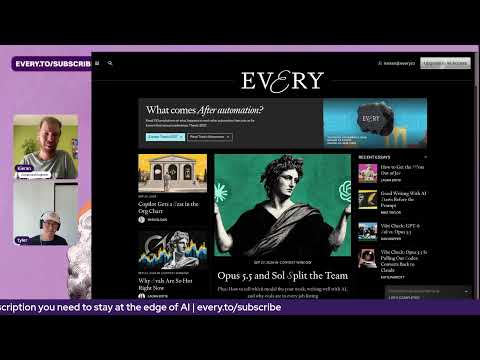
LIVE: Sonnet 5.5
A live discussion of Anthropic's new Sonnet 5.5 model, covering its speed improvements over Sonnet 5 and how it fits into a model lineup where "medium" no longer means Sonnet.
# Channel Identity Observations
## Intended Audience
- **AI-practitioner professionals** — the hosts explicitly segment takeaways by role: *"everyone likes this model. Writers, intellectual professionals, will probably continue to use Opus... But if you're a designer, um, or engineer, for iterative work, maybe it's interesting."*
- **Budget-conscious subscribers** — the channel directly addresses lower-tier users: *"if you're a budget user and only want to pay $20 a month, you're in luck, because this is the model for you"*; also references *"$20 a month plan or a $100 a month plan"* and *"$200 per month subscription"* tiers.
- **Interactive live audience** — hosts respond to named chat viewers by name (Trevin, Dennis, Kieran): *"Trevin asked, 'What interface do you use, CLI or do you use desktop applications?'"* — indicating a live-streaming format with an engaged community.
## Claimed Scope
- **Rapid, launch-day AI model coverage** — *"we're live every time a new model launches and we give our opinion"*; the stream occurs on launch day: *"Today is the launch day of Sonnet 5.5."*
- **Multi-perspective, team-based evaluation** — the channel aggregates takes from named team members (Tyler, Katie, Mike, Kieran, Derek): *"a written vibration check... where you can view all our takes"* and *"we're trying our best not to cause you any hype... have different perspectives on how we use it."*
- **Practical, workflow-level testing** — claims to test so viewers don't have to: *"share that with you so you can learn how you can use it so you don't have to try it yourself."*
## Self-Description Evidence
- The channel self-identifies as **Every** (*"we share all of this on our website, um, it's every.to"*) and brands itself: *"Every—it's the only subscription you need to stay on the cutting edge of AI."*
- The hosts work at Every on real products: *"we're working on the Every agent"* — evaluations are framed by actual professional use (design, engineering, writing).
- **Anti-hype positioning** is stated explicitly: *"we're trying our best not to cause you any hype. Yo, this is the most amazing new model. Let's begin."*
## Observable Presentation Patterns (Demonstrated, Not Claimed)
- **Practitioner demos**: hosts show real artifacts built with the model — a golf game, creative-coding grid layouts, a Three.js land visualization, benchmark comparisons ("LMG bench").
- **Honest criticism**: the hosts note model failures (a cat feature deleted, bizarre hitting mechanics, 19-hour ultra runs) rather than pure promotion — consistent with the stated anti-hype stance.
- **Ecosystem fluency**: casual comparisons across Claude (Opus/Sonnet/Haiku), OpenAI (Codex, Astra), Cursor, and pricing tiers — implying the channel covers the broader AI tool landscape, not one vendor.
- **Live, informal production**: StreamYard stream with resolution issues acknowledged on-air (*"we're live streaming with StreamYard"*) — an intentionally conversational, unpolished live format.
## Distinguishing Claims vs. Demonstrations
- **Claim**: Every is "the only subscription you need" to stay current on AI — a marketing self-description.
- **Demonstrated**: the video itself shows launch-day, hands-on, multi-reviewer testing with named team members and audience Q&A, which substantiates the format claims without requiring the audience to take the marketing line on faith.
# Delivery Observations — "LIVE: Sonnet 5.5"
## Format & Setting
This is a **live launch-day reaction stream** with a co-host (Tyler) and occasional chat interaction (viewers Trevin, Kieran/Derek referenced by name). The delivery is conversational, unscripted, and demo-heavy, punctuated by real-time housekeeping ("we have a written vibration check. It will be sent within the next 30 minutes") and self-deprecating production remarks ("we'll make sure it's high definition next time, because you deserve high definition").
## Tone
- **Enthusiastic but hedged.** Strong praise is repeatedly qualified with a counterpoint: *"I have only good things to say about the Sonnet 5.5... and the cons"* — the pros/cons framing is stated explicitly.
- **Anti-hype positioning** is stated as an editorial stance: *"we're trying our best not to cause you any hype. Yo, this is the most amazing new model. Let's begin."*
- **Casual, exclamatory openers**: *"Happy Monday!"*, *"this is crazy to me"*, *"which is pretty cool."*
## Recurring Vocabulary & Phrases
- **"Low and mid/medium levels"** — the single most repeated phrase, functioning as the video's thesis. Appears in nearly every segment: *"the low and mid levels are perfect for the design work"*, *"use this model at low and medium levels. This is the golden mean"*, *"I'm a big fan of the low and mid-range Sonic."*
- **"Golden mean"** — used twice for the same recommendation (*"This is the golden mean"*, *"the middle level is a very, very good golden mean"*).
- **"Iterative / iterating"** — tied to a specific argument about loop-based work: *"You need these quick iterative prompts"*, *"a lot of my work is iterative"*, *"in iterative design things."*
- **"Why not just use Opus?"** — the central tension, restated multiple times: *"who the hell uses Sonnet?"*, *"why not just use Opus?"*, *"Why, why, why, why should you choose Sonic?"*
- **Money/plan framing**: repeated references to *"$20 a month plan or a $100 a month plan"*, *"$200 per month subscription"*, *"save the company some money on tokens."*
## Teaching Habits
- **Question-led structure.** Opens with a rhetorical question and organizes content around answering it: *"the first question about Sonnet is: who the hell uses Sonnet?"*
- **Effort-level taxonomy as the core lesson.** Consistently teaches by effort tier (low/medium/high/ultra), including a quantified payoff: *"the base average is 37 minutes... on high, it increases four times, then 11 times, 40 times... 16 times more work, that doesn't mean it's 16 times better."*
- **Demo-then-conclusion pattern.** Shows a concrete artifact (Proof editor, golf game, SwiftUI project, Three.js land plot) before drawing the general rule: *"I just wanted to demonstrate that you can do such really interesting design work with just average effort."*
- **Surfacing others' takes as contrast.** Relays team members' positions by name to show divergence: *"Mike and Katie's... 'Yeah, why should I use Sonnet 5.5 if I have Opus?'"*, *"Katie says he's a great co-author."*
- **Actionable, audience-segmented advice at the close**: *"if you're a designer, or engineer, for iterative work, maybe it's interesting... if you're a budget user... you're in luck."*
## Communication Patterns
- **Transcript-level transcription noise**: the model names are inconsistent ("Sonic 5.5", "Sauna 5", "UltraQuote/Ultracode" for ultra effort), likely artifacts of live speech or auto-transcription — treat exact name spellings with caution.
- **Co-host handoff ritual**: *"I'm curious, Tyler, to hear your thoughts... And then I'll share mine."* Turn-taking is explicit and repeated.
- **Reading and answering chat live**: *"Trevin has one. Um, you can only choose one model..."*
- **Filler-heavy delivery**: frequent *"um"*, *"hmm"*, *"you know"*, and self-interruptions (*"sorry, let me just finish this game"*).
## Stable Patterns vs. Isolated Moments
**Stable (repeated enough to trust):**
- The low/medium recommendation and "golden mean" framing.
- Pairing every praise with an Opus comparison and a cost/speed rationale.
- Demo-driven evidence with personal workflow anecdotes.
**Isolated (thin evidence, noted with uncertainty):**
- The 52-minute low-effort caution (*"he worked for 52 minutes at low speed... he won't tell you shamelessly"*) and the 19-hour UltraQuote anecdote each appear once — memorable but not established as a recurring teaching point within this video.
- The anti-tribalism remark (*"you just can't be tribal anymore for the sake of these tools"*) occurs once; whether it's a durable stance can't be confirmed from a single stream.
- Speculation about Haiku 5.5 is explicitly uncertain even in-delivery: *"I really curious... actually, I don't know if I want this."*
# Observed Positions: "LIVE: Sonnet 5.5"
**Video type:** Live stream review of a newly released model ("Sonnet 5.5"), recorded on a Monday, reportedly less than a week after a previous model release. The transcript appears to be a rough or machine-generated rendering — model and tool names are inconsistent (e.g., "Sonic," "Sauna," "Opus 5" vs. "Opus 5.5," "Fable," "Astra," "Soul," "UltraQuote"/"ultracode"). Names below are preserved as they appear; exact wording is not reliable as verbatim quotation.
**Speaker identification:** Two primary speakers are identifiable only by conversational evidence: an unnamed **host** (moderates, relays team takes, discusses benchmarks) and **Tyler** (identified by name in dialogue; described as a designer at Every). Additional takes are reported secondhand from team members **Katie** and **Mike**. Chat participants **Trevin** and **Kieran** are mentioned; **Derek (Darek)** is cited as an external/article source. No other speaker attribution is possible from the transcript.
---
## Central framing (host)
- The launch-day framing question: **"Who the hell uses Sonnet?"** — given Opus, Fable, and Haiku exist, Sonnet is "not the cheapest" and "not the best," so the hosts set out to justify its existence.
- They compared it to **Sonnet 5**, which "we weren't fans of," and the host reports being personally "very surprised by how good" the new model is. He notes his prior Sonnet reference points were Sonnet 3.5-era models, which he considered great.
- Reported tension within the team: **Katie and Mike** asked, in effect, *"Why use Sonnet 5.5 if I have Opus?"* — and concluded they didn't need it, since Opus is "so good, even with less effort, it's also very fast," even though "they liked the model."
## Tyler's position (designer)
- **"Sonnet 5.5 was extremely impressive. I was amazed."** Tested it across effort levels (low, medium, high, "super high").
- **Low and medium effort are "perfect" for his design work** at Every, including work on the "Every agent" toolbar, which he says doesn't require frontier-level intelligence.
- Reasons given: **cheaper than Opus**, and **fast** at low/medium — speed matters for "quick iterative prompts" in design work. Also reports a "surprisingly great track record" on creative coding and game-building tests.
- He was a long-time Max subscriber (aside from briefly leaving "after the Opus 5") and **never used Sonnet** — "I never saw the point" — but now plans to use Sonnet low/medium for most work and "save the company some money on tokens."
- Above medium: **"Why not just use Opus?"** He declines to praise the highest levels.
- Task-level nuance: accessibility fixes on small UI elements → Sonnet Low; **Figma-to-code iteration** → Sonnet works well and is fast enough to iterate; **larger feature implementations → Opus**, which he says is "obvious." As a sole designer who doesn't do large complex implementations, Sonnet fits most of his work.
- Calls Sonnet medium **"something magical… such a perfect middle ground for design"** and says Sonnet will be "a major part of my contribution this month."
- **Demonstration projects:** a creative-coding grid/metal project with a single font-size constraint (built at medium effort via iteration), a Rubik's-Cube-grid design echoing the Every agent logo, storyboard-style animation — describing his prompts as "a single sentence… not perfect English," i.e., "real vibe design."
- **Golf game counter-example:** when he used **max/ultra effort with a long voice-dictated prompt**, the model ran for hours, removed features he wanted (wind fans, a ball-stealing cat), and produced a "bizarre" hitting mechanic. He says he lost intuition about which effort level to use. Low/medium had built most components well.
- **19-hour "UltraQuote" example:** an off-grid property visualization in (transcript: "Jake 3 JS") ran 19 hours at ultra effort, producing superior detail (grass blades, palm trees) but also unnecessary additions (mountain/coast flyovers, time-of-day changes) at much higher cost. His takeaway: **medium/low was "great" and much cheaper; in under 10 minutes he got something "pretty good."**
- **Effort-level data he presented:** base average ~37 minutes; medium ~1 hour (1.6×); then roughly 4×, 11×, 40× at higher levels — with the caveat that "16 times more work doesn't mean it's 16 times better," and that his tasks may have been "too complicated or too big for this model."
- **Tool-tribalism concession:** he says, "sadly" as "a very big fan and supporter of Cursor," that **"you just can't be tribal anymore"** — if a tool makes you more efficient, use it, even accepting the transition cost back to Claude.
- **Caution on Sonnet low:** given an ambitious task, it once ran **52 minutes at low effort** — "you probably just don't want Sonnet running at low speed for 52 minutes."
- Benchmark summary he relayed (host and Tyler jointly, on Opus 5.5 vs. Sonnet 5.5): Sonnet 5.5 is **much better than Sonnet 5 at tool-calling but not as good as Opus 5.5** — "if you want the best tool, go for Opus."
## Host's position
- Views Sonnet 5.5 as **"an extension of Opus"** — "just as good as Opus, but faster," especially at low and mid levels; at high/ultra levels it's "unsuitable for me… too long… not smart enough."
- **Use case split:** for one-off comprehensive feature implementations, he'd choose **Opus at medium** ("very versatile"); Sonnet shines in **iterative loops**, where full-design iterations consume far more tokens than text work — so speed and cost compound. Mentions software and 3D as iterative domains.
- Presents an **LMG bench comparison** (single-query benchmark): Sonnet 5.5 low effort reproduced "Proof" (an AI editor by Dan) that previously only Opus/Fable 5 could one-shot — "this is crazy to me."
- On budget/accessibility: many users hit Opus or "Fable" limits on $20/$100 plans; Sonnet 5.5 offers "very similar capabilities as the Opus 5.5, in many ways," letting $20-tier users run agents "for 2 days without exceeding" limits — opening work normally reserved for the $200/month tier.
- **Writing question (relaying Katie and Mike):** Katie calls Sonnet "a great co-author," but uses Opus 5.5 because it's "a little smarter for writing"; she doesn't know if she'd use Sonnet daily. Mike: **"I don't see why Sonnet is a go-to for me in my day-to-day work, considering I love Opus 5.5 so much."** Their shared advice: if you exhaust Opus limits, Sonnet is "also great."
- **Sonnet 5.5 vs. "Soul" question:** he'd choose ChatGPT/"Astra" for computer-use tasks — "insanely better" — and prefers the **Codex app** to the Claude app, especially for iOS work (smoother simulators, better Xcode/API-setup guidance). For Claude Code he used only the terminal until seeing it work at medium effort in the desktop app, which "has become much better" (browser previews).
- **Anthropic trajectory observation:** two strong releases within two weeks ("previously Anthropic always grew to around 4.1, 4.5… now they're just releasing the fifth version"); he's "really curious" about **Haiku 5.5** (Haiku 5 never appeared) and wonders "how far can you distill these things?" He speculates Haiku might suit cloud-agent products for cost savings, but hedges: "I don't know."
- **Rating caveat:** Sonnet doesn't get a green rating "for everyone" because Opus exists and because mid-tier Sonnet competes with the higher tier of "Soul" — which he says "slightly distorted the reality of the model's class and capabilities."
- **Closing recommendations:** writers/intellectual professionals will likely stay on Opus ("why not?"); **designers/engineers doing iterative work** should find Sonnet interesting; **long-running tasks → Opus**; **budget users → Sonnet 5.5 is "the best model for the money."** Some people prefer "Soul 6" for writing style — "try out the models."
## Tyler's closing summary
- **"The low and mids are very good for the Sonnet"** — he will "definitely be switching to those two models for most of my work."
- His rule of thumb: at anything above medium, **"you could just switch to Opus… just don't use anything high."**
- Echoes that medium is "a very, very good golden mean," while acknowledging low/medium Opus is also great.
---
## Unresolved tensions and qualifications (preserved)
- **Internal team disagreement:** Tyler and the host adopted Sonnet for iterative design/engineering work; **Katie and Mike did not**, finding no reason to switch given Opus 5.5. Both positions are stated without resolution.
- **Effort-level inconsistency:** low/medium praised throughout, but Tyler's own golf-game and 19-hour examples show high/ultra producing *better* output in some cases (best golf results came from planning *and* executing at max, contrary to Derek's plan-at-max/implement-at-low advice — a contradiction Tyler himself flags: "what's interesting… I got the best results when I planned at maximum and let her just execute at maximum").
- **Reliability caveats:** Sonnet low can run unexpectedly long (52 minutes); high-effort runs can consume hours and remove requested features; tool-calling is explicitly weaker than Opus 5.5.
- **Formatting/transcript unreliability:** model and tool names are inconsistent throughout the source transcript, so specific product references (e.g., "Fable," "Astra," "Soul," "UltraQuote") cannot be confidently normalized.
# Speaker Roles & Provenance Record
## Video Identification
- **Title:** "LIVE: Sonnet 5.5"
- **Video ID:** `01a0f15a-44a9-7aa8-b116-cc65ca887878`
- **Format:** Live stream (StreamYard, per host's remark), model launch reaction/review
## Speakers & Roles
| Speaker | Role | Evidence |
|---|---|---|
| **Unnamed host** | Creator / co-host | Opens the stream ("We are live"), leads discussion, delivers closing remarks |
| **Tyler** | Guest / co-host; designer at **Every** ("as a sole designer" on the Every agent toolbar) | Welcomed by name at start; invited to share testing conclusions |
| **Katie** | Referenced third party — written take quoted (writing-focused comparison of Sonnet 5.5 vs. Opus 5.5) | Not present in audio; take relayed by host |
| **Mike** | Referenced third party — written take quoted (prefers Opus 5.5 for daily work) | Not present in audio |
| **Kieran ("Karen"/"Kieran" in transcript)** | Briefly appearing participant | Drops off and rejoins mid-stream ("I think we lost Kieran... Oh, hello, Karen"); no substantial attributed claims |
| **Trevin** | Chat/audience participant | Asked questions relayed by speakers (model choice, CLI vs. desktop); mocked playfully ("Trevin says you live on the edge of AI") |
> Note: Names in the transcript vary in spelling (Trevin/Tyler-adjacent names, Karen/Kieran, Derek/Darek); roles are recorded as stated without adjudicating spelling.
## Referenced Sources & Third-Party Claims
- **Dan** — creator of **"Proof"**, described as an AI editor; cited as the benchmark example Sonnet 5.5 (low effort) could reproduce one-shot.
- **Derek/Darek** — recommended (per speakers, "on Twitter" / "article") planning at max/ultra effort then implementing at low effort; Tyler says he applied this workflow.
- **LMG bench** — benchmark the host used (single-query "complex LMG engineering") comparing Sonnet 5.5 low vs. Sonnet 5.
- **Katie and Mike's written takes** — team member evaluations on writing use; relayed secondhand by the host.
- **"Vibration check" / written take document** — stated to be sent "within the next 30 minutes to an hour" on their site; availability limited to that channel.
- **Every.to benchmarks** — host references "our Opus 5.5 vs. Sonnet 5.5 benchmarks" (tool-calling comparison) published on their website.
- **Mentioned products/models (claims, not verified here):** Opus 5.5, Sonnet 5/5.5, Haiku 5 (never released per speakers), "Fable," "Astra," "Soul," Codex app, Claude app/Code, Cursor, OpenAI computer use.
## Promotional Segments (flagged)
- **Every subscription:** Closing pitch — *"Every—it's the only subscription you need to stay on the cutting edge of AI."*
- **Upcoming content push:** "OpenAI materials tomorrow" and Dennis "reporting live from there" — cross-promotion of future Every coverage.
- **Team takes on every.to:** Repeated redirection to the site for the full written evaluations.
## Availability & Provenance Limits
- Katie's and Mike's full takes: **not included in transcript** — only paraphrased quotes; complete versions deferred to the website document.
- Tyler withholds details of the unreleased Every agent work ("I don't know if I can say what we're working on yet"), later permitted to say "Every agent."
- Tyler checks before screen-sharing the off-grid property project for sensitivity ("make sure I don't share anything too sensitive").
- Comment availability: audience questions arrive via live chat (Trevin cited); no comment-section status stated.
- Stream quality caveat: hosts acknowledge a 720p resolution issue, promised HD next time (production note, not content provenance).
## Attribution Summary
- **Host voice:** framing questions, quoting Katie/Mike/Derek, benchmark commentary, final recommendations.
- **Tyler's voice:** design-work testing at Every, creative coding demos (golf game, grid/Metal project, Rubik's cube logo), 19-hour UltraQuote off-grid 3D.js task, effort-level timing data (37 min base → 1.6x mid → 4x/11x/40x higher tiers).
We are live. Welcome, Tyler. Hello everyone. Today is Monday. Happy Monday! One more week. It felt like we did it last week, which we did. Less than a week later, a new model was released. Happy Monday! Today is the launch day of Sonnet 5.5. Another model 0.5 has been released. And yes, we tried it for you . And the first question about Sonnet is: who the hell uses Sonnet? Because there is Opus, Fable, and Haiku . So, there's this: why do you even use it? It is not the cheapest. He is not the best. Like: why do we need this? And that's interesting. We just tried. And we tried to compare it to the old Sonnet 5, which we weren't fans of. And personally, I was very surprised by how good the Sonnet model is. I think the last Sonnet 5 model I used was the Sonnet 3.5 and the new 3.5. These are great models. And so, let's just talk about how we tested it, what you can use Sonnet 5 for , what that will mean, what we like about it and what we don't. Hmm, we have a written vibration check. It will be sent within the next 30 minutes to an hour, where you can view all our takes. And yes,
some of these takes, like Katie and Mike's, for example. They say, "Yeah, why should I use Sonnet 5.5 if I have Opus?" And,
um, that's a very good question, because Opus is Opus 5.5, it's so good, and even with less effort, it's also very fast. So, why would you choose the, um, smaller model, um, over the Opus if you have one ? So for Mike and Katie it really came down to, they decided, "Yeah, I don't really need that model, that size, um, because Opus is so great, even though they liked the model." And the model, uh, is their version. And then there's Tyler and I, we do different kinds of work. Uh , we don't use it for writing that often. Uh, we were builders, designers, uh, engineers. And so, I'm curious, Tyler, to hear your thoughts on how you've been using, uh , Sonnet 5.5 and, uh, what your conclusions are? And then I'll share mine. So, Sonnet 5.5 was extremely impressive. I was amazed. I actually , uh, tested it at different levels of effort, uh, from low, medium, high, super high, etc. And I found that the low and mid levels are perfect for the design work that I do, for Every, uh, for my work at Every. I don't know if I can say what we're working on yet. Uh, stay tuned . But, I'm sure you can say that. Yes. Well, we're working on the Every agent, and a big part of my work is, um, the toolbar. It does not
require the high-quality intelligence that Opus always needs. Sometimes it's needed, but often, um, you don't need a super-high-end,
um, model on the frontier. So when I tested the low-end and mid-range Sonnet, I realized that it was actually a great model for my daily work. And one of the reasons is that it's obviously a cheaper option than Opus, but it's also fast. Low and medium levels are fast, which is very important for design work . You need these quick iterative prompts. And it also has a surprisingly great track record . I was able to, you know, do creative code tests. I tried creating games with it, which also impressed me. I mean, this model, like the Sonnet 5.5, is actually really delicious, and I was, for example, a Max subscriber, except for the time I briefly parted ways with them after the Opus 5. Before that, I was a Max subscriber for as long as I can remember, and I never used a Sonnet. I just never saw the point. I thought, "I'm just going to use Opus." Hmm, so this is the first time I've thought, "Wow, like, I can use Sonnet 5.5 low and medium for most of my work, save the company some money on tokens, um. Still have a lot of fun, have a lot of fun working." So I'm impressed. I have only good things to say about the Sonnet 5.5, uh, especially the low end, and the cons. What about very high? Can
you say something good about very tall? I think after the middle it's like, " Why why not just use Opus?" Yes. We will look into the details. Yes. Yes. Yes.
Trevin says you live on the edge of AI. Spend that money, Tyler. But it's actually funny because I was asked, as if people are making an argument by using a model that's cheaper to save money. But that's not the reason I use this model. So I want to add to what you're saying that I think our way of working is more similar. I also create products. I really think of it as an extension of Opus, and I like that it's similar in a way . It's just as good as Opus, but faster. And especially at the low and mid levels, I think it's absolutely great. I think if you choose high, extremely high, or any other, it would be unsuitable for me . I just don't like Sonnet there. It's just too long. He's not smart enough to actually do what I need. So our problem is to just give it to Opus. Opus is better, requires less effort. So I think use this model at low and medium levels. This is the golden mean. Uh, especially with things where you can just do more. Like traditionally, uh, we, the ones who spend tokens, just run a million experiments and do all that stuff, but a lot of people have it , uh, accessible, not because of accessibility, because they have either a $20 a month plan or a $100 a month plan, or they end up because they use up their Opus or Fable limits because they just need to
work and there's no room for fun and experimentation. And I think this model gives you very similar
capabilities as the Opus 5.5, in many ways . Which, as crazy as it may seem, the Opus 5 is definitely not that good, but it does a lot more things than you might think it should be able to do. Hmm, and especially in iterative design things like this, where you're in a loop, and like I made this argument, like Katie said, yeah, but I can wait two extra seconds for Opus to come back, uh, because it's a little bit better. Yes, it's a little better, but if you're working with words, it's pretty fast, but if you're doing a full design, suddenly you see this difference. For example, an iteration for a full design is more tokens than a few lines of text. So, I think if you're working with software or, uh, with 3D, uh, it's more iterative, uh, yeah, with technology, they're both close in price, but this is cheaper, faster, and it's actually pretty good. If you compare one thing to another, there's really no reason not to use AI for many things. Even for things you don't think AI should be used for, I'm not going to use it. For example, it will now make it even easier for people to implement more things. Hmm, one example, let me just show a few in parallel, and then Tyler will also do your parallel comparison, but, hmm, I'm
using LMG bench, which is a benchmark for , hmm, which uses complex LMG engineering, which is a single query, and on the left, hmm, Sonic 5.5 at a
low level, and on the right, Sonic 5. Obviously, Sonic 5 is not capable of this. This is a completely rewritten Proof, which is an artificial intelligence editor that Dan made. And the first model that got it was the Opus 5. The first model that was able to do it without errors was the Opus, which is the Fable 5, and it's crazy that we now have, um, the Sonnet model, which is at a low level, which can one-time, um, create this product that works. Hmm, this is crazy to me. Like, Sonnet, with minimal effort, can run the code, uh , and do everything, check everything, make it work, which, um, yeah, that's great. Yeah, and Sonnet 5-no, but nobody likes Sonnet 5. So, uh, this is another example where my cozy island, uh, write Sonnet 5, he did it and left, uh , 5, 5. And obviously it's just more refined, it's better . There's a lot in it. Yeah, it's not as good as, uh, Opus. And also, this is a low level, if you go up, uh, super high, for example, it's already better. Uh, but you can see how crazy the jump is. And it's like a similar jump, uh, like here, you see how much better it is already if you go higher. But I would say it's super high, it just
takes too much time. I think low or medium Opus is just worth the money because it uses fewer tokens. But you can see that it's very powerful, uh, and
it can do a lot of things. Uh, let's see. There are some questions. Trevin has one. Um, you can only choose one model for comprehensive feature implementation , which model and level of effort do you choose? I think for the type of work where you only do one-off things, I would still choose Opus because it is so versatile. I would choose medium. Opus medium, I think, is very well suited for this. But, I think there's a place in this model where you're more in a loop or where you're iterating more. And like Tyler, maybe you can show how it works in your workflow or how fast it is. Things you created. Um, so I would still choose that. Um, Tyler, what about you in terms of design work ? I think it depends on the type of design work . If I'm working on, say, accessibility for a label, chip, or button that's on a surface that you can't see very well, you can use Sonnet Low for that. So it looks more like an interface error. If I'm iterating on a design with Figma, Sonnet also does a really good job of taking the image from Figma and implementing it into
code. And it's also fast enough that you can iterate over it. So I really like it. I think the low- and mid-level Opus is also quite fast
and very good, and in some aspects even more interesting. Hmm, a lot is done for the sake of cost, but the result is surprisingly good. And for bigger things, I think it's obvious that you want to use Opus for bigger things. Hmm, but yeah, you know, a lot of my work, a lot of my work is iterative. It's iterative, you know? So the low- to mid-level Sonnet is actually something of a godsend for me. I'm actually really excited and still can't believe I'm telling people that Sonnet will be a major part of my contribution this month. I think this will be with Sonnet medium. So, you could say that design is your daily driving force. Yes, for the most part, yes. Because for many of my tasks, as a sole designer, I don't do large, complex feature implementations. You know, I'm on the team. We have people who do a lot of this hard work. But personally, it's really hard for me to imagine myself turning to Sonic because, you know, when you're working on a personal app or something like that and you're doing a complex feature implementation , you have to use Opus, like you said, right ? It's just...Why, why, why, why should you choose Sonic? So, in my personal work environment, it makes a lot of sense to use Sonic at low and medium levels. And the middle level is something magical, to be honest . It's just such a perfect middle ground for design. Yes, I agree. And, as before, it often felt like Sonic 5 just couldn't do it . It's like it just doesn't work. And now we have reached a level where he can do almost everything.
Can it be done better or deeper? Yes, Opus, but you don't need it. It can do almost everything you need, even very important
applications such as complex programs. So we've reached a point where it's so capable that, like, you can do a lot of things with it that... Yeah, it's a magical threshold, and I hope it opens up, uh, augmented reality . I'm using... I think we lost Kieran for a second , but while we were waiting for Kieran to come back, someone asked the question: "Would you go with Sonnet 5.5 or Soul first?" Okay, so I can only speak from my own experience. As for GPT in chat, they just use the computer better. I mean, this is insanely better. So, if there is any use for the computer, I don't even hesitate to turn to Astra. And I think Astra is kind of like, if you're going to use something for a computer, you should use Astra. Um, and also, I think the Codex app is much better. I don't know. It's just better made at the moment. It's like the Claude app has gotten a lot better, but the Codex app is truly great. And it seems to work very well with iOS. So I'm working on some iOS projects and it just feels better, seems better. Simulators seem to run smoother. And with all these complicated things that you might not be familiar with, like, let's say you need to ... Let's say you're starting from scratch, you need to create an Apple developer account, or you need to set up some API keys or something, this can get you through it a lot more smoothly. Um, just because it's basically just using a computer. Um, but
you know what? Trevin asked, "What interface do you use, CLI or do you use desktop applications?" You know, for Codex I
only use the app. For Claude Code, I only used the terminal until, ahem, I saw it working on Medium while testing. And that's because you can view your work in a browser. It's just that the desktop application has become much better. Hmm, he got a lot better. So you know what? I'll just share a few things I did at Sonic 55. I'm back too. Oh, hello, Karen. So, are you answering the question about the Sonic 55, um, instead of the Soul, um, or so, my question is, it really depends on what the computer usage is, I 'll always use the Chat GPT. I think right now, for example, for working with Swift UI, um, there's no reason for me to use, um, you know, Cloud is actually really good, but I really like how the simulator opens up in code. It seems to work better with X code. They are doing something magical there. Hmm, so this was all done on Sonic Medium. Hmm, this is just a creative coding project for which I gave, um, a hint that I wanted to do something with a grid layout. And I want to, um, use metal and, um, you know, some other restrictions, like having only one font size for about 90% of the design. And I just do it through iterations at the middle level. So I just wanted to demonstrate that you can do such really interesting, um, design work
with just average effort, which is just amazing to me. So I added a little bit of quivering here. Hmm, I wanted to make it a little crazier. You
can see huge changes in the background. Hmm, and then, I think, the next iteration or one of those next iterations, I tried to see if I could do, um, a Rubik's Cube or a grid. So let me just see a real designer use AI instead of me trying to design something because I like it. Because it looks great. Thank you. Well, it's...it's kind of like the Rubik's Cube from the Every Agents logo. And he pulled it off very well. And then I tried...These are just a few tips, and this is really a real vibe design. I'm not writing anything complicated. I write a single sentence here and there. Not perfect English. I won't explain too much. Hmm, it created something like this below. I don't know if you can see this, but I asked him to create something like a storyboard- style animation for me . So, this is ...And then let me move on to this last one. This is where I, um, gave up. And I had a lot of fun. I think that's the main thing. It's like I got really excited about creating these five designs. Who knows what this is , damn it. Hmm, yes. And is it because sometimes they do things to these models that you don't want, and it annoys you? Hmm, did you
experience anything similar with Sauna? For example, as in the case of Opus, I don't have it anymore. I haven't had many complaints about the Sauna 5, like it just runs too long at
certain points, and then obviously I shouldn't use the Sauna bottle that is the Opus, but have you found anything that annoys you as a designer, like the tilt or something? You know, not in this experiment, but I have another thing that I can show you where it worked, especially on the maximum effort and ultra effort code, I guess I can just share that quickly. Let me just set this up here. But I was building, we're also going to move on to writing, well, we're pushing the separation check a little bit, well, to each adult TO so we can review, well , the responses from other team members who are very busy this week because there's a lot going on. Please continue. Okay, let's begin. So, here's, well, here's a golf game I made using Sonnet. Hmm... Actually...It's like one of the first games I made that I had a lot of fun with. Hmm...but I meant to say maximum effort, um, maximum effort and ultracode effort . But when I just dictated a very long prompt with my voice, I realized that she, um, removed aspects...She was doing so many things that I didn't want. For example, she added...I have these, um, fans here...I don't know if you see it on the left...It's...I had a cat in the game that would run around and steal the ball from you ...But she just deleted it...Oh, by the way, there's a cat that's extremely ugly...I mean, it doesn't click very well...it's...I don't know what it is. But,
hmm, in testing I found that it works much better if you plan in max and ultracode first and then implement, and Derek seems to
have recommended this on Twitter recently. Hmm. Yeah, it's kind of like ...sorry, let me just finish this game. But, yes, this game. So, I think what I realized when I was making this game was that low and medium effort was really good at a lot of things. For example, I created many of the things you see on the map, such as a stack of books, spinner widgets , a golf club, and the ball itself, low and medium efforts created it. And these fans, I wish I had a better screenshot, but the fans were so well made, it was like, "Hey, can you make a fan that blows wind instead of the natural wind that blows the ball in the air?" Hmm, but then when I, you know, the first time I said, when I set the settings to max or ultra code and did a long voice dictation, I said something like, "Hey, I want to do all this crazy stuff and make it more like mini golf, like it's a real golf course, but mini golf." And it worked for a very long time, about a few hours, and, um, there were no fans, the mechanics of the hits changed. It was a really weird, bizarre hitting mechanic. I didn't even know how to hit a ball. Uh, I took the cat, my beautiful cat. And I
was left with this, um, kind of mental confusion, like, I didn't ...um, I didn't have any intuition about what level of effort to use at that moment.
Yes. Well, read Darek's article. He wrote this great article about using Opus, I think, and planning with maximum and ultra code effort, and then implementing and iterating at low. So I actually tried it and it was great. But what's interesting, and I think it's because it's a game that has more complexity. But I got the best results when I planned at maximum and let her just execute the plan at maximum . It was the best. But again, you know, we're lucky because we know we can test this early on. I think if this were my real account, I mean, realistically speaking, I would probably want to use Opus for most of this work, you know, hmm. Yes. Steeply. Yes, the question was, how is he for writing? Both Katie and Mike took the test, and Katie says he's a great co-author. Hmm . But Opus 5.5 is also a great collaborator. So she uses Opus 5.5 because it's a little better at certain things and has more intelligence. So she uses Claude. Hmm, but she doesn't know if she 'll use Sonnet every day. But she likes it as a co-author, just like Opus 5.5, it's incredibly good, fast, and, um, a little smarter for writing. Hmm, but if you've exhausted your Opus usage limits, use Sonnet, because it's also great. Hmm, so if you're on a lower usage plan , yes, it's a good writer. It's just that Opus 5.5 also writes code very well and very fast. Hmm, and this is
Mike and Katie's point: I don't see why Sonnet is a go-to for me in my day-to-day work, considering I love Opus 5.5 so much. Hmm, but like
I said, for me it just opens up possibilities . This gives me the options to use a cheaper model because it's faster, and maybe I've tried some of the ultra-code stuff and it works for a long time. Hmm, of course. So you can say what you want, but it also does a little worse job of calling out tools. So in our Opus 5.5 vs. Sonnet 5.5 benchmarks, it's good. It is much better than Sonnet 5, but not as good as Opus 5.5 in calling out instruments. So if you want the best tool , go for Opus, but enjoy mostly version 5.5 and maybe tell people who have a $20 subscription like you that now you can do crazy things and use your agent for 2 days without exceeding your max, which is pretty cool. This will open up opportunities for work that we would normally do with our $200 per month subscription. So the more people can do it. So I'm really excited about this, and I think this is the second model to come out so quickly, and it's much better than the last one. Previously, Anthropic always grew to around 4.1, 4.5, 4.6, 4.7, 4.8, and now they're just releasing the fifth version. They're making big strides, and I'm just curious what Haiku 5.5 will be like, because we never saw Haiku 5. Will Haiku be a one-off as well ? Will it be even faster?
I'm really curious because it's obvious they've come up with something and it's working because they've released two models within 2 weeks that are really good and amazing. Uh, and, uh,
the only reason the Sonnet doesn't have a green rating for everyone is because there's Opus, and also because the mid- tier Sonnet competes with the Soul, which is the higher tier. They just slightly distorted the reality of the model's, uh, class and capabilities, which is really cool. So I'm looking forward to seeing Haiku 5 5 do that too. Uh, any other final thoughts, Tyler, uh, from you? I think, I think one thing I just want to , for example, really emphasize is that the low and mids are very good for the Sonnet. And, uh, if it's just, uh...I, I did some analysis of some of the work that I've done, uh, where I visualized, uh, this off-grid, uh, property that my relative has. Uh, UltraQuote worked for, uh, 19 hours. Maybe I can just make sure I don't share anything too sensitive, but I can just quickly show this...hmm... We can go a little longer. I...I can also go over some other things here, so I think I can show this very quickly. This will be very fast. Um, here's what might be a little hard to understand, but I
did a task where I essentially said: here's a piece of land, can you build it in Jake 3 JS? Well, that's all. And it was just like that : use
whatever tools you want. And, uh, UltraQuote worked on this task for 19 hours . Um, that was incredibly better. It was as if he had real, beautiful blades of grass. He realized that some of the trees were actually palm trees. He also did some silly things, like he gave me a view of the mountains that were nearby. It was as if for some reason he thought it would be a good idea to do a flyover over the mountains and then a flyover over the coast. Which was very unnecessary and not needed at all. Let me change, for example, the time of day and add different clouds, etc. And it cost much more. Hmm, but what I really consider medium and low was just great. And it was much, ahem , cheaper. I think the numbers you were looking for are roughly the numbers on this scoreboard that Claude gave himself. Hmm, and you know, I just thought I wanted to emphasize that in less than 10 minutes I got something pretty good. Uh, yes. And the value, the value you get from anything other than above average, it's really like, man, you could just switch to Opus. But yeah , I'm a big fan of the low and mid-range Sonic, and I'll definitely be switching to those two models for most of my work, and I'm also really
sad to say this as a very big fan and supporter of Cursor Rock. Because it was my daily car, and I'm just like, oh my God.
Um, you just can't be tribal anymore for the sake of these tools. For example, if someone comes up with a better tool that makes you more efficient, you just have to use it. So there's a transition cost that goes back to Claude, but, um, I think the low and mid levels are really so good that it's like, " okay." And Opus too. Now I have to go back. Hmm. Yes. So, here are the effort levels in my runs. Um, and you can see the base, let's count the time, the base average is 37 minutes. You can see that the average level increases to 1 hour - it is 1.6. And after that, on high, it increases four times, then 11 times, 40 times. So you can see it really grows at the end. And I think it's also because the work I'm giving is a little too complicated or too big for this model. Uh, but you can really see that the middle level is a very, very good golden mean. And you see it, like in the images here, you miss it a little bit, but you don't necessarily see that things are getting much better. You can see that there's a little more detail, maybe on the islands, but like, 16 times more work, hmm, yeah, that doesn't mean it's 16 times better. So, yeah, it's, um, really mid-to- low level, give it a try. Eh, but also medium and low Opus are great, but, um, just don't use anything high. Just use Opus. There is absolutely no reason to use a much higher level. Hmm, we share all of this on our website, um, it's every.to, and I'll just share this. Here you can see, um, our Vitek will appear every time the team finishes editing. Sorry, it's a crazy busy time right now. Um, people are releasing a lot of stuff. There
will be OpenAI materials tomorrow, so stay tuned . Um, Dennis, um, I have to report live from there. Hmm, Every—it's the only subscription you
need to stay on the cutting edge of AI, and we're trying our best not to cause you any hype. Yo, this is the most amazing new model. Let's begin. We're trying to, um, yeah, have different perspectives on how we use it and, um, just share that with you so you can learn how you can use it so you don't have to try it yourself. Hmm, everyone likes this model. Writers, intellectual professionals , will probably continue to use Opus, because why not? But if you're a designer, um, or, um, engineer, for iterative work, maybe it's interesting. For long-term tasks, I still chose Opus. And if you're a budget user and only want to pay $20 a month, you're in luck, because this is the model for you. Use it. This is definitely the best model for the money, hmm, I think, hmm, I think most people say that OpenAI is still very good at using a computer, and it's just very hard to be that good. So we still use it. Uh , some people, uh, really liked, uh, Soul 6 for its writing style. So try out the models, see what works for your writing style. Uh, but this is something worth checking out, uh, if you have a Claude subscription, because it's cool, uh , the Anthropic team is preparing , and now they can give us Haiku 5.5, because that would be pretty cool. That would be great. Uh, actually, I don't know if I want this. And the last thing I know. I'm just curious. How far can you, how far can you distill these things? Yes, that's right. Yes, I don't know. I think if you are building some kind of cloud agent product then Haiku might be a good solution to save some money on your business, but yeah, I don't know. But I forgot to
say one thing about Sonnet local. Uh, you have to be careful how you suggest it. I once gave him an ambitious task and he worked for 52 minutes at low speed. So it's incredible that it can be very fast and iterative, but it can also take a very long time to cook. And I, you probably just don't want the Sonnet running at a low speed for 52 minutes. But he won't tell you shamelessly. I am ashamed . I feel ashamed that he showed us. It seems like he has a similar cycle, but it's not that he's not like that , it's not bad. Also, one, uh, yes, celebration of dropping a cheap token tong. Perfectly. Uh, this is what I want to check the vibration again in 720p. We love low resolution. This is cool. No, sorry. We will solve this. I have no idea. I'm just live streaming with StreamYard, and we'll make sure it's high definition next time, because you deserve high definition. Um, we're working on making them even better, but the most important thing is that we're live every time a new model launches and we give our opinion. And yes, we will make them better. So thank you all. Um, thanks for joining, and maybe I'll see you tomorrow. Um, see you later. See you later. See you later. See you later. See you later.