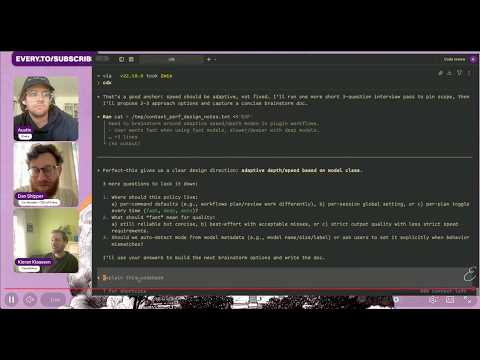
Live Vibe Check: OpenAI's Super-fast Spark Model Running at…
Live testing of OpenAI's Codex Spark model, the first OpenAI model to run on Cerebras hardware, emphasizing its extremely fast inference (~1,000 tokens/second). Discussion covers the model's speed and its coding quality relative to other models, and where it fits in a developer workflow.
# Channel Presentation Observations
## Observable Presentation Evidence
### Format: Live, conversational model "vibe checks"
- The video is a **livestream** ("All right, we're live"), hosted by at least two named participants (**Dan** and **Kieran/Kieran**) plus offscreen support ("if Dan drops again, it's all you, Garrett").
- The channel runs **live reaction streams on new AI model launches**: "Stream day, new model launch day. I feel like these days are coming faster and more furiouser every week."
- Recurring branding of the format as a **"vibe check"**: "We're vibe checking the new model. It's called Spark."
- Frequency claim stated by host: "this is our I think it's our fourth vibe check in the last 2 weeks."
### Demonstrated scope: Hands-on AI coding model evaluation and workflow experimentation
- The content demonstrates **live demos of new AI models** in real tools (Codex app, terminal CLI, agent browser CLI), including speed comparisons against competitors ("The right one is GPT 5.3 and left is Spark").
- Includes **practical use-case analysis**: brainstorming, triage, changelog writing, knowledge work against Stripe/YouTube data, UI design iteration.
- Participants discuss and build on **their own open workflow tooling**: Kieran's "compound engineering plugin" for Codex, and Dan references "Open Claw" and a "CFO skill."
### Claimed access and insider positioning
- Host claims early access and direct contact with model vendors: "We've been testing it for a week or a week or so" and "I learned these things yesterday from the team directly. And so I can share them with you now. And I think this is this is the only place you're going to hear this."
- Claims of requesting API access: "we at Every have requested access to it."
## Intended Audience
- **Builders and professionals trying to keep up with rapidly changing AI coding tools**, addressed directly:
> "If you are feeling like it's hard to keep up, you're feeling anxious about all the different coding models, subscribe to Every, we've got you covered."
> "If you want to keep up with the Edge of AI, you have to stay hydrated."
- Includes **non-technical "vibe coders"**: a participant self-describes as "someone who's like purely a vibe coder no technical background."
- **Live chat interaction**: viewer questions are read and answered on stream ("David asked, 'Can I use Codex Spark on Open Claw?'").
## Channel Self-Description (Explicit Claims)
- **Affiliated with "Every"**: hosts frame themselves as part of Every and promote its subscription as the channel's product:
> "Every is the only subscription you need to stay at the edge of AI."
> "Every time there's a new model launch, we have live checks like this one where we tell you exactly what to use it for and what not to use it for."
- **Subscription call-to-action repeated**: "go to every.to/subscribe" (stated multiple times).
- **Cross-promotion of a product built by a host**: Kora, "an AI agent that sits in your inbox" — "check out Kora.computer"; bundled: "you also get access to Kora when you subscribe to Every for free."
- **Positioning claim**: working "at the edge" of AI — "if you want to truly be working at the edge, which is the kind of what we're interested in."
## Demonstrated Tone and Persona
- Casual, unpolished, humorous livestream style — jokes about hydration, illness, and screen-share failures ("Too much speed… it crashed the stream").
- Running **hydration/brand gag** ("it's really important to stay hydrated… it's what's keeping me going") used as a segue to sponsor-like messaging.
- Openness about uncertainty: "we don't really know how to use it" — presenting discovery-in-progress rather than authoritative conclusions.
## Claims vs. Demonstrated Patterns (Check)
- **Creator claims**: model testing access ("testing it for a week"), insider info from "the OpenAI team," Every's editorial value proposition, Kora bundle.
- **Demonstrated**: live hands-on usage of Spark in Codex app/CLI, comparative reviews, knowledge-work queries against internal tools ("Every Growth OS"), UI iteration via agent browser — all visible in transcript. No private motives inferred.
# Delivery Observation: Live Vibe Check — OpenAI Spark Model
## Format & Setting
- **Live-streamed, conversational demo format** with two hosts (Dan and Kieran), an off-screen producer (Austin), and live chat participation.
- Delivered as a "vibe check": > "we're vibe checking the new model. It's called Spark."
- Structure is loose and exploratory rather than scripted: banter opener, individual demos, comparative tests, mid-stream recap, and promotional close.
## Tone
- **Casual, enthusiastic, jocular.** Frequent laughter markers and exclamations:
- > "Are you kidding me? That's insane."
- > "Holy moly."
- > "This is insane how fast this is."
- Running jokes recur: **"stay hydrated"** framing tied to a water-bottle ad-lib (> "if you want to keep up with the Edge of AI, you have to stay hydrated"), and mocking dramatic stakes (> "The first billion-dollar coffee editing").
- Honest, unpolished admissions of mistakes and failures are normalized rather than edited out.
## Vocabulary & Recurring Phrases
- **"vibe check" / "vibe coding"** as core recurring terms (> "my current vibe check on it", "vibe coding model").
- **"fast" is the dominant repeated word**, with hyperbolic intensifiers: > "really freaking fast", "blowing my hair back", "make the tokens go burr."
- Insiders' jargon used freely: *sub agents, orchestrator, mega prompt, compaction, context left, skills, head-to-head test, deep research, flow.*
- Nickname-style model references: "5.3", "Opus 4.6", "4 6 or 5 3", "Haiku", "Sonnet 4.5."
## Teaching / Demonstration Habits
- **Live, think-aloud demos**: narrating actions in real time (> "Can you look through all these issues? Can you read them all? Use sub agents...").
- **Comparative A/B testing** as an evaluation method: > "The right one is GPT 5.3 and left is Spark. And you can just see AB like what insane difference this is."
- **Explicit use-case framing**: repeatedly answering "when should you use this?" with concrete examples (change logs, growth metrics, brainstorming, triage).
- **Recap segment** for late joiners: > "for people who are just joining I want to give you like a full recap."
- Chat questions are read aloud and directly addressed (> "David asked, 'Can I use Codex Spark on Open Claw?'").
- Claiming insider/exclusive framing to reward attendance: > "this is the only place you're going to hear this."
## Communication Patterns
- **Heavy disfluency and repetition** in spontaneous speech: > "it's is what what I read", "it's it's a it's available now", "and and and I think."
- **Frequent filler words**: "like" and "you know" throughout nearly every paragraph.
- **Self-corrections mid-sentence** (> "It's uh like before planning in a combat engineering workflow" — apparently meaning "compound engineering").
- **Turn-taking handoffs**: hosts explicitly hand off demos (> "Kieran, do you want to actually do a demo um while I'm figuring out what this is?").
- **Recovery from technical failure is itself narrated**: recurring screen-share cancellation (> "My screen share just keeps keeps being canceled"), treated with humor.
- Ends with **CTA block**: hydration callback, every.to/subscribe, Kora promotion.
## Stable Patterns vs. Isolated Moments
- **Stable (repeated) patterns**: speed superlatives, use-case framing, think-aloud demo narration, casual banter with laughter, filler-heavy speech, chat engagement.
- **Isolated moments**: the "billion dollars in 3 seconds" prompt test; the hydration sponsor bit (repeated as callback but a single sponsored segment); the claim that OpenAI "slowed this model down artificially" (single-sourced, flagged as from "the team directly").
## Uncertainty Notes
- Speaker attribution between "Dan" and "Kieran" is inferable from context (> "like Dan said") but the transcript's `>>` markers don't reliably label who speaks; some attributions above rely on contextual cues and may be imprecise.
- Tone observations for the third participant (Austin) rest on only a few lines (e.g., > "Send love. Send love to dad."), so no pattern is claimed for that speaker.
# Observation Record: Live Vibe Check — OpenAI's Spark Model
## Event Context
- **Format**: Live stream ("vibe check") hosted by **Dan** (in Mexico City, ill during stream) with **Kieran** joining remotely. Speakers identified only via transcript conversational evidence (self-identifications: Dan says "I'm currently in Mexico City"; Kieran discusses his product "Kora").
- **Subject**: Launch of **Spark**, an OpenAI Codex model, available to **Pro subscribers** (~$200/month, per Dan) in the app and CLI; not yet in the public API (limited design partners only).
- Speakers note they tested it internally for "a week or so" (Dan).
## Core Claims About the Model
### Speed
- **Dan**: ~1,000 tokens/second, "what I read on their blog"; first OpenAI model on **Cerebras hardware**. "It feels like it's blowing my hair back when it's working."
- **Dan** (relaying OpenAI team, "the only place you're going to hear this"): the team **artificially slowed it down** because it was "too fast… disconcerting."
- **Dan** (relaying OpenAI team): the team is planning **voice interaction** — fast interrupts, turn-taking.
### Intelligence trade-off
- **Dan**: "It's not as smart as [Opus] 4.6 or 5.3." Uses it for low-stakes tasks: changelogs, checking growth metrics.
- **Dan** (head-to-head test): implemented the same plan with Codex 5.3 and Spark; blind Opus code review picked 5.3 — "more comprehensive… more tests… thought through corner cases."
- **Dan**: OpenAI seems to position it as a **vibe coding model**, but he'd still pick Opus 4.6 for vibe coding because Codex models are "a little bit senior engineering-y" versus Opus's design/creativity.
- **Kieran**: "Speed is a form of intelligence" (Dan agrees explicitly). Compares excitement to first experiencing **Composer 1**.
## Kieran's Positions
- Speed matters most **in the flow** — long "ultra effort" runs waste 10 minutes and disrupt; fast iteration can beat maximal smartness.
- Best uses: **brainstorming** ("explore 20 options… do 20 more"), prototyping, exploring designs. *Not* for deep research or "a nasty bug."
- **Tool calls are now the bottleneck** — token generation is faster than orchestration; suggests a "mega prompt revival" / rethinking sub-agent swarms for some cases.
- **Sub-agents slowed things down** in his test: review without sub-agents ~1.5 min vs ~4 min with (context passing/synthesis overhead); but notes context usage drains fast (~26% left).
- Demos: live design iteration on his product Cora using a Vercel agent-browser CLI + a "design iterator" skill (sub-agent screenshot→critique→repeat 10x); visibly impressed ("I'm literally mind blown").
- **Notable shift (per Dan's framing)**: Kieran now uses OpenAI (Codex 5.3) ~50/50 with Opus 4.6 — first OpenAI use for coding "after GPT-4" per Kieran.
- Prefers one smart model over many fast ones: "less variable and random."
- On compaction: vendors (OpenAI/Anthropic) should just make it work; wants the context-percentage indicator removed ("it just makes me anxious").
## Dan's Positions
- **Speed as intelligence**; first step in "a new paradigm of coding models."
- **Consumption bottleneck**: model can output 10 code files in 10 seconds, but UI affordances for verifying/reading at that speed don't exist yet — "we need to be able to consume at this speed."
- **Knowledge-work demo**: Every Growth OS + CFO skill querying Stripe; Spark found the events-page launch (2 days prior) boosted cash flow **176%** in ~3 minutes; matches his intuition.
- **YouTube analytics demo**: month's performance report in ~30 sec vs an estimated 1–1.5 min for Opus/5.3 — sub-30s latency keeps him engaged rather than context-switching.
- **Orchestrator pattern** (also endorsing a chat commenter, Signal Underground/Signal Bird): a smart orchestrator (5.3/Opus 4.6) dispatching many fast Sparks, then synthesizing — more design room since the fast model needn't be human-pace.
- **Best practices churn**: bottlenecks change every 3–6 months, so practices must be thrown out and rebuilt to stay at the edge — "fun and also it feels a little tiring."
## Qualifications & Tensions Preserved
- Kieran's review-flow test: Spark still took minutes → "I don't think this model is going to make a difference in task like this… I have to wait either way."
- Kieran notes Spark "misses some stuff and loops around a little bit" on harder problems.
- Pricing/category unresolved: Dan doesn't know the price; Kieran wonders if fast-but-competent is a **new premium-ish category** vs the usual "fast = cheap" assumption.
- Compaction: Kieran reports it's "super fast"; Dan says compaction is super fast; Kieran also hits "limits left and right" in compound-engineering flows.
- Screen-share repeatedly canceled/dropped during stream; Kieran hits apparent capacity issues ("it's just down") near the end.
- Chat contributions (Signal Bird, Arvin, Burke, CodeRushE) are recorded as stream comments, echoed/endorsed by hosts where stated; not independently verified.
- **Endorsement context**: stream repeatedly promotes Every subscription and Kora (free with Every); promotional claims are the hosts' own.
## Unverified/Secondhand Items
- Cerebras hosting, token rate (blog, per Dan); artificial slowdown and voice plans ("learned from the team directly" — no independent verification offered).
- The 176% cash-flow figure is Spark's own output, accepted by Dan as intuition-matching, not audited on stream.
# Speaker Attribution Record — Live Vibe Check: OpenAI Spark
## Speaker Inventory
| Speaker | Role | Evidence |
|---|---|---|
| **Dan** | **Co-host / creator** (Every; streaming from Mexico City) | Named by Kieran ("like Dan said"); announces the model, does demos, delivers promotional segments, says "we at Every" |
| **Kieran** | **Co-host / guest creator** (builder of Cora, an AI email assistant) | Named in title of address ("How's it going, Kieran?"); discusses his own product Cora and his compound engineering plugin |
| **Austin** | **Off-screen participant** (unnamed role, mentioned) | "If Austin, if I leave, is this going to mess up the stream?"; Austin built "Every Growth OS" |
| **Brandon** | **Off-screen contributor** (mentioned only) | Built the "CFO skill" in Every Growth OS |
| **Kate** | **Off-screen colleague** (mentioned only) | "Kate and I were trying to get the numbers" |
| **Chat viewers (screen names)** | **Audience, quoted** | Burke ("I'm going to try your prompt"), Arvin, CodeRushE, "Signal Underground Signal Bird", David — viewer questions/comments read aloud on stream |
## Source & Provenance Facts
### Model Under Discussion
- **OpenAI "Spark"** (GPT-5.3 Codex Spark): first OpenAI model on **Cerebras hardware**, **~1,000 tokens/sec** — speed figure attributed by Dan to **OpenAI's blog**.
- Availability (per Dan): **Pro subscribers only** (stated as ~$200/month), in the app and CLI; **API access limited to select design partners**; pricing not otherwise known.
### Second-Hand Claims (Unverifiable from Source)
- Dan states he **learned from "the OpenAI team yesterday"** (off-record, not a cited source) that:
- The model was **artificially slowed down** because raw speed was "disconcerting."
- The team intends to move toward **voice interaction** with interruption handling.
- Dan describes a **blind A/B code review by Opus** where Codex 5.3 output beat Spark's — a self-reported internal test, not published.
### Referenced Third-Party Products/Models
- Anthropic Claude (Opus 4.6, Sonnet 4.5, Haiku, fast mode), Cursor Composer, Gemini 3 Pro, Vercel agent browser CLI, GitHub, Stripe, YouTube (OAuth-gated, initially unavailable).
## Promotional Segments — Flagged
1. **Hydration / water sponsorship-style bit** (Dan, mid-stream): promotes "B water… agua premia Mexicana" framed as sponsor hydration messaging ("you have to stay hydrated"). Explicitly promotional in tone.
2. **Every subscription plug** (Dan, ~1 hour mark): "Every is the only subscription you need to stay at the edge of AI… go to every.to/subscribe" — repeated multiple times, including at sign-off.
3. **Kora promotion** (Dan, sign-off): "check out Kora.computer… you also get access to Kora when you subscribe to Every for free."
## Availability & Limitations
- **No curated metadata supplied**; roles inferred from transcript dialogue only.
- Comment/chat availability: live chat was **active and read aloud** during the stream; no post-publication comment availability stated.
- Recurrent **screen-share failures** and one participant's **inability to access Spark in the app** ("I've been trying to get access… I don't know if I'm on it") recorded as factual stream events.
All right, we're live. How's it going, Kieran? \>\> Hey, what's up? It's stream day. \>\> Stream day, new model launch day. I feel like these days are coming faster and
more furiouser every week. \>\> Yeah. \>\> Uh that's fun. That's exciting. \>\> Yeah, I I know we were we had the 3-hour last time. So, is it now like the new format to do like 6-hour streams? Like \>\> I guess so, which I don't know how that's going to really work with my schedule, but \>\> \[laughter\] \>\> We're here. We'll we'll see. No, we're not doing 6 hours, but yeah. \>\> Um so, I'm just wait I'm just tweeting the live stream so people have it. And I'll let you all know we're doing this live. I'm I'm currently in Mexico City and I'm sick as you can tell, so just trying to I'm here. I'm staying hydrated. \>\> Send love. Send love to dad. \>\> \[laughter\] \>\> Be nice. If you're in Mexico City, he likes pastries and fresh juice. \>\> send me hydration. Um okay. So, we're vibe checking the new model. It's called Spark. It's from OpenAI. It's a Codex model. It's a it's available now for pro subscribers in the app and in the CLI. We've been testing it for a week or a week or so, it's really freaking fast. Um it's their first model that's on Cerebras hard hardware and it's about about 1,000 tokens a second is what it's is what what I read on their blog. And you can tell like the the thing I keep saying is like it feels like it's blowing my hair back when it when it's working. Um I think like my current vibe check on it is in terms of whether I use it every day, I I use it for certain tasks that like it's it's not as smart as as 4 6 or 5 3. So, I use it for certain
tasks where I need a ton of speed, but I don't care as much about the the smartness. So, like write the change log updates for this thing or like, you know, go check some of our metrics for um
uh for like our growth numbers today. Like that kind of thing where it's it's not too complicated and it's just really freaking good for that. Um here, what do you think so far? \>\> Yeah, I think it's interesting like there has been a trend of like faster models already, but this is the first one from OpenAI that is at a level where you're like, okay, like this is very usable, very good. For example, uh Composer was was there in in the in the past 1 1 1.5 is there. There's a fast mode in in Anthropic as well, but this one is really fast. And and for these models like like Dan said like, yes, if you if you do the work and it's a little bit less smart, it's easy to say, "Ah, this is not the model for me. I just only want the best model." But you should think about it a little bit different because this model is really good at speed. So, when do you need speed? Uh for me, I need speed when I'm in the flow, for example. So, like one of the the things I don't like about Codex uh ultra effort high uh uh go all the way is that if you kick off a task like you waste 10 minutes and you go to X or you go do something else, which is fine sometimes, but sometimes you just are in the flow and it's very disruptive. And I think speed here might actually be a great trade-off where where speed is more important in giving
you value because you iterate faster than like the model being the smartest. Like there is a place for both, I think, and that's very interesting. And and I
just that that's that's where I'm thinking like where do you use this model? And then has some really good examples like I have for example, when I'm brainstorming, that's a place where I want to iterate quickly and just like go uh like have a conversation and like explore 20 options and say I don't like any of them, do 20 more and then find one. Like that kind of interaction and or read everything people said from the last 100 days and just tell me what the sentiment is. Like if if that is quick uh there's more value to get out of it and and it doesn't mean it writes the code yet. So, I think this model is maybe really good at either like uh like vibe coding where you say this is just let me get a feel what I'm going to build. Like just do a prototype, do something like that. Just that. It's probably not the model you should use to like do deep research and like figure out a nasty bug. But it it's it's yeah, it's very interesting that we have these options now. They're fast and the slow and uh the really fast uh yeah, it is very smart compared to a really compared to less smart or less fast models from other providers. So, that's cool. \>\> Yeah, and I think um uh I I I think you're totally right. I think um it's pretty clear that speed is a is a form of intelligence. Um \>\> Yeah. \>\> And yeah, it's not it's not just like what is the smartest. Like speed is a
factor in intelligence. I've been trying to share my screen and something is not quite working. I don't know why. Uh let me see. Did someone press cancel on my screen share?
Um I assume they didn't, but uh just in case. Okay. Let me just add this Okay, can you see my screen? \>\> Yeah. Yeah, there Yeah. Mhm. \>\> All right, cool. Thank god. Um okay, so I I want to give like a really quick demo of like of of it so we can just like look at how fast it is. So, uh I'm in uh I'm in the the uh Codex app and I'm using the the model right now. And I'm saying, "Can you please write release notes for everything on main?" And did you just see like all the \>\> Sorry, it went It went away all the moment the moment you all the moment it was too fast and it crashed the stream. \>\> Too much speed. Okay, let's try this one more time. I don't really know what's going on, why would like canceling my screen Yeah, it just keep My can- My screen share just keeps keeps being canceled. So, um Kieran, do you want to actually do a demo um while I'm figuring out what this is? \>\> Yes. \>\> Okay. \>\> And let me see if my screen. Maybe restart your browser or something. \>\> going to just I'm going to restart. If Austin, if I leave, is this going to mess up the stream? \>\> Nah, it shouldn't. \>\> No, okay. All right, I'll be right back. \>\> Cool. Okay, then I go share my screen. \>\> Cool. I'm going to add it. \>\> Cool. Okay, I'm in the terminal. Uh you can select the model with uh Spark. I have it set to extra high. I like the smartest. It's not the fastest, but it's it's good. So, what I want to try like I haven't I was thinking like what what are things I need to do that I uh can show as an example here. So, I have um a repo here, which is my compound engineering plugin, which you can run in Codex, which is nice. Um and there are a bunch of issues, so I want to see if I can just do a triage and see if it can pull out some things and maybe brainstorm on what like the next thing I should work on. So, uh let me do that. Can you look through all these issues? Can you read them all? Use sub agents, uh do this is parallel, and can you come up with themes of issues
people have grouped together, and yeah, then we'll go from there. \>\> All right, I'm back.
\>\> Cool. Great. \>\> Kieran's running a a query now. \>\> Okay, you can see finally sub agents in Codex. Thank you. \>\> Do you see how fast that is? Like, that's crazy. \>\> Yeah, it's And And this is like the slowest version uh of it as well. \>\> Why is it the slowest version? Cuz you put extra high thinking on it? \>\> I put it extra high, yeah. Mhm. Okay, so it's now spawning the agents, uh which is great. So, we don't see how fast it is now, but it's very fast. So, I'm fully Yeah. \>\> I haven't used sub agents in Codex. Are they good? \>\> Uh yeah, they work, which is what I want. \>\> Yeah, yeah, yeah. \>\> They They're a little They're interesting because there are different kinds of agents. Um so, it's it's a little bit different philosophy, but I think it airs to between sub agents and like swarms in cloud in cloud. So, it's kind of an interesting interesting take, but it speeds up a lot of stuff, which is great. \>\> Mhm. \>\> Okay, so there we So, okay. Boop. Like, I love how fast the tokens go. And And I And someone shouted out uh composer as well. I think the first time I felt excited about a dummer model was composer one, and I think I feel the same again with this, where I'm like, okay, but this one like it's it just is a workhorse in some way, and I can really get stuff done. Okay, let me run a workflow brainstorm, which is uh like
before planning in a combat engineering workflow, there's like a brainstorm flow now, which means I don't really know what I'm working on or what I want to want it to do, but like help me come up
uh that. So, I'm going to run that. And and I I think it's great for these Okay. Just look at the previous conversation. Thanks. So, this is like me like it's in inside Codex company engineering is still experimental. So, we're still having things like where it doesn't really understand the context stuff like that. Um but yeah, it's it's going pretty fast reading through um It's looking at So, this is This is interesting. It's looking at the plug-in itself as well looking at the the comments and probably we're going to jam now. Okay. Okay, yeah, this is the thing. Okay, so there's there's there's a bug agent type mismatch. This is the thing that I've like worker agents and research agents or something like that or orchestration agents. Um This is the only thing Open AI if you're listening like the the sandboxing and everything is still like it's better than it was but still that's the only place. Okay, so it's waiting for the agents. I don't know how fast it goes but it goes with thousands of tokens. \>\> That's it. That's the interesting thing is like you might be looking at this being like I don't I don't see how fast this is but \>\> \[clears throat\] \>\> so many tokens being like blown through right now. It's pretty wild. Like \[clears throat\] while we're waiting for this, I want to show you something. \>\> Yeah. \>\> Um Let me just uh So, like watch this. So, what I'm going to do is I'm going to say, "Can you write a blog post about Ruth?" And like watch this. Okay, so it's re- it's reading it opens a skill blog post \>\> Yeah. \>\> \[laughter\] \>\> Blink. \>\> Are you kidding me? That's insane. \>\> You can Yeah, you can do like real-time real It's like real-time blog posts. You just blink and it's a new blog post.
Yeah. \>\> And so like Yeah, like And that just changes a lot when you can generate that much text in that little time that's like relatively smart. I
think it It just all the bottlenecks in how you program and how you think about like um reviewing code and and all that kind of stuff. So I think this is like the first This is a first step in a new paradigm of coding models that are this fast. \>\> Yeah, like I just asked something and it immediately gives me Okay, so let's go. So let me Okay, I want you to give me one two three questions every time to steer and I want you to make sure to interview me so we can see what we should work on and also think a little bit yourself. So like now we're primed. It has all the context. It's all loaded. We have 68% left. So like this is cool. Like this feels now more like I'm having a conversation because I'm never waiting. So now reading Okay, so command workflow reliability in cell setup compatibility context performance reliability. So Okay, let's go brainstorm around context and performance. So you can see my speech-to-text is the same speed almost as just the output which is cool. Like it's suddenly me talking takes as long as a model responding which makes me feel like probably at some point this will talk to me as well. \>\> I did \>\> Because it's fast enough, right? \>\> I talked to the team yesterday about
this and that's where they're going with this. It's like \>\> Yeah. \>\> It's going to be all voice and it'll be really fast on interrupts and all that kind of stuff. So, you can just talk to your computer and it writes code for you.
\>\> Okay, so how can we make uh so okay, I found smarter is that it there if you want it to be fast, it can be fast or maybe it should be fast when it should be fast and uh it should be deep and slow. This is actually if you use fast models, it should be super fast. If you use deep models, it should be slower. Maybe that's something we can explore in the plugin. So, I'm kind of seeing like hey, can we add this idea of fast and slow to compound engineer area like hey, I'm this in this model. Okay, so great. \>\> \[laughter\] \>\> Okay. \>\> Well, let's pause here because model is able to produce like text faster than you can think. \>\> Yes. Yeah. \>\> And that's like totally weird and different and and and if it can produce that much text and that much thinking, it the ergonomics of it change where it has to it has to know that it's too fast. And what I actually heard from the OpenAI team yesterday is they actually slowed this down artificially. Um so, this isn't even the fastest that the model can go. They slowed it down artificially so that it it's like less disconcerting cuz like we're still not used to this level of speed. \>\> Yeah, like you see me, I'm like I see like and I'm like oh okay, what do I do now? Because normally you're you're waiting for like thinking or this or that. Okay, so let's go a little bit let's push it a little. Let's do like a chain of fault or something like that. Maybe a a chain of fault is even like within a blink. So, um okay, I I have this idea of like you're in a mode. So, either you're in like a fast mode or a deep mode and
that's conscious because one is you're actually in it doing iterations and the other one just needs to go more like while loop doing it iterating fixing.
Can you do a chain of thought and really think deeply, make a plan and then decide what you think is like a good way to implement that in the philosophy of this repository and this plugin and maybe something like that, you know? Let's go. \>\> Uh Burke, I'm going to try your prompt in Spark and see what it does. \>\> \[laughter\] \>\> You're you're going to need like a two-gallon jug before you \>\> \[laughter\] \>\> All right, make me a billion dollars. 3 seconds, go. \>\> \[laughter\] \>\> Okay, I we don't see your screen yet. Can you share then the screen? \>\> wait, hold on. Wait. All right, share entire screen. Done. Okay. Make me a billion dollars fast in 3 seconds, go. \>\> \[snorts\] \>\> two three \>\> \[laughter\] \>\> Okay, I did it. \>\> But we got a refusal, unfortunately. You can't make a guaranteed $1 fast in 3 seconds, but you can start start a real one now. Okay, make the best possible thing you can in the next turn as quickly as you can. Make it runnable.
All right. I'm I'm completely nuking this repo for
this product that I'm supposed to launch tomorrow by doing this. \>\> \[laughter\] \>\> Maybe you'll make a billion dollars. Maybe this is the missing piece, then. \>\> The first billion-dollar coffee editing. \>\> Maybe it just changes the price to like 100,000 and someone will buy it for \>\> Let's just find one customer. \>\> \[laughter\] \>\> Yeah. \>\> Thoughts and prayers. Thoughts and prayers. \>\> What what is interesting with this model is like normally the tool calls are the fast parts, but now the tool calls are actually the slow parts. So, like the tokens are going faster than the tool calls, which is crazy. \>\> questions like when should you write code versus just like produce more more tokens? \>\> Yeah. \>\> Like it used to be that you would write code to make things faster and more deterministic. And now it's like actually you only need to write code when you need to be more deterministic. And if if price isn't a question, which soon I think price will be very cheap on this kind of thing, you might just want to like just make the make the tokens go burr, you know? \>\> Yeah. And also like contact context management is doing work. That's kind of funny. Yeah. So, also token like uh context management is also an interesting thing because it might be that going back to like a mega prompt now is actually a reason because tool calls are kind of slow and interruptive. And if you have a mega prompt, you just get like an answer in 1 second. Maybe that is something you
want. So, maybe this is also uh like mega prompt revival or something like that. It might be interesting. \>\> That's interesting.
\>\> So, yeah. So, one one other like because with product like I I built Kora, which is a AI's email assistant, and the Whoa. Yeah, but it's We have SAS engine. \>\> Generating a \>\> grade startup score and launch plan in seconds. Okay, I don't I don't really necessarily think that this is a billion-dollar SaaS, but it is it did do it very fast. \>\> \[laughter\] \>\> One out of two. \>\> Yeah, the the design is also not the most billion-dollar looking, but \>\> \[laughter\] \>\> Thankfully, you can also get rid of everything very quickly, too. \>\> What if it doesn't delete other stuff? Like I'm curious what it'll do. This is an interesting \[snorts and laughter\] question. \>\> It It sounds like from seeing y'all work with this a bit that like one thing I'm taking away is that like it's it's dramatically changing how you can even consider like working with a tool like this and you like haven't quite figured it out yet. Is that right of like how can I even approach something this fast? It's like such a such a leap that you're still sorting that out yourself. \>\> Yeah. And also like in production use cases like like you don't need to pre like do stuff because it's so fast that you can just do it real time. Like suddenly that would make building applications easier. Like if you do a summary of an email, for example, maybe you never do the summary until you look at it because it's so fast. Like you don't need it's just a blink. So like it opens up other production implications as well. But for work for sure as well. Yeah. \>\> Yeah, I I think also it's it's like we don't really know how to use it and I think that we also don't like OpenAI and other model companies don't know yet how to make a model that's this fast useful. Because for example, if it outputs like you know, like it outputs a blog post in like less than a second. Um and and and that and that that means it can output like a new code file in a second or two. And it can output 10 new code files in like 10 seconds. And so the question then becomes like how do you make all of that new stuff
consumable and checkable and verifiable? Uh cuz the experience of this is like you're like holy I'm kind of like overwhelmed. Like there's just there's like too much to read right now.
Um and I think we haven't now that we can generate at this speed, we need to be able to consume at this speed and I don't think that the the UI affordances have been built for that yet. \>\> Yeah. And and and I think this is just uh augmenting the problems you already feel. Like we already kind of feel that, but it just makes it 10 times more apparent because like we don't even have time to scroll our X feeds. Like there's literally no time. It's just like it's it's constant. It's like having a person that's very very good at what they do, never sleep, and very hyper, and very interesting, and you love them, but also you're like stop it once in a while. Like it's it's too much. You're too much. And and I guess that that might be a feeling you have, but that's fine. You can't not use it. So uh and and also one thing like sub agents might be very cool. Like if you do this with many many sub agents. \>\> Definitely. \>\> Yeah, because then you don't need to look at all the tokens and you can use a synthesize pattern and all of that. And because that with with the compound engineering flow for example, like if you do review that takes pretty long normally. Like it takes I can try it one one with with Spark as well, but like it takes 5 to 10 minutes, which is something you walk away from, but if it takes maybe 30 seconds, that that's already like that is not overwhelming. That's just better in in that use case. Yeah. \>\> Yeah, I agree with that. Um Signal Underground Signal Bird said, "Fast models are useful in a recursive agent orchestration architecture. Instead of asking one model, you ask 50 super fast models that all fact-check each other." I think that's that's right. And like there's also the orchestrator agent. It's like maybe you ask the 5.3 or the Opus 4.6 to be the orchestrator and it just sends out 1,000 super fast models to like do the exploration that it needs to do and then Opus the result rather than having to like process all the tokens from like the 1,000 super fast models. And um I I do think like the ergonomics
that are needed for these models change if you're thinking about it as this is a model I use directly versus this is a model that an orchestrator uses for me. And there's a lot more like design room
for this is a model that an orchestrator uses because it doesn't have to be something that a human can keep up with. \>\> Mhm. \>\> Yeah, the Yeah, like I I'm still like I know I should spin up like 10 versions and all of that, but for me it's still the easiest to use one model, but then the smarter model because I just like it's less variable and random. \>\> Yeah. \>\> Um So yeah, I I see that and but maybe this model is smart enough. Like maybe it went over that threshold as a fast model where suddenly it becomes very usable. Yeah. I want to hear I want to run like my review commands on those Spark and so prompt. Um So I'll do left right. I'll just do the review. The right one is GPT 5.3 and left is Spark. And you can just see AB like what insane difference this is. Like it uses context also pretty quickly, which makes me a little bit worried. Like here, it's 71% and it's Yeah. \>\> Wow. \>\> \[laughter\] \>\> But I I mean yeah. \>\> it does though. Like how the review compares. Like \>\> Yeah, if one is better than the other,
yeah. Like because in the end you like it's good to choose one or the other. I think we need both. I think there is not one or the other, but like
it is very handy if you're in the flow to go faster. Uh and maybe you run the left the fast one first and you do like a less extensive, but maybe deeper uh review after. So there's like this interplay between models and maybe sub-agents. Like some do the fast model, some don't. Um yeah. Yeah, so on the right it's it's starting to plan uh what agent it should work and on the left it's already like it's already waiting for all the agents and most of them already completed. So like it's insane the difference in speed. Uh yeah, what is the pricing then? Do you know? \>\> I actually don't. Um they just launched it in Pro, so basically the only uh the only people who can use it as of today are Pro users, which I think is 200 bucks a month. Um and it's only available in the API for like limited design partners cuz I think they're not even sure how it's useful yet and it's on Cerebro, so like I don't think that they're ready to totally scale. \>\> They don't have the big scale, yeah. \>\> Yeah, so you can't you can't really pay for it yet, except get it through your map your your pro subscription. \>\> Mhm. \>\> \[clears throat\] \>\> Well, I I think this review will finish. Yeah, so it finishes in 2 minutes. For only like 3 minutes.
And you can see the the agent sub-agent system is experimental, so you can just do \{slash\} experimental to toggle that on. I would highly recommend that.
\>\> Mhm. Yeah, I don't think that they have that in the in the app yet, which is where I mostly am doing all of my work. It's interesting. \>\> Yeah. Yeah, that should because especially for context management, I think it's essential and like speeds as well. So, especially with like the slower models, it's it's good. Um Okay. It's spawning more agents. Okay, it's completing. So, I think still like this is still not as fast as 30 seconds for a review. Um So, like it's interesting because this review thing like like I was saying maybe that is handy to use. So, like it's it's still running for minutes and I think for minutes you still go away. Like we're like now wait. We're waiting now. And so, I don't think this model is going to make a difference in task like this because yeah, sure it's faster, but like I have to wait either way. So, it's like places where you don't have to wait. So, if we go back to this brainstorm. I think this is a better use of it because uh so let let me just see if we can get some plan out of this. Okay, so that sounds good. We can toggle a certain thing. How should we expose whether we're in fast mode or not? Uh is an argument to pass? Should how should we do that? What are some options? Give me some advice.
Yeah, maybe maybe the sub agents actually make it slower. Okay, so actually it is finished here. Um that was like 3 minutes. Maybe let's
run one more without sub agents. I think that's a fun idea too because then we can see more wow. model Spark And maybe let's go meet Let's go medium or high. You do high normally, right? \>\> Yeah. \>\> Okay, let's do high and let's sub agents off. So, experimental Yeah, they're off. We're close. Review. So, if you want this installed, you just go to the compound engineering repo and you can install it from Codex experimental. Okay, there we go. Okay, so the right one is running it without sub agents. That might be way faster. Yeah, and so Arvin says like using Codex Spark for implementation. My only question will be like Sure, but if you have to wait for it still like why not get the better model and and maybe maybe that's fine implementation because normally the planning if the planning is done well then um it's just work and maybe maybe that's nice but I'm like also like sometimes things are missed in the planning and yeah so \>\> Yeah I did a I did a head-to-head test of this \>\> Yeah. \>\> a few days ago where I did I had a plan and then I had um 5.3 uh and um uh Codex 5.3 and Spark implement the same plan and the Codex 5.3 code is just better. Um I
had Opus do a code review and like a blind code review of both and it it picked uh 5.3 and I I agree with that. It was just more comprehensive. It obviously like thought through corner
cases. It had more tests. Like it had a bunch of that kind of stuff. \>\> Yeah. \>\> So I do think that OpenAI is more explicitly thinking about this as a vibe coding model. So if you're writing a product from scratch like it might be worth looking at. The thing about it that I don't I don't like as much for vibe coding the reason I would still pick Opus 46 as a vibe coder is just the Codex family of models are still a little bit senior engineering-y and a little bit more in like vibe aesthetic thing. \>\> Yeah. \>\> Mhm. \>\> filling in the blanks like being creative. Yeah. \>\> is just better at that. So \>\> So I often find as someone who's like purely a vibe coder no technical background that being in Codex more I'm just like saying more often I need you to explain this to me like I'm really stupid in a way that I like have to say less in Opus 46. But I like I also in looking at this the thing that makes me excited about on the fast model is is a lot of knowledge work stuff like disconnected from engineering of like if it's connected to for instance all of our growth tools and our data, and I don't need it to do as much like high-level reasoning, but I want to like chat back and forth with it. Like, I'm going to take 30 minutes to like really understand our like what's happening for this picture today. I can sit with it and get what I need back and forth potentially pretty quickly rather than getting distracted by letting it run a query and then come back to it. \>\> Do you have any demos that you feel like you could show of \>\> I've been trying to get access to it in the Codex app and I I don't know if I'm on it unfortunately. \>\> Oh, really? \>\> Yeah, I mean you have \>\> Do you have Pro? \>\> I I think so, but I I've been trying to get it on in the background. Dan, you have some version of Montaigne installed. \>\> I do, yeah. Yeah, I could probably do it. \>\> just if you just want to like we could do that for like we could even like audit our YouTube channel back and forth
if the YouTube OAuth is is live. \>\> So, here quickly we ran it on the right, which was without sub agents, a minute
and a half-ish. With sub agents, 4 minutes. So, clearly sub agents are slowing things down because we need to pass context and synthesize and all that, which is interesting. So, Arvin was right, but also 26% context left. There's not a lot of space in this model to like go like that. So, like that's another thing. The other one is still going. It will take 10 minutes, 15 minutes, something like that. But interesting, yeah. \>\> And Arvin, I agree with you. I had the same thought. It could be a really good model for Open Claw. Unfortunately, it's not available in the API yet except to some limited design partners. We're talking to Open AI but getting access in the API. So, as soon as we have that access, we'll try it out in Open Claw and let you know what we find. I want to I want to try I want to try doing some more knowledge-worky type task with it. Before we do that, uh I just want to take a second to let everybody know that it's really important to stay hydrated. I'm here in Mexico City. I'm sick. And I'm drinking B water. Um which is mineral natural. It's agua premia Mexicana and it's what's keeping me going. Five checking this is our our fourth I think it's our fourth five check in the last 2 weeks. And there's just a lot
to keep up with. And so if you want to keep up with the Edge of AI, you have to stay hydrated. Um \>\> Cheers. I I'm I'm out unfortunately, but
this is my uh fast model uh guy. \>\> \[laughter\] \>\> It's already used up all of its quantity unfortunately, but I keep this here for the fast models. \>\> I love it. Very very important. Um okay. So I'm going to share my screen. I'm going to try a knowledge-work task. So we have this thing that Austin built called Every Growth OS and it it's basically just like has connections to all of our um uh like our YouTube, our Stripe account, like all that kind of stuff to like help us figure out how we're growing, how well we're growing. Well, it also has a CFO skill that Brandon built. Um and we like a question I might have is like we launched our an events page on Every um 2 days ago. So like how did that change our cash flow? Um uh like look at our Stripe and I might just say and I'll just you know, ask it to go. And this skill is not optimized right now because it was it was written by Brandon or Brandon's Claude code workflow. So I haven't like fully fixed it, but \>\> But normally Claude would be able to figure it out. \>\> Yeah. All right. And it does look like it is figuring it out. So it's like a path-ness match, so. Um \>\> Nice. \>\> So, now I I think it's starting to query
Uh oh, it's it's doing some date queries. And now it's it's up to pulling the Stripe info, which is pretty cool. \>\> \[snorts\]
\>\> Yeah, that that is really cool that skills are so are adopted everywhere. Like it is really handy because \>\> It is really cool. \>\> you can just jump from uh from whatever you created to any other tool, which is really nice. \>\> Okay, I've got the right data path. Now I'm executing a direct Stripe pull and deriving the incremental cash velocity signal. That sounds fancy. That's rings It seems like it's running into some issues like writing correct bash. These are somewhat complicated bash scripts. \>\> But again, the computer is the bottleneck, not or like the slowest part, the tool pool. \>\> Yeah. \>\> Yeah. Yeah, it's like uh the knowledge base it's connected to is the thing that's slowing \[clears throat\] it down. \>\> Yeah, I I bet like if we just spend a little bit of time optimizing the skill, it would we could have this in answer It would give you an answer in like 10 seconds. \>\> Mhm. I wonder, does it Are you um OAuth-ed into our YouTube from from here? \>\> Let me see. \>\> Cuz I wonder like how fast it could just like give us an analysis of the YouTube channel. \>\> Let's see. No. \>\> \[snorts\] \>\> No. \>\> Mhm. I don't know what we got to do with this. \>\> I don't think it's worth it's working. Like I think it's sort of lying to me right now. Yeah.
I confirmed that it has YouTube OAuth. No. I need a I need an OAuth token if you
want to give me one. Cool. I'll grab it. \>\> Just paste it on in the public chat. \>\> Yeah, absolutely. Totally. Everyone can have access to our YouTube. \>\> Read only. \>\> All right. So. Blah blah blah. \>\> Yeah, if someone asks how's the reasoning, like I don't even know if it's reasoning because it's so fast. Yeah. Yeah. I I think I think you can toggle the depth with the high or the low, but like they're all very fast. I think the question is more like how does it stack up against the the slower models or the better the 5.3s? \>\> Yeah. \>\> And and I think it's like it misses some stuff and loops around a little bit. So for certain harder problems, maybe those are still uh yeah, more effective. But Yeah, like it Here you go. \>\> The So the it worked for 3 minutes, which is like longer than it should have. And it did it had to do a lot of like I think a lot of this 3 minutes is it just kind of figuring out, okay, I'm dropped to this repo that I'm not optimized for. What are the right commands to run? But it did find, I think, the right thing, which is we launched an event page 2 days ago, and um people are starting to buy like courses and stuff from us and so that changes how much cash we make and it found that the events page launch
boosted our cash flow by 176% from the two days before to two days after. So it like it's this matches my intuition about it. So
it helps us answer these kinds of questions like pretty quick that might have ordinarily only been something that Oh sorry, was I not sharing my screen? \>\> No, not now. Sorry, it's not shared. \>\> Oh, I thought I was sharing my screen this whole time. So funny. Did it get cancelled? \>\> it just dropped. Yeah, it must have dropped again. \>\> \[snorts\] \>\> So \>\> back. \>\> It said it worked for 3 minutes. Yeah, it basically like it found it found all the right data. It it it found all all the site data for the two days previous and the two days after the events page launch and then did the right math to find that we're actually like up pretty substantially since we launched an events page and that that might that should probably change our forecast which is something that's you know a really important question for us as a business is like how much money are we expecting to make and how much money can we get and all that kind of stuff and it happened very fast. \>\> Mhm. Yeah, so it this is mostly just like your agents and the good of all days or just the setup. Yeah. \>\> \[clears throat\] \>\> And and maybe another model would have figured it out more quickly. So maybe that's not the model to use it for for that, but Yeah, let's see what it does if it Yeah.
\>\> And Austin Spark is showing up in my model picker now. So it should be showing up for you. If you're if you're on a real point. I don't know or or what's the It's only on a specific plan.
\>\> Yeah. I'll check. \>\> I dropped in the private chat the credentials if you want to try to hook up YT. \>\> Yeah, I will. Okay. \>\> So, while we're talking, I'm also continuing this feature on compound engineering for fast and slow. It's just searching the web now. It's uh doing some deep research since we have codex, open codes, closed codes, all supported. Actually, we have droids now as well. And droids. Um and it's seeing if we can make like a fast and a slow mode or like a fast and a deep mode. Where in fast, we just do less, but it might be very good as well. I do see my contacts go down very quickly. Uh that's my worry, but uh maybe compaction will go very fast. So, let's see auto compact as well. Maybe it doesn't take 3 minutes. Maybe it's like a second. \>\> I I find the compaction is super fast. \>\> Okay, great. Well, like I I know people always say that they don't like compaction and want to do their bespoke whatever handoff, but I just think OpenAI and Anthropic should get their together and just make it work. And
I'm just believing on them, and if they have bugs, yeah, sure, but like if it works, it works. I I think this is just a known thing, and then we shouldn't try to fix ourselves. So, they should just
figure it out. So, ideally, I don't even see my percentage of context in the corner. It just keeps going forever. But, yeah. Um Okay, so it did come up with a full plan, which is uh cool. Um let's see. Um You create a plan file. Push this over there. Okay, okay, well, it come back to very quickly. \>\> Yeah, it's like you don't have to wait. \>\> I don't even see it. Like it was a eye blink. So, this is great. I did Open AI, please remove the context level. It just makes me anxious. Just have it magically work. Or Yeah, it's like it go it goes from Yeah, it's it's ridiculous. It's really going. Um Oh, environment subject and limits. Great. \>\> \[laughter\] \>\> So, clearly I'm hitting limits left and right with this model. Uh which is kind of the point of combat engineering is like pushing the system to the furthest and it's not made for the fast models necessarily, but uh as long as it recovers and just does something,
Oh, okay. So, I can use it. Okay. Uh Arvin, thanks. I'm a a noob in Codex. I can remove the the context left with the status line. So, there is a status line
command now as well in Codex apparently. I know in uh Claude there is. So, thanks. I will remove it. Okay, so I have like this is interesting cuz the the planning phase went very fast. Like this just feels different. Like I was saying like if I have to wait, I have to wait, but I have to say sometimes you just forget about something and here I have to wait but didn't forget about it. \>\> Yeah. \>\> And I think that is the that's good. Like we we I did something, this was still running but it was fast enough to like keep in in my head. I didn't forget about it because I do forget about it if it takes like 10, 15 minutes. So that is cool. Um Let's create an issue. And then we have an artifact of all of this. And this is also not like I I have this way where I have it interview me. I I love this as well. So maybe let's go back to one of these reviews. Okay, so it created a GitHub issue. Normally here um Yeah, let's go to this one. So we're in the files. So now uh there is a command called triage and triage basically reads the the the found uh issues in the review and it will then uh go over them one by one. And and it's always kind of annoying because it's kind of slow, but this should feel very fast and uh like should be should help me. Okay, so it's reading this. It's looking for all the things it found. And whenever it's done, it shows
Yeah, okay. Works. One by one case. Okay, so this prompt like I feel the the the following of prompt it's it behaves
a little bit different, but this is cool. Like I have it so this is very fast. So normally this is like P1. Oh, it's found something. I'll like uh yes, do this. I do one. And normally that takes a while. Like it's still working. What I do normally in close, I go to Haiku because it just goes faster. I don't know. I guess this is working. It's just doing This is thinking maybe or reconnecting. Oh, maybe they have capacity issues. Yeah, okay, there it is. So, that is cool. Like, I'm here. Okay, reliability. I don't care about this. Poof. Next. Um this is a very nice way to go through stuff that's found. So, if you want to review a bunch of things that AI found, this is my way to triage it basically where it just goes through and say, "Oh, this is also not important to Yeah, this is For this use case, it's great. Yeah, so \>\> internet problems. \>\> All good. \>\> Uh yeah. \>\> Um Karen, when you're done with this, I can show the some of the YouTube stuff. \>\> Yes, absolutely. So, yeah, I I was just finishing up here. Like, this is a nice use case for the triage command. Um we created a GitHub issue for this
research uh plan. It feels good to use it for brainstorming and planning. Uh yeah. Then you you go with your
\>\> Let's see the Let's see the YouTube thing before I got hot. \>\> Yeah, let's see that. Um so, let me just share my screen. So, basically like we we we talked about earlier about how we have an every request that that Austin built. \>\> I don't see the screen yet. Oh, there it is. \>\> Oh, cool. It basically has all of our OAuth codes and and skills to like get all of our growth stuff. So, I asked the new model Spark, "Can you look up our YouTube performance for the last month?" And it took about almost 30 seconds, which is like that's actually I think a lot faster than Opus or um 5-3. I think they would probably have taken like a minute or a minute and a half. And it gave us really good like gave me really good analytics. Um and I can ask it I asked it to compare for for to the previous month. This time it worked for 25 seconds. I asked it to add February cuz it only added the like most complete month. So, it's basically like 30 seconds to a minute to like get you a really detailed report on something like YouTube performance, which I think is a more ergonomic experience than like 53 codex or Opus would be. \>\> Yeah, I often find when I'm doing this kind of work that I'll I'll do the query and then I'm like that kind of like 90-second to 2-minute wait means that I'll leave and go like respond to
Discord messages or check something. But if it's under 30 seconds, I'm excited to use it to see if I'm like I probably need 30 seconds to read and digest these numbers anyway, and it does feel like it
could act as more of a live thought partner for this kind of thing. \>\> Totally. Yeah, it makes a difference and um yeah, it's really nice to just have this available to ask these kind of questions anytime. \>\> Yeah, and like sometimes it comes up in knowledge work, too, that you're like, "Oh, this meeting's actually in 7 minutes. Let me get We actually just had We were doing a retro on our like crazy vibe check from last week and Kate and I were trying to get the numbers literally 5 minutes before the meeting. And this is actually that happens and that's a good use case for like knock this out right now. I I need it to be prepared for this meeting." \>\> Totally. Oh, it looks like my share got canceled again. \>\> I don't know why I assumed you were done sharing. \>\> I I just want to \>\> We canceled you. \>\> automatic Uh like now you're done. No more sharing. \>\> That's enough sharing of our YouTube numbers. Um I'm going to hop to go look at another new thing we're going to beta test. Uh Garrett, if Dan drops again, it's all you for Yes. I'm going to keep running this. I'll see you all. \>\> See you. \>\> See you. \>\> I I think there's an interesting question. Like I I think that's something I I don't know. Like it's from is Yeah, from Saga long name. Is there Is this where models like Flash and Haiku should be heading? And then about cost as well because I don't know if this is a premium model or if this is a cheap model because normally what we assume is fast models are cheap models and \>\> \[clears throat\] \>\> and maybe this is a new kind of model. Like I I feel this is more of like the composer, but I also don't know what if that's a premium model or not. Like it's a fast model. I'm just curious. Maybe it's a new category of models.
\>\> It could be a new category. I would guess that like I think composer I don't think of composer as a premium model. \>\> No. \>\> I think it's like that's the standard model that just ships. Um \>\> Yeah.
\>\> So I would guess that this is \>\> But is this like this could feel like a premium model in some way. Like it because it is like maybe fast like on on Opus the fast thing is not as fast clearly a premium model, but this is actually competing with Opus in some ways, right? \>\> Yeah. What would you use it for that you feel like it would compete with Opus on? \>\> Like the brainstorming like any any real-time thing vibe vibe coding in a way, but like it's it's not the design necessarily, but it could be iterating on a design. It could be like hey, this is a design system. Let's just put things together. I would normally use Opus for that. I I rarely switch to Haiku because I feel it's just not like it's fast, but like I just need a little bit more and I feel this model it has a little bit more which is interesting. \>\> Yeah. What where are you right now on your like day-to-day building Cora? Like what's your what's your model lineup? What are you using most? \>\> I'm using two models and open 46 and Codex 53 both high effort. \>\> percentage?
\>\> Um 50/50 actually which is very surprising. Yeah, 50/50. Uh and and that is not because one is better
than the other. It's more I'm used to and like Claude more. Like it's better at certain things for sure and there's still some things but also I have to learn Codex a little bit but they made it easier for me to learn Codex now because they leaned into the the like the more friendly side and like more creative side which which is great. Um but I but this is definitely one I will add. Like this is a new thing. Like I always wanted to use composer in a CLI that where I have my competent engineering flow like there is a the cursor see that but that I it never worked there. So I'm now like oh yeah this is a new like it's a new thing I want to try out and see how it works. Like how can we use this? And and and that's really cool. So this is definitely a first thing where I'm like okay this is again exciting. I want to try out where this leads what what is this good for what is this not good for and it's good enough like it holds up for a lot of things surprisingly. \>\> Um sorry my internet cut out. Um but I'm come Yes. Yeah I think people I think I think people should know that it's a big deal that you're into Codex 53. Um, it took you a long time to Like you're you're I think you were one of the first people to like really recognize how important Claude code was with Opus uh the original Opus like 35 or something like
that for coding. And I think this is the first time I've seen you flip a little bit to be like I want to I'm adding this to my repertoire \>\> Yeah. \>\> in a way that's more than just for them
the coding \>\> Yeah, like no testing or playing but actually work. Yeah, I I think Yeah, so like I I used GPT-4 obviously but Sauna 3.5 I just switched off. Like I was not using OpenAI until last week really 5.3 and this one. Like it is the first time I use OpenAI for coding again after GPT-4. \>\> Yeah. \>\> Yeah, that's wild. Um, so okay, so for people who are just joining I want to give you like a full recap cuz we're at about a thousandish people and you If you haven't If you haven't been on the stream yet um, OpenAI just launched a new model. It's called Spark. It's GPT-5.3 Codex Spark. It's super fast. It's like the fastest model that I think I've ever tried. It like produces code basically instantly. Um, and that changes a lot of things. We think it's um, it's it's not as smart as 5.3 Codex. It's not as smart as Opus 4.6. We've been using it internally. We've been testing it for the last week or so internally. Um, Kieran's been using it for things like brainstorming cuz it's just like so fast. Uh, I've been using it a bit more for more like knowledge worky type queries or things that I have to do in my repo that don't require a ton of intelligence. So like, okay, write a change log for all these features or like clean this thing up or whatever where it's I don't I don't have to worry about it getting every single thing right. I think OpenAI is billing it a little bit more for live coding and it it's a little bit less smart, I think it's it's better to use it in a more live coding type context. Um some things that you
should know that uh are public to some degree, but I I like I think we I I I learned these these things yesterday from the team directly. And so I I can
share them with you now. And I think this is this is the only place you're going to hear this. So it's I'm glad that you're on this \>\> Exclusive. \>\> So aside from the fact that it's on Cerebrus, which is public knowledge. A couple things that I learned that I think are really really interesting from this team. Um one is they had to slow this model down. So the we're kind of blown away by the speed of this model and they have actually artificially slowed it down in the Codex app because it was too fast. It was like disconcerting. Um and I think that should tell you something about where we're headed as like the like in terms of the speed of these coding models. I mean this is going to going to happen more and more and more for for all sorts of type all sorts of models especially as they um as they start to uh roll out this new hardware. Um the second thing is they're it's so fast that it makes sense to use this model for voice. And they're moving to to a world where they're probably going to like implement voice um voice for this where it's really good at interruptions. It's really good at handling turn taking in conversation. It's like fast enough that that's possible. And I think that's really really really cool. And what Kieran and I have have been thinking about is Kieran noted that um it used to be that tool calls were the fast part. And now tool calls are actually kind of slower. Do you want to talk a little bit about that, Kieran? \>\> Yeah, normal normally like the tokens and the thinking the working part for example feels like the slowest. But now the like since the tokens are just instant suddenly you need to think about like sub agents were meant to make things faster like reading code was meant to make be to make things faster but now we're at a point where tokens generation is just faster than the coordination and orchestration. So there's this interesting thing that we're kind of back to the master prompt where maybe if you have a very good master prompt and you put it in like it's the fastest output. So like maybe
we should rethink for certain cases maybe to simplify our orchestration because you have this trend of like the agent swarms and orchestration going on.
But maybe there's another trend where it's like let's simplify everything just like get back to the roots of mega prompts in like gathering the right context and just saying this is the thing this are multi-shot example give me the output and suddenly that's the most effective efficient fastest way to do things which is really interesting because you don't have any overheads with like orchestration or handle and all of that stuff. \>\> That is really interesting and it just I love that you identified that and I think that there's this larger thing happening where um there are all these best practice best practices that \[clears throat\] are changing all the time because the constraints are changing so the bottlenecks are changing. So because the model's now so much faster it changes from the best practices around do you want to have a mega prompt or do you want to like split it up and have a bunch of sub agents? And this just happens every like three to six months now and it's going to probably keep happening for a while and I think it's like this new world of engineering where the constraints in the bottlenecks change all the time so the practices that you use change all the time and it's in order to take advantage of it you just have to be willing to kind of like throw throw out your old stuff every three months and just and start over and I think that's what all the model companies are doing and probably not every piece of software needs to do that, but if you want to truly be working at the edge, which is the kind of what we're interested in, that's the that's sort of the model, which is fun and also it feels a little tiring. \>\> Yeah, it is. It is, but also it feels uh but it also feels like we just Yeah, like it it we go back to certain things. It's like things we knew and learned from before.
We can just learn like it's also not new. Like that concept of a prompt, that's how we prompt the GPT-4 and and and like stuff like that. So, it is tiring, but also don't listen to
like agent swarms. That's not what you need to do. That's the solution to everything. I think that the goal is to understand what problems they're all solving and you create your version of like how you like to work because everyone likes to work differently as well. Uh it Yeah, it's it's interesting. I I I can show you one other thing I've on my screen here. \>\> Yeah. \>\> Like one thing this is also very cool. I don't have hot reloading but for some reason, but like this is a version prototype I'm working on for Cora which is my product and like normally this Yeah, so for example, like let's see um can you change the background to be green with some noise or something like that to make it a little bit nicer. So, just the speed in which this goes is I mean, it's not nicer, but it is fast. \>\> \[laughter\] \>\> So, design sense no, but okay, can you revert that? But let's do this. In the top, you can see we have all work and personal. Can you add two
more and make sure that the overflow works? Keep the same design system. So, my
voice-to-text is now slower than the AI, which is interesting. \>\> \[laughter\] \>\> Nothing. The tokens. \>\> \[laughter\] \>\> So, yeah, that This is also like for this kind of exploration where it doesn't need to be the best looking or where you have something already and want to do changes. Um This is very handy. And And yesterday I was doing this in cloud code with swarms, which was another way. Like, I was I just had like 10 swarms work on different things at the same time and just like talk to each other. Which is kind of a similar, like it will solve maybe a similar problem where where you do things very quickly. But, this might be like solving the same problem but in a different way where like, well, you can do very hard orchestration and things. But, you can also just do it very fast. Um Yeah. So, so it is fast. It reverted that. It added more. But, I mean the design Okay, so now um Can you use the agent CLI to iterate over the header so it looks good?
\>\> Well, that's interesting. I'm curious to hear see how it how it does with this kind of um design iteration. \>\> Yeah. Because like one No one wants those things. Even Opus 46 doesn't one
shot like the best version. The The trick is can you iterate? \>\> Yeah. Is the agency CLI an agency CLI for baby Cora or is it something else? \>\> No, sorry. This is the agent browser CLI from from Vercel, which is very good. I love that. But it's just a skill with a CLI, so it's Okay. Holy moly. Is Okay, so all of that it iterated six times. \>\> Wow. \>\> That's sick. That's like Okay, mind blow I I'm literally mind blown here. Because it doesn't matter if it's good or not as long as it's like if it fix if it can fix it Okay, I'm going to do something What else shall we do? I want Yeah, okay. Um Okay, can you add two more categories? Clearly it's not going to work then, so you need to come up with something else. Can you do 10 iterations on the selector? Really make it snap. \>\> What's the selector? \>\> I mean this like Oh yeah, so this is showing all of your all of your email. So if you connect multiple accounts, you can go to your work email only, your personal email, or family email. So you can switch between your emails like I don't consolidate it. So for Cora people out here This is not decided we're doing this, but very likely we'll do a combined version of this as well. And this is also not the design. This is just uh Okay. \>\> 10 agent browser iterations passed. \>\> Holy moly. Okay, it ran it. I mean One thing it's crazy how fast it is. Uh It's it's ridiculous This is insane how
fast this is. And it's it's And And also this is because the the agent browser CLI is headless and it's also very fast and very
efficient. I mean, it's not great, but let me just give directions. Okay, can you do 10 more iterations? Make sure that there's no overflow because currently there's a lot of overflow and also on the left there's some weird white stuff. So, can you make sure take your time? Actually, let me just \>\> I think you're \>\> Here, I think here. I was on medium. Let me go here. Let's go to high because it's just too fast. There's just absolutely ridiculous. So, yeah, I agree with the Open AI team. Yeah. Okay, this seems better speed-wise. Uh Oh, but wait. But I I I suspect it's cheating here. So, iterator. Use this skill. Okay. \>\> What is \>\> design it. Yeah. The design iterator skill basically says, "Hey, uh create a sub agent, uh do some work with whatever it's said, and take a screenshot, uh critique it, and then do it again." And do that 10 times to make it better every time to hone into that goal. \>\> Mhm. \>\> And \>\> Did you see that context compaction? It took like \>\> I don't I didn't even see it. Yeah, I mean, that's great. I hope it doesn't screw up handle of anything like that, but like Open AI should fix that. \>\> Yeah. \>\> Yeah. Okay, so it's it's working. It's doing things quickly. Okay, this is already getting better. I don't love the design aesthetics.
\>\> Yeah. \>\> But \>\> But like also you're like you didn't give it a solution to the problem. You just said like figure it out and it like \>\> No, I said just make it work. Yeah, yeah, I could have said like this is not
the like and it's also hard problem. Like this is not an easy problem. \>\> No, I would have done that. Like what is it even the right solution there? I don't know. \>\> No, yeah, you could Okay, let me do the Actually, I don't know if this is the right solution. It looks a little bit messy. Can we maybe explore a drop down solution so that it's adaptive? So when there are two connected, I think we can keep it what it was, but then if it's more then we do drop down. Ooh, okay, saved. It was doing stuff. Okay. So it is showing now here, which is also fun. We can show what the model is seeing. \>\> Carey, you should tweet about this UI iteration thing cuz I this is like a genuine discovery. I don't even know if the OpenAI team knows about it. \>\> I I tweeted about this in November. I did a whole video about this. \>\> Is with this model? \>\> Oh, with this model. Okay, okay, okay, cool. Yeah, it is cool. Yeah, okay, yeah, I will I will make a thingy about this. Okay, so Okay, it did something. It's still going. So \>\> But can you click the drop down? I'm curious. \>\> Yeah, I'll Yeah. Ooh. \>\> \[laughter\] \>\> Yeah. But but it's interesting, right? Like we we can explore things way more quickly and you don't see the design here, but then then we go into like uh
Gemini 3 Pro because that's the best for design. Why not? Or we go into uh Claude Opus 4 6 because
it has a good design sense. We didn't load the design skill either here, so that makes it better as well. Um But yeah, like another thing that's interesting to try uh like this. And And it's also like it's it's a little bit buggy, maybe. Like, it is doing iterations. \>\> Mhm. Oh. Mhm. I wonder it may not be clicking in to know that that's ugly. \>\> Yeah. I think using an actual native drop-down is not the way to go. Can you make it styled? Use like React Shadcn, like the stuff we have, please. And also let's load the design skill. Front-end design for the win. Yeah, and And the goal is not that it gets it right now, but that the goal is that you just let it run and then like something good comes out of it. And before like models were good enough, they would just do random and keep adding stuff and it would just be a mess, but like if a model's good, it keeps track of the goal, what it tries to do, and like slowly works towards it and notes. And And I think the first time this worked well was was with Opus 45. Actually, Sonnet 45 or yeah, I think Sonnet 45 was the first model that this did this right. Okay.
Okay, it's doing more like you see it slowly See it it's changing because there was a weird overflow and it fixed that now.
\>\> Um CodeRushE asked, "Kieran, can you do five five ask it to do five mock-ups, compare and contrast them with annotations and then explore them?" \>\> Yeah, that's that's good. Um Okay, let's do that. I just am lazy. I copy your question in here. \>\> \[laughter\] \>\> Oh, it did it already. Okay. \>\> I mean, you have to actually implement them, please, and take a screenshot and then compare them because uh you know So, it came up with solutions and it said, "Let's do one two three." Uh yeah. \>\> I think that's the interesting thing is like um and CodeRushE said like, "Mock-ups are faster. Use HTML and CSS with data mock. See all the mock-ups and then like pick the best mock-up rather than like putting it in Baby Corra. Like if you want to do a bunch of design iterations, you can just \>\> Yeah, sure. Yeah. But but this is this is mock data. There's no real data. This is basically that. I just use React here instead of HTML. So, like it is kind of that. Um but yeah, okay. Let let's do that as well. Actually, can you just do new pages not in this you can you can just do new pages in sub
agents do five of them and then look at them look at them with the agent browser and then pick the winner and then implement the winner in for for this application. Okay, the model doesn't exist anymore. Ooh. \>\> Um so while you're figuring that out, so David asked, "Can I use Codex Spark on Open Claw?" That is the big question that that I I had this morning, too, and I was talking to the OpenAI team. So, it's not available on the API yet. Um it's only available for select design partners. So, we at Every have requested access to it and I think we'll get it. So, as soon as we get access to it, the first thing we're going to do, obviously, is put it on Open Claw and we'll let you know exactly what we find. If you want to hear about that, go to every.to/subscribe. Um you know, it's almost an hour into this It's over an hour into this live stream, and I have not even said anything about Every yet, so I got to say Every is the only subscription you need to stay at the edge of AI. If you are feeling like it's hard to keep up, you're feeling anxious about all the different coding models, subscribe to Every, we've got you covered. Every time there's new model launch, we have live checks like this one where we tell you exactly what to use it for and what not to use it for, so you can kind of tune out the noise and just get your work done. Um so, as soon as we get Open Claw, we will as soon as we get Codex Spark in the API, we will use it on Open Claw and tell you what we find. every.to/subscribe. Kieran, how are things going? \>\> Uh the remote compact task is failing because the model doesn't exist. Uh Spark does look at screenshots, I believe. Uh but that's what I instructed it to do with uh \>\> Yeah, it definitely does. \>\> Yeah. \>\> does. \>\> Yeah. \>\> Although I had I had trouble getting into use images in in testing yesterday or two days ago. So they really updated that but it wasn't it wasn't really in in my testing. Yeah, browsers get a seat take screenshot with Asian browser CLI. I think they have some capacity issues or some some issues.
Yeah, it's just down. Yeah, it's down because yeah, maybe the web sockets. Yeah, I think I think it's down. \>\> \[laughter\] \>\> Maybe that's the the the like the end of the stream then but what what do you think? Do do you think we've been at it for a little longer than we than we expected anyway. Yes, I think we're going to we'll end the stream here. We got to get back to work. You got to get back to work or whatever it is that you're doing. Just remember if you want to be at the edge of an of AI you have to stay hydrated so make sure you're hydrating today. Make sure you subscribe to every every.to/subscribe and make sure you subscribe to Kora. If you're into what what Kieren was just building we're going to have a whole new inbox experience coming out soon. It's an AI agent that sits in your inbox and helps you with your email so check out Kora.computer and yeah, stay hydrated everybody. And you also get access to Kora when you subscribe to every for free which is great. Thank you everyone. Go to every. Thank you everyone. We'll see you next time a model drops. See you then.
\>\> Mhm. \>\> Mhm.