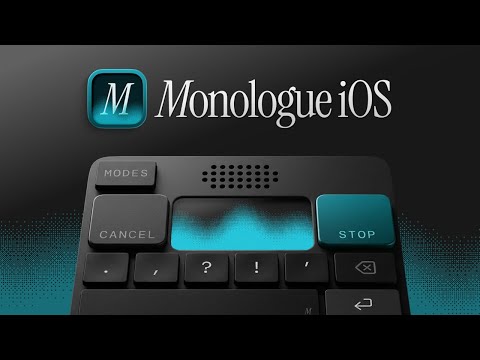
Meet the Team Behind Monologue for iOS: Your Voice as a…
Introduction to Monologue for iOS, an AI dictation app that turns speech into polished writing within existing apps. The team demos the app, explains why they built it, and answers questions live.
# Channel Presentation Observations: "Meet the Team Behind Monologue for iOS"
## Explicit Self-Descriptions by the Creator
### Channel / Company Identity
- The stream is presented under the **"Every"** brand: > "Every is the only subscription you need to stay at the edge of AI. We have three parts of the subscription, ideas, apps, and training."
- Scope explicitly stated:
- **Ideas**: "a daily newsletter and we have a podcast. We do live streams like this one"
- **Apps**: "a bundle of AI apps and monologue is one of those apps you get as part of the subscription"
- **Training**: "courses, camps, webinars, all that kind of stuff"
- Team size framing: > "we're still a small team of uh artisans basically doing this" — a self-positioning claim against VC-funded competitors.
### Product Claims
- **Monologue** described as "the smart dictation app that we just launched on iOS," also on Mac and watchOS.
- Competitive positioning claim: competitors "are run by teams that have raised millions and millions... Monologue is built almost entirely by one guy, Naveen, who's right here with Codeex" — claims AI-assisted small-team development as a differentiator.
- Privacy claim (creator statement): > "from day one itself we don't save any of the data... we just use that to transcribe it and then immediately process it and then send back."
- Usage stats claimed by team: "around 4k downloads and almost 2k new signups" in 24 hours; "yesterday I think we hit 2 million words per day."
- Development timeline claim: roughly "six weeks" from decision to App Store approval for the iOS app.
## Intended Audience
- **Existing Monologue users and fans**: opening line — > "if you are here, you're here because you're a big fan of Monologue."
- **AI-interested general audience**: closing pitch — > "if you're interested in AI... it's very hard to keep up, right? So go check out every."
- **Aspiring builders/AI-curious developers**: emphasis on building a polished app "with AI" and "Codeex" against funded competitors.
- Interactive live audience: hosts repeatedly read and answer chat questions by name ("Amsonic asks...", "dbay cam", "Victor here in the chat"), showing a community Q&A format.
## Demonstrated Content Patterns (Observable)
- **Team introduction / behind-the-scenes format**: round-robin intros of named team members (Naveen, Brandon, Lucas, Daniel, Lucas Fisher) with roles (design iOS engineer, senior designer, creative lead).
- **Live design walkthroughs**: Daniel shows Figma files, iteration history, and an AI-assisted workflow ("I converted this into an image and I asked like nano banana").
- **Live demos**: Lucas Fisher demos his separate app "microwave"; discussion of SwiftUI previews workflow.
- **Product marketing integrated into content**: repeated calls to action — "Download it. It's on the App Store... do leave a rating as well," "retweet us, share this live stream."
- **Playful internal culture shown**: the team compares Monologue usage rankings live ("Naveen... I am 100 right now... top 1.6").
- **Roadmap discussion on stream**: future features named (edit mode, action mode, per-app modes, limited edition skins, possible hardware "never say never").
## Claimed vs. Demonstrated Distinction
- **Claimed**: app quality, privacy stance, download numbers, "artisan" small-team identity — all creator statements without independent verification in this material.
- **Demonstrated**: a live, casual, community-facing team AMA format; comfort showing messy Figma files and incomplete features ("we're still polishing this state"); cross-promotion of the Every subscription ecosystem as the channel's business context.
# Delivery Observations: "Meet the Team Behind Monologue for iOS"
## Format & Structure
- **Live-streamed team panel / AMA.** The host opens with a direct live address: *"And we're live. Welcome everybody. How's it going?"* and closes with a sign-off: *"thank you everyone for joining us."*
- **Structured round-robin introductions:** the host explicitly manages turn-taking — *"let's go around the horn and introduce ourselves"* — followed by targeted handoffs: *"Naveen, do you want to go first?"*, *"Awesome. And lastly, Lucas."*
- **Chat-question integration.** Audience questions are read aloud and attributed by name: *"Amsonic asks"*, *"there's another question here in the chat which is... from dbay cam"*, *"We have Victor here in the chat asking hardware when."*
## Tone & Register
- **Casual, jocular, interrupty.** Speakers talk over each other and laugh frequently; overlapping banter is preserved in the transcript:
> "I have the receipts. I have the receipts."
> "Yo, dude, those receipts prove nothing."
- **Enthusiastic, superlative-heavy vocabulary.** Recurring intensifiers: *"awesome"*, *"amazing"*, *"crazy"*, *"really cool"* appear throughout — e.g. *"It's currently, it's almost in the top 100 productivity apps"*, *"That's crazy"*, *"This is a crazy flow."*
- **Self-deprecating humor about messiness:** *"We're doing it live, folks"*, *"As you can see, I'm super organized with my Figma"*, *"My internet just uh got bamboozled."*
## Recurring Phrases & Verbal Habits
- **Heavy filler use** ("um", "uh", "you know", "like") across nearly all speakers — consistent with unscripted live delivery.
- **Iteration framing as a core theme.** Repeated vocabulary of reps and refinement:
> "it's just this constant iteration of like doesn't feel right... you get to a version where you're like, this just feels like what it should be."
> "Generally, generally the the more you try stuff, the better. like just try more"
- **"Testament to" framing** (host, twice): *"I think, a testament to the team that put it together"* and *"a testament to what is possible."*
- **Hedging before statistics:** Naveen's *"I don't want to give out numbers but"* is immediately challenged (*"we don't want to give out numbers. Why not?"*), showing conversational pushback as a delivery pattern.
## Teaching / Explanatory Habits
- **Show-and-tell with screen shares.** Repeated prompts to demo work: *"Can you show us your Figma?"*, *"maybe Lucas, you should share your screen"*, *"Can you show us some of the early stuff."*
- **Zoom-in guidance for viewers:** *"Can you zoom in just a little bit? It's a little hard to see."*
- **Walkthrough-by-question style.** Technical topics are unpacked via open-ended prompts: *"Can you explain to me like just generally how does Nano Banana fit into your workflow?"*
- **Summarizing/paraphrasing after answers.** The host recaps team members' points: *"it's kind of the same exact thing we were saying about Daniel where it's like your version exposed, okay, this is better."*
- **Concrete numeric evidence habit.** Statistics are volunteered repeatedly: *"around 4k downloads and almost 2k new signups"*, *"we hit 2 million words per day"*, *"hard like six weeks"*, *"The whole querty keyboard... is implemented in 3 hours."*
## Audience-Engagement Patterns
- **Interactive gamified moment:** *"I would like every single person on this stream to check their monologue ranking, and we're going to go around and share"* — followed by each person's number.
- **Repeated calls to action at the close:** *"Download it. It's on the App Store"*, *"do leave a rating as well"*, *"make sure to retweet us."*
- **Promotional interlude delivered mid-stream** (host, pivoting from banter): *"Every is the only subscription you need to stay at the edge of AI."*
## Stable Patterns vs. Isolated Moments
- **Stable:** filler-heavy casual register, question-driven facilitation, superlative vocabulary, iteration/rep framing, and screen-share demos recur across speakers and the full runtime.
- **Isolated / low-confidence:** the *"I have the receipts"* joke, the ranking game, and the Nano Banana reveal (*"Oh my god... This is cheating, Daniel"*) are single-episode moments — noted here as delivery color, not evidence of a repeating pattern. Speaker attribution is sometimes ambiguous in the transcript (multiple speakers named Lucas), so some quotes cannot be confidently tied to one individual.
# Observation Document: Meet the Team Behind Monologue for iOS
## Speakers
- **Host (unnamed, transcript does not explicitly identify)** — leads the stream, departs at ~5pm
- **Naveen** — primary developer of Monologue
- **Brandon** — "deep monologue user," early adopter, Every team member
- **Lucas Fischer** — design iOS engineer, built iOS app (also made Microwave and Future Land)
- **Daniel** — senior designer at Every
- **Lucas (second, surname not given)** — leads the creative team
Note: Two speakers are both named Lucas; the transcript sometimes distinguishes "Lucas Fisher" from "Lucas Krispo/Lucas Vel."
## Product & Claims
### Launch Statistics (Naveen)
- iOS launch "yesterday": ~**4k downloads, ~2k new signups** in 24 hours (initially hesitant to share numbers; host pushed)
- Additional ~2k downloads from existing Mac users day one
- **~2 million words per day** usage; up from ~1 million at start of January; previously "1 million a month"
- Host: app "almost in the top 100 productivity apps" in the US
### Team Composition Claim (Host)
- Monologue "built almost entirely by one guy, Naveen... with Codex"
- Competitors (WhisperFlow, SuperWhisper named) have raised millions; host frames Monologue as evidence that small teams with AI can compete with big funding
## Design Process
### Aesthetic Origins (Lucas, creative lead)
- App originally called **"Jodle"** (also spelled "Jottle" elsewhere in transcript)
- Market observation: competitors used "invisible minimalist" UI; team chose differentiation through design
- Inspirations: **Teenage Engineering, Braun, 1960s–70s industrial design**
- Goal: "highly skeuomorphic, very material, very textured" — "put a device inside of our device"
### Teenage Engineering Credit — Unresolved Dispute
- Brandon claims credit ("I have the receipts"); Lucas disputes ("those receipts prove nothing"). Host notes "we'll never know whose idea Teenage Engineering was." **Contradiction preserved as expressed.**
### Daniel's Workflow (Designer)
- Mimics physical design digitally; ~20 keyboard iterations, many "terrible"
- Used **Nano Banana (AI)** to generate a physical device reference image, then hand-rebuilt it in Figma layers with rectangles for shadows — host jokingly called it "cheating"
- Rationale: hard to find real physical device reference for certain states (e.g., notes recorder shadow)
- Iteration philosophy (Daniel): a bad design "took me to this design somehow — I know what is wrong with this"
## The No-Keyboard Decision (Naveen)
- Learned from prior experiment **"Unwrite"** (a Grammarly alternative): replacing Apple's default keyboard is hard — e.g., space-bar cursor control unavailable to third-party developers
- Decision day one: voice-to-text primary, keyboard secondary
### Apple Rejection & "Happy Accident" (Host, Naveen, Lucas Fischer)
- Apple rejected build ~Saturday 8am, requiring a full QWERTY keyboard — original launch intended a week earlier
- Naveen implemented full keyboard via **"Codex 5.3" in ~3 hours**, initially with a swipe indicator
- Lucas Fischer found it "glitchy... slow," removed animation for instant switching; Naveen: "my version only lived like 3 hours"
- Host reframes as "happy accident": built-in keyboard lets users fix dictation errors without switching apps — made Monologue his default keyboard
## Engineering Craft (Lucas Fischer)
- Rejects the common approach of exporting Figma assets as static images; uses **SwiftUI** to control shadows/states natively, with haptics and sound
- Used **SwiftUI previews in Xcode** as a real-time control panel (idle/processing/error states) to iterate on shadows without recompiling
- Claims hand-coding beats Claude for this fine-grained shadow work ("it just didn't get me satisfying results")
- Prior apps: Future Land (social habit tracker), Microwave (radio sharing app)
## Hiring Signal (Naveen + Host)
- Naveen found Lucas Fischer via X after seeing Microwave's skeuomorphic buttons — "alpha is always X"
- Host generalizes: hire people whose existing aesthetic matches what you want, not something they've never done
## Development Timeline (Naveen, Lucas Fischer)
- Mac app launched September 16; iOS work began ~November week 2; Lucas Fischer joined December first/second week and "deleted everything" of Naveen's code
- Total: roughly **6 weeks** hard work, minus 10 days of winter holidays
## Privacy Stance (Naveen)
- No data saved: audio transcribed, processed, returned, discarded — from day one, unlike competitors who "save all the data"
- Only feedback data (thumbs up/down) is visible; Naveen emails feedback-givers for faster loops
- Deleting app deletes local transcription history
- Trade-off acknowledged (Host): harder to understand usage patterns without a dashboard
## Modes Feature
- **Naveen**: coding mode with custom vocabulary ("ultra think") + auto-enter for Cursor/Claude Code
- **Lucas (creative lead)**: Spanish speaker; built a "Spanglish-to-English" translator mode for his mixed-language stream of consciousness — Naveen said he was "quite shocked" seeing this live
- **Lucas Fischer**: plans to copy that mode for German
- Upcoming: **per-app persistent modes** on iOS ("we somehow found a way")
- Naveen's aspiration: eventually Monologue "understands you really well that you don't even have to use modes" — but cautions "don't go crazy" with modes now
- Chat question about "I am" vs "I'm": Naveen says fixable via custom instructions or per-mode writing samples
## Roadmap (Naveen, team)
- **Not** expanding to Android/Windows yet; focus on making Mac/iOS "really strong" — product is only four months old
- Features in progress: **edit mode** (context-aware, e.g., drafting an email reply) and **action mode** (OpenClaw-adjacent prototypes)
- Already on watchOS ("we need to update the icon"); CarPlay mentioned in passing
- **Hardware**: "hardware is tough... never say never"; a giveaway device exists and the app background image is a physical device prototype
- Design customization planned: limited edition skins, soundwave colors
## Business Model (Naveen, Host)
- 1,000-word trial replaced a 7-day free trial — word-limit drives engagement like game progression; users who hit 1,000 words "immediately understand how good" it is
- Naveen: can't give it away free like VC-funded competitors given infra costs; may consider premium tiers once costs are understood
- Sold individually or via **Every subscription** (newsletter, podcast, apps bundle, training)
- Brandon: Monologue was "built using Monologue" — first product made with itself
- Product Hunt launch planned "mostly tomorrow"
## Internal Adoption Claims
- Team leaderboard: Naveen #1 at 100 (top 1.6%), Lucas Fischer 5,001 (claims he'll catch up; it's early morning for him), Host 422, Brandon 650, Daniel 1,200, Lucas 975
- Daniel admits he's the **latest adopter** — only started last month when iOS shipped ("I can't believe that I'm the designer for this app and I'm not using it")
- Lucas (creative lead): full-team usage is "internal market fit," not yet proven product-market fit; team is varied (engineers, writers, support) suggesting general-purpose use
## Misc
- Easter eggs: sad-face when offline
- Naveen: fidgets by clicking the space button for its tactile feel
- Naveen previously worked on iOS apps at a Japanese company; this is his first App Store release
- Daniel: prior work on smaller Latin American apps; calls Monologue "the best baby I've created for iOS"
# Observation Document: Speaker Roles & Provenance
## Video
- **Title:** Meet the Team Behind Monologue for iOS: Your Voice as a Keyboard
- **Format:** Live stream / team AMA with in-stream audience chat questions
## Speakers & Roles
### Host / Creator-side
- **Unnamed host (first speaker)** — moderates the live stream, frames the conversation, introduces the team, departs partway through ("it is 5 o'clock"). Affiliated with **Every** (company). Promotional delivery of Every subscription pitch.
- **Naveen** — lead developer of Monologue ("built almost entirely by one guy, Naveen"); describes himself as "Naven of Monologue"; based in India; previously built "Unwrite" (Grammarly alternative); prior iOS work at a Japanese company. Takes over hosting after the original host leaves.
- **Brandon** — "Brandon of Every co." (transcription unclear: "Brandon every co"); early Monologue user, "mega fan," team member from the beginning.
- **Lucas Fisher** — design-focused iOS engineer; built the Monologue iOS app; previously built "Future Land" (social habit tracker) and "Macrowave" (radio app). Joined team in December.
- **Daniel** — senior designer at Every; designed Monologue for Mac and iOS; based in New York (per Lucas Krispo's account); native Spanish speaker.
- **Lucas Krispo (second Lucas)** — leads the creative team at Every; joined around December; created a "Spanglish-to-English" Monologue mode.
### Chat / audience questioners (third-party claims channels)
- **Amsonic** — asked about the no-keyboard design decision and privacy approach.
- **dbay cam** — asked about contraction handling ("I am" vs "I'm") in email mode.
- **Victor** — asked "hardware when?"
## Promotional Segments (Flagged)
- **Every subscription pitch** by host:
> "Every is the only subscription you need to stay at the edge of AI... ideas, apps, and training."
Includes newsletter, podcast, live streams, app bundle (Monologue included), courses/camps/webinars.
- **Repeated calls to action:** download the app ("almost top 100 in productivity"), leave an App Store rating, retweet/share the stream, Product Hunt launch "tomorrow."
- **Closing promotion:** Naveen promotes Every content (e.g., article on "Claude Sonnet 4.6") and the Every bundle including Monologue plus "three other AI native apps."
## Referenced Sources & Third-Party Claims
- **Competitors named:** Whisper Flow, Super Whisper (others "we don't care to even mention"); claimed to be run by teams that "raised millions and millions of dollars" — **speaker claim, not independently verified.**
- **Design references:** Teenage Engineering, Braun ("brown" in transcript), 1960s–70s industrial product design.
- **Tools referenced:** Codex ("codeex," "Codex 5.3" per transcript) used for development; Nano Banana (image AI) used in Daniel's design workflow; Figma; Claude (stated as insufficient for shadow/UI detail work); SwiftUI previews in Xcode.
- **Platforms/ecosystem:** Apple App Store approval process (full-keyboard requirement described); Discord (team/user community); X (team discovery channel).
## Statistics Claimed by Speakers (Unverified)
- ~4,000 downloads and ~2,000 new signups in first 24 hours of iOS launch; ~2,000 existing Mac users adopting iOS.
- ~2 million words per day usage (up from ~1 million/month earlier, per speakers' recollection).
- Team member Monologue rankings shared live (Naveen #100, top 1.6%; various others).
- Development timeline: Mac app launched September 16; iOS build in ~6 weeks including holidays.
## Privacy / Data Handling Claims (Speaker Claims)
- Naveen states Monologue does **not** save audio/transcription data server-side; transcription history stored locally only; thumbs-up/down feedback is the only visible data; users emailed for feedback details.
## Comment Availability
- **In-stream chat active** with named questioners (Amsonic, dbay cam, Victor).
- **No curated metadata supplied**; post-publication comment availability on the video platform is **not established** in the source material.
## Uncertainty Notes
- Speaker attributions inferred from turn-taking; transcript lacks explicit speaker labels.
- Two speakers named "Lucas" (Fisher and Krispo) distinguished by self-introduction and context; some turn attributions between them remain ambiguous.
- Company name rendered as "Every" / "every" / "a.0" / "Avery" in transcript — **uncertain canonical spelling.**
- Product's earlier name rendered as "Jodle" / "Jottle" / "Jotal" — inconsistent in transcript.
And we're live. Welcome everybody. How's it going? \>\> Um, so if you are here, you're here because you're a big fan of Monologue,
the smart dictation app that we just launched on iOS. Uh, you should go check it out. It is currently, it's almost in the top 100 productivity apps in the US. Um, which is, I think, a testament to the team that put it together. We've got the team here. Um, let's go around the horn and introduce ourselves so people get a get a sense for who we are and how we relate to Monologue. Naveen, do you want to go first? \>\> Yeah. Uh, hey everyone. Uh, I'm Naven of Monologue. So, Monologue is one of the experiments that came around a few months ago and now we are here where we have iOS app, Mac app. Really exciting. So, \>\> amazing. Uh, Brandon, \>\> I am Brandon. I am I am Brandon every co. Um I'm like a deep monologue user. I've been here from the beginning. Uh and just a mega fan. \>\> Let's keep going. Lucas Fisher, we're just going around the squares. Yeah. \>\> Yeah. Hey everyone. Um I'm Lucas and I am a design iOS engineer. Um and I yeah built the monologue iOS app with Daniel and Naveen. Sweet. And Daniel? \>\> Yeah, I'm the senior designer at Avery and I've been designing uh model lock and on Mac and iOS. So, yeah, I'm a Figma guy. \>\> Awesome. And lastly, Lucas. \>\> Hey everyone. Um, I am Lucas and I'm
leading the creative team. Uh, so basically working closely with Daniel and Naveen and everybody here just to kind of like make sure that everything looks as great as possible. And yeah,
that's me. \>\> All right, so let's I want to set the stage a little bit for the conversation. If you're here, you should know that Monologue is a smart dictation app that um there's a lot of these apps out there. There's like Whisper Flow and Super Whisper and a bunch of other ones that we we don't care to even mention. Um, and most of them are run by teams with that have raised millions and millions and millions of dollars. They have many different engineers. Um, and Monologue is built almost entirely by one guy, Naveen, who's right here with Codeex. Um, backed up by an amazing team of people who are who are around this circle. Um, and it's actually it's just going really well. And I think it's a testament to what is possible. If you get some talented people working with AI, you can go and compete against the biggest teams um with the most funding and make something that's really awesome. Naveen, can you share some statistics about overall where Monologue is and we just launched iOS yesterday, how that launch went? \>\> Uh yesterday's launch was awesome. Like we did really get I don't want to give out numbers but uh uh \>\> we don't want to give out numbers. Why not? \>\> Do do we? \>\> Yeah, let's give out some numbers. Come on. \>\> I think we we are right. I need to check but last time I checked we we got around 4k downloads and almost 2k new signups
that's all \>\> crazy \>\> last 24 hours and uh like other 2k are from you know day one adoption which is awesome like you know existing users who
are on Mac so around 2k people download the iOS app seems like iOS app is like really like you know uh everyone wants it so seems like day one all people are adopting it. Um and and where are we just generally with monologue in the um \>\> over overall? Yeah. \>\> Yeah. Usage wise right now we are do yesterday I think we hit 2 million words per day. \>\> Wow. Per day. \>\> I I just I just uh said to Dan like when I'm right now in New York and like I came around end of December I said like oh we are doing around maybe 1 million words start of January now we are already doing 2 million words per day. \>\> That's crazy. Yeah, \>\> I remember when it was 1 million a month \>\> and that felt like a lot. \>\> That felt like a lot \>\> and it was only us basically talking about it all day on \[laughter\] Discord. \>\> Um, so I think if if we take a step back and think about why do people love monologue, there's a lot of different reasons, but one of the big ones is just it's looks amazing. Like the whole user experience of it is so good, so great. and the team who is here aside from Naveen, both of the Lucas' um Daniel, we love Lucas's and Dan apparently um at this company. Um
uh c can you can you talk to us about like the process for coming up with this design aesthetic? So we can talk about the overall design aesthetic for
Monologue, but then also specifically like the design for the the iOS app and um what the inspirations were and what were some of the interesting challenges you had to solve to make the iOS app work? \>\> Yeah, Lucas, you want to go first? \>\> Yeah. Yeah, absolutely. Sure. I think uh basically at the very beginnings when uh like when we were still sort of like playing with how monologue could feel and look like when it still had another name. It used to be called Jodle by the way and we were like playing a lot with how it could look and feel and obviously like seeing what was out there in the market and we noticed that everybody was sort of like uh going for a more type of invisible minimalist type of UI and aesthetic and we knew from the very beginning that you know design and different design is the key main differentiator. So we were mainly just going back and forth around playing with different ideas that we knew would just sort of like cut through everything else that was out there. And we, Brandon, I, everybody on the team, we were just kind of like throwing out ideas and and we kind of like landed in a really cool place when we started playing with references of teenage engineering, brown, and all the old uh like product uh industrial engineering from like the uh early 70s and 60s and late 60s. Um, so we kind of like landed on the fact that we wanted something highly skew. We knew we wanted something very material, very textured, rich in depth, and rich in detail so that it didn't feel like it
sort of belonged in your computer, but it felt like something completely different. Um, and we just played with different types of uh UIs and devices
and and we kind of like decided, let's put a device inside of our device basically, and that's kind of like how it sort of uh went from there. Um, and then obviously everything is sort of like built on top of that. Uh, I don't know if you want to add uh big add from there, Daniel \>\> or and Brandon. \>\> Yeah. Um, in on my side, as Lucas mentioned, we was trying to mimic physical design into a digital. So, for me, it was just trying to nail those UIs, the mosa, and I spent like several hours just trying to nail the keyboard. I remember like I did like 20 iterations of the keyboards that were terrible just to land. \>\> Can you show us your Figma? I we'd love to see some like some some Figmas that didn't make it or what your work \>\> organized Figma. Yeah. \>\> Yeah. Yeah. As unorganized as possible. We want We're doing it live, folks. \>\> Zoom out all the way. \>\> Um and while he gets this set up, uh yeah, I feel like I mean Lucas, maybe we'll never know whose idea Teenage Engineering was. I think we can safely say it was both of our ideas now. \>\> So these two like Brandon suddenly messaged me, you know, one day saying, "Whose idea is it?" And I'm like, \>\> "Me, too." It's it's a bit controversial inside. \>\> I have the receipts. I have the receipts. \>\> Yo, dude, those receipts prove nothing. I've looked at the receipts, they prove nothing. \>\> Um I uh I Okay, all I knew was, okay, this is a thing that's happening. And then Naveen showed us Jottle and I was like, "Holy there's a comp this is blowing up. There's companies that are doing this that have raised a ton of money. Naveen just over the weekend made a version of this that's just as good as what I'm currently using and paying for. If we can make ours just as good, that would be the baseline. I think we can make it better, but if we can make it just as good and we can make it look and feel really special, this can win." Um,
and then I think that's like, you know, obviously it's it's lore. who came up with teenage engineering, but that was the uh that was the idea and pair it with an every subscription. \>\> Exactly. So for people who are asking, we'll get to Daniel in one second. Every is the only subscription you need to stay at the edge of AI. We have three parts of the subscriptions subscription, ideas, apps, and training. On the idea side, we have a daily newsletter and we have a podcast. We do live streams like this one that keep you on the edge. We also have a bundle of AI apps and monologue is one of those apps you get as part of the subscription. And then we also do a bunch of training. We do uh courses, camps, webinars, all that kind of stuff. Um and and one of the great things about Monologue is you can you can pay for Monologue individually. You can buy it on you can get on the iOS app store, you can get it for desktop or you can get as part of the every subscription, get all the stuff that we make. And so the team here is all um working on monologue and also working on every Daniel, take it away. \>\> Uh I'm going to add your screen your screen to the stage here. So, we're going to go through some of the designs that that made it into Monologue's iOS app. See what he looked at, what he discarded, what he likes, what he didn't. Like, how do you even make something that looks so good, Daniel? \>\> Well, uh I don't know. I think it's just years by using Figma. \[laughter\] And I don't know. I think it's so easy for me to mimic something that it's real. uh because if if I don't imagine it first, it's so complicated for me to to do it. And and actually in order to achieve, for example, for the notes recorder that you're looking at right now, this shadow took me some time. And the the way that I did is basically I
did this. Let me show you this real quick. I copy this. Can \>\> you zoom in just a little bit? It's a little hard to It's a little hard to see. \>\> Sorry, my my screen is kind of
I converted this into an image and I asked like nano banana. Hey, make the second \>\> Oh my god. \>\> to look press. \>\> This is cheating, Daniel. I can do this. \>\> No, no, no. But still, I was like, \>\> then you had to turn it into, you know, then you had to turn it into layers, right? \>\> Yeah. \>\> Yeah. Exactly. Exactly. I \>\> I'm just kidding. I I saw the PNG and then I was just trying to mimic it. \>\> This is what we got. \>\> Whoa. This is a crazy flow. \>\> And this you could see I have like several layers, rectangles, rectangles here that basically give us the the desired look. As you can see, I have this desire. I have this design \>\> and it kind of nails it, but uh still \>\> it's not what I Can you explain to me like just generally how does Nano Banana fit into your workflow? It's basically you already have something that's pretty set up and you want like an you want like a a rev of a state or something like that and it helps you do that or yeah how does it fit in? \>\> Yeah, normally for UI I don't need to jump into Nano Banana and but in this case I was having a hard time to you know actually find that physical device state. So I need to look for a reference and for me it was like okay let me go to AI and ask for it maybe will be he will
handle better than I and yeah and that's how I achieved this state basically and and we're trying we're still polishing
this state to be honest but yeah \>\> this is how I nailed this \>\> and that just goes to show like the the complexity of like starting and trying to do anything like highly skeworphic you have to take into consideration a lot of things that you don't normally have to take into consideration which is like light refraction, shadows, like where the angles of things move and and using Nano Banana helps you like really nail it in a realistic way so you can then translate it into actual vectors. \>\> Can you show us some of the early stuff and like what where you started and like where you ended up and how that's different. \>\> Let me go to Scratch Pad real quick. Oh, well no, let's This is like the first ideas of the on boarding. \>\> Then I just switch to this. This is what basically Lucas rendered on the real boarding with a video with a cool video and sound trying to mimic what we did on Mac. And let me go to review here. I added I did the Sorry, as you can see, I'm super organized with my Figma I honestly just like looking at you scrolling through is entertaining enough. It's just like really I just want to see all this. It's so interesting. \>\> And it's it's more organized than mine. So \[laughter\] very organized. \>\> Yeah. Uh here here it is. As you can see on my left side, I have like several compon uh the same the initial ideas of the of the keyboard that didn't make it. We weren't trying to compete to the with the actual iOS keyboard, but at the end of the day, we ended up having it \>\> and you know, I did like several options like this one. And for me, I see this like a a competition we did on the keyboard like internally \>\> and then we narrow it down to maybe this only this options and I remember the one that
we prefer was like something here. So crazy. While you're designing when you're designing all these things and you're looking at it, it's just like this constant iteration of like doesn't
feel right. \>\> And then you do another one, you're like, h it's like it's cool, but it doesn't feel right. And then you get to a version where you're like, this just feels like what it should be. It feels like what it's meant to be. And you've gone through so many iterations of it that you actually like have the history to know that. \>\> Yeah. For for example, this one, I didn't like it at all, but I know this design, even though it's bad, it took me to this design somehow, \[snorts\] you know, like, okay, I know what is wrong with this. Let me try to fix it based on feedback and based on my personal thoughts. So, yeah. So, um, Amsonic asks, and this is a question on my mind, too, like walk us through Daniel and and the Lucases and Naveen and Brandon, like walk us through one of the things that I think is very distinctive about the monologue monophone on iOS is there's no keyboard. It's like just a big record button. Um, that's a different decision. So, walk us through how you made that decision. So maybe yeah I I'm a bit open-ended in this uh because before Jotal we actually made Grammarly alternative that's just like one of my previous uh experiments that I did before monologue. So I ran that app it's called unwrite. Maybe few of every exper users might know about that experiment. I learned one important thing from that um is it's very difficult for us to replace Apple's default keyboard. \>\> There is always something that Apple doesn't let developers do. For example, um in default keyboard, you can actually move across characters, right? Across
paragraphs just by long pressing the space bar. That is not available for developers. So we always if we have a keyboard we always going to be behind
with Apple uh keyboard because user will come to us saying oh it doesn't work that way. So when we started like that's the learnings I got from the previous experiment. So when we started monologue keyboard I said day one we are not going to do the keyboard at all. \>\> We going to have it but uh it's going to be secondary thing. Uh primary thing will be voice to text. that's where the whole focus is. So yeah, that's the thought process behind \>\> I also think we should talk about like the happy accident that ended up happening. So like \>\> you know when you're launching these things it's it's like you you forget that Apple needs to approve um prove your app. So, we were like, you know, we were going to launch this actually a week before we launched it, but Apple like gave us a bunch of problems with something. And then, like two days before we launched it, Apple came back to us and was like, "Hey, you need to have a full keyboard." And we were like, "This sucks." Like, we don't want to have a full keyboard. We're all in on voice. And, you know, we we think it's important to be like different. Obviously, that's why our app looks so different. And um so we were like, "Okay, we have to add a full keyboard, but we want to stay voice first." So now there is a full keyboard inside of Monologue iOS. You have to just click like the button that's, you know, in the bottom left corner. You get access to a full keyboard. I use it all the time. Now I call it a happy accident because ultimately like dictation is it's 99% good, but sometimes you spell something wrong or it gets something wrong. Now you have a keyboard built in. you don't have to switch back to the default. So, what that has done for me is it's made Monologue iOS my default keyboard because I can primarily dictate and then switch back and forth, you know, in the
built-in keyboard. Um, I think it was a happy accident because like we weren't thinking about it, but I think in the back of our heads we all were like switching back and forth between default
and iOS and now you don't need to. Um, but it's still differentiated enough in voice first. Ju just uh just to add one on top uh one more thing. So Apple rejected our build and I'm like I think it's uh early morning 8:00 or something on Saturday morning. Apple rejected it. Okay, we need to add the key querty keyboard. So I just like kicked off codeex 5.3. The whole querty keyboard, the whole behavior, everything is implemented in 3 hours. My first iteration actually is the swipe where uh you know you have your own voice to text you swipe and then you get the whole word. Then Lucas came in maybe Lucas can tell his point. So we were like that's where having this you know people in team is really important. Maybe Lucas can mention what happened after the initial version the swipe thing once we released it. Yeah, it was like similar like I woke up a few hours later and then I opened the mono talk like every morning because I just was using it was like hm wait why is there like suddenly a swiping indicator? Uh and then I tried to like play around with it and go go back and forth and I noticed it's it feels a little bit glitchy and also like off. Um and it also felt a little bit slow. Um because this is something that just should happen immediately, right? like you quickly just want to write something and I didn't like that interaction. So I played played and it also added like more vertical space because it had like an indicator on which page you're on and stuff. Um so I didn't like that and I played around with it and just noticed this is better without any animation. It should just like immediately switch between the different keyword keyboard types we have now. Um, and yeah,
\>\> just like the just like the the whole app. I just uh came in and polished it a little bit. Um, so it's faster. \>\> My version only lived like 3 hours. So,
\>\> yeah. But it's kind of the same exact thing we were saying about Daniel where it's like your version exposed, okay, this is better. And then when Lucas updated it was like, of course, this is the right natural state. \>\> Yeah. Generally, generally the the more you try stuff, the better. like just try more \>\> I totally agree. I I am kind of curious um Lucas Fischer, talk to us about, you know, some of the UX interactions that you built and some of the details that we may not notice and and how you think about like building an iOS app of this at this level of quality. Um yeah so on a on a previous project I was also trying to work in like scuromorphic um inspirations and so on. Um, but what a lot of developers have done in the past is they um just take a Figma, export it as an image and like a button from Figma, export it as an image as an asset and then just show it and then for and then have like a different image show when you have a press state or something. Um, but now with like Swift UI, it's it's very easy to be able to like control everything that you see on the screen like the shadows and uh all of these like really tiny design that go into like a design like this and it makes it easy to animate them uh on stage changes and then you get like a really natural feel when you also
combine it with haptic feedback and like the really cool sound effects that we have from uh from the Mac That's awesome. \>\> Yeah. So maybe Lucas, you should share
your screen. So the main what happened is uh initial version of the iOS app uh I was coding it and then I got to a point where uh the D designs that I'm getting from Daniel. I'm not the right person to build this because I can build apps but uh you know the the effort that 100 like the focus that you need to build this kind of polish you need a person who's already like you know did that previously and is like detail oriented so that's when like I met on X so it's completely accidental I have been following him for two three years you know his work is like really awesome you should check out his other app which is F future land and uh macrowave when I saw the macro wave the buttons is like also has the depth it has all the things then that's when oh Lucas is the perfect guy here for this monologu once like you know he's started coming in you can see the difference in the app so yeah maybe Lucas if you have a microwave open you should like do a screen share. \>\> Um, what? Oh, microwave. Yeah, sure. Of course, I can show off microwave for a moment. Um, \[snorts\] \>\> Oops. \>\> While he's getting that set up, I would like every single person on this stream to check their monologue ranking, and we're going to go around and share and see who's the top ranked monologuer.
I am 9755 in the top 15%. \>\> You're what are you 975? \>\> 975 top 15%. \>\> All right, we got Luc is at 975. \>\> 650. \>\> Brandon is at 650. \>\> Oh, 635 on my desktop. Maybe that's just not synced yet. Where are we at? \>\> 5001. \>\> Lucas Fisher. 5001. Daniel. \>\> Let me see. 1200. \>\> And Naveen, you better be pretty. \>\> Yeah. So, the thing is I live and breathe this app. I like \[laughter\] And I am 100 right now. \>\> You're 100. Wow. \>\> And top 1.6. Uh I am at uh 422. So yeah, uh Naveen, you're obviously the the GOAT here. Um but Lucas Fisher coming in coming in hot on your heels as well. Um pretty cool. Pretty cool. Okay, Lucas Fischer, do you have some stuff you want to demo? \>\> Uh yeah, sure. Um Naveen asked me to share a little bit about microwave. if I have that ready. I don't know if you can see my my screen already. \>\> Uh, added you to the stage. Add it to the stage. Here we go. \>\> Yeah. So, this is the MacB I worked on
and I like we started working on it at roughly the same time. I I did another microwave uh and monologue for the back and uh the idea behind this inter So,
first of all, this is a little radio app. Um, you can just use it to quickly go get a link that you can share with your friends and they can listen to whatever you're listening to on your computer right now. It's like really fun. Um, so I can just go live here and pick pick an app that I want to share. Um, and you can see like all of these buttons, they they try to look like very screworphic. So they have like a lot of different states, a lot of different shadows. Um, you also have like cool animations when you like switch to to like the receiver which is like just the radio receiver you can use. Um, and \>\> for these kind of like fine grain really beautiful UI interactions like how much hand coding are you doing and how much are you using AI for this? \>\> Yes. Um, so this is a lot of hand coding because it's probably similar to what Daniel work Daniel's work looked like. You have to really go into the details to like tweak all of the little shadows and stuff to get them right. Uh, I tried to to do that with Claude as well, but it just didn't um get me like satisfying results. Um, so it's still a lot of manual work, but to be honest, it's also quite fun. to kind of buttons like this. \>\> That's awesome. Really interesting. \>\> Yeah. \>\> So, when I saw those shadows and buttons, that's when I know, okay, Lucas is the perfect guy for \>\> the keyboard uh design. \>\> I think that's a really good general rule for like hiring people, hiring designers, hiring UX people is uh or or people to build apps is like if they're if the aesthetic you already see them do is exactly what you want, that's a great sign. If you want them to do something totally different than they've ever done it, that's like a little bit harder to make work. \>\> Yeah. So, yeah, this is like where uh even I think
someone on X asked us like how did you meet like Lucas, you know, and for me alpha is always X where that's where you know you get to hang out with other
builders. you can just randomly reach out to them, collaborate with them and uh this was like a really fun u you know coincidence that we'll get to uh see. So \>\> all right um so it is 5 o'clock. I'm going to uh I'm going to head off the stream, but I'm going to hand it over to Naveen and Brandon and Lucas and Daniel and the other Lucas. \>\> What' you say? \>\> I got to head off the stream as well. Okay, we're going to we're going to keep it going with Naveen uh holding down the fort doing uh doing the rest of the conversation with uh with both Lucas's and Daniel. Uh but this is this is awesome, guys. I'm just so proud to that we launched this and and I love how amazing it is. You guys did an incredible job. \>\> And it's also the first ever product that was made using that product. So, Monologue was built using Monologue, which is kind of cool, too. \>\> We love that. Download it. It's on the App Store. It's almost a top 100 in productivity. So, help push us over the edge today and keep listening \>\> and do leave a rating as well. That really helps having faster rating. So, \>\> and Nian, are we going are we going on product hunt? Uh \>\> uh we are um mostly tomorrow. Tomorrow. \>\> Okay. \>\> Cool. \>\> So, \>\> thank you Dan. Thank you Brandon. \>\> See you guys. \>\> See you guys. So maybe we can actually ask few like answer few questions who are on the stream. So how long did it take the the
development tech? So the thing is we launched Mac app on September 16th and on September 17th the same way we are getting now uh Android
when we got iOS when we just launched Mac app but uh people like you know as started asking for iOS app but we got to the iOS app on nove around November 2nd week where it took me couple of days because I'm like you know little um I was v coding thing I'm trying to figure out how to make the keyboard work because that's the the bigger technical challenge here for me to figure out is user clicking the keyboard and then opening the main app and getting the audio session you know that's the so when I figured that out uh I was like okay we should just go build iOS app that's when I reached out to Lucas that's when you know D I reached out to Daniel uh and then these guys like doing the creative part where oh we should like really rethink how the keyboard should be and uh both I think Lucas Krispo and like Daniel are the key guys where oh the way keyboard looks right now is because of them and Lucas Fisher you joined December December second week \>\> yeah or even the first week yeah something like that \>\> so it's like just one week I vcoded second week Lucas Fisher is here and he took over and He said, "My code is and \[laughter\] I'm deleting everything." \>\> Wait, so basically like a month and a half since like knowing that we wanted to kind of like start the project and just like getting it approved on the app store and making it look amazing. Like that's that's an amazing timeline if you think about it, you know. \>\> Don't forget we also have Christmas holidays like the winter holidays like we didn't work for 10 days. I I I traveled. I came to New York. \>\> That too. Yeah. \>\> And then an eternity. \>\> Yeah. So I would say it took us maybe I would say hard like six weeks. \>\> Yeah. \>\> Right. \>\> So like Yeah. Like a month and and one week or month and two weeks something like that which it's kind of crazy if you think about it like time to develop
design ship like an app. That's amazing. \>\> Yeah. Yeah. Okay. So any other we can
\>\> there's another question here uh and maybe this is more for you Naven Ampsonic uh asks I'd love to hear about your approach to privacy. \>\> Yep. Yep. Okay. So first thing when you look at competitors they save all the data that's I think uh is needed at least for monologue to also get improved but we took a stance that from day one itself we don't save any of the data. So meaning whenever you're sending the audio back audio to monologue server we just use that to transcribe it and then immediately process it and then send back it and then that's it. We don't do anything with the data. We don't save anything. Uh so that's our stance from day one itself. But uh there are few users who are like you know this app is still in development. So anyone who wants to uh improve the monologue can leave thumbs down thumbs up. So whenever they are leaving that that's the only data I can get to see and that's where like I use and iterate on monologu accuracy and yeah so it's the same thing on iOS as well like if you actually delete the app and then come back all your previous history transcription history will be gone because it's just saved locally. So yeah, we don't \>\> I think and I think like that's really cool from a privacy and security perspective, but it also makes it like harder on us to know like how people are using the app, you know, we have to have like conversations with people and
actually like jump in because we do not have like a dashboard of what everybody's kind of like talking about, I guess. \>\> Um \>\> yeah, so only way I know if anything goes wrong is the thumbs down, thumbs
up. And we have a really cool community where you know people are actually actively letting me know and uh also at one point whenever user leaves a feedback I immediately email them as well saying oh can you tell me more about what the issue is so that I get like you know closer faster feedback loops. \>\> Yeah. Um another question here uh from the chat is uh talk about modes like what what's the the point of modes and what do modes do that's different? Yes. Uh maybe let me share my screen. \>\> And how maybe how do you use them personally, Navin? That could also be really cool to showcase. \>\> Yeah, we are happy to share that. Let me see if hope I don't have any else open. Uh you guys can see my screen. No, right. \>\> No, no, \>\> no. \>\> Yeah. someone who have access to to that. \>\> I think maybe we'll just have to kind of like chat through it because I think the permissions are gone with our \>\> our friends that left \[laughter\] \>\> but we can talk about the modes. Uh so main thing here at least for me I have this coding mode right uh where I mention whenever you you know uh using
at one point mono doesn't know didn't know about ultra think or these coding related words so I just added them whenever I say something to this and
then also the key thing for me is the auto enter so within a mode we have this like you can enable auto enter so what I do is let's say whenever I'm in cursor or whenever whenever I'm in cloud code after dictation is done send the text as well which is super helpful because then I can just sit back click on the key talk leave and then the whole thing uh gets sent but Lucas you have a cool mode so you should talk also talk. Well, technically I my my main language is Spanish. Um, so working with in English with all my teammates, it makes it so that my stream of consciousness is sort of very spanglish, right? It's not English, it's not Spanish. It's just something that uh it would be very hard to talk to somebody else about. But uh I created this mode that's basically like uh like a spang English to uh English type of translator where I can just kind of like talk and ramble and insert full sentences in Spanish and full sentences in English or even like combine certain words with other words in ways that like maybe most people are not used to. And then I can just kind of like like use those uh like transcripts that get uh processed in a way that's super useful for like uh prompting with AI models or even just chatting with the rest of the team on Discord. So uh it just allows me to not really have to think so much about how do I want to express myself, but I just kind of like let it happen in the way that it kind of comes out, you know, no filter. \>\> Yeah, I saw that happen. Like I didn't know that Lucas is doing that. So when I saw that live, I was like quite shocked that he's using monologue that way. Uh
so which is like really interesting because I didn't know you're doing that. And that's the cool thing about modes, I think, is that uh they kind of like open up like the the Pandora's box of what you can do with with monologue, you
know, like you can really kind of like uh mess with the custom instructions of each mode and kind of like make it really work for your personal use case. So the really the possibilities are endless on like what you can really do and how you can use it. \>\> Lucas Fisher, any any modes you use anything like that? \>\> Um I mean in the future I'm going to use Lucas's mode because I didn't think of that. I have the same problem with uh German. So I'm definitely going to steal that. Uh that's a really good use case. \>\> Yeah. Yes. \>\> But what what maybe we want to talk about is what we have in mind for the future of modes uh on iOS. We had some really cool ideas for that as well. \>\> Yes. So we got to know that you can persist mode per app basis. So for example, if you're in iMessage and iMessage and you select messaging mode, it persists. So that is we're going to add in future. So you can now have per app modes as well within iOS. Before we thought it was not possible, but we somehow found a way to do it. So it's going to be coming soon. \>\> Yeah. Um there's this question coming from the chat uh from dbay cam. Um she I
noticed that when in the email mode I hadn't put any details in there yet. Just using the default it was outputting I am. I would when usually I would write the contraction I'm or I etc. Is that
something that we could fix using the modes \>\> 100%. So again each individual writing is very different right from person to person. So that's the main reason why we even have instructions. So you can either use the custom instructions at the top saying this is how I write. You can even give couple of your writing samples as well. uh this is like usually how I write and then monologue will adapt to that. That's one or other thing is the email like you you can just have it within the email mode so that the the tracking style is only applied for that uh mode. So yeah. \>\> Right. And it's like the the modes that come uh like by default in monologue are sort of like what we think are like the easiest but but those are just the default. Those are like the tip of the iceberg. like you can build all the modes that you think are relevant to your own personal use case. \>\> Yeah. Yeah. But I would say don't go crazy \[laughter\] in all the modes because it's going to be tough. So hopefully Monologue will get to a place where it understands you really well that you don't even have to use modes. Uh that's the plan in future where everything will be automatically learned as you edit more. So it's there. Yeah. Um, there was another question in the chat which I'm very curious for you Nevin and Lucas and also you Daniel. Uh, had any of you three ever made an iOS app before? \>\> Lucas Fisher, you should talk about a little bit about your experience. \>\> Um, yeah, I I worked on multiple iOS apps before. Um, the biggest one is probably Future Land, uh, which is a social habit tracker. um and also some other smaller projects. So yeah, this was definitely not the the first one. \>\> This is my biggest project I work on for iOS. So I worked on a on a a couple of smaller projects, Latin American projects like a gym uh reservation app
or a restaurant app and something like that, but not nothing as big uh small. So for me it's like the best baby I've created for iOS. So yeah, really proud
of it. \>\> So \>\> and you Navin? \>\> Oh uh for me iOS apps uh in my previous job I did work on it's a you know I previously I worked at a Japanese company so those are Japanese apps but I did work on those. So that's when I got to like learn about this whole development flow things. Personally, I think this is my first iOS app that's on the app store. So before this, I did prototypes and stuff, but nothing this polished. Nothing like on the app store. So yeah, I do have ton of Mac apps though. So I'm like a by default Mac developer, but now \[laughter\] I want iOS as well. So \>\> it's awesome. \>\> Okay. Um, yeah. What else should we talk about? Well, I think like we we we know where the app is. We we know that like uh we have Mac OS and iOS. So like what's next, right? \>\> Yeah. So for me the next big thing is just make the current experience really strong. We are just four months old uh product. So I don't want to get like you know add more features or go to Android or go to Windows before coming back uh to basics on Mac and iOS. Make it like really good that people feel it's like part of their you know workflow and it
doesn't like uh you know had friction to their life instead it feels like part of their uh so workflow. So that's the goal
at least for next couple of months. I'm really happy Lucas Fisher is here. So, he's going to, you know, \[laughter\] go delete all my code and and yeah, improve it. And the big feature at least for next uh technical thing that we are focusing on is two things. One is the edit mode. So, right now you can only dictate manually, right? But we also want uh users to like start write like you know maybe start start edit mode within monologue. Let's say you got an email. You can just say hey say I'm going to like you know come at 8:00 or something and it's going to actually write the email understand the context that you are in. It understands your writing style. Uh that's something we are experimenting with. And then cool thing is action mode. I know open claw is a big thing right now. So we are doing couple of prototypes there. So yeah \>\> nice. Uh somebody's asking what about watch OS? \>\> We are actually already on watch. So people can go download watch app as well and record. \>\> We need to update the icon. \>\> We didn't mention it but yeah. \>\> Yeah we need to update the icon. Yeah we need to update the icon for watch OS. I just realized but yeah I think the plan is to do it. \>\> Yeah. So \>\> yeah and then and then CarPlay as well.
\>\> Yeah. And I think \>\> and eventually eventually I guess like Android Windows later down the line once uh once we we feel we have a really
robust product uh that can just needs translation. \>\> Yes. Yes. 100%. But for now focus will be all on making best Mac and iOS apps. But we will take all those learnings and then go really fast on Windows and Android. So that's the plan. \>\> We have Victor here in the chat asking hardware when \>\> even uh yeah I'm asking so but it's it's tough. It's hardware is tough right? So we do have monarchies that we did as a part of giveaway but even that whole process was like really you know difficult to manage because external uh you know manufacturing everything goes into play but as a software company it's very hard to do but never say never. So yeah one day \>\> we have the prototype already the background image is just a physical device. So yeah, \>\> we already know how it's going to look. \>\> Yeah, at least at least we know. We just need to figure out how to convert that physical button into the screen. \>\> People in the chat are just saying just get an agent to do it. \[laughter\] \>\> Yeah. \>\> Well, awesome. I think also maybe like one of the next things probably is a little bit more customization from the design side as well that we've kind of like chatted about like letting people pick more how their own monophone device kind of like looks like and like maybe we have limited edition skins, maybe we have like more types of colors for the soundwave or things like that. We're just kind of like trying to figure out ways so in which we can make it a little bit more playful in the future as well.
\>\> Yeah. Yeah, 100%. Daniel, you have a design. Show show that design. The orange one. \>\> Let me see if I can present.
\>\> No, no, if if I'm allowed to present now the host. \>\> There's also a question on the chat that we can quickly answer. Is Mac OSF and iOS dictionary custom instructions now in sync? I think they are right. \>\> They should be. They should be now \>\> across the devices. So it's easy add dictionary on Mac take that to iOS app. \>\> Yeah, let us know if it's not working for you but it should. \>\> Yeah, I don't think \>\> Yeah, we can't. \[laughter\] So yeah, I'm presenting but I think it's not showing on the live stream. So yeah. \>\> Yeah, we'll have to do another live stream another day as well. \>\> Yeah, exactly. \>\> So \>\> awesome. Lucas, do you want to show like I think uh one key thing uh maybe we might go a little bit technical as well a little bit where you know what Lucas did uh Fisher Lucas Fisher did with uh in terms of prototyping what happened is I think we are at a stage where okay we have the Daniel uh implementation but the shadows the things that you need to get right to make it feel good is hard right you can implement the 80% but the remaining 20% % is where ton of uh work goes into. So I'm Yes, look at that. So yeah, I'm curious like Lucas H uh
Fisher, how did you uh you know 80% implementing buttons is easy, but the remaining getting the shadows right like how did you go about implementing that
polish? Yeah, I mean I would also love to show you with my screen, but but I'm just going to talk about it now. Um, so for the the trickiest part was uh the keyboard, I guess, right? Because it has a lot of tiny details and it has all of these different states that you have to think about. Um, and having to recompile the app every time to just like check a new shadow that you did is like very time consuming. Um, so what I did is like some I used something called Swift previews, a Swift UI previews in Xcode. Um, where the whole keyboard is just a Swift UI view and it is completely abstracted away from the actual functionality and all of the states. Um, so I can actually change every detail about the keyboard of every button in real time and get a real-time preview on the right side of my screen while I'm in code and like tweaking shadows and different states. And it also uh lets me have like a kind of control panel where I can say the keyboard is now in a state of processing or it is in a state of an error or uh it's just idle and then I can quickly just select the state that I want to work on. Um and then it gives me just a way faster speed of iteration. I don't need to restart the compilation
process, open an open an app, try to use the keyboard and see how it changed. I can just like see it right there and make changes in real time. Uh, which
yeah, really helped in this scenario because the the designs from Daniel were really awesome and I was super excited about them. I wanted to implement them as close as possible. Um, so yeah, it was really important to me to get all of these little details right. It's you don't everyday work with like a designer that that cares about all of these little things in details like like I do. So, uh I wanted to use the opportunity to try to get things right uh and make them feel really really good on the screen. \>\> Yeah. I I remember telling Lucas like, "Let me know when's when's the right time to give you feedback on the UI details." \[laughter\] \>\> Yes. \>\> In order to not \>\> Yeah. As soon as possible. Always. As soon as possible. \[laughter\] So you should like actually open the keyboard right now if you guys have it. Just like click on the space button. Just click on the keyboard space button. It feels so good the shadow and everything. So sometimes whenever I'm like uh you know thinking or something I fidget and I click on that space button because it feels uh actual like clicking on physical space button right so that's the feel that we want to give and I was shocked that when he showed me this like you know 50 previews because it you can get to any state of the app within like one and I think it's goes back to what Lucas Krispo mentioned the iterations so You always need to remove friction, right? So that you can do as many iterations, as many reps as possible so you get to that great state like great uh UI stage. And so that means you might need to do some extra work like setting up Swift UI previews or like Daniel
mentioned uh doing ton of other iterations. He know it's going to be bad but still doing it. So, so yeah, like uh that's when you get great products out
of \>\> it. Sorry. \>\> Oh, sorry. Go ahead. Go ahead. \>\> Yeah, I think like some sometimes these like preparation they they they take a little bit of time to to set up. Um but once they set up, they just free up so much time. Like imagine I would have to recompile the app, wait 30 seconds every time I want to try changes and stuff. So like any time spent on removing that friction is always worth it. \>\> Awesome. And yeah and I think like in general that's the the \>\> Can you \>\> Yeah. Yeah. \>\> Yes. \>\> Looks like he's having network issues. \>\> Yeah. \>\> Yeah. So, Daniel, you \>\> Oh, Lucas, you're back. \[laughter\] \>\> You're back. \>\> My My internet just uh got bamboozled. Um, was it like a big interruption or not? Really? \>\> No, no, no, no, no. I was just I was just going to say that I think like that's \>\> and each new experience that we're trying to bring out hopefully is just full of polish and it's a very polished experience. And we want to do that not just from like design but also from like an implementation point of view. And that's just uh what we're really trying to do here at every um and I think it really kind of like shows with the reaction that we've seen online. And I think like it really shows that people are noticing the the amount of time and care that we that this team over here has really put behind every little detail that you see on the screen. And the app is full of like Easter eggs. If
like if you always have Wi-Fi, there's like some Easter eggs that you will never see. Like for example, if you don't are not connected to the internet, you might see like a like a sad little face like asking you to connect to
internet and things like that. So uh definitely play with the app and you'll find a lot of cute little details like that uh throughout it. \>\> Yeah. Yeah. \>\> Then you were saying something. \>\> No. Uh but I can say something. Yeah, I remember on the I would say from \[clears throat\] uh from all of us I would say I'm the latest user of the of Modlock. I actually just became a user of Malog like last month and mainly because right now on it's on my phone so it feels like supernatural to me just to talk to my phone and I remember doing the thing week with every team and I was like everyone was using it but me and I was like I can't believe that I'm the designer for this app and I'm not using it and for now on I'm like 100% just using it. It feels like I don't I don't have to type anymore to be honest. It's not because I we did it. It's actually do think that. So I that for me was a uh change in in the way I think about things. I don't know. Yeah. Even I'm shocked you know I didn't know because uh I I live in India right?
like most of us hang out online like on calls and discord. So when I came to think there were around like 13 other people team members all are using
monologue. Kate uh Elnor who are our chief editor and like you know um writers they were they are using monologue and everyone like Lucas is using monologue. So I'm quite shocked how uh like you know how everyone adopted it and everyone uses in their own workflow but at the end one thing I observed is it's more about you have some idea you want to get that out fast as quick as possible then you can refine it then you can do anything with it. So the same thing that uh put out your bad ideas first uh like you know on paper so that you can refine and you can get to a place that you're happy with. \>\> Yeah. And I think like the the way that we we all knew that we were really onto something is like the fact that we were all using the our own product, you know, it's very rare for like companies to create a product and have all of their employees using it. You know, it's kind of like hard. Even some people that work in Apple are still using like maybe in the financial department, they are still using Dells and things like that in some departments and stuff like that. So, it always depends. Uh but I think like uh the fact that everybody on our team is uh using the app just was for us a really good signal that like if it's not product market fit at least is internal market feed which should hopefully like really help us translate that into like the the wider market and and it's kind of really interesting because our team is very very varied right like we have engineers and writers as you mentioned Navin but we also have like people doing customer support and people doing all sorts of very different things and they have all found like the perfect way to monologue which I think like just goes to show that this is a general purpose tool that just helps all sorts of people you know not not specifically engineers let's say \>\> yeah 100% and I believe Lucas Fisher
before joining monologue right or did you \>\> No \>\> no \>\> no I did I I did not use it \>\> and now you have 500 \[laughter\] \>\> yeah now I'm in the top top 10. And uh
to be honest, it's just it's very early morning here, so I didn't use it today. So, at the end of the day, I'm probably going to be um yeah, catching up to you. \>\> Um we have one final question here in the chat uh that says, "Was the decision not to do a trial a conscious one?" \>\> We do have a trial. So, we do have a thousand words uh trial. Initially we used to have 7-day trial free trial but one thing is ton of people like come in but don't really try it but if you put a thousand word thing what happened is people started trying it and hitting that limit and seeing the value out of it's like kind of uh uh in a game or something you have to hit like thousand words like you know points people like those progression instead of seven days they'll really like uh to hit those words. So once anyone who hits thousand words they immediately understand how good boys is now how good smart dictations have been and how good monologue using the app. So that's was the decision that was made but we might want to do premium in future once we figure out the infra costs because we are still a small comp small team you
know so we don't want uh if we are thinking of making this app as a long-term product we can't do what we other VC companies are doing which is giving this out for free because it costs a ton of money to run this product so that's why we had to be like you know conscious about uh whether to do it free free or uh not once I figure out yeah \>\> we're still a small team of uh artisans basically doing this \>\> so I think yeah we can this is it thank you everyone for joining us thank you Lucas Vel thank you Daniel thank you Lucas everyone uh it was really fun I think this year is going to be really awesome because we are going to come up with really cool things and Yeah, people are going to enjoy it more. \>\> Yeah. And be sure to give us a good review on the app store if you like your experience. Uh make sure to retweet us. Uh share this live stream. Help us spread the word and let's help get the word uh out and now you can talk instead of typing. \>\> And we do have other like if you're interested in AI u like what's happening and it's very hard to keep up, right? So go check out every. So that's where like we even I think today we published uh claude uh phonet 4.6 even like I I personally don't have time to even try it out but I can just go read that article see what people are saying and then um yeah then you can go read that one as well. It's easy to keep up with AI and stay at the edge of AI with a.0 and do like like yeah all the YouTube things. \[laughter\] So, \>\> oh yeah, and uh and Monologue is part of that every subscription. So, if you just purchase an the every bundle, you get access to Monologue as as well as three other AI native apps from the from our team. So, please go and check them out if you're interested. \>\> Uh and thank you for joining this live event. We really appreciate everyone. \>\> Cool. Awesome guys. See you later. See you soon. \>\> Yeah.