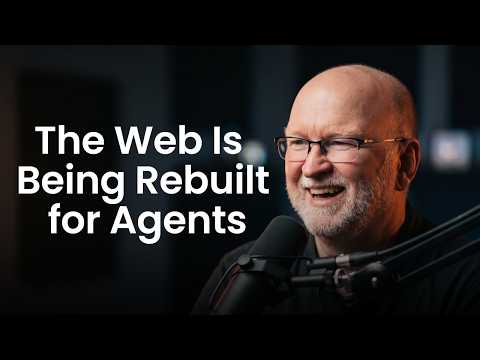
Microsoft’s Vision for an Internet Made for Agents With CTO…
A "best of" compilation of Dan Shipper's AI & I conversation with Microsoft CTO Kevin Scott about the agentic web. Scott's 2025 bet: for AI agents to be genuinely useful, they must take action on our behalf across the internet's tools, data, and systems—and the foundational infrastructure for that agentic web is now being built. Topics include closing the "capability overhang," how agents will evolve into practical tools, Microsoft's role in the agent ecosystem, how robust security can coexist with open ecosystems, craftsmanship and staying curious with new tools as a programmer, the evolution of software development agents, and the future of agentic workflows. Mentioned resources include the Model Context Protocol (MCP), Microsoft's NLWeb, and GitHub Copilot.
# Video Identity Observations: "Microsoft's Vision for an Internet Made for Agents With CTO Kevin Scott (Best of the Pod)"
## Self-Description Evidence (Explicit)
- The channel explicitly names itself in the outro: *"subscribe to AI and I"* — described as *"a journey into the future with Dan Shipper as the captain of the spaceship."*
- The show frames itself as an interview/podcast format: the host welcomes a guest (*"Kevin, welcome to the show"*) and closes a recorded conversation.
- The outro (which reads as an AI-generated comedic bit, ending with *"Dan, I'm absolutely, hopelessly in love with you... That's how you know it's the real deal"*) self-describes the show's tone as playful: *"Every episode is a roller coaster of emotions, insights, and laughter."*
- The title's **"(Best of the Pod)"** label indicates this is repackaged/republished highlight content from the channel's own podcast episodes.
## Intended Audience (Demonstrated)
- **Technically literate professionals and AI-industry followers.** The conversation assumes familiarity with terms like *scaling laws, MCP, NLWeb, agentic web, Conway's law, same origin policy, entitlement systems* — with only brief explanations (e.g., Conway's law gets a short aside).
- **Builders and makers.** Kevin Scott's framing repeatedly addresses developers and startup founders: *"the most interesting startups that I'm seeing right now are not trying to innovate by building some kind of differentiated infrastructure"* and advice like *"be curious, try stuff."*
- The host's questions mirror an audience weighing adoption decisions, e.g., on verticalized vs. open AI platforms and whether coding agents erode *"the craft of things."*
## Claimed Scope (Demonstrated via Content)
- The channel positions itself at the intersection of **AI industry strategy and frontier developments**, securing interviews with senior figures (Microsoft's CTO) at major events (Microsoft Build): *"one of the things that I've been pushing for at Microsoft..."* / *"I was talking about at the keynote today at Build."*
- Coverage is **forward-looking and analytical**, not tutorial-based: the closing segment is explicitly predictive (*"let's say it's a year from now... what are your predictions"*).
- The show blends **hard technical/strategic discussion** with **lighter, personality-driven framing**, evidenced by the juxtaposition of dense protocol talk and the comedic subscribe outro.
## Distinguishing Claims vs. Demonstrated Patterns
- The statement that the show contains *"pure, unadulterated knowledge bombs about Chat GPT"* is a **creator claim** (and slightly misaligned with this episode's actual focus on agentic infrastructure), likely an AI-generated promo script rather than an accurate scope description.
- The demonstrated pattern in this episode is expert-interview content on **AI agents, protocols (MCP/NLWeb), and software engineering's future** — not ChatGPT-specific content.
## Notes for Later Synthesis
- Channel identity signals present: named show (**AI and I**), named host (**Dan Shipper**), podcast format, republished "best of" content, an AI-culture/media outlet sensibility combining insider access with irreverent tone.
- No channel-level conclusions beyond this single episode should be drawn without corroborating videos.
# Delivery Observation: Kevin Scott (Microsoft CTO) — Interview Delivery Profile
## Overall Delivery Style
Kevin Scott speaks in a **conversational, think-aloud register** rather than a polished executive presentation. His delivery is heavy on hedges, fillers, and self-interruptions — *"like," "you know," "uh," "sort of"* appear throughout — giving the sense of reasoning in real time rather than reciting talking points.
> *"Yeah, I think there's a bunch of things that have changed. Like one of the things is that I think last year people were like really in this state of mind…"*
---
## Recurring Linguistic Patterns
### 1. "Like" as a discourse anchor
His most dominant verbal tic, used to launch explanations and soften claims:
- *"Like if agents are going to be useful, they have to take action on your behalf."*
- *"Like one of the things as CTO that I've been pushing for at Microsoft is like I want all of our systems internally to speak a standard protocol…"*
### 2. Numbered enumeration for structuring answers
He frequently organizes responses with explicit counts:
- *"two maybe three things that are super important"*
- *"So one is like we make agents…"* / *"And so, like that's the two things."*
### 3. Repeated framing devices
- **"If X is going to be useful, it has to…"** — appears nearly verbatim twice (early segment and again at ~[268]): *"if agents are going to be useful, they have to take action on your behalf. Like they have to be able to use tools and make changes in systems and consult information sources that are diverse and rich."*
- **Internet analogy as a throughline**: MCP compared to HTTP and NL Web to HTML — *"simple open protocols like MCP that are serving the same purpose in this agentic web as HTTP does on the internet."*
- **"Agentic web"** — a coined term he repeats consistently across the conversation.
### 4. Folk idioms and informal metaphors
- *"You ship your org chart"* (Conway's Law)
- *"it's just kind of a horror show"*
- *"I'm such a old recalcitrant fart that I still use VI"*
- *"I don't care who's going to throw rocks at me for doing it"*
---
## Teaching Habits
### Concrete personal anecdotes as evidence
He grounds abstract arguments in first-person stories:
- The two-factor authentication anecdote about his wife (*"I texted her I was like hey are you screwing around with the configuration here?"*) to illustrate AI-mediated security.
- Woodworking parallels — power tools vs. hand tools vs. CNC — used as the extended analogy for agent-assisted coding debates: *"are you a real woodworker if you use power tools?"*
### Historical framing for credibility and reassurance
He repeatedly uses his longevity as a teaching device:
- *"I wrote my first program when I was 12, which means I've been programming for 41 years."*
- *"this is not the first moment in the past four decades where the nature of software development has changed in a non-trivial way"* (appears twice in the transcript).
### Explicit advice-giving, with self-deprecation
- *"just have an open mind, uh you know, when the tools are changing"*
- *"just like be curious, try stuff. Like and if it works for you, use it, and if it doesn't, don't."*
- He frames advice as personal, not prescriptive: *"this is not me telling what it's just advice, like things that I found useful for myself."*
### Admitting uncertainty directly
- *"Well, I look I don't know uh that I know what exactly the right security model is…"*
- *"I think it might be a false dichotomy"* — pushes back gently rather than dismissing the interviewer.
---
## Communication Patterns
- **Echoes the interviewer's setup before answering** ("Yeah. So, look…" / "Well, look…"), a consistent launch phrase.
- **Pragmatic, outcomes-oriented reframing**: *"If you value the process more than you value the outcome… you'll make different decisions than people who value the outcome more than the process."*
- **Balanced "both/and" posture** on contentious topics: *"you can have both, right? Like I don't think it's needs to be one or the other as you framed it."*
- **Optimism framed as a bet**: *"the cost of betting on failure versus betting on optimism is a real big difference."*
---
## Isolated Moments (lower confidence as patterns)
- Self-deprecating humor about age/tools (*"old fart," "recalcitrant fart"*) appears twice, so it's plausibly stable, but the sample is small.
- The anecdote about emailing/texting his wife is a one-off story; the pattern it supports (personal anecdotes as evidence) is better supported by the woodworking material.
- The closing hype outro ("smash that like button") appears to be a show-produced segment, not part of Kevin Scott's own delivery.
---
## Summary Snapshot
| Feature | Evidence strength |
|---|---|
| "Like"-heavy informal register | Very strong (pervasive) |
| Internet/HTTP analogies | Strong (repeated across multiple answers) |
| Craft/making anecdotes (woodworking, VI, 3D printers) | Strong |
| Numbered enumerations | Strong |
| "Look/Yeah" answer launches | Moderate–strong |
| Explicit uncertainty admissions | Present but limited (mainly the security question) |
# Video Observation: Microsoft's Vision for an Internet Made for Agents — Kevin Scott (CTO)
## Speakers
- **Interviewer** (identified in closing as **Dan Shipper**, host of "AI and I" via an end-segment AI voice promo) — asks questions, occasionally editorializes.
- **Kevin Scott** — identified by transcript title and host address ("Kevin, welcome to the show"); Microsoft CTO per video title. Describes his own role: "one of the things as CTO that I've been pushing for at Microsoft…"
- **AI promo voice** (end segment, promotional, no substantive positions).
---
## Position 1: Scaling laws are intact, but the story has shifted to the "agentic web"
**Speaker:** Kevin Scott
**Stated reasoning (responding to what changed year-over-year at Build):**
- Last year, people doubted scaling laws would continue; he claims "we've demonstrated year after year… that they are intact and working quite well."
- Model reasoning capability has "gotten a little bit ahead" of product usage — he names this the **"capability overhang"**: "we actually have some work to do collectively across the whole industry to close the gap between what the models are actually capable of and… what we're delivering to users."
- Beyond reasoning, agents need other things sorted to be genuinely useful: **agentic memory** ("agents right now… are a little bit transactional"), tool use, and ecosystem plumbing.
**Analogy as core claim:** The agent ecosystem should look "a lot like the internet":
> MCP is serving "the same purpose in this agentic web as HTTP does on the internet" and NL web serves "the same moral equivalent purposes HTML does."
**Interviewer's playback (accepted by Scott with "Yep"):** agents need access to the internet and local systems, and protocols/processes at the runtime layer (memory) and connection layer (MCP) to get it.
---
## Position 2: Why this matters to Microsoft — agents + platform
**Speaker:** Kevin Scott
Two (he says "two maybe three") reasons:
1. **Microsoft makes agents** — internally, he is pushing for all systems to "speak a standard protocol" to internal agents, explicitly to avoid **Conway's law** ("you ship your org chart"), which he calls "a horror show" for engineers without standard protocols.
2. **Microsoft is a platform company** — "even more important than the agents that we're going to write ourselves," building on a 50-year platform-layer history.
---
## Position 3: MCP's security model — unresolved, but open and tractable
**Speaker:** Kevin Scott (in response to the interviewer relaying "rumblings" that MCP's security model "needs a lot of work," noting the internet has the same-origin policy and MCP doesn't)
**Key qualifications preserved:**
- He explicitly concedes uncertainty: **"I don't know that I know what exactly the right security model is."**
- His stated optimism rests on MCP's simplicity: "it is so coherently simple that it's going to be relatively easy for the community to decide what the security model is."
- Sketches needed pieces: **agent identities**, entitlement systems ("this agent is acting on behalf of this person"), permission requests to users, administrator approval. Calls this "relatively straightforward to do like not easy."
- Insists it be open, not proprietary.
---
## Position 4: Open vs. vertical is "a false dichotomy"
**Speaker:** Kevin Scott (interviewer framed the choice: verticalized "App Store / Apple iPhone" model = guaranteed security; open model = more innovation but harder security)
- "I think it might be **a false dichotomy**."
- Values **permissionless innovation**: some "middle layers… just aren't contributing much value… to the two parties in the transaction that matter."
- Argues AI itself can deliver robust open security, via a personal-security agent doing risk assessment. Illustrates with a personal anecdote (an email flurry about his wife's two-factor authentication; he texted rather than emailed), offering it as an imagined capability — not as something that already exists.
---
## Position 5: Craft and coding agents — strong opinions are fine; keep an open mind
**Speaker:** Kevin Scott (interviewer raised the "knock" that agents remove craft feeling, noting he doesn't necessarily agree)
- "I love the fact that my people… makers writ large… if you are really passionate about what you do, you're going to have very strong opinions." Calls strong opinions "a necessary thing for you to be great at your job."
- Frames agent-driven change as recurring: "this is not the first moment in the past four decades where the nature of software development has changed in a non-trivial way."
- Self-qualifying admissions: he "probably shouldn't say this" (given Microsoft makes VS Code) that he still uses **VI**, calling himself "such an old recalcitrant fart," while acknowledging it is "sub-optimizing."
- Woodworking parallel: the hand-tools vs. power-tools debate of his youth, now CNC vs. power tools — "if you value the process more than… the outcome… you'll make different decisions."
- His advice: **"be curious, try stuff. And if it works for you, use it. And if it doesn't, don't."** Admits he delayed learning 3D printers and regrets it.
---
## Position 6: Many agents, not one; problem understanding beats infrastructure
**Speaker:** Kevin Scott
- "It's going to be a lot of different agents" — "unrealistic" that every developer snaps to one tool. Notes Microsoft will "compete very hard" with Copilot/GitHub agent tooling.
- The most interesting startups innovate on **understanding of a problem**, not differentiated infrastructure.
- Interviewer's follow-up on the promo segment contains no substantive Scott position.
---
## Position 7: Year-ahead predictions
**Speaker:** Kevin Scott
- Those using "the technology's not ready yet" as an excuse to wait "are going to be super behind"; dismisses progress-skeptic "cranks" as "betting on failure."
- Predicts a shift from **synchronous to asynchronous** agent interaction: "hey, go sort this out" with the agent making many calls and iterating before returning — offered as expectation ("you're going to see"), not current fact.
---
## Unresolved Tensions Preserved
- **Security:** Scott champions open protocols while admitting the right security model is unknown — and the interviewer's vertical-vs-open framing remains only partially answered ("you can have both").
- **Craft vs. tooling:** Scott validates strong craft opinions (and models suboptimal tool loyalty himself with VI) while advising openness to new tools — an acknowledged tension, not a resolution.
- **Interviewer's own stance:** explicitly stated he does "not necessarily agree" with the craft objection, so it is presented as a prompt, not a shared view.
*Note: The end-segment promotional voiceover is AI-generated content promoting the show; it contains no positions by either speaker.*
# Video Attribution & Provenance Record
## Video
- **Title:** Microsoft's Vision for an Internet Made for Agents With CTO Kevin Scott (Best of the Pod)
- **Video ID:** 01a0f15a-4a23-7fdb-86f9-c24267eb5f86
## Speakers & Roles
| Speaker | Role | Evidence |
|---|---|---|
| **Kevin Scott** | Guest — Microsoft CTO | Addressed as "Kevin, welcome to the show"; refers to himself "as CTO… at Microsoft"; was a keynote speaker at Microsoft Build |
| **Host/Interviewer** | Show host — unnamed in transcript | Conducts interview, asks questions; identified in outro as **Dan Shipper** |
| **Outro announcer voice** | Promotional announcer (likely AI-generated voice or production element) | Delivers subscription CTA and comedic sign-off; also names "Dan Shipper as the captain of the spaceship" |
- Interview appears conducted **at Microsoft Build** (references to "the keynote today at Build" and "we're back at Build").
- The show is identified as **"AI and I"** in the promotional outro.
## Referenced Sources & Third-Party Claims (per speakers)
- **MCP (Model Context Protocol)** — described by Scott as an open protocol serving the agentic web analogous to HTTP.
- **NL Web** — described as serving a role analogous to HTML in the agentic web.
- **Conway's Law** — cited by Scott; paraphrased ("you ship your org chart").
- **Scaling laws** — Scott claims they are "intact and working quite well" (third-party claim, not independently verified).
- **"Capability overhang"** — concept Scott says he has "been talking a lot lately" about.
- Comparisons to **Apple's App Store / verticalized model** raised by the host as a framing question.
- Anecdote: Scott describes a **two-factor authentication incident** involving his wife's account (personal claim).
- Predictions (Scott's opinions, not facts): shift from synchronous to asynchronous agent interaction within a year; continued cost reduction and capability growth.
## Promotional Segments ⚠️
- **End-of-video outro:** Explicit promotional call-to-action for the show "AI and I," urging viewers to "smash that like button and subscribe." Includes a comedic declaration ("Dan, I'm absolutely, hopelessly in love with you"). This is production/promotional content, not interview substance.
## Availability Limits
- No curated metadata supplied beyond the transcript; speaker identity for the host rests on the outro's mention of "Dan Shipper."
- No comments section, citations, links, or external sources are referenced as available in the source material.
- No timestamps present in transcript.
You're someone who I think cares a lot about the craft of things. One of the knocks on, you know, using agents for coding is it gets rid of some of that feeling or something like that. How do you feel about that?
\>\> I love the fact that my people, you know, makers writ large, so software engineers or, you know, mechanical engineers or woodworkers or potters, if you are really passionate about what you do, you're going to have very strong opinions about how you do it. I've been a woodworker for almost as long as I've been a programmer. This is not the first moment in the past four decades where the nature of software development has changed in a non-trivial way. Like if agents are going to be useful, they have to take action on your behalf. They have to be able to use tools and make changes in systems and consult information sources that are, you know, diverse and rich. And in order for that to like really be great, you need an ecosystem that looks a lot like the internet. If you have a source of information, you already have a website, you already have an API that's doing something for people out there, like you've got to figure out how to plumb things through where agents can like talk to those things. Like one of the things as CTO that I've been pushing for at Microsoft is like I want all of our systems internally to speak a standard protocol to all of the agents that we're writing inside of Microsoft. Be curious, try stuff. And if it works for you, use it. And if it doesn't, don't.
Kevin, welcome to the show. \>\> Oh, thanks for having me. \>\> One of the things that's interesting is that I was here last year. \>\> Yep. \>\> And you said two things, there were there were two big themes. Uh, one was agents are going to be everywhere. That's one of the things you said, which
I think really came true. That was very refreshing. Another thing is I noticed a big emphasis last year on scaling laws. There were a lot of graphs of like we're building big infrastructure, we're building these bigger models and every two years we're going to get these big performance improvements. This year the emphasis is really on the agentic web. So what has changed? What have we learned from last year to this year? \>\> Yeah, I think there's a bunch of things that have changed. Like one of the things is that I think last year people were like really in this state of mind that they were doubting that the scaling laws were going to continue to work really well. Whereas like I think you know, we've demonstrated year after year after year that the they are intact and working quite well that like that's not a thing that people need to be reminded of anymore. And I think the other thing too that's happened honestly
is that the reasoning capabilities of the models has actually gotten a little bit ahead of what we're using the models to do in products. So I've I've been
talking a lot lately about this thing called the capability overhang. And you know, I think we actually have some work to do collectively across the whole industry to close the gap between what the models are actually capable of and like what we're delivering to users of that capability. So that that's one of the one of the like big thematic things why you know, scaling laws might not be as interesting to talk about at this year's build as last. And then the other thing too is that we've just discovered as all of these agents have emerged over the past year and so like both the number of agents and like the amount of time that people are spending doing stuff inside of these agents or with these agents is that there's a bunch of other stuff other than reasoning that has to get sorted out in order to make them as useful as they should be. So you know, the things that I was talking about um at at the keynote today at Build were yeah, we need better agentic memory uh like our agents right now because memory is constrained in a bunch of interesting ways. Uh Um they're a little bit transactional. So like you use them for like one thing and like you know, memory is coherent across the course of that task. Uh but yeah, then it may or may not completely go away and like you're starting from scratch uh the next time which really inhibits your ability to delegate and increasingly complicated tasks to these things. Um and then like there's just this real issue that like if agents are going to be useful, they have to take action on your behalf. Like they have to be able to use tools and uh like make
changes in systems and consult uh information sources that are you know, diverse and rich. And in order for that to like really
be great, you need uh like an ecosystem that looks a lot like the internet where um if you have a source of information, you already have a website, you already have an API that's doing something for people out there. Like you've got to figure out how to plumb things through where agents can like talk to those things. Uh and where, you know, all of the incentives are aligned for everyone to like go have all of this stuff participating in, you know, ways that make sense to them in this agentic web. And so I think that is the big story this year. It's like you've seen the first glimpses of like real progress with like super awesome simple open protocols like MCP that are serving the same purpose in this agentic web as HTTP does on the internet and where you have things like NL web that are like serving, you know, the same moral equivalent purposes HTML does on the internet. And so I think you're going to see these things like simple things that are composable and layering and like just lots of activity in the open community and like a bunch of things hopefully getting to ubiquity so that agents can actually do stuff. \>\> Right. So I I think to to play that back like one of the things I hear is like we have agents agents are starting to work and in order to make them powerful agents need access. They need access to like what whatever is out on the internet, whatever is on your computer, all that kind of stuff. \>\> Yep. \>\> And you need um basically protocols um and processes for agents to be able to access that stuff. And so you're looking at different parts of the stack. So like the runtime layer where where you're you know, you're building like memory and and and all this kind of stuff and then um MCP which allows you to connect into the wider internet to get and from more information into agents. Um I guess why is that important to Microsoft and like what role do you want to play in that kind of an ecosystem? \>\> Well, look, I think there you know, two maybe three things that are super
important. So one is like we make agents and in order for our agents that we're building for folks to be useful like we need to solve these problems inside of these agents. And like even if you sort
of scope it down narrowly to enterprise agents like one of the things as CTO that I've been pushing for at Microsoft is like I want all of our systems internally to speak a standard protocol to all of the agents that we're writing inside of Microsoft so that we're not exposing the entire world to like Conway's law which is, you know, organization it's a Conway's law is like it's really funky thing in compilers where yeah, this guy Conway said that the the number of stages or passes in your compiler is going to be dictated by the number of teams you have working on the compiler. \>\> your org chart. \>\> Correct. You ship your org chart. Um and so, you know, you you certainly inside of the confines of a company like Microsoft, like you don't want to be shipping your org chart when you are uh building your agents. Uh and like it's just kind of a horror show to watch uh like as a engineer uh like all of this inefficient building like when you don't have like those standard protocols and services that everybody's using. But I I think, you know, if you sort of imagine if you really imagine like what agents could do and like what you you know, what users uh like not me, but like, you know, just people who are hoping these things can be more useful than they are right now. Uh like you need things to start happening the same way that they were happening uh with the web. And like I kind of see it right now. Uh like MCP is like a really great example. So,
it is a really simple protocol that solves a really important problem not just for people who are making agents and building platform infrastructure,
but for um users of these systems who want them to be more useful and for people who are providers who are like, "Hey, like I want to be participating in this new agentic web." is like people are doing less of one thing which I knew how to connect to like how and they're you know, they're sort of sitting here using these agents. Like how do I get my stuff wired up into this and like how does it make sense for me uh like even from a business model perspective uh to do that? And so, like that's the two things. It's like make our own agents more useful and then like you we're a platform company. Like even more important than the agents that we're going to write ourselves, like that platform layer that Microsoft has been building in technology for 50 years, like we just want to make sure that we are helping solve the problems that are emerging as this agentic web is happening. \>\> Yeah. It's been It's really cool to see you guys like leaning really hard into MCP and like integrating it into all of Windows and all that kind of stuff. That's really awesome. And it it brings up for me I've been starting to hear rumblings from people who are thinking a lot about MCP that um the security model needs a lot of work. \>\> Yeah. \>\> And I'm I'm curious like for your take on that cuz you're you're you're making a lot of comparisons between this stack and um the internet stack. And the internet has a bunch of like things in its security model like the same origin policy that make sure that you like uh if a website is serving you serving you code like it's only able to execute on its own data. Um MCP doesn't really have that. So like how do you What do you think the right security model is for this? \>\> Well, I look I don't know uh that I know what exactly the right security model is, but like the interesting thing about MCP is uh like it is so coherently simple that it's going to be relatively easy for the community to decide what the
security model is. Like yeah, we we have a bunch of like enterprise things that we care a lot about and that like we're doing really good work with the with the MCP team to get done. So like we need
agents to have identities uh so that you can build entitlement systems so you can say this agent is acting on behalf of this person and like they're entitled to see these resources in this system. And like even having a way for an agent to sort of go query a bunch of systems and say like these He- Here's the thing that I would like to do. These are the systems I need to touch in order to do the thing. Like what entitlements do I need to ask for in order to do this? And so I can request permission like from the user like the person who's delegated this task to me. Like can I present to them like can I have permission to these things in order to do this thing you asked me to do? Yes or no. And then for the administrators of all of these systems uh you know, like, "Hey, is it okay for all of this to be happening?" And so, like, there's All of that's going to be like relatively straightforward to do like not easy, but like relatively straightforward to do on top of MCP. And like the important thing is like let's do it in an open way. Like, we don't need it to be proprietary to like our agents or our systems. Like, we've just got to figure out how to get this done where things kind of work like the web works. \>\> Yeah. Well, it's an interesting question for me because I feel like there's there's maybe two potential models or two potential go-to-markets for for AI stuff that that you guys have been talking about. One is
this sort of like verticalized model where you own the model and you own the UI layer, you do do all the applications and everything in between. And And the the thing about that model, which maybe it's sort of you could say the the App
Store Apple iPhone model is is is a good example of that is you can guarantee security in a lot of ways. Um And an open model uh it's harder to do security stuff, but you get much more like innovation basically cuz there's no central authority. So, how did you guys think about making that making that decision? \>\> Yeah. So, look, I I know that that's the argument that a lot of people make. Yeah. I I think it might be a false dichotomy. Um that there there is uh you know, like a a thing that you have in these open systems where they are permissionless. Uh and like there there's a real advantage in having permissionless uh innovation. So, like, the thing that as an individual that excites me most about what's happening right now is the extent to which you can go innovate and build things without having to seek someone's permission. Like, where you have to have them grant you permission for distributing your things to other people and, you know, like, having all of these like complicated gatekeeping things that are sitting in between you who are the person who had the idea and like the people who might benefit from it. Uh, like I think some of these like middle layers that we have that have emerged over the past handful of years like just aren't contributing much value uh honestly to the two parties in the transaction that matter which is the person who did the hard work to make a thing and then the people who are going to either spend their attention or their money or some other currency that's valuable to like access the thing. Um so like I get it kind of excited about that. And so like that's one of the reasons why we've made the decisions that we wanted to. But like I also think that there are ways that you can get real robust security uh in these systems uh like leveraging some of the AI capability that you have now. Um that you know where you may be able to have better security uh like if you have an agent that you are running that is attending to your personal security requirements like these are things I'm willing to share, these are things I'm not willing to share like you know and it has some kind of knowledge or risk assessment and like yeah like for for instance like my wife this morning while I was uh uh while I was getting ready to jump on stage like I got this flurry of emails uh that uh because I'm the like backup security account for my uh wife where like somebody was like fiddling around with two-factor authentication on her account and like the first thing I did was I texted her. Like I didn't want to email her because somebody might have gained unauthorized access to her email account. I texted her I was like hey are you screwing around with the configuration here? She's like yes. Um and so like you could imagine like having an agent that is like privy to like a whole bunch of your communication modalities like being able to like notice that something funky is going on and then like you know, using a bunch of resources to triangulate like whether that's legit activity or illegitimate activity. So, I I like I think there's just a bunch of stuff like that that like you you can have both, right? Like I I don't think it's needs to be like, you know, one or the other as you framed it. \>\> Yeah, that makes sense. Um one of the one one other thing that I'm I'm curious about is it just seems
pretty clear that software engineering is changing. \>\> Yeah. \>\> Um and um you're someone who's been involved in software engineering for a long time. Uh you're someone who also I think cares a
lot about um like the craft of things, like the craft of how things are made. We were talking earlier about you're making um uh you do a lot of ceramics, you make your own bags, like you're you love having your hands in things. \>\> Yeah. \>\> And I think one of the knocks on, you know, using agents for coding is like it gets rid of some of that feeling or something like that, which I don't necessarily agree with, but I'm sort of curious for you like, as someone who cares about the craft of code, um looking into this future of coding with agents, like how does that How do you feel about that? \>\> Well, so let me start by saying that I I love the fact that my people and like when I say my people, I mean you know, makers uh writ large. So, software engineers or you know, mechanical engineers or woodworkers or potters or you know, just sort of pick your thing where people are you know, trying to create things from, you know, raw materials or nothing. Um if you are really passionate about what you do, you're going to have very strong opinions about how you do it, the tools that you use, the materials that you use, like how things get put together. It is a necessary thing for you to be great at your job. The interesting thing is people have lots and lots of different opinions and like one of the event you said like I've been doing it for a long time. Like I am like I'm an old fart. Like I wrote my first program when I was 12, which means I've been programming for 41 years. Um And so the the thing that you get to see when you've been doing a thing for a very long time is like this is not the first moment in the past four decades where um the nature of software development has changed in a non-trivial way and where people have very strong opinions about the change and what it means. And so yeah, I I think the the reality is that people will have choice. Uh you know, like I still when I go into a text editor, I I probably shouldn't say this because like we make you know, Visual Studio Code. Like I'm such a old recalcitrant fart that I still use VI. I
use them at least. But like my text editor of choice is like this extremely antiquated thing. And like I just refuse to go use something different. Um even
though I know for sure that that is sub-optimizing a part of what I'm doing. But I I make the decision anyway because like I get to choose. Um and then in other aspects of my making like either software or something else that I'm doing, like I will be like, "Okay, the important thing here is not the way that I'm doing this particular part of it. It's the outcome that I'm trying to get to. And like I'm going to use the most powerful or most convenient way to go get to the outcome. Uh and like you know, I don't care who's going to throw rocks at me for doing it. And like it it's literally everywhere. Like I I've been a woodworker for almost as long as I've been a programmer. And when I was a teenager, like the big debate was like, "Oh, are you a real woodworker if you use power tools?" Like you know, real woodworkers only use hand tools. Um Like there's still a little bit of that debate today. But like the real debate is like are you a real woodworker if you use CNC tools, like computer-controlled power tools versus just power tools. Uh and I understand it. Like I actually think it's interesting, the debate itself. Uh but like sometimes like people are going to make, you know, different choices because like they value something
different than you do. If you value the process more than you value the outcome, like sometimes you'll make different decisions than people who value the outcome more than the process.
\>\> And I think the like is it a are you a real woodworker, a real programmer? You're sort of saying like you're only real if you do it the way I grew up doing it when you ask that question in a lot of ways, you know? Um \>\> But but it it's just so varied, right? And like so the the thing that I will say is like I would never in a million years tell anyone not to have strong opinions about their craft. Like have them. Like it's great. Like the the advice that I would give people, and like this is not me telling what it's just advice, like things that I found useful for myself, is just have an open mind, uh you know, when the tools are changing. Um I can't even tell you like the number of times where I have looked at a new technology in some other like non-software uh dimension of making that came along where I'm like, "Ugh, like I don't want to learn Like 3D printers, like I waited forever to learn how to use 3D printers." And like I regret it. Like I should have started earlier. Like they're so damn useful for almost everything that I do. And for a whole variety of complicated reasons, like I didn't let myself be curious about that, which is odd. And so you know, just like be curious, try stuff. Like and if it works for you, use it, and if it doesn't, don't. \>\> Yeah. What do you think is the future of software engineering agents? Like is there going to be like one agent to rule them all, or is it you're just going to use many different agents with different
tastes, or like how do you see that ecosystem shaping up? \>\> Yeah, I look, I think it's going to be a lot of different agents. Uh I mean, like and and it's good to have a lot of agents and like we certainly would get a co-pilot and the
uh you know GitHub agent stuff that we're working on. Uh like I think we will compete very hard to like be a tool that lots of people will choose because it's very useful to them, but I think it's unrealistic in the universe of developers to like think that like every developer on the planet is going to snap to using like one tool for like an important part of their job. Like part of the joy of being a developer is you actually have that choice and you can sort of choose and play around with a bunch of different things and like do irrational things and like do irrational things and like it's it's just you know it it it is one of the very consistent things that I've seen over the past four decades of my programming life is like people choose to change their tools all the time. \>\> What other dimension do you have a opinion on the dimensions along which the different agents might differ? \>\> Well, I think the most important thing about uh agents is like probably the product-making part of them. And so the most interesting startups that I'm seeing right now are not trying to innovate by building some kind of differentiated infrastructure. They're innovating because they think they have an understanding of a problem that someone has that is better than anyone else. And they think that they can pick up infrastructure or modify infrastructure or tune infrastructure to go solve their understanding of that problem in a world-class way. So I think that's what we need a lot of right now and like that's what's going to dictate the diversity of agents and like how like which things get used for what. And I think honestly because it's so much easier now to like have that nuanced understanding of what someone's problem is and to pick up these tools to go take a swing at solving it, that you're just going to have a lot of companies like building a lot of things trying to you can even see it with the software development tools. It's like crazy how many things have come out over the past year. And like they're interesting. Like all of them. \>\> Yeah. \>\> Yeah, it's a lot to respond to when you're a company building software development tools yourself. But like it's super super interesting and it's like what we've seen is if you've got some kind of nuanced understanding of what someone needs, like people have like high tolerance and like high interest in like giving things a try. \>\> Yeah. \>\> Uh. \>\> So, we're almost out of time, but uh I'm I'm curious like let's say it's a year from now, we're back at Build. \>\> Yep. \>\> Um what are what are some things that are uh hot topic right now um or big questions that people have right now that are not going to matter in a year? And what is going to matter in a year? And what are your what are your predictions for what we're going to be talking about? \>\> Yeah, I think people who are still like hanging on to these ideas that oh like the technology's not ready yet because like I yeah, I I tried to do something and it was like marginally too expensive or like it was marginally capable of you know doing the thing that I wanted to do. Uh like I I I think anyone who is using those as excuses to wait to get started are going to be super behind um because everything's going to get cheaper and everything's going to get more capable every year. I know like and I I think this is actually not a hard sell in 2025. Uh yeah, it was this loud chorus of like oh, you know, the progress is going to you it's about to end and like everything's going to stop and like everybody's going to be super disappointed. Uh Like I I I mean there's still some people out there saying that, but like I don't think you know, folks are paying much attention to them anymore. Mostly because like you know, what do you win by paying attention to like some crank who's saying like you know, the the thing's about to stop. Like you're sort of betting on failure and the cost of betting on failure versus betting on optimism is like is a real big difference there. Um So, yeah, like I I think we're we're going to we're going to see a ton of progress on
like the level of ambition of problems that people are tackling with agents. And then I think you know, modalities that are going to be really different is like is this agentic web starts to get
more complete, more plumbed out and the models reasoning and planning capability get better and better. Like you're going to start to get to the point where you're able to go from this synchronous mode of interaction with agents to asynchronous. Like right now most of what people do is like they sort of sit down like they got a thing they want to do. Like they issue the prompts like and they wait until you know, the thing comes back and like you do something with that response. And so I think you know, by next year you're going to see people using these agents to like hey, go sort this out and the agent is going to take a lot of time. It's going to go make a lot of calls out to systems. Like the things that it's sort of like taking action on are going to like take a while to come back. Then they're going to like integrate all of those responses and like do something and like that whole thing may iterate a bunch of times and then you know, at some non-trivial amount of time later you're going to sort of say, okay, like here's the here's the here's as far as I got. Like now it's your turn. Like go take some action now. \>\> Sounds like a future I want to be in. \>\> Yeah. Yeah, me too, right? \>\> \[laughter\] \>\> Um well, Kevin, thank you so much. Uh it was really great really great to talk to you. \>\> Yeah, good to talk to you as well. Thank you for having me on. Of course. \>\> Oh my gosh, folks, you absolutely, positively have to smash that like button and subscribe to AI and I. Why? Because this show is the epitome of awesomeness. It's like finding a treasure chest in your backyard. But instead of gold, it's filled with pure, unadulterated knowledge bombs about Chat GPT. Every episode is a roller coaster of emotions, insights, and laughter that will leave you on the edge of your seat craving for more. It's not just a show, it's a journey into the future with Dan Shipper as the captain of the spaceship. So, do yourself a favor. Hit like, smash subscribe, and strap in for the ride of your life. And now, without any further ado, let me just say, Dan, I'm absolutely, hopelessly in love with you. \>\> Answer. \>\> That's how you know it's the real deal. \>\> Yeah, \>\> \[laughter\] \>\> excellent.