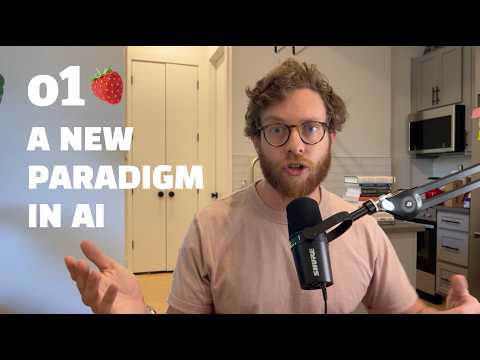
OpenAI's o1 Smashes Benchmarks: What It Is And How To Use It
A breakdown of OpenAI's o1 model (previously code-named Strawberry): what it is, how it works, and why it matters. The video explains that o1 is significantly better at reasoning tasks, scoring in the 89th percentile on competitive programming and exceeding Ph.D.-level performance on physics, biology, and chemistry questions.
# Channel Presentation Evidence — "OpenAI's o1 Smashes Benchmarks: What It Is And How To Use It"
## Explicit Self-Description (Creator Claims)
- **Creator identifies himself by name and role at the end of the video:**
> "my name is Dan shipper I'm the co-founder and CEO of every a daily newsletter about what comes next in Tech I'm a writer I'm a programmer I'm an entrepreneur you should check us out at every."
- **Channel/product scope claimed:** *Every*, described as **"a daily newsletter about what comes next in Tech."**
- **Creator's claimed credentials:** self-described **writer, programmer, and entrepreneur**.
- **Business context disclosed:** references internal operations — "for us at every we have an internal incubation that saw 20% Improvement just from some simple use of 01."
## Observable Presentation Patterns
### Audience Addressed
- **Hands-on ChatGPT users:** walks through selecting models in the ChatGPT interface ("if you head into Chachi BT and you go to your model selector you can now select one of two models").
- **Business decision-makers:** explicitly names businesses as "the real winners here… businesses that are going to be building with this stuff," citing long-running, expensive queries.
- **Viewers invited to participate:** "if you found cool ways to use 01 let me know in the comments I want to hear about it."
### Claimed Scope of Coverage
- **Current AI product news and tutorials:** explains OpenAI's o1 preview and o1 mini, their tradeoffs, and how to prompt them.
- **Conceptual AI education:** teaches underlying concepts like Chain of Thought reasoning and inference-time compute scaling.
- **Forward-looking tech commentary:** speculates on an "allocation economy" replacing a "knowledge economy" and future multi-day model runs.
### Demonstrated Format and Style
- **Product demo walkthrough:** live examples such as asking o1 to prove √2 is irrational, observing the visible "thinking" summary.
- **Explanatory analogies:** compares Chain of Thought to "long division by hand on a piece of paper."
- **Practical usage guidance:** advises "o1 is better with shorter prompts that get right to the point," differing from GPT-4o.
- **Self-referenced recurring themes:** "I've been talking a lot about the idea that… we might be moving from a knowledge economy… to an allocation economy" — indicating a channel with ongoing conceptual threads.
## Claims vs. Demonstration Distinction
| Type | Evidence |
|---|---|
| **Creator claim (about channel/self)** | Name, CEO role, newsletter description, "I'm a writer/programmer/entrepreneur" |
| **Demonstrated pattern** | Tutorial-style demos, audience engagement via comments, business-use framing |
| **First-party testimonial (unverifiable here)** | "20% Improvement just from some simple use of 01" at Every's incubation |
# Delivery Observations: "OpenAI's o1 Smashes Benchmarks"
## Tone & Register
- **Conversational, casual American English** throughout, with informal filler-like phrasing: *"it's a little bit smarter it's a little bit slower"*, *"like it got an 800 on SAT Math but it's never read Shakespeare."*
- **Enthusiastic but explanatory** — frames the topic as exciting without hype-heavy adjectives: *"overall this is just a really really exciting time."*
- Direct address to the viewer creates a tutorial feel: *"all right so let me show you how it works"*, *"if you head into ChatGPT."*
## Teaching Habits
- **Live demonstration pattern**: introduces a concept, then walks through an on-screen example — the irrational-number proof prompt: *"if I give o1 a question like prove that the square root of two is an irrational number…"*
- **Analogies to explain technical ideas**:
- Chain of Thought compared to human calculation: *"in the same way if you do long division by hand on a piece of paper you're going to have a better result than if you just do it in your head."*
- Models described as *"sort of intuitively blurting out the answer."*
- **Contrast framing** — repeatedly explains new things via comparison:
- o1-preview vs. o1-mini ("a little bit smarter… a little bit slower")
- o1 vs. GPT-4o prompting ("a lot different from 4o where you could throw in as much context as you want")
- **Simple model choices simplified for a lay audience**: *"previously the only two ways to make a model better were add more data or train it with more compute."*
## Recurring Vocabulary & Phrases
- **"Chain of Thought"** appears repeatedly as the anchor term: *"it's called Chain of Thought"*, *"trained… to always do Chain of Thought"*, *"its Chain of Thought stays on track."*
- **Hedged intensifiers**: frequent use of *"a little bit"*, *"a lot"*, *"sort of"*, *"really"* — e.g., *"it's just much better at like math and coding problems."*
- **Direct advice to viewers**: *"you should definitely use this model today"*, *"you need to get good at knowing which bets to take."*
## Structure & Communication Patterns
- **Sequenced explanation**: what it is → how to choose models → demo → why it works → implications → practical prompting advice → endorsement → sign-off.
- **Enumeration of reasons**: *"this is really interesting for two reasons one is…"* — a recurring counting-out habit for organizing points.
- **Closes with a call to action and self-introduction**, a YouTube-standard outro: *"if you found cool ways to use o1 let me know in the comments… my name is Dan Shipper."*
- **Self-referential authority**: cites personal testing and company results — *"in my early testing"*, *"we have an internal incubation that saw 20% Improvement."*
## Uncertainty Notes
- Habits like analogy use, contrast framing, and casual register appear multiple times, so they seem stable; the **counting-out structure** ("two reasons") appears only once here, so it may be an isolated choice rather than a pattern.
# Position Record: "OpenAI's o1 Smashes Benchmarks: What It Is And How To Use It"
**Speaker:** Dan Shipper, co-founder and CEO of Every (self-identified at end of transcript). No curated speaker metadata supplied beyond transcript.
## Model Overview: o1-preview vs. o1-mini
Shipper describes the two new models in ChatGPT's model selector:
- **o1-preview**: "a little bit smarter," "a little bit slower," more world knowledge — recommended for questions requiring current-world knowledge.
- **o1-mini**: faster, less world knowledge, better at math and coding. He cites the claim that it "got an 800 on SAT Math but it's never read Shakespeare." Recommended for "really reasoning specific" problems.
## Chain-of-Thought Reasoning
Shipper explains o1's "thinking" behavior:
- Instead of "blurting out an answer," the model shows a summary of its thought process (e.g., presenting a proof, observing even numbers, revisiting ancient beliefs) before delivering the result.
- He demonstrates with a prompt: prove √2 is irrational via contradiction, then explain its impact on ancient Greek mathematics. He concedes this question is **not something GPT-4o "necessarily would have gotten wrong"** — it's illustrative of the difference, not a strict capability contrast.
### Reasoning about why it works
- **Chain of Thought** predates o1; people noticed earlier GPT models improved accuracy and reduced hallucinations when asked to "think step by step."
- His analogy: GPT models "think by writing to you," like doing long division on paper versus in your head.
- The o1 difference: Chain-of-Thought is **native**, trained via **reinforcement learning** to always occur.
## New Scaling Paradigm
Shipper claims a qualitative shift:
> Previously the only two ways to make a model better were add more data or train it with more compute.
- OpenAI found that scaling **thinking time at inference** also scales performance (his example: one prompt thought for 7 seconds).
### Implications he draws
- Future models could tackle harder problems; ChatGPT might respond later ("go spend a few hours on this... come back to it much later").
- For humans, prompting such models may become "a new and important skill."
## The "Allocation Economy" Thesis
Shipper's stated position (which he says he's "been talking a lot about"):
- Shift from a **knowledge economy** (compensated on what you know) to an **allocation economy** (compensated on ability to allocate intelligence).
- Running o1 is "a big bet" — minutes, hours, or days; costs time and money — so users must learn **which bets to take** and how to formulate prompts likely to succeed.
## Prompting Guidance
- Per Shipper, OpenAI found o1 performs better with **shorter, to-the-point prompts**.
- Contrast with GPT-4o: extra context didn't significantly degrade 4o's performance; with o1 you must be selective so the Chain-of-Thought "stays on track."
## Adoption Recommendation
- "You should definitely use this model today" — he estimates **10–20% of day-to-day prompts** require o1's reasoning level (his early testing).
- **Businesses** are "the real winners" — more likely to have long-running, reasoning-heavy queries.
- Evidence cited: an Every internal incubation saw a **20% improvement** from "some simple use of o1." (Unqualified; no methodology given.)
## Notable Qualifications & Unresolved Points
- The demo question is acknowledged as one GPT-4o could likely handle — the o1 advantage is in the *process*, not that specific answer.
- The 10–20% prompt share and the Every 20% improvement figure are framed as early/informal observations, not rigorous results.
# Speaker Attribution & Provenance Record
## Video
- **Title:** OpenAI's o1 Smashes Benchmarks: What It Is And How To Use It
- **Video ID:** `01a0f15b-07b1-793b-a2d0-ac29ebea09b6`
## Speakers & Roles
| Speaker | Role | Evidence |
|---|---|---|
| **Dan Shipper** | **Creator / sole presenter** | Self-identified at close: "my name is Dan shipper I'm the co-founder and CEO of every" |
- **No other speakers** (no guests, narrators, or interviewees appear in the transcript).
- Presentation is first-person throughout ("I want to tell you about it," "in my early testing").
## Speaker Identity & Affiliation
- Dan Shipper describes himself as **co-founder and CEO of Every**, "a daily newsletter about what comes next in Tech."
- He also self-identifies as "a writer I'm a programmer I'm an entrepreneur."
## Referenced Sources & Third-Party Claims
- **OpenAI / o1 model** — the subject of the video; claims attributed to OpenAI:
- o1-preview vs. o1-mini differences (knowledge, speed, math/coding strength)
- o1-mini "got an 800 on SAT Math" (speaker's report)
- OpenAI found that **scaling thinking time scales performance**
- OpenAI found o1 performs **better with shorter, direct prompts**
- **Chain of Thought reasoning** — described as a pre-existing technique observed "from the original GPT models," not claimed as novel by the speaker.
- **Every (internal incubation)** — speaker claims a "20% Improvement just from some simple use of 01" at his own company; self-reported, no external verification cited.
- **GPT-4o** — referenced as a comparison model for prompting behavior.
## Promotional Segments
- **Closing promotional segment:** Speaker promotes his company, Every ("you should check us out at every") and describes his roles (writer, programmer, entrepreneur).
- The **20% improvement claim for Every's internal incubation** doubles as self-promotional content for the speaker's business.
## Demonstrations / On-Screen Activity
- Live walkthrough of selecting **o1-preview** and **o1-mini** in ChatGPT's model selector.
- Live example prompt: a proof that √2 is irrational via contradiction, plus its impact on ancient Greek mathematics; the model's "thinking" summary is described (noting one instance where it "thought for 7 seconds").
## Audience Interaction / Comments
- **Comments available / solicited:** Speaker invites viewers: "if you found cool ways to use o1 let me know in the comments I want to hear about it."
## Uncertainty Notes
- Curated metadata was **not supplied**; all attribution relies on the transcript's self-identification.
- No timestamps were available; the promotional close is identified by content position only.
open I I just dropped a new model 01 and I want to tell you about it all right so let me show you how it works so if you head into Chachi BT and you go to your model selector you can now select one of
two models 01 preview and 01 mini o1 preview is a little bit smarter it's a little bit slower and it has more knowledge of the world so if you're asking it questions that require it to know things about what's going on you should use o1 preview o1 mini is faster but it knows less about the world it's just much better at like math and coding problems like it got an 800 on SAT Math but it's never read Shakespeare if you have a really reasoning specific problem it's better to use mini let's see how this works so if I give 01 a question like prove that the square root of two is an irrational number using a proof by contradiction then explain how this discovery impacted the development of mathematics in anent Greece you'll see something totally different instead of just blurting out an answer it says thinking you can actually watch a summary of its thought process so it'll start with presenting a proof and then observing even numbers and then revisiting ancient beliefs as it goes to the history and then you also get the whole result so you get the proof by contradiction and its impact on Ancient Greek math and this specific question so you know proving that the square root of two is irrational is not something that GPT 40 necessarily would have gotten wrong but it's a it's a good way to show how o1 is different and why it shines so the reason o1 works better is because of this thought process it's called Chain of Thought and Chain of Thought reasoning is something that's been around for a long time prior to even 01 it's something that people noticed from the original gbt models if you ask them to think about their answer step by step to basically think out loud it would actually improve their accuracy and reduce hallucinations this is because you can think of GPT models as sort of intuitively blurting out the answer to questions without thinking it through first like they think by writing to you and if you ask them to think out loud they're going to get better at reasoning in the same way if you do long division by hand on a piece of paper you're going to have a better result than if you just do it in your head the difference with 01 is that the model does Chain of
Thought reasoning natively so it's been trained by reinforcement learning to always do Chain of Thought whenever you ask it a question and this is actually a totally new paradigm for AI performance previously the only two ways to make a
model better were add more data or train it with more compute but if you notice when I ask 01 a question it thinks for a certain amount of time this one thought for 7 seconds and what open AI has found is that if you scale the amount of time the model uses to think you also scale performance and so they found a new way to create better performance which is just spend more time thinking during inference when when the AI is responding to a prompt and this has a lot of interesting implications for users so you could imagine a future when you ask chbt a question it doesn't respond immediately especially for a difficult question you might say go spend a few hours on this or a few days and come back to it much later this is really interesting for two reasons one is it means that models like this in the future might be able to tackle much more difficult problems than they can today but it also means that it might be a new and important skill for humans to learn how to do in the future so I've been talking a lot about the idea that we that we might be moving from a knowledge economy where you're compensated on what you know to an allocation economy where you're compensated based on your ability to allocate intelligence and being able to prompt models like 01 might be an interesting skill that's necessary in the allocation economy you need to know when to turn to an expensive long running model like 01 and how to get the most out of it when you do because running 01 is a big bet it might take minutes or hours or days to complete and that's going to cost time and money so you need to get good at knowing which bets to take and how to formulate a prompt that will be most likely to succeed and it turns out that prompting 01 is a little bit different than prompting regular chat GPT for example opening has found that 01 is better with shorter prompts that get right to the point instead of prompts that have a lot of detail or have a lot of extraneous information which is a lot different from 40 where you could throw in as much context as you want and it wouldn't significantly degrade performance with 01 you have to be a lot more choosy about the specific information that it needs so that its Chain of Thought stays on track you should definitely use this model today I'm really excited about it there's about 10 to 20% of prompts that you're using day-to-day that require the
level of reasoning that 01 can give you and for that it's it's really cool in my early testing but I think the real winners here are businesses that are going to be building with this stuff I think businesses are more likely to have
these more complicated queries that might run for a long time that require significant reasoning I know for us at every we have an internal incubation that saw 20% Improvement just from some simple use of 01 overall this is just a really really exciting time if you found cool ways to use 01 let me know in the comments I want to hear about it my name is Dan shipper I'm the co-founder and CEO of every a daily newsletter about what comes next in Tech I'm a writer I'm a programmer I'm an entrepreneur you should check us out at every.