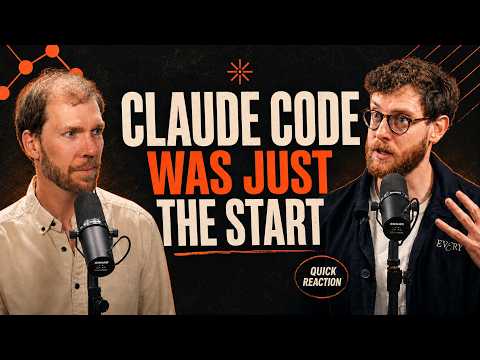
OpenAI vs. Anthropic: The Battle Lines Are Drawn
Dan Shipper and Kieran Klaassen report from Anthropic's Code with Claude conference with their biggest takeaways: the xAI compute deal, doubled Claude usage limits, the launch of Claude Managed Agents, and how the competitive lines between OpenAI and Anthropic are starting to become clearer.
# Channel Presentation Observations
## Video Overview
- **Title:** "OpenAI vs. Anthropic: The Battle Lines Are Drawn"
- **Format:** On-the-ground commentary from Anthropic's developer conference ("Code With Claude"), presented as a two-speaker conversational debrief with news analysis and a humorous "food review" segment.
## Intended Audience
- **AI developers and power users of coding tools:** The speakers assume familiarity with products like Claude Code, Codex, "co-work," and usage limits.
- > "if you actually use the tools, this is great"
- Reference to "everyone gets 2x their usage limits" as exciting news for subscribers.
- **Builders of AI agents/infrastructure:** Discussion of managed agents, orchestration, and reliability is pitched at people who deploy software, not general audiences.
- > "why wouldn't I run this on my Mac mini?"
- > "infrastructure is very hard to do"
## Claimed / Demonstrated Scope
- **Event coverage channel:** Explicit framing as conference reporting with recurring presence at such events.
- > "We will be as always here on the ground at all of these kinds of events giving you the updates that you need"
- **Analysis of the AI model-provider competitive landscape:** The title and content frame a broader OpenAI-vs-Anthropic narrative.
- > "the battle lines between OpenAI and Anthropic... are becoming a little bit more clear"
- **Opinionated commentary ("spicy takes"):** Self-described editorial voice mixed with reporting.
- > "That's the spicy takes that we have here and here for"
- **Lighthearted supplementary content:** A conference food review segment, ranked against other developer conferences ("above Build... middle of the pack").
## Observable Presentation Patterns
- **Host/guest structure:** A primary host interviews a named guest ("Kieran, GM of Cora, father of compound engineering"), lending industry-credentialed commentary.
- **Declared affinity for Anthropic products:** Speakers state a sustained positive stance.
- > "if you've been an Anthropic fan for the last year, as we have"
- > "Anthropic is the best at agent orchestration"
- **Forward-looking framing:** Content promises ongoing coverage of the discussed themes.
- > "something that we're going to be talking a lot about over the next couple months and years"
- **Balanced-but-credulous tone:** Some critical notes (missing "Mythos" launch, absent teriyaki sauce) alongside strong trust claims ("I just trust them").
## Explicit Self-Description vs. Demonstrated Behavior
| Type | Evidence |
|---|---|
| **Explicit claim** | Recurring on-the-ground event coverage ("as always... at all of these kinds of events") |
| **Explicit claim** | Positioning as source of "spicy takes" / opinionated updates |
| **Demonstrated** | Deep technical fluency in Anthropic's developer ecosystem (Claude Code, managed agents, dispatch paradigm) |
| **Demonstrated** | Dual-format structure: substantive analysis + humorous review segments |
# Delivery Observation: "OpenAI vs. Anthropic: The Battle Lines Are Drawn"
## Format Overview
This is a **two-person conversational podcast/vlog segment** recorded on-site at a developer conference ("Code With Claude"). The delivery is informal, spontaneous, and interactive, with speakers overlapping, completing each other's sentences, and interjecting short reactions.
---
## Tone
- **Casual and enthusiast-oriented**: The speaker frames content for fans and tool users — *"...if you're if you've been an Anthropic fan for the last year, as we have..."*
- **Playfully self-aware humor**: Recurring jokes about the low-stakes "food review" segment:
> "We even did a little bit of a food review, so we'll get get you some of get you some of the spicy the spicy takes that you're looking for."
- **Frank, unfiltered moments**: Occasional strong language appears verbatim — *"...we were like, 'Holy shit.'"*
---
## Vocabulary & Recurring Phrases
- **"Sneaky important"** — a distinctive repeated framing device for underappreciated announcements:
> "sometimes there are sneaky things where it maybe doesn't seem like a big deal at the time, but there it is actually a big deal"
>
> "Claude managed agents, sneaky sneaky important."
- **"Battle lines / battlefronts"** — the title's central metaphor, used repeatedly:
> "the battle lines between OpenAI and Anthropic... are are becoming a little bit more clear"
>
> "I think that the the battlefronts are starting to form"
- **Reliability and "boring" as virtues** — the second speaker repeatedly valorizes unglamorous functionality:
> "even though it sounds very boring... it working is insane."
>
> "the most valuable thing is really something that's reliable because getting 90% there is easy"
- **First-person plural framing** — "we" is used constantly to position the speakers as users and insiders: *"we've been thinking about how do we do this," "we were hoping for Mythos."*
---
## Communication Patterns & Teaching Habits
- **Question-and-answer scaffolding**: One speaker interviews the other, prompting elaboration:
> "You said that they're the best at agent orchestration. What do you mean by that?"
This is a stable pattern — the same move appears earlier: *"Do you have something exciting that you want to do with it?"*
- **Self-interrogation as explanation technique**: The second speaker explains new tools by voicing the questions a user would ask:
> "I'm asking myself, 'Why do I use this?' Or, 'What does it solve?' Or, 'When do I use it?'"
- **Summary habit**: The primary speaker closes with an explicit recap structure:
> "if if if if I just summarize the most important things from today, compute deal, that's a huge deal... Claude managed agents, sneaky sneaky important."
- **Concrete comparisons**: Evaluations are anchored to relatable specifics — the salmon bowl is ranked against Microsoft Build's food: *"at Build I I think I had like a you know, one of those turkey sandwiches with the Saran with the the Saran wrap on it."*
---
## Verbal Fillers & Disfluency
A highly consistent, observable feature is heavy filler usage and word/syllable repetition, especially from the primary speaker:
- **"uh" and "um" appear throughout** nearly every extended turn.
- **Repeated words**: *"the the operative word," "it it's always a good time," "if if if if I just summarize," "we We will we will be."*
- This gives the delivery a live, unscripted feel rather than a polished presentation style.
---
## Stable Patterns vs. Isolated Moments
### Stable (repeated across the segment)
- Conversational two-person format with short interjections (*"Very interesting." "Mhm." "Yeah."*)
- "Sneaky important" framing (used twice explicitly)
- Reliability/boring-is-valuable theme (multiple occurrences from the second speaker)
- Heavy filler and repetition in speech
### Isolated (single occurrences — low confidence as patterns)
- The food-review ranking against other conferences (appears once)
- The specific "why wouldn't I run this on my Mac mini?" hypothetical
- Reference to an individual presenter ("Daisy, for example, presented today")
---
## Uncertainty Notes
- Speakers are not named in the transcript beyond the introduction of "Kieran," so attribution of specific habits to specific individuals is based on turn structure and is partially inferential.
- Whether "sneaky important" is a recurring catchphrase across this speaker's other videos **cannot be determined from this single transcript**; within this video it is used twice.
# Observation Record: "OpenAI vs. Anthropic: The Battle Lines Are Drawn"
## Context
- Recorded at **Code With Claude** (Anthropic's developer conference), featuring two unnamed speakers (transcript does not identify them by name; one is addressed as hosting, the other appears to be "Kieran, GM of Cora, father of compound engineering" per the host's introduction).
- Format: on-the-ground recap of announcements, plus a food review.
## Speaker Attribution Note
Speaker turns are not labeled; attribution below is inferred from conversational flow only where clear (e.g., the interviewer asks questions). Claims are grouped by topic with attribution uncertainty flagged.
---
## Position: Anthropic–xAI/SpaceX Compute Deal
- **Claim:** Anthropic did a deal with xAI/SpaceSpaceX to take "all of the compute in SpaceX's Colossus cluster." *(Speaker 1)*
- **Reasoning:** Anthropic has been **compute constrained** as Claude Code demand grew; past restrictions (e.g., banning use of Claude subscriptions with "open Claude") "rankled people." This deal may let them **meet demand and open things up**.
- **Supporting observation (Speaker 2 / Kieran):** Everyone gets **2x usage limits** and looser usage windows — "might sound boring, but if you actually use the tools, this is great."
- **Summary claim (Speaker 1):** The compute deal "puts them right back in the race with OpenAI."
## Position: Claude Managed Agents — "Sneaky Important"
- **Claim:** The biggest launch was new features for **Claude managed agents** (cloud agent platform): memory, agent orchestration, and **outcomes** ("give the agent an outcome and it comes back only when it's done"). *(Speaker 1)*
- **Qualification:** No "holy shit" moment — they were **waiting for "Mythos"** which did not launch.
- **Reasoning (Speaker 1):** **Battle lines** between OpenAI and Anthropic are clarifying:
- One front: desktop work done in **Claude Code, co-work, or Codex** — a "work operating system."
- Parallel front: **provisioning/building long-running, async, team-used agents** in the cloud. "Open Claws, but actually work."
- OpenAI has an **Agents SDK but no cloud version yet** — speaker assumes that's coming.
- **Conclusion:** Managed agents is "probably a bigger deal than you might think."
### Kieran's Supporting Reasoning
- Parallels Claude Code's launch: didn't seem big at first, but was.
- **Infrastructure is hard**; if managed agents "just works, it's very, very good."
- **"Anthropic is the best at agent orchestration"** — because:
- They're "furthest along": dispatch in co-work/Claude Code (talk to one agent that spins up others — a paradigm he predicts "for sure" gets big this year).
- Agent teams / multi-agent collaboration exist in Claude.
- They avoid token-wasting "swarms."
- Named evidence: **Daisy**, who presented today, created that system and is at Anthropic — "the people that think the furthest are also here... I just trust them."
- **Reliability position:** Asked why not run agents on a Mac mini — his answer: a Mac mini going down isn't acceptable at a bigger company; **reliability and scalability** are the value. "Getting 90% there is easy... having it do it all the time" is what matters.
- Tension acknowledged: he isn't sure yet *when/why* to use it — "we'll figure out... it's a beginning of something potentially very exciting." Release-with-feedback framed as the necessary first step.
## Position: Food Review
- Both had a **teriyaki glazed salmon bowl** — "without the sauce" (teriyaki apparently missing).
- Points for feeling **healthy** (whole grains, salad).
- Ranking: **above Microsoft Build** (Saran-wrapped turkey sandwich there), but **"middle of the pack"** among developer conferences overall.
## Summary of "Most Important Things" (Speaker 1)
1. **Compute deal** — huge; puts Anthropic back in the race with OpenAI.
2. **Claude managed agents** — sneaky important; something "we're going to be talking a lot about over the next couple months and years."
## Unresolved Tensions
- Mythos was hoped for and not launched — expectation vs. delivery gap explicitly preserved.
- Kieran's enthusiasm for managed agents is coupled with uncertainty about concrete use cases ("Why do I use this?... we'll see where it's powerful").
- Speaker confidence claims ("Anthropic is best at orchestration," "I just trust them") are stated as personal judgment, not verified fact.
# Speaker Attribution & Provenance Record
## Video
- **Title:** OpenAI vs. Anthropic: The Battle Lines Are Drawn
- **Context:** On-the-ground discussion at Anthropic's developer conference ("Code With Claude")
## Identified Speakers
- **Host / Creator (unnamed):** Opens the video, frames it as a live update segment; conducts the food review; delivers summary. Self-identifies as a longtime Anthropic fan ("if you've been an Anthropic fan for the last year, as we have").
- **Guest: Kieran**, introduced as **GM of Cora** and "father of compound engineering." Co-present throughout; provides analysis of managed agents, agent orchestration, and reliability.
Speaker attribution by turns is **ambiguous**: the transcript uses `\>\>` turn markers without name labels, so specific quotes cannot be reliably assigned to host vs. Kieran beyond Kieran's introduction and role descriptions.
## Third-Party Entities & Claims Referenced
- **Anthropic / Claude:** conference host; product claims include:
- Compute deal with **xAI / SpaceX** for the "Colossus" cluster (all compute)
- **Claude managed agents**: memory, agent orchestration, "outcomes," cloud-based scalable agents
- 2x usage limits, looser usage windows
- Dispatch paradigm in Claude Code and co-work; agent teams; multi-agent features
- **OpenAI:** compared throughout; claimed to lack a cloud version of its Agents SDK ("I assume that that's coming" — explicitly speculative).
- **Daisy (Anthropic):** named as presenter who "created that system" for agent orchestration.
- **Microsoft Build:** referenced for food comparison only.
- **Mythos:** rumored/expected product not announced ("We were hoping for Mythos").
## Third-Party Claims Not Independent
All product claims (xAI deal details, managed agents features, OpenAI's SDK gaps) come from **speaker commentary**, not from cited primary sources or official statements quoted in the transcript.
## Promotional Segments
- **None flagged.** No sponsor reads, ads, or product promotions identified. Food review and "we'll be back" closing are content segments, not promotions.
## Availability & Uncertainty
- **Curated metadata:** not supplied.
- **Comment availability:** unknown.
- **Turn attribution uncertainty:** as noted, per-speaker quote assignment is unreliable due to unlabeled turn markers.
- **Explicit speaker speculation flagged as such:** "I assume that that's coming" (OpenAI cloud agents SDK).
So, we are here at Code With Claude. I'm here with Kieran, uh GM of Cora, and uh father of compound engineering. And uh we've been here all day at Anthropic's big developer conference. Um it's it's always a good time. We have uh we've got a lot of updates for you from the conference, everything that we saw, everything that we heard, um everything that we didn't hear. We even did a little bit of a food review, so we'll get get you some of get you some of the spicy the spicy takes that you're looking for. \>\> Um the big news from today is that
Anthropic did a deal with xAI \>\> Very interesting. \>\> SpaceX to uh basically take the entire like all of the uh all of the compute in
in SpaceX's Colossus cluster, which uh is really interesting because uh the the operative word is is all of the compute. It's called the Colossus cluster for a reason. And it's been one of those things where I think if you're if you've been an Anthropic fan for the last year, as we have, um you started to feel that as people caught on with the sort of like Claude code movement, they've been really compute constrained, and they've done a lot of stuff where it's like they um you know, they they banned you from using your Claude subscription with open Claude, just stuff that like kind of made it like rankle people a little bit. And this seems like a move that will allow them to meet the demand that they're seeing and and open things up in a new way, which I'm really excited about. \>\> Yeah, so everyone gets 2x their usage
limits, and there's no like the windows are a little bit more loose, which is great because the worst thing is starting your Claude session, and then like you're you're almost there, or
you're over your limit. So, this is very very cool. It might sound boring, but like if you actually use the tools, this is great. \>\> Yeah, this is the best. \>\> Yeah. \>\> Hey, when I step back and think about,
okay, what did they actually launch uh today? They The biggest thing that they launched is uh, a new Claude manage I said of new features for Claude manage agents, which is their like cloud agent uh, platform.
So, they launched uh, they launched memory for Claude manage agents. They launched or agent orchestration and outcome. So, like you basically can give the agent an outcome and it goes and accomplishes that and comes back only when it's done. And to be honest, I was I was sort of I think if I step back, I'm thinking like there's not anything where it's like holy \>\> they launched Mythos or whatever. \>\> We were hoping for Mythos. \>\> waiting. Yeah, we were waiting for Mythos. Yeah. \>\> But I But you you made like a really interesting point, which is sometimes there are sneaky things where it maybe doesn't seem like a big deal at the time, but there it is actually a big deal and and I think if I had to put my finger on one of those things the battle lines between OpenAI and
Anthropic and and all these other model companies are are becoming a little bit more clear where there's there's a very clear uh, moment happening where if you're doing work on your computer, you're
going to do it in one of Claude code or co-work or Codex. And like that's your That's your work operating system for you and a and a model to be working together. And then there's this other parallel battle front starting to happen uh, for where and how you provision and build uh, agents that are meant to be long-running and async and probably used by a team. Something like open claws, but uh, for \>\> work. \>\> Yeah, but but actually work. This is that's the spicy takes that we have here and here for. Um, and and so Claude manage agents is that. So, if you want to if you want to build an agent that um, that exists in the cloud, that serves lots of requests, that's really scalable, that's their solution. I think, you know, for us we've been we've been thinking about how do we do this and and it feels like we're um, uh, it feels like you you you to reinvent the wheel a lot. And so, manage agents is sort of doing that, and I think OpenAI does not have that yet. They have a They have the agents SDK, but they don't have a cloud version. I assume that that's coming. So, and I think that the the battlefronts are starting to form, and and so, it manage agents is actually probably a bigger deal than you might think. \>\> Yeah, like whenever Claude came out, it was cool, and we didn't think much of it. \>\> We We thought we were like, "Holy shit." \>\> We were like, "Holy shit." We were the only people. Yes, there were some people that were thinking that. And I feel with this it could be very big, and it's also when something new is introduced, I'm asking myself, "Why do I use this?" Or, "What does it solve?" Or, "When do I use it?" And like, using this, you'll figure out, we'll figure out, and we'll see where it's powerful. But, we know like, this is painful. Like, infrastructure is very hard to do. And all these primitives is if it just works, it's very, very good. And also, I think Anthropic is the best at agent orchestration. So, having them solve this is great, and bringing in everything like the the agent teamwork, or like the like all of that stuff, the multi-agent thinking inside a harness is very interesting. And I think it's also like standing still saying, "Okay, we have all these things. We have it work pretty well. We have these abstractions of outcomes." And they present it to the world, and they're like, "Okay, now everyone like come together, figure out what you need to take from it, how you build your things with this." So, and like, they cannot release it without people using it and giving feedback. So, this is the first step, which is it's out there, people can start using it, and now we'll figure out what we'll do with it. I I feel it's it's a beginning of something potentially very exciting, yeah. \>\> Do you have something exciting that you want to do with it? Um yeah, so I I'm just asking myself the question like, why wouldn't I run this
on my Mac mini? Um and \>\> this you mean like a managed agent. \>\> Yeah, managed agents. But what I what I do think is if you have an agent that
just runs and is reliable, like it can be so valuable and like a Mac mini going down, like it's not something you can actually have happen in a bigger company. So I I think just the reliability, even though it sounds very boring. \>\> Yeah, yeah. \>\> Scalability, just it working is insane. Like if the models do the work always and if the infrastructure always works, you just have something that's reliable and the most valuable thing is really something that's reliable because getting 90% there is easy, but like having it do it all the time and I very strongly feel this team is very good at that. So I I just would use it immediately just become uh yeah, because it's coming from here. \>\> You said that they're the best at agent orchestration. What do you mean by that? \>\> Yeah, I think it's uh first of all, they
they think the furthest along with this. So they have this idea of dispatch in a co-work and Claude code, which is like that's like a thing you talk to an agent and that agent orchestrates other
things. So you can say, hey, start five Claude codes and it's it's a paradigm I think is for sure this year going to get really big where you talk with one agent that will then spin up all the other agents for you. And you have agent teams as well in Claude and they start to talk to each other. You have multi um agents in in there as well. And I I think they're the only company that actually see this and do it and like also not do it because there are swarms that you can do that sometimes like waste a lot of uh tokens for certain tasks, but like they have the people here that think about it. Like Daisy, for example, presented today, uh, and she created that system and she's here at Anthropic. So, like the people that like think the furthest are also here. So, I just trust them. I know others will do this, too, uh, but like I I I know they're ahead. So, I I I feel that's a good indication, yeah. \>\> So, I know that where uh, people are here waiting for the the most important
part of this uh, this live uh, on the ground vibe check, which is the food review. \>\> Yes. \>\> Um, they there was there was we both had the teriyaki glazed salmon bowl. \>\> Without the sauce. \>\> seemed to be no teriyaki. Um, so, there definitely there definitely points for it felt healthy to me. Like it felt like yeah, we went healthy. That kind of thing that like you know, it had like it had whole grains and and salad and whatever. And so, I think um, \>\> Points. \>\> Yeah, so points points for that, but the teriyaki was missing. Um, so, you know, I I think uh, if if I had to rank in terms of developer conferences, I would put this above Build. Um, at Build I I think I had like a you know, one of those turkey sandwiches with the Saran with the the Saran wrap on it. Um, but it's it's still kind of like middle of the pack uh, for for developer conferences. Um, but we're we'll uh, we'll be \>\> We'll be back. \>\> We We will we will be as always uh, here on the ground at uh, at all of these kinds of events giving you the the the updates that you need. Um, so, so if if if if I just summarize the most important things from today, compute deal, that's a huge deal. \>\> Very good.
\>\> That that puts them right back in the race with Open AI. Uh, Claude managed agents, sneaky sneaky important. \>\> Mhm. Um, some new features there, but just generally that idea is is sneaky
important and it seems like something that we're going to be talking a lot about over the next couple months and years.