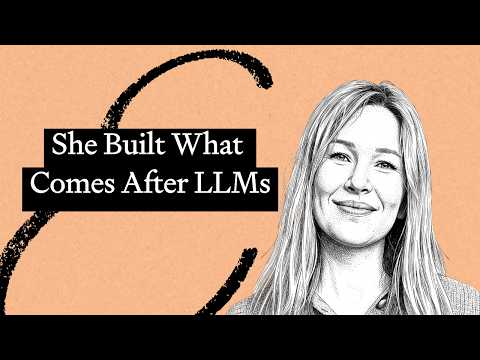
The AI Model Built for What LLMs Can't Do
Dan Shipper interviews Eve Bodnia, founder and CEO of Logical Intelligence, about energy-based models (EBMs) as an alternative to transformer-based LLMs. Bodnia argues that LLMs' token-by-token architecture makes them unsuited to mission-critical tasks such as chip design, financial analysis, or aviation, because they cannot inspect their own reasoning mid-process or guarantee their results. EBMs instead apply the physics principle of energy minimization: rather than predicting the next probable word, they map possible outcomes across a mathematical landscape where likely states settle into valleys and improbable ones sit on peaks. The conversation covers why she believes LLM progress is plateauing, what it means for a model to actually understand data rather than pattern-match across it, how EBMs could solve the vibe coding problem through formally verified code generated in plain English, and how EBMs might enter mission-critical industries that have not adopted LLMs.
Timestamps:
00:00:51 - Introduction
00:02:09 - Why correctness and verifiability matter in AI
00:09:33 - What an energy-based model is
00:14:21 - How EBMs construct energy landscapes to understand data
00:19:00 - Why modeling intelligence through language alone is a flawed approach
00:26:54 - What it means for a model to "understand" data
00:37:21 - How EBMs solve the vibe coding problem and enable formally verified code
00:43:21 - Why LLM progress is plateauing
00:49:54 - Mission-critical industries haven't adopted LLMs, and how EBMs could fill that gap
# Video Identity Observations: "The AI Model Built for What LLMs Can't Do"
## Observable Presentation Evidence
### Format and Structure
- **Interview/podcast format**: A host (identified in transcript as "Dan Shipper") interviews a guest introduced as "the founder and CEO of Logical Intelligence." The guest is welcomed with "Yee, welcome to the show."
- **Educational deep-dive style**: The host repeatedly plays back concepts to confirm understanding ("Let me let me play it back to you and you tell me if I'm getting you"), suggesting an explainer-oriented approach for a listener still learning the material.
- **Mid-roll sponsor segment**: An ad read for **Granola** ("Head to granola.ai/every for 3 months free with the code every") with the URL slug tying to "Every."
- **Branded sponsor skit**: A short comedic interlude — "Hammock mode, an idea by Every. Every, the only subscription you need to stay at the edge of AI" — indicating a house brand (Every) promoted within the episode.
- **Host-read outro parody**: The closing segment is an exaggerated, likely AI-generated or joke outro: "smash that like button and subscribe to AI and I... a journey into the future with Dan Shipper as the captain of the spaceship."
### Show Name and Channel Identity (Self-Description)
- The show is named **"AI and I"** per the outro: "you absolutely, positively have to smash that like button and subscribe to AI and I."
- The host is **Dan Shipper**, named multiple times in the transcript by the guest and the outro ("Dan, I'm absolutely, hopelessly in love with you").
- Affiliate with **Every**: the Granola promo code is "every" and the "Hammock mode" skit names "Every, the only subscription you need to stay at the edge of AI" — observable evidence the show is connected to an Every-branded product/company.
### Claimed Scope
- **Topic scope**: AI-focused interview content — this episode covers energy-based models (EBMs) vs. LLMs, deterministic/verifiable AI, and AI investment trends.
- **Audience claim**: The host explicitly addresses comprehension for listeners: "I just want to make sure for for people listening, they understand what it means to minimize energy."
- **Positioning via outro**: The outro claims the show is "filled with pure, unadulterated knowledge bombs about ChatGPT" and "a journey into the future" — self-description of an AI-education entertainment product (delivered in an intentionally over-the-top tone).
### Audience (Demonstrated)
- **Technically curious but non-expert listeners**: The host asks foundational questions ("Can you define EBM for us?"), offers accessible analogies (a couch, a body settling, navigating San Francisco), and summarizes on behalf of the audience.
- **Practitioners interested in AI tooling**: The host references personal experience "testing the limits of vibe coding" and "testing the latest Codex and Opus models," demonstrating a host actively using AI coding tools — consistent with an audience of AI-using knowledge workers.
### Guest and Subject Scope
- Guest self-describes her company: "Logical Intelligence does... we see ourselves as a foundational AI company. So we working both with EBMs and LLMs... we focused on correctness of software and hardware as a product."
- Discussion spans technical AI architecture (latent variables, diffusion models, token-free models), applied use cases (verified code generation, energy grids, drug discovery), and industry commentary (LLM investment, B2B vs. B2C AI).
## Claims vs. Demonstrated Patterns — Distinction
- **Creator claims**: Show name ("AI and I"), host identity (Dan Shipper), subscription pitch, and Every affiliation are directly stated in the transcript.
- **Demonstrated patterns**: Long-form (~full episode) expert interview format; host-as-translator style with analogies and playback summaries; sponsor integrations embedded mid-content; a playful/ironic tone in the outro.
- **Not inferred**: No conclusions drawn here about channel-wide editorial stance, private motivations of the host, or typical guest roster beyond this single episode.
# Delivery Observation: "The AI Model Built for What LLMs Can't Do"
## Format & Participants
- **Interview structure**: Host (Dan Shipper) questions a founder/CEO guest ("Eve," of Logical Intelligence) about energy-based models (EBMs) vs. LLMs.
- The transcript includes **sponsor ad reads** (Granola), a **promo sketch** ("hammock mode"), and an automated-sounding outro, so delivery evidence for the guest comes primarily from the interview body.
## Guest's Delivery Patterns
### Teaching via Analogy
The guest repeatedly explains technical concepts through extended concrete scenarios rather than formal definitions:
- **Navigation/maze analogy** for autoregression: > "you're sort of allowed to choose one direction at a time and sometimes you take the wrong turns just because you hallucinate... you cannot turn back because you autoregressive LLM."
- **Physics framing** for energy: > "if you're doing theoretical physics, like your full-time job is just to write Lagrangians."
- **Tired-person-on-couch** scenario for energy landscapes, later escalated with the host: > "imagine you're tired, you like done thousands of podcasts... So, you're probably going to end up on the couch."
### Deferred Definitions
A recurring teaching habit is postponing formal definitions while building intuition first:
- > "Yeah, I'll define in a second. So for now just think of it as something which doesn't play a guessing game."
- > "It just for now think of it is just something which minimizes the energy."
- When finally defining: > "so EBM just simply means energy-based model... it comes from physics."
### Rhetorical Questioning / Socratic Turnarounds
The guest flips the host's questions back:
- > "Um actually let me ask you a question back. So speaking of correctness, um I don't know. Well, imagine there's AI driving a car..."
- Follows with a second hypothetical (the plane) after the first answer: > "Okay, let me give you another example. How about the plane?"
### Recurring Vocabulary & Phrases
High-frequency terms across the conversation:
- **"guessing game"** — > "your architecture, which is still playing a guessing game out here," > "There's no guessing game of this kind," > "you're trying to play a guessing game what my next token could be."
- **"black box"** — > "it's like a black box for you," > "It's no longer black box for you."
- **"energy landscape"** — used repeatedly as the core mental model.
- **"vibe coding" / "specifications"** — > "moving you from vibe coding in one specific language to coding in natural language," > "We're moving you from vibe coding to vibe code specifications."
### Hedging & Filler
Frequent verbal fillers ("um," "like," "you know," "so") and self-repairs run throughout:
- > "Um we focused on correctness of software and hardware as a product."
- > "It It's in a form of energy landscape."
- > "It It stores all It stores all of them in in this energy landscape."
This is consistent across the whole interview, suggesting a stable pattern of informal, improvised speech rather than a rehearsed pitch.
### Concession Followed by Reframe
When challenged, the guest often concedes feasibility, then reframes around cost or suitability:
- Host asks whether modeling behavior as token sequences works: > "It's a good way to model things and you don't need LLM for it."
- > "Yeah, you you could do it and people do it today... but it's like that's what makes it expensive and super slow."
## Host's Delivery Patterns
### Active Comprehension Checks
The host frequently paraphrases before continuing:
- > "Let me let me play it back to you and you tell me if if if I'm getting you."
- > "So basically, if I'm understanding this right, if I'm spending tons and tons of tokens..."
- Interrupts to demand clarity for listeners: > "Can I actually pause you because I want to make sure that we do understand what the energy energy-based minimization is?"
### Probing with Concrete Examples
The host proposes his own analogies to test understanding:
- The couch example: > "I'm going to end up sitting onto the couch in a way that minimizes energy... Is that the sort of... energy mini- minimization that you're talking about?"
- Pushback on symbolism: > "when I hear rules about the world... I think of symbolic AI... I'm wondering how an energy landscape that... stores a bunch of rules about the world doesn't fall into the same problems."
### Personal Experience as Evidence
The host grounds questions in his own work:
- > "I've been doing a lot of coding with language models recently to sort of test the limits of vibe coding."
- > "I feel like every month or two I'm testing a new model or I'm like holy this is actually way better."
## Interaction Dynamics
- **Laughter markers** appear repeatedly (blockquotes at [540], [824], [835]), clustering around the couch/energy-landscape analogy — a moment of shared levity.
- The host stakes a mildly contrarian position early: when asked about a hallucinating car, > "I'm I'm curious where it takes me," prompting the guest's second hypothetical.
- Both speakers use **word-level repetitions under emphasis** ("It It," "the the the," "I I I"), suggesting a live, unscripted conversational register.
## Uncertainty Notes
- Segment boundaries (music cues, `>>` markers) suggest an edited/cut video; pauses and pacing cannot be reliably assessed.
- The opening analogy ([0]–[32]) appears to be a **cold-open excerpt** replayed later in the interview — the repetition is an editing choice, not a guest habit.
- Tone qualities (warmth, enthusiasm) beyond explicit markers like [laughter] are not directly observable in the transcript and are not claimed here.
# Position Record: "The AI Model Built for What LLMs Can't Do"
## Speakers
- **Dan Shipper** — host/interviewer
- **Eve** — founder and CEO of Logical Intelligence (identified via her own statement in the transcript)
## Eve's Central Claims
### 1. LLMs are unsuitable for mission-critical systems
- LLMs **hallucinate** and cannot be fully constrained; they play a **"guessing game"** predicting the next token.
- Correctness in software/hardware (code gen, chip design) is rarely questioned: > "very few actually questioning of like how this results are actually like correct?"
- She argues AI placement everywhere is **unavoidable** over the next 10 years, so verification matters even where deterministic systems currently suffice (planes, banking).
### 2. Verification: internal vs. external
- **LLMs:** architecture is a "black box"; only external verifiers (e.g., **Lean 4**) can check outputs — expensive because token generation itself consumes compute.
- **EBMs:** allow **self-alignment / internal verification** during processing, plus external verifiers on top → "double verification." Training is inspectable in **real time**, unlike LLMs.
### 3. EBMs defined (as she explains it)
- **EBM = energy-based model.** Energy minimization borrowed from physics (Lagrangians → equations of motion → conservation laws).
- Analogy: a tired person settling on the couch = **lowest-energy, most probable state**; an **energy landscape** maps states to probability (high points = less probable).
- **Token-free and non-autoregressive**: > "EBMs are naturally non-autoregressive. There are no sequences of tokens and that's what makes it fundamentally different."
- **San Francisco navigation analogy:** an LLM must commit to one direction at a time with tunnel vision and can't turn back; an EBM has the **"bird view"** and can reroute around a "hole in the road."
- Their model's formal name: **energy-based reasoning model with latent variables** (nicknamed "Kona" after coffee).
### 4. Latent variables = knowledge storage
- Not single rules, but structures **holding many rules** about the data, stored as **another energy landscape** — accessible and navigable.
- Claim: **LLMs "don't understand the data"** — they find probable patterns; EBMs attempt to "understand the pattern" and infer world rules (e.g., a differently shaped couch is still recognizable as a couch).
- On symbolic AI brittleness: she answers that avoiding tokenization and mapping to a different data structure avoids those problems (assertion; not elaborated).
### 5. Critique of language-mediated intelligence
- Her reasoning: humans navigate houses, drive cars **without language**; LLMs force non-linguistic tasks (spatial reasoning, numerical data) into language space, losing information and making reasoning language-dependent — > "information processes in French going to be different from what's in English... which feels really wrong."
- Applied engineering analogy: > "when you build a bridge, you don't go to literature department" — using language models everywhere is like "using a literature department everywhere."
### 6. Coding and applications
- Vision: move from **vibe coding to "vibe code specifications"** — coding in natural language with machine-verifiable proofs (compatibility certificates at compile time).
- Acknowledged limit: AI **cannot** determine whether code does what you *want* — behavior specifications remain a human responsibility.
- **Safety claim:** EBMs can be **constrained** formally; LLMs cannot — relevant for cars, planes, and even sensitive chatbot language.
- EBMs work well with **sparse data** (linking lineage through diffusion models; latent variables add "understanding").
### 7. Industry and investment
- LLM investment is at a **plateau** — incremental gains but no phase transition expected: > "so much compute... it still doesn't phase transition you."
- Investors are locked in by **sunk costs** and a circular ecosystem (LLM firms ↔ data centers ↔ hardware) that is "impossible to break."
- Strategy: Logical Intelligence positions EBM as a **compatible layer** under/alongside LLMs — outsourcing spatial reasoning and data analysis tasks to reduce cost, rather than replacing LLM investments.
- Claim (unverified in transcript): big tech companies **have EBMs in-house**, which she calls "a positive signal."
- B2B gap: enterprises (banks, trading firms, drug discovery, energy grids) share **zero** data analysis with LLMs today due to privacy and lack of custom, verifiable models.
## Dan Shipper's Positions
- Pushes back that planes are already well-run by deterministic systems, so AI may be unnecessary there.
- Concedes there are many non-verbal forms of intelligence but argues LLMs are really about **weakly correlated token sequences**, so movement could be modeled without language per se.
- **Disagrees on plateau:** he sees major monthly improvements and feels top labs have "a lot of room in the LLM paradigm" — an unresolved tension left standing.
- Offers own observation from vibe coding: locally correct code forming a patchwork of hot fixes lacking a unified design — asks whether EBMs address this (Eve: yes, it's one of their use cases).
## Unresolved Points
- Whether LLM progress is plateauing (direct disagreement, not resolved).
- Eve's claim that LLMs "don't understand" data is asserted, not demonstrated.
- Symbolic-AI-brittleness concern is only briefly addressed.
- Her statement that big tech has in-house EBMs is her own claim, uncorroborated.
# Speaker & Provenance Observation Record
**Video:** The AI Model Built for What LLMs Can't Do (`01a0f15a-8a32-7853-a7aa-cf2f970719c1`)
## Speakers & Roles
- **Dan Shipper** — **Host/interviewer (creator-side)**. Named explicitly in transcript ("Dan Shipper is currently hard at work", "Thank you, Dan"). Conducts the interview, plays back summaries, asks follow-ups, and delivers sponsor reads.
- **Eve (guest, phonetic)** — **Guest**: **founder and CEO of Logical Intelligence**. Introduced as such ("you are the founder and CEO of Logical Intelligence"). Name rendering uncertain from transcript; the host addresses her as "Eve" near the end ("Um, Eve, this is an incredible conversation"). Primary explainer of EBM/Kona, company claims, and industry commentary.
- **Unnamed narrator/promo voice(s)** — Deliver the **Granola sponsor segment**, the **"Hammock mode" promotional segment for Every**, and the **closing "AI and I" like-and-subscribe outro** (which includes a promotional personal note addressed to Dan).
## Interview Structure Notes
- Opens with an apparent **pre-teaser montage** of guest quotes (EBM definition, map navigation analogy) before the welcome ("Yee, welcome to the show").
- Two distinct speakers throughout the main body: host (questions, playback summaries) and guest (technical explanations).
## Referenced Sources & Third-Party Claims (as stated by speakers)
- **Lean 4** — cited by guest as a machine-verifiable proof language used as an external verifier for LLM outputs.
- **Diffusion models** — cited by guest as historically derived from EBMs for sparse/incomplete data.
- **Big tech model companies** — guest claims some have "EBM models in-house"; **uncorroborated third-party claim**.
- Industry sectors named by guest as conversation partners / unmet AI markets: banks, trading firms, drug discovery, energy grid operators.
- **Kona** — guest's model name; formal name given as "energy-based reasoning model with latent variables."
## Promotional Segments (flagged)
- **Granola** (AI notepad sponsor): mid-episode read by host; **promo code "every" / granola.ai/every for 3 months free**.
- **Every** ("Hammock mode" sketch): promotional segment for Every's subscription, featuring Dan Shipper.
- **Closing outro**: like/subscribe promotional pitch for the show "AI and I," including an exaggerated promotional monologue.
## Availability & Uncertainty
- **Curated metadata: none supplied** — no episode number, publication date, channel confirmation, or verified guest name spelling.
- **Guest name** ("Eve") and **company name** ("Logical Intelligence") are taken from spoken transcript; spelling unverified.
- **Comment availability:** not stated in transcript or metadata — unknown.
Can you define EBM for us? EBM's are naturally non-autoregressive. There are no sequences of tokens and that's what makes it fundamentally different. \[music\] Like imagine you're trying to navigate the map and you have a left
brain. To navigate, you're sort of allowed to choose one direction at a time and sometimes \[music\] you take the wrong turns just because you hallucinate. Like there might be a hole in the road and you're just going to fall. And you might see this hole, but you cannot turn back because you autoregressive LLM. EBM going to have the first view all the time. So if you \[music\] see there's a hole, you're going to choose a different route. \>\> \[music\] \>\> Yee, welcome to the show. Hi, thanks for having me. Great to have you on. For people who don't know, you are the founder and CEO of Logical Intelligence. Tell us what Logical Intelligence does. So Logical Intelligence does uh a few things. First of all, we see ourselves as a foundational AI company. So we working both with EBMs and LLMs. So everything that built in-house, we prototyped on LLM initially and we building EBM at the same time and that sort of gets plugged in in a long term. Um we focused on correctness of software and hardware as a product. Um because I believe there is a lot of issues with AI being placed in mission-critical systems today. Like, you know, can we do the code gen? Can we do the chip design? And the answer is yes, yes, people use LLMs today. Um but very few actually questioning of like how this results are actually like correct? Does it make sense what it produce? And it seems like there's a big gap on market today um having deterministic AI, verifiable AI. So we trying to fill that
gap. Mhm. Uh I I the the place my my brain goes first is why does correctness or whether
something makes sense, why does that matter if it works? Um actually let me ask you a question back. So speaking of correctness, um I don't know. Well, imagine there's AI driving a car and you're in that car and that car is an LLM and someone tells you like, you know, 20% of the time it's going to hallucinate and you might end up like in in like a wrong place. Uh how would you feel about it? Well, I think it in my in my case I'd be like, "Wow, that's kind of interesting. I'm I'm curious where it takes me." Um Oh, okay. \>\> \[laughter\] \>\> Okay, let me give you another example. How about the plane? How about the plane? You take a plane from yourself to New York and someone says, "You know, like 20% of the time it might just like the next word not going to match and it's going to go down." So how would you feel about it? \>\> Yeah, my my my my feeling about that is planes are currently run very well by deterministic systems. So I don't know why I would need an AI for that. Um I feel like we just cannot avoid AI anywhere. Like next 10 years people going to try to place AI everywhere. Automate systems with AI and you know, technically you might not need. We we survived somewhat without AI up to this moment, but now it's just like a next step of evolution that people just want AI everywhere. Like for the banking, you don't need AI initially, but we learn it's really
helpful to automate like certain processes and decision-making. And it's going to save us a lot of time and allow us space to be creative instead of like debugging and fixing
things. Um so I just feel like it's unavoidable future. I think maybe what I'm getting at is um what am I getting at? It seems like if you want a guarantee of certainty, using um the only way to sort of guarantee certainty is to use something that you can express in code or logic. Mhm. That's a part of it. So the certainty comes from internal verifiers and external verifiers, at least for us. Um so for example, if you take LLM, um obviously it's a language-based model and architecture doesn't allow you to do internal verifiers. So you you like it's like a black box for you. You don't have access to what's inside until it's all processed. Um but you have access to the output and many people and companies sort of take LLM, uh train it for certain tasks and if it requires logic, they attach the external verifiers to it such as languages like Lean 4, which is a proof uh I mean, machine-verifiable language, proof language, um which allows you to check this output using mathematical uh frameworks. Um however, you know, it doesn't solve the problem of things being um just so expensive because what's expensive is your architecture, which is still playing a guessing game out here. And even if you attach external verifier, even you fine-tune this LLM specifically for the task you're trying to create, you're still not solving the problems of tokens being expensive. It takes compute for you to play a guessing game. \>\> \[clears throat\] \>\> So this problem is solved by the EBMs, but we're talking about LLMs for now. Um so here we have the situation when there is, right, internal absence of verifier,
but there's external one. Um so now about the EBMs. EBMs don't have tokens. It's token-free model. There's no guessing game of this kind. So essentially um
you could oversee all the possible scenarios. Can you define EBM for us? Yeah, I'll define in a second. So for now just think of it as something which doesn't play a guessing game and something which has architecture which is essentially allow you to self-align itself as a processing the information and it's no longer black box for you. So as it's performing, you can open it anytime during the training and you could see what's happening in there. So you cannot do this with LLMs. Just nature of architecture is different. So you have for verification tasks, you have this notion of self-alignment because of the EBM architecture and the absence of token makes it cheap, but also you have external verifier on top of it. So you have verification sort of on both sides, inside and outside. Um hopefully that makes sense. I think so. Let me let me play it back to you and you tell me if if if I'm getting you. So basically I think what you're saying is we're living in this in this world which is really cool with LLMs, which is we can generate lots of output with them. And the output is um really useful for for a lot of different things, but in order to tell if the output is right, the the best we can do is sort of guess and check. We generate the output and then, for example, if it's code, then we go and check the check the code with integration tests or manual tests or whatever just to see if it works. And that totally works, but it is expensive and time-consuming. Um and one of the problems is it's very hard for us to know, "Okay, how did the LLM get to this answer?" We can't like go look inside of it. \>\> Exactly. And I think what you're saying is there are other types of models that are a little bit more inspectable. And that give us a sense before we even try the um before we even try the output to understand, "Does this work? Does the output work?" We can get a sense from the model by looking at its internals.
So sort of like, "How good is this solution? How good does this model think this solution is?" Um uh and it's sort of like being able to ask someone like, "Are you sure about this? Like how how how good is this?"
before you like go check their work. And a language model can answer that question, but a language model's answers are working at a at a different level when it answers that question than than this models uh than these EMB models are working. And the the answers from EMB models are more likely to be correct. Mhm. Yeah, so you always have an opportunity to see what's inside with the EBMs. And you control the training. \>\> Yeah. \>\> \[gasps and laughter\] \>\> So the the EBMs, you control the training. It's no longer black box for you. You control sort of how the training goes. Well, you do some extent with the LLMs, but you need to wait until the training is done before like you actually go and like see what's inside. In here you could do like a real time. Um yeah, and also you can attach the same external verifiers which works for LLMs. So you have sort of double double verification things. Um yeah, so you asked me what is a EBM? Um I just want to give like a historical note um because I feel like there's so many terms today and just people throwing those terms without defining it. Um so EBM just simply means energy-based model. What is energy? Energy-based um it comes from physics. It's a very popular term when you're trying to minimize the energy. And if you're doing theoretical physics, like your full-time job is just to write Lagrangians, which sort of correspond to
uh terms associated with the energy in your system. Like, "Hey, this is my kinetic energy. This is my potential energy." And then you're trying to derive equations of motion of it.
And the way you derive the equations of motions is you're doing the minimization. So, that's pretty much how how theoretical physics works. And it just start with the energy terms, then you minimize this energy, and you derive equations of motions, and equations of motions going to give you conservation laws. So, you're going to know exactly what are your laws about your system. And this principle is fundamental principle. Like, everything wants to minimize energy around us. Um Yeah, so like even us, we talking to each other, we sitting on the chairs, we're not like jumping and running around because it's a natural state when we minimize the energy. So, we're just using this minimization energy principle as AI is processing information in a high-level terms. So, the term energy-based minimization doesn't really mean anything specifically to AI. It's just the whole like idea of like, "Hey, let's take some energy and try to minimize it and discover what's the laws about it." Um so, our model is called official name of that model, uh even though we call it Kona just because we like big fans of coffee culture, and Kona is one of our favorite kind. So, we decided to start with that. Uh the formal name of the model is called energy-based reasoning model with latent variables. And I'm going to like describe exactly what those words means. So, we already understand what the energy minimization is. Can I actually pause you because I want to make sure that we do understand what the energy energy-based minimization is? Okay. Yeah. It It just for now think of it is just something which minimizes the energy. It It means this AI architecture has a framework which allows you to construct the energy function of your system and minimize it. I get it. I I just think that um so, I just want to make sure for for people listening, they understand what it means to minimize energy, what what energy is, and what it means to minimize it. So, I'm curious, um give me a give me a uh uh tell me if this concrete example is is about what you're like sort of a like close to what you're talking about. So, if I'm going to let's say uh I'm
going to go lie on the couch behind me, and um and I'm trying to I'm trying to predict or understand how is my body
going to be lying on that couch um given the laws of gravity. Uh the the couch is uneven, my body's uneven, and so I'm trying to like sort of understand the fit of like how my body is going to end up settling onto that couch. Um I'm going to end up sitting onto the couch in a way that minimizes energy, so there's going to be like a a good fit between my body and the couch versus like me being sort of like jerky like this and and having lots of different spaces. Is that the sort of the sort of energy mini- minimization that you're talking about? Yeah. Yeah, you just you It It's all about your body finding the most comfortable configuration for you, which going to correspond to the like the lowest potential of your body. \>\> \[laughter\] \>\> I would even tell the like even more high-level of this. Like, you know, um you then you just like imagine you're tired, you like done thousands of podcasts, and you just came home, and someone is asking like, "Okay, Dan is a variable here. Uh let's try to figure out what's his equations of motion in the house, and what where he's going to most likely to end up." So, you're probably going to end up on the couch. \>\> \[laughter\] \>\> With like a nice show and uh probably some drink. Yeah. \>\> Um yeah, so that's going to be a a law. Like, "Okay, when Dan is tired, he's going to go and sit on the couch and
just relax." Um but to get there, we're going to look at all your possible states. Like, you washing the dishes, you know, walking around the house. So, those are going to be different states, but your most probable scenario is going to be on the couch. So, essentially all of this picture can be mapped into something we call energy landscape when the the high It's going to have like it's going to look like a map. So, you're going to have highest points, you're going to have lowest points. The highest points we can associate less probable scenarios. So, probably if you're tired, you're not going to dance around, although I don't know. But, you know, typically people assume that if you're tired, you're probably going to want to relax. So, that's going to be the lowest point. And as we're trying to figure out where you are during the training, we're going to observe you multiple times um uh during different days, and um you know, how much of the workload you have, it's going to be a variable, your internal state is going to be a variable, how your body feels. And eventually we're going to train this landscape to be, you know, based on what we see in real world, right? The lowest point is going to be you on the couch. We've all been there. You're sitting in an important meeting, and you're trying to pay attention, you're trying to stay present, but you have this lingering underlying anxiety that you're going to forget everything, that you're going to miss \[music\] the important detail, forget the decision, forget the action item, let something important slip through the cracks. That's why I love Granola. It's an AI-powered notepad that works in the background \[music\] while you're in your meetings. It takes notes on everything that gets said, transcribes action items, and helps get rid of that feeling. You don't have to
worry about whether you're going to miss something because Granola has you covered. Granola lets you stay present in meetings. I've been using Granola for a long time, almost since they came out, and it's amazing for this. It doesn't join the meeting like some of those other clunky meeting note-takers. The UI is really fast and well considered, and it feels like it's sort of just transcribing all the important moments in my work \[music\] life. And that gives me the confidence to get great work done. And what's even cooler is you can chat with your notes afterwards. You can run detailed research reports on how your \[music\] week was, how you act as a leader, how you performed in particular difficult conversations, and how you can do better. It's really a power tool for anyone who cares about their meetings, and also cares about how they show up in those meetings. \>\> \[music\] \>\> It also has these things called recipes, which are pre-made prompts for common tasks like negotiating, coaching, or summarizing. I even have a recipe that I made \[music\] that's in Granola that you should check out. Once you try it on one meeting, it's really really hard to go back. The notes are always better than what you can do manually, and it helps me be much more present instead of frantically \[music\] typing all the time. Head to granola.ai/every for 3 months free with the code every, e v e r y. That's granola.ai/every \[music\] for 3 months free. And now, back to the episode. Okay. I I That makes total sense. Now, I want to relate this to LLMs for a second because you can imagine that there's an LLM that's trained to predict where I end up after a long day of podcasts. Um and you can imagine it probably would also end up predicting that I would end up on a couch. What are the differences in the ways that it makes those
predictions that make um energy-based models better for this scenario? Okay. Uh that's a good thought exercise.
Um so, okay, now you're LLM. So, they Okay, let's talk about back to EBM because what we described is very natural about EBMs. EBMs are all about constructing energy landscapes and how we navigate those energy landscapes. And energy landscapes is sort of the maps of your states based on the data we observe. So, in your case, we're just going to look at you in all possible scenarios. All of these possible scenarios going to map into energy landscape, highest points uh less probable scenario, lowest point is more probable. So, you'll probably end up on the couch. Yeah. Yeah. Yeah. So, \>\> \[laughter\] \>\> um there might be some other additional low points. Like, sometimes you might go to gym, which actually counteracts like you \[laughter\] feel tired, and you might go to gym. So, it's going to be, you know, lowest points compared to everything else, but some of them are going to be lower. Yeah. Yeah. So, that's the situation. So, this is how energy-based model actually would think. It just takes a data and map it directly to this energy landscape, and then we use certain algorithms to navigate this. But, there are different kinds of energy uh based models today. So, I'm going to talk about it a little bit later. But, the whole idea is just, "Hey, let's map it into the structure and navigate the structure." \>\> \[clears throat\] \>\> And as you see, as we like map into this, there are no tokens. We don't predict any tokens, and so on. So, that's already a crucial difference. Uh how would LLM think? Um LLM Yes, it's going to rely on the training data, and there's going to be a lot of
training data. Like, a lot and a lot of observations of how you behave. And to figure out where you would end up, it's going to be attached to
probabilities of your next token, if that makes sense. And those tokens going to come from words. And what usually bothers me about LLMs, it's intelligence which is language-dependent. Like, our brains, we are intelligent. I'm relatively intelligent. So, like, I speak different languages, and none of my thoughts processes really depend on any language. Like, I can just think in an abstract way, and then I speak different languages and decode the information in other channels. And with the LLMs, it's like if you're searching for the next token in certain words, like intelligent process I I would say that information processes in French going to be different from what's in English just because like words naturally going to be end up mixing to each other. So see what I'm saying? It's like and then we have so many languages in the entire world and you have so many LLMs trained on different languages. So you're going to end up reasoning you're going to end up having reasoning processes different for each of the language which feels really wrong. So in this case observing you walking around the house has nothing to do with language then. It's a pure visual spatial reasoning task. Just looking at your body navigating the space-time and geometry of your house. So we need to map that information in
the language space, find the right words and embeddings, and then we start associating those tokens with the probabilities based on what the data we
see from you. So we trying to map something absolutely has nothing to do with language into language space and think about it in that space, which feels really wrong. And I don't know I I just realizing that for many people it's counterintuitive just because LLMs is the first form of AI we sort of know and it's the most popular form of AI today. Like for for many people it's by default like oh yeah, we just going to use language to navigate the world to drive a car. But and I'm like every time I'm speaking I'm like well, let's wake up. Let's like actually see when you drive a car, when you walk around your house, how much language you actually use. Are you trying to predict next word as you navigate yourself around the house? Probably not. You just use your visual data, your state of the body and you know, you just move your body, right? Without speaking. Uh there's a lot here. I I'm really into this conversation. So I want to start with A, it seems absolutely right to me that um there are many different ways in which we um process information or many different ways in which intelligence can occur and and only a few of them are verbal. Uh but there's there's certain things that come up for me when I when I think of this. One is language models happen to work with languages as their primary way of working, but really they just work with sequences of tokens that have um weak correlations, many thousands of weak correlations between each token that helps us to know which comes next. So even though it might be unintuitive to model my behavior inside of my apartment with like specifically with language, although I'm going to I think there is some interesting things there that it might be related to language, we we could model it as just like a sequence of movements, right? That were
um one one movement is weakly correlated to the next one that we sort of have a trajectory of movements that tell us where where I'm going. Why is that
not a good way to model things? It's a good way to model things and you don't need LLM for it. You need a form of AI which is not attached to language, but it can be compatible with language if you want it to. And that's what our model is about. Right, I guess what I'm saying is um uh forgetting about the the language part of it just like modeling my movements as this string of uh correlated events like an event stream where each token is like one next thing I do. Yeah, you you could do it and people do it today, right? People even do image recognition using language models. Uh you could be really creative, but it's like that's what makes it expensive and super slow because you're trying to play a guessing game what my next token could be and this is what makes it extremely expensive. So like you could do it, but you don't have to do it. You just can use different architecture which is more suitable for non-language related tasks such as spatial reasoning or applied engineering is another example of spatial reasoning like when you build a bridge, you don't go to literature department, you go to engineering school and learn formal methods, right? So here we are trying to use a literature department everywhere and I'm like hey, we don't have to. There are EBMs. There are also other forms of AI which you can experiment with us and you don't have to do everything through language. It's a matter of like it's it's right? It's like energy-based minimization principle when it comes to your resources. If you have infinite money and you don't care about the time scale, sure you could do everything. You can attach it to language, you can attach it to I don't know, your cat movement around the house and connect it to the cat movement and you know where cat goes and your next token goes and we decide
where you going to go. You could be really creative, but if you want to minimize your resources and you don't have opportunity to wait,
like for example, if your AI controls the circuits, you probably cannot wait even even a second. It's all milliseconds, microseconds. So it just this form of AI is not suitable for those tasks. So basically, if I'm understanding this right, if I'm spending tons and tons of tokens and I'm looking for a more efficient, more direct way to um predict some some of these solutions to these these problems, an energy-based model is going to get me there faster than a you know, modeling it with tokens. Is there is it also able to do it with less training data? Um yes, actually the beauty of the of the EBMs is it's really good at working with sparse data because like you know, there's evolutions of like traditional EBMs which were applied for the LLMs, then there was diffusion models and diffusion models came from the fact that sometimes you don't have enough data to train the models or your data is just data set is incomplete. So there are ways to reconstruct those energy landscapes by injecting certain noise and changing the navigation strategies. Um so that's what diffusion models were about and the EBM with latent variables is just like hey, on top of the diffusion stuff, we also understand the data. We're not just taking any data, but we also understand why the data looks the way they are. So that understanding goes to
the latent variables. Just like latent space in your brain sort of understands the world around you and keeping you on top of your tasks and allows you to like predict and plan.
So it's the same idea here. So now we got to the latent variable part of our part of it. So I I would love when you when you use the word understanding, I I think that must mean something very specific to you. Can you help me understand that and how it relates to latent variables and what those are? Yeah, so that's also back to your question was that like how LLMs are different with from the those kind of EBMs we're creating. Um LLMs don't understand the data. It's just you feed a lot of data into it and it's sort of like hey, I I got it. Like okay, I know what's the most probable scenario here and here we are. However, here EBM, you can feed a lot of data. It's not just going to look at like hey, I I see the biggest pattern here. It's going to try to understand the pattern. And that understanding, that knowledge going to go to latent variables. So what is understanding about data? Like it's just basic knowledge about the world, basic rules about the world. Like if there's a couch behind Dan, it's probably because he likes to sit on it or be because he likes it on the background. So there are little rules you can guess about you being as a data point and your couch being a data point. And then then there's you can try to create those kind of rules like for everything, right? For you navigating your apartment, there are little rules like you know, there's a kitchen for cooking, there's I don't know, bathroom, there's sofa, there's your bed.
So that that understanding allows you to have your own mental world model for your brain.
Um which helps you to understand your environment and if something changes in your environment, you understand the rules. Like if somebody brings you a different couch, different shape, you're still going to know what to do with it. So that's an example of how you can infer what to do with something new based on what you already know. So with with people it kind of comes natural because of the evolution and so on, but with AI, we need to teach it. So we need to like mimic that evolution. And what latent variables allow you to have here is like hey, let's look at the data, but let's also try to understand the data. Let's look at you know, if you deal with numerical analysis, we're going to look at all possible correlation functions and the model is going to be creative. It's going to try to figure out what's the total state of the energy and minimize and figure out the the laws about your data. Um but uh there are so many creative ways how you can infer those rules. What is uh so is is a latent variable equivalent to a rule in this scenario? Like uh if there's a couch in my apartment, I sit in it. It's not equivalent to a rule, but it's equivalent to something which holds the knowledge about the rules of your data. It's like a knowledge storage. So, it it it it has many rules in it? Yeah, you could have many rules. So, one
variable has many different rules. Yeah. It's just like a knowledge data set essentially about your data. Is it an explicit data
set? As in like does it have key-value pairs of rules or is it a uh It's It's in a form of energy landscape. It's just another energy landscape you you're going to navigate. So, essentially we take the data, we look at the data, we construct some sort of structure for AI to deal with the data, so it can start learning the rules about the data. And once it understands the rules, it stores its knowledge in the latent variables in the form of energy landscape and then we navigate that energy landscape later. Interesting. And like could it for example explicitly write out for me, theoretically, explicitly write out for me, here all the rules that I know or uh is it It It stores all It stores all of them in in this energy landscape, but \>\> Mhm. Yeah, we we can access that. We can access that. And that's what makes it what That's what like EBM potentially makes it um powerful for data analysis because data analysis is all about searching for patterns and rules about your data. So, and it's it's something where language is not going to be helpful to you. If you try to attach the rules about your data and those data is like numbers and some relationships and functions to like American English and words in American English and then you try to search for the next word that kind of like you're losing a lot of information. So, in this case you have an opportunity to just directly work with the data and understand the data. I think one of the one of the things I'm trying to understand is when I hear
rules about the world and how things relate to each other, I think of symbolic AI. And I'm wondering and and and
obviously those approaches ended up being pretty brittle and requiring too much compute and stuff like that. Um and I'm wondering how an energy landscape that acts as that is a uh that stores a bunch of rules about the world doesn't fall into the same problems. Um well, cuz I guess we avoid to tokenization. In this case, we just map it directly into different data structure. So, see EBMs are naturally non-autoregressive. Like there are no sequences of tokens and that's what makes it fundamentally different. So, essentially I don't know if it helps. There could be another analogy like you're trying to navigate uh the maze and you are LLM person. So, you have LLM brain. Um well, maybe maze is not a good example. Like imagine you're trying to navigate, I don't know, the map of San Francisco. So, and you have LLM brain. So, you're like, "Okay, I'm in Mission Bay. Let's me turn to Embarcadero." So, you cannot you cannot choose So, essentially you you just forced to choose one direction at the time. So, you're like choose to walk Embarcadero and you're just going to keep walking and walking and you can If you want to turn, you just need to choose one direction at the time. And imagine you're like trying to get to the Bay Bridge from like, I don't know,
King Street. Like, you know, it's typically 20 minutes walk, but depending how you walk. So, to navigate there, you're sort of allowed to choose one
direction at the time. You don't see any other options. You're like have tunnel vision. And you just kind of keep walking walking one decision at a time. And sometimes you take the wrong turns just because you hallucinate, you know, some words just naturally next to each other and it doesn't allow you to turn right when you wanted to turn you left. And then you just keep wandering and wandering until you try to reach the Bay Bridge. And the roads you take in might never take you there. Like there might be a hole in the road and you're just going to fall, but you And you might see this hole, but you cannot turn back because you're autoregressive LLM. You have to go into that hole and that's like sometimes you run out. So, this is the reason why sometimes we prompt it and it doesn't give you an answer. It's just because it's searching and searching and searching. It's spending more and more compute and it doesn't have a bird vision. It's just doesn't have ability to turn as it performs the tasks. It doesn't know what's right and what's wrong anymore. It just like randomly chooses one direction at the time and keep walking until it try to read it. So, you might never reach the destination. And that's why you need a lot of training. So, how is it different from the EBM? EBM going to have the bird view all the time and you're allowed to take different routes. So, if you see there's a hole, you're going to choose a different route. It may not look like it, but Dan Shipper is currently hard at work testing the latest Codex and Opus models. Working looks pretty different in this new world. We call this hammock mode. Whoop. Hammock mode's over. Looks like Dan has to jump in.
Hammock mode, an idea by Every. Every, the only subscription you need to stay at the edge of AI.
That's really interesting. It It basically I've doing been doing a lot of coding with language models recently to sort of test the limits of vibe coding. And one of the things that I find with or have found with big production apps is in particular if you have vibe coded something, you over the course of vibe coding it, you may have slightly changed exactly what is this project even supposed to be about. Um and what is the uh what are the problems that I'm trying to solve with it. And if you then go look at the code base, it feels like all of the code is locally correct, but it forms this sort of like patchwork of like hot fixes and solutions where if you zoomed out, you'd be like, "Actually, there's a much sim We should just throw all this out and there's a much simpler way to think about how to do all this stuff." Um but it it has a trouble it has trouble when it's presented with a lot of context then zooming down into okay, I need to create a unified solution here that is not a patchwork of different things, but like carries one concept throughout the entire system. And it gets sort of it ends up being distracted a lot by whatever it's looking at at the at the current moment. Is that the sort of problem that you think this type of system can help with? Mhm. Um there's actually a lot of problems in what you're describing. So, um yeah, so solving the problems with vibe coding is a one of our use case. Uh we're dreaming about generating formally verified code and automate the coding entirely. So, moving you from vibe coding in one specific language to coding in natural language. So, you can code in natural English for example and no more C++ or Python needs to be involved in there. So, that's an idea. And with the coding is like at the state it is today, um yes, we prompt LLMs and it gives us something back, but it's still on you as
an engineer to figure out what's right and what's wrong. So, there's going to be set of rules LLM can try to help you and even if it has external verifier,
um which just going to check whether your old logic in your GitHub space is sort of compatible compliant to what you're trying to create and if the new logic is compatible with your old logic. So, this things external verifiers can check. They could just say, "Hey, we know the old logic. We know the new logic. We're going to see how it's merged together. We're going to write mathematical proof making sure that, you know, this logic is compatible with what you already have and provide you a certificate. It's all like you don't have to review any of it. It's machine verifiable. It's all happening on compiling level. So, all it's going to say is going to send you a message in natural language like, "Hey, look, this part of your code is not compatible by logic. This is potentially how you fix it and this is the things we cannot fix for you. So, we're moving you from vibe coding to vibe code specifications. Those rules and information about your code is called code specification. So, once you understand like this this is the first problem, right? We're trying to solve which is logic in being compatible with what you already have. The second problem is is this code actually doing what you want it to be doing? And this is what AI cannot solve for you because AI cannot look in your brain and know what you want. Example would be like imagine you coding web coding autopilot. So you have specifications from the hardware perspective. You have specifications from your logic perspective. Like hey make it and there's also instructions, right? How the car is supposed to behave. So there's behavior parameters for your code. So code being able to be compiled is one problem. The second problem is is this code doing what you want it to be doing? So for example, how fast it is on the hardware and so on. And if the answer is yes, another set of questions is like okay, is it going to hit the pedestrian by chance? Is it actually going to navigate
the map of I don't know, San Francisco? And the answer is I don't know, right? So in here you need to write a bunch of tests and and test your entire system you
created. Like oh, is it overall behaves the way it was meant to be? And so this is this is another form of specifications, right? And essentially the behavior part sometimes can we can guess it. Like if we have a lot of data, we could have another LLM or EBM proposing you like okay, people who try to do the autopilot of this kind, this is what they're looking at. But it you might be doing something absolutely new and we just don't have data about it. So it's going to be on you to tell the behavior. And this is where the big the big thing starts for me personally. If you have LLM as a form of AI driving something important where people trust their lives like a car or plane or you know, similar. Um LLM can misbehave based because you cannot constrain it. It just hallucinates. And EBM can be constrained. You can come up with a set of constraints and EBM just forced to follow it. So it's on you as a human to make sure you know what you want for AI to be doing. And then from our end, from the technical point, we make sure AI always obeys the rules by given by human.
So and it can go really far, right? We're talking about the cars and planes, but look back to the language. Sometimes model can say something super sensitive
to mental person like struggling with depression and it can go really wrong. So even the language can be dangerous. So here we like what would I also like feel like we're solving is this problem of AI just sometimes we don't know how it's going to behave at different environments. Uh but we do know how EBM will behave. Like at least architecture is designed to be constrained and there are ways formally to force those constraints to be compliant. So it seems like you have a really promising architecture and a model you built or several models you built. And it's very different from the predominant paradigm right now where companies are pouring like hundreds and hundreds of billions of dollars into building data centers and training new LLMs and all that kind of stuff. What do you think about the current state of the industry and um investment in LLMs versus other models \>\> opinions about that? Oh, yes. \>\> \[laughter\] \>\> Um it's an ecosystem, right? Silicon Valley especially it's an ecosystem and there are lots of micro versions of those ecosystems around the world. So LLMs historically the first form of AI which gave us aha effect. Like 2021, 2023 when those just they just started appearing people like oh my god, this is the new future. It's amazing. Um so this is why like people start believing that okay, if it's really good at talking to me, eventually it's going to be good at doing data analysis, my taxes and other stuff. So all the investment community start
pouring money into LLMs. And there were a lot of money to be put in that back then. And right now people see that okay, we
grow the compute. We trying to change the architecture a little bit and it's sort of reaching out plateau. And there's so much money already put in there. Like what do you do with this? Um it's like billions of dollars literally you can't just like forget it and like okay, you know, let's dismiss it. Let's pour money into something new. Nobody thinks this way. And we don't have probably enough money in this entire economy to like just make decisions like that. Billions dollars there, billions dollars there. For the AI specifically. Um so this is why it's so hard just for investment community just like take that step understanding like okay, this is not working. Maybe I invest into something radically new. And I'm not saying people don't do it. Like people do it. Just percentage wise it's my a lot smaller. What people feel comfortable is to take something LLM based which is changed a little bit. So it has a little bit of elements of novelty, but it's also LLM based. So they can still use the portfolio companies and so on. Um so they put money into that. And I understand because like if I were an investor, I would just
always looked at what variables would give me risks and how can I reuse what would I already have. So it's naturally for you to keep investing into LLMs like
architecture just because you already invested a lot in the past. You already committed to this. And maybe start investing a little bit into something new. Um and there's a lot of big tech companies who are a part of this ecosystem, right? So there's a lot of circular deals happening. Like those companies who create the LLMs, they create ecosystem for companies who creating data centers. And those who creating data centers, they have dependencies with the hardware industry. So it becomes like a one giant thing which is impossible to break. And when we came with alternative architecture, we like okay, let's not just try to put it as something out there radically different which you have to abandon LLM for. We we are very much compatible with LLMs. Like you could put LLM on top of us. EBM's compatible with transformers, transformers can you know, work with any LLMs. We can be that layer where still all your LLM investments valued. You want to make them cheaper, everyone wants. You can outsource the task to us related to spatial reasoning. Like if somebody comes to big tech LLM and say hey, can you try to do my taxes? LLM not going to solve this. But if it's attached to EBM, we can take care of that and you can take care of anything language related. So we can actually try experiments to reduce the cost for your LLM portfolio companies and be a part of the ecosystem which is already out there while we creating a new ecosystem on the side for alternative
forms of AI. That's I think that's really smart. It's a great strategy. I'm really curious about something you said a little earlier that that progress is plateauing
in LLMs. That's that's news to me. Like I feel like every month or two I'm testing a new model or I'm like holy this is actually way better. And it does feel like if you look at the top model companies, if you're you know, talking talking to OpenAI or Anthropic or Google, they're they feel like there's a lot of more room in the LLM paradigm. What do what do you think the what what do you think I'm missing or or the big model companies are missing? Um personally, you know, when I'm saying plateauing it doesn't mean it's like reaching out flat. It's like you incrementally better and better. But is there going to be another phase transition like another breakthrough? I don't anticipate that just because we already reached so much complexity of those networks using billions parameters, so much compute, so much of frameworks like creatively paralleling this uh reasoning processes and it still doesn't phase transition you. Um So the reason why I figure out it's not going to work in a long term for some tasks like applied engineering is when I just start speaking to different companies in that space. Like we're speaking to um like digital assets companies like banks, trading firms where a lot of data analysis is needed. Also drug discoveries, essentially just people who looking at a bunch of data, not just patients talking like language set of
data, but also like their blood markers, their genes and so on. Um so a lot of this is data analysis which is still done by people today.
Um there are also like decision making pipelines. Like sometimes you just need to distribute the energy on your energy grid. And you need to know how much energy to pump in your system. So what it means is you need to analyze the data in the short term and the long term, construct a prediction how much data I mean how much power you actually need to put into your system next in the next millisecond or second or an hour. And all of this is still done by people or a combination of people and some programs which are controlled by people. So, LLMs are relatively new and AI is like, you know, not relatively new. It's been like few years for us. And all of this mission-critical industry is still not automated by AI. And even like I'm just asking like, "Oh, how much of your data analysis LLM is doing today?" And the answer is zero. And I'm like, "Why? What's the issue?" And the issue is the big tech LLMs, they're mainly like B2C. So, it works for you, for your coding, and for your personal needs sometimes. But for businesses, they don't want to share their data with them. They don't want to share data in that big brain for all. They want to have privacy and they want to have their own custom AI, like custom version of AI specifically designed for their tasks. And this is what like LLMs cannot do for you in the form we have it today. So, there's no B2B model. There are B2B models for like code generational tools, right? Do you have enterprise package for the code gen for, I don't know, businesses, but it's still done by people. Even coding is still done by people. So, it's like it's interesting to see that there's still a huge gap, especially in applied engineering data analysis. Anything which requires a layer of verification, like LLMs are not
there. I I I I totally agree with you that that there is definitely there definitely still a lot of gaps in LLMs. I'm curious, given this and and given what you're seeing in the in the customers you work with, the companies you work with, do you think the big model companies are sensitive to this? Are they working on energy-based models? Are you working with them? Like if if they're not going to get to the next paradigm, do you suspect that they'll start to adopt stuff like this? Um I do know that some big tech LLM models, I mean, the companies have EBM models in-house. So, which is a positive signal for us, right? So, um you know, the leaders who were there before we came, um they started with LLMs and now if they started building the EBMs after we started building the EBM, it's a positive signal, right? Fascinating. Um Eve, this is an incredible conversation. I feel like I learned a lot. Thank you so much for coming on the show. Appreciate you. Thank you, Dan. Of course. If people are interested in uh following you or uh following your company and maybe using some of your products, where can they find you? I'm mostly on X. Um yeah, we have Logical Intelligence account and my personal account on X. Um I'm still learning to be more active on social media. \>\> \[laughter\] \>\> Um we also have LinkedIn page, so we're trying to update it. Cool. Awesome. Well, thanks for joining. Thank you so much, Dan. Bye. \>\> \[music\] \>\> Oh my gosh, folks, you absolutely, positively have to smash that like button and subscribe to AI and I. Why? Because this show is the epitome of awesomeness. It's like finding a treasure chest in your backyard, but instead of gold, it's filled with pure, unadulterated knowledge bombs about ChatGPT. Every episode is a roller coaster of emotions, insights, and laughter that will leave you on the edge of your seat craving for more. It's not just a show, it's a journey into the future with Dan Shipper as the captain of the spaceship. \>\> \[snorts\] \>\> So, do yourself a favor. Hit like, smash subscribe, and strap in for the ride of your life. And now, without any further ado, let me just say, Dan, I'm absolutely, hopelessly in love with you.