Up-and-coming Filmmakers Are Using A.I. to Break Into…
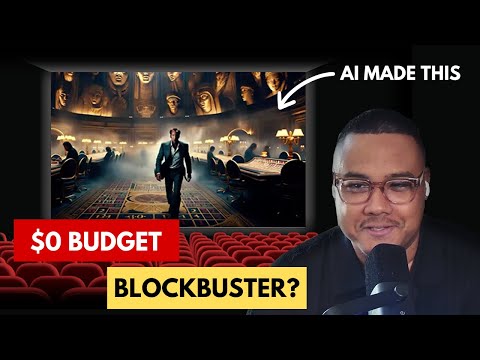
Director Dave Clark explains how he uses AI across his filmmaking workflow, including AI image generators to create visuals and AI animation tools to add movement. He and host Dan Shipper demonstrate the process by concepting and producing a hypothetical Nicolas Cage film using current AI tools.
# Channel Presentation Observations
## Video Overview
- **Title:** "Up-and-coming Filmmakers Are Using A.I. to Break Into Hollywood"
- **Format:** Interview/conversation — an interviewer poses questions and a guest (a filmmaker of color in the sci-fi/horror space) responds at length, followed by the host's personal reflections.
## Intended Audience
- **Tech-curious creators and general viewers interested in AI's impact on creative industries.** The host frames AI filmmaking in parallel with AI's effect on software development ("AI changes who can make software"), suggesting the channel speaks to a broad audience interested in AI's societal effects rather than filmmakers exclusively.
- **People outside traditional industry gatekeeping.** The guest's framing — "everyone has a chance to create something incredible" — and the host's anecdote about wanting to make movies as a kid but lacking money/skill address aspiring creators without connections or capital.
## Claimed / Demonstrated Scope
- **Topic scope:** How AI tools lower barriers to entry in filmmaking, within the broader conversation about AI backlash in traditional filmmaking communities.
- Evidence: The interviewer opens with the "obvious question" about "so much backlash… traditional film making and a lot of worry about AI tools."
- **Format demonstrated:** Interview-based discussion, not tutorial or showcase content. No AI tools are demonstrated or named; the discussion stays at the industry/opportunity level.
## Self-Description Evidence
- **Host self-references (implicit persona):** The host describes a personal history of making software, having wanted to be a filmmaker as a kid ("I so wanted to make movies when I was a kid… this Lego Steven Spielberg Jurassic Park thing"), and pivoting to 3D modeling and then software.
- This demonstrates the host identifies as a software builder/software person, contextualizing the channel's tech-oriented lens.
- **No explicit channel self-description** (e.g., "on this channel we cover…") appears in the transcript, and no curated metadata was supplied.
## Creator Claims vs. Demonstrated Patterns
- **Guest claims (not channel claims):** The guest asserts AI democratizes filmmaking — "AI is the best opportunity for anyone if they want to become a Creator or filmmaker or an artist" — and references speaking to the SAG board of directors. These are the interviewee's claims presented for discussion.
- **Host claims:** The host states a personal counterfactual ("if a lot of the AI filmmaking tools had been available I would probably be making movies") — a stated opinion, not a factual claim about the channel.
- **Demonstrated pattern:** The channel presents interview dialogue exploring contested topics (AI backlash) with sympathetic framing toward AI-as-opportunity, evidenced by the host's closing remark that "anyone can just like go make a movie and it doesn't require that much money."
# Delivery Observation: "Up-and-coming Filmmakers Are Using A.I. to Break Into Hollywood"
## Speaker Structure
The transcript shows a **two-speaker interview format**: an **interviewer** (opens with a framed question, responds at [151]) and a **guest** (a filmmaker, [26]–[151]). The majority of speaking time belongs to the guest.
## Tone
- **Conversational and informal throughout.** Both speakers use casual fillers and hedging:
- Guest: *"it was a little bit of necessity um"*, *"I'm not going to lie"*, *"you know"* (repeated many times, e.g., [49], [60], [72], [82]).
- Interviewer: *"like I loved I so wanted to make movies when I was a kid like"*, *"it's it's so cool"*.
- **Enthusiastic and advocacy-oriented tone from the guest**, especially toward the close: *"I think AI is the best opportunity for anyone if they want to become a Creator or filmmaker"*, *"that's just's really cool to me"*.
## Vocabulary & Recurring Phrases
- **"You know"** is the guest's dominant verbal tic, appearing in nearly every long answer.
- **Repeated concept: opportunity/access.** The guest frames AI around expanded access: *"give people opportunities and storytellers opportunities that might not have you know the opportunity"*, *"everyone has a chance to create something incredible"*.
- **Repetition for emphasis** is a consistent habit: *"there's still it's there's still a small amount of people"*, *"and and and and digital doubles of people"*, *"it's it's so cool"* (interviewer).
- **"Like"** used heavily by both speakers as a filler and comparator: *"kind of how CGI is use like you you'll use AI to create large stadiums of crowds"*.
## Teaching / Argument Habits
- **Concrete illustrative examples.** The guest supports arguments with named references: Jordan Peele (*"that's what everyone always says when you're a black person and you say I want to be a horror director"*), a *"white kid from Arkansas"*, and a *"black kid from the hood"*.
- **Analogy-based reasoning.** AI compared to CGI: *"AI is going to be kind of used kind of how CGI is use"*.
- **Anecdotal self-disclosure from the interviewer**, who mirrors the guest's point with a childhood Lego Steven Spielberg story and a 3D modeling attempt (*"you have to be a freaking genius to like make an actual 3D animated movie"*).
- **Explicit signposting of question structure**: *"so kind of to Circle back on your bigger question"* — the guest acknowledges and restructures his answer.
## Communication Patterns
- **Question → long multi-point answer → interviewer validation.** The interviewer affirms alignment: *"I love that I mean it's so interesting because it's so in line with with things that I felt and seen"*.
- **Hedged uncertainty when appropriate.** The guest flags limits of his knowledge: *"while I can't like answer that truly and really know the answer…"*.
- **Self-interruption and mid-sentence redirection** are frequent in both voices, suggesting unscripted, spontaneous dialogue.
## Uncertainty Notes
- With only ~5 minutes of transcript, patterns like the frequency of "you know" are strongly evidenced, but **speaking-rate, nonverbal, or emotional-tone observations cannot be made** from text alone.
- Speaker roles are inferred from turn-taking and content; no names are given in the transcript.
# Position Record: Up-and-coming Filmmakers Are Using A.I. to Break Into Hollywood
## Speaker 1 (Interviewer)
### Question: Backlash against AI in traditional filmmaking
Opens by acknowledging **widespread backlash** against AI tools within the traditional filmmaking community, citing concerns about:
- Who gets to make films
- What films get made
- Who gets paid
Asks why the guest chose to embrace AI despite this context.
### Parallel drawn to software creation
Later draws an analogy from software: **AI changes who can make software** by expanding who can build things, and suggests the same dynamic applies to filmmaking — the cost and skill barrier to produce even a small video clip has "gone down tremendously."
> "Obviously it requires a lot of skill to like build that into something that people want to see but um it doesn't require that much money."
### Personal reflection: abandoned filmmaking ambitions
Recounts a childhood desire to make movies:
- Had a **Lego Steven Spielberg Jurassic Park set** with a camera for stop-motion-style filming, but "you couldn't make anything good."
- Tried **3D modeling** hoping to make something Pixar-like, but in the mid-2000s "you have to be a freaking genius" to make an actual 3D animated movie.
- Pivoted to software because business software was comparatively easy to build.
**Counterfactual claim:** If AI filmmaking tools had existed then, he believes he "would probably be making movies." He expresses enthusiasm that anyone can now make a movie without much money.
## Speaker 2 (Guest, filmmaker)
### Decision to use AI: necessity and opportunity
Describes his adoption of AI as "a little bit of necessity" and "seeing a lane," grounded in his perspective as a **person of color**:
- Acknowledges brilliant Black and female filmmakers are winning or being nominated for (or should be nominated for) Oscars, but says there is still a **small number** of such people.
- Notes the scarcity is especially acute in **sci-fi and horror**: when a Black person says they want to be a horror director, "like Jordan Peele" is the only reference point — evidence to him that "there's not enough."
### Claim: AI democratizes opportunity
States his argument to big-time director and writer friends (who he says are "starting to come around") is that AI can **enhance and give opportunities to storytellers** who otherwise lack them:
- Example: a white kid from Arkansas making backyard films without connections "has a chance."
- Parallel: a Black kid from "the hood" — his own background — also "has a chance."
- Framing: "everyone has a chance to create something incredible."
### Conversation with SAG
Reports speaking to the **SAG board of directors** via his friend Rob during a webinar on CGI versus AI, in the context of controversy over **digital doubles** and whether AI will replace actors.
**Qualification preserved:** He explicitly states he cannot truly answer whether AI will replace actors:
> "while I can't like answer that truly and really know the answer..."
His stated expectation: AI will be used **like CGI** — e.g., generating large stadium crowds and digital doubles — but "it's all going to be with consent," and he believes **people should get paid for their likeness**.
### Overall position
> "I think AI is the best opportunity for anyone if they want to become a Creator or filmmaker or an artist and create something that can be seen on a large scale."
## Points of Agreement
- Both speakers converge on the view that AI **lowers cost and access barriers** to filmmaking, giving opportunities to people without money, connections, or industry representation.
- Both frame AI as an enabler rather than (in the guest's case, at least) a replacement — though the guest's reassurance on actor replacement remains explicitly tentative.
# Speaker Attribution & Provenance Record
## Video
- **Title:** *Up-and-coming Filmmakers Are Using A.I. to Break Into Hollywood*
- **Video ID:** `01a0f15b-0dce-7232-8726-0b3a36c9951a`
## Speakers & Roles
### Speaker 1 — Interviewer / Host (likely channel creator)
- **Evidence:** Asks the opening question, references "the production call previous before we started this show," and shares personal anecdotes.
- **Key statements:**
- Poses the "obvious question" about AI backlash in traditional filmmaking communities.
- Draws analogy to AI changing "who can make software."
- Recounts childhood experience with a **Lego Steven Spielberg Jurassic Park** movie set and later 3D modeling attempts in the mid-2000s.
- States: *"if a lot of the AI filmmaking tools had been available I would probably be making movies."*
### Speaker 2 — Guest (filmmaker, self-identified person of color, aspiring horror/sci-fi director)
- **Evidence:** Responds to questions; identifies background and community affiliation.
- **Key statements:**
- Motivation framed as *"a little bit of necessity"* and *"seeing a lane."*
- Notes scarcity of Black horror directors, citing **Jordan Peele** as the frequent comparison.
- References *"big-time film director friends"* and writers who he says are *"starting to come around"* on AI.
- Describes speaking to **SAG (Screen Actors Guild) board of directors** via *"my friend Rob"* during a webinar on **CGI vs. AI** and digital doubles.
## Referenced Third Parties & Claims
- **Jordan Peele** — cited by guest as the common reference point for Black horror directors.
- **SAG board of directors** — guest claims direct interaction via a webinar arranged by friend "Rob"; topic was digital doubles and consent/compensation for likeness.
- **Unnamed "big-time" director and writer friends** — guest says they view AI positively; unverifiable.
## Promotional Segments
- **None identified.** No product, service, or sponsor mentions appear in the transcript.
## Availability & Limitations
- **No curated metadata supplied** — speaker names, channel identity, timestamps, and comment availability are **not established** by the source.
- Speaker attributions are role-based inferences from dialogue structure; exact names are unknown.
- SAG interaction and friend references are **unverified third-party claims** by the guest.
I guess like I have to ask the obvious question which is um there's so much backlash I think particularly in a community that you're a part of and and really familiar with which is like traditional film making and a lot of
worry about um AI tools and how it CH how it will change who gets to make films or or what films get made or who gets paid or there's just a lot of questions and I'm curious like how you decided to sort of jump into this um versus not yeah no again I think it it was a little bit of necessity um it was a little bit of of seeing a lane you know being a person of color I'm not going to lie I mean of course there's a brilliant um black filmmakers and female filmmakers that are winning or getting nominated for Oscars or should be getting nominated for Oscars but you know there's still it's there's still a small amount of people like especially in the sci-fi horror space if you say oh yeah I want to be a I want to be a horror director oh yeah like like Jordan pill that's what everyone always says when you're a black person and you say I want to be a horror director so that just tells you that there's not enough um and I think um for me you know my argument to anyone and and I have you know big-time director films and uh big-time film director friends and and writers and and they um they're starting to come around they're starting to kind of see the the positivity in it and how it could really enhance and give people opportunities and storytellers opportunities that might not have you know the opportunity like I think about you know if you're like a you know if you're like a white kid from Arkansas like who loves making films in your backyard but you don't have like you know the connections like you have a chance if you're a black kid from the
you know from the hood like that's how I grew up you have a chance like everyone has a chance to create something incredible and that's just's really cool to me um and then you know I I was able to speak to Sag directly which was uh an
interesting moment I was like talking to the board of directors uh through my friend Rob uh he was giving a webinar on just a difference of like uh CGI versus AI because there was a there was a whole thing about digital doubles and you know is AI going to replace me as an actor and while I can't like answer that truly and really know the answer I do know that AI is going to be kind of used kind of how CGI is use like you you'll use AI to create large stadiums of crowds and and and and digital doubles of people but it's all going to be with consent and people I believe people should get paid for their likeness and all that so yes so kind of to Circle back on your bigger question is I think AI is the best opportunity for anyone if they want to become a Creator or filmmaker or an artist and create something that can be seen on a large scale you have a great chance if you use some of these AI tools I love that I mean it's so interesting because it's so in line with with things that I felt and seen just in different um uh different areas of the world um and I didn't realize how directly it applied to filmm but it obviously does like one of the things I see a lot is AI changes who can make software um like it it dramatically expands the the territory of people who are are able to build stuff because it can program for you um and I think the same thing it seems to be true here like um the cost
and and the level of skill maybe to get started with building just a making a a very very small video clip just went down tremendously and obviously it
requires a lot of skill to like build that into something that people want to see but um it doesn't require that much money and like for me we were talking about this in the in the production call previous before we started this show like I loved I so wanted to make movies when I was a kid like I I got this like I had this like Lego set this like Lego Steven Spielberg Jurassic Park thing that like came with a camera and you had you could have the little actors and it was sort of like almost a stop motion animation thing and I was like so into it but you couldn't make anything good and so then I got into like 3D modeling and I was like trying to make a Pixar type thing but that didn't really worked because it was like at that time you know you have to be a freaking genius to like make an actual 3D animated movie and like the mid 2000s and um and so then I started making software because like software especially business software you can like you know it's just easy to make forms that people fill out and pay money with a credit card which I love I mean it's it's a really an amazing like part of my life but honestly like I think if a lot of the AI like film making tools had been available I would probably be making movies and I think it's so amazing that like people now anyone can just like go make a movie and it doesn't require that much money it's it's so cool