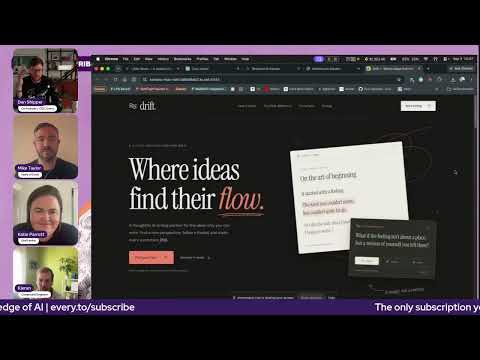
VIBE CHECK: GPT-6 ASTRA
A "Vibe Check" review episode evaluating GPT-6 Astra, with discussion of its capabilities, computer use, and how it compares to prior models like Sol 5.6 and Fable for everyday (non-coding) work tasks.
# Channel Identity Observations
## Self-Description (Explicit Claims)
### Positioning Statement
- The channel is operated by **Every**, described repeatedly as: *"Every is the only subscription you need to be at the forefront of AI."* / *"the only subscription you need to stay on the cutting edge of AI."*
- Dan Shipper identifies himself as *"the co-founder and CEO of Every."*
### Claimed Scope of Offering
- **Education and tools**: *"If you want to be at the forefront, what do you need? You need two things. Education and tools."*
- Concrete offerings cited in the video:
- A **daily newsletter** with model reviews on release day
- Long-form "vibe check" reviews (~4,000 words) covering *"programming, writing, design, and intellectual work"*
- A **YouTube channel** with short review videos
- Paid-subscriber **"camps"** (live Zoom streams on workflows): *"We're all getting together on Zoom… cover a topic where we go into detail about our workflows."*
- **Courses**, **model reviews**, and an in-house product: *"our own agent, Agent Every."*
- Team-member-authored **plugins** (Kieran's "Compound Engineering Plugin," Katie Parrott's "Compound Writing")
- A public benchmark site: *"mikechecks.to. We just launched it today."*
### Team Composition (as presented on camera)
- **Kieran** – manages agents, creator of Compound Engineering Plugin
- **Katie Parrott** – staff writer, author of the 4,000-word review
- **Mike Taylor** – leads the evaluation department
- **Dan Shipper** – co-founder/CEO
- Supporting staff mentioned: Jack Chang (editor/writer), Randy (video manager)
## Observable Presentation Patterns
### Format & Methodology
- The video is a **live panel-style "vibe check"** of a new AI model release (GPT-6 Astra), with a signature **"appeal test"** / "relevance test" format: *"Do you use it every day? Do you turn to him? And why, in what situations?"* Each panelist gives a **traffic-light verdict** ("green," "yellow").
- Emphasizes **speed-to-publish**: review produced *"from start to finish in about 12 hours"* after a 3 AM launch notification—presented as a competitive differentiator.
- Systematic **benchmarking apparatus**: Mike describes automated testing with custom checks *"my own taste embedded in those checks,"* blind A/B writing tests, and a "cozy island" 3D benchmark from Kieran.
### Intended Audience
- **AI-forward professionals and practitioners**: discussion repeatedly frames findings through a business/workflow lens—*"I test everything mostly through a business lens"*, *"business professionals will appreciate Astra's individuality."*
- People making **tool-purchase decisions**: comparisons positioned to help viewers *"decide what you need it for"* between competing models.
- The community framing for camps targets enthusiasts: *"we are a group of people who love AI… there aren't that many such people in the world."*
### Voice & Culture
- Casual, personality-driven panel banter (jokes, inside references like the "Pelican test," "warm paper" design debates, a Celsius can on camera).
- Comfortable **criticizing even promoted products**—the review concludes the model *"doesn't quite reach the level of Fable 5.1 in top tasks"* despite strong praise elsewhere.
- Self-aware about industry hype: *"if you had asked me last week… This is amazing"*; *"everyone says Astra is AGI. Maybe it's just hype."*
## Notes on Evidence Boundaries
- All team roles, product names, and claims above are **creator-stated** in the transcript; audience inference (professionals/practitioners) is drawn from the demonstrable framing of tests, examples, and the paid-community pitch. No metadata beyond title and transcript was provided.
# Delivery Observation — "VIBE CHECK: GPT-6 ASTRA"
## Format & Structure
- **Fixed segment skeleton.** The delivery moves through the same arc every time: intro → team self-introductions → summary of published review → per-category testing (programming, writing, design, intellectual work) → closing plug for Every's subscription. Each transition is announced verbally: *"Let's go through the main points"*, *"We are moving on. Now we will talk about writing texts."*
- **Circle-style go-arounds.** The host repeatedly gathers opinions in rotation: *"Let's go around in circles. Kieran, you have a 'yellow' level. Can you share your opinion?"* and *"Okay, we'll continue in a circle."*
- **Named recurring rubric.** The team's evaluation device — the *"appeal test"* / *"relevance test"* ("Do you use it every day? Do you turn to him? And why?") — is re-explained at multiple points, functioning as the show's signature teaching frame.
## Vocabulary & Recurring Phrases
- **Traffic-light verdicts.** Models get color ratings: *"he gets the 'green light' from me"*, *"That's why Kiran is 'yellow'"*, *"You are green. Can you tell us about your experience?"*
- **"Warm paper" as a running motif.** The design default is named and joked about repeatedly: *"she has a notebook… this is a warm paper-colored background? Just saying."* / *"You don't like 'warm paper' as much as Katie and I do."*
- **Verbal tics and asides.** Frequent *"you know"*, *"um/uh"*, and self-deprecating asides: *"Uh, I'm so sorry for the rhyme, but I couldn't help myself."*
- **Enthusiasm markers.** Recurring *"it's just crazy"* / *"this is just a crazy model"*, *"This is amazing"*, *"Let's go"*, and *"friends"* as a direct address (*"It was done the first time, friends"*, *"stay hydrated, friends"*).
## Teaching & Demonstration Habits
- **Show, then analyze.** Nearly every claim is backed by a live screen share (Waterloo reconstruction, diary-scanner app comparison, Hadestown set build, "Mike's Checks" dashboard) followed by a specific contrast: *"In Fable… you just bring up the page, press the spacebar… And Astra does this, where again there are many similarities, but… look at all this."*
- **Quantified evidence.** Concrete numbers anchor credibility: *"about 4,000 words"*, *"released around 3:00 AM… it's now 3:30 PM"*, *"25,000 views"*, *"I did 50 comparisons today."*
- **Teaching by artifact.** The host walks through written artifacts (headlines, subheadlines, prompts) line by line: *"If I wrote such a sentence, I would be very satisfied."*
- **Naming team members' methods.** Repeated attribution and promotion of colleagues' tools: *"we call it 'Mike's Checks'"*, *"You should pay attention to Jack. He is amazing."*
## Communication Patterns
- **Conversational hosting with frequent checks.** The host actively manages turns and tech: *"Your microphone is muted"* (twice), *"Does anyone with programming experience want to say a little more?"*
- **Playful banter as connective tissue.** Jokes interrupt analysis: *"Did you get arrested for being too active in 'vibe coding'?"*, *"Congratulations Simon Wilson, but Mike beat you to it."*
- **Hedged judgment.** Opinions are regularly framed as personal or provisional: *"these are my subjective checks"*, *"this still needs to be verified"*, *"there are some differences in the team."*
## Stable Patterns vs. Isolated Moments
- **Stable (multiple occurrences):** the appeal-test rubric, traffic-light ratings, "warm paper" running joke, demo-then-dissect method, "green light/one request/crazy" enthusiasm vocabulary, "only subscription you need" pitch (repeated at least four times).
- **Isolated (uncertain as patterns):** the closing rhyme apology, the misnamed model in the YouTube video confession, the peanut-allergy refusal anecdote, and the courthouse bit with Ellie — each appears once and should not be generalized as habitual delivery features.
- **Caveat:** the transcript appears machine-translated, so exact phrasings ("appeal test" vs. "reach test" vs. "relevance test") vary; these are treated as one recurring concept rather than three distinct ones.
# Observation Record: "VIBE CHECK: GPT-6 ASTRA"
## Video Overview
A panel review/discussion hosted by **Dan Shipper** (co-founder and CEO of Every) covering a newly released model, "GPT-6 Astra," from OpenAI. Panelists: **Kieran** (agent manager, Compound Engineering Plugin), **Katie Parrott** (staff writer, Compound Writing plugin), **Mike Taylor** (leads evaluation at Every), and guest **Ellie Miller** (joining from near a courthouse, on jury duty). The transcript appears to be a translation and contains inconsistent model naming throughout (e.g., "GPT-6," "GBC 6," "GBD 5.6," "GPT-4o," "Astro," "Astra" used interchangeably), which is preserved here as untrusted data.
## Context Claims (Dan Shipper)
- Greg Brockman "at Axio" said the model is "pretty close" to AGI. Dan presents this as a question to test, not a settled fact.
- The team tested the model before launch; they learned of the ~3 AM ET release the same night and published a ~4,000-word review ("GPT-6 Astra—a big update with bad habits," written by Katie Parrott) in roughly 8–12 hours.
- The review draft itself was produced by Astra on the first try, per Dan.
## Dan Shipper's Positions
- **Writing:** "This is my favorite model for writing… my main tool for every day," but he turns to Fable "when I need to accomplish something truly large-scale."
- **Computer use:** "Incredible." Randy (video manager) had Astra edit a 20-minute Fable 5.1 review video in Premiere over ~5 hours.
- **3D/design:** Asked Astra to build a historically accurate, frame-by-viewable reconstruction of the Battle of Waterloo — "done the first time."
- **Overall verdict:** "A very good model that is capable of incredible things," but with "several bad habits" — it "doesn't quite reach the level of Fable 5.1 in top tasks," overloading outputs with extra text, labels, and "decorations."
- **Appeal test verdict: green light**, with the caveat: "we need to see how it goes once we start paying for tokens… and whether I'll have to go back to 5.6."
- Claims ChatGPT for work/Codeex is "the best tool for controlling your computer right now," criticizing Claude's prior "orange frame" approach.
- Notes he misspoke ("GBD 5.6" instead of "GPT-6") in the YouTube video, which Randy declined to fix.
## Kieran's Positions ("Yellow")
- Enjoys Astra ("really a lot of fun… exceeds expectations") but does not trust it as a primary tool.
- Trusts Fable 5.1 as "a reliable colleague, the only model I've had such confidence in since Fable 5"; hoped Astra would feel the same — "But no, she keeps adding so much extra."
- Objects to correction workflows: "This workflow of having to correct what has been done annoys me, I thought we had outgrown it."
- Would "never choose it if it cost as much as Fable" — uses it only for landing pages, 3D games, or idea generation, "not as a primary tool."
- **Coding:** His rewrite-from-scratch of Dan's markup editor had bugs; "Fable 5 and Fable 5.1 didn't have any bugs."
- **Landing pages:** "Her landing page design is just crazy. If you are a designer, this will be a very interesting and cool model."
- **"Cozy island" benchmark:** Astra's version is impressive but "tires you out"; "Fable leaves a little more space for ideas and people… Astra is just like 'let's go.'" Compares Astra to "fast food" vs. Fable's haute cuisine.
- Notes a uniform "landing page factory" aesthetic, speculating "they over-trained their data."
- **AGI skepticism:** AGI discussion misses consistency: "The point is, can you do something consistently in a way that I can't look at it and say, 'I know where that came from.'"
- Blender demo: created a vineyard scene in one go with self-generated textures (background was a projected image plane).
- Coined the "show horse" phrase picked up in the AI-written draft.
## Katie Parrott's Positions ("Green")
- "I am delighted with this model." Wrote the review draft by delegating to Astra overnight — set it up around 3–4 AM, returned to a finished draft by ~7 AM.
- Emphasizes it was still a team effort (Jack, Kate, Kieran, Mike, Dan, others).
- Her usual writing method is section-by-section with drafts, but Astra "followed the instructions, found the right context, and used it appropriately" in one shot — "I don't think I've ever seen a model do that before."
- Reaches for it "maybe more often than Fable 5.1": "it's big, but with the energy of a small model in a very good way… I forget that I'm using a big scary model." With Fable she feels she must "spend tokens responsibly."
- **Scriptorum demo:** Asked for a Bible-study homepage; Astra "was the first to do it in a way that made me think, 'Oh yeah, I'd love to use that.'" Notes (with humor) the warm-paper background; says she loves warm paper as a writer.
- **Hadestown set demo:** Astra's 3D set "looks as if someone actually saw it," whereas "Fable looks like the model just read a description" (though Fable's balcony wrapped the full perimeter correctly, and Astra's staircase side was wrong).
- On layout/design over-formatting: frames it as an unsolved problem requiring "a theory of mind for humans… that strange ephemeral space between the biological brain and the brain of zeros and ones."
- Astra inserted screenshots and captions per their Notion style — tasks she "avoid[s] like the plague."
- On prior workflow: she would not trust a model with raw Slack access previously; staged summarization/verification was required. Reader-first framing (why an example matters before presenting it) was historically hard for models; Astra "did quite well."
## Mike Taylor's Positions ("Yellow")
- Would have said "green" last week after Fable 5.1; with Astra: "I didn't see it make any major mistakes, but I also didn't notice anything special compared to Fable."
- Currently splits usage "50/50" between tools, partly fearing he's missing something; skeptical of AGI hype ("since everyone says Astra is AGI. Eh, maybe it's just hype").
- Interested in exploring **computer use**, where Astra is "much, much faster" — this is where his opinion might change.
- **Blind A/B writing test** (50 comparisons, app itself built by Astra): Astra came out **slightly ahead of Fable 5.1**, surprising him — "maybe I was a little too critical of the model on first impression." This partially contradicts his "yellow" rating; he leaves the tension visible.
- **"Mike's Checks"** (automated benchmark at mikechecks.to, launched that day): embeds his own taste into code-based checks; stresses results are subjective ("whether this model is the one I personally want to use, not whether it's the best in the world").
- Dashboard task: good design, but "it's the same… warm paper"; praised **Grok** as a "dark horse" that performed best on this task and made beautiful custom SVGs; said he spent more tokens on Grok than Fable the previous day.
- Writing task (originally written by Opus 4.8): Astra "smoothed out all the sharp corners," dropped statistics, and linked rather than displayed a tweet — downgraded, which surprised him given the blind-test result.
- Training-plan task (from anonymized interviews): passed 100% of checks, grounded in source interviews — "I would 100% send that to the client."
- Typeform-clone vibe-coding test: "completely hits the mark" — the hardest test from months ago, "now surpassed by Astra."
- PowerPoint arrows test: Astra "almost got it right"; Fable 5.1 nailed it; "Soul" lacked spatial awareness. Argues it's more economically important than the "Pelican" test since "most of the world works on PowerPoint."
## Ellie Miller's Positions (guest)
- Tests "through a business lens": Astra replaced Claude for "tone and vibe" tasks — "I'm just not yelling at this model… I yell at Claude several times a day."
- "Business professionals will appreciate Astra's individuality more than Fable's."
- Computer use: "If you've been waiting for something to start using a computer… GPT-6 Astra is the moment of truth." Successfully unsubscribed her from Nextdoor emails, which prior models couldn't do.
- Her team builds "theory of mind" documents (e.g., a storytelling doc called "Resonate"); Fable 5.1 "works better when it gets this theory of mind tool."
- AI-writing patterns (e.g., "not X, but Y," repeated words like "quiet") are less obvious in Astra but predicts "we'll need more samples… I'm sure they'll still be there."
- Repeat-refusal story: Astra refused seven times to fill out her daughter's school allergy form — "it would be easier to do it myself." Calls refusals "one of the major barriers to computer control" for administrative tasks.
## Attributed-to-Jack Chang Case Study (presented by Dan)
- Jack digitizing handwritten diaries: identical one-shot macOS app prompt (webcam page-scanning transcription app).
- **Fable version:** simple, works intuitively (hold page, press spacebar) — Jack "didn't even have to describe it in detail."
- **Astra version:** better visual design (warm paper, green accents, "a little more designer") but excessive complexity — three buttons, redundant steps, extra options. Dan frames it as the core difference in "taste" and "the ability to make decisions without significant guidance."
## Recurring Team Observations
- **"Warm paper" default aesthetic:** a GPT-line trait "since GPT 55 or so." Katie and Mike like it; Dan dislikes its ubiquity ("I just want more concepts").
- **Over-formatting / "allergic to complete paragraphs":** every element gets its own line, bullet, italic (Dan and Kieran both flagged it).
- **New "garbage" signature:** two-line headings with the second italicized, both ending in periods — diagnostic of Astra (and "DB56").
- **Landing-page compulsion:** navigation bars and logos appear even in 3D scenes and games where they serve no purpose.
- **Grok praise (mostly Mike):** increasingly used ("many people just secretly use Grok"), ranks near top in writing; framed as underrated.
## Unresolved Tensions (preserved)
- **Overall standing vs. Fable 5.1:** Dan says Astra is his favorite for daily writing; Kieran and Dan both say Fable remains better for top-tier tasks; Mike's blind test put Astra *ahead* of Fable 5.1 in writing, contradicting his own benchmark impression — he acknowledges the inconsistency without resolving it.
- **AGI question:** Raised (Brockman's "pretty close" claim, "everyone says Astra is AGI") but treated skeptically by Mike ("maybe it's just hype") and Kieran (recognizability/consistency argument). No panelist endorses the AGI claim.
- **Refusals:** Katie notes refusal behaviors and speculates, citing the model card, that a prior "serious incident" led to safety measures that "temporarily affect usability" — presented as inference, not confirmed fact.
- **Mike's rating:** "Yellow" overall, while conceding he might have been "a little too critical" and that his opinion "might change over the next few weeks."
# Video Attribution & Provenance Record
## Video Identification
- **Title:** "VIBE CHECK: GPT-6 ASTRA"
- **Format:** Live panel/roundtable review of a newly released AI model ("GPT-6 Astra" from OpenAI, per the transcript)
- **Publisher:** Every (self-described repeatedly as "the only subscription you need to be at the forefront of AI")
## Speaker Inventory & Roles
| Speaker | Role (explicit in transcript) | Notes |
|---|---|---|
| **Dan Shipper** | Co-founder and CEO of Every; host/moderator | Leads the roundtable, introduces others |
| **Kieran** | Team member at Every; manages agents; creator of "Compound Engineering Plugin" | Also references "Compound Writing" plugin context |
| **Katie Parrott** | Staff writer at Every; lead author of the featured review | Also has a "Compound Writing" plugin; wrote the 4,000-word vibe check using Astra |
| **Mike Taylor** | Leads the evaluation department at Every | Created "Mike's Checks" benchmark suite; blind writing A/B test |
| **Ellie Miller** | Guest (role at Every not stated) | Joined mid-broadcast; mentioned being "near the courthouse" / jury duty; describes herself as testing models "through a business lens" |
Other people **mentioned but not speaking**: Randy (video manager, credited with editing pipeline), Jack Chang (editor/writer, built a diary-transcription test case; author of *See You in the Cosmos*), Kate (contributor), Tobi, Douglas, Simon Wilson (referenced re: "pelican test"), Greg Brockman (quoted source, below).
## Referenced Sources & Third-Party Claims
### Cited people/statements
- **Greg Brockman (via Axio):** Dan cites Brockman "at Axio" saying the model is "pretty close to" AGI.
- **OpenAI blog:** referenced regarding computer-control capability.
- **Model card:** Mike references it regarding safety rejections ("a significant portion of the issues have been resolved").
### Third-party models/products named for comparison
- **Fable / Fable 5.1** (Anthropic per one mention of "Claude Fable 5.1") — primary comparison baseline
- **Grok** — characterized as an underrated "dark horse"
- **Claude**, **Codeex / ChatGPT for work**, **HighQ 4.5**, **Opus 4.8**, **Cursor**, **Premiere Pro**, **Blender**, **Notion**, **Slack**, **MCP**, **Nextdoor**, **Facebook Marketplace**, **Typeform**
### Internal artifacts produced/referenced
- **4,000-word review:** "GPT-6 Astra—a big update with bad habits," by Katie Parrott, at `every.vibeck/6-astra-vibe-check` (URL as read aloud; transcription uncertain)
- **YouTube video:** ~3–4 minute Astra review; also a Fable 5.1 review video (~26,000 views stated) edited by Astra in Premiere Pro
- **Mike's Checks:** `mikechecks.to` — benchmark site, launched the day of recording
- **"Resonate" document:** internal Ellie-team document on storytelling
- **Katie's prior guide** to writing with AI (mentioned)
- Prior events referenced: GBD5 launch in upstate New York, summer 2025; "Sonnet 3.5" 3D environment demos
## Promotional Segments (flagged)
- **Every subscription pitch:** repeated throughout ("the only subscription you need to stay at the forefront of AI")
- **Full review URL** promoted on screen multiple times
- **Every "camps":** paid-subscriber livestream; tomorrow's camp covering "Fable vs. GPT 5.1" promoted; `every.to/events`
- **Upcoming products:** new courses, new model reviews, "Agent Every"
- **Call to action at close:** try Astra and leave comments on Every or X; "Mike's Checks" site promoted
- **Self-promotional framing** of the review process itself (e.g., 4,000 words written in ~8–12 hours) presented as evidence of model capability
## Comment Availability
- Dan invites viewers to "let us know in the comments on Every, anywhere in X" — comments are solicited on Every's own platform and X, **not** stated as available on the video host itself.
## Availability & Timing Facts Recorded
- Model reportedly launched ~3:00 AM Eastern; review completed by ~7:00–8:00 AM (transcript gives slightly differing figures: "about 12 hours," "about eight hours," "less than 12 hours")
- Model initially available to corporations only; general availability deferred ("not even available to ordinary people... until tomorrow")
- Known limitation noted: safety rejections affecting usability of computer-control tasks (per Mike, model card referenced)
## Uncertainty Flags
- The transcript appears machine-translated; model/product names are inconsistent (e.g., "GBC 6," "GPT-6," "GPT-4o," "GBD5," "GBG 5.6," "Soul," "Astro," "Astra" used interchangeably). Speaker attributions above rely on explicit introductions; some longer passages (e.g., Waterloo, Hades Town demos) lack explicit speaker tags and are inferred from conversational flow, not stated fact.
- Two URLs read aloud (`every.vibeck/6-astra-vibe-check`, `mikechecks.to`/`mike's checks.to`) are rendered inconsistently in the transcript.
And we are on the air. Greetings to everyone. We are back in a familiar place. We are reviewing and testing the new model. This time from OpenAI. This is GPT-6. GPT-6 Astra. In honor of Astra, I wore a NASA T-shirt. um, secondhand, I have to say. Um, and the main question: how good is it? And is this AI of general level ( AGI)? Greg Brockman at Axio says she's pretty close to it. We've been testing it for the last ...well, we can't say how long, but we've been testing it. We've thoroughly tested it in programming, writing, and brainstorming, and we have a first-day review for you . The Every team is with me. Let's introduce ourselves one by one. Kieran, do you want to start? Yes, I'm Kieran. I manage many agents and have a plugin called Compound Engineering Plugin. Surprisingly. Now we have Katie Parrott. I'm Katie Parrott, a staff writer. And starting this week, I also have my own plugin called Compound Writing. So, two people can play this game. Let's go. And now we have Mike. I'm Mike Taylor, or Michael if I'm in trouble . And I don't have the Compound plugin yet. Yes. But I lead the evaluation department at Every. Perfectly. And I'm Dan Shipper . I am the co-founder and CEO of Every. Every is the only subscription you need to be at the forefront of AI. We have a lot of information for you today. If you're here and wondering what we've done and achieved with Astra, know that it's all on Every , we have a full review. There are about 4,000 words.
This is on every.vibeck/6- astra-vibe-check. I'm highlighting the URL here. You should watch this. It has everything you need and more, written by our own Katie
Parrott. Title: "GPT- 6 Astra—a big update with bad habits." Interesting. Interesting. One thing I think is worth starting with, and which should tell you something about the quality of this model: we learned that the model was supposed to be released around 3:00 AM Eastern Time, and it's now 3:30 PM Eastern Time. So, it's been about 12 hours, and this entire review was written from start to finish in that time. We also just posted a video on our YouTube. This is about a three- to four-minute video . We do an incredible amount of work to test this model, and we use the model itself for this testing. I want to show you how our Katie Parrott used Astra to do a review of herself on her first try. This was the basis for that review, our impression check, which we just published. There is really very high-quality text here. I think this should give you an idea of how powerful it is—we actually created our own review of this model on our first try, which served as a baseline and allowed us to produce a great 4,000-word piece in about 12 hours. Even in less than 12 hours. It took about eight hours, somehow. Let's go through the main points. This is a very good model for me. This is my favorite model for writing. I use it every day. It remains my main tool for every day. She is incredibly good at working with a computer. We released a video about Fable 5.1 on YouTube. This was a 20- minute review
of Fable 5.1 impressions two days ago, and Astra actually edited it. Our video manager, Randy, just started the process and let it run in Premiere for about five hours, and
he did a lot of the editing for this video. So there's something really interesting going on here with the use of the computer. This is just a crazy model for such tasks. She also does well with 3D games, 3D design, and design in general. I actually asked her, we'll talk about this in more detail later, but I asked her to build, a reconstruction of the Battle of Waterloo that I can watch frame by frame. It is historically accurate. It reflects the entire geography. It has all these little details of the shape. It was done the first time, friends. So this is just a small demonstration of what's possible with Astra. And this is a new class of model, higher than the Soul, so it is more expensive. It costs the same as Fable, so we compare it to Fable on an equal footing . Our impression after testing it for some time is that this is a very good model that is capable of incredible things. And the main conclusion is that she has several bad habits. There are a few moments where, in my opinion, it falls a little short of Fable's level. We have some differences in the team , but overall, in my opinion, it doesn't quite reach the level of Fable 5.1 in top tasks. It does some things , like overloading landing pages with too much text and all sorts of stuff. It writes well, but once you apply it to software, it starts adding a bunch of unnecessary labels and extra details. I
think Fable has a special thing: when you give it a hint, it intuitively understands what you want and expands on it in a way that's surprising, but remains simple
and focused on the main thing. Astra does this to some extent too, but not as well; sometimes it loses direction a bit and adds a lot of unnecessary " decorations" that you don't really need. So, this is an incredibly smart model, a big step up from the soul , very good at writing texts, programming, and intellectual work. We'll take a detailed look at all the tests we ran it through, and, you know, it's not exactly top-notch. So for your most important tasks, in my opinion, Fable is still a bit better. Now I want us to discuss this in a circle. I want to talk about the " appeal test." This test is our way of evaluating, and I believe it is the best indicator of the quality of the model at an early stage. Do you use it every day? Do you turn to him? And why, in what situations? For me, this is now my main tool for every day. I do almost all my daily tasks in it . Everything: from programming and writing to intellectual work. But I turn to Fable when I need to accomplish something truly large-scale. So he gets the "green light" from me. This is a leap forward for my daily tasks. My only caveat is that we need to see how it goes once we start paying for tokens, how quickly they run out, and whether I'll have to go back to 5.6. That's my small caveat, but right now it's my main working tool. I think this is a very good model. Let's go around in circles. Kieran, you have a " yellow" level. Can you share your opinion? Tell us your overall impression of the appeal test. Yes, I'm comparing it to Fable 5.1 because it's a fair comparison, as it's my primary tool and I had a lot of fun working with Astra. This is really a lot of fun. You can do incredible things, and she exceeds expectations, in a good way. This is really cool, but I work and I want the model to work for me, make life easier, do a routine I don't want to do, or improve my ideas. I trust Fable, as
I said in my Fable 5.1 review—I see it as a reliable colleague, the only model I've had such confidence in since Fable 5. I was hoping
Astra would give me the same feeling that I could trust it. But no, she keeps adding so much extra—sometimes it's fun, but most of the time you have to say, " They gave it all away." This workflow of having to correct what has been done annoys me, I thought we had outgrown it, at least with the cheap models. It's really nerve-wracking: if I give a model a task, she just has to do it. I don't want her to add 20 more unnecessary things. It's good if it does something better than I intended, like Fable. But I have to say, her landing page design is just crazy. If you are a designer, this will be a very interesting and cool model for you. I am very impressed with this aspect. For regular coding, it is also good, but not as high quality as Fable 5.1. Do you turn to it in your daily work? And if so, why? No, I would never choose it if it cost as much as Fable. There is no point in taking a model that is worse and less reliable than Fable.
Unless for landing pages or creating 3D games. Or just for fun, to see what it has
to offer— use it for idea generation, not as a primary tool. So, somehow. not as a primary tool. That's why Kiran is " yellow." Uh, let me go back to our Weibo verification page. I'll bring it up on the screen again. Now we have Mike Taylor, also " yellow". Mike, uh, share your general thoughts and tell us about your reach test. What are you striving for in this model, if anything , and why? Yeah, it's, uh, a weird industry that we work in, because if you had asked me last week, I would have said, "Yeah, it's ' green.'" This is amazing. My new daily tool . Because uh, we just got Fable 5.1, which fixed a lot of the issues I had with the previous version of Fable. Uh, now it's like...well, this, this is amazing. You know, we live in wonderful times, and I probably get the most satisfaction from my work. But, uh, I used it, uh , as much as I could, and I didn't see it make any major mistakes, but I also didn't notice anything special compared to Fable. Um, so is this part of your daily routine? I know you've been switching over the last month or so from cloud services to, it seems , a lot of codecs. Yes. Is this still the case? Are you going back? Where are you now? Right now I'm using both options
50/50. Er, just because I feel like I might be missing something. Uh, but I, you know, since everyone says Astra is AGI. Eh , maybe it's just hype. But, uh, no, I
mean, maybe what I'm missing, and that's why I want to explore this more, is the computer usage side. It's much, much faster, and I just don't feel like I trusted AI enough to use a computer, so, uh, maybe I'll be more ambitious about it now. So this is where I think my opinion might change over the next few weeks. I think this is absolutely true for people who have just joined. I was talking about this, she edited a 20-minute video from start to finish that has about 25,000 views. Our Fable 5.1 vibe review was edited by Astra, oddly enough. Uh, and they did it in Premiere Pro. This is complex software that I don't even know how to use. So, there are some very interesting things happening in the area of computer usage right now that I think should change our overall understanding of how we work with computers. Um, okay. Now we have today's star —Katie Parrott. Katie wrote this article in its entirety. Let me remind you, this is 4,000 words of verification of the Weibo. Wait, I'm not showing the screen. This is a 4,000 word vibe review that she wrote from start to finish using Astra in just a few hours, because we had been testing this model for a while , but we got word that it was going to launch around 3am EST , and here we are. Katie, this would have been impossible without Astra, we've never done this before. You are green. Can you tell us about your experience with this model, your overall impression, and your tests? Yes, I am delighted with this model. I, you know, owe her, as you mentioned, considering we had a very tight deadline for this review, and to be honest, I rolled over and checked Slack, which is not something you should do in the middle of the night. Children, don't
do this, I saw that it was time to act. So I got out of bed, went to the office, and said, "Hey, Astra, can you look at these channels, run a
process, and write a vibe check based on these examples and this context?" And around 7 am I returned to the finished draft. So I went back to sleep, and it was... you know, it's not something I did and forgot about. It's a lot of work, and I wrote about it in the Weibo review. Creating such a test requires the efforts of an entire team. So it was really a team effort—myself, Jack, Kate, Kieran, Mike, Dan, and everyone else contributed to writing this piece. But we managed to get a really good frame with one query, and I don't think I've ever seen a model do that before. I usually want a draft, and I wrote about this in my guide to writing with AI. you should go section by section because a decision made early on can have a domino effect on the entire draft, but I set this up and it followed the instructions, found the right context, and used it appropriately. So I'm excited about this model this week and in general, because what really impresses me and why I reach for it, maybe more often than Fable 51, is that it's big, but with the energy of a small model in a very good way. She feels very approachable, I can have a dialogue with her and it's like I forget that I'm using a big scary model and not a regular friendly one. Whereas with Fable, I always realize: it's Fable, and I better make sure I
spend my tokens responsibly, because it's Fable. And this model doesn't have that aura, which I think is good from an accessibility perspective, because it seems like something you can approach and
not be afraid of . I completely agree. So what I want to do now—we're going to move on to checking for vibes. So, again, let's just open this up. We have a vibe check. Katie wrote this 4,000-word vibe check. It is available on every.0. Every is the only subscription you need to stay on the cutting edge of AI . And we tested this model. We have a lot of things worth talking about. everything from programming to writing, design, and intellectual work, we ran many different tests on this model, which we will review. I'll start with programming. So, regarding programming, it's worth noting that it does these things. This is a one-off app that recreates the Battle of Waterloo, which is just crazy. I basically just said, "Hey, the French are retreating now." I just said, "Hey, I want you to research the Battle of Waterloo and create a historically accurate reconstruction of the final attack and then the retreat." And it just did it. And I mean, it's kind of crazy. Does anyone with programming experience want to say a little more about why it's so impressive that it does this? I mean, I've never done this before, but there aren't many things that could go wrong here. And it has to look really good too. So, this has to tickle your, uh, your brain in a certain way. There are just so many things that can go wrong, especially with performance as well . I'm not a game designer at all , but this, this is a very complicated thing. That's many, many weeks or months of effort before the AI era, and it was definitely impossible to do on the previous generation of models with this level of detail. So that's kind of cool, right ? Um, and you and I
talked about how it doesn't quite, um, not quite accurately match Fable at the highest level and, well, complicates things a bit.
And so I want to look at some very specific examples that will probably help you understand this a little bit . So, um, this is a case study that we put together thanks to Jack Chang, one of our editors, who helped create this Vive review and did a bunch of testing. You should pay attention to Jack. He is amazing . And Jack—this, Jack—is the editor. He is also a writer. He actually wrote a few children's books that you should definitely read. Actually, the way I found Jack was I read one of his books, um, called " See You in the Cosmos," and it was one of my favorite books, and I thought, "I have to meet this guy." And so we started, uh, talking and spending time together, and now it's working, now we're working together, and it's, it's amazing. In short, an incredible writer, and he has all these handwritten diaries that he wants to digitize, so he thought it would be a good idea to try out Fable 5.1 against GBC 6 for digitizing his diaries. So he did a little prompt, something like, let's see, it looks like we have a prompt here. Um, actually I don't know if, I don't know if there's a prompt here, but the prompt was, essentially, uh , oh, I'll read the exact prompt. Here he is. You create a full-fledged working application for Mac OS in one go. No one will answer questions during this task. If something is ambiguous, blah blah blah. Um, what I want you to do is, uh, use your Mac's built-in webcam as an input device. Uh, support an entire notepad session. The user works with many consecutive pages, and no page is lost. create an accurate transcription, then ask the user where to save it. So, basically , he wants something where he can just hold his notebook and, um, get
a transcription just by turning the pages, right? So, let's see how Fable and er and Astra coped with this task. Here is the welcome screen. So
, this is the version from Fable. You see, it's a bit simple, but it does its job. It's like a notepad scanner, one, two, three. I think there's probably too much text here, but you know, this is kind of a basic approach. This is Astra. We've already talked a little about the design feel of the Astra. In my opinion, Astra has a really good design vision . She uses warm paper too often. This has been a feature of GPT models since, I don't know, probably GPT 55 or something like 54, 55, 56. So you could say it's a bit GPT-like because of the warm paper, but it's there. There are green accents here. This looks a little more designer. You see these things like "one, two, three" and all that. The text here is not bad, but there is much more complexity, for example, from paper to markdown, then bring each page to the camera, review the entries, save the entire notebook, although this has already been mentioned here. And then these little tags, like " photos that you select to transcribe or send to Open Router." And it's just all too much. There are three buttons, you know, that's too much. And these are some of my complaints about the Astra, that it all feels a bit " over the edge" here, as Kieran says. So the next thing that I think is interesting and is an important part of this is how do I, how do I show this to you ? Okay, like this . The next thing that is interesting and an important part of this is what the
actual scanning process looks like in this app. This is a version of Fable . In Fable, it's still pretty simple: you just bring up the page, press the spacebar, and
we move to the next page. Bring up the page, press the spacebar, do the next page, and then finish. It's actually a very convenient workflow that Jack did n't even have to describe in detail. It just works. And this is an example of how Fable demonstrates a kind of intuitiveness: "I understand what you want, and I'll make a version that you may not have explicitly asked for, but that works exactly as you expect, and remains simple enough." And Astra does this, where again there are many similarities, but... look at all this: there is "prepare photo", "rotate 90 degrees", " apply crop" , "clear selection", " this page is empty", "enter yourself", " transcribe page", " use other readers". That is, to do this, he has to hold the page, tap to take a screenshot, then tap " transcribe", and then move on to the next one. So, it's a much more complicated process, and the whole interface is significantly more complicated. And I think that's essentially a good example of the difference between these two models in completing large tasks in one go , their level of taste, and their ability to make decisions without significant guidance. Kieran, Mike, Katie, does anyone have a reaction to this based on your experience? Yes, very similar. I also noticed the navigation bar, now all my apps have a top navigation bar, even if it's a 3D island or something, which is quite interesting, it really directs to marketing pages. If you share my screen, I have one app, this is my original coding example—it's a complete
rewrite from scratch of Dan's amazing markup editor, which I took a request from and said, " can you just build this?" Dan spent many months getting
it to this perfect quality, and now we're just doing it in one go to see if it actually works. But, as you can see , there are bugs, and this doesn't work, whereas Fable 5 and Fable 5.1 didn't have any bugs. So for me, that's the same high level I'm talking about: it looks a little loaded, although cool, but for an app, I'd say it's not as good as Fable here. I want simplicity because simplicity gives me a direction to go, and it's a little... yeah. And it doesn't work. So this is probably the hardest part of my test. It handled the rest pretty well. But in terms of encoding in this test, it's just not as good as Fable 5 or Fable 5.1, because both did better. Well , that's all, friends. I want to add that Ellie Miller is with us today. Ellie, congratulations. How are you? How did we get here? Your microphone is muted. Your microphone is muted. I'm hanging out near the courthouse. How are you, guys? Did you get arrested for being too active in " vibe coding"? That's right. It happens to the best of us. The jury also decided that Astra is cool. So, let's talk about this. Perfectly. We are delighted. We are very glad to have you with us. We've just been reviewing our Astra reviews. When we talk about new models, we always mention the “ relevance test”. Do we turn to a model, and if so, why and instead of what? How has our behavior changed? I wonder how it was for you. I know you have also tested this model. I think I test everything mostly through a business lens, and the thing I used to go to Claude for and do n't now is tone and vibe. I'm just not
yelling at this model. Kieran, I hear you about the mistakes, I've seen the same thing, but I yell at Claude several times a day, asking, "What are
you talking about?!" And I think business professionals will appreciate Astra's individuality more than Fable's. And what struck me: I saw how you analyzed game design. I love all this 3D design. But I don't think it already occupies a significant niche in the business sphere. The function of using a computer is simply space. If you've been waiting for something to start using a computer, a browser, or anything else, then GPT-6 Astra is the moment of truth. I just tell people: imagine someone recording your screen for a whole week. What would they see you doing all the time? Can you ask AI to do this? I used to ask models to take control of my computer and unsubscribe me from all Nextdoor emails. Previous models couldn't handle this, I tried, but with Astra it's quite possible. What do you use the computer control feature for ? We edited the video about Faithful 5.1 ourselves, which we released with the help of Astra. So, what are your main computer usage scenarios? Because I think we're all starting to feel like there's a new way to use computers, because these models can use them faster than you can, uh, and often better. So, how do you use this in your daily life? Yes. And I would say it's something like " measure seven times, cut once," only the other way around. For example, if it's a truly one-time task, I'd still rather do it myself. But if it's something like " fill it all in for me," then it's faster. I'll give you a crazy example: I was working remotely. I was on my phone. As you know, working with Codeex is remotely a million times better than working with Claude. Uh, and in Claude all my chats were broken. So I actually used Codeex's computer management feature to access my PC, go into Claude,
find a chat I already had, and transfer it to Codeex so I could continue it there. So being able to switch between them—I know, it's such a
weird use case, but I trusted it. Uh, and a lot of other things related to managing Gmail, which, again, is just a normal business task. Uh, and we also tried things related to very specific, uh, for example, purchasing from suppliers. For example, the logistical processing of an order, where there are a bunch of different forms, and he handled it very, very well. I like it. I like it. Okay, we'll continue in a circle. Ellie, stay with us. We like your opinion while we discuss. We just finished coding. We'll get to the writing in a second. Then we will go through the intellectual work. I feel like you'll have a lot to say. I know you also participate in jury trials. So when you need to go, just don't be shy to let me know. But we're thrilled to have you with us today for our " mood check." Uh, before we go any further, does Mike or Katie have anything else to add about coding? I noticed the same thing as Kieran. Uh, there were a bunch of extra marketing " embellishments" he added. Uh, I was trying to build a simple app, and I kept telling him, "no, simpler, simpler, simpler." So I feel like he's almost trying a little too hard, but, uh, I guess that goes for all AI agents. Yes. Yes. Hey Katie, have you even tried "vibe coding" with this? I know you've been busy writing, but I'm curious. Well, there's always time for "vibe coding" with a new cutting-edge model . Um, I actually asked a few different models to try to create something like my
Bible study homepage. In short, I just want a convenient and nice panel to view and work with all my notes, bibliography, and
small seminar library, etc. And what Astra created for me...Astra was the first to do it in a way that made me think, "Oh yeah, I'd love to use that." If I extend my screen, I can just show you. Yes. Let me add you. Oh, yes. As soon as you start the show , I'll bring it up on the main screen. Good. OK. You are on the air. Here. Scriptorum. So, this is Scriptorum. Here is, for example, one of the last notes I made about the word " righteous" or " righteousness." Um, she has a notebook with all these notes. Tell us about righteousness. Tell us about righteousness. Before we do that, can I just point out that this is a warm paper- colored background? Just saying. Just saying. In any case, yes. Very even. This is very chatty . I didn't say that. I never said anything else because I love warm paper. I am a writer. Warm paper is just what you need. So thanks to the OpenAI team for developing an app that I like. Um, but back to that note. I can go back to that note. And here it says: "what I noticed." Um, word families to explore. What did I notice? Ahem. I don't remember. Righteousness carries so much accumulated theological weight that an English translation can begin to interpret a passage by the very use or avoidance of the word. So I thought, "Here are a bunch of different places where it's '
righteous,' ' righteousness,'" but different translations render it as ' righteous paths' or ' right direction ,' and there's just a lot of different nuances of translation that you can dig into, and I'm trying to capture all of that
here. Um, and here are also the studies that I need to work on. And this is like my journal, my real reading diary, which is not very complete. So, you see, there are things around the edges that aren't quite ready to go, but there are so many different dimensions here, and the layout...I know what all these buttons do and why I would use them. And I could never have designed something so complex with such meager technical requirements, because I basically just said, here's a file with all my Bible study materials. Do me something useful, and this is what I get. Um, so that's even...yeah. It's like I didn't have some kind of developed vehicle or something, it's just what Astra thought was necessary for me. So I just want to take us back. Remember when we were in upstate New York, in the summer of 2025, during the GBD5 launch, and you were trying to “vibe- code” your own CMS for the editorial team? Tell us about the difference between what was then and what is now. Well, then I sat up until midnight or two the night before, desperately trying to make it work. And then I put it online, it crashed, then I tried to get it up and running a few more times, only to do a last-minute Theranos trick and pretend everything was working on demo day, when in fact it was n't. Um, and this... I barely made any effort , I just made a request and
sent it sailing. And then, when the draft was out of my hands this morning—into “ editorial land” ( which doesn’t exist) or “CMS land” (which is none of my
business)—I went back and looked at it, and I thought, “Oh, this is really cool.” So yeah, the difference between learning what a branch is and why it's so important, because everything could go wrong, and what we have now—it's just ridiculous. This is amazing. We have something Ellie wants to say while Ellie is talking. Katie, can you get your Hades Town demo ready, because I feel like it's worth showing. Whatever it is, I'm really excited. Um, Katie, in your last screen demonstration, I want to point out something that I've encountered in previous GPT models and continue to encounter in Astro. This is annoying: the model seems to be allergic to complete paragraphs and their small number. Every little thing gets its own line, a new indent, a new bullet , a new italic—you name it . Kieran, your demonstration was the same. This is italics. This is underlined, this is lowercase , this is uppercase, this is bold. Dude, choose one or two options and alternate them. I think a copywriter with a design vision, if he really tried to perfect something, would be annoyed by this typical behavior of all GPT models, absolutely all of them. So
I'm constantly forced to provide something like wireframes for text design. Katie, do you have anything to say? I
mean, I talked to Douglas about how we need integrated marketing, because copywriting is difficult, and layout design is also difficult. And it makes sense to me that this is one of those things that is still an unsolved problem, simply because it requires a theory of mind for humans, and that is something special. Understanding what information is ...is working in that strange ephemeral space between the biological brain and the brain of zeros and ones. And getting those two things to coexist so that they work together is something that models are still trying to figure out. And you see it in things like that, in more blurred areas like design, copywriting, and regular writing, I think . Agree. Okay, here it is— Hades Town. What is " Haydestown"? " Haydestown" is a Tony Award-winning musical, another Tony-winning musical with a one- word title that starts with "G" and ends with "H," and it's not " Hamilton." It has just been released on streaming services, a recording of the London cast that mostly matches the original Broadway cast . So lately I've just been obsessed with " Haydestown," and I especially like the stage design, I find it very compelling. So, I asked both Astra 6 and 5.1 to build these scenery as my own way to test out some of these cool 3D design concepts that are being talked about so much. And this is the Astra version, you see, there is a balcony at the top and stairs down. We have space for our band on both sides, tables like in a cafe, and then a revolving stage. So,
that's pretty good, but you'll notice that the background color and the balcony are limited to just this one spot. If you compare this to the
Fable 5.1 version, you will see that the balcony runs around the entire perimeter, and the spiral staircase is on the wrong side. So, I would phrase the difference between these two versions like this, and I'll go back to the Astro version. Astro's version looks as if someone actually saw it, as if the model actually saw the scene itself. It's as if she actually found the visual references, whereas Fable looks like the model just read a description of what the set looked like. So I think that's how I would phrase the difference that I see in their approaches to this task. I like it. I really think this is a great example of how much more cool details there are in this version compared to Fable. And you can also see the world above and the world below. It looks like she's turning everything into a landing page, writing too much text, and adding too many buttons. And here is the navigation bar—why is there a navigation bar here? What does she even do? This is because you can look at different parts, you can look at it from different angles. No, I mean the panel on top, like the Hades Town logo, Broadway, first act, about the model—why is that ? This adds nothing. No matter what you ask for, it will add a logo with the name and a navigation bar, because that's supposedly what you need. Okay, we continue. We continue on. Oh, I just realized that in our YouTube video about this model, I called it GBD 5.6 instead of GPT6, which is just perfect. We shot this
video in less than an hour early in the morning, and I have a Celsius can here for a reason. So we'll have to , we'll just have to accept it.
Unless we can cut it out. I don't know. Randy says no. Our Tobi needs to switch to Alani. You But I think we'll just have to accept it, Randy. And it's just funny, you know, so let's just do something funny in the comments. If we can. Class. Okay, let's continue. We are moving on. Now we will talk about writing texts. My favorite topic. So what you should know about this model is that it passed its own "vibe" test on the first try. You should know that this is the only subscription you need to stay on the cutting edge of AI . If you want to know more, we have a full "vibe" review written by KD. 4000 words written from start to finish around 7am today, because we only found out at 3am that the model was coming out. Look, it's so beautiful. It turns out to be a six. There are really cool things happening here. There are all our tests, all our feedback from our entire team. We have screenshots. You can compare it to Fable. You can compare it with the model you have chosen. Now let's move on to writing. And the most interesting thing is that I saw around 3 am that the model was coming out. I received a message in Slack and a few SMSes and thought: “ Oh, \[ \_\_ \].” Then I spent an hour worrying, "How are we ever going to get the inspection done, we only have a few hours." I was
making plans, like, "Okay, we'll tweet." I can definitely tweet it out and then we'll promise a real review for Monday or something, because the model is n't really
available to everyone yet, just to corporations today. It's not even available to ordinary people, it seems, until tomorrow, or they're still figuring it out themselves . And then I woke up at 7am after a lot of stress, and Katie already had a draft almost ready . I don't know if it was seven, but it was pretty early. Katie had a full draft in her feed, and I just opened it and started reading it without looking too closely , and I thought, "Oh, this is a pretty good draft." Katie did well. I'm amazed that she wrote so much and with such quality, with screenshots and stuff. It's just Astra. Astra just did it the first time. This is simply incredible. I'll go through part of the text here and tell you what I think is done well. But, Katie, is there anything you want to say before I start going into detail? Just to get everyone ready for what it's like to be in an editorial meeting with Dan. I mean, I'll say compliments . There is something good here. There is something good here. Um, okay. So, the Weibo check: GPT-4o is a “show horse” . So I'm a little critical of myself. In fact, one thing that's really interesting here and I like is that he picked up on Kieran's apt phrase. Kieran referred to him as a “show horse ” because he was a bit “ too much” and he did a good job of finding something interesting and bringing it to the top . This is not the headline we chose, but it is quite believable. OpenAI's new model has impressive visual taste and a knack for consulting work. Her ambition still outstrips her judgment. This is actually very good. I think he does a pretty good job of choosing things that are... well, that are true. I think "impressive visual taste" is not exactly how I would put it , but "a penchant for consulting work" is definitely it. Hmm, the phrase "ambition precedes judgment"—that's...that's interesting. He's a little... I think he's even being too hard on himself in this subtitle, but okay. Um,
okay. GPT-4o is very good at being fascinated. OpenAI's new model was released today. Creates beautiful things. I asked him to do a 3D rendering of the set for Hadestown and got a small theater with shabby
green walls, hanging lamps, and a wooden stage surrounded by lights. This is a very good introduction. Um, there's no " not X, but Y" structure there. I think there's a slight problem here: the phrase "he's very good at getting excited." His new model creates beautiful things. The two sentences are unrelated, which is a bit of a problem, but he got the point...we often do a succinct short line and then a long paragraph. He captured this form correctly. And I think this sentence: "I asked him to do a 3D rendering of the set for Hadestown and got a small theater with shabby green walls, hanging lamps, and a wooden stage surrounded by lights." If I wrote such a sentence, I would be very satisfied. And I find it incredible that we've reached the stage where artificial intelligence is writing things like this. And not only does he do that, he, uh , he actually keeps writing paragraph after paragraph, forming a well- structured look, look, there's even a reachability test with different options. There is a code there. There are screenshots there. I don't even know, it's really, it's very, very impressive. Katie, is there anything you want to draw special attention to? Um, no , since you mentioned screenshots, I'll note that he didn't just insert the screenshots I needed when I set him up to use them and follow our Notion style for the "vibe check" itself. He did it for me. I didn't have to format any images or write any captions, which are two things I put off until the last minute and avoid like the plague. Um, so this is a dream, right? This is what we expect from AI—
to take on tasks that annoy and burden us. And that was our " black eye" for a while— organizing screenshots. And all this thanks to the ability to control a computer. I agree. And it makes
you realize, I think we were in the preparation phase, because we were waiting for the monitor to be released for a while. This makes you realize that most of the "vibe check" is simply collecting information that already exists and bringing it to the proper form. And then there are things that reflect our taste or, you know, have that human touch that we want to add and that a model can't replicate. But being able to start from this foundation is very useful, it significantly reduces the amount of work. Tell us about the work you had to do before ASTRA came along to gather all the information in one place and make it look like this. Yes. First, I would definitely go through several stages in the process. I wouldn't trust a model just like that, I wouldn't just give her access to our Slack channels and links to " vibecheck" or our benchmarks so she could just "have fun" . I usually go through a stage of summarizing the conclusions, which I then check to make sure everything in the text is logical, and that we notice any contradictions or points where opinions diverge. And you know , a lot of this analytical work happens before you even get to editing the text sentence by sentence. This requires a consistent selection of relevant examples and an explanation of why they are important . But then you have to take a step back and provide the main analysis of what will be most interesting to the reader, because you can't just start with an example. You should outline what exactly you are going to demonstrate with this example. This was one of the problems I encountered when working with previous models : they always tried to start with the example. And I'm like, "Okay, but I don't understand why I'm reading this." Understanding what the reader wants to know and what they will be convinced by what comes next—this is something that I have historically had a really hard time achieving from models, but this one did quite well, I like it. This exactly
matches my experience. Ellie, do you have any tests or experiences with this model as an author that you would like to share? Well, one thing I've noticed in all the previous models—
OpenAI, Anthropic, or others— is that you start to recognize patterns in AI writing when multiple people try to answer the same question. So I'm just curious to see what the reviews will look like when we post the job . When I make a post on social media, I wonder what the comments will look like? Because in our testing, these patterns were not as obvious as in previous models, where the word "quiet" was repeated a thousand times, or in previous Claude models. Or the structure of " not X, then Y"—all those patterns that we could recognize from fewer samples. I think we'll need more samples to detect these patterns, but I'm sure they'll still be there. I agree, I completely agree . It's just one of those things that you change, but it's not about any specific things, like "it's x, not y," that's not bad in itself. It's just that it's used too often in different contexts, and people notice it very well . Mike, I know you've done a lot of work on the texts for this model and comparing it to others. Do you want to share something? Yes, I can show you a blind writing test that I took because it really surprised me. Please. Yes, let me share the screen. Good. Where are you? Here we are. I'm adding to the scene. That's it. Yes. Steeply. So, first of all, as you probably noticed, Astro created
this app, because it's the same design that you've seen in some of the other demos. But I wanted to take a post that I actually wrote using AI,
deconstruct it, and test it on different models. It works like this: I have a few different comparisons here. This is taken from a real article I was working on, it was 200 words long. I have broken the article down to highlight only the factual information in each paragraph. This is the ninth paragraph out of eighteen. What happened? And this is what is happening in the paragraph he is writing right now. And this is what two different models wrote. So you can say, "I choose A" or "I choose B." This is a fair test because both models were given the same task and context —my half-hour talk on this specific topic. So one task, you understand, is a completely fair and blind test. So I don't know which of these models was which. I did 50 comparisons today, just to see which model I actually liked. And if I click "view results," I'll be very surprised to see that Astra is slightly ahead of Claude Fable 5.1. This came as a surprise to me because in some of the writing tests I had done before for my benchmark, I thought, "Well, that's not bad." But not as good as Fable 5.1. Um, well, actually, I think working through enough of these samples made me realize that maybe I was a little too critical of the model on first impression. Very, very interesting, and it's really fun to watch this grouping. It's just this generation of models, it's a bigger model, and both OpenAI and Anthropic have figured out some things that just make text better. Um, I know Ellie wants to say something. First of all,
I just love it. I like the way you conduct testing . I think everyone should sign up and do everything Dan Schipper tells you to do. So thank you for inviting me and
allowing me to praise you all. I think the way you test everything is great. I want to add one more thing about theory of mind: my team is spending more and more time training these AI models of theory of mind. Like we spend time developing, call it SOPs, skills or instructions, it doesn't matter, we provide these things, for example, we have a whole document called " Resonate" that talks about how to tell a compelling story. How to tell it visually? How do you know all the things Katie mentioned? And by the way, Fable 5.1 works better when it gets this theory of mind tool that we built. So me, and Mike, you inspired me. I'm going to do the same kind of blind AB testing. I like it. I too am looking forward to seeing if the results will surprise me. But with this foundation, Fable 5.1 currently shows better results, although this still needs to be verified. Anyway, thanks so much for inviting me, guys. You are simply wonderful. Fantastic team, and the cops look at me and they have no idea how cool you are. Don't tell them when I'm going to disconnect. Thank you for joining . Good luck. Okay, bye, guys. OK. So, this is our perspective on writing. Kieran, do you want to add anything? Did you notice anything about the writing? Uh, I...No, but I'll use it. I actually use GPT for writing through the Compound Writing plugin. So I'm really curious to see how this model will handle writing. So I will definitely do it. But yes, this is about writing. This is interesting. OK. Well, let's continue. We move on to checking the vibe. Eh, I'll share my screen again. If you are here, welcome. We are the only subscription you need to stay at the forefront of AI. If you want to be at the forefront, what do you need? You need two things. Education and tools. Regarding education, we have a daily newsletter. We test all these models before they are released. Each one. We have a review of the Astra. Two days ago we reviewed Fable 5.1. And on release day,
as soon as they come out, we have extensive reviews like this one . That's 4,000 words of testing from our entire team in the areas of programming , writing, design, and intellectual
work. We already have a lot of materials. We have already reviewed our capability tests. For example, what exactly are we using this model for? And why not ? You know, because we've been using it for a while now. So we can say: this is what I use Fable for, this is what Astra is for, in a way that helps you decide what you need it for. We've already done a lot of programming on this broadcast. I showed this cool thing about Waterloo. It is essentially a reenactment of the Battle of Waterloo, and it appears to be historically accurate. This is really cool. This is one request, just one request, folks. We also covered the topic of writing. Astra actually wrote the first draft of her own review for us, and, you know, we heard that release at 3 in the morning, and by 7 in the morning we had a draft from Katie that was just Astra's work. Now, I think we move on to the most important part of this broadcast—the review of intellectual work. I think the best thing—and this is evident from the way OpenAI wrote their blog—is that the computer control in this model is just incredible. Eh...and in particular, I think ChatGPT for work/codeex is the best tool for controlling your computer right now, because you can tell it to do something and it will do it in the background . It has its own cursor. It uses your browser. It uses any application on your computer. Claude, uh, for a long time, if you asked him to use the computer, he would kind of make this orange frame around your screen, and you'd think, is it you using the computer or am I? Eh, it seems they just fixed it, but still, I think ChatGPT is the best computer management tool for work right now , and Astra is the best model for it. She is very fast. Actually, let me see if I can find it. She, uh, made our Fable 5.1. Eh, a video with a Weibo check. So, this is a
Weibo verification video. Fable 5.1. It has 26,000 views. We published it two days ago. Astra edited this, which is just, damn, incredible. Astra mounted this. We
also have a fantastic human editor, our head of social media, Randy. Eh, respect Randy. But he just took all the raw material and threw it into Premiere. Or, actually, I do n't even know if he threw it in... Did he throw it in Premiere? OK. And then you put Fable to work. Yeah, he threw it in Premiere and then he just...not Fable, he had Astra work on it. And that's pretty... that's pretty impressive. Quite impressive. I also use it a lot for tasks related to intellectual work. I mean, even if you have a Comcast bill or something like that, or you need to interact with customer service for whatever reason, it's so convenient because they already have AI on their side, and you can have AI on your side that says, "I want a refund for this," and it just keeps communicating, and you don't have to worry about it . I let it sell things for me on Facebook Marketplace, such as posting ads and selling things, which GBG 5.6 could do, but I find this model to be much more robust and handles it better. But if you really want to know what this model is good for and why, we have a special column from Mike Taylor, we call it "Mike's Checks." Mike, tell us what validation is and what "Mike's Validations " are, and then explain how they help us understand whether this model is good. Yes, your
microphone is off, Mike. Okay, now everything is fine. Well, yeah, so one of the first things I did when I joined Every, because I
realized I was going to be testing a lot of models, was to automate it somehow. And so I tried to put together a bunch of different tasks that I usually do when I get access to a new model. Um, and then I created a program that essentially did all of these tasks for me. I could have just specified the model name. Well, and it produces all these different files, and, you know, some of them are writing assignments, some of them are PowerPoint assignments. Well, there is one task to create a dashboard, right? So we discussed it for a long time and found an interesting way to do it. Um, we wanted to automate the actual feedback that we give to or receive from the model. So if you go to the task and if you see my screen, I'm just like, I'm just going to click here, this is the dashboard creation task. We give him some NPS data from Every and say, "Hey, I want you to create a dashboard that displays this data." So this is a pretty short request. Um, and the model, you know, will create it and take the pictures. But what's really interesting is that we do these checks after that. Where this came from, um, it's after I checked a bunch of results from different models like I have here, like Fable 5, HighQ 4.5, Fable 5.1, etc. Um, I went through everything and just gave a lot of feedback saying that of course the page should load because in some cases in early models the page wouldn't load. Well, the NPS indicator should be correct. So, there are a few things you can check with code. But many of the important checks are essentially my own taste embedded in those checks. So, one thing that I really like is when there's readable
typography or a distinctive design, and I gave it a definition of what I consider distinctive design. Oh, and the model will go and check it out. Um, so the model does all these
checks. I just need to go in, review, read, and also look at it and provide additional feedback. So, here's what we did. We plan to scale this up, uh, and do this process with other people in the company so that everyone has their own benchmark and can, um, you know, test new models without having to test them all the time, because there are so many new models coming out. Well, we had four new models this week. And I'm so excited about it. It's a whole new world to check out for a "vibe." We now have inspections, tell us what you found. Let us, you know, walk through the checkpoints for this model compared to the others. And I don't know if others notice it too. I think your screen is a little blurry for me. Can you guys read his screen? This is New York Internet. We've managed to avoid internet problems, uh, since we got the new FiOS. But yes, there is something to size here. This is normal. Yes. Is that better? Yes, that's better. Yes. Okay, great. Um, so, uh, the first thing I noticed, uh, is that, uh, she did a better job with the design, uh, with the yeah. And that's just the default design . I know , Dan, you, you do n't like "warm paper" as much as Katie and I do, but, uh, but I think it's a better job, um, compared to the other results. I just don't like that it's the same. He always makes it warm. It's like I come up with a concept and then it's just "warm paper ", you know, I just want more
concepts, you know? Exactly. I probably want, I probably want that purple gradient back because it seems fresh right now. Yes. So, um, yeah, we have, like, this is Fable 5.1,
for example, and that's one of the things that Fable got downgraded for, is that it had a really boring design, um, and a really boring name. Uh, but if you look at the Astra, I think it's much better. Um, but yes, you're right. He is very similar. Um, just to add, uh , this is a completely different model. This is Grock. Uh, and Grock, I think, actually performed the best in the last, uh, last few weeks, uh , on this particular task . Um, because it has a narrative, but it's also, well, it's still a bit of a "warm paper," but, um, I think it looks a bit more expressive. You see, Grok is the "dark horse" among models that no one talks about because they have been weak for too long . But now that Cursor has appeared, many people just secretly use Grok all the time. Of course. The second most popular model. I spent more tokens on Grok yesterday than I did on Fable, which is pretty funny. This is fascinating. Grok ranks among the best in the text writing benchmark, along with Fable 5 and Astra. You see, it's an underrated model, guys, everyone should use it, I did n't use it. I should have used Grok. Everyone should try Grok. Uh, that's what Mike's check says. That's what Katie says. This is what Kieran says. Yes. Um, go on, Mike. Yes. So, he did a pretty good job with the dashboard. Um, what he did n't do very well on was this particular writing test, which surprised me, because he did well on the blind test . Um, I
just wanted to point out that one of the checks I did for this article, for this particular assignment ...I gave it a bunch of context. I gave
him a tweet I wrote myself and talked for half an hour about a specific thing—how to get the team to use AI. This was something I often helped people with. Um, and I asked Claude to write this piece. This article was originally written by Opus 4.8. Um, but I give the same brief to different models and he did n't do it the best way. How would I describe it...he smoothed out all the sharp corners and made the text a little boring. Um, and he still hasn't saved many of the statistics I gave him. I am a big fan of statistics. I like it when the data stays in the text. Um, such trifles: he just gave a link to the tweet , instead of showing it. I think it's very important to show the tweet so that people don't have to click on the link. Um, so yeah , he got a bit of a downgrade for a lot of those moments. Hmm, fascinating. Yes. That's why, obviously, we need to test a lot of things, right? Um, he did really well with this test, where we provided a bunch of context from a bunch of interviews that we anonymized for the client. Can we put together a training plan for this client, and if you look at the audits here, the topics were very in-depth. He didn't just repeat what was in the original descriptions. This was actually supported by the interview, meaning he wasn't making anything up . So he did 100% of my checks here correctly. I think he did a really good job of highlighting the right topics. And because I remember this particular case, I look at it and think, "Yeah, I would 100% send that to the client." This is cool. Mike, remind me, are they public? Yes. Yes, we do , so you can see the website here. This is mikechecks.to. We just launched it today. So, you can go here. I think you referenced it in the original post, from the Vibe check. You should watch this. P, oops, sorry, PRO is joining. Mike's
checks.to. There are a few interesting things here. Okay, continue. Keep going, Mike. Yes. Another point I wanted to point out. Again, another design. It's that
greenwarmaper thing again. But I think they did a very, very good job on this task. This task is to essentially clone Typeform, but make it interview a person instead of making them fill out a survey. So this is a kind of " vibe coding" test. I'm trying to figure out if he really completes everything completely? And does he create a good design for it? And he just completely hits the mark. This was the most difficult test I had a few months ago, and now it has been surpassed by Astra. Wow. Can we see 5.5.1? Yes. So, yes, Fable 5.1 almost got it right. The only thing it got downgraded for was this, you know, " vibe" purple design. I made it very clear that I didn't want it to look like some kind of hack. Um, and, you know, I think again, these are my subjective checks. So the point of this test is really just whether this model is the one I personally want to use, not whether it's the best in the world, because you can of course argue, depending on what you like. And everyone can have their own criteria, as they do, and we can debate which ones are correct. So , okay, is there anything else about this microphone that you want to discuss? Hmm, I'd say he did pretty well with PowerPoint. Eh, I just wanted to show it because we talked about it with Fable. Um, he made this visual design almost perfect, and then he just added this weird
scribble that's annoying . So the reason why this is important, even though it seems like a very subtle point, is because a lot of models do it wrong. Um, I don't know if we have,
actually, again , this is another point that Grok does really well, like really , Grok has created its own SVGs here. Wait, I want to see, let's find that slide. Yes. Yes. Yes. Um, so let me see . So, this is what I want to see. Yes, I'm trying to remember. Is n't he usually earlier? Yeah, I'm trying to remember which slide it is, because Grok ended up making a bunch more slides. But I just wanted to point out, by the way, that Grok has made a lot of his own SVGs here, and they are beautiful. I think they are really very accurate. They did a good job. This is entirely in line with the brand. Um, so yeah, again, kudos to Grok. This is not a channel for praising Grok, but here we go. Yes. So yeah, I'm trying to find that slide. Maybe if I , yeah, I can't find it here, but let's look at the one with the soul, because I know that was the one where I think he got it a little wrong. Yes, yes. Yes. So, for example, this is soul, who again is an amazing model, and I was singing her praises a couple of weeks ago , but she does all this, it's kind of super silly, isn't it, like she has no spatial awareness. Um, this is an example of a model doing it wrong, and, you know, Astra has almost got it right, it's very close to the goal. Um, who really nailed it was Fable 5.1 very recently. So, it was here, and yes, she did it. I mean, again, this is intern-level design in PowerPoint , but even that
shows we've come a long way. She completely passed the "arrows" test, which in itself is much more comprehensive and difficult than the "
Pelican" test. Yes. Congratulations Simon Wilson, but Mike beat you to it. Well, I mean, it's also more economically important, because most of the world works on PowerPoint. But you know, pelicans are very close to our hearts. This is true. No, I'm kidding. But I think spatially they both test the same thing , right? Spatial awareness has been such a terrible failure for most models for a long time. And it feels like we're making great progress on this. And this can be seen in both benchmarks. I completely agree. OK. I like it. I'm spending a lot of time checking on Mike right now. So it's worth it for all of you too . Um, we have another series of demos from Kieran. Kiran, come on, show me. Good. I should say before you start, it's very popular right now to create an entire 3D environment as part of model validation. And you've been doing this for a long time . He was doing this before 3D environments were even possible with these models. And now we have to go back and show, for example, the Sonnet 3.5 3D environment, because we have them. Kiran , tell us about your benchmark "cozy island". Tell us about your cozy island. Yes, "cozy island" is just about making a cool cozy island, and I want to know how it differs from other models, and it's not even about whether it's good or bad, because every model is very good. The only question is, how are they different? And
let's look at this, for example, you can clearly see the title of the website " little haven", which is interesting, and it looks more like a cool site than anything else. If
you compare this to Fable 5.1, you might say, "Oh, that's boring." But, um, it's also more focused, and like, the details, the animations are a little more refined here. Um, but you could say, yeah, the details here are really cool, and there 's a certain aesthetic to it. And you can see that a different color palette is used here. And there are all these things on the screen. Like, why are all these things here? But then you can say, "Oh, that's actually cool, because you can switch to the night version here and the day version here." You can even switch between them, and you could say that it's very neat and really cool. And that's neither good nor bad. It's one of those things that I think is great, but this whole text and everything else—I just do n't like it. Why do I need this? This adds nothing. And, apparently, coming back here is cool. Um, bigger full screen, I mean, there's so much here. I can even take and save a postcard and it loads a PNG and there are sounds. I don't know if you can hear it, but there's this sound of waves, and there's so much here. Um, but
personally I like models that just do something and inspire me to the next thought. Fable leaves a little more
space for ideas and people. And Astra is just like "let's go", it's more like inspiration. It's more like generative, like this is how much it...it's more like that. You can see the same for this example, which is a breathing exercise app. Again, it looks like a website. I'm already tired of this kind of design because every time I see a design from someone else, it looks the same: a logo with a title. It's almost as if this is an artist who was forced to work in a landing page factory and tortured until he learned to do only that. Yes. Yes. It seems they over-trained their data, tailoring it to specific landing pages and this type of page. And here you can see the difference. This is Fable. Hmm, does this look better from a design perspective? It may be more boring, but it leaves more space, and I like that. This makes you tired faster. It's more like fast food. It's impressive, and then you're like, "Oh, this is a bit like a haute cuisine restaurant." It's, well, you know, it's a bit like "I love it, I hate it, " but over time it becomes something you like. And here you first feel admiration, and then you think: "Oh, I'm already a little tired of this." So a new level of "garbage " has emerged, essentially very clickbait and likely viral. But I have to say, this is a landing page, and it's the most beautiful page I've ever seen on any model. It's true, yes,
it may be sloppy, but it looks really good. I really like this page and I haven't seen any other model do anything like this. So there is a flip side.
If you need it, it probably handles it very well , but even if you don't want it, it still tries to do it, which is interesting. Absolutely. We were discussing, actually, let's go back to that landing page. We talked about what the new "garbage" is and what are the signs of this model? If you scroll down a little , it's like "You bring the spark, we'll keep it." It likes two-line subheadings or headings where the second line is italicized and both end with periods. If you see it, it's an Astra, or actually the DB56 does that too , but especially the Astra. And that's exactly the thing when we talk about whether it 's AGI. There's something else about our intellect that you see something amazing like this on the first day, and two days later you think, "I recognize that." I know what it is. It's not that interesting anymore. But people are not like that . Um and I think that's one of the main things that's missing when we talk about AGI vs. non-AGI. It's not just about whether you can create that amazing landing page. The point is , can you do something consistently in a way that I can't look at it and say, "I know where that came from." I'm not surprised by this, you know? Or am I surprised by this? Okay, Kieran, you have something else you want to show. Yes, because everyone was doing demos in Blender. I also made a demo in Blender . So, I just created the scene in Blender in one go. I said, "Can you create a vineyard and something like that and then render it," and he did. Great wine? You should know about Kieran's great wine . Yes, I love wine. And he rendered it. So, that's really cool. This is pretty cool. And I didn't do anything. So,
wow. Uh , yes. So that's cool. And he used image generation to create textures on the couch and everything else. So
all the textures were generated by him too. Didn't use any ready-made assets. The background is actually fake. He simply superimposed the generated image on the background. It's like a fresco. It's like, Yeah, it's just a plane. If you see here, there is a plane onto which the image is simply projected. But the rest is real, and that's cool. You can look around. So Blender and other open source tools suddenly become things you can explore , especially with MCP and the computer control feature, which is really cool. I like it. OK. So, I think that's all we wanted to talk about today. Is there anything, any topic, that we have n't covered yet? Is there anything we tested that's worth mentioning? Anything else you want to share with the team before we wrap up? I have one story about computer control. I was really lazy, and my daughter has a mild peanut allergy, and the school sent me a big form to fill out, and I asked him to fill it out, and he refused seven times, and I had to use the best prompt injection to get him to do it, and finally I thought, "Oh my God, it would be easier to do it myself." So I would say that this is perhaps one of the major barriers to computer control. Because a lot of the things I want to do are administrative tasks. And if he refuses to, I don't know, fill out a tax return or something like that, then that's probably a concern or a limiting factor. Absolutely. Yes, there were definitely some rejections. Somewhat, I think, it's similar to certain cybersecurity tools, in that they apparently had a serious incident; and judging from their model card and other things, it looks like a significant portion of the issues have been resolved, but it will temporarily affect usability. So it's worth knowing that when you try this model, it might behave exactly like this. Katie, I think you wanted to share something? I just wanted to add that if you want to hear more of the Every team's impressions of the GPT6 Astra and Fable 5.1 Soul, you should subscribe to Every and join us for
camp tomorrow. You said come to camp , so within the Every subscription—again, Every—this is the only subscription you need to stay at the forefront of AI. As part of the Every subscription, we host regular camps— live streams similar to this one, but only available to paid subscribers. We're all getting together on Zoom. We communicate, and at the camps we usually cover a topic where we go into detail about our workflows and how we use these tools, everyone has the opportunity to share experiences and meet others, and it's really great because we are a group of people who love AI. We really love using it at work and for doing great tasks. And there are n't that many such people in the world . So it's like a small social circle for people who want to share all this with each other, learn and gain experience. So camps are a lot of fun. Tomorrow we will take a detailed look at Fable vs. GPT 5.1. And that will be really interesting. I, I'm so sorry for the rhyme, but I couldn't help myself. And, yes, it will be, it will be just incredible. You should , you should check it out. Uh, every.to/events can tell you more about camps. We will have new courses soon. We have new model reviews coming out. We have our own agent, Agent Every, who is just incredible. All of this is combined into one subscription, the Every, every.to subscription—the only subscription you need to stay at the forefront of AI. Thank you for joining. Please try Astra. Let us know what you think. Let us know in the comments on Every, anywhere in X, and remember— stay hydrated, friends. Keep yourself and your agent liquid- cooled. Uh-huh. See you next time. See you all.