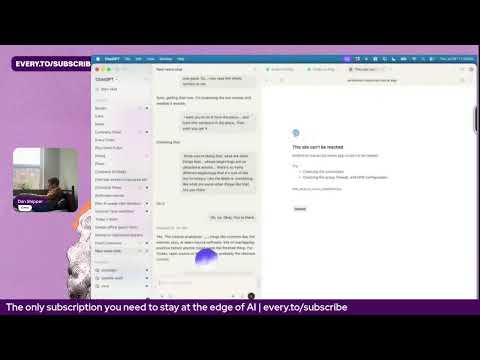
WATCH MY WRITING PROCESS LIVE WITH CHATGPT FOR WORK
A demonstration of the creator's writing process using ChatGPT for work, shown live.
# Channel Presentation Observations
## Explicit Self-Description
- The host introduces himself and his company directly: *"if this is your first time here, I'm Dan Schipper. I am the co-founder and CEO of Every, Every—the only subscription you need to stay on the cutting edge of AI."*
- Closing call-to-action reinforces the pitch: *"subscribe to Every.TO. We'll have tutorials on how to use voice mode and how to use it for writing. We post a lot of great content every day."*
## Claimed Scope
- The channel is presented as a blend of **AI journalism and live demonstration**: the host is writing *"the definitive story of Codex"* based on insider access (*"I've been able to watch it from the inside, since the days of GPT-3"* and *"a bunch of interviews with people inside OpenAI"*).
- Claims a **workflow-innovation angle**: he is writing the article *"using Codex... specifically with voice mode, it's really changed the way I've been working,"* positioning the channel as a place to see AI tools tested in real work.
- Promises future formats: *"I'll probably do more of these broadcasts. I'll probably make a YouTube video about it,"* plus a viewer-answered commitment: *"Will this turn into a video?" "Yeah, we'll make a video of this."*
## Intended Audience (Observable Presentation)
- Addresses a **professional AI-interested audience**, not casual viewers: the session assumes tolerance for technical discussion of reasoning models, test-time compute, and reinforcement learning.
- Treats viewers as **interactive collaborators**: *"if you have a question or something you want to know, just write in the chat... don't hesitate to work with me. I think this could also be a good way to consume content."*
- Responds to specific chat questions on process and personal habits (e.g., what he does while waiting: *"washing dishes or folding clothes"*), suggesting a community-style, behind-the-scenes relationship with the audience.
## Demonstrated Presentation Patterns
- **Raw, unpolished live format**: tech setup fumbling (*"where are my headphones?"*), a friend arriving mid-stream, casual asides ("Okay, class," "Cool").
- **"Open kitchen storytelling"** as a stated method: *"you're going to watch me create this material, and then as you consume it, you're going to be able to look at all the primary sources yourself."*
- Shows the **real AI-assisted editorial workflow**, including friction with the tool (*"That's one of the bugs in the codex,"* "That's very AI-like" about a draft sentence), demonstrating a transparent process rather than a finished product.
## Creator Claims vs. Demonstrated
- **Claimed**: insider access, definitive journalism, subscription value of Every.
- **Demonstrated**: hands-on use of ChatGPT voice mode for drafting, source-verification habits (checking exact quote wording: *"we just need to make sure we put three periods between 'we' and 'established' to make the quote accurate"*), and iterative drafting with an AI agent.
# Delivery Observation: Dan Schipper — Live AI-Assisted Writing Session
## Overall Format
This is a **live "work with me" stream** where the speaker writes an article about Codex by dictating to and collaborating with ChatGPT voice mode in real time. The delivery is dominated by **two voices**: the speaker's own commentary and the AI's spoken responses (read back through voice mode), which make up a large share of the transcript.
---
## Tone & Register
- **Casual, unpolished, conversational.** Frequent false starts and self-corrections:
> "Um, um, so I'm just going to write what I hope will be the definitive story"
- **Warm, audience-inclusive framing** of viewers as "friends":
> "Okay, we're here, friends. We are going to write."
> "Okay, friends. So, here we are."
- **Comfortable narrating confusion and technical friction live**, e.g., the browser bug:
> "It's really annoying when it tries to open something and then closes right away."
---
## Recurring Phrases & Verbal Tics
- **"Um" and "uh" appear extremely frequently** throughout — a hallmark of the unscripted, thinking-aloud delivery.
- **"Okay" as a reset/hinge word**, used constantly to transition between tasks:
> "Okay, cool. That's good."
> "Okay, let's go. Wow. Okay. Here we go."
- **"Class" as a quick exclamation of satisfaction**:
> "Class. And you confirm that they are indeed in the document."
> "Um, okay, class."
- **"Can you read [it] to me verbatim / word for word"** — repeated insistence on hearing exact text:
> "Please read this aloud word for word."
> "Can you read this to me verbatim?"
- **"That's a good question" / friendly chat engagement** when responding to viewers:
> "To Mike, who asked, 'Will this turn into a video?'"
---
## Teaching & Working Habits (Observable Patterns)
- **Dictates rough thinking, then asks the AI to refine it** — a stable workflow across the session:
> "This is terribly worded, and I probably missed something, but can you write it down verbatim, and then suggest a redaction that retains the gist of what I said and streamlines it a bit."
- **Asks for multiple options before choosing**, rather than accepting the first output:
> "Yeah, give me, give me three versions of this sentence and think about it in the context of what we've already written earlier."
- **Openly critiques AI output and flags it as machine-flavored**:
> "Okay, that's wrong. We can't do that. We need a better first sentence." … "Instead of 'didn't create' and then 'he did'—I don't like that wording. **It's very AI-like.**"
- **Uses "TK" placeholder comments** as a professional editorial convention:
> "just add a comment, like: TK, add more technical details please."
- **Insists on quote accuracy and source fidelity**:
> "So we just need to make sure we put three periods between 'we' and 'established' to make the quote accurate."
- **Checks the AI's work rather than trusting it**:
> "Can you tell me why you said 'coding and software development'? Can you explain what's happening there?"
---
## Framing & Storytelling Devices
- **The "open kitchen storytelling" conceit** — a term he adopts from ChatGPT itself and builds the stream around:
> "So today we're going to do a little bit of open kitchen storytelling in the sense that you're going to watch me create this material."
- **Reads the model's own hallucination back to the audience as a light anecdote**:
> "And it's like, 'Oh, it's just, you know, something I made up, basically.'"
- **Recurring structural vocabulary** from the article itself: "closed loop," "machine-verifiable feedback," "compute/test-time," "bottom-up initiatives," "strategic priority."
---
## Audience Management
- **Periodic check-ins with chat**, stated as a policy:
> "If you have a question or something you want to know, just write in the chat. I'll check in on the chat from time to time."
- **Answers viewer questions in-line**, including personal/habit questions:
> "Sometimes I just do some housework: washing dishes or folding clothes—that helps a lot."
- **Ends with a soft promotion of his company and future content**:
> "I'll probably make a YouTube video about it. And, um, subscribe to Every.TO. We'll have tutorials on how to use voice mode and how to use it for writing."
---
## Isolated Moments (Low Confidence as Patterns)
- The **guest arriving mid-stream** and the speaker stepping away is a single event, not a pattern:
> "I think my friend is here to work on some writing with me. Um, it's not AI."
- The **extended technical troubleshooting** around the blocked Vercel site (~[1704]–[1862]) occurs once; it illustrates his comfort with friction, but no repetition is observable.
- The **opening headphone/setup fumbling** is routine stream-start behavior; only one instance is in evidence.
---
## Summary of Stable-Looking Patterns
1. Thinking-aloud dictation followed by requests for verbatim read-back and refinement.
2. Heavy use of "okay," "um," and "class" as structural and evaluative markers.
3. Active editorial skepticism toward AI output ("It's very AI-like," multi-option requests).
4. Framing the session as transparent process-sharing ("open kitchen storytelling").
5. Warm, casual address ("friends") with intermittent chat engagement.
# Observation Record: "WATCH MY WRITING PROCESS LIVE WITH CHATGPT FOR WORK"
## Video Overview
- **Speaker identification basis:** The speaker introduces himself explicitly in the transcript: *"if this is your first time here, I'm Dan Schipper. I am the co-founder and CEO of Every."* A second voice is the AI assistant (ChatGPT voice mode), identified by turn-taking content and the speaker's direct address to it.
- **Format:** A live-streamed writing session in which Dan Schipper co-writes an article about OpenAI's Codex using ChatGPT's voice mode, narrating his process in real time.
---
## Dan Schipper's Expressed Positions
### Purpose and framing of the article
- He describes his goal as writing *"the definitive story of Codex,"* calling it *"an incredibly important story in technology."*
- He claims a basis of authority for this: he has watched the story *"from the inside, since the days of GPT-3"* and *"did a bunch of interviews with people inside OpenAI."*
- He frames the article as an experiment: he is writing it *using* Codex itself.
### "Open kitchen storytelling"
- He objects to standard journalism quoting practice: *"one of the things I hate about reading articles is that you see a quote but you don't see all the context around it."*
- His proposed solution: readers can *"click on any quote"* and *"see the whole interview in the sidebar, and you can explore it yourself."*
- He notes, with self-aware humor, that the term **"open kitchen storytelling"** was invented by ChatGPT itself: *"it said, 'Oh yeah, that's a good example of open kitchen storytelling.' And I'm like, 'What is this?' And it was like, 'Oh, it's just, you know, something I made up, basically.'"* He adopts the coined term anyway.
### Editorial judgments expressed during the session
- **On drafting style:** He criticizes an AI-generated opening line — *"The coding priority didn't create a single Codex project"* — as *"wrong"* and calls the construction *"very AI-like."* He requests three alternative versions and selects the second: *"Making programming a top priority for the company sparked a surge of parallel work on the same problem across OpenAI."*
- **On accuracy of quotation:** He insists on fidelity to source wording, e.g., ensuring *"three periods"* (ellipsis) between "we" and "established" to make the Greg Brockman quote accurate, and checking whether "coding and software development" was Greg's actual phrasing.
- **On placeholder workflow:** Rather than inserting more technical detail now, he prefers a flagged placeholder: *"TK, add more technical details please."*
- **On the article's narrative arc:** He says the story must move *"from their company priority all the way to the launch of GPT-5 and Greg's quote about us essentially being too focused on test scores and not on the real thing."*
### Claims about OpenAI (offered as his stated understanding, some flagged as unverified)
- **On the strategic logic:** Programming was suited to test-time compute because it is *"one of those areas where you can find a lot of educational data, and it's verifiable"* with *"fast feedback loops."* He qualifies this himself: *"But I'm probably missing some things and nuances."*
- **On OpenAI's culture:** *"OpenAI seems to be a pretty bottom-up company, where multiple different teams often work on the same problem from different angles. Which I think is one of the reasons why Codex has worked, but it can also be quite chaotic."*
- **On the priority's reality (tension preserved):** He acknowledges uncertainty — *"maybe they called it a company priority, but I know that they certainly had... well, I know that they declared it a company priority"* — and wants concrete internal evidence, plus balance: listing 2025 side projects (naming Sora as at least one) even though coding was the stated top priority.
- **On Thibaut (Sauteau):** He states Thibaut *"joined the internal coding agent development initiative in December 2024"* and "eventually became the head of Codex," while repeatedly flagging uncertainty: *"I don't know his exact position... We should check that out."*
- **On Alexandre:** He notes Alexandre *"was writing a paper on reinforcement learning (RL) in programming"* as a parallel origin thread.
- **On Codex's origins:** He recalls (uncertainly) that *"it was either Thibaut or Andrew who said... Codex has a lot of origins"* — and importantly, the assistant later **fails to confirm the verbatim quote**. Dan accepts this: *"That's right."* This unverified quote remains unresolved in the record.
- **On analogies:** He asks for parallels to things with *"so disparate"* origins they get lost in history, musing about *"like the Bible or something."*
---
## ChatGPT (Voice Mode Assistant) Expressed Positions
- **Verbatim reading discipline:** It repeatedly complies with Dan's requests to read text *"word for word,"* confirming: *"Got it. I will check and read it for sure."*
- **Drafted content:** It drafted the explanatory passage on chain of thought and reasoning models, and the argument that *"code offers a closed loop of learning and work"* giving *"machine-verifiable feedback."* Its draft included an explicit epistemic hedge: it flagged as *"a hypothesis to be tested, rather than a definitive statement, ... whether the programming made this the only correct choice, or whether it was one of several strong options."*
- **Self-correction on fact-checking:** When Dan asked about a quote, it stated: *"I can confirm the content, but not that verbatim quote yet"* — noting it *"was working with the source notes, not that raw repository."* When it could not save a sentence in place, it stated: *"I couldn't save that sentence in the right place, so I'm not going to pretend it's there."*
- **Reported tool failure:** It disclosed it could not access a website: *"I tried to access the Vercel site directly, but this browser session is blocked from opening it."*
- **On analogies:** It proposed *"common law, the internet, jazz, or open source software"* as disparate-origin analogies, judging *"open source or the internet are probably the most apt parallels for Codex."*
- **On Greg Brockman's phrasing:** It explained that *"coding and software development"* was *"Greg's wording, not two separate priorities."*
---
## Unresolved Items and Preserved Tensions
- **Unverified quote:** The claim that someone said *"Codex has a lot of origins"* remains unconfirmed against the raw transcript repository at the session's end.
- **Open research tasks:** Dan delegated to the assistant: gathering evidence on the priority's internal manifestations, compute commitments, 2025 side projects, and Greg's assessment about test scores vs. real-world performance.
- **Thibaut's exact title:** Explicitly uncertain (*"I don't know his exact position"*) and marked for verification.
- **Dan's own self-qualification:** He repeatedly labels his own spoken reasoning as rough — *"This is terribly worded, and I probably missed something"* — with the workflow being verbatim capture followed by AI-assisted streamlining that he then approves.
- **Pending edits:** The transition to Greg Brockman's second quote (autocomplete → Cursor-style → agent/CLI) is deferred: *"move on from that tomorrow."*
- The session ends mid-process; Dan signs off noting a friend arrived, promising possible future broadcasts and a YouTube video, with tutorials to appear on Every.to.
# Speaker & Provenance Record
**Video:** "WATCH MY WRITING PROCESS LIVE WITH CHATGPT FOR WORK" (ID: 01a0f15a-61e8-738e-bcae-e447eafab500)
## Identified Speakers & Roles
### Dan Schipper — Creator / Host
- Self-introduces: "I'm Dan Schipper. I am the co-founder and CEO of Every."
- Describes Every as "the only subscription you need to stay on the cutting edge of AI."
- Role in this video: live-streaming his writing process for an article about **Codex**.
### ChatGPT (voice mode) — AI Assistant / Writing Tool
- Second voice throughout the transcript; reads drafts aloud, makes edits, offers sentence revisions, and confirms or reports failures to save changes.
- Not a human speaker; treated as a tool/agent, not a co-author or source.
### Viewer chat participants — Unnamed audience members
- "Mike" (asked whether this will become a video), "Tth" (asked what Schipper does while waiting). Only chat handles, no other identity info available.
## Cited / Referenced Sources
### Interviews conducted by Schipper (primary sources)
- **Greg Brockman** (OpenAI) — multiple quotes, e.g., *"In early 2025, we actually established coding and software development as the company's primary focus."*
- **"Alexander" / "Alexandre" / "Alex"** (spelling inconsistent in transcript) — quote on runtime/test-time compute; reportedly wrote a paper on RL in programming.
- **"Thibaut" / "Thibaut Sauteau"** (later head of Codex, per Schipper) — reportedly joined an internal coding-agent initiative in December 2024; joined "to accelerate research infrastructure."
- **"Mia"** and **"Andrew"** — mentioned as quote sources; no quotes attributed on-screen in this transcript.
- An unnamed interviewee (recalled by Schipper as "either Thibaut or Andrew") said Codex has "a lot of origins" — the assistant **could not confirm this verbatim quote** in source notes.
### Working materials referenced
- Draft article and a **brainstorming document** (shared working doc with the AI).
- A **raw quote repository** hosted on a Vercel site (with "compose" route), accessed via login/password from prior threads — **access failed**: "this browser session is blocked from opening it."
- Source notes from previous Codex threads.
## Flagged Items
### Promotional content
- Opening description of **Every** as a subscription product.
- Closing promotion: "subscribe to Every.TO. We'll have tutorials on how to use voice mode... We post a lot of great content every day."
- Announcement of a planned **YouTube video** version of this material.
### Third-party claims & uncertainty
- Schipper states he has "been able to watch [the Codex story] from the inside, since the days of GPT-3" and did interviews "inside OpenAI" — **self-reported, unverifiable from this transcript**.
- Naming, titles (e.g., Thibaut's exact position), and quote wording are repeatedly flagged by Schipper himself as needing verification ("We should double-check that," "check the raw repository").
- Draft content explicitly labeled by Schipper and the AI as a **hypothesis to be tested**, not definitive.
### Tooling / availability limits
- The AI's browser could **not access the Vercel quote site**; verification of raw quotes was therefore incomplete in this session.
- The AI reported it **could not save one drafted sentence** in the intended location and said so transparently ("I'm not going to pretend it's there").
### Content notes (provenance only)
- The AI coined the phrase **"open kitchen storytelling"** and admitted it invented the term; Schipper adopted it for the stream's framing.
- Transcript spelling of names is inconsistent (Brooklyn/Brockman, Rottman/Brockman, Sauteau/Thibaut); original spellings unverifiable from transcript alone.
Hello, we're back. Um, where are my, where are my headphones? Let's see if I can find them. Okay,
we're here, friends. We are going to write. Hmm , let's see. Okay, cool. Let me put on my headphones. I'll make sure you see me. You can't see me. Okay. Can you hear me? Yes, you hear me. Class. Perfectly. Okay, friends. So, here we are. We are streaming. Today is Thursday. Um, and we'll continue writing this article about the Codex. So, if this is your first time here, I'm Dan Schipper. I am the co-founder and CEO of Every, Every—the only subscription you need to stay on the cutting edge of AI . And, um, let me just...better. And, um, I'm writing, um, I'm trying to write, um, the definitive story of Codex. Um, I just think this is an incredibly important story in technology, and I've been
able to watch it from the inside, since the days of GPT-3. And then I did a bunch of interviews with people, um, inside OpenAI, and, um, I'm just going to
write this. Um, um, so I'm just going to write what I hope will be the definitive story, and one of the things I'm doing is I'm writing it using Codex, and it's really fun. We're testing it out if you...Um , and specifically with voice mode, it's really changed the way I've been working the last few days, so I'm actively investigating it. One thing that happened today that was just crazy was I was thinking about the fact that I did all these interviews, so you can see on the screen, um, quotes from Greg Brockman from the interview I did with him . And one of the things I hate about reading articles is that you see a quote but you don't see all the context around it. And I think we're going to make it really easy, um, when you're reading this article, um, to click on any quote, and then you can see the whole interview in the sidebar, and you can explore it yourself. You can ask your agent to look at it and all that. And I was talking to ChatGPT's voice mode about it, and it said, "Oh yeah, that's a good example of open kitchen storytelling." And I'm like, "What is this?" And it was like, "Oh, it's just, you know, something I made up, basically." And it's like, " Open kitchen storytelling" -- that's a good, a good term for it. So today we're going to do a little bit of open kitchen storytelling in the sense that you're going to watch me create this material, and then as you consume it, you're going to be able to look at all the primary sources yourself. And I just want to make sure everything is working properly. Yes, it works. And if you have a question or something you want to know, just write in the chat. I'll check in on the chat from time to time. And don't hesitate to work with me. I think this could also be a good way to consume content, but tell me yourself . I'll turn on some music. Well, okay.
So, chat, will you remind me? I want you to read the previous chapter we just wrote about thinking, and then
remind me where we are in this new chapter. Please read this aloud word for word. Did I turn on the sound? I don't know if I did it. " thinking" that flickers where the answer will appear. It looks like something random, like a verbose loading indicator, but it marks a new style of computing that made Codeex possible. Early models responded instantly, improvising on the fly. Then, "chain of thought " led to reasoning models that think before responding, improving the result with increasing computation time. This made the strategic priority obvious. They had to focus entirely on coding. Do you read word for word? I don't want you to miss anything. Please reread everything word for word. Got it. I will check and read it for sure. The greatest comeback in business history begins with something simple—thinking. In 2026, every time you interact with an AI model with any complex query, you'll see the word " thinking" flashing where your answer should appear. This may seem like a minor, verbose replacement for the boot icon in Mac OS or the blue ring that Windows displays near the cursor. Each
of them is a universal sign that the computer is working at the limit of its capabilities. But " thinking" in this context is not just a label. This
marks a new style of computing, without which Codeex would never have emerged. The first generation of large language models were external processes . They didn't have a flickering "thinking" interface . Instead, they were " thinking" directly in the process of answering you. Whatever you asked them to do—write a letter or a line of code— they had to come up with the answer word for word, immediately and in public. So the first chat models resembled improv actors, to whom the audience gave a topic, forcing them to react without the right to a take or rehearsal. The results were impressive and sometimes predictably funny, as these alien tools created on the fly. Early adopters of these systems noticed that if you ask a model to think aloud step by step, it often gives a better answer than if you didn't . This was called a " chain of thought"—a requirement for the model to show the course of its reasoning step by step before giving a final answer. This led to the second generation of AI models and that "flickering " thinking interface we're talking about. Instead of asking the model to solve the problem step by step in the answer itself, OpenAI created a new type of model— reasoning models that can think aloud before providing an answer. OpenAI named its first model of this type o1. They realized something radical. In difficult tasks, the model became better if it was allowed to think longer before answering. If we
could increase the computation at runtime, we got higher performance. Alexander told me, “Runtime computing is exactly what it sounds like.”
Instead of making the model smarter before you use it, you can waste more computing power when a complex question comes up . The more time and resources you give to a specific problem, the longer it can run before an answer is given. This created a second path to AI scaling. Previously, most improvements were achieved in advance by training a larger model for longer periods of time. Now , in complex problems, the model that's already in front of you could become better simply by being allowed to continue working. This made the strategic priority obvious. OpenAI was supposed to focus entirely on coding. After that, the draft includes two quotes from Greg about coding as the company's primary goal, product consistency, and a handoff note for this transition. Okay, cool. That's good. Hmm, I actually like that. Okay, two small remarks. First: in the section on thinking, there is a point where you say , did we write "this has been called a chain of thought." I want to add: can you edit this and add "prompting with a chain of thoughts" to that sentence so that it sounds correct? And I also want you to add a little comment where we explain the reasoning models and how they
differ. I don't think I want to add a bit more technical detail here. I don't want to do that now, just add a comment, like: TK, add more technical details
please. Of course. I will update the wording and add this placeholder comment. Good. Do it in parallel. Um, and while you're at it, can you just read me the Greg Brockman quotes, please? Of course. I will edit and output these quotes now. Those that are already in the document. M-hm. I'm checking them. In early 2025, we actually established coding and software development as the company's primary focus. Then you start with autofill. Then you move on to a style similar to Cursor. Then it's a kind of agent application or CLI for coding. Both are Greg Brockman. I also changed the sentence to " chain of thought " and added TK's comment " more technical details please " near the part about reasoning models. Class. And you confirm that they are indeed in the document. I'll check again to see if it's saved there now. Um, okay, class. I like to start this new chapter with a quote from Greg. Um, and I just want it to be like regular text, not like you do it, you know, with that weird formatting. For example: "At the beginning of 2025, we set coding as the main goal of the company." Um, Greg Brockman told me in an interview, um, and I think he said "we really set it up." So we just need to make sure we put three periods between "we" and " established" to make the quote accurate. Ahem.
Can you do this? Yes. I will fix this and check the transition point. I'll turn this into a regular paragraph
, keeping the ellipsis between "we" and "established." Done. Now it starts like this. "At the beginning of 2025, we established coding and software development as the main focus of the company." Greg Brockman told me in an interview. Greg's second quote is still below, ready for insertion. The section on thinking says "chain of thoughts." and added comment TK attached to... Can you tell me why you said " coding and software development "? Can you explain what's happening there? Yes , I'm checking the details. This is Greg's wording, not two separate priorities. He says “coding and software development ” to clarify what he means by coding. I understand. Good. Just make sure it looks right in the document , like as a placeholder expression without dashes or comments or anything like that. I do n't know. Got it. I'll quickly check this design. This is already in the correct parenthetical form using dashes. So I left it as per Greg's wording. So, I think um, I think we need to um first,
explain why it was logical. Um, Rick told me this in an interview, and we need somewhere between two and three sentences about why reasoning models where
you can scale computation while testing predict programming as the most valuable use case . Which is more or less, um, programming—it's one of those areas where you can find a lot of educational data, and it's verifiable. So you have fast, um, fast feedback loops, and if you can scale the computation during testing, you can predictably get better and better results, somehow . But I'm probably missing some things and nuances. So, um, let's, let's go back to our brainstorming document for today, and, um, can you just write a version of what it could say? Um, let's just make our argument clear about why, um, why working with computations during testing meant that OpenAI should focus entirely on programming, rather than any other area where such computations could be applied. Okay, I'll prepare a draft in today's brainstorming document. I will add a clearly marked working version to today's work plan, separating the technical mechanism from the strategic conclusion, and will not include it in the main text. I
added a working version to today's plan . Key idea: Programming was not the only possible goal, but it was extremely suitable because the agent could act,
run tools, receive machine- verified feedback, and use additional computations during testing for subsequent attempts. It also says that this is a hypothesis to be tested, not a definitive statement . Can you read everything you wrote? Of course, I'll open it now . The considerations made programming strategically clear because code offers a closed loop of learning and work. The agent can check out the real repository, make changes, run the compiler or tests, see what failed, and fix it. This gives it a lot of machine- verifiable feedback and allows it to direct additional computation during testing to subsequent attempts, rather than simply to longer answers. Other areas can also benefit, but few have this combination of feedback with the scale and value of software development automation . What I still consider as a hypothesis to be tested, rather than a definitive statement , is whether the programming made this the only correct choice, or whether it was one of several strong options that could be transformed by reasoning. Okay, now I want to add my version, and we'll put that in the brainstorming document first. So, programming was extremely convenient for taking advantage of the new reasoning paradigm . The code offers a closed loop workflow where an agent can work on any task with verifiable results. um, which
gives it the ability to get a lot of machine-readable feedback and makes it very adept at, um, essentially trying out a number of different options or solutions to a problem, and
then getting reinforcement when it finally solves it, so that it learns the chains of reasoning that are more likely to lead to good results. This is terribly worded, and I probably missed something, but can you write it down verbatim, and then suggest a redaction that retains the gist of what I said and, um, but streamlines it a bit. Got it. I'll paste this into the document as is. Then I'll add an edited version that preserves your content. Done. I've added your verbatim version and a revision that separates feedback during training from iterations during testing, staying true to your idea. Can you read this to me verbatim? Of course. I'm opening it now. Programming was an excellent fit for the new paradigm of reasoning because it provides a closed loop of work and verification. An agent can try out an approach in a real codebase, run tests or a compiler, and get quick machine-readable signals about whether it worked. During learning, these signals can reinforce trajectories that lead to correct outcomes. And during testing, they allow the model to spend more computing resources trying, testing, and correcting competing solutions. The result is an area where longer considerations can often be turned into measurable improvement, rather than simply a longer answer. This is actually very good. Can you add this, um, to the draft, please? And then read this from the last line of the thinking section to the end of what you have. Of course, I'll insert that and then read this excerpt. This made the
strategic priority obvious. OpenAI was supposed to focus entirely on programming. At the beginning of 2025, we identified programming and software development as the
main goal of the company. Greg Brooklyn told me in an interview, " Programming was a great fit for the new reasoning paradigm because it provides a closed loop of work and validation. An agent can try an approach on a real codebase, run tests or a compiler, and get quick machine-readable signals about whether it worked. During training, these signals can reinforce trajectories that lead to the right outcomes. And during testing, they allow the model to spend more computational resources trying, validating, and correcting competing solutions. The result is a realm where longer reasoning can often be translated into measurable improvement, not just a longer answer. Okay, I like that. Start with, um , so a few points. So we need to go from their company priority all the way to the launch of GPT-5 and Greg's quote about us essentially being too focused on test scores and not on the real thing. That's kind of the story. Um.
But there are a few things, which I think we should do or at least discuss together: first of all , maybe they called it a company priority , but I know that they
certainly had... well, I know that they declared it a company priority . So I would like to have some concrete examples of what that meant internally . I think we have a lot of quotes and stuff from Thibaut, Mia, and Alexandre on that. So we should gather everything that might be relevant and decide how we're going to organize it and what exactly we want to include. And it also involves, for example, getting a lot of computing power, which they did. So we should probably mention that. Um, and finally, they also had a lot of side projects at that time. So I think to keep it balanced, we need to actually list— at least, I would like to know—what side projects they were doing in 2025 that... even if it was their top priority, I think Sora is out at least. There's a lot of it. So can you do some research on all of these things and then get back to me? And feel free to ask me any questions you have about what I'm looking for. Regarding that. I'll gather evidence on programming priorities, compute commitments , 2025 product side-projects, and Greg's assessment of the tests against real-world conditions. I think one of the specific examples I need from Thibaut is that we could say: around this time Thibaut started working on infrastructure programming for agents to help them with infrastructure. I guess that's a good fit. We should double-check that, but it's an example of what's going to come in this section. Got it. I'll check it against the interview transcript and the timeline. To Mike,
who asked, "Will this turn into a video?" "Yeah, we'll make a video of this . Um. Well. I'm still working on it. But the important
detail is that Thibaut joined the internal coding agent development initiative in December 2024 , related to accelerating the research infrastructure. And so am I, and so is this a great example of how the priority showed up early on. Okay, keep doing what you're doing in parallel, but I have an idea that might be right. So we could say something like this was around the time that Thibaut, I don't know his exact position, but he eventually became the head of Codeex. Um, something like that. We should check that out. When Thibaut, uh, you know, comma , his position, um, first started, um, working on the precursors to what would become, um, what would become the
Codeex effort, something like that, um, I do n't know if that's the right wording, because I know that Alexandre was doing something too, and we should make a note of what
Alexandre was doing, and it seems he was writing a paper on reinforcement learning (RL) in programming and so on. So we have to make sure that's there. But I want to mention that Thibaut essentially started working on, um, started working on, uh, the infrastructure, the infrastructure of OpenAI. I'm checking that with the original note. Careful wording: around that time, Thibaut Sauteau, who later headed Codeex, joined an internal initiative to develop coding agents to accelerate OpenAI's own research infrastructure. That's one of the early branches. Alex's branch is separate. Before the cloud, he advocated for an interactive programming product with frequent user validation. I would present them as parallel predecessors, not as a single source. Later, Thibaut headed Codeex. Okay, cool. Uh, actually, uh, someone said that. It was either Thibaut or Andrew who said, like, um, Codeex has a lot of origins. So maybe, um, we should start with that quote and then move on to some specific origin stories or case studies. Good point. I'll check that quote. I can confirm the content, but not that verbatim quote yet.
The notes say that Codeex started as cross- experiments, but I didn't find the phrase " Codeex has a lot of origins." That's right. Are you looking in the
repository for all the quotes that are on that site? I'll check that. I was working with the source notes, not that raw repository. Yes, I want you to check the raw repository for everything I just asked about, for example . Um, so what, what did you say? I tried to access the Vercel site directly, but this browser session is blocked from opening it. Please open it. in the built-in browser and let me know when it's ready. Can you send me the link again? That's one of the bugs in, um, the codex. Uh. Here's a link to a site with a transcript in a shared folder. It's really annoying when it tries to open something and then closes right away. Hmm. I think there's a longer URL there , with a slash, a hash, and the word "compose" or something. Can you figure out what that is ? I'll check. I can't
confirm the compose route from here. The site still won't load, even though it's public in ... No, you should just look at the previous codeex threads or the
HD work threads. We built this all together. There's the login and password you mentioned yesterday. So you can find all that in the other thread . I'll check now. Tth asks, "What are you doing while you're waiting for CHBT?" "Um, sorry. Go ahead, Ch. Forget what I said. Uh, what am I doing? Well, getting back to that. I'm just, uh... Hi. I'm just looking out the window and thinking. I guess a lot of the time I'm not doing a bunch of parallel research tasks while I'm just waiting. Sometimes I just do some housework: washing dishes or folding clothes—that helps a lot . So I just do whatever else I'm doing. But that's a good question. If you have any other questions, let me know. Great. You
should find it.
Okay. And don't let me forget about it. While it's "cooking ," tell me when you're done. While it's cooking, let me know that quote, okay? So I want to
move from... okay, we've made it a company priority . That's why. Programming—it's the right thing to do. That's why the compute- while-testing that we already have... That's why computing during testing meant that programming was something to bet on . I think the next step is going to be the most interesting: once they made that a priority for the company, it seems to have led to this . I don't know what to call it, but I would like it to be a little bit more in line with the idea of differentiating different logical inferences or modeling along many different paths. But what this company has actually led to is a kind of fork, not really a fork, but more of a bunch of separate initiatives in different parts of the company, bottom- up initiatives within OpenAI to improve coding in different ways. So because one of the things I want to strategically touch on , at least for me, is that OpenAI seems to be a pretty bottom-up company, where multiple different teams often work on the same problem from different angles. Which I think is one of the reasons why Codex has worked, but it can also be quite chaotic. So I think this is a good time to to bring it up as a topic and then give examples, as Thibaut says, there are many different origins of Codex, and then talk about Thibaut’s path and Alexander’s path. Can
we do this in a brainstorming document first? Can you write a draft and then read it to me based on what I just said? I’ve added
it to the working document, and I’ll read it verbatim. The coding priority didn’t create a single Codex project. It gave a common strategic name to several efforts that were already taking shape in the company. Different people in different parts of OpenAI attacked the same opportunity from different directions. A useful parallel with reasoning is not that the company followed a plan, but that it explored several possible paths at once and kept the ones that worked . The priority can encourage bottom- up initiatives rather than forcing one clear line of execution. Okay, that’s too straightforward. Give me your first line again. I’ll check. this. You here? First line. I'm getting this line now. Why so long?
Here it is. The coding priority didn't create a single Codex project. Okay, that's wrong. We can't do that. We need a better first sentence.
What was your second sentence? I'll check, it was this: he gave a common strategic name to several efforts that were already forming in the company. No, that's a different topic. We need something more proactive. Instead of " didn't create" and then " he did"—I don't like that wording. It's very AI-like . Um. I uh, how do I... let's work on this sentence, how do I best say that when they identified this priority, it created a kind of bottom- up initiative where a lot of different teams started working on it from different angles. Um. Yeah, give me, give me three versions of this sentence and think about it in the context of what we've already written earlier for this particular section, which makes sense. follows . When OpenAI made programming a company priority , it became a laboratory for cross-cutting approaches to solving this problem. Making programming a top priority for the company sparked a surge of parallel work on the same problem across OpenAI. The programming mandate unlocked bottom- up initiatives across OpenAI, where
different teams were working on the same problem in parallel. I like the second option. Let's see. That was good. Now read me the whole chapter.
Sure. I'm opening it now. I'm reopening the working version and reading it exactly as it is. I want you to do this from the text and have this sentence in the text. Yes. I'm checking it. While you're doing that, what other things are there whose origins are so ubiquitous or so disparate that they seem to get lost in history, like the Bible or something like that? What else is there like that? Are you here? Working on that? Yes. The closest analogies are common law, the internet, jazz, or open source software. A lot of cross- practices before anyone could call it a finished product. For codecs, open source or the internet are probably the most apt parallels. Okay. Did you
insert a sentence? Can you read me the section, please? I'm getting the current section. I
couldn't save that sentence in the right place, so I'm not going to pretend it's there . Here's what's written in the current section. That made the strategic priority clear.
OpenAI had to focus entirely on programming. In early 2025, we identified programming and software development as the company's main focus. Greg Broman told me in an interview, " Programming was a great fit for the new paradigm of reasoning because it provides a closed loop of work and verification." An agent can try out an approach on a real codebase, run tests or a compiler, and get quick, machine-readable signals about whether it worked. During training, these signals can reinforce trajectories that lead to the right results. And during testing, they allow the model to spend more computing resources trying, testing, and correcting competing solutions. The result is a realm where longer considerations can often be translated into measurable improvement, not just a longer answer. You start with autocomplete, and then you move to a cursor style. Then it's a kind of agent application or a command line interface (CLI) like Codeex. Greg Rottman, move on from that tomorrow. Okay, stop. Organizational. Um, okay. So, first of all, instead of just giving a longer answer, just cut that out. That doesn't make any sense at all. Um, can you put in the sentence you came up with there? The one about running a series of parallel tasks. Got it. Updating that. I'm just making these two edits to the current draft. You should be able to just do it through the CLI here. I, I'm
not really bed. This is my, uh, this is my guest room. But , uh, no. Okay. Okay, let's go. Wow . Okay. Here we go
. We started out with programming and software development as our main focus. Programming was a great fit for this new paradigm of reasoning because it provides a closed-loop validation where you can run tests or compile a codebase and get a quick machine signal that it worked. During training, these signals can reinforce trajectories that lead to the right results, and during testing, they allow the model to spend more computation on finding a solution. The result is I think my friend is here. My friend is here to work on some writing with me. Um, it's not AI. So I'm going to go sit with him. Um, and I'll probably come back later when he's settled in. Um, but thanks for joining us. It was a lot of fun. I, I'll probably do more of these broadcasts. I'll probably make a YouTube video about it. And, um, subscribe to Every.TO. We'll have tutorials on how to use voice mode and how to use it for writing. We post a lot of great content every day. Check out every, subscribe. Have a great day.