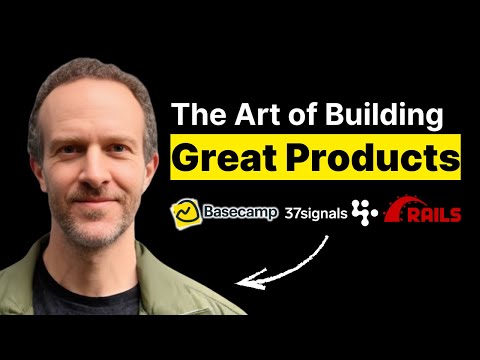
What Jason Fried Learned from 26 Years of Building Great…
Interview with Jason Fried, co-founder of 37signals, on lessons from 26 years of building products like Basecamp, HEY, and Ruby on Rails. Fried explains that despite 37signals' profitability, he cares most about making great products centered on a single coherent idea—complete wholes where each piece matters, like a Frank Lloyd Wright house or a vintage car. Topics include what architecture, watches, and cars teach about building software with soul; how AI fits into product development and how 37signals developers use it; Fried's biggest realization after 26 years; the role of luck in his career; advice for graduates entering the AI boom; running a non-traditional company; why staying true to yourself builds something lasting; and wholeness as the north star for products and companies. References Christopher Alexander's book The Timeless Way of Building.
# Channel Identity Observations — "What Jason Fried Learned from 26 Years of Building Great Products"
## Format & Presentation
- **Interview/conversation format**: Host Dan Shipper interviews guest Jason Fried, with direct address evident in the opening: *"Jason, welcome to the show"* and closing *"Dan, thank you so much. This is amazing."*
- **Casual, long-form conversation style**: Opens with informal small talk — *"what watch are you wearing today?"* — before moving to substantive topics.
- **Sponsorship present**: Mid-roll ad read for **"Working Smarter, a podcast about AI and modern work brought to you by Dropbox."**
## Observable Intended Audience
- **AI-interested professionals and builders**: The ad copy addresses viewers *"trying to make sense of how AI will change our lives… and how we work"*; the discussion centers on AI-assisted product development, coding workflows, and *"how to live and work with AI."*
- **Founders/operators of small, bootstrapped tech companies**: The host's core question concerns running a ~15-person, bootstrapped, multi-product media-plus-software business at an *"inflection point."*
- **Product/design-minded viewers**: Substantial discussion of craft, ergonomics, architecture (Frank Lloyd Wright, Christopher Alexander), and product aesthetics.
## Claimed Scope (Creator Self-Descriptions)
- **Channel explicitly about ChatGPT/AI**: Closing call-to-action describes the show as delivering *"pure unadulterated knowledge bombs about Chat GPT."*
- **Host-led exploration**: The outro frames it as *"a journey into the future with Dan Shipper as the captain of the spaceship."*
- **Note**: The outro is hyperbolic/satirical in tone (*"smash that like button… epitome of awesomeness"*, *"I'm absolutely hopelessly in love with you"*), so its literal self-description should be treated cautiously.
## Demonstrated Content Patterns (vs. Claims)
- **Guest-driven founder interviews**: The episode demonstrates in-depth conversation with a well-known software founder (Jason Fried, 37signals/Basecamp) on product philosophy, AI tooling skepticism/adoption, and business lessons.
- **Host self-references his own company**: Shipper describes *"we've got four AI products… the media arm"* and a consulting business, indicating the host is himself an AI-company founder — relevant context for the channel's perspective.
- **Balanced debate on AI**: The episode features genuine disagreement — guest skepticism (*"where are the breakthrough products… that are the result of [AI tools]"*) versus host enthusiasm (*"it's the best… I'm committing code"*), suggesting the show hosts differing AI viewpoints rather than pure promotion.
## Notable Distinguishing Features
- **Aesthetic/philosophical depth**: Extended segment on watches, architecture, and *"a single idea… executed so beautifully"* — more humanities-flavored than a typical tech interview show.
- **Channel name evidence**: The outro names the show **"AI and I"** (*"smash that like button and subscribe to AI and I"*), with host Dan Shipper.
# Delivery Observations: Jason Fried on *AI and I*
## Overall Tone
- **Conversational and reflective** throughout. Fried speaks in long, winding sentences with frequent self-interruptions and restarts ("And and and," "the the the"), consistent with unscripted dialogue rather than rehearsed talking points.
- **Casual register**: informal vocabulary like > "look at the inside of this crazy ass thing" and > "What is this place to dump?" — he quotes others using colloquial speech comfortably.
- **Earnest, low-hostility disagreement** when pushed back on AI claims: > "I'm still currently um skeptical um but optimistic but skeptical at the moment."
## Recurring Phrases and Verbal Habits
- **"I don't know" as a hedge**, repeated many times, often mid-thought: > "I don't know. They they they really and I don't know what it is, but I really like them." and > "maybe I'm just late to the game and or not paying attention, but I just there's something in it that doesn't feel right to me yet."
- **"You know" as a connector**, appearing constantly: > "there's a few hands pointing at a few numbers and some that can do a few other things, you know."
- **Repeated key terms**: "feeling" / "feel" is his dominant framing word — > "it's always a feeling," > "You just get a feel for things," > "I try to find that place where I'm I feel a deep satisfaction."
- **"Spiritual"** recurs as a descriptor: > "It is a spiritual [music] experience" (opening), > "It feels like that to me, too" regarding the "spiritual" framing, and later > "the the the um spiritual aim, let's say, is is similar."
## Teaching / Explanation Patterns
- **Explains by analogy to physical objects** — watches, cars, buildings, furniture — repeatedly mapping abstract ideas onto craft domains: > "Same thing is true for great architecture," > "Or 'This case can't be this. It has to be like this.'"
- **Uses concrete brand-name and specific examples** rather than abstractions: Frank Lloyd Wright, "Cherokee red," Home Depot sinks, Fleetwood and Sky Frame windows, FileMaker Pro, a "Mac SE, black and white."
- **Show-and-tell moments**: he physically displays books on camera — > "look at like look at the inside of this crazy ass thing" — narrating visual props for the audience.
- **Extends the interviewer's metaphors** rather than replacing them, e.g., adopting the John Mayer lyric: > "that's a great way of putting it... I just want to make the music."
- **Memorable aphoristic summaries** punctuate longer rambles: > "Those weren't my mistakes. Those were me making other people's mistakes," and > "Wrap yourself around yourself and don't let go."
## Argumentation Style
- **Asks rhetorical questions to challenge hype**, a clear repeated move: > "um I go make things for who?", > "where are the breakthrough products... where are they?", > "when is it going to get to the station?"
- **Explicitly signals epistemic limits**: > "I don't have the numbers on like the number of AI, you know, products," > "maybe I'm just I'm unaware. I'm genuinely curious."
- **Concedes counterpoints before disagreeing**: > "I mean I I definitely agree in one sense that um you know I've seen everyone on our team... builds things" before pushing back on hand-coding.
## Emotional/Expressive Moments (Isolated)
- A audible **[snorts]** and **[laughter]** appear a few times, e.g., after > "Yeah, I mean, it is in a way, but it's a good one. [snorts]" — light self-deprecation, not a pattern.
- **Self-criticism about past confidence**, stated with visible discomfort at his younger self: > "like what an I was to say that" (apparent expletive omitted in transcript) regarding denying luck.
## Uncertainty Notes
- Patterns like the "feeling" vocabulary, "I don't know" hedges, and analogy-based explanation are well-supported by multiple exact instances across the transcript.
- Verbal fillers ("um," stutter-restarts) are pervasive but appear in both speakers; attributing them specifically to Fried's style versus general unscripted speech carries some uncertainty.
- Tone claims rest on transcript text alone (no audio/video signals), so delivery features like pace, pauses beyond fillers, and vocal inflection cannot be assessed.
# Position Record: "What Jason Fried Learned from 26 Years of Building Great Products"
**Speakers:** Jason Fried (guest, co-founder of 37signals) and Dan Shipper (host). Attribution below relies on the conversational structure of the transcript; in some overlapping exchanges, speaker boundaries are approximate.
## Aesthetic Philosophy and Inspiration
- **Fried on running a business:** "Running a business is not that interesting to me. I really fancy myself more as someone who makes products." He states a business is *necessary* to build products, not something that drives him. He cites a John Mayer quote: "I just write lyrics because guitar would sound weird without them — I really just want to play guitar."
- **Inspired by non-software things:** Fried says he draws inspiration from watches, cars, and especially **architecture**, which he calls "my real true love in the arts." Being in a great building is "almost like a spiritual experience."
- **Honest materials over photogenic modernism:** Fried claims modern architecture often "looks good in pictures and not as good in person," while older buildings made of natural materials "feel better in person than they look in pictures." He judges by the in-person feeling.
- **Example building:** A round meditation hut at Esalen in Big Sur, California — he describes its scale, materiality, and location as feeling "right."
- **Software's limitation:** He acknowledges he cannot bring physical materials to software ("we're talking about a flat screen and pixels") but tries to bring a "sense of scale" and to find the feeling of "that feels right."
## Self-Conscious vs. Unselfconscious Design
- **Shipper** brings up Christopher Alexander's *The Timeless Way of Building* and the distinction between **unself-conscious design** (direct feedback loop between inhabitant and space, e.g., primitive hut-building) and **self-conscious design** (specialized architects planning spaces they won't inhabit). He asks whether Fried's sensibility comes from this.
- **Fried affirms the connection**, showing books on handmade, non-architect-designed buildings. Claim: "There is a real soul and character that comes through in a space when someone who wasn't an architect designed it just for living for themselves." He qualifies: great architects exist (cites John Lautner as a favorite), and he admits it's "an acquired taste" — others have called such places "a dump."
## Disagreement and Tension on AI-Built Products
This is the sharpest divergence in the conversation:
### Shipper's position
- **AI has reset the game board:** Building for yourself is uniquely viable now; his company (Every) runs **four apps, each built by a single person**, with thousands to tens of thousands of users and millions in ARR — "totally impossible without AI" at that scale.
- **No hand-coding:** "No one inside of Every... is hand coding anything." Everyone uses AI tools across the whole product lifecycle.
- **Analogy to scripting languages:** He frames programming in English as the same shift as earlier suspicion of Ruby and JavaScript — "it changes the substrate of what you're programming on."
- **Timing of breakthroughs:** He argues we're in "the way early innings"; compares to the late-90s internet when breakthrough companies (e.g., Amazon) existed but were small, and claims programming "changed fundamentally in the last 3 months" — but only organizations fully attuned to it benefit.
- **Personal AI use:** He reads, writes, and commits code with AI; wrote three articles and submitted a bug-fix PR in one week — "it should not be possible."
### Fried's position
- **Skeptical but optimistic:** "I'm still currently skeptical but optimistic... that people are going to be building really great tools for others purely with AI." He holds that AI works well for **personal tools** (he compares it to his own history building FileMaker Pro databases for himself) but breaks down with multiple users and edge cases: "the art of product development is... all these little pieces of fabric you need to sew together so you can't see the seams."
- **Market-evidence challenge:** Fried asks where the **second-order breakthrough products** built by AI tools are: "Where are the tools that are one order down... that are breakthrough products?" He says he doesn't see "an enormous upswell of options" hitting the public market and that "there's something in it that doesn't feel right to me yet."
- **Every/37signals contrast:** Fried's programmers "like the craft of writing code by hand" and will "probably all be that way through their career." They use AI "around the edges" (lookups, learning, boilerplate) but rarely to write code. He notes skill **atrophy** as a risk: "if you have the skills that you like to use and you don't use them... you begin to lose those skills."
- **Partial concession:** Fried says AI for personal education and as a writing partner has been "the most useful" for him.
## Luck and Timing
- **Fried revises an old stance:** He recounts once saying on a Startup School stage, "I don't believe in luck" — and now calls that "what an idiot" moment: "I have come to realize that it's almost all luck." Qualification: "you got to do the work and you've got to be good... but there's a lot of people who do the work."
- **Luck factors he names:** being born in 1974 and graduating in 1996 as the public internet arrived; a neighbor's Mac SE at age ~13; the chance online encounter with business partner David; Scott Heiferman offering the Meetup.com design work, which led to Andrew Mason and the Groupon board. "If the early ones didn't happen, the later ones wouldn't happen."
- **Counterfactual on AI-era graduation:** Fried says had AI existed when he was young, "that would have been the tool of the day" — but he suspects he'd have been **less valuable** as a consultant now, because natural-language AI lets more people do things themselves, unlike when HTML knowledge was scarce. **Shipper disagrees**, guessing demand for such skills is actually higher now because people prototype and then want experts.
## Advice to Shipper at Every's Inflection Point
Shipper describes Every: 15 people, ~$1.3M ARR growing 50% in a quarter, a $1–2M consulting arm, four AI products, a media arm, bundling — modeled partly on 37signals, minimal fundraising ($600K raised once).
- **Fried: nobody has run your business before.** "Of course you don't know what you're doing because you're doing it as you're doing it... there's no way to be prepared for that other than to keep doing it." His "biggest revelation": "it's perfectly okay to make it up as you go."
- **Don't separate roles at small scale:** Recounts hiring COOs to free himself and David for product — "the day-to-day and the product and the business, it's all the same thing." At 15 people, "there's no real separation."
- **"Those weren't my mistakes. Those were me making other people's mistakes."** Fried's claim: his biggest errors came from doing what he thought he *should* do. **Shipper agrees** and connects it: his own bad decisions were "doing things because I thought I should do them" — e.g., after raising money, he stopped writing ("CEOs don't do the IC work"), leading to "two or three years of just being flat and me being miserable," until he decided "I'm just a writer" and used ChatGPT to find examples like Fried.
- **The whole-idea principle:** Fried argues a good company is like a Frank Lloyd Wright house — "a full complete idea" where you "can't take the sink out." "You can't tease them apart and replace big things... it's no longer that whole anymore." "The writing is the business... it's all one piece of material."
- **Qualification on delegation:** Handing something off is fine *if you don't love it* (he delegated front-end work because he'd "kind of lost interest") — but never hand off something you love. He notes his own atrophied skills: "I used to be able to do 24 pull-ups consecutively. Now I can do three."
- **Age of undifferentiation (Shipper's term):** Shipper claims software interfaces "all look like wireframes," marketing sites use templated designs — so a company that is genuinely different is well-positioned, and "the only way not to be the same is just to be you." **Fried agrees**: "Wrap yourself around yourself and don't let go."
- **Fried's final qualification:** "You also still could crash and burn that way... but what a great way to go down. The worst way to go down is pretending you're doing the right thing because other people think you should." He also admits he "can't say that I've achieved that" wholeness in his own products — he aims for it, but software has more trade-offs than buildings (variable screens, conditions, clients).
## Notes on Source Integrity
- The transcript contains an embedded **advertisement** (Dropbox's *Working Smarter* podcast) and a closing outro with exaggerated promotional language ("hopelessly in love with you") — not substantive positions of the speakers.
- Speaker attributions in fast back-and-forth exchanges are inferred from conversational flow; the transcript's `>>` markers are inconsistent and some boundaries are ambiguous.
# Speaker Attribution & Provenance Record
## Video Identification
- **Title:** What Jason Fried Learned from 26 Years of Building Great Products
- **Show:** "AI and I" (per closing segment)
- **Video ID:** 01a0f15a-b810-7935-9e4a-10840c4f2063
## Speakers & Roles
### Dan Shipper — **Host / Interviewer (creator)**
- Identified by name in transcript ("Thanks for having me on" — guest; "Dan, I'm absolutely hopelessly in love with you" — outro; "Dan Shipper as the captain of the spaceship" — outro).
- Runs the company **Every**; discloses company facts during interview (~15 people, ~1.3M ARR, four AI products, newsletter/media arm, consulting business).
### Jason Fried — **Guest**
- Identified by name in transcript ("Jason, welcome to the show"; "Jason, thank you so much").
- Co-founder of **37signals/Basecamp**; discusses 26 years running the company, Basecamp, products, AI skepticism, architecture influences.
### Outro Announcer — **Promotional voice (unidentified)**
- Closing segment urging likes/subscribes for "AI and I"; role in production not specified.
## Promotional Segments (Flagged)
- **Mid-roll sponsor read:** "This episode is brought to you by **Working Smarter**, a podcast... brought to you by **Dropbox**." Includes CTA: "workingsmarter.ai."
- **Channel outro:** Like/subscribe promotion with exaggerated praise for the show and host — clearly promotional, not editorial content.
## Referenced Sources & Third-Party Claims (as attributed in transcript)
- **Christopher Alexander**, *The Timeless Way of Building* — cited by Dan Shipper (self-acknowledged recollection from ~15 years prior: "I'm probably going to butcher it").
- **Two unnamed physical books** shown by Dan Shipper: one on handmade/non-architect-designed buildings, one "handmade houses" — titles not fully given.
- **John Mayer quote** paraphrased by Dan Shipper ("I just write lyrics because guitar would sound weird without them") — attributed, not directly quoted.
- **Frank Lloyd Wright** buildings/"Cherokee red" floors — referenced by Jason Fried.
- **Architect John Lner** (transcript spelling) — referenced approvingly by Jason Fried.
- **Esalin/Esselin Institute, Big Sur** — meditation hut building referenced by Jason Fried (spelling varies in transcript).
- **ChatGPT query** — Dan Shipper recounts asking ChatGPT for founders who write; claims Jason Fried appeared in results (uncorroborated, anecdotal).
## People & Companies Mentioned (Not Speakers)
- David Heinemeier Hansson ("David," Jason Fried's business partner)
- Scott Heiferman ("Scott Hyperman" in transcript) — Meetup
- Andrew Mason — Groupon
- Paul Graham / Y Combinator (Startup School mention)
- Sam Harris
- Companies: Basecamp, 37signals, Every, Meetup, Groupon, Dropbox (sponsor), FileMaker Pro (product reference)
## Metadata Gaps / Uncertainty
- No curated metadata supplied; all attribution derived from transcript.
- Speaker turns are unmarked in portions of the transcript; some exchanges (e.g., AI discussion) were attributed by conversational context — direction of specific claims should be verified against audio before quotation.
- Transcript contains apparent transcription errors (e.g., "Hoyer" for Heuer, "John Lner," "Franklled Wright") — original spellings preserved above with notes.
- **Comment availability:** not indicated in source material.
- **Timestamps:** none present in transcript.
Running a business is not that interesting to me. I really fancy myself more as someone who makes products. It's like you just get a feel for things that are a whole a single piece, a single
idea, a single concept executed \[music\] so beautifully. You get a feel for that. When you run into stuff like that, it is a spiritual \[music\] experience.
\>\> Jason, welcome to the show. \>\> Good to be here, Dan. \>\> Uh, so I have uh a very important question to start with. Uh, what watch are you wearing \>\> today? Um, are you a watch guy? I am a watch guy. \>\> All right. So, today I'm wearing I'm embarrassed because I don't know the reference number. I don't remember exactly. It's a vintage Hoyer. \>\> Wow. \>\> Um I think it's called a 11 63 or something like that from 1974. And I dig it because it just I like I just like the color. I like the case. It's kind of that 70s style like tunnel case. And then just the the really bright orange. It's kind of a neat neat piece. It's nothing like remarkable, but really kind of cool. I've been enjoying it for a while. So, \>\> it's beautiful. Um, and and \>\> what about you? \>\> Well, I I'm I'm wearing a sub, which I bought for my every uh fiveyear anniversary. Um, \>\> you buy a new watch. \>\> Uh, just Yeah, just for like uh you know, I've been doing it for 5 years, \>\> right? \>\> I want to mark the occasion. \>\> Nice. Nice job. Did you get it from an ad or did you have to get it pre-owned or \>\> I got it pre-owned. \>\> Okay. Yeah, they're hard to find unfortunately. \>\> Yeah, they are. Um, so but there's something here which is like I think you have this interesting um aesthetic appreciation for things like watches and cars and stuff like that that I think also you can see in the products that you make and they're the products you make are so like wellcrafted on every level. Curious like what the what the relationship is or what the overlaps are. Um h the overlaps I would say I'm I'm inspired by a lot of things that are not software. So we could start there. I I'm inspired by watches. One of the
things I like about watches is that they're basically all the exact same thing for the most part. Yet there's like a thousand different designs, you
know, and I think that's interesting. Um, I mean there's of course different versions, but really it's like, you know, there's a few hands pointing at a few numbers and some that can do a few other things, but for the most part it's like a round base on your wrist some degree. And like, wow, there's a lot of different ways to to do that. And and I think that's always been interesting to me. Um, cars are um full of details, u materials, how things come together, how things feel tactically, you know, the tactileness of something, the the um ergonomics of it, where is it? Is everything within reach? I'm just fascinated when I sit in a car that has really good ergonomics and you could tell someone really thought about it versus someone sort of drew it. Like there's this sense of like, oh, someone drew this out. There's a blue blueprint here and then they put it together versus like someone kind of probably I'm guessing, I don't know, but like sat in the seat and thought about what it would be like to drive this. Same thing is true for great architecture. So, I love architecture is probably my my really true I've realized like my real true love uh in the arts, let's say. And being in a a great space uh in a great room in a great building of any of any sort um is just kind of almost like a spiritual experience for me. Just the way the proportions are and the light comes in and the colors and the textures and the way materials meet and the scale. It's just all those things. I just I love the feeling that it gives me. I would say same thing is true for being in a in a in a car. I like uh
inside or outside and then also like a watch. And I I try to want to build products that give me a similar feeling understanding that there's huge limitations. I mean, we're talking about like a flat screen and pixels. So, I
can't bring different materials to the table, you know. Um but you can bring a sense of scale and you can think about it in terms of what if it was a physical object to some degree. Uh, and I just I don't know. I try to find that place where I'm I feel a deep satisfaction with with what I'm looking at and using in the same way I would if I was to stand in a nice building or be in a nice car or or something like that. Trying to find that feeling. There's not really an equivalency here, but there's a sense of, yeah, that feels right. And that's what we try to do with the products. \>\> What's the last building you were in that made you feel that way and why? I was in a building um in um Big Su, California. Um it was uh do you know what Eselin is? Yeah. So I was at Esselin. Uh I'd never been. First time I was ever there. And there's this really beautiful um meditation circular round meditation hut building which is down by this river. Uh, and um, I've been in many, many buildings that I've really appreciated, and this was just maybe the last one I can think of that was like that where I just walked into it and I said, "This just feels good." There's something about the scale, the space, the materiality,
the the the radius of things, I don't know what it was, a lot of things and the location just made me feel good. Uh, like this is the right building for
right here. um things I I tend to like just like buildings made with very honest materials. So that I I actually also enjoy looking at modern architecture and some being in some modern architecture, but I find most of it to be um often times it looks good in pictures and not as good in person. Meanwhile, a lot of older buildings or buildings made of of more natural materials um feel better in person they look like than they look in pictures. And so I like the inerson feeling. That's what I kind of judge something by. \>\> That is that is really interesting. One one of the things that you said um uh just now about enjoying being in a car, for example, that someone had obviously sat in as they designed it. \>\> At least I think they did. I don't know, \>\> but I think that, you know, you can kind of tell in in a certain way. Did it come from a blueprint or did it come from experience? And the the thing that it makes me think of is I know you're a big Christopher Alexander guy. Um, and he has this book that I read in college when I first met you, um, called The Timeless Way of Building. \>\> Yeah, great book. \>\> It's a great book. And I I literally have not read this in 15 years, so I'm probably going to butcher it, but I do remember he makes this distinction between I think what he calls um self-conscious and unself-conscious design. And unself-conscious design is like where design starts. And it's and he um makes this uh analogy to the way that uh people in primitive societies might build their house. like they're literally just building a hut as they live in it and they're patching holes as they come up and they're there's a very direct feedback loop between the person living in a space and feeling the like tensions in the space and then resolving them versus um
uh you know now we have specializ specialized people architects who are like making plans for a thing they're they're not going to really be inside of and don't necessarily understand the
people who are in the buildings in many cases Is is that where the where some of this comes from? \>\> Yeah. You know, I'm just trying to think. Ah, I do. So, I have um been on this like book kick for finding books. This isn't these are not the only two, but these are two that I bought recently, which are um exactly what we're kind of talking about. Uh, this is like a book of of handmade handmade buildings, non-archchitect designed buildings, just spaces that people made themselves. Um, you know, weird neat things, you know, just like and and and some of these things like look at like look at the inside of this crazy ass thing. And this is like a geodessic dome kind of thing, but um, you know, you can imagine like it would you would love to be in a space like this. it just it there's something about the feeling of these spaces. Um and so this is one of the books. This is another great book called uh handmade houses and it's it's similar style. Um wonderful uh pictures of like like this is a crazy ass like kitchen sink setup here, you know, just like but look at the look at the the panels. They're like diagonal in the back and there's just like kind of stuff everywhere. Um, and this is not about it
being a mess. Um, but like this is, you know, someone probably had was able to find like windows from other buildings and, you know, pieces of glass and they just made it all work, right? And I've
been in a number of buildings like this, not like these, not these specific buildings, but there is a real soul and character that comes through in a space when someone who wasn't an architect designed it just for living for themselves. That's not to say there aren't great architects and there are and there are amazing buildings built by amazing architects and I love many many buildings built by many great architects. Um John Lner is a great example of someone who I just love love his houses. Um number of great architects anyway but there's still for me a charm and a soul uh stepping into a space that was just put together um by someone with like a crafty creative vision and even if they don't even have that but just kind of sewed it together essentially. And I I don't know what it is but it's it's it's similar to the Christopher Alexander point. I think, you know, his whole point is like the best architects are the people essentially who need the spaces. Um, and and uh, you know, again, there of course were were incredibly important buildings built by great architects, too. Um, but I don't know. I I think there's something to it. And uh, I I know it's an acquired taste. Like I I've been through some of these spaces with people who don't share my point of view and they're like, "What is this place to dump?" Like, yeah. I mean, it is in a way, but it's a good one. \[snorts\] And and there I don't know. They they they really and I don't know what it is, but I really like them. And I don't know how to make things like this, but but I really like them. And I I pay more I pay more and more attention to things that are built that way than the things that you might uh someone that the average person might look at and go, "That's amazing." So, we've made it 10 minutes into this
podcast without talking about AI, which I think is probably \[laughter\] um but I but I'm going to bring up AI because um there's something about this that reminds me of some some of the
things that I've been noticing. So inside of every we um incubate products and uh we have four that we run internally now in addition to the the the newsletter that we run and um there's something different about building products in AI one because um the game board has been reset in a lot of ways and so everything is everything is new. So, it's this uh it's this really I think unique time to build for yourself because anything that you want probably hasn't been done. And then you also have all these tools that make it easy for anybody to build a thing. Um like it's way easier to just build a prototype than it than it ever used to be. And so, you know, all of our products are built by one person and they're uh and and they're building for themselves. and first and then building for everybody inside of every next and then building for the audience after that. And um there's something about that. I mean I I think we aspire to have our products be a little bit more polished than um than than some of the houses house examples. and but and there is something about that where it's like it it's a uniquely good time to be building things that you live inside of and and can give to other people. \>\> Yeah. I mean I think one of the differences of course like with these house parallels like these people built these houses for themselves to live in in their own lives. A product you usually usually would build for I mean you can build for yourself to your point and that's what's really wonderful about AI building right now. I think most most tools that are going to come out of this are actually very personal tools. Um, but generally a product if you want if you're a product company and you make products to make a living, you make them
for other people. And so when you make things for other people, it's a little bit different than like hobbling together something for yourself. And this is I think one of the really interesting things about that I don't really see actually frankly discussed
enough. There's a lot of bragging about how fast people can make things these days. Um, and then I go make things for who? And that's where I think there's a breakdown because I think you can make really you can make things quickly for yourself. And I think that's incredibly valuable. And this is how I got started in software. I used to make FileMaker Pro databases for those who don't know what that is. This used to be I mean maybe FileMaker Pro still exists, but it's like a graphical user interface to basically make a database and you could layer your own graphics on it to build an interface. Uh, and it's essentially a product that you make for yourself to store things and look things up, which is essentially what most products are anyway. All the backend stuff was provided by FileMaker. You dra drag in these tools and put your UI around it. And these were just tools I made for myself. Um, and FileMaker was kind of I didn't know how to program, but I could figure out how to make FileMaker and do some scripting and stuff and kind of pull things together, which is essentially what people can do with AI now even faster and and better in a lot of ways. So, I think that's incredibly good and wonderful. I'm still currently um skeptical um but optimistic but skeptical at the moment that people are going to be building really great tools for others um purely with AI while you can basically build a great tool for yourself purely with AI but once you have multiple people involved and all the edge cases
that come with multiple users and people who don't know how a system works like you do or have different approaches, it it can break down pretty quickly. And that's really the the art of product development is like edge cases and
conditions and all these little small things that you need to all these little different pieces of fabric you need to sew together so you can't see the seams. Um, and uh it's it's easy to do when it's just for you because you can kind of live with things that don't work so well, but it's hard to do for others. I mean I I definitely agree in one sense that um you know I've seen everyone on our team technical or nontechnical builds builds things and if you're non-technical you can definitely build something and like get it working but getting it to be something that we would launch or something that people even people internally would use is very hard and usually um at at least at this point unless it's something like self-contained so like something in a cloud artifact or something like that it's not going to be something that other people are going to use. Um, however, I I definitely don't agree in the um if you are a professional developer um and you're building with these tools like no one inside of every is uh co is looking at the code is hand coding anything. Everybody is using these tools to um to build and you know uh uh deploy and like basically you know the entire product development life cycle. Um, and and I think it helps with all of those specific things like all the um all the little edge cases and all the little seams if you're using like you have to obviously use it in a way that is conducive to that. But um I just sort of see it as in the same way that um you know when I was when I was growing up people were sort of pretty suspicious of scripting languages and Ruby and and JavaScript see it as same kind of thing with English and it changes the like substrate of what you're programming on. you're programming it in English, but you're you're writing in English about all of the different implementation details, almost like pseudo code, and that's where the programming happens, which I think is a total change. Um, so I I don't know how much, you know, how much AI adoption inside of 37 signals you have for this kind of thing, but it's it's been really crazy to watch. It \>\> it is crazy to watch. I mean, let me ask you this. Um, wouldn't you think there'd be a massive
proliferation of new products that are like making real waves given the proposed or the the the the um
the tooling that we have, the AI tooling that we have now where it's always like, well, you know, um I can make things super fast. Uh I can just tell it what I want it to do. um like where are the breakthrough products aides from the the AI tools themselves, right? Where are the where are the tools that are one order down was the second order the ones that are being made that are breakthrough products. Um given the fact that technically you can imagine launching hundreds of a company could launch hundreds of products as as as the concepts being pitched as the technology is being pitched. Um you could have an unlimited number of agents coding and making and building and the whole thing. I just I would imagine at this point that you would see some breakthrough standalone products that are not the AI tools themselves but are the result of them. Maybe I I haven't seen maybe I'm just I'm unaware. I'm genuinely curious like where are they? What are they? And if they're not out yet, why given the promise of the technology? \>\> I think I think that's a I think that's a really good question. You know, I don't have the numbers on like the number of AI, you know, products that have been built and all that kind of stuff, but I can tell you just from my own personal experience. So, we have 15 full-time people and we run four software. We've run four apps inside of every each of them is run by a single person and um each of them has uh between thousands and uh tens of
thousands of users. Um some and you know altogether like the whole thing is doing you know in the millions of ARR and that would be totally like what would we do would be totally impossible uh without
AI at at this scale right like um I could see if we had one gigantic product and then like one big cash cow product and then we could like invest a lot of the money into building other things like we could probably do that. So I think you know that's a that's a model that you guys have done really well. Um for us we have been able to do that at a much smaller scale at a much lower revenue number and it seems to actually work which is kind of crazy. \>\> It's great. I'm glad to hear that. Yeah. Yeah. \>\> And I think um so but I like I don't I wouldn't necessarily call any of our products yet breakout products but like we'll see. Hopefully soon. \>\> I hope they do. Yeah. They hope they become that. But they're certainly they're certainly growing really fast and designs seem to be like exciting. I also think that um there's something there's something other than just technology that it like is a bottleneck here which is you know think about the internet and like you know the late 90s it's like where are the breakthrough companies? they actually existed. They were just much they were pretty small. Um like Amazon was around. It just like just hadn't hit it yet. Um and I think uh I think there's also something going on where there's at least in my view programming has changed fundamentally in the last like 3 months. Um and it and it it makes a big difference if your whole engineering organization is attuned to that and is coding in that way. And if you have one person or two senior people who are like no like or maybe like halfway or whatever, it's it's still you still don't get the same kind of benefit. It takes a long time for small companies that can just start from the ground up doing it this way to actually get big. It's it's we're still in the way early innings is is is the is my response. \>\> Yeah. \[gasps\] Yeah. I mean because Yeah. I I can see that in our own company. We we're not you know um I would say that our our um you know uh our programmers like the craft of writing code by hand and they will
probably all be that way through their career. Like that's sort of how they grew up. what they like they're they would you know if you're a poet you want to write poetry and so that that's the
kind of programmers they are so we're not a very AI heavy organization in terms of writing code um our programmers use it to look things up all the time um to learn new things to to look up API call like there's a bunch of ways we use it around the edges but we don't really use it to write code um very often there's some some boilerplate stuff and some stuff that can be sped up um even on the on the front end side uh just it's easier to do some of those things or have have the system do some of those things. Um but we've also found that it does sort of atrophy the skills that you had if you have the skills that you like to use and you don't use them just like anything else you begin to lose those skills and so if you like those skills it's a delicate trip tricky thing to to to to balance. Um, every organization is different, whatever, obviously, and and as to your point, like if everyone comes up in a certain way or everyone is sort of dictated to do certain things in a certain way, you're going to have a different type of organization. So, I I'm there's there's all sorts of different ways to do things. And I'm curious to see how this whole thing happens over time. I just the thing that that that I get I this is just my I don't know my general push back about anything where I hear a lot of hype around around it. I'm fully on board with with with with a lot of the the the incredible promise of AI and and I use it for my own personal like um education essentially and learning things and whatever. But this idea that like I'm hearing from people like well I can spin up you know 100 agents or whatever they want to do and I want to do this and I can do this and all the things and everything's changing and then I I look at the market I look at the the the the product market and I don't see the result of all the promises being delivered at the public layer essentially. So like at at the at the where the mark where the products hit the market, I'm not seeing an enormous upswell of of options in a category or something like that. So I'm just curious about the the buffer there. I think to your point making things internally, making things for individuals, learning all these things, also speeding up all sorts of other development for existing products, great. But I'm just wondering where the the the rubber is going to hit the road here really. Um, and given the hype train, you're like, when is it going to get to the station? Because you'd think at this point there would just be a thousandfold more things being launched all the time given that this is working 24/7 and it's you don't you don't need humans to do a lot of this stuff anymore. So, I I don't maybe I'm just late to the game and or not paying attention, but I just there's something in it that doesn't feel right to me yet. Um, and I I would love to see the opposite of what I'm saying is true currently. I'd love to see a thousand more options for everything. This episode is brought to you by Working Smarter, a podcast about AI and modern work brought to you by Dropbox. We're all trying to make sense of how AI will change our lives and our relationships and of course, how we work. That's where Working Smarter comes in. Each episode features real people who are actually using these tools and talking about what it really looks like to work and live with AI. One guest is a chef who uses AI to make his prep work less of a grind so he can be more creative in the kitchen. Another episode features a group of scientists who are using AI to find longlost shipwrecks in the Great Lakes so that we can better understand our past. Then there's people like Wayne who's the head of marketing at a small batch whiskey distillery. Wayne has a small team and they're competing against big brands with big budgets, but AI is helping them punch way above their weight. Working smarter goes beyond the headlines to show you how you can use AI to do more of what you do best and so you can work smarter, too. Listen to working smarter wherever you get your podcasts or visit workingsmarter.ai. And now back to the episode. You should come hang out with us. Open invite. Come hang out online or come to the office. I'd love to show you some of this stuff because I think uh it I think it'll be interesting to you. \>\> Yeah. Yeah, for sure. For sure. Um, but something that I'm I'm curious about is you've been um you've been running the company for like 20 years. \>\> Yeah. 26. Yeah. \>\> 26. That's a long time. \>\> It is. It's a long time. \>\> What have you I guess I I don't I you know, the longest I've run a business is is this one. So, I'm like almost six years in. Um many many years to go. But I'm curious like how has your experience changed over the last, you know, 26 years? and and how are you different now than when you started? \>\> I think I mean probably in all sorts of
different ways. Um I think one of the more fundamental things I've re I've come to realize is that
running a business is not that interesting to me. like the business side of things like I I'm fascinated by it to some degree you know like oh we have an organization and we have people here and hiring and all the things you do to run a business and couple pricing models and all so it's interesting but really to me a business is just necessary to build products and and to and to have an organization that can survive um and so I find myself less interested in business than I think I was 15 years ago where I think I was more pumped about business, you know, and product, but now I just like to make products and like the business sort of um is not it's not something I think that much about. Um so I think that's a fundamental thing and and maybe maybe that's a problem. I I don't know. I mean, you could say like, well, someone else should be in that role who's like just all about growing businesses and building businesses. And maybe maybe that's correct, but um I I just don't really care that much for that side of the the I effort equation. I I just like to make things. And luckily we have a base camp uh which is a a very very popular product that generates a lot of cash that gives us a lot of flexibility and allows us to make a lot of other things also and take a few more swings at the plate or the ball I should say. Uh and see if we can hit some more. Um but um I don't know. I just like to make stuff and I think like I you know I yeah I'm an entrepreneur obviously because I I run a business and I started a business and I'm in charge of the business but like I really fancy myself more as someone who makes products and the entrepreneurship piece of it is like part of what's required to do that also you know um which is why like if I if I wasn't doing this I would not start another business like starting a business is not exciting or interesting to me at all actually making things kind of reminds me um John Mayer has this quote that's like uh I just write lyrics because like guitar would sound weird without them, you know, like I really just want to play guitar. \>\> Yeah, I dig that. That that's Yeah, that's a great way of putting he he's really skilled with words. Um that's a great way of putting it actually and that's how I actually feel about it and that's a really wonderful way to think about it which is like I have to have a business. We have to take in revenue. Uh I have to have employees. We have to provide health insurance. we have to provide an organization for them, you know, all the things like I it's not that I don't like it. I just like it's doesn't drive me. I just want to make the music. I just want to make the products, you know. Um so so that's one thing I would say. Um I think there's just also, you know, a shift in in you know, when you're younger, you're cockier and and and and and way more sure of yourself like in some ways. And of course as you get older you're more sure of yourself in other ways that are I think better ways. Um so I I think I remember there's something that horrified me once when I was uh I wrote about this recently somewhere. Uh I was on a startup school. I don't know when this was the Paul Graham thing or the Y combinator thing and someone asked me I remember I was on stage. I was one of the speakers and had some Q&A and someone asked me like what do you think about luck? I'm like I don't believe in luck. like I don't believe in luck and and I'm just like I'm like like what an what an I was to say that like I have come to realize that it's almost all luck. I mean you got to do the work and you've got to be good and all those things but there's a lot of people who do the work and there's a lot of people who are good. Luck, timing, all sorts of things come into play here that you don't control. And I I kind of give those things a lot more credit today than I probably used to. What do you think is like the biggest luck factor in your career? \>\> Timing. Um, I'd say a few things. So, timing. Um, I just happened to be born at a certain time and got out of college in 96 and got to do a little bit of internet stuff. You know, my junior and
senior in college 9596 when the when Netscape, you know, was just hitting. And before that I was I did BBS stuff and did a lot of textbased you know
telecommunications stuff you know but then then the graphic interface or the the graphical browser came and I was sort of in the right place at the right time I learned HTML uh and I just had this I was hungry I was young I was interested in computers and this internet thing came around and I didn't want to I got a degree in finance I didn't want to go work at a bank so I'm like man I can do this internet thing I think uh no one else knows how to do it either It's brand new. Um, from starting from scratch, like every like how often does something so new happen where no one knows anything and then you're like even playing everyone's on even ground. So, it's just really I got lucky there. Um, and then um obvious luck along the way. I was thinking about this recently just people I've met and of course meeting David, my business partner now. Um that was just a chance encounter online and then getting a chance to do um uh meetup.com the first version of Meetup Scott Hyperman uh this guy from New York who I didn't know he reached out to me and gave us an opportunity to design meetup.com and that introduced me to a guy named Andrew Mason who did Groupon and and that you know I got on the board of Groupon and got some really interesting insights into a whole bunch of different kinds of businesses at different scales and met some interesting people there and there's all these things I there's so many different dots to to connect. Um, so I think it's all one big ball of luck, but there's certainly moments that I had absolutely nothing to do with, which is just like being born in 1974 meant that I graduated college in 96, which is when like the internet happened, the public internet happened. \>\> What What do you think? Uh, \>\> actually, and the other thing I would say before that, when I was like 13 or something, my neighbor got a Mac. Um, and uh, he's like, "Come on over, check this thick computer out I got." I'm like, "Sure." And I went over to his house and it blew me away. He had like Microsoft Flight Simulator. It was like a Mac SE, black and white. And it just floored me and like that's how I got interested in computers basically at that point. And that that was just a lucky chance that I lived next to this guy who got this computer. Who knows, right? All these things are that. Um, so it's a bunch of things. Obviously, some moments are spikier than others in terms of their importance perhaps, but you know, if the early ones didn't happen, the later ones wouldn't happen. So, it's all related. \>\> Yeah. What do you think like 22 23 year
old Jason would have thought if instead of graduating into the com boom, you graduated into the into into AI right now? Like what would you have been into it? How would you have felt?
\>\> Yeah, I'm sure I would. Um, and I I am interested in it and curious, but I'm not like of it, you know? I'd have to admit that I'm not of it, you know. Um, yeah, I think that I was, you know, I I was just a curious kid who uh likes to like to make things and so, you know, the things I learned to make were like, you know, websites from, you know, writing HTML from scratch and then CSS from scratch and some of that stuff, right? Those are the tools of the day. Uh, had AI been around then, that that would have been the tool of the days most certainly and I'd probably be doing that instead. And um and then you know I think that's all and if I was born a hundred years prior to that I'd be I don't know what the heck I'd be doing with with whatever I could find. But I I I needed I needed to make something. I clearly needed to make something and I was just going to use what I could. Now I don't know how to like work with wood or or or metal or ceramic or any of those things. But I could have had I grown up in an environment where those were the things. So I just kind of fell into this, you know. Um and uh I think back then also I would say that I was um I I did have this sense of like I want to work for myself. And so there was more of a business drive in the early days to find something that I could do that I could sell like a service I could sell and I knew how to eventually knew how to design websites and so that's like how I got started. So I think whether or not I could do that today like you know whether or not I could sell \[snorts\] AI skills cuz I was a consultant initially I was doing websites for other people. So, I'd have to find something in the AI realm where I could do something for other people, which certainly you can. Um, but I think what's interesting is that it seems like today, um, because AI is primarily natural language, that's really the real kind of breakthrough like from the, you know, interaction layer that I feel like more people can probably do things on their own than back when I learned HTML and no one knew how to do that. uh companies who want to get a website had no clue whatsoever what to do and how to do it. So I think I was more valuable back then than I might have been if I was just coming into the AI boom right now. But who knows? \>\> Who \[snorts\] knows? \>\> What do you think? I mean, you know, what's your sense on on yourself with those questions? Um well I think like the the specific thing that you just said I would guess that the demand for the skills that you had is actually higher now because people can do a prototype and be like this isn't exactly what I want like I want someone else to come in \>\> right \>\> also for you you would have been able to work with many more clients um than you would have previously I think for me like but like this is my job so like this is not a um it's not necessarily a fair question But love I love it right now. It's like the best. I'm you know I'm reading with it. I'm writing with it. I'm coding. I'm like I'm committing code. We have four products. I'm like I I I wrote three articles last week for every and I also uh submitted a PR for a bug fix in one of the codebas which is like it should not be possible. Right. \>\> Right. Yeah. \>\> Yeah. \>\> And uh \>\> it's amazing to to feel like all of a sudden you've got more limbs than you had before. I mean that's kind of the thing that's really wonderful about it. You're like, "Oh my god, I can do more things at once. I can do more things I couldn't do at all." \>\> Exactly. \>\> Like an extra thumb or whatever it is. Like, "Wow, where'd this come from?" Yeah. \>\> Yeah. Exactly. And And there's also stuff where it's like um uh you know, like I can read books with much more depth now because I can get the kind of stuff that I probably would have had to take a college class or like a graduate class to get. Um so I'm just like reading books and then I'm like, "What's the history of this and what's the context of this?" and I'm just like going down these like rabbit holes. \>\> I use AI for that constantly as well. And and and for me, I think the educational component of it has been for me the most useful. Uh I I and and I also use it as a writing partner occasionally. Um simplify something or or help like \>\> I can't I've got this idea but it's like clunky, you know, and oh yeah, that's another way of saying it or something. That that's always been helpful to me as well. \>\> Totally. One of the things that I'm this is now now we're getting into the selfish part of the interview. \>\> Good. Let's do it. \[laughter\] \>\> One of the the like uh reasons I wanted to talk to you is is and we talked about this briefly right before the show started which is um when I was in college I was running a bootstrapped B2B
SAS company and you were like my hero. I was like, "Oh my god, Jason Freed, um 37 signals." Um and I got to come out and meet with you, which is like a core me
core memory for me. Um and uh and you know that that company did fine and I sold it and whatever and and that actually helped me in a lot of ways, set me up in a lot of different ways to like run every um but we're we've reached this interesting point in every which is we've got 15 people. We do we We're at like maybe 1.3 million in ARR. Um, but it grew 50% this quarter. Um, and uh, and then we also have a consulting business uh, where we train people how to use AI tools. Like big companies how to use AI tools and that itself is like in the one to two million in revenue range but also growing very quickly. Um, we've got four AI products. We've got the media arm and the media company. the the media arm sends um users to uh or readers to the to the products. We we bundle it all together so you pay one price and you get access to you know all the writing and all the software and there's a lot of like 37 signals flavor in here um in in different respects like you and you and um David like wrote a lot of books. I know about you because you read you wrote great blog posts um and still do. Uh you have multiple products like so there's a lot of like overlaps, right? And another big overlap is um we haven't really raised money. Um we raised a tiny bit um but I've been very the thing I like about every is it's this sort of like creative playground. Um and I want it to be like an institution and and I think it can have that kind of cultural impact to like um show people how to live and work with AI by us doing it ourselves. Um uh but I'm I've never run a company like this before. Like we're at this like kind of inflection point. Um and and I I I know that you know this running a business for 26 years like obviously it all matters but like there are certain points in a company where you're just like growing really fast and you kind of like you accumulate an advantage or an audience or like a subscriber base that then sets you up for for everything else. Um, and I'm curious about I don't
know how to run a business like this. And this is it's a very non-traditional business. And if I go to a VC and ask them what to do, like they're definitely have no idea what to what I should do. Um, and you run a business
that is like closest to the thing that I'm doing. And I'm sort of curious um what you would pay attention to or what you would look out for and and what you've learned from doing things uh the way that you've done them over the over the year these years in similar types of periods. \>\> Yeah. Um well I I remember I've had similar thoughts like I don't know I've never done this before. And then you can quickly turn to like, well, so therefore I should find someone who has. But what you also quickly realize is nobody has. \>\> Yeah. \[laughter\] \>\> Because every business is different. You've got your own thing going. You've got your own mind. You've you've built this thing into what it is. Someone else couldn't have built it to into what it is. So how could someone take it over? Maybe someone could. Okay. Right. Maybe you find the I I don't think it's very easy to find like the right person to take it to the next level or whatever. So, so my sense is like of course you don't know what you're doing because you're doing it as you're doing it. And and um there's no way to be prepared for that other than to keep doing it. So my my one of my biggest revelations like I would say and I'll just share this with you is maybe hopefully this is useful for you is just to admit that it's perfectly okay to make it up as you go. You don't have to like feel like you know what to do or that you have the experience to do what's going to come next. you just fig you just stay with it like you just stay with it day by day
and you figure it out as you go which is what anybody and everybody else would do but you have the advantage that you actually know all the source material like you know why the decisions were
made you know how how things happened and that's irreplaceable so I almost I I don't know if you're worried about it or you don't know what to do or whatever but like I would just say keep doing what you're doing you obviously done what you've done. Uh you you've built an incredible business if you're doing a few million bucks a year and you've got a consulting arm, you got a product arm, you got 15 people and you're using the latest tools and you can do a lot more than you thought you could and and you've got this newsletter, you got all these things going for you just like great like that's amazing versus like what am I supposed to do with it? Um I don't know that you'll anyone would know. Now some people would would would change it. That's what they would do. So you could find a million people to change it. If you want it to be changed, then find someone else. If you want it to keep going the way you want it to go and to build it into this institution and to just be this creative place to play and build things like you need to keep doing it. You need to keep running it and you need to keep doing it the way you've been doing it cuz I don't I don't see any mistakes in your past if here's where you are. You know what I mean? That that's my that's my general feeling which is like I just want I I mean I anyway I have I have I have had these inflection points where like well maybe like we and David and I have have gone through this a few times and we we've we hired a few different COOs. We're like well we think it's time to hire a COO because like well we need someone else to kind of run the day-to-day and so David and I can just focus on product. And the thing is is that it's all the same. the day-to-day and the product and the business, it's all the same thing. The idea, I mean, certainly, I'm sure very, very large companies, they're different, but at small companies, they're not. You cannot just be the one focus on the creative stuff and someone else is running the business. There's only 15 of you. Like, you can see each other. If you look around, you know, there's no real separation there. I think it all needs to be part of the same thing. Um, needs to be like a
holistic thing versus like trying to separate these things out and give different people responsibilities. That's that's my instinct on it for whatever it's worth. Um I would just go hell yeah. Look what we've made something great so far. Let's just keep
doing what we've been doing and do it our own way and make our own decisions. And the decisions we've already made have been pretty good. So let's keep making more of those. \>\> Some some have been pretty bad for the record. Um but \>\> yeah, but really though I mean like \>\> Yeah, but like tell me how. Let's talk about that. Really bad. No, I I'll tell you how and then I will and I will connect it to what you just told me because I think there's actually a really good throughine. Um, which is if I look back, not all, but most of the bad decisions have been doing things because I thought I should do them. \>\> Yes. \>\> And I think what you're saying is like just do you more or less. Um, which is the thing I always liked about about how you run your business anyway. like you can feel that in in the way that you run your business. Um, and I think at um in these sorts of inflection points, uh, it can be easy to subtly be like, well, I guess I I shouldn't do me anymore. Like, now I I have to really serious. We're getting serious here, right? I'd be reckless if I was just little old me. \>\> Yeah. \>\> Yeah. See, what I'm hearing is, and I know that feeling. I do know that feeling. And I'm just here to tell you get over it because \[laughter\] it's it's like what you said earlier is interesting cuz I' I felt the same way which is like the m bigger mistakes I made I made because I thought we were supposed to be doing something else or whatever. And I realized those weren't my mistakes. Those were me making other people's mistakes. \>\> Like I was trying to think I was trying to be someone else. \>\> Um \>\> that's what it is. \>\> That's what it is. And you're like I can't be someone else. I can't be if I'm going to go be a CEO of someone else's company, I have to be someone else. But when you start your own thing and run your own thing, like you got to do you. That's that's why you exist. That's why this is here. Uh and
the further you break away from who you are, um I think the less stable the whole thing becomes. Even though you feel like you're running towards stability, like I'm going to do the right things and the businessy person
things, like you're you're just it's instable at that. It's unstable at that point. It's teeter totter because there's no it's not there's no foundation below it anymore of meaning. It's like just this sort of thing I think I'm supposed to do. And and uh so I would just say I would say stay very close to you and who you are and what you want to do. And as long as you're running the thing, be fully that. If you ever want to hand it over because you're like I'm done or whatever, then hand it over and get out. Don't try to hand it over and then stick around because you won't like that. \>\> Yeah, I know you're nowhere near that, but like \>\> just do your own thing, \[clears throat\] man. \>\> See, \>\> there's there's so you know, I've been I'm going to write I've been started
writing this in my head last night. This like there's an we're in the what I'm calling the a I don't this is not the right language, but we're in the age of undifferentiation.
um in that like everything is the same. It seems like everything's the same now. Like software interfaces just look like they all look like wireframes. They're all just like they're like thin gray lines and gray text with you know like everything the sidebar over here and then there's like a main content area and there's like maybe another sidebar on the right. Like everything looks the same now. I mean literally um undifferentiated just the same and most marketing sites look the same and in fact they are because people are just using templated designs now and it's like everything looks so like if you run a company that is not the same I think you're in a really really good position and the only way not to be the same is just to be you. \>\> Yeah. \>\> And stay stick to that really tightly. Wrap yourself around yourself and don't let go. That's what I would say. \>\> Thank you. Um, I appreciate that reminder. \>\> You also still could like crash and burn that way, right? Like, but what a great way to go down. The worst way to go down is like to go down pretending you're doing the right thing cuz other people think you should. Like, that's a crappy way to go down. \>\> Yeah. I mean, it reminds me of um when when we first started the company, I was I was writing all the time and and it was just a newsletter at that point. Uh we had we we launched little products because it was like oh it's always sort of been in our DNA and like it's a good way to write about technology is to build with it. \>\> Make stuff. Yeah, for sure. \>\> Um and then we start it started working. It was growing really fast and so me and my co-founder were like okay like now I I shouldn't write anymore. Um I have to hire writers um \>\> because of time primarily or \>\> uh yeah \>\> we need to I shouldn't be doing this. My time has been too important. I should be doing other things \>\> and and and like we we we raised a tiny bit of money which I uh like 600k and I said to all of our investors you should expect this is the last money we should ever raise. So, I was like very sensitive to um the effects of raising money, but as soon as we took it, I was like, I now I have to be a CEO and like CEOs don't do the IC work. And and then we had like two or three years of just being flat and me being miserable. And then like like two years ago or so, I was like, no, I think I'm just like a writer. like I just want to spend at least half my time writing and I don't I don't know how that's going to work. And then I literally was like Chad GBT are there any other business people that like spend a lot most of their time writing but they also run a successful company and I was like there's this guy Jason Freed and I was like of course \>\> I mean I'm in Chad GPT \>\> and like Sam Harris and like you know there's a bunch of people like this \>\> because that is the business. \>\> Yeah. \>\> Like that's the business. \>\> Yeah. the business. That's why I'm kind of trying to get to this like you can't really it's not like a bunch of layers
that you you laminate together, you know? It's like it's all one one piece of material. Um, and the writing is part of it and the way you run the business part of it and the way you think is part
of it and all the things you do is part it's all part of it. Um, but you can't tease them apart. I don't think you can be like, I'm going to take this layer out and give it to someone else to do now. It's no longer the same material anymore. Um, now there's a point like You do grow though to a place where like you do other types of things. So for example, I I don't I'm not in the products doing writing HTML and CSS anymore. Um and I wish I was a little bit more into that because I kind of lost a little bit of my skills there. I've like atrophied because I delegated most of that and now when I want to get back in there myself, I'm like not very sharp but I can do it. But like um but I I do other things uh that I didn't do before. So, you've got to be doing something, but it takes a while, I think, to really transition out of something versus just handing it over. Like, there needs to be a transition. So, if you don't like to write, that's a different story than if you like to write, but feel like, well, I like to write, but someone else needs to do the writing, that's not I don't think that's a good way to handle it, right? Like, there was a point where I just didn't want to. I don't I kind of lost interest in the day-to-day making of the uh front end coding of design for whatever reason. It's kind of like I don't know got sick of it for a while. And so like I it wasn't when I when I kind of delegated more of that. It wasn't because I loved it and had to do something else. It's cuz I kind of
didn't really want to do it so much. But I actually lately been wanting to get back into it. And now I'm finding myself well I'm a little bit behind the eightball cuz I kind of haven't been doing it for a while. It's like you don't you don't do pull-ups for a year and you try to do a pull-up like I used
to be able to do 24 pull-ups consecutively. Now I can do three. What happened? Well, because you're not doing it like so I need to get back into doing that. So I I do want to get back into doing that some more. But but I think what again when you hand something off, it can't be something you love to do. That you got to hold tight again. That's for you. \>\> Where did you learn this like it's all one thing idea. And how did you learn it? It it feels like almost spiritual to me. \>\> Yeah. Um, it feels like that to me, too. Um, I don't know where I learned it other than I would say that, um, I'm going to use architecture again in like furniture and cars and watches actually as a as a potential explanation. Whenever I come across something that is like a complete idea, uh, like Franklled Wright buildings are a good example of this. when I see like a really nice Franklidd Wright building um or a house um I go in there I go this is someone's idea manifested in wood and glass and concrete and stone but it's a full idea like it's a full complete idea. Um everything there was made by designed and made by him and here it is. If you were to take the sink out and put in like a Home Depot sink or something or like even some fancy Italian whatever sink, you're like, "No, no, that you can't take the sink out. The sink's part of the house. You can't take these pieces apart. You can't repaint the floor. It's like Cherokee red is Frank Lid Wright's favorite color. Like whenever he did a concrete floor pretty much was was tinted this color. if you went back and painted it blue, you can't take can't take the red out of the floor. Like, it's not a Frank White House anymore. So, I think that's part of it. And whenever you see like a a watch that's like just so completely thought out and executed to someone's vision, you go, "Well, you can't take those hands out and replace them with other hands. It wouldn't work." Or, "This case can't be this. It has to be like this." I just like things like that. And so I think
that good companies are the same way. You can't just like tease them apart and like replace big things with other things. It just it's no longer that hole
anymore. So I think something it it's more like um anyway, that's how I would think about it. I don't know. There there's some and then there's some houses you can walk into like yeah, you could replace these windows with like a new set of Fleetwood windows or some custom windows or Sky Frame or some other brand and you wouldn't know the difference because the house is just a bunch of separate pieces that are put together. But that's why it's not as great as the house that cannot be pulled apart. If you replace anything in that house, it's going to stand out like this is wrong. And I think the the best things are like that. Um, so anyway, that that's and again it always comes back to like this this this feel for me it's always a feeling. So this is maybe the more spiritual part of it. It's like you just get a feel for things that are such a that are um a whole a single piece, a single idea, a single concept executed so beautifully. You get a feel for that when you run into stuff like that. It is a spiritual experience. Um and um so there's that. I mean, there's there's, you know, probably other influences that I'm unaware of, but I would say that um those are the things. \>\> Beautiful. I've got got a little chill going up my the back of my neck. So, \>\> have you ever been into a space like that like for you? Like, do you know what I'm talking about? \>\> I do. Um I like I definitely I think there's the the idea of the thing where it's
everything is there for a reason. I get that most strongly in writing. So if you read a Czechov short story, it's like every single sentence is like there for
a reason and it all kind of coheres in this beautiful way. Um I think I'm probably not uh like I don't have enough of an eye for buildings for example to say like I know that sometimes I I see something and I'm like that is just a it's there's something sacred about it. It is just like it just gives me that feeling like if you go into a church or a certain you know a train station or certain things you get you get a feeling like that. Um I don't have words to be like this is what the idea is but I think you can you can just feel it. \>\> Yeah. and and and there are fewer as we as we become um less willing I think to to invest in whole in complete ideas as a society um you see a lot of things that are just sort of like pieced together and they can they can look good but they don't feel as good um as something that is a a whole complete idea where everything was considered um and uh They're just it's a special experience when you run into stuff like that. So I I mean I can't say like I I I can't say that um that I've achieved that in the things we've made. I I try I aim for that, you know, but um there's always, you know, trade-offs uh in in everything. And this is true about architecture, too. um unless you have some client who's just like willing to do whatever the architect wants or whatever, you know. But um software has more trade-offs because you in some ways you have to like deal with all sorts of conditions that that aren't fixed and like a building. You build a building and there it is. like software. Well, it can show up in this screen or that screen or this screen size and like, yeah, okay, things can shift and whatever can happen and, you know, it's not quite the same, but but the the the the um spiritual aim, let's say, is is similar. \>\> Well, um that's as good a place as any to leave it. Jason, thank you so much. This is amazing. \>\> Yeah, it was fun, Dan. Thank you. Thanks for having me on.
Oh my gosh, folks. You absolutely positively have to smash that like button and subscribe to AI and I. Why? Because this show is the epitome of awesomeness. It's like finding a treasure chest in your backyard, but instead of gold, it's filled with pure unadulterated knowledge bombs about Chat GPT. Every episode is a roller coaster of emotions, insights, and laughter that will leave you on the edge of your seat, craving for more. It's not just a show. It's a journey into the future with Dan Shipper as the captain of the spaceship. So, do yourself a favor, hit like, smash subscribe, and strap in for the ride of your life. And now, without any further ado, let me just say, Dan, I'm absolutely hopelessly in love with you.