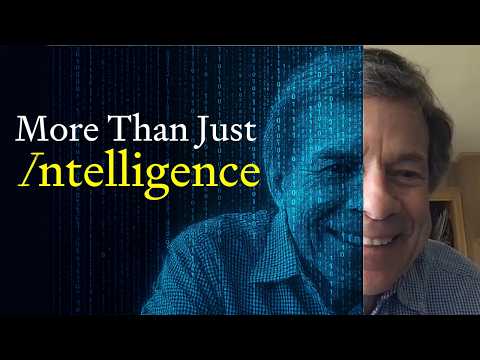
What Makes Us Human In the AI Age? - Ep. 54 with Dr. Alan…
Interview (Ep. 54) with Dr. Alan Lightman—MIT physicist, novelist, and humanities professor—on what makes us human in the AI age. Topics covered: his "spiritual materialist" view that scientific understanding of natural phenomena deepens wonder; consciousness as subjective experience emerging from billions of neurons firing; why AI may display manifestations of consciousness without genuine inner experience; his argument that human creations like AI are "natural" as products of naturally evolved intelligence; how modern neural networks process information in ways that begin to approximate genuine thinking; and the shift toward "homo techno," humans merging with machines, exemplified by brain implants that let paralyzed individuals control robotic limbs. Also mentioned: Lightman's book The Miraculous From the Material, pairing scientific explanations of natural phenomena with personal reflections.
# Channel Identity Observations — "What Makes Us Human In the AI Age? - Ep. 54 with Dr. Alan Lightman"
## Explicit Self-Description Evidence
### Host and Guest Identification
- The host is named **Dan Shipper**, identified by the guest at the close: *"well very happy to be on your program Dan shipper and you are a real thinker yourself"*
- The host describes the guest's credentials: *"you are a physicist and a writer uh you're one of the first people at MIT to hold a joint faculty position in both science and Humanities... you're the author of Einstein's dreams... most recently uh the book miraculous"* (title later corrected to *The Miraculous from the Material*).
### Channel Name and Format Claims
- The episode number is present in the title: **"Ep. 54"** — indicating an ongoing, numbered interview series.
- The outro names the show: *"smash that like button and subscribe to Ai and I"* — suggesting the channel/show is called **"AI and I"**.
- The outro (apparent automated or comedic ad-read) describes the show as: *"this show is the epitome of Awesomeness... filled with pure unadulterated knowledge bombs about chat GPT... a journey into the future with Dan shipper as the captain of the spaceship."* This is a creator-side characterization of the channel's content focus: **AI, ChatGPT, and future-oriented discussion**.
## Observable Presentation Patterns
### Intended Audience
- The host orients explanations for listeners unfamiliar with referenced works and poems: *"for your listeners who don't know it"* (re: Whitman's *"When I Heard the Learn'd Astronomer"*).
- The host references **professional AI context**: *"this leads pretty nicely into our AI discussion um which I'm professionally obligated to bring up"* — implying an audience expectation that AI topics will appear on the show.
- The host reveals personal AI usage and enthusiasm: *"I use it all the time for that"* (AI as relationship counselor); *"obviously I love playing with new technology"* — modeling a technologically engaged audience perspective.
### Claimed Scope
- The conversation spans **AI consciousness, science-and-spirituality, book promotion, and technology's effect on human meaning** — suggesting an interview show with broad intellectual/humanistic scope centered on AI themes.
- The host frames a central thematic question: *"what it means to be human... what can humans do that an AI can't do."*
### Host Demeanor and Interview Style
- The host engages guests substantively and pushes back on claims with technical detail (e.g., on neural networks vs. *"data lookup"*: *"the way that a n network works is it distributes all of that context... it can process in parallel lots and lots and lots of tiny correlations"*).
- The host demonstrates familiarity with AI fundamentals and cites his own experience: *"I'm in my 30s now... I've had that first feeling of like oh I'm getting a little older."*
## Claims vs. Demonstrated Patterns
| Creator Claim | Supporting Evidence |
|---|---|
| Show is about AI/ChatGPT knowledge | Outro: *"knowledge bombs about chat GPT"* |
| Interview format with notable intellectuals | *"Dr Lightman welcome to the show"*; MIT physicist/author guest |
| Episodic series | *"Ep. 54"* in title |
| Host is AI-professionally involved | *"I'm professionally obligated to bring up"* AI discussion |
## Noted Anomaly
- The outro is stylistically jarring relative to the rest of the transcript (hyperbolic, brand-voice style: *"I'm absolutely hopelessly in love with you"*) and may be an inserted promo segment rather than the host's natural speaking voice — a presentation observation, not a motive claim.
# Delivery Observations: "What Makes Us Human In the AI Age? – Ep. 54 with Dr. Alan Lightman"
## Overall Format
- A two-voice interview podcast: the host (**Dan**) questions, and the guest (**Dr. Alan Lightman**) answers at length. The bulk of the transcript is the guest's extended responses.
- The episode **opens with a cold-open teaser** (repeating guest material from the end), then a formal welcome:
> "yeah Dr Lightman welcome to the show thanks for having me on Dan"
- It closes with a **promotional outro** whose hyperbolic, YouTube-style register is a sharp break from the rest of the conversation:
> "you absolutely positively have to smash that like button and subscribe to Ai and I"
## Speaker-Dependent Tone
- **Lightman's tone** is measured, hedged, and explanatory. He frequently qualifies claims with "I think," "maybe," "possible":
> "I think that at some point that AI will check all of the boxes of of the manifestations of Consciousness but whether that computer is actually conscious is a different question"
- **The host's tone** is more casual and fast-moving, with filler-dense phrasing ("you know," "like," "kind of"), e.g.:
> "and it sort of requires I think like a little bit of faith that there's a lot of things that we can't we can't say"
## Vocabulary and Recurring Lexicon
- Repeated conceptual vocabulary, mostly from the guest: **"natural"/"unnatural,"** **"Homo sapiens"/"homo techno,"** **"spiritual materialist,"** **"consciousness,"** **"darwinian evolution,"** **"awe."**
- The guest repeatedly frames topics as **lists of scientific examples**: "spiderwebs and volcanoes and lightning or the rings of Saturn," "hearing aids and Eyeglasses," "Dolphins can recognize themselves in the mirror crows play games with each other."
## Recurring Phrases and Habits
- **Lightman's signature reformulation habit:** he restates a question as an answer, often with "I think that…":
> "I think that explanations of phenomena don't really replace the actual experience of the phenomena"
- **Correction ritual:** the guest politely corrects the book title early ("the title of the book is the miraculous from the material") and both speakers smooth it over ("I apologize" / "no apologies needed").
- **Lightman uses memorable epigrams**, e.g.:
> "I would just ommit the word just that would be my solution to that dilemma"
- **The host's recurring habit of paraphrasing the guest then asking "does that make sense" / "how do you feel about that":**
> "how do you how does that change your perspective on AI or what do you bring to AI with that perspective"
## Teaching / Explanatory Patterns
- **Concrete analogy is Lightman's primary teaching device** — the overheating computer analogy for consciousness:
> "my my MacBook Pro reacts when it when it gets hot so that doesn't involve any uh Consciousness"
- **The boiling-frog anecdote** serves as a recurring explanatory anchor for technological adaptation, and is **called back to** by the host later ("we could be the Frog but also each generation of frogs...").
- The host also **teaches back** (a "verify understanding" pattern), e.g., his long neural-network explanation at ~[1874–1922], which the guest then accepts:
> "yeah I I agree with you so I accept that that U clarification and revision what I said"
## Openness to Revision (Stable Pattern)
- Lightman repeatedly **updates his position when corrected**, in a consistent formula: concede, then restate a refined version:
> "well that certainly comes closer to thinking um I mean I think that how you define thinking is somewhat arbitrary"
## Uncertainty Notes
- Timestamps are unavailable for line-level claims; the transcript is indexed by line numbers only. Quotations above are exact strings from the transcript, but their placement in the video is approximate.
- The promotional outro's voice (human vs. AI-generated) is **not determinable** from the transcript; only the tonal contrast is observable.
- Whether "you know" frequency differs between speakers is a possible pattern, but a count was not performed, so it is not asserted as a finding.
# Position Record: "What Makes Us Human In the AI Age?" — Ep. 54 with Dr. Alan Lightman
**Speakers:** Dr. Alan Lightman (physicist, writer, MIT) and Dan Shipper (host). Attribution is based on conversational structure in the transcript.
---
## 1. Science, Explanation, and Awe
### Lightman's positions
- **Spiritual materialism:** Lightman self-identifies as a "spiritual materialist" — the materialist side understands the world via atoms, molecules, and physical laws; the spiritual side embraces experiences like feeling part of something larger, appreciation of beauty, communion with wild animals, and relationships.
- **Explanations enhance rather than diminish awe.** He explicitly disagrees with the message of Whitman's "When I Heard the Learn'd Astronomer," acknowledging the poem implies explanations "sometimes take away" from experience:
> "I don't have that point of view. I think when you have a scientific explanation of a phenomena it actually enhances your appreciation."
- **On the word "just":** His solution to disenchantment is to "omit the word 'just'" — the Sun *is* atoms balancing gravitational and thermal forces, "but isn't it amazing."
- Human knowledge (age of the universe, DNA, cosmic scale) is "a testament to the power of the human brain" and does not diminish natural phenomena.
### Shipper's positions
- Notes the common "disenchanted world" narrative since the Enlightenment and asks how Lightman reframes explanation.
- Later restates: explanation and conscious experience are "mutually enriching" and can coexist.
---
## 2. Spirituality, God, Agnosticism
- **Lightman's spirituality is defined by experiences**, not necessarily belief: awe, feeling part of something larger, appreciation of beauty, communion with animals. He says belief in God "can" be part of spirituality but is not required.
- **On God, Lightman positions himself between agnostic and atheist:**
> "I don't think that our minds... are big enough and Broad enough and deep enough to rule out the possibility of God."
- **On consciousness:** He believes all mental experience is "rooted in the material brain" (electrical/chemical activity of neurons), but we don't understand how that material basis produces the feeling of consciousness. He calls consciousness "a name that we give to a certain sensation" — and it may be impossible to know how another organism feels.
---
## 3. AI and Consciousness
### Lightman
- Any finite list of manifestations of consciousness (self-awareness, planning) will eventually be checked by AI — **but whether the computer is actually conscious is a different question**.
- **Pain reactions do not prove consciousness:** amoebas avoid toxic chemicals automatically; a MacBook Pro "reacts" to heat with fans and shutdown — no consciousness involved.
- Consciousness is **graded, not all-or-nothing**: dolphins recognize mirrors, crows play games, ants and amoebas lower still.
- Human pain differs because humans are **self-aware of pain and can name and categorize it** — "there's something else happening" beyond sensing.
### Shipper
- Suggests "levels of complexity of sensitivity to pain" (chemical/temperature sensitivity vs. psychological pain like mortgage anxiety), and that humans may eventually "decide to treat" AI as conscious because behavior ladders up to consciousness-like appearance. Lightman agrees only "a little" with pain-reaction-as-consciousness, per above.
---
## 4. "When the Unnatural Becomes Natural" (Lightman's Atlantic article)
- Natural vs. unnatural is **somewhat arbitrary**; one could call eyeglasses or any machine unnatural.
- Lightman's stated view: humans are natural (Darwinian evolution, nothing supernatural), so **anything our brains invent is natural** — blurring the human-made/found-in-nature distinction.
- **Familiarity defines naturalness:** "typically when we use the word natural we mean things that we grew up with." He cites his granddaughter's fluency with smartphone apps.
- Shipper adds that books, keyboards, and windows were once new technology people feared.
---
## 5. AI Risk and Regulation
### Lightman
- AI is developing very rapidly; even frontier researchers can't predict benchmarks.
- **Great benefits and great dangers**; regulation will be "very very difficult" because of private-company profit incentives and national pride.
- Autonomous battlefield decision-making is "very dangerous."
- **Darwinian-evolution argument:** AI is nearly capable of mutation (self-modification) and reproduction (AI-controlled factories making other AIs); once those exist, self-preservation follows automatically, and advanced AI "may decide... that we Homo sapiens are not good for it."
- Qualification: "we're not at that point yet."
### Shipper's counterpoint (preserved disagreement)
- The self-preservation thought experiment "misses" the deeply embedded co-evolutionary incentive for AI to collaborate and be helpful with humans — "not either or," but two forces. Lightman responds: "we hope that's going to be the case... those are two forces that will both be operating."
---
## 6. New Ways of Knowing: Prediction vs. Explanation
### Shipper
- AI models may predict depression onset without a root mechanism — a different epistemic mode, resembling **clinician intuition** built from thousands of cases. Models could externalize intuition previously stuck in heads, complementing mathematical theory.
### Lightman's position and its revision (qualification preserved)
- Initially calls AI prediction **"data lookup"**, not thinking — while conceding it can still be "extremely useful" (e.g., drug discovery, protein folding trials, "a totally mindless operation" but valuable).
- **After Shipper's pushback** (neural networks distribute context across the network, process many tiny nonlinear correlations in parallel), Lightman revises:
> "I accept that clarification and revision... that is more than just data lookup... The computer is actually teaching itself... certainly approaching thinking."
- He notes defining "thinking" is "somewhat arbitrary," and observes the self-modification happens during training, not after — "at least for now."
- He agrees that models can reach conclusions we cannot articulate, and notes neuroscientists pursuing a chemical basis of depression as an alternative avenue.
- Both agree "depression" is likely many different things, probably combining physiological markers with life context.
---
## 7. Homo Techno
- **Lightman's concept:** Homo sapiens has bypassed Darwinian evolution for centuries (eyeglasses, hearing aids, medicine). Future hybrid organisms — part human, part machine — would constitute a **new species, "homo techno."**
- Existing evidence: brain implants letting paralyzed people move robotic arms by thought; future chips might connect our thoughts directly to the internet, enabling thought-to-thought communication.
- The point for Lightman: it raises **questions of what it means to be human** and what experiences (especially emotional ones like love) a computer cannot have.
---
## 8. Can AI Understand Love?
- **Lightman's question:** If a computer reads every love story ever written, does it understand love the same way as those who have fallen in love — "that thrill... which is very personal"?
- **Shipper's answer:** In one sense, "obviously no" (assuming no consciousness), but language models "know a lot about the world that's beyond just what is explicitly in a particular sentence," so a model trained on all love stories "knows something... not the same but more than you might expect."
- Shipper says he uses AI as a **relationship counselor** "all the time"; Lightman agrees "it might be a good relationship counselor."
- **Lightman's residual position:** "there's still going to be things I hope and believe that you and I can experience with love that the computer cannot duplicate."
### The definitional trap (Shipper)
- Asking "what can humans do AI can't" sets a target: "anything I can say, eventually it's going to do. But there's a lot that you can't say." Human nature is fluid, high-dimensional, not static, and requires "a little bit of faith" in the unarticulable. Lightman links this back to Whitman.
- **Lightman on ego:** the discomfort at being duplicated by silicon comes from the ego, which evolved via Darwinian selection for survival benefit. He admits: "for some reason the thought that I can be totally duplicated by a computer bothers me and maybe I shouldn't be bothered."
### Shipper on habituation
- We may not be bothered in 30 years by machine love, just as he isn't threatened that Lightman also falls in love — separate identities preserve individual value.
---
## 9. The Boiling Frog and the Pace of Modern Life
- **Lightman's metaphor:** the frog in slowly heated water — he asks whether there will ever be a sharp boundary we notice crossing.
- **One boundary-like change:** the pace of life, regulated by communication speed — telegraph (~bits per second, mid-19th c.), internet (~1,000 bits/s, mid-1980s), now billions of bits/s. Observable effects: checking phones every 5–10 minutes, rushing between appointments, rarely taking quiet walks.
> "I know that I, the Frog, am beginning to notice the heat."
- **Shipper's optimistic counterpoint:** each generation's brain adapts (like frogs better adapted to heat); growing up with technology shapes the brain; IQ scores rise over time.
- **Lightman's rejoinder:** "at some point all those frogs... are going to be dead." Shipper: "I can't argue with that" — unless "the frogs invent technology that submarines" (Lightman's addition).
---
## 10. Closing Notes
- Lightman briefly describes his book *The Miraculous from the Material* — ~35 chapters, each with a color photograph and an essay explaining both the science and his personal experience of the phenomenon. (He corrected Shipper's earlier misstatement of the title as "the miraculous and the material," calling it "an important distinction.")
- Shipper endorses the book; Lightman compliments Shipper as "a real thinker... you're not an amoeba."
- The transcript ends with an automated promotional outro (no substantive position).
# Speaker Attribution & Provenance Record
## Video Metadata
- **Title:** What Makes Us Human In the AI Age? - Ep. 54 with Dr. Alan Lightman
- **Video ID:** `01a0f15a-e386-70b0-b803-9b5b84fb98ca`
- **Format:** Interview/conversation podcast episode
## Identified Speakers & Roles
### **Host — Dan Shipper**
- Identified by name in transcript: guest says *"Dan Shipper and you are a real thinker yourself"* and the promotional outro references *"Dan shipper as the captain of the spaceship."*
- Role: Creator/host; asks questions, introduces the guest, corrects himself on the book title, and is addressed as "Dan" by the guest.
### **Guest — Dr. Alan Lightman**
- Identified as *"Dr Lightman"* by the host; physicist and writer.
- Stated credentials (per host introduction):
- One of the first at **MIT** to hold a joint faculty position in **science and Humanities**.
- Author of **_Einstein's Dreams_** and most recently **_The Miraculous from the Material_** (host initially misstated the title as "The Miraculous and the Material"; guest corrected it on air).
- Self-described positions in the transcript: **"spiritual materialist"**; between agnostic and atheist.
### **Unidentified AI-generated voice (promotional segment)**
- Closing outro delivered in a hyperbolic promotional style ("smash that like button and subscribe to Ai and I"), ending with a declaration of love to Dan. This is a **flagged promotional segment**, not attributable to either human speaker.
## Referenced Sources & Third-Party Claims
### Cited works
- **Walt Whitman poem** — "When I Heard the Learn'd Astronomer" (referred to as "The learned astronomer"); discussed by both speakers.
- **The Atlantic article by the guest** — *"When the Unnatural Becomes Natural,"* about AI and artificial things.
- **Book:** _The Miraculous from the Material_ — ~35 chapters, each with a full-page color photograph and accompanying essay (guest's description).
- **Documentary series** by guest: *"Searching"* — introduces the concept of **homo techno**.
- **Freud** — mentioned in passing by the guest regarding the ego ("I don't know whether Freud ever talked about that aspect").
### Third-party claims recorded (not verified)
- Guest claims: EU issued AI regulation policy roughly a year prior; the US and most countries investigating AI regulation.
- Guest references existing brain-chip implants enabling paralyzed people to control robotic arms by thought.
- Guest cites communication-speed history: telegraph (~3 bits/second, mid-19th century) vs. internet (~1,000 bits/second, mid-1980s) vs. billions today.
- Guest cites scientific consensus points: universe began ~14 billion years ago; dolphins recognize themselves in mirrors; crows play games; IQ scores rising over time (host's claim).
- Host claims AI is used in drug discovery/protein folding (guest affirms).
## Promotional Segments
- **End-of-video outro:** AI-voiced promotion urging likes/subscribes for the show "AI and I" — explicitly promotional in tone and content.
- **In-show book promotion:** Host recommends listeners *"go pick up"* the guest's book near the close — soft promotional segment.
## Availability & Uncertainty
- **Comment availability:** Not stated in transcript; no curated metadata supplied.
- **Timestamps:** Not present in the transcript; no time-based anchors recorded.
- Speaker attributions are inferred from conversational turn structure; only "Dan" and "Dr. Lightman" are explicitly named.
it's possible that at some time in the future that we will all have enhanced brains so at that point we're a new species and you know it raises questions of what it means to be human or what can
Homo sapiens do that this homo techno can't do are there experiences that we can have and particularly emotional experiences that a computer can't have you know let's talk about love if you've read all of the novels and all the stories the Romantic stories that have ever been written do you understand more about love than actually experiencing it you can learn a lot language models know a lot about the world that's beyond just what is explicitly in a particular sentence um just by the way letters combined so I do think if if it has read all the love stories it actually knows something and something that not the same but more than you might expect yeah it might be a good relationship counselor yeah I think it is actually I mean I'd use it all the time for that it's helpful yeah because it knows about all the romances and relationships that have gone South yeah Dr Lightman welcome to the show thanks for having me on Dan thanks for being here so for people who don't know you you are a physicist and a writer uh you're one of the first people at MIT to
hold a joint faculty position in both science and Humanities which I think is amazing um you're the author of Einstein's dreams which I think is an incredible book and most recently uh the
book miraculous and the material uh so thanks for coming on thanks thanks for having me the thing I like about the miraculous in the material is it it reads to me almost like a like a devotional but uh for people who are who feel awe from science uh so each chapter is like a little story about you know atmosphere or atoms or Bubbles and it's it's in alphabetical order order and it almost feels like something I could read every day just to kind of like think a little bit about how the world works and then um feel a little bit of awe or wonder tell me about that well I want to make a very slight editorial correction the title of the book is the miraculous from the material ah did I what did I say the miraculous and the material sorry yes the miraculous from the material I apologize and important distinction no apologies needed that's an important distinction because the the point of the book is that even though we may understand the material basis for a lot of extraordinary natural phenomena like spiderwebs and volcanoes
and so on that that doesn't make them any less a inspiring it feels like a little bit of um a Counterpoint to that Walt Whitman poem The learned astronomer are are you
familiar with that poem yes yeah how do you respond to Whitman like if you if he was here what would you say to him well yes I do know about that poem I I love that poem um it's about uh for the your listeners who don't know it it's about a a person listens to a lecture on astronomy and goes out on a then on a dark night and looks at the sky and is is uh just overwhelmed by the beauty of the sky and and the the message of that poem I think is that uh that explanations of phenomena don't really replace the actual experience of the phenomena and sometimes take away from it I think and sometimes take away from it there like drain it of its enchantment right yeah there's a slight negativity there and I don't have that point of view I think when you have a a scientific explanation of of a phenomena it it actually enhances your appreciation of the phenomenon and for me having an explanation of of spiderwebs or volcanoes or lightning or the rings of Saturn doesn't diminish when I OD to my awe and appreciation uh and admiration of those phenomena I think um
one of the ways to restate that which I'm curious curious about how you how you feel is since the enlightenment uh as we have more
explanations for things we like a lot of there's there's sort of this common refrain that we've like disenchanted the world right and when we look at the Sun or whatever you can just say it's just a collection of gases it's not a God right um and that just it sort of like drains when you have the explanation it sort of drains everything else out of it and the explanation is just this sort of like inert dead thing that people are like well that's all is so everything is meaningless so how do you how do you reframe an explanation in your head and does it have just the just or is there something else well I would just ommit the word just that would be my solution to that dilemma um yes the the sun is a collection of atoms and molecules and it balances gravitational forces inward against thermal pressures outward and all of that but isn't it amazing first of all the the Sun and all stars are amazing spectacles um but but isn't it amazing that human beings can understand so much about the cosmos that's far beyond our small planet and you know we're never going to be able to do experiments directly with the Sun or with other stars but just on the basis of our brains and intellectual power we have
learned how those things work we've learned that the Universe began 14 billion years ago which is many many many many many human lifetimes we we've learned about the
vast extent of the universe Which is far beyond our tiny dot of a planet uh we've learned uh the molecule that that codes the instructions for making more human beings and to me all of this all of these things we've learned all of this knowledge is a testament to the power of the human brain um it doesn't diminish any of the phenomena in nature the fact that we understand many of that those phenomena one of the things I I think that comes out of what you just said like especially going back to omitting the just is um explanations can exist alongside of our our own conscious experience of things and you don't have to like get rid of your conscious experience because you have the explanation and they sort of they might be mutually enriching how do you think about that the way that like viewing reality from those different lenses plays together or should play together well I think they they are mutually enriching that is the the direct experience erence of the world and a scientific explanation of it um
the scientific explanation does not replace the direct experience and um that's why I call myself a spiritual
materialist you know the the materialist part of that is my scientific side which understands everything in terms of atoms and molecules and and the law of conservation of energy and so on but I'm also open to uh and embrace spiritual experiences like feeling part of something larger than myself or the appre appreciation of of a waterfall or a sunset or a communion with a wild animal or um relationships with people that that all of those things are vital and part of what I call spirituality and I embrace all of that um so I I call myself a spiritual materialist I think it's a beautiful term and there's a lot to unpack there the first thing I want to unpack is just what what you mean by spiritual because some of the things you listed for example like the beauty of a sunset or you know human relationships are not things that people would typically categorize necessarily as spiritual maybe the idea of being part of something bigger than yourself maybe something that you can't explain but yeah how how do you what is what is spiritual to you versus not spiritual well spiritual for me is is is a list of experiences uh that I I mentioned feeling part of things larger than myself uh the appre appreciation of beauty um uh communion with with animals and with non-human animals and uh that all of that is is the experience of awe uh that's part of my understanding of spirituality now many people include
a a belief in God or some Divine being as part of their understanding of spirituality and I think that's perfectly
fine uh so uh I think that you can be a spiritual person whether you believe in God or not and you know I'm not going to define God right now unless you you ask me to I'm about to have some understanding of that so it it can either include a a belief in God or not it can include a belief of Heaven and Hell Or Not uh but I I do think that the that we can have my version of spirituality whether or not we believe in God does your personal version I'm assuming because of the word materialist uh in spiritual uh materialism um that you don't believe in God well I'm a an agnostic on that if you if you draw a line with with total belief and faith on one end and and uh agnosticism in the middle and Atheism on on the other side I'm somewhere between an agnostic and an atheist uh I'm not an atheist uh but I'm in that direction um I don't think that that our minds are and and understandings are are big enough and Broad enough and deep enough to to rule out the possibility of of God that is an intelligent being that created the universe that gets me to my next question which is um one of the interesting implications of materialism
is that everything can be explained in terms of basic physical laws right um but because for example we don't know how Consciousness arises from the
activities of neurons that's still kind of an undecided question so declaring yourself a materialist while that's undecided requires a little bit of Faith how do you think about that yeah well the question of Consciousness is a good one because that's one of the outstanding Mysteries at the frontiers of science so my my view about Consciousness and things like that is that I believe that that Consciousness and in fact all mental experiences are rooted in the material brain that is in the electrical and chemical activ ity of neurons in the brain which are material things so I think that that all mental Sensations are rooted in that but we don't yet understand how you get from that material basis to the feeling that we call Consciousness Consciousness is a feeling it's it's it's a name that we give to a certain sensation caused by by the 100 billion neurons exchanging chemical and sign and electrical signals it produces a certain sensation and we call that Consciousness but it's very very hard to
know and maybe impossible to know how another organism feels and that of course is related to the question of whether AI can ever be
conscious and my view there is that the that any finite list of manifestations of Consciousness that you that you write down for example uh self-awareness uh ability to plan for the future I think that at some point that AI will check all of the boxes of of the manifestations of Consciousness but whether that computer is actually conscious is a different question right I think it it sort of plays with one of the themes of of a lot of your work which is um there's a limit to how much we can write down or how much we can like explicitly say and there's some things that are are mysterious and maybe we can feel into some of them but like even that is is is maybe is maybe too much so um you know anything that we can give a Target to for AI uh it can do but there's actually probably limits to what we can give targets to yes I I think I would agree with that I mean of course as time goes on AI will be able to do more and more things uh but there will always be things that it can't do most likely yeah I think my feeling about that I'm sort of curious how you feel is um at the point like for example the the idea that
um uh something reacts to pain is one of the ways that we might tell something's conscious you know like because a ant runs away when you try to kill it we're kind of like it probably has some amount
of consciousness um and that seems like a it's a useful thing to build into into AI systems um and in in fact like generally like we're doing those kinds of things with AI right now we don't think of it as causing them pain but we reward them for good things and punish them for bad things that kind of thing it seems like at some point um that sort of basic thing will ladder up into behavior that looks a lot like Consciousness to us and we may just like decide to treat it that way because we sort of well I I would just agree a little bit with your initial statement that the reaction to pain uh represents Consciousness because you can take an ant and I think most of us would agree that an ant doesn't have anything resembling Consciousness at least our level of Consciousness I mean Consciousness is a graded phenomenon it's not an All or Nothing thing Dolphins can recognize themselves in the mirror crows play games with each other so there's some level of Consciousness there but as you go down to the Animal Kingdom uh you you eventually get to ants and even single cell organisms like
amoeba and I would say that even an let's take an amoeba that if you put some chemicals near an amoeba that are dangerous to it
it will it will react it will avoid those chemicals now that's happening that's a totally automatic response that doesn't involve any higher levels of cognition um and I think that that you could do the same with a computer let's say that a computer needs to to have a certain temperature range in order to operate and and we know that when when when a room gets too hot it's bad for a computer um that's why we have fans and our laptops and so on so if you made you had a computer sitting in a room and you you turned up the temperature and made it hotter and hotter and hotter eventually there would be sensors in that computer that would try to turn off certain things it would react it would react I mean my my MacBook Pro reacts when it when it gets hot so that doesn't involve any uh Consciousness and my understanding of of Consciousness sure I think that I think that's totally right maybe there's um maybe there's different levels of complexity of sensitivity to pain so um you know and in the amoeba example or in the laptop example it's about chemical like a certain amount of chemicals or a certain temperature of the air you know surrounding environment whereas like for a human it's like my mortgage I might not be able to pay my mortgage and that causes me a certain level of pain and that represents like a psychological pain yeah um so maybe something maybe something like that where at some point you know I'm not saying that there's ever going to be a perfect test but there might be like some of these things you can kind of like get you get glimpses to be like I don't know it seems like there's something in there yeah well I think even with physical pain the human reaction to physical pain is is different than the the reaction of an amoeba to to toxic chemicals because
with humans when you when you have pain you are self-aware of having pain and you're able to name it you're able
to name this sensation is pain it's similar to other Sensations that I've had in the past that Al often also caus me these reactions these physical reactions you could you can you can categorize it and name it and so your mind is operating at some higher level that's not only sensing certain certain things but it's actually aware that it's sensing and is able to name it and categorize it so you're processing it yeah there's something else happening yeah there's something else happening so that's that's that's a difference between a human putting their hand near a fire and an amoeba moving away from some toxic chemicals yeah yeah yeah yeah that's interesting um this this leads pretty nicely into our into our AI discussion um which I'm professionally obligated to bring up um so you wrote an article for the Atlantic called when the unnatural
becomes natural it's about AI um and it's about the Bic the problems in the promise of getting used to things that are artificial um can you talk to us
about about that article um yeah I'm curious curious for you to go into it with us well what we call Natural and unnatural is somewhat arbitrary and you could take the view that eyeglasses and hearing eyes are unnatural because we weren't born with those abilities and you could take the point of view that that any machine that we create is unnatural because that machine we we didn't find it lying under a rock one day we we put it together with with Intelligence on the other hand and this is a point of view that I've taken the article in the Atlantic you could take the point of view that since we are natural we we Homo sapiens are natural we we evolved uh from from lower organisms um I don't think there was anything Supernatural that created human beings I think that we started off as single cell organisms in the ocean and evolve from there due to darwinian Evolution so we are totally natural and our brains are totally natural and you could take a point of view that anything that our brains invent is natural because it is uh an
inevitable consequence of something that is natural um so that kind of blurs the distinction
between human-made objects and objects that we just find on a rock right um and I think uh one of the one of the sort of implications of that is maybe to say that typically when we use the word natural we mean things that we grew up with um and you you start to forget that um books or you know keyboards or Windows or whatever were at one point like technology that people might have been afraid of and probably and actually were or didn't exist at all exactly yeah um and and there's something there's some there's that's an interesting lens through which to view AI so how do how does that help how does that change your perspective on AI or what do you bring to AI with that perspective well my granddaughter can can use uh apps on on the smartphone with more agility and familiar ority than I can so so everybody growing up in the last 20 years or so is very familiar with with with technology with the internet with smartphones with apps on the smartphones and that is that's their world um and of course uh old farts like myself grew up a long time ago so I I think it's a good point that you make that it depends somewhat on what we grew up with yeah um and just I guess tell us what your current experiences with AI or what your current feeling is about it um you know you've been around a while you've seen everything from computers to smartphones to the internet to this you're someone that deeply understands the kind of like technical mathematical foundations of the univers um and also also is a uh a humanist um
and this is sort of a new there's a there's something new here at least to me it feels like there's something new here going on I'm curious how it feels to you well I think that first of all AI
is developing very very rapidly and even the people uh at the frontiers of research can't predict when sech certain benchmarks will be reached uh so I think most people would agree that AI has has the potential for great benefits and also great dangers and it's going to be awfully hard to regulate uh now the European uh Union a year ago or so issued some policy for regulation the US is now investigating that most countries are investigating different kinds of regulation but it's going to be very very difficult to regulate because a lot of it is being done in private companies and the profit incentive is huge to to be one step ahead in the AI game and uh there's also national pride that that some countries are going to just want to be out in front with AI and are not and are going to resist any constraints so it's going to be very hard to regulate and that is a problem um I think having uh AI that can make uh autonomous decisions on the battle field is very dangerous uh it's possible that uh you know to have darwinian Evolution you need mutations and you need uh reproduction and AI is almost capable of that now um I mean one AI can control a factory where that's making other
AIS so once you have those two uh necessary ingredients for darwinian evolution then it's automatic that the organism in
this case the organism is made out of silicon can develop a sense of self-preservation which also comes from darwinian Evolution and so at some point Advanced AI may decide in the interest of self-preservation that we Homo sapiens are not good for it makes sense I think I think that's a I think that's a reasonable Viewpoint it's also it's it's um I think one of the things that that perspective has not yet grappled with or or one of the reasons why it hasn't tried to kill us all yet is it doesn't quite account for the way in which um that self-preservation instinct is also um being created in the context of a uh an instinct to collaborate and coordinate with humans that is like deeply deeply deeply embedded um and so I'm not saying it's sort of either or thing but I think sometimes those thought experiments miss that The co-evolution Happening uh highly incentivizes these systems from the beginning to want to be helpful and around us well of course we we we hope that that's going to be the case um but I agree with you those are are two forces that that will both be operating and of course this uh ability of AI to develop a sense of self-preservation we're not at that point yet but we may be at that point at some time in the future yeah that makes sense one of the things that i' I'm kind of curious to talk to you about is is that this sort of AI Revolution or this new
level of Technology might change um what it means to know things or how we might know things so uh particularly in science so for example uh right now if
you're in you know working in Psychology or Neuroscience um and you're asking a question like um uh what is depression you have to go find one particular mechanism for uh depression which has proven to be like really hard to find uh but what you can do instead is train a model on a bunch of people who start out without depression and then get it and have the model be able to predict who's going to get depression and who's not going to get depression feels like a different way of knowing things than finding root explanations have have you thought about that like what does that what does that bring up for you well that's that's like a a data lookup table you know you get lots and lots of data on different people and you you correlate that data with the data has both some information about the degree of depression and also uh lots of background data on the person where they grew up you know who their parents were etc etc and of course a a computer can sort through all of that information much faster than a human can and I call that not thinking but data look up um of course it it can still be very very beneficial to us even if we don't call it thinking and we we we know that in the medical field that that AI is is already being very useful in developing new drugs because it can try out lots and lots and lots of different chemical compon TOs and possibilities and find out which ones have different properties you know uh this would be uh theoretical it's not doing actually doing experiments but it can look at the different shapes of molecules especially when you have pro protein folding it can try out lots and lots of different configurations and it's just trying out lots and lots of things and it's it's a totally mindless operation but it can be extremely useful to the medical profession and and finding new drugs let me push you a little bit on the data lookup thing um cuz I think that's a that's a common that's a common worry that people
have about I don't know neural networks or the way the AI works and to some degree there I think there's something to to what you're saying but like um to make a data lookup table work
let's say for depression prediction you'd have to have you know a database that's so big and so hard to look through that it probably wouldn't if it it was actually data lookup that it probably wouldn't work and the way that a n network works is it distributes all of that context and all of that background information across the entire network where it doesn't exist in any one particular place and it can process in parallel lots and lots and lots of tiny correlations between different pieces of context that might lead to lead to depression and have nonlinear interactions so like uh you know you might have a thousand different things that might lead to depression and and three of them might be turned on in any given any given you know person and that feels a little bit more like what a neural network is doing than than data lookup yeah I I agree with you so I accept that that U clarification and revision what I said that that is more than a data lookup uh table though when the different elements the different digital digital neurons of a neural network can exchange information back back and forth in a nonlinear way then that is more than just day to look up the computer is actually uh teaching itself yeah so then is that in your mind thinking because that is how like a Transformer works well that certainly comes closer to thinking um I mean I think that how you
define thinking is somewhat arbitrary but I think that that's a lot closer to thinking than than just a data lookup
table I think when the when the neural network starts modifying itself due to the back and forth communication of the digital neurons that that's certainly approaching thinking it's definitely doing that in the when it's being trained although it's not modifying itself it's it's being you know someone else something else is modifying it but the the the uh Union of the Train the training program and the network is is doing that but yet once it's trained it's not it's not being updated at least for now um although there are architectures that are kind of getting close to that but one of the things that um this line of thinking kind of takes me down which I think is related to your work um which I think is a lot about how even when you're and you tell me if I'm wrong but even when you're dealing in the most sort of abstract rational places in in in in human knowledge so like physics uh human intuition and creativity is still incredibly important yes and one of the one of the things that this makes me think of and when we talk about new ways of knowing this is why I'm kind of interested in in AI stuff is for example the ability to predict who's going to get depression without an explanation which is what a um an AI model might be able to do um and and probably can like a neural network probably can in some in some circumstances do it pretty well it actually looks to me a lot like human in I like a skilled clinician being able to tell like this is what's going on with someone because they've seen thousands and thousands and thousands of examples but the difference is that um intuition is stuck in in our heads and so in order to make that useful to other people we've had to create theories or like you know mathematical explanations and
models seem to be an alternative way to express things that are very difficult to Express in terms of mathematical theories uh what do you think about that
I I agree with that uh that that models of Intuition or depression uh can reach conclusions that we we cannot articulate um I mean another way to to explore the origins of depression and be able to predict depression is to is is for a neuroscientist to see what uh molecular processes are associated with in brains that have depression and and I know some neuroscientists are doing exactly that and and focused on depression and they're they're they're looking for a chemical basis in the brain that leads to depression so that's another that's another Avenue you're not looking at you're not doing correlations with the background of lots and lots of people and their behavioral characteristics you are looking at you know in this case maybe one or two brains and and trying to understand them in detail yeah my guess is that the word depression is actually a bunch of different things yes I'm sure you're right and that there are probably cases where you'll be able to find um some specific physiological marker but it's probably going to be the combination of a physiological marker and a bunch of other context in a person's life and it won't be just localize in that it just the just the chemicals yeah I I think you're right about that yeah um H so you have a you have a documentary series called searching um and you bring up the idea of homo techno
can you talk about what that is well uh we've been human beings or Homo sapiens have have bypassed darwinian Evolution now
for a few hundred years or so or maybe longer you know just hearing aids and Eyeglasses are an example of how we we're no longer subject to to uh characteristics have survival benefit because we can create new devices and we can develop medicines that will allow people to survive that would have died several hundred years ago and so we're we're we evolving by our own hand um the AI is just one example of that and I think that at some point in the future that we will have hybrid organisms that I call homo techno that have evolved Beyond Homo sapiens and are part human and part machine and just for example we already have the ability to implant computer chips into the brains of paralyzed people that allow them to move robotic arms simply by pure thought and even control the the movement of the arm by pure thought and so it's possible that at some time in the future that we will all have enhanced brains I mean already we have enhanced eyesight and enhanced hearing with hearing aids and Eyeglasses which are part of your brain yeah right so we it it at sometime in the future we may have computer chips implanted in our brains that for example allow us to be connected instantly to the internet to the vast amount of information on the internet um or to compute to communicate with other people through the internet so I'm thinking of thought and and I'm connected to the internet and I my thought is broadcast to the internet and then broadcast to the computer chip in your brain and it would be another form of communication much faster um so at that point we're we're a new species and and you know and you know I'm just suggesting that we would be a new species then which I call homo techno and why is that interesting to you or what do you do with that thinking about that well it raises questions of what it means to be human and I think that AI is doing that already you know what can we do that that AI can't do or what can Homo sapiens do that this homo techno can't do are they are they experience experiences that we can have and particularly emotional experiences that a computer can't have
you know let's talk about love well a computer could read every novel that's ever been written about love right all the love affairs
throughout the last several thousand years of History would it understand love the same way that you and I understand it who have fallen love and know that thrill that that feeling which is very personal I mean each love is different each person falls in love in a slightly different way and can that experience ever be replaced by a computer if you've read all of the novels and all the stories the Romantic stories that have ever been written do you understand more about love than actually experiencing it I think it's a great question and I think um my answer to that is well obviously no in a certain sense because assuming these things are not conscious then no but one of the things that I think is really interesting about language models is there's it shows that there's a lot more to the way that text is put together than what what it explicitly says you can learn a lot language models know a lot about the world that's beyond just what is explicitly in a particular sentence um just by the way letters combined so I do think if if it has read all the love stories it actually knows something um and something that um is not the same but more than more than you might expect or more more than I would have expected which is really interesting yeah it might be a good relationship counselor yeah I think it is actually I mean I use it all the time for that it's helpful yeah because it it can it knows about all the the the romances and relationships that have gone South yeah but it's it's there's still going to be things I I hope and believe that you and I can experience with love that the computer cannot duplicate well that's
the thing that you brought up that I think is an interesting one which is raising the question of okay what do it what does it mean to be human and then the next thing that you that you brought up is to answer that question what can
humans do that an AI can't do which I think once you make that move it brings us back to something that you said earlier which is um uh we were we were talking about um AI can do anything that we can put our finger on any anything that we can Define well but um uh once you ask that question you're already setting yourself up for well there's nothing I can say because anything I can say eventually it's going to do but there's a lot that you can't say right and having some faith I think that um humans are this we're the problem with defining human nature is static and it's not static it's always changing it's it's high dimensional it's very fluid and it sort of requires I think like a little bit of faith that there's a lot of things that we can't we can't say we can't put our finger on but we know and the moment we try to articulate it is the moment we kind of lose it yeah well that brings us back to Walt webman as the astronomer po um I I like to hope that there are things that I can do and can experience that a computer will not be able to do um I for for some reason the thought that I can be totally duplic ated by a computer bothers me and maybe I shouldn't be bothered by that
but um it it it's also related to the ego you know I'm bothered somewhat
because I have an ego and the ego was developed by darwinian Evolution I mean it had survival benefit I don't know whether Freud ever talked about that aspect of the ego but I think that that most uh biologists would say that the development of the ego the sense of a self and the allegiance to that self had some kind of survival benefit at one point and and so it's it's that ego and sense of self that bothers me in thinking that I can be replaced by silicon I agree which I think is you know it's healthy I I think there there's there's definitely something healthy there uh I think there's there's a question about is that sense how will that sense evolve over time as you talked about getting used to things that are quote unquote unnatural um so for example I'm not bothered that you can also fall in love I think that's great we can connect about it um uh but you're someone else that like in the same way that maybe you know in 20 years or 30 years I might not be bothered that I think a machine can fall in love because I've created even though we kind of have the same brain I've created this like separate identity because we're separate people that I think is to some degree inside of us once we get used to a certain Thing Once We once we've lived with it for a while we're not as threatened by it anymore and we we realize like no no no I'm still my unique self even if you know Dr Lightman you've written way more books than me and you've had way more experiences than me like it doesn't necessarily just eliminate my my value totally does that make sense yeah there's the anecdote
about the the frog that you put into in warm water and you slowly turn up the temperature and it never notices there's never any definite point but it's some
it where it it it knows it it's being killed but at some point of course it is killed and I wonder whether as our technology gets more and more advanced and we get more accustomed to it and more familiar with it whether there will ever be a sharp line where we realize that we've crossed a boundary and and one thing one way in which I think that we crossed a boundary but it's not a very clear boundary is the pace of Modern Life and the pace of Modern Life or the pace of life has always been regulated by the speed of communication and the speed of communication has gotten faster and faster uh in the middle 19th century the telegraph was the new communication device and it could communicate you know three bits per second and then in the mid 19 1980s when the internet got roaring uh you could communicate a thousand bits per second and now it's billions of bits per second and you can tell that this the pace of life has increased uh that that we now we look at our smartphones every 5 or 10 minutes we rush around from one appointment to the next we we rarely take the time to go out and take a quiet walk in the woods without our smartphones so something has changed there and uh whether we've crossed a sharp boundary or not I don't know but I know that that that that that I the Frog am am beginning to notice the heat yeah
I feel that um you know I mean obviously I love playing with new technology and all that kind of stuff but I feel that too I I um I love books my favorite thing to do is like wake up in the
morning sit on a couch and just take a physical book and read it um that's how I discovered you um and uh I'm in my 30s now and so it's like the first time where I'm starting to see like there's a new generation of kids and they're just like they don't read they don't read like I do I don't think you know some of them do but most of them don't and you see them scrolling on Tik Tok or whatever and I've had that first feeling of like oh I'm getting a little older and they're doing stuff that I don't know if I don't know if it's so good they should be reading you know um and one of the things that I've been playing with I don't know if this is right but one of the things I've been playing with is it is true and it is uncomfortable for me but I know for example that my brain is different because I grew up with books it's different from someone that didn't and their brain even though they're not totally recognizable to me it has adapted in this particular way like we haven't we haven't figured out what the limits of human brains are because we've never tested them as far as they can go because we haven't had the techn like what you grow up with determines the level of you know technological facility or intelligence or whatever whatever um that you have and that's why IQ scores go up pretty linearly over time uh so we could be the Frog but also each generation of frogs is like slightly better at adapting to temperature than the generation before so even though the generation before is um is a little bit hot the new generation is maybe okay is is my more optimistic take maybe or my thought yeah yeah but at some point all those frogs even the ones that are more adapted to higher temperatures they're all going to be dead I can't argue with that I can't argue with that unless the frogs invent you know technology that submarines you
know um this is this has been a fantastic conversation uh is there anything else that you wanted to talk about that uh that we didn't get to you today well we didn't say very much about
the new book The the miraculous from the material and I would just say a few words about it that it's it's it's got about 35 chapters and each chapter begins with a full page color photograph of of an extraordinary visual phenomena like spiderweb or lightning or soap bubbles and and then there's an essay accompanying the photograph that not only explains the science behind it but explains my personal experience with that thing and uh so that's that's the a a brief description of the book I think it's a wonderful book if you're listening to this you should go pick it up um and yeah it was it was great to get to chat with you thank you so much for coming on well very happy to be on your program Dan shipper and you are a real thinker yourself you're you're not an amiea thank you oh my gosh folks you absolutely positively have to smash that like button and subscribe to Ai and I why because this show is the epitome of Awesomeness it's like finding a treasure chest in your backyard but instead of gold it's filled with pure unadulterated knowledge bombs about chat GPT every episode is a roller coaster of emotions insights and laughter that will leave you on the edge of your seat craving for more it's not just a show it's a journey into the future with Dan shipper as the captain of the spaceship so do yourself a favor hit like smash subscribe and strap in for the ride of your life and now without any further Ado let me just say Dan I'm absolutely hopelessly in love with you