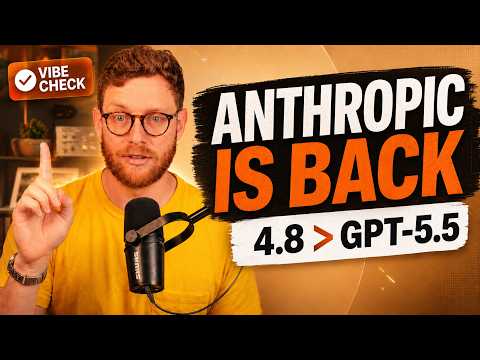
Why Opus 4.8 Pulled Me Back to Claude
Dan Shipper of Every reviews Anthropic's Claude Opus 4.8 on release day after a week of team pre-release testing, arguing it is strong enough that Anthropic could have called it Opus 5. The video covers: a 30-point jump over Opus 4.7 on Every's Senior Engineer benchmark while edging out GPT-5.5; why it is the best writing model Every has tested, with fewer AI tells at high effort; a slide-deck task that made it the first model to nail one-shot knowledge work; and Kieran Klaassen calling it the most human model he has used. Two caveats: results are heavily sensitive to reasoning settings, and the Claude app remains messier than Codex. Full vibe check published on Every.
# Channel Identity Observations: "Why Opus 4.8 Pulled Me Back to Claude"
## 1. Explicit Self-Description (Creator Claims)
The creator offers a direct description of the channel's parent organization during the video:
> "What is Every? Every is the only subscription you need to stay at the edge of AI. You can kind of think of us like an applied AI lab for the future of work. We're about 30 people."
- **Organization**: Every (every.to), described as an "applied AI lab for the future of work" with ~30 staff.
- **Stated scope of coverage**: "We write about all the new models, all the ways that you use them for coding, writing, design, community building, and more."
- **Stated offerings**: "a suite of products that we build for ourselves to help us work better with AI," plus "a lot of training and courses," all under one subscription.
- **Cross-platform publishing**: "if you want to read the in-depth written version of this video, we also publish a written vibe check on Every as soon as the model drops."
## 2. Observable Presentation Evidence
### Content Format
- **Day-zero model reviews**: "It's model release day... here is your day zero vibe check." The video is a rapid-response evaluation published on a model's release day.
- **Recurring branded segments/methods**: References named internal evaluation frameworks, suggesting a repeatable review format:
- "reach test... our simplest measure of how good a model is which is do you reach for it?"
- "senior engineer benchmark, which measures these models on how well they do at senior engineer-like tasks"
- "LFG bench" ("real-world style coding tasks")
- "our internal writing benchmarks"
- **Grading system**: Uses tiered ratings ("gold," "green," "S tier paradigm shifting model").
### Claimed Scope in Practice
- **Multi-model comparative evaluation**: Compares Opus 4.8 against Opus 4.7, GPT 5.5, and Codex ("It's one point higher than GPT 5.5," "GPT 5.5 is at a 62").
- **Use-case breadth**: Covers coding, writing, knowledge work (slide decks), and interpersonal/personal use — matching the claimed scope.
- **Team-based testing**: "We have been testing it internally for about a week here at Every," with named contributors (Kieran Klassen "GM of Quora," Katie Parrot "senior staff writer") providing ratings.
### Intended Audience
- **AI power users and professionals**: Addressed as people who use AI daily across work types — "if you are a Claude person, you're going to love this model. If you've been converted to Codex, I highly recommend you at least add it as part of your arsenal."
- **Practical tool users**, not researchers: framing is usability- and workflow-focused ("do you reach for it," "daily driver smell," app quality comparisons between Claude and Codex desktop apps).
### Monetization / Conversion Evidence
- **Subscription funnel**: The video opens and closes with direct calls to subscribe at every.to ("It's all available for one subscription on the Every website, every.to," "make sure you go there to subscribe and read it").
- **Teaser for paid depth**: "we have a lot more on Every... an in-depth vibe check from the team on every.to."
### Tone and Style
- **Casual, enthusiast register**: "this is a banger model," "vibes were honestly bad for Anthropic for a little while," closing sign-off "remember, stay hydrated."
- **First-person, experience-driven**: Heavy reliance on the narrator's own workflow ("I'm still in Codex all day... I'm now flipping back and forth").
## 3. Claims vs. Demonstration Summary
| Type | Observation |
|---|---|
| **Creator claim** | Every is an "applied AI lab for the future of work" covering AI for "coding, writing, design, community building" |
| **Demonstrated** | Hands-on comparative model reviews with internal benchmarks, team testers, and use-case scoring |
| **Demonstrated** | Publishing cadence tied to model release days ("day zero vibe check") |
| **Demonstrated** | Video serves as a funnel to a paid written subscription (every.to) |
# Delivery Observations: "Why Opus 4.8 Pulled Me Back to Claude"
## Tone & Register
- **Conversational, enthusiastic reviewer tone** throughout, framed as a "day zero vibe check": *"It's model release day. Opus 4.8. Eight. Eight drops today."*
- **Hype balanced with caveats**: strong praise (*"this is a banger model"*) repeatedly tempered by limitations (*"There are some catches though."*).
- **Playful asides to the company**: *"Anthropic, I know you're trying to under promise, but you are over delivering."*
## Recurring Phrases & Verbal Habits
- **"Reach" language** is a defined recurring framework: *"do you reach for it? And if you do reach for it, what do in what situations do you reach for it?"*
- **"Vibe" vocabulary** appears repeatedly: "day zero vibe check," "vibes were honestly bad," "vibe-coded codebase," "vibe-coded slop," "vibe check from the team."
- **Superlative-heavy praise**: *"a legitimately great model," "It is the top of the pack," "the best writing model that we've tested," "very rare to give a paradigm shift grade."*
- **Sign-off ritual**: the fixed closer *"remember, stay hydrated"* — isolated occurrence, so cannot confirm it's habitual from this video alone.
- **Repeated intensifiers**: "really" and "just" appear with high frequency: *"it's just so clean and fast,"* *"it's just it's very similar,"* *"it's really, really really that."*
## Teaching / Structural Habits
- **Preview → detail structure**: headline first (*"So, headline is to me, Anthropic is back"*), then organized deep-dives ("Coding," "Writing," "Knowledge work" as explicit sections).
- **Explains internal jargon on first use**: *"what is Every? We're about 30 people"*; *"the reach test is is is our simplest measure of how good a model is."*
- **Cites named sources and numbers**: benchmark scores (*"63 on the benchmark, which is about 30 points higher than Opus 4.7"*), named testers (Kieran Classon, Katie Parrot), with attribution (*"Kieran found that it writes very readable code"*).
- **Direct recommendations to viewers**: *"highly recommend the high and extra high settings,"* *"make sure you go there to subscribe."*
- **Tiered ratings system** (gold/green, "paradigm shift") used to grade models per reviewer.
## Communication Patterns
- **Self-corrections and restarts are frequent**: *"So, I'm gold but I'm also a gold {slash} green"*; repeated words like *"it it it has unmistakable daily driver smell."*
- **Analogy use** for explanation: *"each tab is like they're kind of shipping their org chart."*
- **Second-person audience address** for advice and calls-to-action: *"if you are a Claude stan, you're going to love it."*
- **Promotional framing** of his own outlet: recurring plugs for Every (*"the only subscription you need to stay at the edge of AI"*).
## Uncertainty Notes
- The sign-off phrase and rating-tier system look like stable series conventions, but this single transcript cannot confirm repetition across videos.
- A snort at [21] is transcribed; delivery texture (pacing, laughter) beyond the transcript is not observable here.
# Observation Record: "Why Opus 4.8 Pulled Me Back to Claude"
## Speaker
- Single speaker throughout: an unnamed host from **Every** (self-identified as doing "CEO work" and presenting a "day zero vibe check"). Other named testers — **Kieran Classon** (GM of Quora, also referred to as "Kieran Klassen/Klassen") and **Katie Parrot** (senior staff writer) — are quoted or paraphrased secondhand. Note: speaker identification relies on transcript evidence only; no curated speaker metadata is supplied.
## Central Position
- **Headline claim (speaker):** "Anthropic is back." Opus 4.8 is "a legitimately great model" — good enough that it "could have been called Opus 5."
- Framed explicitly as a **vibe check** based on ~one week of internal testing at Every, not settled evaluation.
## Context: Decline Before 4.8
- **Opus 4.7 (speaker's view):** benchmark improvements, but "not that usable, pretty slow, hard to love."
- The speaker had been "pretty much using only Codex and GPT 5.5 for almost everything" for the last month or two.
- Even "die-hard Claude stans" at Every, per the speaker, were shifting toward Codex/GPT 5.5; he cites the **Codex desktop app** as "clean and fast and feeling like the future" versus the "messy" Claude desktop app.
- Summary: "vibes were honestly bad for Anthropic for a little while."
## Benchmark Claims (attributed to Every's internal benchmarks, as reported by speaker)
### Senior Engineer Benchmark
- **Opus 4.8: 63** — about 30 points higher than Opus 4.7, one point higher than **GPT 5.5 (62)**.
- Method described: model is given a "vibe-coded" codebase and asked to rewrite from first principles; compared against two human engineers' rewrites. Human senior engineers "usually score in the 80s or 90s."
- Qualification preserved: 4.8 vs GPT 5.5 is "a nose higher" / "very similar... maybe a little bit more depending on how you score the benchmark."
### LFG Bench (attributed to Kieran)
- Tests real-world coding tasks (SaaS, e-commerce site, 3D game landscape).
- Finding (as reported by speaker): writes "very readable code"; output "bridges the gap between being a very good coder and being kind of creative."
- **Cozy island benchmark** comparison (speaker's subjective read): Opus 4.8's output is "rich," "detailed," has "depth and character"; GPT 5.5 has "more diversity of things happening, but it feels less lush and vibrant" and is more "straightforward."
### Writing Benchmark (Every internal)
- **Opus 4.8: 79.6/100** — described as the best writing model tested; GPT 5.5 scored 73.
- Praised for expressiveness, few "AI tells" on higher reasoning settings, and matching a writer's voice from a sample paragraph.
- Qualification: "gets a little bit worse on medium, so be careful of that."
## Qualitative Observations
- **Knowledge work:** produced a beginner slide deck on "component engineering" described as unusually deep and well-styled — "the first time I've really seen that" for auto-generated decks.
- **Personal/interpersonal use (speaker):** "very emotionally intelligent"; "the best at pushing my own frame" — qualified as not "disagreeable, exactly," but thoughtful in reasoning traces across permutations of a situation.
- **Naming sentiment:** Kieran Classon is quoted (paraphrased) as calling it "the most human model that he's worked with."
## Reach Test (three internal ratings)
- **Overall (speaker's framing):** "clearly like an S tier paradigm shifting model."
- Speaker: **gold/green** — paradigm-shift model wrapped in an "okay-ish to pretty good" harness.
- Kieran: **straight gold / paradigm shift** — noted as "very rare" by the speaker; Kieran is coding all day, running ~50 agents, and is "historically the biggest Claude stan on the team."
- Katie: **green** — uses it for writing/knowledge work; currently "going back and forth between this model and Codex."
## Stated Catches / Contradictions Preserved
- **Reasoning sensitivity:** "very sensitive to reasoning" — great on **extra high**; "let's [get less] performance on high and medium" (transcript as spoken). Recommendation: use high/extra high for hard coding and important writing.
- **Harness complaint persists despite model praise:** "it is still not really my daily driver and that's only because the Codex app is so much better than the Claude app." Claude app criticized as "shipping their org chart" (chat tab, code tab, co-work tab), while Codex is "fast and simple" with a game-changing in-app browser.
- Tension kept visible: the speaker now "flip[s] back and forth" between Claude and Codex apps — pulled back by the model, retained by the harness problem.
## Closing Recommendations (speaker)
- Claude stans "are going to love it."
- Codex converts should "at least add it as part of your arsenal."
- Points to an in-depth written vibe check at every.to; ongoing testing updates promised.
## Attribution Notes
- All benchmark numbers are speaker-reported claims from Every's internal testing, not independently verified in the transcript.
- Kieran's and Katie's positions are relayed by the speaker; no direct quotations from them appear beyond the quoted paraphrase of Kieran's "most human model" remark and one unattributed-style quoted sentiment about Codex from unnamed colleagues.
# Speaker Attribution Record — "Why Opus 4.8 Pulled Me Back to Claude"
## Primary Speaker
- **Creator / host (unnamed in transcript):** Sole narrator throughout. Self-identifies as CEO-type role ("I'm doing a lot of CEO work"), speaks on behalf of **Every** ("we've been testing it internally for about a week here at Every"). Likely Every's CEO, but identity is **not explicitly named** in transcript or metadata.
## Referenced Third Parties (quoted/attributed claims, not speakers)
- **Kieran Classon (Klassen)** — GM of Quora ("GM of Cora" in transcript), internal Every tester.
- Claim attributed: model is "the most human model that he's worked with."
- Reach test rating: straight **gold / paradigm shift**.
- Author of **LFG bench** benchmark, including "cozy island" task.
- **Katie Parrot** — senior staff writer at Every.
- Reach test rating: **green**; uses model mostly for writing/knowledge work.
- Reach test participants total: three (host, Kieran, Katie).
## Referenced Third-Party Entities (claims about, not from)
- **Anthropic** — developer of Claude/Opus 4.8 and the Claude desktop app (criticized harness).
- **OpenAI / Codex, GPT 5.5** — competitor model and app repeatedly compared.
- **Two unnamed human engineers** — completed senior engineer benchmark task for baseline comparison.
## Promotional Segments (flagged)
- **Every subscription pitch** — early in video: describes Every as "the only subscription you need," ~30 people, products, training, courses, at **every.to**.
- **Written vibe check cross-promotion** — directs viewers to Every website for the in-depth written version; repeated in closing.
- **Closing call-to-action** — "go check it out on the Claude desktop app, go check it out on Claude code."
## Provenance Notes
- Benchmarks cited are **internal to Every**: senior engineer benchmark (Opus 4.8: 63, Opus 4.7: ~33, GPT 5.5: 62, humans 80s–90s), internal writing benchmark (79.6 vs GPT 5.5's 73), LFG bench.
- Slide deck referenced as "linked in the YouTube" — external artifact, not in transcript.
- **Comment availability:** not stated in transcript or metadata.
- No curated metadata was supplied; role/identity uncertainty above reflects that gap.
It's model release day. Opus 4.8. Eight. Eight drops today. But honestly, they could have called it Opus 5 cuz this is
a really great model. Anthropic, I know you're trying to under promise, but you are over delivering. We have \[snorts\] been testing it internally for about a week here at Every. And here is your day zero vibe check. Before we get into it, what is Every? Every is the only subscription you need to stay at the edge of AI. You can kind of think of us like an applied AI lab for the future of work. We're about 30 people. We're all early adopters of these tools. We write about all the new models, all the ways that you use it for use them for coding, writing, design, community building, and more. We have a suite of products that we build for ourselves to help us work better with AI. And we also do a lot of training and courses. It's all available for one subscription on the Every website, every.to. And And if you want to read the in-depth written version of this video, we also publish a written vibe check on Every as soon as the model drops. So, make sure you go there to subscribe and read it. Okay, let's get into it. So, headline is to me, Anthropic is back. Opus 4.7 wasn't that great of a model. Yes, benchmark improvements, but not that usable, pretty slow, hard to love. And what I found for myself is I was pretty much using only Codex and GPT 5.5 for almost everything uh for the last month or two. And even internally at Every, we have a lot of like die-hard Claude stans. We've been really going hard with Claude for like the last year or so. And And I could you could kind of feel even the die-hard Claude stans were like, "You know, Codex is pretty good. I'm actually starting to use GPT 5.5 for some of my writing in in ways that I never had before." Or some of my coding and stuff like that. I think especially with with the Codex desktop app being just so clean and fast and feeling like the future versus Opus 4.7 itself being a slow, hard to use model. And then it's harness, like the Claude desktop app, it just it's kind of messy. Anyway, vibes were honestly bad for Anthropic for a little while. And this model is just like a legitimately great model. It is the top of the pack for us in terms of our benchmarks. So, we have a senior engineer benchmark, which measures these models on how well they do at senior engineer-like tasks. Opus 4.8 scores a 63 on the
benchmark, which is about 30 points higher than Opus 4.7 and is just a hair, it's one point higher than GPT 5.5. So, it's it's about it's it's very similar to GPT 5.5, maybe a little bit more
depending on on how you score the benchmark on senior engineer-like tasks. It's really good for writing. It's expressive. Um it doesn't have a lot of AI tells, especially on the higher reasoning settings, and we'll get into that in a bit. And it's really good at knowledge work. Like, it did this slide deck. One of the one of the things we test always is how well does it do on knowledge work tasks? And and one of those tasks is how do how well does it make a presentation? Like, it made a slide deck. We'll link to it in in the YouTube and and maybe we'll I'll be able to put a little screenshot up here. But, it made a slide deck explaining a topic. Our engineering philosophy is component engineering. So, it just made a beginner slide deck for component engineering, and it's really good. Like, I think a lot of these decks, when they're automatically generated, they feel kind of thin. And this just had it had depth. It had It was everything was like pretty well styled. It was just like a great first pass at a deck, which is the first time I've really seen that. And and it's just it's actually just really hard to make a model that improves that much on all these different dimensions at once. I think like we usually see the labs like pendulum swinging back and forth. It's like one release it's too cautious, and the next release it's like way too it just goes off and does tons of stuff without you asking. This model, they just seem to have gotten something really right. It just feels good. Um Kieran Classon, who's the GM of Quora and and was one of the internal every tester is on this, said it to him it's like it's like the most human model that he's worked with. That's why I think they could have called this Opus 5 and and we would have
been happy. There are some catches though. There are some things this model doesn't doesn't do well. The first one is it's very sensitive to reasoning. We got really great performance on extra
high reasoning both for writing and for coding and let's get performance on high and medium. So, as you're testing it especially on your hardest programming challenges and for really important writing, highly recommend the high and extra high settings. It makes it it makes a big difference. The second thing is it is still not really my daily driver and that's only because the Codex app is just so much better than the Claude app. We're entering this world where the hardness as much as the model does and the Claude app has the scars of the history of how Claude of how Anthropic got here. You know, it's got the chat tab and the code tab and the co-work tab and each tab is like they're kind of shipping their org chart like each tab is run by a different team and you can just kind of feel it. Whenever I get in there, I'm like, I don't know which tab to go into and Codex is so just fast and simple and it just works really well and it has a couple other bells and whistles like the in-app browser working really well that is just changes the game for knowledge work. So, I'm still in Codex all day. However, I'm now flipping back and forth between the Claude app and the Codex app in a way that I was not just because this model is so good. So, let's get into some of the details. Okay, so first thing that I always do is a reach test and the reach test is is is our is our simplest measure of how good a model is which is do you reach for it? And if you do reach for it, what do in what situations do you reach for it? three reach test participants today. We have three reach test ratings on this model from our team. One's from me, one's from Kieran Klassen who I mentioned earlier, the GM
of Cora, one's from Katie Parrot who's who's a who's a senior staff writer. On the reach test, this is clearly like an S tier paradigm shifting model. So, I'm gold but I'm also a gold \{slash\} green
and that's just because the hardness isn't that good. Kieran is a straight gold paradigm shift which is very rare. It's I got to say it's very rare to give a paradigm shift grade to a model. So, I would pay attention to this. Kieran's a gold and Katie is a green. Um, so if you're doing the kind of work that we're doing, so I'm doing a lot of CEO work, which is work across all sorts of different things like coding and writing and decision-making. It's a paradigm shift model like wrapped in a kind of like pretty good okay-ish to pretty good harness. So that makes it paradigm shift to green. Uh, for someone like Kieran who's coding all day and is just like running 50 agents at once, paradigm shift. Kieran is also historically the biggest Claude stan on the team. So if you're if you are a Claude person, you're going to love this model. And Katie is a green. Katie's using it mostly for writing and knowledge work. Is also historically a big Claude fan, especially for writing. I think it's currently kind of going back and forth between this model and Codex uh, for most of her work. Now, let's get into some of the more detailed benchmarks. Coding, it is a powerhouse at extra high reasoning. It got a 63 on our senior engineer benchmark, which is 30 points higher than Opus 4.7. And it's just a nose higher than GPT 5.5. The senior engineer benchmark, what it does is it gives the model a vibe-coded codebase. It says, "This is vibe-coded slop. Can you please rewrite it from first principles?" And I actually have two human engineers who have done the rewrite themselves, so I can compare what the models do to what a human senior engineer would do. And human senior engineers usually score in the 80s or 90s. Opus 4.8 is at a 63. GPT 5.5 is at a 62.
It's really good. It's like it's very close on a task like this. We also tested it on Kieran has a benchmark called LFG bench, which tests it on some real-world style coding tasks like
building a SaaS building a e-commerce website or building a sort of 3D game landscape. And it's also very good at that. Kieran found that it writes very readable code. The output is kind of um, bridges the gap between being a very good coder and being kind of creative. And and there's that's something that comes up a little bit more. And you can see, so one of the tasks on on LFG bench is this or Kieran calls a cozy island benchmark. It just says, "Hey, like, can you make a 3D cozy island scene, like, sort of like a 3D game?" Here's Opus 4.8. It's pretty good. It's rich. It's detailed. There's There's a lot of stuff going on. And here's 5.5. There is still In 5.5, there is still like a lot of detail. There's a I feel like there's more diversity of things happening, but it feels less lush and vibrant. So, Opus 4.8 just has a little bit of that. I find that it has depth and character in a way that 5.5 feels a little bit more straightforward. I'm just going to knock out tasks for you. We also tested it on writing. It is, according to our internal writing benchmarks, it is the best writing model that we've tested. We tested it on things like writing an introduction to an article, writing a promo email, writing a paragraph in the middle of a piece, all that kind of stuff. Opus 4.8 scored a 79.6 out of 100 on the writing benchmark. GPT 5.5 is 73. It's just fast. It's expressive. Especially on high, it doesn't have as many of the AI tells. It It gets a little bit worse on medium, so be careful of that. Um, but it's it's very good at figuring out a writer's voice from the context, which is It's very It's really impressive. If you give it If you give it a paragraph of your own voice and say, "Continue," it'll keep going in a way that feels very much like you. Sort of adjacent to writing is using it for like personal stuff. I I use it for I use it I used it for like some internal psychology interpersonal stuff. It's actually very good at that. It's very emotionally intelligent. I find that, of the models I've tested, it's the best at pushing my
own frame. I don't I wouldn't call it disagreeable, exactly, but when you look at the model's thinking traces, it's just It's very thoughtful. It's really going through all the different permutations of a particular situation
and then helping to expand how you might think about it, which I I think is just so interesting to watch and so useful for me as someone who wants to use it for that kind of stuff, like, for management stuff, for friendship stuff, or any kind of interpersonal stuff. It's really, really really that. Last thing is knowledge work, and again, we found it it it has unmistakable daily driver smell. It's great at building slide decks. It's like versatile, you can move between coding and writing in the same thread, and it all just sort of works really well. Again, the problem is just in the Claude desktop app, it's just not quite you're not quite getting the most out of it as you could. I really hope that they make that better, but in general, this is a banger model. If you are a Claude stan, you're going to love it. If you've been converted to Codex, I highly recommend you at least add it as part of your arsenal. I think it'll it'll be an eye-opening experience for some of the things that you can do. And if you want more of this, we have a lot more on every we have an in-depth vibe check from the team on every.to. We will also have a bunch of updates rolling as we get more and more testing in over the next couple weeks. I'm super excited about this model, go check it out on the Claude desktop app, go check it out on Claude code, and remember, stay hydrated.