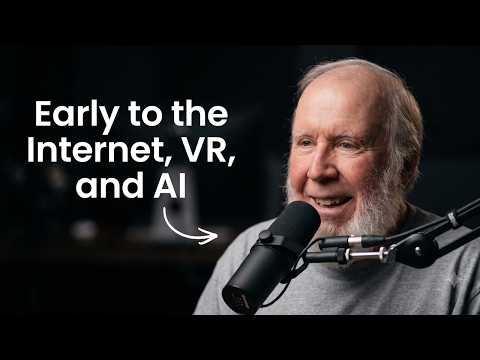
Wired's Kevin Kelly on Why AI Is a 50-year Overnight…
A re-release of Dan Shipper's AI & I conversation with Kevin Kelly, founding executive editor of Wired, author of The Inevitable, and cofounder of the Long Now Foundation. Kelly discusses why historians can be the best futurists, how modern efforts to understand intelligence parallel early scientists' study of electricity, and how his long-term perspective keeps him grounded through tech hype cycles. Other topics include how Kelly predicts the future, discovering your competitive advantage, assembling Wired's roster of star writers, co-creating a book with ChatGPT, using AI as a mirror for the mind, and lessons from betting on VR in the 1980s. Kelly also describes the joy of creating a personal AI-generated saga featuring Leonardo Da Vinci, Christopher Columbus, and Martin Luther—one only he will ever read.
# Channel Presentation Observations
## Video Overview
An interview episode featuring **Kevin Kelly** (Wired co-founder) in conversation with host **Dan Shipper**, on a show identified in the outro as **"AI and I"**.
## Self-Identification Evidence
- **Show name and host**: The outro names the program directly — *"subscribe to AI and I"* and *"a journey into the future with Dan Shipper as the captain of the spaceship."*
- **Content repackaging**: The title frames this as curated back-catalog content — *"Wired's Kevin Kelly on Why AI Is a 50-year Overnight Success (Best of the Pod)"* — indicating the channel re-releases "best of" episodes.
- **Creator's other role**: The host self-describes as a media company operator: *"the company that I run it's a media company... I come from the software world."*
## Intended Audience
The presentation addresses a **technically literate, professionally engaged audience**:
- Detailed, unprompted discussion of model versions (*"are using 401 03?"*, *"I have the 01 pro"*) presumes listeners tracking AI tooling.
- Discussion of OpenAI's then-new memory feature described as breaking news (*"just came out today like a couple hours ago"*), positioning the channel as timely for AI-following viewers.
- Career/practice advice for knowledge workers and creators: *"don't aim to be the best, aim to be the only"*, plus editing-workflow tips for writing with AI.
- The host frames personal resonance for people doing creative/knowledge work: *"it's about being honest and authentic to who you are... that's been quite helpful for me."*
## Claimed Scope and Positioning
- **AI-centered but intellectually broad**: despite the show name, the conversation ranges across Annie Dillard, Burning Man, the history of electricity, and *The Long Now Foundation* — suggesting a channel positioning AI within a wider techno-cultural/intellectual frame.
- **Interview format with expert guests**: guest credentials foregrounded in the title (*"Wired's Kevin Kelly"*) and host framing (*"a personal hero of mine, I am a longtime Wired reader"*).
- **Futurism with humility**: guest claims like *"it's easy to make predictions and hard to make predictions that are true"* and *"AI is a 50-year overnight success"* signal a reflective, historically-grounded take on technology.
## Observable Presentation Patterns
- **Playful, informal outro**: the scripted call-to-action (*"smash that like button... filled with pure, unadulterated knowledge bombs about chat GPT"*, *"Dan, I'm absolutely hopelessly in love with you"*) uses exaggerated, comedic delivery — indicating a self-aware, humorous channel voice layered over substantive content.
- **Conversational, long-form dialogue** with host-driven follow-ups rather than Q&A rigidity.
- Notably, the host references his own employer's ecosystem casually (*"CHACHBT"*, using AI tools "all day before we got on the show"), consistent with practitioner-adjacent rather than purely journalistic framing.
## Caveats
- All scope/positioning inferences are from a single episode; the "(Best of the Pod)" title suggests this is representative but repackaged material.
- Guest statements about AI, VR, and blockchain are the guest's claims, not channel claims, though the channel chose to host and title around them.
# Delivery Observation: Kevin Kelly Interview (AI and I podcast)
## Overall Format
Long-form conversation between host Dan Shipper and guest Kevin Kelly. The delivery alternates between the host's framing questions and Kelly's extended, example-driven answers.
## Recurring Linguistic and Teaching Patterns (Kelly)
### Aphorism-style compression
Kelly repeatedly condenses arguments into short, quotable maxims, often repeated verbatim later in the conversation:
> "It's easy to make predictions and hard to make predictions that are true."
> "VR is still waiting for its LLM moment."
> "AI is a 50-year overnight success."
> "Don't aim to be the best, aim to be the only."
### Analogical teaching via historical parallels
Kelly's dominant teaching habit is mapping the present onto history, especially the electricity analogy, which he sustains across multiple exchanges:
> "We're as ignorant of it as Isaac Newton and others were of electricity when it was first encountered."
> "I suspect that intelligence is not an element but a compound... in the same way that salt's not a element. Salt is actually a compound of some elements."
> "You can think of the current AI is we're making some kind of salt and we don't even know what it's made from."
He extends the analogy structurally (elements → compounds → "tissues"), showing a layered, building-block explanatory style.
### Concrete narrative episodes
Kelly teaches through specific first-person stories with dates and details:
- Jaron Lanier showing him VR in 1987 ("I was completely blown away")
- Discovering *Pilgrim at Tinker Creek* in "a library, American library in Kandy, Sri Lanka" — entered "because there was air conditioning"
- Burning Man history ("the first 96 or so... there was no adult supervision at all")
- The da Vinci/Luther/Columbus AI world-building project
### Honest self-accounting about error
He foregrounds his own wrong predictions, naming them specifically:
> "I was very wrong about VR... I was wrong about eBay... I was early to blockchain, but I didn't think Bitcoin was really going to be much."
### Hedged certainty markers
Kelly frequently signals degrees of confidence rather than asserting flatly:
> "I suspect that there is many compounds and that they will be engineered to do different things"
> "That's possible but I suspect that's wrong."
> "I could be wrong, but for me, eBay is only now succeeded because most people aren't using the auctions."
### Verbal tics and rhythms
- Intensifier stacking: "very very surprised," "huge huge huge gap," "very very good AI therapists"
- Self-restarts and repetition for emphasis: "I was completely blown away and I thought, 'Oh my gosh, this is this is this is the future.'"
- "You know" as a frequent filler across turns
## Host Patterns (Dan Shipper)
- **Analogical bridging**: connects guest topics to outside references — *Deadwood* for "pioneer to builder," "active imagination" (Jungian therapy) for Kelly's AI world-building.
- **Quotation-anchored questions**: opens segments by reading the guest's own words back ("after living online for the past three decades... my confidence in this inevitability...").
- **Personal disclosure as rapport**: "I am a longtime wired reader. I had like a gigantic shelf of magazines growing up."
- **Conversational rhythm**: frequent "Yeah" acknowledgments and collaborative completions ("Yeah. I lifted and struck.").
## Isolated Moments (lower confidence as patterns)
- **Promotional outro** (final ~40 seconds) in a markedly different, hyped register ("smash that like button," "knowledge bombs") — likely scripted channel branding, not representative of the conversation's tone.
- Kelly's advice-giving register ("This is what I tell every aspiring [writer]...") appears mainly in the Neil Stevenson segment and may be situation-specific rather than habitual.
- Laughter, snorts, and throat-clearing annotations appear throughout but reflect transcription capture, not deliberate delivery choices.
## Uncertainty Notes
- The single transcript provides one session; repetition confidence is highest for the electricity analogy, aphorisms, and hedging language (each appears 3+ times), and weakest for claims about interview temperament or consistent pacing, which cannot be verified from text alone.
# Observation Record: Wired's Kevin Kelly on Why AI Is a 50-year Overnight Success
## Speakers
- **Kevin Kelly** — founding editor of *Wired*, author of *The Inevitable* (identified via title/metadata and transcript context)
- **Dan Shipper** — host (identified via outro narration; media company founder, background in software)
---
## Kevin Kelly's Positions
### On prediction and being wrong
- **Core claim:** > "What I've learned with the future is that it's easy to make predictions and hard to make predictions that are true."
- Kelly opens by reflecting on his own errors:
- **VR:** Jaron Lanier showed him VR in 1987; he was "completely blown away" and thought it was the future. He argues the VR of decades ago "is not that much different than the VR you get now" — the change was cost, from multi-million dollars to ~$100, not a million-fold capability improvement.
- **eBay:** He dismissed it ("who would use this?") — he now says he lacked imagination. He speculates (with hedging: "I could be wrong") that eBay succeeded *because* most users moved beyond auctions, which he personally never connected with.
- **Bitcoin/blockchain:** He was early to blockchain but didn't foresee it becoming a store of value, expected micropayments (underestimating processing costs), and expected non-financial uses — which "really didn't happen."
### Why VR stalled — and why robots will too
- VR required solving **biological** problems (eyes, weight on the head) in addition to hardware ones: "you have hardware, biology, and that is just going to go slower."
- **Extrapolation:** > "The arrival of robots is going to take a lot longer than people think," because humans are "a 25-watt supercomputer and a quarter-horsepower engine" — an efficiency gap he calls "huge, huge, huge."
### VR vs. AI timing
- > "You could say VR is still waiting for its LLM moment."
- He notes LLMs emerged indirectly — reasoning was noticed in language translation work, "completely unexpected" — so VR's key breakthrough might come from elsewhere, but hasn't yet.
- **Framing:** > "AI is a 50-year overnight success."
### On intelligence: the electricity analogy
- **Central contention:** > "We have no idea what intelligence is." He compares our ignorance to Newton's (wrong) fluid theories of electricity.
- Historical detail he cites: Davy and Faraday's weekly electricity demos (origin of the Royal Institution's ticketed meetings); early beliefs electricity was biological; the vacuum experiment that eliminated the ether.
- **Hypothesis:** > "I suspect that intelligence is not an element but a compound... made up of a complex of different cognitive elements" that we haven't identified — "we're making some kind of salt and we don't even know what it's made from."
- Sources of the intuition: Marvin Minsky's *Society of Mind*, and mixture-of-experts AI architectures.
- He distinguishes the elemental "cognitive units" from neural network hardware — citing Danny Hillis's Tinkertoy computer — saying the basic unit is some unidentified process of pattern matching/reasoning, possibly platform-agnostic.
### On human minds and AI diversity
- Human brains are "incredibly opaque to introspection... deliberately" — if we had source-code access, "we'd be completely wrecking ourselves."
- In the possibility space of all minds, humans are "an edge species," not at the center of anything.
- He rejects the view that there's only universal intelligence: "I suspect that's wrong. I suspect that there are many compounds," engineered for different purposes, some of which we won't understand.
### On frontiers, pioneers, and builders
- He acknowledges **loss** as frontiers formalize: "feelings of loss as the... freedom of no laws... goes away."
- **Burning Man analogy:** early years were chaotic ("no streets... no adult supervision"), but after a death, order layered in. His verdict: "Burning Man's better than ever" — "more to be gained by adding that layer of organization and structure and governance."
- **Prescription:** keep generating new frontiers. "Some people are better on the frontier than back at the center... I want to maintain both."
- His personal stance: > "I tend to visit the frontier." He lived in remote Asia but "would have died if I needed to live there." Same with Burning Man ("fantastic for two weeks") and the internet/AI frontier: "I can keep going up to the edge to see what's happening, but I don't need to stay there... I'm going to actually come back and report."
### Balancing frontier and long-term view
- Favorite futurists "were actually great historians too." He balances AI reading with history, and screen work with hands-on workshop time.
- References Jeff Bezos on building on what doesn't change, and the **Long Now Foundation** (he says he's been "very central to" it): thinking about "the next 10,000 years and the last 10,000 years."
### On career and creativity
- "I had more directions than destinies or destinations."
- **Advice:** > "Don't aim to be the best, aim to be the only" — which he wishes someone had told him earlier; he only realized retrospectively this is what he'd done.
- The lesson crystallized at *Wired*: story ideas he couldn't sell to writers, he'd do himself and realize "only I can do it."
### On assigning writing (disagreement with host)
- Shipper said getting writers to execute his ideas is "almost never" good. Kelly **disagreed from his own experience**: "the writers were even better." He assigned Neil Stevenson the fiber-optic story after reading in *IEEE Spectrum*; Stevenson "did this masterpiece I could never ever have done," as did Bruce Sterling.
- **Method:** give young science fiction writers journalistic assignments — "they're born storytellers. You're paying them to go learn something they want to learn." He concedes Shipper's point that the writer must be genuinely interested: "you have to match it to something that they're interested in... that's the trick."
### On AI in his writing workflow
- AI is great "because it's... helping get something on the page" — he describes himself as "a gardener rather than architect," and AI helps with organizing, which he lacks.
- Uses **OpenAI** (says he has "the o1 pro"); calls deep research results "astounding."
- **Skill claim:** > "Getting the most from it is a skill that will take you 10,000 hours... It's definitely not just pushing the buttons."
- Uses Midjourney for AI images (habitual preference); likes the public Discord prompt-learning aspect.
### The "audience of one" hypothesis
- Describes a project using deep research: an AI-generated conversation among da Vinci, Luther, and Columbus stuck in a hotel, expanded into a world-building exercise (a science-and-religious-freedom city in the New World, Queen Victoria as rival, reaching China before the Portuguese), producing 10 novels, a synthesized saga, covers, and marketing materials.
- He won't show it to anyone: > "The joy of creating it was better than reading it. It was the audience of one."
- **Hypothesis:** of the ~50 million AI images generated daily, "99.999% have the audience of one"; people will co-generate feature-length films for themselves, with the pleasure in the generating.
- **Qualification:** "There's no economic model for the audience of one" — it's "closer to entertainment than... a career," like Sunday painting or journaling.
### On AI emotional bonds
- > "People are going to be shocked by the degree of the emotional bonding that we will have as we put emotions into the AIs" — some people will be "very dependent on them to do their best."
- He predicts very good AI therapists, possibly unlabelled as such (companions/buddies performing that function).
### On Annie Dillard
- Discovered *Pilgrim at Tinker Creek* in an American library in Kandy, Sri Lanka ("because there was air conditioning"). It's "why I write at all": "I don't know what she's doing, but I want to do that."
- Praises the combination of "cosmic poetic" transcendence grounded in concrete science trivia ("wrapping rapturous ecstasy with very concrete science trivia"), and the "sweet sour flavor" — she "can be pretty harsh too," not "just sweet kumbaya."
- Read her essays (*Teaching a Stone to Talk*, *Holy the Firm*, *The Writing Life*); says her total eclipse account is one "anybody who writes about eclipse has to start with."
- Sent her a haiku-and-sketch book from his bicycle crossing of the US; she replied with "some nice words" and liked one little drawing — a reply he thinks is "probably pretty rare."
---
## Dan Shipper's Positions (host)
- **On Annie Dillard:** His favorite writer; describes her theme of transcendence in ordinary nature — "the veil is lifted from your eyes... moments of transcendence where everything feels like it's glowing from within."
- **Pioneer→builder resonance:** Cites Kelly's *The Inevitable* quote about "pioneer... to builder" and relates it to HBO's *Deadwood*; argues "every single wave" (including AI) shows pioneers mapping terrain before builders move in.
- **Pushback on intelligence:** Suggests we "do know" what intelligence is, but in a different way than electricity — no explicit mathematical theory or decomposition, but interpersonal recognition ("I know that you're intelligent"). Frames fuzziness as possibly a property of intelligence itself.
- **On neural networks:** Notes we know the low-level "atomic units" and that architecture choice barely matters for high-level behavior — "something... hard to understand in between the simple components and the... outward behavior"; asks how many learned rules are contingent vs. universal.
- **On ghost-writing:** His experience running a media company (from a software background) is that assigning your idea to writers is "almost never" good; only a small portion of writers make good ghosts. Talent isn't the issue — interest is.
- **AI as editor:** Observes AI "puts you into editing mode much quicker."
- **Active imagination:** Introduces Jungian active imagination as a parallel to Kelly's AI world-building — the creative choices "might tell you something about yourself."
- **On OpenAI memory (released that day):** Describes ChatGPT's new automatic access to past chat history; says "I want to use something that feels like it knows me... I get more attached to it. I personally think that's really good, but there's trade-offs," and he's "curious how that changes how we relate to each other."
---
## Unresolved Tensions & Disagreements (preserved)
- **Kelly vs. Shipper on knowing intelligence:** Kelly insists we only *recognize*, not *know*, intelligence ("You may be confusing recognizing something with knowing it"); Shipper maintains we know it in a non-decompositional way. Neither concedes.
- **Kelly vs. Shipper on assigning writing:** Kelly's experience contradicts Shipper's; they partially reconcile via the interest-matching caveat.
- **Kelly's self-correction:** He flags his own eBay explanation as tentative ("I could be wrong, but... I don't know if that's really true or not").
- **Kelly's tension on frontiers:** He mourns lost frontier freedom yet says structure and governance produce net gains — resolved only by insisting on *continually new* frontiers.
- **Audience of one vs. economics:** Kelly explicitly notes the phenomenon lacks any economic model, separating it from his earlier "1,000 true fans" framing (Shipper draws that contrast; Kelly confirms with "there is [a model] for OpenAI").
- **Kelly's confession of past error:** His framework of prediction is built on his admitted failures (VR, eBay, blockchain), not presented as a record of foresight.
# Speaker & Provenance Record
## Video
- **Title:** *Wired's Kevin Kelly on Why AI Is a 50-year Overnight Success (Best of the Pod)*
- **Show name (as stated in outro):** "AI and I"
- **Format:** Interview podcast episode, apparently a "Best of the Pod" compilation/cut
## Speakers & Roles
### Kevin Kelly — Guest
- Identified by the host's greeting: "Kevin, welcome to the show," and his reply: "It's a pleasure to be here."
- **Identity credentials stated in conversation:** co-founder/longtime figure at **Wired** (host calls him "a personal hero," references reading *Wired* growing up; Kelly describes assigning stories at *Wired*); author of *The Inevitable*; involved with the **Long Now Foundation** ("I've been very central to").
- **Claims about himself in-transcript:**
- Was shown VR by **Jaron Lanier in ~1987**
- Spent extended time in remote Asia in early adulthood; bicycled across the US, made a daily haiku-and-sketch book and sent it to **Annie Dillard**, who replied with a note
- Attended the first Burning Man (~1996); did artwork there recently
- **AI usage claims:** uses OpenAI (ChatGPT, "01 pro"), Midjourney for image tweets; describes a collaborative "audience of one" worldbuilding project (Da Vinci/Luther/Columbus fictional city)
### Dan Shipper — Host / Interviewer
- Named in the outro: "with **Dan Shipper** as the captain of the spaceship."
- Self-identifies as running a **media company**, coming from a software background, being an Annie Dillard fan, and having experimented with ChatGPT's newly released memory feature "all day before we got on the show."
### Other identified roles
- **Unidentified narrator (closing promotional segment):** A stylized outro voice urging viewers to "smash that like button and subscribe to AI and I," praising the show and Dan Shipper. This is **promotional content**, not interview material — flag as **promotion**. Speaker identity not established (possibly AI-generated or scripted voice).
## Referenced Sources & Third Parties
- **People/works discussed:** Annie Dillard (*Pilgrim at Tinker Creek*, *Holy the Firm*, *Teaching a Stone to Talk*, *The Writing Life*), *Deadwood* (HBO), Marvin Minsky (*Society of Mind*), Danny Hillis (tinkertoys computer), Jeff Bezos ("things that don't change"), Neal Stephenson and Bruce Sterling (assigned Wired stories), Isaac Newton's fluid/ether theories, Davy and Faraday, Long Now Foundation, mixture-of-experts AI.
- **News claim (host, third-party):** OpenAI released a new ChatGPT memory system "today, like a couple hours ago" — dated claim made in-transcript, not independently verifiable here.
- **Kelly's tools claim:** uses OpenAI 01 pro, Midjourney.
## Availability / Segment Boundaries
- **Curated metadata:** none supplied beyond title/transcript; speaker identity of host relies on the outro naming Dan Shipper.
- **No cited external documents, links, or comment availability** are referenced in the transcript.
- **Promotional outro** (final paragraphs) is not part of the interview and should be excluded from content attribution.
What I've learned with the future is that it's easy to make predictions and hard to make predictions that are true. Jiren Lenir showed me VR in 87.
I was completely blown away and I thought, "Oh my gosh, this is the future." The VR that we had back then is not that much different than the VR you get now. The difference was that was multi-million dollars and it was now $100. I've been very very surprised about how slow that has been. You could say VR is still waiting for its LLM moment. AI's 50y year overnight success.
\>\> Kevin, welcome to the show. \>\> It's a pleasure to be here. I'm glad to be seen. \>\> I am very excited to have you. In addition to being a personal hero of mine, I am a longtime wired reader. I had like a gigantic shelf of magazines growing up. So, it's sort of crazy to get to chat with you. There's a lot of things I want to talk
to you about, but I want to start with we have a mutual love of Annie Dillard. \>\> Mhm. We do. \>\> She is my favorite uh writer and I know she's your favorite writer as well. Tell
me why you like her. For for th for those who aren't familiar with Annie, she burst onto the scene with a meteorite of a book called Pilgrim at Tinker Creek that for some reason it's account of her spending some year on musing kind of like a Henry David Thorough intimate investigation of a creek. freaking in Virginia or West Virginia, I don't remember. And so it was just the writing and the style and the ideas and her blazing brilliance in being able to capture this into a few words. It was almost like poetry, those pros. It somehow just worked on my brain. And I don't know enough about literature to describe her in relation to other writers and why it doesn't work for me as much. But there was something about her spirit as well as her writing which was very expansive, cosmic, enthusiastic, questioning. She talked about feeling as if at one point in the story that she was a bell that someone else had rung and I felt exactly the same in response to her writing. It was like she was ringing my bell in a curious way. \>\> Yeah. I lifted and struck. There's another part in the early part of the book where she talks about the tree with the lights in it. \>\> Yeah. And that moment is so very
evocative of like one of her big themes which is you can just be sort of walking around in in ordinary life and ordinary nature and somehow like the veil is
lifted from your eyes and um you can experience these um moments of transcendence where everything feels like it's glowing from within. \>\> So yeah. So, so there was this her kind of cosmic poetic, you know, ability to kind of take these moments, but then interstitual with that were these findings, these weird little trivia bits that you'd find in some obscure book that you would be grounded in before the next jump. It was it was a a very distinctive way of kind of wrapping repsotic ecstasy with very concrete science trivia or oddities. And that combination just somehow appealed to me. \>\> Yeah. The uh the thing I remember is she spends a long time talking about Henley's loops which are like this little part of the kidney, right? Um, and it's just like \[laughter\] where does that even come from? Um, and uh, yeah, I think like she sort of zooms out to the biggest stuff and then zooms into the smallest stuff, \>\> right? \>\> But another \[snorts\] thing that's really interesting about her writing, and I'm I'm curious how you've thought about this in your own work, \>\> is um, she spends a lot of time talking about the beauty of the world, but she also spends a lot of time talking about the worst of the world. like there's an entire um chapter on insects and how
gross insects are, but she's also angry about it and not afraid to be angry about it, you know. Um and I think a lot of writers are usually either one or the other. Either you're like really angry
or you're really \>\> everything is beautiful and awesome and she does both pretty well. \>\> That's true. She said, I think either \[clears throat\] she said in the book or elsewhere that she wrote the book as if there was a patient of cancer dying in her room. \>\> Oh wow. \>\> And she's talking to them. So yeah, that was uh um that Yeah, it it's not just saccharine. It's not just sweet kumbaya. It's Yeah, she's she can be pretty harsh too. And and as you said, that is part of the attraction of you know the sweet sour flavor. How has she, if at all, influenced how you write or edit? \>\> Well, in some ways, it's why I write at all because I I I came across that book in the weirdest of all places. It was in a library, American library in Candy, Sri Lanka. \>\> Wow. \>\> And I walked in because there was air conditioning and there was a book. Why they had the book there, I don't know, but there was a book I opened up and from the first immediate paragraph. I once said to Tom Cat who, you know, like it was I was I was caught and I didn't put it down and it was like I don't know what she's doing, but I want to do that. If I could do that, I would, you know, I'm it. I'm golden. \>\> I feel the same way. Have you read any of her other any of her other stuff? \>\> Yeah. Yeah. I didn't I didn't write read her fiction book but the other essay books of essay teaching a stone to talk and holy the firm the writing life \>\> yeah holy the firm and all those yes and her account of the eclipse has uh the total eclipse it's sort of never to be equaled um anybody who writes about eclipse has to start with Annie's version.
\>\> Yeah, it's it's so funny because like the reason I started with Annie is um I love her so much and I and she evokes all the same kind of feelings in me that I think she evokes for you and and gives
me that same kind of energy to write stuff. If I write stuff after I've read something that she's written, it just it brings something out in me that I just love. Um, and also no one else I know likes her or even really has heard about her. Like I feel like a lot of her work is um, uh, it's maybe taught in school, but it's like kind of the thing that you're assigned, but people don't like as much. \>\> Well, they probably also don't read the whole thing. They probably would have understood is they only get the excerpt. \>\> Yeah. \>\> Um, you know, it's probably some one passage about the the lights in the trees or whatever. Um, yeah, it it is true because because she didn't really I mean she wrote a couple other books but she didn't really go on to have a huge amount of work and a huge amount of output for whatever reason. I actually sent her a book that I did when I was riding my bicycle across the country. I did a haiku and a sketch every day \>\> and I sent her the book, the original, and because I thought I was inspired by her. I just thought that she would enjoy it \>\> and she actually sent some nice words in response to the book and sent it back. \>\> Um, so that was my kind of my one that was the one time when I kind of wrote to
a hero. \>\> That's really nice. \>\> Yeah, she she did a reply. I bet a reply a reply from Annie is probably pretty rare. So, uh, that's that's pretty
great. I \>\> think I still have it. I I think it's right behind me. I should dig it up and see. She did there was one little drawing. She said she really liked that little drawing. So, that was that was good. \>\> Yeah. Another thing um to move on from Annie for a second, one thing that you wrote in your book The Inevitable that I really loved and thought was interesting is um after living online for the past three decades, first as pioneer in a rather wild empty quarter and then later as a builder who constructed parts of this new continent, my confidence in this inevitability is based on the depth of these technological changes. I really love the the sort of like pioneer to builder transition. Mhm. \>\> I've been watching this show. It's an old HBO show called Deadwood. I don't know if you've seen it. \>\> I haven't seen it. \>\> Um, but it's it's basically about Deadwood. Uh, I think now it's South Dakota, but it was like a it was a mining town in Indian territory before it was annexed into a state and so it had no law. Um, and the whole show is kind of about that transition from pioneer to like or order out of chaos. I think there's a lot of resonance with with sort of what you wrote and and this um yeah the transition from pioneer to to builder feels like something that's deeply embedded into tech. Even with every single wave like in the in this new AI wave there's this whole movement of pioneers like kind of figuring out the whole new landscape and then the builders kind of move in. Tell me about what that's been like for you to participate in and watch over the last couple decades. \>\> Yeah. Um there are a lot you know there are always um feelings of loss as the
the kind of the freedom of no laws the unvarnished the unconstrained ability to do what you want without having to ask permission that goes away and and oh actually I was just just just I had
another experience that was like that which was Burning Man. \>\> Yeah. And um um I was reminded that because I did a a podcast with Burning Man today and they we were reminiscing about you know my the first 96 or so the first uh time I was at Burning Man when there were no streets, there were no uh there's no adult supervision at all. There was no sense of order. There was it was it was crazy and chaotic and wonderful. But there was a second year I think there was somebody who died because they got run over by a car and they were just sleeping on the sleeping bag. And so it was like oh we need streets. Okay. And so um and over over years and years of Bernie man, they have more and more of the layering of law and order and they have tons and tons of police and sheriffs and whatnot and laws and and the bureaucratic stuff that I had to go through because I did artwork last year was unbelievable. It was like dealing with somebody in India and um so but at the same time I think Burning Man's better than ever. And so you lose something, but actually I think um there's more to be gained by adding that layer of organization and structure and governance. And so um what you want to have is though you still want to have those zones where there's a frontier. You want to keep making new territory that generates new frontiers. And some people are better on the frontier than back at the center. And I think that's a wonderful way the world would work. And so for me, I want to maintain both of constantly new frontiers where those who are suited to not having to have many rules um are able to thrive and then those who prefer to have the discipline of working within rules also can thrive. \>\> What about in your own life? because um you know as someone who's interested in new technology that requires being on
the frontier and the interesting thing about the frontier is if you're a little bit of a restless spirit it's pretty cool as it um but being a restless
spirit is um it can be hard it can be lonely. How have you balanced that in your own life or dealt with in your own life? \>\> So \[snorts\] I tend to visit the frontier. I'd spend a lot of my adult life in the very remote parts of Asia where there was very little infrastructure. I'd spend a early portion of my adulthood for many extended time in areas where there was very little modern infrastructure and I thoroughly thoroughly enjoyed it but I would have died if I needed to live there. I mean, so so it was a great place to visit, but it was only great because I was going to leave. I have the same kind of things with the frontiers is like, "Yeah, Bernie man's fantastic for two weeks, but it'll be horrible. I have to live there year round." And, you know, being on the the frontier of the internet and or AI, my understanding is is that, you know, it's a moving it's a moving frontier. It's going to move. I can keep going up to the to the edge to see what's happening, but I don't need to stay there. And I'm going to actually come back and report anyway. Um, so I have the liberty of being a nomad in that sense of um occupying it. So for me, it's a fantastic place to spend some time in, but not a a place that I want to spend all my time in. \>\> And how does that work? cuz I understand sort of the frontier of going to another country and be able to come home, but with technology, um, you can be at the frontier in your house. Um, and so is that is that structured for you? Like there are there are periods in your life or periods in your day where you're sort of immersing yourself in what's new and then periods where you're kind of in the sort of stability of whatever you're familiar with or how does it work? \>\> Yeah. Right. So one of the things I I discovered over time is the all the my favorite people who were best about the future were actually great historians too. So I would balance reading something about AI with trying to read something historical in the past and um I balance you know wrestling with the latest AI stuff with working in my workshop and using my hands. So for me, yes, that's exactly what it is. Um Jeff Bezos said, you know, he was trying to build a business on the things that didn't change. And so the Long Now Foundation, which I've been very central to, is trying to take the long-term view and not just to forward, but also the past. And so for me, I would spend time on this ephemeral frontier, but also then try to think about the next 10,000 years and the last 10,000 years. \>\> As you're digging into the current AI
wave, what are the historical periods that you're thinking about or diving into? \>\> Yeah, actually I spent a good amount of time recently reading about the
discovery and or invention of electricity. Because my contention right now is we have no idea what intelligence is. That we're as ignorant of it as um Isaac Newton and others were of electricity when it was first encountered. And Isaac Newton, one of the smartest humans ever, was totally wrong about electricity, right? He had just wrong weird ideas about it that were just that were just wrong. \>\> What did he think about it? I I have not heard anything about Isaac Newton in electricity. That's really interesting. \>\> He was one of the people who kind of thought that there was this either floan. Have you heard of floan? \>\> Yeah. Flegest. Yeah. Yeah. \>\> So it was it was \>\> that creates fire. \>\> Yeah. It was this kind of well no it was just this kind of um element and that it was another element and this and and the the uh discovery electricity was happening at the same time that basically we were understanding what elements and atoms and compounds were. So Davies and Faraday and those guys um were almost discovering stuff about um electricity weekly and the origins of the Royal Academy came out of the weekly meetings that they would have where they would sell tickets and do demos with electricity and make sparks and stuff. And one of the biggest news items in the shocks was when they and I forget who it was, maybe if I already proved that electricity would happen in a vacuum because there goes the ether. You don't need ether. It's like, well then what is it? Okay. And um and there was you know some of the earliest beliefs electricity was that it was primarily a biological phenomena and there's all those um all this \>\> reflexes and \>\> reflexes and stuff and so there were just endless theories about what is and they all reminded me of all the theories we have about what intelligence is because we don't really know what it is and I have been saying I suspect that intelligence is not an element but a compound that it is made up of a complex of different cognitive elements and that we haven't even identified yet in \[clears throat\] the same way that salt's not a element. Salt is actually a compound of some elements that they had not yet identified. So you can think of the kind of the current AI is we're making some kind of salt and we don't even know what it's made from. Yeah, I think that's true. Where it makes my mind go and I'm curious how you would respond to this is um we actually do know what it is, but we don't know it in the same way that we know what electricity is. Um so we don't have a explicit exact mathematical theory in the same way that we can talk about talk about electricity and we don't have a way to decompose it into parts that um that that reduce down and then recombine into it. But we do know what it is on a in a different way like I'm talking to you and I know that you're intelligent. Um and that's harder to grasp. It's not it's not the same kind of graspy um I can pin it down to the wall kind of thing, but I think that that just may be a property of of intelligence that it is sort of like this fuzzy thing. How do you think about that? \>\> Well, I don't know. You may be confusing recognizing something with with knowing it. So, I think we can recognize it, but
I don't actually don't think we know what it is. And in fact, I think our brains are incredibly opaque to introspection on deliberately. I I I I I think we have these complex things that that
deliberately does not allow the organism to interfere and meddle with it because you imagine if we had access to the source code, we'd be completely uh wrecking ourselves. And what the it is again I I I think we humans have a very peculiar complex of things that if we map it out in the possibility space of all possible minds which is a very highdimensional space that we're going to be our compound is way at the edge. We're an edge species. We're not at the center of anything the galaxy or the solar system or evolution. We are an edge. our kind of intelligence will be revealed to be a very peculiar mixture that's um evolved for us. And then what we're going to be doing with AI is making hundreds of various other kinds and filling out that possibility space with many types of thinking. And so we'll go look back and you know we we won't even recognize maybe some of these other things as intelligence right now because doesn't we don't have a very good definition. You know it's like what are the definitions or what are the marks for something that doesn't like a humanlike intelligence. The some people say well there isn't anything. There's only universal intelligence and that we're just going to make more of it. that there's only one thing and I that's possible but I suspect that's wrong. I suspect that there is many compounds and that they will be engineered to do different things and to some degree we won't understand even how they work but
that's because they're different and so um uh I I I think we are very much like the early days of electricity where we simply didn't have a clue about what it
was even though we could use it even though we could recognize it. Where does your intuition that it's made up of compounds come from? \>\> Well, and several ways. One is Marvin Minsky was the first who suggested it called the um society of mind. And then these days the AIS have mixture of experts um where they are already doing that where they already are taking different kinds of cognition and making them into compounds and so I think we'll have various layers of this like tissues where you have cells and and um or molecules made from elements and so we're going to make some very high chain heavy compounds of intelligence at some level made up from lots of little bits of elemental cognition. What we haven't done yet is done the chemistry of identifying what some of the basic cognitive units are or the cognitive elements and um um we may be starting to do that. thinking about the way neural networks work. A way to look at them is they learn many many thousands or millions of rules for what to do in particular situations that they can partially apply and run many many of those rules in parallel to find the right set that sort of applies to a particular situation. So in that case like intelligence is a compound of rules that are about like little microcorrelations. um that are applied depending on how relevant they are to a particular
situation. Um but it's interesting to think about um how much of those rules are uh
contingent like they're just situational versus they're they're sort of universal. Um because we do know for example how neural networks function at a low level like we know the atomic units and in fact like the specific architecture the specific set of atomic units that you use doesn't really matter for the high level behavior. It does to some extent but you can get basically the same behavior no matter the the simple components you use \>\> right \>\> so there's something like always hard to understand in between the simple components and the like outward behavior that we observe. I mean, you know, Danny Hills made a computer with tinker joys. So, you can make computers out of all kinds of elements, logic gates and stuff like that. So, I don't want to confuse sort of like your neuronets. I don't think that is the basic unit. I think there is a type of reasoning or learning or something that happens with the neuron nets that we haven't quite identified yet that I would say that's that that would be the the element is is what is that process of pattern matching or if that is what it is or deduction or what's the logic or what's the workflow for doing deduction and it could be uh you know could be agnostic to the actual platform. \>\> It seems like it must be um and in some way but yeah that's interesting. Um one
of the things I love about um the way that you've set up your career and and I think probably also the um the way that you think about just creative work in general is um it's about being honest
and authentic to who you are instead of what you think you should be doing. And I found that over and over again like especially like at the beginning of a career it's like really easy to be like I need to do things in this particular way \>\> and then at some point you're like I don't know this kind at least for me you're like this isn't working as well as it should and this kind of sucks and like I guess I have to like do the thing that's like more honest to who I am and more shaped to who I am and and it it removes all of this like daily friction. Um, so like honestly like hearing you talk about that in various forms over the year has been like quite helpful for me. How does that look now after many years of thinking that way? Is that still something that's that's on your mind that's difficult that you have to like unstick yourself from or are you kind of do you get used to living that way after a while? \>\> Um, yeah. I mean my own life was never very planned or deliberate in that sense. I had I had more directions than destinies or destinations. A phrase that I like or advice that I like to give these days is about don't aim to be the best, aim to be the only, be the only. But that was not something that I was doing consciously when I was younger. That was something that I only realized I was doing much later. And it's it's part of the book about wisdom I wish I had known earlier is I really did wish that someone had told me that earlier. Um and so I think I did some a bunch of things very intuitively without necessarily um having a grand plan about it. And so so I kind of naturally move in that direction. And um this this idea of being the only was made clear to me first at Wired where I was trying to assign stories that I had to other writers and often not getting any traction with a great idea that um I couldn't sell to anybody. And after years of kind of um trying to kill it, I would wind up doing it myself and then realizing, oh, that's because only I can do it and that's what I should be focusing on to begin with. And um so that was so I think the the the clarity of it I I think I have more clarity of it but I'm still kind of doing what I've always done but maybe being a little bit more aware of the the actual process of of doing it. \>\> Yeah. Um I I resonate very much with this like trying to get writers to to do an idea. Um so every the company that I run it's a media company and um it's so different from other any other business because like uh I come from the software world and if you have a product idea and you build a little bit of it you can have someone else like build a lot build most of the product and it's totally it can be great but getting a writer to write your idea it's never any good almost never there's like the people who are good ghost writers are like such a small portion of writers That actually wasn't that actually wasn't my experience. My experience was
that the writers were even better. So, you know, I assigned uh I had I discovered reading it e spectrum that they were laying the um fiber or you
know, fiber optic cables around the globe and I thought they're wiring up, you know, the new sphere. Um that would be a great story. So, I signed Neil Stevenson to that. He he, you know, he just did this masterpiece. I could never ever have done. Um, and Bruce Sterling and the other great writers, um, they did a much better job of writing it than than I ever could have. \>\> Well, I wish I had Neil Stevenson \[laughter\] writing for me. \>\> Well, okay, here's the thing. This is what I tell every aspiring is get the young science fiction writers of today and give them journalistic assignments. They love it because they're they're born storytellers. You're paying them to go learn something they want to learn and they'll come back with something amazing. \>\> I think that's the key thing and and what I what I'm more talking about rather than like it's it's I I' I've worked with a lot of like really talented writers. Everyone that I work with, I think, is super talented. But trying to get someone to write about something they don't really want to write about, it's never going to be that good. Um in my experience. \>\> Well, yeah. But Yeah. So, so you have you have to match it to something that they're interested in. So, um yeah, that's that's the that's the trick. I wasn't giving them I wasn't making them write something they weren't interested in, but I was and sometimes that's how the conversation would start, you know, okay, what's something you're really interested in um that we can help make happen that we can pay you to educate yourself in? And you know, we could jointly come up with an idea. Um, and I mean, if again, if I
was running a magazine, that's the first thing I would start doing is finding the youngest science fiction writers and giving them assignments. \>\> I should uh I should look into that.
Mostly, I just uh find people who write good tweets that I'm that I find interesting. \>\> Yeah, that's fine. That's a good way, too. But um uh find someone who can tell a good story and has a little bit of a um ability to kind of fantasize or you know whatever. So um you know and Neil was not Neil when we were first starting you know he he he he was still at the beginning of of his career which is of course why he agreed to it. \>\> Yeah. One of the things you you talk about a lot is being a reluctant writer um and born editor. And one of the just getting into AI for a second, one of the things that strikes me about AI is it it puts you into editing mode much quicker. \>\> Yeah, it does. \>\> How has that worked for you? \>\> It's been great because it's I can get over that big hump. It just just kind of helping get something on the page and starting to work with and kind of illuminating the spots that I'm most ignorant of. And um yeah, for me it's a really great way to start. \>\> Is there anything that has worked particularly well like um as part of your workflow to like to get it started? \>\> Um well, I use it for re it I use some of them for research, too. And that's another way what you while you're researching, you're summarizing stuff and synthesizing. So there are these elements that begin to to take place. It's that the LMS are really good at organizing things and that's see I'm not that organized normally. I don't I don't I kind of um
I'm a gardener rather than architect in terms of things and so I can get a little bit more further along and thinking about it in an or architectural way. Um so for me it's a yeah it's a
great way to start on things. What are you using day-to-day AI wise? Like what which models? \>\> I'm using mostly open AI right now. \>\> Do you use uh any like any particular one? Like are using 401 03? \>\> Um I have the 01 pro. \>\> Do you like it? \>\> Yeah. I mean I I've done some of you know for very deep research and it's it's it's astounding. I'm just reminded again again that this is a skill. Using him, getting the most from it is a skill that will take you 10,000 hours. And it's definitely not just pushing the buttons. It's not just clicking. And so, um, it it's very apparent to me that, um, you know, I need to spend a lot more time whispering and understanding how it is and what is, how to use it. And so, um, my needs right this moment are not so that I'm using that level of research every day. \>\> Do you have specific examples of like when you've used it for research that it has like blown you away? I did something
and this is a little bit of something I've been meaning to write about which is um I I I had this fantasy um I had had this observation
that I realized that um uh Leonardo da Vinci, Martin Luther and Christopher Columbus were all alive at the same time. And I said I was this is my conversation with the AI. I said, 'Imag it's a snowy evening and all three are stuck in the same hotel together and they have a conversation, you know, give me the conversation based on, you know, based on your writings and or their interests and their personalities and their and so they did the conversation. I said that was amazing. But um there they got along so well they decided to collaborate on a project. What would that project be? And this was um the AI's idea. The AI's idea was that they would um want to start a a new city in the new world that was based around science and religious freedom. And I said, "Okay, you know, start writing Wikipedia articles about this city and start we'll start start filling it in." And then we had characters and peoples and histories. And then I was going on with um starting to tell actually to tell research stories based on these characters. And then I introduced other things like uh other contemporaries like Queen Victoria who was alive at the same time. She was the main rival trying to take down the city. There was they reached uh China 10 years before the Portuguese and then they would bring all the books from China. And so I was just making this bigger and bigger and bigger thing world building. And I started I I got 10 different novels from it. And then I had them had synthesize and iron out all the contradiction between the novels and make a big epic saga. And then I had it write the um making book covers and writing the marketing materials. And the point of all this is that I'm not going to show it to anybody because the I don't need to the joy of creating it was better than reading it. It was it was the audience of one. And so what I'm hypothesizing is that a lot of the generative stuff, the 50 million uh images that are generated each day with AI, 99.999% have the audience of one. They're generated for the pleasure of the co-creator. And this idea of people will be making featurelength movies for themselves. And the the the pleasure will be in the generating of the movie, the co-generating of the movie that you're directing. You'll be directing the movie for yourself. And um anyway, so that was a project I was using pro because the the the degree of historical realism and fantasy was mindbending. \>\> That's really cool. I love that. It seems like an there's an interesting line from a thousand true fans to an audience of one. \>\> Yeah. \>\> How have you thought about that? \>\> Well, of course, there's no economic model for the audience of one. \>\> \[laughter\] \>\> There is for open AI, \>\> right? Exactly. I think this is in, you know, this is the abundance mindset where where you have the time to to do this. So So I I think this is not so much a business or someone's career. I think this is kind of a different form of entertainment or self-expression. This is like Sunday painting or keeping a journal or um you know um someone doing ice skating. It's it's a form of selfexpression and relaxation and enjoyment entertainment. So it's it's closer to entertainment than it is to actually um you know a career.
It reminds me a little bit of um have you are you familiar with active imagination? \>\> No. \>\> It's a um uh it's part of like Yian psychotherapy.
Um the idea being um you can do active imagination where you um you take a dream that you've had recently and you sort of like re-enter the dream world while you're waking and you explore some of the archetypes and themes um either by writing them out or just like exploring them to to to and with yourself. And in doing that um it kind of reflects back to you things that might be like a little bit more latent in in your psyche. So, the fact that you're playing around with these characters and you're and these novels are going in different directions or whatever and the decisions that you're making \>\> might say something to you about what you're processing or like what you're what you're currently thinking about that um in addition to just being really fun. It might tell you something about yourself. \>\> Um yeah, so it may be something like that. In fact, you know, I mean, I think there will be very very good AI therapists. Um, and maybe to the extent that we may not even make that distinction, maybe some particular AI AI companions, AI buddies, AI partners will perform some of that and people will use them in that capacity even though they're not maybe nominated as that. Um, and again, this is something else I've been saying is I think people are going to be shocked by the degree of the emotion emotional bonding that we will have as we put emotions into the AIS. Um, and some people will be very very close to these on a always on basis and very dependent on them to do their best. \>\> Yeah. One thing that um I don't know if you saw but just came out today like a couple hours ago. No, I haven't seen them in podcast all \[laughter\] the \>\> You're in for a treat when you get off the when you get off the podcast grind, but OpenAI released uh a new memory system for CHACHBT. So, previously chatbt, you could ask it to save memories, but it would like do it when it was really explicitly told to um and you know when it like really thought, okay, this is definitely something I need to store. But what the new memory system does is it just it it is able to access all the past history of all your chats that are relevant automatically. So you can ask things like um what do you know about me that from all of our chats that I might not know about it myself and it will just go through all these historical chats and tell you a a lot of really interesting things. I've been playing I was playing around with it all day before we we got on the show. Um, I think you'll really uh I think you'll really like it. And I think to that sort of emotional attachment point, I want to use something that feels like it knows me. \>\> Sure. \>\> I get I get more I get more more attached to it. I personally think that's really good, but there's there's trade-offs obviously, and I'll be curious to see how that changes how we relate to each other, too, over the next couple years. \>\> Yeah. Yeah, that's cool. I've been I've noticed that you're also doing a lot of tweeting with uh it looks like AI generated images. Are you using um are you using native image gen for that? \>\> I think you're mostly midjourney. \>\> Midjourney. \>\> Yeah. Which for me I just have a habit of that. It's it's comfortable. Um, I know Dolly, I mean, not Dolly, the chat now has some which I've tried and and it's pretty good, but I just um I actually like the public aspect of the mid Journey Discord where you actually it was a huge quick learning curve because you're seeing what the prompts other people were doing and how you could get there and I and I like that public aspect of it. \>\> Yeah. I'm curious if we if we zoom back out. Um you've seen a lot of different technology waves. Um I think one of the interesting things about this particular one is um how how scared people are. Um and that's probably been true to some extent of of previous ones. Uh but I think in a lot of ways like with mobile it was like people didn't even care. it just like wasn't even on their minds for a while. Um, at least in my lifetime. Um, and I'm curious what you've learned about like seeing all these different waves come and go, like what you've
learned about the future uh, and how to think about the future. \>\> That's a pretty big question. I think um, the first thing I think about all the
places that I was wrong. \>\> Where were you wrong? \>\> Oh, so many so many times. I was very wrong about VR. I saw Jiren Lenir showed me VR in 87 something like that in his lab and I was completely blown away and I thought, "Oh my gosh, this is this is this is the future. This is amazing." And to to be clear, the the VR that we had back then, which was 30 40 years ago, it's crazy. I can't remember. It's a lot of years ago, many decades, is not that much different than the VR you get now. The difference was that that was multi-million dollars and it was now $100. That's the main difference was not that it was actually that much better now. It is. It is better, but it's not a million times better, but it's a million times cheaper. And so, um, I I was I've been very very surprised about how resistant how slow how how slow that has been because I really expected that to take off. Um, I was uh
wrong about eBay just as a trivial example. I thought I don't get, you know, what's it's who who would use this? And I just didn't have the
imagination to um to see it. I was early to blockchain, but I I didn't think Bitcoin was really going to be much. I didn't understand. I didn't I didn't foresee the way in which it became this um store of value and uh I expected like everyone else that it could be used for microp payments. Um, but it was I didn't understand or didn't appreciate or we didn't know how expensive it was going to be to to do a processing. And so so my expectations about the role of blockchain. I also thought that we would have more of a headway into things that were not financial and and again so blockchain became completely overwhelmed by the amount of money in it and it became about money and finance and I was thought that it would be used for things that had nothing to do with finance and that really didn't happen. So, um, so that's what I think about what I've learned with the future is is that it's easy to make predictions and hard to make predictions that are true. \>\> Um, well, if we if we go back to those specific cases, it seems like there was one case where you were like, this is definitely got a future and another and two other cases where you're like, this is not I don't think these are really that that great. Um, and what do you think you missed? Let's talk about the first one. You're like, "This definitely has a future." What do you draw from that? What do you think you you missed there that made it much harder than you expected to get people to adopt it? \>\> I think it required a lot of biology and uh understanding or or being able to work with biological things rather than just our mind. You you have focusing on your eyes. you you have um
just the \[clears throat\] weight of the thing on your head. There's just a lot of biological things in addition to the hardware things you have hardware biology and that that is just going to
go slower. And so one of the things I take from it is I think the arrival of robots is going to take a lot lot lot longer than people think because we have a 25 watt supercomput and a quarter horsepower engine and and there's no there's no way we can do all that kind of stuff with that kind of efficiency anywhere close to that. So the amount of of power that we need to either compress or to eliminate by making more efficient things is is is a huge huge huge gap. And so that again that physicality of it particularly around our bodies and stuff are near scale of our bodies I think is is going to be a lot slower. That's what I've taken away from the thing that what I've learned about VR is that it's gonna take a lot more time than than just making AI. \>\> Well, that's interesting because I was going to bring up AI as an interesting parallel example where it also took a lot longer to do AI than we thought it would, but then it just all seemed to suddenly happen in like 10 years. Um, and I'm curious what you think uh the leading indicators are for something like Okay, so AI didn't work for 50 years and then like suddenly in like 2010 or so it started to like there was some like glimmers of hope and then chatbt a couple years ago is like really wow this is a thing um in VR like if we wanted to measure where we are in that cycle do you have a thought for that? Yeah, I mean you could say VR is still waiting for its LLM moment, right? Where where where where there's some technical breakthrough um in the lenses or focusing or something or projection
that um allows for that. So it's interesting too that the LLMs were kind of not working on reasoning
directly. they were they were doing language translation and that's they noticed that there was some reasoning happening in language translation which was completely unexpected um and maybe uh the key technology for VR AR will come from somewhere else but it hasn't happened yet and doesn't look like it's happening um right now um so I yeah um we you know AI is a It's a 50-year overnight success. And um \>\> um what about uh what about going back to the other two examples? Um so eBay and blockchain of like hey like I don't this isn't really that interesting. \>\> Right. Right. So eBay um I think uh with the auction stuff and I think the only reason why eBay worked is that people move beyond the auction. I use eBay all the time and I've never used auction. I just have no patience for it. And so I think the idea that it was this idea that it was auctions and that I didn't connect to and I was never really interested. And I I could be wrong, but for me, eBay is only now succeeded because most people aren't using the auctions, but I don't know if that's really true or not. Do you use auctions on eBay? I I only I got really into eBay when I was like 10 and I was like I want to sell everything in my dad's garage, you know.
\>\> Did you? \>\> Uh I didn't end up doing it because uh it it just it selling things online as a 10-year-old was it was a complicated uh situation. \>\> Yeah. \>\> Um but I was really into it for that reason, but I've never really bought anything on eBay. Never I've never I never bid. \>\> So So eBay is actually very very useful. It's kind of like there's Amazon and then there's, you know, Alibaba and then there's eBay, which is sort of like all the things that either aren't officially for sale or, you know, they're way out of stock or out of print or they're totally obscure. And so for me, if you if I can't find it on Amazon, you look Alibaba and then you then you're on to eBay. U Etsy is another level which is like, you know, handmade stuff. But there's eBay is really good for like really obscure stuff. And then they do have the option of auction, but I never use it. But anyway, so for me the the thing was this idea of auctioning for everything. Didn't seem like that was going to work. Um, but for a while it it did. And that was just me personally just not being much of a bargainer type. \>\> I guess you can't win them all. Um um I know you have a hard stop. Uh Kevin, um it was really great to get a chance to chat. Thank you so much. Um would love to do this again soon. \>\> Yeah, it was a pleasure. Um great things and um I'm glad there's another Andy Diller fan. \[laughter\] \>\> Oh my gosh, folks. You absolutely positively have to smash that like button and subscribe to AI and I. Why? Because \[snorts\] this show is the epitome of awesomeness. It's like finding a treasure chest in your backyard, but instead of gold, it's filled with pure, unadulterated knowledge bombs about chat GPT. Every episode is a roller coaster of emotions, insights, and laughter that will leave you on the edge of your seat, craving for more. It's not just a show. It's a journey into the future with Dan Shipper as the captain of the spaceship. So, do yourself a favor, hit like, smash subscribe, and strap in for the ride of your life. And now, without any further ado, let me just say, Dan, I'm absolutely hopelessly in love with you.