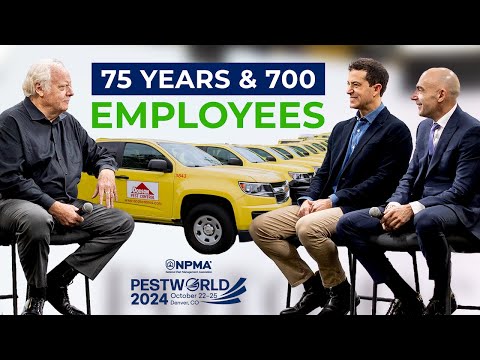
75 Years Strong: How Dodson Pest Control Grew to 700…
Interview recorded at Pest World 2024 in Denver, CO: Paul Giannamore and Nick Bartolo speak with Bert Dodson, President of Dodson Pest Control, about the company's growth since its 1944 founding into an enterprise with over 700 employees and 38 branches across six states. Topics include three generations of family ownership, decentralized management with local managers and regional offices, employee incentives and long-tenured staff, owning company real estate, residential versus commercial demand, decades of debt-free operation, lessons from acquisitions and the pandemic, regulatory advocacy, and leveraging scale with vendors. The recording opens with a teaser on local and state politics, Potomac TV channel updates, and Bert Dodson receiving the Crown Leadership Award.
# Channel Presentation Observations — Video: "75 Years Strong: How Dodson Pest Control Grew to 700 Employees"
## 1. Explicit Self-Description (Creator Claims)
The host opens with a direct statement of what the channel is about:
> "historically pomac TV has been focused on business and operational information interviews for residential and Commercial Services business owners"
- **Channel name (as spoken):** "Pomac TV" / "Patomic TV" (transcript renders it both ways; the host signs off "thanks for joining us here at patomic TV").
- **Format claim:** interview-based content ("interviews for residential and Commercial Services business owners").
- **Stated audience:** owners/operators of residential and commercial service businesses — specifically **pest control** in this episode's context (#PestWorld2024).
- **Content pivot announcement:** the host states demand after publishing an "M&A master class" is driving new content:
> "my LinkedIn inbox has been inundated with a variety of different requests so Dylan and I will be sitting down filming more extensive m&a master classes both focusing on the sell side as well as the buy side... delving deep into m&a psychology... and due diligence"
- **Distribution/engagement claims:** subscription prompt, an email distribution list link in the description, and a claim of viewer-driven direction:
> "this channel is largely driven by you the viewer and what you want to see from us"
## 2. Demonstrated Presentation (Observable Patterns)
### Interview Format and Participants
- The bulk of the video is a **long-form interview** with a pest control company executive (Dodson Pest Control), conducted by at least **two hosts** ("Paul" and "Nick" are both addressed by the guest; Paul introduces himself as "Paul jamore").
- Recorded on location at an industry event (**PestWorld**, per title and guest's mention of the "crown leadership award" being presented "tonight").
### Demonstrated Topic Scope
- **Business operations:** growth strategy, decentralization, real estate ownership, incentive/profit-sharing structures, employee retention, branding.
- **M&A discussion:** acquisition experience ("18 to 20 Acquisitions last 12 15 years"), due diligence, seller behavior, private equity impact on the industry.
- **Regulatory/advocacy:** state-level pesticide preemption, the farm bill, political engagement for business owners.
- **Industry economics:** private equity consolidation, pricing strategy, inflation, wage growth.
### Demonstrated Interview Style
- Hosts ask structured, financially literate questions (e.g., "reinvesting in the business in marketing and advertising versus taking some profit out," "growth on let's say a 2 five 7year basis").
- Hosts share their own industry observations and gently challenge the guest (e.g., on real estate ownership flexibility, baiting vs. liquid termite treatments).
- Recurring collaborative host handoffs: "Paul you got another question."
## 3. Intended Audience (Observed)
- **Primary:** owners and operators of service businesses, especially pest control, based on both the explicit claim and the demonstrated depth of pest-industry-specific questions (franchises, termite renewal accounts, PMP-focused regulatory issues, NPMA reference).
- **Secondary (emerging):** viewers interested in **buying or selling service businesses**, per the announced M&A master class expansion.
## 4. Claimed Scope Summary
| Dimension | Evidence |
|---|---|
| Channel name | "pomac TV" / "patomic TV" (host self-identification) |
| Core content | "business and operational information interviews for residential and Commercial Services business owners" |
| Expanding content | M&A master classes (sell-side and buy-side, psychology, due diligence) |
| Publishing channels | YouTube channel + email distribution list (link "here in the description") |
| Editorial philosophy | "largely driven by you the viewer" |
## 5. Notes on Source Limits
- No curated metadata was supplied; identity evidence rests entirely on the host's opening and closing statements and demonstrated content.
- The exact channel spelling ("Pomac" vs. "Patomic") is ambiguous in the transcript.
- The host's full name appears in the transcript as "Paul jamore" — likely a transcript rendering of "Paul Giannamore," a figure associated with pest control M&A commentary, but the transcript alone does not confirm spelling.
# Delivery Observation: Dodson Pest Control Interview (PestWorld 2024)
## Overview
The video consists of a short **channel intro by host Paul** followed by a long **interview format** with two interviewers (Paul and Nick) questioning the guest ("Mr. Dodson"). The guest carries the majority of the speaking time in an informal, conversational trade-show setting.
---
## Tone & Register
- **Conversational and folksy.** The guest uses plain, colloquial phrasing rather than polished corporate language:
> "I would imagine more than that"
> "it works out real well" (repeated many times)
- **Dry humor and deflection.** When asked whether the award was expected, he jokes: *"well first of all, it might ran out of names maybe okay"* — laughing off praise before answering seriously.
- **Blunt, hedged candor.** He signals what he will and won't say: *"I'm really close to John Myers I want to watch myself"* and *"let's just say we've had a golden opportunity in the last few years."*
- **Self-deprecating asides.** On working under family ownership: *"so I work for a bunch of women."*
---
## Recurring Phrases & Verbal Habits
- **"what happens / what happen"** is his most frequent transition filler, appearing dozens of times:
> "so what happens we go to an area we stay in the area"
> "but I think what happens is that you got to build that inflation part"
- **"it works out real well"** as a recurring all-purpose positive assessment (appears at least 6–7 times).
- **"I think what happens is that..."** used as a recurring explanatory setup before opinions.
- **Restatement habit.** He frequently repeats words mid-sentence for emphasis: *"we're not a dead business we're a very live business"* and *"it's a it's a it's a it's a seller's market."*
- **"okay"** used as a turn-closing marker: *"the good Lord looks after me I'm fine okay Paul you got another question."*
---
## Teaching / Communication Patterns
- **Concrete numbers as evidence.** Nearly every answer is anchored in specific figures:
- *"38 offices in six states"*
- *"145,000 accounts as of last week"*
- *"61,000 termite renewals"*
- *"we done around 18 to 20 acquisitions last 12 15 years"*
- *"20 to 30% of their total income is based on the profitability of the office"*
- **Story-based instruction.** He teaches through anecdotes rather than frameworks, e.g., the technician story: *"he's 80 years old he gets up early... he makes the coffee for his customers."*
- **Counter-example teaching.** He contrasts his approach with private equity behavior: *"they're there to flip it... they spend x amount of money and flip it in x amount of years."*
- **Demanding question definitions before answering.** When asked broad questions he pushes back:
- On commercial demand: *"first of all you got to define commercial"*
- On hard lessons: *"define hard lessons"*
- **Memorable aphorisms.** He compresses advice into quotable lines:
> "if you don't have a seat at the table you're part of the menu"
> "nothing happens overnight"
> "the harder you work the luckier you'll get"
> "you pay your bills if you get a reputation not paying your bills people won't work with you"
---
## Answer Structure Habits
- **Deflect-then-engage.** Several answers begin with a joke or pushback, then pivot to substance.
- **Hedged confidentiality.** He marks proprietary boundaries: *"I won't get all the details but by buying 50 to 70 vehicles a year..."*
- **Attribution to legacy/father.** Repeatedly grounds practices in family history: *"my father was very incentive driven... my father told me back that's the only way to go bankrupt."*
---
## Interviewer Delivery (Host Side)
- Paul uses **preview-and-pivot framing**: *"let me ask you a question... is there something to that in the South"*
- Interviewers **affirm and mirror** the guest's points: *"yeah exactly right"* — a low-friction, guest-forward style.
- Nick supplies **context-setting context before questions** (e.g., citing the Matt/Nixon–Anticimex deal) to prompt expansion.
---
## Uncertainty Notes
- The transcript contains apparent speech-to-text artifacts (e.g., "B say what I said," "ped yellow," "pesold"), so some phrasing observations may reflect transcription error rather than actual delivery.
- Pauses, laughter, and body language are not observable from the transcript; tone descriptions above are inferred from word choice and syntax only.
- Which interviewer asked which question is not always distinguishable in the transcript, so per-interviewer pattern claims are kept general.
# Position Extraction: Dodson Pest Control — PestWorld 2024 Interview
## Video Overview
- **Title:** 75 Years Strong: How Dodson Pest Control Grew to 700 Employees #PestWorld2024 #Entrepreneurship
- **Setting:** Interview conducted at PestWorld; hosts **Paul** (Pomac TV) and **Nick** interview **Mr. Dodson** (referred to as "Bert" by Paul at one point), representing the family-owned Dodson Pest Control.
## Paul's Introductory Positions (Pomac TV host)
- Announces upcoming expanded **M&A master class** content (sell-side and buy-side) driven by LinkedIn demand following the CIDE M&A master class publication.
- States the channel will cover **choice of process, M&A psychology, buyer-side practice approach, and due diligence**.
- Frames the channel as viewer-driven: "this channel is largely driven by you the viewer."
## Dodson: Company History & Recognition
- Receiving a **Crown Leadership Award** ("Guardian award" per Paul; Dodson calls it the Crown Leadership Award) given to five people annually; he attributes it to the family-owned company and its team members. He jokes: "maybe it ran out of names."
- **Founded August 20, 1944** by his father (then 8 years old, per transcript) and an uncle returning from the war; originally "Dodson Brothers and Germinating Company."
- Father bought out a brother mid-1950s/early 1960s, held 95% at his death in **1989**.
- Ownership passed to Dodson's mother and two sisters; Dodson states "I work for a bunch of women" who hold the majority stake.
- Mother, age 98, sits on the board and remains active.
- Nearly **700 team members, 38 offices, six states** (Virginia, West Virginia, North Carolina, South Carolina, Eastern Tennessee, DC area).
## Growth & Management Philosophy
- **Decentralized decision-making:** 38 office managers, four regional offices (Raleigh, Charlotte, Richmond, and a fourth region). Reasoning: "a lot of times when pest control companies grow they don't have the management to grow."
- **Selectivity in acquisitions:** "we pick and choose which ones we want." Most growth is organic; roughly **18–20 acquisitions in 12–15 years**.
- Acquisitions are opportunistic: "it's where the deal is... it might be a market where [someone] wants to retire."
- Due diligence practice: requests **three years of federal tax returns** to detect sellers inflating growth to sell; deals typically run **4–6 months** before signing.
- On bad deals: "never admit defeat... some have turned out better than others, we never regretted any of them."
## Views on Private Equity & Industry Competition
- **Rollins and Terminix** historically bought companies; private equity entered ~10+ years ago and "has really shaken things up" — "they pay a lot of money" and "it's a seller's market" for good pest control businesses.
- Distinguishes PE firms that employ pest control professionals (better) from those treating pest control as "other services."
- On PE platform playbooks: "I know what the strategy is... they keep everything the same for a year, then they start working people six days a week... then they raise the prices 15 to 20% and then customers start flowing to other pest control companies." He calls this pattern "very beneficial for us" in smaller markets (less so in large metros).
- Dodson characterizes PE as "package them, work them for a while, and sell them off... that's what private equity firms do. It's the American way. I don't know if I agree with it, but it's an American way."
- **Will not compete with PE on multiples:** "we're not going to be competitive with private equity firms because they're there to flip it."
- On the American Pest / Anticimex example (raised by hosts referencing Matt and Jay Nixon): platform acquisition model — buy a platform, add companies, eventually sell. Dodson: "if they say anything different, they're not telling the full story."
## Real Estate & Operations
- **Owns branch real estate and vehicles** (~750 vehicles, 33–38 owned offices). Reasons: landlords don't like renting to pest control companies; technicians report daily to pick up vehicles ("we have control of our people"); owning avoids rent and landlord delays; provides longevity.
- No separate real estate corporation — all within one corporation.
- On rigidity concern (host's question): "we never admit defeat... we go to an area, we stay in the area, it's brand awareness"; selling property can be profitable if exiting.
- **Local presence strategy:** ~13 competitor/offices within a 2-hour drive of Lynchburg; no centralized call center ("zero" consideration) — local offices answer, providing hometown familiarity. 80 full-time salespeople.
- **Mix:** ~60% residential / 40% commercial; ~145,000 accounts; 61,000 termite renewals; does liquid termite work, fumigation, and food processing/chicken/pharma chain work.
## Termite Position
- **"Very termite-centric," liquid treatments for 20+ years**; skeptical of bait systems, though acknowledges bait has "pluses and minuses" and says "I'm not going to put down bait."
- Host (Nick) notes industry trend toward bait; Dodson offers an explanation he's heard: some companies stay with bait because they lack supervisors/managers with the training longevity to train new technicians in liquid treatments.
## Compensation & Culture
- Incentive-driven culture inherited from his father (ninth-grade dropout, farm background): sales reps on tiered commission; many technicians on commission; CSRs get a percentage of office collections.
- **Profit-sharing inversion:** "most family-owned companies... the ownership gets a cut and everybody else gets a cut. We flip that rectangle... everybody in each 38 offices gets a cut of the profit and the families at the end."
- Managers are profit-centric: **20–30% of office manager income** tied to office profitability.
- Retention examples: 45-year CSR retirement; an 80-year-old technician running the same route 50 years "gets up so early he makes the coffee for his customers."
- Qualification retained: "now people move around, don't get me wrong, but if they care about us we care about them." "We're not a government agency to hire just to hire people."
## Financial Philosophy
- **Debt-free for decades**; his father taught that debt "is the only way to go bankrupt."
- Long-term investment view: new office investments may take **4–5 years** to return; some large profitable offices struggled 10–12 years ago.
- Sticks to pest control only: operators who diversify into other industries often fail.
- Growth target: **5–7% per year**, preferring consistent growth over 10–20% where "a lot of things [are] not handled as they should be"; ~$4 million monthly recurring = ~$48 million base.
- Price increases: "you cannot charge the same thing you were five, seven years ago" or profitability and company net worth shrink.
## Demand & Market Observations
- Residential demand "is good"; during the pandemic, business went up, not down, because people were home. "People just don't like living with roaches and mice and Pavon ants."
- Residential accounts "last maybe two or three years, some last 30 or 40 years"; a residential-only base risks down years — commercial/residential mix provides balance.
- Market differences are **urban vs. rural**, not regional: urban markets have 30–40 competitors; rural may have 4–5. "Everybody wants service yesterday."
- Pandemic: never closed a day; essential-worker status traced to WWII-era treatment of pest control operators and funeral directors.
- Hurricane damage in Western North Carolina: Dodson flew to meet 25 team members individually for 6.5 hours to reassure them their jobs were safe — "that tears your heart out... you got to have the perseverance to move on."
- Inflation: "no matter who's President, it has no control over inflation"; notes wage growth means "you're paying people more to do the same amount of work" from 5–6 years ago.
- Size advantages: buying 50–70 vehicles/year, committing to product purchases a year in advance, paying bills on time, high BBB and credit ratings, yellow-branded fleet/billboards/stadium advertising.
- Bigger size brings bigger risk exposure: "the bigger you are, the more susceptibility you have as far as big issues."
## Politics & Regulation
- Served as **city council member and vice mayor for 12 years**; self-identifies as a "moderate Democrat," which he notes is "rare in this industry."
- Advises operators to **focus on local and state politics**, not national: "if you don't have a seat at the table, you're part of the menu."
- Relationships with Senators **Tim Kaine and Mark Warner** (20–25 years each); currently working with Kaine's chief of staff on the **farm bill**.
- **Key regulatory position: preemption** — pest control should be regulated at the state level, not by localities; without it, "there's no way you can operate" across hundreds of localities. Notes a New Jersey senator is pushing against preemption in the farm bill; expects the farm bill to be handled next year.
- Advice on involvement: "pick out a good candidate, give him money, be there all the time."
- Broader stance: "we're all Americans first and then we're Republicans and Democrats afterwards."
## Closing Advice to Younger Operators
> "Nothing happens overnight. Pay your bills. Work hard. Believe in your people. Don't get frustrated and just appreciate the business that you have."
- Warns against "the quick fix... the quick dollar"; urges openness to criticism without taking it personally; "the harder you work, the luckier you'll get."
## Unresolved Tensions & Qualifications Noted
- Dodson jokes about award merit ("maybe it ran out of names") while expressing pride — both preserved.
- He is both complimentary ("I'm not being critical") and critical of PE practices, explicitly saying "I don't know if I agree with it."
- Deflects on Terminix post-Rentokil integration benefits ("let's just say we've had a golden opportunity... we've taken full advantage of it") while noting closeness to John Myers and wanting to "watch myself."
- Host Paul's attribution of "American Pest... 60 million" revenue is framed as a guess ("I'm guessing"), not a confirmed figure.
- Transcript ambiguity: founding anecdote says father "was 8" while uncle "was 29" — preserved as expressed, unverified.
# Speaker Attribution & Provenance Record
## Video
**Title:** 75 Years Strong: How Dodson Pest Control Grew to 700 Employees #PestWorld2024 #Entrepreneurship
**Video ID:** `01a168c8-2ef8-7beb-be59-3b354910e034`
## Speakers & Roles
| Speaker | Role | Evidence |
|---|---|---|
| **Paul Jamore (Paul Giannamore?)** — introduced as "Paul jamore" | **Creator / Channel host** — "hi I'm Paul jamore I wanted to welcome our new subscribers to the channel"; addresses guest as "Mr. Dodson" | Channel opening; interview questioner |
| **"Dylan"** | Referenced co-host — mentioned by Paul ("Dylan and I will be sitting down filming more extensive m&a master classes") | Mention only; does not speak in transcript |
| **Mr. Dodson (Bert Dodson)** | **Guest / interviewee** — CEO of Dodson Pest Control; referred to as "Bert" by Paul | Main interviewee throughout |
| **Nick** | **Co-interviewer** — asks multiple questions ("what Nick said", closing "thank you Nick Paul") | Directly addressed by guest at close |
| Unidentified opening voice | Speaker discussing politics/office-holding; may be Dodson pre-interview or intro clip — **uncertain attribution** | Appears before Paul's channel welcome |
## Promotional Segments (Flagged)
- **Channel promotion:** Paul's welcome segment promotes **Pest Control TV / "patomic TV"** — encourages subscribing, an email distribution list link, and viewer comments; references a previously published **"CIDE M&A master class"** and upcoming sell-side/buy-side master classes.
- This is the only explicit promotional content; the remainder is interview.
## Referenced Third Parties & Claims (Provenance Inventory)
- **Companies cited by speakers:** Rollins, Terminix (Terminex), Massey, Arrow Exterminators, Anticimex (Stockholm-based, PE-backed), Rentokil (London), Copan, Dodson Pest Control (guest's firm).
- **Named individuals:** Matt and Jay Nixon (former owners of "American", sold to Anticimex — revenue figures given as interviewer's estimate/guess), John Myers (Terminix), Tim Kaine and Mark Warner (US Senators), JD (Dar) with NPMA, Pete Smith (Executive VP, Dodson), Karen and Bonnie Dodson (sisters/leadership), mother (98, board member).
- **Claim types:** Revenue figures for the Nixon/Anticimex deal are explicitly framed by the interviewer as guesses/estimates ("I'm guessing 60"); Dodson company figures (founded Aug 20, 1944; ~700 employees; 38 offices; 6 states; 145,000 accounts; 750 vehicles; 61,000 termite renewals; $4M monthly pest control revenue; 18–20 acquisitions in 12–15 years) come from the guest and are unverified.
- **Regulatory topics:** Farm bill preemption, state vs. local regulation — guest's positions only.
## Availability & Uncertainty
- **No curated metadata supplied** — no comment availability status, no verified speaker identities beyond transcript self-identification.
- Speaker name spelling ("Paul jamore" / channel "pomac TV"/"patomic TV") is inconsistent in transcript; treated as uncertain.
- No timestamps available in transcript; segment boundaries inferred from content only.
everybody gets involved in who's President who's vice president who's running for this running for that it's a local and state that really affects you I always believe and I've been in politics for decades and run for office
served as city council member and vice mayor for 12 years of the city I live um if you don't have to see the table you're part of the menu hi I'm Paul jamore I wanted to
welcome our new subscribers to the channel you know historically pomac TV has been focused on business and operational information interviews for residential and Commercial Services business owners but after the publication of the cide m&a master class last month my LinkedIn inbox has been inundated with a variety of different requests so Dylan and I will be sitting down filming more extensive m&a master classes both focusing on the sell side as well as the buy side I intend to talk about the choice of process delving deep into m&a psychology uh as well as extend ensive buide practice approach and due diligence for those of you who have not subscribed you can click below and subscribe to the channel furthermore we've provided a link here in the description where you can get on our email distribution list and if you do that you'll receive an email right in your inbox with our latest Publications feel free to put a comment below on the types of things you want to see I mean this channel is largely driven by you the viewer and what you want to see from us again thanks for joining us here at patomic TV
Mr doson thanks for joining us on the Shel thank you Paul appreciate you ask you this off so Bert you're out here at um pestworld and I understand you're going
to be presented award tonight is it a the guardian award is that accurate it's a really nice award that five people a year get it last 30 years and it's very kind and gracious that the crown leadership award has been given to five of us tonight and we have an event and it's a really Testament for our familyowned company and um and the people who work for us our team members I mean I would say it's not a surprise that that's being given to you even though there's only five people given how much you've given back to the industry and your local community over the years why has that been important to you well first of all it might ran out of names maybe okay but I would say that uh it gives after 80 years of being a pest control business since 1944 it really kind of stresses uh a family-owned company as family-owned companies get disappear from The Pest Control World by acquisition Etc uh it's a real proud and we have almost 700 team members and I'm really proud of every one of them being part of the process let's talk about that so what year was your firm founded August 20th of 1944 my father was 8 ke and had an uncle
who had previous press control experience came back from the war and he was 29 and they formed a company called Dodson brothers and germinating company another brother came in the late 40s but
my father bought him out in the mid-50s if not the early 60s uh so he had 95% of the company when he passed away in uh in 1989 he had a bring tber at the presently my mother and my two sisters and myself on the company so I work for a bunch of women they had majority of the St is your active in the business no she's on the board of directors she's 98 and uh but she's very active as far as what we're going on and if we do real well she's very well appreciated throughout the uh the industry and obviously our company and uh We've grown a great deal for her my two sisters uh Karen and Bonnie being uh leadershi in the company so you've got over 700 team members how many branches are you running that out of we have 38 offices in Six States uh we cover all of Virginia West Virginia North in South Carolina and we have operations in Eastern Tennessee and betway DC area and
if you think about the last 10 years how how have you grown that has it been geographically out of Virginia or have you operated in the periphery for a while well with 38 offices we have 38 managers and we have four regions and we
we decentralize a lot of decision- making a lot of times when pest control companies grow they don't have the management to grow yeah so that's what we've done we have Regional officers in Raleigh North Carolina Charlotte North Carolina Richmond Virginia and ronal Virginia so we decentralized lot of decision making and it works out real well as far as people on sales managers and uh uh Regional supervisors work under the direction of regional managers and it works out real well as far as the way we have grown the company we do Acquisitions but what happens we Pi we pick and choose which ones we want me how have you seen the industry change in the last decade from a competitive perspective in in your area well I would say Obviously over the decades I've been
doing work since I was 15 years old uh we always had Rollins and Terminex buying companies and then you had some other big players obviously massie's grown a great deal Arrow's grown a great
deal but you know the private Equity firms and come into the business only 10 plus years ago that's really shooken things up um they pay a lot of money okay and people want retire and move on that's fine but it's interesting that um if anybody's got a good Pest Control business and got some good customers and a good U reputation uh it's a it's it's a it's a it's a sell's market have you seen when you think about companies that have partnered with the private Equity firms what do they like as competitors for you from a service perspective or dealing with your customers how have you seen that have you seen those companies change well the private Equity firms that employ Pest Control professionals do better than ones who just think Pest Control is other servers um you think about it how many companies have gone bankrupt in pest control over the number of dictates I don't know any the Terminex guys tried to break that thing for years and they never could right exactly and in Pest Control I tell new team members to come with this it's a great business because it's um you can't automate our jobs you can't send them overseas you have constant press pressure and you got people pay for it so that's a great combination I've got a lot of friends that lost a job because U companies have been sold sent overseas it set Bankers you know lost a lot of jobs but pest control keeps on growing and it's a great industry to be in you know when I think about a close personal friend of yours Matt and Jay Nixon right they owned American they partnered with anti CX which is a private Equity backed firm I mean you look at I think when Matt sold that business it was maybe 12 15 million in Revenue give or take now it's probably I don't know I'm guessing 60 well I would imagine more than that what they do they buy companies as a platform and then they buy other companies to put it on their platform and then but then they going to sell the platform sooner or later I mean not anti- seix I guess because they're obviously based in Stockholm as rill is based in London but what occurs is that they're going to package them work them for a while and sell them off that's what private Equity firms do it's the American way I don't know if I agree with it but it's an American way have you ever heard from any of your regional managers or local managers about market share changes after a private Equity platform comes into a region um well it depends on the size of area for example we uh you take a large metropolitan area like Raley North Carolina Charlotte DC Richmond Hampton Roads for example you don't hear about it that much but if you take smaller markets and a private Equity Firm comes in and they don't keep the local talent and then they raise their prices um it's been very bful for us that's all I got to say on that yeah I imagine I mean the first part of their playbook is typically taking up prices drastically which does create that nice pricing umbrella for you guys to come underneath if that's part of the strategy I know what the strategy is but it seems like they keep everything the same for the year then they start working people six days a week we work days a week now we got something to do on weekends we do it uh but what happens and then they raise the prices 15 to 20% and uh then customers start flowing to uh other pest control companies one of the things I'm really interested in as you've grown that firm how have you chosen new markets I mean what are the things that you look at when you know
you're the c a lot of our offices we've had we had operations in our area anyhow and then what happen we buy a company and we establish our brand and then would grow from the brand we do 60%
residential 40% commercial uh we do a tremendous we have 145,000 accounts as of last week uh we got 750 vehicles that we own and 33 to 38 offices we own too we're having to real estate and own our vehicles but I think what happens you got to understand the market as far as uh competition and as far as availability you got some areas that we operate the economy is not that good got some areas it's really good so you got to pick and choose and which one you want to really expand it can you tell us a little bit about
that philosophy to own the real estate that's what I'm interpreting from your comment that you guys actually go in buy the branch location the actual physical property yeah what happens is that
people don't want to rent to pest control companies and we we're different we have and 90% of our Pest Control technicians come in every day pick up the vehicle leave and we do termite work too I mean we do liquid termite work we got 61,000 and Termite renewals for example uh so and we do fumigation work so you got to have a base for that so what happens we have control of our people a great deal by coming in picking up the vehicles rather than being in detached all the time uh and and what happen as far as real estate we own the property so you're not paying rent and we go in to invest in some areas we don't want to buy you talk the DC area you know it's pretty expensive real estate there but I think what happens is that it gives us longevity and we can have control over our our situation I'm remember years ago people give us six months notice to leave and try to find a place uh so having a own place own own property it works out real well we don't have a separate Corporation some people have a corporation that can funnel money to uh but it's all within one Corporation and we need to make repairs and make repairs and have to go through a landlord have you ever noticed that it might limit your flexibility on operations by actually owning the real estate so for instance you want to expand but that location just can't handle the expansion and so you have to go out and buy another property for instance when maybe it would have been nice to just be able to move without still continuing to own that real estate well we never admit defeat or anything so what happens we go to an area we stay in the area it's brand awareness and what it's it's a good question too but if we ever want to pull out we can make a lot more money by selling the property with with the financial game let me ask you a question you know a lot of the guys down in the South Southeast talk about you know when you look at for me personally when I look at a southern company they typically have more
branches the northern companies tend to have big one big service center that does 20 million in Revenue um is there something to that in the South that folks like to be able to see the local
shop in their Town well for example I live in Lynchburg Virginia which is around an hour south of Charlottesville and two hours West of Richmond Virginia I can count 13 offices with a 2-hour drive or where I sit in my office so what I think having local presence for example uh we don't have uh phone Banks we don't have call Service uh people call us in our local office we know where the location is they talk to somebody on the ground it's not we're not they're not calling a different state so that gives you like like Hometown familiarity and it works out real well for us did you ever consider doing one call Centralized call center zero cuz you like to be able to somebody calls in and it's next door to that supermarket and the lady on the phone knows exactly where it is and we detached we have out of the almost 700 people work for our company we have 80 full-time salespeople so we can uh get to the BB needs rather have to go through several different branches or information for my understanding people stick with you a long time right so your retention of employees you know what I hear has been really high have you been
able to accomplish that um it's pretty simple we care about people care about us and we have like 20 different Center programs in the company um all time uh for every
position and now people don't care about us they can be successful somewhere else we're not a government agency to H just to hire people but we incentivize people to do the right thing and they they we have people I just went to had a retirement party for a CSR that spent 45 years with us um we have a technic that's in R Virginia in Charleston West Virginia we have a pest control technician who ran the same route for for 50 years he's 80 years old he gets up early so early in the morning that he makes the coffee for his customers so he get out a bit now that work ethic is supreme so I've done I do a lot of retirement parties when people retire I give them a nice bonus check and wish them the best so I like people come with us grow with us raise their families retire now people move around don't get me wrong but if they care about us we care about them could you expand on some of the incentive programs so I mean has that always been a focus like I I'm personally a huge believer in incentives and think that they're typically under estimated by people and that incentives you know Drive behavior and so I'm just curious has that always been a focus of yours yeah my father was very incentive driven my my my father dropped out of school in ninth grade a farm boy so he worked his way up and no College exp high school education and what I'm saying he said incentivize people so we have as far as getting to our we have like 80 something uh sales representatives they have different brackets and get different percentages now that there again it comes at the end of the year it drops B to the original percentage our technicians many of them on commission uh they're not hourly now some are hourly but what have most of them are there uh our csrs get a percentage of the collection the office so we have a a different company and our company which is family-owned we're basically in most family-owned companies not be critical if any the the ownership gets a cut and everybody else gets a cut we flip that uh rectangle where whereby that a triangle that they everybody in each 38 officer gets a cut of the profit and the families at the end so again it's not just talk we care about people care about us you know I'm curious I'm going to switch topics here for a second if you think about the last 2 years and you think about residential and Commercial what have you seen on the customer demand side for resi versus commercial
has that changed at all well that's a big broad question first of all you got to Define commercial is it high-end uh accounts uh food processing plants medical facilities or is it convenience
stores and Banks let's define it as you do in your business whatever that is well we do a combination and we do a lot of chain business you know for our area we were uh stockholders with Copan for you know a number of decades and of course obviously sold out the term next you know a few years ago um but we do a lot of residential work too um what happens is that I think residential work is good money but it comes and goes people move around people Etc and Commercial is a really good business to be in but you got to know what you're doing we do a tremendous amount of food processing facilities chicken processing facilities um you know large pharmaceutical plants and we've worked out a real good angle there that's been very successful over the years so so how is how was residential demand this year versus last year um and I is good well during the pandemic you know we all now we thought things would go south where they want North because people are at home and the like and then what happens people got back to work etc one thing that people just don't like living with roaches and and mice and pavon ants and everything else Under the Sun so I think what happens there's a demand for residential a lot of comp a lot of residentials last maybe two or three years some last 30 or 40 years but I think what happens if you base your you know your business just on residential you might have a down year you might have a very cold season depends where you you're living at and that hurt your business by having a combination of commercial and residential gives you uh a better balance do you know is there any kind of cultural differences between the Carolinas and Virginia and dealing with customers that's another broad question I think what has to do with more urban and rural that would be a better answer you know Urban you can you got 30 40 companies in the area R you may have four or five yeah and I think what happens that that's big difference there of course everybody want service yesterday and I don't care where they live they want it yesterday they don't want it tomorrow you know what are some things that you you guys might do differently at least in the eyes of the customer versus some of your competitors that's another interesting question I think what happens by them getting uh obviously on commission basis they do good work and we have to do do we do mostly every other month service on residentials of course and of course in commercials as far as monthly I think what happens is that um caring about the people who do the workforce and what happens is they have a built-in interest we have trips for people we have incentives Etc they we want people to be you know enthus about doing their job and that gets down to the customers too I had told so many customers have told me I really like you technician I don't more Pest Control problem but I will call you back people remember you if you have a bad experience they remember a lot longer they have a good experiments they'll call you back how much of your total business is termite versus general pest um we do uh liquid treatments we do have some accounts with bait uh but that's very small uh we're very uh temperor Centric uh we've been doing it for over 20 years uh of course many years ago it's chloridine hepor and all we remember those so I think what happens as far as termite business uh we do I don't know what percentage is off top of my head we do a lot of fumigation work too uh for bed bugs and obviously wood destroying insects but termite it depends on the area that we have uh some areas have light subterran termite activity some have heavy and like that so it's been a very good business what I found talking to other companies more people are going debate I was just going to ask you that I'm seeing everyone go I was going to ask you why you haven't done that well first of all I'm not a real big thinger bait I like I like I'm I'm I'm I'm from the school and they got 61,000 TR Mars we had a lot of people stay for a long time I think one thing as far as bait and bait's got the pluses and minuses obviously we got areas you know and I don't go here and down bait but you don't have the experience of training new technicians on liquid treatments I've heard from people say they just they go stay in bait because they don't have the supervisors or the managers they got the longevity training to train new people come in to do to my controller with liquid I see go ahead man so you're family-owned you've grown a lot over the
years and you know you have this incentive structure with profits being shared throughout the organization I'm curious as you've expanded and grown have you balanced reinvesting in the
business in marketing and advertising versus taking some profit out you know for your family um my father excuse me um one thing I would say we have been debt free for decades U my father told me back that's the only way to go bankrupt actually exactly um that's a good way not to go bankrupt okay all right um yeah he had a bank he B some money in uh from a bank and he came in every Friday to get his money and we got uh what huge company as far as press control obviously and not have to worried about any debt works out real well U but what happens is that you make investments if you going to make investment in a business and I just know Pest Control I don't know anything else I mean some people do well in Pest Control they go to other Industries or other services and they fail because they think they're very good in pest control that happens over and over but what happens is that if you invest in your in in whatever you do in a company you're not going to have a one or twoe return might be four to 5 years down the road and we got some very profitable and very large offices that 10 12 years ago you know they're just struggling it's a long-term investment rather than short-term investment did that answer your question Nick yeah no it does I mean it just seems like as the industry's evolved over the past 10 20 years you do have a lot of maybe let's call them new school operators that invest everything and then some into growth in order to try to drive that Top Line as opposed to balancing profitability and growth well they might be increasing growth to sell and then that work I mean May it's like people just drive it up and go from s like that so for example what we do uh when we look at companies we went three years with the Federal Tax Returns so you can see pretty clearly if they try to grow it real fast to sell M so let's talk about that so you've done some
Acquisitions over the years and is it largely for to get into new markets it's where the deal is and it might be a market where real strong that somebody wants to retired been known us for years
and might did into different markets too uh we done around 18 to 20 Acquisitions last 12 15 years so we're active into it but most is organic growth and like what what sort of what sort of things have you learned having done some Acquisitions yourself well if they do termite work they never had a clean of course they never had a clean okay um they always say some of them well you know how much money I really put in in my pocket I go that's between you and the IRS IRS might be calling me tomorrow about this many right to you in IRS and the one thing too is that sometimes people who are good Pest Control operators uh if they don't have good uh accountants or lawyers particularly tax lawyers they kind of go into it blind and that's when Consultants not trying to make you look good Paul would have come in and give them a true figure everybody thinks they got the gold Nest okay to sell everyone's got the best company out there obviously okay then you bring them down the bring them down to earth as far as what they can get have you have have you had any of these deals turned bad after you bought him never admit defeat B say what I said never admit defeat yeah exactly right um some have turned out better than others we never regretted any of them we do a due diligence we're very I mean uh we have people on corporation that meet with
individual that I meet with individual we talk we it's not a quick it's not a quick thing we most of our deals go 4 to 6 months before we can do sign the papers it sounds like you've been very
opportunistic in these deals what's the environment like right now are you seeing deals come up yes but with the prior Equity firms coming in the the multiples they pay are just you know very very there good don't get me wrong but what happens is that I think long-term companies like ourselves you know we got to pick and choose but we're not going to be in competitive with private recor firm because they're there to flip it they were to spend x amount of money and flip it in in x amount of years and that's the way things happen I'm not being critical I'm that's a business plan and they say anything different they're not telling the the full story they're just Partners whatever they want and everything I don't I don't owe anybody anything okay the good Lord looks after me I'm fine okay Paul you got another question no I was just thinking about it like what Nick said you you've really been opportunistic it's like if there's opportunities that come up it doesn't sound like I mean it sounds like focused on organic growth over Acquisitions and if you see the right thing at the right time it works out real well now before private record Farms got into the business there was more opportunity obviously but I think what happens is that uh we just want to you know fit fit the right and you got to have the management you can buy a company but you got have the right management to ingrain into your existing company and and that works out real well you know in some of the territories you're in um you've got non-franchised Terminex operations actually uh yeah we we operate against three different franchises and there are huge of obviously in North Carolina South Carolina and uh they uh part of Virginia part of part Hampton Roads in Hampton Roads Virginia exactly right but in the non-franchise territories have you noticed any difference in post renil
Terminex have you gotten some great people from them I'm really close to John Myers I want to watch myself you know John's done a great job done a great job integration things happen that
are so I'm just curious well um let's just say we've had a Goen opportunity in the last few years and we've taken full advantage of it I mean look it's it's only natural you combine those organizations good people are going to go I that's typically what happens exactly and customers too if if if for what for whatever reason it was a big integration they went through and uh I know it was a lot of trial and error but you know that that was it's not my money it's their money yeah so in terms of growth how do you think about growth and do you look at growth on let's say a 2 five 7year basis when you're kind of budgeting out what's your plans are well we have uh deposit we use deposit goals as revenue and sales as new sales goals for each office each year so we have we we we went on x amount of 5 to 7% growth a year and that's good you grow at 10 15 20% which is great but a lot of things not handled as they should be we like consistent growth over a period of time and we we have around we have around $4,000 no she $4 million worth the uh monthly pesold so that's $48 million right there yeah so that gives you constant growth like as far as growing up yeah and I imagine it really gives you the opportunity to manage the profitability at a healthy level with that type of growth so well our managers are very profit uh Centric because about 20 30% of their total income is based on the profitability of the office so they're very they're very they're very engaged would have been some hard lessons you've learned over the years
you've been doing this a while um Define hard lessons business challenges that you know you didn't necessarily have the
solution for right away they took some time to overcome the pandemic was something uh obviously we were essential workers which is created as you well know in World War II I think test control operators and funeral home directors were excluded uh and I we have a corporate office in Lynchburg and we have 45 50 people work out of the office we never closed down a day uh we never missed a day through the pandemic it was really everybody went through it we had meetings constantly about how to deal with issues and it was very it was very it was very challenging to like um when you have a big snowstorm right now and we have a major office in Western North Carolina and I went to I flew up to see them uh two weeks ago and had 25 team members and sat down with each of them individually for 6 and a half hours saying we're not cutting anybody's job you know we're got to rearrange a few things bear with us but you don't have to worry about your job when The Neighbor drowned the next day the the day before or the house is gone so what happens is that I that is something that tears your heart out as far as a natural disaster and what have we have to re rebound from that part but it's like you got to have the perseverance to move on yeah I'm sure that had a tremendous impact you going down there and having those face-to-face meetings with those team members yeah it was I could got have our Executive Vice President Pete Smith who's wonderful for the company our regional managers but I said well if I went to tell them face to face a lot of them knew me already you got a lot of hardworking uh team members in office um they know that you know I'm not somebody's not coming back next week your job's lost so we'll work through the we we do the best we can to look at people the best we can what's it like having three women as your boss um thank you Mom thank you sister thank you sister it works out pretty well um they're very I have four women at home so I I kind of know the feeling well yes I'm there somewh with three girls and um they a father and they have a baby girl we had I got four daughters and I adopt them and uh it's interesting when you have women running your life you got to work your p's and q's you got to watch your language too works out pretty well what you know you're pretty involved in politics and Pest Control there in Virginia what what's the latest and greatest on the regulatory regime how do
you feel about that well I encourage all Pest Control operators to ignore the national stuff I mean everybody gets involved in who's President who's vice president who's running for this running
for that it's a local and state that really affects you I believe and I've been in politics for decades and run for office served as city council member and vice mayor for 12 years on the city I live um if you don't have a see the table you're part of the menu and to get involved with elected officials whether Republican Democrat conservative liberal don't many difference Pest Control is essential for the livelihood of all of Americans and by working with them and show the practicality pest control services you can gain a lot more than trying to be crazy about politics like that so it helps out a whole lot I got two years senators in Virginia uh Tim Kane and Mark Warner I've been knowing 20 25 years each and we have Pest Control issues like forance the farm bill I'm dealing right now with this Chief of Staff of Tim K I had him come to the legislative uh function back in in the winter and they understand so by having to be involved with them then they can hear what's going on cuz if you don't have a representation at the state and the local and and obviously National level you'll get eat up by the opposition and and what is it about the farm bill that you're focused on uh preemption okay you don't want local uh local Lo localities to regulate you you want the state to regulate you fine but like I live in Virginia okay I don't want Richmond and Nori and Newport News and Charlottesville for example to have
their own uh look legislation or North Carolina or Raleigh you you got to have centrality and I think I wish the preemption is a huge part of the farm bill that's coming out you talked to JD
Dar with the mpma and where does it look like that that issue is going to settle out well the farm bill is probably going to be handled next year it's been extended for a period of time but uh I think with more people get involved and show that that the farm our part of the farm bill which is small but it's big to us preemption part is a very essential part can you imagine run a pest control business and you got to deal with like 15 or 20 different localities in our case be hundreds of localities there's no way you can operate yeah I mean we see that in the Northeast a lot like States like Maine will have different counties and municipalities with very very different regulations with regard to what you can use no neighbor notifications all sorts of stuff um that's good way that's a good thing that living in Virginia you we don't have that but I think what happens you see what's happening I think in Maryland has that and a few other states Connecticut I believe I'm not sure but it's it's very it's and actually this US senator from um New Jersey is pushing not having preemption in the um in the farm bill so what do you recommend folks in the industry do to get involved in that um pick out a good candidate give him money be there all the time they need them and support them now there again I'm not a Gam but back in politicians like B on horses you never can tell who's going to win who's going to finish last but I think
what have being involved works out real well I know I got a number of Republican legislators in Virginia over the years have called asked me I'm a moderate Democrat okay I'm which is rare in this
industry right yeah it's very rare okay I I I get it all the time but the main one my father was Etc but I'm trying to get to is that we're all well one thing on nationally if we all remember that we're all American an first and then we're Republican Democrats afterwards like I say Virginia we all Virginians first and then Republican Democrat are independent we get a lot more done getting off the political ring it's like test control is a great essential business it's been here for decades it'll be here for decades after this and we have to take care of our customers because we it's the the rats the roaches the mice the the fire ants they not going anywhere in the bed bugs that came back to haunt us you know around 20 years ago so we part of the business we're not evolve we're evolving business but what happens we're not like we're not we're not a dead business we're a very lot business anything else on that regulatory front that keeps you up at night well first of all nothing keeps you up at night so I I said coming here and wor about with the questions you're going to ask um not not too much just got to you know obviously be controlled but if you're not in control of your own self and have people control you from the political part or legislative part then you had a disadvantage do you ever worry about the economy or inflation as it relates to the business or is that another area in that area where just infl has hurt all of us I mean you look at it you look at and and and I went to business school University of Richmond so I'm not I I'm been I learned a long time ago no matter who's President it has no control over inflation um there's less demand dur the pandemic so inflation was down um but you know a war starts in Ukraine by an aggressor and then what happens the oil prices increase but I think right now the inflation's gone down but it's like if now we don't there again we don't borrow money either so have to worry we care about obviously rates being to a low a lower percentage but I think what happens is that you got to build that inflation part now that's another thing about price increases too people in our industry got to look at price increases you cannot charge the same thing you were five seven years ago if you do your your profitability are shink and your net worth of your company are strink too yeah especially when wage wage growth is around over 4% right now just as the
country one thing now I'm not I'm not an economist but you're paying people more to do the same amount of work you wor five six years ago so that has a big part of
inflation what's gotten easier as the company has gotten bigger now that's a good question um you're always going to have an issue
and you can't stay up at night worried about every issue if you worry too much it'll be kind of productive but the bigger you are the more susceptibility you have as far as big issues that will
consume you I don't know if that makes any sense but it what happens the bigger you are the more you got to worry about what's going on I don't know if that makes any sense at all that makes some sense have you all been able to use your size to your advantage in order to have a more sustainable business increase retention or grow at a faster rate well I won't get all the det details but by buying 50 to 70 um Vehicles a year uh we have certain vendors we work with so they know the money is going to get paid on them um dealing with vendors as far as tomato side and other um products uh we buy year we commit year in advance so and we pay our bills on time uh we have a very high rating as far as the Better Business Bureau and we have a very high rating as far as um shamro Commerce so it works out real well that we pay your bills one thing about running a business you pay your bills if you get a reputation not paying your bills people won't work with you I imagine it's helped your brand awareness as well is that something you all focus on Yes actually uh yellow is our color uh we have uh 760 Vehicles there about so saying all them ped yellow um our technicians have yellow shirts and Bill boards we're Bing Big boards Billboards rather baseball stadiums particularly on highways interstate so yellow is like color and it works out real Y in red it's a brand awareness that we have you know B I want to close out this session asking you you know you've been at this a long time what sort of advice do you have to some of the younger folks out there who are kind of early on in
their journey and building a business nothing happens overnight pay your bills work hard believe in your people don't get
frustrated and just appreciate the business that you have um it I think sometimes people want the Quick Fix they want to make the quick dollar um you will make money but it takes a period of time but be open to criticism don't take it personally and the bottom line is that what you put into something you'll get back um I believe that the harder you work the lucky you'll get Mr Dodson thank you so much for joining us thank you Nick Paul it's been very questioning you