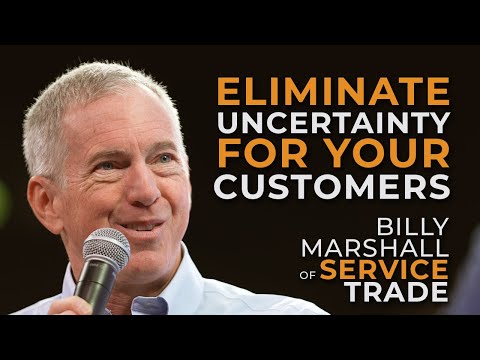
Leveraging Tech for Business Growth in Fire Protection with…
An interview recorded at the NFPA conference in Orlando in which Paul Giannamore speaks with Billy Marshall, founder of Service Trade, about value creation in the fire protection and life safety industry. Topics include Marshall's career path from GE and Red Hat to founding Service Trade, the role of technology in improving customer value and retention, key business growth metrics, pricing strategies in the fire protection market, and long-term trends in the trades, including the use of AI, video documentation for technicians, and international growth.
# Channel Presentation Observations — NFPA Interview Video (Billy Marshall, ServiceTrade)
## Video Identity & Format
- **Format:** Sit-down, one-on-one interview conducted at what appears to be a trade show floor (host Paul; guest Billy Marshall of ServiceTrade).
- Evidence: "it's great to sit down with you"; "you'd see walking around the floor here"; "I saw Tommy Clemens from VSC"; "a lot of the folks that are here in this building today."
- **Length/depth:** Long-form, single-topic conversation structured around the guest's career and value-creation advice, moving through structured question prompts from the host.
- Evidence: "I got a ton of questions on value creation today but before we get into that I want to talk about how you got to where you are today."
## Intended Audience
- **Primary audience:** Owners and operators of fire protection / life safety contracting businesses, and more broadly commercial service contractors.
- Evidence: "how do you think about creating value in a fire protection Life Safety business what are what are some things that owners should be thinking about"; "I encourage our customers... are you classing them as a b and c customers."
- **Secondary audience signals:** People interested in trades careers and business/technology topics — discussion of being "long the trades," labor supply/demand, and consolidation.
- Evidence: "I'm generally long on the trades because I think that's going to be a durable Trend."
## Claimed / Observable Scope
- **Brand identity in title:** Channel identified as **NFPA** (National Fire Protection Association) via the title suffix "| NFPA," indicating fire/life-safety-focused content.
- **Topic scope demonstrated:** Business growth, technology adoption, pricing, customer retention, sales/marketing, AI, and entrepreneurship — all framed within the fire protection industry.
- Evidence: pricing power discussion ("be reasonably assertive about your pricing practices"); AI discussion ("we have actually released that capability... Early Access").
- **Guest curation:** The channel books industry executives and entrepreneurs for in-depth conversation, not just NFPA staff.
- Evidence: guest is founder/CEO of a contractor software company; host references a prior statement "Billy yesterday you said something that stuck with me," implying multi-day event coverage.
## Explicit Self-Description
- No direct self-description of the channel by the host or guest appears in the transcript (no "welcome to the NFPA podcast" type statement); the channel identity is carried by the title metadata only.
## Creator Claims vs. Demonstrated Patterns
- **Guest claims (not channel claims):** Billy Marshall's statements about ServiceTrade ("we probably have about 600 customers"), his books ("the first book was called the digital rap"), and Red Hat history are guest assertions, not verified by the channel.
- **Demonstrated channel patterns:** Interviewer asks informed, follow-up questions showing industry familiarity ("prior to this you you were a software guy you did you start your career at Red Hat"), suggesting the channel produces substantive, researched conversations rather than promotional ones.
# Delivery Observation: Billy Marshall Interview (NFPA)
## Speaker Roles
- **Interviewer (Paul)**: asks structured questions, occasionally mirrors interviewee language ("that's your value creation story," "that's brilliant because every residential commercial services business faces the same thing").
- **Interviewee (Billy Marshall)**: delivers the majority of the talk time in long, narrative, advisory-style answers.
## Tone & Register
- **Conversational and anecdotal**: heavy use of filler and verbal stumbles — "um," "uh," "you know," repeated words ("and and and," "is is is," "that that's").
- **Plainspoken and direct**, sometimes blunt:
- > "the world's full idiots right push back push back"
- > "I said Tim if you listen to this idiot you're as big a fool as he is"
- **Self-deprecating humor** about his own failures: "I was fired from the last two including a company I founded."
## Recurring Phrases & Verbal Habits
- **"right" as a tag question** — extremely frequent: "your retention is high when they run a good business those are Apple margins right," "that's not run-of-the-mill and those are probably really good customers to have and... right."
- **"you know"** as a pervasive connective throughout nearly every answer.
- **"really really"** doubling: "the business was doing really really well," "some metrics that are really really important," "a really really good customer base."
- **Repetition for emphasis**: "video video," "ai ai ai ai ai," "push back push back," "over and over and over again."
- **"if you will"** as a hedge: "has generally not been sexy if you will," "a trade if you will."
## Teaching & Rhetorical Patterns
- **Socratic questioning of hypothetical customers/contractors**:
- > "I ask them do you think your customer cares about code and I'll say I'll give you a hint they don't"
- > "are all the customers you currently have great customers or are there some that could be replaced by better customers"
- **Contrast framing** — "the way you don't do it" before the way you do:
- > "probably the start is the way you don't do it is start there"
- **Concrete numeric anchors** when giving advice: "30 customers in 2013... 70 customers in 2014," "$1,500 and $2,000 of work every day," "35 to 45% gross margin," "at least a dollar pull through."
- **Analogies and pop-culture references** as teaching tools: the *Moneyball* quote, *The Terminator* "risk Terminator" framing, Dire Straits' "Money for Nothing," the truck wrap "digital wrap" metaphor, auto-shop and dentist video examples.
- **Named concrete examples**: "Sage 300 Sage 100," "Blackstone and ax and and KKR," "Tommy Clemens from VSC," "the fire troll guys," index-card anecdote from a Canadian customer.
## Signature Concepts (Repeated Themes)
- **"Get with the program"** — repeated customer-grading phrase (appears at least four times).
- **"Show them"** as the core sales advice: "you got to show them," "show them again and again and again," "if you don't show them anything you can't charge them a premium."
- **Risk vs. code framing**: "your customer cares about risk... it's not an NFPA 25 inspection form."
- **"I'm long the trades"** — repeated twice as a personal investment stance.
- **"Voodoo"** used twice for how customers perceive fire protection work.
## Interviewer Delivery Notes
- Paul interjects with short summaries and follow-ups ("so they built their own software is that what you're saying," "that's hard for business owners to do isn't it fire customers") — a supportive, low-interruption style.
## Uncertainty Note
- Timestamps embedded in the transcript are coarse (second-count markers, not verified media timestamps); frequency claims above (e.g., "at least four times" for "get with the program") are based on transcript text count and are approximate.
# Position Record: Billy Marshall (ServiceTrade) in Conversation with Paul (Interviewer)
## Speaker Identification
- **Billy Marshall** — identified by title and transcript; founder/leader of ServiceTrade, former Red Hat early employee.
- **Paul** — interviewer (identified by name in transcript).
---
## Career & ServiceTrade Origin (Billy Marshall)
- Was fired from his **last two startups** (one he founded) in late 2009, prompting his search for a new opportunity.
- Was recruited by entrepreneur **Joe Dunn** of **Dunwell**, a fire contracting business that had built internal software showing customers the value of kitchen exhaust cleaning and suppression work.
- Observed the market around 2009–2012: Building Reports existed, but most contractor software was **construction accounting** (Sage 300, Sage 100) with service add-ons — a "poor platform" because service should center on the customer, not accounting.
- In **2012**, Dunwell was sold to Cintas (transcript: "Centos"), which became **ServiceTrade's first customer**.
- Earlier career: started at GE, entered software in 1998 at **Red Hat**, where he "got the bug" of entrepreneurship. Notes Red Hat sold to IBM for ~$34 billion; his own next company "was a dud."
- Quotation: > "The world is full of 15-year-old overnight successes… it almost never happens overnight."
- ServiceTrade now has roughly **600 fire/life safety customers**; sells exclusively to fire, life safety, and mechanical trades; operates almost exclusively in **North America** ("this is the big market").
- Growth history stated: 30 customers (2013), 70 (2014), ~100 (2015).
## Value Creation Philosophy
- Key metrics: **retention, net retention, upsell/cross-sell, price expansion** — a track record showing predictable, profitable growth with the best customers.
- **How not to do it:** show up only when something is broken and share only an invoice — > "if the only thing you ever share with your customer is an invoice, the only thing they're ever going to talk to you about is price."
- Customers don't care about **code**; they care about **risk** (business disruption, property loss). Contractors must demonstrate risk control through their work product, not NFPA inspection forms alone.
- Customers will pay premiums for demonstrated risk reduction and remain loyal against 10%-cheaper competitors.
## Customer Retention & "Firing Customers"
- Not all customers are equal; focus on the best customers in the market.
- **Periodically fire customers** who ignore demonstrated risk conditions and create emergencies/unplanned work; unplanned work is very hard to schedule-optimize.
- The next owner wants a predictable book of business at premium price with premium customers.
- Advice on loss aversion: > "You got to follow the data and you got to lose the customers that won't get with your program."
- Methods to exit bad customers: raise prices until they leave, or politely refer them to competitors (using technology evidence that they reviewed deficiency quotes but declined repairs).
## Pricing & Labor Market
- Encourages clients to be **"reasonably aggressive"** with price increases given inflation, high demand, and scarce skilled labor.
- Pricing power is durable only when service delivery is transparent.
- **"Long the trades"**: believes the labor supply/demand imbalance will not be cured for **10–20 years**; trades have a US "marketing problem" ("failed into my trade") that is slowly improving as youth see vocational opportunity.
- On consolidation: well-run fire businesses run at **35–45% gross margin** with recurring revenue — "Apple margins" — attracting private equity (Blackstone, Ares/"ax," KKR). Sees no near-term end to consolidation.
## Productivity Metrics
- **Technician billing productivity**: e.g., alarm technicians should complete **$1,500–$2,000 of work per day**.
- **Customer productivity**: grade customers by engagement; in sprinkler, expect at least **$1 of maintenance pull-through per $1 of inspection** ($1.25–$2 in some cases), making inspection contracts a predictor of ~2x planned revenue.
- ServiceTrade helps measure billing by service line, customer, planned vs. emergency work mix.
## Books & Concepts
- **Book 1: *The Digital Rap*** — technicians' digital artifacts (photos, GPS, inspection records) turned back to customers create a "digital wrap" of the brand, stickier than a $700–$3,000 truck wrap, which is "fleeting."
- **Book 2: *Money for Nothing*** (co-authored with colleague Sean Mims) — customers want "nothing" (no breakdowns, no false alarms); delivering nothing without showing the work invites low-price competition. Show the work repeatedly online to justify premiums. Inspired by the Dire Straits song's business-model contrast.
- **Potential Book 3 ("The Risk Terminator")**: analogy to the 1984 Terminator film; Cameron "predicted" AI ~40 years out (1984 + 40 = 2024); the service contractor's mission is to "terminate risk" using AI to ingest structured/unstructured data.
## AI Positions
- AI succeeds only with a clear **mission statement**; otherwise you "flop around in it."
- ServiceTrade innovations:
- Mobile app feature: AI summary of last four years of service history per equipment item (25 service calls, ~400 records distilled into a readable paragraph).
- **Video transcription and cleanup**: technicians take 30-second videos; AI removes jargon/bad grammar and produces customer-ready text. Released in **Early Access**; fully enabled by September (year not specified in transcript).
- **Amazon** is the AI platform partner and paid **$80,000** for ServiceTrade engineers to build these features, expecting customers to "thirst for more."
- Institutional investors pressure ServiceTrade to lead in AI or risk being upended; PE sponsors have AI-focused **operating partners**.
- Claim: AI will **deliver on the promise of IoT**, which failed due to poor signal-to-noise ratio; ServiceTrade has **13 million assets** in its system for pattern analysis.
## Video Documentation & Customer Pushback
- **Number one advice**: get technicians to video-document everything (good and bad); if not video, at least photos. Cites auto shops and dentists conditioning customers to "see the story."
- Acknowledges **security concerns** with phones/videos in some customer locations; recommends respectfully collaborating (e.g., private networks) rather than accepting refusals — > "the world's full of idiots… push back."
- Red Hat anecdote: told his CEO to ignore an IT person's wireless-security objection while building his house ("if you listen to this idiot you're as big a fool as he is") — used to illustrate pushing back on categorical refusals.
## Sales & Marketing
- Most contractors say they have "more business than I can deliver on"; Marshall challenges them to classify customers as **A/B/C**, define profiles, and launch sales teams at A-customer lookalikes.
- Build a backlog of A and B+ customers; convert B customers to A patterns.
- Marketing serves **two purposes**: attracting prospects **and attracting labor**.
## Interviewer (Paul) Positions
- Frames his own focus as "value creation and the monetization of value."
- Generalizes the "money for nothing" problem to all residential/commercial services (pest control, lawn care): absence of a problem invites price competition.
- Raises business-owner concerns about technician phone cameras in customer locations.
## Qualifications & Contradictions Preserved
- Marshall notes international growth in fire protection (India, Brazil, Mexico) will occur but is **unsure it helps US contractors** since contracting is local.
- On pushing back with customers: "sometimes you won't get anywhere" / "sometimes you won't" get compromise — the advice is not guaranteed to work.
- He describes his own failed startups and firings candidly; "failure leads to a pretty good outcome."
- No third book exists yet — the "Risk Terminator" topic is hypothetical ("if I wrote another book").
# Video Attribution & Provenance Record
**Video ID:** `01a168c8-7b77-70ef-a4eb-d301edc3ca08`
**Title:** Leveraging Tech for Business Growth in Fire Protection with Billy Marshall of Service Trade | NFPA
## Speakers & Roles
### Paul — **Interviewer / Host**
- Identified by name in the transcript ("thanks for having me Paul").
- Drives the conversation; asks questions on value creation, retention, pricing, AI, and marketing.
- No surname, affiliation, or title given in the transcript beyond hosting the interview.
### Billy Marshall — **Guest (primary subject)**
- CEO/co-founder figure at **Service Trade** (software company for fire/life safety and mechanical trades contractors); transcript says Service Trade "exists to help contractors use technology to become more important to their customer."
- Career as stated by him: started at **GE**, joined **Red Hat** in 1998 as an early employee, founded two prior companies (was fired from both), joined Joe Dunn's fire contracting business **Dunwell**, whose system became the basis for Service Trade after the business was sold to **Cintos** in 2012.
- Author of two books discussed: **The Digital Wrap** (book one) and **Money for Nothing** (book two, co-authored with colleague Sean Mims, named in transcript).
### Sean Mims — **Referenced third party (non-speaker)**
- Named as Billy Marshall's colleague and co-author of *Money for Nothing*; gave a presentation on loss aversion to Service Trade's customer base.
## Promotional Segments (Flagged)
- **Service Trade product promotion:** Billy Marshall describes Service Trade's platform capabilities throughout, including a newly released AI feature (equipment history summarization in the mobile app) — stated as "Early Access" with full enablement "by September."
- **AI video transcription/cleanup feature:** promoted as released in Early Access.
- **Amazon partnership promotion:** Billy Marshall states Amazon is Service Trade's AI platform partner and paid **$80,000** for engineering work on these features.
- **Book promotion:** extended discussion of his two books, *The Digital Wrap* and *Money for Nothing*.
- **"Digital Rap conference" reference:** mentions giving a talk at Service Trade's own conference.
## Referenced Sources & Third-Party Claims
### Companies & People Named
- **GE**, **Red Hat** (sold to IBM "for about 34 billion"), **IBM**, **Joe Dunn / Dunwell**, **Cintos** (first Service Trade customer, Sept 2012), **Building Reports**, **Sage 300 / Sage 100**, **Blackstone, KKR, "Ax"** (private equity firms cited re: consolidation), **Amazon**, **Nvidia** ("just became the most valuable company in the world"), **Dire Straits** (song basis for book title), **Moneyball / Brad Pitt** (quote referenced), **The Terminator / James Cameron, 1984** (AI analogy), **Facebook, TikTok**.
### Service Trade Customer Companies Named
- **VSC** (Tommy Clemens named), **Fire Troll**, **Mari**, **MMI** — cited as customers since 2015–2016 (as spoken, some names approximate in transcript).
### Customer Metrics Attributed to Billy Marshall
- ~**600 fire/life safety customers**; ~13 million assets in the system; customer growth figures (30 in 2013, 70 in 2014, ~100 in 2015); well-run businesses at "35 to 45% gross margin."
### Industry Claims (unverified, attributed to speaker)
- Labor supply/demand imbalance durable "10 to 20 years"; US leads world in fire protection system deployment; private equity consolidators "long the trades."
## Provenance & Availability Notes
- **No curated metadata supplied** beyond title and transcript; no channel/producer attribution beyond "NFPA" in the title.
- **Comment availability:** not indicated in the supplied material.
- **No timestamps** present in the transcript; all attributions above are sequential, not time-coded.
- Interview appears conducted on-site at a trade show/event floor ("walking around the floor here," "booth").
- Speaker surnames ("Paul") and some company name spellings (e.g., "Cintos," "Dunwell," "Mari") are as-rendered in the transcript and may contain transcription errors.
well Bly it's great to sit down with you I uh got a ton of questions on value creation today but before we get into that I want to talk about how you got to where you are today well thanks for having me Paul and
um you know they say that uh necessity is the mother of invention and in uh late 2009 it was necessary for me to find my next opportunity because I've been fired from the last two including a company I founded and I was fortunate that uh I was um sought out by a entrepreneur by the name of Joe Dunn who had a fire contracting business called dunwell and they had innovated inside of that business with some technology that made it easy for the customer to see the value they were adding with their kitchen exhaust cleaning and with their suppression work and the business was doing really really well at a hard time and so clearly they were doing something right and I looked under the hood and said well this is an interesting Innovation this idea that you can show your customer something that generally speaking feels like Voodoo to them but that you've actually added value and so they built their own software is that what you're saying they did they had built the system that had them stand out in the market and Joe's interest was gee maybe there's another business here other than the contracting business I came from a software background and he said would you look at it and tell me if you think it's interesting and I looked around the market um building reports was actually in the Market at the time but there wasn't a lot of other things for the contractor to um maximize the value of
their labor force or to maximize their relationship with the customer it was just accounting applications construction accounting applications and I said well there's definitely a need um
how do you want to set this up and he said why don't you join us here while you build a team out and I did that and um in 2012 we sold that business to Centos and Centos became the first customer of a new company called service trade and service trade basically exists to help contractors use technology to become more important to their customer and to grow their business which is your value creation story well if I and if I remember correctly you know prior to this you you were a software guy you did you start your career at Red Hat is that where you started or was that well I started my career with with GE but I got into the software business in uh 1998 with red hat and um I was an early employee at that company of course uh I think most people know the story huge success story open source software um one of the biggest transactions in software sold it to IBM about 6 eight years ago for about 34 billion so great success story and I was there when it was a little $5 million company so I kind of cut my teeth in software in the infrastructure space but I got the bug of uh sort of being an entrepreneur by being in that early stage company and all the excitement um that it generated when it was doing well and I was a part of that you know part of a great run and so then I founded a new company after that and um had a lot of hype and raised a bunch of money and it was a dud well I guess Red Hat was a dud at some point in the in the in the late 90s right felt yeah it felt it it felt like it and and you know there's you know Paul the world is is full 15-year-old overnight successes um it and it really takes uh a lot of work to to create something super valuable and it it almost never happens overnight but that's okay because you know it's a lot of fun along the way as well so at
service trade cintos became the first customer right and and this was back in 2012 September of 2012 2012 okay so then where did you take the business from
there well well in 2013 we began selling a you generally released product Centos kind of had a special version that was part of the old company and um we sold 30 customers in 2013 we sold 70 customers in 2014 we sold about a 100 customers in uh 2015 almost exclusively Fire and Life Safety customers um uh a lot of the household names that you would hear or you'd see walking around the floor here here have been our customers since about that time um I just saw Tommy Clemens from VSC they've been our customer since 2015 I saw the fire troll guys with with their um Booth over here they've been our customers since about 2016 I saw the folks from Mari um walking around the show here centas is still a customer um and so you know we have in the fire space we probably have about 600 customers now that are Fire and Life Safety customers and we sell exclusively to Fire and Life Safety and and and the mechanical trades mostly and and and the great news for all of the contractors here is that a space that when I began nobody wanted to talk to me nobody in the capital markets wanted to talk to me about you know
investing in it or or or funding it boy it is covered up with Innovations now there there are tons and tons of
technology companies aiming their Innovations at the Contracting Market because they've realized it is a really really good customer base what were all of these companies using back in 2005 oh boy it was a uh a mix of almost anything um you know you saw Excel spreadsheets you saw uh index cards literally a a one of my bigger customers in Canada had index cards that were set up by month and they would pull out the next month's index cards and those cards would tell them what to do that month literally and um so Excel sheets uh you would see um construction accounting systems like Sage 300 Sage 100 that would have some add-on for service and that's just a poor platform uh as a basis for service because the core of your concern for service should be your customer it's not how you do your accounting it's how you deliver value to your customer and how you demonstrate value and how you maximize the value of that customer relationship and none of these systems were set up to do that they were simply ways to deal with um you know the data
around what they had to do to get an invoice out and your invoice isn't the most important item for your customer if the only thing you ever share with your customer as an invoice the only thing
they're ever going to talk to you about is price a very good point well you know really my entire life centers around value creation and the monetization of value and so I think you're a great person to chat with today about you know how do you think about creating value in a fire protection Life Safety business what are what are some things that owners should be thinking about out there well in almost any business like even in my business right there there are some metrics that are really really important right for example um retention how many of your customers stick with you year after year after year your net retention how much more can you charge year over-year for what you do because they believe in you right what new Innovations can you bring to them so they're buying more product so they're not just buying let's say suppression from you they're also buying sprinkler they're also buying alarm they're also buying maybe maybe you sell them knock boxes right so what can you do year over year to demonstrate to the market that you have a predictable pattern of profitable growth with the best customers in your market and so that's the essence of any business right how well can you demonstrate proof in the past of what's likely to happen in the future because you've got a track record of retention You' got a track record of upsell you got a track record of price expansion and your customers stick with you through that because you're the most valuable provider so how do you do those things well I mean number one the the probably the start is the way you don't do it is start there the way you don't do it is is is simply show up when
something's wrong when something's broken and and and the only thing you share is an invoy right that's that's the wrong way to do it so you know I tell a lot of these
folks I say I ask them do you think your customer cares about code and I'll say I'll give you a hint they don't right your customer really does not care your customer cares about risk right risk of business disruption risk of loss that's what your customer cares about so what is it that you're doing to demonstrate to them that you've got their risk under control and it's not an NFPA 25 inspection form it's not an NFPA 17A inspection form it's none of that it's the story that you tell them through your work product that shows them that it's not really Voodoo that you've got it under control that you understand their equipment and you help them understand their equipment and then they'll believe in you and they will respond when you tell them you've got risk with these systems and so I'm going to take these actions and I'm going to send you a bill for that but you're going to be happy to pay it because you understand what I've done to show you your risk and then to take it out and they will happily pay for that all day long you can't beat them over the head with code you've got to show them and educate them how their systems work why this is risky the way that's set up now and what you're going to do to make it better and then they'll pay the bill and they're happy to do it and they'll keep
you when the next guy comes in and says hey I'll do your 25 inspections for 10% less yeah but can you show me how to avoid business disruption risk can you
show me how to avoid property risk and when they look at you and say what do you mean they'll say no I'm happy to pay the premium with my vendor how do you think business owners should think about Rec the recurring Revenue nature of these fire protection businesses and what are some things that influence customer retention I I obviously what you just said makes a huge impact right what are some other aspects of customer retention well number one you should start with which customers do you really want to retain because not all customers are equal y some of them have a much greater ability to um pay a premium for a premium service than others will they will value that more um so number one you need to focus on the best customers in your Market you need to have a periodic approach to firing your customers who will not get with the program in other words if you have a customer that you have demonstrated over and over again that their systems are exhibiting risk conditions that they shouldn't tolerate and yet they do nothing about it and then them doing nothing about it creates an emergency for you or you can't serve a great Customer because you've got to be distracted taking care of their emercy
that's not a good business plan for you so you need to fire those customers who won't get with the program and you need to focus on the customers who will trade
capital for labor efficiency on your part they will trade capital for risk such that you're not dealing with unplanned work it's very very difficult to optimize a schedule for unplanned work whereas if your work is highly planned and highly curated you can optimize the outcome or the output that you deliver with your scarce labor to have the best outcome for your customer and had the most predictable outcome for your business and that's what the next owner wants they want a book of business that's highly predictable ideally at a premium price point with a premium customer set and so you should always be selling better customers you should always be firing the worse customers and you should always be grading them based on their ability their willingness to get with the program to take risk off of both you and them you talked about pricing a little bit ago and obviously we've had uh some significant inflation in recent years when you look at the customer base of service trade your clients what sort of price increases are these folks able to push out into the market in recent years well we have encouraged all of them to be be reasonably aggressive with those price increases because they're facing increased cost um the customer needs the service and generally speaking there is a pretty big imbalance between the amount of demand that's out there that's very very high and the amount of Labor to service that demand which is relatively scarce so if your brand can attract high quality labor you need to leverage that in the market
with premium pricing because they can't just get that from anywhere so if you're doing a great job you do have quite a bit of pricing power but that pricing
power only is durable when the way you deliver the service is transparent you're not beating them over the head with code you're showing them the risk they faced you are helping them do Capital planning you know if you get in front of the capital cycle saying hey we should be replacing this equipment before they've actually done their Capital plan there's a good chance that they might budget you in so I would say you know be reasonably assertive about your pricing practices but you have to have the ability to show the value and the way you deliver the service on the other side and most of that value comes in helping the customer understand their risk and to show them ways to trade capital for lower labor less labor content and to trade capital for lower risk and and most of them will do that you know Billy yesterday you said something that stuck with me you talked about just a minute ago you were talking about supply and demand and you also yesterday mentioned that you're long the trades due to this Supply demand uh diseal liiv amage so I want to talk let's talk a little bit about that and what you think kind of long term here in the trades well I said a minute ago if you've got a strong brand that can attract high quality skilled labor to you you occupy a terrific place in the market because the amount of demand for that labor far out strips the supply so I'm generally long on the trades because I think that's going to be a durable Trend I don't think that the supply demand imbalance is going to be cured
in the next 10 to 20 years I think I think you know we we've got a we've got a little bit of a marketing problem in particular here in the US in that the
work associated with the trades has generally not been sexy if you will I think it's becoming more so I think people are looking at um the opportunity to go to work and earn um and some of these younger kids are saying well you know if I like to work that's a pretty good career um but historically The Narrative was you know four-year college education and there's nothing wrong with being educated right I I'm very well educated and I'm thankful for it but educational achievement doesn't necessarily correlate with economic or vocational outcomes and a lot of these folks are learning that and I'm even seeing you know some folks that could be on a heck of a track with you know top tier schools and everything actually electing no I'm going to go in a different route and I'm going to get busy in the market for something that I can be good at a trade if you will and that's going to be my path and that path has been super successful for a lot of the folks that are here in this building today and I think that's going to continue but we've we've had a marketing problem in the US that the trades were generally looked down upon people Al often use the term I failed into my trade and I failed Into My Success right um I couldn't get into the school I wanted to get into so I I failed into the trades well you know pretty dang good place to be these days and and and I'm I tell people I failed at my last two startups before this when I was fired yeah from them and um sometimes failure leads to a pretty good outcome would you've in this industry for a long time I mean when you think particularly about fire protection what what's your overall outlook for this specific industry well the US leads the world generally
speaking um even the developed world in the you deployment of high quality systems to minimize the risk of property loss and minimize the
risk of Life loss so you have to believe that some of these upand cominging economies whether that's India whether that's Brazil whether that's Mexico ultimately are going to rotate into more and more um sort of I would say forward or better deployment of of equipment and systems and processes and procedures to improve the or lower the risk of of property and life loss now I'm not sure how that helps the US contractor because I'm not certain I think most of the contracting business is local business um but I do think the the expansion of those markets will continue aside from the labor but in the in the area of equipment and other things will'll continue to create economies of scale that ultimately the equipment you deploy ideally will actually require less labor M it has to require less labor because of the imbalance will require less labor to service it and to know that it's effective so I would encourage you know all the folks that participate in this market to constantly be looking for those Innovations where the equipment that gets deployed is of a higher reliability and the codes evolve to where you have less and less labor associated with maintaining you know reasonably High certainty of safety um I think that's got to be a trend and I think the rest of the world coming online will drive some economies of scale and the Innovations in the equipment the reliability of equipment and and overall the code moves slow so the code is going to move very very slowly but it will move and it will move towards a place where ideally there's less labor that has to be deployed um to assure sort of
uh you know protection of of property and life he mentioned International growth I mean how much of your client based at service trade is outside of North
America almost none I mean we we're pretty exclusive North America Canada and and the 50 states um this is the market this this is the big Market this is the market that everybody wants most of my competition is landing on Shore here from other markets whether it's uh Australia or Great Britain or um whatever um you know those those markets are small relative to this Market this is the big Market you've been a participant in this industry for a long time what do you think about the recent consolidation amongst Contracting firms well back to that Supply demand imbalance it makes sense that you know if you figured out how to attract labor to your brand that's that is skilled at servicing this demand um you know you should want to do more of that and so we're seeing and by the way the interesting part of of this Market too is you know these well-run businesses are running at 35 to 45% gross margin and the revenue is repeatable the retention is high when they run a good business those are Apple margins right and if you got a good percentage of that revenue is recurring Revenue why wouldn't a cap Capital IST want to be involved in that market so I'm not sure I see much of an end in sight again I'm long the trades I think that that you know I think I think the folks at companies like Blackstone and ax and and
KKR and these other places I mean they're nobody's fools right if they're if they're coming in now they're long the trades as well they're not coming in such that the seller is the one making
money they're coming in because they believe as the buyer they're the ones that are going to make money you know at service trade you guys deal with a lot of firms that are using kind of home homecooked software systems and index cards and all sorts of stuff I'm curious about when you get a new client that's basically doing everything in housee and they get on service trade what sort of improvements are they seeing in their business over time after having gotten on the software yeah so so so I encourage them to pay attention to essentially two metrics a lot of them are driven they come have a construction mentality they driven by gross profit right and and and I'm happy to remind them you don't have a gross profit problem in service you do not right um so what I encourage them to focus on is on a daily basis how much work is being delivered by your text as as translated by or as measured by how much Revenue were you able how much were you able to invoice based upon the work they did the day before so are you able to schedule let's say for a alarm technician you should be able to schedule somewhere between $1,500 and $2,000 of work every day and you should measure that they're actually getting through $1,500 to $2,000 worth of work every day so that's number one number two um for the customer contracts you are selling right are you grading your customers are you measuring them based upon the way that they engage you to keep their systems in
good working order in other words the folks that won't get with the program the folks that won't repair the equipment that is at
risk and create risk for you in your schedule you need to rotate them out so and you need to be selling customers that will that will respond to your program because you need to have let's say in the sprinkler space you should be it should be reasonably predictable that for every dollar of inspection you're doing you should have at least a dollar pull through Associated for maintaining those systems you know maybe a125 or a buck 50 if it's an early customer that you took from someone who wasn't maintaining them you know maybe that's even $2 right and if you can show a future investor that's euristic that says look under contract for inspection I've got this number of dollars with my customer base you can pretty much count on 2x that from a revenue perspective of planned work not tnm not emergencies planned work so those are the two things that I encourage them to focus on what's the productivity of your technicians from a billing perspective every day and number two what's the productivity of your customers in terms of how much revenue you can rely on from that base and if you can't rely on it you need to sell customers that you can rely on so how does service trade then help folks understand those productivity metrics well we help them measure their business by sort of every element of the business right you know what does your billing look like for your inspection by service line right what does your billing look like for Planned Repairs by service line by customer what is your um
what portion of your of your work was work that you did on an emergency basis that made you scramble your schedule to respond to somebody and generally speaking all of your customers should be
you should be measuring how well your customers are rotating into planned work and rotating out of unplanned emergency work um if they won't insulate the north walls of their building and they're constantly having broken pipes that's bad for you and them right if they don't get that north wall insulated when the winter comes around and they get a cold snap you know get rid of them find a better there's plenty of cust customers out there find a better customer but that's hard for that's hard for business owners to do isn't it fire customers it so so we just gave a presentation recently um one of my colleagues Sean Mims who who was Al actually a co-author of of my second book Money for Nothing um he gave a presentation to this customer base on loss aversion right um there's a great quote from the Moneyball movie where um the character playing Billy Bean um you know Brad Pit says guys I hate to lose and I hate losing chobby I hate it I hate losing more than I even want to win we are wired to have strong feelings of loss aversion you've got to overcome that you got to follow the data and you got to you got to lose the customers that won't get with your program and that's a hard thing to do sometimes right maybe one way lose them is just to raise their prices to the roof and they'll fire you and maybe you'll feel better about that but generally speaking you there's too much de good demand out there for you to be servicing bad demand you can't do it so one way is obviously raise prices till they walk away the other one would be to politely let them know you're moving on sure right and by
the way a great way to do that is g I've sent you all of these deficiency repair quotes I've noted that you've reviewed them on online because our technology
shows them that the customer is actually seeing it and paying attention if you can't maintain your equipment I can't maintain this relationship so I'm going to kindly refer you to my competitor who's often happy to deal with emergency calls and things like that they would be a better fit for you just send them along you know you just mentioned your second book so we're not going to walk away today without talking about your books Let's talk about them what was your first book well I didn't necessarily come into this space thinking that I was going to write a couple books in order to figure out how to communicate with the contractor on some terms that maybe they would Embrace us around so um the first book was called the digital rap and and the idea was that all of these contractors spend money anywhere between 700 and $3,000 to wrap their truck with their brand promise that brand promise is typically their logo their contact information and some tagline that says here's why we're special and they do that such that during the course of Service delivery they might make an impression on a customer that the customer says oh you know uh vssc is here maybe something Good's happening fire trolls here maybe something's good Happening mmi's Here maybe something good is happening the problem with a truck wrap from a
marketing perspective is perfectly targeted as long as it's in the service area but the problem with it is that it's fleeting it's on your Fleet it doesn't necessarily make the jump to
long-term memory they don't necessarily remember your brand well during the course of service your technician particularly now in the age of smartphones is creating a ton of digital records right GPS clock ends um in route notifications um they are taking photos of deficiencies uh they're creating inspection records right they're doing all these things that create digital artifacts and those if you can turn them back to the customer online for the customer to review for the customer to respond for the customer to forward um then you have created an impress with the technicians work online that didn't require a marketing person to write a blog or anything like that but that impression is Meaningful to your customer so that's the definition of your digital rap during the course of their work the technician is impressing the customer with the value of your brand with nobody doing anything extra so it's just like a truck W just do your job and I'm going to lay my brand promise on you over and over again on online and an online brand impression is much stickier than a truck rap impression and
so we we coined the term G how you going to maximize the value of your customer base by having a great digital rap that's a that's great and so that
was book one that was book one let's talk a little about book two book two was I I would often ask um you know I would ask contractors what do you think customer wants you know do they want a fixed price contract do they want um you know do they want to get their NFPA 25 inspection reports quickly you know what do they really want and you know they'd throw different darts at it and I would say well in my opinion you know I think the only thing your customer wants is nothing and they'd look at me and I'd say no breakdowns no system dumps no false alarms you know no equipment failures of any kind anyway um of any type ever all they want is like what you hear about the elevator guys right it just works right I don't want to know anything about it other than the fact that I'm confident that it works well G if all you deliver to your customer is that great nothing outcome you're susceptible to the low price guy coming in behind you and say hey yeah what happens around here and the customer says nothing nothing ever happens well how much are you paying for all that nothing kind of a premium price I'll do it for 10% less well okay well so so how do you become impervious to the low price threat if all you deliver is nothing you've got to show the customer over and over and over again online all the great work that went in to doing to
achieving that nothing outcome they're not going to go in the Riser room with you they're not going to walk the inspection for the NFPA 72 inspection they're not going to do that so what
you've got to do is you've got to virtually show them all the challenges you found when you were there you got to show them online what you plan to do about it and so what happens is when you show them again and again and again all the work that goes into them having a strong assurance that nothing will ever happen they're happy to pay a premium for that but if you don't show them anything you can't charge them a premium so you got to show them and so that's how we coined the whole idea of of of money for nothing it was actually based on the dire strait song where you had this comparison between the rocker right Dire Straits and you had the blue collar guy who was saying gee why is it that the Rockers get the girls why do they get the money well they've got a better business model than a lot of the blue col guys because they're selling what makes us feel good well if you show your customer all the stuff you do they're going to feel really good about you and they're going to pay a premium for that Feelgood they're going to pay more than just the labor and the parts they're going to pay a premium for feeling good about the fact that nothing ever happens here that's brilliant because every resian Commercial Services business faces the same thing whether it be pest control lawn care fire protection you name it if they're paying for nothing they don't want have the problem and how Pest Control no rats no roaches yeah you know it's just the absence of a problem and people start questioning what am I paying for right I don't have a problem why do I have to pay you um and it does make you um subject to price competition so what are some of the what are some simple things that you talk about demonstrating to your customer what it is that you're doing what are some very basic and simple things that businesses can do to to to communicate that I'm sure anyone who has Teenage child or is around a a teenager early twins have has noted noted the popularity of Tik Tock as an example right back in the day it started with photos Facebook photos photos photos now it's evolved to video right so the simplest part of advice I can give you
is get your technicians dialed into the idea that when they see something good or bad they need to video document it as
to what's going on and you turn that back to your customer and those little vignettes those things will ground them in the reality that you're facing and they will Embrace that reality with you if you think you can do it with comments if you think your texts are going to type out a bunch of stuff you're wrong so just get them and by the way this whole generation coming up now is all about video video right if you can please just get your technicians to video document the things that are important to the customer and you can turn that back to your customer that's probably the single biggest thing you can do to become more valuable to your customer and to pull them into the story of how you're delivering value for them if you'll just do that you'll find they will respond they will engage with you they will pay you a premium you take your car to the shop these days at the end of the visit you get a video back from them that says hey I got your hood up I'm looking inside your air filter it's a little bit dirty we're going to go ahead and change that out you know I've checked your brakes and they show you the measurement on the um on on on the micrometer where they measured your your the amount of life you got on on your Brak they pulled you in if they're doing that you darn well
better begin doing it as well you go to the dentist now they don't just show you the x-rays they show you all the photos of the inside of your mouth right people
are becoming conditioned to seeing the story of what's going on so if you can do one thing it's videos if you can't get them to do videos at least get them to do photos but videos if you can get them to do videos I would say that's the number one thing that you can do to become more valuable to your customer I have a question on that you know you talked about you go to the auto shop they take a video that's their location right that's their commercial establishment they got video in there I do hear business owners getting concerned sometimes nowadays with the proliferation of technicians and employees having phone cameras and so on and so forth and concerns about video in somebody else's location right you're going out to service a place are there any concerns about taking videos in some cases for some locations huge concerns right um you know there are certain places where you can't take your phone with you so you know what those are special circumstances customers right that's not run-of-the-mill and those are probably really good customers to have and I would actually engage with the customer in that case and say hey let's figure out how to do what I need to do anyway and maybe it's on your private Network let's find a way for you to have what you should have while maintaining the security protocol that you absolutely demand let's figure that out right instead of just take you know
I can't tell you how many times I have customers tell me you know oh my customer won't do this won't do that won't do the other thing I said well have you pushed back right respectfully
right not push back respectfully and say hey we need to solve this because I can't give you the kind of value you deserve if you insist that we can't take advantage of some tech technology and some other things so let's figure out how to do that I remember way back in the early days of of red hat I had a boss the CEO of the company who was building a house very nice house he he would the house was $100,000 over budget on the flooring alone building a crazy crazy nice house and we had this it guy from Red Hat who who said he was talking to him about wiring the house with Cat 5 and all the other stuff I said Tim you shouldn't do a lot of wiring ing you should mostly have everything be wireless IT guy said that's not secure somebody will hack that and I looked at the IT guy and I said Tim if you listen to this idiot you're as big a fool as he is I said everything's going to be Wireless right but yet again somebody says something you just take it for gospel no no no no no no no the world's full idiots right push back push back try to find a respectful way to get them them the value they deserve while you also get the motion that you that you need to have to do the business effectively sometimes you won't sometimes you won't get any compromise but a lot of times you'll find somebody that's willing to to collaborate with you so that you get what you need in your work motion and they get what they need in their work product that comes out but you got to you got to push on a little bit and sometimes you won't get anywhere but you should always always push and see what you can get do you have a third book on to I do not have a third book right now but if I did um I just gave a talk at our last uh digital rap conference and um uh a lot of people probably everybody's talking about AI right ai ai ai ai and um I showed them uh some video
clips from the 19 84 movie The Terminator so the Terminator was perfect Ai and James Cameron had to demonstrate
that this was actually a machine and I don't know if anybody remembers how he did that but what he did was he showed Terminator vision and in that Vision there was a bunch of like computer text gibberish corber you know splashing through his field of motion now of course computers don't do that that was a human right you know the theater people would call that Mison s right how are they demonstrating through what I'm seeing on the screen the set of circumstances that are being faced so there were there was no computer mouse then there wasn't any of that and so Cameron had to demonstrate that this Terminator was a computer that was ingesting what massive amounts of unstructured data in order to make a decision about the next step he would take to achieve the mission what was the mission you remember the mission from the first Terminator perminate Sarah Connor that was the mission well that's right right and so Cameron was talking talking to us about AI in 1984 and so he demonstrated to the audience through a set of you know imagery that this was a walking talking AI machine we wouldn't call it AI then but it was a cyborg and blah blah blah and um so there's there's one engagement in the movie where uh Sarah Connor is with Kyle Kyle's the guy that's saving her from the terminat and she said look I'm not stupid they can't make stuff like that now this Terminator thing I am not stupid you know they cannot make things like that yet not yet not for about 40 years and I just looked at everybody and I said well 1984 plus 40 That's 2024 that's now so I said James Cameron's bril right
he's right Nvidia just became the most the most valuable company in the world AI is taking over the world so if I had to sort of lean into a new book it would be you know as a service contractor you
are the risk Terminator your job is to ingest a bunch of data structured and unstructured have a machine get through all that data and then you make the next decision for your customer what you need to do to achieve the mission which is to eliminate risk for the customer you are the risk Terminator so I if I if I wrote another book it would be you know how the service contractor becomes the risk Terminator for their customer using AI that would probably be the topic of the book well I I love it let's talk a little bit about it right now I mean you know AI is such a complicated topic right and we've talked to a lot of folks here and there's a lot of questions like how do you use you know how does the average business owner use AI in his business right that was a topic of conversation yesterday well if you if you go back to that Terminator example I I think AI can can become effective if you are if you understand your mission if you understand what you're trying to achieve with it if it's just you know technology then ultimately I think you'll flop around in it so first like I said I think a great mission statement is how do we terminate risk for the customer using all the data sources we
can possibly get access to and running them through a set of machines such that boy if I had a human they could spend a thousand hours running through all those same records They probably come to the
same conclusions but I might be able to get to that conclusion in a matter of a couple of hours with the machines sort of learning and and and working through it so I say number one settle on what your what what your mission is like terminate Sarah Conor s settle on what your mission is and then go look for the data sets um look for the patterns that you would feed to the machines to try to give you an answer that lets you take the next step in that mission right so I'll give you a couple areas where where service trade is is innovating in order to do that right so this idea that gee if you if you gave a technician 3 hours to do a review of a particular piece of equipment and all the service history and whatever they would probably become pretty smart about that and they'd probably know what step to take next for that equipment to be better well one of the things that we're releasing is that in our mobile app the technician can pick a piece of equipment and say will you summarize for me AI um the last four years of Risk Service and things that I might want to be looking out for and it turns out it does a really good job of grinding through maybe those 25 service calls maybe those 400 records associated with that with
that Riser with that alarm system and giving back hey these are generally the things that you should be thinking about while you're here because this has been the history here and it'll put that in a
short readable paragraph but again the mission in that case is to get the technician up to speed quickly right so if you if you settle on a mission statement you can probably find ways to achieve that using AI I talked about doing video AI is really good at transcribing that unstructured video data into structured text and then you can say G take all of the jargon out take all of the bad grammar out and make this a high quality comment for the customer and AI is super good at doing that as well so you're saying you got a technician takes a video explains the problem the situation how it was solved it's on video the technician is not going to take the time to type it up but he can take 30 seconds to do the video now the video not only can go to the client but also AI can interpret the video remove the naughty word remove the jargon it's very simple here was the problem here's the solution here's what we did so on and so forth AI can clean it up the same way a good administrator in the office could clean it up by sitting there and listening to it AI can do that same exact thing very very effectively you just got to convince your text to do more video absolutely interesting that's now is service trade able to do that at this point so we have actually released that capability and what we call Early Access to a handful of customers and by September you know that'll be you know full fully enabled inside of of our platform and and of course we're standing on the shoulders of giants right Amazon is our um you know artificial intelligence platform partner
and this is so important to them that getting this feature done they actually paid us to put it out there they spent
$80,000 for our Engineers to work on these features and put it in our platform because they understand once our customers get a taste of it right they're going to thirst for more and more and more and so we're going to be writing bigger and bigger and bigger checks to Amazon for using their AI engine so they're willing this Market is so important that there's this AI things that the the Giants are seeding the market to make sure that capability gets out there well you know at your shop there how does something like this come up did you guys determine hey we need to be able to process these videos on behalf of our clients get it out to their customers we need to find an AI solution and then you have a chat with Amazon is that effectively how it all work well it it starts back just a little bit further than that in that you know we've got institutional investors they are all amped up about not getting tripped up by Ai and instead being a leader in AI so they lean on us to hey you better go figure it out because somebody could upend you if you're not first so go figure out how to apply AI to your market so it sort of starts there then we organize the company with resources that are pointed at solving problems with AI and so they go out and they brainstorm and they meet with custom customers and and they look at other things going on in the market
and they come back with you know things that we ought to be examining that we ought to be innovating in um and then you engage your customers and you show them things and say which of these
things seems to be more valuable to you which one would be more valuable and you got your own opinions and you know that's generally how how Innovation Works as well there's there's a set of pure research things that occur then there's a set of you know testing that occurs and then there's there's the winnowing process of some winners some losers and eventually you end up with durable Innovations in the hands of customers who are happy to pay a premium for it so but it started with an investment thesis R said if if you don't get there then somebody else will and we'll invest but you better have a plan because if you don't have a plan somebody will upend you and you've service trade has Financial sponsors invested in the business do they at the actual fund level the private Equity advisor level are are these firms do they have internal AI type groups working with portfolio absolutely they have they have um you know so there there's two types of Partners inside of you know these firms generally there are the um sort of the folks that run the fund the folks that that that that are the financial types and then they will have vocational um know partners that are responsible subject matter expt subject matter experts exactly that and and yes there is definitely a footprint of AI related you know what what they would call operating partners that that sort of ride her on the entire portfolio on what are you doing about Ai and and you know interestingly enough um as I said you know 10 10 years ago nobody with capital really cared a lot about this space now everybody cares about it we're kind of the bell of the ball um in in in regard to the portfolio management of of our customer of of from from from our financial sponsors and um the AI partner
basically said boy um this is an area where service trade has an amazing data set to get value out of AI and so
they're very bullish on what AI is going to do with this data set of equipment repair records deficiency records um history I mean we've got over 13 million Assets in the system that they tend to exhibit Trends and other things and historically you know there's been a if you recall five 10 years ago there's a lot of talk about internet of things iot iot well the problem with iot is that the signal to noise ratio wasn't great there was a lot of data and not a ton of signal and so people got fatigued with all that data I actually think now ai is going to deliver on the promise of iot by eliminating all the noise because artificial intelligence is going to get through all the noise and instead providing the signal of gee this piece of equipment in this type of environment will exhibit these type of failure conditions at this point in its life cycle it's time to get it out of the way instead of waiting for the failure condition to actually show up so I think AI is actually going to deliver on the promise of iot that became you know difficult because of a low signal noise ratio that's interesting let me ask you in closing Billy you know you've been in the space for a long time you've seen a lot of Evolutions here and I'm wondering what you see in the whole sales and marketing arena for your your your clients the clients of service trade the guys out there actually doing the fire protection business how has how has advertising and marketing changed over time boy that's a that that's actually a really good question I encourage our customers if you don't have selling and and marketing as a core
competency you needed and they're like why you know I've got my phone rings I've got more most popular response is I've got more business than I can deliver on anyway right I I hear that a
lot and and and and so the challenge that I'll put out there that say are all the customers you currently have great customers or are there some that could be replaced by better customers like yeah there's some customers that aren't optimal I said are you measuring them and are you classing them as a b and c customers are you doing that right have you have you defined a profile for your a customers have you defined a profile for your B customers right do you understand what makes a customer seek customer all right well if you've done that what would it be worth to you to put on a sales team to profile the eight customers and to launch a sales team at a prospects go find all the prospects that look like your a customers and put a pitch out there for them to come on board your platform fire all of your C customers figure out how you point your sales team at your B customers to get them into an a pattern right and how do you maximize the pull through sales that you have to your a customers right because if you
can build up a great backlog of work you can build a better schedule if you can build a better schedule of planned work you can build
more every day for every technician so it's it's it's very important that you have a sales team building a great backlog of a and B+ customers and a backlog figuring out how to get those B customers to become a customer that is an investment that absolutely worthwhile and you need to figure out how to do that if you do that you're even more valuable to the next person why because you can build up an even bigger book of business that has that predictable pull through that has that predictable return based upon the number of tech techicians that you put to work and of course you got to get into the business your marketing should also be pulling technicians into your business because they see boy the people that are operating in this business seem to be very content with their work patterns and very content with the quality of the customers they service so your marketing will serve two purposes not only to attract prospects but also to attract labor yeah I think people don't often think of that that's a very important aspect of it well Billy listen I really appre appreciate you taking the time to sit down with me it's been a fantastic discussion so thank you well hi thank you for having me up um it's it's a pleasure sort of uh making your acquaintance and and um you know given given the amount of capital flowing into this thing I I think I'd be bullish on ponic as well neat thank you Billy you