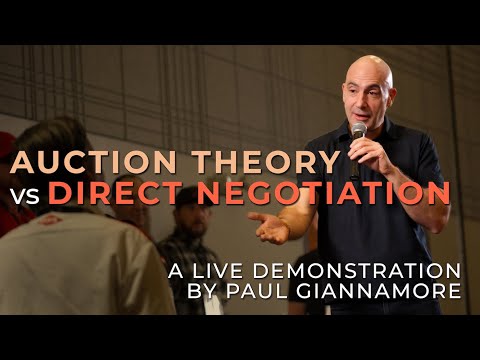
Why World Class Deal Makers Avoid Negotiations: Exploring…
Keynote by M&A advisor Paul Giannamore, filmed at the AZPPO Great Western Conference in Mesa, Arizona, on March 27, 2024. The talk examines a key decision in asset sales: choosing between negotiation and auction as a selling process. Using the story of selling a family-owned violin as an entry point, Giannamore explains the dynamics of a controlled auction in a business sale, including how competition among buyers replaces traditional negotiation and how tactics such as switching to a Dutch auction can push the final price toward a desired outcome. The presentation offers an overview of strategic process selection for maximizing sale outcomes.
# Channel Identity Observations
## Creator Self-Description (Explicit Claims)
- **Profession**: The speaker identifies himself as an **M&A adviser**: *"my job is m&a advisory and I've been doing it for over 20 years."*
- **Career background**: He describes his history: Cornell graduate, Lehman Brothers, CSFB in London working for Frank Quattrone ("the number one Tech Banker on the street"), then private equity buy-side, then founding his own firm with a partner.
- **Specialization**: He claims a niche focus on **pest control M&A** since 2003: *"since 2003… we've done… billion dollar deals"* and *"we advised On The Rollins/Terminix merger."*
- **Compensation model**: *"we take a percentage of the transaction,"* and clients often engage the firm years in advance of a sale.
- **Named first person**: An audience Q&A reveals his name is **Paul** (*"they'll say Paul, five years from now we want to sell"*).
## Observable Presentation (Demonstrated Patterns)
- **Live conference talk format**: The video captures an in-person keynote with an audience, props (jar of coins), interactive auctions, and volunteers — a speaking engagement rather than a studio production (*"I don't come to a lot of these things anymore… this is a big one"*).
- **Teaching style**: Heavy use of **storytelling** (selling a family violin in the 1990s) and **interactive demonstrations** (closed-bid jar auction, a role-played controlled auction of the real ServiceMaster/Norvest "No More" deal) to illustrate auction theory concepts like the Winner's Curse, English auctions, and Dutch auctions.
- **Central thesis presented**: *"The most important decision I make as an m&a adviser is whether to negotiate or to auction,"* and that process-setting, not negotiation tactics, creates leverage.
## Intended Audience
- **Business owners and prospective buyers/sellers**, especially in **pest control and blue-collar service industries**, evidenced by repeated direct address:
- *"if you guys go out there and buy small businesses… you're going to talk to an owner"*
- *"if you had a $2 million Pest Control business… and I was an owner"*
- References to "boring mundane blue collar industries."
- Audience members are assumed to be potential deal participants; Q&A questions concern small acquisitions (*"vast majority of Acquisitions in this industry are probably less than $2 million"*) and how to find/engage an adviser.
## Claimed Scope of Content
- **Sell-side and buy-side M&A process design**: negotiation vs. auction, controlled auctions, sealed bids, Dutch auctions, "shutdown moves," information concealment vs. misstatement (with legal caveats by jurisdiction).
- **Deal-size breadth**: From $2 million owner-run businesses to $200M+ cross-border private equity exits, with market commentary on pest control consolidation (Rollins, Terminix, Rentokil, Anticimex, PE platforms).
## Evidence Notes
- No curated metadata was supplied; identity observations rest solely on the transcript.
- The talk is a one-off conference session, so channel-wide format conclusions beyond this video's demonstrated style are not inferable from this material alone.
# Delivery Observation Report
## Speaker Overview
The speaker (self-identified as "Paul") is an M&A advisor presenting a conference talk on auctions vs. negotiations in business sales. The delivery is conversational, story-driven, and interactive.
## Tone & Register
- **Casual, blunt, and humorous.** Vulgar/colloquial phrasing appears repeatedly: "we didn't give two shits about win-win," "what the hell for," "you can make an ungodly amount of money."
- **Self-deprecating humor and hyperbole.** "I've never been burdened by a false sense of modesty."
- **Playful teasing of audience participants.** To a volunteer: "you can't smile you have to look constipated definitely don't laugh you got to look Swedish."
## Vocabulary & Recurring Phrases
- **"Process setter" / "I am the auctioneer"** — repeated as the central framing device: "I'm the process Setter... I am the auctioneer" (appears multiple times throughout).
- **"Shutdown moves"** — used repeatedly for negotiation tactics: "there's a variety of shutdown moves that we use."
- **"Boot from the process"** — recurring phrase for eliminating bidders: "you get booted from the process."
- **"Revise their offers forward" / "revise your bid forward"** — his consistent term for raising bids.
- **"At the end of the day"** — a frequent verbal tic: "at the end of the day whenever you read... these books," "at the end of the day what really matters is like negotiating process."
- **Auction-theory jargon** used naturally: "English auction," "Dutch auction," "Winner's curse," "ascending price auction," "indicative bids," "final round bids," "tightly clustered."
## Teaching Habits & Structure
- **Story-first teaching.** Opens with a long personal anecdote (the family violin, ~[112]–[396]) before introducing the framework.
- **Live props and audience experiments.** A jar of coins: "this is going to be a real auction money's going to change hands here." Uses audience members as bidders in a simulated deal: "I don't have slides and I think people make better props."
- **Real-world case as demonstration.** Reenacts an actual transaction with real numbers: "we're going to use service Masters 2019 acquisition of no more."
- **Contrast framing.** Repeatedly sets up binaries: "whether to negotiate or to auction," "cross table negotiation" vs. "same side negotiation."
- **References to well-known books to position against.** "you read these books you know Donald Trump's book or Chris voss's book... the for the large part... most of these businesses are sold through without negotiating at all."
## Interactive Habits
- **Direct audience negotiation demos,** including improvising a live haggle: "how much will you give me for that uh 21 49 how about I counter you at 35."
- **Names and calls on volunteers:** "what's your name Ben," "Tucker all right Tucker you are my client."
- **Q&A-heavy second half,** often validating questions before answering: "that's a great question," "that's that's a good question," "great question."
## Communication Patterns
- **Colloquial fillers and restarts** suggest an unscripted, spoken style: "um you know," "I mean," "so on and so forth."
- **Concrete dollar figures throughout** ($50,000 in cash, $105,000, 189/191/193 million) to anchor abstract concepts.
- **Blunt advice delivered as directives:** "you should never lie," "you got to be ruthless," "be agnostic as to who the buyer is and let the money and the terms speak."
## Uncertainty Notes
- The transcript has transcription errors (e.g., "Crona"/"Strater" for likely Cremona/Stradivari; "vient" for violin; "Winter's curse" for Winner's curse; "sside/cell-side" for sell-side), so exact wording of some quotes is uncertain.
- **Hand gestures and stage movement are only inferable** from verbal cues ("I'm getting all sorts of hand signals," "I don't like the podium"); visual delivery details cannot be directly confirmed from the transcript.
# Position Extraction: "Why World Class Deal Makers Avoid Negotiations"
**Speaker:** Paul (identified in transcript), M&A advisor with 20+ years of experience, sell-side advisory focused on pest control industry.
## Core Thesis
- **The most important decision in selling any asset is the process by which it is sold** — choosing between **negotiation** or **auction** (with fixed-price as a rare third option).
- On Wall Street, most businesses are sold **without negotiating at all** — through controlled auction processes.
- Paul's job as M&A adviser involves negotiating two things: **substance** (price, terms) and **process** — and **process is what provides leverage**.
- He criticizes popular negotiation books (citing Donald Trump's and Chris Voss's) for focusing on counter-offers, anchoring, influence, and "win-win" rather than process design.
## Key Arguments and Claims
### Two negotiation dynamics
- **Cross-table negotiation:** direct back-and-forth between buyer and seller.
- **Same-side negotiation/pressure:** competition among buyers in an auction pushing price up — the preferred dynamic when selling.
### Winner's Curse
- Referencing Professor Richard Thaler's 1970s jar-of-coins experiment (transcript says "Richard Thor"), Paul demonstrated with a live auction: jar contained **$22.50**; winning bid was **$39.99** — winner pays above intrinsic value.
- Sellers benefit from this: "which we love when we're selling businesses especially when the business is yours."
### Concealment over bluffing
- Sellers should **conceal information** (e.g., number of bidders) rather than lie.
- "You're better off concealing information than actually outright making a material misstatement."
- Claims he could likely have run the Dutch auction with only one bidder and achieved similar results by shading information.
- Legal qualification: in the US bluffing is mostly tolerated; in **civil code countries (Europe), material misstatements lead directly to court**.
### Seller behavior advice
- "Be agnostic as to who the buyer is and let the money and the terms speak."
- Sellers fall in love with "cultural match" buyers and concede value; after closing, management turnover (e.g., "if you sold to Terminex management changed every 16 months") erodes those relationships.
- Sellers take the real risk building the business, so should be **ruthless** in maximizing the one-time sale.
### Buyer-side process control
- Buyers should constantly think about controlling process, not just substance.
- **Shutdown moves** for buyers:
- Negotiate exclusivity with a no-shop condition ("if we come to an agreement you will not shop my deal" — creates legal exposure if breached).
- The **sealed-envelope simultaneous bid**: both buyers deliver precise sealed offers to the seller's attorney, opened together, highest binding — precludes further shopping. The attorney is bound by professional conduct codes to execute it.
- Sophisticated buyers can make "an ungodly amount of money" buying small pest control businesses cheaply by "fighting the auction."
## Case Narratives
### The violin story (~1991)
- Family owned a violin made in Cremona (transcript: "Crona"), same shop as Stradivari, 1717.
- Failed attempts: sister's online listing (offers included a chameleon and dirt bike); music shop owner Gus's $30,000 estimate; a collector's escalating offers ($50,000 cash immediate-close, then $65,000 "final").
- Paul appealed to higher authority (family) to delay; ultimately used a New York auction house — estimated ~$100,000, sold at **$105,000** — his first auction lesson.
### No More Nattermänn / ServiceMaster deal (2019)
- Sell-side for Norwegian PE firm **Norvest** (owner of the second-largest independent pest control business in Europe).
- Client goals: reserve **€/$180M**, happy at 190, smiling at 200; Paul agreed to chase 200.
- Process: went to ~50 buyers; round-one indicative bids clustered **$150–159M**; lowest bidders eliminated (noting Rollins exited); successive rounds of "revising bids forward" in exchange for more information/management access; price rose to the 180s.
- **French firm's shutdown move**: $186M, 24 hours to accept, all cash, two-week close. Paul let it expire because three remaining bidders were **tightly clustered** at 180–185; auction theory says you get "second price plus a little bit," and clustering felt favorable. The French firm exited — the only **descending price moment** in the process.
- Final round bids: **189, 191, 193** — but client wanted 200.
- Solution: convert to a **Dutch (descending) auction** starting at **$220M**, cycling through the three bidders with falling prices and shrinking acceptance windows. ServiceMaster (David Buckley, per role-play) accepted at **$200M**.
- Rationale: all bidders had sunk months and hundreds of thousands of dollars; the descending structure put everyone at risk of losing the deal for a few dollars less.
- Paul noted the prior "final" bids became **null and void** once the Dutch auction started — an acknowledged risk (a busted auction if a sole buyer walks).
- Outcome: runner-up finalist for European Middle Market Deal of the Year.
### Dutch auction aside
- Named after the flower clearing house near Amsterdam; ~2.3 million cut flowers/day sold by descending price until buyers press a button and choose quantity.
## Advice for Selling a Small Business (~$2M, DIY)
- Identify actual likely buyers; cast a wide net.
- Prepare basic materials: three years of clean financials, cash flow, recurring revenue, pricing.
- Require NDAs, then request **indicative bids by a date** including: dollar amount, deal structure, financing source, statement of intent (people, integration).
- A clean self-run quasi-auction: start with the **lowest bidder**, tell them the high bid, ask them to beat it or be eliminated; enforce your own rules exactly.
- Paul's own practice differs: he would **not** go to the lowest bidder to leapfrog the highest — but endorses it as clean and easy for a DIY seller.
## Market Commentary (Pest Control)
- 2003: effectively a **duopoly** of buyers (Rollins/Orkin and ServiceMaster/Terminix).
- 2004: British buyers acquired Ehrlich (~$120–130M), putting Rentokil on the map; Anticimex arrived ~2016; now many private-equity-backed platforms.
- Local/family buyers often lack capacity or willingness to pay, or "want to pay you with your own money" — Paul prefers maximum cash at closing.
- Full controlled auctions run roughly **once per year** in pest control; most deals are **modified/quasi-auctions** combining auction and negotiation. Less experienced buyers adhere less to process rules; some won't participate in auctions at all.
- Scarcity value: businesses above ~$5M revenue become scarcer and more attractive; geography matters (heavy PE tuck-in activity in the Southeast vs. Wyoming/Montana/Illinois).
## Q&A Positions
- **Who sets process?** The seller *should*, but often doesn't — whoever sets process rules has tremendous leverage.
- **Rules/laws?** "The only rule is there are no rules" — but auctioneers' rules operate within legal/regulatory boundaries and good-faith dealing; jurisdiction matters (US vs. civil code).
- **Compensation:** percentage of transaction value; many clients engage years in advance. Paul told clients to wait in 2015–16, then urged selling by 2019; market now slowing.
- **Background:** Cornell, Lehman Brothers, Credit Suisse First Boston London under Frank Quattrone (top tech banker), private equity buy-side, then founded his own firm; entered pest control in 2003 via a Terminix deal. Advised on the Rentokil/Terminix merger antitrust dispositions, including re-selling the same European business (for less the second time).
## Preserved Tensions and Qualifications
- Paul concedes the risk in voiding final bids before the Dutch auction — "probably a risk I wouldn't have taken" with only one buyer remaining.
- The French firm's withdrawal actually *lowered* the top price mid-process — auction processes can backfire.
- He acknowledges his recommended DIY lowest-bidder-first tactic differs from his own practice.
- Controlled auctions "don't happen much in the private markets," especially pest control — his centerpiece example is an outlier, which an audience member explicitly challenged given most industry deals are under $2M.
# Speaker Attribution Record
## Video
- **Title:** Why World Class Deal Makers Avoid Negotiations: Exploring Auctions in Mergers and Acquisitions
- **ID:** `01a168c8-a18d-7f3b-8985-f8cf6fd889de`
## Speakers
### Primary Speaker — "Paul" (Creator / Featured Presenter)
- Identified by first name **within the transcript itself**: an audience Q&A exchange includes "what did they call you... they call me a lot of things," and later he says clients say "Paul, like five years from now we want to sell."
- **Role:** M&A adviser with **over 20 years** of experience; runs his own advisory firm (founded with a partner). Background stated in transcript:
- Cornell graduate; hired at **Lehman Brothers** in the late 1990s.
- Moved to **CSFB (Credit Suisse First Boston)** in London; worked under **Frank Quattrone** on tech M&A (Microsoft, Cisco, Gateway, Dell cited).
- Moved to private equity buy-side before founding his firm.
- Entered pest control M&A in **2003** via a Terminix-bound deal in the DC Metro area.
- **Function:** Delivers the talk, runs live audience experiments, answers questions. He is the presenter/creator-voice of the video.
### Audience Volunteers & Named Participants (Other — minor roles)
- **Ben** — volunteer; direct-negotiation demo participant (bid $21.49, agreed at $26).
- **Tucker** — volunteer; role-played the client **Norvest** (Norwegian PE firm owning **Norwood / "no more"** — transcript spelling uncertain), engaged in brief Q&A with the speaker.
- **Named as props/participants (speaker addresses them):** David Buckley (role-played ServiceMaster), Mr. James, Joe, Kyle (role-played the French bidder who issued the $186M ultimatum), Matt (Vance), Doug, and unnamed volunteers.
- **Unnamed audience questioners** — asked questions on seller process-setting, binding final bids, how to find an adviser, small-deal ($2M) processes, and legal rules.
## Referenced Sources & Third-Party Claims
- **Violin anecdote (personal, first-person):** 1717 violin from Cremona ("Crona" in transcript), Stradivari's shop context; appraised by "Gus" (music shop owner, ~$30k), a University of Chicago Music Conservatory professor, an unnamed collector ($50k cash offer, raised to $65k), and an unnamed New York auction house (estimated ~$100k; sold for $105,000).
- **Academic reference:** "Professor Richard Thor did this in the 70s" to demonstrate the **Winner's Curse** (transcript spelling; likely Max Bazerman/William Samuelson-style jar experiments — identity not verifiable from transcript).
- **Cited books (by reference, not quotation):** Donald Trump's negotiation book, Chris Voss's book.
- **Deal case study (first-person claims):** ServiceMaster's **September 2019** acquisition of a European pest control business ("no more"; second-largest independent in Europe), seller **Norvest**; client reserve $180M, target $200M; final Dutch auction closed at **$200M** with ServiceMaster; transaction described as runner-up finalist for European Middle Market Deal of the Year.
- **Other deals cited by speaker:** Rollins/Terminix merger advisory (~a year and a half prior), including antitrust dispositions of European/UK assets (sold second time for less); Rentokil's purchase of Ehrlich (~$120–130M, per speaker), Anticimex entering ~2016.
- **Dutch flower auction reference:** small town outside Amsterdam, ~2.3 million cut flowers/day (speaker's stated figures, unverified).
## Promotional Segments
- **None explicitly flagged.** The speaker references his own firm, fee structure ("we take a percentage of the transaction"), and multi-year client engagements — **self-promotional in character** but no product, service, or sponsorship pitch segment is present.
## Unavailable / Uncertain Provenance
- No curated metadata was supplied; speaker identity beyond first name "Paul," the firm name, event name/location, and upload details are **not established**.
- Several proper nouns are transcription-uncertain: "Norvest," "no more" (business name), "Crona" (Cremona), "Richard Thor," "stany" (Seinfeld character), "Orin" (likely Rollins' **Orkin**), "renil" (likely **Rentokil**).
- **Comment availability:** not indicated — no metadata provided.
- Audience participants' identities beyond names spoken aloud are unverified.
you nice to see all right everyone hear me okay perfect you guys put on a good show out
here I don't come to a lot of these things anymore and I'll tell you this is a big one so it's good to see everyone I see some yawning out there so I know it's early I'll uh I'm going to try to use some props and uh get this thing exciting but uh my job is m&a advisory and I've been doing it for over 20 years and today I think what I'm going to talk about is just effectively one big idea probably the most important thing I've learned over decades which is I think extremely applicable to folks who may not even be in the process of buying or selling a business and you know in the capacity of my job the most important decision okay the this works as well perfect this is better I don't like the podium the most important decision I make as an m&a adviser is whether to negotiate or to auction and if you think about the sale of any asset in the world there's two ways to do it either a negotiation or an auction now I guess there really is a third way you got a fixed price process you can go to Starbucks in the morning buy a cup of coffee it's three bucks you don't want to pay three bucks take or leave it but for the most part every asset is sold either through a direct negotiation or an auction so the most important decision I make and my day-to-day job is whether to negotiate
or to auction and so for you folks what I want you to always keep in mind as we have this discussion today is that the most important decision you'll make when you sell any asset is the process by
which you sell that asset and my first foray into this was I don't know going on 30 years ago my family was living on the west side of Chicago we discovered that we had a very valuable violin that had come over with us from Italy was made in Crona in the same shop that Strater worked in in the 1700s and we had no idea how much this thing was worth and so my father got the bright idea and said you know what we could use some money so let's sell this bad boy now the problem was it's a rare musical instrument and none of us had any idea how the hell to do that so my little sister decided to head out on an expedition on the internet which was quite new at the time and she went on the precursor of Craigslist and decided she was going to put it online vien made in 1717 Old as probably worth a lot who wants to buy it she got a lot of interesting offers a lot of interesting trades for sure um package deals a chameleon named Lester an RM80 dirt bike a new VHS video recorder but she didn't really come up with some great cash offers so my father's next idea was go see his friend who ran a music shop Named Gus we went in we saw Gus and Gus sweet old man looked at it and said I have never seen anything like this but it's got to be worth about 30,000 bucks and that was a lot of money back then because the house I lived in I don't even think was worth 100 Grand at the time so but he saidou know I've never seen one of these before but I think I can probably sell it for you and I was like Dad I don't think Gus is our guy The Next Step was to go down to the University of Chicago I went to the Music Conservatory and I thought you know there's orchestras here there's got to be people that know what the hell they're doing when it comes to musical instruments I talked to a professor there and he said you know what it's a valuable instrument you got there and I know a collector I said okay so he set me up an appointment I went to this collector's home as I sat there The Collector LIF at the instrument and said I am interested in this he went into the
back room he came out with a bag a canvas bag I distinctly remember it and it had $50,000 in cash in it I remember I was a young kid and this was probably
1991 that was a lot of money so he looked at me and he said I will buy this instrument right now for $50,000 in cash but you've got to accept this deal right now now unfortunately I didn't have the authority to do that and when he made that offer time bound attempted to use a closing move on me I got a little bit nervous so I stepped out and I said you know what I've got to talk to the family about this I appealed to higher authority and said I'm not the decision maker I got to step off got talk to my parents went back to the professor and I said Professor I don't know what to do he offered me $50,000 now between the time I left his home and the following day when I saw the professor The Collector called and said you know what tell that kid I'll give him 65 Grand that's my final offer so now I'm thinking to myself okay I in the process of negotiating with the collector um my sister is a total bust on her online sale process my father's still hanging out drinking coffee with Gus and so what should I do the professor said well you know I do know that there's instrument auctions take place often times in New York we have in Chicago but there's a company that deals with these rare instruments maybe you should talk to them so I got their phone number placed a phone
call um my father worked for an airline so it was super easy for me to travel back then so I took a violin which at the time I knew to be worth at least $65,000 and put in my backpack and got
on the plane went out to New York I met with the auction house they looked at it and said this thing will sell at auction for approximately $100,000 now that was aming to my ears and so I learned about the auction process I eventually we engaged the auction house which sold the violin for $105,000 which was worth more than the house I lived in at the time so it was a literally hitting the lotto for my family um but it was a first it was the first experience I'd ever had with an auction right and since then I've been to scores of auctions around the world for everything from I've sold companies at auction I've been to farm auctions I've been to watch auctions art auctions now but when I think about the sale of a business it really comes down to one of two ways direct negotiation like with the art collector or auction through the auction house and there's not really a clear-cut way of doing it takes a lot of judgment to determine not only the profile of the seller but also that of the buyers and I think today what I want to try to do is I want to you guys are just waking up so we're going to do a few thought experiments but ultimately what I want to do is I want to walk you through a cell-side process and I want to walk you through a cell-side process where there's no negotiation because at the end of the day whenever you read you know you read these books you know Donald Trump's book or Chris voss's book or any of these negotiation books are always talking about things like making counter offers and anchoring and methods of influence and win-win negotiations the for the large part you know on Wall Street most of these businesses are sold through without negotiating at all and as a process Setter so as an m&a adviser my job is to do two things I'm negotiating substance right I'm
negotiating purchase price and terms but I'm also negotiating process and the process is what effectively really gives you leverage and a sale process and
we're going to do some very very basic experiments and then I'm going to add to some complex here so that we can see how this works in real life I want to start with this jar o cash now not as valuable as a vient but there is money in here and this is going to be a real auction we're going to start with an auction um I'm going to auction off this jar now Professor Richard Thor did this in the 70s to demonstrate what's referred to as the Winter's curse that's what we're going to talk about today I'm just going to give us a quick example of of a single round Clos bid auction so here's how this is going to work let's say for example there's $40 in this jar you guys will make a bid you guys have pen and paper out there I want everyone to make a bid now this is a real auction money's going to change hands here so do this right I want to whatever the amount is in here the highest bidder in this single round auction will ultimately take this now if there's $40 in here and you bid 45 you owe me five bucks if there's $40 in here and the highest bid is 20 bucks I owe you so mark your bids down guys let's do this who wants to participate Clos bid we're going to do this Clos bid this is going to be an open outcry auction we're going to although those are more fun for sure I want to try to demonstrate a principle so everyone that wants to participate just write down a number what you think I I'll pass this around you guys want to take a look at the jar pass that around remember a roll of quarters is 10 bucks a roll of Dimes is five nickels are two pennies of course are 50 so while while we're while we are taking a look at that jar and we're going to bid on that we're going to do two things we're going to auction this jar o coins and then we are going to do a very quick negotiation and then I'm going to need some volunteers this morning
maybe just do some guess work write your bids all right you my friend what's your name Ben Ben let's let's try to let's do
a quick direct negotiation of this here jar how much will you give me for that uh 2149 21 49 how about I counter you at 35 it's a good jar good coins fresh coins I went into the bank yesterday they thought I was crazy I was like can I get rolls of quarters they're like what the hell for it doesn't look like there's 30 quarters in there I'd say that little high okay let's uh put the difference maybe 26 okay 26 I'll take your 26 is there anyone out there that would give me more than 26 what would you give me for it I'll give you 80 bucks 80 bucks done so done in a in a direct in a direct negotiation like that you know there's a lot of and anytime we get involved in in in negotiation particularly direct negotiations like this you always want to think about changing process rules and so one of the things that you'll experience if you guys go out there and buy small businesses you guys want to go out and buy a small Pest Control business inevitably you're going to talk to an owner who is going to not be running a formal process and he's going to say yeah I agree to your terms and you're going to get all excited and then he's going to turn around and he's going to do exactly what I did he's going to shop your offer he's going to say okay I've got this offer from this guy and he's going to call all his friends up and say who's going to do me better now there are things and we're going to talk about this as we go through some examples today about some shutdown moves I mean one of the things you could have said to me is I'm I'm negotiating with
you exclusively under the understanding that if we come to an agreement you will not shop my deal now there's a legal hus on me I can't do that otherwise you have a cause of action and there's a variety
of shutdown moves that we use in these sort of processes that we're going to talk about in just a second all right what who has bid more than $20 for that raise your hand who's at 20 who's at 25 who's at 30 who's at 35 for the jar coins what did you bid sir oh 3250 3250 did we have anyone higher than 3250 3320 3320 39.99$ 39.99 3375 okay so it sounds like we're going to call 39.99 as the bid there's actually $22.50 you were the closest in that jar um and that that experiment demonstrates the Winner's curse in an auction right you know you get into these auctions price this is what's called an English auction which is an ascending price auction as the price goes up whether it's open outcry or seal bid price goes up and ultimately the winner of the auction typically pays more than the ultimate intrinsic value of the asset being conveyed which we love when we're selling businesses especially when the business is yours um on the one end of the spectrum when you think about selling a business you have on the far end of the spectrum you have what's called a formal controlled
auction and I want to demonstrate to you how this works um this is a textbook example of how a controlled auction Works in selling a material
asset you'll notice that in the controlled auction process there's there won't we'll get to a final purchase price and you're not going to see any negotiating whatsoever you will see negotiation of process so similar to an auctioneer when you're selling a business the core responsibility of the m&a adviser is to stand up and set the process like an auctioner would and what you're hoping to see is competition on the other side of the table pushing up the price when you have direct negotiation it's cross it's he and I are going back and forth that's cross table negotiation when you're running an auction you want same side negotiation or pressure amongst buyers now this is a small stage I have never done anything like this before so I'm going to experiment but I want to get some volunteers because I don't have slides and I think people make better props so I want to ask for some folks to come up here this morning can I at least get one volunteer to be a client sir what's your name Tucker Tucker all right Tucker you are my client um we're going to use a real example we're going to use service Masters 2019 acquisition of no more um in Europe it was the second largest independent a pest control business in Europe at the time it was acquired by service master in September 2019 you will represent actually you kind of look like the people that I want you to represent you are going to represent norvest which is a a Norwegian
private Equity Firm that owned no more so that means you can't smile you have to look constipated definitely don't laugh you got to look Swedish nice to meet you Tucker okay so you're the
client and again this is going to be a little bit silly here but I'm going to try to do this anyway I want to demonstrate how a controlled auction process works um Tucker here is the client no more it's a business that you know they engaged Us in 2019 and I went up to Stockholm and they said Paul we want at least 100 m $180 million for our business is what we want right this is kind of our reserve price but um we'd really be happy about getting a buck 990 and we would crack a smile if we were able to get 200 million for it and so I looked at the business and I said I think 180 is an appropriate price and they said um could you do 200 and I've never been burdened by a false sense of modesty so I said you know what I'm up for this challenge we're going to try for 200 um whenever we take a business to Market we think about it from the standpoint of on the cell side you are the process setter your first question is do I negotiate or do I auction and there's a variety of different factors that would cause you to make the decision one way or the other but nine times out of 10 in my business when you sell a when you sell an asset you're choosing to auction or do a combination of the two now I need 10 additional participants and this will go quick you won't have to say anything um and I apologize my is that my phone I don't know um can I quickly just get 10 Folks up here I promise I'll make you sit down quickly I just need you for prop perspective there we go Tucker why don't you come over here with me well uh Matt stand on up here this is
great one two three four five six seven we'll we'll use what we've got all right so we prepare a business we put together
sside materials and then we go out to typically in this market when private Equity is involved 50 or 60 participants so we'll out to 50 firms say hey we've got this business are you interested in buying it they get an opportunity to review the materials they put together their financial models and at the end of the day they are required the first step in the process because we are the process Setter like the auctioneer we say on such such and such a date you guys have to Tender a bid an indicative offer and you're effectively buying your way into the auction by presenting an offer that actually begins to get into the ballpark so when we did the no more transaction I'm going to use real numbers here right out of the gate the majority of the offers clustered between 150 and 159 million so we typically begin with the lowest offer and that's the or man over here when we get into the second round so we got the first round we got the indicative bids we got a big stack of these things we look through them and then we go to the lowest biders and we start to have conversations about whether or not they're really serious about doing the transaction and if they will move revise their offer forward now all of these folks did the orcan man in this particular case and actually realistically it was orcan really in the process so Orin I'm glad to Rollins I'm glad to ask you to depart from the process so now what we do is because we have process rules we have to enforce them so you didn't make it into the mix you are out you get booted from the process right and so this is how this works and again there's no negotiation here it's really just asking the acquirers to revise their offers forward so after the first round we went through a second round got rid of some buyers by the third round it was time to have management meetings so in order to actually get the opportunity to sit down with management you you have to make another bid so folks bid forward revise your bids due on Monday in this particular case unfortunately the lady here my friend from magic thank you for participating and Matt Vance you guys have been excused from the process because the acquirers Revis their bid forward 150 155 160 165 this is a closed sealed bid English auction ascending
price auction no negotiation just asking him to rise bit forward every time they revise the bid forward they get a treat for doing that they get further information on the company they get more
access to management but in order to survive right they have to continue to revise their bid forward because if they do not they will be booted from the process and not have the opportunity to to effectively finally bid on the business so as we continued to go through this process we got another round Doug thank you for participating you still didn't you didn't make it but now the purchase price is is we're now in the 180s so you guys have made it up into the 180s so I'm pretty damn close to the reservation price of where the client needs to be and I was very happy that Tucker here the Swede or the Norwegian told me really where they need to be and ultimately where they want to get but we are are still a far cry from this so um a French firm represented by the gentleman here in red Kyle decided they were going to use a shutdown move in August of 2019 they were pissed they were tired of bidding they came in and basically said we are offering $186 million you have 24 hours to accept or reject our bid it isn't all cash we'll close this deal in two weeks now you're at 186 the rest of you are at between 180 and 185 and so now we had somewhat of a dilemma in our hands because the 186 was a great price I wasn't sure where we're going to get these other guys to go but we still had three biders that were very tightly clustered and tightly clustered bids in an auction process is where you want to be you don't want to see huge disparities between price because auction Theory tells you you're going to get the second Price Plus a little bit but when you've got tightly clustered offers I was feeling very good so we let that offer expire and we came back the next day and said okay on Friday we're going to final
round and and Final Round is when all of these gentlemen well the French guy you stormed off Kyle appreciate you participating you you were pissed you you like hell I'm out of here so we lost
him so our our price just fell actually it was the first time in that auction that we had a descending price because 186 was the top all of a sudden fell and we're like so now I'm sweating a little bit but cool and we said on Friday we need final round bids and there's a really important reason why we do this and it's one of the things that is freaking maddening when you're out there trying to buy a business from a single operator let's say you're out in the middle of Arizona you want to buy a company the negotiations go on forever right you negotiate price now you're negotiating something else and what are we going to do with my aunt my daughter still works for the company and there's a million things they just keep coming and coming and it's a thousand paper cuts but when you're selling an asset and you're setting the process again we've done zero negotiation once we didn't do a counter offer we didn't use influence we didn't give two shits about win-win nothing it's an auction ascending price we're controlling the process we're controlling the timing so now we say final round bids are du on Friday and we say final rounds because in a lot of ways in an auction the final round is somewhat like it's like a marathon right like you see the New York Marathon these dudes are running running for hours you're like holy like what is going on and then all of a sudden they see the finish line and they start to Sprint so you always want to show the buyers the Finish Line because they hold back they will inevitably hold back so what we're going to do is attempt to show them the finish line so Friday you guys tender your bids your bids came in Final Round bids exciting day Friday so I'm up in
Stockholm we get the final round bids we open up the papers and we were at 189 191 and
193 now now I was internally satisfied I mean it was a textbook fantastic process um but rightfully so the clients wanted the big 200 and I thought there was an opportunity to get it but I had a problem so Tucker I typically don't ask clients for advice but I think for today's purposes I'm going to what do we do so we've got a 189 a 191 and then 193 you want 200 million we told them it's final rounds they put in their bids what what can we do apart from holding another auction well let's talk about that what how how would we do that what would we do just end this auction it without incurring too many expenses I don't know what kind of expenses go on in an auction like this and then hold another auction put it up for auction again so I think that's an interesting idea the problem is so we've gone out to now instead of doing what my sister did and put a ancient vient on like Craigslist predecessor and wait for somebody to pop up we've gone out and we've hunted we found all the best buyers there's 50 likely buyers of this company on the planet and we just ran them through this intensive auction process we're already above our reserve price right so we are we wanted at 180 we're pretty damn happy in the 190s but we want 200 because we only get to do this once and you know what we're gonna extract every single nickel out of these buyers it's not their money anyways these are publicly trading companies they care let's ramp this up and so
faced with that we decided to do exactly what you said we ran another auction but here's how we did it we you know we talked about an English auction which is
a an ascending price auction and there's a variety of auctions there's a Japanese auction how many have heard of a Dutch auction have you heard of a Dutch auction a Dutch the a Dutch auction is an auction process which is a descending price auction and a Dutch auction for I don't know the last probably 10 years or so on a small town outside of Amsterdam the reason why this auction has its name the Dutch auction is because the small town outside of Amsterdam is the global Clearing House for flowers and they sell flowers in a descending price auction and they do I don't know last looked 2.3 million cut flowers change hands every single day at this auction and what they do is they start at a high price and it descends until somebody pushes a button right so it might be I don't know I don't know how much flowers cost but say the bulb's 10 bucks and it goes 10 950 9 and then when somebody hits the button they choose how much the quantity of the flowers they want to buy when they're done the price keeps falling until the market is clear so in this particular case we've already said final bids so these guys are all expecting final bids there was no way to go back to them and say pay us more money because they had just like the French they would have said the hell with you we're not playing anymore so I really couldn't negotiate anything but I could change the process because remember I'm the process Setter I am the auctioneer and so we changed process so what we did is we said we're going to now do a Dutch auction so we took the final three biders and we started at 220 million and I went first here to Mr David Buckley and I said David the bid now is 220 you're at 189 the bid's at 220 you have 4 hours to accept or reject this and if you reject it it goes to the next party and now it'll keep coming around but the price will continue to fall until somebody hits it so 220 4 hours you tell me H not
so much interested and quite frankly he would didn't want to pay 224 it anyway so he didn't care right it's not his loss like I'm not paying 224 let somebody else take it Mr James we go to you and so now I
got to move the price down 215 you got three hours except to reject you rejected now I go to Joe Joe 210 2 hours except or reject and so this process went on through the night until we we finally got back to David here which is service master and when it came around to them it was 200 million they hit the bid closed it was a binding transaction at that point in time and by bringing the Dutch auction into process what it did is it put now it put every participant in this process that had worked months spent hundreds of thousands of dollars flown around the world went to all sorts of meetings it put everyone at risk of losing the deal like at what point do you want to lose the deal right and when it got down to 200 service master looked at it and said it makes Financial sense if we let the price fall again and somebody else takes it somebody's going to buy it for a few bucks less and we're going to lose out and so that's how a controlled auction works and that again is it's a it's a transaction that I'm extremely proud of we were runnerup finalist for the Europe the European Middle Market deal of the year that year for the use of the ascending price auction and the Dutch auction accommodation in order to get that transaction done but that's a very elegant way to negotiate the sale of a business without negotiating anything you just let the process run and um you have it and you were happy uh Norwegian dude look at that smile on your face over there I like it so thank you guys app
participation that is a classic example of a fold control auction that doesn't happen much in the private markets particularly in Pest Control we probably run one of those once per year the
majority of transactions are sold in a combination or what I call a modified auction or a quasi auction and so it takes combinations of the two and you can pull off controlled auctions with very sophisticated corporate buyers the less experienced buyers in the mix the less they tend to adhere to process rules the more some of them won't even participate in an auction because it takes a certain skill set to be a buyer in an auction you've got to understand closing moves and how to actually negotiate process yourself but in Pest Control in general the majority of these deals are a combination of a controlled auction with some elements of a negotiation and I would say typically you know almost every transaction that we do um we would start out in a very similar manner materials got into the market acquirers are given the opportunity to bid um they go through successive rounds of bidding now most of these sale processes are closed bid or seal bid auctions and as a seller whenever you're selling an asset one of the most important things you can do is conceal information right you want to conceal information you do not want parties to know how many parties are participating I mean hell I probably could have run that with one bidder
right I mean I literally probably could have one bidder there the bidder would have not known how many other biders are there they would have thought there's three or four or five others and I could
have run that Dutch auction and I think it's likely we would have ended up with very similar results by shading what's in our pocket effectively concealing information and that's one of the most important things that you can do as a seller and it's one of the things that these small sellers often do not do and I think you know when I look around the m&a market here in Pest Control in General I think you can make an ungodly amount of money if you really understand how to go out and buy these businesses on the relative treat if you learn how to fight the auction so to speak you can go out and buy buy these businesses and I see it happen every single day you can go out and buy these businesses on the relative cheap build up massive businesses and turn around and and sell them so those opportunities are there and I could Babble on for a long time but this is a good time for me to take kind of of an intermission break and see do we have any questions traditionally does the seller always set those processes you know in any that's a great question the seller should set the process but the seller often does not and that's where the seller gets into problems like so if you're a buyer you know whoever is able to set the process rules has tremendous leverage in any sort of a process and so the theory is you're selling an asset it's a unique asset there's one of it and you should have a variety of different buyers that are able to compete if you're a sophisticated buyer you're always not
only trying to negotiate the substance of the deal but you're trying to negotiate process so you know there's a variety of different things um you know
I was selling that jar that we'll use that jar again as an example you know one of the things that he could have done is try to pin me down into exclusive negotiations with him um let's say that you're you're you're you're buying a business you know you talking to the Oldtimer he's ready to sell and you guys are in final negotiations and then he tells you out of the blue hey um somebody else called up and is interested in the business now for you that's not great competition's never good and what you want to do is try to convince these sellers to not bring competition into the mix but inevit it happens so there's a lot of things you could do you could you could basically say hey I'm not going to give you a final bid here um because I don't want you to shop it but here's what I'm willing to do let's get your attorney on the phone and I am willing to write an offer right now I'm going to Tender it tomorrow at 10: a.m. you tell the other buyer to Tender that offer tomorrow at 10:00 a.m. both of them in sealed envelop delivered to your attorney and it has to be a precise number and the highest number will win period and neither envelope can be opened unless both envelopes show up now why would the seller do that seller shouldn't do that but that's you on the buy side trying to control the process now you're negotiating process and what you're doing now is you're putting the seller in a position where the attorney if he agrees to that has to do that by codes of professional conduct he has to do exactly what you guys agreed to so he's got to take both of those letters got to open them up at the same time and the highest bid has to win and what that does is it precludes anyone from being
able to if if you win by a nickel to go out and shop it there's no more back and forth there's no more auction there's nothing that's it so that's a shutdown move but that's an example of you
controlling the process and always when you're buying an asset on the buy side you should constantly be thinking to yourself how can I control this process because most people aren't thinking about it they're reading Donald Trump's book and they're like oh I'm going to counter offer I'm going to Anchor like methods of persuasion all this sort of but at the end of the day what really matters is like negotiating process and substance so anyway who else we got out here yes sir those final the final bid prior to going to the Dutch auction were they finding still even when they when you moved it into a Dutch mhm are are the the final offers binding all the way through so if your Dutch option Falls below those binding offers you still get the final great question so once we move into the next round everything before that is null and void so those guys are out the door yeah so it's a risk I mean there was certainly a risk there um but it was a risk that W you know I said I probably could have pulled it off with one buyer and and potentially we could have it's probably a risk I wouldn't have taken in that particular case because if you got one buyer at the table and he gets pissed and he's like I'm not participating in this then that's it and then I've got a busted auction and I'm calling buyers up saying hey you know we were friends last week let's talk again it's not a good way to go on the next date so any other questions out here yes sir what what did they call you and number two where what's your cut they call me a lot of things and they're not always nice but I mean you know you've got a company say well I want to sell MH my company but then how do they find you as
the person that's going to negotiate or take care of the sale are you a realtor or do you fall into like a category like
that that's that's a good question so these are all great questions so you know I my background is when I graduated from University I had no idea what the hell I wanted to do and I graduated from Cornell and my friends were going through recruiting and they were doing something called Investment Banking and I could barely spell it I was like I don't even know what this is um but it was the late 90s and Wall Street as you guys remember what happened in the late '90s the run up to the.com Bubble I mean investment Banks were literally pulling kids out of the Taco Bell drive-through window to do Financial models back then I mean it was insane and so I got a job at Leman Brothers which of course is no longer with us and I did that for a few months and then I met some folks on the csfb the credit s vers Boston deal team and a few months later I went up over to csfb in London did that for a few years and I went to the private I went to the private Equity world I went on the buy side what a lot of sside guys do I was on the cell side and so I worked when I worked at credit S I worked for a guy named Frank quatron who um was the number one Tech Banker on the street doing mergers and Acquisitions advising Microsoft Cisco Gateway Dell all those companies I did that for a few years and then did that on and went on the buy side work for private equity and then myself and a partner got together and put together this firm and we didn't know about Pest Control by the way like I didn't even know it was a business you know I knew it from like watching Seinfeld you know you had what was his name stany exterminate I didn't even know it was a business I had heard of Orin before but I had no idea and so I started I remember doing I remember doing deals and I got a I got a call one day and a colleague of mine who I'd worked with for a long time was on the west coast and he said hey I need help on this transaction um it's a pest control company and it's being sold to a company called Terminex and I was like okay and he's like you live out there can you get involved and help us so I met that's my first introduction to pest control and this is back in 2003 and the guy that sold that business this was in the DC Metro area he and I became friends he introduced me a lot of folks and I started around I'm like you know what here I am doing Tech deals competing with all these guys that are way smarter than me there's no one doing in this in
these boring mundane blue collar industries you got like the guy who used to I was a pest control guy and now I do deals and he has no idea what he's doing I'm like this is fantastic so I jumped into it and since 2003 I mean we've
we've done you know we do million dooll deals do we advised On The Run aill termex merger a year and a half ago we did their all their antitrust dispositions when the merger was needed to face regulatory approval we sold off their European Assets in the UK half that business no more that that's my recurring Revenue business like I sold it to service master and then they were doing the merger and they're like hey can you sell it again so I came back in and sold it off I sold it for Less the second time though yeah um but yeah so how do they find me like you know some people wish they couldn't find me now like so um so yeah I just I've been doing it for 20 years so a lot of folks know me and usually when we do a deal we so our the way that we work we you we take a percentage of the transaction and I try to make as much money as I can I try huge percentages that doesn't always work but we take a percentage of the transaction and what we do is a lot of our clients engage us years in advance um you know you have a company that does like 20 million in revenue for example and they'll say Paul like five years from now we want to sell and we want to make sure we're doing all the things that we need to be doing so our team will run a financial model we'll start to look at numbers we talk about strategy so on and so forth and then 5 years later we're ready we pull the trigger a lot of our clients years ago I remember back in 2015 2016 I was telling clients to wait and then by the time 2019 came along I was just like everyone needs to sell because this is insanity and now things are slowing down a little bit but uh I hope that answers your question who else we got yes sir described a pretty elaborate auction across say for what's obviously a very large company you you're undoutedly aware vast majority of Acquisitions in this industry are probably less than $2 million so what what does a more what does a process look like that if you're you know selling a one two 10 person company yeah that's a great question so let's say that you got a a $2 million run-of-the-mill P control business you know again you want to think first first I've got one asset it's a $2 million business and who are the likely
acquirers for this business now the market has changed when I started back in 2003 it was literally Rollins and Service Master Oran Terminex that's it
those are the only two companies out there back in 2003 2004 the Brits came in and bought erck which is out in PA um for I don't like 120 or 130 million bucks that kind of put renil on the map because for the prior 30 years when are you doing 25 million a year in the US but renil shows up in 2006 anti-six doesn't show up until 20 or 2016 and then of course now we have the proliferation of all these private Equity backed platforms so back in the day it was a duopoly to buyers right and then of course you have local players right you've got like the family businesses but in my experience and I hate to offend um they often don't have either the capacity to pay or the willingness to pay or they alternative they want to pay you with your own money and I'm all about getting as much cash at the closing as I can and so if you got a 2 million doll Pest Control business you want to first off understand specifically who the actual potential buyers are and you want to cast a wide net um it doesn't take a rocket scientist to figure that out right anyone with a couple brain cells in a phone book can figure out okay here's who are the buyers the most important thing you can do though is run a competitive process and you can do this on your own I think you made a fabulous point about the fact that this textbook controlled auction process is not ideal for a $2 million business which it's not but you can take a lot of components from that so if I had a $2 million business and I was an owner and I'm like you know I'm going to do this myself I would put together some materials some basic materials I would
show the final you know last three years of financials I would clean it up I would show the cash flow I would demonstrate all the positive aspects of the business the level of recurring Revenue the relative pricing all those
things that buyers would want to and I would have the various buyers execute a confidentiality agreement and then I would say here's some materials on my business um if you could put together an indicative bid by the 15th of the month so I can understand what your level of interest is that would be great and you know what I would do is I would say buyers on your indicative bid need to know the dollar amount I need to know the deal structure I need to know how you're going to finance this do you have money in the bank are you going out to borrow money is your Aunt Sally giving you the cash how you doing this what's your statement of intent what are you going to do with the people what are you doing with me what are you doing with my people how are you going to integrate this thing so there's a variety of questions that you can request being put into an indicative offer but you know you could set your own process I mean you could reasonably say to the buyers um I I am going to take all the offers and here's how the process is going to work I am going to begin with the lowest offer and I am going to go to the high I'm going to I'm going to begin with the lowest offer I'm going to go to that guy and I'm going to tell him what the high bid is and I'm going to ask him
if he would like to beat that high bid in order to stay in process and if he doesn't beat that high bid he's eliminated from process and I would make sure that I actually do exactly what I
say and adhere to my own process rules and I would boot the guy from process and that way would go to the next one there's a million different iterations of running a quasi informal auction that you could do but that would be a very clean and easy way to get it done start with the bottom see if you can get them above the Top If he doesn't go you eliminate them you go to the next one a lot of sellers get in the traps of you know theyve fall in love with a particular buyer at the end of the day they think H this is a great cultural match I really want to do business with this particular buyer they fall on love and then they're willing to actually concede things that they otherwise shouldn't at the end of the day what they do find out is more times than not in my experience I've been doing this 20 years billions and billions of dollars worth of these deals again I hate to offend but more times than not One S DED money's changed hands you move on with your life as a seller your employees like H they didn't care about you that as much as you thought they did because you were signing their paychecks so they don't love you that much and the buyer all of a sudden like if you sold to Terminex management changed every 16 months so like all of the old agreements were null and void anyway and branch managers change people change people forget the boss comes in and yells at somebody next thing you know like you're like why did I leave a million dollars on the table to do deal with a seller and I'm not even dealing with the same people and my employees don't like me so if you actually do take the risk you know sellers take a lot of risk right it's
you guys are the ones that are not able to get your kids Christmas presents while you're growing these businesses over the years you take a lot of risk you should attempt to maximize the sale of your business one time to go and I
think you got to be ruthless so I always tell sellers be agnostic as to who the buyer is and let the money and the terms speak but that's a very kind of informal process and that's very similar to you know in in my own practice I wouldn't personally go to the lowest bidder um you know when I'm representing a client I wouldn't go to the lowest bidder and try to get them above the highest but if you were a seller trying to do it yourself that would be one of the ways that I would recommend do it because it's very clean it's easy it's a process you understand it's a process that they understand and not a lot of things they can do with screw with you if you follow through that process who else we got I got one question yes Orin is are there actually any set rules in this game in other or laws or what you can and can't do well they say the Only Rule is there are no rules um yeah yeah yes there are and depending on the jurisdictions quite frankly uh they can become very very important and let me give you some examples um you know I would always encourage you know sellers are often times Their Own Worst Enemy when they try to sell their business because there's a lot of fluffy and bluffing and I got all these offers and all this sort of and you can read through that very quickly you should never lie and and I
know sometimes when you're trying to sell an asset you you might want to Bluff and say hey I got an offer for2 million and you're at 1.5 but you don't have that $2 million
offer you're better off concealing information than actually outright making a material misstatement in the United States you can get away with that for the most part in most civil code countries if I try to do that in Europe no that's a that's a big big big no no that's we're going right to court for even insinuating that um so the the the rules are whatever you set as the auctioneer as the process Setter within the legal and Regulatory boundaries of you know good faith dealing with the counterparties and just all of those normal things that come with contract negotiations um but I I find that like once you get good at this you don't actually have to lie or Bluff because concealing the information or running an auction is um is uh is all you need to do I'm going to take one final question real quick and I'm going to close this out yes sir am yeah I mean you know obviously the bigger you are the more attractive you become but you know in any given Market there's there's a need to buy a 500,000 in revenue or an 800,000 or a million dollar business in Revenue I would say that you start getting above 5 million you become more scarce so there's some scarcity value there right you're a $5 million business or 10 you're becoming more scarce the bigger you get um but there's no hard and fast rules it kind of really depends upon the geography if you've got a lot of private Equity activity and they're doing a lot of tuck in one particular area like for example the southeast right now there's a ton of activity there with a bunch private Equity firms like the million-dollar guy is in a much better shape than the million-dollar guy in you know Wyoming or Montana or Illinois for example and I'm getting all sorts of hand signals so I'm getting booted from the stage as per usual I appreciate everyone joining me this morning thank you for having me out here and uh wish you guys the best you