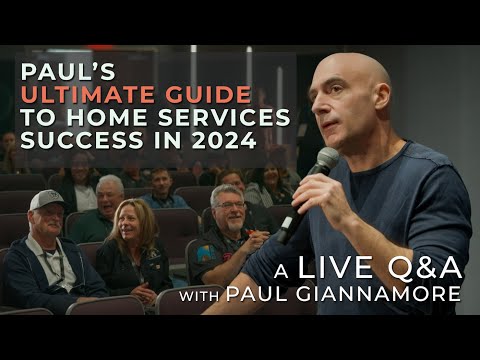
The Ultimate Guide to Growing a Service Business in 2024…
Recorded speech by M&A advisor Paul Giannamore at the AZPPO Great Western Pest Control Conference (March 2024) on growing, managing, and valuing pest control businesses. Topics include focusing on core services, prioritizing durable cash flow and recurring revenue over revenue, the shift from strategic acquirers (e.g., Orkin, Terminix) to private equity buyers, building geographic and customer density, strategic pricing to counter inflation, maintaining high gross margins (suggested ~60% for smaller firms), rising customer acquisition costs and the resurgence of direct mail, bundling and subscription offerings, business valuation drivers, and consistent customer service.
# Identity Observation: "The Ultimate Guide to Growing a Service Business in 2024 with M&A Advisor Paul Giannamore"
## Content Type and Format
- **Live conference/keynote presentation** with audience interaction, evidenced by:
- Repeated direct address to an in-person audience: "I had about five or six of you guys come up to me and say what are these acquirers looking for."
- Q&A format in the latter half: "I want to open up the floor real quick to do we have any questions right now."
- Audience members are named and referenced: "we've got Matt — Matt, you were just here," "what's your name — Fred."
- **Guest-expert format**: the speaker is presented as an outside advisor ("M&A Advisor Paul Giannamore" per the title) addressing an industry gathering rather than a studio-produced explainer.
## Explicit Self-Description by the Creator/Channel
- The speaker references a recurring media property: "over the last few years of doing the **boardroom Buzz** we've had a lot of different operators on there talking about the business."
- He also references "a **Pomac TV episode**" recorded with Matt Rogers.
- He describes his firm's scope directly:
> "we advise on m&a deals and we do it all around the world — I do it from Singapore to Egypt to the US."
> "we do on average about a **billion in transaction volume a year**."
> "I see probably somewhere between **250 and 300 pest control companies per year**."
> "we picked one area and we focused on it and we know it better than anyone else on the planet."
- The firm is identified as "Atomic": "when I think about my business, Atomic should not be doing the volume of transactions we do every year."
> ⚠️ Note: These are **creator claims** about reach and expertise, not independently verifiable from this material.
## Demonstrated Scope (from material, not claims)
- **M&A and valuation advisory for pest control / home services businesses**, demonstrated by substantive discussion of: EBITDA multiples, gross margin benchmarks ("I love to see gross margins in the 60%"), operating margin targets ("mid-20s... in a perfect world you're at 25%"), and deal pricing history ("five to seven times EBITDA... deals going at... 20 times EBITDA" in 2021).
- **Market intelligence on acquirers**: "5 years ago 90% of our transactions were with strategic acquirers... in 2023, 90% were with private Equity firms or financial sponsors."
- **Operational coaching for owner-operators**: pricing strategy ("sort it by pricing and literally go down the list and find those oldtimers"), geographic density ("focus on smaller Market"), and recurring revenue bundling tactics.
## Intended Audience
- **Pest control owner-operators and prospective acquirers**, evidenced by:
- Direct second-person address to pest control business owners: "one of the most powerful things that **you guys** can do is be focused... on the actual service of pest control."
- References to industry touchstones the audience is assumed to know: "the **PCT top 100**," "a lot of you guys got your careers started at **Orkin or Terminix**," CRM tools "PestPac" (transcribed as "pest Pac").
- Buyer-oriented Q&A: "how do you convince them that they're not worth five times... as a buyer."
- Implied audience includes **existing followers/listeners**: "I listened to the buzz forever and I known you guys" (quoted caller anecdote).
## Presentation Style
- **Conversational, irreverent, data-anchored**: informal asides ("Reading Pennsylvania, which is a hole") blended with specific benchmarks and multiples.
- **Q&A-driven back half** with audience members challenging and building on answers ("just to follow up on that," "you touched on it earlier, but what about pricing").
- Recurring rhetorical frame positioning the speaker as candid insider: "I don't have any solutions for you... I'm identifying the problem."
## Channel-Level Signals
- The video demonstrates a channel that produces **long-form business content for the pest control / home services industry**, featuring expert interviews or keynote appearances, tied to companion properties the speaker names (Boardroom Buzz, Potomac TV as transcribed).
- The title positions the channel around **evergreen business-growth guidance** ("The Ultimate Guide to Growing a Service Business in 2024"), while the content is a live talk rather than a produced guide.
# Delivery Observations: Paul Giannamore — Service Business Growth Talk (2024)
## 1. Signature Verbal Fillers and Connectors
- **"You know"** is by far his most frequent connective, appearing constantly across the talk:
> "and you know one of the most important lessons that I think I've learned here"
> "and you know from the early or the late 90s into the kind of the mid teens"
- **"At the end of the day"** functions as a recurring pivot phrase used to restate his core thesis:
> "because at the end of the day when you're buying a business what are you buying it for"
> "but at the end of the day the focus really is on cash flow"
> "because at the end of the day you really want to ruthlessly be focused on Gross margins"
- **"Right"** is used as a constant audience-checking tag:
> "it's really your decision as a shareholder as to how you're going to do that right"
> "and you're right there is an interplay between your growth rate"
## 2. Conversational, Informal Register
The speaker consistently uses casual, blunt language rather than polished corporate phrasing:
- > "you raise prices you lose customer customers but you're going to end up losing the ones that are the realy pains in the asses anyways"
- > "it's a proper dump"
- > "your technicians don't give two shits about selling an extra service unless you're paying them money"
- > "it was a dismal failure"
Colloquial compound coinages also appear: **"bro math"** ("you can use some basic bro math just take a napkin out") and informal asides like **"chunky money"** ("I can do a $2,000 Wildlife job and that's chunky money").
## 3. Direct Audience Address and Slightly Needling Humor
He repeatedly addresses the live audience as **"you guys"** and uses teasing, provocative framing:
- > "you guys that are actually running BS you guys with brain cells that are running businesses should be able to do a lot better than these big fat sleepy publicly traded companies"
- > "every one of you in here is the best I realize that"
- > "here's what I learn about every PES op operator every one of you is the best right"
- Joking about an attendee: > "I'm going to keep you away from your wife I'm going to make you make up all sorts of stories"
This is a stable pattern — the mock-affectionate jab at operators' self-perception appears at least three times.
## 4. Teaching Habit: Concrete Number Benchmarks
He anchors nearly every concept with specific figures:
- > "5 years ago 90% of our transactions were with strategic acquirers"
- > "I love to see gross margins in the 60%"
- > "you should ideally be somewhere in the the mid-20s in a perfect world you're at 25%"
- > "I've literally seen it double in residential pest Over The Last 5 Years double"
- > "a good proxy... 20% of commercial and residential units"
## 5. Teaching Habit: Named Anecdotes and Case Studies
He illustrates points with real, named examples rather than abstractions:
- **Ehrlich/Big Hamill** in Reading, PA: > "I was not going to leave reading until I was doing 10 million in revenue"
- **Scotts Miracle-Gro / Ortho**: > "we green fielded some of that we started some Pest Control branches from scratch down in Florida... and it was a dismal failure"
- **Terminix/TrueGreen cross-sell failure**: > "how on Earth could you have two companies... and literally zero cross sell whatsoever"
He also names individuals in the room ("Matt Rogers", "Dave Johnson", "Fred"), personalizing the live setting.
## 6. Repetition for Emphasis and Self-Interruption
- He often **restarts sentences** when refining a thought:
> "they're they're they're concerned about the dollars that are coming to the bottom line"
> "I I I'm identifying the problem"
- He **repeats key words immediately** for emphasis:
> "double who is experiencing that... yeah okay so we're seeing this double"
> "focus on smaller right focus on smaller Market"
- He asks and answers his own rhetorical questions:
> "and how how is a business valued... well you know..."
## 7. Structure: Thematic Spine + Open Q&A
- The prepared portion walks **down the P&L** explicitly: pricing → density → gross margins → operating margins → customer acquisition costs.
- He signals a shift to interaction: > "I can go blabber on and on and on I I want to open up the floor real quick to do we have any questions"
- In Q&A he repeats questions back and validates askers ("o that's a good one", "Fred I really appreciate your question").
- He closes with an explicit summary takeaway:
> "if you walk away with with one thing from this entire discussion it really should be tiny geography as focused as possible raise your prices and don't do a lot of other focus on pest control"
## 8. Intellectual Honesty Markers
He explicitly flags the limits of his own expertise, a recurring habit:
- > "I don't have any Solutions for you I I I'm identifying the problem"
- > "I don't know anything about online marketing at all like at all like nothing"
- > "now how effective it is I really don't know"
## 9. Single-Occurrence Features (Low-Confidence as Patterns)
- The extended **"romance the seller" anecdote** about a founder letting a letter of intent expire appears once; it may reflect a stock story, but the transcript provides insufficient repetition to confirm.
- The Chick-fil-A / "Jesus chicken" digression is an isolated humorous moment, not a pattern.
- Occasional audience interjections ("exactly right that's exactly what what's going on now") suggest banter with the crowd, but the transcript captures only his side, so the interactive dynamic is partially unobservable.
## Summary
The dominant, stable delivery features are: heavy use of **"you know"** and **"at the end of the day"**, a blunt and humorous informal register, constant **"you guys"** audience address with teasing asides, benchmark numbers attached to every claim, named real-world case studies, and self-questioning rhetorical structure — culminating in a Q&A segment with an explicit closing summary.
# Position Record: Paul Giannamore on Growing a Service Business in 2024
**Video:** "The Ultimate Guide to Growing a Service Business in 2024 with M&A Advisor Paul Giannamore"
**Speaker:** Paul Giannamore, M&A advisor (Potomac / "the Boardroom Buzz"), speaking to an audience of pest control operators.
---
## 1. Core Thesis: Focus on Core Pest Control
- **Giannamore's central lesson from 20 years working with owner-operators:** focus on the actual service of pest control rather than diversifying.
- He observes many operators add crawl space, termite, carpet cleaning, and other service lines (cites Matt Rogers / Killingsworth with five or six lines as an example).
- The PCT top 100's big players (e.g., Orkin, Terminix) are **pure-play pest control** — "there is something to this."
- **Stated reason owners diversify:** wanting to capture every customer dollar at the house — a distraction he calls "not always a bright idea."
> "The guys that are able to make the hard tradeoffs and say I'm going to forgo a dollar today from an additional service that's not within my bailiwick and I'm going to focus on pest control — those are the guys that are going to grow quicker and those are the guys that are going to sell more."
**Analogous example:** His own firm, Potomac, does more transaction volume than a mid-market investment bank because it focused on one area — "we know it better than anyone else on the planet."
**Qualification:** "Pure play" includes termite in some markets — "I'm not saying don't do termite... in certain areas of the market you've got to do termite."
---
## 2. Valuation Is Driven by Cash Flow, Not Revenue
- **Cornerstone of value = cash flow.** Buyers are buying a stream of cash flow; the larger and less risky the stream, the more valuable the business.
- **Market shift in acquirers:**
- Late 1990s–mid 2010s: strategic acquirers (Orkin, Terminix, Anticimex) focused on revenue (especially recurring revenue).
- **5 years ago:** 90% of his transactions were with strategic acquirers.
- **In 2023:** 90% of transactions (~$1B average annual volume) were with **private equity firms / financial sponsors**, who care less about revenue type and more about **durability and resilience of cash flow**.
- **Two ways to get a return:** current dividends vs. capital appreciation — "it's really your decision as a shareholder." He gives both archetypes (the coupon-clipper; the growth-focused operator — "our Mormon friends are really great at" the growth approach).
---
## 3. Pricing Advice
- He declines to give a specific price-increase number ("that's an impossible question... I don't know what your pricing").
- Recommends **benchmarking via secret shopping**, as Orkin and Terminix do, to find the market median.
- Operators who haven't raised prices in recent years "missed the boat," but he believes opportunity remains because **inflation is sticky** ("we'll probably see 3 or 4%... could see 10% depending on what happens geopolitically").
- **Practical instruction:** export the customer database from the CRM (PestPac, etc.) into Excel, sort by pricing, and raise underpriced "old-timers."
- **Claim:** raising prices loses customers, but "you're going to end up losing the ones that are the real pains in the asses anyways."
---
## 4. Geographic Density Over Sprawl
- His standing advice: **"focus on smaller" markets** — smaller market → more density → more cash flow.
- Criticizes operators running multi-state operations with technicians "driving all over the kingdom."
- **Case study:** "Big Hamill" and Erlich ("erck"), started in Reading, PA, refused to leave Reading until $10M revenue; one metro area generated $40M+; market share dominance → efficient routes → higher gross margins → cash flow to reinvest. (Acquired by Rentokil ~2005–2006.)
- **Rule:** "Never leave a geography unless you're actually the market share leader."
- **Market share math ("bro math on a napkin"):** count commercial/residential units; assume ~20% use pest control (industry proxy); determine your share.
- **Cutting periphery customers:** hand unprofitable far-out customers to competitors — "free, take it, it's yours."
- Example of neighborhood density programs: free mosquito service incentives to get 20+ neighbors on service; one technician handles a whole neighborhood in a day.
---
## 5. Margin Benchmarks
- **Gross margin** definition he uses: revenue minus chemicals, direct labor, and vehicle expenses.
- Big companies ("big fat sleepy publicly traded"): **mid-50s (55–58%)**.
- Small nimble operators: should achieve **60%+**.
- **Recurring revenue caveat:** hard to hit 60%+ margins with many one-time services; a $2,000 wildlife job is chunky now, but a recurring pest account is "extremely profitable by year three" — ~**80% margin** on a residential customer.
- **Operating margin** benchmarks: ideal mid-20s (25%); very dense businesses 27–28%; big companies low 20s (Rollins/Anticimex sometimes 18–19%, mostly 21–23%).
- **Below the gross margin line**, he is less concerned about operating costs — the biggest levers are price, direct labor, and density.
---
## 6. Customer Acquisition Costs (Rising)
- **Observed data point:** customer acquisition costs in residential pest have **doubled over the last 5 years** (based on ~250–300 pest control companies reviewed per year).
- Causes: hot money/private equity flowing into residential services driving up prices; door-to-door sales costs "out of control."
- Resurgence of **direct mail** in 2023; statistics he's seen suggest direct mail is cheaper for acquisition than digital and door-to-door — though he qualifies, "how effective it is I really don't know."
- **Explicit limitation:** "I don't have any solutions for you... I'm identifying the problem."
---
## 7. Growth vs. Cash Flow Tradeoff
- There is an interplay: a company growing 20%/year at 5% margins (reinvesting everything) vs. one at 30% margins growing 2%/year.
- **His preference as a buyer:** the one "growing cash flow into the future because all valuation is forward looking."
- Growth-vs-dividend positioning is a strategic decision each owner must make.
---
## 8. Q&A Positions
### a) EBITDA question (audience member)
- He treats EBITDA loosely: "just think about... whatever falls to the bottom" in a clean P&L with personal expenses added back.
### b) Market selection (Phoenix Metro question)
- **Number one driver of a residential service market: population growth** ("it's the biggest tailwind").
- History: Anticimex entered the US via New Jersey (2016), consolidated the East Coast/Mid-Atlantic; a company in Virginia/DC would sell for a **30–40% premium** over the identical company in Phoenix due to scarcity of assets and competing acquirers.
- Auction theory: a good auction needs 6–8 participants; one additional acquirer can dramatically change the clearing price.
- **Counterintuitive advice:** don't chase currently "hot" regions (Southeast) — "find those areas of high growth that are going to be hot in the future." The Southwest hasn't seen East Coast-level activity yet "but that's coming."
### c) Cross-selling benchmarks
- **Scotts Miracle-Gro case (2011):** tried to cross-sell pest control (Ortho brand) into a $250M lawn care base; greenfielded Florida branches plus one acquisition — "it was a dismal failure"; CEO pivoted to hydroponics and sold the business to True Green.
- **Claim:** cross-sell statistics are unavailable to him, but **monetary incentives are decisive** — "your technicians don't give two shits about selling an extra service unless you're paying them."
- Cited Terminex/True Green (ServiceMaster) as a massive missed opportunity: ~zero cross-sell due to no workforce incentives.
### d) Does diversifying into lawn care devalue a business? (audience)
- **Yes, agreed:** "it decreases the acquisition pool of potential buyers" — pure-play pest can be bought by pest, lawn, or commercial cleaning companies; multi-service businesses get complicated.
### e) Contracts / "five-star company" (audience: Fred)
- **Pest control service agreements are "not worth the paper they're printed on."** A contract = willing provider + willing customer with anticipation of ongoing service; a paying customer with a handshake is effectively contracted.
- "No contract" marketing often means no commitment to continued service — "that's not good stuff."
### f) Service quality
- **Claim:** customers "have zero idea how to judge anyone's technical ability"; certificates and entomological expertise don't matter to customers.
- Knocks door-to-door operators ("a train wreck... not all of them, but a lot of them") while acknowledging they're the ones selling.
- **Quality service defined:** someone friendly who answers the phone — Chick-fil-A/"my pleasure" analogy; recommends creating a consistent company lexicon for customer interactions.
- **Review-mining exercise:** his team pulled all Google/Yelp reviews in a market (e.g., North Carolina) into spreadsheets; majority of complaints concern responsiveness/rudeness, not bug-killing.
- Recommends **90-day sprints** on one or two organizational objectives (e.g., "most friendly organization in the marketplace") rather than boiling the ocean.
- **"Never have to compete on price"** — if you must, re-examine customer interactions.
### g) Bundling (audience)
- Endorses subscriptions/bundling: value is **inversely proportional to risk**; more subscription revenue = more durable cash flow = more valuable.
- Example: $2,000 wildlife exclusion job bundled with $500/yr pest control + $100/yr exclusion warranty ("basically free money") — doubling cash flow on the account.
- **Caution:** do the math — aggressive bundling (15 services for $625/yr that would sell separately for $1,500) makes no financial sense.
### h) Convincing small sellers of realistic valuations (audience: Johnson)
- **Answer: time convinces them** — the market will not bid 5x for a sub-$1M business.
- Anecdote: a seller romanced by a PE firm into an LOI who (after consulting Giannamore — "you probably could have done about $5 million better") let exclusivity expire; first-round market bids then exceeded the LOI price.
- PE buyers "romance the seller" — buyers should emulate: breakfasts, dinners, trust-building.
- **Buyer vs. seller psychology:** sophisticated sellers care only about money and terms; small owners care about who buys — the 70-year-old doing $700K who wants to keep working but not run the books is an ideal acquisition (small down payment, seller note, keep him employed).
- **Multiple history:**
- ~15 years ago: 5–7x EBITDA, 1–1.2x revenue.
- 2021 peak: ~20x EBITDA, 5–5.5x revenue; sold $20M companies for north of $100M.
- Today: two platform deals this year above 5x revenue; a $2M business can sell for ~$8M — "a lot more difficult than 2021" and likely getting harder; multiple expansion applies as businesses get bigger.
- **Small business benchmark:** a $700K revenue business, 80% recurring, 20% bottom-line margin is worth **$600–800K enterprise value** to him; someone might pay $1.5–1.6M, but a buyer should pay ~5x, maybe 6x cash flow, "otherwise they don't create value."
- Buyer discipline: "let nine of every 10 deals go away."
### i) Recurring vs. non-recurring (audience)
- A 50/50 recurring business's non-recurring half largely disappears in an acquisition — "you're often buying a bundle of accounts"; assess like Orkin/Terminix did: accounts, pricing, technicians, retentability.
### j) Underpriced targets (audience member shares experience)
- Audience member: a target charging less than half his price was a deal-killer; post-COVID sellers who didn't raise prices create gaps — customers leave on price increase, then call back after checking the market.
- **Giannamore agrees:** bad pricing is one of the worst things; buying to "increase pricing" fails because relationships break ("they're gone"). Service-type mismatch (power spraying vs. baseboard) causes similar attrition. COVID-era price hesitancy "created a huge gap... between premium companies and a lot of these smaller guys."
---
## Summary of His Stated Takeaways
> "Tiny geography, as focused as possible, raise your prices, and don't do a lot of other [services] — focus on pest control."
## Preserved Qualifications & Tensions
- He offers no solutions on digital acquisition costs — problem identification only.
- Direct mail effectiveness: "I really don't know."
- Termite carve-out from the "pure play" rule.
- Growth and cash flow margins trade off; neither is universally prescribed — owner's strategic choice.
- The "no contract" question: he distinguishes legally worthless contracts from de facto recurring relationships.
# Speaker Attribution & Provenance Record
## Video
- **Title:** The Ultimate Guide to Growing a Service Business in 2024 with M&A Advisor Paul Giannamore
- **Format:** Live presentation / talk with audience Q&A (appears to be recorded at a pest control industry event, March 2024 per speaker's comment)
## Speakers
### Primary Speaker — Paul Giannamore
- **Role:** Creator/featured speaker; M&A advisor ("The Potomac Company" implied by "Potomac TV" reference; firm name appears as "Atomic" in transcript, likely transcription artifact — identity not otherwise confirmed in source)
- **Self-described credentials:** ~20 years advising pest control owner-operators; sees 250–300 pest control companies per year; ~$1B average annual transaction volume; works globally (Singapore, Egypt, US); based in Puerto Rico; sell-side only advisory practice; host of "the Boardroom Buzz" (podcast/presentation series referenced)
### Audience Questioners (unnamed except one)
- **Audience member "Fred"** — asked about contracts/reviews; name stated explicitly by speaker
- **"Matt Rogers"** — referenced in third person; runs "Lizard" online marketing company; father ran "Killingsworth"; appeared on a recorded "Potomac TV" episode with the speaker (not a direct speaker in this transcript)
- **"Dave Johnson"** — referenced by name during Q&A (pricing/acquisition question); speaking role
- Multiple unnamed audience members asked questions (recurring revenue, small acquisitions, EBITDA, Phoenix market, cross-sell benchmarks, bundling, pricing)
### Referenced Third Parties (claims made about them, not by them)
- **Orkin, Terminix, Rentokil (Anticimex)** — strategic acquirers; benchmarking and margin examples
- **Anticimex** — Swedish firm, entered US ~2016, East Coast acquisitions (Modern, JP McHale, Killingsworth)
- **Scotts Miracle-Gro / Ortho** — 2011 pest control cross-sell experiment; described as failure; CEO Jim Hagedorn pivoted to hydroponics
- **ServiceMaster / TruGreen / Terminex** — cross-sell incentive failure claim
- **Greg Hamill (transcribed "big Hamill")** — founder of Ehrlich ("erck"), acquired by Rentokil 2005–2006; Reading, PA market-density example
- **PCT Top 100** — cited industry ranking
- **Chick-fil-A** — customer-service analogy (informal, non-promotional)
## Promotional Segments
- **None explicitly flagged.** Speaker mentions his own firm's transaction volume, deal count, and "Boardroom Buzz"/"Potomac TV" appearances as context, not as promotional segments. No sponsor or product promotion identified in transcript.
## Claims & Data Provenance
- Statistics (90% PE vs. strategic buyer shift; customer acquisition cost doubling; margin benchmarks; multiple ranges) are attributed to the speaker's own deal flow/anecdote, **not cited external research**
- Direct-mail vs. digital CAC claim: speaker cites "some data and the statistics I've seen" — **unspecified source**
- 20% household pest-control usage proxy: attributed to "a lot of the big guys" — **unspecified**
## Availability Limits
- **No curated metadata supplied** beyond title; no comment availability information provided
- Transcript quality issues: apparent transcription errors (e.g., "iida/eidon" for EBITDA, "erck" for Ehrlich, "rills/anit-cx" for Rentokil/Anticimix, "prelimary", "Matt Hamill") — flagged, not corrected beyond notation
- No timestamps available in source
the job of running a pest control business is obviously a particularly difficult one and you know one of the most important lessons that I think I've learned here over the last 20 years with
owner operators is one of the most powerful things that you guys can do is be focused and focus on the actual service of pest control you know over over the last few years of doing the boardroom Buzz we've had a lot of different operators on there talking about the business and inevitably you know we run into a lot of folks who run a pest control business but also do crawl space they do termite they do carpet cleaning they do you know Matt Rogers is in here somewhere running around his father ran a business called Killingsworth they had five or six different lines of service you know when you look at the PCT top 100 I mean the big players out there are peer play P control businesses a lot of you guys got your careers started at Orin or Terminex I mean these are massive companies and they focus on general pest control so there is something to this and I think it's very very common that owners get distracted with regard to how they run their business because they want to capture every single dollar every single customer dollar at the house right I've got the relationship with the customer I can sell them Pest Control I can sell them screen door repair I can sell them chocolate bars whatever I can do I'm gonna make that dollar I'm GNA sell that it's it's not always a bright idea because you know in my line of business really at the end of the day what I'm focused on is cash flow when you ultimately sell that business what an acquir is going to be looking at is cash flow and you know from the early or the late 90s into the kind of the mid teens most pest control companies out there that were making Acquisitions are strategic acquires orcan renil Terminex ancx and those guys were focused on revenue and of course they were focused on recurring Revenue but now the Market's changed quite a bit um and I don't know if I mentioned this yesterday but you know 5 years ago 90% of our transactions were with strategic acquirers with orgon ancx Terminex around the globe all over the place in
2023 90% of our transactions and we do on average about a billion in in transaction volume a year 90% were with private Equity firms or financial
sponsors and so a very very common question I get not only at the the bordom buzz but also on a day-to-day basis and even yesterday I had about five or six of you guys come up to me and say what are these acquirers looking for and that's really just another way of saying you know how can I make my business be as valuable as possible when I ultimately go and sell it and the Cornerstone of value in a business is cash flow because at the end of the day when you're buying a business what are you buying it for you know you're not buying it because you want to have fun with the customers you're not buying it because you care about the employees no you're buying it because you want to make money and so at the the end of the day you're buying that stream of cash flow and how how is a business valued the less risky it is and the greater or the larger that stream of cash flow is naturally the more valuable it's going to be and now in the private Equity realm these guys are are much less concerned about the type of Revenue you're generating they're more concerned about the durability of that stream of cash flow and what do I mean by that they're they're they're concerned about the dollars that are coming to the bottom line and how resilient that that stream of cash will be going forward and of course that implies that we want to have a a lot of recurring revenue and so when I think about Focus you know Pest Control operators just like any other business person just like myself want to have a massive ftim so that means want to do a lot of services want to do big Revenue numbers want to cover a large
geography and my advice to people over the years is always the same focus on smaller right focus on smaller Market because at the end of the day the smaller the market you're in the more
density you'll get and the more cash flow and so I've seen a lot of mistakes made over the years with folks focusing on Revenue at the expensive cash flow and when you think about a business how do you get your return from a business you own a business you get your return in one of two ways you get it either through current dividends so the money you suck out of the business every year or you get it from capital appreciation making that business worth more over time and it's really your decision as a shareholder as to how you're going to do that right you know some guys will say hey got a $5 million business I make a million bucks a year I don't really care about how this thing grows I like my million dollars a year I'll clip the coupon I'll sell this thing 10 or 15 years from now and I'll be done with it other guys particularly you know our Mormon friends are really great at this they look at it and say hey I don't really care about the cash flow right now I'm going to double down on growth I'm going to put as many counts on the doors I'm going to get this thing as big as possible I'll scale off the doors ideally increase cash flow and sell it so so that decision is yours it's really where you get the best return on your Capital the guys that want to pull money out some you know you guys love to dabble in real estate right so take a lot of money out of the business buy real estate diversify yourself that's your own prerogative however you want to handle it but at the end of the day the focus really is on cash flow so how do you focus on cash flow
well you know in today's market we talk a lot about price increases and I had a lot of discussions about price increases yesterday and you know people always ask
me hey you know how what sort of price increase should I do right if you want to start we think about cash flow we start at the top of the P revenue and they say well what sort of price increases should I do well that's an impossible question for me to answer because I don't know what your pricing is but you can bench Benchmark in Smart Companies I mean or in in Terminex those guys Benchmark they have an whole office that goes out there and they make they secret shop you guys they try to figure out what pricing looks like in the market there's certainly something to this where you guys could actually secret shop your competitors you can determine what the median pricing is in the market and and make sure your pricing is there now those of you who have not um raised prices over the last couple of years to certain degree have missed the boat but I think there's still a lot of opportunity to do that because no doubt about it things are getting more expensive and it's pretty clear now that inflation's not going away and this is going to be sticky and it's probably going to be sticky for a long time we'll probably see 3 or 4% how we could see 10% inflation the next year depending on what happens geopolitically so staying on top of your price increases is going to be very important and so I always suggest to folks get into your get into your CRM system whatever you guys are us in pests pest Pac surf weet export your customer database into Excel and sort it by pricing and literally go down the list and find those oldtimers that you're still charging you know $72 a quarter and go out there and try to raise those prices and don't be afraid of it do not be afraid of increasing pricing because at the end of the day what I have found out is that you raise prices you lose customer customers but you're going to end up
losing the ones that are the realy pains in the asses anyways it's always the guys that don't want to pay you they're the realy pains in the ass right they want the service they want you there on time they want this they want that so focus on that price increase the other
thing you need to focus on is you know if we're at the top of the p&l you got to focus on density it boggles my mind that at least half of you want to run massive full State multi-state operations and you've got guys driving all all over the kingdom to get this stuff done it it's the exact opposite of what you should do you know when there's a guy named big Hamill out on the East Coast he ran he ran a business called erck and erck erck was ultimately acquired by Ren Hill back in 2005 2006 and it was doing 100 million in change in revenue and they started that business in Reading Pennsylvania which is a hole right it is in the middle of nowhere and um it we've been there um unfortunately I have as well uh but the place is you know it's a proper dump and it's a old you know you you got these kind of New York Pennsylvania old busted out steel and coal towns and he said you know what as I grew erck I made the determination I was not going to leave reading until I was doing 10 million in revenue and this was 40 years ago right this is one metro area in PA generating 40 million in Revenue knew he said I wanted to have the absolute majority of the market share and and what that allowed him to do with market share is increase his gross margins because his routes were very efficient increase his cash flow and use that cash flow to invest in other areas you guys should be doing the exact same thing you guys should be thinking smaller from a geographic perspective as opposed to larger once you tap out a market I mean if you I always say never
leave a geography unless you're actually the market share lead in that space and you know people always say well how the hell do I figure out if I'm a market share leader right well I
mean there are some basic things you can do you can use some basic bro math just take a napkin out you don't have to be particularly sophisticated about it but understand how many commercial and residential units are in a in a market make the Assumption as to how many folks are actually using pest control services in that market and then determine what percentage of that you own and you know a good proxy a lot of the big guys will use 20% of commercial and residential units on average in a particular geography are using pest control services and how many of those guys am I servicing but once you become the market leader then it becomes a lot more interesting to grow geographically and I always encourage people to look at their service Footprints you can do a heat map of your customers and kind of drill down and say why do I why am I doing all these guys on the periphery why am I collecting 150 bucks a month when it takes me an hour and a half to get out there and then the place is a royal pain in the ass to deal with and now you're losing money get rid of that hand that stuff to your competitors free take it it's yours because at the end of the day you really want to ruthlessly be focused on Gross margins and when I talk about gross margins as I go down the p&l gross margins is your Revenue minus the costs associated with providing that service and in my line of business when I look at gross margins I I'm looking at you know Revenue minus um chemicals direct labor so the guys that are out there actually doing the work um vehicle expenses whether it's operating
leases or whatever fuel whatever your your vehicles are taking to operate um you subtract that from revenue and you can get to your gross margin line and I love to see gross
margins in the 60% you know whenever I look at a business the first thing I look at is how is the Top Line growing is the Top Line growing at at least bare minimum the the the rate of growth in the local market and you know I had a conversation with one of your colleagues yesterday and he made an interesting point he's like you know and certain areas of Arizona are not growing but the Phoenix Metro area is and it's growing at 10% a year and so you know the guys that are all super stoked about growing at 8 or 10% in this market are actually just Treading Water right they're just maintaining market share they're not growing so you look at that growth rate on the top line and then you subtract uh from revenue those direct costs and you get a gross margin the big boys are typically at somewhere in the mid-50s 55 56 58% that's usually where the big guys are smaller companies you guys that are Nimble you guys that are actually running BS you guys with brain cells that are running businesses should be able to do a lot better than these big fat sleepy publicly traded companies you guys should be able to run gross margins at 60 plus per. but it's really hard to do 60 plus% gross margins when you're not doing a lot of recurring Revenue right and you know recurring revenue is one of these things where you know a lot of the companies I work with do wildlife and they do lawn and they do all sorts of other services you know when I think about gross margin it is hard to get a high gross margin when you're doing a
lot of one-time services and guys look at recurring and they're like ah you know I can do a $2,000 Wildlife job and that's chunky money and it brings it right to the bottom line and that's right that's true a recurring Pest Control account
doesn't necessarily do that for you in the first month or the first year but by year three it's extremely profitable and you should be able to get 80% margin out of that residential Pest Control customer and then on top of that when you're focusing on the density aspect of this in one neighborhood you know it's like you go into a subdivision and you're doing three homes there well your LDS buddies are knocking on doors and they're trying to get that density you should follow that and think about how on Earth can I do more Revenue in one area and I've seen all sorts of creative stuff I've seen I've seen guys on the East Coast quite a bit you know if you think about my neck of the woods in the east coast up and down in the Mid-Atlantic you'll see a lot of neighborhood programs where people go out into a neighborhood and you know you're serving four or five residential customers in a neighborhood you go out there and say hey if we get 20 of your neighbors on here we're going to give you free mosquito services this season or what have you it's virtually no incremental cost to you you buy some bifenthrin solution mix it in water takes you 20 minutes you spray it and now you've got 25 customers in that neighborhood all on general pest and now you got one technician that's able to out there go out there and handle that whole neighborhood in one day as opposed to doing three here three there next thing you know he's done nine in a day you can be doing 25 so thinking about ways that you can get more dense less geography you can get more folks in one geographic area um selling it at higher prices I always tell people if you're really if you're really providing the service that you say you are because every one of you is T every one of you in here is the best I realize that um but if you're really doing that you should be able to get the pricing for it right you should be able to push that pricing and I challenge you to push the
envelope on pricing you know one once we get down past the gross margin line here in um in a p&l I get less concerned about
operating costs I get less concerned you know folks are not that you shouldn't pay attention to your insurance by all means like you should be looking at insurance rates you should be looking at liability all those things that go in the main cost structure of a business but the biggest lever for you guys is that Revenue minus direct costs your direct labor your price your density if you can get those things right you're going to be way ahead of most of your competitors who AR not even thinking about this you know as you grow these businesses if you're keeping an eye on cash flow and you know I know we've got different folks in here that look at their business differently and have different levels of experience with this so I don't want to get too financially focused today but you you know I look at something that's called IIT da which is effectively your uh pre-tax net income plus depreciation and amortization and we're going to forget that for a second and we're going to go very basic today your operating margin so basically on the bottom line had you not you know put the addition on your home and took your european vacation and all that you just pretend that's not there Just Pure Clean numbers um you should ideally be somewhere in the the mid-20s in a perfect world you're at 25% now if you're a very dense business you're going to be 27 28% um you know the big companies tend to be running in the low 20s so when you look at the rills of the world anti- seaxes these guys tend to be somewhere you know sometimes they'll pop out an 18 19% margin but for the most part they're 21 22 23% and that's where these Pest Control businesses tend to reside again the guys who are doing this right and really focusing on pricing and D City should be in the mid 20s or higher um I want to talk a little bit about growth um I had a very interesting chat with where is Matt Matt you were just here there he is Matt Rogers I had an interesting chat when I flew in you know Matt and I did a pomac TV episode um
that we recorded on Tuesday and you know Matt runs a business called lizard and it's a online marketing company and I don't know anything about online marketing at all like at all like nothing but it's one that's been
particularly interesting to me is that um you know customer acquisition costs no doubt about it if you listen to the calls from the publicly traded companies customer acquisition costs are going up across the board and they went up acutely during covid right I mean got real expensive online marketing door-to-door worlds out of control I mean they're paying these kids a tremendous amount of money I mean it's the sales guys running the show um they're paying up a ton of money on the doors and so we've seen a lot of hot money flow into this space right as you guys have not lived under a rock you see all the m&a deals you see the private Equity firms investing in this so there's a ton of money coming into residential services and while that might be exciting to those of you who are exiting right now it's certainly not exciting to those who are trying to grow their businesses because at the end of the day that money coming in drives up prices and it has driven up prices across the board to acquire customers so you have to get more sophisticated and Nimble when you are acquiring customers and I have recently begun to really think through customer acquisition costs in a way that I have not before because I never really had to because it was never really an issue in this industry and what I have begun to notice is so if you think about my business what is my business we we advise on m&a deals and we do it all around the world I do it from Singapore to Egypt to the US you name it I spend the majority of my time in Puerto Rico taxfree paradise and um but I look at a lot of companies I mean I see probably somewhere between 250 and 300 pass control companies per year we
do prelimary valuations on these so I mean if you think about it over 20 years I mean this is thousands of companies over time we've compiled a lot of data on a lot of things but really it's been recently that I've looked at customer
acquisition cost and I I've literally seen it double in residential pest Over The Last 5 Years double who is experiencing that have you guys seen that in your business here yes yeah okay so we're seeing this double which of course requires people to be more sophisticated as to how they acquire customers um you know it's like 20 years ago everyone was doing direct mailers you guys remember all those things the postcards so on and so forth and then no one's doing them anymore and I'll tell you in 2023 when I look at these companies I've seen a dramatic proliferation now in direct mail because no one's using it now how effective it is I really don't know but I'm starting to see a lot of more direct mail and some of the data and the statistics I've seen is direct mail actually is cheaper from a customer acquisition perspective than digital and certainly than door-to-door um but getting very smart about your digital marketing and understanding what those customer Acquisitions and cost for conversions are is going to be more and more important I believe going forward because when I spend time at the rills of the world and the anti- cxes of the world these guys are spending a ridiculous amount of money to go out and Corner these markets digitally I don't have any solutions for you I I I'm identifying the problem you're like no I know that's a problem so I don't have Solutions there that's not my line of business but I just thought I would bring it up um it's like the old days when we used to buy the triple trunks in the yellow page ads yes the big guy could afford to do it the little guy couldn't that's right and then the internet came along we all were kind of on even playing field now it's the guy who has the most biggest budget
so it's right back to the triple trunk exactly right that's exactly what what's going on now I can I've got more things to say I can go blabber on and on and on I I want to open up the floor real quick
to do we have any questions right now yes sir you touched on growth margin and you used that mysterious word iida which I don't really grasp if you have a good Healthy Growth margin does that mean your iida is good also yes so iida is just a I don't know it's not even really an accounting term it's more of a finance term and it you should probably just forget it and just think about you got a p&l what's at the bottom I don't care what you call it net income iida doesn't matter whatever falls to the bottom in a in an actual naturally created p&l that does not have again all your vacations and all the other jazz in it like what's the number like if you spent a quar of a million bucks on all sorts of crap that's personal just add that back and what's that bottom line look like that's a proxy for it there was another oh yes sir how do the strategics and the priv the Phoenix Metro area as a market where do you know it's a great question you know and I and I get calls all the time and people say hey I want to start a pest control company what's the best area to get into right right like I can go anywhere in the country where should I go you know where are the choirs interested what you know and I always say that this Market has been you know I started in pest in
2003 and it was extremely static it was a duopoly it was orcan and teric buying these things the market was pretty sluggish um and then over time as the acquirers have changed as the market has
gotten more sophisticated um you ended up with pockets of a tremendous amount of activity and what I mean by that is if you think about 2016 ancx came into the United States it's a Swedish firm and just like Europeans they came across and they started on the East Coast right um and they started in New Jersey as opposed to Boston and they um they bought a bunch of companies up and down the east coast and so now I had renil I had Terminex orcin and now I've got a new acquire called ncx spending a ton of money buying modern and JP mccale and Killingsworth and all these companies up and down the east coast and then doing a bunch of add-on Acquisitions and the Mid-Atlantic got super hot and I could sell a business in the Mid-Atlantic so basically Virginia DC that area I could sell that if I took the exact same company in Phoenix Arizona and popped it down in Virginia it would sell for a 30 or 40% premium and the reason why is the scarcity of assets and you've got a lot of um acquirers competing in this market now I think it's important for folks to look at the fact that we've got Financial sponsors or private Equity firms that have entered the market and they're not building National businesses they're building Regional businesses and so we've got the southeast we've got a handful of them there we've got the Mid-Atlantic um Pacific Northwest so we have these guys entering markets and focusing on particular geographies and
you know when I think about like auction Theory you know to run a really good auction in a perfect world you need six to eight participants um you add one
additional acquire to that mix though and it can dramatically change the market clearing price or you know the price of the business on the margin so that's a lot of words to say do I think it's attractive I do because the first thing I look at for a market is the growth rate right is this Market growing or is it a net exporter of people like do I want to be in Phoenix or Syracuse New York well people are leaving Syracuse and they're moving here so population growth is of course the number one driver uh it's the biggest Tailwind that you can have for a resi service business people moving into a market so I would say that checks that box the other thing is people say well Paul like you know the southeast is super hot there's a lot of private Equity firms doing a lot of stuff there so that's the market I should be in and I say no it's the opposite of that because that activity is taking place now you're not selling your business right and it's great to be there right now if you would have done that 20 years ago but you didn't so don't go there now find those areas of high growth that are going to be hot in the future and there really hasn't been the the Southwest has not seen nearly the same activity that we've seen up and down the East Coast but that's coming and so I do think for folks like you out here who are thinking about the future focusing on your cash flow because private Equity firms are cash cash flow buyers right they are not they don't care about your Revenue mix as
much they don't care about your absolute amount of Revenue they're focused on your cash flow so it gives you and you know when I talk about cash flow people say well I can't how am I supposed to grow a business at 12% a year and
then also have 25% margins because I got to invest back in the business and you're right there is an interplay between your growth rate you know you can take a company that grows at 20% a year with 5% margins because they're investing everything back in the business and then you got another guy who's doing a 30% margin well he's growing at 2% a year he's actually going backward but he's kicking off more cash today which one would you rather buy the one growing at like 2% a year that's a hasb I want to buy the guy that's growing cash flow into the future because all valuation is forward looking so there is some interplay there it does take a little bit of you know what the big public companies do is they sit back every year and they say okay how much are we going to reallocate into this business how much are we going to reinvest what do we want to Target our margins to be do we want are we a growth stock or are we a dividend stock where do we want to be that's a corporate strategy business strategy type decision that you have to make so I hope that answers your question who else we got yes sir uh you gave some good benchmarkers on numbers for other stuff but I'm curious um do you have any benchmarks for if someone's on like a recurring general pest control how many customers or what percentage investers buy additional Services o that's a good one you know I I I had a interesting experiment in Cross cell some years ago back in 2011 Scotts Miracle company decided hey we want to get into pest control and so they called me up and said hey we do 250 million in lawn care revenue and we've got a pest control brand um called ortho and we want to use
Ortho and to me Ortho sounded more like a kind of a World War II era gas chamber type chemical like that didn't sound like a good brand to be like Ortho Pest Control like we'll come to your house so
they decided hey we want to do pest control because we've got all these Lawn Care customers and we can go out and cross sell this and we're just going to make a ton of money because half of these guys are going to buy our pest control and so in 2011 I started working with them and we green fielded some of that we started some Pest Control branches from scratch down in Florida and then they made one acquisition and experimented with that for a while and it was a dismal failure um it was very difficult to cross- sell those services and you know Jim Hagadorn the CEO ultimately you know he pivoted at that period of time from weed killer to killer weed they got into Hydroponics and he's like I got to do weed like I want to do all this sort of stuff and you know pest control and Lawn Care sucks so they got rid of it s on True Green I don't have any sort of statistics about cross cell but one thing I can tell you is monetary incentives are extremely important when it comes to cross- selling services because your technicians don't give two shits about selling an extra service unless you're paying them money and so the guys who get really aggressive with if you want to do an additional service you have to determine what that service is worth to you over time if it's an additional recurring service and it's going to add value to your business and you're able to PO cross sell it you should think about the incentive structures and that's the problem that Terminex always had with true grein right you had service master they own True Green they own Terminex how on Earth could you have two companies both doing more than a billion dollars in customer revenue and literally zero cross sell whatsoever well they had an incentive problem they didn't incentivize any of the workforce to cross- sell anything it was a massive missed opportunity yes did you have a question sir just to kind of follow up on that so if if uh if you do diversify into like control and Lawn you know lawn care whatever whatever that other service is U doesn't that uh how do the ACT how do the acquirers uh look at that because you got rill or these these big acquirers that aren't in the lawn care business so does that does that actually uh devalue
business it you're right it it decreases the acquisition pool of potential buyers for a business the more things that you do the less you're going to look like
everyone else you know if you're pure play pest become very easy you know you're pest a commercial cleaning company can buy you a lawn care company could buy you a pest control company could buy you but you start doing a variety of different Services it gets complicated and it's you know at its core though when I think about all these multiple Services I mean I've seen a tremendous amount of direct evidence that shows me that the guys that are able to make the hard tradeoffs and say I'm going to foro a dollar today from an additional service that's not within my belly Wick and I'm going to focus on Pest Control those are the guys that are going to grow quicker and those are the guys that are going to sell more and at the end of the day if you're running a pure play and when I talk about Pure Play Pest Control let's be honest anything P control related I'm not saying don't do termite now in certain areas of the market you've got to do termite um but if you stick with your core you're going to be able to focus on it you're going to be a you know when I think about my business Atomic should not be doing the volume of transactions we do every year I mean we are we do the amount of transactions as a as a real middl Market Investment Bank and I attribute that to the fact that we picked one area and we focused on it and we know it better than anyone else on the planet so when there's a transaction going on in Ghana or Djibouti we get the call and so you know when Terminex and renil were merging and they needed to do the antitrust sales in Europe we get the call because we focused purely on that there was no one in the market better than that than we are and you guys should look at your business the same way I mean because if you specialize you know it's like it simplifies your business too I think one of the when I see a lot of these guys running these multi-service businesses it's like okay you're a pest control guy you know that you've been doing that 20 years and then all of a sudden you start doing HVAC and you're like like I got to have this licensing and I don't know really how to buy this this equipment and you know how to train these guys and then you've got to hire other folks and then it's a big distraction for what purpose margins are lower it's more Capital intensive it's like what the hell are you doing focus on pest there's a reason for that and so
again I I think if you walk away with with one thing from this entire discussion it really should be tiny geography as focused as possible raise your prices and don't do a lot of other
focus on pest control and I'm not sure that's how I got kicked off the stage yes give it to me so you know you hear the buzz word oh if you're a oldstar company you can get that higher you know number of you know selling there and so when you're when they're saying that what are they looking for is that five star type company I see a lot of people advertising no contracts and stuff like that so by having all your customers cont contract does that make a bigger difference than you're just flying by see your pants let's talk about that for a second because one of your colleagues came up to me yesterday super nice fell said I didn't want to ask you this question yesterday because I was ashamed of the question but it was a great question and he said we don't have contracts we don't have contracts we don't have written contracts is that a problem and no when I think about contracts they're not worth the paper they're printed out especially in this space it's like years ago when it was orcin and Terminex doing Deals they would always audit they would they buy a pest control company they audit the contracts like let's see who's which customers have signed a contract nowadays it's I I view a pest control service agreement as a willing provider and a willing customer and both with the anticipation of ongoing services so if a customer if you've got a customer no contract to Shan Shake hey I'm going to do your pest control and you're charging them a 100 bucks a quarter let's say and that
customer expects continual service and you expect to provide it and he's paying you that's a contract um the no contract thing what you're
referring to is I think a lot of times guys are doing hey you what they mean by no contract as they mean like no no requirement of continued service we're just going to come out and spray a bunch of and hopefully get rid of your bugs and take a few bucks that's not that's not good stuff I get a call every day where somebody will call me up and say hey Paul here's what I learn about every PES op operator every one of you is the best right so you guys call me up and like we're the best in the market da d da d da and I always say Well define best and usually it's folks talking about their technical prowess like how they know all the different bugs and they know every single you know they read that malice handbook 50 times and they know all that and certificates customers don't care about that care about that at all not one bit what do customers care about well you guys know what customers care about and I always to myself like when I look at the market on the one hand I'll knock LDS guys for a second these guys are selling the out of knocking on doors they're hiring like you know dudes that are two months out of school as technicians don't know what they're doing spraying all sorts of stuff it's a mess right not all of them but a lot of them it's to it's a train wreck um and it pisses guys off that have been in this industry for you know decades that have really spent a lot of time learning educating themselves and their staff having a lot of technical expertise um but at the end of the day it's the guys that are on the doors are the ones who are selling all of this stuff the customers have zero idea how to judge anyone's technical ability when it comes to P control whatsoever and I think there is a balance here and I always
tell our clients you know we work with guys for years I'm talking a lot of our clients have' been working with us for 5 10 years and I always tell them like there's a between like the technical
aspects of the business which the customer doesn't care about whatsoever and they don't care about any of your certificates and they don't know what an ace is none of that and and and providing just quality service and Quality Service doesn't necessarily mean killing the bug Quality Service means somebody who answers a phone that doesn't sound like Dolores the chain smoking stenographer from Long Island right like somebody who who is friendly on the phone willing to help all those sorts of things you know just start with I always tell people like start to audit your interactions with your customers can't you can't you sit back one day and say hey we're you know every time I go to Chick-fil-A which I don't do it as much as I used to um but you know they're always hi my pleasure blah blah blah can't you sit back and sou huh they think of like who somebody the other day called it Jesus chicken was that you no okay no but you can think about a vernacular like what what is the vernacular or the Lexicon you're everyone on your team is going to use with a customer what are words that how are you going to say thank you how are you going to say goodbye is there a consistency you can almost create your own dictionary of language that you use within your company so it stays consistent and you know that from every single touch point the customer is getting a very consistent a very friendly message um when you read you know if you guys haven't done this you know one of the things that um we did years ago is I had a couple admins and probably you do this by with AI and now this was years ago but we we would go into markets like I was looking at North Carolina for example and I start to size up acquisition opportunities in a market I want to understand market share and who's doing what there and so I I said pull all of the Google and Yelp reviews
for every company in this market and let's put it all in a spreadsheet and let's use some macros and pivots and whatever you finance data nerds can do
but I want to understand what are the issues that these customers have and I challenge you to go out and do this because the majority of the customer complaints have nothing to do with killing bugs right sure they're out there but it's usually like the technician rre like the guy was an like I called 15 times and no one answered my calls you can very quickly figure out what pisses off customers by looking at your reviews and the reviews of your competitors and thinking about how you can change those things and you know there's a million things you can do as the operator of a pest control business but you know I always challenge folks to say you know it's what is it now March of 2024 and it's important to think about like one major objective and get the entire organization focused on it for any given period of time and I think 90-day Sprints are good ways to do it but you could basically sayy hey you know in 2024 we are going to standardize our interactions with customers we're going to get everyone on in the organization on the same page and I the owner I'm not going to do this you guys are going to drive this but how can we be the most friendly organization in our marketplace right how can we Delight every single customer that calls and you pick one or two things and you get the entire organization focused on that for a 90-day period you can make a dramatic change in your business and then you move on to the next one it's natural for us to want to boil the ocean yeah we want to do everything at once I got you
know a huge list of 90 different things to do but no think about some things that could potentially really move the needle and I appreciate your question what's your name Fred Fred I really appreciate your question because it's an
important it's it's really an important one that you know understanding these customer interactions you don't have to compete on the no there's ton there's plenty of customers out that that want long-term relationship with a company that's going to provide a recurring service you never never have to compete on price if you find yourself in a position where you have to compete on price you really need to take a step back and say how do we change our interactions with our customers and there are companies out there that spend a lot of time attempting to do this so anyway yes sir what about bundles a lot of people are bundling all their services now and they're going to subscription phase yes yeah I look to the extent that you can bundle you every you want to do everything in subscription everything you possibly can and why would you want to do a subscription because at the end of the day the value of business is inversely proportionate to this level of risk and so the higher the level of subscription Services you have the less risky that stream of cash flow is out in the future and therefore the more valuable that's why everyone talks about you know you buy recurring accounts well that's the shorthand for cash flow that is more durable is worth more and so I I think you know one of the things that I have seen quite a bit as of late is you know a lot of folks that are doing Wildlife um that's a onetime service and how do you continue to do Wildlife um you do exclusion work you bundle that with pest control so I'll
give you an example there's a lot of companies I don't know that you guys have the same issues that they have in New York or Pennsylvania or all these like forests but you know they'll do a $2,000
exclusion job and then that's it like they seal up the attic and it's done and and there's no more service service for that house well now what they'll do is I see a lot of people bundling it's 500 bucks a year for pest control for an extra 100 bucks a year you know we will do a warranty on any of your Wildlife exclusion and now you're getting the 500 bucks for the pest control you're getting an additional 100 bucks a year which basically is free money it flows to the bottom line because you're probably not going to have to do any work for that now you've just you've doubled your cash flow on that account and so there's a lot of ways to bundle it um mosquito bundling so on and so forth I think some of the issues that I come into with bundling though is sometimes people get you really have to do your math get that napkin out because sometimes when people get too aggressive with bundling you kind of look at it and say well how does this even make Financial sense because now you're doing 15 different services that you would have otherwise charged you know 1,500 bucks a year for and now you're charging 625 it doesn't make sense you would have been better off not bundling anything at all than just so general pest so you have to think about that who else we got yes sir Johnson so when you're dealing with as a firster someone's under a million doll how do you convince them that they're not worth five times so you said how how under a million Buck under a million how do you convin them they're not worth 5 million oh they they'll realize that over time that's what ends up happening they without sending them to somebody else when you're having a conversation how do you convince them hey you know be realistic let's talk about yeah you know that's a complicated situation
because you know on the on the acquisition front I think the most important thing that guys like you can do that you want to go out and buy these small companies is you
should take a PlayBook take a play from the private Equity Playbook so if I'm a private Equity Firm as I discussed yesterday in the m&a discussion if I'm a private Equity Firm I'm a you know I run a sophisticated fund and I'm buying companies is low and I'm attempting to sell them high and so in order to do that um I need to get proprietary deal flow now I as a private Equity Firm whenever I S sell an asset I 100% sell it through a controlled auction process or a modified auction process like at the top dollar but when I'm a buyer I don't want to do that and I was just having a discussion the other day about the fact that a lot of the deals that we're doing right now are guys who we're doing three transactions right now where they were companies that called us up that they were already in process with a private Equity Firm they' signed letters of intent they're going through this whole process and and one guy called me up about a month ago and he said Paul I you know I listened to the buzz forever and like I known you guys and I read all the stuff that you write and I was always getting ready to use you whenever I sell but you know I got a call from this private Equity Firm and they were super nice and we went to lunch then we went to dinner and we hung out we went here and they're taking me to a different events next thing you know finances changed hands they're looking at my numbers and then next thing you know I'm in a letter of intent and I didn't realize at the time kind of
it was real it was just the tip first it was very slow and it was like this dance and then next thing you know I'm pregnant and I and that's what happens and that's what they should do and that
and and ultimately they you kind of Romance the seller over time and next thing you know they're under an they're in exclusivity so this guy calls me up and he's like hey I want to talk to you a little bit about the offer and I just he's like I don't know if I'm getting a great deal or if I'm getting totally screwed so he tells me the numbers and I'm like yeah you probably could have done about 5 million better than that and um yeah so he left a lot of money on the table now that ultimately that ex he he looked at it and the exclusivity expired he told the private Equity Firm he's he dragged his feet until the letter of intent expired now he's officially out on the market and his first round bids actually he just went to Market uh a couple of weeks ago his first round bids now are higher just the first round the initial indications of Interest are higher than what he was about to transact at so that's kind of the but the private Equity firms do it right you know they'll romance you and I think that I always tell guys if you're going to go out and buy small you should by the way if you have the wherewithal you can create a lot of value but you got to go out and have breakfast with these guys take them to dinner build their trust over time um because I've experienced that sophisticated players don't care who the buyer is they care about the money and the terms it for people that it's a financial transaction I don't care who buys this thing at all I Russia could buy my company I don't care like I want the highest price smaller guys tend to be a lot more concerned about who is actually is it a family business who are my technicians
going to be working for and a lot of guys who are out there you know you got the the 70-year-old who's doing 700 Grand a year he's getting tired he doesn't want to hang out he doesn't want to hang out with his wife all day though
so like what is he going to do he wants to work but he wants to not own the company anymore because he doesn't want to do the books and all the other crap that goes along with it those are ideal opportunities to say hey Jim you can come work for me I'm going to give you 20% down I'm going to pay you the rest out of time I'm going to keep you away from your wife I'm going to make you make up all sorts of stories and stuff you have to do like there's a lot of opport is there for that I don't know how you convince them I think what ultimately convinces them is time no one's going to bid that and when you think about Acquisitions like you know I I use cash flow multiples or eidon multiples but you when you think about the market for 15 years ago you know these things were selling at five to seven times iida and like 1 to 1.2 times Revenue if you were lucky right I mean even big deals $100 million deals that's what they were selling for you know in the last 5 years we saw this kind of ratchet up from 2018 2019 into 2020 21 21 was the biggest year and these were deals going at you know 20 times Eid five 5.5 times Revenue I mean I sold $20 million companies for north of 100 million bucks in 21 it was a great time to be alive um we're seeing that to a certain degree now with financial sponsors they're buying platform businesses we sold two this year at north of five times Revenue both almost $1 million deals even smaller ones you know you can sell it you know you can sell a $2 million business business for 8 million bucks in this market it's a lot more difficult than it was in 2021 and I think it'll increasingly get more difficult here in the near future but it's still there the $500,000 guy no he's not going to get that because you do see multiple expansion as these businesses get bigger I think I've got one time for one more question yes sir just follow up on that what would a small guy you know what's a good U I guess Benchmark what what would a small guy get big guys are
getting four to five and a half times Revenue what do you what do you see as a as a guide on small Acquisitions you know for me you know
it's it's different if I'm a buyer or I'm a seller I'm going to give you two different answers like so now in my practice we only advise on the sell side so I only deal with sellers but I also look at this from at the end of the day from you know my perspective when I look at you know a $700,000 in Revenue Pest Control business it's doing 80% recurring and and running 20% bottom line margins that business to me is worth somewhere between $600 and $800,000 Allin Enterprise Value that's what that's worth to me now will somebody pay 1.5 or 1.6 million for that sure that's very very possible um but again if you guys are buyers out there I mean your return the return that you're going to get on that transaction is set on the day that you enter it for the most part there's only so much you can do to improve a business so your return I mean it's just like real estate right like you know your return is largely set you can't you have no control over appreciation um but your return is set largely by that money you write there on the closing table when you buy that building and so you have to be willing I think you guys when you do Acquisitions you got to be willing to let nine of every 10 deals that you see just go away and not even worry about to Dave Johnson's question like don't even worry about convincing these guys like you cannot waste time if you see the right opportunity and you get it at the right price but you should be paying five times cash flow for these things maybe six otherwise they don't create value so um yes sir what about uh a company that has a lot of recurr re versus one that has that very little yeah I mean naturally the one
that has more recurring revenue is going to be stickier right you know when you buy a small company that does 50% recurring and 50% non-recurring that company is going to disappear tomorrow you're going to bring it into
yours half that business is going to disappear the name won't even exist most likely so all you really have is those recurring customers now you can get creative and go to cut you know canceled customers and try to sell services and people are very effective with that but for the most part when you guys when I think about small deals I try to I try to make the distinction between am I selling a going concern am I actually selling some sort of an Enterprise that's going to live into the future or am I buying a bundle of accounts and when you're buying a small business you're often buying a bundle of accounts and that's really how you should look at it you should how look at it how orcan and Terminex looked at every single deal for 35 years is I'm buying accounts and how much am I willing to pay for those are they Priced Right what's these technicians doing are my guys going to be able to service this am I going to be able to really keep these accounts you assess that you make the you say hey I'm willing to pay x amount for it and I'm buying these accounts and that's it yes sir you touched on it earlier but what about pricing I mean the example I think of we looked at a guy a couple years ago and we were kind of excited when he called and then we found out what his pricing was it was less than half of what I charged and that just to me was a deal killer right there and and I think you know people looking to sell you might want to stress you did touch on how important it is to command a decent price yeah custom I I agree with
you I mean the worst one of the worst things you can do is have crap pricing for sure that's it it it it's really hard to build a business if you're not getting the right prices and your
margins are so thin and when you look at acquisition opportunities it a lot of times guys will do deals they'll go out and say I'm going to buy this million dollar business as pricing sucks but I'm going to increase pricing well good luck because this guy had all these relationships with these customers so they're going to lose that relationship and then you're going to raise the prices forget it they're gone so I I I think it's a very it's a key point you pointed out service type is the same thing if if they're power spraying and you only baseboard treat you go tell that customer we don't power spray no more they're gone true issue as well I I I just barely acquired a company and I had that exact same issue and I think I like I with covid and everything there was a lot of um businesses that didn't want to raise prices because they didn't want to face their customers and so the PE the businesses that all of us are purchasing we're getting those uh those customers that are so low in price and so we tell them like hey my price is way up here and then they're like I'm gone and but then they come back or they call the market and then they realize crap everybody's that high so then they call back so I don't we see it all the time and it's really and you're right Co has been uh a cause of M you know it's like the the the price increase throughout Co have really created a huge gap in the market between kind of Premium companies and a lot of these smaller guys but I think I am at the end of the Rope here guys thanks for your time it was great being here you